Netball Australia sets the right tone for civil disagreement

The Israel Folau saga is reaching new levels of the ridiculous. It now seems as though it’s an enormous issue for Maria Folau to support her husband publicly.

Maria Folau is a star of International netball, representing New Zealand and playing for the Adelaide Thunderbirds.

What did she say that was so terrible and controversial?

She wrote a single word on her Instagram account, “Support”, along with reposting her husband’s statement where he explained why he was pursuing legal action and how people could support the costs, should they wish to do so.


Screen Shot 2019-06-24 at 9.09.54 am.png

Netball Australia and Netball S.A succumbed to public pressure (or in this case, I think they preempted the coming tsunami) and released a statement in support of Maria Folau. They made it clear that they were not agreeing with Israel Folau’s views, but also that Maria had not breached any rules.

It is important to quote the following statement in full.

Statement by CEO of Netball South Australia – Ms. Bronwyn Klei

First and foremost, I want to be very clear that Netball South Australia is fiercely determined to provide an inclusive environment that allows anyone to participate in the great game of netball regardless of gender, religious belief, age, race or sexual orientation.

We also believe in fairness and perspective.

Like millions of other people across Australia, Maria Folau uses her personal social media platform to share her life and beliefs with her family, friends, and fans. This week, she shared her husband’s controversial Go-Fund-Me post.

While Netball SA in no way endorses the reposting, we do not believe Maria has contravened our social media policy.

Maria is a key member of the Thunderbirds. Not only has she provided great strength and leadership on court, she attends and works with netballing clinics, spends a lot of time with fans, engages with local communities and passionately encourages young kids with their netball dreams. We continue to support her as we support all our players.

To the thousands of people that play netball across South Australia every week:

Netball SA is not endorsing Maria’s repost.

Netball SA is committed to diversity and inclusion.

Netball SA and the Adelaide Thunderbirds support and encourage everyone wanting to play this great game.

And finally, we want to get out on that court today, play a great game of netball and win this game.

Media requests and further information please contact Grays Public Relations:

Cathy McHugh
0412 515 819
cathy@grayspr.com.au


My daughter plays netball.  I for one appreciate this public statement. Australian netball has acted wisely and impartially, taking what only a few years ago would have been considered a sensible and reasonable course. But of course, we no longer live in such a culture.

Liz Ellis, a former Australian netball Captain, responded,

“Yeah nah not good enough. How about this: There is no room for homophobia in our game. Anyone who is seen to support or endorse homophobia is not welcome.”

We are left wondering, what would Liz Ellis like to see happen? Does she believe that Maria Folau should be sanctioned or suspended? Does Ellis expect Netball Australia and the Adelaide Thunderbirds to publicly denounce Maria Folau for supporting her husband? Is this what family members should expect in the future?

Once again, a lot hangs on the interpretation of Israel Folau’s original comments. Liz Ellis is among those who assume it is ‘homophobia’. Let the reader understand, under this assumed language (that is by the way never defined or articulated), the Bible itself and Christianity would need to be defined as ‘homophobic’, for Israel Folau was simply paraphrasing parts of the Bible. Indeed, thousands of sermons in normal Christian churches throughout Australia would fall under this category every month, even though none of the preachers or congregations are fearful of or hateful toward people who identify as homosexual. Indeed, they welcome and are close friends with people who identify across the sexuality spectrum. Sometimes we forget, Churches are not communities for the self-righteous but for sinners, as Jesus himself put it.

Indeed, in the moral blitzkrieg that’s sweeping Australia, the Apostle Paul would find himself tarred and feathered. John the Baptist? We know what happened to him when he challenged the marriage of Herod! And Jesus? I can already hear the Aussie crowd yelling out, “Crucify him, crucify him”.

That’s the problem. There used to be an ethical category called loving disagreement which was employed regularly by Jesus Christ, the Apostles and by most Christians ever since (granted that Christians have sometimes failed in this regard).  This was about presenting an alternate position not because you thought less of another person or because you carried a dislike for them, and neither was the problem one of ignorance. Rather, out of concern that they were exercising a lifestyle that you believe is harmful or disadvantageous to their spiritual or social wellbeing. Indeed this ethical framework can still be found in use today in some quarters of society, for example among friends or with parents explaining to a child that their choices are not particularly good or helpful.

Loving disagreement has largely been bullied out of the public square, but others have at least wanted to hold onto civil disagreement, but even this is too much for the authoritarian secularists who wish to use sexuality as a weapon against religious thought and speech.

Liz Ellis’ comment, which has been retweeted and quoted thousands of times since Sunday afternoon, reinforces the narrow but now mainstream view that only certain religious beliefs should be freely expressed in the public space. Such beliefs are no longer defined by religious institutions or by a sacred book, but by self-appointed moral elitists who insist that all society conforms to the rigid sexual ethic that they have created. This is somewhat problematic because their grid is constantly changing and being redefined according to how many letters need adding, and even then we are now discovering that L and T have turned in on each other. Lesbians are now finding themselves being chewed and spat out of organisations because they find problematic men who identify as women. One of tennis’ all-time great players, Martina Navratilova, was sacked earlier in the year from her role as ambassador to an LGBT group for raising concerns about this issue.

Netball Australia has suggested a return to the centre, to at least try and resurrect the notion of civil disagreement. Well done to netball for exposing Rugby Australia’s overreach and for modeling to Australians are sensible and reasonable course. It reminds of the stance the Carlton Football Club took during the marriage plebiscite. They issued a statement in which they said,

“As a Club, we respect that this is about personal choice, and as such don’t intend to campaign on the issue, but we do strongly reinforce our Club’s absolute commitment to equality – and a community that is free from any form of discrimination.”

The response was instant and vitriolic.

It will be interesting to see what further backlash will come upon Netball in Australia because of the stance they have made. We may well hope that their example will encourage other sporting codes and organisations to also stand for fairness and neutrality, but one suspects a whistle has already been purchased from Sportsmart and self-appointed referees are about to blow that whistle and shout that there’s been a court violation and send Netball into the magistrate’s office for re-education.


June 26: Liz Ellis has written a piece for Fairfax in which she clarifies her tweet & so it’s only fair to include a link here – https://www.theage.com.au/sport/netball/super-netball-and-thunderbirds-missed-a-chance-with-folau-statement-20190625-p52112.html

“Not every policy is scientific Murray”

I’ve been hearing this line of argument over and over again for the past four years. Ours is a post-scientific age, where what is true is no longer measured by empirical evidence and objective reality, but by what each individual feels is real for them.

A clear and blunt example of this epistemological transition was recently recorded in Scotland. A 17-year-old school student by the name of Murray suggested to his teacher that there are only two genders. The conversation was recorded on the student’s phone (not a move that this Murray condones), and the commentary is telling. The student was asked to leave the classroom, with the teacher informing the student that he should keep his opinion to ‘his own house’. In other words, in this Scottish school which is following the national education curriculum, there is no safe place for students to suggest the biological fact that there are two genders.

Murray responded to the teacher who defended teaching the set curriculum,

“That’s not scientific whatsoever.”

To which the teacher replied,

“Not every policy is scientific”

Scotland was once the seat of the Enlightenment and a key player in Scientific Revolution. I imagine Scotland’s Enlightenment thinkers now wanting to be raised from the dead and come back to educate Scotland’s teachers (and haunt them at the very least!).

Most of us like to view ourselves as rational and as believers in science, but the reality is, we drop the truth into the toilet as soon as it clashes with a priori commitments to our preferred moral and preferences and worldview. If truth doesn’t support my moral inclinations, then flush it down the sewer. I am who I think I am, which is somewhat problematic if I identify as an 6-year-old girl (as one 46-year-old Canadian man decided), but isn’t prejudice that we dare question what he believes himself to be?

If as in the case of gender, we affirm the biological reality of male and female, and that biology and sex and gender belong together, there is an obvious tension when there’s a disconnect between what is true and how I feel. It becomes necessary to claim an alternate reality. This alone can create a plethora of problems because not every self-identity is good for the individual or for the relationships around them.

img_9452

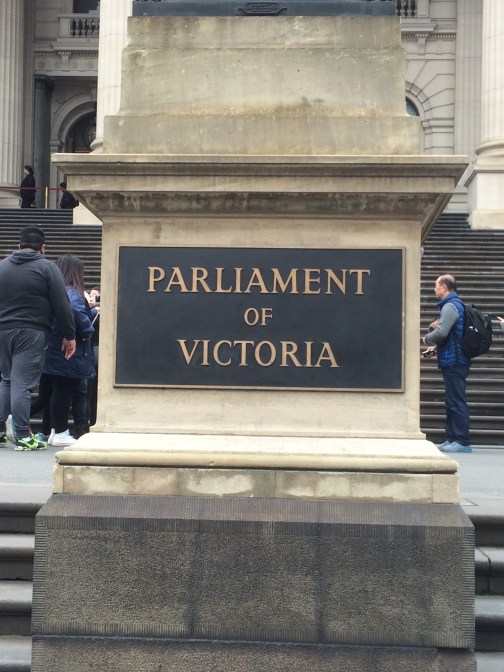
This conversation has a renewed relevance in my home State of Victoria. We are already the world sporting capital and food capital and atheist capital (some say), and we’re now vying to be the most progressive capital in the world. Let’s kill off the unborn up to point of birth and let’s kill the terminally ill, and let’s feed our economy off the backs of the vulnerable through gambling, and let’s beat Scotland to be even more progressive with our school curriculum.

As I said, this Scottish teacher’s honest slip of the tongue has an immediate application in Victoria at the moment. The Victorian Government is renewing its intent to amend the birth certificate laws to enable people to change the gender on their birth certificate in order to match how they wish to be identified.

Birth certificates were once sacrosanct and rightly treated as definitive legal documents. What was once subject to facts surrounding the birth of a child, can now be repeatedly altered according to how individuals wish to reconstruct their sexual identity. Does this undermine the very nature of such documents?

I want a pause for a moment and recognise that gender dysphoria is real but rare.  am not without personal knowledge of Victorians who are genuinely struggling and suffering due to gender confusion, and they seek resolution and acceptance (which does not always mean being identified in ways contrary to their biological sex). I want to affirm their dignity and humanity and pray that they would come to know the God who loves and gives us the greatest and most fulfilling identity, of being in Christ and knowing him. 

My intent is not to cause people greater consternation, but to alert the fact that Labor’s proposal is no solution at all.

Here’s are a few questions that require attention:

  1. Children can apply to alter their birth certificate, but doing so with the approval of their parents and with a supporting statement from either a medical practitioner or psychologist. One question that needs to asked, however, is what will happen when a child wishes to change their gender on the birth certificate and the parents believe that such action is not in the best interest of their child? Are we to expect a similar situation to what now takes place in Victorian schools where children can be given resources to transition without parental consent and knowledge?
  2. Will the new legislation, like its predecessor in 2016, allow persons to change their birth certificate every 12 months, or is only one change permitted? As the medical and scientific fraternity attest, the major of people dealing with gender dysphoria will grow out of it by adulthood, identifying comfortably with their biological sex. What will happen in these cases?

On another occasion, I’ve quoted from this article in The Atlantic and it is worth repeating here (it should be noted that it’s not a conservative publication). The author warns against moving quickly to intervene in cases of gender dysphoria. Keep in mind, in this instance the Victorian Government is not proposing psychological or medical intervention (which already happens) but a legal declaration.   This is more than recognising that a person feels like they are a certain gender, this is the State announcing that a person is their chosen gender.

“the World Professional Association for Transgender Health…states that while some teenagers should go on hormones, that decision should be made with deliberation: “Before any physical interventions are considered for adolescents, extensive exploration of psychological, family, and social issues should be undertaken.” The American Psychological Association’s guidelines sound a similar note, explaining the benefits of hormones but also noting that “adolescents can become intensely focused on their immediate desires.” It goes on: “This intense focus on immediate needs may create challenges in assuring that adolescents are cognitively and emotionally able to make life-altering decisions…But some clinicians are moving toward a faster process. And other resources, including those produced by major LGBTQ organizations, place the emphasis on acceptance rather than inquiry. The Human Rights Campaign’s “Transgender Children & Youth: Understanding the Basics” web page, for example, encourages parents to seek the guidance of a gender specialist. It also asserts that “being transgender is not a phase, and trying to dismiss it as such can be harmful during a time when your child most needs support and validation.”

“Ignoring the diversity of these experiences and focusing only on those who were effectively “born in the wrong body” could cause harm. That is the argument of a small but vocal group of men and women who have transitioned, only to return to their assigned sex.”

We have entered a very new and strange space where what is true is no longer true, and what is good is considered bad for society, and where people crying for help are told there is nothing wrong. I also suspect biology teachers may soon be out of work, or at best they’ll be transitioned into the humanity’s department.

Our culture has tried to kill off God and now we’re displacing science. One thing is clear, the path forward is not befitting of the word, progressive. I heard it once, and I’ve been trying to say it regularly ever since a day is coming when a generation of disillusioned and damaged Victorians are going to need safe places for healing and love. Governments may play the game of identity politics and flaunt the neo-marxist ideas that are pulling strings out of the universities, but there is a better way. We can affirm a fellow human being and acknowledge their struggles and needs without approving of every self-belief. Perhaps the Labor Bill will pass on this occasion and join the growing line of regressive ideological positions that have been enshrined inside Parliament over recent years. Perhaps common sense will win the day. Whatever the outcome, I trust our Churches will have doors wide open to welcome, love, and care for those who come inside looking for hope and resolution. 

While being careful to avoid misapplying texts of Scripture, I’m noting at the back of my mind that this Sunday we are preaching on 2 Corinthians 5:1-10. It is not a passage about gender dysphoria but it does hint at dysphoria more broadly speaking. The verses recognise that there is a groaning and discontentment in the human condition and a longing for permanency and settling into what is good and right.

“While we are in this tent, we groan and are burdened, because we do not wish to be unclothed but to be clothed instead with our heavenly dwelling, so that what is mortal may be swallowed up by life.”


Campbell Football Glory

My daughter has made her school’s soccer team and is playing in a tournament today. Hurray, the Campbell traditions continue.

I decided that I would share the history of my soccer prowess with her, to spur her on to greatness on the pitch today.  I’ve played the world game across the world, even as far away as England, and dribbling my skills before Englishmen, Scots, Irish, Welsh, and players from across Europe. My football history (we true appreciators of the game should never refer to it as soccer, so very American!) belongs to the annals of the game.

During my first match in England, I started on the bench. This is understandable for I was new to the team and they had only seen glimpses of what I was capable of during training. I finally got my chance. I ran onto the pitch, ran up and down tirelessly, and up and down once more, and touched the ball off the boot with a deftness that few can imagine.

Cornhill.JPG

Cornhill Football Team 2000

We’ve all seen how difficult it is for sportsmen to transition from one code of football to another. The Rugby into AFL experiment proved to be an enormous and undeniable success: it can’t be done! At training one Tuesday evening, I forgot that I was playing the ballet of football, for anytime I was within metres of another play I was meant to fall down, contort my face, and let out a cry. Instead, I knocked the team Captain to the ground and awarded him concussion for the night.

It’s one thing to lapse into old habits during training, but AFL is in the blood of Melbournians. One game, one infamous game between Cornhill and Oak Hill, instincts took over when I rushed forward to stop the Oak Hill midfield who were fast nearing their goals. One Marcus Nodder (if my memory is right) was dribbling just inside the box when from behind I launched my body into his and tackled him successfully to ground. But being soccer, instead of me being awarded a free kick, the whistle blew for a penalty and the soon scored.

My stint as a defender was short lived. I volunteered to kick the ball in instead of our goalkeeper. It left the foot awkwardly but found a player with precision…from the opposing team who then quickly steamed forward and kicked a goal.

By the end of the game, few of our team were standing. Rolling on the pitch in uncontrollable laughter and bursts of hysteria, Oak Hill tried to take the advantage but you see our team had two secret weapons, and none of them was the young lad from Melbourne Australia. We won. I won.

A year later, now being assigned to Sydney, where all the former greats end their careers, I found myself once again putting on the footballs. I was playing for Moore College (yay…boo…and yay some moore), and we were entering the annual grudge match against Morling College. During an intensely fought game for ecclesiastical superiority, the moment arose and I found the ball at my feet. With a swift motion and without thought, I curled the ball into the net and SCORED!!! One team was overjoyed, the other not: 1-0 to Morling. From that day forward I was treated with suspicion at Moore College and was called to undertake special education classes. The situation became so perilous that the Archbishop visited my year and warned us against the perils of Baptists. Let the reader understand, Morling is Baptist and Moore is Anglican. As a Baptist, I was naturally conflicted, torn, rent asunder.

By the time I finished sharing these exploits with my daughter she had long left the room with her eyes still rolling and wondering if I truly understood the definition of prowess.

Is Big Brother listening to your sermons?

Ok, I’m reading George Orwell’s 1984 at the moment, as it seems many people are doing! Leaving aside the somewhat hyperbolic imagery, there are important observations to be made regarding the interactions between Churches and the public space.

Would you like the media to enter your home and report to the world what was spoken? Would you appreciate a journalist attending a local club meeting and sharing the juicy bits on social media? Are you ok for a reported to look around your Facebook page and to publish content on a newspaper?

This week Israel Folau has provided our media with a new installment of gossip, slander, and innuendo. He was preaching on Sunday at his church in Western Sydney and the sermon was uploaded to the church’s Facebook page. It’s not as though a journalist took the time to visit the church and to hear everything that was said and done that morning and to observe all of Izzy’s words and interactions that morning. Rather, they listened to the sermon (and quite possible only parts of it), and with the nuance of a tank the headlines in our newspapers were,

“Folau launches fresh attack on gay and transgender people”

“Israel Folau intensifies stance on homosexuals”

“Israel Folau launches new LGBT attacks in church sermon”

“Israel Folau launches fresh homophobic attacks in church sermon”

Rugby Australia, Qantas, and much of the media have already succeeded in their quest to have Folau sacked and publicly disgraced for comments he made earlier in the year on social media. It appears as though the wolves are still hungry for more.

folau

This isn’t the first time that journalists have taken the courageous step to digging up church sermons in order to publicly tar and feather Christians. Back in 2016, there was a media campaign to have churches banned from renting public buildings in schools on the Central Coast, NSW. These churches were accused of homophobia and inciting hatred against gays and lesbians. Of course, this wasn’t the case, but telling the whole truth doesn’t always fit the narrative that click-bait journalism is seeking to portray.

There is today a growing antagonism toward Christianity, at least much of the media and among the back slapping cultural dominants in Australia. We are to be suspicious of Christianity. Engaging with the Christian message on its own terms isn’t required anymore, but ignorance necessitates a flurry of rhetorical bashing against those who believe Jesus is Lord. Of course, recent scandals and sins among some Christian organisations have understandably dented public trust. It would be unhelpful to judge those who judge churches for the terrible things down by supposed ‘men of God’. Nonetheless, the Folau controversy has nothing to do with these issues.

There are States around the world where officials are sent to visit local churches, to check on what is being taught and said. Thank God that’s not happening here in Australia. Instead, we use the media and public opinion to manipulate and to scare.

The media’s trolling of Israel Folau’s church raises questions about the dynamics and interactions between Churches and outside entities. Consider these other recent inquisitions:

  • In Victoria, Religious Instruction classes have been driven out of public schools.
  • The attempt has been made (and temporarily thwarted) to install the Government as an Ecclesiastical figure to oversee Christian schools, with the purpose of influencing doctrine and determining what is and isn’t ‘inherent belief’.
  • Sporting codes (and allegedly major corporations who sponsor them) are pressured into preaching the new moral orthodoxy and to provide special education classes to players who are found to hold a heterodox sexual ethic.
  • Universities are cracking down on faculty and students who articulate theological views that are not in keeping with the slippery and ever-changing moral environment of these institutions.

Of course, the situation differs from State to State, and from school to school, and from club to club. Many Aussies are reasonable and fair and think that the ‘God’ police are ridiculous and overreaching their authority.  The situation before us is one where secularists are attempting to take religion out of the public area and they are also beginning to step into the religious and to make pronouncements about that space also. This is somewhat concerning.

With the restoration of the monarchy in 1660, the freedom to preach was taken away in England. Preachers and pastors who didn’t comply with the State’s oversight of religious affairs were imprisoned and congregations shut down. We may look back to that era and think how ridiculous and unnecessary it was. Of course, we don’t want Government intruding upon traditional religious beliefs and practices. Don’t we believe in a separation of Church and State? This distinction never meant that there is no overlap between religion and State, for that is an impossible and undesirable position to hold. To make the public square and the political arena void of religious ideas is to attempt the status quo of China. As China exemplifies, it is an impossible task because it necessitates the Government to introduce policies about religion and to intrude into the religious space as well.

I am not suggesting that journalists, skeptics, and the irreligious shouldn’t visit a local church or listen to their sermons online. This blog regularly has journalists, social commentators and politicians reading it. Hey, I’d love them to also listen to our sermons at Mentone Baptist Church, so long as they quote words in their real context! Better still, come and visit us on Sundays. But there is also an element of hypocrisy in the interest surrounding Folau’s sermon at his local church. At a time where the secular world is wanting to squeeze religion out of the public sphere, the same people are peering into the religious arena and wanting to interfere that in that space.

This is not all bad. It’s a good opportunity for churches to ask some important questions. Why do churches post sermons and messages on websites and social media.? Is it for public consumption and education? Is the aim to provide a service to church members who couldn’t be present for that Sunday? Who the intended audience is and who else may end up listening?

If a church isn’t prepared for ‘outsiders’ to listen and to critique, my advice is, don’t publish your sermons online. Do we however really want to create a culture in Australia whereby churches no longer feel free to publish sermons online or are pressured into leaving out bits of the Bible because of who might hear and report on it in a skewed fashion? At the same time, there is a positive lesson and opportunity here. Preachers ought to take care of what we say and how we speak these words. This is no reason for watering down the good news of Jesus Christ but it is a great incentive for us to teach with clarity and compassion, faithfully and thoughtfully.

John Bunyan lived at the time of the restoration and was imprisoned for his preaching and for organising a church gathering that wasn’t sanctioned by the Government. His initial term of imprisonment was extended from 3 months to 12 years because he refused to cease preaching upon release from jail.  He famously said,

“What God says is best, is best, though all the men in the world are against it.”

This isn’t an argument for blunt and insensitive preaching. Bunyan wasn’t suggesting that we teach the Bible without appreciating its nuances or ignoring the real lives of the real people who are listening. The conviction was that truth and goodness is not defined by a poll or by the academia or even by the Government, but by God himself as revealed in his written word about his Son Jesus Christ. It is a word that challenges our moral preferences and even our deepest heartfelt intentions, not to crucify us but to redeem us and to fill us with a life of immeasurable joy.

At the end of the day, what we are discovering is that Aussie society doesn’t know what to think of Christianity. And I suspect many Christians are also unclear and they are unsure about how to go about relating to the broader culture: to love, be kind, and to relay a message that many find unfit for human consumption.

Media Freedom and Religious Freedom

According to the last few weeks of media reporting, George Orwell’s 1984 has come to roost in Australia. A headline in yesterday’s The Age announced that “This country’s treatment of whistleblowers has strong echoes of Orwell”. While acknowledging Orwell’s novel is set suspiciously in Oceania and that ‘Big Brother’ was headquartered on the Gold Coast, I reckon that the population of Hong Kong have a better understanding of the Orwellian State than we Aussies.

I am thankful for the fact that we live in a country where the press has the freedom to report issues. They don’t need to hide under a blanket and with a pseudonym, uploading stories to those who are brave enough to click on them This is not the case in every nation, and it’s a blessing that we shouldn’t take for granted.

UNADJUSTEDNONRAW_thumb_78.jpg

Journalists perform a vital task in modern societies: to investigate and to inform people of news stories. Media is a key source for attaining information regarding all manner of news items, and so it is essential that they have freedom from Governmental control and influence (and indeed, freedom from the control of big business and influential identities). I’m suspect that self-interest sometimes serves as a journalist’s catalyst which can encourage boundaries to be pushed or even crossed,  whether it is fame, extra clicks and likes, or corporate profit. I’m also sure that many work with personal convictions and integrity and are seeking to do good for the public interest. 

There was been a strong and immediate reaction to two raids made by Federal Police over the last couples of weeks, one in a journalist’s home and the second at the ABC’s Sydney office. Authorities enacting newly introduced laws that are aimed at protecting information sensitive to national security. 

In today’s The Australian, Labor Senator, Kristina Keneally said,

“When freedom of the press — a basic tenet of our democracy — is seen to be under attack, the government must speak up.”

While not all journalists are concerned by this ‘news’, across the media’s ideological spectrum there has been a fairly unified expression of concern. 

In an interview on ABC radio Melbourne last week, Kerry O’Brien commented

”people have to be really clear about what’s at stake here”.

“If they care about democracy, this does go to the heart of democracy and the democratic process”.

Richard Flanagan’s piece for Guardian goes even further,

“The AFP media raids aim to suppress the truth. Without it we head into the darkness of oppression

If mass surveillance is brought in, how will we know about it? Is national security best served by the inevitable abuses of such a scheme about which we are never told and which would go unpunished? Would national security be enhanced or weakened were Mr Dutton to use such powers for political advantage or to enable political persecution without our knowledge?

And if we cannot know the truth of such fundamental matters, what security as a democracy do we have?”

Professor Peter Greste has offered what appears like a more even-handed analysis, suggesting that, 

“We are not suggesting that those laws be repealed – clearly, we need to update our national security framework to deal with evolving threats – but if in the process of trying to make us safer, we undermine the very system that has made us one of the safest countries on the planet in the first place, something has gone terribly wrong.”

The legislation, if accurately summarised by Damien Cave in the New York Times, does seem needlessly broad and vague.

“The most recent expansion of governmental secrecy came last year with an espionage bill that increased criminal penalties for sharing information deemed classified, even if a document happened to be as harmless as a cafeteria menu, and broadened the definition of national security to include the country’s economic interests.”

It’s a little tricky to work out what all the relevant parties think about the Federal Police raid on the ABC. For example, both the Coalition and Labor last year supported the legislation which gave license to this police investigation. It was also last year that Greens Leader, Richard Di Natale, called for Parliament to introduce legislation to crack down on journalists who were allegedly engaging in “hate speech” (by which he meant, social commentary that he didn’t agree with). Last week, he was whistling a very different tune.

The Age newspaper ran with the headline, “without fear or favour”. It is a perfectly sensible ideal and many journalists aim to live up to this high standard. The benchmark is, of course, an impossible one, for no media corporation is without bias and no reporter is morally or politically neutral. Indeed, as society becomes more polarised, we are seeing a diminishment of this kind of “without favour” reporting, with many journalists spouting popular ideology and replacing evidential and reasoned reporting with sloganeeing, sometimes without the faintest idea of the subject matter that they are talking about. The topic of religious freedom is an all too obvious and rather ironic example of this.

There is more than a touch of incongruity in the middle of this public outcry. Many of the same voices who are today yelling grave concerns for journalistic freedoms have been quite prepared to deny similar freedoms to religious people when it comes to speaking and persuade in the public square. 

Parallels between media freedom and religious freedom

Indeed, I suspect some members of the press would squirm at the realisation that there are striking correlations between the media and religious communicators. 

Firstly, both groups have little protection under Australian law. Professor Peter Greste explains,

“Like a lot of people, I’m really concerned about the last two raids … it imposes an extra level of intimidation and that’s really unhealthy.

“That’s why it demonstrates to us the need for a media freedom act, that acts as a buffer to prevent these kinds of activities.”

Two South Australian Senators, Rex Patrick and Stirling Griff, have announced plans to introduce legislation to amend the Constitution in order to give the press similar protections to those enjoyed by American journalists under their Constitution. 

At the same time, legal experts have also been calling for the Government to give protection to religious organisations, schools, and churches so that they can continue to adhere to their values and to speak, without fear of Government intrusion and without businesses defining appropriate religious belief, as we have witnessed in the recent Israel Folau case. 

Secondly, both groups have a role and responsibility to broadcast and communicate a message. 

It is worth noting that the Biblical language for religious speech is not dissimilar to that of the reporter. To preach means to herald a message. To teach is to inform and to impart information of importance to others. The preacher may analyse social events and cultural trends but foremost they are to present the truth of Jesus Christ without “fear or favour”. In this way, I can empathize with journalists who feel as though the Government is attempting to intimidate and control.

Some of our media have mud in the eye today, or is that a plank? Sadly, I don’t think they’ve spotted it as yet. Freedom for the press, but not freedom for religious speech. Freedom from Government intrusion, unless you’re a religious organisation in which case the Government has every right to interfere. If only some of our most vocal journos practiced what they preached, “without fear or favour”, they might be receiving a little more sympathy today. Despite their lack of concern for the freedom of other Australians to present, speak, and persuade in the public square, other Aussies understand that there is an important principle at stake for both groups. With that in mind, might I suggest the following 5 points.

5 Points for Consideration

As I calculate the actions and reactions in light of the police raids, here are 5 thoughts for consideration:

1. Freedom of the press is paramount for sustaining a liberal democracy. We ought to defend the media’s freedom to pursue and publish stories that are of public interest and importance, without undue external pressures being applied.

2. Journalists shouldn’t work outside the law (I’m not saying that’s the case here with the ABC. The fact is, we don’t yet know). 

3. We should be slow to impute bad motives on our police (and on the Judge(s) who signed the warrants)

4. We should be cautious about making unsubstantiated judgments about Governmental interference. Rumouring and speculating don’t aid the cause of the media, nor that of the public. If we are truly concerned about ‘fake news’, we mustn’t let rhetorical flair escape the evidence at hand

5. If recently instated laws are unnecessarily inhibiting journalists from setting about their work with integrity and thoroughness, it is appropriate for the Government to reevaluate these laws (as well intended as these laws may be).

A Cricket Masterclass in Civility

India not only gave the world a masterclass in cricket last night but also in sportsmanship.

In Australia’s third game of the World Cup that is being played over in England, the Indians batted first and gave the crowd an exhibition of sublime batting, as well as exposing Australia’s lack of depth in our bowling attack.

Late in the innings when Steve Smith moved to field at third man on boundary line, much of the crowd, largely made up with thousands of Indian supporters, began to boo and jeer him. Smith has been booed throughout the tournament so far, whether he is fielding and especially when batting.

Kohli.png

Just over a year ago, Steve Smith was Captain of Australia’s men’s cricket team when he and two other players were embroiled in an incident of ball tampering, which resulted in a 12 month ban from the game. The ban has been served and now Smith and David Warner are back in the Aussie side.

Virat Kohli, India’s captain, was batting at the time when he left the crease and approached the spectators, signalling with his hands and telling them to stop booing Smith, and instead suggest that they clap Smith.

At the press conference after the game, Kohli spoke about the issue,

“So just because there’s so many Indian fans here, I just didn’t want them to set a bad example, to be honest, because he didn’t do anything to be booed in my opinion. He’s just playing cricket.

“He was just standing there, and I felt bad because if I was in a position where something had happened with me and I had apologised, I accepted it and I came back and still I would get booed, I wouldn’t like it, either.

“So I just felt for him, and I told him, I’m sorry on behalf of the crowd because I’ve seen that happen in a few earlier games, as well, and in my opinion that’s not acceptable.”

Kohli has exhibited the kind of leadership that is unusual in this highly charged and partisan age. At a time when the temptation is stop playing the ball and instead throw insults at those with whom we hold disagreement, a little grace and kindness is a powerful alternative. It is amazing how a few drops of perspective can breakdown a wall of irrational and unnecessary antagonism and bullish behavior.  I reckon our political leaders and leading social commentators could take a lesson from last night’s cricket. I suspect that even Christian leaders could do with learning to play few balls like this.

India didn’t lose anything by Kohli’s actions. He batted well and he captained his side to victory. At no risk to India’s performance, Kohli exercised fairness and tolerance, dressing down his own fan base for unsportsmanlike behavior. In doing so, he gained the appreciation of Smith and other Australian players, as well as that of the general public.

It was Jesus who said, “love your enemies and pray for those who persecute you”

Peter would later write, “Show proper respect to everyone, love the family of believers, fear God, honor the emperor.”

The Apostle Paul added,

“clothe yourselves with compassion, kindness, humility, gentleness and patience. Bear with each other and forgive one another if any of you has a grievance against someone. Forgive as the Lord forgave you. And over all these virtues put on love, which binds them all together in perfect unity.”

We don’t lose by exercising these qualities. But in this season of outrage we too often wrongly conclude that the only way to combat opposing ideas is to respond with throwing insults and alleging the worst of motives in others. Kohli last night proved that theory flawed. Of course, the issues being debated and argued on the world stage are of greater significance than a game of cricket, and yet this doesn’t lessen the power of civility and grace. Indeed, such qualities are of even greater necessity and value today.

The President went to Church and the Pastor prayed for him

President Donald Trump went to Church today. After playing a round of golf on Sunday morning, he visited McLean Bible Church in Vienna, Virginia. A spokesman from the White House said that President Trump was there to “visit with the pastor and pray for the victims and community of Virginia Beach.”

David Platt is a Pastor at McLean Bible Church. Platt was formerly the President of the Southern Baptist Convention’s International Mission Board and is a Council member of the Gospel Coalition. McLean Bible Church is a nondenominational church located just outside of Washington DC. The Church describes their aim as, “We glorify God by making disciples and multiplying churches among all nations beginning in greater Washington, DC.”

Screen Shot 2019-06-03 at 10.47.13 am.png

What does a Pastor say when the President of the United States arrives for Church? One could conflate Christian faith with conservative politics and therefore deflate the Gospel and create needless divisions in your church. One could condemn the man and his politics and so initiate another unnecessary division in your church and once again confuse the Gospel. One could use the opportunity to campaign either for or against President Trump.

The Scriptures provide us with examples of how to navigate such scenarios, although I don’t recall a specific example of a national leader visiting a church service. There is Daniel before Nebuchadnezzar, and Paul before Agrippa, Festus, and Felix.  As David Platt made mention in his prayer, 1 Timothy 2 gives us instructions as to how to pray for Governing authorities,

“I urge, then, first of all, that petitions, prayers, intercession and thanksgiving be made for all people— for kings and all those in authority, that we may live peaceful and quiet lives in all godliness and holiness. This is good, and pleases God our Savior, who wants all people to be saved and to come to a knowledge of the truth.”

It is clear from Platt’s prayer that he shares this Pauline view of the world.

I’m not privy to the arrangements made prior to the President’s visit (reporting suggests that it was quite an impromptu visit), but it is worth noting that Mr Trump did not speak or share while on the platform; Church is not a political rally. Mr Trump did not pray or read the Bible, as Church’s sometimes feel obliged when dignitaries visit. Pastor Platt and the Elders of McLean Bible Church respectfully guarded their pulpit and they rightfully acknowledged their nation’s leader with them and prayed for him and for the country.

We need more examples like David Platt.

How would we greet our political representatives, should they turn up to our churches next Sunday?  What would our reaction be should our Prime Minister, Scott Morrison or our Opposition Leader, Anthony Albanese decide to drop by for church? Or if you live in Victoria, what if our Premier Daniel Andrews wished to attend? Placards or prayer? Posturing or Gospel presentation?

In an era where social outrage and political partisanship are on the rise, and where the culture drives people to the poles of icy extremes, David Platt offers us an example worth heeding.

Take 3 minutes to watch the video and listen to the pastor’s prayer for the President.


Since writing earlier today I have received some pushback. For the most part, Christians have expressed gratefulness for the way in which David Platt prayed, but some are suggesting that it’s all about optics rather than the content of the prayer. I don’t know what motivated the President to turn up that morning (I’m not naive enough to think politics wasn’t at play), but I also believe that the God to whom we pray is more wise and powerful and can outwit even the optics created by the President of the United States. The will of God to whom we pray will outdo the intent of any who wish to spin it for their own short-term political ends.


David Platt has since written this letter to his church. I appreciate his love for the Gospel and for his Church https://www.mcleanbible.org/prayer-president?fbclid=IwAR1nxkslWRJlU7kxOquyYYmyQxsjilfOHIp5nCtKKbG5GZwuAjn2vMfvRlI 


Avoiding the St Edward Hospital Syndrome

I was preaching through 2 Corinthians 2:12-17 last Sunday at Mentone Baptist. It is a word of exhortation given by Paul to the Church in Corinth. The imagery doesn’t only denote the big picture purpose of Paul’s ministry, but one for all who are participating in Christ’s redemptive work and who are now being led by and used of God. In other words, this is yet another description of God’s intention for his Church in the world

During my sermon prep, I was reminded of an episode from Yes Minister. I love watching reruns of Yes Minister. This 1980s British comedy combines the best of British humour with a view of political rumbles that is at times eerily close to reality.

yesminister.jpg

A Hospital without doctors and patients

In the episode called, ‘The compassionate society’, Jim Hacker, the Minister for Administrative Affairs, learns about a new hospital that had opened in London, St Edward’s hospital. It is a large 1000 bed hospital that had had been opened for a year. Hundreds of staff had been employed and were working in the facility, but there were no doctors, no nurses, and no patients. Hacker is puzzled by this strange omission and so he questions his advisors. “How can the Government spending millions on pounds on a hospital that has no patients, no doctors or nurses?”

The reasoning is both absurd and logical. Sir Humphrey Appleby explains that hospitals require all manner of staff in order to function; For example, a hospital needs accountants, otherwise who would administer the finances and pay the employees and hospital costs?  Secretaries are necessary to facilitate communication between departments and with outside contractors and Governmental authorities. A hospital also needs maintenance staff and cleaners, and managers to every oversee each department, and so the rationalising continues.

Upon hearing this ridiculous state of affairs, Jim Hacker is beside himself, decrying the obvious missing point, “but there are no patients”.

Indeed, what is the point of having a hospital that doesn’t care for the sick?

The Minister finally decides to visit St Edward Hospital and to assess the situation for himself. He is led on a tour by the hospital’s CEO. She explains to him that St Edward is one of the best run hospitals in the UK and that they were recently nominated for the ‘Florence Nightingale’ award for best hygiene!

As he is shown around a surgical theatre which is filled with all the latest and best medical equipment, Mr Hacker turns to the CEO and asks,

“Doesn’t it disturb you that it’s not being used?”

She replies, “Oh no. prolongs the life of the equipment and cuts down costs.”

A Church without Gospel proclamation

A Church can exist, having people and a budget and running programs, but if we are not preaching the Gospel and calling people to repentance and faith in Jesus Christ, we are like St Edward hospital, void of the purpose for which God has called us. A Church can be busy doing stuff and being content in that, and yet failing to administer the work that God has set us aside to join. It’s not that all the other work is unimportant, but they designed to support and promote the primary work of a Church.

14 But thanks be to God, who always leads us as captives in Christ’s triumphal procession and uses us to spread the aroma of the knowledge of him everywhere.15 For we are to God the pleasing aroma of Christ among those who are being saved and those who are perishing. 16 To the one we are an aroma that brings death; to the other, an aroma that brings life. And who is equal to such a task?17 Unlike so many, we do not peddle the word of God for profit. On the contrary, in Christ we speak before God with sincerity, as those sent from God. (2 Corinthians 2:14-17)

Paul regularly reminds the Churches that he’s writing to that participation in God’s mission is no easy task. Indeed, he exclaims in v.15, “Who is equal to such a task”. He doesn’t however confuse difficulty with ambiguity.

God has given His Church a mission. This mission is clear and yet difficult. It is beautiful and yet sometimes poorly regarded. It is triumphal and yet necessitates costly sacrifice. It is the aroma of life to some and the stench of death to others.

The Christ who now leads a triumphant procession was first led in another procession, one that ended in a cross. God here views his own people as captives, which denotes an expectation of suffering but also of belonging, that Christ’s servants who are to obey his commissioning. As we follow as captives in Christ’s triumphal procession God uses us [the Church] to spread the aroma of the knowledge of him. This spreading is described in vv12-13 as preaching the Gospel of Christ. The true knowledge of God and knowing God comes through the Gospel of Christ who has been raised from the dead. Thus, the proclamation of this good news is the ministry of the church.

A challenge for our churches is that in a season where they are so many challenges and demands and opportunities, we want to avoid the St Edward Hospital syndrome, and the only way to do that is to keep trusting and obeying God to lead us and to use us in his Gospel mission, as he has revealed in his perfect word.


Hell just won’t go away

Once again, Australians are talking about hell. It was only last week that I wrote an article suggesting that the Israel Folau case might set a course for the future. Little did I realise that it would only take a few days before Australia would be hit with another example, and this time it’s one that might influence the outcome of a Federal election.

The week started with a schoolyard journalist believing they’d discovered the great gotcha moment. They asked Prime Minister Scott Morrison, “Do you believe gay people are going to hell?”

Mr Morrison gave a roundabout answer, which sounded like, “I do believe that, but my personal beliefs about hell don’t have anything to do with public policy and governing the country.”

There is some truth in this kind of response. Even a non-response would have been okay—after all, don’t answer a fool according to their folly is proverbial wisdom (Prov 26:4). But of course, as soon as the Prime Minister flustered his answer, everyone from Broome to Ballarat everyone knew that hell had now become an election issue.

Mr Shorten jumped on the Prime Minister’s response saying,

“I cannot believe in this election that there is a discussion even under way that gay people will go to hell,”

“I cannot believe that the Prime Minister has not immediately said that gay people will not go to hell.”

“No, I don’t believe gay people, because they’re gay, will go to hell. I don’t need a law to tell me that. I don’t believe it.”

“I think if you want to be prime minister of Australia you are going to be prime minister for all people. And I just don’t believe it. The nation’s got to stop eating itself in this sort of madness of division and toxicity”.

Finally, Mr Morrison issued a statement saying that he didn’t believe gays would go to hell.

In one sense, it’s not the answers that are the issue here (I’ll qualify this remark later on), but the fact that the question is being asked at all of our political leaders.


1024px-Flag_of_Australia.svg.png

I am fascinated by, and glad to see, Australians discussing eternal matters. These questions are of great significance. They bring God onto the nation’s radar and help us to ask existential questions about what we believe and how we live our lives. I am less encouraged, however, by some of the assertions being made by journalists and politicians alike. As a Christian, while I firmly believe that what we think of heaven and hell matters enormously, these things should not become tests for public office. Indeed, the Australian Constitution S116 offers protection and states that there is to be no religious test for office.

I understand why religious institutions, churches, and organisations would require agreement on the doctrine of hell. For example, how can someone teach the Bible at a theological college if they do not subscribe to the basic doctrinal position of the said institution? It’s not that hell is extraneous and inconsequential to the wider societal discourse, but have we entered the place where outside the church, a person’s theological convictions are to be judged?  Are we to define a person’ suitability for public office based on their personal views about eternal matters? Is the public square to be a place fitted with theological gates to keep out bits of the Bible that don’t applaud current cultural obsessions and attitudes? The answer seems to be, yes.

Once upon a time, if an employer asked you what you thought about hell, it wasn’t in order to find grounds to have you sacked. How quickly has our culture shifted!

I don’t think we should be getting our doctrine of hell from any given political party, and I don’t think we should be voting for or against candidates because of their particular understanding of hell. I can honestly say that as a Christian this issue has never been one of the top 50 questions that I’ve ever thought of asking candidates.

But truly secular society can never be a religion-free zone. That is a fictitious position that can only exist in the theoretical world and is posited by persons who are themselves reacting against set religious thinking (usually Christian theism).  Classic secularism (of which Australia is an example) is designed to provide a civil public life which encourages the discussion of life’s big questions without control by any single ideologue. Secularism, in contrast to the ravings of some, is not meant to establish atheism or soft and bland religion as the official state religion. Secularism is meant to be pluralistic; to make our society an Areopagus where people bring ideas to the table and where people argue and seek to persuade each other. No one is excluded because they are Christian or Jewish or Hindu or atheist.

Unfortunately, many of today’s secularists have shifted the goalposts. They don’t want secularism in the classic sense, they want to pit people against each other. They trade in outrage and scare campaigns—the intention of which are to punish and banish any heresy that doesn’t fit with their dogma. Hence, Rugby is no longer about playing football but is about subscribing to the narrow sexuality agenda being forced by corporate sponsors. University learning is less about the free exchange of ideas and discovery, but about forcing progressive theory into young minds. And now, Christian politicians are apparently required to affirm that they are theological liberals when it comes sexual matters.

My point is this, Christians who think they can hold onto their beliefs in private and keep them tucked away from public gaze, probably need to wake up and think again. While a generation of educators and public narrators told us that religion is a private affair and that our views about God are not welcome out loud, the very same parrots are now demanding that we open our mouths. Of course, they are not interested in listening and engaging with ideas. Far from it, they want us to speak because they are convinced that Christianity, like two atoms hurtling toward each other at extraordinary speed, will implode. Many of our cultural scriptwriters are keen to write out Biblical Christianity from the Australian storyline altogether, either by forcing Christians to admit that they believe the Bible or by denying it publicly.

It is time for Christians to think about what they really believe and why, and to formulate answers to these hot topics, explanations that are grace seasoned with salt. If colleagues at work or fellow students uni are aware that we follow Jesus, are they not already asking us these kinds of questions? Surely it is prudent for us to be thinking biblically, lovingly, clearly, and winsomely. As Peter writes,

“be prepared to give an answer to everyone who asks you to give the reason for the hope that you have. But do this with gentleness and respect.”

I would also suggest that  Christians reopen Augustine and Calvin, as aids to helps us think through the complexities of religion and public life. Jonathan Leeman’s, How the Nations Rage, is a new volume that deserves careful treatment (while written for an American context, there is a wealth of theological insight to gain from this book).

As it happens, I don’t believe anyone goes to hell because of their sexual orientation. I also don’t believe anyone goes to heaven because of their sexual orientation. Will gays go to hell? Will heterosexuals go to hell? The answer to both questions is yes, but not because of sexual orientation but because in a thousand expressions we all dismiss and denude God’s ways. Both self-realisation and self-righteousness are a sure path to hell, because both deny that there is God and that he is altogether good and holy and love. There will be plenty of happily married couples who never enter heaven and many same-sex attracted men and women who are welcomed by God. This isn’t because sex is malleable and or because the Bible’s teaching on marriage isn’t clear and good. Jesus insisted that any sexual activity outside the marriage between a man and a woman is to be considered immoral. And yet we also see his compassion on those who had digressed and lived in ways contrary to God’s design.

Heaven and hell isn’t a left or right issue, it is a human issue. The self-righteousness that is condemned in the Bible isn’t owned by any single political party, but it must not be a characteristic of those who profess to follow Jesus Christ as Lord. Rather, Christians can remind each other that we’ve come to understand the rightness of God who judges; the wonder of God who shows mercy; and that we desire nothing more than to see straight Australians, gay, lesbian and transgender Australians also finding this God who loves.

So to the question that is making headlines across the nation this week, when we are next asked, “do you believe gays will go to hell”, how will you answer?

Planting Churches or Gardens?

“For you have been born again, not of perishable seed, but of imperishable, through the living and enduring word of God” (1 Peter 1:23)

I have noticed there has been a growth in the gardening industry of late. Christians are planting roots into local communities by beginning community gardens and teaching horticultural skills. Churches and Christian organisations are making substantial financial commitments to establishing these beds of vegetation. In fact, no fewer than 3 Pastors have asked me about this phenomenon over the past month.

Such ventures sound like a great idea. They can encourage people to think creatively about sustainable food, they may foster relationships among local people, and impart practical skills. But should we call these activities mission? Should we understand these programs as growing God’s Kingdom?

gardens.JPG

Starting a community garden could well be an expression of Christlike love and may exhibit some of the qualities of God’s Kingdom to our neighbourhood. These activities may articulate an interest in our neighbours and an intent to serve our communities. They may create relationships from which we will share the Gospel and see local churches growing. However, at least in some instances, the soil isn’t producing a harvest for God’s Kingdom because Christians are planting with stones, not seeds. The problem lies when these activities are pursued in the place of evangelism and when we develop these ministries instead of cultivating the local church.

We mustn’t neglect people’s material needs. God’s love for us in Christ Jesus should be displayed in every aspect of our lives, and yet the Bible gives a clear vision of what God’s mission is about and the Bible gives the Church clear mandates for how this mission is to be fulfilled.

There is a substantial theological argument supporting the thesis that mission should be understood as evangelism: speaking, explaining, and proclaiming the Gospel of Jesus Christ. Whether we understand the biblical categories of mission to be speaking exclusively or primarily about evangelism, the imperative to preach Christ crucified, to call for repentance and faith in Christ, and see (new) Christians joining a local church is at the core of God’s purposes in the world.

If Jesus promised, “I will build my church”, why would Christians decline to join in this task, or suggest that it is optional?

If Jesus calls on people to repent and believe the good news, how can we conclude that this is no longer central to our task?

The Great Commission places intentional Gospel telling front and centre,

“Then Jesus came to them and said, “All authority in heaven and on earth has been given to me. 19 Therefore go and make disciples of all nations, baptizing them in the name of the Father and of the Son and of the Holy Spirit, 20 and teaching them to obey everything I have commanded you. And surely I am with you always, to the very end of the age.”

The book of Acts is a record of the Gospel being preached, men and women being saved, and Churches being planted.

As the Apostle Paul explains to the Romans,

“If you declare with your mouth, “Jesus is Lord,” and believe in your heart that God raised him from the dead, you will be saved. 10 For it is with your heart that you believe and are justified, and it is with your mouth that you profess your faith and are saved. 11 As Scripture says, “Anyone who believes in him will never be put to shame.” 12 For there is no difference between Jew and Gentile—the same Lord is Lord of all and richly blesses all who call on him, 13 for, “Everyone who calls on the name of the Lord will be saved.

14 How, then, can they call on the one they have not believed in? And how can they believe in the one of whom they have not heard? And how can they hear without someone preaching to them? 15 And how can anyone preach unless they are sent? As it is written: “How beautiful are the feet of those who bring good news!”” (Romans 10:9-15)

We repeatedly discover that the Church is God’s given means through which he will display his purposes to the world,

“His intent was that now, through the church, the manifold wisdom of God should be made known to the rulers and authorities in the heavenly realms, according to his eternal purpose that he accomplished in Christ Jesus our Lord.” (Eph 3:11-13)

I suspect the shift that we are seeing from evangelism to community work and from church to community results from several factors. For example:

  1. Planting a garden is more socially accepted than planting a church. The former is easier when it comes to gaining council approval, and local funding, and people warm to the idea.
  2.  We look for immediate results. Church planting is a long-term, patient work with no guarantees of immediate fruit whereas a garden bed or community program is tangible.
  3. Poor teaching on ecclesiology has resulted in breeding unhealthy churches and therefore a lack of confidence in churches.
  4. Cultural pressures have diminished our view of God and removed the Bible’s portrait of sinful humanity.  Another problem is how too many Christians no longer believe in sin and in a God who judges nor believe that personal repentance and faith in Jesus Christ is necessary.
  5. Confidence in God’s word has taken a beating through the exegetical and hermeneutical minefields laid down by Christian liberalism, which keep telling us that the Bible can’t surely mean what it says.

I attended a denominational workshop several years ago where the speaker was encouraging attendees to think about mission. It soon became apparent that his shtick was, “mission today depends on finding ‘new and innovative methods’”, and verbal proclamation wasn’t one of them. When I asked a question about evangelism, the response given was, “I guess one might think about that as an option”. In other words, evangelism was not a necessary component for participating in God’s mission. At the very least this demonstrates a deficient theology of the Gospel.

If the biblical pattern is to preach the Gospel and plant Churches, why push these tasks to the periphery and instead focus on gardening or cafes or teaching life skills to kids? Again, I’m not dismissing these activities; I think they can wonderful ways to serve others and to show people God’s love. They may well serve as part of what we do as Christians, but let’s not pretend it is mission, unless we are also using these ministries to create conversations about Christ or as a jumping off point to begin a Christianity Explored course or reading the Bible 1-1.

As Ed Stetzer famously quipped, “feed the poor and if necessary use food!” Of course, he was responding to the famous saying that is falsely attributed to Francis of Assisi, “preach the Gospel, and if necessary use words”.

I suspect mission has joined the growing list of words that are becoming meaningless due to the loose ways Christians have been applying it. A 1000 people might sit in a room and mention mission and everyone will shout, ‘Amen’. The problem is, we’ve either defined mission so broadly as to make the term redundant or because of reluctance to deem any activity as not conforming to God’s mission, we avoid defining it all together.

My contention is this: if we view mission without Gospel proclamation and without a view to building Christ’s Church, we have strayed a long way from the vision God has revealed in his word. Even worse, these ministries cease to be good works and become stumbling blocks to the Gospel.

For the third time, I am not saying that it’s a mistake for Churches or Christians to create ministries in their communities that provide services or helps. I say if it’s a constructive way to love neighbours in your area, go for it. May we not give up on doing good works and loving our neighbours in all manner of ways, but let us not blur our vision of what God’s Kingdom is about by taking our eyes off God’s word and believing what God has spoken about his mission in the world.

In the parable of the sower, the Lord Jesus tells us the secret of the Kingdom,

“The farmer sows the word… Others, like seed sown on good soil, hear the word, accept it, and produce a crop—some thirty, some sixty, some a hundred times what was sown.”

Surely we can trust God to produce a great harvest, even in this age of scepticism in which we find ourselves today. Our role in mission is to obediently plant His seed (the Gospel) and to keep asking the Lord of the harvest to make it grow, for the good and salvation of people and for the glory of Christ.

By all means, plant potatoes, peas, carrots, and pumpkin seeds but please don’t neglect the seed that is the word of God, the only word that gives life to sinners.