A new course exploring Christianity

Making Sense of Christianity is a new course designed to present and explain the message of Christianity.

It’s starting in 6 days time (July 28th, 7:3pm)

The 4 week course examines some of the biggest questions of life:

  1. God and the universe
  2. Humanity, sin, and death
  3. Jesus Christ
  4. Christians and the church

The material is written by a Melbournian (me) and for Melbournians

To register, email Murray at pastor@mentonebaptist.com.au

Make sure you include your name, contact details, name of church (if you attend one), and why you’re interested in doing the course.

Check out the intro video


A Season for Conspiracy Theories: 1 Timothy 4

Conspiracy theories are to truth and life what arsonists are to a hot and dry summer in Australia.

Back in May I wrote a piece about the dangers of conspiracy theories and why it is the duty of Christians to not only avoid them, but also to refute them. At the time I was preaching through Colossians (and we still are!), and we made note of the warnings given by God about entertaining myths. As Colossians highlights, in the church “such things promote controversial speculations rather than advancing God’s work”.

At the time I tweeted what should have been a fairly innocuous statement, “In light of the growing proliferation of nutty conspiracy theories, I’m pleased that we’re currently studying Colossians at Church. Colossians presents a clear repudiation of gnosis. Christians are to be people of reason not speculation, love not fear.”

I was wrong; this was a highly controversial thing to say. 

In particular, I addressed the growing issue of QAnon, which is a political conspiracy theory nest that has recently morphed into a pseudo-christian and cult like religion. In the United States the FBI now consider some QAnon members a domestic terrorist threat. 

You can find the original article here (with links to several important investigative pieces from the Atlantic and the ABC).

Photo by Anna Shvets on Pexels.com

In the last few weeks I’ve had a number of conversations with people in the community who are hearing more of these conspiracy theories. For example, one friend today copied a text message that is being sent to people. The message claims that you have been in contact with someone who has COVID-19 and you must not self isolate. This scam is signed by “COVID-19anon”.

Such messages are foolish, needless, and potentially life threatening.

Other friends are sharing stories of peoples who are convinced that COVID-19 is a hoax orchestrated by the Government. It is interesting to note that those who are thinking this way also tend to believe in other conspiracy theories as well. 

The alternative position to conspiracy theories isn’t to lock your brain away in the freezer and glibly accept everything Governments say as gospel truth. Most of us understand that our political leaders are fallible and that they sometimes massage truth for the sake of political point scoring. There is however a massive gap between grasping political biases and believing in Government led hoaxes. 

Over the weekend, one of the Pastors at Mentone led a group discussion on 1 Timothy ch.4. While unintended, the words couldn’t come at a more pertinent time. 

1 Timothy 4:6 says, “Have nothing to do with godless myths and old wives’ tales; rather, train yourself to be godly”. This chapter of Scripture is helpful for Christians in guarding themselves against conspiracy theories. Here are 7 salient points: 

  1. Paul assumes such ideas will appear and grab hold of peoples imaginations.

2. Paul assumes some of these theories will filter into churches.

3. Paul believes these myths have demonic origins; they are not from God.

4. In verses 3-4 he gives examples, which refer to teachings that deny creational order and good.

“They forbid people to marry and order them to abstain from certain foods, which God created to be received with thanksgiving by those who believe and who know the truth.For everything God created is good, and nothing is to be rejected if it is received with thanksgiving,”

5. Paul tells Timothy that he has a responsibility to publicly repudiate these matters (vv. 6;11).

6. These ‘godless myths’ compete with and contradict the “truths of the faith” upon which Christians ought to be ‘nourished’ and “follow”. 

7. Whereas what is true and good produces godliness and life, these speculations drive a wedge into ones faith in Christ and are destructive in all kinds ways.

In addition (as I pointed out in my previous article on the issue), conspiracy theories often lead to gossiping, slandering, and to divisive behaviour. All such behaviour is sinful and contrary to how Christians are to speak and act. One of the sad ironies is that when someone leaves a church because they believe COVID-19 is a hoax, they are in fact proving Paul’s point in 1 Timothy 4 and Colossians 3. 

The sad reality is, it is very difficult to persuade people who believe conspiracy theories that they are mistaken. Conspiracy theories succeed because they play into pre-existing assumptions, and they justify irrational political and religious beliefs. Conspiracy theories don’t depend on evidence but on capturing those seeds of doubt or inquisitiveness that otherwise may lay dormant in the consciousness. Conspiracy theories can be refuted with reasoned argument and with actual experts but this unlikely to convince the skeptics. 

I understand that people have some warrant for being suspicious of media and of politicians; many (not all) are prone to exaggeration, fear mongering, and sometimes they espouse straight out falsehoods. In treating truth this way, they encourage doubters and feed the skepticism that may have otherwise lay dormant among the population. And yet, throwing babies out with the bathwater is a really dangerous way to live.

Last week Andrew MacDonald (who is the associate director of the Wheaton College Billy Graham Center Institute), made this important statement about Christians and the media, 

“Having acknowledged the failures in journalism, it is critical that Christians resist the temptation to reject mainstream reporting altogether. This is a critical mistake that leads us down the pathway to isolation whereby we invalidate any news article we find unfavorable.

Moreover, there are good journalists in major outlets, even religion journalists who strive to understand and report on evangelicalism in all fairness. At times, this leads them to our failures, but in other cases they want to detail the nuance and complexity within the movement. I might not always agree with them, but I respect their integrity and desire to report honestly.

This all-or-nothing mentality also suggests a poor understanding of Christian engagement. Our goal should be a maturity to engage the new reporting of our time with a critical eye rather than to shout bias upon seeing the outlet logo. We need to read critically across a wide range, accepting hard truths that are well supported rather than if they support our political or cultural narrative. We need to resist our temptations to echo chambers; a temptation that is common to many other subcultures across the globe.”

This crazy year has another 5½ months to go. When there are crucial issues facing society, conspiracy theories are not far behind intruding with their secret knowledge and special insights. Handling the real issues is difficult enough for most of us without having also to put out these needless spot-fires. 

Ed Stetzer is right when he says to Christians, 

“Long story short, you’re ultimately bringing harm to yourself and your community. You may make yourself feel like you’re making a difference when you are not.

Most importantly, we damage our witness and that of your church when you focus on unproven theories and speculation more than the good news we’ve been commanded by our Lord to proclaim.”

Was Jesus Perfect?

CNN’s Don Lemon yesterday interviewed New York State Governor, Andrew Cuomo. During the conversation on racism, statues, and slavery, Mr Lemon came out with this rather bold assertion about Jesus,

“But here’s the thing, Jesus Christ, if you believe — if that’s what you believe in, Jesus Christ, admittedly, was not perfect when he was here on this Earth.”

Mr Lemon was using Jesus as an example of why it’s wrong to ‘deify’ America’s founders. He continued,

“So why are we deifying the fathers of this country, many of whom owned slaves, and in the Constitution – the original one – they didn’t want — they put slavery in there, that slavery should be abolished because it was the way the king wanted.”

In other words, if Jesus wasn’t perfect why should Americans regard their founding fathers so highly? Leaving aside the strained parallel, I’d like to ask Don Lemon this straight forward question, can you show us how Jesus was ‘not perfect when he was here on earth’? Name one thing Jesus ever said or did that was faulty or was sinful?

I am certainly interested to hear how Mr Lemon will substantiate his allegation.

When I define Jesus through my own fallible lens, I might assume that Jesus made mistakes. After all, if Jesus is just like me he must have made a bucket full or errors and transgressions. But here lies the problem. Jesus is simultaneously like us and he is unlike us.

Jesus is like us in that he is fully human. He ate, slept, and went to the toilet, he worked and knew tiredness, he expressed happiness and humour, and he experienced great suffering. He died.

Jesus is unlike us in two important ways.

First of all, Jesus is also fully God. His miracles, words, compassion, and forgiveness served to reveal his identity, power, and purpose as God the Son.

He is described in Colossians as the One who created all things and who has Divine power and authority to uphold the universe, 

The Son is the image of the invisible God, the firstborn over all creation. 16 For in him all things were created: things in heaven and on earth, visible and invisible, whether thrones or powers or rulers or authorities; all things have been created through him and for him. 17 He is before all things, and in him all things hold together.” (Colossians 1:15-17)

Mr Lemon may not believe or accept the biblical testimony, which might explain his bizarre comment. However, all the different strains of evidence, come to the same conclusion:

“We know also that the Son of God has come and has given us understanding, so that we may know him who is true. And we are in him who is true by being in his Son Jesus Christ. He is the true God and eternal life.” (1 John 5:20)

while we wait for the blessed hope—the appearing of the glory of our great God and Savior, Jesus Christ” (Titus 2:13)

Second, as a human Jesus is what we are not, without sin. He is the sinless one who always did what was right and good, and always said what was true and loving, and always acted in purity and affection.

The testimony of Jesus friends and enemies alike is that he never did any wrong. At his trial, the judge announced Jesus to be innocent and yet sentenced him to death in order to appease the mob and the social censures of the day.

The testimony of the Scriptures insist upon Jesus’ moral and spiritual perfection, 

“God made him who had no sin to be sin for us, so that in him we might become the righteousness of God” (2 Corinthians 5:21). 

This faultless living doesn’t suggest he was an artificial person. The book of Hebrews testifies to something far more necessary and extraordinary, 

“In bringing many sons and daughters to glory, it was fitting that God, for whom and through whom everything exists, should make the pioneer of their salvation perfect through what he suffered. 11 Both the one who makes people holy and those who are made holy are of the same family. So Jesus is not ashamed to call them brothers and sisters

14 Since the children have flesh and blood, he too shared in their humanity so that by his death he might break the power of him who holds the power of death—that is, the devil— 15 and free those who all their lives were held in slavery by their fear of death. 16 For surely it is not angels he helps, but Abraham’s descendants. 17 For this reason he had to be made like them, fully human in every way, in order that he might become a merciful and faithful high priest in service to God, and that he might make atonement for the sins of the people. 18 Because he himself suffered when he was tempted, he is able to help those who are being tempted.” (Hebrews 2:10-18)

It is the fact that Jesus experienced the traumas of this world, and was tempted but resisted, that he can empathise with us. Here is a God with understanding. That he remained faithful to his character and purpose also proves Jesus was qualified to serve as Saviour. Jesus not only sympathises but he saves.

Don Lemon did highlight a stark and odious sin that was present among some of America’s Founding Fathers; slavery. The reality is, every human institution is going to have its limitations and frailties, even the very best. Governments, political systems, and every of social entity can do good and serve the betterment of communities, but they are not meant to reign as our saviour. Only one who is perfect can take on that role. Only one demonstrated the necessary qualities, and only one was able and willing to lay down his life on the cross, to take on the sins of the world.

Thank God Jesus was perfect, when he was on the earth. Thank God he remains perfect, the one true and sufficient Saviour that our hurting world needs.

Banning Books in Hong Kong and more

“As a young person, to already have the courage to face the pitiless glare, to overcome the fear of death, and to regain respect for death – this is the task of this young generation. And thus you do well in this midnight hour to commit to the flames the evil spirit of the past. This is a strong, great and symbolic deed – a deed which should document the following for the world to know”.

The above words formed part of a speech which was aimed at calling people to a return to morality and social decency. This address given to university students was of course delivered by Joseph Goebbels directly before one of the most infamous book burning scenes in history.

During the rise of Nazism in the 1930s, purging the population of dissenting ideas was seen as an essential step. The Säuberung or cleansing included destroying religious and political texts that didn’t conform to the new normal. 

The destruction of books is as old as literature. Hate is a strong motivator, as is fear. To be honest, there are plenty of books that I believe are dangerous, and I’m happy to warn people about their messages. There is a vast difference though between informing people about a book’s content and removing those same volume’s from libraries and blowing their ashes into the wind. 

The Age is tonight reporting, 

“Books by prominent Hong Kong pro-democracy figures have become unavailable in the Chinese-ruled city’s public libraries, days after Beijing introduced sweeping national security legislation, according to online records and one activist.”

A search for books by young activist Joshua Wong or pro-democracy politician Tanya Chan on the public libraries website showed the books, including Unfree Speech, co-authored by Wong, either unavailable or under review.

“The national security law … imposes a mainland-style censorship regime upon this international financial city,” Wong tweeted on Saturday, adding his titles “are now prone to book censorship.”

…It is unclear how many books are under review. Two titles by Chinese Nobel Peace Prize-winning political dissident Liu Xiaobo were still available, according to the online”

This isn’t the first attempt by the Chinese Government to eradicate writings that don’t support the State’s unbending ideologies.

In 2018, the Government began work on a new version of the Bible, to ensure that the Bible affirms ‘socialism’ and doesn’t contain ideas that might subvert the Government. One can imagine how distorted the Holy Scriptures will become once this atheistic, militant, and totalitarian, regime has finished their rewriting project. In many regions of China it is already difficult to own and read a Bible, let alone teach this book in a semi-public setting. Preaching ‘Jesus is Lord’ is likely to end in arrest and possible imprisonment.  

without the permission of the authorities, you can’t organize a Bible study. And if you do get permission, you’d better hold it in a Party-approved religious venue, at a Party-approved time, with a Party-approved leader and using the new Party-approved Bible, which contains quotations from Confucius and, of course, Xi Jinping.”

Not even Christians are permitted to change the words of Scripture, let alone a Government who wishes to change and control its message.

“For truly I tell you, until heaven and earth disappear, not the smallest letter, not the least stroke of a pen, will by any means disappear from the Law until everything is accomplished.” (Matthew 5:18)

“All people are like grass, and all their glory is like the flowers of the field; the grass withers and the flowers fall, but the word of the Lord endures forever.”  (1 Peter 1:24-25)

Let’s shine the camera on ourselves. 2020 is the year of cancelling. We might look at China with disgust and growing wariness of their geo-political agenda, but our own background is a growing mound of buried careers, reputations, and lives. We have long lost the will to disagree with other, even with passion. The mob demands destruction of any idea that is not representative of new morality and decency.

Let’s not forget, even the beautiful State of Victoria has faced the Government’s axe. In 2016, Christian programs were removed from State schools in light of many Christian ideas being deemed inappropriate. The same Government has recently reaffirmed its commitment to ban conversion practices (which under their current definition will probably include Christian teachings on sexuality. This includes normal Christian teaching and prayer that takes place in Churches). It would be silly to equate this situation with China, for the two are not the same. The point is simply, our own societies are not entirely blameless.

The Chinese Government is afraid of the Bible, and so are we. Perhaps we ought, for it is no small thing to contest the Sovereign God who made the universe and whose word says he will judge all the living and the dead.

Hong Kong libraries are beginning to experience what is commonplace in China and what religious groups have been forced to do for generations, hide their precious books under the bed because the bookshelf isn’t safe.

No society should take their literature for granted, especially the words that give eternal life.

Put away the matches, because as cancel culture is demonstrating, once it starts, it very easily burns out of control. Perhaps we, who want to preserve the freedom to read and teach our texts, ought to show a little humility toward those who prefer and magnify a different set of books. Let’s argue with words not by deleting them. 


Correction: I originally said ABC when it should have read The Age

No, Jehovah’s Witnesses are not Christian

Jehovah’s Witnesses have come into the media spotlight once again due to their reluctance to sign up to the National Redress Scheme.

The Scheme was introduced as a result of the findings from the Royal Commission into Child Sexual Abuse.  The Royal Commission uncovered many hundreds of cases of child sexual abuse within the Jehovah’s Witnesses and the organisation’s complicity in covering up these cases. With the announcement of the National Redress Scheme, there was wide recognition among Christian Churches of its importance, and most denominations signed up quickly. According to last night’s report on Channel 10s The Project, the Jehovah’s Witnesses “will not join the scheme”.

Screen Shot 2020-06-22 at 10.39.53 am

In the Federal Parliament,  Prime Minister Scott Morrison has said of institutions that are not joining the scheme is that they are “doubling down on the crimes and doubling down on the hurt”.

First of all, it is quite staggering to hear that a religious institution is refusing to join the scheme. I hope this changes before the cut off date of June 30th.

Second, I made the mistake of sending a tweet.  Twitter is designed for tweets and for twits, and I was one last night.

The Project repeatedly referred to Jehovah’s Witnesses as a Church. The word association is unhelpful and confusing because Jehovah’s Witnesses are not a Christian Church. They are a religious group but not a Christian Church, and the distinction matters.

I said, “BTW Jehovah’s Witnesses are not a church. They have nothing to do with Christianity & neither do they describe their communities as a church”.

What I said is accurate. Jehovah’s Witnesses call their communities ‘Kingdom Halls’ not Churches. It’s also true that they have nothing to do with Christianity. Responses came flooding in, correcting my ignorance of Christianity, with people declaring Jehovah’s Witnesses as Christian and as a church. 

Some people insisted upon the Christian credentials of Jehovah’s Witnesses, simply on the grounds that some Jehovah’s Witnesses now call themselves Christian. One person linked to a piece on the BBC as definitive proof that Jehovah’s Witnesses are a Christian Church. Do people even stop to think and realise that the BBC is a media outlet, not an academic institution let alone a school of theology? If I’m wanting medical advice I visit my GP, I don’t ask the BBC. If I’m wanting an expert opinion on Constitutional Law, I don’t google a television station, nor do I treat a quick Wikipedia search as Gospel truth.

As it happens, I am a Pastor of a Christian Church who holds a degree in theology and who writes regularly on theological matters. None of this necessarily makes me an expert (and I’m not an expert in cults), however, I have a fair understanding of what beliefs accord with Christianity and those which do not.

We are living in strange times when a basic point can be demonstrably proven, and yet washed over as an irrelevance. One person suggested that it doesn’t matter if Jehovah’s Witnesses don’t believe in the Trinity, they still qualify as Christian. That’s like saying you can be a vegan and enjoy eating steak every night. Another person admitted that Jehovah’s Witnesses don’t seem to have a high view of Jesus, but because they believe in ‘God’ they still count as Christian. Perhaps the word Christian is a little confusing! Based on this flimsy argument Muslims and Hindus are also Christian!

Twitter has become its very own version of the famed Monty Python Sketch, The Argument Clinic.

Both historically and theologically, Jehovah’s Witnesses is rightly considered a separate religion, which at most is an aberrant form of Christianity. Theologically, they belong to the category referred to in the Bible as ‘false teaching’. Why? Because they reject almost every core belief of the Bible regarding the person of God, the person of Jesus Christ, the resurrection, and the means by which people can be redeemed.

Christianity can be traced back to the person and work of Jesus Christ, some 2,000 years ago. The Bible details, as does Jesus himself, that Christianity is the fulfilment of God’s ancient promises that were written about in the Old Testament. In this way, Christianity is directly linked to Judaism. Christian Churches today base their teachings on these Scriptures and they worship this Jesus as God.

In contrast, Jehovah’s Witnesses came into existence in the late 19th Century, in the Pennsylvanian town of Allegheny. Their founder, Charles Taze Russell, began as a Seventh Day Adventist but he came to disagree with how Adventists were predicting the Second Coming of Christ. He claimed that Jesus had already returned in 1874 and would consummate his reign in 1914. From there, groups formed across America, and eventually internationally. There is something like 70,000 Jehovah’s Witnesses in Australia today. The Jehovah’s Witnesses is an American made religion. Their origins are not even directly connected with a Christian Church, but they jumped off from another American sect/cult.

To my knowledge, no Christian denomination, historically or present, has ever accepted Jehovah’s Witnesses as a legitimate and authentic Christian Church or denomination. Rather, they are rightly defined as a separate religion, if not a cult. In fact, until very recent, Jehovah’s Witnesses have been referred to as a cult, given the stern control the religion’s leaders have on their followers. This authoritarian and bullish control over people is well documented and this point was also noted last night’s segment on The Project.

Jehovah’s Witnesses adhere to almost no basic and essential Christian belief. In almost every area of Christian belief and thought, their views openly contradict the Bible and well established and historic Christian teaching. Their beliefs can no more be aligned with Christianity than calling an egg a type of fruit or, believing cows milk comes from the artichoke.

It’s not as though Jehovah’s Witnesses beliefs are locked away in some hidden vault and can’t be accessed for reading. It only requires a short visit to their own websites to discover how open Jehovah’s Witnesses are about rejecting basic Christian beliefs. In fact, I conclude that the only reason they ever use the term ‘Christian’ is in order to fool the public into thinking they are somehow a legitimate religion and not a cult. It’s like a Collingwood supporter trying to invite themselves into the Carlton coaching box, while wearing a Collingwood jumper, carrying their Collingwood membership card, and singing “Good Old Collingwood Forever”, as a duet with Eddy Maguire (apologies to Collingwood and Carlton fans alike)!


9 Beliefs that are inconsistent with Christianity

Here are 9 facts about Jehovah’s Witnesses that make this religion irreconcilable with Christianity:

1. The Bible used by Jehovah’s Witnesses (‘The New World’ translation) is a corrupted version that changes words and meaning of the Bible to fit with their beliefs. A classic example of this deliberate manipulation of the texts is John 1:1. The New World states that “the word was a god”. The actual text says, ‘the word was God”. The insertion of the indefinite particle completely changes the meaning of the verse, and indeed it changes the identity of Jesus (which is, of course, the intent).

To my knowledge, no reputable Bible scholar in the world accepts the ‘The New World’ translation as a legitimate and faithful rendering of the Bible.

2. They reject the Christian teaching that Jesus Christ is eternally God. Instead, they believe that Jesus is a created being and prior to being on earth Jesus was the archangel, Michael. Jesus is a lesser God to Jehovah, whereas the Bible teaches that Jesus is equally and fully God, as is God the Father and God the Holy Spirit.

3. They reject the Trinity, that there is one God in three persons: the Father, the Son, and the Holy Spirit.  

4. They reject the bodily resurrection of Jesus. Instead, they claim Jesus returned to his pre-existent spiritual state.

5. They don’t believe that the Holy Spirit is the third person of the Trinity. Rather the Holy Spirit is an impersonal force working for Jehovah.

6. Salvation is by good works, not by grace, and you can lose your salvation. Salvation is based upon adherence to religious practice, especially missionary success.

7. They don’t believe that hell is final and eternal. Rather everyone who goes there will come back and hell will be made redundant. Some people, though, are so evil that even hell is too good a place. They end up in a place called Gehenna (which they believe is different to hell).

8. They believe that God’s Kingdom came to earth in 1914 and the Battle of Armageddon has been predicted numerous times…although each date was predictably wrong!

9. Only 144,000 people will be saved (based on a misinterpretation of Revelation ch.7). This has caused consternation for the several million members of the Jehovah’s Witnesses around the world today. To accommodate the overflow of members, while only 144,000 members will be welcomed into heaven, others can now be sent back to earth for what’s being coined, a b-grade eternal reward!

A Challenge for Churches

What struck me last night is the ease in which people are prepared to call an organisation by a certain name, on the basis that they have heard someone else use that word in association with the group. In one sense this shouldn’t surprise because, in today’s Western Culture, self-identification has become the only plumb line for truth. If I identify as such, I am, and no one has the right to question the validity of my self-expression. If I say that I’m a Christian, I am regardless of what I believe or how I live. Such blind acceptance is notably ridiculous, and it’s also dangerous.

What about facts and reasons and looking at evidence? Part of the issue is that the average Aussie doesn’t know what Christians believe and so they are ill equipped to assess what beliefs are and are not Christian. This poses an enormous problem. The general population may hold certain assumptions about Christianity which are often completely disconnected from Christianity, or at best, are vaguely true. It shouldn’t surprise us therefore that we have such frail and diluted understandings of the faith.

This means Christian Churches have a responsibility and opportunity to be clear about what we believe and to provide useful teaching in the public square to aid our neighbours in coming to grips with these good and life changing truths. Instead of preferencing vague and sloppy theology in the name of connecting with people, we ought to be catechising our churches and referencing clarity and conviction in our presentations to the broad community.

What is Mentone Baptist Church doing to combat this community fuzziness toward Christianity? Apart from this blog which aims to present a Christian view of the world, we have almost finished writing a new course exploring the big questions of Christianity. It’s called ‘Making Sense of Christianity’. Anyone interested in joining the 4 week study can register by emailing pastor@mentonebaptist.com.au.

My initial frustration last night has turned to sadness.  It is insane that a religious institution is prepared to double down on the pain of victims to child sexual abuse, and it is terribly sad to once again hear that knowledge of Christianity is so nebulous in our society, that we can’t distinguish basic and logical truth from error.  Christian Churches have a lot of work to do. Are we ready for the task?

——————–

Jehovah’s Witnesses finally signed up to the scheme in March 2021

Making Sense of Christianity

A new course exploring Christianity is coming to Melbourne.

‘Making Sense of Christianity’ is written by a Melbournian and for Melbournians. In each episode, Murray explores some of the big questions of life:

1. God and the universe

2. Humanity, Sin, and death

3. Jesus Christ

4. Christians and the Church

For further details and to register, please email pastor@mentonebaptist.com.au


The Search for Christian Authenticity

I first came across Gregorian Chants when I was 18 years of age. I was studying first year music at university. Straight away I became entranced by the sounds of these monastic choirs. I similarly appreciate the Cantatas of J.S Bach. Although composed 300 years ago, these are beautiful sonnets to God. It is one thing to listen to the Cantatas on my Spotify playlist, but it is quite another experience to sit in a cathedral and hear a choir and orchestra sing in front of you.

At the same time, I wouldn’t want my local church using these musical forms during our Sunday services, for a variety of both theological and pragmatic reasons. For starters, we don’t speak or understand either Latin or German; if we can’t understand the words we shouldn’t sing them.


people sitting on brown wooden chair

Photo by Shvets Anna on Pexels.com

The ABC has published a revealing article this weekend, noting a surge of young adults turning away from contemporary churches and toward more traditional church.

“Gregorian chants, renaissance choral music and incense wafting from a metallic censer.

In an era when Kanye West runs gospel-inspired services, and megachurches, like Hillsong, release chart-topping hits, these ancient Christian traditions are, unexpectedly, having a moment.

And they’re not just resonating with older generations, either.

Younger people are flocking to late-night Latin Mass — at least they were pre-COVID — and embracing Christian orthodoxy in online spaces.

So says Tara Isabella Burton, America-based author of the forthcoming book Strange Rites and a member of the self-proclaimed “Weird Christian” movement.

The allure of Weird Christianity goes beyond an espousal of the Bible. Burton says the otherworldly nature of religious rituals are also appealing to the young and disillusioned.

“There’s a sense of enchantment that often comes with the pageantry,” says Burton, who attends St Ignatius of Antioch in New York City, part of the Episcopalian or Anglo-Catholic tradition.

“It’s that sense that this is a sacred place and not just another thing you do in your week, the same way you might go to a SoulCycle class or you might go out to dinner with friends.”

I have witnessed first hand a few young adults who are thinking this way. They believe older equals authentic, and tradition indicates genuine Christianity. The logic is,  if we can work our way back to the past we somehow become more like the early churches and therefore we are having a genuine Christian experience. The way to be really close to God is to embrace the old. This phenomenon isn’t only about embracing the old, it is about turning off the new. There are millennials seeing through popular Christianity with its accommodation of mainstream culture and its compromise on Christian teachings that don’t suit a consumer audience. 

There is something astute about this revelation. The historian Tom Holland, who isn’t a Christian, has made a similar observation although about English Bishops,

“I see no point in bishops or preachers or Christian evangelists just recycling the kind of stuff you can get from any kind of soft left liberal because everyone is giving that…if they’ve got views on original sin I would be very interested to hear that”.

Like giving Coke away to kids, the caffeine and sugar in some of the trending churches is addictive, but it leaves you hungry and needing to pay a visit to the Dentist. It’s one thing to recognise a weakness in one presentation of church, but jumping from one unhelpful extreme to another is not the answer.

It is a truism that churches focusing on contemporary production can be theologically shallow and even spiritually misleading. At the same time, many traditional churches give similar attention to production quality and can also be doctrinally unorthodox.

Reverend Dries, of Christ Church St Laurence in Sydney, advocates for an ‘older’ style of church. He highlights (perhaps unwittingly) a crucial flaw in what these young people are wanting in a church.

“It’s not theatre, but there’s certainly an element of drama,” he says, pointing to the candles, incense and elaborate liturgical wear that feature in services.

“We sing music here that goes back to the Middle Ages — Gregorian chants — and renaissance choral music, so we rely on young people, who are very involved in those things.”

Reverend Dries believes that Anglo-Catholicism has an “element of mystery about it” that can be missing from everyday life or other religious practices.

“Some of our young people come from a more evangelical tradition, which is sort of word-based and very long sermons or improvised prayers,” he explains.

“I think for some people … there sometimes comes a point where they can’t deal with words anymore, and there’s this genuine desire to enter into silence, mystery, music and ritual.”

One of the issues here is that Christianity is a word based religion. Jesus is the Word made flesh. Jesus reveals God. The written word of God reveals God. God is not found in the silence but in his word. The Bible itself calls on churches to make the ministry of the word central to its life.

devote yourself to the public reading of Scripture, to preaching and to teaching.” ( 1 Timothy 4:13)

“Preach the word; be prepared in season and out of season; correct, rebuke and encourage—with great patience and careful instruction.” (2 Timothy 4:2)

Also, the separation of music from word ministry is a false dichotomy. According to the New Testament, music is a part of the ministry of the word, not separate from it. If you believe a certain musical style connects you to God in a more authentic experience, and the preaching of the word does not, then it’s not Christianity you are holding onto but a form of neo-gnosticism.

“Let the message of Christ dwell among you richly as you teach and admonish one another with all wisdom through psalms, hymns, and songs from the Spirit, singing to God with gratitude in your hearts.” (Colossians 3:16)

As I read the piece on the ABC and have spoken with several young people wrestling with these issues, the question is, are we looking for a religious experience or are we worshipping God? Are we determining the efficacy of the experience by what appeals to our senses or by what God has spoken in his word?

Of course, no single style of church fits all, but a 19th or 13th century version of doing church is no more Christian than is the church who adopts the latest pop genres. This may sound strange to some readers who belong to evangelical churches but the point needs stating: You can be a truly orthodox Christian without being a member of the orthodox church. You can be a truly catholic Christian without joining Rome. In fact, believing older is closer to the original is a dangerous misnomer. Assuming that tradition equates to a more full version of Christianity can lean toward gnosticism and to a disconnecting from the head (Col 2:19).

And if one is to join one of these historical denominations, which version of older is more authentic? Do we choose Greek Orthodox or Russian Orthodox or Ethiopian Orthodox or Roman Catholic? And among each of these options which type of orthodox or Catholicism will we choose, for there are many and varied branches belonging to each of these tribes?

For hundreds of years churches never sang Gregorian Chants,  the clergy didn’t wear vestments and there were no high altars or gothic structures. Incense and candles were used in Old Testament cultic services but they didn’t feature in the earliest churches, and there is certainly no instruction for their use in the New Testament. What these millennials assume is authentic church is, in fact, a product of the slow development of medieval Christianity.

I am encouraged to hear that there are many young adults recognising a superficiality in some contemporary expressions of Christian Church. They are right to resist the consumer menu that is found in these places that worship ‘trend’. It is, however, a mistake to conclude that older is necessarily better.

There is one exception to this, the old which is The Tradition, the Scriptures.

  • Is the Bible read, taught faithfully, and believed among the Church? Is the whole counsel of God explained?
  • Is prayer to God the Father a regular part of church life?
  • Is the focus on Jesus Christ and glorifying God, or is the attention given to me?
  • Is the object of spiritual experience faith in Christ or does it depend on some extra biblical human tradition, whether that tradition is brand new or a 1000 years old?
  • Are the ordinances (Baptism and the Lord’s Supper) faithfully administered?
  • Does the Church practice believers’ membership and are the members growing in unity, maturity, and love?
  • Are visitors, Christian and unbeliever alike, welcomed and befriended, and encouraged to know the Gospel?

Looking for an authentic experience of God is a worthwhile pursuit. Indeed, is it not the highest and most rewarding of goals? This is however only successful when we encounter the Christ of Scripture, who is the living, reigning, saving, and judging, God over all things.

At Mentone Baptist, we are currently preaching through Paul’s letter to the Colossians. The central idea in this letter is sufficiency and supremacy of Jesus Christ. Paul is at pains to remind the Church that they have believed the real Gospel, but now they need to remain in this Gospel. Why? Paul notes that there are always other ideas and practices that become attractive and popular, but they are not necessarily of God.

So then, just as you received Christ Jesus as Lord, continue to live your lives in him, rooted and built up in him, strengthened in the faith as you were taught, and overflowing with thankfulness.

See to it that no one takes you captive through hollow and deceptive philosophy, which depends on human tradition and the elemental spiritual forces of this world rather than on Christ.” (Colossians 2:6-8)

I am not arguing that all older styled churches adhere to such ‘human traditions’ any more than I’m suggesting all contemporary churches are somehow more faithful. The answer is of course, both and neither! However, Paul’s appeal is incredibly important. We ought to assess what is taught and what is practised according to the measure God has given us, namely the Gospel of Jesus Christ. Too often, when I’ve heard someone say that they want to become Orthodox or Catholic, it’s because they are convinced that those traditions somehow lead to a more full or experientially complete encounter with God. Such think not only insults the people of God who constitute the local church that you’re leaving, but it is also an assault on Christ who is the head of the church. Again, I’m not arguing against all tradition here, but I am repudiating the idea that older means closer proximity to God and to being a real church.

The principles of church that I’ve listed above will find free expression in various cultures and times, and that is part of the curious success of Christianity. This faith can be known and experienced across time and places. There is no single style of church, both the cathedral and the home church can be equal and real expressions of the body of Christ. The megachurch and the small community church can likewise be equal representations of Christ’s church.

My encouragement to churches is, be biblical and keep things simple. We can learn from history without replicating it in the present. We can discard old fashions and do meaningful church while avoiding the unhealthy proclivity toward individual consumerism. One of the wonderful things about Christianity is its cultural adaptability. The one Gospel can be faithfully transmitted across cultures and time. While the Bible is clear about what constitutes a church and while the Bible prescribes which elements are necessary for church, the in-practice reality of these things is not dependent upon a single expression.

I don’t want my church looking like either Hillsong or the Catholic Cathedral. We are not required to reject the past in order to reach the future, and neither am I bound to take on and use every latest whim that captures our culture’s attention. If the church is constantly reaching into God’s word and letting the rule Christ govern us, we will continue in being faithful, knowing the fulness of God, and communicating the Gospel in ways that are understandable and attractive to the community around.

“For the entire fullness of God’s nature dwells bodily  in Christ, 10 and you have been filled by Him, who is the head over every ruler and authority. (Colossians 2:9-10)

JK Rowling, Cancel Culture, and the Gradual Demise of the West

Real life dementors are swooping around JK Rowling and they’re coming for you too.

JK Rowling has found herself caught up in cancel culture. Both JK Rowling and Harry Potter are currently trending on Twitter. There are 100,000s comments and memes expressing outrage. Indeed many of these tweets are themselves outrageous and even abusive. 

What did JK Rowling say to invoke such anger? She dared challenge the culture’s narrative.

“If sex isn’t real, there’s no same-sex attraction. If sex isn’t real, the lived reality of women globally is erased. I know and love trans people, but erasing the concept of sex removes the ability of many to meaningfully discuss their lives. It isn’t hate to speak the truth.”

Let’s be clear, JK Rowling hasn’t said anything controversial. She has simply noted an established fact: a scientific, biological, and sociological fact. Indeed, sex is one of the few self evident truths that has been universally accepted in all human history and across cultures, that is, until the last few years. In today’s Western world, to affirm that women are women and that men are men is to speak heresy. To suggest sex is real is paramount to signing your own incarceration to Azkaban.

lbj101-1113_2018_185535

Our societies have been occupied by other important issues of late, especially the COVID-19 pandemic and now racism. The response to JK Rowling is a reminder however that even a pandemic and racism don’t diminish the fervour of those following the latest chapter in the sexual revolution. Again note, we are talking about half a million comments stemming from a simple statement affirming that women are women. This shows us how nothing is to excuse, distract, or dilute, full and unquestioned adherence to the sexual milieu.

While our attention has been necessarily elsewhere, the Victorian Government is still planning to introduce legislation this year that may well prohibit classical Christian teaching on sex and gender. Also, over the past few days, The Australian has published two important articles exposing the wrongful conflation of autism with gender dysphoria. Girls with autism are being misdiagnosed with gender dysphoria and are undergoing treatment to change their gender.

“Professor Attwood, a psychologist based in Brisbane and author of the guide known globally as the “Asperger’s bible”, said unhurried and thoughtful gender change could be a success but he worried about a crash back into depression if trans status was embraced with impulsive and unrealistic hopes of a fix for autism“Once they’ve changed gender, they still have autism and when (gender) transition doesn’t solve their problems they think, Oh no, that was the only option I had, what’s the point of life?,” he told The Australian.

“One of the characteristics of autism is what we call a one-track mind, and sometimes the issue of gender dysphoria (discomfort with one’s body) and changing gender becomes a special interest with a phenomenal knowledge and determination.”

Not even medicine is immune to popular social theory. Our culture’s inability to affirm basic scientific and social truth exposes a growing distrust of authority and a preference to determine moral goodness by personal inclinations. This has the negative effect of harming children and creating greater social disharmony.

As today’s example with JK Rowling demonstrates, hardline secularists preach a message of tolerance that is soaked in hateful speech. They call for justice and acceptance while demeaning everyone around them and demanding their silence. Secularist sermons are as religious as the most ardent fundamentalist. They are as confident as the Titanic sailing from the shores of England and will prove to be as successful.  Except, in this case, the new moral arbiters are not waiting for the iceberg to hit, they are already busy throwing overboard anyone and everyone who questions the decided course, which is to hit the iceberg. That is the agenda. We are not witnessing the rebirth of Western culture as much as we are signalling its gradual demolition.

The project of relativising truth was all along about breaking down society in order to introduce a new and authoritarian truth. This new order exists without reason and grace and it insists on our total allegiance. Gender theory serves as the flagship for the new orthodoxy. The fact that this theory keeps bending and changing every few months is ignored by the most vocal evangelists. Whatever its latest iteration, unwavering conformity is demanded.

Paul Kelly has offered this insightful analysis of the fracturing of Western culture. He says,

“The progressive mantra is that Western liberalism is immoral with its tolerance of colonialism, invasion, racism, inequality, climate cowardice, sexism and patriarchy. While Australians are pragmatic and responsive to sensible changes in the liberal status quo, progressivism demands a new moral order that unnerves and divides the community. It is about power. It sees every issue in terms of a victim class and an oppressor class. It is more interested in power than solutions. It demands people change their values to fit its moral impositions and it is disgusted by how liberalism has tolerated so many reactionary views…”

“…American writer Yuval Levin argued in his 2016 book, The Fractured Republic, that culture was being re-engineered. It was now what the individual preferred it to be. Once your guiding star becomes your own self-expression then, as Levin says, we “recoil from any demands that we conform to the requirements of some external moral standard — a set of rules that keeps ‘me’ from being ‘the real me’, ‘true to myself’ ”.

Such rules were to be discarded. Indeed, they were to be mocked, with the Christian religion top of the list. Such individual empowerment leads to defiance of moral instructions handed down by church, state or nearly any authority. Those defying the authority are applauded because being “true to yourself” is seen as the ultimate morality.”

Jesus declares that the “truth sets us free”. Yet, we see our society abandoning truth on many fronts; not only Christian truths but also universal knowledge. We see it with our attitudes toward the unborn, we see it when society denigrates other races, and it’s evident in our whitewashing of sex and gender. The situation is made more complex because past generations have not always offered a better discourse. Examples abound of where Western culture has previously suppressed self evident moral truth in the name of other ideologies, but this is no justification for repeating the sin of Adam today.

As Paul Kelly suggests in his article, Western societies like Australia are likely to become more fragmented and tribal. One of the byproducts of this is that as we grow weaker, we become more vulnerable. The sun is slowly setting on the West, less because of emerging powers like Communist China, but because like Rome we have chosen to destroy ourselves. At times we highlight genuine issues and then weaponise them to knock each other out. Agreement is often aloof and kindness even more distant. It is telling that as a society we can no longer agree on what a woman is and what a man is.

That there are individuals who believe they are born in the wrong body cannot be denied. It is also a fact that most children who wrestle with this disjuncture find the issue resolved as they grow into adulthood. That some individuals continue to struggle with their gender identity does not mean we dismiss biological facts, but it does require us to find suitable ways to love and support them. Indeed, while Christian ethics is largely dismissed by today’s cultural elites, it is the Bible belief that all people are made in the image of God that teaches us that all people matter. We do not leave aside those who are crying for help, rather we come alongside them.

The West is in trouble. As a Christian, my primary focus is not on keeping the West. However, to say none of it matters is simply naive. With all its flaws and failures, Western civilisation has given the world liberties and life that have not grown elsewhere. Again, the very notion of human equality and dignity depends on Judeo-Christian teaching.  If the West is to be saved, we need to rediscover the very doctrines upon which it was built, and indeed the very same teachings that are now flourishing in many other parts of the world; name Christianity. This exercise, however, requires humility and even repentance. At the moment, there is little appetite for either.

Racism, Protests, and our faith in Christ: a letter to my church

“Turn from evil and do good;

    seek peace and pursue it” (Psalm 34:14)


Screen Shot 2020-06-05 at 2.41.20 pm

Dear Church,

I have never written an email of this nature to you before. I do so out of love for you all and also love for our neighbours.

I understand that among us there will be different reactions to the events transpiring in America this week, and there will be varied thoughts about how to respond.

As a church, we, of course, hold substantial agreement on account of our union with Christ. We confess Jesus is Lord. He is the One Saviour of the world. Together we affirm all human beings are made in the image of God and all are therefore equal before him and have inherent worth. We affirm that racism is anti-Christian, anti-God, and is destructive to society.

This week we are being reminded of how highly charged and partisan our societies have become. In the name of ‘love’ and ‘truth’ too many people have given up love and truth and instead turned on one another. Sadly, cultural movements often have the effect of dividing rather than uniting. We need to resist those temptations and false binaries, both in the church and as we live in the community.

There is a mass protest being organised in Melbourne city this Saturday, to support ‘Black Lives Matter’.

As your pastor, while recognising our freedom both in Christ and in the State to voice our concerns, I want to draw your attention to the following important points:

  1. In the State of Victoria, there remain strict laws enforcing social distancing and limiting meeting in large numbers, both indoors and outdoors. COVID-19 remains a health issue in our society. Both the Federal and State Governments, and the State Police are urging Victorians not to attend because of the COVID-19 situation
  2. Authorities have issued a warning, informing the public that there are protesters planning to incite violence and disorder.
  3. The organising group behind this particular city protest (Warriors of the Aboriginal Resistance) does not recognise Australia’s legal system and has called for the dismantling of Australia.

I’m not arguing against the principle of public protest, nor am I telling anyone what they should or should not decide. I personally don’t think protests and marches are the best way to argue a point. But I acknowledge that there can be value for this kind of social action. I have friends who have participated in different protests in the United States in recent days, and many who have not and yet they are very much grieved by the events in Minneapolis last week. It is incumbent upon each of us to make decisions that are appropriate and reflect love for neighbour and that don’t dishonour the Lord Jesus in any way. 

To anyone planning to protest this week, know why you protest and understand your aim. If you are joining with others, know why they are protesting and what they are aiming to achieve.

We can stand against racism and not join this particular protest at this time. You might like to post a statement or prayer on social media to express our belief in the dignity of Indigenous Australians or call for greater measures to tackle the terrible numbers of Aboriginal people who have died in custody since 1991. You could post appropriate Bible verses.

When restrictions are lifted then perhaps organise an appropriate event: a prayer vigil, or prayer walk, as I’ve seen Christians doing in the US this week.

I’ve just heard Mike preach on Psalm 34, which was recorded for this Sunday. I encourage you all to listen on Sunday; it is a good and timely word. We want to be focused on God, we want his word to direct our motives and attitudes and thoughts. Even as a church where we agree racism is evil, we may want to respond in different ways. Be gracious to one another when we talk and share. Be prayerful. Find ways to love your neighbour: welcome them into your home, speak a kind word, ask them how are they doing.

We want to avoid the danger of falling into popular narratives from the left and from the right. Instead, our identity and our lives are now defined by the Gospel of Christ; this is what it means to be Christian. Therefore, let our motivations, words, and actions promote this good news. Doing so doesn’t make our voice weaker, it is more powerful and attractive.  It allows us to grieve with those who grieve,  to express anger for those who are trodden on, to forgive, and to know God will do right. 

“The eyes of the Lord are on the righteous,

    and his ears are attentive to their cry;

but the face of the Lord is against those who do evil,

    to blot out their name from the earth”. (Psalm 34:15-16)

Nancy Pelosi repeats President Trump’s mistake with the Bible

“Better a poor but wise youth than an old but foolish king who no longer knows how to heed a warning”. (Ecclesiastes 4:13)

“Do not answer a fool according to his folly, or you yourself will be just like him.” (Proverbs 26:14)


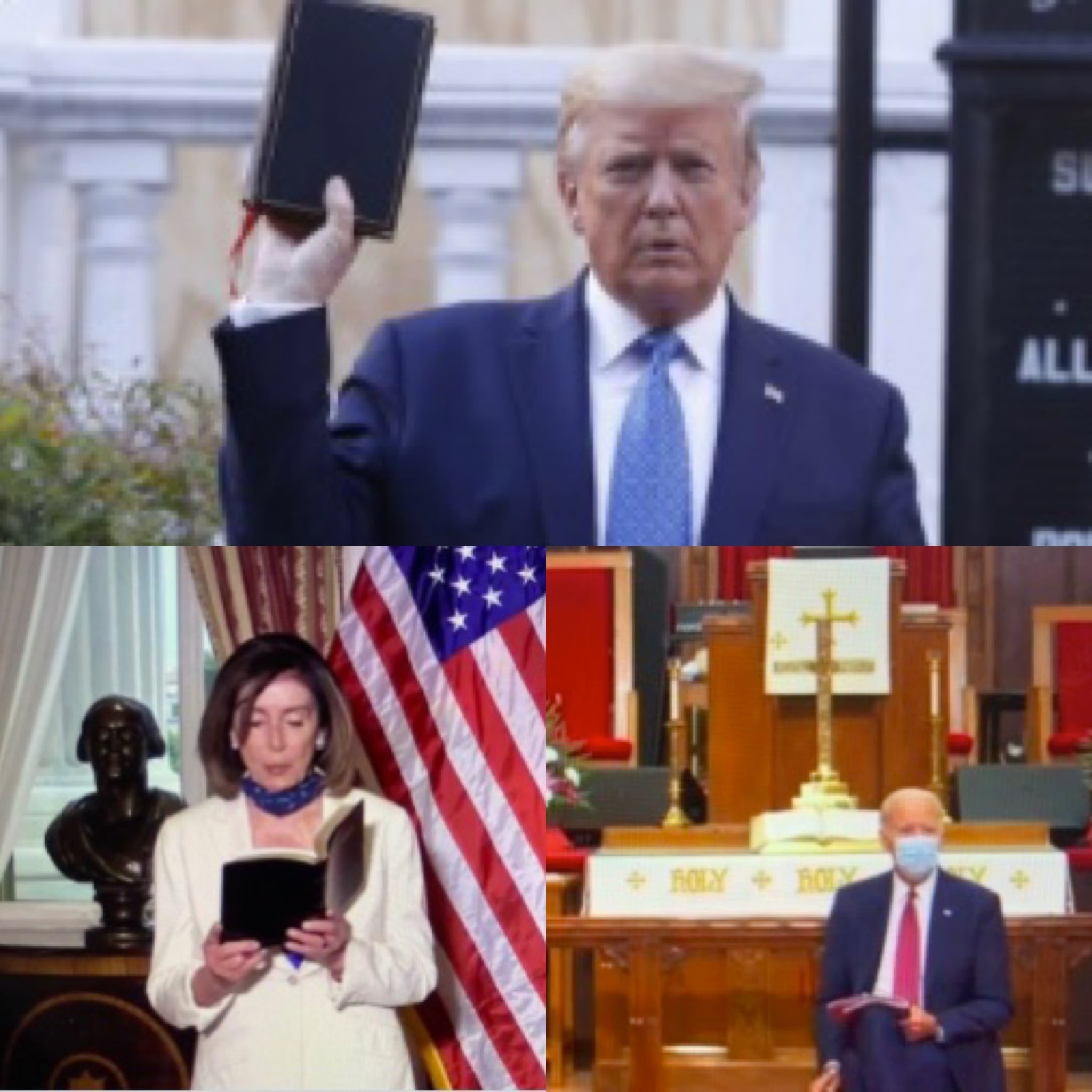
If President Trump acted with hubris and foolishness yesterday by standing in front of a church building and holding a Bible in his right hand, then someone should have told Nancy Pelosi not to repeat the mistake.

Nancy Pelosi is the serving Speaker of the United States House of Representative. She has responded to President Trump’s awful photo op by offering one of her own. During a press conference at the Capitol Building today, Nancy Pelosi held onto a Bible and spoke to the media. She had learned one lesson of what not to do from President Trump, she opened the Bible and read out loud what can be described as a loose paraphrase from Ecclesiastes ch.3

“There’s an appointed time for everything…A time for every event under heaven. … A time to heal, a time to embrace and a time to shun embracing..a time for peace…”

She might have continued and read what follows in that chapter, 

 And I saw something else under the sun:

In the place of judgment—wickedness was there,
in the place of justice—wickedness was there.

 I said to myself,

“God will bring into judgment
both the righteous and the wicked,
for there will be a time for every activity,
a time to judge every deed.”


101587234_10158340522674347_5489073349382373376_o

Nancy ‘the Bible teacher’ Pelosi may have offered at least a conciliatory tone but the grandstanding is nonetheless equally egregious. It was a silly game of oneupmanship, made using the word of God as the instrument of choice.

The fact that she opened the Bible and read a few verses holds her to a higher standard of responsibility. As the Scriptures says,

“Do not merely listen to the word, and so deceive yourselves. Do what it says. Anyone who listens to the word but does not do what it says is like someone who looks at his face in a mirror” (James 1:22-23)

I’m sure this press briefing will be received positively by many. The media hasn’t treated it with the same kind of disdain that has been expressed over President Trump’s efforts yesterday. Let the reader understand, the media isn’t interested in the word of God being rightly handled, and neither are partisan hacks. As followers of the Lord Jesus Christ, we ought to be.

“Do your best to present yourself to God as one approved, a worker who does not need to be ashamed and who correctly handles the word of truth.” (2 Timothy 2:15)

These words are not written for politicians, they are directed to pastors, and they are also applicable to Christians in general. Christians should not be fooled by either photo op. Mocking God is not a wise course of action, and we don’t want to find ourselves excusing or supporting these behaviours.  Pretending to hold Scripture in high regard while openly legislating against its teachings is known in the Bible as ‘hypocrisy’.

As a result of criticising President Trump yesterday, I received some pushback, which is unsurprising in our fractious world. As Christians we must understand that the standard for Christian faith is not allegiance to any given political party, it is the Lordship of Jesus Christ. This is a real danger for Christians living in a polarised and politically partisan society. Of course we all hold political preferences, and I appreciate the real ideological difference between Republicans and Democrats; these things matter,  but they should never supersede our allegiance to Christ.

Criticising the wrongful actions of one political leader does not mean an endorsement of another; that is a logical fallacy. If we cannot hold people in public office to account even when they represent our political party,  and call out their abuse of God’s word, then perhaps we need to ask ourselves what kind of Christianity we are believing.

The footage of President Trump was poor and should not be defended by Christians. There was no calling the nation to open this word and to live by it. There was no humility. Today’s footage of Nancy Pelosi similarly speaks to political expediency.

Caesar is not infallible and neither is Brutus. I would love to see both Pelosi and Trump reading and meditating upon this precious word that truly gives peace, life, and hope to all who receive it. It is truly insane when the very word of life is being held in the hand and yet rejected. I encourage my American brothers and sister in Christ to pray for their leaders, as the Scriptures urge us to.

Let me finish with the words of a pastoral colleague who is serving in a church in Virginia. He summarises the issue well:

“Beware of those who use God’s Name for political gain.

Jesus is neither a Republican or Democrat.

His Kingdom is not of this world.

“God’s name is blasphemed…b/c of you.” Romans 2:24

In the past 24 hours, 3 leading political figures have presented themselves as representing Jesus without giving evidence of knowing Him.

Our church would welcome each as guests & we’d share the Gospel w/ them but I’m grieved when people confuse people about what it means to know Jesus.

To be clear: Christians can vote for candidates who are not Christian. We often will.

But beware of forming your opinion of Jesus based on the lives of those who use Jesus to further their own anti-Jesus ambitions.”