I’ve written about The Change or Suppression (Conversion) Practices Prohibition Act numerous times given the extraordinary nature of this Government intrusion into the lives of religious Victorians. In this post, I want to inform people of one further way these laws will encroach on religious and civil freedoms and commonsense.
The laws will come into effect in February 2022. Churches are supportive of some measures contained in these laws, but the Act goes well beyond what is reasonable or right.
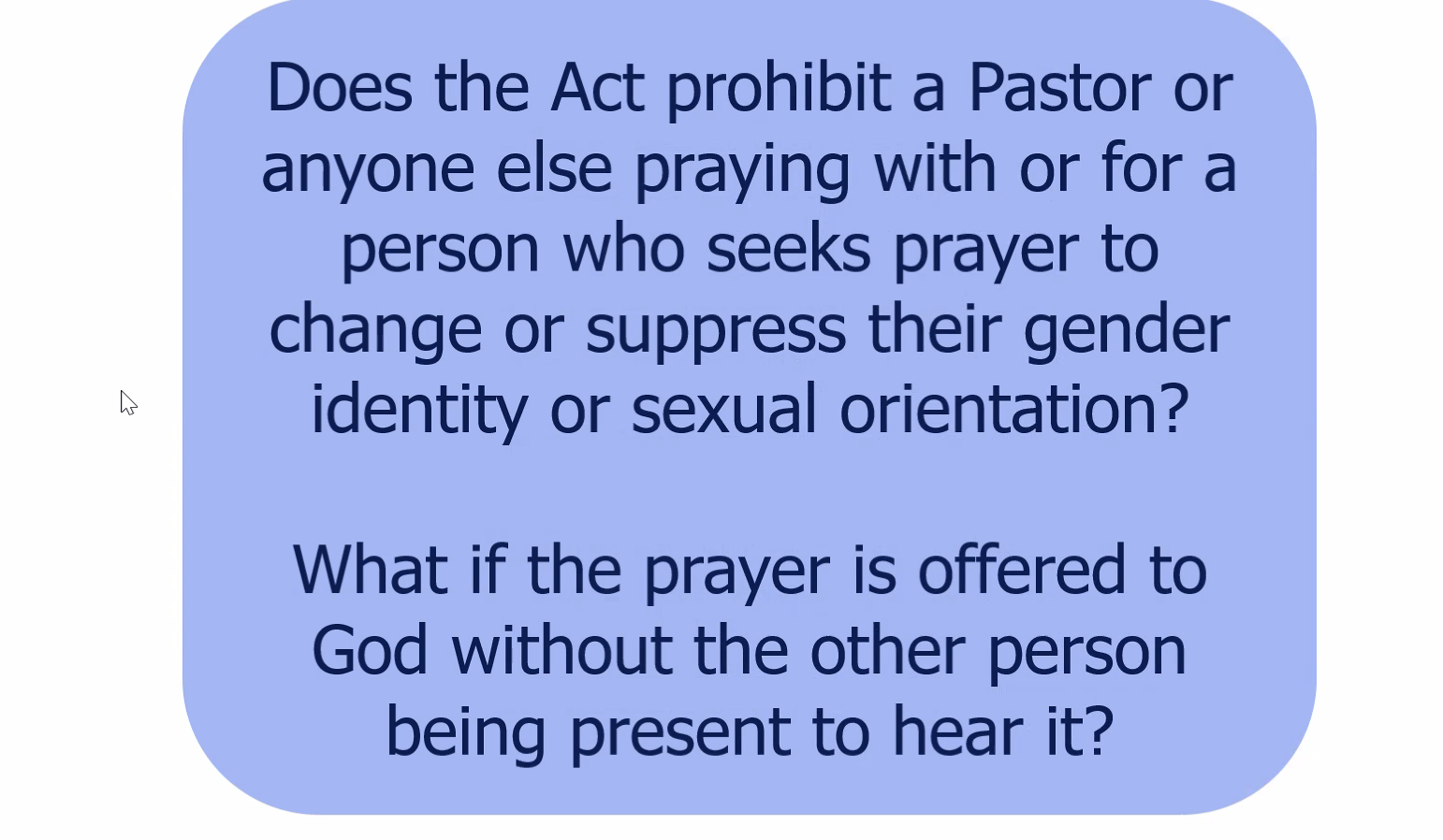
Among the more extraordinary measures found in the Act is banning people from having conversations with individuals about sexuality and gender, and prohibiting praying with them in line with a Christian view of sexuality (even with their express consent).
Slide is from a VEOHRC forum
The new laws may well extend even beyond consensual prayer. In a letter sent to church leaders from my own denomination we read,
“There is some uncertainty about the application of the Act to praying for or with people regarding their sexual orientation or gender identity. The Act specifically includes “a prayer based practice, a deliverance practice or an exorcism” in the unlawful practices, even if the person seeks or consents to such prayer. However, the VEOHRC has advised that it is a “grey area” if the person is not present when they are being prayed for. It may be unlawful if the person is aware of such prayer, in that this would be understood to be directed at them with the intention of change or suppression.”
Private prayers are considered a ‘grey area’ by the VEOHRC (Victoria Equal Opportunity Human Rights Commission). If that doesn’t make your eyes pop out of your head and roll down the hallway, what will?
For example, a believer prays for a friend, it’s just them and God. Or perhaps 2 or 3 friends pray together, as Christians do all the time, and they bring a request to God about another friend for whom they are concerned. This prayer, even if the person never knows about it, is potentially a breaking of the law. And depending on how police treat the crime, it could potentially lead to a term of imprisonment. More likely, the guilty prayers will be investigated by a civil tribunal and have their lives turned upside down and be forced to attend a reeducation camp where they must learn how to pray and believe in line with the religious views acceptable to the government.
Part of the problem with the VEOHRC coming out with what they call a ‘grey area’ is that it likely means a test case. Some poor woman or man will have their life dragged through the mud, legal system and courts, to see if a vexatious complaint can push the limits of the law.
What business is it of the Government to interfere with my prayers to God, or the prayers offered by anyone?
For those who are not already convinced, can we not see the massive overreach and the insanity that a Christian’s personal prayers are treated as a violation of State law?
What is it about prayer that the Government is so concerned about? Are they worried that God might answer prayer? As a Christian, I follow the Bible’s exhortation to regularly pray for our Governments, regardless of who is in power. I pray they might have wisdom and discernment, to act rightly, fairly, and mercifully.
What is it about prayer that is so egregious? The answer is, activists are not content to ban what were a few rare and abhorrent practices. The intention is to delete any belief and practice that does not fully embrace their own worldview.
One group behind the laws explained,
“A similarly insidious development in conservative religious communities is the ‘welcoming but not affirming’ pastoral posture.”
Ro Allen (the VEOHRC Commissioner) said in an interview,
“The proposed law is quite clear in countering any teaching that says that homosexual sex is wrong, so this may well be part of their education”
I thank God that Jesus welcomes us while not affirming every attitude and behaviour I might have. The very crux of Christianity is that God mercifully welcomes those who contravene his good design in many different ways. I will say again, for those who haven’t read before, the Gospel aim isn’t to change a person’s orientation but it is that they might live a godly life (the distinction is important). There are many same sex attracted Christians who uphold and want to live in light of the Bible’s sexual ethic. The very nature of Christianity is that it welcomes and includes everyone who doesn’t belong by nature and choice. That’s good news worth thinking about.
But understanding the very notion of sin and conversion, transgression and forgiveness cuts against what some groups will tolerate in our society. They are not prepared to live in a civil society where a plurality of thought is encouraged or permissible. Banning certain behaviours isn’t sufficient; the aim is to change and control what we believe and even think. Yes, even our prayers.
Orwell’s 1984 has been done to death in recent years. The next latest 1984 analogy is getting rather tiresome and predictable, but sometimes Mr Orwell had a knack of looking into the hearts of men and seeing something disturbing,
The aim of the Party in 1984 was power and they would orchestrate mind games in order to gain control over even the thoughts of the citizens,
“The thought police would get him just the same. He had committed–would have committed, even if he had never set pen to paper–the essential crime that contained all others in itself. Thoughtcrime, they called it. Thoughtcrime was not a thing that could be concealed forever. You might dodge successfully for a while, even for years, but sooner or later they were bound to get you.”
There is one who understands the mind and who hears our prayers, and it is beyond the purview of any Government.
“Search me, God, and know my heart; test me and know my anxious thoughts.” (Psalm 139:23)
“For the word of God is alive and active. Sharper than any double-edged sword, it penetrates even to dividing soul and spirit, joints and marrow; it judges the thoughts and attitudes of the heart.”(Hebrews 4:12)
Let God judge our prayers and our minds. And perhaps with time, reasonable minds will appreciate the misstep taken by the Victorian Government and seek to amend this set of laws.
The idea that God has new things to say and that the Holy Spirit speaks to people outside of Scripture is a common understanding among some religious circles. The ‘Holy Spirit said to me’ has become a popular belief, particularly among Pentecostal and progressive Christians. Stories of the Spirit speaking offer powerful testimonies, albeit ones that cannot be verified. The claim is often used to justify ideas and decisions we want to make. After all, how can we say ‘no’ to an idea if the Spirit has spoken?! This is, however, a misleading and yes, even dangerous notion. This view of the Spirit and God’s speech in fact ignores the Spirit’s own testimony through Scripture. It’s of no wonder that it often leads to all manner of pastoral issues.
When we have a dodgy doctrine of the Bible we shouldn’t be surprised if we take a wrong turn on all kinds of theological and ethical issues.
Before I turn to the Bible I want to clarify a few potential pushbacks.
What I’m not saying
I’m not suggesting that we only listen to Scripture and that other voices are unimportant. It is an act of love and respect that we listen to and understand the culture around us. We value people by appreciating the questions and fears and longings they feel and express. It’s for this reason, that people matter, that it’s vital Christians don’t go around playing God and claiming authoritative words from God.
Let me also preface, I am not pretending that the culture we live in doesn’t influence how we read the Bible. The conversation however is not a dialectical one where we come to the truth by listening to both the Bible and the voices of today. Rather the Holy Spirit sanctifies God‘s people so that we understand and embrace more of what God has spoken. His word will increasingly draw us into conformity with His Son and not with the standards of our cultural moment.
I am not denying the active work of God’s Spirit in the lives of God’s people. The Spirit illumines God’s words so that we may understand, believe, and obey them. The Spirit ministers to our hearts and affects joy, peace, love, and perseverance. The Spirit unites us to Christ and with each other. However, the Spirit does not speak new words or words that contradict Holy Scripture.
The suggestion that God’s Spirit is revealing new truths beyond the Bible cuts against the grain of what we learn about the Spirit’s role in revealing God and his plan of salvation. John 14-17 is one of the Bible’s most important sections for giving us a doctrine of Scripture. In these chapters, Jesus teaches his disciples extensively about the work of the Holy Spirit. Please note the following:
The Holy Spirit is sent from the Father and the Son (14:26; 15:26–27; 16:7).
He is the Spirit of truth (14:17; 15:26-27). Already in John’s Gospel the truth has been defined as Jesus (14:6) and the Father’s words are defined as truth (17:7). As the Spirit of truth his representation of God and God’s purposes are true. He does not lie.
The Holy Spirit has a speaking role. He is, however, not a free agent doing and saying whatever he pleases, but as the One sent from the Father and the Son his mission is tied to theirs (16:13–15). Jesus makes this very clear to his disciples.
The content of the Holy Spirit’s speech is Jesus: ‘the Holy Spirit will teach you everything, and remind you of all that I have said to you’ (14:26); ‘the Spirit of truth…will testify about me’ (15:27).
Most scholars agree that in 14:26 and 16:13–15 Jesus is addressing his apostles, rather than the Church at large. After all, when Jesus says, the ‘Holy Spirit…will remind you of all that I have said to you’, this must be addressed to the apostles who were with Jesus during his earthly ministry.
Thus, Jesus is not saying that the Spirit will teach us new things, he is teaching his apostles that the Holy Spirit will help them remember, understand and apply Jesus’ teachings. In other words, the Holy Spirit is pointing back to Jesus. On three occasions John shows his readers this divine’ remembering in action (2:22; 7:39 12:16).
6. The Spirit’s words to the disciples become what we know as the apostolic message, the New Testament Scriptures. In John 17:6–19 Jesus prays for his disciples, that as men who had been sanctified by the truth, and as Jesus had been sent by the Father, so Jesus sends his disciples into the world. This prayer is immediately followed up by a prayer for all future believers, those ‘who will believe in me through their message’ (17:20). To summarise: God’s revelation comes from the Father and from the Son, it is mediated by the Spirit, to the apostles, about the Son, who in turn are sent into the world. There is no hint that the Holy Spirit will speak words beyond the apostles or in addition to the full revelation of God in Christ.
In my view, this is game, set and match. Jesus’ teaching on the Spirit and Scripture in John 14-17 gives clarity as to the how, what, and why of the Spirit’s teaching.
One of the corollaries accompanying the view that the Spirit speaks new words today is the belief that the Bible isn’t sufficient. But is this the way Jesus and the Apostles describe the Bible? Let’s explore,
Jesus consistently taught that the entire Old Testament (for the New Testament had not yet been written) ought to be considered as the words of God, and accordingly trusted and obeyed.
For example, in the Sermon on the Mount, Jesus establishes his Scriptural hermeneutic, saying,
“Do not think that I have come to abolish the Law or the Prophets; I have not come to abolish them but to fulfil them. For truly I tell you, until heaven and earth disappear, not the smallest letter, not the least stroke of a pen, will by any means disappear from the Law until everything is accomplished.” (Matt 5:17-18)
This statement is important for at least these two reasons: First, Jesus explicates one of the chief purposes of the Old Testament Scriptures. “Law and Prophets” is shorthand for the entire Old Testament (from Genesis to Malachi), and with clarity, he explains their ultimate design, which is to prepare for and point people to himself. Jesus is not dismissing the fact that there is much to learn about God, the world, and ourselves through reading the Old Testament. In its pages, God reveals his character and Being, his justice and mercy, his righteousness and kindness, his power and his gentleness. We uncover human nature, spoken of without our masks and artificial moral colouring: people are presented in all their glory, worth, and depravity. In addition, historians, anthropologists, and linguists gain knowledge about the ancient world through reading this most unique of texts. Jesus, however, announces that the Old Testament is a word of promise, a divine plan that was awaiting fulfilment, and with his coming, the plan was being realised.
Second, not only is all Scripture full of divine purpose, it is also authoritative. Jesus states that every letter and brushstroke is considered true, important and abiding. The smallest letter in the Hebrew alphabet is yod, a tiny inverted comma-like flick of the pen. The least stroke of a pen is more difficult to identify with precision, although scholars have suggested several plausible candidates, including the letter waw, an ornamental stroke known as a “crown”, or even a hendiadys. Jesus’ point is nonetheless clear; not even the tiniest drops of ink on the page will be erased from Scripture but will remain until everything is accomplished.
Those listening to Jesus are left with no doubt that he has the highest regard for all the Scriptures, as the very words of God and words that remain authoritative. These words are to be interpreted in light of Christ but still hold continuing relevance and jurisdiction.
In summary, the Old Testament is true and purposeful, not losing its significance but finding fulfilment in the person and work of Jesus Christ. This is important for all kinds of contemporary issues surrounding racism, sexuality and gender.
Lest one thinks Matthew 5:17-18 is an isolated statement and we don’t need to take it that seriously, following his death and resurrection, Jesus once again explained the gravity of those events to his disciples by opening the Scriptures, again proving the link between the Old Testament promises and himself.
“He said to them, “This is what I told you while I was still with you: Everything must be fulfilled that is written about me in the Law of Moses, the Prophets and the Psalms.”
Then he opened their minds so they could understand the Scriptures. He told them, “This is what is written: The Messiah will suffer and rise from the dead on the third day, and repentance for the forgiveness of sins will be preached in his name to all nations, beginning at Jerusalem. You are witnesses of these things.” (Luke 24:44-48)
Jesus not only connects the Old Testament with himself but also the New Testament. This is unsurprising in many ways, given that the life of Jesus dominates the Gospels of Matthew, Mark, Luke, and John, and the remaining 23 books expound on the living reality and meaning of Jesus’ life, death, and resurrection. Jesus himself possibly never wrote a word with ink and papyri, and yet the authors of the New Testament were not independent biographers and theologians. They wrote not only about but under the direction of the Word become flesh.
Throughout the remainder of the New Testament, it is clear that the Apostles did not veer from Jesus’ view of the Old Testament Scriptures, and their own writings confirm Jesus’ foretelling of the work of the Holy Spirit who would enable them to retell God’s final revelation who is Jesus Christ.
For example, the Apostle Paul insists of Scripture,
“But as for you, continue in what you have learned and have become convinced of, because you know those from whom you learned it, 15 and how from infancy you have known the Holy Scriptures, which are able to make you wise for salvation through faith in Christ Jesus. 16 All Scripture is God-breathed and is useful for teaching, rebuking, correcting and training in righteousness, 17 so that the servant of God may be thoroughly equipped for every good work”. (2 Timothy 3:14-17)
The words of Scripture come from the breath of God. The relationship between God and the Bible is akin to one’s mouth and breath. Every word was expired from the mouth of God, and every word is useful. None is to be erased or excused, but all are useful for life and doctrine.
This Pauline paragraph also points to the way Scripture is authoritative and relevant for future generations of Christians, specifically in this case, Timothy. Words that were then centuries old remain useful to second-generation Christians. In other words, the Scriptures continue to hold their truth, crossing generations and cultures, nations and languages.
Hebrews ch3 provides us with a really clear example of the relationship between Scripture, the Holy Spirit’s voice, and today.
“So, as the Holy Spirit says:
“Today, if you hear his voice,
8 do not harden your hearts as you did in the rebellion, during the time of testing in the wilderness,
9where your ancestors tested and tried me, though for forty years they saw what I did.
10 That is why I was angry with that generation; I said, ‘Their hearts are always going astray, and they have not known my ways.’
11 So I declared on oath in my anger, ‘They shall never enter my rest.’ ”
12 See to it, brothers and sisters, that none of you has a sinful, unbelieving heart that turns away from the living God.”
The author of Hebrews confirms that the Holy Spirit speaks and he chooses a present active verb to suggest the continuing relevance of this speech. And notice the words the Holy Spirit speaks: Psalm 95. And notice the warning of the Spirit’s words which are Psalm 95, don’t harden your hearts to his words.
In his excellent book, ‘Hearing God’s words, Peter Adam, quoting Calvin, says,
“For Calvin, ‘Scripture is the school of the Holy Spirit’. Moses, for example, ‘wrote his five books, not onlyunder the guidance of the Holy Spirit, but as if God himself had suggested them out of his own mouth’. The words of Scripture do not come from the pleasure of men ‘but are dictated by the Holy Spirit’. Amos ‘possessed the discerning of the Holy Spirit’ and Ezekiel ‘only spoke from the mouth of God, as the organ of the ‘Spirit’.
“God not only caused the Scriptures to be written originally, but also sends the Spirit to bring those same words deep into the hearts of believers.” (Adam)
“For by a kind of mutual bond the Lord has joined together the certainty of his Word and of his Spirit so that the perfect religion of the Word may abide in our minds when the Spirit, who causes us to contemplate God’s face, shines.” (Calvin)
Wrongful claims about the Holy Spirit are unnecessary, misleading, and dangerous
The view that the Holy Spirit is speaking new words today cannot be sustained in light of the Spirit given word that is the Bible. What it does do is create a host of problems.
It undermines people‘s confidence in the Bible
It subjectivises the way God speaks.
It collapses revelation into illumination.
It inevitably suggests the Holy Spirit is a contrarian who gives contradictory words to different groups of believers. Which words are true? Which words are we to listen to?
It is often used to justify ethics and decisions that are clearly contrary to what God does say in his word.
God hasn’t given us a dodgy word that needs supplementation or revision. The issue isn’t that we need ‘new’ words from God, but that we often don’t press close to God in his sufficient word: reading, trusting and obeying.
Is God in a habit of having to correct himself? Is God a contradictory God? Are we to believe that the Holy Spirit is communicating new ideas that reject parts of the Bible?
Heterodox ideas throughout history have often come about because people have either added to or subtracted from God‘s Word. It’s the serpent on repeat, did God really say? It’s like building your case for or against vaccines based on the personal opinions of vociferous social media voices rather than medical experts. And sometimes, churches have adopted the letter of the word but lost the heart of what God is saying, and in doing so they cause many to stumble.
If we want to know what God thinks, open the Bible and read it; not plucking verses out of their context but reading it as we ought, in context, understanding genre, recognising that all Scripture is preparing for and fulfilled by and is about Jesus Christ.
A classic example of this arose during Jesus’ ministry. The Pharisees of Jesus’ day had adopted a revisionist view of marriage and one day approached Jesus with the aim of entrapping him by their new understandings. Jesus’ response wasn’t to reinvent human sexuality and the nature of marriage. Instead, Jesus pointed people back to the Scriptures and affirmed God’s purpose in marriage. Not only that, Jesus defined (in accordance with Scripture) that any sexual relations outside marriage between a man and a woman are considered porneia.
The wonder of God’s word is that it doesn’t leave us with pronouncements of judgment for all the ways we reject and break his good word. God’s Gospel word is that he loves to forgive and reconcile. This isn’t because righteousness becomes unimportant or fluid. Rather, the Scriptures show us that the God of absolute goodness and holiness is also the God of extreme mercy. This is where we find true inclusion and acceptance; God is not excusing or endorsing human attitudes and behaviour, but in Christ God forgives and restores us no matter who we are and what we have done. We don’t need to find new words to add to this final one.
Some of this material is taken from an essay and a lecture that I gave some years ago
I admit it. I’m a bit of a fan of Christmas movies. It doesn’t fall as low Hallmark, but put on a classic Christmas show I’ll make the popcorn. As a kid and now with children of my own I love sitting down and watching the snowfall and a Christmas tune and trying to take in the smell of pine and fir trees through the tv screen.
Home Alone, the Grinch, and A Christmas Carol are perennial favourites in our house. Even a Harry Potter Christmas scene is enough to take me in.
At this time of year, everyone is churning out new seasonal Christmas movies. Among the most anticipated Christmas movies for 2021 is ‘A boy called Christmas’. The movie features a lineup of British actors including Maggie Smith, Jim Broadbent and Toby Jones.
I haven’t seen the movie yet, but the trailer certainly caught my attention. First of all, ‘A boy called Christmas’ has all the hallmarks of another half-decent, fun viewing, film for families. It has the right amount of snow and pretty lights and elves and Christmas jargon to draw us into the story being told.
But if the movie is anything like the messaging that’s promoted in the trailer, ‘A boy called Christmas’ deserves an eye roll the size of Hollywood.
Covered with enough sugar dusted on top to make it all sweet, the story projects a couple of myths about Christmas.
Before I dare follow the well-trodden path of the Grinch and criticise anything connected with Christmas, let’s keep in mind that this new version of the origins of Christmas is fantasy and fiction; the producers and writers aren’t pretending otherwise. Nevertheless, ‘A boy called Christmas’, reinforces (as truth) two myths that are perpetually bouncing around our culture today.
First of all, Maggie Smith’s character makes a claim as she tells a group of children the story of Christmas,
“Long ago nobody knew about Christmas. It started with a boy called Nicholas.”
Ummm….no. There was once a man named Nicholas. He lived in the 4th Century AD and served as a Christian Bishop in the city of Myra (located in what is today, Turkey). But Christmas didn’t start with him, nor was it about him. In fact, one can pretty much guarantee that Nicholas would be appalled by any suggestion that he invented Christmas.
The event that we know as Christmas today certainly started with a boy, but his name wasn’t Nicholas; it was Jesus.
It’s worthwhile separating the day on the calendar called Christmas and the original event it is honouring. By Christmas, I’m not referring to the public holiday or to December 25th, but to the event that changed the world and which the world has sought fit to mark with a celebration every year in December. In fact, while Christians have always believed and held onto the birth of Jesus as a crucial step in God’s plan of redemption, no one celebrated a day called Christmas for hundreds of years.
I realise the name kind of gives it away, but in case we’re unsure, Christmas has something to do with Christ. Indeed, it has everything to do with the Christ. Christ of course is the Greek noun for the Hebrew name, Messiah. It’s a title that denotes ruler and anointed King. Christ is God’s promised ruler who will receive a Kingdom that will never end, fade, or perish.
“The woman said, “I know that Messiah” (called Christ) “is coming. When he comes, he will explain everything to us.”
Then Jesus declared, “I, the one speaking to you—I am he.” (John 4:25—26)
“Everyone who believes that Jesus is the Christ is born of God, and everyone who loves the father loves his child as well.” (1 John 5:1)
This first faux pas from ‘A boy called Christmas’ is forgivable, in the same way, Narnia and Dr Seuss aren’t given to us as history or sacred writ, but please make sure our kids realise this is the case. It is this next line from the movie trailer (which presumably features as a motif) that is nothing short of inane. A young Nicholas is given this advice,
‘Things only exist if you really believe in them!’
What a stupid thing to say! Does gravity only work when we believe it exists? Is Mount Everest only real because it has been seen and climbed? Do I cease to exist because most people on the planet have never heard my name or seen my face?
The advice, as insipid as it is, is however true to form. The movie is mimicking the way we are now trained to think and make choices and choose beliefs today. In Western culture, truth is no longer truth. Truth is your truth. Truth is the set of ideas that you preference and want to hold onto for meaning and guidance in life. One of the startling consequences of this is that we now live in a post-science age. For example, biology no longer determines reality, what matters is how you feel inside. Whether the issue is vaccines or climate change or a host of important issues, the scientific task is often considered little more than an instrument used to promote various socio-political agendas.
In a similar fashion, history has succumbed to revisionist keyboards, where events are rewritten and retouched according to a priori commitments to identify politics and other prevalent social preferences.
Here’s my advice, don’t learn theology from Netflix. Don’t use Hollywood as a history book or as a manual for learning about God, or pretty much anything for that matter. I guess this advice is kind of obvious, and many of us not only agree but respond with a rather dull ‘duh’. However, perhaps we underestimate the extent to which movies and tv shows influence the way we think about issues and the way these mediums inform our understanding of history and world events.
Movies are successful, not only because of their entertainment value, but because of the ways they both mirror the culture and change the culture. Hollywood, Netflix and Stan each echo the clarion call from our academic institutions and leading social activists. They are today’s poets and preachers, both teaching and enticing us to adopt new ways of thinking and living. Movies are designed to recalibrate attitudes and even to normalise ideas that are not yet embraced by our neighbours.
The real story of Christmas exceeds Netflix’s best attempts. It is more powerful and stunning and dangerous and wonderful than the best of fantasy writers, except the Biblical story is true.
The birth of Jesus is not a fact of history because I choose to believe. I believe because the events are historical and because they speak of wonders that are too good to ignore.
The Bible (yes, that ancient book which is supposedly unreliable and bad for your health), says some pretty startling things about belief and what is true and the great existential dilemmas.
The Bible authors insist on recording history with accuracy. The Bible writers also provided an explanation for the meaning of these events. Historians do not doubt the birth of Jesus Christ, and historians do not deny that the Bible is the earliest and most reliable source for retelling the circumstances of His birth, and life, death, and resurrection. Of course, some of the details are astonishing, for example, the presence of angels and the virgin birth. But this is the point, amidst seemingly ordinary history, such as the birth of a child, there was something extraordinary taking place.
In 2014 (note: this was said before the pandemic), historian Dr John Dickson went on the front foot to expose the view that real historians doubt the historicity of Jesus’s birth. He said,
controversial enough to get media attention. They have just enough doctors, or doctors in training, among them to establish a kind of “plausible deniability.” But anyone who dips into the thousands of secular monographs and journal articles on the historical Jesus will quickly discover that mythicists are regarded by 99.9% of the scholarly community as complete “outliers,” the fringe of the fringe. And when mainstream scholars attempt to call their bluff, the mythicists, just like the anti-vaccinationists, cry “Conspiracy!”
Christianity isn’t true because we choose to believe. We believe in this Jesus Christ because he is proven true and we trust him with all life because he is demonstrably good and efficacious.
So yes, I’m looking forward to watching ‘A boy called Christmas’, but kids please don’t get your theology from Hollywood. Parents, it’s okay to let your children enjoy these Christmas movies, but take a moment and explain to them that these are fun but untrue stories, and the real story is better than any fiction.
I thank God that the advice given to Nicholas isn’t true. Think about it, what a burden to carry if truth and reality were dependent on my understanding and adherence. I thank God truth doesn’t come from within. Thank God truth doesn’t depend on me believing it to be so.
Christmas didn’t not with some boy named Nicholas, but with God sending his one and only son into the world. He didn’t hide away in a toy factory. He didn’t hand out bicycles, lego, dolls, X-boxes, and puppy dogs wrapped in colourful paper. He laid down his life for us. As the book of Romans testifies about the Christ,
“You see, at just the right time, when we were still powerless, Christ died for the ungodly. Very rarely will anyone die for a righteous person, though for a good person someone might possibly dare to die. But God demonstrates his own love for us in this: While we were still sinners, Christ died for us.”
The incarnation (that is, God the Son becoming human) is inescapable. The imprint of Jesus coming not only remains at Christmas but is all around us today. As we follow this Jesus we gain the greatest gift that no Christmas tree can hold or no toy factory manufacture: Peace with God, the forgiveness of sin, and eternal life.
Check out this short video that explains how we’re returning to church at Mentone Baptist. It may be a little while before we are gathering as one congregation and doing everything that is so important to us, but this is a start.
Whether you’re a Christian or not, you’re very welcome to join us. If you don’t live near Mentone/Cheltenham and would like to find a church to visit, let me know and we’ll try to suggest one for you.
Premier Daniel Andrews’ Pandemic Management Bill, is one hot potato. The Bill is currently being debated in the Victorian Parliament and it is drawing much attention in the media and also among the legal fraternity
The President of the Victorian Bar, Christopher Blanden, QC, says of these new powers,
“Stasi police would have been more than happy with the range of powers if they were given it…It’s extraordinary.”
Such authoritarian tendencies have been the hallmark of this Premiership. I’m not here to speak about this contentious Bill. And please note, what I have to say in this article should not be read as a politically partisan presentation, for that is not my agenda. When a Government accomplishes good, I am thankful, no matter who is in power. Without taking away from any good that this Government has achieved in recent years, it is evident that it is drawn by draconian impulses. No Government in Australia in contemporary history has introduced as many policies targeting religious freedom as has this Victorian Government. I say this as someone who lives in Victoria and is watching religious liberties slowly eroding through a combination of policy and power.
Most recently, in February this year, the Government introduced and adopted the Change or Suppression (Conversion) Practices Prohibition Bill 2020. While Churches agreed with aspects of the Bill, the Government took the unnecessary approach (breaking with jurisdictions around the world) to define conversion practices as broad as possible, such that normal Christian activities are now prohibited. The Act makes it illegal for Christians (and others) to pray with or speak with another person about sexuality and gender with the aim of persuading them according to Christian beliefs. The Government believes that these activities are so heinous that they have attached a prison sentence of up to 10 years for some offences (this law comes into effect February 2022).
While almost all attention this week is on the new powers being given to the Premier through the Pandemic Management Bill, another Bill has been tabled this week and it deserves attention, The Equal Opportunity (Religious Exceptions) Amendment Bill 2021. It will be debated in Parliament in 2 weeks time.
The proposed amendments to the Equal Opportunity Act are directly aimed at further reducing religious freedoms in Victoria,
“Religious organisations and schools will only be able to make employment decisions based on an employee’s religious beliefs where these are inherent to the job. Religious bodies and schools will still be able to practice their faith, teach their beliefs and set the religious ethos within their organisation.”
The Premier’s second statement is denuded by the first. By introducing an inherent requirement test for jobs in religious organisations, the Government is self-determining the nature of religious work and removing from these organisations their freedom to make employment decisions for the benefit of their school, church, or charity.
The Bill not only impacts the ability of religious organisations (and faith-based schools) to employ persons according to their established religious convictions. Attorney-General Jaclyn Symes, explains,
“The Victorian bill would also mean no faith-based organisations could discriminate when delivering government-funded services such as counselling or homelessness support, or hiring out community facilities”.
Should the State dictate to religious organisations what constitutes religious work and what is not? Do we really want the State defining the theological beliefs and requirements of faith-based organisations? Is a gardener or an office administrator not doing specifically Christian work because they are not teaching Scripture? The Government is creating a false dichotomy that does not exist in the Christian faith, nor in many other religions. Every role is an expression of commitment to God and is a valuable part of the whole that serves a common purpose.
The Government is also mistaken in assuming that because a role does not have a direct theological or spiritual teaching component, it is therefore irrelevant whether the employee agrees with the organisation’s ethos, beliefs, and vision. This is purely illogical. Why would any organisation or company employ someone who does not support the basic values and vision of that association?
One month prior to the Bill being tabled in Parliament, the Attorney-General indicated that the new parameters maybe even further expanded,
“We could be convinced to extend it, we just haven’t consulted on that particular element of reform. I certainly wouldn’t have a closed mind to revisiting that down the track”.
A similar comment was made about the Conversion or Suppression Practices Act by the then Attorney-General, Jill Hennessy. Hennessy told Parliament that conduct “such as sermons…may be considered as part of the Legislative Assembly’s ongoing inquiry into anti-vilification protections.”
In other words, as extraordinary as these amendments are, the Government is already indicating that further religious restrictions may be introduced in the future.
In 2016, a similar amendment to the Equal Opportunity Act was narrowly defeated, however, this latest attempt is likely to pass.
Today not only marks the release of this Bill in Victoria’s Parliament, it also coincides with another day from history. On October 28th 312AD, the Roman Emperor Constantine won a famous victory. This pagan ruler attributed his triumph to what had been up until that moment an illegal religion: Christianity. Soon after, Christianity was legalised and the formal oppression of Christians came to an end in the Roman Empire.
Christianity and the State have not always had an easy relationship, whether it was Ancient Rome, Tudor England or China’s Sinicization. In Australia, for more than a century our society achieved a healthy dynamic between Church and State. The Church does not control the State and the State doesn’t dictate religious beliefs and practices. This division doesn’t mean that religious ideas can never influence public policy. After all, politics is never free from worldview, ideology, and theology. Indeed, our appreciation of the secular state has its roots in the teaching of Jesus Christ.
One day when Jesus was confronted by a group of political and religious pundits, he responded with what has become a vital principle for a healthy society,
“Give back to Caesar what is Caesar’s and to God what is God’s.”
Jesus wasn’t arguing for the exclusion of religious ideas from the political sphere and neither was he fusing them together. Similarly, the Australian Constitution doesn’t advocate for secularism without religious ideas and contributions, but rather Government is protected from the control of any single religious organisation.
It is important to realise that the social pluralism we enjoy in Australia is deeply embedded in Judeo-Christian beliefs. Indeed, Australia’s political and social pluralism is one of the byproducts of Christian theism. If, as some hardline secularists want, that we rid our culture of all public vestiges of Judeo-Christianity, we will in fact destroy the underpinnings for a healthy pluralistic society and instead create one that is far more authoritarian and far less tolerant. Do we want to take that road?
It took almost 300 years for Christianity to be no longer deemed dangerous and criminal. In the space of 5 years, basic Christian ideas have been maligned and even made illegal in my State of Victoria. It’s one thing to disagree with Christian teaching, but such Governmental interference is wrong and needless. Without diminishing this overreach, I don’t want to overstate the case either. It’s not as though the future of Christianity depends upon Governmental permission. Far from it! Christianity often grows where the State opposes Churches. The opposition forces Christians to consider who we truly worship, love and follow. When Christians attribute too much to Government, we can weaken the Gospel and lose sight of the centrality of the Church. We are not theocrats! Government intrusion does however make following Jesus Christ more difficult and costly.
At a time where many nations are turning the screw on religious freedoms, from China to Iran and to Russia, why would we want to join this number? The Equal Opportunity (Religious Exceptions) Amendment Bill 2021 achieves less for inclusion and instead gives the State greater control over what religious organisations can do in line with their religion. This legislation contradicts healthy pluralism, and it denies the very foundations upon which our secular society is built.
This article is an update on comments I made about the proposed Equal Opportunity Amendments last month
I’ve been asked by a number of pastors what Mentone‘s plan is for returning to church later this year. Our church elders recently put together a document and they’ve given me permission to share it here, in the hope that it may be of some value to others. I stress, it is important to read the entire document and not remove one statement from the context of others.
We have tried to convey the complexity of issues that lay before churches in Victoria. We are not suggesting that this is the only path forward for churches. We appreciate that churches will land on these issues in slightly different ways. This is Mentone Baptist’s direction and the theological framework that is underpinning our decisions. In light of the fact that the COVID-19 situation is fluid (and as we state in the document), some aspects of the plan may change in the event of new information and updates. We pray that the Lord grants ongoing wisdom and patience to the churches across our State as we navigate this difficult season.
Statement by the Elders of Mentone Baptist Church regarding the return to church and vaccines
We realise that the topic of vaccine mandates and church is a contentious issue, with strongly held opinions in the community and including among Christians. The Elders have sought advice, discussed at length, and prayed over our position. Here is what we think.
We outline 5 principles in this document which together serve to frame the position we are taking in relation to church and vaccines. As you will see, forming a view is not a matter of using one Bible verse or singling out one issue. Rather, there are multiple issues and many theological strands that together help us formulate the conclusions we have arrived at. Also, it is not the case that we prioritise one of these convictions over the others, but that we hold all 5 together.
We appreciate that each church will be required to carefully consider these issues and some may arrive at slightly different conclusions. We are not pretending that the subject is easy and neither are we claiming to have infallible insight. We are nonetheless persuaded that the direction we have settled on is wise and godly. We also understand that if the rules change we may need to reassess the decisions we have made. As men who love the Lord Jesus and uphold the authority of Scripture and are committed to the health and future of Mentone Baptist Church, we commit this plan to you.
1. We believe the in-person gathering of the church is essential
We believe that Church is an essential service, both for the spiritual and social wellbeing of Christians and for the spiritual and social health of society.
People are not disembodied beings. We are physical creatures who require physical presence and social interaction. We are also more than flesh and blood. We are mental and spiritual beings, who depend on more than food and sleep for life. It was Jesus who famously said in the Sermon on the Mount, “Is not life more than food, and the body more than clothes?”
Churches provide one of the few remaining places where people can meet and share the joys and sorrows of life, and where supportive relationships are created. Zoom, Youtube, and social media are a blessing but they are no substitute for real and personal meeting. Indeed, church by definition is the physical gathering of Christians, meeting to worship God and to encourage one another.
The Scriptures exhort believers to meet regularly and not to give up this practice,
“And let us consider how we may spur one another on toward love and good deeds, 25 not giving up meeting together, as some are in the habit of doing, but encouraging one another—and all the more as you see the Day approaching.” (Hebrews 10:24-25).
Without diminishing the Biblical principle of in-person gathering, it is worth pointing out lessons from history. In times of plague and emergency, Churches were adaptable and took reasonable measures for the common good. For example, when the Spanish Flu struck North America in 1918, churches closed for several months. In the 16th Century, while there was little understanding about the way disease spread, Christian leaders including Martin Luther and John Calvin adapted their ministry practices during outbreaks of the plague.
In a letter Martin Luther wrote,
“Others sin on the right hand. They are much too rash and reckless, tempting God and disregarding everything which might counteract death and the plague. They disdain the use of medicines; they do not avoid places and persons infected by the plague, but lightheartedly make sport of it and wish to prove how independent they are. They say that it is God’s punishment; if he wants to protect them he can do so without medicines or our carefulness. This is not trusting God but tempting him. God has created medicines and provided us with intelligence to guard and take good care of the body so that we can live in good health.”
“If in the Old Testament God himself ordered lepers to be banished from the community and compelled to live outside the city to prevent contamination (Leviticus 13–14), we must do the same with this dangerous pestilence so that anyone who becomes infected will stay away from other persons, or allow himself to be taken away and given speedy help with medicine.”
Restraints on freedom to gather for public worship must be reasonable and temporary. We believe that current limitations on church gatherings qualify as reasonable and short term, although we are concerned about the increasing toll this is taking on peoples’ mental, social, and spiritual wellbeing. Subsequently, we accept there is an argument for reevaluating the current restrictions imposed on Melbournians. When we believe the Government is acting unfairly and unreasonably toward Churches, we will ask for correction.
2. We believe we have a duty of care toward others
“Do nothing out of selfish ambition or vain conceit. Rather, in humility value others above yourselves, 4 not looking to your own interests but each of you to the interests of the others.” (Philippians 2:3-4)
“Be careful, however, that the exercise of your rights does not become a stumbling block to the weak.” (1 Corinthians 8:9)
We want church to be safe for everyone and we want everyone to have opportunity to hear the Gospel and for all God’s people to gather as Church. Among these goals are competing tensions and we need wisdom for navigating these.
The Elders accept the broad consensus in the medical community that the COVID-19 vaccines are overwhelmingly safe and effective and we encourage people to be vaccinated. This is a way we can show consideration toward others. While we encourage people to be vaccinated, we also understand that a few cannot for medical reasons and others may express concerns. It is important for us to love those who have come to different conclusions.
We also don’t want to do anything that will discredit the Gospel and unnecessarily cause anyone to think ill of Christ and his Church. At a time where Christianity has lost social credibility through important issues such as abuse, are our actions adorning the Gospel or confusing the Gospel or conflating the Gospel with other worldviews and political agendas? Serving the wellbeing of our community and city is an important way of demonstrating the love of Christ.
3. We believe obeying the Government is a matter of godliness
“Let everyone be subject to the governing authorities, for there is no authority except that which God has established. The authorities that exist have been established by God. 2 Consequently, whoever rebels against the authority is rebelling against what God has instituted, and those who do so will bring judgment on themselves. 3 For rulers hold no terror for those who do right, but for those who do wrong. Do you want to be free from fear of the one in authority? Then do what is right and you will be commended. 4 For the one in authority is God’s servant for your good. But if you do wrong, be afraid, for rulers do not bear the sword for no reason. They are God’s servants, agents of wrath to bring punishment on the wrongdoer. 5 Therefore, it is necessary to submit to the authorities, not only because of possible punishment but also as a matter of conscience.” (Romans 13:1-5)
“Remind the people to be subject to rulers and authorities, to be obedient, to be ready to do whatever is good, 2 to slander no one, to be peaceable and considerate, and always to be gentle toward everyone.” (Titus 3:1-2)
The two exceptions to this principle of obedience are 1. where Government policy directly violates Holy Scripture, and 2. where a Government mandate is manifestly unjust.
4. We believe the conscience has an important although not supreme role in determining what is right and good
We are mindful of the conscience and believe we should tread cautiously before acting against ones conscience. However, the conscience is not infallible. We mustn’t assume that strong feelings equal right feelings. We mustn’t assume that an issue must be primary or essential because people hold strong views or feel strongly about it. As Jonathan Leeman says (Political Church: The Local Assembly as Embassy of Christ’s Rule: 2016),
“Christians no doubt possess a duty to be faithful to their consciences, yet I would argue that they possess a higher duty to be right. After all, consciences in the Bible can be misguided and must be instructed.”
There is a mistaken view of the conscience that has taken hold in some quarters, and that is, the conscience should never be violated and thus whatever I think about public health measures should only be enforceable where I agree with those measures. Jonathan Leeman is once again helpful,
“First, government is very much in the business of binding whole persons, including their consciences. […] God established governments in Genesis 9 precisely because humanity’s consciences had become unbound. A person might be conscientiously convicted that a nation’s immigration laws are unfair, but he or she is still obligated to obey them, even while simultaneously working to change them. His or her conscientious objection is no measure of the law’s legitimacy. An act of disobedience by the Christian can only be justified by demonstrating that the law is not just or right, not simply that one has a conscientious objection to it.”
“Luther’s celebrated parry against usurpatious princes and priests, “To go against conscience is neither right nor safe,” makes for good Protestant sermon fodder, but a theology of authority and submission is a bit more complex. God does in fact authorize various individuals and institutions to place burdens on the conscience. When a parent instructs a child to go to bed, the child should feel conscience bound to obey. So with a prince and subject or an elder and church member in their areas of jurisdiction.”
Professor Patrick Parkinson (Academic Law Dean at the University of Queensland and Chair of Freedom for Faith) explains why the argument from conscience is not always legitimate,
“If I object to taking a vaccine because I am worried about side-effects, or because I am concerned that it is insufficiently tested, I am not objecting on moral or conscientious grounds. I am making a decision based upon my assessment of the risks versus the benefits to myself on medical grounds. We should not fool ourselves into thinking that such a judgment is a religious one. The Bible gives us no guidance whatsoever on the medical efficacy or benefit of a new vaccine. A religious person who has an objection to a vaccine does not have a religious objection by reason only of the fact that he or she happens to be religious.
‘A religious person who has a non-religious objection to vaccination is absolutely entitled to refuse a violation of his or her bodily integrity; but this does not mean that governments and employers are not justified in imposing restrictions to protect others, so long as the restrictions are reasonable.”
In other words, we believe that coercing the conscience is fraught with problems, however not every argument against taking the COVID-19 vaccines can be attributed to the conscience.
5. We believe keeping the unity of the body of Christ is of paramount importance
“Make every effort to keep the unity of the Spirit through the bond of peace.” (Ephesians 4:3)
“I appeal to you, brothers and sisters, in the name of our Lord Jesus Christ, that all of you agree with one another in what you say and that there be no divisions among you, but that you be perfectly united in mind and thought.” (1 Corinthians 1:10)
“My goal is that they may be encouraged in heart and united in love, so that they may have the full riches of complete understanding, in order that they may know the mystery of God, namely, Christ” (Colossians 2:2).
At Mentone Baptist Church we will not divide the church with endless controversies (Titus 3:9-11) and/or over disputable matters. Christians who repeatedly introduce topics to the Christian community which are both divisive and of tertiary importance (such as the debates around covid), and refuse to stop doing so are guilty of dividing the church. People are free to have these discussions in their own time with others who wish to participate. But it is inappropriate to hash these discussions out in Bible study chat groups or church zoom meetings.
We will not treat with antipathy those who cannot be vaccinated or those who hold reasonable grounds for not getting vaccinated. We want to show grace and peace toward all.
We will affirm the Gospel together and that we are one in Christ Jesus. We will encourage each other with this Gospel and not allow other matters to distract or destroy the fellowship we enjoy together in Christ.
We encourage anyone who has concerns to speak with one of the Elders. We encourage anyone who has concerns about vaccines to speak with their GP.
Mentone’s roadmap for returning to Church:
The Victorian Government has announced the roadmap to recovery. We understand that the pathway is subject to unforeseen changing circumstances, but nonetheless it is useful to have this clarity.
Our 5 governing principles are each important but as the Victorian plan indicates, putting these into practice is not always straightforward. We maintain the essential nature of the public gathering of church, our duty of care toward others (both inside and outside the church), the need to obey Government, the role of conscience, and God’s command to maintain the unity of the Church.
In light of these 5 principles, our goal is to return to a single service and with everyone meeting in the same room (auditorium) as soon as possible. We recognise that this aim will come about in stages over a period of time. For the sake of public witness and public health we should exercise patience and grace.
Below are key dates and the Church activities that can recommence as per Government guidelines:
Date
Our decision
Victorian Government Roadmap” ‘Place of worship’
From October 26
Growth Groups and prayer meetings can recommence outdoors (on church property). If there are persons in a Growth Group who are unvaccinated, we encourage the entire group to continue meeting online rather than divide the group. Youth Group may restart, with the discretion of leaders.
If fully vaccinated, with medical exemption, and u16: Meetings must be outside, DQ4, 50 cap. Unknown vaccination status: any meeting is capped at 20, is outdoors, DQ4.
From November 5th
In addition to the above, and depending on latest health advice, we intend to return to in-person gatherings on Nov. 7th. If meeting indoors we will need to meet over 2 services. For those unable to attend we will provide online access.
Fully vaccinated: Indoors DQ4 and 150 cap, outdoors DQ2 500 cap. Or, Unknown vaccination status: any meeting is capped at 20, is outdoors, DQ4.
From November 19
tbd
Note: all dates are indicative and may change
The Government rules currently require proof of vaccination for entry into a place of worship to operate with appropriate numbers. As such, those who are unvaccinated (apart from those with a medical exemption and underage children) will be excluded from indoor and main gatherings in the short term.
We have concerns about this. As Sydney’s Anglican Archbishop Kanishka Raffel has said,
“Churches have a responsibility to minister to all, regardless of immunisation status…We want everybody to be safe at church, but we also want to make sure we minister to everybody.”
Hence, we will comply with Government restrictions so long as they are reasonable, fair and temporary. For both stages of reopening (October 26th and November 5th), the Victorian Government is mandating double vaccination for people wanting to attend any events, restaurants, and churches. Therefore, this is not discrimination against Churches. In fact, whereas other public events and spaces are not permitted to include unvaccinated people at all, the Government have made provision for unvaccinated people to gather for a religious service, so long as it is outdoors and with a maximum of 20 persons. We are not comfortable in keeping anyone from our main gatherings, even for a limited period of time, but the rules do indicate that the Government is accommodating religious Victorians.
Many of us may disagree with aspects of the Government’s plan or share concerns, but that is not sufficient reason to disobey. Once the vaccination rates hits the required target on or around November 19th, we anticipate that Australia’s National Plan will remove the barriers between vaccinated and unvaccinated people. If this is the situation, we are prepared to endure 2 weeks of this less than ideal situation. To signal our unity in Christ, for Sundays Nov 7 and 14, we will refrain from the Lord’s Supper. In addition, rather than speaking of church we will use the language of ‘public gathering’.
We believe it is incumbent upon both the Federal and State Governments to confirm with adequate time the date when unvaccinated Victorians can mingle unhindered with vaccinated Victorians. If it becomes clear that these arrangements are going to extend beyond November 19th, we will appeal to the proper authorities and we will discuss with the church what the wise and godly course of action will be.
We recognise that these arrangements are less than ideal; it is the nature of a pandemic. We are very conscious of the fact that while the majority of people agree to being vaccinated, we understand that others have concerns. We are also aware that we have a duty of care toward those who are unable to be vaccinated for medical reasons and we want to be able to confirm with visitors that we are a safe space for them. Each member is important to the whole body and we do not want to live in an environment where some are excluded. Again, we encourage people to be vaccinated if not for their own wellbeing, then doing so out of love for others. The Elders are happy to address any moral or theological concerns, but we ask that you speak to your GP for any medically related issues.
Brothers and sisters, let’s “make every effort to keep the unity of the Spirit through the bond of peace”. (Ephesians 4:3)
I just got off the phone with a friend and fellow baptist pastor from Melbourne. He has resigned himself to the likelihood that he will face imprisonment over the next few years. This isn’t because he’s done anything wrong or immoral. He’s a faithful follower of Jesus and lovingly serves a local church. He shared how he has been made to feel that he is a criminal. Again, this is not because he is behaving in any egregious manner. It is because he is a faithful follower of Jesus and a loving pastor that he expects to face jail time.
My friend had just attended an information session for baptist pastors regarding Victoria’s new conversion practices laws. I attended the same forum but on a different day.
The Government representatives provided a thorough briefing on the intent and details of The Change or Suppression (Conversion) Practices Prohibition Act. No assurance was given that the laws are only targeting extreme practices. Instead, the Government representatives made it clear that numerous Christian beliefs and practices are now on the wrong side of the law.
I won’t repeat everything that was said in the forum, nor will I cover all the ground that I’ve written about previously and that others have well documented. The aim here is to remind Victorians of the serious threats posed by The Change or Suppression (Conversion) Practices Prohibition Act. The Bill was adopted by the Victorian Parliament in February this year, and it comes into effect in February 2022.
At the moment, churches are understandably focused on issues relating to COVID-19 and what church may look like once we can return in November. At the same time, this Act looms large and will have real consequences for faithful Christians and also for Victorians who seek solace and a new identity in Jesus Christ.
Government Doctrine
The forum speakers were at pains to say that their role was to explain the law and not enter discussions about religious doctrines. However, their commentary was interspersed with judgements on various Christian beliefs and practices. One Government official referred to the Christian view of sexuality as ‘insidious’. The law itself is designed to stop certain beliefs and practices inherent to the Christian faith. Indeed, the Change or Suppression (Conversion) Practices Prohibition Act is a religious manifesto wrapped in the guise of politics and law. Lest we were left in any doubt, the government presenters offered ‘Christian’ resources for us to read. None of the sources reflect Christian views, but the teachings of certain LGBT activist groups.
For example, we were informed that no person’s sexuality or gender identity is broken or sinful, and to suggest so contravenes the intent of the new laws. While this may be a popular view in our cultural moment, it is logically incoherent and experientially false.
We were told that,
“It’s deceptive to say there’s a problem when there isn’t one.”
And
“It wrong to suggest that “you cannot have faith unless you change”.
However, by definition, Christianity is a conversion religion. God requires us to repent of sin and to turn to him for forgiveness, new life, and reconciliation. There is no Christian without change. People are persuaded by the message of Jesus Christ and are changed by it. I am not suggesting that a person’s sexual orientation changes, nor do we minister for that goal. Contrary to the views presented at the forum which repeatedly stated that people cannot change, the fact is, some people do find their sexual orientation changes, while many do not. What does change however is an individual’s desire to live in conformity with God’s righteousness. It is normal for people to share this newly found desire in Christ and to seek counsel and prayer to live in light of the beliefs that they are now persuaded to be good and right.
We were informed by a lawyer representing the Government that,
“We are to affirm peoples sexual orientation and preferences and ‘the love of God’ in that!”
The love of God as described by God in the Bible is given to people, not on account of moral aptitude and adherence to his laws. The beautiful account of God in the person of Jesus Christ is that God loves ‘sinners’. It is not a love that condones human sexual behaviour and preferences, but a love that is offered despite our behaviour and desires. To affirm certain preferences is not ‘the love of God’, that is a betrayal of his love, and it is beyond the scope of a government lawyer to suggest so.
The following questions were asked during the forum:
Christians believe that sexual practices should only take place within marriage between a man and a woman. This belief comes from the Bible, affirmed by Jesus, and has been the norm for thousands of years.
Say, for example, someone approaches a Christian and shares that they are same sex attracted. They ask for prayer because they don’t want to live out those desires but instead live according to Christian principles. I am acting unlawfully by praying this with/for them?
If the same person also asks me for assistance on how to live according to Christian beliefs and so refrain from sexual relations outside heterosexual marriage, am I acting unlawfully?
The answer in both cases is, yes, this would be a breach of the law.
Here’s another example, a home group may conduct a Bible study on Romans chapter 1. However, if during the study someone shares that they are homosexual, the study cannot continue, because doing so may be interpreted as an attempt to change or suppress the individual’s sexual orientation.
There is one point where confusion remains; it relates to church positions (whether staff, volunteer or membership). While a church can appoint persons in line with expressed doctrinal values, it seems to be the case that once a person reveals their sexual orientation or gender identity, you cannot remove them from their role. This will have real repercussions for issues of employment, freedom of association, and the Christian practice of church discipline.
To be clear, it is not only religious leaders who are subject to the Act, everyone Victorian is subject to these laws.
Government Overreach
Since governmental discussions on conversion practices started 4-5 years ago, the direction was pretty clear, and today’s forum has reinforced this simple fact: in Victoria only one view of humanity is permitted, and the Christian view is not it.
No doubt, some Victorians will be very pleased with this news. However, for all the pop-talk about the separation of church and state, and of government commissions not getting involved in church doctrine, this law is all about doctrine and forcing a hardline (and at times anti-scientific) humanistic view onto religion. It appears that extremely rare practices that belonged among a few fringe religious groups is being used as a trojan horse to push the most progressive of ideologies onto society and churches. As another pastor expressed to me, for a law that’s designed to ban ‘conversion’, he feels that he is being forcibly converted away from Christianity and into some new fangled civil religion.
It is extraordinary for a government to assume such authority and tell its citizens how to pray and who to pray for. It is beyond reason and fairness that a government should threaten religious people for loving others as Christ has loved us. To wield the law in order to bully churches into changing their beliefs is beyond the pale.
Through reading and hearing stories I am aware that a few religious groups have taught and practiced things that are wrong and harmful. I don’t know of anyone who disagrees with every element of the Act. I’ve been on the record since I first heard about ‘conversion practices’ and publicly repudiated such activities. However, this law goes well beyond banning a few practices that belonged on the fringes of a small number of religious organisations. It’s like the Government noticed an ingrown toenail on the left foot and their answer is to cut off the entire leg, and then threaten to cut off the other leg should we offer any resistance! Let me repeat, this law makes it illegal to speak with someone and pray with someone about human sexuality in line with the Christian faith. Worse still, it threatens to silence the most precious good news the world can ever know.
The Bible is clear and good
“Or do you not know that wrongdoers will not inherit the kingdom of God? Do not be deceived: Neither the sexually immoral nor idolaters nor adulterers nor men who have sex with men[a] 10 nor thieves nor the greedy nor drunkards nor slanderers nor swindlers will inherit the kingdom of God. 11 And that is what some of you were. But you were washed, you were sanctified, you were justified in the name of the Lord Jesus Christ and by the Spirit of our God.” (1Corinthians 6:9-11)
Becoming a Christian doesn’t remove every issue or struggle, but it does give us a new standing and status before God, and by his Spirit, he gives us a new set of desires and purpose. I am not saying that a person’s sexual orientation will change. I don’t think the aim is to change a person’s orientation, nor have I ever suggested so. The Christian goal is to persuade people with the Gospel of Jesus Christ and to encourage believers to live godly lives that reflect God’s good purposes as revealed in the Bible.
Again, the Bible is clear. You may not agree with it, but that’s part of living in a healthy and pluralistic society. People share and exchange ideas, and people do their best to love and care, and people can choose to engage or not. When the Government deems it necessary to clamp down on historic mainstream Christianity, all Victorians need to be aware and consider what is becoming of our society.
What can Churches do? Write a letter to their local MP expressing concerns. Speak with your organisational/denominational leaders and them to provide adequate protection and advice for churches. Don’t give up on the goodness of the Gospel.
I think it’s helpful to learn and hear how others perceive Christians when we argue for religious freedom issues. It may be increasingly difficult for Christians to get a fair hearing, but there is value in us learning about the fears, concerns, and attitudes the unbelieving society is expressing.
A piece in Saturday’s The Age attempted to draw together several issues including the State Liberal leadership, proposed legislation targeting Christian Schools and the Conversion Practices Bill which passed earlier this year.
I know nothing about alleged promises made between Michael O’Brien and the ACL and these things are not my interest here.
As I read, I noticed that one of quotations came from me, although it wasn’t attributed to me (from The Age 5/12). I mentioned this to the reporter (who by the way has been doing excellent reporting on the pandemic in Victoria) as well as a brief summary of why Christians are rightly concerned by the Change or Suppression (Conversion) Practices Prohibition Bill 2020 . I noted how Churches agreed with aspect of the Bill while explaining how other aspects are overreach and misguided.
With the same degree of surprise as someone jumping into sea and expecting to get wet, the Twitter community bandied together to object to what I said. Their objections were telling. For instance, one person used the issue of child sexual abuse in churches to argue Christians have no right to engage in conversation and dialogue,
“Christian faith had no right to use prayer institutions to groom, abuse, assault, persuade and then cover up child sexual abuse for decades either. Stay out of people’s sexual choices. You lot lost any moral right to have anything to do with persuading (bullying) people.”
While I disagree with how they conflate issues that are very separate, it’s worth listening to the comment. The harm caused by evil people who worked their way inside some churches is truly insidious. Though their abuse may have taken place many years ago, it will have an ongoing effect for many years to come, and possibly for generations. In the first place, the damage inflicted on victims of these crimes is both real and abhorrent. Second, the damage these actions has caused to the reputation of Christ and churches is real. We may say, as I have myself have pointed out, churches are overwhelmingly safe and that such behaviour contradicts every fibre of Christian faith. Indeed, the Bible warns us how people with evil intent will worm their way into churches and cause harm both by their words and by their actions. And of course, issues of sexual abuse are widespread throughout every part of society. Nonetheless, we need to understand how these sins and the manner in which some churches at times overlooked abuse, has understandably marred peoples’ view of Christianity.
Second, there are members of the community who genuinely believe Christians have no right to speak and practice our religion publicly. These voices range from the anonymous Twitter account through to high-profile social commentators and one can mount the case that this is becoming an adopted view inside the current Victorian government.
For example, a few responses to my tweet stated that Christians have no right to persuade anyone,
“In this context, those “offers” are unquestionably acts of psychological abuse, deliberately inflicted on vulnerable people. That you would defend this as your “right” is a damning indictment. Disgraceful. You’re not a victim, stop pretending otherwise.”
The problem is one of framing. I mentioned this issue last week in relation to the Victorian Attorney General’s announcement of forthcoming legislation that is targeting faith-based schools. Instead of supporting the rights of religious organisations to employ people who affirm their values, the Government, using it’s own theological priorities, is seeking to insert its own preferences onto faith-based schools and other organisations.
Similarly, the Conversion Practices Act attempts to remove what are common sense and essential aspects of Christian faith; namely the freedom to persuade and to pray. The lead up to the debate on conversion practices was framed according to a narrow and at times misleading narrative. The Government told stories of so called Christian practices that are horrible (and these are horrible especially to Christian ears). The problem was, these practices were either only ever practised by a small number of marginal religious groups many years ago, or never at all. Instead, what happened is that a straw man was built out of thousands of plastic straws and with a couple of strands a genuine hay. This predominantly false presentation was used to justify making illegal activities that are not only congruent with 2000 years of Christian history, but also congruent with a civilised and pluralistic society that encourages persuasion and conversation and prayer. Does the government have any right to tell me who I can pray for and what I can pray for? It somewhat bemusing to hear ardent secularists approve of political means to step into the religious realm and legislate against prayer and conversation. In the name of equality, Victoria is again moving to diminish freedom and equality and tolerance.
I have been saying for many years that society and sometimes churches have not always treated gay and lesbian neighbours in love and with the respect due them. Every Christian who is a born again Christian is aware of the fact that we only come to know God‘s wonderful forgiveness and the gift of reconciliation because of His undeserved grace and love towards us in Christ. This grace doesn’t motivate hatred toward others, but desires to see people doing well. Of course, the narrative that now controls much public discourse is that you cannot love another person and uphold the Christian view of marriage. It is said that one cannot hold to a Christian view of sexuality and truly want the best for others. The megaphone may be loud, constant, and popular, but it is no more true than those who claim the earth is flat or those who argue that the climate is not warming.
One thing Christians in Victoria need to realise is that we no longer hold a place of respect or authority in our society. Of course, that is a generalisation, for there many Victorians (even among unbelievers) who still value the contributions of Christians and who believe in healthy pluralism. Nonetheless, we need to comes to terms with the fact that culture is shifting The answer isn’t for Christians to pine for yesterday. The answer isn’t to ‘reclaim’ our political or social position. These attempts not only usually fail, they often lead to further polarisation and to muddying the Christian message. There is a place to contest unfair laws and unjust governmental intrusion, but these avenues should be pursued by reasonable minds not by angry activists. Rather, Christians need to be doing what Christians have always done at their best and that is, humbly walk before God, and being persuaded by the Bible keep living out God’s good ways, and with patience, grace and clarity, keep speaking God’s good news, and keep loving our neighbours no matter who they happen to be.
The past 18 months have proven difficult for all Victorians. During this time 100,000s of Victorians rely on and are grateful for the support, care, and education provided by religious organisations: from schools to counselling services, and more. Churches have continued to minster to people and offer hope where disease and lockdowns have darkened the lives of so many. During this same period, the Victorian Government has moved again and again to reduce the freedoms of religious organisations for the simple reasons: for holding beliefs and practices that align with the historical convictions of their religion.
In February this year, the Government introduced and adopted the Change or Suppression (Conversion) Practices Prohibition Bill 2020. While Churches agreed with aspects of the Bill, the Government took the unnecessary approach (breaking with jurisdictions around the world) and defined conversion practices as broad as possible, such that normal Christian activities are now prohibited. The Act makes it illegal for Christians (and others) to pray with or speak with another person about sexuality and gender with the aim of persuading them according to Christian beliefs. The Government believes that these activities are so heinous that they have attached a prison sentence of up to 10 years for anyone breaking the law (this law comes into effect February 2022).
This week, Attorney-General Jaclyn Symes announced another piece of legislation. This Bill will be brought to the Victorian Parliament before the end of year, limiting religious organisations in employing persons who subscribe to the values of the school, counselling centre, or aid agency.
“Religious schools in Victoria will be prohibited from sacking or refusing to employ teachers because of their sexuality or gender identity under sweeping social reforms proposed by the Andrews government.
Attorney-General Jaclyn Symes said legislation would be introduced later this year to close an “unfair, hurtful” gap in anti-discrimination laws that allow faith-based organisations to discriminate on the basis of sexuality, gender and marital status.
“People shouldn’t have to hide who they are to keep their job,” Ms Symes said.”
While the story focuses on Christian schools, the legislation is again broad and will swallow a great number of organisation (even some churches),
“The Victorian bill would also mean no faith-based organisations could discriminate when delivering government-funded services such as counselling or homelessness support, or hiring out community facilities”.
The proposal is deeply flawed and should trouble religious and non religious Victorians alike.
First of all, the conversation is wrongly framed. Not only is the Attorney General twisting the narrative, but even The Age assumes the story line that is being fed to us by today’s cultural preachers.
The canvas paints Christians as mean and intolerant and makes us think that they’re firing gays and lesbians in their schools every second Tuesday. Instead of the crude and misleading ‘religious people hate gays’ rhetoric, this is about faith based organisations appointing staff who affirm their values.
Faith-based schools largely exist because 100,000s of Australian families have lost trust in State schools to deliver an education that isn’t also accompanied by certain ideologies. Christian and other faith based schools are growing because families want their children to be educated in line with their faith. Not only have families been driven away from State schools, now the Government is pursuing them in their faith-based schools.
Rather than saying, here are mean and intolerant Christians discriminating against others, the real picture is of religious organisations wanting to employ persons who affirm their stated values. It’s called freedom of association.
Should a cricket club be forced to appoint a coach who wants to change the game to lacrosse? Should the ALP be forced to welcome One Nation members into the fold and change their platform to accomodate One Nation? If a hospital employs a doctor who later changes their views, coming out as an anti-vax campaigner who disagrees with COVID vaccines, should the hospital be forced to put them in charge of immunology?
Not only does the framing of this conversation sounds like a badly acted caricature on Comedy Central, the policy itself is flawed and troubling for it depends on imposing a secularist view of religion.
“Ms Symes said the reforms would “narrow” the exceptions to anti-discrimination legislation so that any discrimination would need to be “reasonable” and an inherent requirement of the job. For example, a school might be permitted to prevent a gay or transgender person being a religious studies teacher but could not stop them being a maths teacher.”
Who is the Attorney General to dictate to religious organisations what constitutes religious work and what is not? Do we really want the State educating and defining the theological beliefs and requirements of faith-based organisations? Is a gardener or an office administrator not doing specifically Christian work because they are not teaching Scripture? The Government is creating a false dichotomy which does not exist in the Christian faith, nor in many other religions. Every role is an expression of commitment to God and is a valuable part of the whole which serves a common purpose.
The Government is also mistaken in assuming that because a role does not have a direct theological or spiritual teaching component, it is therefore irrelevant whether the employee agrees with the organisation’s ethos, beliefs, and vision. This is purely illogical. Why would any organisation or company employ someone who does not support the basic values and vision of that asociation?
Equal Opportunity doesn’t mean sameness. I’m not doubting the Victorian Government’s commitment to ‘equal opportunity’, but their paradigm is flawed, and represents an ethic that is ultimately not about diversity, but is about conformity.
Is the Attorney General the new Archbishop? Is the Government a replacement ecclesiastical council? The question needs to be asked, is it reasonable for a Government to determine what constitutes required religious adherence or not? Is it the Government’s role to dictate theology and ministry practice? Does the Government have the necessary skills and knowledge required to adequately understand theology and therefore make the right judgement regarding the question of what is inherent?
The Labor Government tried to pass similar legislation in 2016, the Equal Opportunity Amendment (Religious Exceptions) Bill. It fell short by a single vote in the Legislative Council. The vote is likely to be reversed on this occasion.
Not only is this latest attack on religious freedom a step too far, Jaclyn Symes is already hinting at expanding the legislation. The Bill has not even been tabled in Parliament and the Attorney General is fishing for justification to broaden the intrusion into religious organisations,
“We could be convinced to extend it, we just haven’t consulted on that particular element of reform. I certainly wouldn’t have a closed mind to revisiting that down the track”.
The previous Attorney General, Jill Hennessy, made a similar comment in 2020 in relation to the Conversion Practices Bill. She indicated that the Government is open to extending prohibited ‘practices’ in the future and include church based sermons.
“This ensures that conduct generally directed— such as sermons expressing a general statement of belief—is not captured. However, such conduct may be considered as part of the Legislative Assembly’s ongoing inquiry into anti-vilification protections.”
These Government moves sadden me, not only because the proposal is so unnecessary and a significant threat to religious freedom, but also because like many Christian leaders, I have urged people to do the right thing throughout this pandemic and to be patient with Government restrictions. We regularly pray for our Premier and the Government, and so this latest legislative move is a vicious and unnecessary attack on Victorians.
Religious organisations are already free to employ people regardless of sexuality, if they so choose. The Victorian Government wants to take away choice.
For those who can still remember back to 2017 and the assurances offered during the Marriage Plebiscite, they have proven to be as leaky as a bucket of water held by a politician in one hand and an electric drill in the other hand, and with a team of social activists turning on the power.
Above all, what concerns me is how the legislators framing of this debate skews the very nature of the Christian message. The Gospel of Jesus Christ isn’t phobic or bigoted, and neither does it affirm and agree with every idea and desire that we express. The good news is God’s gracious and loving message of redemption. The Christian worldview presents an attractive alternative. Of course, not every Victorian will be convinced (and I’m the first to admit that sometimes Christians don’t help convince neighbours by some of the things we say and do), but this Government is bent on removing this choice and imbedding a version of sexual secularisation into Christian schools and organisations. This kind of intrusion will not strengthen our society and enable the vibrant pluralism and tolerance that once marked Victoria.
By the end of the year, hundreds of schools and organisations will need to decide who they’ll follow. Will they sacrifice the good and God given vision for marriage and human sexuality or will they sacrifice Government funding*? A healthy and pluralistic society should never force this junction. At a time when we are still trying to survive the most difficult season in living memory, this Government is threatening religious organisations. One may hope that commonsense will prevail and that this legislation will fall down, but I suspect it’s time for organisations to consider what their true values are and where their ultimate allegiance lies.
Teachers have shared with me that it’s not just funding at stake but also registration and the ability to continue as a school
“God made me fast. And when I run, I feel His pleasure,” so said Eric Liddell, the 400m gold medalist from the 1924 Paris Olympics Games.
Such a view may appear strange to many of our ears, partly because God is the idea we are trying hard to leave behind. Who needs God today? But also, we have accepted a popular myth; God is baggage that keeps us from having success and happiness. Over the course of the Tokyo Olympics we have heard multiple athletes showing us otherwise.
Like millions of Aussies, COVID lockdowns have been softened a little by the Olympic Games. Last night we were treated to an epic high jump final. Australia’s Nicola McDermott won silver and achieved an Australian record in the process.
In the post medal ceremony interview, Nicola McDermott was asked about her faith,
“I think as a teenager i was always an outcast; and I got welcomed into a faith community that loved me. And I just remember encountering god’s love and it changed the way I though of my self – as a misfit why was I created so tall and stuff – and it gave me passion and purpose to use it.
“In 2017 was my big moment when it flicked the switch and I decided to pursue God over sport.- whatever comes from sport is a bonus but I am already complete and perfect and loved as a person regardless of it.
“That just allowed me to soar over high jump bar and not be scared anymore because I am loved and that is the most important piece.”
In a recent interview for the Guardian, Mcdermott offered this insight,
“I keep the focus on making my identity outside of sport – I do sport, but it’s not who I am. That’s been the breakthrough for me – realising that my performance does not determine my identity. Once you do that, you realise that it doesn’t matter whether you win the Olympics or come last, you’re still the same person.”
Sydney McLaughlin is an American athlete who won 2 gold medals at the Tokyo Games, including breaking the 400m hurdle world record. Following her 400m hurdle final, Mclaughlin spoke to NBC, saying,
“All the glory to God…Honestly, this season just working with my new coach and my new support system, it’s truly just faith and trusting the process. I couldn’t ask for anything more and truly it is all a gift from God.”
“I think the biggest difference this year is my faith, trusting God and trusting that process, and knowing that He’s in control of everything. As long as I put the hard work in, He’s going to carry me through. And I really cannot do anything more but give the glory to Him at this point.”
McLaughlin’s Instagram bio says,
“Jesus saved me.”
“I no longer run for self recognition, but to reflect His perfect will that is already set in stone. I don’t deserve anything. But by grace, through faith, Jesus has given me everything. Records come and go. The glory of God is eternal. Thank you Father.”
Last week the gold medal winning Fijian Rugby 7s team sang of this reality that exists above.
These testimonies expose a large crack in the myth that belief in God prevents us from having the fullest life. These athletes winning Olympic glory speak of an even greater glory that belongs not to them but to God. For them, this greater identity and meaning exceeds winning athletic Olympic medals.
Of course, there are extraordinary athletes who follow Jesus and there are extraordinary athletes who do not. In every field of endeavour this is the case. Some of the most brilliant minds in the world today are followers of Jesus while others are not. Many of history’s most influential thinkers were professing Christians and others not. Today, in the fields of medicine, law, science, music, film, and economics, there are men and women who profess the name of Jesus and there are men and women who do not.
The difference does not depend on a persons intellect or effort but in the category that is greater than all others. Neither is the distinguishing characteristic success, as though Christians are more likely to win Olympic medals or non Christians are more likely.
You don’t need to sacrifice God for sporting achievement. You don’t need to ditch God in order to find success. We are not required to ignore God in order to find our truest self. Nicola McDermott and Sydney McLaughlin are among the many athletes who prove this myth to be false. And what these athletes have shared is a message of good news that surpasses sporting achievement. Eric Liddell who felt God’s pleasure as he raced to gold, also said this, “Many of us are missing something in life because we are after the second best.”
The Apostle Paul once wrote a letter to a young man. He used a sporting analogy to describe the greatest race worth running.
“ I have fought the good fight, I have finished the race, I have kept the faith. Now there is in store for me the crown of righteousness, which the Lord, the righteous Judge, will award to me on that day—and not only to me, but also to all who have longed for his appearing.”
No doubt many young Aussies are dreaming about future sporting success. Many more are thinking about the future and considering the possibilities before them. We do not need to make the mistake of denigrating God from life. Indeed, through Jesus Christ he promises something of eternal meaning, joy and satisfaction. A few may eventually win an Olympic medal, but let’s not miss out because we are after the second best.