Over at the Gospel Coalition I’ve written a piece, reflecting on an important ABC article that raises the issue of abuse toward women by ‘Christian’ husbands.
Over at the Gospel Coalition I’ve written a piece, reflecting on an important ABC article that raises the issue of abuse toward women by ‘Christian’ husbands.
It was a great joy to visit Regeneration Church last night for their first ever public service. It was exciting to see a packed building, and encouraging to see the Regeneration team in action for the first time.
If you live in/around Clayton, why not visit one Sunday?

I was invited to offer a word of exhortation to the new church. Below is a copy of my remarks:
“200,000 people live in the City of Monash. They are made in the image of God, important to God, and needing Jesus.
The Great Commission is Jesus sending his disciples to the nations in order to preach the Gospel and to make disciples. In line with this mission, Mentone Baptist Church has sent the Regeneration team to area of Monash, a place where the nations have come.
Understand that being part of a new church may be the hardest venture, the most joyful venture, and the more important venture, of your lives. Indeed, today marks the beginning of a new Gospel work that, we pray, will bear fruit lasting into eternity.
Most residents in this area won’t know of Regeneration Church and many won’t care, and some people will become interested and join. Understand, whatever the reception, God loves his church, Jesus will build his Church, and she is marvellous in his eyes.
While we at Mentone Baptist we will miss all of you, we are not so much saddened to see you go, as we are excited to partner with you in this new work. Indeed, Melbourne needs hundreds more Gospel-centred Churches. New Churches have begun in Box Hill, Northcote, Officer, Footscray, and elsewhere. And yet we are yet to penetrate the first layer of skin in Melbourne.
As Paul reminded the Corinthians, may I impress on you,
“I planted the seed, Apollos watered it, but God has been making it grow. So neither the one who plants nor the one who waters is anything, but only God, who makes things grow.”
Understand our role, it is to plant and water. Regeneration Church: Do the work of evangelism, preaching, teaching, loving and caring, serving. And trust God to grow his church. Trust him, depend on him, ask him.
Mentone will keep you in our prayers, and we are keen to continually support you in other ways. I’m also looking forward to preaching here a couple of times this year.
May God richly bless this work, to grow a Church glorifying his Son.”
The Victorian Parliament is expected to commence debate on an assisted-suicide Bill next week, although the conversation has been taking place for many months already.
Two of the main issues that I have heard expressed concern the ethics of killing human beings, and the question of safeguards. In regard to the latter issue, Peter Singer (who is one the most notable global pro-euthanasia voices) recently admitted in a Melbourne meeting,
“Euthanasia without patient consent does happen in Europe. Don’t worry it happens here too.”

This week, however, another important area of debate has been brought to the fore by the Victorian Greens.
St Vincent’s Health Australia has made it clear that should euthanasia be legalised in Victoria, they will not be offering this ‘procedure’, given that killing human life contradicts their values. In response, Victorian Greens have asked the Government to review public funding of St Vincent’s if clinicians are banned from administering assisted suicide. How extraordinary that a political party would remove funding from a major health care provider on account that they refuse to assist patient suicide. Imagine living in a State where hospitals were forced to participate in killing patients; welcome to Victoria. In all probability, it is unlikely that the Parliament would support such measures, but this is yet another example of how far our society has moved in the dehumanisation project.
A Greens spokesperson then had the audacity to attack St Vincent’s hospital, accusing them of lacking compassion for the terminally ill and “condemning people to pain.” One can imagine what the doctors and nurses at the hospital think of such a repugnant comment.
I am a strong supporter of the Greens policy to ban Greyhound racing because of the appalling statistics of these dogs being euthanised. We own a greyhound rescue dog, and he’s a much loved member of our family. How ironic that the same political party not only support proposed legislation to encourage assisted suicide of human beings, they would also threaten health providers who find such action unconscionable.
The nature of unity and diversity within Christianity has captivated churches, denominations, and Christian organisations for centuries. Unity and diversity can at times seem like polar opposites, as though we must choose between them. They can however co-exist, and in the Gospel we find that they ought.
What does this unity/diversity paradox look like in a Christian Church? What does it mean to be united? How diverse should we be and diverse in what?
Navigating the waters of unity and diversity can be trickier than piloting a supertanker through Port Phillip Bay, and it’s made even harder if we ignore the navigation system that is provided for ships to follow. For that reason we must turn to the Bible and ask what does the Bible teach us about unity and diversity in the Christian Church?

The Gospel of Jesus Christ is God’s chosen means to reconcile sinful human beings to God. The Gospel isn’t an indefinable feeling or idea, it is a message that has concrete meaning and significance. The Gospel is God’s good news about Jesus Christ, his atoning death on the cross and his resurrection from the dead. At the heart of this message is God’s gracious gift of justification that we receive through faith in Christ.
Through this Gospel God brings about two new relationships: we are united to God (Eph 2:13, 16-18), and we are united to each other (2:14-15, 20).
In Ephesians ch. 4, Paul stresses the importance of and joy of Christian unity. The focus is on life in the local church, but this teaching can extend beyond the parameters of the local gathering of believers. It is important not to conflate everything that is a church with what a Christian organisation is and does, or with what a denomination is and does. Denominations are not a church, rather they are a group of churches (and with other organisations thrown into the mix). Christian denominations are organisations which exist to serve Churches of shared theological convictions. They may provide a network of Gospel relationships, an institution for training clergy, mission training and strategy, and organisations that help with social care. In denominations such as Anglicanism, there also exists formal hierarchical oversight, with bishops appointed to shepherd groups of churches. While they are not a church, the theological principles given by Paul are useful and wise. After all, what should be the unifying factor for denominations if not the Gospel of Jesus Christ?
Paul outlines that we don’t ultimately establish Christian unity, for that work belongs to Christ through his shed blood on the cross, and by the Spirit of God. He unites us firstly to God, and through him to one another (Eph 2:11-22). At the same time though, Paul insists that we need to work hard at maintaining this unity and growing this unity. Growing unity is expressed through works of service, love, speaking the truth in love, and Christian maturity.
There is sometimes a false dichotomy introduced between relationship and doctrine, as though unity is found by being in relationship with one another, as opposed to doctrine which has propensity to divide. The unity that God is on about is a commitment grounded in common assent to the Gospel; it is both relational and doctrinal (i.e. 1 Tim 4:16). Returning to Ephesians ch4, we learn that there two ingredients necessary for authentic unity to grow and mature: love and truth (both are found in Christ). Such dynamic growth stems from the ministry of the word. As the word of God rules the Church, her people are equipped for works of service, and the outcome is maturity, strengthening, speaking the truth in love, and growth. The Apostle even warns that when truth is absent or hidden or misused, the effect upon the church is devastating,
“Then we will no longer be infants, tossed back and forth by the waves, and blown here and there by every wind of teaching and by the cunning and craftiness of people in their deceitful scheming” (4:14).
Ephesians 2:11-22 beautifully describes the power of the Gospel to break down the barrier between Jew and Gentile; by the shed blood of Christ the two people become one.
“For he himself is our peace, who has made the two groups one and has destroyed the barrier, the dividing wall of hostility, 15 by setting aside in his flesh the law with its commands and regulations. His purpose was to create in himself one new humanity out of the two, thus making peace, 16 and in one body to reconcile both of them to God through the cross, by which he put to death their hostility. 17 He came and preached peace to you who were far away and peace to those who were near. 18 For through him we both have access to the Father by one Spirit.
19 Consequently, you are no longer foreigners and strangers, but fellow citizens with God’s people and also members of his household, 20 built on the foundation of the apostles and prophets, with Christ Jesus himself as the chief cornerstone. 21 In him the whole building is joined together and rises to become a holy temple in the Lord. 22 And in him you too are being built together to become a dwelling in which God lives by his Spirit.” (Eph 2:14-22)
Gospel unity is not uniformity. There is a type of diversity that is to be welcomed and even desired. In the Gospel God draws together men & women, young and old, people from every race and language, and from different cultures. Such demographic diversity reflects God’s purposes in the world.
Within the local church there is also a diversity of gifts given by God, and there are many different opportunities to serve the body and to love the local community.
It is also the case that no single church can reach every person from every culture and place. Thus a diversity of churches in different places and with various cultural expressions is natural and laudable.
What about theological diversity? To my knowledge nowhere does the New Testament encourage or endorse a diversity of theological persuasions. There a couple of places which reference a breadth of views (i.e the weaker brother in Romans 13), but this is Paul recognising a situation rather than esteeming such divergence. Here are some thoughts about about theological diversity:
i. The closer the working relationship, the more important it is to be on the same page theologically. This is one of the reasons why we have denominations. Interestingly though, the unifying factor for denominations is often their ecclesiology, rather than other areas of theology. Given the nature of denominations, it makes sense that there is a shared view of church, however is this enough to keep a Christian denomination growing in unity?
ii. A different standard exists for leaders than for congregation members (cf 1 & 2 Timothy, Titus 1:5-16; James 3:1). While new Christians have an ignited love for God, it is normal for them to have many questions and to lack discernment over many theological matters (cf.1 Timothy 3:6). Leaders, however, are rightly expected to hold deeply to the faith and to be disciplined when they err.
iii. While there are no unimportant doctrines, Christians have historically believed that some doctrines are more central than others. Christians have historically disagreed over matters such as church governance, baptism, Charismatic gifts and eschatology, but over many other matters any disagreement has been rightly deemed heterodox.
iv. The Bible does not include issues of sexuality among those disputable matters:
“We know that the law is good if one uses it properly. We also know that the law is made not for the righteous but for lawbreakers and rebels, the ungodly and sinful, the unholy and irreligious, for those who kill their fathers or mothers, for murderers, for the sexually immoral, for those practicing homosexuality, for slave traders and liars and perjurers— and for whatever else is contrary to the sound doctrine that conforms to the gospel concerning the glory of the blessed God, which he entrusted to me.” (1 Timothy 1:8-11)
“Or do you not know that wrongdoers will not inherit the kingdom of God? Do not be deceived: Neither the sexually immoral nor idolaters nor adulterers nor men who have sex with men 10 nor thieves nor the greedy nor drunkards nor slanderers nor swindlers will inherit the kingdom of God. 11 And that is what some of you were. But you were washed, you were sanctified, you were justified in the name of the Lord Jesus Christ and by the Spirit of our God.” (1 Corinthians 6:9-11)
These two passages are important to this discussion for several reasons including, sound doctrine is integrally connected to the Gospel, and sinful acts contradict sound doctrine. If the Bible teaches that a particular act is sinful and keeps people from God’s Kingdom and is a reason for God to reveal his wrath, accepting diverse opinion on that matter would be to deny unity in the Gospel.
When it comes to applying this tension to actual relationships we should be aware of our own natural preferences, which may be to emphasise unity over diversity or diversity over unity. We all have our blind spots, which is one reason why it’s so important to together humbly return again and again and again to God’s word for correction and direction.
In recent days there have been a series of public letters being circulated by various Australian Bishops, and they are wrestling with this issue of unity and diversity. It is not only the Anglican Communion who are struggling with this, for there are many Christian denominations, both globally and locally, who are trying to come to terms with significant theological and moral disputes. How we respond depends in part on what the issue is, and the nature of the relationship with those among whom there is (dis)agreement.
For fours years my wife and I lived in the now capital of Aussie ‘no religion’, Erskineville, in Sydney. Our home was an old terrace, in one of the famous narrow one way streets that navigate the suburb. We loved where we lived, and spent four very happy years there. Toward the end of our time however, we discovered termites eating away at the walls and underneath the house. The first sign was a gaping hole appearing at the bottom of the staircase. A number of options were apparent to us, but the one we quickly discounted was doing nothing and leave things as they were.
What happens when there’s a crack in the building? What if you notice a friend’s house being eaten away by termites? If you are in a position to assist, don’t you help? Don’t you ask, what can we do to assist?
In Ezekiel 13:9-11, God speaks of a “flimsy wall” that Israel’s leaders were building. Upon completion they would whitewash the wall in an attempt to hide its poor construction. We can dress it up with colourful paint, and Banksy can make a night time appearance and create a new work of art. But the rain will eventually wash off the paint and the wind will tear down the wall.
None of this is new; there have always been white ants undermining churches and Gospel unity. The one thing we cannot afford to do is throw a new coat of paint on the wall and pretend all is well. True Gospel unity and diversity is stunning, but when our structures begin to protect the teaching of termites, it’s time we reevaluate the build.
If Tuesday’s headlines in the Melbourne’s media were anything to go by, the most important news coming out of the national census is that Melbourne is better than Sydney and we are about to become bigger. After all, you can’t dispute numbers! A closer inspection of the data however points out that Melbournians will have to wait a little longer for this prestigious non-title title, about 33 years!

A more important conversation has exploded across the country, that of the religious contour of Australia, or should that be, its lack thereof?
Lobbyists have begun spinning census numbers their way, for greater numbers supposedly means more social power and influence. However, statistics can be less useful than we are being led to believe, this is certainly true regarding the question of religious affiliation. The census is useful as a sociological exercise, for it is asking Australians to self-identify. Census data is the national collation of Australian opinion and self-allocated identity, but the numbers however may not always reflect what some are alleging.
Let us take the following two groups as an example, ‘no religion’ and ‘Christian:
Tosca Lloyd wrote a piece in The Age, with this headline, “End Australia’s Christian bias”. His was one of several examples of census overreach. It is truly an odd piece, take this comment for example,
“Does secularism commit the same offence, imposing the views of the nonreligious onto the religious? No. The advantage of a secular society is its tolerance of, and neutrality between, different groups and individuals in society providing they obey the law and do no harm.”
Lloyd equates the ‘no religion’ numbers with atheism, he wrongly defines secularism as non religion and therefore with atheism, he ignores the fact the the majority of Australians still identify as Christian (22% higher than ‘no religion’), and he doesn’t appreciate how many non Christians value much of the Christian heritage Australia has and would like this to continue, and he ignores the fact that atheistic secularism is not neutral but is frequently intolerant of other world views. Indeed, his own article reeks of intolerance toward Christianity.
I understand people feeling tempted to inflate numbers, but it is not a particularly rational response to the data. One senses from social media that some of our atheist friends have been looking for the knock out punch against Christianity, and they believe the census is just that. It seems that they don’t always know what they are swinging at.
The Australian suburb with the largest percentage of people ticking ‘no religion’ is North Fitzroy in Melbourne, with 47%. In an interview for SBS,
“Local councillor Misha Coleman said the high number of “no religion” responses may just have been a reluctance of responders in the area to identify with one particular faith.
“It’s more than privacy, it’s maybe a reticence to say they’re one thing or the other,” she said.
“Maybe people in the area don’t want to be defined, or categorised, or labelled as a particular religion.”
In other words, don’t conclude that ‘no religion’ always means no belief in God.
In the words of the Australian Bureau of Statistics (ABS),
“Australia remains a religious country, with 60% of our population reporting a religious affiliation. However, the proportion of people reporting no religion, including people with secular and other spiritual beliefs, increased to 30% in 2016 – up from 22% five years ago.
The current state of the nation’s faith breaks along age lines. Older people keep their faith. Younger people tend to report ‘no religion’. This response was most common among younger people, with 39% of those aged 18 to 34 reporting no religious affiliation.
Part of the decline in religious affiliation is a general move away from the traditional Christian denominations. Nevertheless, 52% reported an affiliation with a Christian religion – predominantly Catholic (23%) and Anglican (13%). New South Wales and Queensland remain the most Christian states, but there is an overall decline in the percentage of Australians reporting their faith as Christian.
About 8.2% of us reported a religion other than Christianity, with Islam (2.6%) and Buddhism (2.4%) the most common.”
The census no more reveals the number of convinced atheists in the nation than it does the number of actual Christians in the nation.
The census assumes Christianity is defined in ways other than by the Gospel of Jesus Christ. The only category offered is, do you self-identify as Christian, and with which Christian denomination? This is not a fault of the census as such, for ABS is simply asking questions through a different grid to that which Christians would use for working out such things.
Who is a Christian in Australia today? The census gives great laxity here. A individual may define their religion according to their cultural or family heritage. It may be that they were baptised as infants, or that their grandparents attend a church.The connection may be as tight or as loose as each person determines.
The percentage difference between the new census figures and those who regularly attend a church are vastly different, and the numbers of Australians whose membership is with an evangelical church is smaller again. Not that church attendance is the sign of being Christian, but it is a measure.
Again, it is beyond the scope of this census to determine, but decades of theologically liberal Christianity and spiritual soft drink Christianity have inevitably led to people turning away. If I held up a faded photocopy of a hand drawn chalk copy of Van Gogh’s ‘Starry Night’, drawn by me, and I tried to persuade people that this was a genuine Van Gogh, it would make sense that people were disinterested and skeptical. Who would want to believe in and follow Jesus Christ, given the fraudulent presentations so often given in Australian Churches?
One further question that was outside the parameters of the census relates to how evangelical churches are going in contrast to other Churches. While Christian denominations are overall witnessing decline, many individual churches are moving in the opposite direction. Evangelical Churches are not confined to any single denomination but are found within and across many Christian traditions. I’m using the term evangelical in the most basic way, to denote churches who uphold orthodox doctrine, and who preach and practice this faith. These Churches are Gospel-centred, Bible based, and active in evangelism. Such churches are regularly seeing growth not decline.
There is not one religious shift taking place in Australia, but several:
1. Other religions are growing in Australia. This is primarily due to immigration, as opposed to conversion growth. There are of course a few Australian who formally convert to Islam, Buddhism, or Hinduism, but the numbers of probably very small.
2. Cultural Christianity (or nominal Christianity) continues to decline. Despite this decline, more Australians than not, still see themselves as having some affiliation with Christianity. More than that, it is highly presumptuous for social commentators to conclude that only “Christians” are interested in upholding Christian values across the cultural and political fabric of the nation. To strip away these heritages that a derivative of Christianity will eventually leave our country naked and searching for a fig leaf to hide behind.
3. Younger Australians are less likely than older Australians to align with a particular religion.
4. Humanist secularism is growing (as opposed to a properly defined secularism which gives ample public space and freedom for religious views). There are probably more atheists, as there are almost certainly more agnostics, more self-defined spiritual-not-religious people, deists, uncommitted theists, and so on.
5. Evangelical Christian Churches are growing, and there are more of these churches starting across the country.
Atheists gladly proselytise, they even organised a public campaign prior to the census, urging Australians to tick the ‘no religion’ box. Now that the figures have been released, their recruitment drive is on again. Christianity is also a missionary religion and a persuasion religion. The challenge in previous generations was to evangelise nominal Christians, today’s opportunity is to love and serve and evangelise people from other religions and those who identify with none.
Christians should not be discouraged by the census, because understanding what our fellow Australians think and believe and value, is enormously helpful.
We can expect mainline Churches to continue downward. Churches that obscure or who redefine the good news of Jesus Christ will inevitably collapse into irrelevance. While this saddens us, it is also a good thing because we don’t need more Churches painting faded fakes of Jesus Christ. More than ever Australia needs Aussie Christians to be clear on the Gospel. We Christians need to believe, trust, tell and show our fellow Australians why and how the Christian Gospel is the greatest and most vital message we can ever hear. This is imperative, not because we are trying to hijack a census or attempting to retrieve some lost national identity, but because the life of each and every Australian matters, and God matters. The ultimate numbers crunch isn’t Census 2016, or Census 2021 or 2026, but the book that will be opened on the last day. And this book will be more revealing than any census, and we long for our fellow Australians to have their names printed there.
Last night on live television Clementine Ford called fellow journalist, Miranda Devine, “a c**t”. The ABC has today publicly apologised to Devine, although Ford has begun moving through the expletive vocabulary as people on twitter dare suggest that a civil society requires civil discourse.
The topic for last night’s episode of Hack Live was, Is Male Privilege Bullsh!t?” With such a cleanly articulated topic for conversation, should anyone be surprised that one of the program’s guests took liberty with language?

Only hours earlier The Age published a piece by Andrew Street, asking the question, ‘Why do atheists have to behave like such jerks?’
Andrew Street bemoans the behaviour of some of his fellow atheists including the likes of Sam Harris and Richard Dawkins. Summarising a piece by Mark Oppenheminer, Street admits that such behaviours are a massive problem in the international atheist community. His particular and present concern is the treatment Clementine Ford has received since being invitated to speak at the Atheist Global Convention in Melbourne. Without question, the online abuse is appalling. Street quotes the moderators of the Convention’s Facebook page, ”we have been deleting specific rape and death threats as they occur… there have been substantial numbers”. There is no justification for such demeaning and disgraceful threats and language, and I’m pleased to hear Andrew Street confronting it.
Toward his conclusion, Street makes a swipe at ACL, trying to analogise ACL with the crude atheists attacking Ford. This comparison is sadly predictable, and greatly misplaced:
He writes, “It also means such groups end up much like the Australian Christian Lobby: filled with reactionary voices that don’t remotely represent the diverse community for which they’re claiming to speak.”
The Australian Christian Lobby may not share views on sexuality and marriage that many atheists hold, but they do not resort to vulgarity, and they are known for their advocacy for women against sexual exploitation. One may not agree with ACL but one cannot associate them with the kind of vitriol that Ford has been subjected to and has also dished out.
Street’s article is revealing, for he is rightly concerned about the attitudes and behaviour of his fellow atheists, but he doesn’t recognise how their creed gives no protection from such assaults, indeed atheism gives license to demean and hate. Not for a second do I think that this is a problem exclusive for atheism, we should keep in mind that the same can also be said of many religions.
While Street’s article doesn’t dig so deep, it helpfully reminds us that worldview matters and that from the heart we speak.
“For the mouth speaks what the heart is full of” (Matthew 12:34).
Much of Australia’s intelligentsia insists that there are few if any axioms and that ethics is mostly freelance. We cannot however do away with them and the most convinced anti-theist recognises that there are right ways and wrong ways to treat people. This deeply rooted belief doesn’t stem from atheism but from Christianity.
We often treat people in ways similar to how have been treated, and it is a vicious cycle. With a decisiveness and efficacy that makes the Hadron collider appear like recycled garbage, Jesus Christ broke the cycle. He showed us how to live and he lived that life on our behalf. He made himself a substitute, not returning hate for hate but enduring it on the cross. This grace and kindness does more than give us the example par excellence for public conversation, for he liberates the human heart from hate, as well as from pride that stems from forced adherence to cultural conventions. No doubt Christians have at times forgotten this good news, and even proven themselves unChristian by using speech that contradicts the character of Jesus Christ. This love given by Christ changes attitudes and behavior, such that we show respect toward those with whom we have significant disagreement, not because society demands civility, but because we wish to share this infectious love that God has given to us.
A story about yoga and the use of Church facilities broke today in the media. It seems as though much of the public are as confused about the issue as people are about the meaning of the cobalt blue rooster! There is however good reason behind the decision among Sydney Anglicans.
The Bishop of South Sydney, Michael Stead, has explained that yoga is incompatible with Christian belief and practice, and therefore should classes should not be offered within Church precincts. I tend to agree with my friends from the north.
Here’s a post from a few years ago, which although not touching on yoga classes on Church property, does highlight relevant points to the discussion:
“There are many Churches that organise yoga classes and many more Christians who use yoga at home. Even to ask this question may seem rather banal to many Christians today, but let me begin by explaining something that happened yesterday.
One of my sons came home after school and told us that they had taken a yoga class that day. Apart from the issue that parents were not made aware that this was happening (a mistake I’m sure that school won’t repeat[1]), I suspect the school was not aware of what took place during this session. The children were taught a number of different postures and to speak aloud various names. It is difficult to ascertain whether the children were simply being encouraged to learn the names of the different postures or whether they were being taught particular chants that can accompany the postures. My concerns were heightened when my 6 year old son produced a ‘magic stone’, given to him and one to every student by the instructor. Two pamphlets came home with him, one asking him to sign up to an after school yoga program, and the other explaining the value of the ‘magic stone’, to quote, “ask your magical stone to take away any of your worries, so you can sleep better at night. Or ask your magical stone to give you special powers”.
Yes, that’s right, without parental permission a stranger handed out little idols to the class (that’s what they are) and is encouraging them to pray to these stones for help and special power’!
Thankfully my son thought the whole exercise was, to use his word, ‘ridiculous’. But nonetheless he came home confused about what he had heard and been taught.
I hear some friends saying, ‘Murray that’s terrible but yoga doesn’t have to taught that way. It’s okay to do yoga’.
Can Christians practice yoga? I know some Christians who believe that yoga is demonic and should never be touched, and I know Christians who believe that yoga is fine and can be easily practiced without any pagan connotations.
I would like to offer these thoughts:
1. Yoga comes from ancient Indian religions.
Yoga’s precise origins are ambiguous. What we know is that it comes from India and has been practiced for centuries, and is intimately tied to paganism, Hinduism and Buddhism.
2. Yoga is not simply physical exercise.
The purpose of yoga is to attain union with the soul and therefore peace. It involves physical, mental and spiritual dimensions.
As Christians we do not want to delve into practices that are idolatrous and could introduce us to ideas/practices that undermine the beauty, sufficiency and truthfulness of Jesus Christ. But I know some Christians who will practice yoga and believe that they can adopt the physical exercises while keeping out the spiritual aspects that regularly accompanies yoga. I don’t use yoga, but I can appreciate how relaxation exercises can be useful, and perhaps it is possible to redeem these exercises from yoga’s pagan roots. But let’s be aware of the following:
It is often said that the yoga is practiced in ways that are divorced from Hinduism. One local yoga instructor in Mentone offers ‘Hatha yoga’. ‘Hatha yoga’ deals with, to quote, focuses mainly on the physical body as opposed to more spiritual yoga styles.’ Sounds ok. But further on the same web site says this,
‘Yoga develops all aspects of one’s being – body, mind and spirit. The body becomes stronger, more flexible, more relaxed and generally much healthier. See each class as an opportunity to nurture yourself physically, emotionally and spiritually.
And this,
‘Turn your mind inwards and focus on your own practice.’
‘Be kind and loving to yourself by accepting where you are. Remember to practise with a sense of ‘honouring and exploring’. Honour yourself and what you are capable of and explore where your body can take you. It is important to listen to your body and recognise your limits so that you do not injure yourself.’
So, spiritual free yoga is nonetheless designed to help you spiritually!
The Yoga Australia website explains.
‘Today, the most popular of these more recent approaches is generally known as a form of Hatha Yoga, and is considered to be the beginning or early stages of the process towards fullness of what Yoga offers.’
In other words, ordinary yoga is designed to be an initiation into real yoga.
3. Yoga is bad theology. Even when we leave out all religious connotations, yoga teaches us to look inside ourselves for peace, whereas the Bible clearly teaches us that we need to look away from ourselves and to Christ. Peace doesn’t come to us from meditation and looking inward, but it comes from God and is given to us freely through the cross of Christ. Yoga simply repeats the same old problem, but with hip pseudo-spiritual language. The Gospel of Jesus Christ exposes the folly of seeking peace from within and points us to the only true God who is able and willing to forgive and restore and bring peace.
Something that yoga gets right is that we are not purely physical beings, but the physical, mental and spiritual interrelate. But it calls us to seek peace from within and it calls us to pay homage to nature and to false gods in order to empower us to achieve this self-seeking harmony.
We are physical beings, and therefore physical exercise, even relaxation exercise, can be useful. While it is theoretically possible to empty these exercises of all their religious content and replace it with godliness, the dangers are many and often subtle. When there are so many great alternatives available to us, why bother at all? Take up a sport, go swimming, go for a walk, get a massage!
Whoever follows me on twitter will win absolutely nothing, and to prove it, why not try it out today! My account is @MurrayJCampbell
In 2013, the Vatican announced that it would offer indulgences to those who followed Pope Francis on his twitter account. According to the CBS report, the Vatican Council was recognising how many young Catholics would be unable to attend the World Youth Conference in Brazil, and so Vatican kindly arranged for people to access the events on social media.

Other indulgences have since been offered by the Vatican in an attempt to quicken the faithfuls time in purgatory and fast track the route to heaven. In 2015, Pope Francis announced that a Jubilee year of mercy would be accompanied with special plenary indulgences.
Purgatory is not a concept that is found in nor taught by the Bible, but has its origins in Medieval Catholicism. It is believed that once a person dies, instead of direct entry into heaven, they spend a period of time in an intermediate realm known as purgatory. The purpose of this place is to purify sinners and to punish all those sins that have not been forgiven in this life. Anyone caught committing a mortal sin will find themselves going directly to hell, but others have opportunity to pay for their sins by a duration in purgatory, a timeframe which depends on the number of and seriousness of those sins.
The practice of indulgences, another teaching which is not taught in the Bible, slowly came into being from the 16th Century, and became a catalyst for the Reformation. Roman Catholicism teaches that indulgences are a means by which people can receive remission for sins, and therefore reduce the time they would otherwise spend in purgatory. Indulgences take on multifarious forms, from saying a prayer, to completing a sacred pilgrimage, to helping the poor and now, by following Pope Francis on twitter. Specifically, you needed to follow the live feed of the Youth Conference via his twitter account, and doing so will alter your personal account before God and aid you to enter heaven more quickly.
Speaking to the offer of indulgences via twitter, Patrick Hornbeck (chair of the department of Theology at the University of Fordham in New York) suggested,
“This Pope has done a remarkable job of demonstrating how well aware he is of the way in which his younger audience, his younger followers, follow things and I think it totally makes sense that young Catholics would be much more likely to participate via social networking and social media rather than through traditional ways”.
While Protestants may readily repudiate these dangerous and untrue doctrines on indulgences and purgatory, we have our own ways of slipping into similar pathways. Anytime we emphasise an experience or ritual or activity as a means of convening assurance before God or of acquiring God’s favour, we have turned our backs on the only gift that justifies and reconciles.
The Bible is clear, no works, whether religious in nature or not, can aid in any way a person’s standing before God.In contrast to depending on misleading religious works to release of jail time in a place that does not exist, the good news of Jesus Christ is this,
“all have sinned and fall short of the glory of God, and all are justified freely by his grace through the redemption that came by Christ Jesus.” (Romans 3:23-24)
“For we maintain that a person is justified by faith apart from the works of the law” (Romans 3:28)
“If, in fact, Abraham was justified by works, he had something to boast about—but not before God. What does Scripture say? “Abraham believed God, and it was credited to him as righteousness. Now to the one who works, wages are not credited as a gift but as an obligation. However, to the one who does not work but trusts God who justifies the ungodly, their faith is credited as righteousness. Therefore, since we have been justified through faith, we have peace with God through our Lord Jesus Christ.” (Romans 4:2-5)
The rise of Pope Francis has been taken as a positive sign by many Catholics, Protestants, and by many irreligious Westerners; his camaraderie with the common person is appealing, and his commentary on social issues at times suggests ground is slowly shifting in the Vatican. Even I would agree with Pope Francis on some points of theology and ethics, and yet on this most crucial matter he is in error and by reinforcing the errors of Trent, he is directing millions of twitter followers not out of purgatory but into hell.
This isn’t rocket science, does anyone truly believe that saying a prayer or throwing a few dollars to a charity or listening to a Papal sermon can really wipe away years of transgressions and persuade God to change his posture toward us? What volume of ‘good deeds’ is suffice and of what duration should they be? This is chasing after the wind. There is no assurance and it requires the adherer to trust the words of priests who have invented these supposed means of grace. Instead, we ought to accept what God has spoken and what Jesus Christ has accomplished.
At a gathering of the Victorian Chapter of the Gospel Coalition today, Peter Jensen reminded those present that “faith is the instrumental means of salvation… faith can never be boasted of because faith always points to its object…Faith is the antithesis of all good works…Don’t turn faith into a work.”
So long as ecclesial authorities play games with the grace of God in Christ Jesus (whatever their denomination affiliation), and so deny people the sweetness and joy of knowing peace with God, the principle of semper reformanda remains a pressing agenda. My encouragement to my Catholic friends is, bypass this nonsense of indulgences and return to the source, read the Bible for yourself and see what not only the Reformers discovered in the 16th Century but what Christians have understood and believed since the very beginnings of the Church,
“For it is by grace you have been saved, through faith—and this is not from yourselves, it is the gift of God— not by works, so that no one can boast” (Ephesians 2:8-9).
During a recent visit to the United States I managed to get a seat at the MET in New York for a performance of Mozart’s Don Giovanni. In case you’re unfamiliar with the MET, the Metropolitan Opera is one of the most famous opera companies in the world, and conducting the performance was Placido Domingo, one of the finest classical musicians of the past 50 years. One reviewer wrote that this particular cast was one of the best ever assembled for a performance of Don Giovanni. On top of all that, no one has ever composed more exquisite and sonorous music than Wolfgang Amadeus Mozart.
Leaving aside the fact the Opera singers have the acting talent of an Australian soap opera, the music did not disappoint. There were a few stylistic and technical quibbles, but none to write home about. This was a rare opportunity to hear one the great musicians lead a superb cast in singing some of most sublime music ever heard on earth.
A few days later I was in Washington DC, and it was during this stay in DC that I heard music that made the Metropolitan Opera almost sound trifle. I spent 3 weeks hiding away in an apartment on Capitol Hill, working on a writing project. I occasionally slipped outside to buy food and to visit an art gallery or museum, and folk at Capitol Hill Baptist Church (CHBC) were kind and generous, and constantly inviting me to various church events throughout the week (an offer very hard to refuse!). On Sundays though I wanted to be with God’s people, and at Capitol Hill Baptist everyone spends most of the day together; it was a great joy and time of personal refreshment.
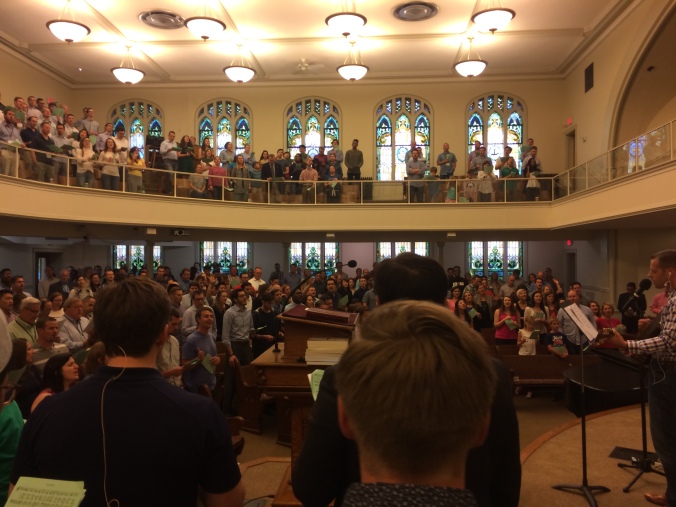
They love to sing at CHBC, as many as 10 hymns in the morning service and several more during the evening service. As someone who was once a professional musician, and once given an invitation to sing with the Melbourne Symphony, I have a particularly high view of what can and ought to be with music, and yet I can say that at over my time at CHBC I have rarely heard musical sounds that have given me more joy and encouragement, such that 10 hymns was not enough; a 1000 voices singing to God and each other with heart felt joy and delight.
The musical accompaniment was simple and bare – an acoustic guitar and piano, and with 2-3 vocalists who were mic’d but only just enough so that they could lead the congregation through any unfamiliar passages and to keep time. The music is deliberately restrained, in order to elevate the role of the congregation sing, and hearing the people sing only encourages everyone to sing more.
I am not suggesting that this is how other churches should orchestrate music for church; I appreciate other genres of music in church and I have been part of congregations where the musical style is more contemporary, scored for a more full band, and musically more garnished, like a Mozart recitativo; such playing can encourage congregations to sing and be heard. However, in practice, the band and the way music is led from the front can inhibit and detract from congregational singing. Louder music isn’t always better. More professional music doesn’t equal improvement. More energetic (and charismatic) music leaders isn’t evidence of more godly or ‘successful’ music ministry. Not that such things are necessarily wrong, and I am proposing a false dichotomy between faithful music and professionalism, or congregational music and contemporary music, but if we cannot hear each other singing to praise God and to encourage each other with the truths of God, perhaps we should reconsider how we are doing music in church.
More important than how the music was arranged, it was clear that people believed what they were singing, and it was this belief in the words being sung that spawned such wonderful singing. Choose songs with superficial or bland lyrics, and we shouldn’t be surprised if the results follow suit. The words of every song were theologically rich and deep, and Gospel-centred, and chosen with care in order to assist the congregation prepare for and respond to God’s word. Unlike most churches today, there is no screen up front displaying the lyrics. Instead, everyone is given copies of the words and music in the bulletin on the way into church. Perhaps because I’m not used to paper anymore or maybe there is some didactic phenomena that I’m unaware of, but I found that in reading the word in front of me I was considering their meaning more carefully than when I follow words projected on a white screen.
The reason for sharing this experience is mostly because I loved the CHBC’s singing so much, and we should share stories and experiences that have encouraged us. At a time when so many negative and troubling news stories are coming out of Washington DC and Capitol Hill, just around the corner, in view of that famous dome, is a 1000 people, mostly 25 years old, whose voices are reaching heaven.
How are we encouraging our congregations to sing, not the band but the people to sing and be heard and encouraging one another with the truths of God and his Gospel?
“Let the message of Christ dwell among you richly as you teach and admonish one another with all wisdom through psalms, hymns, and songs from the Spirit, singing to God with gratitude in your hearts.” (Colossians 3:16)
Matthew Merker is one of the Pastoral Assistants at CHBC and over the weeks we sang one of his hymns, ‘He will hold me fast’. I’m looking forward to introducing it to Mentone Baptist in the near future:
“When I fear my faith will fail
Christ will hold me fast
When the tempter would prevail
He will hold me fast
I could never keep my hold
Through life’s fearful path
For my love is often cold
He must hold me fast
Chorus:
He will hold me fast
He will hold me fast
For my Savior loves me so
He will hold me fast
Those He saves are His delight
Christ will hold me fast
Precious in His holy sight
He will hold me fast
He’ll not let my soul be lost
His promises shall last
Bought by Him at such a cost
He will hold me fast
CHORUS
For my life He bled and died
Christ will hold me fast
Justice has been satisfied
He will hold me fast
Raised with Him to endless life
He will hold me fast
Till our faith is turned to sight
When he comes at last
(Getty Music)
Manhattan overwhelms the visitor; there is so much to see, taste, and do, that it is impossible to gather up all the possible experiences in a short space of time.
The first time I visited Manhattan was with my family and we spent 5 weeks here, living in an apartment on Greenwich St, in the Financial District. My current stay was a rapid 3 days, although I’ve managed to walk over 70kms through New York’s streets, avenues, and parks.
There is of course much more to New York City than the Borough of Manhattan, but this 21km Island is suffice to enthral a lifetime of imagination.

Street where I’m staying
How might one describe this metropolis?
There is no singular way to describe Manhattan, with all of its tones and expressive pluralities. As I walk through this city different music seems to harmonise with its buildings and people, and I would find myself swapping from one composer to another, depending the mood in that neighbourhood.
For example, on the Upper West Side (where I was staying) the sounds is Verdi, on account of the Metropolitan Opera being a close walk down the street. In addition, my closest subway station opens out at Verdi Square on 72nd Street
Harlem: Prokofiev, because Harlem is vibrant, dynamic, and complex.
The Upper East Side is all elegance, class, and intellect, requiring nothing less J.S. Bach and Mozart.
Midtown resonates with the call of Gershwin – bold and brash. The opening cry of the clarinet in Rhapsody in Blue reminds me of sirens rushing through 42nd second.
Gramercy is Haydn, because Gramercy is respectable but particularly memorable, but with one exception, the beautiful Flat Iron building.
Hell’s Kitchen: John Cage’s aleotorism may sounds like a freeing concept, but in practice it’s hell.
Chelsea: Tchaikovsky, for his swirling romanticism on a grand scale and yet carrying persistent longing for fulfilment.
Greenwich Village: Schumann’s playfulness.
Tribeca: The extravagance of Mahler; although bigger and grander isn’t always better.
The Lower East Side carries with it the plot of Puccini’s La Boheme, filled with optimism and poverty, and the eagerness of young artists.
The Financial District is definitely Stravinsky, because the drubbing pace is constant and hectic.
Battery Park: Handel, because one can’t walk through this southern most region of Manhattan and not imagine the world of Great Britain in the mid 18th Century, just prior to the American Revolution.
 MurrayCampbell.net