Abortion, Canada, and the relentless wave of Authoritarian Secularism

I love taking Claude (family greyhound) for an early morning walk through the streets of Parkdale and Mentone, and to listen to the Bible as we go. Today in the Psalms, I was struck by Psalm 8:2, which says,

“Through the praise of children and infants

    you have established a stronghold against your enemies,

    to silence the foe and the avenger.”

Afterward, I was catching up on the news and heard a report about a recent announcement by Canadian Prime Minister, Justin Trudeau. Organisations applying for Government funding for the Canadian Summer Jobs program, must now sign an attestation that they support abortion. The Government had tried previously to prevent funding to pro-life groups but there were legal hurdles that couldn’t be jumped. Instead, they have now built a wall to keep out organisations they won’t subscribe to the extreme social secularism that is being enforced on Canadians by the Trudeau Government.


Screen Shot 2018-01-19 at 10.07.38 am.png

The form states,

“CSJ applicants will be required to attest that both the job and the organization’s core mandate respect individual human rights in Canada, including the values underlying the Canadian Charter of Rights and Freedoms as well as other rights. These include reproductive rights and the right to be free from discrimination on the basis of sex, religion, race, national or ethnic origin, colour, mental or physical disability, sexual orientation or gender identity or expression.

The employer attestation for CSJ 2018 is consistent with individual human rights in Canada, Charter rights and case law, and the Government of Canada’s commitment to human rights, which include women’s rights and women’s reproductive rights, and the rights of gender-diverse and transgender Canadians. Canada Summer Jobs 2018 4 The government recognizes that women’s rights are human rights. This includes sexual and reproductive rights — and the right to access safe and legal abortions. These rights are at the core of the Government of Canada’s foreign and domestic policies. The government recognizes that everyone should have the right to live according to their gender identity and express their gender as they choose, free from discrimination. The government is committed to protecting the dignity, security, and rights of gender-diverse and transgender Canadians.”

According to information stated on the application form, the rationale for this change is twofold:

-to prevent the Canadian Government from funding projects that don’t endorse abortion and LGBTQI rights,

-and to protect minors being “exposed” to these anti-social views.

Among the organisations that are unable to sign the attestation are Christian groups, many who previously were part of the program and providing work for Canadian youth.

Attention to this new policy came to fore last week when Justin Trudeau was asked a question about free speech during a Town hall meeting at McMaster University, Hamilton. He answered,

“In this country, we defend each other’s rights, even when they’re unpopular, as we’ve seen a couple of times. At the same time, we need to know that there is a difference between freedom of expression and acting on those expressions and beliefs. A great example that I was wondering whether you’d bring up is the current kerfuffle around the Canada Summer Jobs program, and expecting that any organization that gets funding to bring young people through the Summer Jobs program – which hundreds of thousands of young people go through – will respect the Charter of Rights and Freedoms.

Now, that doesn’t mean that religious groups and faith groups can’t apply for that. On the contrary, so many of the great community organizations that we have working incredibly hard are faith-based across this country and it’s an important and wonderful part of our society. It does, however, mean – and this is where we get to the crux of the matter – that an organization that has the explicit purpose of restricting women’s rights by removing rights to abortion, the right for women to control their own bodies, is not in line with where we are as a government, and quite frankly where we are as a society.”

The fact the Mr Trudeau felt liberty to use the Summer Jobs Program as his example in answering a question on free speech, says something about his confidence for advancing his social agenda.

Trudeau’s comments are sadly not unusual, but are indicative of much western civilisation today. He is saying to Canadian Christians, ‘we’ll let you hold your believes in private, and perhaps within the confide of your association, but these views are no longer permitted publicly’. This means that organisations will either have to bury their convictions, hide their conscience, and sign the document, or accept that they are no longer Canadians of equal footing and thus lose their funding.

Of course, this is Canada, not Australia. However, we are not so different. Our culture, our history, and our system of Government, is more closely aligned to Canada than it is the United States. The same authoritarian secularism that is sweeping the the land of the maple leaf is also at work here in the south.

It is a perfect illustration of where Western secularism is moving; the gods of the sexual revolution don’t take prisoners. Indeed they will sacrifice the unborn and will trample on the living dissidents. We have already seen a similar move undertaken in Australia. In 2016, the Victorian State Government attempted to legislate that all religious groups must conform to a proposed ‘inherent requirements test”. In short, this would removed freedom from churches and organisations to employ persons based on the theological convictions of the group. The legislation was finally defeated in the Upper House by a single vote. The point is, a State Government in Australia felt as though the sway of society had moved such that they could put forward such Erastian law.

It should also be noted that in addition to the new restriction, Canadian groups are calling for  “anti-abortion” agencies to lose their charitable status altogether.

Joyce Arthur, executive director of the Abortion Rights Coalition of Canada, 

“No anti-abortion agency should be registered as a charity…The mission and activities of anti-choice groups are inherently political and biased, which should disqualify them from charitable status. They work to stigmatize abortion, constrain individuals’ access to it, and ultimately to re-criminalize it.”

In light of the recent introduction of same sex marriage in Australia, the hot issue has become religious freedom and freedom of conscience. These issues have been highlighted by some in the Federal Parliament, and mocked by others. In response to what is probably a combination of reasoned argument and political pressure, a panel has been established to review Australia’s religious freedoms.

As Australians talk about religious freedoms and submit reports to the Ruddock Inquiry, we shouldn’t be surprised to find some who look to this latest Canadian example and use it as ammunition to further squeeze religious freedoms here in Australia.

Jane Caro is a representative of the vanguard of socio-politico thinking in Australia. Two days before Christmas she wrote an article for The Saturday Paper, in which she argued a case for defunding religious schools. In the wake of same sex marriage, Caro has strong views about schools and other organisations whose views differ to the newly redefined Marriage Act.

“We believe that if publicly subsidised schools – and other religious organisations – wish to discriminate against others, they should have to advertise both whom they discriminate against and why – prominently – in all promotional material, prospectuses, websites and job ads. One of the costs of discrimination is that it narrows the field of available talent and anyone considering using the services of such a school ought to be fully informed about that.

Another way of making the statutory right to discriminate fairer for everyone is to remove the blanket exemption and require authorities wishing to discriminate to appeal for an exemption in specific cases. As private school providers claim they rarely resort to exercising their freedom to discriminate, this would seem the most sensible way forward. It might be reasonable to seek to apply religious selection criteria to those who will be giving religious instruction, but why would a mathematics or physics teacher, or a rowing master, or a cleaner or groundskeeper need to be selected on such a basis?

Why should public funds be provided for those staffing positions that require religious discrimination? Surely it would be reasonable for the costs of these positions to be met by the faith community itself, specifically the church and the parents?”


It is easy for people to say, “the answer is straightforward, stop applying for Government funding.” The issue is less about the money, but the attack of religious freedom and freedom of speech. This is yet another example of a western nation shedding principles of a liberal democracy. Where citizens lose the freedom to express a point of view (indeed, a viewpoint that was until recent times morally accepted and valued) and are threatened with defunding for holding that position, we are witnessing societies letting go of principles that made possible the creation of the modern democratic State.

Authoritarian secularism may employ the language of progress, equality and fairness, but the reality is very different to their sloganeering. This is about changing how people think and live, this is about redefining truth and morality, and forcing everyone to worship at the feet of our modern manifestations of Moloch and Venus. Aussie Christians need to get used to the fact that the country has changed. We are no longer nominally Christian, and that means that many of the structures and moral frames which built this wonderful nation are being removed. There will be social stigma, there will be financial cost.

How different was my morning reading from Psalm 8. The God of the Bible reveals his glory in his creation, and most wonderfully in humanity. He affirms the praises and song of children and of infants; they are wonderfully made. How different is the view of children that Canada now promotes.

The Lord is majestic in all the earth, both in his stunning acts of creation and in his wondrous act of redemption.

The Psalmist asks,

“what is mankind that you are mindful of them,

    human beings that you care for them?”

The answer given is that God give human kind unique glory and honour, and has placed them uniquely in all the universe to rule. God’s image bearers all fall, failing to rule with care, justice, and kindness.  In love God’s only Son descended to the grave, having being killed in the place of sinners. He was raised to life on the third day, to defeat not only death, but to prove the efficacy of his death for sin.

“Lord, our Lord,
how majestic is your name in all the earth!”

Volunteering makes the world a better place

2018 may only be 5 days old, but we already have a contender for the most stupid article of year award.

For a moment, I thought all Fairfax Editors had vacated the building for summer holidays and had given the keys to an 18 year old work experience student who’s started the campaign to elect Bernie Sanders as the next Prime Minister of Australia.

Fairfax has published a piece with the title, Volunteering doesn’t make the world a better place.

As the headline suggests, the article is an attack on the indispensable practice of voluntary work in Australia.

Catherine Walsh is calling on Australians to “stop volunteering”.

Why? She sees volunteering as a faux help, not resolving societal issues but aggravating them. Walsh arrives at her conclusion by arguing that voluntarism is inefficient, is unvalued, and is exploited by organisations who are disinterested in solving problems.

Walsh’s solution seems to be, get rid of voluntarism and instead let’s create a bigger government and remunerate people for all their work. Sounds great, doesn’t it? Let’s handball even more communal opportunity and responsibility over to Government, and let’s suck out the tiny bit of oxygen that keeps Australian philanthropy alive. Instead of donating time and money to causes that we think highly of, let’s give Government permission to charge even higher taxes to pay for the programs that it subscribes as morally relevant.


UNADJUSTEDNONRAW_thumb_dd71.jpg

Apart from her less than satisfactory alternative to voluntarism, there are several important flaws in Walsh’s presentation of volunteering that require response.

Firstly, Walsh largely equates volunteering with virtual signalling. She says,

“Being a volunteer, or fundraising, or working for a charity, signals that you are a good person.”

“If volunteering was valued we would have a separate resume for it, at parties people would ask each other about their volunteering, and hours worked would contribute to superannuation.”

I have no doubt that there are persons involved in voluntary work because it gives them a drug free high. They feel good about themselves, and they enjoy the praise they receive from people around them. That is certainly not the Christian motivation for doing good. We give because we know the joy of what it is to receive. Those who have been loved, want to love others.

According to Walsh, if Australians truly value volunteering, we would be congratulating one another. But why should people boast about their volunteering and donating? Doing so undercuts the very nature of the work, that is, it is being done for the good of others, not for oneself. Is it not possible that Australians happily give time and effort to serve others without demanding compensation, let alone, superannuation? Where is the ideal of sacrificial giving? Indeed, as soon as we strip these Christian foundations for society, we fast become bereft of moral structures that we need for building a healthy society.

And BTW, people can and do include volunteer work on their resumes!

Not only does Catherine Walsh paint volunteerism as egotism, she secondly alleges that voluntary work is inefficient.

“A lot of the volunteering we do is inefficient. Schools ask that parents bake cakes to be sold to the children of other parents who have baked cakes. Most school events involve sausages on white bread and fizzy drinks, which is not recommended as a healthy diet. Chocolates are sold in staffrooms to raise money for the children’s hospital. Rubber wristbands are sold by charities to raise awareness of illnesses. A fundraiser for the environment can sell unhealthy food one week, and a fundraiser for health can damage the environment the next. This is inefficient. Any effort to help one system should not be feeding into the brokenness of another. In order to be helpful we need to factor in all systems at once.”

I do agree with one small point here  – her examples about about cake stalls and chocolate drives; these are often self-defeating exercises given that the very people designed help are the ones buying the sugary treats. We shouldn’t need incentive in order to give generously to a cause that we value. Volunteering though is not donating: voluntarism isn’t donating $5 at a school fete and receiving a chocolate bar in return.  Voluntarism is work without pay; it is giving time, energy, skills, and productivity for a cause without expecting any reimbursement.

Is voluntary work always efficient? No. But then, is paid work always more efficient? Is Government the very epitome of efficiency? And why is efficiency the only measure worthwhile considering?

Much of life is not efficient. Relationships are often complex and messy, and they require time and patience and perseverance. The reality is, not all of life’s brokenness can be fixed with a signed policy statement and a grant dispersed by Government bureaucrats.

Matt Perman explores this myth about work in the book, What’s Best Next?. He writes,

“While efficiency is important, it is secondary. More important than efficiency is effectiveness — getting the right things done. Efficiency doesn’t matter if you are doing the wrong things in the first place.”

It is also important to broaden the view of worthwhile work which is suggested by Walsh. For example, Tim Keller defines work as, ‘rearranging the raw material of God’s creation in such a way that it helps the world in general, and people in particular, thrive and flourish.”

Dorothy L. Sayers asks the poignant question, “We should ask of an enterprise, not “will it pay?” but “is it good?” She argues, “the habit of thinking about work as something one does to make money is so ingrained in us that we can scarcely imagine what a revolution change it would be to think about it instead in terms of the work done. To do so would mean taking the attitudes of mind we reserve for our unpaid work – our hobbies, our leisure interests, the things we make and do for pleasure – and making that the standard of all our judgements about things and people”

In other words, while we shouldn’t ignore inefficiency, there are bigger and more important questions that need asking about our work, and indeed why we should value unpaid work. At its root, Walsh advocates a consumerist and individualist paradigm which inevitably squashes the greater love, which requires selfless giving for another’s good.

Thirdly, Walsh presents a narrow understanding of voluntarism.

In her article, Catherine Walsh is targeting organisational volunteerism, however much voluntary work and giving in our local communities is informal.

I think of my local cricket club which depends upon the generosity of volunteers who love the game and who want to encourage children in the game. I think of the local athletics club where my daughter runs, and how they depend on the voluntary time giving by families.  

Thinking of my own local church, where people lovingly pour 1000s of hours into giving, serving, caring, and organising. What they achieve is more than running a few programs, they are building and belonging to community, and including others in this endeavour. Societal cohesion and growth cannot be left to Government, but requires spontaneous and informal contributions from the grassroots up. It’s about loving our neighbour as ourself.

Walsh soon enlightens us as to where her real criticism lays – it is with religious organisations and churches. She says, 

“Many government services are now outsourced to church-run charities, which win contracts due to their tax concessions and tax donation status – and rely on the work of volunteers. They are exempt from anti-discrimination laws. It is not in their interest to solve problems.”

“It is not in their interest to solve problems”?

Wow. One can only assume Walsh has never visited a church, nor observed religious charities at work, nor considered the data which elucidates the extraordinary work being achieved by religious groups in this country. Of course there are always going to be a few bad eggs in any system, but is she being serious? Is this a moment of hyperbole? I know of countless people who have found financial restitution through the generosity of others, of mums who can go back to work because friends are helping to baby sit, of marriages being healed because of counselling provided, of people offering beds for those without, of finding hope and forgiveness where society offered none.

A healthy society can only exist where the people contribute to the wellbeing of others without seeking personal benefit. Do we want to be taking away further personal responsibility and opportunity, and therefore assume that big Government will take care of it? If anything, this will produce more cracks and more people going without.

Imagine Australian society with Surf Life Savers, the CFA and SES, without locally run sporting clubs and playgroups. Consider the billions of dollars that we would be required to pay to Government, should churches and religious organisations (yes, primarily Christian) were abandoned of free serving and giving volunteers?

I’m reminded of the words by the Apostle Paul, who said of Christians,

“Therefore, as we have opportunity, let us do good to all people.”

The Apostle doesn’t call us to dump everything on Government, or to assume someone else will do it, or to demand reimbursement for services completed. He writes in the context of Christian freedom, for we work in light of an eternal future that has been made secure by a God who worked by grace for our good.

Australian Generosity at Christmas

Caitlin Fitzsimmons has called for Australians to be more generous, and to give to charity outside the Christmas period. She offer some sage advice for all of us, and her points about generosity also got me thinking.

She writes,

“Before we dive into the prolonged festival of consumerism that is the summer sales or turn our thoughts to the new year, let’s pause to reflect on the season of giving.

December is the third-biggest month for charitable giving behind May and June, the two months before the end of the financial year when people are trying to maximise their tax deductions, according to Commonwealth Bank figures.”

Fitzsimmons helpfully points out,

“The lead-up to Christmas is when many charities give a big marketing push to drum up donations. It’s also a time of greater need, especially for organisations that help disadvantaged families in Australia or rescue abandoned pets, for example. But no matter the cause, the need doesn’t disappear in January.”

Fitzsimmons doesn’t want us thinking that we’re a nation of Scrooge’s. She proclaims that,

“The good news is that Aussies are generous year-round”.

So how generous are we?

According to research cited in the article, 2/3rds of Australians give to charity, totalling $4.2 billion. That’s not an insignificant sum, although it in fact equates to approximately $300 per Aussie. Hmmm. Generous? I’m beginning to wonder if Scrooge was an Australian.

Fitzsimmons goes on to offer some helpful practical advice about how to give to charity, and why it’s important for organisations to have knowledge of regular giving rather than one off guilt driven contributions.

It would be interesting to know what the average regular Church attender gives per annum. Based on many years of experience, working for and being a member of several Churches, I reckon that a conservative estimation would place Christian giving at 10 times the national average, and Christians often give without any tax benefits.

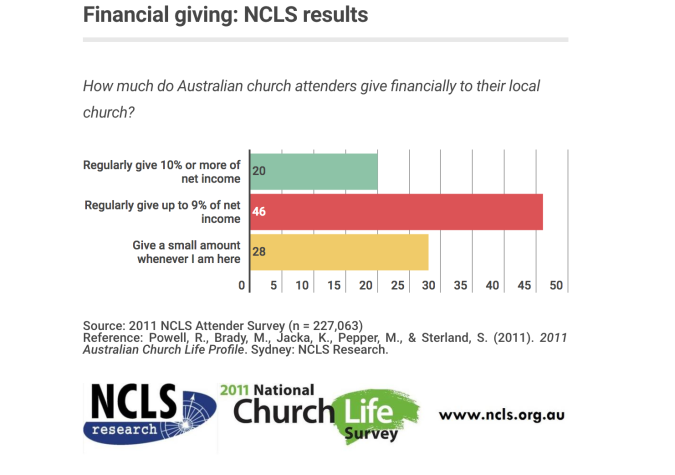
According to NCLS research (a national survey across Christian denominations, which involved 10,000s of participants), 66% give regularly, with 20% of attendees regularly giving over 10% of their income. It is important to note that these figures only include financial contributions to the local church, and does not include all the charitable giving beyond. Again, this is consistent with my experience of Christians and Churches.

Screen Shot 2017-12-27 at 10.21.35 am


The question is, why is the gap between general Australia and Christian Australia so great? I’m sure that some Christians give out of a sense of obligation (although they should not), and others give because of a dubious understanding of Divine blessing (ie the prosperity Gospel). But those two reasons cannot explain the giving that continues in evangelical Churches across the country.

So what is the reason?

My hypothesis is a simple one, and it comes from the Bible: Grace changes peoples’ hearts.

“Each of you should give what you have decided in your heart to give, not reluctantly or under compulsion, for God loves a cheerful giver.” (2 Corinthians 9:7)

“For you know the grace of our Lord Jesus Christ, that though he was rich, yet for your sake he became poor, so that you through his poverty might become rich.” (2 Corinthians 8:9)

When you have come to experience the sacrificial love of God in Christ Jesus, and how the Lord of the universe gave up everything, even his life on the cross, this good news changes you inside and it reorients the way you view your income and the way you look at other people. I’m not suggesting that Christians are better people; Christians are ordinary citizens who face the same financial responsibilities as other Aussies. I am however proposing that there is a difference, and that difference turns on belief in the Gospel of Jesus Christ. The extraordinary gift of forgiveness that is found in Jesus, not only frees people to give generously but installs a joy in giving to others.

I happily join Caitlin Fitzsimmons in encouraging Australians to think about generosity in 2018, and we do so, I also encourage us to consider the greatest act of compassion and sacrifice the world has ever known.

Christmas at Mentone

We want to invite the communities around Mentone and Cheltenham to join us this Christmas.

Christmas often causes us to pause and reconsider the things that we trust and rely on for life’s meaning and happiness. We believe God is good and kind, and in his kindness he gives us many wonderful things to enjoy, and yet none can replace the greater and deeper joy that is found in Jesus Christ. This Christmas at Mentone we are revisiting this superlative joy.

On Christmas Eve we are hosting an annual community Carols. There is a family BBQ from 5pm, with activities for children. The carols service commences at 6pm.

Christmas morning service starts at 9:30am and will finish by 10:20am, leaving plenty of time to prepare for lunch.


Christmas at Mentone


This Christmas, Churches be clear about Jesus

It’s beginning to look a lot like Christmas. Our Christmas tree is up. The smells of cinnamon, cloves, and nutmeg are gently drifting through the house.  Yes I know, I’m not a very particularly strict Puritan this time of year!

I’m also preparing my Christmas sermons and at Church we’re gearing up for our Christmas Eve service.


Christmastree.jpg

At least since 1965, we have been preaching that commercialism is the real enemy of Christmas. Remember what Lucy says to her friend Charlie Brown in A Charlie Brown Christmas,

“Look, Charlie, let’s face it. We all know that Christmas is a big commercial racket. It’s run by a big eastern syndicate, you know.”

Sermons warned us about not drowning out the true meaning with all the food and shopping and decorations. In the last few years though, we’ve changed our sights and declared that the real enemy of Christmas is now secularism. As shopping centres ban songs about Jesus, as manger scenes disappear or are pushed to the side, and as schools are discouraged from singing beyond Rudolph and bells that jingle, our Christmas messages now come with admonitions about those ripping Christ from Christmas.

First of all, our message isn’t “save Christmas”, our message is, “Jesus is Lord, and he came to save”. There is certainly less Jesus in today’s culture, and dislike for the Christian view of Christmas has become mainstream. Also, the two are not completely disconnected, with the former signalling disproval of the latter. However it is just possible that Christianity can prosper without the public holiday

Second, and maybe this is stating the obvious, but should we be getting all our Christmas lights in such a knot over this? Is it the role of society to announce the Gospel of Jesus Christ? Does it make sense that an unbelieving population should focus attention on God incarnate? Why would they? Perhaps we should revisit the Nativity passages to remind ourselves of how Jesus was received,

The true light that gives light to everyone was coming into the world. 10 He was in the world, and though the world was made through him, the world did not recognize him. 11 He came to that which was his own, but his own did not receive him.” (John 1:9-11)

I wish more Australians would consider Christ, not only at Christmas but every day of the year. The angelic announcement to the Shepherds remains the greatest news ever to be broadcasted. The proclamation was so astonishing that it was recorded in Holy Scripture, and for over 2000 years people have been hearing the news and millions more will sing about it this year.

“Do not be afraid. I bring you good news that will cause great joy for all the people.11 Today in the town of David a Savior has been born to you; he is the Messiah, the Lord. 12 This will be a sign to you: You will find a baby wrapped in cloths and lying in a manger.”

You kidding me? God has come to earth and become human,  entering as a baby? He is Lord and he has come to save? We Aussies are so absorbed in finding little happinesses that we stubbornly refuse to accept the joy God promises in Jesus Christ. It’s nuts, and the nuttiness is only equaled by Churches obscuring this glorious news,

Surely the cult of tradition can be just as great an enemy of Christmas, as is secularism and commercialism. Clouding the message of the incarnation through candles and processions and choirs can just as easily keep people from grasping the reality of Christ come. Don’t get me wrong, I love a well performed Festival of Nine Lessons and Carols, but often that’s all it is, a performance. For many Australians still interested in Church during the season, attendance is often driven by the appeal of tradition or keeping grandparents happy.

Sometimes, because Churches want to “build” relationships with our local community (which is a good thing), we avoid too much Jesus and too much Bible getting in the way. We’ll say the necessary words, but let’s pad it lots of other elements that we know everyone enjoys: if we have to have the egg, make sure we add plenty of nog!

Sometimes, because we’ve assumed the old story needs retelling in new and innovative ways, we sacrifice clarity for the contemporary. Yes, I realise that these things don’t have to be dichotomous, but tell me, how many carol services have you attended where the Bible is never read, the prayers are vague and politically correct, and the headline act is a man carrying about with a pillow stuffed under a $75 hired suit?

It’s not the job of channel 9s Carols by Candlelight to preach Jesus. It’s not role of the local primary school to explain Luke ch.2. If they do, fantastic; a truly pluralist society would embrace such, but it’s not their mandate.

It is the role of Churches, and our privilege, to present and explain the reality of the incarnation, and of the death and resurrection of Immanuel. If the coming of Christ is truly good news that brings great joy, shouldn’t we make it our aim to present Him as clearly and passionately as possible? We can still put on the BBQ, light candles, drink mulled wine, and let the kids do a pageant, but please don’t hide the Gospel. If we are not making the good news of Jesus Christ clear, who will?

When you are insulted

Did Turnbull Malcolm speak too soon?

As the Dean Smith Bill was about to be receive its final reading in Parliament yesterday afternoon, Prime Minister Malcolm Turnbull proclaimed,

“Australia has done it. What a day for love, for equality, for respect.”

It’s attractive rhetoric, and perhaps Mr Turnbull really believes what he said, or maybe he’s just hoping for the best. Whatever is the case, Australia hasn’t disappointed because soon after he spoke these words, trending across Australia on twitter was hashtag Lyle. Even out doing many hashtags dedicated to celebrating yesterday’s decision, thousands of people are sending offensive tweets to Lyle Shelton, using all kind of base language in order to offend. Telling a fellow human being to eat excrement, in my opinion, is shameful. It doesn’t matter whether you agree with Shelton’s views or not, it is simply disgusting.

For those who may not be aware, Lyle Shelton is the Managing Director of ACL (Australian Christian Lobby), and he took a key role in the national campaign to uphold the classical view of marriage in Australia.

OLYMPUS DIGITAL CAMERA

No doubt Lyle Shelton is a controversial figure. Not every Christian would agree with everything he says or how he has said it, but his view of marriage is certainly in keeping with the Christian understanding. More than that, he is respectful and gracious when interacting with people, even those who send him verbal parcels of expletives and insult.

This national pronouncement of love and respect isn’t only being directed toward Lyle Shelton, but it has been a sad the trend throughout much of the debate on same sex marriage. Gay and Lesbian Australians have have been subjected to awful mud slinging, and many supporters of classical marriage have had all manner of insult and assault aimed at them. The difference between the two is that the latter has often found public and media support. Remember when Bill Shorten and other Federal members equating opponents of same sex marriage with haters and bigots?

Remember when comedian and Fairfax columnist, Benjamin Law, threatened to sexually assault Government MP, Andrew Hastie? Apparently, it’s not only ok, but it’s funny to make a joke about raping a politician. More humour from Mr Law last night,

“Now I am become Lyle, the eater of shit”

Even before the vote was taken on Thursday, throughout the day’s proceedings, the public gallery in Parliament continually interrupted MPs who dared suggest that Australia is likely to see a reduction of religious freedoms in light of changing the Marriage Act.  It was impossible not to see the irony, while fellow MPs referred to concerns over religious freedoms as “baseless”, the choir sitting in the public gallery repeatedly applauded and cheered in triumph when any MP suggested religious freedom would be reduced.

No doubt there have been many people from across the opinion divide who have expressed their views respectfully and who have been quick to speak against those who are hateful. Maybe I’m wrong, but I suspect that our Prime Minister’s words are already destitute. A truly pluralist and tolerant society is able to handle rigorous debate and can avoid jumping into the sewer. Last night and again today, thousands of Australians can’t contain their eagerness to take scoop down and start throwing it at high profiled defenders of classical marriage.

It’s not nice, it’s awful, but should we be surprised? Didn’t Jesus tell us in advance that this would happen? The final vestiges of our Christian culture have up til now served as padding against some of the slings and arrows of social outrage. Yesterday’s Parliamentary “victory” has been interpreted by thousands as justification to knock down those who didn’t support the cause. I suspect that for some, they’re simply letting off steam following months of anger and frustration, although I’m not sure that a justified reason.

While this was unfolding, I was preparing my sermon for Church this Sunday. At Mentone Baptist we are looking at Matthew ch.10. While the context of that passage is mission, and Jesus instructing his disciples how to go about mission and what to expect when they are sent into surrounding towns, it’s hard not to notice some relevance.

Jesus is forewarning his disciples that not everyone is going to welcome them and welcome their message. In fact, at times it’s going to be incredibly hard. People will turn on you, insult you, and even take you to court.

Jesus says, “be as shrewd as snakes and as innocent as doves (Matt 10:16). The combination of both qualities is essential: shrewdness without innocence can lead to deceitfulness and unkind methodology, and innocence without shrewdness can lead to naivety or to a foolish bravado. In other words, don’t be stupid and don’t be sinful. Don’t respond to trouble in kind.

While many Australians are today celebrating, many others are today disappointed and saddened by how easily our Parliamentary representatives dismissed the genuine concerns about religious liberties, don’t leap onto social media and say something stupid and sinful. Stop, think, and read these verses:

“8 Finally, all of you, be like-minded, be sympathetic, love one another, be compassionate and humble. Do not repay evil with evil or insult with insult. On the contrary, repay evil with blessing, because to this you were called so that you may inherit a blessing. 10 For,

“Whoever would love life
and see good days
must keep their tongue from evil
and their lips from deceitful speech”. (1 Peter 8:10)

Jerusalem and Gaza, the home for many

As Jerusalem makes headline news across the world today, as so often is the case, my mind turned to a letter written by a friend a couple of years ago. At the time, with his permission, I posted it on the Mentone Baptist Church blog. Again with his permission I’m publishing the letter here, because it brings to the fore an often forgotten group of people who are living in that most beautiful yet tumultuous land. His letter doesn’t concern Jerusalem per se, but it does bring a nuance, and timely theological reflection, to a context which is too often misunderstood in binary ways. It was written in 2014.


23926558_10156000240969973_3512398476017643912_o.jpg

G. Athas (2017)

Editor’s note: due to the sensitivity of the issues I have withheld the author’s name. It is written by a Christian friend from Palestine who now lives in Melbourne. I am publishing, with their consent, part of an email correspondence from last week that came about after I learnt that members of their family have been killed in Gaza in recent days. 


“It is a sad reality…our loss is for my dad’s cousin, and 2 of my second cousins.  My dad is somewhat bitter about the events dominating the land since 1948 and the gradual ethnic cleansing since, and his family (and my mothers) experienced much sorrow seeing Christians flee – taking with them the true heritage of the land. 

Over the years, we have experienced losses that are hard to understand.  Another of my first cousins was shot in the hip, though is alive, and cannot walk around properly.  He has 2 daughters that he struggles to feed because he cannot work.  Therefore my dad and I have supported him somewhat – including his extended family.  This particular incident happened a few years ago in the previous incursion.  He’s a believer and knows that the Lord has a plan – but he struggles.  They live day by day.  His daughter, my niece, did not really know that bananas were yellow, because she had never seen one in real life.  Another of my cousins died late last year because he was unable to obtain medical treatment, and he was my age, and had 3 children.  The family is in great pain knowing that he may have been saved, but was not.

In Australia and much of the west it is very easy to take essential provisions for granted.  Food, water, warmth, basic amenities, and the freedom to worship as a Church or body of Christian believers.  Such rights as voting, police protection, medical and health cover, or a simple roof over your head do not exist to many in Palestine.  Freedom to move around from suburb to suburb within the nation do not exist.  There is no right to external travel, and no right of return.  

 We pray for Christians to be strengthened during this time.  We pray that they will not lose hope, and that they will not blame God, or Christ for the suffering and anguish they endure at the hand of politics, greed and selfishness – the inherent heart of man!  I know they have not got the answers they so desperately seek and they yearn for understanding and adequate explanation.  It is most undoubtedly a difficult time for them (and us being somewhat helpless here), and it seems like there is no real end in sight.  Every day passes by without offering a hint of improvement.  Another day of this life passes by and it cannot ever be reversed.  I know that this eats away at them because they feel they cannot even enjoy the simplest of lives with their children and families.  Uncertainty and persecution is everywhere.  Many fall in despair and suggest God is only a God of the Jews, and hater of the Palestinians.  They consider God hated Ishmael – whereas instead God saved him in the wilderness, and blessed him bringing into his line 12 princes.  The pain distorts their view on God’s true love and equitable justice.  God is not the racist they often time feel He is portrayed as.

So we do sincerely appreciate your prayer, and love in action.  Nothing else helps.  Earnest and fervent petition to our Lord to hear the voice of His people (Christians), whom He loves.  To incline His ear and see their affliction, and turn and answer them and heal their pain – bringing them closer to Himself.  And while doing so, to bring many more others to His Name that were once lost that they too may worship the One True God.  Selah. Amen. 

 As believers, we know that Jews can’t bring true peace.  Muslims can’t bring true peace.  But the Lord of the Bible can.

 I pray this is the Lord’s will for that land.  But I fear more trouble comes first.”

Australia is Changing and Churches are unprepared

Note from today (December 7):

During the course of today, several MPs have offered amendments to the Parliament in order to ensure that religious freedoms and freedom of conscience will continue without threat, once the Marriage Act changes to legalise same sex marriage. As in the Senate, every single motion has failed to win sufficient support in the House of Representatives. No one is surprised by this. What has surprise me was when the member of Canning, Andrew Hastie, sought to table correspondence from religious leaders across the country and was denied. He was not even permitted to table the concerns from many of the nation’s most respected religious leaders.

The constant response to proposed amendments has been, fears of limiting religious freedoms are “baseless”, and they have ironically insisted upon this while the choir sitting in the public gallery have all day applauded and cheered when any MP has suggested religious freedom will be reduced.

One thing we can guarantee once the law passes, a point that I raised a couple of weeks ago, “As soon as the Marriage Act is reworded, future laws and interpretations of these laws, and future social norms will all be defined by this wording. This raises important questions for millions of Australians who with good conscience, do not support the corollary of expectations that will ensue throughout many parts of Australian culture.”

——————————

Since I was a child, Governments have promised to deliver a high speed train, to service Melbourne to Sydney. Last night, the Senate in Canberra began to deliver. The sexual revolution was offered a free upgrade which will ensure that it can accelerate toward its unaccommodating vision for Australia.

high_speed_rail_1920x1005

Social progressives have declared their agenda for many years now, but other progressives felt the need to either downplay or ignore their voices, at least in public. Their dream for Australia seemed too bold, too audacious, too big to swallow all at once. 

The Australian public was reassured that same-sex marriage had nothing to do with freedom of religion, although social commentators and even politicians, dedicated an awful lots of words to insist that opponents of same-sex marriage are all haters and need to be silenced. Indeed, within minutes of the marriage survey results being announced, Fairfax had published an article calling for Parliament to ignore the of religious freedoms,

“So let’s not be hoodwinked into changing the law to pander to bogus religious freedom lobbyists.”

Even prior to the marriage survey’s announcement, there was a chorus of public voices explaining how the debate on marriage was connected to religion, and that marriage is the instrument of choice to erase religion from public life altogether.

Mauvre Marsden, in the Sydney Morning Herald (Oct 4),

“Yes, marriage is not the final frontier. Yes, we want safe schools. Yes, gay conversion therapy is child abuse. Yes, we want transgender kids’ agency to be respected and supported – regardless of what their parents want. Yes.”

Auberry Perry in The Age (Sept 3),

“This survey offers us a conscious opportunity to make a firm stand in support of a secular government and to reject discrimination or favouritism based on religion. It’s our opportunity to say that religion has no part in the shaping of our laws. A vote against same-sex marriage is a vote for religious bias and discrimination in our legislation, our public schools, our healthcare, and ultimately, in the foundation of our social structure.”

We should not forget, that only last year the Victorian Government attempted to pass legislation that would have taken freedom from religious organisations in hiring staff who subscribe with their values. By values, the Government was targeting beliefs that didn’t fall into line with the sexual revolution. It was, as Dr Michael Bird explained at the time, an example of Secularized Erastianism, a philosophy which asserts that the State shapes and controls religious belief and practice. Is this the direction Australia wants to head?

Remember all the assurances given to Australians during the same-sex marriage campaign, of how very little will change? Only a couple of weeks ago, the Prime Minister assured the nation that,

“I just want to reassure Australians that as strongly as I believe in the right of same-sex couples to marry, as strongly as I believe in that, even more strongly, if you like, do I believe in religious freedom…”

Last night in Canberra, we were given assurances that much will change. So what was decided in the Senate last night? In short, there will be no safety net for any person or organisation who oppose same sex marriage, except for clergy when it comes to performing weddings and perhaps also for official ‘church’ buildings (although, the ABC is reporting that religious institutions will not be able to refuse to hire out church halls for same-sex weddings).

Stephen McAlpine gives this helpful summary of the main points thus far (based on reporting from The Australian):

  • Protect Civil Celebrants refusing to marry gay couples
  • Create two definitions of marriage – one as between a man and a woman and the other as between two people
  • protect “relevant beliefs’ around marriage
  • prevent governments and agencies from taking action against people with a traditional view of marriage
  • Allow parents to remove their children from classes if they believe material taught is inconsistent with their view of marriage

McAlpine is spot on,

“I totally get points one, two…I didn’t expect anything different on those, and can’t really see an argument around them.  But to refuse protection around “relevant beliefs” about marriage?  That opens the door to all sorts of activism, and it will cost religious groups dearly.

But it’s that idea that the Parliament does not see fit to protect people with a traditional view of marriage from having action taken against them by governments and other agencies that is particularly unfortunate.  You can hear the knives sharpening already, can’t you?”

The prophets of the sexual revolution don’t appear so crazy this morning; they were right and they’ve won the social and political battle. This debate was never about equality, but always about social conformity with the new sexual milieu. There are certainly Australians who still believe that all this is solely about equality and human rights, but they are pawns being played for a much bigger game.

Social pluralism is on the way out, and adherence to the new gods of sexuality is obligatory. Pluralism in Australian could only continue so long as those in authority encouraged alternative views to be expressed publicly, without fear of litigation or threats of violence. The Senate has taken the next step to ensure that such freedoms will decline. This should concern all Australians, not because pluralism is god, and not because we are moral and spiritual relativists, but because we believe a healthy society requires its citizens to argue and persuade, and to allow others to make up their minds.

It’s not too late for the Parliament to deliver sensible legislation, but slowing down the train will be interpreted as a betrayal, and will likely have you thrown off. I’m not suggesting that Parliament puts on the brakes in relation to changing the Marriage Act. I’ve stated elsewhere that Parliament should not unnecessarily delay this process. However, it is incongruous to not fully address, the broader issues which are in fact the main issues.

It is important to remind ourselves that the future of the Gospel in Australia doesn’t ultimately need political assurances from the Government, for it is too good and too true. Charles Spurgeon was right when he said,

“The Word of God is like a lion. You don’t have to defend a lion. Unchain it and it will defend itself.”

The Parliament is however, setting up the scene whereby being a Christian will carry more cost than it has in the past. It is time for Aussie Christians to take  their cross from under the bed, give it a good dusting, and start following Jesus.

Those who identify as progressive of course have nothing to fear from any legislation, because they eagerly jumped on board and abandoned the Gospel 6 stations ago. It doesn’t matter that their churches are dying,  they are happy to pay the price for a seat in business class.

I also suspect that many more Christians will go on pretending as though nothing has changed, until such time that they too have their convictions forced out of them and are then left vulnerable, having their dreams of a prosperous life derailed. When will we wake up and realise Jesus was telling us the truth all along?

19 “Do not store up for yourselves treasures on earth, where moths and vermin destroy, and where thieves break in and steal. 20 But store up for yourselves treasures in heaven, where moths and vermin do not destroy, and where thieves do not break in and steal. 21 For where your treasure is, there your heart will be also.

22 “The eye is the lamp of the body. If your eyes are healthy, your whole body will be full of light. 23 But if your eyes are unhealthy,[your whole body will be full of darkness. If then the light within you is darkness, how great is that darkness!

24 “No one can serve two masters. Either you will hate the one and love the other, or you will be devoted to the one and despise the other. You cannot serve both God and money.” (Matthew 6)

The notions of liberal democracy and social liberalism lost some shape last night, and before this journey is over, we will have a nation that is less tolerant and less free. Christianity will survive because it is not defined by these terms, but we can no longer afford a cost free faith. Christians though are not the only ones who are likely to pay; eventually we will see people wanting to get off the train, and churches need to be there and ready to minister to the injured and hurting.

Are we ready?


An earlier report had suggest that Defence Chaplains were not given exemption. That was incorrect and have since made the correction here

Australia’s Pharisees

John Dickson has this afternoon written a helpful response to Julia Baird’s column, “Same-sex marriage result was a defeat for only one type of Christianity – and a triumph for the grassroots sitting in church pews”.

He has corrected important mistakes made by Baird about the nature of grace and the love of Christ. For instance, while the current secular definition of love insists upon agreement, the love God displayed toward in Christ Jesus is premised on the fact that God does not agree with us.

John also challenged Baird’s unsubstantiated claim, that the majority of people in the pews support same sex marriage. With great certainty, Baird proclaimed,

“Who speaks for God?”

The answer according to Julia Baird is, the silent majority in Church pews who support same sex marriage.

“It was… a defeat for a certain brand of public, conservative Christianity, one that has focused on sexuality, morality and traditional views of men and women…

And a triumph for the grassroots, those in the pews who – as polls repeatedly showed – quietly tolerated but did not share the views of their church leaders.”

In addition to the evidence John has produced, is research conducted by NCLS in 2016. This data is more substantive than the few straw polls that have elsewhere been conducted, for the simple reason, NCLS was asking the question to people in Churches, as opposed to the general population.  Other polling failed to differentiate between nominal Christians & practicing Christians. NCLS is at least polling people who are attending Church (the demographic that Baird alleges  are in majority supportive of same sex marriage). NCLS data reveals:

73% of church attenders did not support same sex marriage

14% were unsure, 

13% were in favour.

Having said that, even if the majority of people in our pews support same sex marriage, does that make it the voice of God, as Baird purports? Of course not. Christianity is defined by Jesus Christ in the Scripture, not by ecclesial consensus or popular vote. It’s one of the great dangers when we turn to popularism rather than biblical truth for our theological and moral convictions.

OLYMPUS DIGITAL CAMERA


In this post I wish to add to the conversation, a comment about Julia Baird’s use of the word, Pharisee. In her article she compares Christians who don’t support same sex marriage with Pharisees, whereas those who truly speak for God are the masses inside the nation’s churches who are letting out a great  “Amen” to same sex marriage.

Name calling is a particularly unhelpful by-product of the current social climate, and even we Christians are sometimes guilty of joining in.  It is easy to call a group of Christians, Pharisee, but is it the right label? Or as Stephen McAlpine asked yesterday, is this the new Godwin’s Law?

Everyone knows the name of the most famous group of bad guys in the story on Jesus, the Pharisees. But who were the Pharisees, and has Julia Baird got it right? I reckon she is mostly wrong and little bit right.

Pharisees were a class of social and political elites who greatly influenced and controlled much of Jewish society in the century before Christ and into first century A.D. Very few Pharisees belonged to the priesthood (they were not clergy), although they held considerable religious sway. According to the Jewish historian Josephus, their influence eventually diminished due to a series of sharp disagreements between themselves and the official Jewish clergy in the First Century.

Pharisees are most remembered for their opposition to the ministry and mission of Jesus Christ. In the historical records we learn of the Pharisees’ persistent harassment of Jesus, protesting his preaching, criticising his good deeds, condemning his beliefs, and plotting his downfall. They didn’t stop at expressing disagreement, but resorted to all the tactics available at their disposal in order to have Jesus silenced.

We need to keep in mind that while the name Pharisee is today a pejorative term, this was not the case at the time of Jesus’ earthly ministry; they were greatly esteemed and respected in local communities, and having the ear of the ruling authorities of the day. The New Testament reveals another side to the Pharisees, namely their intolerance toward those in society who didn’t live up to their standards. They couldn’t stomach Jesus’ commitment to the poor and outcast.

It is also important to understand that the problem with Pharisees was not that they held God’s law and righteousness too highly, but that they were self-righteous. They took pride in their self-perceived ability to follow the Mosaic law, and given that they were governed by pride, they managed to find loop holes and extensions to the law in order to satiate their wants. They added hundreds of stipulations that had no grounding in the Jewish Scriptures. For example, whereas the law commanded fasting once a year, on the day of atonement, Pharisees fasted twice a week. This new social norm was not followed by Jesus and he was criticised for not adhering to it.

Important to the topic at hand, it was not Jesus who taught a progressive view of marriage, it was the Pharisees. Jesus consistently and repeatedly affirmed the Genesis paradigm for marriage (which continues to be held by Christians today). Pharisees, on the other hand, had deconstructed and reframed marriage in order to justify their sexual proclivities, and they challenged Jesus for not supporting their progressive views. So, if we are wanting to follow Jesus (accepting his view of marriage and to love and show grace), it is paramount that we resist the current modelling in many Western cultures.

By the way, I am not suggesting that there are no Pharisees within Australian Churches, either among clergy or congregation. Of course there are, but the insult kinda falls flat when the word is misappropriated. Nevertheless, there is something in Baird’s criticism that is worth being reminded of, and to humbly check before God – while Pharisaism is incompatible with the Lord Jesus and therefore with Christianity, are there not occasions when we dip into self-righteousness and are tempted to measure others by our own standards? 

The root of self-justification is unbelief and pride, and pride inherently sets the self against others, belittling those who don’t meet your standard and envying those who out do you. Self-Justification in all its guises is ugly and self-defeating, which is perhaps why Jesus dedicates so many words to exposing the Pharisees.

We are not presenting a truthful or attractive Gospel if we parade the streets of Melbourne in saintly masks and garb; self-righteousness doesn’t fool anyone. And yet, a Christianity that modulates with the changing currents of the culture, is almost certainly one that has drifted from the anchor that is the Gospel. It is no wonder that progressive theology in Australia always leads to declining churches, moral confusion, and the praise of society. If our version of Christianity consistently reflects popular sexual ethics, might I suggest that there is something amiss with our understanding of Christianity. Our nation and our churches don’t need any more Pharisees, whether appear as social conservatives or social progressives. Australia needs Christians who walk with grace and conviction, love and faithfulness, not exuding self confidence and avoiding cultural-pleasing.

“Remain in me, as I also remain in you. No branch can bear fruit by itself; it must remain in the vine. Neither can you bear fruit unless you remain in me.” (Jn 15:4).


Julia has since attempted to qualify her article on social media, explaining that she is not calling all conservatives, Pharisees.  In response to John’s article, she said, “NB: I wasn’t calling parish priests or conservatives Pharisees! I was referring to church leaders w. skewed priorities.”

This qualification however doesn’t diminish the charge she makes in the original piece.


Gearing up for the Marriage Survey Outcome

Tomorrow morning, the results of the national marriage survey will be announced. While I suspect many Australians are moderately interested, many others are waiting with much anticipation and anxiety.

I was thinking through the book of Daniel this morning and realised again how instructive it is for us. So, ahead of tomorrow’s results I wish to suggest, for Christians, some lessons worth learning from this Old Testament book.

1. Choice when there is no choice.

Daniel did not choose the time in which he lived, nor did he decide to leave his homeland for Babylon, where he was forced into the service of King Nebuchadnezzar. He did however have choices as to how he would live in this place of exile.

2. Ask permission

Soon after his move to Babylon, Daniel made the decision to refuse food that would defile him (i.e. cause him to disobey God’s food laws). While he was firm in his conviction, Daniel nonetheless asked permission from his supervisor to eat an alternative. He even proposed a trial period, to see whether it was beneficial for the broader group.

Daniel was strong in his views but he did not push this on everyone else. Rather, he did encouraged a better way via presenting clear requests to those in charge.

3. Seek the wellbeing of society

Daniel find himself living in a very different culture to where he had been raised and understood. He was now living in a city that had destroyed his own city, and had removed all that was common to and valued by God’s people. He was living in a place which showed little regard for the God of Israel and his purposes. Despite all this, throughout the entire book, Daniel uses his wisdom for the good of Babylon, even the Kings of Babylon: he gave regular counsel, and his 3 friends became administrators over Babylonian Provinces.

4. Work for mercy

One one occasion when Nebuchadnezzar became fed up with his advisors and threatened to have them executed, Daniel mediated on their behalf. Despite the irreconcilable worldview being propagated by these figures and the damage inflicted by their whacky views, Daniel called for mercy. 

This is one of the greatest gifts we have to offer Australian society. In our culture that is becoming sharply polarised, and where disagreeable ideas are quickly associated with ‘extreme’ and hateful ideologies, Christians can resist this behavior. “Blessed are the merciful”, says Jesus. Seek the good of those who do not tolerate Christianity, be generous in our attitudes toward fellow Australians who have no time for Christian speech and ideas in the public square.

5. Faithfulness is always better than freedom

Daniel and his friends repeatedly risked their security and position, choosing to honour God over obeying wrongful laws. From this we shouldn’t surmise that Daniel was not a loud voice or angry voice or hateful voice. He was courageous, not stupid.

When a law was introduced, forbidding prayers to anyone except the King, Daniel continued in praying only to God. He didn’t make a song and dance out of it, but quietly maintained his practice.

Daniel didn’t abandon or avoid what he believed was right and good, and when asked to give an account, he spoke truthfully, with clarity and courage. Of what value is societal freedom if we have to sell the soul and give up God?  

For Daniel, faithfulness to God would at times result in threats, and other times, especially when God’s word was demonstrably proven true, Daniel was vindicated. Vindication normally follows faithfulness, not the other way round, and the only vindication promised to Christians in Scripture, will come about when the Lord Jesus appears on the last day.

6. Whose word is our hope?

Unlike Melbourne’s much loved Elm trees that are sadly facing extinction, no matter tomorrow’s marriage survey outcome, the good news of Jesus Christ will remain true and good.

“the grass withers and the flowers fall,  but the word of the Lord endures forever.” (1 Peter 1:24b-25a)

Daniel didn’t view exile as the end of his story, nor that of the people of God. Through the word of God, Daniel was often reminded about the faithfulness of God’s promises and appeals to Him.

15 “Now, Lord our God, who brought your people out of Egypt with a mighty hand and who made for yourself a name that endures to this day, we have sinned, we have done wrong. 16 Lord, in keeping with all your righteous acts, turn away your anger and your wrath from Jerusalem, your city, your holy hill. Our sins and the iniquities of our ancestors have made Jerusalem and your people an object of scorn to all those around us.

17 “Now, our God, hear the prayers and petitions of your servant. For your sake, Lord, look with favor on your desolate sanctuary. 18 Give ear, our God, and hear; open your eyes and see the desolation of the city that bears your Name. We do not make requests of you because we are righteous, but because of your great mercy. 19 Lord, listen! Lord, forgive! Lord, hear and act! For your sake, my God, do not delay, because your city and your people bear your Name.” (Daniel 9:15-19)

7. Conscious about confessing sin

Daniel was not ignorant of Israel’s history of covenantal unfaithfulness, and nor did he try to cover it up. Chapter 9 records a prayer of confession, and a request for Divine mercy in light of the multitude of sin,

“Lord, the great and awesome God, who keeps his covenant of love with those who love him and keep his commandments, we have sinned and done wrong.We have been wicked and have rebelled; we have turned away from your commands and laws. We have not listened to your servants the prophets, who spoke in your name to our kings, our princes and our ancestors, and to all the people of the land.

“Lord, you are righteous, but this day we are covered with shame—the people of Judah and the inhabitants of Jerusalem and all Israel, both near and far, in all the countries where you have scattered us because of our unfaithfulness to you.We and our kings, our princes and our ancestors are covered with shame, Lord, because we have sinned against you. The Lord our God is merciful and forgiving, even though we have rebelled against him; 10 we have not obeyed the Lord our God or kept the laws he gave us through his servants the prophets.11 All Israel has transgressed your law and turned away, refusing to obey you.”

babylon


I’ll have more to say tomorrow, once the results have been published, but dear Christian, as we wait let us guard our hearts and check our motives and think carefully about our words.

We pray as did Daniel, “We do not make requests of you because we are righteous, but because of your great mercy.”