Is this Rome’s time for Reformation?

An open letter written by Archbishop Carlo Maria Viganò, has connected the coverup of child sexual abuse with the highest offices in the Roman Catholic Church,

“A former Vatican ambassador to the United States alleges in a 7,000 word letter that top Catholic Church officials, including Pope Benedict XVI and Pope Francis, were long aware of sexual misconduct allegations against former D.C. archbishop Cardinal Theodore McCarrick.” (NPR)

For years it has been apparent that there is a culture of abuse among many Roman Catholic priests, and that church hierarchy has been quietly suppressing the stories for many decades. But this week’s allegations demand, even more, the need for Rome to reform. At this point, Pope Francis’ only response has been to say, “I will not say one word on this. I think the statement speaks for itself and you have sufficient journalistic capacity to reach your own conclusions.”


photo-1522460676881-83490b51a873.jpeg

unsplash.com

When Martin Luther nailed his 95 theses to the Wittenburg Cathedral door in 1517, he was not calling for schism within the Roman Catholic Church, but for her reform. Luther rightly observed that reform begins with repentance.

The first of the 95 theses reads,

 “When our Lord and Master Jesus Christ said, ‘Repent,’ he willed the entire life of believers to be one of repentance.”

Martin Luther’s rediscovery of the Gospel call had an almost immediate effect. As the Reformation swept across Europe in the 16th Century, Rome sent out counter punches in the hope of quelling the tide. In the centuries since, there have indeed been moments of change made inside the Vatican, but these revisions have been primarily cosmetic and cultural, rather than ripping out the rotted foundations and replacing them with τῇ ὑγιαινούσῃ διδασκαλίᾳ.

It is interesting to note that the events which led to Martin Luther’s clarion call concerned an issue of abuse; Rome’s teaching of and reliance upon indulgences.

The practice of indulgences is nowhere taught or encouraged in the Christian Bible. Indulgences contradict the most basic of Christian teachings, that justification before God is by God’s grace alone, received by faith alone, because of Jesus Christ’s atoning death alone,

“For it is by grace you have been saved, through faith—and this is not from yourselves, it is the gift of God— not by works, so that no one can boast” (Ephesians 2:8-9).

Roman Catholicism has taught indulgences since Medieval times, believing that they are a means by which people can receive remission for sins, and therefore reduce the time they would otherwise spend in purgatory. Leaving aside the fact that purgatory is another Roman concept which finds no warrant in the Bible,  indulgences take on multifarious forms, from saying a prayer, to completing a sacred pilgrimage, to helping the poor. Indulgences regularly contained a monetary aspect, paying a financial sum to the church to gain an indulgence, and thus time exemption from purgatory. The stunning St Peter’s Basilica in Rome that tourists and pilgrims enjoy today, was built in the 16th Century by stripping Europe’s poor via these indulgences.

In case we make the mistake of thinking that indulgences were left behind 500 years ago, they remain in vogue, with the current Pope publicly encouraging the practice of indulgences on at least two occasions since taking the seat in the Vatican in 2013. More odd, the ABC reported this week that the Anglican Church in Yea, Victoria, has recently taken up the practice in order to raise money to repair their dilapidated building.

Revelations made in recent years have once again made it clear that the problems inside Roman Catholicism are deeply rooted. When Martin Luther exposed the abuses made in the 16th Century, he rightly called for repentance and sought reform in the Church. Once again, Rome has been caught abusing the vulnerable, this time, sexually abusing young children and then consistently covering up the crimes. There are voices from within and many from outside, calling for Rome to reform her ways, but it appears that so far there is little sign of change. The allegations made this week by Archbishop Carlo Maria Viganò suggest that change needs to extend to the very top. Indeed, should the Archbishop’s letter be proven accurate, this would confirm the abuse scandals to be the most profound  faced by the Roman Church in centuries.

In criticising Rome, please don’t misunderstand, I am not suggesting that Protestant Churches automatically make the cut. Children have been abused inside Anglican, Baptist, and Pentecostal Churches, and even one example is one more than should ever be. There is, however, a vast difference between cases of abuse, and a culture of abuse. In addition, Churches that have once embraced the principles of the Reformation, need to reaffirm them with every new generation, lest we too lose our way. Europe, the United Kingdom, and Australia are littered with churches that once joyful upheld the 5 Solas, but today are little more than crumbling buildings sitting on prime real estate supporting the retirement funds of heterodox clergy.

The Apostle Paul insisted that we hold onto both doctrine and life, “Watch your life and doctrine closely. Persevere in them, because if you do, you will save both yourself and your hearers” (1 Timothy 4:16). The former shapes the latter, and the latter can easily distort the former when we preference personal morality above the ethics given by a good and holy God.

Is this Rome’s time for Reformation? Will Rome finally wake up and realise that they need to do more than move around the furniture or cover up the walls with a new coat of paint? 500 years ago, abusive practices were called out and thousands of clergy and churches across Europe heeded God’s gracious call to repent, but Rome ignored the opportunity. How will Rome respond this time?

At the heart of the 16th Century, abuses derived from a distorted view of God and his Gospel. With the rediscovery of God’s good news and with the people gaining access to the Scriptures in their own languages, unhelpful and gross evil practices were exposed and removed.

Reformation needs to come from within, and reformation requires the dismantling of any and all teachings, practices, and traditions that confuse, cloud or contradict the Gospel of Jesus Christ. This kind of foundational change will be confronting and difficult. Christians can pray that a movement of repentance will take over Rome. We can pray that both among Rome’s clergy and congregations there will be a rediscovery of the Gospel, the good news that the Apostle Paul first shared with the Romans almost 2000 years ago,

“All have sinned and fall short of the glory of God, and all are justified freely by his grace through the redemption that came by Christ Jesus.” (Romans 3:23-24)

“For we maintain that a person is justified by faith apart from the works of the law” (Romans 3:28)

Repentance: the forgotten practice

While Pope Francis was visiting Ireland over the weekend, accusations have been raised by one of the Roman Catholic Church’s most senior Archbishops.

According to an explosive piece in NPR,

“A former Vatican ambassador to the United States alleges in a 7,000 word letter that top Catholic Church officials, including Pope Benedict XVI and Pope Francis, were long aware of sexual misconduct allegations against former D.C. archbishop Cardinal Theodore McCarrick.”

Given the gravity of the allegations being made by Archbishop Carlo Maria Viganò, it is inappropriate for other observers or me to offer an uninformed opinion on the particulars. It is however surely incumbent upon authorities to fully investigate this public letter.


ap_18238592394326_wide-8c1e266ac52772e5855bc009b453bf5324ea4c6f-s1600-c85

Matt Dunham/AP, via NPR

What I wish to do here is re-express my great concern and sorrow. 18 months I presented a series of matters relating to the report published by the Royal Commission into Institutional Responses to Child Sexual Abuse. At the time, the Australian media were uninterested in this perspective, but I believe it is important to repeat the message because the Australian public and Australian Christians need Church leaders to speak up. Thank God, there are Christian leaders speaking openly and unreservedly; Richard Condie (the Anglican Bishop of Tasmania) is one such example who immediately comes to mind. The pain and anger rightly runs deep, and Churches must face reality, that repentance must also be deep and enduring.

We can expect accounts and allegations of sexual abuse from within the Roman Catholic Church and coverups by clergy to come to light for many years to come. No doubt, the same will be true for many religious and nonreligious organisations.

When the Royal Commission released statistics relating to child sexual abuse in the Roman Catholic Church of Australia (February 2017), Australians were appalled and shocked, although sadly we were  unsurprised.

The Royal Commission disclosed that a survey conducted by the Australian Catholic Church found 4,500 alleged cases of child abuse within their organisations. This number reflects claims made between January 1, 1980 and February 28, 2015, and it also excludes cases that were not investigated.

Few significant organisations in the country have not discovered someone who has abused a child; my own Baptist denomination is not without known cases. Jesus warns us about the log in our own eye, and the Scriptures also call Church leaders not to treat gross sin lightly. We anticipate people will try to infiltrate all kinds of organisations to scope and prey on innocence; this is not to excuse due organisational diligence, but this world holds insidious individuals who will attempt to circumvent the highest standards. Having said all that, this new data communicates what we perhaps already knew and that there is a major flaw in Roman Catholic attitudes, brought about in part by flawed theological belief and practice. While any instance of child abuse is repugnant, there is a difference between isolated cases of abuse and a culture of abuse.

7% of Catholic priests serving between 1950-2009 have been identified as alleged perpetrators. The current known number is 1,880 men. Among some Catholic organisations the percentage is considerably higher: 22% of ‘Christian Brothers’, and 40.4% of those belonging to the order of ‘the Brother of St John of God’ are known to be sex offenders.

The issue extends beyond the fact that priests have abused thousands of children, but that Catholic Dioceses (and other denominations) have also failed to adequately address allegations and the clergy in question.

This is a national catastrophe.

Abusing children is unacceptable, for any person belonging to any community group or society, and sadly it is occurring even now in many family homes across our suburbs and towns; it should not be. The Royal Commission has disclosed child abuse in schools, sporting clubs, Government organisations, and across religious groups. There is, however, something particularly evil about the presence of such sin among communities who profess Jesus Christ.

As a parent with three children, I can imagine what many Aussie parents are thinking about these revelations, and these thoughts are not cordial. There are feelings of disgust toward the perpetrators and toward ecclesial authorities who have repeatedly failed to investigate and protect. There are feelings of sorrow for those whose childhood was snatched from them.

As a Christian and as a Church minister, I am angered that men would betray children under their care and that they would so disdain the name of Jesus by their gross sin. It is beyond reprehensible.

“For certain people have crept in unnoticed who long ago were designated for this condemnation, ungodly people, who pervert the grace of our God into sensuality and deny our only Master and Lord, Jesus Christ.” (Jude 4)

As much as we may point out that these priestly behaviours are irreconcilable with authentic Christianity, for they certainly contravene the person and teaching of Jesus Christ in every way, and yet we must appreciate that this issue has understandably tainted peoples trust in Churches. I can also see how many Australians don’t differentiate between Roman Catholicism and Christian Churches, for there are correlations, but there are also stark differences, which pertain to deeply held theological views that are proving to be unbiblical and untenable, including Rome’s view of the priesthood and of the confessional.

Pope Francis last night offered a prayer on a tweet,

“I ask our Blessed Mother to intercede for the healing of the survivors of abuse and to confirm every member of our Christian family in the resolve never again to permit these situations to occur.”

While it would be presumptuous of me to question the Pope’s sincerity, this prayer will be as efficacious as praying to a man in a cape or Jack Dorsey himself. A better approach is surely to take Jesus’ view of repentance more seriously. Christians mustn’t give up being like Jesus, we need to become more like him. In the same short New Testament letter of Jude, where Christians are urged to look out for potential abusers in our churches, a few verses later we are also encouraged to “be merciful to those who doubt”.  This is not a time for defensiveness, but repentance, public repentance.

Bad Leaders and Good Leaders

The very notion of leadership has become a public parody, a cartoon, a crazy dream that is strangely Orwellian and Black Adder together.

It seems as though among leadership of every kind and level, there is crisis, mismanagement, incompetence, and division. Whether we are talking about Australian politics or international politics, managing boards of major corporations, sporting clubs and yes even Churches, not even twitter can hashtag all the latest fiascos and failings. 

Of course, there are always criticisms, whingers, and dissenters, no matter who is leading. Even when leaders are performing their duties with excellence, grumblers are never far away.

At yet, corruption, bias, and abuses of power are very real and when it happens people are understandably upset, and they lose confidence in their leaders.

At the moment I’m preparing for Sunday’s sermon. We are currently preaching through the book of Jeremiah, and this week our reading is chapter 23, and it’s all about leadership: good leaders and bad leaders.

Jeremiah2.jpg

I should note, this blog post is not about the current state of affairs in Australian politics.  It is about a form of leadership that is more significant, namely that of Christian or Church leadership. The original context of Jeremiah chapter 23 is of God addressing the leadership of Judah (which included the King, the priests, and the prophets); the equivalent for us today is the church.

Characteristics of a good leader

“Therefore this is what the Lord, the God of Israel, says to the shepherds who tend my people: “Because you have scattered my flock and driven them away and have not bestowed care on them, I will bestow punishment on you for the evil you have done,” declares the Lord. 3 “I myself will gather the remnant of my flock out of all the countries where I have driven them and will bring them back to their pasture, where they will be fruitful and increase in number. 4 I will place shepherds over them who will tend them, and they will no longer be afraid or terrified, nor will any be missing,” declares the Lord.

“The days are coming,” declares the Lord,
“when I will raise up for David a righteous Branch,
a King who will reign wisely
and do what is just and right in the land.

In his days Judah will be saved
and Israel will live in safety.
This is the name by which he will be called:
The Lord Our Righteous Savior.

7 “So then, the days are coming,” declares the Lord, “when people will no longer say, ‘As surely as the Lord lives, who brought the Israelites up out of Egypt,’ 8 but they will say, ‘As surely as the Lord lives, who brought the descendants of Israel up out of the land of the north and out of all the countries where he had banished them.’ Then they will live in their own land.” (Jeremiah 23:1-9)

Two metaphors are used, the Shepherd and the King.

Like a Shepherd:

  • a good leader tends (feeding and protecting those under his care)
  • he gathers (brings them together)
  • he calms fears and terror

Like a righteous King:

  • he will act wisely
  • he will act with justice
  • he will act with righteousness

It is important to note that God identifies himself as the Shepherd, and the King (the righteous branch) is the promised Messiah. The point is, the Lord will accomplish what his leaders have failed to achieve. He will redeem his people from the mess created by failed leaders.

Seven Centuries following this Divine pronouncement,  a preacher from Galilee arose, and announced, “I am the good shepherd”. But the phrase, “I am”, he was adopting the holy name of the Lord for himself. By exclaiming “I am the good shepherd”, Jesus was identifying himself as the God of Jeremiah 23:3, in contrast to the generations of bad shepherds who had gone before him and who were prevalent during his own public ministry.

What is most remarkable, is the extent to which the Good Shepherd would go in order to save and bring lost sheep: he would lay down his life for his sheep. This Shepherd leader loves his sheep so much, that he would give his life to save them. Jesus is providing us with much more than a model of leadership, for his sacrificial death is unique is salvific power and design, and yet he also signals a pattern that is to be followed by those who would serve as leaders under his rule.

In Jeremiah 23:4, God also speaks of other shepherds who will work under him. “I will place shepherds over them who will tend them, and they will no longer be afraid or terrified, nor will any be missing,” declares the Lord.” While the salvific focus is on God himself and his leadership role, he intimates that he will raise up shepherds to work under him” (v.4).

1 Peter 5 interprets Jeremiah 23 (and similar Old Testament passages) by speaking of the Chief Shepherd (the Lord Jesus) and Elders of a local Church,

“To the elders among you, I appeal as a fellow elder and a witness of Christ’s sufferings who also will share in the glory to be revealed: 2 Be shepherds of God’s flock that is under your care, watching over them—not because you must, but because you are willing, as God wants you to be; not pursuing dishonest gain, but eager to serve; 3 not lording it over those entrusted to you, but being examples to the flock. 4 And when the Chief Shepherd appears, you will receive the crown of glory that will never fade away”. (1 Peter 5:1-4)

Characteristics of a bad leader:

The leaders in question are Judah’s king, the priests, and the prophets. Rather than faithfully administering their responsibilities under God, according to his covenantal word:

i. They create their own ‘truth’

“I did not send these prophets,
yet they have run with their message;
I did not speak to them,
yet they have prophesied.” (verse 21)

“This is what the Lord Almighty says:

“Do not listen to what the prophets are prophesying to you;
they fill you with false hopes.
They speak visions from their own minds,
not from the mouth of the Lord.

They keep saying to those who despise me,
‘The Lord says: You will have peace.’
And to all who follow the stubbornness of their hearts
they say, ‘No harm will come to you.’ (vv.16-17)

 Like Dustin Hoffman and Robert De Niro in the film Wag the Dog, the prophets have raised a green screen and laid over an unreal picture of reality. The prophets have fabricated an alternate reality: times of peace and prosperity, with images of green fields and cool streams, sandy beaches, city cafes, captivating moods and suggestions of a beautiful life to come.

ii. They make promises that they can never keep

“They keep saying to those who despise me,

    ‘The Lord says: You will have peace.’

And to all who follow the stubbornness of their hearts

    they say, ‘No harm will come to you.’” (v.17)

iii. They falsely attribute their words to God

“I have heard what the prophets say who prophesy lies in my name. They say, ‘I had a dream! I had a dream!’ How long will this continue in the hearts of these lying prophets, who prophesy the delusions of their own minds?” (vv.25-26)

“I am against the prophets who steal from one another words supposedly from me. Yes,” declares the Lord, “I am against the prophets who wag their own tongues and yet declare, ‘The Lord declares.’ (vv.30-31)

iv. They are motivated by evil

“And among the prophets of Jerusalem
I have seen something horrible:
They commit adultery and live a lie.
They strengthen the hands of evildoers,
so that not one of them turns from their wickedness.
They are all like Sodom to me;
the people of Jerusalem are like Gomorrah.” (v.14)

This religious industry of ‘new’ Divine words was tied to a moral agenda that was being promoted by Judah’s leaders. God connects their words with the concept of adultery and he likens them to the days of Sodom and Gomorrah. In other words, they form their religious ideas and Divine words based on their moral vision. The reference to Sodom and Gomorrah is telling. Sodom and Gomorrah were the famous twin towns destroyed by God in Genesis chapter 19, as a result of the townsmen wanting to have sex with the men whom Lot was protecting. It is therefore likely that the prophets’ message was an 8th Century version of the sexual revolution.

According to God, the prophets were speaking new words because God’s words restrain sin and they want to live out sin. If the Bible doesn’t give me adequate justification to pursue immorality, let’s make up new words and say that they are from God.

v. They are responsible for division and destruction

The outcome is scattering, misery, and social and spiritual carnage.  As God exclaims, “They do not benefit these people in the least” (v.32).

Right expectations

Should we expect more of our political leaders? Politics in the age of social media has yet to deliver on the kind of stability, integrity, and unifying vision that some predicted would occur. There may be some principles worth reflecting upon for leaders in general, but like I said at the outset, Jeremiah ch.23 is not speaking to the question of modern civic and political leadership, but to those who assume or are recognised as leaders of Churches. The kind of leader God affirms, is one who chooses God’s ways over popular cultural movements, who is okay with being unoriginal and uninventive in his words, and who brings unity not division among God’s people.

What do we expect of our Church leaders? They will certainly fall short because they are as human as the rest of us. They carry weaknesses and they struggle with temptation like all of us, and yet the expectations set for those who oversee churches are appropriately high.

Jeremiah ch.23 reminds us of how perilous it is to entertain new and interesting ideas about God and to use God as justification for our moral proclivities. Whether it is the Roman Catholic crisis coming out of Pennsylvania or with the schism within the Uniting Church of Australia, or royal preachers, prosperity preachers, or theological scholars from the school of Lord Voldemort, it is not difficult to see the harm and division that is created by many modern-day priests and prophets. If our favourite preachers and authors smell like the culture and look like the culture, and are praised by the culture, perhaps it’s time for us to find new preachers and teachers.  Above all, I’m reminded of how much we need the promised Shepherd and King of Jeremiah ch.23.

“I am the good shepherd; I know my sheep and my sheep know me— just as the Father knows me and I know the Father—and I lay down my life for the sheep.”

#Metoo for unborn girls?

Today at Church we celebrated the birth of a little girl. The parents gave thanks to God for her, and we as a congregation prayed for them. It was a joyous occasion, because life is so precious and wonderful, and every new life is beautiful.

As I was preparing for the infant dedication service earlier this morning, I came across this upsetting article in today’s The Age,

“A phenomenon of “missing girls” could be afflicting Victoria, as a study of more than a million births suggests some parents could be aborting unborn female babies or undergoing embryo selection overseas in order to have a son.

If nature was left to take its course, it is expected that for every 100 girls born, about 105 boys will be brought into the world.

But in findings researchers say indicate “systematic discrimination against females starts in the womb”, mothers within some key migrant communities are recording sons at rates of 122 and 125 for every 100 daughters in later pregnancies.

Lead researcher Dr Kristina Edvardsson from Melbourne’s La Trobe University said it showed gender bias persisted in Victoria, despite laws banning people from choosing the sex of their child, other than for medical reasons.

“We believe that some women may be terminating pregnancies after discovering they are expecting a girl and in other cases are travelling overseas to access non-medical sex selection services through assisted reproduction,” she said.

Analysing almost 1.2 million births between 1999 and 2015, the study found while the overall ratio of male and female babies born across Victoria was as expected (at close to 105 to 100), there were notable exceptions.

There is now widespread global access to ultrasound technology to determine the sex of a baby, and Australian parents can find out their baby’s gender from within 10 weeks with a newly-available blood test.

“The Indian government has estimated that two million girls go “missing” from its population each year due to sex selective abortion and other forms of discrimination that lead to premature death.”

kelly-sikkema-692353-unsplash.jpg

unsplash.com

The report is disturbing; it’s more than disturbing, it is utterly evil. Let’s be clear, we are talking about the conscious decision to kill little girls because they are girls.

One wonders, how quick will our fourth wave feminists be to speak against this phenomenon? The only children who are more likely to face abortion are children diagnosed with mental and physical disabilities, such as Down Syndrome. Even this year, we have seen that their right to live has been drowned out by placards and tweets about the ‘right to choose’, as though the value of human life depends on what we want it to be.

Why should killing on the basis of gender matter more than choosing an abortion for other biological or sociological reasons? It shouldn’t, but this article nonetheless reveals a terrible trend in our society that needs addressing.

I appreciate that sometimes, some of the people crying “pro life” are obnoxious, and even crass and hurtful, but these are few and hardly representative of the average Australian who does not support abortion. Surely it is possible, and indeed desirable to view every human being with dignity and inherent worth, but sadly the evidence suggests that we believe otherwise.

For example, #metoo has captured the fury and passion of millions of women and men all over the world. The outrage has much justification, for women are often mistreated, abused, or simply undervalued. However, like other agitations for social change, #metoo is selective in the injustices that they wish to advocate. I’m not talking about fighting any and every cause of injustice in the world, but one that is surely consonant with the fight for women’s equality. Where are the #metoo for unborn girls and unborn children with disabilities? Where is the wave of feminists marching the streets for the millions of girls who will never grow up and go to school and finds careers, and experience love and joy?

Perhaps, this is one reason why the rhetoric of these hashtag movements lack cogency and long-term positive change. They are not fighting for all women, but only some women.

The birth of Christianity contested the Roman practice of abortion and infanticide. Christians welcomed and loved little ones who were neglected and left on the hills to die from exposure; by far, the majority of these children were girls. They did this against the grain of popular culture, and often at great personal cost, and yet over time the good could not be denied. Aisha Dow’s article is simply unveiling another grotesque step in the dehumanising project that is becoming all too common in Australian culture.

Is there a correlation between a society that leaves Christianity behind, and a society that dehumanises others? There will be historians and sociologists better equipped than me to answer that question. But to me, evidence suggests that there is a connection. Even as science reveals more and more wonder about human life in the earliest stages of pregnancy,  many couples are using this modern technology to determine the sex of the child and therefore to abort those who don’t match their expectations. “Although they claimed to be wise, they became fools” (Romans 1:22).

Protests and social media outrage may win momentary ‘likes’, but it’s not enough, and to often these movements are hijacked by unhelpful groups. We need a better vision, a more beautiful and glorious vision to capture the minds and hearts of Australians.

Jesus once said, ‘Greater love has no one than this: to lay down one’s life for one’s friends’. What an incredible way to consider people around us. Imagine, the betterment of society if we took Jesus’ words to heart! Indeed, how great is the love that sacrifices our hopes and plans for children who enter our lives unplanned. The very nature of a loving community is that it requires the unexpected and difficult, and rather than eliminating those surprises, we alter our life expectations in order to see their lives flourish. Perhaps instead of #metoo, we should be suggesting, #themtoo. 

The Dividing Church: When a Denomination Chooses Syncretism

“Elijah went before the people and said, “How long will you waver between two opinions? If the Lord is God, follow him; but if Baal is God, follow him.”

But the people said nothing.” (1 Kings 18:21)

UC_lp.jpg

Last week the 15th Assembly of the Uniting Church of Australia adopted a motion to permit same-sex marriage for their churches.

According to reporting by Eternity newspaper,

“The vote means the church will provide a choice of marriage services. A new marriage rite will be written for “two persons” to marry, and will sit alongside the UCA’s existing marriage service for men and women. This is often described as a “Two integrities” solution which attempts to allow two beliefs about marriage to co-exist in the one church structure.”

In other words, the Uniting Church has embraced same-sex marriage, but it is willing to give each minister and church, freedom to choose whether they will conduct marriages along the classical definition of marriage or according to the newly adopted definition.

The deal is being packaged as a triumph for diversity, and a celebration of recognising the rights of people to marry whomever they wish. However, once we’ve stripped the rhetoric of its layer of spray paint, what’s left behind is good old-fashioned syncretism.

How is the Uniting Church’s embracing syncretism?

Syncretism is the practice of merging two or more religions (or ideologies) together, often with the pretense of preserving the purity of one or of both. Syncretism is frowned upon in the Bible because of who God is. When God revealed his law Exodus 20,

“You shall have no other gods before me.

 “You shall not make for yourself an image in the form of anything in heaven above or on the earth beneath or in the waters below.  You shall not bow down to them or worship them; for I, the Lord your God, am a jealous God, punishing the children for the sin of the parents to the third and fourth generation of those who hate me,  but showing love to a thousand generations of those who love me and keep my commandments.”

The history of Israel in the Old Testament is replete with examples of syncretism. God likens syncretism to spiritual adultery.

“Has a nation ever changed its gods?

    (Yet they are not gods at all.)

But my people have exchanged their glorious God

    for worthless idols.

12 Be appalled at this, you heavens,

    and shudder with great horror,”

declares the Lord.

13 “My people have committed two sins:

They have forsaken me,

    the spring of living water,

and have dug their own cisterns,

    broken cisterns that cannot hold water.” (Jeremiah 2:11-13)

Of course, syncretism can take many forms. It may be that a Church identifies too closely with a particular political ideology, or takes on board practices from other religions. Jesus forced the issue when it came to wealth. He said,

“No one can serve two masters. Either you will hate the one and love the other, or you will be devoted to the one and despise the other. You cannot serve both God and money.” (Luke 16:13)

The reasons behind Israel’s choice of marrying other religions with their own varied. Sometimes they were convinced that other gods were more real and vital. On occasion, they endorsed new religious beliefs for sake of securing political power and retaining their social standing. Most often, these alternate religions preached a moral latitude that gave permission for practices that the people to embrace. It is interesting to note how often syncretism was accompanied with revisionist views on sexuality.

One of the important questions is, how do we know that the Uniting Church’s decision is out of line with orthodox Christian teaching? We could turn to church history, where we will find no endorsement of such practices until the most recent of years. We could observe how the majority of Christian churches around the world today continue to uphold the classical view of marriage. We should especially turn to the Bible where we find a clear definition of marriage, and where all other sexual practices and relationships are defined as porneia. In fact, the Bible views these alternate arrangements with such gravity that they are described in terms of keeping people out of the kingdom of God and being against sound doctrine and opposing the Gospel of the Lord Jesus Christ.

Vaughan Roberts is an Anglican Minister who has shared his own personal testimony of being same-sex attracted. In a recent interview at GACFON, Roberts noted,

“We cannot ‘agree to disagree’ on core convictions of the apostolic gospel, sexual sin is one of those.”

Archbishop Peter Jensen, speaking of the current troubles in the worldwide Anglican Communion, has suggested that what’s going on is the creation of new religion,

“What the liberal Americans did was to so breach the tradition – at a pretty vital point – that it has begun to create a new religion.”

By adopting two separate marriage definitions, the Uniting Church is saying that Christians can believe in both, and that we can practice both. The fact that an individual church can decide which version of marriage to adopt doesn’t retrieve the situation, for these two reasons: First, the denomination has clearly affirmed same-sex marriage as a moral good which Christians can embrace.  Second, the local Uniting Church, even should it hold to classical marriage, is nonetheless in union with other churches who no longer subscribe to orthodox Christianity. A question is, was the  Apostle Paul right when he suggested,

“For what do righteousness and wickedness have in common? Or what fellowship can light have with darkness?”

Where to from here?


1. Anyone can fall

In the age when instant isn’t fast enough, no one wants to slow down like the NBN or be caught in the gridlock along Hoddle Street. When a new cultural wave hits our shores, we want the ride and we want to be among the first. One of the problems with the current swell is that it’s simultaneously popular and perilous. It sometimes feels as though the majority of Australian organisations and public voices are riding this latest wave of the sexual revolution, and it is hard to stand against it, and it’s even harder to pull out once you’ve been drawn in.

It is of little surprise that the Uniting Church is the first major denomination in Australia to take this decision,  and while most other denominations are unlikely to push ahead with redefining marriage for everyone, the idea of a “two integrities solution” may be seen as a viable option for other denominations who are trying to appease everyone. As I’ve already shown, it is no solution at all.

It is a challenging time for Christianity in Australia. Indeed, it is more grievous than last year’s events which led to the legalization of same-sex marriage in our country. It is one thing for society at large to make decisions relating to moral issues, but it is incumbent upon Churches to adhere to the theological and ethicals standards laid out by God in the Scriptures.

Churches always face tensions and temptations. None of us are beyond erring, should we take our eyes off the Lord Jesus. I pray that as the broader Christian Churches observe what has transpired in the Uniting Church, that we won’t respond with pride or with spiteful and unhelpful words, but humbly ask God to check our own hearts and desires, and ask him to keep us faithful to Christ.

2. This adds to Gospel confusion

The decision made by the Uniting Church of Australia doesn’t resolve confusion about Christianity; it makes it worse. It’s one of the ridiculous ideas that often dictates dying churches and denominations; they see their salvation from obscurity by becoming more like the culture.

The thing is, LGBT people matter so much, that we are failing to love them should we embrace same-sex marriage. It is not hatred that says, marriage is for a man and a woman, it is trusting God and believing that his ways are good.

Churches are 100% made up of men and women who in many ways have deconstructed God’s purposes and justified attitudes that are downright awful. Too many Churches, in trying to affirm classical marriage, have also tainted Gospel witness by exuding self-righteousness and demeaning their LGBT neighbours. Christianity is not, ‘we are better than you’, but that ‘we are like everyone else and in God’s grace he has gifted us now a better way’.

3. Be ready to welcome orphans from the Uniting Church

After Mount Carmel, Elijah felt overwhelmed by the experience and alone. God reminded him that he wasn’t the only remaining who was trusting Him, there were thousands more.
There are already Uniting Church members who are leaving their churches and looking for new churches to call home. Churches across the country need to welcome these brothers and sisters, to encourage them and care for them.

4. Pray

Above all, pray. Pray for the many Christians within the Uniting Church who have difficult conversations and decisions ahead of them. We can thank God for the faithfulness of those who have stood on the Gospel, in the face of what would have been a very difficult week. There are many important discussions to be had about the future of congregations who are choosing the Evangelical faith over the neo-Balaamism that has been introduced. We can pray that God fills them with wisdom and honours their faithfulness.

Baptists believe in Freedom of Association

Until Friday, I had never heard of Logan Robertson or Pillar Baptist Church in Queensland. Today, all Australia knows his name.

Logan Robertson and two other men have been charged with public nuisance offences following events that took place during the week at two Brisbane mosques. The incidents were ugly, offensive, and without warrant.

Mr Robertson is a New Zealand national who has already gained notoriety in his homeland for extreme religious views, including being subject to a police investigation regarding his public conduct. Prior to entering Australia a year ago, Robertson was cautioned about his behavior. Tonight he is in custody and will be shortly deported back to New Zealand.

Screen Shot 2018-07-07 at 9.46.15 pm

To begin with, along with Christians across the country, I wish to apologise to our Muslim Australians who were subjected to Robertson’s unruly conduct. People of any religion should be permitted to worship in freedom and without threat. We have seen other nasty incidents in recent months, usually with Christian churches and groups being targeted. On this occasion though,  the perpetrators were a group who purport to be Christian. We do not want Westboro or Münster type religious fanatics interfering with peoples religious freedoms, regardless of what their religion may be.

It is understandable that this story has made headline news across the country; this is a time when religious freedom is a topic of national conversation and we await the Government’s report on the Ruddock review. In the middle of these discussions, here is a ‘Christian’ minister intruding on a Muslim time of prayer and intimidating worshippers, including teenage boys.

Why does this matter? There are two issues here. First, there is the criminal charges and social ills that Robertson and others have allegedly engaged in. We should not intimidate other Australians by entering their worship spaces and interrupting religious services. Second, it is important to address this story, because just like the fake gynaecologist who was caught out and imprisoned in Melbourne this past week, a fake Baptist should also be called out because of the dangers in misrepresenting what Baptists, and Christians in general, believe.

While Logan Robertson self-identifies as a Baptist, as the media have rightly stated, he and his church have no affiliation with the Queensland Baptist Union and the Baptist Union of Australia. Indeed, there is little about Pillar Baptist Church that can be called Baptist.

As with all Christians, Baptist beliefs and practices are shaped by the Bible. What Christian Churches share in common is far greater than any differences. For example, while Baptists don’t baptise infants as do Anglicans and Presbyterians, and our church governance differs, otherwise,  we share the same beliefs that have been taught and lived out for 2000 years.

I have read the Doctrinal Statement of Pillar Baptist Church, and it does not resemble any Baptist confession that I have ever read before, and it includes some very strange ideas indeed.

Most Baptist Churches in Australia belong to the Baptist Union of Australia, and so they are in formal association with one another. There are also independent Baptist churches, and these vary in their beliefs and practices. Independence does not alone denote what a church is like, but as with every church (including those belonging to a traditional denomination), we ought to examine their doctrine and life closely. At the very least, when a Church states that it “reject[s] the teaching of the universal church” and does not associate with other Christian groups, that ought to raise serious questions.

Not only does Robertson’s Church have a doctrinal statement that doesn’t fit with historic Baptist faith, and not only are they unrelated to any formal Baptist association, it is clear that Logan Robertson has abrogated two important Baptist principles, namely that of freedom of conscience and freedom of association. While these principles are not owned by Baptists, they are closely aligned with Baptist thinking through the Centuries. Freedom of thought and freedom of association found clear expression among Baptists in the 17th Century, at a time when religious freedom didn’t exist but was often controlled by the crown, by Parliament, and by establishment churches. Baptists were often oppressed and even imprisoned for holding these beliefs. The author of Pilgrim’s Progress, John Bunyan, was twice imprisoned because he believed in and practiced freedom of religious association.

These two principles are not saying that Baptists agree with other religions or that we think that these religions are intellectually coherent, spiritually healthy, and morally good. Baptists are not theological and moral relativists. It does, however, mean that we believe Christianity is accepted through persuasion not by coercion, by gracious explanation and not by galling intimidation. Freedom of belief is not about privileging  one religious group over another, but positively guaranteeing that all Australians can speak and live their beliefs without harassment. Neither the State nor individuals in the community should resort to browbeating in order to change another person’s mind on an issue. We cannot create a healthy society by thuggery, whether it is noisy secularists forcing out Christians from the public square or religious fanatics spitting out their dogma in our faces.

Australia needs honest conversations about the big questions of life. We need these discussions happening in public spaces and in private meetings, and yet sadly, people like Logan Robertson caste a shadow on our optimism, and authoritarian secularists are throwing even darker clouds over the social and religious freedoms that we have long enjoyed in this country.

It is easy to say that Logan Robertson’s behaviour is unAustralian, but I’m not sure if I want to indict my New Zealand friends on this occasion! Robertson’s ideas and behaviour are certainly anti-Baptist, and therefore they have caused confusion over the beauty and goodness of the Gospel of Jesus Christ. When Jesus met people with whom he held profound disagreement, he loved them and he went to a cross to die that they might come to know and enjoy God forever. That is how Australians can tell a Christian, not that we agree with your beliefs, but that we love you and above everything we desire for you to know the Lord Jesus Christ, not to force him upon you, but with grace and fervour, with openness and humility, to explain the reason for the hope with have in Him.

12 Lessons from Jeremiah

I am currently preparing for a sermon series at Mentone on the book of Jeremiah. It is a daunting task, not least because of the size of this volume; Jeremiah is the longest book in the entire Bible. More than that, the message that God speaks through his prophet is often distressing and frightening. God’s indictment of Judah and on the nations is terrifying in what it reveals about the human heart. The sheer number of words given over to spell out the charges and judgment can be overwhelming to read.

Jeremiah2.jpg


Here are 12 things that have struck me as I’ve been meditating on the book Jeremiah:

1. Disobeying or making light of God’s word is dangerous and reckless.

“‘How can you say, “We are wise,

    for we have the law of the Lord,”

when actually the lying pen of the scribes

    has handled it falsely?

 The wise will be put to shame;

    they will be dismayed and trapped.

Since they have rejected the word of the Lord,

    what kind of wisdom do they have?”  (Jer 8:8-9)

Refusing to accept, believe and obey God’s word led to an entire nation being destroyed, its cities made rubble and survivors sent into exile.

2. God not only uses history to achieve his purposes, but he shapes history according to his purposes.

For example, God’s orchestrates Babylon’s rise to regional power and they will become an instrument to punish Judah, and yet Babylon is not exempt from being accountable for their own actions.


3. God’s warnings about judgement are also an expression of grace.

Within lengthy passages where God expounds his pronouncements on Judah, we also find words of grace and mercy.

“Return, faithless people,” declares the Lord, “for I am your husband. I will choose you—one from a town and two from a clan—and bring you to Zion. Then I will give you shepherds after my own heart, who will lead you with knowledge and understanding.” (Jer 3:14-15)

God loves to show mercy. God longs for his people to repent and to return to him.


4. Social sins (i.e caring for the poor) are integrally connected to spiritual sin (what we think of God and his law).

“But these people have stubborn and rebellious hearts;
they have turned aside and gone away.

They do not say to themselves,
‘Let us fear the Lord our God,
who gives autumn and spring rains in season,
who assures us of the regular weeks of harvest.’

Your wrongdoings have kept these away;
your sins have deprived you of good.

“Among my people are the wicked
who lie in wait like men who snare birds
and like those who set traps to catch people.

Like cages full of birds,
their houses are full of deceit;
they have become rich and powerful

    and have grown fat and sleek.
Their evil deeds have no limit;
they do not seek justice.
They do not promote the case of the fatherless;
they do not defend the just cause of the poor.” (5:23-28)

5. Fake repentance is a thing

“In spite of all this, her unfaithful sister Judah did not return to me with all her heart, but only in pretense,” declares the Lord.” (3:10)

6. God’s promise of judgement is not merely rhetorical:

God promises:

“I have determined to do this city harm and not good, declares the Lord. It will be given into the hands of the king of Babylon, and he will destroy it with fire.” (21:10)

God acts:

“In the ninth year of Zedekiah king of Judah, in the tenth month, Nebuchadnezzar king of Babylon marched against Jerusalem with his whole army and laid siege to it.” (39:1)

“Then he put out Zedekiah’s eyes and bound him with bronze shackles to take him to Babylon.The Babylonians set fire to the royal palace and the houses of the people and broke down the walls of Jerusalem.” (39:7-8)


7. God is serious about his 10 commandments

“22 For when I brought your ancestors out of Egypt and spoke to them, I did not just give them commands about burnt offerings and sacrifices, 23 but I gave them this command: Obey me, and I will be your God and you will be my people. Walk in obedience to all I command you, that it may go well with you. 24 But they did not listen or pay attention; instead, they followed the stubborn inclinations of their evil hearts. They went backward and not forward”. (Jer 7:22-24)


8. Wrath is often a slow drip rather than a sudden flood

Jeremiah’s public ministry extended for almost 40 years, and there were prophets before him and afterward, who warned God’s people about their sin and who called them to repentance.

During the latter years of Jeremiah’s ministry, 13 years separated Nebuchadnezzar’s first invasion of Judah, and of his final defeat and destruction of Jerusalem.

This gradual unfolding of wrath and periods of ‘relief’ was sometimes interpreted as evidence that Jeremiah was wrong. It was not God who was lying, but Judah’s leaders and prophets,

“The prophets prophesy lies, the priests rule by their own authority, and my people love it this way. But what will you do in the end?” (5:2)


9. Not every story ends with grace, judgment can be final.

“There at Riblah the king of Babylon killed the sons of Zedekiah before his eyes; he also killed all the officials of Judah.” (Jeremiah 52:10)


10. Leaders of God’s people must not twist or ignore God’s word.

The strongest warnings and judgments are directed toward Judah’s teachers and priests, those who claim to speak for God and yet deny him with their words and actions. Churches leaders cannot afford to trivialise, ignore, and remove words of Scripture, simply because they are unpopular or difficult.

“They dress the wound of my people

    as though it were not serious.

“Peace, peace,” they say,

    when there is no peace.

Are they ashamed of their detestable conduct?

    No, they have no shame at all;

    they do not even know how to blush.

So they will fall among the fallen;

    they will be brought down when they are punished,

says the Lord.” (8:11-13)


11. Divine grace and forgiveness is more astonishing and wonderful than we can ever imagine

“At that time,” declares the Lord, “I will be the God of all the families of Israel, and they will be my people.”

2 This is what the Lord says:

“The people who survive the sword
will find favor in the wilderness;
I will come to give rest to Israel.”

3 The Lord appeared to us in the past,[a] saying:

“I have loved you with an everlasting love;
I have drawn you with unfailing kindness.

4 I will build you up again,
and you, Virgin Israel, will be rebuilt.
Again you will take up your timbrels
and go out to dance with the joyful.

5 Again you will plant vineyards
on the hills of Samaria;
the farmers will plant them
and enjoy their fruit.

6 There will be a day when watchmen cry out
on the hills of Ephraim,
‘Come, let us go up to Zion,
to the Lord our God.’”

7 This is what the Lord says:

“Sing with joy for Jacob;
shout for the foremost of the nations.
Make your praises heard, and say,
‘Lord, save your people,
the remnant of Israel.’

8 See, I will bring them from the land of the north
and gather them from the ends of the earth.
Among them will be the blind and the lame,
expectant mothers and women in labor;
a great throng will return.

9 They will come with weeping;
they will pray as I bring them back.
I will lead them beside streams of water
on a level path where they will not stumble,
because I am Israel’s father,
and Ephraim is my firstborn son.

10 “Hear the word of the Lord, you nations;
proclaim it in distant coastlands:
‘He who scattered Israel will gather them
and will watch over his flock like a shepherd.’

11 For the Lord will deliver Jacob
and redeem them from the hand of those stronger than they.” 
(Jer 31:1-11)


12. Jesus is the promised redeemer in Jeremiah

“the ministry Jesus has received is as superior to theirs as the covenant of which he is mediator is superior to the old one, since the new covenant is established on better promises.

7 For if there had been nothing wrong with that first covenant, no place would have been sought for another. 8 But God found fault with the people and said:

“The days are coming, declares the Lord,
when I will make a new covenant
with the people of Israel
and with the people of Judah.

9 It will not be like the covenant
I made with their ancestors
when I took them by the hand
to lead them out of Egypt,
because they did not remain faithful to my covenant,
and I turned away from them,
declares the Lord.

10 This is the covenant I will establish with the people of Israel
after that time, declares the Lord.
I will put my laws in their minds
and write them on their hearts.
I will be their God,
and they will be my people.

11 No longer will they teach their neighbor,
or say to one another, ‘Know the Lord,’
because they will all know me,
from the least of them to the greatest.

12 For I will forgive their wickedness
and will remember their sins no more.”

13 By calling this covenant “new,” he has made the first one obsolete; and what is obsolete and outdated will soon disappear.” (Hebrews 8:6-13)

Tasmanian Art Needs Saving

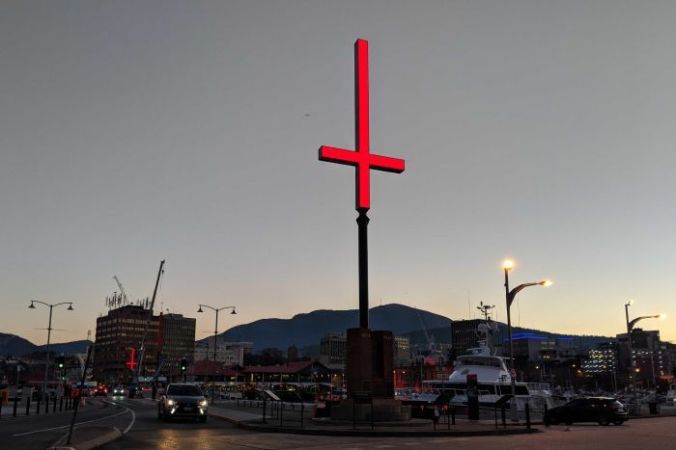
Last month a friend was about to visit Hobart and asked me whether it was worth visiting the Mona (Museum of Modern Art in Hobart). At first I thought he said MOMA, and so I proceeded to give a rapturous endorsement of this famous art gallery in New York City. He then clarified that he had said Mona and not Moma, at which point I was no longer able to help him. Perhaps there is a vibrant contemporary art scene in Tasmania, perhaps not. But then today, as I peered outside my Melbourne window and across Bass Strait, the distant feint red glow of upside down crosses didn’t succeed in turning around  my opinion about Tasmanian art.

9845166-3x2-700x467 (1).jpg

ABC

This is art? I realise that in Tasmania, the ministry of the Arts is combined with Justice, Correction, and the Environment. Was someone in the ministry confused when they opened the public purse? Or is Tasmania introducing a new form of justice and correction?

These so called ‘Crosses of Saint Peter’ look more like half assembled mood lights from Bunnings, rather than works of art. Then again, perhaps I’m being unfair to Bunnings!

Dark Mofo is a winter solstice festival, which aims to shock and to subvert. Last year, the Festival caused controversy in its ‘artistic’ use of slaughtered bulls, with blood and guts smeared all over people. This year, there is an anti-Christian theme, which would be innovative and interesting, except that it’s not. It’s kind of old and tried, about 2000 years so,  and sticking a few coloured LEDs onto  crosses is somewhat pedestrian.

Speaking of which, also appearing during the Dark Mofo Festival, is another artist, Mike Parr, who is going to bury himself under a road for three days. It’s unlikely though that his performance will have the same energy and excitement as the real resurrection, given that he’s not actually dead, and presumably he’ll need to eat and drink and poo and sleep. The more pressing question is this,  how is Mr Parr going to assess the critics reviews? Is trampling and driving over his ‘grave’ a sign of critical acclaim or of people expressing disinterest in the stupidity of the stunt?

Going back to these disco coloured inverted crosses, not only are they advertising an absence of artistic creativity, surely this project is a theological and social misfire.

The sight of these crosses is upsetting some Christians around Hobart, and I understand their reasons. Indeed, for millions of women and men around the world, they are being imprisoned and even killed because they love and believe the message of the cross, but why we would allow such facts to interrupt the creative processes. More so, I also think that once we’ve taken a step back, we can evaluate these cultural illuminatatis in a different way.

In his interview on the ABC, Mikey Lynch said it well,

“My immediate reaction was a bit of an eye roll — here we go, a shock jock statement that gets Christians grumpy.

“It’s a religious symbol and so for some people it is precious, so of course people are going to find that hurtful.

“For Christians, the cross is a symbol of shame and it’s about God taking on shame for the salvation of the world, so there’s a weird irony in getting offended by a symbol which in itself is offensive.”

These artists are taking what is the most offensive object of history, the cross, and are attempting to make some subversive statement about Christianity and to offend Christians in the process. Really? Let’s shame the symbol of shame? Perhaps the point has escaped the genius of these Dark Mofo artists, because surely their own subversive and unoriginal interpretations of the cross in fact reinforces the original point that was proven on the cross.

The Apostle Paul put it most aptly when he wrote,

“18 For the message of the cross is foolishness to those who are perishing, but to us who are being saved it is the power of God. 19 For it is written:

“I will destroy the wisdom of the wise;
    the intelligence of the intelligent I will frustrate.”

20 Where is the wise person? Where is the teacher of the law? Where is the philosopher of this age? Has not God made foolish the wisdom of the world?21 For since in the wisdom of God the world through its wisdom did not know him, God was pleased through the foolishness of what was preached to save those who believe. 22 Jews demand signs and Greeks look for wisdom, 23 but we preach Christ crucified: a stumbling block to Jews and foolishness to Gentiles, 24 but to those whom God has called, both Jews and Greeks, Christ the power of God and the wisdom of God. 25 For the foolishness of God is wiser than human wisdom, and the weakness of God is stronger than human strength.” (1 Corinthians 1)

Tasmania may be disconnected from the mainland by 500km of water, but apparently there also exists an ocean separating the Dark Mofo team from the world of art. Artists of Tasmania, please paint and sculpt, and resurrect what remains of your reputation.

They have may failed to set the art world alight, but these winter solstice revellers have given Tasmanians a new reason to ask questions about the cross. What a great conversation starter for Christians in Hobart this week.

Melbourne Baptist Church Hosts Same Sex Wedding

A story broke on DavidOuld.net this morning, naming a Baptist Church in Victoria which has recently opened its building to host a same sex wedding.

The focus on DavidOuld.net is of several ordained Anglican ministers from the Diocese of Melbourne who were present at the ceremony, and who appear to have formally participated during the service. It is not currently known who the official celebrant was, but presiding over a same sex marriage is a violation of the government marriage licence for both Anglican and Baptist clergy. Anglican and Baptist marriage celebrants can only conduct weddings according to the marriage rites of their said denomination.

According to the Baptist Marriage Rites, marriage is “the union between a man and a woman to the exclusion of all others, voluntarily entered into for life.”

My concern is the news that a Baptist Church in Melbourne has hosted this wedding, and it appears as though at least one ordained Baptist minister was involved. This doesn’t project a view of Victorian baptists that will adorn the Gospel of Jesus Christ.

Screen Shot 2018-05-28 at 11.14.14 am.png


Community Church of St Mark belongs to the association of Churches that is the Baptist Union of Victoria. I cannot imagine that they would have received permission from the BUV to conduct a same sex wedding on their premises. Such permission is not however required as local churches have significant autonomy.

There is a question as to whether the Community Church of St Mark rented out their building to a third party or were  formally hosting and supporting the event? In one sense, that distinction is a matter of semantics, for either option is a clear promotion of same sex marriage. Footage of the wedding procession clearly shows the banner of St Mark’s being paraded, thus indicating at least some involvement by the Church. In addition, an ordained baptist minister was also present and part of the procession, and it appears that she was involved in a formal capacity.

Why does this matter?

It is important for baptists for at least these two reasons:

First, Community Church of St Mark have misrepresented what Baptists believe about marriage. They have welcomed teaching and have blessed a view of marriage that contravenes the clear doctrinal position of the Baptist Union of Victoria. In so doing, they are sending confusing messages to local communities as to what Baptist believe about marriage, and in so doing they are leading people astray from God’s good purposes. 

Second, Churches who are affiliated with the BUV are in relationship with each other. There is rightly a significant degree of autonomy given to each church, however an association is not arbitrary or meaningless. Without clear theological common ground that is affirmed and practiced, churches can’t work together. To what point can we share an identity together when that name is being misrepresented in such grievous ways?  The question is, should our Baptist Churches allege unity with another Church who has decided to act against Baptist doctrine? Is it appropriate to call Community Church of St Mark to repentance?

The issue of marriage is not unimportant or secondary in the Bible. Indeed, during last year’s plebiscite debate advocates made it clear that they believe it’s about human rights and amending one of the great social evils in our country. For Christians, our Scriptures define sexual relations outside of heterosexual marriage as porneia, it being alongside many other activities which prevent people from entering the Kingdom of God. The Apostle Paul includes homosexual activity as being “contrary to the sound doctrine  that conforms to the gospel concerning the glory of the blessed God, which he entrusted to me.” If the Bible defines this as a Gospel issue, then it is incumbent upon us to do so as well.

This morning’s news is incredibly sad but unsurprising. For some time there have been baptist clergy and churches agitating to redefine marriage and to be given permission to formally conduct same sex weddings. These numbers are small, only representing tiny fraction of the BUV, but they are persistent. We are being naive if we believe that this matter will eventually blow over and that these advocates will simply give up.

A precedent can easily become a pattern if we don’t speak up.

As it currently stands, Baptist marriage celebrants cannot conduct same sex weddings. The position for churches is however somewhat murky. The spirit of the law suggests that a Baptist Church should not facilitate a same sex marriage, either by renting out their building or by inviting a secular celebrant to preside. However, the strict letter of the law does not (to my knowledge), prohibit this practice. This ambiguity needs to be attended to and fixed in the near future.


Update (Monday 7pm): I can now confirm that the officiating celebrant was Rev James (Jim) Barr. Rev Barr was formerly the Senior Pastor at Collins St Baptist and at Canberra Baptist. He is now a Welsh Methodist credentialed minister, and thus no longer holds a baptist licence. It is however unclear how how substantive his role was in this service, given that Baptist and Anglican clergy were also participating. In other words, one question is answered, but the original concerns remain, and they are substantive concerns for Baptists and Anglicans alike.

Should we speak of “Bible Believing Christians”?

“Jesus answered, “It is written: ‘Man shall not live on bread alone, but on every word that comes from the mouth of God.’” (Matthew 4:4)


Yesterday I was accused of making a “serious” category mistake in theology, namely to speak of “Bible believing Churches”. Geoff Thompson, who teaches Systematic Theology at the Uniting Church’s college here in Melbourne, wrote a respectful critique of my recent article on Bishop Michael Curry and his royal sermon.

The focus of Thompson’s piece was on a phrase I used, “Bible believing Church”. I was encouraging people who were struck by the wedding sermon to seek out a Bible believing and Jesus loving Church, as opposed to one that is not. Geoff Thompson has taken issue with my encouragement, saying,

“Christians are not called to ‘believe’ the Bible; they are called to acknowledge its authority, and to listen to it through the filter of the gospel proclaimed by Jesus. It is a serious category mistake to talk about ‘believing’ the Bible.”

I certainly agree with his statement about acknowledging the Bible’s authority and interpreting Scripture through the Gospel of Jesus Christ, but those things do not denude the phrase, ‘Bible believing’, in fact, they accurately reflect part of what it means to be a Bible believing Christian.

Does Geoff Thompson have a case? To answer, I thought, well, what does the Bible say? Let’s take some examples,

“And we also thank God continually because, when you received the word of God, which you heard from us, you accepted it not as a human word, but as it actually is, the word of God, which is indeed at work in you who believe.” (1 Thessalonians 2:13)

“By this gospel you are saved, if you hold firmly to the word I preached to you. Otherwise, you have believed in vain”. (1 Corinthians 15:2)

“After he was raised from the dead, his disciples recalled what he had said. Then they believed the scripture and the words that Jesus had spoken”. (John 2:22)

“I look on the faithless with loathing, for they do not obey your word”. (Psalm 119:158)

“And now you will be silent and not able to speak until the day this happens, because you did not believe my words, which will come true at their appointed time.” (Luke 1:20)

“And because of his words many more became believers”. (John 4:41)

“Very truly I tell you, whoever hears my word and believes him who sent me has eternal life and will not be judged but has crossed over from death to life.” (John 5:24)

“Don’t you believe that I am in the Father, and that the Father is in me? The words I say to you I do not speak on my own authority. Rather, it is the Father, living in me, who is doing his work.” (John 14:10)

“The apostles and the believers throughout Judea heard that the Gentiles also had received the word of God”. (Acts 11:1)

It is clear from these verses (and many others could have been used) that God wants us to believe his word. Accepting and trusting the Bible (which is God’s word) not only pleases God, it is one of the ways God differentiates between his people and those who are not. Indeed, when his people reject his word, he calls them to repent and to return to the word. Receiving, believing, and obeying the word is one of the Bible’s ways of describing who is Christian.

IMG_0302.JPG


This word is from God and is about God, and especially his son Jesus Christ.  God’s call to believe his words, both Old and New Testaments, is never merely about intellectual assent, but is about understanding, trusting, desiring, and obeying. In fact, prior to our response the word, the word must firstly begin a work in us, as the book of Hebrews declares,

“For the word of God is alive and active. Sharper than any double-edged sword, it penetrates even to dividing soul and spirit, joints and marrow; it judges the thoughts and attitudes of the heart.” (Hebrews 4:12)

The word is not only God working in the human heart but it is God saving, creating, and ruling. More than that, as many of above Bible references explain, when Jesus, the Apostles, and the Prophets talk about believing the word, they don’t divide belief in the word and belief in God; to trust in the Scriptures is to believe God.

In short, the Bible does talk about believing the Bible and it does so in a very positive and necessary way. To speak of Bible believing Christians and Churches is one way of talking about men and women who accept the Bible as God’s authoritative, true and good word, and who now commune with God by his Spirit through his word about his Son. 

Wouldn’t it be odd for someone to respond, “Oh that’s not Murray, that’s just his words…I believe in Murray, but not his words.”

Yes, there is a question of ontology, but nonetheless, we don’t divorce a person from their words. What does the Apostle Paul say to Timothy?

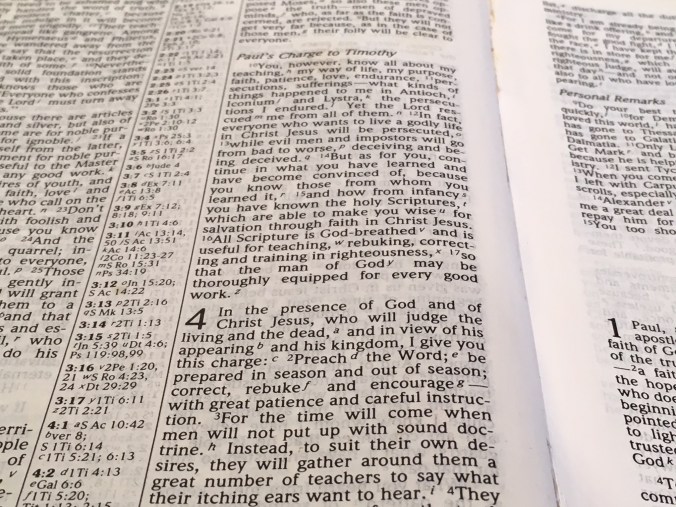
“14 But as for you, continue in what you have learned and have become convinced of, because you know those from whom you learned it, 15 and how from infancy you have known the Holy Scriptures, which are able to make you wise for salvation through faith in Christ Jesus. 16 All Scripture is God-breathed and is useful for teaching, rebuking, correcting and training in righteousness, 17 so that the servant of God may be thoroughly equipped for every good work.”

Far from being a category error, “Bible believing Church” is a phrase which accurately reflects the Bible’s own presentation of the relationship between God, His word, and his Church. It doesn’t say everything, and neither is it intended to. Like any Christian idiom, it can be misappropriated, but that doesn’t mean it’s theologically wrong or misleading. Yes, it is possible for someone to believe the Bible is true or useful without having personal faith in Jesus Christ; our society is filled with such people. But is this what we mean when referring to Bible believing Christians and Churches? The only people I know who might talk about being Bible believing are those who have a living faith in Jesus Christ. If anything, it could be used, not adjectively, but as another way of describing a Christian.

The real question is, why do some Christian scholars want to discourage this identity marker?  Why is it the case that when God can define his people as those who believe his word, there are Christians telling us that it’s wrong to describe ourselves as Bible believing? Geoff Thompson explains, it’s because he doesn’t agree with my interpretation of the Bible. No doubt, the task of interpreting the Bible is incredibly important but that doesn’t mean it’s “seriously” wrong to talk about “Bible believing Churches”.

He argued, “When a church presents itself as ‘Bible-believing’, it is often a fairly blunt proxy for legitimating its interpretations of the Bible without acknowledging that they are interpretations.”

While that can be the case, it doesn’t have to be, and normally it is not. Thompson’s argument is more red herring rather than substantive.

On the other hand, when it comes to hermeneutics, the opposite can be true, “when a church wants to teach and practice revisionist morality, they often present the Bible as having many and varied meanings and we should accept validity in all interpretations.” Indeed, some are honest enough to admit that they no longer believe in certain parts of the Bible. 

I don’t know Geoff Thompson or the hermeneutical grid he uses to interpret the Bible, and how broad his theological canvas is in accepting divergent interpretations, so I won’t offer speculation. My purpose here is not to delve into those questions (as important as they are), but it is to correct the alleged correction, that it is wrong to speak of “Bible believing Churches”. Do we not want our Churches believing the Scriptures? I certainly pray so.