When talking about hell…

When I went to sleep last Thursday I didn’t expect to wake and find that the topic of hell had become a national conversation piece. While we cannot control the public conversation with all its warts, snidery, and well-meaning contributions, we can take responsibility for how we speak about what is a grave issue; the eternal state of people.

With a sense of humour reminiscent of Nero plucking his harp while Rome burned, columnist for The Sydney Morning Herald, Greg Growden, wrote,

“Folau’s version of hell, surrounded by drunks, homosexuals, adulterers, liars, fornicators, thieves, atheists and idolaters, actually sounds like good fun – especially if it excludes narrow-minded sporting identities.”

I don’t know anyone who enjoys talking about hell. It is a truly horrific subject. This doesn’t mean that we avoid or downplay what the Bible teaches, it does, however, necessitate that approach the topic of hell with great care and earnestness.

Unbelievers are poking fun at Israel Folau’s comments on hell with hackneyed jokes and Memes. There are Christians squirming uncomfortably as though a cactus needle were stuck erect in their chair. Hell makes people angry and dismissive, generating a range of negative reactions. So, how should Christians approach the subject of hell?


Screen Shot 2019-04-11 at 9.30.10 am

Here are 4 words of advice for talking about hell

1. Be biblical

Hell is a Christian doctrine. Hell (or Gehenna) is taught and affirmed in the Bible as a real place of eternal judgment. This notion of a final judgment is included in the historical Christian Creeds and Catechisms, as well as in doctrinal statements for Christian churches throughout the ages. Such as …

He will come to judge the living and the dead. (Apostles Creed)

What is the misery of that estate whereinto man fell? A. All mankind by their fall lost communion with God are under his wrath and curse, and so made liable to all the miseries of this life, to death itself, and to the pains of hell forever (Westminster Shorter Catechism, Question 19)

The resurrection of the dead, and the final judgment of all people by the Lord Jesus Christ. (article 8, Baptist Union of Victoria Doctrinal Basis)

Jesus taught about hell frequently, and as others have observed, the topic was on Jesus’ lips more than anyone else in the Bible. In his own words …

“Do not be afraid of those who kill the body but cannot kill the soul. Rather, be afraid of the One who can destroy both soul and body in hell.” (Matt 10:38)

“But the subjects of the kingdom will be thrown outside, into the darkness, where there will be weeping and gnashing of teeth.” (Matt 8:12)

 “‘Depart from me, you who are cursed, into the eternal fire prepared for the devil and his angels…  “Then they will go away to eternal punishment, but the righteous to eternal life.” (Matthew 25:41,46)

While Bible writers, Jesus in particular, use various metaphors and analogies to convey the awfulness of hell, they do so, not to obscure its reality, but to communicate the finality and dreadful realism of what hell signifies. There is no benefit in Christians downplaying the Bible’s teaching on hell or concentrating on speculations and theories of what hell may or may not be: the Christian’s responsibility is to be biblical. By that I mean, read, understand, and communicate what the Bible teaches about hell. In talking about hell, use the range of words and reasoning that is offered to us in the Scriptures—not ignoring the contexts and arguments in which the concept appears. Such diligence will aid us in speaking of hell accurately and helpfully.

Indeed, it is difficult to explain the Christian Gospel without reference to judgment, given that the Gospel is about redemption from Divine judgment. Whereas we tend to view the Gospel through the lens on anthropological needs and problems, the Bible also views salvation in light of Divine categories (justice and the right satisfaction of God’s righteousness). We obscure God’s glory and we diminish the human condition when we ignore or downplay this doctrine, like a Doctor talking of a patient’s terminal cancer as though it was a bruised knee.

2. Be loving and earnest

Speak about hell with soberness and with tears. Talking about hell isn’t judgmental; it is an act of love. Of course, people can speak about hell in a judgmental and unhelpful way, but people can also explain the Bible’s teaching on hell with sincerity and clarity because they love their friends and neighbours.


3. Appeal to notions of ultimate justice

The Bible doesn’t present hell as a Russian gulag; unjust, mean, cruel, and unnecessary. It is, rather, a just outcome and the place where people prefer to be. The natural consequence of life lived for self. While Greg Growden and others might joke about Folau’s list of transgressions and how many they have broken, the reality of such things is far from funny. Marital unfaithfulness destroys lives and families. Lying breaks the bond of friendship. Theft is a betrayal of trust and leaves victims frightened, and at times, financially destitute.

Our nation, for all its blessings, is filled with extraordinary pain and sorrow caused by the greed and hate of its citizens. We are governed by thousands of laws because we don’t trust one another and because we feel the necessity to guard ourselves against each other. Our judicial system, for which we should be thankful, is not beyond making mistakes and many who perpetrate crimes escape justice, and many of the deepest wounds are not the result of criminal activity but moral and personal assault. Where is the justice for such?

Our nation, for all its blessings, is filled with extraordinary pain and sorrow caused by the greed and hate of its citizens. We are governed by thousands of laws because we don’t trust one another and because we feel the necessity to guard ourselves against each other

Do we not long for a justice that is altogether right and comprehensive? Do Australians not hope that no evil will escape the attention of justice? I suspect that there are very few Australians (no matter what their religious beliefs) who do not (at least on some scale) believe or wish they could believe that hell exists for some people. One of the things the Bible does is to show us that the problem is not only external and persistent in society, but it derives from hearts that seek to define life without God: the problem lies within each of us. In other words, we may desire justice when others are guilty, but we long for mercy we realise our own guilt.

The point is, God offers justice, the kind of justice the world is ultimately looking for, and yet paradoxically does not wish to be true.

4. Don’t forget the gospel

Our message isn’t merely hell, our message is the good news of Jesus Christ, which includes salvation from hell, and the forgiveness of sins and the gift of justification, regeneration, adoption, and eternal life. The Gospel is good news because what is deserved is taken from us and what is undeserved is given to us by God as his gracious and loving gift

We will never turn to God and seek his mercy unless we first appreciate our personal culpability and accountability before a holy God. There is no genuine turning to Christ without a manifest awareness of guilt. The gospel tells us both the bad news of our sin and judgment; and the glorious antidote to that judgment in Christ. As the writer of Hebrews summarises things:

Just as people are destined to die once, and after that to face judgment, so Christ was sacrificed once to take away the sins of many; and he will appear a second time, not to bear sin, but to bring salvation to those who are waiting for him. (Hebrews 9:27-28)

Or, as Luther puts it in his earthy and practical way:

When the devil throws your sins in your face and declares that you deserve death and hell, tell him this: “I admit that I deserve death and hell, what of it? For I know One who suffered and made satisfaction on my behalf. His name is Jesus Christ, Son of God, and where He is there I shall be also!” (Martin Luther)

Was Israel Folau guilt of hate speech, as many are arguing? He may be guilty of breaking his word by continuing to post such comments. But are his comments bigoted? If connecting a list of sins with hell is akin to hate speech, it doesn’t take much imagination to work out how our society would view Jesus Christ. Connecting sex outside of heterosexual marriage with the language of sin and hell is not inherently anti-social and anti-people; it comes from the conviction that not every action and not every attitude is good or right. Australia’s problem is that we’re suffering from Judges syndrome, everyone wants to “do what’s right in their own eyes.” Such attitudes have become mainstream platitudes. And now we want to send Izzy into the eternal Rugby exclusion zone for daring to suggest that it might lead to disaster.

The danger for most Christians today isn’t that we make too much of hell, but that we think too little of the Bible’s teaching on hell. We may not have a conversation about hell every week, but if we never talk about it, our friends would be right to wonder, do these Christians even believe what Jesus says?

Israel Folau Charged with Social Blasphemy

Israel Folau is in trouble once again for espousing views that are in line with 2,000 years of orthodox Christianity. This is not the first time that he garnered the fury of the cultural watchdogs and has found himself reported to the governing authorities of Rugby Australia.

Yesterday, Folau posted 2 comments on Instagram which garnered immediate anger and disappointment, such that it is the subject of newspaper articles and television reporting today.


Israel Folau is one of the great rugby players that Australia has produced in the past 20 years. His reputation on the field has excited spectators, and off the field, he has defied cultural messaging and created national consternation: what to do with a national sporting star when he won’t conform to the moral narrative of today’s Australia?

Here are 5 thoughts:

1. Social media is a problematic medium.

I am increasingly convinced that social media is not a particularly constructive medium for conveying important messages. Pithy statements are too often misunderstood and taken out of context. On this occasion, the issue isn’t that people are misreading Folau, but that he hasn’t said enough. A photo on Instagram or a 240 character tweet often doesn’t suffice. I don’t offer an answer for resolving this perpetual problem with social media, but I am observing that it does exist, and it is a problem not only for people we agree with but also among those with whom we disagree.

Perhaps one forward step would be to ask for clarification; what do you mean by that tweet? Can you elaborate and tell me more so that I can understand where you are coming from?

2. Both content and manner matter

“Let your conversation be always full of grace, seasoned with salt, so that you may know how to answer everyone”. (Colossians 4:6)

“in your hearts revere Christ as Lord. Always be prepared to give an answer to everyone who asks you to give the reason for the hope that you have. But do this with gentleness and respect…” (1 Peter 3:15)

I am not about to lambast Israel Folau for not being as irenic as perhaps we might prefer. He certainly has more courage to speak Bible truths than do many of our Bishops and Christian leaders across the country.

What we say matters enormously. The content of our speech either reflects our deeply held beliefs or it betrays them. How we speak also communicates volumes to those who are listening. I don’t know Israel Folau nor his heart and motivation. I appreciate why some people might read his comments as coming from a frustrated or even angry man. Of course, he may well be expressing heartfelt concern and earnestness for his fellow Australians. If Israel reads this blog post, I would gently suggest that his comments could be improved if they reminded his followers of his own need and thankfulness for God’s mercy to him; Christians don’t want to give the impression that we are somehow morally or intellectually superior to anyone else. While quoting Galatians 5:19-21 Folau could also have mentioned some of the wonders and goodness that comes from knowing the transformative power of the Gospel of Jesus Christ, as Paul describes in Galatians 5. For example,

“13 You, my brothers and sisters, were called to be free. But do not use your freedom to indulge the flesh; rather, serve one another humbly in love. 14 For the entire law is fulfilled in keeping this one command: “Love your neighbor as yourself.”

The good news of Jesus Christ is salvation from hell and it is salvation to a new and better life. The Gospel is the greatest story ever told and it is one that can become my own as I accept God’s assessment of me and trust God’s answer for me.

FOLAU_PV3_1280x560-1

3. Don’t expect the culture to endorse the Gospel of Jesus Christ.

This shouldn’t surprise because it is, after all, the Bible’s own presentation of humanity. People don’t accept God on God’s terms. Instead, humanity has a very long history of showing intent to redefine and deconstruct God’s righteousness in order to justify their own moral proclivities. The Apostle Paul’s words remain true today,

“To the one we are an aroma that brings death; to the other, an aroma that brings life. And who is equal to such a task?” (2 Corinthians 2:16)

The Christian message is both compelling and repellent, attractive and offensive. We should present the good news of Jesus Christ with clarity and kindness and with unction, and still, there will be people who object and are even angered. Remember the greatest Christian preacher and apologist of all time, Jesus Christ. No one spoke a more compelling story than Jesus and yet the social elite could not tolerate him, not least because he would not abide by the sexual ethics of the day.

The media are particularly upset by Folau including homosexuality in his list of sins. Had he limited his list to adultery, lying, and stealing, people might have laughed but we wouldn’t see the kind of reaction that we’re observing today. Folau’s heresy is that he doesn’t fully and without qualification, affirm LGBTIQ lifestyles. He contravened the moral law of the land and no one, not even a sporting great, is allowed to get away with such blasphemy.

The response in the media and by Rugby Australia’s need to have the matter investigated once again highlights our society’s view of Christianity. Effectively what Israel Folau has done is quote the Bible and summarise part of the Gospel message. Are we really at the stage in Australian society where Australians are to be publicly castigated for quoting the Bible? Are we prepared to enter that ominous space where nations like North Korea, Saudi Arabia, and China, already belong, namely to prohibit Bible verses and Christian messaging? Are beliefs consistent with 2000 years of Christian faith now to be defined as hate speech?

The reality is, the only version of Christianity our society is willing to accept is a Christianity that has all its edges cut and its heart and skeleton removed. The only acceptable Christianity is a dead Christianity, where Jesus is no longer Lord and where he doesn’t need to save because we are without sin. Jesus is nothing more than the candyman, handing out spiritual tips to people who haven’t yet grown up and realised that the world is without ultimate meaning and design.


4. Society wants to control religious speech

The word on the street today is less about Israel Folau holding his beliefs or not everyone is saying that he shouldn’t have freedom to speak his views. The message being proclaimed by commentators including Peter FitzSimons is  that Folau’s contract must be terminated,

“His contract will be suspended or terminated on the grounds of having breached either rugby’s social media policy or his contract.

Rugby Australia simply has no choice.”

In other words, you have the freedom to speak but should your words fail the test of modern secularist orthodoxy, your words will cost you.

The headline in today’s Fairfax newspapers is telling,

“Until Folau repents, Australia has no choice but to let him go”.

This is only the latest of a growing number of examples of Aussie Christians facing job loss and financial cost for choosing Jesus. There is no tolerance, no accepting of religious opinion that deviates from the proscribed agenda. There is only space for the dogmatic preaching of conformity to the storyline of authoritarian secularists.


5. Jesus was serious when he spoke about taking up a cross and following him

Notice the deathly silence from Christian leaders once again, as we squirm with the uncomfortable knowledge that we agree with Izzy even if we would say things a little differently. This is another awkward day for Aussie Christians because one of our own has let the cat out of the bag, and if we’re being honest, we’d prefer if he hadn’t. I wonder, what does this say about us?

At the time when Israel Folau was the subject of similar controversy last year, I wrote

“As a nation we are struggling to cope with societal pluralism. Sexuality has now been defined in such strong terms, that alternative views, as reasonable and loving as they may be expressed, are now perceived as evil and unacceptable. It’s reached the point that sporting codes are now making theological commentary, and assuming a position on hell. Unfolding before us is another test for Australian society. Are we serious about religious freedoms and freedom of speech, or does the rhetoric only apply when beliefs fall into line with the new sexual morality? Do we accept that millions of Australians don’t subscribe to the now popular view on marriage and sexuality, and that these Australians have a right to express their opinions? While politicians and company CEOS and sporting organisations wrangle over a position on religious freedom, it is even more important for Australian Christians to be thinking through these issues. What do we really believe? How can we best communicated what we believe? What are prepared to lose for the sake of knowing Christ Jesus as Lord?”

Even though Folau’s sporting future remains uncertain, his testimony presents a challenge to the rest of us Aussies who profess faith in Jesus Christ. Would we be prepared to walk away from job security? Would we be willing to give up a lucrative income? Are we ready to embrace public abuse?

Our Bible text for this Sunday at Mentone Baptist Church is Matthew 16:13-28. Following Peter’s confession that Jesus is the Christ, Jesus began to explain that he must suffer and die. When Peter rebuffed Jesus for suggesting such a crazy idea, Jesus then explained,

“Whoever wants to be my disciple must deny themselves and take up their cross and follow me. 25 For whoever wants to save their life will lose it, but whoever loses their life for me will find it. 26 What good will it be for someone to gain the whole world, yet forfeit their soul? Or what can anyone give in exchange for their soul? 27 For the Son of Man is going to come in his Father’s glory with his angels, and then he will reward each person according to what they have done.”

Do we love our sport more than we love Jesus? Is our pursuit for social acceptance more important to us than loving our neighbours as Christ has loved us? 

When Jesus spoke about taking up a cross and giving up the world’s offerings, he wasn’t speaking rhetorically. Perhaps it is time for Christians in Australia to begin pondering his words and examine our own hearts and ambitions.


Update: Rugby Australia have announced that they are terminating their contract with Israel Folau (April 11th, 6:30pm)


Update April 14th

It’s important to relay important information when it comes to light so that I’m not misrepresenting the facts

  • Rugby Australia remain intent to sack Folau, however, the argument is being made by legal experts that this may not be possible as RA haven’t followed their own code of conduct when it comes to disciplining players
  • More important, someone has brought to my attention that Folau seems, at the very least, to be confused by the Christian teaching of the Trinity. His comments on the Trinity that have been shared with me are troubling, to say the least. This doesn’t negate the 5 points made in this post, but it may cause us to reevaluate Folau’s understanding of Christianity.  I suspect that many Christians, in explaining God, fall into one Trinitarian heresy or another, simply because they haven’t been taught the Scriptures well. Perhaps he needs a Christian brother to get alongside him and disciple him with a Bible in hand (don’t we all?). The doctrine of the Trinity, however, is too important, too central to the Christian faith, for us to ignore.
  • A few voices are now suggesting that Folau made a verbal agreement with Rugby Australia not to post such comments again on social media (I don’t know whether this is accurate or not). If that is true, then he has acted dishonestly and it is appropriate for Rugby Australia to sanction him. It also remains the case that it is inappropriate for RA to make such religious demands of its players, especially given there are examples where other players have publicly commented on similar issues, albeit for a different point of view to Izzy. 

A Mural and a Sign: Two Messages for Melbourne

A mural has appeared in Melbourne’s famous Hosier Lane. I’m not sure whether it’s commemorating or celebrating the egging of Senator Fraser Anning, but it’s there and no doubt it’ll gain national if not international attention by tomorrow morning.

It was only last night that I realised that this incident took place just up the road from where I live and from where my church is located. Frankly, I felt sickened that in my neighbourhood an event took place which is being described as an extreme right-wing political meeting.


Egg boy mural.jpg

Photograph V.T Rudd

The egging was a 17-year-old boy’s response to Senator Anning’s comments about Friday’s terrorist attack in Christchurch, where 50 Muslims were murdered as they prayed in two separate Mosques. Senator Anning suggested,

“The real cause of bloodshed on New Zealand streets today is the immigration program which allowed Muslim fanatics to migrate to New Zealand… The entire religion of Islam is simply the violent ideology of a sixth century despot masquerading as a religious leader.”

He then had the audacity to misread and misapply the Bible as a proof text. Dr Andrew Moody has written a helpful article which explains what Jesus is saying, as opposed to the message Anning is communicating.

I find Senator Anning’s comments morally repugnant. As an Australian, I wish we would be more welcoming of refugees. I spoke to someone over the weekend who works among some of the poorest and more oppressed peoples in the Middle East. They reminded me of the continued needs that thousands of Christians, Muslims, and Yazidis have, who are looking for a new home, a place that is safe and where they can raise their families without bloodshed.  Also, as a Christian who is serving in a church literally down the road from Moorabbin, I find Anning’s use of Jesus’ words repellent.

Like many Australians, I understand why a 17 year old boy might be tempted to ‘egg’ the Senator when the opportunity arose. If I was 17 years old and the supermarket was close by, I might also be tempted to do likewise, but surely we don’t correct one wrong by making another, even if it a relatively harmless egg.

What has been equally sad in the midst of a grief that so many New Zealanders are experiencing this week, is to see politicians, journalists and social commentators throwing their own rhetorical eggs at each other, lobbing insults from left to right and from right to left. If tragedies like Christchurch are unable to bring communities closer together, we have drifted into an unseemly place in our society. It has reached levels where I prefer not to check my twitter feed, and where reading the opinion pages leaves one feeling more disillusioned and disappointed. I don’t think it’s because we have forgotten how to speak civilly and how to show respect by carefully listening to each other, it’s that we don’t want to, and when people do try they are often shouted down with a torrent of verbal insults. The aim of the day is to win the argument by shouting louder and making oneself appear more morally outraged than others.

A few minutes drive south from Moorabbin along Nepean Hwy and with a left hand turn into Mentone, there is a sign which has been displaying its message for 50 years. Thousands of cars drive past this sign every day, although I suspect most people take little notice; it certainly won’t gain the attention that the mural will receive. I understand why. However, the message does grab the attention of some people. At Church yesterday, a man shared his testimony before the congregation and explained how he was driving past Mentone Baptist Church a few years ago and the message on this sign stood out to him and left him wondering about his own life. He eventually started to attend the Church and he became a Christian, his life turned dramatically, and yesterday he and another young guy at Mentone were baptised down at Parkdale Beach.

The message he saw reads, “Jesus Saves”. It is simple and beautiful, its meaning is ancient and yet also current, it both repels and compels, it creates questions and gives an answer. The message is very different from the mural on Hosier Lane that is imprinting the Moorabbin incident onto the city landscape. In a couple of years time only a few people will remember the egging and by then the mural will have been painted over many times. But the good news message of Jesus Christ will still be here, not because there’s anything special about the sign at Mentone Baptist, but because He is that good. It is a message that not only stands against racism but all manner of thinking and living that deposes goodness and truth and life. It is a message that not only signals fault but speaks of an extraordinary and undeserving redemption.

“For God so loved the world that he gave his one and only Son, that whoever believes in him shall not perish but have eternal life.” (John 3:16)


IMG_6840.jpg

Can I be a Christian and a Marxist? A Qanda

I haven’t watched Q&A for some time. The predicable lineup of guests, questions, and interventions by Tony Jones has made the program rather dull. But given the interest that the ABC was generating with Jordan Peterson’s invitation onto the panel, I thought perhaps it was time for a revisit. Not that I’m a Peterson devotee, but at least he speaks his mind and is not afraid to challenge newly adopted cultural norms.

Did the show live up to the hype? Probably not. I suspect the tone of conversation was more civilised than producers were hoping for—even to a fanciful extent, when Terri Butler MP, insisted that no one in Australia is shut down or squeezed-out for speaking their mind. Had she forgotten what happened when Tim Wilson and Andrew Hastie sat down with a Coopers beer and started a friendly conversation about gay marriage? Has no one shared with Ms. Butler how difficult it is for cultural conservatives (especially Christians) to retain faculty teaching positions in Australian universities today? Could someone at least share with her the stories of families who are being forced out of the public school system because of the social engineering programs that are being forced fed on our children?

QandA.png

Leaving that aside, I was interested in what each of the panelists said when answering one of the final questions for the evening: “do you believe in God?”

What a great question. I listened to each of the responses. With responses ranging from agnosticism to deism, it was a reminder that hardline atheism is not as prevalent as some would make it out to be. Even politicians, psychologists, and transgender women, wrestle the notion of God. This is a question that won’t go away.

I was particularly struck by Catherine McGregor’s comment about being without a spiritual home. Catherine acknowledged the reason for this. Catherine, if you’re reading this, I would love to meet up with you over a coffee next time you’re in Melbourne. In fact, I would be keen to sit down with any of the panelists to listen to their questions and thoughts about God and to open the Bible with them and explore the Gospel together. There is no greater inquiry than this, who is God and can he be known?

Now I’m zooming in on the particular issue that I wish to comment on in this post. Tony Jones brought Van Badham into the conversation by revealing what he must have thought was a revolutionary marriage: Marxism and Christianity.

Van Badham nodded and explained that she is a Christian and a Marxist, “both at the same time … I absolutely believe in God”.

Alex Hawke, retorted, “I’m not sure you can be a Christian and a Marxist … they are mutually exclusive”.

Marxist Christianity?

Who is right? Can we hold Christianity together with Marxism? Hawke would go on to repeat the unhelpful and untrue idea that religion is a private affair, so I’m not suggesting that he is espousing a better view of God.

The question this raises is not as silly as we might think.  For example, socialism is once again finding appeal among young Australians. So when Roz Ward wrote the curriculum for Safe Schools, she announced that its purpose was to expose children to Marxist ideology.

Is Van Badham right to say that we can hold Marxism and Christianity together? I think we are right to be a little suspicious of anyone who juxtaposes Christianity with a set political ideology. It doesn’t matter whether the political views are representative of left or right, progressive or conservative, it is entirely appropriate to tread with caution.

It was Jesus who said, 

“Give back to Caesar what is Caesar’s and to God what is God’s.” (Mark 12:17)

“My kingdom is not of this world.” (John 18:36)

Jesus was not arguing for a complete separation of religion and state and of the temporal and eternal. Jesus elsewhere taught that, “The time has come … The kingdom of God has come near. Repent and believe the good news!” Also, the Great Commission doesn’t ignore nationhood and systems of Governance, but rather insists that Christ, as Lord, has the right to issue a gospel summons to the nations:

“All authority in heaven and on earth has been given to me. 19 Therefore go and make disciples of all nations, baptizing them in the name of the Father and of the Son and of the Holy Spirit, 20 and teaching them to obey everything I have commanded you. And surely I am with you always, to the very end of the age.” (Matthew 28:20)

It is important to see that, while different groups tried to box in Jesus politically and socially, he would not allow it. His political ideology is the Gospel and the Kingdom of God, not liberalism or socialism. It is prudent for Christians to step with care, for if Jesus wouldn’t permit his character and work to be defined in socio-political categories, should we? It may be argued, that aspects of Christ’s teaching can be adopted by political minds. We might find tiny pieces of Jesus’ethics at work across the political spectrum in all kinds of legislative agendas. However, we ought to express great reticence at matchmaking the message of Christianity with any political structure and ambition.

Having said that, what about the example offered by Van Badham? I suspect Karl Marx would disagree with her synthesis.

Karl Marx argued:

“The foundation of irreligious criticism is: Man makes religion, religion does not make man. Religion is, indeed, the self-consciousness and self-esteem of man who has either not yet won through to himself, or has already lost himself again. But man is no abstract being squatting outside the world. Man is the world of man – state, society. This state and this society produce religion, which is an inverted consciousness of the world, because they are an inverted world. Religion is the general theory of this world, its encyclopaedic compendium, its logic in popular form, its spiritual point d’honneur, its enthusiasm, its moral sanction, its solemn complement, and its universal basis of consolation and justification. It is the fantastic realization of the human essence since the human essence has not acquired any true reality. The struggle against religion is, therefore, indirectly the struggle against that world whose spiritual aroma is religion.

Religious suffering is, at one and the same time, the expression of real suffering and a protest against real suffering. Religion is the sigh of the oppressed creature, the heart of a heartless world, and the soul of soulless conditions. It is the opium of the people.

The abolition of religion as the illusory happiness of the people is the demand for their real happiness. To call on them to give up their illusions about their condition is to call on them to give up a condition that requires illusions. The criticism of religion is, therefore, in embryo, the criticism of that vale of tears of which religion is the halo.”

Take for example the following comparisons:

Karl Marx

Christianity

Was an atheist

Jesus believes in God and he claims to be God

Taught that belief in God is the invention of people

God is eternal and we exist because of him and for him

Claimed religion is a drug given to dull peoples senses as well as comfort them in their poverty

The Gospel is real good news of salvation that brings forgiveness and freedom and reconciliation to the living God

Christianity is dangerous

Christianity is good

The religion of revolution, with the masses toppling those in authority.

Christianity grows through preaching and prayer, loving our neighbours as ourselves

The State controls total life: commerce, education, art, sport, religion

Governments have a role to play but they are not God.

Has led to totalitarian regimes who have oppressed and murdered 10s million of people

Christianity is largely responsible for the political and religious freedoms exercised in the Western Hemisphere today. The principle of persuasion not coercion is antithetical to Marxism and foundational to the Christian Gospel.

The goal is a classless society, achieved by the masses.

The goal is the exaltation of Jesus Christ, the redemption of sinful men and women, right judgment on the world, and the bringing in of the new creation, accomplished by God alone through Christ.

Christ and the Collective Saviour

These differences are hard to reconcile. The subject has added complexity if, as some philosophers suggest, Marxism is its own religion. Raymond Aron is among many who note that communism, (the natural outworking of Marxist thought), is a “secular religion” whereby “Marxist eschatology attributes to the proletariat the role of a collective saviour”. There is no synthesis to be had between Marxism and Christianity.

Marxism, like other ’isms, asks important questions and highlights real issues that face real people. However, whether it we define it according to Marx’s own teaching, or by the embodiment of those original ideas in  130 years of history, it is pretty hard to marry Marxism with Christianity. Marxism is driven by an a-theology, soteriology, and eschatology that rejects almost every single Christian premise. There has not been a single country that has fully embraced Marxism and has also encouraged religious freedom and freedom of thought. The sum total Marxist States that support Christianity is zero. It is true that Christianity often expanded in these contexts, but this was despite Governmental oppression, not because of it.

It was a great question for Q&A, and some interesting answers were offered. I hope it might encourage other Australians to ask and seek and find God. He is better than we imagine. He may counter our expectations and agendas and supplant them with a greater love and meaning and challenge than we can imagine.

“Seek the Lord while he may be found; call on him while he is near.” (Isaiah 55:6)


I’ve posted a follow-up article in light of comments offered by a few readers – Further Thoughts on Marxism and Christianity. Can I be both?

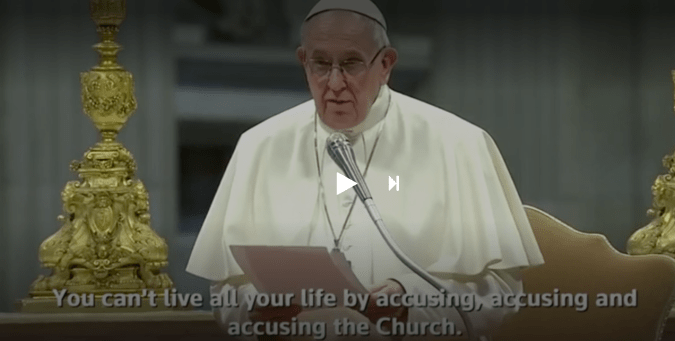
Pope Francis calls critics of Rome “friends of the Devil”

Pope Francis has accused thousands of victims and their families who have been abused by Roman Catholic priests of being related to the Devil.

Yesterday during an address given to pilgrims in southern Italy, Pope Francis said,

“You can’t live all your life by accusing, accusing,  and accusing the church. Who is the accuser? Who in the Bible is called the Great Accuser? Who is it? …The Devil.

Those who spend their lives accusing, accusing, accusing, are not the devil’s children because the devil has none. Friends, cousins and relatives of the devil and this is wrong. Mistakes should be reported to be corrected. When mistakes are reported, when flaws are denounced, the church is loved”.

Screen Shot 2019-02-22 at 10.58.49 am.png

Despite Pope Francis opening a summit for Rome’s Bishops to address these issue of abuse,  where he has acknowledged that they must fight the “enemy within” almost every element in this statement by the Pope is appalling. Mistakes? Which mistakes is he talking about? Is Pope Francis referring to thousands of priests slipping their hands into little boys genitals and asking children into having sex with them? Is he talking about the shoddy processes responsible for mishandling sex abuse allegations, or of the deliberate protection offered to perpetrators of these crimes? Even the word, ‘accusing’, which the Pope has chosen to emphasise, is a poor choice of language, for it suggests that there may be reason to doubt the claims being made and even that the person making the allegations is a troublemaker.

This is not the first time that Pope Francis has insulted the victims of abuse. In September 2018 he suggested,

“With people who do not have good will, with people who seek only scandal, who seek only division, who seek only destruction, even within families,” the answer is “silence. And prayer.”

“May the Lord give us the grace to discern when we must speak and when we must be silent. And [to do] in all of life: in work, at home, in society…” to become more closely imitators of Jesus Christ

As it says in the day’s Gospel, the people “rose up, drove [Jesus] out of the town, and led him to the brow of the hill… to hurl him down headlong. But he passed through the midst of them and went away.”

Those who drove Jesus out of the city were not people, but “a pack of wild dogs,” …They shouted instead of using reason, and in the face of this, Jesus’ response was to remain silent.”

I responded at the time by asking,

“I certainly hope Pope Francis wasn’t inferring that he is behaving like Jesus and that those asking for clarification of the allegations are not like ‘a pack of wild dogs.’”

Days later Pope Francis added,

“In these times, it seems like the ‘Great Accuser’ has been unchained and is attacking bishops. True, we are all sinners, we bishops. He tries to uncover the sins, so they are visible in order to scandalize the people. The ‘Great Accuser’, as he himself says to God in the first chapter of the Book of Job, ‘roams the earth looking for someone to accuse’. A bishop’s strength against the ‘Great Accuser’ is prayer, that of Jesus and his own, and the humility of being chosen and remaining close to the people of God, without seeking an aristocratic life that removes this unction. Let us pray, today, for our bishops: for me, for those who are here, and for all the bishops throughout the world.”

The Pope’s remarks about the Devil and abuse victims is disgusting. I cannot work out why he would continue to articulate such insensitive and even untrue statements. By them, he is accentuating the pain that is already carried by so many thousands of Catholics, and his comments make a mockery of the message that is the good news of Jesus Christ, which marks out what a Church is about.

I feel compelled to speak up because the Pope’s commentary is wrong and Christian leaders need to respond and correct his galling words. Calling for justice and for repentance is not the work of the Devil. The Devil’s work lays with those evil priests who have abused innocence, and with the bishops and cardinals who have covered over the bloody stains of these heinous acts of betrayal. Surely, demands for the Vatican to change her ways is more in line with the Lord of the Church, Jesus Christ.

What does Jesus say? “You belong to your father, the devil, and you want to carry out your father’s desires. He was a murderer from the beginning, not holding to the truth, for there is no truth in him. When he lies, he speaks his native language, for he is a liar and the father of lies.” (John 8:44)

Christ’s message to any church who uncovers sinful activity in her midst is repentance and discipline. Churches that either enable sexual abuse or protect guilty persons are not representing Jesus Christ but are defaming his name.

Have we forgotten what happened to the Church in Pergamum? Of this church Jesus said,

12 “To the angel of the church in Pergamum write:

These are the words of him who has the sharp, double-edged sword. 13 I know where you live—where Satan has his throne. Yet you remain true to my name. You did not renounce your faith in me, not even in the days of Antipas, my faithful witness, who was put to death in your city—where Satan lives.

14 Nevertheless, I have a few things against you: There are some among you who hold to the teaching of Balaam, who taught Balak to entice the Israelites to sin so that they ate food sacrificed to idols and committed sexual immorality.15 Likewise, you also have those who hold to the teaching of the Nicolaitans.16 Repent therefore! Otherwise, I will soon come to you and will fight against them with the sword of my mouth. (Revelation 2:12-16)

500 years ago there was a God-given opportunity for Rome to repent and to reform. Many Christians throughout Europe listened to God’s gracious call and they found new life and forgiveness and Churches began to flourish and through them, entire cities and regions were transformed. All the while Rome instead chose to dig in her heels. Today, once again the cries are great, and the frustration is telling.

While the Vatican persists with upholding doctrine that contradicts the beauty and truth of the Gospel, it is should not surprise us to see her continue to obfuscate issues of holiness and morality. The problems are deep, not only legal and material but also spiritual and theological. In once sense Pope Francis has rightly identified an underlying cause in Rome’s current crisis: the Devil is playing his game. But sadly and dreadfully, he is laying fault at the feet of the wrong group of people.

Bishop Curry: Preacher of love and Persecutor of the Church?

“give your servant a discerning heart to govern your people and to distinguish between right and wrong.” (1 Kings 3:9)

Who is wise? Let them realize these things. Who is discerning? Let them understand. The ways of the Lord are right; the righteous walk in them, but the rebellious stumble in them. (Hosea 14:9)


The world fell in love with Bishop Michael Curry last year as he delivered the sermon at the royal wedding. Even Christians were smiling and laughing at his wit and mesmerised at his storytelling, and nodding in agreement each time he spoke of love. He left convention behind, ignoring the stale, stuffy, and short sermonette that everyone has become accustomed to for a royal event, and he instead preached a long humorous monologue about love.

abc royal wedding


Prior to this sermon which stole the news headlines around the world for days to come, few people had ever heard of Bishop Michael Curry outside The Episcopal Church (TEC), of which he is the Presiding Bishop. Within moments of beginning his homily, social media lit up with Christians and atheists alike, gleaming and expressing likes all-round.

Some voices dared challenge the message and the preacher; I was one of them. I understood why Curry’s sermon might appeal to non-Christians; his words sounded awfully like their own secular worldview, except that he added the idea of God to the conversation. But many Christians were disappointed and even angry by the fact that some Christian leaders questioned the royal sermon. Even when concerns were more fully expressed, some swiped them away as though we were throwing mud at a great man of God.

His sermon was stamped ex cathedra, out of bounds to any criticism. He mentioned love and God, and Jesus was thrown in somewhere, so what’s the problem? Jump off the critic’s chair and join the crowds in celebrating Bishop Curry and his message of love!

Earlier this week, a story reported that this preacher of love is perhaps less loving that he has been made out to be. Indeed, he is less like Apostle Paul who wrote 1 Corinthians 13 and more like Saul, the persecutor of the church.

Christian Today has reported that,

“The head of the US Episcopal Church has taken disciplinary action against the Bishop of Albany for opposing same-sex marriage ceremonies. 

Presiding Bishop, the Most Rev Michael Curry, moved to restrict part of Bishop William Love’s ministry after he introduced a policy in the diocese last year preventing churches from performing gay weddings.” 

The Bishop famed for his sermon on love has moved to discipline a local bishop who believes in upholding the biblical understanding of marriage.

In 2015, Episcopal Church’s General Convention protected dioceses who banned the practice of same-sex weddings, but those protections were removed last year. Bishop Love has instead chosen to follow what he believes is congruent with God’s word and to guard his congregations against damaging teaching and ceremonies. Bishop Love has responded to Curry’s disciplinary action, saying that his policy reflected the official teaching of the Church that marriage is between one man and one woman, and that no resolutions from the General Convention had overridden this. 

Before anyone assumes that this is the first of such instances, Michael Curry has a history of persecuting clergy and churches who don’t support his progressive views of sexuality and marriage.

This was one of the important facts that was whitewashed amidst all the public adulations being heaped on Michael Curry in the wake of the wedding; not only does he deny the biblical definition of marriage, he presides as Bishop over a denomination which has taken its own churches to court in order to remove them from buildings and property, on account that these churches won’t cave into theological liberalism. Michel Curry has been and continues to be one of the chief protagonists responsible for fracturing the Anglican communion not only in America but worldwide.

Curry’s latest actions against a local bishop are just another example of this man who preaches love and practices persecution.

It grieves me to know that while brothers and sisters in Christ in the United States are counting the cost for faithfulness to the Gospel, many other Christians remember that royal wedding sermon with fondness. It perhaps shouldn’t surprise us, but it ought to trouble us, that with a few slick words spoken at a wedding, Christians have sided with the world and decided that Curry’s heterodox beliefs and practices shouldn’t discount the warmth people enjoyed by his presence as he stood and spoke behind that pulpit in St Georges Chapel. It’s almost as though, for the sake of lapping up a captivating presentation, we are prepared to ignore reality and to toss out God’s loving truth, even when these things are made transparent to us.

Let us pray for and learn discernment. Let us side with those who are persecuted, and not with the persecutors. Pray for the churches and clergy who remain in The Episcopal Church and remain in Christ. And ask God that he might lovingly bring Michael Curry to repentance, just as God so graciously did for Paul on that road to Damascus.

Our Summer Vacation wasn’t a time for missing out on Church

“the gospel is bearing fruit and growing throughout the whole world—just as it has been doing among you since the day you heard it and truly understood God’s grace” (Colossians 1:6)

This year we decided to escape one month of the Australian summer by heading for the northern hemisphere. Susan and I had the opportunity to take an overseas holiday with our children, and so we packed our winter coats and gloves, grabbed the passports, made a dash across the equator and didn’t stop for 18000km.

We marched up The Mall to Buckingham Palace. We joined the Tottenham hoards at Wembley Stadium for an EPL game. We toured Lord’s Cricket Ground, wandered the galleries at Tate Modern, drove through Flanders and the First World War battlefields, spent days walking through the beautiful city of Paris, eating a ridiculous amount of tasty French breads and cakes, and finally, a mountain of bbq pork and daily yum cha in the enticing city of Hong Kong. Yes, it was amazing and alluring and many other adjectives beginning with the letter ‘a’.

IMG_1150.JPG

Amidst visiting and enjoying many wonderful sights, foods, and experiences, there was something else even greater and most astonishing, something we didn’t want to miss out on. To non-Christians, this may sound daft, and sadly, even among many Christians. What could possibly outdo the many places and tastes that garnished our holiday? What beats lunch in Paris and shopping at Selfridges? Answer? It was spending time with God’s people each Sunday. That’s right, the highlight of our trip was Church.

I admit it,  I don’t leap out of bed every week for church, let alone when I’m on holidays. It’s not that I don’t want to be with church, but rather, I’m exhausted, in every sense of the word. Nevertheless, I take Hebrews 10:23-24 seriously, and I have a beautiful wife who spurs me on even when I’m lacking motivation. And after all, when Christians in China are facing arrest and imprisonment for gathering together as Church, how can I justify nonattendance because I’m on holiday?

I remind my own congregation that regularly meeting with God’s people is both a command and a comfort, an exhortation and encouragement. Just as eating food is necessary and delicious, so church for the Christian is both vital and pleasing, nourishing the soul and feeding the body. That means, we need time with God, in his word, and with his people, even when I’m on vacation.

We visited several churches during our time away: 3 in London, 1 in Lille (France), and 1 in Hong Kong. We met people for the first time, who were already brothers and sisters on account of Christ. We sat among a French-speaking Church and heard the name of Jesus sung and preached with joyful earnestness. We watched another Church not only accommodate but love special needs children in the most natural and beautiful way; their spasmodic noises and motions were not an interruption to the service but were warmly embraced as part of their worship to God.

On our final Sunday before heading home to Melbourne, we listened to a sermon which captured wonderfully a truth that we experienced throughout our time away.

An old friend, John Percival, serves as the Senior Pastor of Ambassador International Church in Hong Kong. John opened the Scriptures to Colossians 1:1-8.

I was immediately struck by verses 3- 6, which reads,

“We always thank God, the Father of our Lord Jesus Christ, when we pray for you, because we have heard of your faith in Christ Jesus and of the love you have for all God’s people—  the faith and love that spring from the hope stored up for you in heaven and about which you have already heard in the true message of the gospel 6 that has come to you. In the same way, the gospel is bearing fruit and growing throughout the whole world—just as it has been doing among you since the day you heard it and truly understood God’s grace.”

What I noticed is how the churches we visited are an embodiment of Colossians 1:3-6 (at the very least, this was our experience of them, as it is has been our joy and privilege in serving at Mentone Baptist for the past 14 years).

Each of the Churches we visited prayed for the nations and for the Gospel to advance throughout the world. They gave thanks for God’s grace at work in bringing people to Christ. The preachers pointed people to the Lord Jesus and called them to believe in him and put their hope in Christ and not the things of this world. It is always exciting to see these words spoken to a small town church 2000 years ago are still working today in the lives of congregations in different parts of the world, and knowing that it is the same Gospel at work in our own lives. And so, just as Paul thanked God for the Gospel at work among the Colossians, I am thankful to God for evidence of his grace among these churches

Our time away was beneficial for many reasons, and among them was seeing again how the Apostolic word is continuing to bear fruit all over the world, just as God said would happen. The same good news that we believe at Mentone Baptist is held by women and men 17000km away. The same message that is preached at Mentone is being proclaimed to people across continents in other languages. The same message that Paul speaks to the Colossians is, 21 Centuries later, still bearing fruit all over the world.

As in the years that have already past by, 2019 will no doubt provide us will another onslaught of church naysayers and Gospel skeptics. We’ll hear unbelievers knock the message of the cross and laugh at the notion of resurrection, and we’ll read about clergy doing the very same thing. New leadership gurus and theological “pioneers” will give advice about how we need to be more ‘radical’ and more ‘revolutionary’ in our approaches to ministry (as though innovation is the Gospel).

Instead, I have been refreshed by words that speak of a faith, love and hope that is growing among churches, born from hearing and understanding God’s grace, “true message of the gospel”. 

You see, if we had chosen the ‘easier’ path and not bothered to find a Bible-believing local church, if we had instead skipped church so that I could catch up on lost sleep or see more sights and try new things, we would have missed out on this great encouragement from God. I would have given up Divine food for stuffing myself with a few stale chips, such are medieval buildings, fashion houses, and restaurants, in comparison with what God is growing throughout the whole world.

So as I return to Melbourne and to a new year of pastoral ministry at Mentone, having enjoyed a time away and seeing God’s world and taking pleasure in many wonders of human intellectual and creative exercise. More importantly, I am reminded of the one Gospel which in 2019 will give birth to faith, love, and hope, and being reminded how these things grow together in and through the life of the local church.

The Pruning of Australian Christianity

Does God sometimes allow non-Christians to do the work Churches should be doing themselves?

God used Nebuchadnezzar and the Babylonians as a weapon of judgement against Judah, and God used Cyrus as an instrument to bring God’s people back to the land and to see the Temple rebuilt.

While we cannot say with certainty that any specific person or organisation has been handed the pruning shears by God (for the simple reason, God hasn’t told us), we do know from the Scriptures that God is concerned with cutting off dead branches, pruning lives branches, and bearing fruit in the lives of his disciples.

In John ch.15 Jesus uses one of his many analogies to describe his relationship with his people, namely that of the vine and branches.

Jesus says,

 “I am the true vine, and my Father is the gardener. 2 He cuts off every branch in me that bears no fruit, while every branch that does bear fruit he prunes so that it will be even more fruitful. 3 You are already clean because of the word I have spoken to you. 4 Remain in me, as I also remain in you. No branch can bear fruit by itself; it must remain in the vine. Neither can you bear fruit unless you remain in me.

5 “I am the vine; you are the branches. If you remain in me and I in you, you will bear much fruit; apart from me you can do nothing. 6 If you do not remain in me, you are like a branch that is thrown away and withers; such branches are picked up, thrown into the fire and burned. 7 If you remain in me and my words remain in you, ask whatever you wish, and it will be done for you. 8 This is to my Father’s glory, that you bear much fruit, showing yourselves to be my disciples.”

img_7985


There is no doubt that churches have been entangled in many scandals in recent years. Clergy have been guilty of committing terrible abuses on children, while other ecclesial authorities have at times hidden these crimes. Popular preachers have been called out for marital unfaithfulness, embezzling money, acting like mini-dictators, and saying some really dumb and unwise things relating to an array of social and political issues.

Australia has a band of public figures and journalists who are always quick to castigate, shame, and then to investigate, all manner of evils perpetrated by Christians (and by people of various kinds of religious perspectives). This is no bad thing, for why should Christians be given a jail free pass, simply because they allege a diplomatic Jesus card?

At the same time, Churches and Christians are being increasingly condemned for believing and practising things that are in line with their Scriptures. Whereas abusing children is abhorrent and aberrant to the Christian faith, believing in heterosexual only marriage is consistent with biblical and historical Christianity, and yet many do not care for such moral distinctions.

With the redefinition of marriage, only the most naive maintained that nothing would change; after all, the entire point of altering the marriage act was to create further societal change. The flow on effects has not been a flood, but it is a regular trickle and one that is far from finishing. Whether the bathroom tap is dripping slowly or water is pouring out of the faucet, the end result is the same, the sink fills up and floods the room.

Australian laws have and are changing, and the cultural narrative has is shifting faster than the writing of a cheap romance novel. Dozens of Australians have already faced the prospect of losing their jobs or businesses because of their religious convictions on marriage. Now it is religious schools who are being targeted. Indeed without carefully considered legislation,  the only religious schools that will remain in 10 years are those who have given up their convictions and fully subscribed to the religion of secular humanism. Hardline secularists will not be content to leave the agenda in the political arena or in schools. Next stop is the family home and after that, the local church. For example, if the Australian Labor Party platform becomes law, parents may face losing their children if they do not actively support a child who wishes to change their gender. Australians may soon be compelled to ignore biological fact and instead identify people according to their own chosen gender, and face anti-discrimination tribunals and prosecution should they decline to do so. And while Churches have some protections, it is delusional to conclude that teaching a Christian view of marriage will remain unchallenged by secular authorities.

Part of the problem is that the broader Australian culture has lost its cognitive awareness, rarely knowing what is and isn’t Christianity (and this blurring will only increase as Governments further squeeze out Christian education and religious freedoms); let’s return to the good old days of Pliny the Younger, who assumed the Lord’s Supper consisted of Christians eating the flesh and drinking the blood of fellow human beings! Weeds, plants, trees, and grass, all look the same, and the temptation to mow it all down is too great for some. This unfortunate and unsurprising trend toward religious ignorance is one reason why our society struggles to differentiate between the real sins in Churches and Churches who are properly exercising their faith.

Another problem is that in the world of today’s social media madness, the noise is at a crescendo, with people shouting and screaming at everything they don’t like, forgetting that not everything that they disagree with is necessarily wrong or harmful or evil. Religious and irreligious people are both guilty of the unsociable new norm, and it’s a worrying trend because when the volume reaches triple forte, it becomes near impossible to any worthwhile and important discourse.

Juxtaposed to these Metallica like screams is a deathly quiet that we find in some religious quarters. Rare moments of stillness can be of some value, but we should not confuse the appearance of saint-like silent meditation with spiritual authenticity; sometimes it’s nothing more than a magician’s trick to hide cowardice or complicity.

You see, at one level we can’t blame the culture, because it defines good and bad by its own standards, even if those moral lines keep moving around like a cat chasing a laser light. We are not expecting secular Australia to define moral goodness according to the Christian faith, because we understand, even as Jesus taught, that the two are not synonymous.

It’s not as though God’s righteousness is only true for the Church and is irrelevant to the outside world, for there is nothing in creation that escapes God’s good design and intent. The entire cosmos, including Governments, is subject to the rule of God, and yet they are in a state of rebellion, whereas the Church is meant to be a redeemed people, a city on the hill revealing the glory of Christ.

The greater responsibility lays with Churches and religious organisations, who have too often neglected the faith once for all delivered, and have instead adopted the moral and epistemological posture of the prevailing culture.

One of the persistent problems we have in Australia is with many Christian leaders failing in their responsibility. They have failed to stand for orthodox teaching. Instead of refuting bad and dangerous doctrines, these ideas are promoted and taught, or they give a silent endorsement. After all, can anyone really say that they know what the Bible says? Surely, only a puffed-up bigoted Pharisee would ever suggest that Biblical truth is clear and mandated? While far too many theologians and pastors have hired smoke machines to create ambiguity over pretty much every Christian doctrine, others have failed to act against bullies and abusers, perhaps through incompetence, and more often, through neglect or not being willing to pay the cost.

The question is if Churches are unclear about discipleship and if Church leaders are failing to fulfill their ordained responsibilities, perhaps God will employ another to do that all-important work of pruning?

I understand why some Aussies look at our backyard and conclude that religion in general, and Christianity especially, is waning. The culture has shifted, and every leaf and twig not conforming to the new pattern will be picked off for mulch. But that is to misunderstand what is happening. When a tree is pruned, it looks so bare and feeble that some might mistake it for being dead. That was certainly the reported diagnosis in the wake of last year’s national census, and with regular reminders about church closures and dipping church attendances. Is the Church dying? Is Christianity on the way out? Or is God in the process of cutting off dead branches and pruning those that bear fruit?

While many Australian Christians are concerned with happenings both inside Churches and in our surrounding communities, it would be wrong to respond with despair or hopelessness. It is a work of grace that God so loves his church that he attends to it: watering, feeding, and yes even pruning her. The vine is Jesus, and the branches are those who have been united with him. Remaining in Jesus is the only way to be fruitful, and remaining in Him is to remain in his word, namely to keep trusting and obeying his words. 

Surely we can be thankful as dead Christendom is removed from the scene, and while the culture isn’t savvy enough to discern between real and fake Christianity, the season can also be used of God to refine and prepare. In other words, pruning may hurt, but it’s good, and it’s the necessary prelude to a bumper crop. 


This is an updated piece from Sept 2018

The War Never Ends

William Campbell exchanged a coal mine for a trench, a cap for a soldier’s helmet, one shovel for another and added a rifle with fixed bayonet*.

Born in Wallsend, NSW, my great-grandfather joined the ranks of the 35th Battalion, 3rd Division, known famously as ‘Newcastle’s own’. We don’t know much about William Campbell’s experience of war. No stories have been passed on through the generation, and until a couple of years ago, I didn’t know that he had sought in the Great War.

He was shipped out to England in 1916 where the newly formed Division trained and trained and prepared to fight in France. Their commanding officer was a General who was yet to make his name, John Monash. Prior to Christmas they arrived in France and settled into a ‘quiet’ sector of the front, just east of Ypres.

6075074 (1) copy.jpeg

My great-grandfather is not remembered for any heroics. In fact, almost nothing has been recalled of his service in the First World War. He had a habit of going AWOL, and was even imprisoned at one stage for doing so. He was often sick and sent to a hospital in England. He survived the first weeks of frontline warfare, during the cold of winter and venturing on raiding parties across no man’s land. He fought at Messines, witnessing the tremendous mine explosions made famous in the film, Beneath Hill 60. Hundreds of his fellow soldiers were injured or killed in a gas attack the night before. He and the surviving members of his Battalion went over the top and drove the Germans back. Nine months later he was wounded at Villers Bretonneux, with the official war record stating that he ‘remained at duty’, but was later invalided to the UK.

I don’t know the reasons why William Campbell habitually ran off from his unit and from hospital. Was it fear? Was it an Aussie larrikinism taken to the extreme? Did his first sight and smell of battle push him over the edge? Perhaps so, but he did return to fight another day. By war’s end, he was disgraced and was never allowed to collect his medals.

This Sunday marks the 100th anniversary of the end to the war that was to end all wars. After four years of violent bloodshed, with 12 million dead (including 60,000 Australian dead), the time was set for the final volley of cannon and rifle shot. At 11am on the 11th day of the 11th month, 1918, the guns fell silent on the Western Front.

On that day William Campbell was detained in barracks and so he missed the eery and long forgotten tranquility that reappeared over Flander’s fields. Whatever his actions, both good and wrong, he went home and most of his mates did not.

This Sunday’s commemoration of the end of the First World War is worthy of attention. In part, we remember because it signifies the cessation of awful sacrifice. We must not forget or ignore the past. We should not neglect the blood of Australians that has been offered up for the security and stability of the nation. We also remember, more horrifically, that this date served as a catalyst to even greater and bloodier conflicts throughout the 20th Century: the Russian Revolution and the rise of Communism, the birth of fascism and 70 million dead of the Second World War, the so-called Cold War that piled the dead into untold millions more.

War begets war. Violence encourages violence.

Human beings have colossal value. It is why we fight so vigorously for life and it is why death appalls us so. The First World War revealed to modern man what we are capable of achieving when we are resolute. With the Enlightenment and Nietzsche’s declaration of the ‘death of God’ we did not evolve into better people, rather, we invented ways to more effectively wage war. It is true that the First World War so appalled some nations, including Great Britain, that in the 1930s they did their utmost to blow away the storm clouds of Nazism through diplomacy. War is hell, and damn to hell those who want another war.

We are being naive to believe that the world will not again witness warfare with such brutality. While recent wars may not have resulted in as great a loss of life for Western nations, we are largely ignorant of the huge numbers of casualties suffered over the last 20 years in Central Africa and in the Middle East. And this is only taking into account conflict through war, and not the many other issues that devour humanity.

We need a new paradigm for dealing with human conflict. We need an alternative narrative. The First World War reminds us of the glory and shame of humanity, and of the repeated incredulity of believing that we can be our own Saviour. Surely the First World War ought to cause us to turn from ourselves and to seek one who is greater than us and better than us, and who is loving enough to remove the greed and selfishness that is at the heart of these conflicts, and to change us and fill us with a love for our neighbour as ourselves.

Human warfare ought to provoke in us a desire for peace, and it should at the very least cause us to consider the One who claims to be the Prince of Peace. After all, if the last 100 years teaches us anything, it is that despite all our intelligence and sacrifice and our strength and ingenuity,  we are unable to produce a lasting and true peace for this world.

In the book of Revelation we are told that Jesus Christ redeems, rules and judges through the sword of his mouth, which is the word of God (1:16; 2:12; 19:15). Christians have sometimes forgotten this crucial truth, but more often they have lived by it. The Kingdom of God and the rule of peace comes through the proclamation of this Gospel of Jesus Christ. Men and women are turned from being God’s enemies to enjoying his peace through this Gospel, and as they are united to God in amazing love and joy they are also reconciled together. Jesus spoke of the love demonstrated by laying down one’s life for a friend. The Bible speaks of an even greater love that we would do well to adopt, “God shows his love for us in that while we were still sinners, Christ died for us…if while we were enemies we were reconciled to God by the death of his Son, much more, now that we are reconciled, shall we be saved by his life” (Romans 5:8 and 10).

This is a battle won not by the strong and the wise, but by a good God who redeems the weak and the sinful. In this, the Gospel of Jesus Christ turns the world upside turn in order to make it right. Instead of power corrupting and power destroying, God’s power is saving. Imagine God coming into the world, and laying down his life for his enemies. Imagine, while understanding and condemning all our wrongdoing, he yet offers us lasting peace and reconciliation, bought by blood but not our own, but with the willing once for all sacrifice of Jesus Christ for us.

Australian society, like many Western cultures, is now further entrenched in Nietzsche’s proclamation. We may not all believe God is actually dead, but we certainly think he is irrelevant. Maybe take him out on special occasions, pray a prayer on Remembrance Day, but be quick to close the good book until the next auspicious occasion. What if we’ve been wrong all this time? What if the slaughter of humanity signals not the failure of God but the persistent unbelief of humanity to believe the grace of God?


——————————–

*His stated occupation was in fact ‘fireman’, but the battalion he joined was largely made up of Newcastle coal miners.

Part of this article was first published by the Gospel Coalition Australia as part of the centenary commemorations of Gallipoli in 2015

A return to common sense pluralism in Victoria?

Matthew Guy, leader of the Victorian State Opposition, has announced that “a government I lead will bring back religious instruction in schools because it’s very important.”

This is encouraging news, not only for Christian families but also for Victorians in general. Let me explain.

But first of all, it is important to premise my commentary with this statement: when I talk about various policies or pieces of legislation, one shouldn’t read into this an advocation for any one political party.  I don’t believe it is the role of a pastor to dictate or to suggest to their congregation (or to others) how to vote. I also recognise that there are many important issues which influence the way we vote and on these Christians may differ. One, however, may comment on specific policies, for such things are designed to influence and to shape aspects of society, and therefore they can very real consequences for constituents. It is a misstep however for the reader to conclude that either giving praise or criticism is a signal to vote in any one direction.

img_9452

Having said that, let’s address the issue at hand.

In 2015, the Victorian State Government announced that Special Religious Instruction (SRI) classes would cease in our schools, during class hours, as of January 2016. This was not a policy that State Labor took to the election.

At the time, Education Minister, James Merlino, offered this reason for SRI’s removal, ‘We can’t have kids missing out on essential teaching time.’ However, he then announced that a new program will be introduced to schools, replacing SRI, which includes instruction on faith and ethics. The reasoning behind the axing morphs again when the Australian Education Union supported the decision, stating that SRI is at ‘odds with Victoria’s secular education system’.

To be fair, Mr Merlino also made it clear that SRI could continue “outside the curriculum.” I am sure that Mr Merlino was and is aware of what every parent knows, and that is our children already have multiple programs running during lunchtimes and after school. During those breaks when they are not having sport or music practice, they need that downtime to relax and to play with friends.  Yes, schools are permitted to run SRI, but the goal posts were moved so frequently that almost no one knew what was permissible, and the red tape has been wound so tight that most schools were unable to give students an option. Despite the rhetoric about schools being allowed to run religious classes, by design, there is a massive disconnect between optics and what is actually possible on the ground.

One of the results of this move is that many Victorian families no longer feel welcomed in State Schools, and instead have been pressured into moving their children into religious schools, often at significant and unplanned cost to these families. This movement may have benefited independent schools, but our State Schools are the poorer for it. Matthew Guy’s announcement is welcoming and sends the message that all children are welcome.

It is also important to note that under the current Government (and the previous Government), important lessons were learned in relation to the training of religious instructors and to preferring an opt-in approach. Mistakes were made by SRI providers, but the sensible answer, however, was never to rid schools of these classes.

Once again, I understand that Matthew’ Guy’s announcement is enmeshed in politics and an upcoming election; so let me repeat, that’s not my interest here. What can be said is that (whatever the motivation) the Liberal’s position on this issue better reflects the Australian ethos than does the current position on religion in schools. The announcement permits and encourages healthy pluralism, as opposed to the narrow ideology that is currently being forced upon an entire generation of children.

A return to opt-in SRI also better reflects the Universal Declaration of Human Rights (UDHR) which was adopted by the United Nations in 1948:

‘Every child shall enjoy the right to have access to education in the matter of religion or belief in accordance with the wishes of his parents or, as the case may be, legal guardians, and shall not be compelled to receive teaching on religion or belief against the wishes of his parents or legal guardians, the best interests of the child being the guiding principle.’

Art5(2) Declaration on the Elimination of All Forms of Intolerance and of Discrimination Based on Religion or Belief (1981)

Replacing Safe Schools with a curriculum safe for our children

Matthew Guy has also announced that a Coalition Government would remove the  Safe Schools curriculum from Victorian schools. This is a safe option for our children.

While some of the intent of Safe Schools needs affirming, it was unnecessarily but inextricably enmeshed in unscientific and dangerous theories that have potential to cause immense damage upon our children. To teach our children to respect others, regardless of their sexuality, is right and important, but to teach that gender is fluid, to encourage exploration in sex, and to encourage children to transition to another gender despite research indicating that most children will recover from dysphoria with maturity, it is morally and intellectually reprehensible to have such things taught in our schools. To label children who believe in heteronormacy as ‘sexist’ is itself sexist, and demonstrates the hypocrisy that’s woven into the program. The whole saga has been troubling; Safe Schools isn’t about anti-bullying, it’s about forcing on our children a particular and narrow view of sexuality. When the very authors of the curriculum pointed out this fact, the Government were quickly dismissive.

Since the introduction of Safe Schools, two separate and academic reviews have been conducted (the first by Professor Louden and one by Professor Parkinson), both demonstrating significant flaws and problems with material, including dependence on fake statistics, unscientific theories, and in places presenting as fact ideas that remain highly contested within the medical fraternity. Following Professor Louden’s Review, the Federal Government announced significant changes to the curriculum, but Victoria has insisted on ignoring the findings and implementing the program without change.

What has happened in Victoria over the past 3 years is that a ½ hour opt-in religious program was removed and then replaced with compulsory curriculum (not only Safe Schools but also Respectful Relationships). In addition, the Government began designing a ‘general religious’ curriculum course for schools, which is to be compulsory across our schools (I am not aware if this course has been implemented as yet).

Don’t fall for revisionist views of secularism

According to The Age, “Australian Education Union Victorian branch president Meredith Peace said special religious instruction had no place in the curriculum of secular public schools.

She said there was already room to learn about religion and its role in society and history in state schools.”

“But it shouldn’t be taught by unqualified people who come into the schools with a very different purpose.”

These remarks prove the point. Contrary to Meredith Peace, secular does not mean non-religious or keeping religion out of public education and other public domains. The definition of secularism is not private religion, as Peace implies. True secularism allows for and encourages the plurality of ideas.

Also contrary to Meredith Peace, it is sensible that those who teach the Bible, should be qualified people (whether teachers or volunteers) who understand and believe the Bible’s message, rather than skeptics who explain away and misrepresent the Bible’s message.

Neutral education is a fairy tale, and it’s simply disingenuous for anyone to suggest such. This bias is clearly demonstrated by the Department’s own statements in the draft general religious studies program. As someone who holds an honours degree in theology I am in some way able to speak to the following statements.

According to the Education Department, these are the key premises of Christianity:

“There is one God, consisting of the Father, the Son (Jesus Christ) and the Holy Spirit. God is the creator and sustainer of the universe. God became human in the person of Jesus, the Son.

People have one life and its purpose is to live in a loving relationship with God, with others and with the world. The life and teachings of Jesus show how this is done and make possible the life-giving changes needed in individuals and society. Christians are empowered by the Holy Spirit and are called to demonstrate God’s love, compassion and justice in all their relationships and interactions. Most Christians believe in an afterlife; that after their physical death, they will live forever with God.

The Bible is the sacred text for Christians. The Bible has two parts, known as the Old and New Testaments. The Old Testament contains Jewish books and teachings, before the time of Jesus. The New Testament records the teachings of Jesus as well as the history and teaching of the early Church which is based on the teaching and example of Jesus.”

Some of the above statements align with Christianity, while others are blatantly wrong, and some of the most central tenets are altogether missing.

Here is one example of a basic error, ‘Most Christians believe in an afterlife; that after their physical death, they will live forever with God”. No, all Christians believe in an afterlife, and this life beyond death will be physical.

Notice how there is no mention of sin, Jesus’ death on the cross and his resurrection, and of salvation on account of God’s grace. There is no mention of hell. Without these things, there is no Christianity. It is not enough to make the excuse, we can’t say everything in a few paragraphs, the core of Christianity has been ripped out and in so doing it is presenting a Christianity that is inauthentic and inaccurate.

To quote the Bible, Christianity is about “Christ and him crucified”.

My point is this, if the Education Department is unable to fairly and accurately summarise the Christian faith, how can we trust what they want to be taught about any and all religion?

Would we want our children being taught maths by a teacher who doesn’t understand algebra? Would we be happy to learn that the school biology teacher doesn’t believe in male and female anatomy? Is it acceptable for sports teachers to deny the value of physical exercise? Why is it, therefore, acceptable when it comes to Christianity specifically, and religion more generally.

This is not about imposition, this is about recognition.

Why shouldn’t we give our children an opportunity to explore the greatest book that has ever been written? A book to which we owe more than any other? A book that has given shape to millennia of civilisation (not only in the West but also in the East), and has given our society its ethical and political moorings?

An intolerant secularism that is claiming the public space.

The version of secularism that now dominates much public and political conversation in Victoria feints intellectualism and freedom, but it is simply the guise for a new wave of intellectual totalitarianism, where dissent is squashed by a tirade of shout downs.

Barney Zwartz made this astute comment in the The Age,

“This attitude masks a more serious problem in the widespread contemporary misunderstanding of what “secular” means, one that I suspect is shared by Fairness in Religions in School. It has never meant, as many imagine, the absence of religion from the public arena but simply that no religion should be privileged (as, for example, the Church of England is in Britain).

Properly understood, that works to protect people of all religions and none, and to foster an open, vibrant, tolerant public culture.”

Are we so frightened of the Bible that we must prevent our children from spending 1/2hr of the week from exploring it in a safe and fun environment? It is sad to see children having taken from them the freedom and opportunity to explore what is the greatest book to have influenced Australian life and culture.

I said it in 2015, and it remains the case today; 20 years from now, a generation of Victorians will look back upon the decisions that have been made, and we will recognise the diminished experience that we have given our children, having kept from them the very ideas that gave birth to Augustine and J.S Bach, C.S Lewis and Martin Luther King, and many of the greatest thinkers, scientists, artists, writers, and humanists of history.

I would encourage the Government to reconsider their own policies on these issues, and to realign them true secularism and with best scientific and medical research. Surely for the good our children and the future of the State, it is worth it.