Don’t “mess” with laws on freedom of religion, fix them!

At the start of the week, a news reporter stood outside on a North Carolinian street during Hurricane Florence, facing the heavy rain and struggling against winds. It looked as though he might be blown over at any moment. As he clenched his muscles and defied the hurricane’s power, two men passed by behind him, walking casually and without any trouble or concern caused by the winds.

Not all news is fake, but sometimes journalists exaggerate their case or they forget to mention other pertinent information. Maybe it’s due to ignorance, while at other times there is an agenda which they reckon can’t afford nuance or balanced reporting. I cannot say which is the case for Wednesday’s Editorial in The Age, “No need to mess with laws on freedom of religion”. Let’s assume the best and that the writer, Alex Lavelle, is simply not on top of the issues he is addressing.

Lavelle has stated a simple case, arguing Australia does not need further religious protections. Responding to the Prime Minister’s suggestion that religious freedoms require legislative protections,  Lavelle contends,

“There is a real risk such undue interference by government, which could undermine separation between church and state in a secular democracy, might unleash further discrimination, including the refusal to employ or provide goods and services to people of other religions or from the queer community. In short, Mr Morrison risks needlessly reducing the rights of many.”

Two important corrections need to be made.

First, existing laws do not adequately protect people of faith.

Alex Lavelle cites Section 116 of the constitution, which reads,

‘‘The Commonwealth shall not make any law for establishing any religion, or for imposing any religious observance, or for prohibiting the free exercise of any religion, and no religious test shall be required as a qualification for any office or public trust under the Commonwealth.’’

His point is that Section 116 provides adequate protections for religious people in Australia. What Lavelle ignores or is perhaps unaware of, is that  Section 116 has been interpreted so narrowly by the High Court that no successful litigation has ever been brought under it. Also, this section of the Constitution only binds the Commonwealth, not the States and Territories, and most of the growing problems in relation to religious freedom have arisen at a state level where S116 cannot help. 

When it comes to state laws, protections for religious freedom are inconsistent and often weak. In Tasmania, you can find yourself in serious trouble for doing nothing more than teaching the basics tenets of one’s religion. And in NSW, religion is not even a protected attribute for anti-discrimination law.

Second,  examples of religious restrictions are real and growing

The second major problem with this editorial is Lavelle’s reason as to why Australia is considering religious protections. He suggests,

“The issue exists only because former prime minister Malcolm Turnbull commissioned a review by former Liberal Party minister Philip Ruddock to assuage minority concerns about same-sex marriage.”

This is simply not the case, or at the very least, it is not the full story. The Ruddock Inquiry was initiated because there already is an issue relating to religious freedoms in Australia, and there are concrete reasons for thinking such freedoms will be further weakened and even denied.

Recent examples abound:

  • Archbishop Julian Porteous wrote to Catholics, explaining Catholic teaching on marriage, and he soon found himself facing the anti-discrimination laws of Tasmania
  • A Presbyterian preacher in Hobart wrote a blog article in which he addressed same-sex marriage from a Bible and pastoral perspective. The Anti-discrimination commissioner accepted a complaint against him.
  • A Queensland doctor is currently in trouble with the Medical Board for committing the horrendous crime of retweeting a selfie of Lyle Shelton and author Ryan Anderson (and expert in transgenderism), with Lyle encouraging people to read Anderson’s book.
  • In 2016, the Sydney University student body attempted to deregister the Evangelical Union, because it required students to affirm, “Jesus is Lord”.
  • Last September at the University of Sydney, a mob of 200 students violently attacked a small group of Catholic students who were peacefully handing out literature on marriage and encouraging a ‘no vote’ during the marriage plebiscite.
  • Churches were vandalised in the lead up to the marriage plebiscite.
  • A young university student asked another student if she would like prayer. He was told by university authorities that he had challenged a student’s beliefs, and was subsequently suspended. The university informed him that he was to attend fortnightly counselling and that he would be forcibly removed should he step foot on the university campus.
  • The Victorian State Government is seeking to ban ideology that does not fully embrace transgenderism and homosexuality. It may become unlawful to even question a person’s sexual self-identity or to present the Biblical view of abstinence outside of heterosexual marriage. Federal Labor is also putting forward for their national platform, policies that will include as child abuse, any persons (including parents) who do not support young children in transitioning from one gender to another.
  • The chief executive of a Queensland Baptist agency sent an email to staff, calling for people to respect differing views on marriage while also presenting his case against same-sex marriage. One employee complained and a case was taken to Queensland Industrial Relations Commission.

We praise Qantas when they wrap themselves in rainbow colours and when their chief executive officer publicly advocates gay marriage, but it’s deeply offensive and outrageous for a religious person to express an alternate view in their organisation (and a religious organisation at that!)? Had the Baptist chief executive sent an email to staff in favour of same-sex marriage, the outcome would be vastly different. To begin with, the Queensland Industrial Relations Commission would almost certainly be disinterested. On the off chance that he sent an email in which he advocated for a ‘yes’ vote in last year’s plebiscite, and one of his staff complained to the Baptist Union of Queensland, and he was reprimanded as a result, can you imagine the public outcry? How dare Baptists stifle this man’s freedom to voice an opinion and to share his views amongst his staff!

The Federal member of Goldstein, Tim Wilson, was asked about the particular case on Sky News only two weeks ago. Mr Wilson said,

“it’s not a good trend. It’s not a good principal, and it’s certainly inconsistent with the very basis of free speech”

He also pointed out how in the workplace free speech needs to be used “reasonably and respectfully”, and from what he had seen, this Queensland Baptist case hadn’t crossed that line.

Maybe Alex Lavelle is unaware of these and many other examples that have been disclosed in recent times. Perhaps he is unaware that his own newspaper has reported on some these cases. Perhaps he is also unaware of Fairfax journalists who have written articles arguing for the restriction of religious freedoms. To cite two examples,

Auberry Perry

“This survey offers us a conscious opportunity to make a firm stand in support of a secular government and to reject discrimination or favouritism based on religion. It’s our opportunity to say that religion has no part in the shaping of our laws. A vote against same-sex marriage is a vote for religious bias and discrimination in our legislation, our public schools, our healthcare, and ultimately, in the foundation of our social structure.”

Matt Holden,

“‘the best guarantee of religious freedom is keeping religion out of politics”.

DMJzz1jVwAAKJDy

I  imagine that a decade ago most Australians would probably have agreed, there is little need to offer legal reform in relation to religious freedoms, for most Australians accepted that we should have freedom of association, and be free to speak and to have a conscience that accords with our religious convictions. Australia has changed and is changing. The move away from cultural and philosophical pluralism and toward domesticating and conditioning religion according to the zealotist rules of humanistic secularists is no mere trickle.

We can choose to ignore the evidence and to proffer that there is no issue, but we can only pretend for so long before that leaky tap spills over the sink and floods the entire house. The agenda to squeeze out religious beliefs from politics and schools and businesses and universities is all too real, and the fact that many cases are already reaching anti-discrimination tribunals demonstrates that there is a problem. Even if some of these cases are being thrown out or overturned, the tide is persistent, and without proper and positive protections in place, we will see an increasing number of religious Australians losing their freedom to believe and practice their faith.

The Magpie: Melbourne’s Most Dangerous


Screen Shot 2018-09-19 at 8.48.25 am.png


It is time for the wisteria,

to send her sweetness into the warming air.

Sun rays are gently descending,

Rebirthing the dormant soil.


Playgrounds, parks, and backyards,

are once again filling.

Children, joggers, and dogs.

Cyclists are speeding to work.

Couples holding hands, plagarising that romantic walk at dusk.


As winter closes her door,

And the new season begins,

Moods lift and conversations shift.

Smiles erupt for September is here.


Yet, not all is well for a Melbourne spring.

These streets with blossom filling,

And the pungent fresh of newly mowed grass,

Forewarn a coming danger.


Tis the season of the magpie!

No, I don’t mean that scrawny football team,

The 18 to deride and despise.

That team of bogans,

The belly aching black and white of Collingwood.


I mean that Luftwaffe of birds,

Patrolling the suburban sky.

Waiting to swoop on innocence below.

Like the crack of a rifle which follows the bullet,

There is no warning for victims of the magpie.

The first known sign is the strike to the head,

And only thereafter, the woosh of wings soaring past.


Sirens sound, screams are heard.

It’s too late.

Another child, another cyclist has been hit.

Bleeding, scratched, afraid,

Resembling the Collingwood fan club.


The tropics have beaches and crocodiles to share.

The surf is a blood bath for surfers and sharks.

The bush floor is a game of hide and seek for strolling walkers and venomous snakes.

But from the sky, comes our most aboding fore.


Land, sea, and air, there is no escape.

Australia is made to scare.

Touch the water.

Tip toe on land.

Reach your hand inside that dark crack.

Duck, cover, put that helmet on.


It’s the magpie,

That makes us cower.

It’s happy laugh which signals spring.

The sirenic call, that ironic laugh.

How beautiful we say,

Final words for those for whom it’s too late to take cover.  


The Sound of Papal Silence

 There is “a time to be silent and a time to speak”.

Pope Francis has been mastering the technique of silence in recent weeks, although I suspect there has been little quiet behind Vatican walls. Last month, former Vatican envoy to Washington, Archbishop Carlo Maria Viganò,  published an 11-page document, outlining allegations of cover-up by Vatican officials in relation to hundreds of cases of abuse in Pennsylvania. Included in the list of those who had knowledge of Cardinal Theodore McCarrick’s appalling history of sexual abuse, is the current Pope.

Pope Francis’ initial response to the allegations was to say, 

“I will not say one word on this. I think the statement speaks for itself and you have sufficient journalistic capacity to reach your own conclusions.”

Then eight days ago, he added,

“With people who do not have good will, with people who seek only scandal, who seek only division, who seek only destruction, even within families,” the answer is “silence. And prayer.”

“May the Lord give us the grace to discern when we must speak and when we must be silent. And [to do] in all of life: in work, at home, in society…” to become more closely imitators of Jesus Christ

As it says in the day’s Gospel, the people “rose up, drove [Jesus] out of the town, and led him to the brow of the hill… to hurl him down headlong. But he passed through the midst of them and went away.”

Those who drove Jesus out of the city were not people, but “a pack of wild dogs,” …They shouted instead of using reason, and in the face of this, Jesus’ response was to remain silent.”

I certainly hope Pope Francis wasn’t inferring that he is behaving like Jesus and that those asking for clarification of the allegations are not like ‘a pack of wild dogs.’

Yesterday (September 11), Pope Francis once again broke his silence, by preaching a sermon in which he accused Satan of undermining Rome’s Bishops. He said,

“In these times, it seems like the ‘Great Accuser’ has been unchained and is attacking bishops. True, we are all sinners, we bishops. He tries to uncover the sins, so they are visible in order to scandalize the people. The ‘Great Accuser’, as he himself says to God in the first chapter of the Book of Job, ‘roams the earth looking for someone to accuse’. A bishop’s strength against the ‘Great Accuser’ is prayer, that of Jesus and his own, and the humility of being chosen and remaining close to the people of God, without seeking an aristocratic life that removes this unction. Let us pray, today, for our bishops: for me, for those who are here, and for all the bishops throughout the world.”

I’m presuming Pope Francis hasn’t read my particular recent criticisms, but in case he has and this is what he reckons,  I think he and I need to have a chat. Far more likely, this is a veiled attack on Archbishop Carlo Maria Viganò and others who are bringing to light details of a very sordid history. Notice there is no sense of what Jesus asks his followers, “Blessed are the poor in the spirit…Blessed are those who mourn.” There is, however, a game of blame the Devil for the bishopric scandal!   Don’t get me wrong, I believe in a real Satan, one who is an architect of evil, but surely the evil is of men pretending to be of God and penetrating shocking acts against children. Surely, the work of the Devil is to obfuscate the beauty and goodness of the Gospel of Jesus Christ by introducing ideas that are septic.

So why the Papal silence?

There are 3 reasons why one would choose silence in the face of serious allegations, such as those being leveled by Archbishop Carlo Maria Viganò.

First, there is weight to the allegations, and so one is working out the best strategy before speaking up. There is something to be said about this. Not every word needs to be spoken along the high-speed highway that is Twitter. It is okay to slow down a little and to offer considered responses rather than instant tweets. I think it is appropriate given the gravity of the allegation, that a thoughtful response is offered. It has however been several weeks now and the Pope has been speaking, but just not answering.

A second reason for choosing silence is because you consider your interlocutors or accusers as fools. As Jesus said, why cast pearls before swine?

A third reason for keeping quiet is because it’s an effective rhetorical tool. I will bore people to the point of giving up, and they’ll soon enough be swept up in a controversy somewhere else.

One of the suggestions being made is that there is a civil war breaking out in the Vatican. Perhaps this is true, but of course, that does not mean the allegations are any less true (or untrue as may be the fact).  I’m not interested in internal bickering inside the Vatican unless of course, it involves calls to return to the Gospel of the Lord Jesus, in which case we praise God for such a movement.

I also remain amazed at how the mainstream media have played down this story, given that it is potentially the biggest religious stories of this Century thus far.

Since the story broke in August, much of the media have either sided with Pope Francis, arguing that this is nothing more than internal fighting with conservatives trying to push back on the enlightened progressives inside the Vatican, or they have kept quiet. It’s as though the Pope said, “shh,” and the media answered, “ok.”

Since becoming the Pope, Francis has bedazzled onlookers, with his vintage styled uniforms with glittering gems, and his seemingly progressive views on social issues.

The behavior is most unusual, given that journalists are usually trigger happy when it comes to reporting the sins of Christians. Even when there is a sniff of an allegation or rumours of another religious nut saying espousing an outrageous message, we can sure that there are journalists at hand, with shovel ready to dig it up. If you think I’m exaggerating, as a veiled attempt to mock Scott Morrison’s Christian faith, last week The Guardian uncovered a Pentecostal preacher whom no one has ever heard from a church that no one has ever heard of,  and they reported his scandalous message ‘from God’ about our new Prime Minister. Yes, the preacher was saying dumb things that were not from God, but was it really worthy of public attention? Catholic clergy who have been accused of abusing children or of covering up abuse, have been rightly highlighted in our news. And yet, when the head of the Roman Church and other most senior Catholic clergy are named as co-conspirators to protect child abusing priests, the cone of silence descends not only on the Vatican but also on the media.

One of the accusations leveled at religious organisations is their lack of transparency and their long attempts to cover up abuse. Peoples’ anger at religious institutions is understandable and largely justifiable. It is beyond outrageous that ecclesial authorities should hide evil men who have destroyed the lives of thousands of children in their care. It is an automatic pass to hell.

If I had friends who were victims in Pennsylvania, for their sake I’d be wanting answers. If my children had ever been placed in such a vulnerable position, I would be in Rome right now with placards and a megaphone and a list of verbalisms to compete with any that Martin Luther ever preached.

This is time for reform inside the Roman Catholic Church. They ignored the opportunity when it came around 500 years ago, but they cannot afford to ignore it now. Bad theology leads to justifying bad living, and a trail of broken people in the wake.


Screen Shot 2018-09-11 at 9.23.52 am.png

In the growing strange web of paradoxical ‘silence’, Rome refuses to break the seal of the confessional, but the Pope is still breaking God’s rules about praying, as he sends out more tweet prayers to Mary and to other saints.

I say all this, being aware of the plank in my own eyes, and the wood-paneled rooms of my own denomination. This is not about, ‘let him who has no sin throw the first stone’. Our broader society often misinterprets Christianity and Churches, and claims wrongdoing when there is none, but on this issue, people are right to be horrified. The harshest words Jesus ever spoke, were not toward those who admitted ignorance about God, but those who claimed to know and represent God, but by their actions denied him.

There is no glory or good to be found in the silence or in feeble half measures. If Jesus is Lord, then we must obey his call for repentance. Repentance repudiates cover-ups and superficial penances or forced retirements; repentance begins with confession and true contrition.

We wait to hear the silence end.

The only good Christian politician…

The only good Christian politician is one who has the prefix non sitting at the front. Or, if they insist on believing in God, make sure it’s not the Christian God. Or, if that too fails, just make sure the god being worshiped is domesticated and progressive and doesn’t really believe what the Bible says.

It only took a few days, but elements of mainstream media have established their narrative for Australia’s new Prime Minister: Scott Morrison is one of those whacky Christians who believe in prayer and who hates gays and refugees. He’s dangerous because he isn’t following the script, the one that is being redrafted continuously by social progressives as they cherry pick scientific research and dismantle moral parameters that don’t fit with their already fixed social theories.


ZZa43Ifa_400x400.jpeg

Tony Wright, yesterday sent our bodies into spasmic motions of laughter as we read his classic tales of Christian mockery and parody, Scott Morrison’s Sermon on the Murray. Love: it’s for Australians.

“Love, exhorted Australia’s latest Prime Minister, Scott Morrison, pacing like an old-time tent preacher. Love!

“I love Australia,” he cried.

“Who loves Australia?” he demanded.

“Everyone,” he answered himself.

“We all love Australia. Of course we do.

“But do we love all Australians? That’s a different question, isn’t it?

“Do we love ALL Australians? We’ve got to.

“That’s what brings a country together. You love all Australians if you love Australia.”

Call it Scott Morrison’s Sermon on the Murray.

It turned out to be a stream of consciousness devoid of policy announcements, starting and finishing with pledges to uphold Menzies’ legacy, and heavy on folksy family tales, love and, yes, prayer.

In the midst of a long and dreadful drought, glory be, it rained in Albury on Thursday.

Morrison wasn’t about to let that go by without homage.

“It’s great to see it raining here in Albury today,” he said, roaming the stage with a hand-held microphone.

“I pray for that rain everywhere else around the country. And I do pray for that rain.

“And I’d encourage others who believe in the power of prayer to pray for that rain and to pray for our farmers. Please do that.”

And in case there were those in the audience who weren’t God-fearing, Morrison included them, too.

“And everyone else who doesn’t like to do that, you just say, ‘Good on you, guys. You go well’. Think good thoughts for them. Or whatever you do.”…

The room by then was fairly oozing the love. No one had the poor form to note out loud that Morrison’s love for everyone apparently stopped firmly at the coastline he once defended by Border Force, or that supporters of that other Mardi Gras might not share his happy sense of family, given his well-known thumbs down to equal marriage…

No. He’d come to give his Sermon on the Murray. Family and prayer and individualism.

Yes. And love. Lots of love. For everyone, so long as they’re Australian.”


Ok, I have to admit, the “Sermon on the Murray” line is kind of funny, but mainly because I spent some of my childhood in Albury Wodonga and my name is, well, Murray!

Like every Prime Minister before him, Scott Morrison is creating a narrative of his own, and he has chosen to be upfront about his Christian faith. Good on him. Why should he hide it? We’re not living in North Korea, are we? Or in an Islamic country?

I’m not suggesting that Christians should be beyond scrutiny. Christians serving in the public sphere should not be exempt from serious questions on relevant policy and views. Christian beliefs are not beyond the scope of impassioned dialogue and debate. Indeed, as we read the story of the Bible we discover countless examples of the Apostles inviting careful investigation. Equally so, the Christian life ought also to display the character of Christ,

 “You are the light of the world. A town built on a hill cannot be hidden. Neither do people light a lamp and put it under a bowl. Instead they put it on its stand, and it gives light to everyone in the house. In the same way, let your light shine before others, that they may see your good deeds and glorify your Father in heaven.” (Matt 5:14-16)

Don’t misunderstand me, Scott Morrison is no Messiah. I assume that our new PM, like every other Christian, will sometimes get things wrong, and that means that some of his decisions won’t always best reflect the Christian worldview that he upholds. For instance, do I think the Government’s policy on Asylum Seekers best reflects a Christian view of refugees? No, I don’t.  I think it’s cruel and unnecessary. But are our atheistic secularist friends really wanting an Australian Prime Minister to adopt policies that are shaped by Christianity?

If a politician or public figure makes their religious convictions known, it is entirely appropriate for journalists to note hypocrisy and inconsistency. However, it’s clear that the derision toward Scott Morrison’s Christianity doesn’t stop there; let’s mock the PM’s belief in prayer. Why? The issue isn’t even the fact that Scott Morrison has called for prayer, but that he’s praying to the wrong kind of god. The God who is revealed in Jesus Christ and who authored the Bible doesn’t preach their ‘progressive’ gospel of sexual fluidity, abortion, and non-heterosexual marriage.

Many of the same political pundits who are critical of Morrison’s Christianity are very quick to praise the sloganeering of religious figures like Rod Bower. They can’t get enough of his tirades of abuse toward conservative politicians. The more heretical his signs, the louder the applause. Yes, Australia remains ardently religious, and even the irreligious can’t help themselves. They’ll keep mocking religion that doesn’t fit their agendas, and they will praise from the heights (or lows) of twitter any Aussie in a clerical collar who preaches their message.

Mocking the right type of Christian will win ‘likes’ on social media, and will ensure our parodies are published in the paper, but it is all rather dull and unoriginal. This kind of mud-slinging has been going on since, well, since the time of Jesus. The Roman soldiers had a riot of a time while they mocked Jesus, before crucifying him, and the religious elite joined in the fun as Jesus hung there on the cross.

My advice to Aussie Christians is, don’t get too upset by the latest round mocking Christianity. Didn’t Jesus have something to say about insults in the Sermon on the Mount?  After all, remember the strangest irony of all, our Churches are filled with once-upon-a-time mockers. Our congregations are made up of people who once didn’t believe in prayer but have now discovered pray is effective. Today’s Christians were often yesterday’s critics; we once argued how the Bible is an archaic and immoral book, but now we have become convinced that the words of Scripture are true and good. Anti-theists become theists and worshipers of Jesus Christ.

Here ends today’s Sermon by Murray!

Banning ‘Conversion’ Therapy, what does it mean?

Media outlets have renewed a campaign to outlaw gay conversion therapy (GCT). The Age published an article on the weekend with the title, Churches, LGBTI Christians urge crackdown on ‘conversion’ therapy.

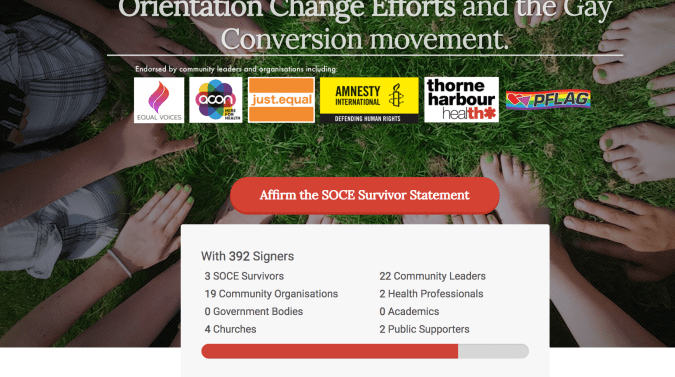
The headline is somewhat misleading, for according to the SOCE website (the group who are asking the Federal Government to ban GCT), only four churches have signed their statement along with 3-4 church ministers. No doubt there other supportive Churches, but nothing like the groundswell of ecclesial enthusiasm that the newspaper implies.

If The Age had asked Christian leaders and Churches from across the country, I suspect that they would find partial agreement with the folk at SOCE Survivors, and also significant disagreement.

Screen Shot 2018-09-05 at 9.54.24 am.png

To begin with, testimonies of gay conversion therapies are disturbing. Far from being ‘normal,’ these practices belong to fringe religious groups, finding little or no support amongst mainstream Christian Churches and theology. As a Christian, I do not support or agree with gay conversion therapy, as defined in terms of using pseudo-scientific and unbiblical spiritual methods to change a person’s sexuality. I feel for those who have undergone these traumatic experiences, wishing that they had not, and praying that they will find true and lasting recovery and peace.

The conversation is important because the health and life of LGBTIQ Australians matters enormously. They are not pawns to be played in political games, but human beings made in the image of God, and who ought to be treated with dignity. This, however, does not mean that every sexual preference and activity is morally good and beneficial, and neither does it mean that people who choose celibacy are somehow less complete or fulfilled as human beings.

It is interesting to learn that the SOCE Survivors statement makes the repeated observation that most organisations who once practiced GCT have now folded or no longer use such programs. If this is the case, then why are LGBTIQ groups and two political parties campaigning to have gay conversion therapy banned by Governments? If the aim is to inform the public of these formerly used and egregious methods, that’s fine, and yet their stated goals extend far beyond this. Why is there a concerted campaign to make illegal, practices that are no longer employed? As one reads further into the document, a picture emerges that their primary focus is no longer with GCT  but with any ideology that does not fully support LGBTIQ identity and lifestyles.

The statement argues that “many expressions of SOCE exist at the micro level, making them difficult to recognise, quantify, and regulate. The underlying ideology is firmly embedded in the everyday life of many faith communities as a collection of messages, beliefs and practices.”

According to their document, the key to this ideology is the erroneous and harmful belief (in their opinion) that “heterosexuality is the intended order”. Among these unacceptable practices are sermons that “talk about and reinforce traditional gender roles and ‘living as men and women of God”.

How broad is the net of unacceptable teaching and practice in faith communities? It certainly feels sufficiently broad to include the majority of Churches and Christian organisations. That’s part of the problem with the SOCE website, and also with the reporting in the newspaper, their descriptions of gay conversion therapy are vague, so much so that depending on how one reads in between the blurry lines, preaching a sermon on Genesis chs.1-3 or Romans 1:18-32 could fall foul of the authorities.

Definitions matter. The meaning of words and phrases is essential, lest we import a wrong sense or create confusion by speaking across each other. At the same time though, ambiguity and breadth are also proven rhetorical devices that gently and unassumingly push the envelope open even further.

In the Bible, God calls Christians to sexual purity. This does not necessarily mean there will be a change in sexual orientation. Some men and woman find their sexual desires and identity change with time, and to argue otherwise is to ignore the weight of personal testimonies. Indeed, researchers have demonstrated that the majority of children who experience gender dysphoria will grow out of it by adulthood and will happily identifying with their biological sex. However, the fact is, when becoming a Christian, many gay and lesbian people will not become heterosexual.

The Bible may not state that a person’s sexual orientation will change, but it does teach conversion. Christianity by definition is a conversion religion, where human beings made in the image of God, shift from looking for freedom in the myth of post-enlightenment moral relativism, and instead discovering the greatest freedom in the person of Jesus Christ. Let me repeat, I am not suggesting that people cease to struggle with aspects of their past, including sexual orientation, but it does mean that they now want to be godly in their sexuality. According to the Bible, this sanctification includes affirming that sex belongs to the loving, exclusive, mutually consenting, covenant of marriage between a man and a woman.

Does believing and teaching the above, and encouraging Christians to practice the above, push me outside the moral parameters of SOCE? Keeping in mind that none of the above views are new or novel, for they sit perfectly within orthodox Christian teaching and practice. Nonetheless, should this standard Christian view be considered wrong and harmful, and to be scrutinised by the authorities?

Anything other than the full affirmation of lgbtiq individuals as fully equal (including in the church, with a move toward correcting the poorly translated words currently classed as “homosexual” in the bible) is really unacceptable.”

While the SOCE Survivors document is vague at points, a spokesperson from SOCE has this week responded to a friend of mine who was also seeking clarification from them. The spokesperson said,

“The conversion therapy movement is very broad. Eg. theologically driven celibacy of lgbtiq people, prayer ministry, sermons that veer into exgay ideology leading to harm. They all need firm interventions. The survivors who wrote the statement are very keen to keep the definition broad. Anything other than the full affirmation of lgbtiq individuals as fully equal (including in the church, with a move toward correcting the poorly translated words currently classed as “homosexual” in the bible) is really unacceptable.”

The SOCE representative also asked,

“Would people who attend this group be encouraged to avoid being in a long-term committed same-sex relationship on theological or psychological grounds?”

When my friend suggested, ‘yes’, he was then informed that,

“I would say this group falls under the umbrella of the ex-gay movement. As you can see from the statement, the ex-gay movement has been viewed through many lenses over the years – from conversion therapy, to ex-gay programs that are less about therapy and more about solidarity. Regardless, such a group goes against the latest biblical scholarship, as well as a significant body of research detailing the harm caused by attempts to suppress or change a person’s orientation or gender affirmation on religious grounds. Thanks.”

There you have it. The agenda is wider than banning rare and harmful practices, but includes ministry and preaching that encourages the classical Biblical understanding of sexual holiness and human identity.

One might choose to ignore this most recent reporting of the issue, believing it’s another example of Christian philistinism. However, SOCE’s agenda is being adopted by two of the nation’s major political parties (ALP and the Greens), and the current Victorian State Government is also considering legislating on the issue. In other words, there is a strong possibility that these views will be shaped into legislation in the not too distant future, and could be used to against Christian Churches across Australia (and especially in Victoria). In case we assume there will be no severe implications from such legislation, as one example, the ALP platform speaks of removing children from parents who fail to affirm children in their self-assigned gender and sexuality, referring to this as child abuse.

Rather than chasing the culture down the rabbit hole of fluffy and imprecise language, Churches need theological and pastoral precision. This is a time for Christians to repudiate unsound, unbiblical, and harmful practices that have been used in the past, albeit by marginal and whacky groups. This is a time to repent of resentment toward LGBTIQ Australians and to ask for forgiveness where we have wronged them. This is also a time to embrace God’s good ways that are revealed in the Scriptures.

The future of Christianity does not depend on Governmental or societal approval, but it does hinge on whether Churches will “contend for the faith that was once for all entrusted to God’s holy people.” Christianity didn’t survive and flourish in the Roman Empire because they allowed the sexual norms of the day to define the Church, or because they played dodge-the-bullet with broad and vague language, but because they believed and lived the freedom that was brought about by Jesus Christ. Clarity in an age of confusion; that is what is required of Christians today: humble clarity and gracious conviction that God’s purposes are good and true.

Gehenna’s Dead

abortion2-flickr


Piled in unmarked graves,

Ashes to ashes, dust to dust.

Filling Gehenna with what remains,

Of flesh and blood and marrow.


Who are these nameless ones,

Whose time on earth so short?

What mountain of horror to see,

the scandalous unwanted dead.


No coffin or ceremony,

No words of solace spoken.

Though lingering in the deep,

Are perhaps doubts and disquiet,

Wonderings and hopes.


What cause,

What appeal,

What affliction has created this disturbance?

What necessity or hate has so consumed,

That life is deemed discretional?


Who would give their children to Molek,

Or present offerings to Eros and Aphrodite?

What god so insatiable must we appease,

To pull from womb ones so dear?


A public commotion shudders the earth,

Let us dance and celebrate;

Cheers reverberate through the streets;

We are free to kill.

We choose to kill.

Little ones, do not deny our liberty.


Jezebel, she is a jealous prophet;

Let us prove our dignity and worth.

For freedom sake,

Give us our rights.

We choose ourselves,

And we vote to forfeit others.


The altar of self is a bloody place.

The smell of burning corpses stiffens the air.

Winning is losing and the losers die.

Is this progress’ price,

Suffer the little children, and let them not come?


“Death has climbed in through our windows and has entered our fortresses;

it has removed the children.”

With approval we look on;

Humanity scorched, and losing soul.


Who will love these little ones, imago dei?

Who will remember them, their smiles and motions,

their cries and laughter,

that first word and step?

Who will celebrate their first birthday,

Hug them and say, ‘I love you’?


Who would give life to these unwanted,

to those disdained and sacrificed for Molek?

What name is given to these young lives,

Who are found amidst rubbish and refuse alike?


Greater Josiah has come.

He will love them.

He will welcome them home.

This greater Josiah;

A King upon a cross,

purify Gehenna,

redeem the dead,

forgive the transgressor.

Come Lord Jesus, come.

Is this Rome’s time for Reformation?

An open letter written by Archbishop Carlo Maria Viganò, has connected the coverup of child sexual abuse with the highest offices in the Roman Catholic Church,

“A former Vatican ambassador to the United States alleges in a 7,000 word letter that top Catholic Church officials, including Pope Benedict XVI and Pope Francis, were long aware of sexual misconduct allegations against former D.C. archbishop Cardinal Theodore McCarrick.” (NPR)

For years it has been apparent that there is a culture of abuse among many Roman Catholic priests, and that church hierarchy has been quietly suppressing the stories for many decades. But this week’s allegations demand, even more, the need for Rome to reform. At this point, Pope Francis’ only response has been to say, “I will not say one word on this. I think the statement speaks for itself and you have sufficient journalistic capacity to reach your own conclusions.”


photo-1522460676881-83490b51a873.jpeg

unsplash.com

When Martin Luther nailed his 95 theses to the Wittenburg Cathedral door in 1517, he was not calling for schism within the Roman Catholic Church, but for her reform. Luther rightly observed that reform begins with repentance.

The first of the 95 theses reads,

 “When our Lord and Master Jesus Christ said, ‘Repent,’ he willed the entire life of believers to be one of repentance.”

Martin Luther’s rediscovery of the Gospel call had an almost immediate effect. As the Reformation swept across Europe in the 16th Century, Rome sent out counter punches in the hope of quelling the tide. In the centuries since, there have indeed been moments of change made inside the Vatican, but these revisions have been primarily cosmetic and cultural, rather than ripping out the rotted foundations and replacing them with τ γιαινούσ διδασκαλί.

It is interesting to note that the events which led to Martin Luther’s clarion call concerned an issue of abuse; Rome’s teaching of and reliance upon indulgences.

The practice of indulgences is nowhere taught or encouraged in the Christian Bible. Indulgences contradict the most basic of Christian teachings, that justification before God is by God’s grace alone, received by faith alone, because of Jesus Christ’s atoning death alone,

“For it is by grace you have been saved, through faith—and this is not from yourselves, it is the gift of God— not by works, so that no one can boast” (Ephesians 2:8-9).

Roman Catholicism has taught indulgences since Medieval times, believing that they are a means by which people can receive remission for sins, and therefore reduce the time they would otherwise spend in purgatory. Leaving aside the fact that purgatory is another Roman concept which finds no warrant in the Bible,  indulgences take on multifarious forms, from saying a prayer, to completing a sacred pilgrimage, to helping the poor. Indulgences regularly contained a monetary aspect, paying a financial sum to the church to gain an indulgence, and thus time exemption from purgatory. The stunning St Peter’s Basilica in Rome that tourists and pilgrims enjoy today, was built in the 16th Century by stripping Europe’s poor via these indulgences.

In case we make the mistake of thinking that indulgences were left behind 500 years ago, they remain in vogue, with the current Pope publicly encouraging the practice of indulgences on at least two occasions since taking the seat in the Vatican in 2013. More odd, the ABC reported this week that the Anglican Church in Yea, Victoria, has recently taken up the practice in order to raise money to repair their dilapidated building.

Revelations made in recent years have once again made it clear that the problems inside Roman Catholicism are deeply rooted. When Martin Luther exposed the abuses made in the 16th Century, he rightly called for repentance and sought reform in the Church. Once again, Rome has been caught abusing the vulnerable, this time, sexually abusing young children and then consistently covering up the crimes. There are voices from within and many from outside, calling for Rome to reform her ways, but it appears that so far there is little sign of change. The allegations made this week by Archbishop Carlo Maria Viganò suggest that change needs to extend to the very top. Indeed, should the Archbishop’s letter be proven accurate, this would confirm the abuse scandals to be the most profound  faced by the Roman Church in centuries.

In criticising Rome, please don’t misunderstand, I am not suggesting that Protestant Churches automatically make the cut. Children have been abused inside Anglican, Baptist, and Pentecostal Churches, and even one example is one more than should ever be. There is, however, a vast difference between cases of abuse, and a culture of abuse. In addition, Churches that have once embraced the principles of the Reformation, need to reaffirm them with every new generation, lest we too lose our way. Europe, the United Kingdom, and Australia are littered with churches that once joyful upheld the 5 Solas, but today are little more than crumbling buildings sitting on prime real estate supporting the retirement funds of heterodox clergy.

The Apostle Paul insisted that we hold onto both doctrine and life, “Watch your life and doctrine closely. Persevere in them, because if you do, you will save both yourself and your hearers” (1 Timothy 4:16). The former shapes the latter, and the latter can easily distort the former when we preference personal morality above the ethics given by a good and holy God.

Is this Rome’s time for Reformation? Will Rome finally wake up and realise that they need to do more than move around the furniture or cover up the walls with a new coat of paint? 500 years ago, abusive practices were called out and thousands of clergy and churches across Europe heeded God’s gracious call to repent, but Rome ignored the opportunity. How will Rome respond this time?

At the heart of the 16th Century, abuses derived from a distorted view of God and his Gospel. With the rediscovery of God’s good news and with the people gaining access to the Scriptures in their own languages, unhelpful and gross evil practices were exposed and removed.

Reformation needs to come from within, and reformation requires the dismantling of any and all teachings, practices, and traditions that confuse, cloud or contradict the Gospel of Jesus Christ. This kind of foundational change will be confronting and difficult. Christians can pray that a movement of repentance will take over Rome. We can pray that both among Rome’s clergy and congregations there will be a rediscovery of the Gospel, the good news that the Apostle Paul first shared with the Romans almost 2000 years ago,

“All have sinned and fall short of the glory of God, and all are justified freely by his grace through the redemption that came by Christ Jesus.” (Romans 3:23-24)

“For we maintain that a person is justified by faith apart from the works of the law” (Romans 3:28)

Repentance: the forgotten practice

While Pope Francis was visiting Ireland over the weekend, accusations have been raised by one of the Roman Catholic Church’s most senior Archbishops.

According to an explosive piece in NPR,

“A former Vatican ambassador to the United States alleges in a 7,000 word letter that top Catholic Church officials, including Pope Benedict XVI and Pope Francis, were long aware of sexual misconduct allegations against former D.C. archbishop Cardinal Theodore McCarrick.”

Given the gravity of the allegations being made by Archbishop Carlo Maria Viganò, it is inappropriate for other observers or me to offer an uninformed opinion on the particulars. It is however surely incumbent upon authorities to fully investigate this public letter.


ap_18238592394326_wide-8c1e266ac52772e5855bc009b453bf5324ea4c6f-s1600-c85

Matt Dunham/AP, via NPR

What I wish to do here is re-express my great concern and sorrow. 18 months I presented a series of matters relating to the report published by the Royal Commission into Institutional Responses to Child Sexual Abuse. At the time, the Australian media were uninterested in this perspective, but I believe it is important to repeat the message because the Australian public and Australian Christians need Church leaders to speak up. Thank God, there are Christian leaders speaking openly and unreservedly; Richard Condie (the Anglican Bishop of Tasmania) is one such example who immediately comes to mind. The pain and anger rightly runs deep, and Churches must face reality, that repentance must also be deep and enduring.

We can expect accounts and allegations of sexual abuse from within the Roman Catholic Church and coverups by clergy to come to light for many years to come. No doubt, the same will be true for many religious and nonreligious organisations.

When the Royal Commission released statistics relating to child sexual abuse in the Roman Catholic Church of Australia (February 2017), Australians were appalled and shocked, although sadly we were  unsurprised.

The Royal Commission disclosed that a survey conducted by the Australian Catholic Church found 4,500 alleged cases of child abuse within their organisations. This number reflects claims made between January 1, 1980 and February 28, 2015, and it also excludes cases that were not investigated.

Few significant organisations in the country have not discovered someone who has abused a child; my own Baptist denomination is not without known cases. Jesus warns us about the log in our own eye, and the Scriptures also call Church leaders not to treat gross sin lightly. We anticipate people will try to infiltrate all kinds of organisations to scope and prey on innocence; this is not to excuse due organisational diligence, but this world holds insidious individuals who will attempt to circumvent the highest standards. Having said all that, this new data communicates what we perhaps already knew and that there is a major flaw in Roman Catholic attitudes, brought about in part by flawed theological belief and practice. While any instance of child abuse is repugnant, there is a difference between isolated cases of abuse and a culture of abuse.

7% of Catholic priests serving between 1950-2009 have been identified as alleged perpetrators. The current known number is 1,880 men. Among some Catholic organisations the percentage is considerably higher: 22% of ‘Christian Brothers’, and 40.4% of those belonging to the order of ‘the Brother of St John of God’ are known to be sex offenders.

The issue extends beyond the fact that priests have abused thousands of children, but that Catholic Dioceses (and other denominations) have also failed to adequately address allegations and the clergy in question.

This is a national catastrophe.

Abusing children is unacceptable, for any person belonging to any community group or society, and sadly it is occurring even now in many family homes across our suburbs and towns; it should not be. The Royal Commission has disclosed child abuse in schools, sporting clubs, Government organisations, and across religious groups. There is, however, something particularly evil about the presence of such sin among communities who profess Jesus Christ.

As a parent with three children, I can imagine what many Aussie parents are thinking about these revelations, and these thoughts are not cordial. There are feelings of disgust toward the perpetrators and toward ecclesial authorities who have repeatedly failed to investigate and protect. There are feelings of sorrow for those whose childhood was snatched from them.

As a Christian and as a Church minister, I am angered that men would betray children under their care and that they would so disdain the name of Jesus by their gross sin. It is beyond reprehensible.

“For certain people have crept in unnoticed who long ago were designated for this condemnation, ungodly people, who pervert the grace of our God into sensuality and deny our only Master and Lord, Jesus Christ.” (Jude 4)

As much as we may point out that these priestly behaviours are irreconcilable with authentic Christianity, for they certainly contravene the person and teaching of Jesus Christ in every way, and yet we must appreciate that this issue has understandably tainted peoples trust in Churches. I can also see how many Australians don’t differentiate between Roman Catholicism and Christian Churches, for there are correlations, but there are also stark differences, which pertain to deeply held theological views that are proving to be unbiblical and untenable, including Rome’s view of the priesthood and of the confessional.

Pope Francis last night offered a prayer on a tweet,

“I ask our Blessed Mother to intercede for the healing of the survivors of abuse and to confirm every member of our Christian family in the resolve never again to permit these situations to occur.”

While it would be presumptuous of me to question the Pope’s sincerity, this prayer will be as efficacious as praying to a man in a cape or Jack Dorsey himself. A better approach is surely to take Jesus’ view of repentance more seriously. Christians mustn’t give up being like Jesus, we need to become more like him. In the same short New Testament letter of Jude, where Christians are urged to look out for potential abusers in our churches, a few verses later we are also encouraged to “be merciful to those who doubt”.  This is not a time for defensiveness, but repentance, public repentance.

Bad Leaders and Good Leaders

The very notion of leadership has become a public parody, a cartoon, a crazy dream that is strangely Orwellian and Black Adder together.

It seems as though among leadership of every kind and level, there is crisis, mismanagement, incompetence, and division. Whether we are talking about Australian politics or international politics, managing boards of major corporations, sporting clubs and yes even Churches, not even twitter can hashtag all the latest fiascos and failings. 

Of course, there are always criticisms, whingers, and dissenters, no matter who is leading. Even when leaders are performing their duties with excellence, grumblers are never far away.

At yet, corruption, bias, and abuses of power are very real and when it happens people are understandably upset, and they lose confidence in their leaders.

At the moment I’m preparing for Sunday’s sermon. We are currently preaching through the book of Jeremiah, and this week our reading is chapter 23, and it’s all about leadership: good leaders and bad leaders.

Jeremiah2.jpg

I should note, this blog post is not about the current state of affairs in Australian politics.  It is about a form of leadership that is more significant, namely that of Christian or Church leadership. The original context of Jeremiah chapter 23 is of God addressing the leadership of Judah (which included the King, the priests, and the prophets); the equivalent for us today is the church.

Characteristics of a good leader

“Therefore this is what the Lord, the God of Israel, says to the shepherds who tend my people: “Because you have scattered my flock and driven them away and have not bestowed care on them, I will bestow punishment on you for the evil you have done,” declares the Lord. “I myself will gather the remnant of my flock out of all the countries where I have driven them and will bring them back to their pasture, where they will be fruitful and increase in number. I will place shepherds over them who will tend them, and they will no longer be afraid or terrified, nor will any be missing,” declares the Lord.

“The days are coming,” declares the Lord,
“when I will raise up for David a righteous Branch,
a King who will reign wisely
and do what is just and right in the land.

In his days Judah will be saved
and Israel will live in safety.
This is the name by which he will be called:
The Lord Our Righteous Savior.

“So then, the days are coming,” declares the Lord, “when people will no longer say, ‘As surely as the Lord lives, who brought the Israelites up out of Egypt,’ but they will say, ‘As surely as the Lord lives, who brought the descendants of Israel up out of the land of the north and out of all the countries where he had banished them.’ Then they will live in their own land.” (Jeremiah 23:1-9)

Two metaphors are used, the Shepherd and the King.

Like a Shepherd:

  • a good leader tends (feeding and protecting those under his care)
  • he gathers (brings them together)
  • he calms fears and terror

Like a righteous King:

  • he will act wisely
  • he will act with justice
  • he will act with righteousness

It is important to note that God identifies himself as the Shepherd, and the King (the righteous branch) is the promised Messiah. The point is, the Lord will accomplish what his leaders have failed to achieve. He will redeem his people from the mess created by failed leaders.

Seven Centuries following this Divine pronouncement,  a preacher from Galilee arose, and announced, “I am the good shepherd”. But the phrase, “I am”, he was adopting the holy name of the Lord for himself. By exclaiming “I am the good shepherd”, Jesus was identifying himself as the God of Jeremiah 23:3, in contrast to the generations of bad shepherds who had gone before him and who were prevalent during his own public ministry.

What is most remarkable, is the extent to which the Good Shepherd would go in order to save and bring lost sheep: he would lay down his life for his sheep. This Shepherd leader loves his sheep so much, that he would give his life to save them. Jesus is providing us with much more than a model of leadership, for his sacrificial death is unique is salvific power and design, and yet he also signals a pattern that is to be followed by those who would serve as leaders under his rule.

In Jeremiah 23:4, God also speaks of other shepherds who will work under him. “I will place shepherds over them who will tend them, and they will no longer be afraid or terrified, nor will any be missing,” declares the Lord.” While the salvific focus is on God himself and his leadership role, he intimates that he will raise up shepherds to work under him” (v.4).

1 Peter 5 interprets Jeremiah 23 (and similar Old Testament passages) by speaking of the Chief Shepherd (the Lord Jesus) and Elders of a local Church,

“To the elders among you, I appeal as a fellow elder and a witness of Christ’s sufferings who also will share in the glory to be revealed: Be shepherds of God’s flock that is under your care, watching over them—not because you must, but because you are willing, as God wants you to be; not pursuing dishonest gain, but eager to serve; not lording it over those entrusted to you, but being examples to the flock. And when the Chief Shepherd appears, you will receive the crown of glory that will never fade away”. (1 Peter 5:1-4)

Characteristics of a bad leader:

The leaders in question are Judah’s king, the priests, and the prophets. Rather than faithfully administering their responsibilities under God, according to his covenantal word:

i. They create their own ‘truth’

“I did not send these prophets,
yet they have run with their message;
I did not speak to them,
yet they have prophesied.” (verse 21)

“This is what the Lord Almighty says:

“Do not listen to what the prophets are prophesying to you;
they fill you with false hopes.
They speak visions from their own minds,
not from the mouth of the Lord.

They keep saying to those who despise me,
‘The Lord says: You will have peace.’
And to all who follow the stubbornness of their hearts
they say, ‘No harm will come to you.’ (vv.16-17)

 Like Dustin Hoffman and Robert De Niro in the film Wag the Dog, the prophets have raised a green screen and laid over an unreal picture of reality. The prophets have fabricated an alternate reality: times of peace and prosperity, with images of green fields and cool streams, sandy beaches, city cafes, captivating moods and suggestions of a beautiful life to come.

ii. They make promises that they can never keep

“They keep saying to those who despise me,

    ‘The Lord says: You will have peace.’

And to all who follow the stubbornness of their hearts

    they say, ‘No harm will come to you.’” (v.17)

iii. They falsely attribute their words to God

“I have heard what the prophets say who prophesy lies in my name. They say, ‘I had a dream! I had a dream!’ How long will this continue in the hearts of these lying prophets, who prophesy the delusions of their own minds?” (vv.25-26)

“I am against the prophets who steal from one another words supposedly from me. Yes,” declares the Lord, “I am against the prophets who wag their own tongues and yet declare, ‘The Lord declares.’ (vv.30-31)

iv. They are motivated by evil

“And among the prophets of Jerusalem
I have seen something horrible:
They commit adultery and live a lie.
They strengthen the hands of evildoers,
so that not one of them turns from their wickedness.
They are all like Sodom to me;
the people of Jerusalem are like Gomorrah.” (v.14)

This religious industry of ‘new’ Divine words was tied to a moral agenda that was being promoted by Judah’s leaders. God connects their words with the concept of adultery and he likens them to the days of Sodom and Gomorrah. In other words, they form their religious ideas and Divine words based on their moral vision. The reference to Sodom and Gomorrah is telling. Sodom and Gomorrah were the famous twin towns destroyed by God in Genesis chapter 19, as a result of the townsmen wanting to have sex with the men whom Lot was protecting. It is therefore likely that the prophets’ message was an 8th Century version of the sexual revolution.

According to God, the prophets were speaking new words because God’s words restrain sin and they want to live out sin. If the Bible doesn’t give me adequate justification to pursue immorality, let’s make up new words and say that they are from God.

v. They are responsible for division and destruction

The outcome is scattering, misery, and social and spiritual carnage.  As God exclaims, “They do not benefit these people in the least” (v.32).

Right expectations

Should we expect more of our political leaders? Politics in the age of social media has yet to deliver on the kind of stability, integrity, and unifying vision that some predicted would occur. There may be some principles worth reflecting upon for leaders in general, but like I said at the outset, Jeremiah ch.23 is not speaking to the question of modern civic and political leadership, but to those who assume or are recognised as leaders of Churches. The kind of leader God affirms, is one who chooses God’s ways over popular cultural movements, who is okay with being unoriginal and uninventive in his words, and who brings unity not division among God’s people.

What do we expect of our Church leaders? They will certainly fall short because they are as human as the rest of us. They carry weaknesses and they struggle with temptation like all of us, and yet the expectations set for those who oversee churches are appropriately high.

Jeremiah ch.23 reminds us of how perilous it is to entertain new and interesting ideas about God and to use God as justification for our moral proclivities. Whether it is the Roman Catholic crisis coming out of Pennsylvania or with the schism within the Uniting Church of Australia, or royal preachers, prosperity preachers, or theological scholars from the school of Lord Voldemort, it is not difficult to see the harm and division that is created by many modern-day priests and prophets. If our favourite preachers and authors smell like the culture and look like the culture, and are praised by the culture, perhaps it’s time for us to find new preachers and teachers.  Above all, I’m reminded of how much we need the promised Shepherd and King of Jeremiah ch.23.

“I am the good shepherd; I know my sheep and my sheep know me— just as the Father knows me and I know the Father—and I lay down my life for the sheep.”

#Metoo for unborn girls?

Today at Church we celebrated the birth of a little girl. The parents gave thanks to God for her, and we as a congregation prayed for them. It was a joyous occasion, because life is so precious and wonderful, and every new life is beautiful.

As I was preparing for the infant dedication service earlier this morning, I came across this upsetting article in today’s The Age,

“A phenomenon of “missing girls” could be afflicting Victoria, as a study of more than a million births suggests some parents could be aborting unborn female babies or undergoing embryo selection overseas in order to have a son.

If nature was left to take its course, it is expected that for every 100 girls born, about 105 boys will be brought into the world.

But in findings researchers say indicate “systematic discrimination against females starts in the womb”, mothers within some key migrant communities are recording sons at rates of 122 and 125 for every 100 daughters in later pregnancies.

Lead researcher Dr Kristina Edvardsson from Melbourne’s La Trobe University said it showed gender bias persisted in Victoria, despite laws banning people from choosing the sex of their child, other than for medical reasons.

“We believe that some women may be terminating pregnancies after discovering they are expecting a girl and in other cases are travelling overseas to access non-medical sex selection services through assisted reproduction,” she said.

Analysing almost 1.2 million births between 1999 and 2015, the study found while the overall ratio of male and female babies born across Victoria was as expected (at close to 105 to 100), there were notable exceptions.

There is now widespread global access to ultrasound technology to determine the sex of a baby, and Australian parents can find out their baby’s gender from within 10 weeks with a newly-available blood test.

“The Indian government has estimated that two million girls go “missing” from its population each year due to sex selective abortion and other forms of discrimination that lead to premature death.”

kelly-sikkema-692353-unsplash.jpg

unsplash.com

The report is disturbing; it’s more than disturbing, it is utterly evil. Let’s be clear, we are talking about the conscious decision to kill little girls because they are girls.

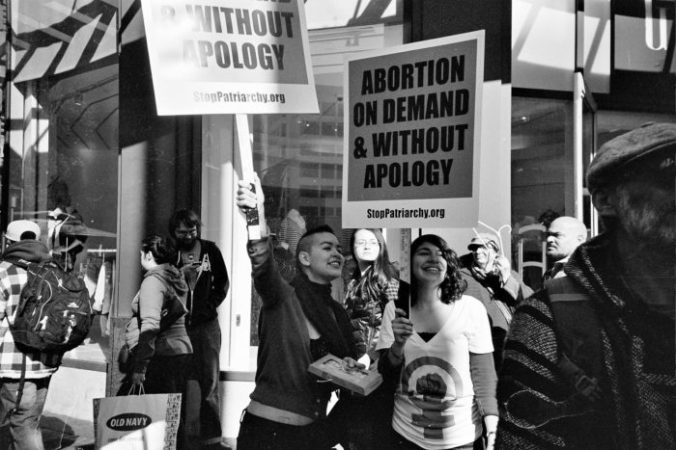
One wonders, how quick will our fourth wave feminists be to speak against this phenomenon? The only children who are more likely to face abortion are children diagnosed with mental and physical disabilities, such as Down Syndrome. Even this year, we have seen that their right to live has been drowned out by placards and tweets about the ‘right to choose’, as though the value of human life depends on what we want it to be.

Why should killing on the basis of gender matter more than choosing an abortion for other biological or sociological reasons? It shouldn’t, but this article nonetheless reveals a terrible trend in our society that needs addressing.

I appreciate that sometimes, some of the people crying “pro life” are obnoxious, and even crass and hurtful, but these are few and hardly representative of the average Australian who does not support abortion. Surely it is possible, and indeed desirable to view every human being with dignity and inherent worth, but sadly the evidence suggests that we believe otherwise.

For example, #metoo has captured the fury and passion of millions of women and men all over the world. The outrage has much justification, for women are often mistreated, abused, or simply undervalued. However, like other agitations for social change, #metoo is selective in the injustices that they wish to advocate. I’m not talking about fighting any and every cause of injustice in the world, but one that is surely consonant with the fight for women’s equality. Where are the #metoo for unborn girls and unborn children with disabilities? Where is the wave of feminists marching the streets for the millions of girls who will never grow up and go to school and finds careers, and experience love and joy?

Perhaps, this is one reason why the rhetoric of these hashtag movements lack cogency and long-term positive change. They are not fighting for all women, but only some women.

The birth of Christianity contested the Roman practice of abortion and infanticide. Christians welcomed and loved little ones who were neglected and left on the hills to die from exposure; by far, the majority of these children were girls. They did this against the grain of popular culture, and often at great personal cost, and yet over time the good could not be denied. Aisha Dow’s article is simply unveiling another grotesque step in the dehumanising project that is becoming all too common in Australian culture.

Is there a correlation between a society that leaves Christianity behind, and a society that dehumanises others? There will be historians and sociologists better equipped than me to answer that question. But to me, evidence suggests that there is a connection. Even as science reveals more and more wonder about human life in the earliest stages of pregnancy,  many couples are using this modern technology to determine the sex of the child and therefore to abort those who don’t match their expectations. “Although they claimed to be wise, they became fools” (Romans 1:22).

Protests and social media outrage may win momentary ‘likes’, but it’s not enough, and to often these movements are hijacked by unhelpful groups. We need a better vision, a more beautiful and glorious vision to capture the minds and hearts of Australians.

Jesus once said, ‘Greater love has no one than this: to lay down one’s life for one’s friends’. What an incredible way to consider people around us. Imagine, the betterment of society if we took Jesus’ words to heart! Indeed, how great is the love that sacrifices our hopes and plans for children who enter our lives unplanned. The very nature of a loving community is that it requires the unexpected and difficult, and rather than eliminating those surprises, we alter our life expectations in order to see their lives flourish. Perhaps instead of #metoo, we should be suggesting, #themtoo.