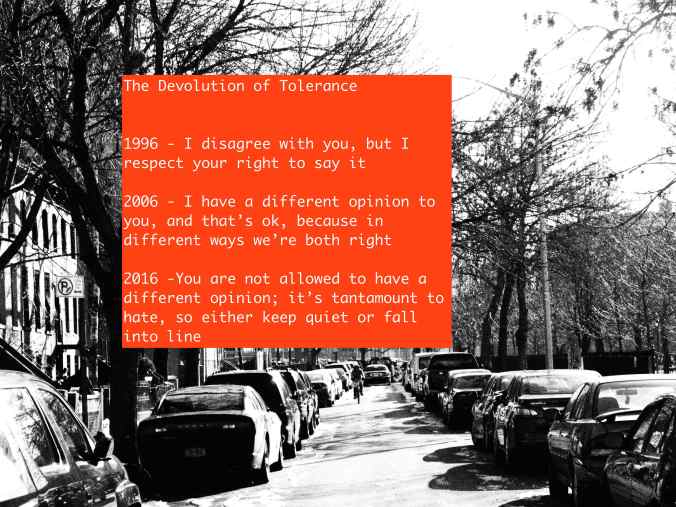
I do not hate you

7518580-3x2-700x467

ABC photo of commemoration at Federation Square

Following the terrible mass murder in Orlando, Jason Ball, Greens candidate for the seat of Higgins, has criticised those who offered prayers for the victims and their families,

“This week, media commentators who have previously vilified us, leapt on the unspeakable atrocities in Orlando and used our grief as a battering ram to prosecute their own agenda against another minority.

Then they wring their hands and offer us their ‘prayers and sympathy’ whilst conveniently ignoring the fact that acts of hate and violence are the logical conclusion to a public ‘debate’ that maintains we are abnormal and not worthy of the same rights and respect as our fellow citizens.”

Like many people I gloss over most words that I read online, but Mr Ball’s comments stood out and made me put on the brakes. As a reflected on his words, I found several different threads of thought running through my mind, some conflicting:

Does genuine grief depend upon agreement? The thing is, I do feel great sadness for those who have been personally affected by the Orlando massacre. It was a display of evil for which there is no justification. Am I being hypocritical for thinking this?

On the one hand, the Muslim community has been criticised for their lack of public outrage over the attack, and yet Christians offering prayers for those affected are being told to keep quiet? It feels as though we’re damned if we do and damned if we don’t.

Is it true that the logical outcome of not supporting same-sex marriage is hate and violence?

Is it right to pray for a group of people if they ask us to desist?

Should we only pray for those with whom we have congruity of thought? Is our common humanity not enough?

What can Christians do to overcome the view that not supporting SSM does not equal hating LGBTI people?

The same article reported how Mr Ball has had campaign material smeared with hateful words, ‘fag’, and so understandably he is skeptical of certain peoples’ words of support for the victims in Orlando. More so, it takes a callous person to dismiss the fears and grief many LGBTI people are experiencing in the wake of Orlando.

A question I am wrestling with is this, as a Christian, how should I respond? Should I remain quiet? Do I ‘repent’ of my understanding of marriage, as one commentator has argued Christians must do? Are our only options, conformity to or exile from the public sphere?

The fact that you are reading these words probably gives away my answer, although I have taken several days to ponder the question before writing. The reason for writing this piece is to try and communicate, albeit somewhat clumsily, that Christians do care and are concerned for the LGBTI community. It is not hate that drives us to speak and pray.

Jason Ball may be right, there are people using Orlando, ‘as a battering ram to prosecute their own agenda against another minority’. In fact, I’m pretty sure he is right. This horrendous event is being utilitarianised by several public figures to silence all manner of minority voices. There are haters in our community, including individuals who detest LGBTI people, and we stand with you against them.

Hate and violence derives from commitment to a worldview that cannot tolerate difference. This worldview may be of a religious orchestration; its shape may be that of secular humanism.

Jesus once said that it’s relatively easy to love those whom you like; it takes grace to love those with whom you disagree. We all fall short of this ideal, which would well leave us hopeless, except there is one who lived the ideal without ever misstepping.

“After this, Jesus went out and saw a tax collector by the name of Levi sitting at his tax booth. “Follow me,” Jesus said to him, and Levi got up, left everything and followed him.

Then Levi held a great banquet for Jesus at his house, and a large crowd of tax collectors and others were eating with them. But the Pharisees and the teachers of the law who belonged to their sect complained to his disciples, “Why do you eat and drink with tax collectors and sinners?”

Jesus answered them, “It is not the healthy who need a doctor, but the sick. I have not come to call the righteous, but sinners to repentance.” (Luke 5:27-31)

Jesus calls those who would follow him, to be like him.

“But to you who are listening I say: Love your enemies, do good to those who hate you, bless those who curse you, pray for those who mistreat you. If someone slaps you on one cheek, turn to them the other also. If someone takes your coat, do not withhold your shirt from them. Give to everyone who asks you, and if anyone takes what belongs to you, do not demand it back. Do to others as you would have them do to you.

“If you love those who love you, what credit is that to you? Even sinners love those who love them. And if you do good to those who are good to you, what credit is that to you? Even sinners do that. And if you lend to those from whom you expect repayment, what credit is that to you? Even sinners lend to sinners, expecting to be repaid in full. But love your enemies, do good to them, and lend to them without expecting to get anything back. Then your reward will be great, and you will be children of the Most High, because he is kind to the ungrateful and wicked. Be merciful, just as your Father is merciful.” (Luke 6:27-36)

A Christian cannot hate because we have been on the other side, we have belonged to the crowd who have hurt others and thrown stones of hate, pride, and greed. Christians, if they are Christian, confess their spiritual and moral destitution, and yet we have come to experience the undeserving and loving grace of God who forgives our trespasses through Jesus. Once the human heart has experienced Divine forgiveness, we can not walk back into old attitudes of disdain for other people, nor hold onto some cold and languid acquiescence toward popular moral thought. When God replaces hate with love, it is a commitment to affirm what is good as defined by God. Can not love lead us to disagree with fellow human beings? Can a desire to see people flourish not include aspects of nonconcurrence, as we find in the life of Jesus Christ?

I do not hate you. I would willingly stand alongside you against those who have insulted you and graffitied your campaign posters. Clearly though, we have much work to do. I don’t know if Jason Ball will read this piece, and if he does, what his response would be. But I hope and pray he and others hear, and not only hear, but come to experience that Christians do not hate them. We must do more to love others as Christ has loved us.

I’ll finish with two examples that I have come across of where a Christian voice is trying to speak into the awfulness of what took place just over a week ago.

The American chain restaurant, Chick-Fil-A, is known for its conservative values and for not opening on Sundays out of observance for the Sabbath. Following the shooting, they broke their rules and opened on the Sunday to serve their community. They gave food to firefighters, police and volunteers, and they handed out sandwiches to those donating blood.

Last week, a service was held at the Anglican Cathedral in Sydney, and in his address Archbishop Glenn Davies said,

“As Australians, we abhor violence in all its forms—domestic violence, street violence, xenophobic violence, religiously motivated violence, and especially violence against members of the LGBTI community. As the leader of the Anglican Church in Sydney I want to affirm my stance against all such outbreaks of violence, and if any members of our churches have participated in such acts of violence against women, against young people, against ethnic minorities, against religious minorities or against those from the LGBTI community I offer my heartfelt apology.” 

“Yet we must all search own hearts, as evil resides in each one of us. We have all fallen short of the glory of God. None of us are without fault. Words of derision, mockery and exclusion so frequently fall from our lips when directed against persons who are different from us. This is especially the case for members of the LGBTI community, who have suffered the verbal abuse that so deeply cuts into a person’s soul. Where we have been guilty of such words, I also offer my apology on behalf of the Anglican Church in Sydney.”

“God’s love knows no bounds. He extends his love to all without distinction and without prejudice. Therefore when one, let alone 49, bearers of the image of God are murdered, God grieves. When a further 53 are injured and hospitalised, God grieves. For our God is a God of compassion and grace, and in the depth of our sorrow and pain, he offers to carry us ‘through the valley of the shadow of death.’”

A sling, an arrow, and the Gospel

“Whether ’tis nobler in the mind to suffer

The slings and arrows of outrageous fortune,

Or to take arms against a sea of troubles,

And, by opposing, end them?”

Cleisthenes

From the Delphic hamlet that is The Australian, Greg Sheridan has given Australian Churches an oracle.

According to Sheridan,

Australia’s Christian churches are in crisis, on the brink of complete strategic irrelevance. It’s not clear they recognise the mortal depth of their problems.

The churches need a new approach to their interaction with politics and the public debate, and to keeping themselves relevant in a post-Christian Australian society.

The churches cannot recognise and come to grips with their strategic circumstances. They behave as though they still represent a living social consensus.

The Christian churches now need to reconceive of themselves as representing a distinct and not all that big minority (of practising Christians). They should conduct themselves as a self-confident minority, seeking to win conversion through example and persuasion and not to defend endlessly legal protections and enforcements that are increasingly untenable or meaningless.

In my opinion Greg Sheridan offers a lucid critique of many Churches who are failing to grapple with the rise of secularism, although I wonder if he adequately understands the nature of the Church’s mission and therefore how success and relevance are defined.

Sheridan is right to point out the gross sins of abuse within the Catholic Church (and other denominations as well), and the way this has greatly damaged community perceptions of Churches.

There is urgent need for Churches to practice repentance. Dressed in clerical collars and reciting liturgy, great evil has been perpetrated, especially in the area of sexual abuse. Joe Smith and Lisa Jones can see it, but there remain clergy in some institutions that still don’t get it. The fact that their deeds expose them to be frauds of faith does not diminish the impact on the community. Real, transparent, and deep repentance is required.

Sheridan is also spot on in observing the naivety of some Christians who believe they still belong to the centre of Australian life. We defer to census figures that prove the majority of Aussies believe in God and who identify as Christian, but surely we know better. The reality is, Churches have never belonged comfortably at the centre of Australian society; they have played a significant role in shaping culture, alongside many other voices, but it is more a case of Churches being tolerated rather than celebrated and embraced.

This tolerance is eroding, rapidly so. This year alone we have seen various groups slamming the foot on the accelerator, such that we are fast approaching an intersection called ‘free speech’, and the direction Australians will take remains unclear.

Several political groups have declared their hand:

The Greens have decided their way forward by calling for religious organisations to lose their exemptions for discrimination laws.

Federal Labor have made clear: “Labor believes that no faith, no religion, no set of beliefs should ever be used as an instrument of division or exclusion, and condemning anyone, discriminating against anyone, vilifying anyone is a violation of the values we all share, a violation which can never be justified by anyone’s faith or belief. Accordingly, Labor will review national anti-discrimination laws to ensure that exemptions do not place Australians in a position where they cannot access essential social services.”

Bill Shorten has since stepped back from this position, but there are no guarantees he won’t step forward again.

And the Victorian Government, singing from their autocratic hymnal, has determined to insult and silence anyone who challenges their hermeneutic of life.

Should churches fight to keep a voice in the public arena?

We must concede that Churches no longer occupy a position in the middle, but we don’t want to evacuate the public space altogether. I want to argue that it is worth fighting for a voice in public discourse, but we do so with the belief that the Gospel does not depend upon it. So why should we defend notions of ‘freedom of speech’.

First of all, we have something to say. We have good news to speak and show our neighbours, and so why would we walk away from secular principles that give us freedom for speaking and contributing?

Secondly, we should defend the right to speak for the sake of those who speak against us. Is this not a way in which we love our neighbour?  Is it also not a sign of a mature society, one that is big enough to allow a plurality of voices, and to say ‘I disagree with you, but let’s hear you out and then talk it through’.

A great example of this happened last week when Christians came to the support of Roz Ward, a professing Marxist and co-founder of the controversial curriculum, Safe Schools. Ward was forced to resign from a Government role and was suspended from La Trobe University after a comment she made in regard to the Australian flag. While her views may be disagreeable to many, she has the right to express them, and to find herself being ousted from an academic institution on account them was extreme. Subsequently, a number of Christian leaders noted this hypocrisy and sided with those who called for her reinstatement.

Thirdly, we are members of a democratic society, which in principle gives permission for Christians and atheists alike to speak and offer their opinion.

As a liberal democracy, Australia is governed by these 4 principles:

“A belief in the individual: since the individual is believed to be both moral and rational;

A belief in reason and progress: based on the belief that growth and development is the natural condition of mankind and politics the art of compromise;

A belief in a society that is consensual: based on a desire for order and co-operation not disorder and conflict;

A belief in shared power: based on a suspicion of concentrated power (whether by individuals, groups or governments).”

If we accept these principles, surely Christians have freedom to articulate their views in public discourse? This doesn’t mean people have to like or affirm these beliefs (nor those of any worldview), but it does mean there is freedom to speak. Unfortunately though, it seems as though these values are becoming museum pieces, relics from a golden age of democracy when the Cleisthenes’ of Australia stood tall. After all, no fair democracy has ever endured the ages. And yet, while Australia formally holds to these democratic convictions, there is a place for Christians to speak without fear of law or litigation.

Our democratic liberties give Christians a platform and context for doing public ministry, and we are thankful for this, but the Gospel is not curtailed by the limitations or freedoms of liberal democracy. Indeed, history demonstrates that Churches have often flourished where they have been most resented. More importantly, Jesus Christ taught a theology of the world which lives in opposition to God and which hates those who follow Jesus. Why should we assume Australia is any different?

How should Churches view ‘success’?

Are, as Greg Sheridan suggests, ‘churches in crisis now on all fronts’? It depends on how one defines the mission and role of the church.

Our aim is to love others, whether our convictions are affirmed by others or not.

Our goal is not relevance, for the Gospel we believe is not defined by a popularist epistemological current, but by the word of the cross, which is foolishness to the wise and powerful of this world. Instead, our purpose is to preach this foolishness for through it God works to redeem and heal.

Our mission is not to set up power structures at the centre of society, but to speak the Gospel and to love others no matter where we find ourselves situated in relation to broader society.

Freedom of speech has become the gordian knot of our day. Politicians, lawyers, and academics will ponder and debate and try to find a way to navigate through the many layers of twisted and knotted rope, and while their answers will have implications for Christian speech and life in public, our hope does not lay with them, but in the Gospel, a word that is sharper than a two edged sword. Our hope rests in the Christ who has promised that he will build his church and not even Hades can stand against it.

Sadly many Christians have sold their soul in order to buy a place at the centre of public life, and they are now being marshalled into following the lead of the social progressives, and others are instead holding tight to their conservative neuroses. There are however exceptions; across the land there are churches growing and people are becoming Christians, and there are Bible colleges in Australian cites who are training more men and women than in the previous generation. There are Christians serving in Parliament, teaching in universities, and working in a thousand different jobs. And to these men and women, keep preaching and living the Gospel, loudly from the centre or whispering it from the edge, and through it God will keep working his grace and growing his Kingdom.

Freedom of Speech in Australia: A Symposium

freedom of speech

‘Freedom of Speech’ is a significant social and political issue in Australia. The topic is being debated by the major parties in the current Federal election, and is an important issue for all Australians.

Mr Tim Wilson is the Liberal candidate for the Division of Goldstein. He was a public policy analyst and a commentator who was the Australian Human Rights Commissioner from 2014 until his resignation in 2016.

Dr Michael Bird is a lecturer of theology at Ridley College. He is one of Australia’s most distinguished theologians, having written over 20 books and speaking at conferences across Australia, the UK, and USA. 

Both speakers have offered important contributions to this topic of ‘Freedom of Speech’, and it is a privilege to have them share the platform for this symposium.

The evening will consist of an address by each speaker, an opportunity for them to reply to the other’s presentation, and there will be a time for question and answer from the floor.

Refreshments will be served at the conclusion of the evening

Click on the graphic or here to book seats


Julia Baird defends John Dickson…sort of

“It is easy to believe in freedom of speech for those with whom we agree.” (Leo McKern)

Like an episode of ‘Rumpole of the Bailey’, Julia Baird yesterday came to the defence of John Dickson, although in a somewhat less convincing performance.

John-Dickson.jpg,q1414797734.pagespeed.ce.xwQMht8rl1

One week ago Rev Dr John Dickson raised a question on his personal Facebook page, concerning the manner in which the same sex marriage debate is being conducted in Australia. Within hours the post was taken down by Facebook, and then reinstated one day later with a somewhat fuzzy apology attached.

In yesterday’s The Age, Julia Baird came out swinging, first of all using testimony from Prince and then proceeding to argue, ‘Dickson’s questioning should not be slammed but aired, and he is right to argue conservative viewpoints should not be so rapidly shut down or dismissed as hate. It was very odd of Facebook to delete this post.’

At the same time, Baird didn’t hold back in offering her own view on Dickson’s comments,

‘This is a massive, inadvertently inflammatory call and one I do not agree with. Surely acceptance, tolerance and absence of judgment about difference would make LGBTI youth feel better. But, isn’t it up to them, to say what makes them feel better? It is also highly provocative to accuse those who either belong to, or are allies of the LGBTI+ community of augmenting the very hatred they have spent their lives trying to fight and diminish.’

The fact that a journalist in Australia has freedom to speak her mind and to disagree with another Australian, and to do so in the most direct manner, is a sign of a healthy society. Would we want our sitz im leben to be less than this? 

In her closing statement, rather than reiterating Dickson’s right to offer an opinion, it seems as though Baird crossed the floor to the prosecutor’s table, and it is these remarks that I find most odd.

Baird finishes by quoting another Facebook post, that of Sydney Chaplain, Garry Lee Lindsay,

I can’t see how this helps anything. Please don’t try to convince me that it is intellectual debate or you are approaching the subject with an open mind and a loving heart. You might be, but why do you have to say it? And why is it so important to make comment about other people’s lifestyle or culture on Facebook? Just go out and make friends with people because they are people, made in the image of the Creator, inseparable from God’s love.

“What about calling people to prayer for those poor people in Japan and Ecuador that lost their lives and family in the earthquakes? To start with!!! What about we stop writing posts like this one, make some soup and sandwiches, go and hand it out to the hundreds of rough sleepers on our streets every night and give them some company? Why don’t I? Because I’d rather whinge about the terrible people that aren’t like me, don’t think like me, don’t live like me. And do it from a distance, because then at least I know I’m OK. What a wretched man I am? Who will save me? Thanks be to God.”

First of all, Lee-Lindsay (and presumably Baird, given she is appealing to the quote) dismisses the importance of people offering comments about lifestyle and culture matters on Facebook. Although I wonder, does  Lee-Lindsay realise that he is guilty of the very thing he is accusing of others of doing? ‘Others mustn’t use Facebook to express opinions about sexuality issues, like I am doing right now…!’

Do Lee-Lindsay and Baird not realise that these issues of marriage and of transgenderism are very much public issues? Marriage may be a personal relationship, but it is also a societal one. If it were not, why are wedding ceremonies held in the presence of witnesses, and why does Government have a role and why do we have a national marriage registry?  Similarly, recent discussions on transgenderism demonstrates it is not merely a private issue: should boys be allowed to use girls toilets in schools? How is society to relate to people who don’t wish to identify with their biological sex? It is incongruous to suggest these issues cannot be discussed in public forums; these matters effect families, schools, communities and Governments. And if they are discussed, are only agreeable voices to be allowed?

Second, the quote implies that Christians such as John Dickson are whinging as they make public statements about SSM, when what they should be doing is ‘making friends with people’ and helping people where they are at. This is not only a very smug caricature of Christians, it is hugely presumptuous. How do they know we are not providing food for the hungry, and not praying for victims of those earthquakes?

Can we not do both? John Newton was a preacher and an anti-slavery campaigner. John Wesley preached more sermons than most and he started orphanages. Jesus preached, taught and addressed all manner of social and spiritual issues, and even daring to question the political realms, and he cared for the poor and broken. Christians I know are committed both to speaking and sharing, preaching and praying, and I have no doubt John Dickson does likewise.

Despite initially supporting John Dickson’s right to post on Facebook, Baird lands on what is becoming an all to common place; while John Dickson technically has the right to freedom of speech, he really shouldn’t say anything unless he is offering unqualified support for those who wish to pursue non-heterosexual lifestyles. In fact, Christians should stick to helping people and leave public discourse to others.

Ultimately, Julia Baird falls for the false antithesis: disagreement equals hate. Why is Baird propagating such poor logic? The latter may be an expression of the former, but not necessarily. For example, as a parent there are occasions when I disagree with my children’s choices, and yet I still love them. Indeed, love necessitates that I sometimes disagree with them. More than that, Jesus Christ lived and spoke constant love, and yet this love sometimes manifested itself by offering correction to people, even rebuke.

If Christians are to be anything like Jesus we will continue to trust and graciously speak his words, the gospel, and seek to love others as Christ has loved us. As far as John Dickson has tried to emulate his Lord and Saviour, he given us a worthwhile example to follow. It is clearly unpopular, but popularity is often a poor test for what is truly good and right.

What did John Dickson say? Facebook outrage

What was so shocking about a John Dickson post that Facebook found it necessary to delete it? What vindictive or vilifying comment did Rev Dr John Dickson make? What disgusting accusation did he write?

John-Dickson.jpg,q1414797734.pagespeed.ce.xwQMht8rl1

mug shot of the accused

Here is the full gross hate-filled speech that has caused Facebook to act with swift justice, resurrected from the hidden vaults of a computer’s history:

“I might be wrong, but I think I detect a pattern of argumentation over same-sex marriage that potentially harms LGBTI youth and, yet, is partly the fault of those advocating for gay marriage.

It is true that demeaning insults were once part of the stock language against the LGBTI community in the public square. I can only imagine the damage that did to young (and old) people wrestling with their sexuality. It is a terrible part of our recent history. God, forgive us!

But I haven’t seen many demeaning insults directed at the LGBTI community in the public square in the last few years. Whether on The Project or ABC’s Q&A, it seems that all or most of the intemperate language and spiteful tone comes from advocates of gay marriage, while defenders of classical marriage—even if they are wrong and loopy—seem to have learned to engage in this contest of ideas with respect and civility.

But here is the thing that intrigues me most. At the climax of many of these public debates, as advocates of gay marriage raise their voices and deliver their insults, they frequently declare with unnoticed irony something like, “And this is precisely why we shouldn’t have a national Plebiscite on gay marriage: the discussion is so negative and hate-filled, and it can only reinforce feelings of rejection among LGBTI youth.” They sometimes cite a recent surge in calls to LGBTI helplines to prove it.

But my fear is that by heightening the tone of the debate and reiterating the hatred which classical marriage advocates allegedly have for the LGBTI community, it is advocates of gay marriage themselves who are unwittingly entrenching in young gay and lesbian men and women the sense that there is something wrong with them, that there is a whole segment of Australian society that despises them and sees them as second-class citizens. In short, isn’t it possible that the LGBTI community’s frequent claims of being a despised minority are exacerbating feelings of being hated among LGBTI youth?

But imagine an alternative scenario. If gay marriage advocates chose tomorrow to emphasise in public debate that it’s entirely possible to disagree with same-sex marriage and be deeply respectful of LGBTI people, isn’t it possible that young gays and lesbians listening in would be spared some of the harm this debate could cause? If calm and civil discussion was the order of the day, instead of tribalism and slurs, wouldn’t LGBTI youth feel better about who they are and less ‘under attack’ from other segments of society?

I realise I see all this through the lenses of classical Christian convictions and centuries of social power. I have tried to assess my motives and look at it from the perspective of others. But I am left wondering if gay marriage advocates bear as much responsibility as traditional marriage advocates for ensuring that LGBTI youth are not harmed in the lead up to the Plebiscite.”

The offence is as easy to spot as a Facebook algorithm…well, no, it’s not.

Facebook stipulates that,

“We remove content, disable accounts and work with law enforcement when we believe that there is a genuine risk of physical harm or direct threats to public safety. Learn more about how Facebook handles abusive content.”

Fair enough, but where are any of those things in John’s post? Perhaps someone wrote a comment in the thread, so appalling that it required the entire discussion to be erased? Unfortunately the entire discussion has been deleted and so we cannot verify, although I did read many of the comments while the thread was still available and I only read civil dialogue, even when disagreement was proffered.

No one is surprised by the fact that Facebook contains millions of appalling groups, pages, comments, and images; things that are truly sickening and derogatory, toward all kinds of peoples. If Facebook was genuinely concerned with bullish, defamatory and hateful speech, perhaps they might consider visiting the pages of some football clubs, or ABC’s QandA, or The Age newspaper (I’m referring to comments posted by members of the public).

Let us be clear, John has raised a reasonable question, one based on valid observations about current conversations on LGBT issues. He was not preaching a message; he offered an opinion and then asked what other people thought. He was respectful, and called for  ‘calm and civil discussion’. He made it clear (at the end of his original post) that he would delete any harmful comments. As anyone can see for themselves, John expresses concern for LGBT people, and bemoans the fact that too often debate on SSM resorts to insults.

And yet, Facebook determined to have this respectful conversation taken down. Why? At this point in time Facebook have not responded to John’s enquiry, nor that of others who have written and asked questions.

The famous American Chef, Anthony Bourdain once said, “I don’t have to agree with you to like you or respect you.”

It appears as though Facebook is joining the league of those who haven’t read Bourdain’s recipe!

Disallowing serious and legitimate discourse is not a sign of a mature society, but of a regressive culture that has become enslaved to an absolutist and oppressive ideolog. This is increasingly the case in Western societies as we see politicians,  media personalities, and entertainers insist the population adhere to their self-defined and unprovable moral truths. The fact that their definitions frequently change doesn’t get in the way of them demanding unquestionable allegiance. Under such a system it is irrelevant whether one speaks with compassion and clarity, and with evidence and grace; it is enough that the secularist’s sexual proclivity has been questioned.

We are somewhat stunned by Facebook’s actions, but let’s remember, this is nothing new. During his life Athanasius found himself exiled 5 times for speaking his views. William Tyndale was burnt alive for giving the English people the Bible in their own language, and John Bunyan had freedom of speech snatched from him and a prison cell given instead. This is not the first time in history when sensible speech has been censored, and it won’t be the last. Yes, it is irrational and intolerant, but such was the experience of the gentlest, most loving, rational, gracious man to have ever walked the earth, Jesus Christ.  The full beauty of glory of God dwells in Him, and yet the world disdained his talk of peace and love, and people despised the fact that he showed grace toward people, even those with him he strongly disagreed.

With perspective, last night’s actions by Facebook are pretty small, but they are certainly symptomatic of a broader issue that ought to concern not only Christians but all people who believe in fair, truth-seeking, and respectful debate.

Lessons in how to disagree with popular opinion

When children speak in favour of atheism or secularism or GLBTI issues, they are praised and receive vocal public support.

gndwebprofile_thumb

sydneyanglicans.net

Last week, several anonymous female school students received wide public backing when they expressed to the ABC, “shock and frustration” by the “outdated” ideas Archbishop Davies promoted.  Archbishop Glenn Davies had spoken at the annual service for Anglican School Leaders, and as part of his address he made comments about gender equality; nothing radical, he affirmed the historic Christian understanding.

But when a teenage girl spoke out on Friday in favour of the Bible and the Bible’s teaching about marriage, the story was sadly very different. Paige Katay wrote a piece for The Drum, and was also interviewed by Julia Baird for The Drum’s evening television program.

To be fair, and probably in view that a 17 year old school girl was speaking, many people dampened their rhetoric from some of the usual delights. It should also be noted that  a significant number of people encouraged Paige for her courage, clarity and conviction. However, underlying many the comments was a streak of condescension, with frequent references to ‘brain-washing’  and ‘indoctrination’.

Here are some examples from the comments section on ABC’s The Drum:

“Good that this poor child is having her washed brain questioned by @cassandragoldie who knows what happens when men rule”

“Spirited defence, but I suppose a girls Anglican school has to rationalise like this in order to stop the girls smelling a rat when the law of the land says they are equal to their brother….”

“Your “belief” that males and females have different gender based roles in society and relationships is incredibly sexist. This type of “belief” ALWAYS results in *MEN* occupying the primary positions of societal authority and power, whereas you interpret it as “a beautiful kind of harmony”. Yep, you’ve been very effectively and thoroughly brainwashed by your religion.

Yes, the Archbishop has you thoroughly controlled and brainwashed. After all, nearly 2,000 years of brutal Christianity has shown it’s all about domination and control of others. Luckily, old style violent Christianity has been slowly defeated over the past several hundred years by secularism ….. by secular morals, secular freedom, secular democracy and secular decency. Hopefully Christianity will never return to it’s bad old days.”

And among the responses on twitter (some tweets are sadly unrepeatable):

“Poor brainwashed indoctrinated Child.”

“Paige Katay believes in invisible men in the sky & has been indoctrinated from age zero. Her opinions are worthless.”

“I had been mightily impressed with how today’s young people seem so progressive and socially aware. Then along came Paige Katay.”

As I observe Australians debating important issues, I can see three main approaches:

The first approach (and most common) is where there is no engagement with an opposing view with reasoned argument or questions, just ridicule and bullish tactics.

This has become all to common when discussions use the word ‘gender’ or ‘marriage’. 

I had believed that bullying was a reprehensible act, and the public outraged at any whiff of children being intimidated, but apparently it is okay if the person in question is a Christian teenage girl affirming her beliefs. 

The second approach is somewhat better, although far from ideal. Here, there is no engagement with the views actually presented, but loaded with assumptions about what we ‘think’ the person has said or should be saying, a critique is offered. But arguing against a caricatured position is hardly fair and it does little to progress debate.

This was evident on Friday’s episode of The Drum, when Tom Allard was asked a question about Paige Katay’s views. He began by rebutting an idea that Paige never articulated, and when Julia Baird corrected him, he then spoke against a view of the Bible that no Christian that I know of, believes or teaches.

The third approach is where each party listens carefully to the others, and can repeat accurately the views you disagree with, and then offer a respectful critique, and finally outline your own position. It requires humility, honesty, and kindness, even when you feel strongly about the issue.

As Australians talk to polemical social and moral issues, I am not surprised that many are choosing to interact in the first two ways,  although I am nonetheless disappointed and saddened, especially when politicians and ‘leaders’ resort to these machiavellian tactics. Here, I want to encourage people, especially Christians to work hard at exemplifying the third way. Paige Katay has given us a wonderful example, as have many other Christians in the public space. Indeed, non-Christians such as the now former Human Rights Commissioner, Tim Wilson, also give us an example.

I remember watching a short video conversation on the Gospel Coalition website between Tim Keller, Matt Chandler and Michael Horton, where they agree that we want to be in the place where we can express the views of our opponents better than they, such that they can see that we understand them.

Meekness may not be easy, but Jesus certainly thinks it is the way to go. Let’s resist hateful speech, false representations, and parodies, and insist upon words and a way of communicating that reflect the Lord Jesus. 

Super Bowl Doritos Advert turns people off corn!

I ate a packet of Doritos last week, and enjoyed it. Cheese Supreme and Cool Ranch are my two preferred flavours, although with a rich tomato relish dip, plain is always better. Today, I discovered that is there is more to my Doritos than I realised.

Of the big headlines coming out of today’s Super Bowl, is not the Broncos winning or the game itself, nor is it the half time performance by Coldplay et al, or even Lady Gaga’s pretty sensational singing of the American national anthem; it is the Doritos ad.

IMG_6664

What kind of controversy could a corn chip possibly incite? Obesity? Cholesterol? Close…well, not near close. Pro-abortionists are up in arms because the ad, “ humanises foetuses”. That’s right. They are offended because the advertisement shows an unborn child in the womb, in such a way that suggests that it is human.

Here is the exact tweet sent by NARAL (National Abortion Rights Action League):

“#NotBuyingIt – that @Doritos ad using #antichoice tactic of humanizing fetuses & sexist tropes of dads as clueless & moms as uptight. #SB50”

First of all, when one sees an ultrasound of a pregnant woman, one is in fact seeing a human being in the womb. He or she is not an inanimate object, nor plant life or four-legged creature; the fetus is a human being.

Leaving that simple fact aside for a moment, there are no religious connotations in the advert, and there is no subversive social engineering occurring, to my knowledge. As far as I can tell,  there is no intent, whether deliberate or subconscious, to promote a pro-life agenda.

This is a simple and humorous promotion of a corn chip.

In fact, if NARAL hadn’t begun this surge of twitter outrage, I doubt if I would have thought about a connection between Doritos and abortion. Now, everyone does, and we all seeing how wonderfully made an unborn child is, even if CGI has helped out a little.

This irrational and over-the-top response by NARAL exemplifies however, a growing trend in western societies. ‘Freedom of Speech’ is fast becoming a phrase devoid of its intended meaning. Dissenting views are tolerable so long as they keep quiet. Diversity is society’s clarion call, unless of course you are a Christian who trying to present a view in the public realm (or a chip company).

In case you think that this Doritos’ advertisement is a one off example:

Before Christmas an advertisement featuring the Lord’s Prayer, was produced for the Church of England, and was quickly banned from British cinemas.

Here in Australia, in August last year, a paid advertisement by the Marriage Alliance was banned by several radio stations and by Channels 7 and 10, despite the fact that the ad did nothing more than affirm the current law in Australia regarding marriage.

This is the bizarre world in which we now live, and we shouldn’t be surprised to find this happening more and more.

What is a Christian response? I am reminded of the words of the Apostle Paul in 2 Corinthians 4, words we need to take to heart as we prepare for an increasingly hostile culture in Victoria, Australia and beyond.

“Therefore, since through God’s mercy we have this ministry, we do not lose heart. 2 Rather, we have renounced secret and shameful ways; we do not use deception, nor do we distort the word of God. On the contrary, by setting forth the truth plainly we commend ourselves to everyone’s conscience in the sight of God. 3 And even if our gospel is veiled, it is veiled to those who are perishing. 4 The god of this age has blinded the minds of unbelievers, so that they cannot see the light of the gospel that displays the glory of Christ, who is the image of God. 5 For what we preach is not ourselves, but Jesus Christ as Lord, and ourselves as your servants for Jesus’ sake. 6 For God, who said, “Let light shine out of darkness,” made his light shine in our hearts to give us the light of the knowledge of God’s glory displayed in the face of Christ.

7 But we have this treasure in jars of clay to show that this all-surpassing power is from God and not from us. 8 We are hard pressed on every side, but not crushed; perplexed, but not in despair; 9 persecuted, but not abandoned; struck down, but not destroyed. 10 We always carry around in our body the death of Jesus, so that the life of Jesus may also be revealed in our body. 11 For we who are alive are always being given over to death for Jesus’ sake, so that his life may also be revealed in our mortal body. 12 So then, death is at work in us, but life is at work in you.”


Finally, back to this non-religious pro-corn chip eating ad. I need to be transparent and make a confession, it is true, I am biased toward this ad, and it’s not because of baby – apparently the creator is an Australian filmmaker! So naturally, I think it’s greatest advert of all for SuperBowl 2016.

Do we have religious freedom anymore?

Dr Michael Bird breathes some common sense into what is fast becoming a ludicrous situation in Tasmania.

This is an important read for every Australian who believes in freedom of speech.

http://www.onlineopinion.com.au/view.asp?article=17832