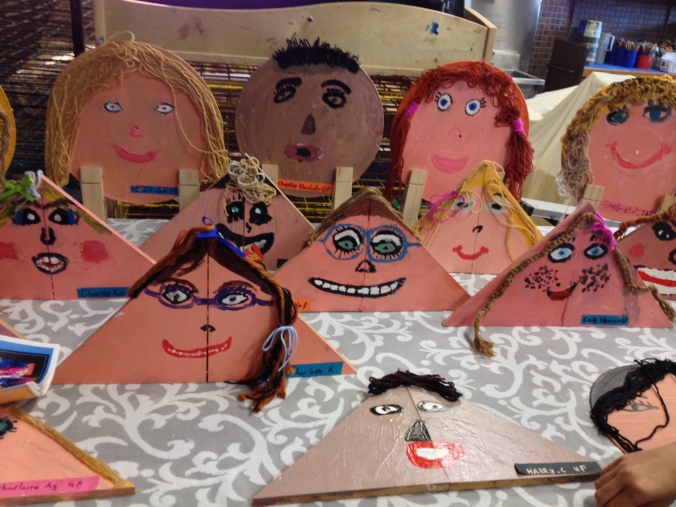
Changes to Victorian Donor Laws: some notable & unexpected corollaries

Changes to donor laws that were adopted by the Victorian Legislative Council in 2015 have today been enacted, and if the news is anything to go by, I can express initial support.*

As of today (March 1), Victorians can access information regarding their donors and heritage.

The Age has published the story of Katherine Vowles, a 26 year old Melbourne musician. At the age of 11 her mother told Katherine that she had been conceived with a sperm donor.

“As a young girl, the possibility of half siblings, especially sisters, was tantalising.”I imagined all these different versions of myself,” she said.   “When you’re a little kid you want to find all these brothers and sisters because you want to hang out with them.”

Curiosity grew into a personal mission about a decade later, in 2012, when Katherine moved from her hometown in regional South Australia to Melbourne, where she was conceived.

“As I’ve gotten older I’ve had more questions because of things like medical history, heritage, life interests and life goals, the who am I stuff.”

“As I’ve gotten older I’ve had more questions because of things like medical history, heritage, life interests and life goals, the who am I stuff,” she said. “I wondered if he was into music, if he was any kind of creative.”

The only new information she could get was how many other babies had been conceived with the same donor’s sperm. “I had a lady on the phone … she had the file with his name on it but she’s just not allowed to tell me anything,” Katherine said.”

img_0037

One of the many commonalities every human being shares is the existence of a mother and father. We all have a mother and father; life would be impossible otherwise. For most of us, we know and love our mum and dad. For some, one or both parents have caused us great harm and pain, and this knowledge continues tear at us and to bring tears. Others, such as Katherine Vowles, have not know one of their biological parents, whose identity until today remained a secret.

I am grateful for the fact that I do know and was raised by my biological parents, and so because of my own experience it would be presumptuous to assume what is likely to be multifarious thoughts and desires among those who have not known their biological parent(s).

As the story in The Age expresses, it is understandable and even natural for children wanting to know their biological parents, and for the Governmental to remove obstacles is positive, although understandably not all children will take up the opportunity, and no doubt some parents will be apprehensive at the prospect.

I want to focus my comments on 2 unexpected but important corollaries from this change in law:

Firstly, when it comes to children and parents, we cannot escape biology. There may be good reasons why such a separation occurs, and there also be unethical reasons, but we know that time and space and anonymity are not sufficiently strong to break that bond between parent and child.

We should therefore resist establishing societal structures that build family units which depend on removing this link between a child and their biologic parents. This is very different from the example of adoption or foster care, whereby society is practicing a retrieval ethic, that is, making the best out of a bad situation. It is important for Australians to realise that as we tinker with definitions of marriage, for example, we are creating social units that cannot naturally create human life, and therefore necessitate removing a child from one biological parent.

Secondly, the Government, on this occasion at least, makes it clear that the rights of children outweigh those of a parent, albeit a donor parent. Health Minister Jill Hennessy says the Government recognises the issues pertaining to peoples anonymity, but have decided that children learning their parents names is more important than the rights of a donor.

What this shows us is that no matter how hard society tries to fashion relationships and marriages in whatever form we want, we keep finding ourselves going back to that which we should never have left. If the design is good, we should not play with it.

But there is one more thing that needs saying, and in some ways it is more important than these first two points:

The story of the Bible does not end with the ‘normal’, as though affirming and experiencing the normal pattern of family is the prerequisite for knowing God, and you’re damned to hell if it is otherwise.

While the Bible presents a consistent view of marriage and of the family unit, and notably it is this understanding that remains paradigmatic today, it also describes many other families. Some of these families speak of unenviable and difficult circumstances, and yet from them we read beautiful stories of grace: Abraham and Hagar, Jacob and Rachel, Judah and Tamar. These stories are not normative and neither are they suggesting to us alternate ways to create family, but rather they teach us that such scenarios are not the end of the line. Those family relations were not ideal and some clearly immoral, but God was not stumped by them, and through human error (and sin) he showed grace and love.

Society functions best when we encourage family structures that enable children to be raised by their biological parents. As far as I understand the changes to the law, the Government has made a good decision, although I appreciate the difficulties attached for both children and donors. As good as all these things may be, there is something even better, and it is not dependent upon biology or family, and neither is it an alternative to these relationships. In a world where familial identity and relationship may elude us, there is possibility of relationship that surpasses even the most loving and secure family:

“For he [God the Father] chose us in him before the creation of the world to be holy and blameless in his sight. In love he predestined us for adoption to sonship through Jesus Christ, in accordance with his pleasure and will” (Ephesians 1:4-5)

It is seriously worth pondering these words for a moment. We may search for lost parents, lost siblings, and children, and we long for these holes to be filled and questions answered. There also exists a need and desire to be reunited with God, and this awareness is as basic and innate to human beings as is our need for familial love and relationship. Consider those words from Ephesians in the Bible: to be known and welcomed and loved by God is the greatest joy and satisfaction anyone can experience.  It is beyond the scope and power of any Government to achieve this, but it is not beyond God who has come down to us in Jesus Christ and calls us to come back to him.

————————-

*I should preface my comments by acknowledging that the field of sperm, egg, and embryo donation is thwart with ethical concerns, but most are beyond the scope of this post.

How would you define marriage?

Last week a Senate report was released, following the Inquiry: the Select Committee on the Exposure Draft of the Marriage Amendment (Same-Sex Marriage) Bill.

The scope of the inquiry was deliberately narrow, limiting discussion to consequences for law and society, should the Marriage Act change and include non-heterosexual marriage. The Senate Inquiry was not asking for arguments for and against same-sex marriage; indeed the committee outlined that such submissions would not be published. Unfortunately though, this important fact has been overlooked by some journalists who have painted the report as an argument for the inevitability of marriage change.

Deliberations concerning the fall-out from redefining marriage are important, and concerns are warranted given what is happening in some countries who have adopted same sex marriage. There are real consequences relating to freedom of religion and freedom of speech, and there are genuine questions relating to the rights of children having a mum and dad, and to the issue of surrogacy and assisted reproduction. It is simply naive for us Australians to assume that nothing will change.

OLYMPUS DIGITAL CAMERA

As important as those conversations are, there is the preceding question, the question not tackled by the Senate Inquiry and is now assumed by many as a given: what is marriage?

According to the report, the new definition will involve deleting the phrase, ’man and woman’, and substituting it with ‘2 people’. Thus marriage would become in Australian law, ‘the union of 2 people to the exclusion of all others, voluntarily entered into for life’.

Increasingly, Australians have been led to believe that same-sex marriage is the great inevitable. The legal definition of marriage may well change in 2017, but the case for change has been less about cogent reasoning, and much to do with emotive stories and slick slogans. One should not ignore peoples personal experiences, but if we are to be fair, we will also listen to the equally powerful stories of same-sex attracted people who are asking us not to change the marriage definition. Yet, stories alone should not dictate Australian law.

Disappointingly, many people have been driven to silence, following a constant tirade of abuse from numerous politicians and media personalities. To even question the validity of same sex marriage is paramount to a new social heresy according to some. But it is possible, indeed desirable to speak for the dignity of LGBTI persons, and to seek their well being, without making the logical misstep of calling for marriage redefinition.

The question remains, what is marriage?

What is it about the nature of marriage that requires us to remove man and woman from its definition?

Is it love?

Love is of course a wonderful thing, and there are many kinds of love, but is this argument sufficient? Surely, not every loving relationship should be called marriage. The reality is, there must be more to marriage than love, otherwise even the proposed redefinition is discriminatory and inadequate.

Another argument that has been put forward is the view that marriage morphed throughout history, therefore it’s okay to once again institute change. This thesis however is nothing more than an example of historical revisionism. The 2004 amendment to the 1961 Marriage Act did not change the nature of marriage, it simply spelled out what was already established belief and practice. And when the Marriage Act was enacted in 1961, it was not reinventing the definition of marriage, but delineating what was known to be true about marriage. Similarly, the Family Law Act 1975 which established the principle of no-fault divorce, did not alter the meaning of marriage, but wholly depended upon it.

What about the argument of equality?

The phrase ‘marriage equality’ is often cited, and it’s a clever piece of marketing, but it is also self-defeating and potentially disingenuous.  First of all, all sides in the marriage debate believe in marriage equality, but equality depends on how one defines marriage. Second, if the current debate is really about honouring equality, for whom is it attaining equality? The draft definition will continue to discriminate against polygamists and polyamorists, and it will also discriminate against those who believe marriage should have fixed term rather than ‘being for life’. If proponents of ‘marriage equality’ are in fact wanting equality for all, it makes sense to ask, why do they insist marriage should remain between 2 persons and be intended for life?

Such questions are not difficult to answer for those holding to the traditional and historical understanding of marriage, but I am yet to hear a persuasive argument from those advocating change, and I am keen to hear one.

As far as I can see, pretty much everyone in the marriage debate discerns a level of discrimination, but the question is at what point? What is it about marriage that requires 2 persons and life long commitment?

After an interesting dialogue last year, one interlocutor wrote to me saying, “marriage is about what people want it to be, whether it’s about love, convenience, social acceptance, children, getting a visa or whatever.”

I appreciated his honesty, and it demonstrated that when nudged, the reasoning for marriage change frequently ends in this same place of vagueness and imprecision. But arguing that the meaning of marriage is malleable is a fast track to making marriage meaningless. Conversations such as this one revealed the argument boils down to individualism, and to the belief that I am free to determine meaning as I like. As appealing as that may at first sound, it’s ultimately fallacious and counter-productive for a healthy society.

If I walked along the Monash freeway, I would soon find myself in trouble because the Monash freeway is not designed for pedestrians.

Similarly, marriage is and has always been designed for a particular type of relationship: a loving consensual relationship between a man and a woman, intended for life, for personal relationship, for procreation, and for the building of society. There is something inherently unique about this covenantal relationship that we call marriage, and which can only be fulfilled by a man and a woman. As an example, biologically, the act of procreation requires 2 persons: a man and a woman. And such is the intimacy of this sexual union, that it requires the kind of loving commitment that marriage provides. We all know  children who grow up without a father or without a mother, but I don’t know of anyone who believes that this is a good thing. It is sometimes necessary given the awful reality of domestic violence, or the tragic death of a parent, but does anyone truly believe that the ideal context for raising children is without a mum and dad?

If our Australian Parliament is to change the Marriage Act, we need better reasoning than what we have heard thus far. And last year’s argument, ‘well, the Americans have done it’, probably doesn’t hold so much weight anymore!

I trust people won’t confuse my frankness here with glibness or insensitivity, for I do not wish to cause hurt to any for whom this is a personal issue. I genuinely desire for you to have life to the full, as Jesus spoke about (John 10:10). It is also possible that there will be a few ‘religious’ people who will read my words and use them to agitate views about homosexuality that I do not share; they will not find an ally here because the God whom I know and serve has made every human being in his image and they are deserving of love and dignity. That marriage is for a man and a woman is a good thing,  which even many gay and lesbian people recognise and affirm*.

Is it wise to redefine marriage? Which ever way you respond to that question, we need to also answer these questions: what is marriage, and with what reason(s) do you define at such?

————————————————————-

*Sam Allberry is an English Anglican Minister who recently spoke to this issue, albeit in the British context,

“I am same-sex attracted and have been my entire life. By that, I mean that I have sexual, romantic and deep emotional attractions to people of the same sex. I choose to describe myself this way because sexuality is not a matter of identity for me, and that has become good news,”

“My primary sense of worth and fulfillment as a human being is not contingent on being romantically or sexually fulfilled, and this is liberating,”

“The most fully human and compete person was Jesus Christ. He never married, was never in a romantic relationship, and never had sex. If we say these things are intrinsic to human fulfilment, we are calling our saviour subhuman. “

“I have met literally hundreds of Christians in my situation, and know of thousands more, who are same-sex attracted, and who joyfully affirm the traditional understanding of marriage being between a man and a woman, and the only Godly context for sex. If you do not hear from more of us, it is because it is really hard to stand up and describe ourselves in this way…”

(https://www.thegospelcoalition.org/article/two-minute-clip-homosexuality-every-christian-should-watch)


Respectful Relationships now compulsory across Victoria

The Respectful Relationships curriculum is now compulsory across Victorian schools and early childhood learning centres. Children will be first introduced to material in kindergarten.

With all the attention on the now unravelling Safe Schools program, its cousin, Respectful Relationships has received little attention, despite it targeting not only teenagers but also our young children, and it being made mandatory throughout the State. It has however received some attention this morning in The Australian,with reporter Rebecca Urban, revealing that Safe Schools co-author, Joel Radcliffe,  has been appointed to the Victorian Education and Training Department to assist in rolling out the program across the schools.

It is important for parents to have knowledge of Respectful Relationships and to ask questions where they are unsure of its content or have concerns. One may well discover that their school shares similar concerns over the material.

I want to make it clear that there are positive aspects to this new program as well as  significant concerns, and it would be a shame for the program’s aim to be hijacked by the unscientific theories and morally dubious suggestions that currently run throughout. It would be certainly irresponsible to teach some of the content without parental awareness. 

IMG_0214

If you are unfamiliar with the program, here is an overview that I wrote last year:

I agree with Daniel Andrews’ recent comments about the evils of domestic violence in our society, and I laud the Victorian Government for adopting strong measures to support victims and convict perpetrators. Domestic violence is a dreadful, dreadful thing: Sexual, physical, emotional, and material abuse is never justified.

In August 2015, Daniel Andrews announced that the program replacing SRI in schools would be Respectful Relationships, which has been introduced into secondary schools, and will be compulsory from kindergarten to year 10 in 2017.

There are many things to like in the curriculum, but oddly, a significant portion of the material has little to do with domestic violence, but is teaching children how to find partners and have sex.

For example, year 8 students are asked to write an ad, describing what qualities they would like to find in a partner. Is it appropriate to ask 12 and 13 year old children what kind of sexual relationship that would like to have?  Is it healthy for children to be directed to online dating sites, and given examples, such as these found in the curriculum?:

‘hot gay gal 19 yo seeks outgoing fem 18-25 into nature, sport and nightlife for friendship and relationship’

‘lustful, sexually generous funny and (sometimes shy) Tiger1962 seeking sexy freak out with similar intentioned woman.’

Not only are young teenagers taught about what to look for in a partner, they are taught what to seek in sex, and they are taught what to believe about sexuality, even to explore and affirm alternative sexual orientations.

As one of the year 8 sessions explains, it is designed to,

“enable students to explore the concept of gender and the associated notions and expectations that have an impact on sexuality. It also provides them with the opportunity to connect issues of gender to different positions of power central to adolescent sexual behaviour. The activity also aims to extend their understanding of gender by exploring traditional notions of gender in a case study that examines the experience of a young transsexual person.”

Much of the ensuing material explores broadening the horizons of sexual relationships, with the determination of deconstructing the “narrow” view of gender.

It may surprise some people to learn that children can legally have sex in Victoria from the age of 12 (younger in some States), so long as it is consensual and the other person(s) is within the legal age bracket. This may be lawful, but I suspect many parents would be shocked to learn that schools teach our children it is okay for them to engage in sexual intercourse at such a young age.

We are fooling ourselves if we think that exposing children to these ideas will not result in influencing sexual and social behaviour. The fact that Respectful Relationships makes consent unequivocal (a vital point) does not mean the activity is therefore good and okay for the child.

Also astonishing is what is missing. In a curriculum teaching relationships and sex, marriage receives almost no mention. Why is that? Marriage is mentioned on a ‘character card’ where Stephen, a 16 year old Christian attending a Christian college, believes sex should only take place within marriage between a man and woman (got to love the pastiche Christian example!). And there is Maria, a 15 year old girl who doesn’t want to wait for marriage before experiencing sex. Otherwise, marriage is only mentioned as a power structure behind which domestic violence occurs. What a sad and miserable view of marriage. I understand there are marriages where appalling abuse happens, and in my work I have ministered to victims from such circumstances. But marriage is designed to be, and often is, a beautiful thing, and it remains the best model for loving and caring intimate relationships in society.

Is it not a wonderful thing when a couple covenant together for life, ‘for better, for worse, for richer, for poorer, in sickness and health, to love and to cherish’?

There is much sensible and good advice offered in Respectful Relationships, which could be easily taught without the intrusion of particular views on sexuality and without exposing young children to ideas that blemish their innocence. It is a travesty that the issue of domestic violence has been taken captive by sexual libertarian ideology.

Is it the role of Government to absolutise onto children a theory about gender that is disputable and widely contentious? James Merlino has made it clear that this curriculum is to be compulsory in Victorian schools; I wonder, is forcing explicit sexual language and ideas onto children, moral or even legal?

Far from solving the unspeakable horrors of domestic violence, it is ultimately presenting a different version of the me-centric vision of the world. Author, Tim Keller writes, ‘It is possible to feel you are “madly in love” with someone, when it is really just an attraction to someone who can meet your needs and address the insecurities and doubts you have about yourself. In that kind of relationship, you will demand and control rather than serve and give.’

Instead of leaning on a failed sexual revolution in order to find a way forward on domestic violence, would we not serve our children better  if we considered a paradigm of sacrifice and service, and where living for the good of others is esteemed more highly than our own gratification?

We can learn from NSW…sometimes

I know we like to dislike our northern neighbours in NSW, but sometimes we really ought to take notice and learn from their example. No, I don’t mean playing football with an oversized egg or drinking their faux coffee. Yesterday, The Australian  reported that students in NSW schools will no longer be permitted to learn gender theory,

Students will no longer be taught that gender is a “social construct”, or that sexuality is “non-binary”, occurring on a ­continuum and “constantly changing”.

An edict encouraging teachers to “de-gender” their language will also likely be scrapped, along with sexually explicit case studies and teaching aids such as the “Genderbread Person”, which promotes the idea that there are “infinite possibilities” of gender identity.

The decision follows an independent inquiry that reported in September last year. The review was headed by Professor Bill Louden (of the University of Western Australia) and examined sex and health education resources for NSW schools. It appears as though changes are being implemented not only with Safe Schools, but any part of the State curriculum where a de-gender and gender-continuum message has been integrated.

img_9452

Of particular relevance for Victoria is  that Professor Loudan’s review is finding bi-partisan support in NSW. In fact,  NSW Labour MP Greg Donnelly has taken the unusual step of writing an open letter to the Victorian Premier, imploring him to give this report due consideration,

“Politicians in one state do not generally take kindly to colleagues in another state giving them advice. There can be exceptions but the unwritten rule is that if you stick your head out and give advice across the border, you are likely to get it knocked-off. With that said, let me now give some advice to my Labor colleagues in Victoria.

The Safe Schools program that the Victorian Government is imposing on public schools in that state is political poison. While it may be just starting to show up in focus groups and other polling activities undertaken by the Labor Party, do not underestimate its malignancy. When it fully manifests, it will be like a fully laden freight train that you will not be able to stop.

The problem for the Premier and the Minister for Education is that the Safe Schools program from the get-go was never about anti-bullying. It was about inculcating into school children hard edged sexuality and gender ideologies. The same ideologies that are examined and debated when undertaking Gender Studies units at university. The same units that such students elect to do by choice; no compulsion or requirement. Not only are these ideologies being presented to school children as a matter of fact i.e. sexuality and gender are not to be understood in any other way, but parents are being kept completely in the dark about what is being presented to their children and by who.”

Mr Donnelly continues, “Premier Andrews and Education Minister Merlino have been both doctrinaire and obstinate about the Safe Schools program. As a case in point, in March last year following a review of the resource material located on the Safe Schools Coalition Australia website it was recommended by the reviewer, Professor William Louden, that certain content was not fit for purpose. It was subsequently removed from the Safe Schools Coalition Australia website. In Victoria though the material that was removed from the website was immediately uploaded onto the state’s Department of Education and Training website, presumable under instruction from the Premier and/or Minister for Education. That material still sits on the Department’s website and is being actively promoted. In other words instead of taking into account what were rather modest recommendations by Professor Louden, the Victorian Premier and Education Minister got all hairy chested and gave the whole review exercise the middle finger.”

I totally get why Victorians build rhetorical walls to keep out this colony of convicts. Listening to a New South Welshman may sound like a Banshee singing Justin Bieber, but on this occasion we Victorians are fools to ignore such sage advice.

Mr Andrews and Mr Merlino, as a Victorian and parent of 3 children, I strongly urge you to re-examine your position on Safe Schools, and the unscientific and harmful gender theories now being forced upon our children. It’s ok to once in a while to redress mistakes and poor policy; humility is in fact a virtue that we value in our political leaders.  In winding back ‘Safe Schools’ and aspects of the ‘Respectful Relationships’ program, we do not have to wind back the clock on caring for children who may be working through issues of their own sexuality. We want to see them safe and flourishing, and this is achievable without having to promote ideology that is demonstrably skewed and unsuitable for the classroom.

The Glass Ceiling Women are not allowed to break

Recent conversations about abortion in Australia and in the United States have made it clear that it is not enough for a woman to be a woman, nor is being a feminist suffice; one must also publicly support abortion. A woman may reach the zenith of public office but it is apparently redundant if they are not promoting a particular type of womanhood. It is not enough for a woman to be woman (which I assume is insulting to many women), but you have to be a woman who talks to and represents a particular agenda.

443_1_promo

Last week the world witnessed over 3 million Americans marching through their cities, protesting the Presidency of Donald Trump. These protests are understandable given the unacceptable views on women that the new President has expressed. I want to emphasize how appalled I am by his comments about women. However, not everyone who wanted to march in support of women was welcomed, those who describe themselves as ‘pro-life’ were excluded.

The new Minister for Women in NSW is Tanya Davies, and within moments of giving her first press conference as minister,  numerous journalists and social commentators began calling for her removal. The reason? What atrocious deed is lurking in her wardrobe? The problem is, Tanya Davies is pro-life.

She said,

“Personally I am pro-life … but in my role I am there to support all women and I will support all women, and I will listen to all women and I will take on board all the stakeholders’ comments and feedback … and ensure the best outcome for all women is secured,”

In today’s The Age, Jenny Noyes made it clear as translucent silica that one cannot be Minister of Women if one does not support a woman’s right to abort her children,

“the appointment of Tanya Davies as the new Minister for Women was immediately soured when she admitted during the press conference to being “personally pro-life.”

“This simply is not good enough…NSW needs a Minister for Women who will actually fight for women’s rights, who is willing to put reproductive rights on the table – not to wind them back…”

The comment that I found most troubling was this one,

“The so-called “pro-life” movement says a life that hasn’t even begun is more important than the self-determination of a living, breathing woman.”

First of all, let’s not fudge the facts: life has already begun. Treating unborn children as pre-life and pre-human counters what we know to be true scientifically and ethically. To grade human beings according to levels of humanness is gross and immoral, and reminds us past generational ideologies which rightly cause us to shudder. Life does not begin at birth; our children are living sentient beings inside the womb. They are feeling and thinking and feeding and growing, responding to music and to touch.

Noyes’ also misrepresents the “pro-life” paradigm, painting  an either/or fallacy. It is possible to be both for unborn children and for women. But in the highly charged individualism which so much feminism has now adopted, room isn’t permitted for women (or men) to both support a woman’s health and life, and the health and life of the child in her womb. 

In Ancient Rome, baby girls were often abandoned and left to die in the open. Today, it is not sexism and misogyny that is responsible for most abortions in Western countries (although evidence suggests that the majority of world-wide aborted babies are girls), and neither is it the endangered-life of the mother, but the endangered life-style of women who are encultured to smash more glass ceilings. 

The irony is, Tanya Davies is cracking another panel, but it is not one that some women want broken.

As a Christian I can’t help talking about Jesus, for I reckon he is more relevant to these discussions than we often think. We know Jesus’ views of women countered the norms of his day, which angered many men who sought to subjugate women. Jesus also taught us to welcome and care for little children. A healthy and mature society will do both.

I wonder, instead of women and men jumping to break more ceilings, what if we learned from Jesus, and stopped climbing on our step-ladders and shattering glass all over those underneath us? How often in advancing our own dreams we sacrifice others whom we leave below? Jesus accomplished the greatest act in the history of human rights, not by asserting his position but in laying down his life out of love for others. He flipped on its head the alleged axiom of ‘power verses abuse’, when he chose to serve those with whom he held strong disagreement. And instead of discarding those whom we perceive as holding us back, Jesus gave them dignity and called them to walk with him through life. At least to me, this sounds like a better way forward.

Terrorism, Christmas, and Boxing Day in Melbourne

Melbourne is my city. I love its people, culture, food, sport, parks, city and suburbs. It is a wonderful place to live. But over the past few days Melbourne has witnessed two significant threats to the human soul, terrorism and materialism.

OLYMPUS DIGITAL CAMERA

Last week’s threat of a terrorist attack in Melbourne City was not enough to keep people away from celebrating that most holy night. A large crowd converged on St Paul’s Cathedral, one of the alleged targets of the plot, to celebrate the birth of Jesus.

Terrorism is not an unknown experience for Churches, more often referred to as persecution. Persecution is common place for many of the hundreds of millions of people who profess Jesus Christ is Lord. It is also true that people of other faiths are also terrorised, and that there are also examples of people wielding the sword in the name of ‘Christ.’ There is no justification for any such heinous acts, but as Greg Sheridan of The Australian reported this year, Christians are ‘more persecuted than any other in the world, persecuted more frequently, more widely and with more intensity.’

Civilisations have not always survived the onslaught of horrid regimes. Carthage was put to the sword by Rome, and Rome destroyed by tribal groups from Northern and Eastern Europe, and the Mongols wiped out the Jin Dynasty, and the Conquistadors over the Aztecs. In all cases, reasons for subjugating another culture were multifarious, and it would be intellectually unsound to disconnect religious motivations from imperialism, trade, and at times racial provocations.

One idea has always outlasted persecution, and that is, Christianity. As Tertullian (2nd C) said, ‘the blood of the martyrs is the seed of the church’. This is evident in history, for example, through sporadic seasons of persecution Christianity flourished in the Roman Empire, and when China closed its doors to missionaries under Communism, 10s of millions of Chinese were converted to Christ.

Terrorism is not new, and while separating modern ‘Jihadism’ from ‘faith’ is understandable, it is ultimately irresponsible. Islamic terrorism is targeting Christianity, as well as other religious groups, and Western Civilisation. Many Muslims are appalled by news that a group of Australian muslims planned mass murder, and so it is only right that politicians are careful with their language. At the same time, as long as the social ‘left’ play games with political correctness, they will only add weight to the extreme ‘right’, as the world is seeing in the United States at the moment. In my opinion both spectrums are dangerous to a healthy pluralist society, as both insist on a flawed moral absolutism.

Undoubtedly, people congregated at St Paul’s Cathedral yesterday for different reasons: as an act of defiance, to show solidarity, as well as for marking the birth of the world’s Saviour. All these reasons have a place, but there is something true and symbolic about the message of Jesus Christ breaking through threats of violence.

The message that resonated around the Gothic walls of St Paul’s and in hundreds of churches across Melbourne this Christmas is one of the incarnation, how God broke through a world of human hostility, even amidst State attempts to kill the new born child. At Mentone Baptist with a congregation overflowing into the hall, we sang of this most extraordinary wonder,

‘True God of true God, Light from Light Eternal,

lo, he shuns not the Virgin’s womb;

Son of the Father, begotten not created’

Today in Melbourne, the same city we love and that yesterday celebrated the birth of Jesus Christ, is once again teaming with people, somewhat sluggish from overeating but eager to fill shopping bags with deals. It’s the Boxing Day sale day!  While not denigrating the pursuit of a great sales price, to fill again Santa’s sack that was emptied only one day earlier, suggests a certain proclivity toward toys and clothes and other stuff.

There is a certain irony in that the Jesus whom we sang about with such gusto on Christmas, spoke more often about the danger of materialism than he did of persecution.

‘What you have said in the dark will be heard in the daylight, and what you have whispered in the ear in the inner rooms will be proclaimed from the roofs.

“I tell you, my friends, do not be afraid of those who kill the body and after that can do no more. But I will show you whom you should fear: Fear him who, after your body has been killed, has authority to throw you into hell. Yes, I tell you, fear him.’ (Luke 12:3-5)

“When Jesus heard this, he said to him, “You still lack one thing. Sell everything you have and give to the poor, and you will have treasure in heaven. Then come, follow me.”

When he heard this, he became very sad, because he was very wealthy.  Jesus looked at him and said, “How hard it is for the rich to enter the kingdom of God!  Indeed, it is easier for a camel to go through the eye of a needle than for someone who is rich to enter the kingdom of God.” (Luke 18:22-25)

We may have resolved to resist physical violence, but eating away at the soul of Melbournians is an excessive love for things. We are the world’s most liveable city and we’re intent of maxing it out.

Christmas may be the happiest day of the year for many Australians, and it is also the loneliest for many of the poor and sick. What makes news of God incarnate, good, is not that we get to dress up in suit and tie, and visit Church for one day, feast on too much food and open presents. The incarnation says God understands human poverty and suffering, and he went further than any of us can go, he died on a cross for our sins and rose from the dead for our justification.

Terrorism can’t destroy this Christian hope, neither can materialism. But while terrorism may drive Aussies back to Church, materialism deadens the soul. I get it, such a suggestion is amount to heresy in this city that I love, but what if Jesus is right? What if these ancient words remain true for us today?

And what about the Boxing Day cricket test? Leave cricket alone!

Heteronormacy is the new Heresy

A word of clarification and qualification:

I’ve received some helpful feedback this afternoon, and upon reflection, I should probably have nuanced some of the comments in this post.

While the guidelines don’t ban the use of ‘traditional’ words, it is nonetheless framing a new language that the Government want used in the workplace.And while I agree that one can read the document with a fair degree of latitude, it is written in a way that can also be enforced rigidly when suited.

– The Guidelines do discourage using the language of husband and wife, and it does encourage gender neutral alternatives.

-The document also rejects heteronormative language and thinking, branding it as a form of sexism.

Both of these points are problematic.

————————————

The Victorian Government has published Guidelines for State employed workers, informing them of what language is appropriate when addressing fellow employees, including those who are married. The Government is encouraging even non-Government  business and organisations to adopt their chosen language.

img_9452

In The Australian today, Ro Allen, Victoria’s gender and sexuality commissioner, says that the Inclusive Language Guide is designed to teach people to use the ‘correct language’.

What is the basis for the officially declared ‘correct language’? If anyone was hoping the answer would be grounded science or even common sense, you’ll be sadly disappointed. The accepted language is defined against what is perceived as heteronormative. In other words, the noun wife assume that the person is a woman; that is gender specific and therefore inappropriate.

What is the correct language? Spouse is preferred, but also, if you a married woman, you shall be known as Hir, and if you are a married man, you shall be called Zie.

I would have thought that quite a few married women will be offended if you refer to them as an androgynous being, which is what the pronoun Hir means. And calling a bloke Zie is not going to upset anyone? Hey Bill, instead of referring to you as he and him, and man, I will now speak of you as Zie! And if you’re offended by that, don’t worry, it’s the correct language so says the Government. 

To be fair, the Guidelines also address some issues relating to LGBTIQ persons, which are reasonable. For example, using words to demean gay and lesbian people is not appropriate, in the workplace or anywhere for that matter.

The Guidelines state,

‘Inclusive language ensures everyone is treated with respect as such language is free from words or tones that reflect prejudice, discrimination or stereotypes. Gender and sexuality are experienced and expressed in many different ways, and using language that excludes or stereotypes can cause unintentional harm to LGBTI individuals. This includes ‘positive’ stereotyping of LGBTI people.’

The Government has a growing list of policy initiatives that allege to defend equality and safety for LGBTIQ Victorians. I gladly affirm policies that will protect people from harm, but it is clear however, that the Government’s agenda exceeds these goals, and there is the now explicit intent to rewrite the human understanding of male and female. Whether it is Safe Schools, the birth certificate legislation, Respectful Relationships, or this workers guide, what we are told to believe is that heteronormacy is false and unethical. Indeed, as with Safe Schools, these Guidelines judge that anyone affirming heteronormacy is sexist, and their views are to be removed from the workplace.

Think about it, what is more sexist, acknowledging my wife’s femaleness, or referring to her as an androgynous being? What amounts to discrimination, suggesting a married man is someone’s husband, or calling them Zie, and doing so whether they like it or nor?

As crazy as it sounds, in the foreseeable future Victorians will be forced to refrain from speaking of anyone as a woman or man, boy or girl, daughter or son. Instead, we will told by Governmental authorities what the correct language is, and those who fail to comply will no doubt find themselves in hot water.

The new moral vision that Daniel Andrews is championing will not lead to a fairer Victoria, but a more confused Victoria, and one where people are fearful to use natural and wonderful words like husband and wife, and man and woman, lest they be bullied for pseudo-sexism.

We should not be afraid to affirm manhood and womanhood. No one should be called sexist for using the natural categories of wife and husband. No gay and lesbian or transgender person should be victim of work place mockery and bullying.

I trust that concerned members of Parliament, including  within the Labour caucus, will speak up against this latest chapter in Mr Andrews program to prejudice heteronormacy.

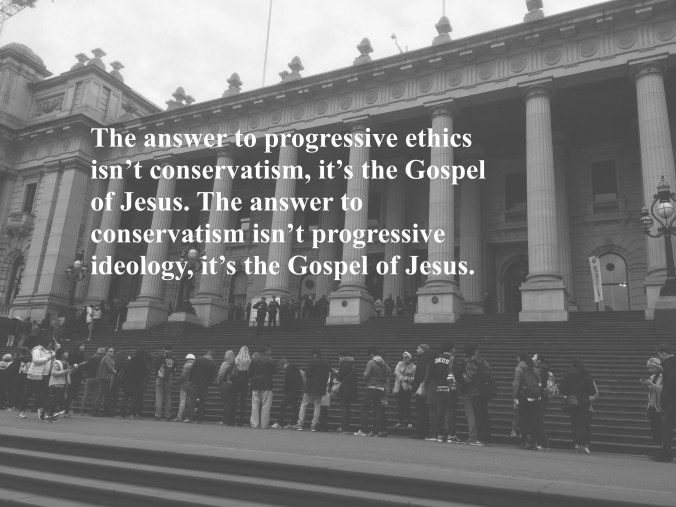
The answer can be found inside the Victorian Parliament

“All along the answer was staring us in the face.”

BREAKING NEWS: We are thankful to God for his grace and grateful to those who voted and defeated the ‘inherent requirement’ legislation.

Should this amendment to the ‘Equal Opportunity Act’ have been adopted, all religious organisations in Victoria, including churches, would have lost their freedom to employ people based on the beliefs and practices of the organisation. A tribunal would have been appointed by the Government, establishing a theological framework for all religious groups, and this same body would determine whether potential employees would be ‘inherently required’ to follow the convictions of any particular religious organisation.

In essence, the legislation would have redefined the role of Government in religious matters, giving it pseudo-episcopalian oversight.

A liberal democracy necessarily provides and protects an environment for society whereby associations have freedom to employ persons who’s convictions and character align with that organisation. In spite of the Andrews Government’s intent to remove this freedom from churches and religious schools, the Parliament has determined otherwise, at least for this point in time.

Today, we witnessed the Victorian Parliament putting on the brakes, and in a small way, slowing down a movement that is intent on eliminating Christian beliefs from society. After a series of anti-Christian policies that have come into effect over the past 2 years, we should be thankful for today’s decision, which means that the State of Victoria has retained an important aspect of religious freedom.

As we express gratitude, I trust though that people will refrain from pontificating, and from presuming that this decision will in some way advance Christian faith in Victoria. The reason is simple, the Gospel doesn’t advance through Parliamentary processes but only through the proclamation of the Gospel of Jesus Christ. Don’t get me wrong, it is a good thing that the legislation was defeated, but we mustn’t over-state the argument.

img_9500

Rather than focusing on the ‘inherent requirement’ legislation, I wish to take the opportunity to speak of a little known fact about our Parliament building. Positioned in the middle of the Victorian Parliament building, inside the library, is a large Bible, opened and sitting on a wooden stand. It is not hidden in a corner or shelved along a row of books, but stands alone at the centre of the library, conspicuous as a light post.  Despite its prominence though, one wonders how often people stop to notice let alone read this copy of God’s word. One wonders if people consider this Holy book anything more than an item of historic curiosity.

I have walked passed this Bible on numerous occasions, and  have noted that it is always opened to the same passage, Jeremiah chapter 31. I don’t know the story behind choosing this particular portion of Scripture, and whether it was chosen carefully or just opened randomly. Either way, it is a fitting page for the seat of Victorian political power.

The book of Jeremiah was written in the 6th Century BC, at the time of the Babylonian invasion and of Jerusalem’s destruction.  The book details the ministry of Jeremiah the prophet, who expounded words from God that offered explanation of the nation’s then predicament. It was a time when society had turned its back on the God of the Bible, and instead chose to propagate and trust in ‘progressive’ political and religious thought. Not all Biblical thought was silenced, aspects were retained although heavily redacted and reinterpreted in ‘new’ ways.

The nation’s leaders, both political and religious, in ways that may remind one of Neville Chamberlain, spoke of a message of peace,

“From the least to the greatest,

all are greedy for gain;

prophets and priests alike,

    all practice deceit.

They dress the wound of my people

    as though it were not serious.

‘Peace, peace,’ they say,

    when there is no peace.

Are they ashamed of their detestable conduct?

    No, they have no shame at all;

    they do not even know how to blush.

So they will fall among the fallen;

    they will be brought down when I punish them,”

says the Lord.’

(Jeremiah 6:13-15)

The book of Jeremiah contains many bleak messages, and with good reason, but it is not without hope. Jeremiah ch.31 gives a portrait for a new beginning, a Divine promise of hope to those without hope. What is especially staggering about the message is that it is not written for ‘good’ people who are being beaten down by an oppression regime, but it is written for those who were doing the beating. To a disinterested and at times vitriolic people, God speaks a message forgiveness and newness, one that reaches to a level of humanity that no human law and politics can reach, the human heart.

He says,

31 “The days are coming,” declares the Lord,

    “when I will make a new covenant

with the people of Israel

    and with the people of Judah.

32 It will not be like the covenant

    I made with their ancestors

when I took them by the hand

    to lead them out of Egypt,

because they broke my covenant,

    though I was a husband to them,”

declares the Lord.

33 “This is the covenant I will make with the people of Israel

    after that time,” declares the Lord.

“I will put my law in their minds

    and write it on their hearts.

I will be their God,

    and they will be my people.

34 No longer will they teach their neighbor,

    or say to one another, ‘Know the Lord,’

because they will all know me,

    from the least of them to the greatest,”

declares the Lord.

“For I will forgive their wickedness

    and will remember their sins no more.”

35 This is what the Lord says,

he who appoints the sun

    to shine by day,

who decrees the moon and stars

    to shine by night,

who stirs up the sea

    so that its waves roar—

    the Lord Almighty is his name:

36 “Only if these decrees vanish from my sight,”

    declares the Lord,

“will Israel ever cease

    being a nation before me.”

37 This is what the Lord says:

“Only if the heavens above can be measured

    and the foundations of the earth below be searched out

will I reject all the descendants of Israel

    because of all they have done,”

declares the Lord.

It is quite extraordinary and wonderful that at the centre of Victoria’s State legislative power is a reminder of ultimate hope. The answer to our deepest struggles and concerns lays not with Government policy and lawmaking, not in a ground swell of public opinion, or in the strident voices of columnists, but in an ancient promise given by God, God who kept his word by sending his only Son into the world.

The reality is, in different ways our political and ideological preferences can blind us from the glory of Jeremiah ch.31, whether we define ourselves as progressive or conservative, green, red or blue. No matter where people align themselves on these spectrums Jeremiah 31 gives a Divine word that counters and surprises. God is not frustrated by or restrained by any socio-political movement, and neither is he defined by it.

I would encourage all who visit our Parliamentary library, don’t walk past the Bible. Why not pause and read, and ponder at the possibility of its promises being true?

Saying No to a Registry for Muslims

According to media reports, political advisors close to Donald Trump are exploring the establishment of a registry for Muslim immigrants to the United States. The policy may extend as far as requiring all Muslim Americans to be signed up to a Government register.

No doubt such a decision will find many supporters, even among some Australians. It is likely that Trump policies may give greater voice to certain groups in Australia, and so as a way of pre-empting such conversations here, let me give 4 reasons why a Muslim registry is a really bad idea.

1. Lessons from history

When a Government decides to impose itself on a religious minority, hatred and intolerance is incited and people suffer. Is this not one of the plagues of the Islamic State? Indeed, in many Islamic nations non-muslim citizens are marked out and carry the burden of having to pay the Jizya.

Some commentators have already raised the example of Nazi Germany. On the one hand, I find it somewhat duplicitous  that ‘left’ leaning journalists are outraged when conservative commentators cite the example of Nazism, and yet they seem to have little qualm in using the analogy when it suits them. In this instance though, while being careful not to overdo the comparison, the question is not completely absurd.

2. Most Muslims are not terrorists

It would be foolish to deny a connection between Islamic beliefs and current terrorist activity across the globe. Whether it is IS, Al Qaeda, Boko Haram, and many others, one of the common threads is Islamic religion.

It is also the case that many nation states adhere to strict forms of Islam, and while we exchange trade and business with these countries, internally they impose a religion on their citizens that is often harsh, and where women are mistreated and non believers denied rights.

Without ignoring real ideological issues that are often found in cultures where Islam is dominant, this does not mean that the populations living in those countries are content with the status quo, or that they are potential insurgents laying in waiting. The reality is, millions of people are fleeing these countries in order to find a new life, a  better life.

Muslim people have been living in Australia since the 19th Century, and for the most part they are hard working contributors to our country. They are friendly, kind, and are important members of our diverse and pluralist society.

Should the many suffer indignity because of a few? Indeed, those few persons who are of concern to the Government, are they not already highlighted? If so, what is the point of another register which will require all Muslim people to be participants?

3. The hypocrisy

There is a hidden hypocrisy at work here, both in the political and religious arenas.

Over the last decade across Western Governments we have witnessed increased intolerance towards people whose religious convictions don’t conform to the secular humanist worldview, especially when it comes to the issues of sexuality and marriage. This has been evident both in the USA and Canada, and my own State of Victoria is among the leading examples of this Erastian movement. Those who have been working to remove Christian ethics in the public square may well cry foul over this proposed registry, but they do so from a position of illegitimacy.

This works both ways. So when Christians speak up and seek to defend their freedom of religious thought, speech and life, do we deny it for others?

It will be of no surprise to readers that I disagree with Islam, mormonism, atheism, and many other belief systems. These theologies hold a view of God that contradicts the person and teaching of Jesus Christ, and yet nation states are not Churches, they are (in our modern history) secular and pluralist institutions. As such, a functioning and maturity society will find ways for this diversity to cohere, and encourage public spaces for people to disagree and to debate with fervour and respect.

4. Threats of a registry creates fear and makes people vulnerable.

Would I like my own family to live in fear and with uncertainty, not knowing how the Government may act toward us, given our race or religion?

I know for a fact, many Victorian Christians have felt apprehension as our Government continues to pressure our children out of public schools, and we are experiencing uncertainty as legislation is introduced to control Christian Churches and organisations. Would we wish that on another minority group?

One American Muslim has written this,

“This is what it feels like to me now that the republican nominee is now the president elect.

He is the abuser. We are trapped. We are circling the wagons, trying to mitigate the damage by finding allies and waiting for the abusive behavior that we know is coming. We are sharing strategies on how to parent our children now that our president elect has taught them that being a racist, sexist, fear mongering, money hungry bully will get you the highest office in the nation.

We are trying to find the way to rebuild the inroads amongst ourselves while finding the strength and power to strategize how we can get free.

This is a far different place than I thought our nation would be today. I saw hope, I saw people of color being treated fairly. I saw refugees and immigrants being embraced for their unique potential; I envisioned a path towards unity. I live and breathe the mantra, Stronger Together every day.

Now I look out my door and wonder, which one of my neighbors thought it was a good idea to elect a president who wants to implement a Muslim registry. A database of anyone who practices Islam, so they can be watched and rounded up whenever he believes we need to be put in check.”

OLYMPUS DIGITAL CAMERA

Christians must speak up for our Muslim neighbours, not because we agree with their religion, but because they should not be discriminated against for their religious beliefs. They are citizens of our countries, and they are human beings who ought to be treated with dignity and kindness.

There is no doubt, Donald Trump’s ascent to the Presidency has sent many social progressives into cardiac arrest. What many thought was an inevitable social engineering quest from the left has become not so assured. Perhaps the rise of Trump will only prove to be a temporary swing of the pendulum, but for now, the shift is real and no one yet knows how far it will move.

Many Christians will be thankful that they may find some reprieve after years of pushing and shoving from social progressives, but I don’t believe we should be rejoicing at the prospect of a Trump Presidency.

As calls are made for a Muslim registry, Christians would do well to remember people like Naaman, the Samaritan woman, and the jailor in Philippi. Ask ourselves, how do we love our neighbours? Should we cause them to fear, or should we protect them? I reckon we would do well to reread Jesus’ parable of the Good Samaritan,

“A man was going down from Jerusalem to Jericho, when he was attacked by robbers. They stripped him of his clothes, beat him and went away, leaving him half dead. A priest happened to be going down the same road, and when he saw the man, he passed by on the other side. So too, a Levite, when he came to the place and saw him, passed by on the other side. But a Samaritan, as he traveled, came where the man was; and when he saw him, he took pity on him. He went to him and bandaged his wounds, pouring on oil and wine. Then he put the man on his own donkey, brought him to an inn and took care of him. The next day he took out two denarii and gave them to the innkeeper. ‘Look after him,’ he said, ‘and when I return, I will reimburse you for any extra expense you may have.’

“Which of these three do you think was a neighbor to the man who fell into the hands of robbers?”

The expert in the law replied, “The one who had mercy on him.”

Jesus told him, “Go and do likewise.”

(Luke 10:25-37)