Letters for Members of the Victorian Parliament: RE ‘inherent requirement’ test

If you are interested in writing to your local State MP to express concerns about the amendment to the Equal Opportunity Act, here are some salient points that you might include when drafting a letter of your own
 

OLYMPUS DIGITAL CAMERA


Dear Sir/Madam,

I am writing to express concerns over the proposed ‘inherent requirement’ test, that is being re-introduced by the Andrews Government.

Diversity, freedom of association, and freedom of religion, are key characteristics of our liberal democracy that are esteemed by Australians. Throughout our history Governments have valued the contributions of religious organisations, indeed society would be the lesser without them, and yet Governments have also understood a demarcation between the State and religious institutions.

The proposed Equal Opportunity Amendment (Religious Exceptions) Bill 2016 will cross that line, with the Victorian Government taking a role in supervising whom religious organisations may employ.

First of all, why is this legislation targeting religious groups?

The amendment to the Equal Opportunity Act will not impact any social or political groups, only religious ones.

As it stands, political parties, sporting clubs, and other interest groups have freedom to appoint persons who subscribe to the views and goals of those organisations. This is only common sense. For example, it would be unfair to force the Greens to employ a climate-change skeptic, or to expect the local Football Club to appoint a groundsman who was intent on converting the oval into a swimming pool.

It is therefore reasonable to ask, what is the motivation behind the Government focusing on religious organisations, and not others?

Indeed, this amendment to the Equal Opportunity Act is but the latest of a growing list of anti-religious measures that have been introduced by the Government over the last 2 years. I appreciate that some policy changes are being presented as fighting equality for LBGTI people, and some of this is laudable. However other policies are completely unrelated to sexuality issues, and are simply attacks on religious freedoms: removing SRI lessons from schools is one such example. And the legislation itself says its scope is not limited to discrimination on the basis of sexual orientation, but extends to ‘differing religious beliefs’. In other words, it is no longer permissible for a church or school to reject an applicant on the basis of them adhering to a different religion. Such an idea would be laughable, except it may soon become law.

Secondly, the inherent requirement test assumes that the Government has the right to intrude on religious organisations, and influence whom they employ.

This test is a clear abrogation of one of Australia’s most basic ideals, that the State will not interfere with the beliefs and practices of religious organisations.

Mr Andrews has stated, “Religious bodies or schools will be required to demonstrate a necessary connection between their religious beliefs and the requirements of a specific role.”

This move counters the very notion of a pluralist society, and is setting up the situation whereby  a Government impose impose its narrow secularist agenda onto groups who do not share their ethical and religious viewpoint.

Thirdly, the test assumes that the Government, and any tribunal set up by the Government, has the expertise and knowledge to interpret the theological framework underpinning these organisations.

Again, Mr Andrews has said,

“The defence will be limited to circumstances where religious beliefs are an inherent requirement of a job, and an employee or job applicant does not meet the requirement because of a specific personal attribute.”

But who is to say when and where religious beliefs are an inherent requirement of a job?

The legislation assumes that some jobs in a church,  or mosque, or religious school can be considered ‘religious’ and others not. This may be the case in some instances, but is the Government really in a position to decide what is inherent and what is not?

It is important to understand that this assumption is not ethically or  theologically neutral; it requires a body, set up by the Government, to interpret and impose their understanding of Islam, Judaism, or Christianity onto these various organisations. For example, in Christian thinking, the roles of gardener, administrator, and teacher are not separated into religious and non-religious work, for all are expressions of service to God. 

As it happens, many of these organisations do employ persons who don’t subscribe to the particular religious principles of the institution; that is their freedom to do so. Surely though, school boards, charities, and churches are in the best position to understand the values and needs of their organisation?

In the end, it comes down to these questions:

Is it the role of Government to interfere with the beliefs and practices of religious organisations?

Is it wise or fair to force religious organisations to employ persons who do not share their values and beliefs?

I believe this legislation is unnecessary, and will set a dangerous precedent for our future as Victorians.

I am asking that you consider voting against this legislation. I am very happy to answer any questions you may have.

Thank you for taking the time to hear my concerns

Yours Kindly,

Murray Campbell

Mother Teresa, Sainthood, and the Saints

Mother Teresa was today declared a saint by Pope Francis. Her many decades of work among India’s poorest in Calcutta, left an indelible mark on the 20th Century. In front of  10,000s of people at a special Vatican ceremony, Pope Francis has canonised Mother Teresa, and there are special masses being conducted in India also.

_91020410_035091930-1

Pope Francis proclaimed,  “After due deliberation and frequent prayer for divine assistance, and having sought the counsel of many of our brother bishops, we declare and define Blessed Teresa of Calcutta to be a saint and we enrol her among the saints, decreeing that she is to be venerated as such by the whole Church.”

One nun, working in the same mission where Mother Teresa once served, said, “We are blessed with this canonization because we know mother is in heaven and she will pray for us and she will bless us”

Sainthood is a prestigious club in the Roman Church, although no one knows exactly how many members there are, with some estimating there being as many as 10,000 Saints. This number may seem rather large, but when one takes into account that there are over 1 billion Catholics in the world today, we begin to sense exceptional character of sainthood club.

Sainthood is rare in the Roman Church, partly because the process is arduous and only a few hold the right kind of resume to even proceed.

Canonisation (the final process of becoming a saint) begins with death. Sainthood is only given to men or women posthumously, and generally with at least 5 years separating their death from the commencement of the process.

The process begins usually with the Diocesan Bishop opening an investigation into the life of the departed person, whereby they try to ascertain if they have lived a life that is adequately holy and deserving of sainthood. In other words, if we think you’ve been good enough, as testified to by various witnesses and documents. If this all goes well, a higher authority, the Congregation for the Causes of Saints, examines the holiness, deeds, and miracles of the deceased. Following this is beatification, where evidence of a miracle must be verified, of someone who has experience miraculous healing by praying to the deceased person. If all goes well, the Pope will finally canonise or declare the dead person to be a saint.

For Catholics, Saints play an active role in peoples’ lives, this side of heaven. Millions of Catholics venerate (honour and even worship) saint, praying to saints, and allegedly experience healing, guidance, and help from these saints.

In contrast, when we read the Bible we don’t find different classes of Christian, depending on levels of holiness or miraculous deeds. Rather, every Christian is known as a saint. The word itself comes from the Greek verb, meaning, to set apart or to be holy. It is a designation that is true for every Christian, indeed the Christian life is contingent upon this work of the Holy Spirit.

“To all in Rome who are loved by God and called to be his holy people” (Romans 1:7)

“To the church of God that is in Corinth, to those sanctified in Christ Jesus, called to be saints together with all those who in every place call upon the name of our Lord Jesus Christ, both their Lord and ours” (1 Corinthians 1:2)

“And he gave the apostles, the prophets, the evangelists, the shepherds and teachers, to equip the saints for the work of ministry, for building up the body of Christ, until we all attain to the unity of the faith and of the knowledge of the Son of God, to mature manhood, to the measure of the stature of the fullness of Christ…” (Ephesians 4:11-13). Note that the Saints are not leading churches, but a normal congregation members.

Does it really matter? Yes, it matters because it is fudging the teaching of the Bible, and it matters because it creates  false classes of Christians, and it matters because it empties the Gospel of its power by leading many people to believe in merited salvation. In the Scriptures from which Christianity forms its beliefs,  we find that saints are not spectacular Christians who should be awarded special honours; saints are the only Christians to be found in heaven or on earth.

There is no gold or platinum level club in heaven, and there ought to be no elitism in our churches. The Christian message is about God’s undeserved grace and kindness to us, and everyone has equal standing before God in Christ.

We can thank God for the multitude of ways various Christian brethren have served Christ, the Church, and the world. We would be foolish and ungrateful if we didn’t remember and give thanks for lives devoted to the service of the poor, lives spent in the service of the gospel, lives laid down in martyrdom for the name of Jesus. We may (and we must) celebrate good deeds done in love, and remember the stories of lives worthy of imitation. But “sainthood” is not the category for these stories, apart from how the Bible defines sainthood – those who know God through faith in Jesus Christ.

And should anyone be wondering, should I or can I pray to someone who is not God? Is it ok to pray to a saint? If I may respond by asking another question,  why would we want to pray to a saint? Even if we leave aside the fact that the Roman category of sainthood is erroneous, the extraordinary good news of Christianity is that Jesus Christ has opened the way to God the Father. If this is true, that we have freedom to enter the presence of God through trusting Jesus; we have no need of knocking on empty doors.

As the Bible tell us,

“Since then we have a great high priest who has passed through the heavens, Jesus, the Son of God, let us hold fast our confession. For we do not have a high priest who is unable to sympathize with our weaknesses, but one who in every respect has been tempted as we are, yet without sin. Let us then with confidence draw near to the throne of grace, that we may receive mercy and find grace to help in time of need.” (Hebrews 4:14-16)

Happy Birthday!

On the way to 100 million reads! (hyperbole intended)

It’s one year since I began this blog. Blogging is a work in progress; not unlike learning to the play piano. You have to practice regularly, and as you do one discovers that there is yet more improvement to be had. 

From the vault, here are the 10 most read articles that I’ve written thus far (I’m not including pieces published in the media and other sites). A couple from the previous blog have snuck in as they continue to be read.

This list shouldn’t be  confused as being synonymous with the most significant articles from the blog, but those which have attracted the highest readership.

Also interesting is how social issues dominate the list, rather than posts which focused on theological and church matters. I suspect this is due to the fact that ethical questions have broader interest than issues facing a Christian denomination, amongst others things.

cropped-melbourne-day-two-15

1. 2 Straight men marry 

2. What did John Dickson say?

3. New anti-religious legislation to impact Victoria

4. Please don’t call Jehovah’s Witnesses Christian 

5. What does Bible say about Asylum Seekers? 

6. The End of Tribalism (Gospel Coalition of Australia)

7.The trouble of disagreeing with homosexuality 

9. Observations & Questions about Safe Schools 

10. Lessons in how to disagree with popular opinion 

Incoherent ‘inherent requirement’ test

Two months ago I sat in a packed room where Mr Tim Wilson MP and Rev Dr Michael Bird addressed the topic, ‘Freedom of Speech in Australia today’. During the conversation Mike Bird said that the next issue facing Victorians will be in relation to religious schools and discrimination policies. This week my non-prophetic friend was proven to be right: the Victorian Government announced that it will reintroduce the ‘inherent requirement’ test, impacting whom religious organisations may and may not employ.

The test was originally introduced by the previous Labor Government in 2010, but was removed in 2011 by the Coalition Government.

IMG_9102

This explanation is offered on the Premier’s website:

“The test was scrapped by the former Coalition Government in 2011, which left many Victorians vulnerable to discrimination when seeking employment with religious bodies or schools, particularly because of their sexual orientation or gender identity.

The inherent requirements test will limit the ability of a religious body or school to rely on a religious defence to discriminate in the area of employment because of a person’s sex, sexual orientation, gender identity, marital status or differing religious beliefs.

The defence will be limited to circumstances where religious beliefs are an inherent requirement of a job, and an employee or job applicant does not meet the requirement because of a specific personal attribute.

The test will not force religious bodies or schools to employ people with attributes that conflict with its religious beliefs and principles. However, it will require them to demonstrate a necessary connection between their religious beliefs and the requirements of a specific role.”

This latest move from the Victorian Government is disturbing, although not surprising. I appreciate and at times laud the Government’s move to ensure particular social minority groups are protected, including LGBTI people. But one may be forgiven for concluding that some of the extreme measures have less to do with the principle of inclusion, and more about exclusion.

For example, removing SRI from schools had nothing to do with advocating sexual equality. Indeed, the list of anti-religious of measures is growing, and one can only wonder where and if Mr Andrews’ will draw the line. Over the last two years many Victorian families have come to feel as though they are being pushed away from public schools, and now it appears as though the same Government is set on invading the religious school space also, and that of any religious organisation. It is yet unclear whether Churches will be protected from this test or not.

The inherent requirement test is a deeply flawed concept:

First, the notion of ‘inherent requirement’ depends upon imposing a secularist view of religion. The test presumes a separation between what is considered spiritual work and what is not. It is surmising, for example, that a gardener or an office administrator is not doing specifically Christian work because they are not teaching the Bible, etc. This is a false dichotomy that does not exist in Christian faith, nor in many other religions. Every role is an expression of commitment to God and is a valuable part of the whole which serves a common purpose.

Second, this test wrongly assumes that because a particular role does not have a direct theological or spiritual teaching component, it therefore does not matter whether the employee agrees with the organisation’s ethos, beliefs, and vision. This is purely illogical. Why would any organisation or company employ a person who does not support the basic values and vision of that association?

Equal Opportunity doesn’t mean sameness. I’m not doubting the Victorian Government’s commitment to ‘equal opportunity’, but their paradigm of equal opportunity is flawed, and represents an ethic that is not ultimately about diversity, but about conformity.

During that cold July night when Michael Bird pre-empted Mr Andrews’ announcement this week, Tim Wilson offered an idea which deserves consideration as the Victorian Parliament wrestles with this legislation. Mr Wilson believes that the question of whom religious organisations employ is better dealt with through contracts rather than through law. He said,

“In terms of hiring and firing people, I don’t think it’s best dealt with through law. I fully accept that religious institutions have a right to preserve the environment and the value systems of people who embody those value systems.”

“It is the right of children and parents, to raise their children in the culture, traditions and customs to which they hold dear.”

Finally, the question needs to be asked, is it reasonable for a Government to determine what constitutes required religious adherence or not? Is it the Government’s role to dictate theology and ministry practice? Does the Government have the necessary skills and knowledge required to adequately understand theology and therefore make the right judgement regarding the question of what is inherent?

Baptist Courage of the 17th Century


17th Century England was not a promising environment for serious discourse on theological matters. Indeed, discussing theology in public could lead to loss of employment, imprisonment, exile, and on rare occasions, death.

Pressure to conform to the prevailing winds was enormous, with both governmental and ecclesial bodies (the two often working in tandem) interpreting difference as hostility and something to be silenced.

And yet this period of English history also witnessed tremendous Gospel growth, and playing a significant role in the missio Angliae were the early Baptists.

john-bunyan

Perhaps no group in England made more use of public disputations than did Baptists. Between 1641 and 1700 at least 109 such public debars involving Baptists were held in England, with 79 of these between 1641 and 1660. These debates pitted one or more Baptist champions against opponents from Anglican, Quaker, Independent, or sometimes, Roman Catholic groups. Baptists welcomed these occasions, for they gave opportunity for declaring the gospel to large crowds, helped defend Baptists against unjust slanders, and often led to numerous conversions and the planting of new Baptist Churches. Many leading Baptists of that time were converted at public disputations.” (Leon McBeth, ‘The Baptist Heritage’, p64)

The Scriptures encourage Christians to live quiet, peaceful and productive lives. We are to pray for all, including those who Govern over us, and to submit to their authority with humility and obedience. At the same time, we are to live courageous lives, choosing godliness and faithfulness over compromise and indifference.

Of course, we do not need to choose between 1 Timothy 4:1-2 and 2 Timothy 4:2-5, or between Ephesians 4:1-6 and Galatians 1:6-9. All are applicable to our circumstances and they are driven by the desire to see God saving people and bringing them to a knowledge of the truth.

Challenging the norms of society is no easy task; it requires grace and wisdom the size of the outback.

A century of ecumenical murkiness makes the Rio Olympic pool smell and look like pure H2O. Indeed, one might forgiven for thinking the only heterodoxy left is the view that still believes that there is a line separating orthodoxy and other.

As we look at the enormous social and spiritual challenges before us, both in terms of engaging in the public square and in the ecclesial circle, there is encouragement to be found from among our Baptist grandparents. They didn’t permit a culture of fear to win the day. Instead, taking their confidence in the power, truth, and beauty of the Gospel, they sought to persuade all. Not all were convinced, but many were and thus begun one of the great church planting movements in Western history. 

I wonder what might happen if we in Melbourne (and Australia) adopted this kind of Gospel determination?

Do we want a Maverick Baptist College?

Simon Carey Holt has written a blog piece where he speaks favourably of the current climate of Whitley College. Simon is currently the Senior Pastor at Collins Street Baptist, and for many years he taught at Whitley.

whitley-lr-112

It is good to hear Simon’s perspective. There is much that can be said in response, but here are four thoughts for now.

First, it is important to understand the role Simon attributes to the college.

For example, he states, “Theological educators must be prepared to stand on the sidelines of the church and call it to account. Like those pesky prophets of old, courageous theologians call the church to be different than what it is, a challenge to a radical transformation and a critique of the status quo.

While putting it in a rather gentle way, Simon is essentially saying, the College’s role is to speak down on the churches, telling us what we are doing wrong.

Yes, we need a theological college with academic rigour, where students are encouraged to think deeply and engage with a broad spectrum of theological persuasions. We also need a college that is anchored to the ‘faith once for all delivered’.

The question is, is it the role of the college to “call churches to account”, or does the college exist to serve the churches? When a former lecturer portrays the college as a maverick with a stick, he only reinforces concerns and exemplifies how out of touch they are with the Baptist community (and with Baptist polity!).

Second, Simon believes the college listens to the churches, but is that the case? I have no doubt that a few churches are listened too, but if the College was truly listening to the broader churches, we would not be hearing concerned voices from a growing number of churches and pastors.

Which leads to a third point,

Simon suggests, “As a priestly community, the theological college is one that nurtures and enables the local church”.

This is a noble desire, one which is worth pursuing, but as I mentioned last week,  many of our churches do not have confidence in the College to train and teach the next generation of Gospel ministers. This is demonstrated by the fact that churches continue to send their people to alternative theological colleges in Melbourne and interstate.

Fourth, Simon said,

In my experience, criticisms like these often hold a kernel of truth mixed with a good dose of ignorance and clichéd hyperbole. Too often such criticisms are leveled by those who have never sat in a class, never pursued a sustained conversation with a teacher, and never read anything of substance written by those they deride. Sadly though, when mud is thrown it sticks, deserved or not.”

This may be a fitting description for some scenario somewhere, but here it is nothing more than a straw man. The reality is, some of the concerned baptists have sat in classes, they have conversed with teachers, and they have read publications. And many who made the decision to study at other theological institutions have engaged with Whitley College in other ways over the years.

I notice that Simon does not deny the theological discord between the College and Churches; indeed he admits Whitley promotes ideas and teachings that are incongruent with those of the churches. His rationale is, the College is  a prophetic voice speaking to the BUV, “like those pesky prophets of old, courageous theologians call the church to be different than what it is, a challenge to a radical transformation and a critique of the status quo”.

I guess Hananiah was a prophet of sorts! Should not prophets contend for the faith, rather than contravene the faith? In fact, professionalising prophecy was the error of the kings of Israel and Judah. While God may use a voice from the college in a ‘prophetic’ way, assuming the mantle of prophet is dangerous, and is certainly not the role ascribed to it by the BUV.

In conclusion, we want to see a faithful and growing Baptist College in Victoria, which is able to serve our Churches well. I agree with Simon in that a change of leadership is opportunity to ask hard questions. Hard questions have been asked this year; what remains to be seen is how they will be answered.

Advertising: Principal of Whitley College

The Baptist theological college in Victoria, Whitley College, is looking for a new Principal.

whitley-lr-112

This is an exciting opportunity for the Baptist community in Victoria, as well as for one auspicious applicant.

There is an elephant standing a few blocks from the famous Melbourne Zoo, and one which can’t be ignored: The name ‘Whitley College’ conjures up a long history of theological liberalism, and with good reason. The sad reality is, there are very few statements in the Baptist doctrinal basis that are not rejected by one or more of Whitley’s faculty and adjunct teachers. One cannot assume that penal substitution or the physical resurrection of Jesus Christ are necessarily affirmed or taught as Bible truth. Ideas such as universalism, modalism, affirming homosexual practices, are all to be found in teachings among the faculty.

I understand there are some Victorian Baptists who have a positive relationship with the College, but there is no escaping the fact that many churches (perhaps the majority) will not currently send their people to Whitley, because of radical deconstruction of the evangelical and baptist faith that swirls around its Colosseum looking building. 

For two generations Evangelicals have overwhelmingly stayed away from Whitley (except for ordination studies), and have trained at other Bible Colleges in Melbourne, and even interstate.

That being said, there is a growing desire to see reform, and to see our college move forward.

Letters from various Whitley Board members have been circulating this year, aghast at the idea that Baptists are expressing concerns over the college’s orthodoxy, but the reality is, these concerns have been present for decades. For the most part people have been afraid to speak up, and when they have, no one has been listening, until now. In several public forums this year, including May’s Gathering, numerous concerns were raised regarding the teaching and training emanating from Whitley, communicating that the Churches want change.

whitley

Please refer to the formal job description. In addition, I can speak for some Victorian Baptists who are keen to see the following attributes in the College Principal:

  • We are looking for a Principal with strong Evangelical convictions and who affirms the doctrinal basis of the BUV.
  • We are looking for a Principal with a pastoral heart.
  • A strong leader and visionary for the future of training Gospel ministers.
  • A character that fits with the qualifications described in 1 Timothy 2 and Titus ch.1
  • A Principal who can effectively engage with Victorian Baptist Churches

The College Principal is an important position, and provides a significant opportunity for the future of not only the College, but also for the Baptist Union of Victoria. 

Perhaps you would like to join with many of us in praying for this process. Anyone interested in applying should follow the above link (applications close August 22nd)

Looking to the Russian Winter

News of the Russian Olympic drug scandal has reached the ears of the media and is being rightly exposed, but flying under the radar is another Russian story, one of tragic Dostoevskian proportions.

Two weeks ago President Vladimir Putin signed into law measures outlawing evangelistic activities of religious groups in Russia. Under the guise of ‘anti-terrorism’, the Russian Government has banned churches from communicating their beliefs outside of sites officially designated by the state.

Charges can now be made against individuals for inviting people to church, for distributing literature in the community, and for presenting in peaceful ways, a persuasive case for one’s religious convictions.

Chair of the United States Commission on International Religious Freedom, Thomas J. Reese, has said,

“These deeply flawed anti-terrorism measures will buttress the Russian government’s war against human rights and religious freedom…They will make it easier for Russian authorities to repress religious communities, stifle peaceful dissent, and detain and imprison people. Neither these measures nor the currently existing anti-extremism law meet international human rights and religious freedom standards.”

Thousands of Churches across Russia are holding prayer vigils, but with little hope of seeing the Government return to any sense of reasonableness.

IMG_8049

Most Australians will recognise these measures as alarming, draconian, and unbefitting of any nation claiming to be a pluralist society and a liberal democracy. Whether Russia would consider itself to be these things is disputable, but surely we would never witness such restrictions here in Australia?

Before we ask Dale to tell the world of the hole we haven’t dug, we must recognise that Putin-like voices can also be found in Australia, on both poles of politics. The ideology is different, but the desire to control and limit religion is similar.  In the media, politics, and education there is a growing murmuring, arguing that religion is tolerable in private, but has no place in public discourse, and certainly not in politics and in our schools. For example, both the Greens and the Sex Party are famed for policies that will reduce religious freedoms, and the current Victorian Government has done more to legislate against Christian freedoms than any other Australian Government in living memory.

Then there is the now infamous example of Section 17 of the Tasmanian Anti-Discrimination Act, and how it was used to attack the Catholic Archbishop, Julian Porteous. What was so intolerable that the weight of law was required to come down on him? Well, Porteous published a pamphlet for Catholics, explaining a view of marriage that is congruent not only with Catholic beliefs, but which also reflects the legal definition of marriage in Australia.

It is possible to prohibit religious speech through law, and it possible to achieve the same goal by bullying and slandering those who hold religious convictions. In the lead up to the Federal election there were notable voices telling the Australian people that public dialogue about the Marriage Act was impossible. Ironically, the very same people proved their point as they employed insults and derogatory words against those who dared suggest a plebiscite might be a good idea.

Secularists wants us to believe that the public space is a purist place free from ideologue, which of course they define as atheistic humanism.This could not be further from the truth, for there is no public vacuum free from assumptions and beliefs informed by world views.  The Australian public space is pluralist, and invites people to contribute, not by leaving their convictions and consciences at home, but by bringing them to the conversation. The epistemic and moral superiority of secular humanism is as mythical as the pokemon, and yet we are chasing after it.

There is a distinction established in Australia’s Constitution between the secular state and religious institutions, but it does not denude the role of religion in public, but simply protects the State from either being controlled by or instituting any single Christian denomination.

“The Commonwealth shall not make any law for establishing any religion, or for imposing any religious observance, or for prohibiting the free exercise of any religion, and no religious test shall be required as a qualification for any office or public trust under the Commonwealth.” (Ch5. Section 116)

This Australian dichotomy between government and religion is easily sustained for Christians, given that the distinction exists because of the Christian world view. For the Christian, Jesus is Lord over all of life but the church is not the state and the state is not the church. There is an entity called the  ‘Church of England’, which is the unfortunate outcome of various historical quirks, rather than theological necessity, but it is not the situation we have here in Australia. To what extent other religions can manage this distinction, is a topic worth exploring.

During the recent Symposium on ‘Freedom of Speech’, hosted by Mentone Baptist Church, the new member of Goldstein, Tim Wilson, remarked,

“we need a lived culture of open discussion”.

It was as though someone had finally solved the congestion issues on Melbourne’s roads, such was the freshness.  Mr Wilson gave example to this value by addressing the marriage debate, saying, “I don’t think we can have a constructive conversation around the marriage of same-sex couples until both sides can say what they truly think.”

I couldn’t agree with him more.

A darkness is descending on Russia. For so much of her history the Russian people have been oppressed by one totalitarian rule or another. The light of democracy that dawned late last century is now disappearing over this vast steppe. Australians can assume the naive posture of ‘never us’, but the seeds of religious intolerance are already planted, and without due care it will grow and choke free speech. 

Not imposition but persuasion; that is the mark of a true liberal democracy. Progress cannot be achieved when the State bullies its own citizens and stifles disagreement; it only further polarises people. We would do well to heed Tim Wilson’s exhortation. More than that, perhaps we should return to the words of the Christian Scriptures’ that many Australians now deem as irrelevant, ‘speak truth in love’. Imagine, grounding a society upon that ethic?

‘Vive La Australia’: Freedom of Speech in Australia

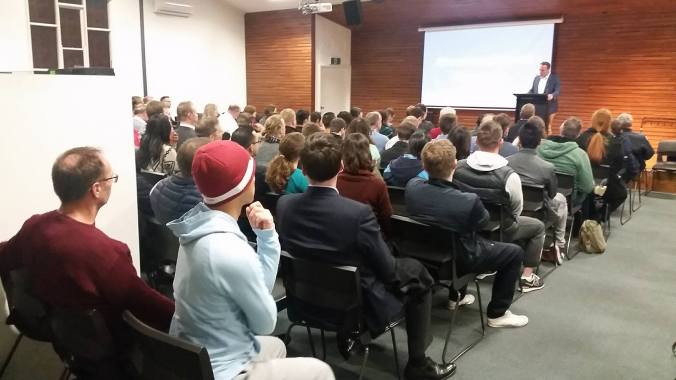
Last night while Melbourne suffered through the Great Snowstorm of 2016 and the rest of the world chased Pokemons, Mentone gathered for quite an extraordinary evening.

FreedomofSpeech

The topic of conversation was ‘Freedom of Speech in Australia’, and we were privileged to have speaking, Mr Tim Wilson MHR, and Rev Dr Michael Bird. Present in the audience were members of various political parties (and of none), and people reflecting a variety of religious and non-religious world views, including of course members from Mentone Baptist Church.

The first thing I learnt last night is that the Federal seat of Goldstein, whom Tim Wilson now represents, is not pronounced Goldstein but rather, Goldstein! In other words, the ein is pronounced as mine, not bean. Apologies to everyone living in Beaumaris, Hampton, Brighton, and so on!

Electoral names aside, both Wilson and Bird presented a case for free speech in Australia that was erudite, thoughtful, and engaging. And this was followed by a time of QandA with the audience.

Tim Wilson spoke first. He offered an historical overview of Australia’s anti-discrimination laws, and articulated how ‘good law’, that which related to work place harassment, has been abused by being applied universally to public speech. A case in point is the now infamous and inexplicable Section 17 of the Tasmanian Anti-Discrimination Act.

In a defence of free speech, Wilson asked, “is it really right, just, that to exercise our most basic right we have to question whether we are going to be held in contempt of the law and then going have to pay significant legal bills to defend ourselves”

While not the topic at hand, it is difficult to speak on Freedom of Speech in 2016 without commenting on the current marriage debate. Wilson shared some of his own experiences growing up as a homosexual and of him favouring changes to the Marriage Act. Most importantly, in light of his views on marriage, Wilson said,

“I don’t think we can have a constructive conversation around the marriage of same-sex couples until both sides can say what they truly think.”

He then pushed further, pointing out, “the hypocritical nature of so many people today, when they don’t want to hear a particular argument, they declare it to be bigoted or hate speech.” Wilson then referred to Bill Shorten and Penny Wong, noting that only a few short years ago they spoke against changes to the Marriage Act, but now they can’t desist from calling opponents of same-sex marriage, bigots and hate filled.

At the other end of the spectrum, Tim Wilson offered a timely admonition to religious organisations, who though themselves call for a higher standard of morality, they have been exposed, especially in the area of sexual abuse.

As a Christian leader I affirm his rebuke, and would add that men (or women) who commit abhorrent acts on children behind clerical vestments and institutions are not representative of the Christ whom they claim to worship, but are the very manifestation of anti-Christ, for the deny him by their deeds. And yet, we need to understand that the public do not also differentiate between authentic Christians and dress-up Christians. Tim Wilson was spot on to call out Christian leaders to work harder on this.

Mike Bird employed his familiar array of jocose analogies and allusions, while driving home some pertinent truths for Australian society, as well as for Churches.

‘The future is French’, Mike asserted, in relation to where Australian religion and politics is heading. Either we will take the path of Vive la différence or that of the less desirable, Laïcité.

“I like to think our Constitution is robust enough to protect basic freedoms, and our political parties will seek to do right by all. However, people of faith can expect to receive a hard time from progressive activists and parties in the forseeable future. Religion may be sanitised from the public square.”

How should Churches respond to this paradigm cultural and political shift? Bird proposed that the future will either be Swedish or Chinese!

The reproach was overlooked by many last night, but Bird was calling out ‘liberal’ churches, suggesting they suffered from Stockholm syndrome. That is, they have lost their identity by tinkering with the tenets of the Christian faith in order to ensure religion is palatable to the powers that be.

Instead, Bird exhorted Christians to learn from Christianity in China, where it exists on the margins of society. Yet despite the oppression of Christians in China for many decades,  it has witnessed exponential growth, and all without the privileges of political and public freedoms, which we currently enjoy in this country.

Michael Bird also lauded Tim Wilson’s work last year in organising the Religious Freedom Roundtable, and he suggested that we need more forums such like that.

If I were to offer any criticisms, they would be minor:

At one point Tim spoke of certain religious groups who have tried to impose their morality onto other minorities. I do not disagree that historically there have been religious groups who’ve behaved as such, but the key word here is ‘impose’. There is an essential difference between imposition and influence, or pressure and persuasion. Mike said it well, when he exhorted Christians to “persuasive and compassionate discourse.”

In a crescendo of rhetoric Mike declared that, ’Christendom is over’. I would push back on this point and argue that Christendom in Australia never was. There is no doubt that Christianity has significantly influenced Australian culture and life, but it has been tolerated rather than happily embraced, sitting there in a position of begrudged prominence.

13682448_10154314182706499_523605627_o

The content of each presentation was winsome and helpful, but for me the highlight of the evening was the manner in which the conversation was conducted, including  participation from the audience. The tone was respectful but not innocuous; certain hypocrisies were called out, and serious challenges were proposed, but all without the immature name-calling and shout downs that are becoming all to common in the public square.

Last night demythologised the rhetoric of some social progressives, that civil dialogue can’t be had on issues relating to sexuality and marriage. Can an heterosexual Evangelical Anglican clergyman discuss issues of national importance with an agnostic gay politician? The answer is, yes. Indeed, despite obvious differences, they shared much in common. And can a room full of people, representing a spectrum of political and religious ideologies, enjoy a robust night of conversation? Yes, and in fact, people stayed and talked so late into the evening I was tempted to begin turning off the lights.

Finally, as a poignant way to close the evening, while answering a question on how to raise children to preserve and properly practice free speech, Mike Bird responded, ‘Love God, love your neighbour.’

Of course, these words comes from the lips of Jesus, who in turn was affirming the Old Testament Scriptures, and they remain the model for how Christians relate to others in society. I cannot speak for those of other world views, but this is how Christians must participate in both public and private. This Golden Rule does not build a staircase to Heaven as is sometimes believed, but rather, it is the life response of a person who has been captivated by the grace and mercy of God in Christ Jesus. It was fitting way to end such a rewarding night, “Love your neighbour as yourself”.

The talks an be downloaded here and the QandA here