Baptist Courage of the 17th Century


17th Century England was not a promising environment for serious discourse on theological matters. Indeed, discussing theology in public could lead to loss of employment, imprisonment, exile, and on rare occasions, death.

Pressure to conform to the prevailing winds was enormous, with both governmental and ecclesial bodies (the two often working in tandem) interpreting difference as hostility and something to be silenced.

And yet this period of English history also witnessed tremendous Gospel growth, and playing a significant role in the missio Angliae were the early Baptists.

john-bunyan

Perhaps no group in England made more use of public disputations than did Baptists. Between 1641 and 1700 at least 109 such public debars involving Baptists were held in England, with 79 of these between 1641 and 1660. These debates pitted one or more Baptist champions against opponents from Anglican, Quaker, Independent, or sometimes, Roman Catholic groups. Baptists welcomed these occasions, for they gave opportunity for declaring the gospel to large crowds, helped defend Baptists against unjust slanders, and often led to numerous conversions and the planting of new Baptist Churches. Many leading Baptists of that time were converted at public disputations.” (Leon McBeth, ‘The Baptist Heritage’, p64)

The Scriptures encourage Christians to live quiet, peaceful and productive lives. We are to pray for all, including those who Govern over us, and to submit to their authority with humility and obedience. At the same time, we are to live courageous lives, choosing godliness and faithfulness over compromise and indifference.

Of course, we do not need to choose between 1 Timothy 4:1-2 and 2 Timothy 4:2-5, or between Ephesians 4:1-6 and Galatians 1:6-9. All are applicable to our circumstances and they are driven by the desire to see God saving people and bringing them to a knowledge of the truth.

Challenging the norms of society is no easy task; it requires grace and wisdom the size of the outback.

A century of ecumenical murkiness makes the Rio Olympic pool smell and look like pure H2O. Indeed, one might forgiven for thinking the only heterodoxy left is the view that still believes that there is a line separating orthodoxy and other.

As we look at the enormous social and spiritual challenges before us, both in terms of engaging in the public square and in the ecclesial circle, there is encouragement to be found from among our Baptist grandparents. They didn’t permit a culture of fear to win the day. Instead, taking their confidence in the power, truth, and beauty of the Gospel, they sought to persuade all. Not all were convinced, but many were and thus begun one of the great church planting movements in Western history. 

I wonder what might happen if we in Melbourne (and Australia) adopted this kind of Gospel determination?

Looking to the Russian Winter

News of the Russian Olympic drug scandal has reached the ears of the media and is being rightly exposed, but flying under the radar is another Russian story, one of tragic Dostoevskian proportions.

Two weeks ago President Vladimir Putin signed into law measures outlawing evangelistic activities of religious groups in Russia. Under the guise of ‘anti-terrorism’, the Russian Government has banned churches from communicating their beliefs outside of sites officially designated by the state.

Charges can now be made against individuals for inviting people to church, for distributing literature in the community, and for presenting in peaceful ways, a persuasive case for one’s religious convictions.

Chair of the United States Commission on International Religious Freedom, Thomas J. Reese, has said,

“These deeply flawed anti-terrorism measures will buttress the Russian government’s war against human rights and religious freedom…They will make it easier for Russian authorities to repress religious communities, stifle peaceful dissent, and detain and imprison people. Neither these measures nor the currently existing anti-extremism law meet international human rights and religious freedom standards.”

Thousands of Churches across Russia are holding prayer vigils, but with little hope of seeing the Government return to any sense of reasonableness.

IMG_8049

Most Australians will recognise these measures as alarming, draconian, and unbefitting of any nation claiming to be a pluralist society and a liberal democracy. Whether Russia would consider itself to be these things is disputable, but surely we would never witness such restrictions here in Australia?

Before we ask Dale to tell the world of the hole we haven’t dug, we must recognise that Putin-like voices can also be found in Australia, on both poles of politics. The ideology is different, but the desire to control and limit religion is similar.  In the media, politics, and education there is a growing murmuring, arguing that religion is tolerable in private, but has no place in public discourse, and certainly not in politics and in our schools. For example, both the Greens and the Sex Party are famed for policies that will reduce religious freedoms, and the current Victorian Government has done more to legislate against Christian freedoms than any other Australian Government in living memory.

Then there is the now infamous example of Section 17 of the Tasmanian Anti-Discrimination Act, and how it was used to attack the Catholic Archbishop, Julian Porteous. What was so intolerable that the weight of law was required to come down on him? Well, Porteous published a pamphlet for Catholics, explaining a view of marriage that is congruent not only with Catholic beliefs, but which also reflects the legal definition of marriage in Australia.

It is possible to prohibit religious speech through law, and it possible to achieve the same goal by bullying and slandering those who hold religious convictions. In the lead up to the Federal election there were notable voices telling the Australian people that public dialogue about the Marriage Act was impossible. Ironically, the very same people proved their point as they employed insults and derogatory words against those who dared suggest a plebiscite might be a good idea.

Secularists wants us to believe that the public space is a purist place free from ideologue, which of course they define as atheistic humanism.This could not be further from the truth, for there is no public vacuum free from assumptions and beliefs informed by world views.  The Australian public space is pluralist, and invites people to contribute, not by leaving their convictions and consciences at home, but by bringing them to the conversation. The epistemic and moral superiority of secular humanism is as mythical as the pokemon, and yet we are chasing after it.

There is a distinction established in Australia’s Constitution between the secular state and religious institutions, but it does not denude the role of religion in public, but simply protects the State from either being controlled by or instituting any single Christian denomination.

“The Commonwealth shall not make any law for establishing any religion, or for imposing any religious observance, or for prohibiting the free exercise of any religion, and no religious test shall be required as a qualification for any office or public trust under the Commonwealth.” (Ch5. Section 116)

This Australian dichotomy between government and religion is easily sustained for Christians, given that the distinction exists because of the Christian world view. For the Christian, Jesus is Lord over all of life but the church is not the state and the state is not the church. There is an entity called the  ‘Church of England’, which is the unfortunate outcome of various historical quirks, rather than theological necessity, but it is not the situation we have here in Australia. To what extent other religions can manage this distinction, is a topic worth exploring.

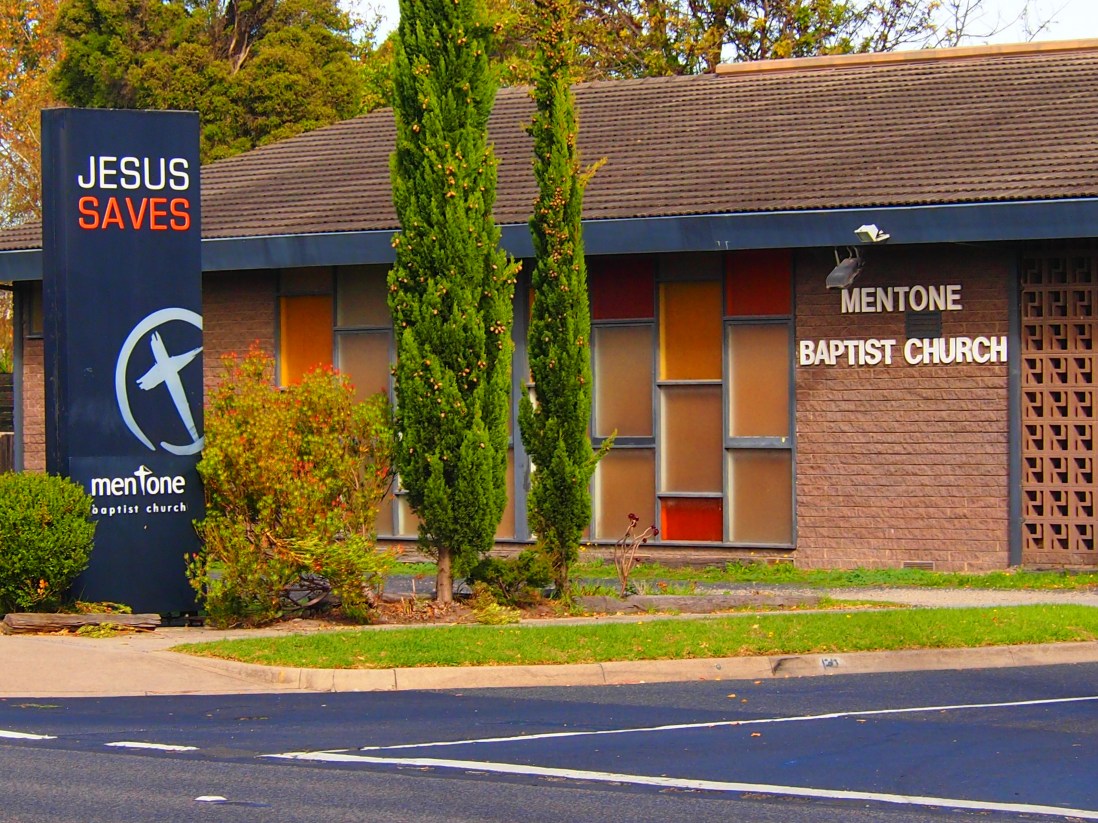
During the recent Symposium on ‘Freedom of Speech’, hosted by Mentone Baptist Church, the new member of Goldstein, Tim Wilson, remarked,

“we need a lived culture of open discussion”.

It was as though someone had finally solved the congestion issues on Melbourne’s roads, such was the freshness.  Mr Wilson gave example to this value by addressing the marriage debate, saying, “I don’t think we can have a constructive conversation around the marriage of same-sex couples until both sides can say what they truly think.”

I couldn’t agree with him more.

A darkness is descending on Russia. For so much of her history the Russian people have been oppressed by one totalitarian rule or another. The light of democracy that dawned late last century is now disappearing over this vast steppe. Australians can assume the naive posture of ‘never us’, but the seeds of religious intolerance are already planted, and without due care it will grow and choke free speech. 

Not imposition but persuasion; that is the mark of a true liberal democracy. Progress cannot be achieved when the State bullies its own citizens and stifles disagreement; it only further polarises people. We would do well to heed Tim Wilson’s exhortation. More than that, perhaps we should return to the words of the Christian Scriptures’ that many Australians now deem as irrelevant, ‘speak truth in love’. Imagine, grounding a society upon that ethic?

‘Vive La Australia’: Freedom of Speech in Australia

Last night while Melbourne suffered through the Great Snowstorm of 2016 and the rest of the world chased Pokemons, Mentone gathered for quite an extraordinary evening.

FreedomofSpeech

The topic of conversation was ‘Freedom of Speech in Australia’, and we were privileged to have speaking, Mr Tim Wilson MHR, and Rev Dr Michael Bird. Present in the audience were members of various political parties (and of none), and people reflecting a variety of religious and non-religious world views, including of course members from Mentone Baptist Church.

The first thing I learnt last night is that the Federal seat of Goldstein, whom Tim Wilson now represents, is not pronounced Goldstein but rather, Goldstein! In other words, the ein is pronounced as mine, not bean. Apologies to everyone living in Beaumaris, Hampton, Brighton, and so on!

Electoral names aside, both Wilson and Bird presented a case for free speech in Australia that was erudite, thoughtful, and engaging. And this was followed by a time of QandA with the audience.

Tim Wilson spoke first. He offered an historical overview of Australia’s anti-discrimination laws, and articulated how ‘good law’, that which related to work place harassment, has been abused by being applied universally to public speech. A case in point is the now infamous and inexplicable Section 17 of the Tasmanian Anti-Discrimination Act.

In a defence of free speech, Wilson asked, “is it really right, just, that to exercise our most basic right we have to question whether we are going to be held in contempt of the law and then going have to pay significant legal bills to defend ourselves”

While not the topic at hand, it is difficult to speak on Freedom of Speech in 2016 without commenting on the current marriage debate. Wilson shared some of his own experiences growing up as a homosexual and of him favouring changes to the Marriage Act. Most importantly, in light of his views on marriage, Wilson said,

“I don’t think we can have a constructive conversation around the marriage of same-sex couples until both sides can say what they truly think.”

He then pushed further, pointing out, “the hypocritical nature of so many people today, when they don’t want to hear a particular argument, they declare it to be bigoted or hate speech.” Wilson then referred to Bill Shorten and Penny Wong, noting that only a few short years ago they spoke against changes to the Marriage Act, but now they can’t desist from calling opponents of same-sex marriage, bigots and hate filled.

At the other end of the spectrum, Tim Wilson offered a timely admonition to religious organisations, who though themselves call for a higher standard of morality, they have been exposed, especially in the area of sexual abuse.

As a Christian leader I affirm his rebuke, and would add that men (or women) who commit abhorrent acts on children behind clerical vestments and institutions are not representative of the Christ whom they claim to worship, but are the very manifestation of anti-Christ, for the deny him by their deeds. And yet, we need to understand that the public do not also differentiate between authentic Christians and dress-up Christians. Tim Wilson was spot on to call out Christian leaders to work harder on this.

Mike Bird employed his familiar array of jocose analogies and allusions, while driving home some pertinent truths for Australian society, as well as for Churches.

‘The future is French’, Mike asserted, in relation to where Australian religion and politics is heading. Either we will take the path of Vive la différence or that of the less desirable, Laïcité.

“I like to think our Constitution is robust enough to protect basic freedoms, and our political parties will seek to do right by all. However, people of faith can expect to receive a hard time from progressive activists and parties in the forseeable future. Religion may be sanitised from the public square.”

How should Churches respond to this paradigm cultural and political shift? Bird proposed that the future will either be Swedish or Chinese!

The reproach was overlooked by many last night, but Bird was calling out ‘liberal’ churches, suggesting they suffered from Stockholm syndrome. That is, they have lost their identity by tinkering with the tenets of the Christian faith in order to ensure religion is palatable to the powers that be.

Instead, Bird exhorted Christians to learn from Christianity in China, where it exists on the margins of society. Yet despite the oppression of Christians in China for many decades,  it has witnessed exponential growth, and all without the privileges of political and public freedoms, which we currently enjoy in this country.

Michael Bird also lauded Tim Wilson’s work last year in organising the Religious Freedom Roundtable, and he suggested that we need more forums such like that.

If I were to offer any criticisms, they would be minor:

At one point Tim spoke of certain religious groups who have tried to impose their morality onto other minorities. I do not disagree that historically there have been religious groups who’ve behaved as such, but the key word here is ‘impose’. There is an essential difference between imposition and influence, or pressure and persuasion. Mike said it well, when he exhorted Christians to “persuasive and compassionate discourse.”

In a crescendo of rhetoric Mike declared that, ’Christendom is over’. I would push back on this point and argue that Christendom in Australia never was. There is no doubt that Christianity has significantly influenced Australian culture and life, but it has been tolerated rather than happily embraced, sitting there in a position of begrudged prominence.

13682448_10154314182706499_523605627_o

The content of each presentation was winsome and helpful, but for me the highlight of the evening was the manner in which the conversation was conducted, including  participation from the audience. The tone was respectful but not innocuous; certain hypocrisies were called out, and serious challenges were proposed, but all without the immature name-calling and shout downs that are becoming all to common in the public square.

Last night demythologised the rhetoric of some social progressives, that civil dialogue can’t be had on issues relating to sexuality and marriage. Can an heterosexual Evangelical Anglican clergyman discuss issues of national importance with an agnostic gay politician? The answer is, yes. Indeed, despite obvious differences, they shared much in common. And can a room full of people, representing a spectrum of political and religious ideologies, enjoy a robust night of conversation? Yes, and in fact, people stayed and talked so late into the evening I was tempted to begin turning off the lights.

Finally, as a poignant way to close the evening, while answering a question on how to raise children to preserve and properly practice free speech, Mike Bird responded, ‘Love God, love your neighbour.’

Of course, these words comes from the lips of Jesus, who in turn was affirming the Old Testament Scriptures, and they remain the model for how Christians relate to others in society. I cannot speak for those of other world views, but this is how Christians must participate in both public and private. This Golden Rule does not build a staircase to Heaven as is sometimes believed, but rather, it is the life response of a person who has been captivated by the grace and mercy of God in Christ Jesus. It was fitting way to end such a rewarding night, “Love your neighbour as yourself”.

The talks an be downloaded here and the QandA here

The grass is not always greener on the other side

“Do not say, “Why were the old days better than these?”

    For it is not wise to ask such questions.” (Ecclesiastes 7:10)

OLYMPUS DIGITAL CAMERA

In my view, Christians should not be so entrenched in a political ideology that they cannot in principle move to another party and viewpoint;  after all, Gospel values can not be boxed into particular  political ideologies, and the current political landscape in Australia is an example of this. Many Christians are rightly dismayed by the Coalition’s policies on asylum seekers and cuts to foreign aid. Similarly, there is significant concern with Labor’s position on asylum seekers, as well as positions on marriage, sexuality, and freedom of religion that is being platformed by both Labor and the Greens.

Of course, there are a thousand economic issues which should not neglected either, for economics contribute impacts societal good and order, and vice versa.

It feels as though our politicians are digging tunnels in the mud, in a race to the bottom of the quagmire.

I don’t disdain politics, nor those who are prepared to serve the public in what is often a much maligned profession. As Christians, we believe we should honour those in authority and to pray for them. This we do, and without denuding these things, in our democratic society we also have opportunity and responsibility to articulate our concerns.

As a Pastor, I have never suggested to others how they should vote, nor do I disclose my own vote. I do however believe it is important for voters to be aware of  agendas their vote will be supporting.

In any Government there is the good and bad, but the bad in our political parties right now is so appalling, it is leaving many voters (not only Christians) despondent and with little enthusiasm for tomorrow. Not only so, the gravity of the issues at stake have provoked more Christian commentary than I have seen in any previous election.

Chief among the issues is religious freedom, which most popularly framed in terms of the debate on marriage, however there are other related issues. For example,

Earlier in the election campaign, opposition legal affairs spokesman Mark Dreyfus referenced one of his own party’s policies, saying, “Labor believes that no faith, no religion, no set of beliefs should ever be used as an instrument of division or exclusion… Condemning anyone, discriminating against anyone, vilifying anyone is a violation of the values we all share, a violation which can never be justified by anyone’s faith or belief.”

Thankfully, Bill Shorten backed away from these comments, albeit in a somewhat imprecise and noncommittal manner.

One of the more bizarre moves I have seen is of some Christians giving weight to the Greens Party whose platform includes taking freedoms from Christians.

On this, I have gently chuckled at the irony of some of my Baptist colleagues, who on the one hand are the most ferocious defenders of church and state separation, are sometimes the most keen to talk politics and in a few instances, happen to be vocal supporters of the Greens.

Perhaps if the Greens stuck to policies on asylum seekers and the environment there may be good reason to offer support. These are issues of grave significance. However, it would be simply naive to vote for these policies without considering the fact that a vote for the Greens is a vote against religious liberty.

Firstly, the Greens’ intention is to limit religious freedoms in Australia; that is without dispute. They themselves have said so:

“Our anti-discrimination laws offer good protections to our lesbian, gay, bisexual, transgender and intersex communities, but they come with a gigantic exemption for religious organisations. Successive Labor and Coalition governments have maintained these exemptions, which mean that a religious hospital can refuse to employ a gay doctor, and a faith-based homelessness shelter can refuse to accept a transgender resident.

The Greens have fought against these exemptions at every opportunity, and we believe they should be eliminated. Anti discrimination laws should apply to everyone”

Nick McKim, Greens Senator, has said “The fundamental principle here is that Australians should be treated the same, whether or not they’re of one particular religion or another or whether in fact they’re not religious at all’.

I don’t disagree with the words as such, but the question is, what meaning and agenda is imported into these words? Let’s not be fooled by the rhetoric, this is not about treating all Australians the same, this is about forcing a narrow secular humanity worldview onto all Australians. The existing exemptions are not designed to give special privileges to certain groups, but to protect freedom of conscience.  In that light, this issue concerns not only Christians, but any Australian who believes in freedom of conscience.

Second, the Greens have not (to my knowledge) defined the extent to which they will remove religious exemptions from the anti-discrimination laws; this is most concerning. Their platform doesn’t site any exemptions, although the examples provided refer to religious based hospitals and schools, and not churches. I suspect though, these examples are carefully chosen, ones that very few people would take issue with. But that’s all they are, examples. They do not stipulate with any precision how far they intend to take these redactions.

Even if they promise not to intrude on Churches and para-church organisations, there remain serious questions relating to religious based hospitals and schools, including:

Will religious based schools be forced to employ persons who do not affirm the values of their schools?

Will religious affiliated hospitals be coerced into providing procedures, such as abortions, against good conscience?

As Andrew Katay has rightly pointed out,

“a basic principle of political theology is the commitment to a pluralist state, where conscience is not coerced.”  The Greens platform betrays this essential democratic ideal, trouncing conscience and forcing people to betray the deepest convictions, and with that bringing “the punitive power of the state to bear against those who seek to follow their conscience.”

Freedom of conscience and freedom of religion are not the only serious issues deserving our consideration tomorrow, but we are blindsiding society’s health and freedom should we ignore these matters

While I am grateful for the privilege of casting a vote at the ballot, tomorrow’s task will have little joy in it. Like so many people my heart and mind is scrambling together a retrieval ethic in order to find the least objectionable of choices. And yet even this moral dilemma, we should give thanks that we still have such freedom to choose.

Whatever the outcome, the reality that does gives Christians great joy is that our faith and hope does not lie in the electoral process nor its outcome, but in the Lord of life.  The Australian landscape may well be changing;  the Greens, and any party for that matter, can do their damned best to subvert and silence the Christian hope, but history’s story cannot escape God and the power of his amazing Gospel. 

SBS and the not so inclusive “exclusive”

On the weekend it snowed on the outskirts of Melbourne, and it appears as though some of that snow fell on the Central Coast of NSW and clouded the vision of one SBS reporter.

snow

An article was published on the SBS website late this afternoon, aiming to discredit a group of FIEC churches on the Central Coast. These Churches use facilities in local schools after school hours, especially for Sunday services

Journalist, Robert Burton-Bradley, has accused the Churches of promoting a ‘homophobic’ message, and he then proceeds to prove his case by providing a list of quotes from various sermons. Unfortunately, his evidence looks more like a JFK conspiracy theory than material fit for publication on a respected Australian media website.

To begin with, the headline states, “Claims evangelical Christian churches preach gay hate in public schools” and has the accompanying tag line, “Exclusive: Serious allegations have emerged that gay hate messages are being preached inside public schools by evangelical groups.” It sounds truly outrageous and, these headings are sufficiently vague to lead readers to believe that the following ideas are being taught in these schools, which is not the case. The content of these sermons is for a church, not for children in the classroom.

Secondly, in light of the evil mass murder in Orlando, the media have reported various Muslim leaders who believe homosexuals should be executed. In the midst of these  stories, it appears as though Burton-Bradley is portraying these Christian Churches  as if they are preaching a similar hate message. He writes,

“One recording of a sermon on homosexuality and the Bible’s book of Leviticus from the Lakes Christian Church, based inside the Berkeley Vale Public school on the NSW Central Coast, includes references to the “death penalty” as a punishment for the “sin” of homosexuality.”

Taking words from their intended setting could potentially be seen as slanderous, which leads to a third point,

The article quotes statements from various sermons with no regard for the context in which they were spoken.

Anyone can cut and past a few words from a sermon, and give readers all manner of impressions. I once said in a sermon, ‘sex is good’; I guess one can only assume I’m a member of the sex party. I’ve also declared my dislike of cats, perhaps someone ought to report me to the RSPCA for possible future animal cruelty!

Not only does the article ignore context in which words were spoken, there is no understanding here of biblical theology, by which I mean, how the Old Testament relates to the New Testament, of how God’s holiness and love relate, and of the way the cross of Jesus Christ is the key to understanding Christianity and Christian thought and attitudes toward other people. Nowhere does Robert Burton-Bradley bring his readers to the conclusions that are offered in the sermons.

Christians do not hate homosexuals, and from what I know of the Churches in question, neither do they.  If I may repeat words that I wrote last week in a piece relating to Jason Ball,

“A Christian cannot hate because we have been on the other side, we have belonged to the crowd who have hurt others and thrown stones of hate, pride, and greed. Christians, if they are Christian, confess their spiritual and moral destitution, and yet we have come to experience the undeserving and loving grace of God who forgives our trespasses through Jesus. Once the human heart has experienced Divine forgiveness, we can not walk back into old attitudes of disdain for other people, nor hold onto some cold and languid acquiescence toward popular moral thought. When God replaces hate with love, it is a commitment to affirm what is good as defined by God. Can not love lead us to disagree with fellow human beings? Can a desire to see people flourish not include aspects of nonconcurrence, as we find in the life of Jesus Christ?”

What lessons should Churches be learning from such reporting?

First of all, be mindful that our sermons and websites are available to whoever is interested, including whacky atheists, angry secularists, and agenda driven journalists. In fact, this example is a helpful reminder for preachers and pastors. How do our sermons  come across to unbelieving Australia? Indeed, how is skeptical Australia reading our blogs!?

Secondly, be mindful of the fact that uncritical and biased reporting is a reality, not always, but it is common place. Such impropriety ought to disappoint us but not surprise us.

I’m not a fan of media bashing, and so I’m pleased to be able to say that on most occasions when I have dealt with the media, the experience has been positive. One time, a major newspaper even revised a headline to more accurately reflect my argument, and I remember the time when  Derryn Hinch stepped off his bandwagon to publicly acknowledge he had misunderstood something I’d said. Sadly though,  I think we can expect more fractious reporting in future days, as our society closes the door on fair and civil public discourse.

This is extremely poor journalism; no wonder the schools and churches didn’t feel obliged to speak to SBS. I hope SBS’s editorial team will have the common sense and decency to remove the piece and apologise to the parties involved.


UPDATE: I believe SBS have taken down the article from their website. Thank you to SBS for their wise deliberation and response. (June 30)

I do not hate you

7518580-3x2-700x467

ABC photo of commemoration at Federation Square

Following the terrible mass murder in Orlando, Jason Ball, Greens candidate for the seat of Higgins, has criticised those who offered prayers for the victims and their families,

“This week, media commentators who have previously vilified us, leapt on the unspeakable atrocities in Orlando and used our grief as a battering ram to prosecute their own agenda against another minority.

Then they wring their hands and offer us their ‘prayers and sympathy’ whilst conveniently ignoring the fact that acts of hate and violence are the logical conclusion to a public ‘debate’ that maintains we are abnormal and not worthy of the same rights and respect as our fellow citizens.”

Like many people I gloss over most words that I read online, but Mr Ball’s comments stood out and made me put on the brakes. As a reflected on his words, I found several different threads of thought running through my mind, some conflicting:

Does genuine grief depend upon agreement? The thing is, I do feel great sadness for those who have been personally affected by the Orlando massacre. It was a display of evil for which there is no justification. Am I being hypocritical for thinking this?

On the one hand, the Muslim community has been criticised for their lack of public outrage over the attack, and yet Christians offering prayers for those affected are being told to keep quiet? It feels as though we’re damned if we do and damned if we don’t.

Is it true that the logical outcome of not supporting same-sex marriage is hate and violence?

Is it right to pray for a group of people if they ask us to desist?

Should we only pray for those with whom we have congruity of thought? Is our common humanity not enough?

What can Christians do to overcome the view that not supporting SSM does not equal hating LGBTI people?

The same article reported how Mr Ball has had campaign material smeared with hateful words, ‘fag’, and so understandably he is skeptical of certain peoples’ words of support for the victims in Orlando. More so, it takes a callous person to dismiss the fears and grief many LGBTI people are experiencing in the wake of Orlando.

A question I am wrestling with is this, as a Christian, how should I respond? Should I remain quiet? Do I ‘repent’ of my understanding of marriage, as one commentator has argued Christians must do? Are our only options, conformity to or exile from the public sphere?

The fact that you are reading these words probably gives away my answer, although I have taken several days to ponder the question before writing. The reason for writing this piece is to try and communicate, albeit somewhat clumsily, that Christians do care and are concerned for the LGBTI community. It is not hate that drives us to speak and pray.

Jason Ball may be right, there are people using Orlando, ‘as a battering ram to prosecute their own agenda against another minority’. In fact, I’m pretty sure he is right. This horrendous event is being utilitarianised by several public figures to silence all manner of minority voices. There are haters in our community, including individuals who detest LGBTI people, and we stand with you against them.

Hate and violence derives from commitment to a worldview that cannot tolerate difference. This worldview may be of a religious orchestration; its shape may be that of secular humanism.

Jesus once said that it’s relatively easy to love those whom you like; it takes grace to love those with whom you disagree. We all fall short of this ideal, which would well leave us hopeless, except there is one who lived the ideal without ever misstepping.

“After this, Jesus went out and saw a tax collector by the name of Levi sitting at his tax booth. “Follow me,” Jesus said to him, and Levi got up, left everything and followed him.

Then Levi held a great banquet for Jesus at his house, and a large crowd of tax collectors and others were eating with them. But the Pharisees and the teachers of the law who belonged to their sect complained to his disciples, “Why do you eat and drink with tax collectors and sinners?”

Jesus answered them, “It is not the healthy who need a doctor, but the sick. I have not come to call the righteous, but sinners to repentance.” (Luke 5:27-31)

Jesus calls those who would follow him, to be like him.

“But to you who are listening I say: Love your enemies, do good to those who hate you, bless those who curse you, pray for those who mistreat you. If someone slaps you on one cheek, turn to them the other also. If someone takes your coat, do not withhold your shirt from them. Give to everyone who asks you, and if anyone takes what belongs to you, do not demand it back. Do to others as you would have them do to you.

“If you love those who love you, what credit is that to you? Even sinners love those who love them. And if you do good to those who are good to you, what credit is that to you? Even sinners do that. And if you lend to those from whom you expect repayment, what credit is that to you? Even sinners lend to sinners, expecting to be repaid in full. But love your enemies, do good to them, and lend to them without expecting to get anything back. Then your reward will be great, and you will be children of the Most High, because he is kind to the ungrateful and wicked. Be merciful, just as your Father is merciful.” (Luke 6:27-36)

A Christian cannot hate because we have been on the other side, we have belonged to the crowd who have hurt others and thrown stones of hate, pride, and greed. Christians, if they are Christian, confess their spiritual and moral destitution, and yet we have come to experience the undeserving and loving grace of God who forgives our trespasses through Jesus. Once the human heart has experienced Divine forgiveness, we can not walk back into old attitudes of disdain for other people, nor hold onto some cold and languid acquiescence toward popular moral thought. When God replaces hate with love, it is a commitment to affirm what is good as defined by God. Can not love lead us to disagree with fellow human beings? Can a desire to see people flourish not include aspects of nonconcurrence, as we find in the life of Jesus Christ?

I do not hate you. I would willingly stand alongside you against those who have insulted you and graffitied your campaign posters. Clearly though, we have much work to do. I don’t know if Jason Ball will read this piece, and if he does, what his response would be. But I hope and pray he and others hear, and not only hear, but come to experience that Christians do not hate them. We must do more to love others as Christ has loved us.

I’ll finish with two examples that I have come across of where a Christian voice is trying to speak into the awfulness of what took place just over a week ago.

The American chain restaurant, Chick-Fil-A, is known for its conservative values and for not opening on Sundays out of observance for the Sabbath. Following the shooting, they broke their rules and opened on the Sunday to serve their community. They gave food to firefighters, police and volunteers, and they handed out sandwiches to those donating blood.

Last week, a service was held at the Anglican Cathedral in Sydney, and in his address Archbishop Glenn Davies said,

“As Australians, we abhor violence in all its forms—domestic violence, street violence, xenophobic violence, religiously motivated violence, and especially violence against members of the LGBTI community. As the leader of the Anglican Church in Sydney I want to affirm my stance against all such outbreaks of violence, and if any members of our churches have participated in such acts of violence against women, against young people, against ethnic minorities, against religious minorities or against those from the LGBTI community I offer my heartfelt apology.” 

“Yet we must all search own hearts, as evil resides in each one of us. We have all fallen short of the glory of God. None of us are without fault. Words of derision, mockery and exclusion so frequently fall from our lips when directed against persons who are different from us. This is especially the case for members of the LGBTI community, who have suffered the verbal abuse that so deeply cuts into a person’s soul. Where we have been guilty of such words, I also offer my apology on behalf of the Anglican Church in Sydney.”

“God’s love knows no bounds. He extends his love to all without distinction and without prejudice. Therefore when one, let alone 49, bearers of the image of God are murdered, God grieves. When a further 53 are injured and hospitalised, God grieves. For our God is a God of compassion and grace, and in the depth of our sorrow and pain, he offers to carry us ‘through the valley of the shadow of death.’”

A sling, an arrow, and the Gospel

“Whether ’tis nobler in the mind to suffer

The slings and arrows of outrageous fortune,

Or to take arms against a sea of troubles,

And, by opposing, end them?”

Cleisthenes

From the Delphic hamlet that is The Australian, Greg Sheridan has given Australian Churches an oracle.

According to Sheridan,

Australia’s Christian churches are in crisis, on the brink of complete strategic irrelevance. It’s not clear they recognise the mortal depth of their problems.

The churches need a new approach to their interaction with politics and the public debate, and to keeping themselves relevant in a post-Christian Australian society.

The churches cannot recognise and come to grips with their strategic circumstances. They behave as though they still represent a living social consensus.

The Christian churches now need to reconceive of themselves as representing a distinct and not all that big minority (of practising Christians). They should conduct themselves as a self-confident minority, seeking to win conversion through example and persuasion and not to defend endlessly legal protections and enforcements that are increasingly untenable or meaningless.

In my opinion Greg Sheridan offers a lucid critique of many Churches who are failing to grapple with the rise of secularism, although I wonder if he adequately understands the nature of the Church’s mission and therefore how success and relevance are defined.

Sheridan is right to point out the gross sins of abuse within the Catholic Church (and other denominations as well), and the way this has greatly damaged community perceptions of Churches.

There is urgent need for Churches to practice repentance. Dressed in clerical collars and reciting liturgy, great evil has been perpetrated, especially in the area of sexual abuse. Joe Smith and Lisa Jones can see it, but there remain clergy in some institutions that still don’t get it. The fact that their deeds expose them to be frauds of faith does not diminish the impact on the community. Real, transparent, and deep repentance is required.

Sheridan is also spot on in observing the naivety of some Christians who believe they still belong to the centre of Australian life. We defer to census figures that prove the majority of Aussies believe in God and who identify as Christian, but surely we know better. The reality is, Churches have never belonged comfortably at the centre of Australian society; they have played a significant role in shaping culture, alongside many other voices, but it is more a case of Churches being tolerated rather than celebrated and embraced.

This tolerance is eroding, rapidly so. This year alone we have seen various groups slamming the foot on the accelerator, such that we are fast approaching an intersection called ‘free speech’, and the direction Australians will take remains unclear.

Several political groups have declared their hand:

The Greens have decided their way forward by calling for religious organisations to lose their exemptions for discrimination laws.

Federal Labor have made clear: “Labor believes that no faith, no religion, no set of beliefs should ever be used as an instrument of division or exclusion, and condemning anyone, discriminating against anyone, vilifying anyone is a violation of the values we all share, a violation which can never be justified by anyone’s faith or belief. Accordingly, Labor will review national anti-discrimination laws to ensure that exemptions do not place Australians in a position where they cannot access essential social services.”

Bill Shorten has since stepped back from this position, but there are no guarantees he won’t step forward again.

And the Victorian Government, singing from their autocratic hymnal, has determined to insult and silence anyone who challenges their hermeneutic of life.

Should churches fight to keep a voice in the public arena?

We must concede that Churches no longer occupy a position in the middle, but we don’t want to evacuate the public space altogether. I want to argue that it is worth fighting for a voice in public discourse, but we do so with the belief that the Gospel does not depend upon it. So why should we defend notions of ‘freedom of speech’.

First of all, we have something to say. We have good news to speak and show our neighbours, and so why would we walk away from secular principles that give us freedom for speaking and contributing?

Secondly, we should defend the right to speak for the sake of those who speak against us. Is this not a way in which we love our neighbour?  Is it also not a sign of a mature society, one that is big enough to allow a plurality of voices, and to say ‘I disagree with you, but let’s hear you out and then talk it through’.

A great example of this happened last week when Christians came to the support of Roz Ward, a professing Marxist and co-founder of the controversial curriculum, Safe Schools. Ward was forced to resign from a Government role and was suspended from La Trobe University after a comment she made in regard to the Australian flag. While her views may be disagreeable to many, she has the right to express them, and to find herself being ousted from an academic institution on account them was extreme. Subsequently, a number of Christian leaders noted this hypocrisy and sided with those who called for her reinstatement.

Thirdly, we are members of a democratic society, which in principle gives permission for Christians and atheists alike to speak and offer their opinion.

As a liberal democracy, Australia is governed by these 4 principles:

“A belief in the individual: since the individual is believed to be both moral and rational;

A belief in reason and progress: based on the belief that growth and development is the natural condition of mankind and politics the art of compromise;

A belief in a society that is consensual: based on a desire for order and co-operation not disorder and conflict;

A belief in shared power: based on a suspicion of concentrated power (whether by individuals, groups or governments).”

If we accept these principles, surely Christians have freedom to articulate their views in public discourse? This doesn’t mean people have to like or affirm these beliefs (nor those of any worldview), but it does mean there is freedom to speak. Unfortunately though, it seems as though these values are becoming museum pieces, relics from a golden age of democracy when the Cleisthenes’ of Australia stood tall. After all, no fair democracy has ever endured the ages. And yet, while Australia formally holds to these democratic convictions, there is a place for Christians to speak without fear of law or litigation.

Our democratic liberties give Christians a platform and context for doing public ministry, and we are thankful for this, but the Gospel is not curtailed by the limitations or freedoms of liberal democracy. Indeed, history demonstrates that Churches have often flourished where they have been most resented. More importantly, Jesus Christ taught a theology of the world which lives in opposition to God and which hates those who follow Jesus. Why should we assume Australia is any different?

How should Churches view ‘success’?

Are, as Greg Sheridan suggests, ‘churches in crisis now on all fronts’? It depends on how one defines the mission and role of the church.

Our aim is to love others, whether our convictions are affirmed by others or not.

Our goal is not relevance, for the Gospel we believe is not defined by a popularist epistemological current, but by the word of the cross, which is foolishness to the wise and powerful of this world. Instead, our purpose is to preach this foolishness for through it God works to redeem and heal.

Our mission is not to set up power structures at the centre of society, but to speak the Gospel and to love others no matter where we find ourselves situated in relation to broader society.

Freedom of speech has become the gordian knot of our day. Politicians, lawyers, and academics will ponder and debate and try to find a way to navigate through the many layers of twisted and knotted rope, and while their answers will have implications for Christian speech and life in public, our hope does not lay with them, but in the Gospel, a word that is sharper than a two edged sword. Our hope rests in the Christ who has promised that he will build his church and not even Hades can stand against it.

Sadly many Christians have sold their soul in order to buy a place at the centre of public life, and they are now being marshalled into following the lead of the social progressives, and others are instead holding tight to their conservative neuroses. There are however exceptions; across the land there are churches growing and people are becoming Christians, and there are Bible colleges in Australian cites who are training more men and women than in the previous generation. There are Christians serving in Parliament, teaching in universities, and working in a thousand different jobs. And to these men and women, keep preaching and living the Gospel, loudly from the centre or whispering it from the edge, and through it God will keep working his grace and growing his Kingdom.

The rain washed away Church

Today in Sydney it is raining, it is pouring.

As I took a morning glance at my Facebook thread I noticed several northern Pastors drawing a link between the weather and church attendance, and encouraging their people to not stay away on account of rain.

One friend posted,

“Dear churchgoers of Sydney… it is only water.”

raining

Keep in mind, we have coats to wear and umbrellas to hold, and most people also have cars to drive to church, and so the reality is, most of us won’t get that wet traveling to church.

Nonetheless, pastors far and wide are aware that as their congregation members peers out the window today and see the water running down the glass, it is a signal to them to stay indoors.

I suspect we won’t make similar excuses when driving to work tomorrow morning. And I’m pretty certain a storm won’t prevent us from attending the family party or going to the movies later today.

A little rain keeps us away. In contrast, I have been reading Steve Kryger’s reflections on his recent trip to Iraq, where he and a few others were visiting Christian communities who have been subject to ISIS terror. The problem Iraqi Christians are facing is not rain but bullets, and yet these Aussies have been profoundly challenged and rebuked by the openness and faithfulness of these brothers and sisters.

“let us consider how we may spur one another on toward love and good deeds, not giving up meeting together, as some are in the habit of doing, but encouraging one another—and all the more as you see the Day approaching.” (Hebrews 10:24-25)

God know’s what he is talking about. We mustn’t not treat church with the sentiment of a trip to the cinema or appointment at the optometrist. Rather, remind ourselves of the reality of Church in God’s eyes:

  • God purchased the church with his blood (Acts 20:28)
  • It is his church that Jesus has promised to build (Matthew 16:18)
  • It is through his church, that God has chosen to ‘reveal his manifold wisdom’ (Ephesians 3:10)

It’s also raining in Melbourne today. I am looking forward to church, and many are. Through the seemingly ordinariness of Christians meeting, God is present and working to grow the splendorous sight the world will ever know. Church is more wonderful and significant than even we pastors realise. Let us heed Hebrews 10:24-25