The Phoney War is Over

The days of free speech in Australia have come to an end. From today, public speech comes with a cost.

For several decades Australia has experienced a pseudo-peace. Since the 1960s the sexual revolution has been gaining momentum and slowly dynamiting deeply held views about God, humanity, sex, and family. We have noted these changes, and sometimes with protest, but mostly we just get on with life and pretend that things are not so bad. The last 3 years has seen an acceleration in social and moral change, and just maybe we are rubbing the sleep from our eyes and beginning to wonder, what’s going on? Gender is fluid, and it’s compulsory for my kids to be taught this in school? Marriage can be for 2 people of the same gender?

For several years I have tried to speak to all kind of issues in the public square, with a measure of success and also with some mistakes. Today, I’m calling it, the days of free speech have come to an end. The end though won’t be the end because the appetite of the sexual revolution is insatiable, and we are fools if we think that the conquest will end should Australia adopt same-sex marriage. Changing the law will simply escalate the efforts of those who would love to see Christianity pushed into Southern Ocean.

The catalyst for this cultural epitaph was a video produced by the Bible Society. Understand what people are so angrily protesting about:

The video does not present a hate filled preacher spitting out vitriol.

The video does not present a Christian leader carefully and winsomely articulating the Bible’s view on marriage.

The video shows a gay man who supports same-sex marriage and a heterosexual man who does not, and they are engaging in a respectful conversation about marriage while enjoying a beer.

What is so reprehensible about this video? Nothing, of course, but in the eyes of the self-determined moral judges of our age, this video debunks the myth they have spun, that civil speech and questioning same sex marriage cannot go together. From Canberra to Spring St, from SBS to The Age, we have been told that unless we support same sex marriage without qualification, we are bigots and homophobes. The problem is, this video dismantles that myth. But instead of engaging with it, there has been outrage because there is no forgiveness for those who dare denude the same-sex marriage narrative. 

The Hastie/Wilson conversation (and there are many other examples that could be mentioned) reminds us that there are still people of good will, Australians of different persuasions who believe in giving everyone a say on these important topics. What we are seeing however, are vocal and powerful people overreaching and drowning out these discussions.

To be fair, some people have also argued that the same-sex marriage is a human right, and to even question marriage change is therefore undermining their rights. I can see the point of view, but this is also a myth and needs challenging: marriage is not a human right…for anyone. It is a gift and a privilege but not a right. More than that, the onus lays with marriage change advocates to demonstrate the logic of their definition for marriage. How can any reasonable society redefine its societal foundation without first having reasoned, rigorous, and respectful discourse?

Let the reader understand, anyone, any organisation or person who allies themselves with civil discourse will not be immune for public shaming. Add God or the Bible to the mix, and the response will be even stronger.

OLYMPUS DIGITAL CAMERA

It’s also important for us to realise from today that opponents to free speech are not prepared to end with name calling. Despite not being a sponsor of the video, Cooper’s Brewery has been branded homophobic and could well suffer financial loss as a result. The lesson is, if you associate too closely with Christians and they happen to say anything about marriage, be prepared to take a financial hit.

It is somewhat ironic, and indeed Biblical, that this watershed day centres on an organisation that exists to bring the word of God to Australians. It’s not totally unlike when Hamlet mistakingly kills Polonius with his sword.

Waving his sword around, Hamlet shouts, ‘How now, a rat? Dead for a ducat, dead!’ He then plunges his sword into a wall carpet and kills Polonius who is hiding behind.His mother cries, ‘what hast thou done?’ , to which Hamlet responds, ‘dunno’.

I wonder, have we understood our actions and the consequences that will flow from them?

I’ve had Christian friends suggest to me today, if only the Bible Society had stayed away from same-sex marriage, as though that would keep everybody happy. Respectfully, do we not realise that that is in itself a concession, and is simply buying into the rhetoric of those who wish to outlaw dissenting speech and belief from society?

In some formal sense, free speech will exist tomorrow morning, but  in practice, a cacophonous minority have succeeded in shouting down reasoned and respectful speech. I remember one year ago referring to freedom of speech as the gordian knot of our time; well, today the sword has been taken out of its sheath and cut right through the ropes.

Free speech is gone and what we have left is costly speech. To speak truth will cost. To suggest an alternative narrative, will have you branded as bigot, and more.

Again understand, this is not about what is right and fair, or about what is reasonable and respectful, it is about conforming to the program of what Stephen McAlpine has termed, the sexual fundamentalists.

What now?

For many Australians life will go on as usual, until the shrapnel finally crashes through their own lounge-room window.

The self-determined moral elite will celebrate with a pint  of anything-but-Coopers-Beer. 

Today may well mark the end of cost-free speech in this country, but it doesn’t mark the end of the Gospel and the relevance of the Church. The reality is, we could lose all our political and civic freedoms, and yet we will not cease to love Christ and to love and serve our neighbours.

What I am praying is that sleepy Christians will wake up, alert Christians will be humble, and compromising Christians will repent.

“Wake up! Strengthen what remains and is about to die, for I have found your deeds unfinished in the sight of my God. Remember, therefore, what you have received and heard; hold it fast, and repent. But if you do not wake up, I will come like a thief, and you will not know at what time I will come to you.” (Revelation 3:2-3)

Christians in this country have to often and wrongly believed that we can have our Christianity and  it won’t cost us anything. Sure, we recite those verses that talk about talking up our cross, and we nod in agreement, but our lives betray this flimsy assent to Jesus. We have believed the prophets of our time who calmly reassure us that there is peace, when in fact there is no peace. We work and play and make love, and believe the world is ok. We have turned to our false prophets who keep scratching where we itch and assuring us that all is well. But the phoney war has ended, and too many of us have been caught unprepared. We love our hedonistic lifestyle, and I fear many will be unable to let it go in order to follow Christ into this new Australia.

We need to wake up.

This is no time to leave behind Biblical convictions and godly character. We must resist any temptation to run away or to change teams. The one thing we can no longer afford to do is keep pretending everything is ok: I’ve got my family, and my job, and Church is there when I need it. She’ll be right, ain’t right!

If we (I’m speaking to Christians here) are serious about staying true to that which we have become persuaded of, namely the Gospel of Jesus Christ, then we can no longer afford to live in isolation from other Christians. Christians without a Church don’t survive. We need one another for encouragement, support, care, correction, and courage. Roll out of bed and commit to a local church. Forget about the materialist and ultimately self-centred Aussie dream, drop the beach days every other weekend, and instead commit  to learning from and supporting your brothers and sisters in Christ.

We also need to listen to the Bible more closely than we have ever done before. Take for example, the Beatitudes. The Beatitudes have been misrepresented a fair bit lately. They are not cushy and likeable sentiments, they are vital words teaching us how to live in a fallen world.

Indeed the Beatitudes give us perhaps the greatest template for speaking and living in an environment that is eager for us to disappear. It is worth every moment to read and consider the Beatitudes. Be encouraged, be challenged, be rebuked, be changed:

“Blessed are the poor in spirit,

    for theirs is the kingdom of heaven.

4 Blessed are those who mourn,

    for they will be comforted.

5 Blessed are the meek,

    for they will inherit the earth.

6 Blessed are those who hunger and thirst for righteousness,

    for they will be filled.

7 Blessed are the merciful,

    for they will be shown mercy.

8 Blessed are the pure in heart,

    for they will see God.

9 Blessed are the peacemakers,

    for they will be called children of God.

10 Blessed are those who are persecuted because of righteousness,

    for theirs is the kingdom of heaven.

11 “Blessed are you when people insult you, persecute you and falsely say all kinds of evil against you because of me. 12 Rejoice and be glad, because great is your reward in heaven, for in the same way they persecuted the prophets who were before you.


If you have read this article, I’d also encourage you to read this follow up piece (published March 15th) – https://murraycampbell.net/2017/03/15/in-the-coopers-wash-up-lets-revisit-the-beatitudes/

Beer, Bible, and a Baptist?

Ok, let me clear my glass from the outset, I don’t drink beer. And no, it has nothing to do with being a Baptist. To my episcopalian skeptics I will retort by pointing out that for some years we had a group of  ‘underground’ beer brewers at our Church!

Leaving my personal drinking preferences aside, connecting the Bible and beer isn’t that novel an approach. After all, according to Martin Luther the Reformers held a Bible in one hand and a beer in the other,

“I simply taught, preached, and wrote God’s Word; otherwise I did nothing.  And then, while I slept, or drank Wittenberg beer with my Philip and my Amsdorf, the Word so greatly weakened the papacy that never a prince or emperor did such damage to it.  I did nothing.  The Word did it all.”

In what is possibly a first though, the Bible Society has joined arms with Coopers Brewery, with Coopers tagging 10,000 cartons of their light beer with a Bible verse, and with links to the Bible Society’s 200th anniversary. While Coopers may or may not benefit financially from this partnership is, I suspect, beside the point. One Aussie company is celebrating our nation’s oldest continuing organisation. There is nothing new about this; Aussie companies have noted and branded all kinds of Australian symbols and celebrations over the years, and this is just another…until one checks their twitter feed!

As part of the Bible Society’s anniversary, they have produced a series of short videos featuring Aussies discussing current topics. The first video was released this week with Federal MPs Tim Wilson and Andrew Hastie talking about same-sex marriage. Unlike the Bible versed cartons, Coopers Brewery has not sponsored the videos.

Yes, the video is light hearted

Yes, it’s promoting the Bible. Is that so wrong?

Yes, it is staged, but that doesn’t make the two politicians any less genuine with their comments. I don’t know Andrew Hastie, but I have met Tim Wilson, and I found him to be a decent Aussie bloke, who is clear about what he believes and who is also willing to let others express their views.

I’m sure a lot of Aussies will appreciate the video for what it is, a nonchalant signal that Australians can still sit down and talk about real issues, without name calling and speaking down to the other. However, it was clear from my Sunday afternoon twitter feed that not everyone is so happy.

One Melbourne politician and LBGTI advocate tweeted, ‘Nothing ‘civil’ about homophobia, and that’s what opposition to LGBTI equality is. Boycott @coopersbrewery’

Christine Milne is calling for Aussies to boycott Coopers! It’s okay Christine, I never have.

Screen Shot 2017-03-12 at 2.15.58 pm

Apparently we should never buy Coopers beer again, and the video reeks of homophobia. I’m not quite sure how that works given that Tim is openly gay and an advocate changing the marriage act.

It is sad to see how our society has reached the point where notable public figures have self-determined that civil discourse is no longer permissible unless it conforms with their particular brand of secular humanism.

I am not sure whether peoples grievance is over the fact that the Bible Society is behind the campaign or because two politicians have dared demonstrate a courteous disagreement about marriage. Either way, this short video breaks the narrative that social progressives would have the public believe, and for them, this is unforgivable. 

When society no longer permits the dissenting voice, as reasonable and gracious as that voice may be, we have abandoned any true sense of the phrase ‘liberal democracy’, and we have entered a very dark and dangerous pathway to authoritarianism. I do hope that we can see the light and steer away from such a direction.

I am reminded of when Christianity first arose in Jerusalem and then spread to neighbouring regions, and eventually throughout the Roman Empire. The Acts of the Apostles records how the apostles and first Christians won over people with persuasion and reason, with impassioned argument and kindness. There may or may not have been a beer in hand, but there was often a Bible, and that is ok. Should we hide the reasons for our beliefs and values? Is not owning up to them a more honest and ultimately more productive approach to public discourse and dialogue? And who knows, maybe next time we’ll drink coffee instead!

Australia’s Oldest Organisation Turning 200 years old

This weekend, Australia’s longest continuing organisation is celebrating it’s 200th anniversary. Few institutions survive 200 years, let alone continue to flourish after such time. The organisation which is reaching this rare milestone is not a bank or a theatre company, nor a business or school; it is the Bible Society of Australia.

logo

I suspect that if this were any other type of organisation, the coverage would be wide across our news and television. Let’s admit it, a 200 year anniversary doesn’t happen very often in Australian history.

The Bible Society had started in England some years earlier, with the purpose of distributing copies of the Bible to military servicemen, and later to Welsh speaking Britains who could not read an English translation of the Scriptures.

It was Governor Macquarie who in March 1817 encouraged the birth of the Bible Society of Australia.

The aims of the Bible Society have changed little in its 200 years. They exist to bring the Bible to Australians, whether in English or  by translating the Scriptures into many other languages so that people can read the word of God for themselves. They also support many translations projects across the world.

According to McCrindle research, approximately 45% of Australians now own a Bible (and that percentage shrinks to 32% for Gen Y), although Bible websites are visited by Australians in huge numbers, one site alone has over 50 million visits a year by Aussies. 

The Bible remains the most read book throughout the world, and has been translated into more languages than any other book. Despite a smaller number of Australians owning and reading the Bible, it remains enormously influential across our culture, including in politics, law, and the arts. And while some Australians have put is aside, many thousands of new Australians are keen to read this most astonishing book. Like the foundations of a building, or the innumerable kms of pipes that traverse underneath our streets, both are unseen and yet we depend on them every day, so to  the Bible has provided a bedrock with out which our society would be considerably weaker and less certain.

Think about it…the Bible is, to use its own description, the words of God, the very breathed out words of the living God for us. The Bible is the words of God, about God, and for us so that we might know him, and understand the world and even ourselves.

“The law of the Lord is perfect,

    refreshing the soul.

The statutes of the Lord are trustworthy,

    making wise the simple.

The precepts of the Lord are right,

    giving joy to the heart.

The commands of the Lord are radiant,

    giving light to the eyes.

The fear of the Lord is pure,

    enduring forever.

The decrees of the Lord are firm,

    and all of them are righteous.

They are more precious than gold,

    than much pure gold;

they are sweeter than honey,

    than honey from the honeycomb.

By them your servant is warned;

    in keeping them there is great reward.” (Psalm 19:7-11)

The Bible is without parallel in human thinking in regards to its view of God and design for humanity. It portraits God in ways that make the Sistine Chapel appear like a cistern, it penetrates the human psyche more deeply than a hydraulic drill piercing deep into ancient bedrock. It is more glorious than the music of J.S Bach and more comforting than the closest friend. It is more honest, more confounding, more rational, more mysterious than any other text we will read in our short lives. And yes, it chiefly tells us the story of redemption, of the God-man Jesus Christ, who has accomplished the impossible for us.

In a season when many Aussies are less inclined to consider God, I love the Bible Society’s anniversary slogan, Here for Good. Perhaps it sounds a little presumptuous, but 200 years isn’t a bad beginning, and for a book that has been changing the world for centuries longer, might I suggest that the presumption lies with those skeptics who would wish us to close the Bible once and for all, or to lock it up in a Museum’s glass case with the nation’s relics. The problem is, the Bible is a living book and it will continue to transform future generations of Australians, long after every other book has been forgotten.

This weekend there are formal celebrations taking place around the nation, but people are welcome to drop in to a church near them. If you live around Mentone/ Cheltenham, we’d love you to join us this Sunday at 10am, as we open the Bible together and hear of wonderful thing from God.

Also, the Bible Society is giving away free Bibles to anyone interested. If you’re visiting Mentone we are also very happy to give you a free Bible.

Facing our mortality

When beggars die, there are no comets seen; The heavens themselves blaze forth the death of princes.  (Shakespeare, Julius Caesar, Act 2, Scene 2)

In any given population there will be a few individuals whose death will be reported by media and mourned by grieving masses. Some people make the news, not because of their life but because of the tragic circumstances in which they died. Many more will people die without even a footnote in the local obituary, and yet their death is as a real and the grief from loved ones as profound.

More celebrities will depart this world in 2017, and countless thousands of anonymous people will join them in the grave. This isn’t being facetious or morbid, but stating what is inevitable

As we have been assailed with stories of people dying we respond to death with revulsion, and rightly so, for it is a destroyer of life and friendship; death is our enemy. When we have witnessed someone suffer for an extended season, there can be relief in their passing, but it is not their life that wish to see ending but their suffering.

img_4335

Their mortality reminds us of our own, and it is wise for us to give due consideration to our beliefs and hopes over the grave.

It is not uncommon for people to sentimentalise and even trivialise death. Perhaps we do so in the hope of defying this great adversary.

Death is nothing at all.

It does not count.

I have only slipped away into the next room.

Nothing has happened.

(Henry Scott-Holland)

Another approach, and one that is probably more common, is that of rage and anger, as Dylan Thomas famously cried,

Do not go gentle into that good night,

Old age should burn and rave at close of day;

Rage, rage against the dying of the light.

Though wise men at their end know dark is right,

Because their words had forked no lightning they

Do not go gentle into that good night.

Good men, the last wave by, crying how bright

Their frail deeds might have danced in a green bay,

Rage, rage against the dying of the light.

Wild men who caught and sang the sun in flight,

And learn, too late, they grieved it on its way,

Do not go gentle into that good night.

Grave men, near death, who see with blinding sight

Blind eyes could blaze like meteors and be gay,

Rage, rage against the dying of the light.

And you, my father, there on the sad height,

Curse, bless, me now with your fierce tears, I pray.

Do not go gentle into that good night.

Rage, rage against the dying of the light.

There is however an alternative to uncertain optimism and despair, and it is spelled out in the good news of Jesus Christ,

“Listen, I tell you a mystery: We will not all sleep, but we will all be changed— in a flash, in the twinkling of an eye, at the last trumpet. For the trumpet will sound, the dead will be raised imperishable, and we will be changed. For the perishable must clothe itself with the imperishable, and the mortal with immortality. When the perishable has been clothed with the imperishable, and the mortal with immortality, then the saying that is written will come true: “Death has been swallowed up in victory.

“Where, O death, is your victory?

    Where, O death, is your sting?” The sting of death is sin, and the power of sin is the law. But thanks be to God! He gives us the victory through our Lord Jesus Christ.”

(1 Corinthians 15:51-57)

Throughout the life and ministry of Jesus Christ we see God who empathises with those who grieve. John ch.11 records the story of one of Jesus’ close friend, Lazarus, falling ill and dying. When Jesus reached the town where Lazarus lived and died, he mourned with the family and outside the tomb “he wept”.

Jesus not only sat alongside those in the midst of grief, but he has walked the path of death. He endured its full horrors, not because of sickness or tragic circumstances, but he chose to enter into death out of love for humanity and to face hell for us. Indeed, in the hours before his crucifixion he told his disciples, “My soul is overwhelmed with sorrow to the point of death.” (Matt 26:38)

We are all approaching death, faster than we imagine; it is the great wall that cannot be avoided. But it does not have to be journeyed alone, and it does not have to endured without certain hope of resurrection. Imprinted into the fabric of the deathly world is the resurrection of Jesus Christ from the dead; real, historic, physical, and forever resurrection.

We can choose to pin our hopes on imagined sleep-like permanence, or fight off all thoughts of death until the moment arrives and we explode with fearful rage, or we can place our confidence in the one who has defeated death and who promises eternal resurrection to all who accept him, to the celebrity and the unknown, the beggar and the prince.

Terrorism, Christmas, and Boxing Day in Melbourne

Melbourne is my city. I love its people, culture, food, sport, parks, city and suburbs. It is a wonderful place to live. But over the past few days Melbourne has witnessed two significant threats to the human soul, terrorism and materialism.

OLYMPUS DIGITAL CAMERA

Last week’s threat of a terrorist attack in Melbourne City was not enough to keep people away from celebrating that most holy night. A large crowd converged on St Paul’s Cathedral, one of the alleged targets of the plot, to celebrate the birth of Jesus.

Terrorism is not an unknown experience for Churches, more often referred to as persecution. Persecution is common place for many of the hundreds of millions of people who profess Jesus Christ is Lord. It is also true that people of other faiths are also terrorised, and that there are also examples of people wielding the sword in the name of ‘Christ.’ There is no justification for any such heinous acts, but as Greg Sheridan of The Australian reported this year, Christians are ‘more persecuted than any other in the world, persecuted more frequently, more widely and with more intensity.’

Civilisations have not always survived the onslaught of horrid regimes. Carthage was put to the sword by Rome, and Rome destroyed by tribal groups from Northern and Eastern Europe, and the Mongols wiped out the Jin Dynasty, and the Conquistadors over the Aztecs. In all cases, reasons for subjugating another culture were multifarious, and it would be intellectually unsound to disconnect religious motivations from imperialism, trade, and at times racial provocations.

One idea has always outlasted persecution, and that is, Christianity. As Tertullian (2nd C) said, ‘the blood of the martyrs is the seed of the church’. This is evident in history, for example, through sporadic seasons of persecution Christianity flourished in the Roman Empire, and when China closed its doors to missionaries under Communism, 10s of millions of Chinese were converted to Christ.

Terrorism is not new, and while separating modern ‘Jihadism’ from ‘faith’ is understandable, it is ultimately irresponsible. Islamic terrorism is targeting Christianity, as well as other religious groups, and Western Civilisation. Many Muslims are appalled by news that a group of Australian muslims planned mass murder, and so it is only right that politicians are careful with their language. At the same time, as long as the social ‘left’ play games with political correctness, they will only add weight to the extreme ‘right’, as the world is seeing in the United States at the moment. In my opinion both spectrums are dangerous to a healthy pluralist society, as both insist on a flawed moral absolutism.

Undoubtedly, people congregated at St Paul’s Cathedral yesterday for different reasons: as an act of defiance, to show solidarity, as well as for marking the birth of the world’s Saviour. All these reasons have a place, but there is something true and symbolic about the message of Jesus Christ breaking through threats of violence.

The message that resonated around the Gothic walls of St Paul’s and in hundreds of churches across Melbourne this Christmas is one of the incarnation, how God broke through a world of human hostility, even amidst State attempts to kill the new born child. At Mentone Baptist with a congregation overflowing into the hall, we sang of this most extraordinary wonder,

‘True God of true God, Light from Light Eternal,

lo, he shuns not the Virgin’s womb;

Son of the Father, begotten not created’

Today in Melbourne, the same city we love and that yesterday celebrated the birth of Jesus Christ, is once again teaming with people, somewhat sluggish from overeating but eager to fill shopping bags with deals. It’s the Boxing Day sale day!  While not denigrating the pursuit of a great sales price, to fill again Santa’s sack that was emptied only one day earlier, suggests a certain proclivity toward toys and clothes and other stuff.

There is a certain irony in that the Jesus whom we sang about with such gusto on Christmas, spoke more often about the danger of materialism than he did of persecution.

‘What you have said in the dark will be heard in the daylight, and what you have whispered in the ear in the inner rooms will be proclaimed from the roofs.

“I tell you, my friends, do not be afraid of those who kill the body and after that can do no more. But I will show you whom you should fear: Fear him who, after your body has been killed, has authority to throw you into hell. Yes, I tell you, fear him.’ (Luke 12:3-5)

“When Jesus heard this, he said to him, “You still lack one thing. Sell everything you have and give to the poor, and you will have treasure in heaven. Then come, follow me.”

When he heard this, he became very sad, because he was very wealthy.  Jesus looked at him and said, “How hard it is for the rich to enter the kingdom of God!  Indeed, it is easier for a camel to go through the eye of a needle than for someone who is rich to enter the kingdom of God.” (Luke 18:22-25)

We may have resolved to resist physical violence, but eating away at the soul of Melbournians is an excessive love for things. We are the world’s most liveable city and we’re intent of maxing it out.

Christmas may be the happiest day of the year for many Australians, and it is also the loneliest for many of the poor and sick. What makes news of God incarnate, good, is not that we get to dress up in suit and tie, and visit Church for one day, feast on too much food and open presents. The incarnation says God understands human poverty and suffering, and he went further than any of us can go, he died on a cross for our sins and rose from the dead for our justification.

Terrorism can’t destroy this Christian hope, neither can materialism. But while terrorism may drive Aussies back to Church, materialism deadens the soul. I get it, such a suggestion is amount to heresy in this city that I love, but what if Jesus is right? What if these ancient words remain true for us today?

And what about the Boxing Day cricket test? Leave cricket alone!

Christmas is optional, Jesus is not

Should Christians defend Christmas?

In recent days Federal Government Ministers, Peter Dutton and Scott Morrison, have come out to bat for Christmas, arguing that political correctness has gone too far in curtailing the religious significance of this national holiday.

When a listener called into 2GB and shared how his children’s school had blacklisted Christmas Carols, Mr Dutton responded,

“You make my blood boil with these stories… “It is political correctness gone mad and I think people have just had enough of it.”

“Many of the people, regardless of their religious belief, would be there happy to sing along with Christmas carols, happy to enjoy the fact that we celebrate Christmas as a Christian society and it’s beyond my comprehension.”

OLYMPUS DIGITAL CAMERA

They have a valid point, there is a movement of Grinches emerging across the country, seeking to control and even remove Christian vestiges from the season’s festivities. References to the Magi, Shepherds, and Jesus Christ are harder to find, which is perhaps why we are pleasantly surprised when we hear an entertainer at Myer Music Bowl Carols or see a shopping mall nativity scene redirect us to that wondrous night in Bethlehem.

Christmas remains a national public holiday, and is almost certainly the most enjoyed day of the year for the majority of Australia’s 24 million people. For many there is no religious sentiment attached to Christmas, and yet people happily gorge themselves with many of Christmas’ associations. It is also true that Christ-less Christmases have become the norm for many families. One friend conducted a straw poll on Facebook last week; some friends admitted that their children didn’t associate Jesus with Christmas, and one child had never heard of Jesus Christ.

While previous generations may have connected Christmas with Christ, this is disappearing, partly due to Australia reconfiguring into a multi-faith society, partly because of secularism, and even our exuberant consumerism blinds us to what lays behind the tinsel, turkey, and toys.

The diminishment of Jesus in Australian Christmas celebrations grieves me, not because December 25th matters, but because it indicates how our culture is shifting further away from the greatest and most beautiful news we can ever behold.

I’m not suggesting that the Australia of my childhood was somehow more Christian than today. It was okay to sing about Jesus in 1980 and Church attendance was more common, but it is quite possible for a culture to be deeply embedded with Christian themes and festivals, and yet be utterly impervious to their significance.

How much should Christians defend Christmas?

First of all, celebrating Christmas is not a requirement for Christians, let alone for anyone else.

Nowhere in the Bible are Christians told to celebrate a day called Christmas. Indeed, Christians are warned against legislating special days, as they can mislead and manoeuvre  people into a form of self-righteousness that opposes the Gospel of grace. Under the Old Covenant Israelites were given special days for observance. These days were tied to events with theological and historical significance to that nation, but once the new covenant was instituted by Jesus Christ, such festivals became unnecessary. There was freedom to observe or not.

This may sound anathema to some Christians, but it doesn’t matter whether we celebrate Christmas or not. Christmas is a religious and national holiday, one we can choose to celebrate or not, eat Turkey or not, sing carols or not, give presents or not. We have freedom to skip over December 25, although your kids might be a little miffed on Christmas morning. 

Don’t misunderstand, I’m not suggesting that we dump Christmas from the national or ecclesiastical calendars.

I’m no Puritan when it comes to Christmas. I love Christmas. The Campbell house in December is bouncing with Carols and the aroma of pine, we’re eating up pre-Christmas Christmas food, and my kids are exclaiming, ‘Dad, not another Christmas movie’. But celebrating Christmas is a cultural advent, not a Biblical mandate.

Second, are we trying to introduce people to Christmas or to Christ? The answer is not necessarily either/or. For example, Christmas is an opportunity to remind our mates that the Christ has come. It is an easy route for inviting friends to Church and to swing conversations around to the Gospel. However, while we may bemoan secularism taking Christmas hostage to its truculent ideals, are we better off investing our efforts in proclaiming the Gospel of Christ? In advocating Christmas are we sending mixed messages about Christianity?

My question is, are we about promoting Christmas the event or Christ the person? I sense that some of us are leaning heavily toward the former.

Perhaps we should exert less concern about protecting the day called Christmas, and make more effort to live and speak the reality of the good news that entered the world that dark and unfriendly night in Bethlehem.

Leaving aside the word ‘Christmas’ and the day December 25th, in uncovering the birth of the Christ child we discover truth that is too good to ignore, too wonderful to brush off. In the bleak mid-minter God came down and took on flesh. God the Son lay aside his glory in heaven in order to suffer and die on a cross for people who have ditched God.

If we’re intent on waving a ‘save Christmas’ placard, we must avoid communicating that we’re trying to revive a celebration for the remnant of conservative and traditional Australia. I want my secular friends and my religious friends to fall in love not with Christmas, but with Jesus. In a year where refugees have once again dominated the news, where transgender issues have made news, and where hurting families make headlines, let’s make effort to show people Christ.

In the bleak mid-winter 

Frosty wind made moan,

Earth stood hard as iron,

Water like a stone;

Snow had fallen, snow on snow,

Snow on snow,

In the bleak mid-winter

Long ago.

Our God, Heaven cannot hold Him

Nor earth sustain;

Heaven and earth shall flee away

When He comes to reign:

In the bleak mid-winter

A stable-place sufficed

The Lord God Almighty,

Jesus Christ.

(Christina Georgina Rossetti, 1872)

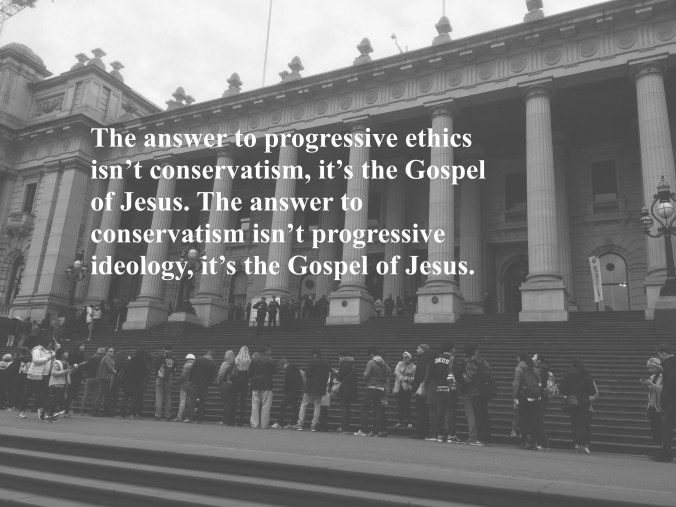
The answer can be found inside the Victorian Parliament

“All along the answer was staring us in the face.”

BREAKING NEWS: We are thankful to God for his grace and grateful to those who voted and defeated the ‘inherent requirement’ legislation.

Should this amendment to the ‘Equal Opportunity Act’ have been adopted, all religious organisations in Victoria, including churches, would have lost their freedom to employ people based on the beliefs and practices of the organisation. A tribunal would have been appointed by the Government, establishing a theological framework for all religious groups, and this same body would determine whether potential employees would be ‘inherently required’ to follow the convictions of any particular religious organisation.

In essence, the legislation would have redefined the role of Government in religious matters, giving it pseudo-episcopalian oversight.

A liberal democracy necessarily provides and protects an environment for society whereby associations have freedom to employ persons who’s convictions and character align with that organisation. In spite of the Andrews Government’s intent to remove this freedom from churches and religious schools, the Parliament has determined otherwise, at least for this point in time.

Today, we witnessed the Victorian Parliament putting on the brakes, and in a small way, slowing down a movement that is intent on eliminating Christian beliefs from society. After a series of anti-Christian policies that have come into effect over the past 2 years, we should be thankful for today’s decision, which means that the State of Victoria has retained an important aspect of religious freedom.

As we express gratitude, I trust though that people will refrain from pontificating, and from presuming that this decision will in some way advance Christian faith in Victoria. The reason is simple, the Gospel doesn’t advance through Parliamentary processes but only through the proclamation of the Gospel of Jesus Christ. Don’t get me wrong, it is a good thing that the legislation was defeated, but we mustn’t over-state the argument.

img_9500

Rather than focusing on the ‘inherent requirement’ legislation, I wish to take the opportunity to speak of a little known fact about our Parliament building. Positioned in the middle of the Victorian Parliament building, inside the library, is a large Bible, opened and sitting on a wooden stand. It is not hidden in a corner or shelved along a row of books, but stands alone at the centre of the library, conspicuous as a light post.  Despite its prominence though, one wonders how often people stop to notice let alone read this copy of God’s word. One wonders if people consider this Holy book anything more than an item of historic curiosity.

I have walked passed this Bible on numerous occasions, and  have noted that it is always opened to the same passage, Jeremiah chapter 31. I don’t know the story behind choosing this particular portion of Scripture, and whether it was chosen carefully or just opened randomly. Either way, it is a fitting page for the seat of Victorian political power.

The book of Jeremiah was written in the 6th Century BC, at the time of the Babylonian invasion and of Jerusalem’s destruction.  The book details the ministry of Jeremiah the prophet, who expounded words from God that offered explanation of the nation’s then predicament. It was a time when society had turned its back on the God of the Bible, and instead chose to propagate and trust in ‘progressive’ political and religious thought. Not all Biblical thought was silenced, aspects were retained although heavily redacted and reinterpreted in ‘new’ ways.

The nation’s leaders, both political and religious, in ways that may remind one of Neville Chamberlain, spoke of a message of peace,

“From the least to the greatest,

all are greedy for gain;

prophets and priests alike,

    all practice deceit.

They dress the wound of my people

    as though it were not serious.

‘Peace, peace,’ they say,

    when there is no peace.

Are they ashamed of their detestable conduct?

    No, they have no shame at all;

    they do not even know how to blush.

So they will fall among the fallen;

    they will be brought down when I punish them,”

says the Lord.’

(Jeremiah 6:13-15)

The book of Jeremiah contains many bleak messages, and with good reason, but it is not without hope. Jeremiah ch.31 gives a portrait for a new beginning, a Divine promise of hope to those without hope. What is especially staggering about the message is that it is not written for ‘good’ people who are being beaten down by an oppression regime, but it is written for those who were doing the beating. To a disinterested and at times vitriolic people, God speaks a message forgiveness and newness, one that reaches to a level of humanity that no human law and politics can reach, the human heart.

He says,

31 “The days are coming,” declares the Lord,

    “when I will make a new covenant

with the people of Israel

    and with the people of Judah.

32 It will not be like the covenant

    I made with their ancestors

when I took them by the hand

    to lead them out of Egypt,

because they broke my covenant,

    though I was a husband to them,”

declares the Lord.

33 “This is the covenant I will make with the people of Israel

    after that time,” declares the Lord.

“I will put my law in their minds

    and write it on their hearts.

I will be their God,

    and they will be my people.

34 No longer will they teach their neighbor,

    or say to one another, ‘Know the Lord,’

because they will all know me,

    from the least of them to the greatest,”

declares the Lord.

“For I will forgive their wickedness

    and will remember their sins no more.”

35 This is what the Lord says,

he who appoints the sun

    to shine by day,

who decrees the moon and stars

    to shine by night,

who stirs up the sea

    so that its waves roar—

    the Lord Almighty is his name:

36 “Only if these decrees vanish from my sight,”

    declares the Lord,

“will Israel ever cease

    being a nation before me.”

37 This is what the Lord says:

“Only if the heavens above can be measured

    and the foundations of the earth below be searched out

will I reject all the descendants of Israel

    because of all they have done,”

declares the Lord.

It is quite extraordinary and wonderful that at the centre of Victoria’s State legislative power is a reminder of ultimate hope. The answer to our deepest struggles and concerns lays not with Government policy and lawmaking, not in a ground swell of public opinion, or in the strident voices of columnists, but in an ancient promise given by God, God who kept his word by sending his only Son into the world.

The reality is, in different ways our political and ideological preferences can blind us from the glory of Jeremiah ch.31, whether we define ourselves as progressive or conservative, green, red or blue. No matter where people align themselves on these spectrums Jeremiah 31 gives a Divine word that counters and surprises. God is not frustrated by or restrained by any socio-political movement, and neither is he defined by it.

I would encourage all who visit our Parliamentary library, don’t walk past the Bible. Why not pause and read, and ponder at the possibility of its promises being true?

Is my local Church my joy and crown?

This morning in my Bible reading I was stopped by this verse from Paul’s letter to the Philippian Church,

‘Therefore, my brothers and sisters, you whom I love and long for, my joy and crown, stand firm in the Lord in this way, dear friends!’ (4:1)

I was struck by Paul’s affection for the local church in Philippi. He not only loves the people and wants to be with them, he speaks of them as being his joy and crown. This made me pause and ask myself, what words do I use to describe Mentone Baptist Church? How do I view this family to whom I belong in Christ?

Joy is one of the main themes that threads through the entire letter; it speaks of a deep wonderment and excitement of knowing these people are God’s and were partnering alongside Paul in the Gospel of Jesus Christ.

Crown refers to the wreath awarded to an athlete who had trained hard and seen success. As Paul surveys his life and ministry, his prized achievement and great happiness is a local church, and this accomplishment is all God’s doing. From what we know of the Philippian Church there was nothing remarkable about them, but in their ordinariness they lived the Gospel of Christ. Paul’s joy was not rooted in the Church’s power ministries, or in some captured à la mode vibe, but in the genuineness of their Gospel partnership.

We will better understand Paul’s affection for the Church by  reading what he says prior to and following 4:1:

In the latter part of chapter 3 Paul has exposed a group of people, who though probably connected to the Church, were not genuine believers. He refers to their appetite for ‘earthly things’. These people lived for now and the pleasures that can be had in the present, whilst ignoring greater and more important realities. In contrast, Paul reminds us of  an identity and home that is in heaven, and we set our minds on this hope.

‘Join together in following my example, brothers and sisters, and just as you have us as a model, keep your eyes on those who live as we do. 18 For, as I have often told you before and now tell you again even with tears, many live as enemies of the cross of Christ. 19 Their destiny is destruction, their god is their stomach, and their glory is in their shame. Their mind is set on earthly things. 20 But our citizenship is in heaven. And we eagerly await a Savior from there, the Lord Jesus Christ, 21 who, by the power that enables him to bring everything under his control, will transform our lowly bodies so that they will be like his glorious body.

Immediately following 4:1, Paul mentions an argument that is occurring within the church between two godly and Gospel-centred women, Euodia and Syntche.

‘I plead with Euodia and I plead with Syntyche to be of the same mind in the Lord.  Yes, and I ask you, my true companion, help these women since they have contended at my side in the cause of the gospel, along with Clement and the rest of my co-workers, whose names are in the book of life.’

Paul can both speak wonderfully of this Church and also recognise there are issues needing to be addressed.

The two women whom Paul is talking about are not enemies of the Gospel, they are mature and faithful workers who have found themselves clashing. We don’t know the nature of their disagreement, but it is clear the issue needs resolving. In verses 2-3 we see that Paul is not harsh with them, he does not tell them to leave or remove them from ministry, but rather he organises counselling for them in order to restore the relationship.

P1018405.JPG

As I meditated on God’s words today, these 3 points came to mind:

Firstly, Philippians 4:1-3 encourages me because even healthy churches have disagreements. It is inevitable but it need not diminish our affection for one another; indeed we can and ought to work through these quarrels and arguments because of our Gospel partnership.

Secondly, an appetite for ‘earthly things’ is a constant danger and is a destroyer of genuine Christian fellowship and joy. If our affection for the local church diminishes, it is worth asking ourselves the question, what are we hungry for? What are we filling up on in order to feel satisfied?

Third and foremost, when we sense our passion and love for our local church dissipating, return to the Scriptures and listen afresh to how God describes these communities of brothers and sisters in Christ.  The Bible is a great antidote to our modern individualism and sense of autonomous living, which sadly impacts the growth of so many of our Churches.

I confess, there are moments when my own Church doesn’t feel like it’s my joy and crown, and I suspect the sentiment is at times reciprocated! That is a great reason for reading Philippians 4:1 and many other passages like it. We often forget how extraordinary the local church is in the sight of God, and how wonderful it is to be called by God to belong to a local gathering of his people.

Is our local Church a people whom we love and long to spend time with? Do we see the local church to whom we belong as our joy and crown?

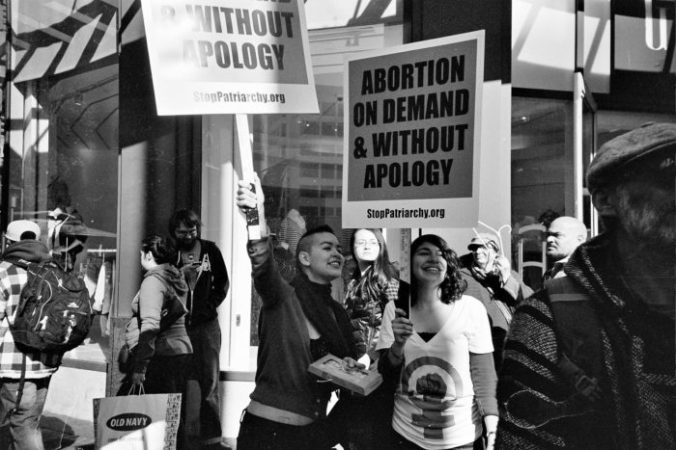
Let’s speak about, not shout about abortion

“Heaven is filled with boys and girls, who though unwanted by their earthly parents, have been welcomed by a Father who is committed to their eternal good and joy.”

Every year in Australia 10,000s of children are aborted, a practice that is not only supported by the law in some states, but it is something celebrated by many Australians.

Over the weekend Jane Caro has come out to defend and publicise abortion. Caro begins by sharing her own story of having an abortion, and then calls on other women to shun the guilt associated with abortion.

She writes,

“Abortion and the fear of unwanted pregnancy, frankly, is a normal — if not very pleasant — part of many women’s lives.”

“Shout out about your abortion any way you see fit — if the subject comes up in conversation, perhaps, or there is a story about it in the news.”

“If you have had an abortion, do not be ashamed of it. You are in good company. Shout it out and help lift the shame for all the other women who have also decided that every child should be a wanted child.”

I may need to clear the air in relation to one obvious point, which in the eyes of some readers will automatically preclude me from having anything to say on the issue. Yes, I am a male, and because of this anatomical and psychological fact, I understand some women will straightaway invalidate any comment I wish to make. We are all familiar with the mantras, ‘it’s the woman’s right to choose’, and, ‘women have the right to control their body’.

I suspect though, many on the pro-abortion side would be quite happy to have men speaking in support of abortion. Indeed, only a few short months ago Queensland MP, Rob Pyne, introduced legislation to relax abortion laws in that State; we didn’t hear many women protesting his public voice.

Not only that, it is a simple point of biology that men are involved in the process of women becoming pregnant. Should a father be involved only in the act of procreation, and be excluded from happens next? This is not about being controlling or patriarchal, it is about being a responsible parent and participating in an relationship. Sadly though, many men are irresponsible and uncaring, a problem which continues to cause frightful harm in so many of our homes.

abortion2-flickr

Morten Liebach, Steenaire (inset); flickr

While abortion has remained a hot political issue in the United States, in Australia it had largely shifted out of public discourse, becoming a forgotten shadow twisting through our cities, towns, and homes. But now, all of a sudden, partly due to the recent American Presidential election and also because of a Queensland Parliamentary vote, abortion is being talked about once more.

Jane Caro is writing though in response to last week’s announcement by Pope Francis, who has given priests ‘permission’ to forgive Roman Catholic women for having an abortion,

“I henceforth grant to all priests, in virtue of their ministry, the faculty to absolve those who have committed the sin of procured abortion.”

Caro responds,

“Given the Catholic Church’s attitude to contraception and its behaviour towards vulnerable children the world over, I simply cannot take anything this institution has to say about sex and reproduction seriously.”

Her criticism has some warrant, and I certainly understand her blanket mistrust of Roman Catholicism in light of its dreadful  history of sexual abuse. I am also critical of the Pope, for it is not the Pope’s place, nor the role of any priest to forgive anyone their sins. Priests may find permission in a papal edict and in their Church dogmatics, but such authority is not found in the the Bible, and as Christians that’s what counts. Priests are imperfect men who need their own sins forgiven by God, and as the Bible affirms, 

“there is one God and one mediator between God and mankind, the man Christ Jesus,” (1 Tim 2:5)

One of the reasons for writing today is because of a sadness that overcame me when I read Caro’s call to view abortion as ‘normal’. It is not normal. Abortion is never something to be celebrated or normalised. On rare occasions, when a mother’s life is genuinely at risk, I understand it is permissible, but to consider killing unborn children as okay is not okay.

A society that sanctions, and even celebrates the killing of unborn children is one denying its own humanity.

If one surveys global societies that have embraced a culture of abortion, one notes China with its population suppression policy. There are also numerous religious cultures who denigrate women and frequently force abortions when the baby is female.  And there is our western secularism with its excessive commitment to individualism. When we value the self above the good of others, we create an atmosphere of self-indulgence and not sacrifice, of self-worship rather than selflessness.

The very nature of loving community is that it requires the unexpected and difficult, and rather than eliminating those surprises, we alter our life expectations in order to to see their lives flourish.

Jesus once said, ‘Greater love has no one than this: to lay down one’s life for one’s friends’. Indeed, how great a love it is to sacrifice our hopes and plans for children who enter our lives unplanned.

In my role as a Christian Minister, over the years women have shared with me their stories of having an abortion, and without exception there is a shame attached. Reasons are multifarious: when a woman is raped,the fear of giving birth to children with a disability, when the mother’s life is at risk, and when the child is unwanted due to the mum not feeling ready or not wanting the responsibility or wanting children to impact their lifestyle or career. The reality is, only a tiny portion of abortions occur on medical grounds that the mother’s life is in danger. Many more abortions occur because of the child’s gender, or because the child may carry a disability, and many other children are killed because of lifestyle choices. For many many women this decision has left a wound that has not healed.

As much as Jane Caro wishes women to wash away their shame for having abortions, many women cannot, and no Pope or priest can achieve that either. But in the person of Jesus Christ we find a God who is willing and able, and who is more merciful and wonderful than any of us can ever imagine.

As distressing a topic as abortion is, it is good to hear people talking once again. I don’t want to silence women who have had an abortion. Claire Smith has last week written an article encouraging people to speak more about abortion, and I wish to echo her words. And to a certain extent I also repeat Jane Caro’s words, that of urging women not to keep silent. But the speech we need is different, words that don’t speak affirming  destroying young life, but words that enable conversation, and ears that will listen to these stories.