Jerusalem and Gaza, the home for many

As Jerusalem makes headline news across the world today, as so often is the case, my mind turned to a letter written by a friend a couple of years ago. At the time, with his permission, I posted it on the Mentone Baptist Church blog. Again with his permission I’m publishing the letter here, because it brings to the fore an often forgotten group of people who are living in that most beautiful yet tumultuous land. His letter doesn’t concern Jerusalem per se, but it does bring a nuance, and timely theological reflection, to a context which is too often misunderstood in binary ways. It was written in 2014.


23926558_10156000240969973_3512398476017643912_o.jpg

G. Athas (2017)

Editor’s note: due to the sensitivity of the issues I have withheld the author’s name. It is written by a Christian friend from Palestine who now lives in Melbourne. I am publishing, with their consent, part of an email correspondence from last week that came about after I learnt that members of their family have been killed in Gaza in recent days. 


“It is a sad reality…our loss is for my dad’s cousin, and 2 of my second cousins.  My dad is somewhat bitter about the events dominating the land since 1948 and the gradual ethnic cleansing since, and his family (and my mothers) experienced much sorrow seeing Christians flee – taking with them the true heritage of the land. 

Over the years, we have experienced losses that are hard to understand.  Another of my first cousins was shot in the hip, though is alive, and cannot walk around properly.  He has 2 daughters that he struggles to feed because he cannot work.  Therefore my dad and I have supported him somewhat – including his extended family.  This particular incident happened a few years ago in the previous incursion.  He’s a believer and knows that the Lord has a plan – but he struggles.  They live day by day.  His daughter, my niece, did not really know that bananas were yellow, because she had never seen one in real life.  Another of my cousins died late last year because he was unable to obtain medical treatment, and he was my age, and had 3 children.  The family is in great pain knowing that he may have been saved, but was not.

In Australia and much of the west it is very easy to take essential provisions for granted.  Food, water, warmth, basic amenities, and the freedom to worship as a Church or body of Christian believers.  Such rights as voting, police protection, medical and health cover, or a simple roof over your head do not exist to many in Palestine.  Freedom to move around from suburb to suburb within the nation do not exist.  There is no right to external travel, and no right of return.  

 We pray for Christians to be strengthened during this time.  We pray that they will not lose hope, and that they will not blame God, or Christ for the suffering and anguish they endure at the hand of politics, greed and selfishness – the inherent heart of man!  I know they have not got the answers they so desperately seek and they yearn for understanding and adequate explanation.  It is most undoubtedly a difficult time for them (and us being somewhat helpless here), and it seems like there is no real end in sight.  Every day passes by without offering a hint of improvement.  Another day of this life passes by and it cannot ever be reversed.  I know that this eats away at them because they feel they cannot even enjoy the simplest of lives with their children and families.  Uncertainty and persecution is everywhere.  Many fall in despair and suggest God is only a God of the Jews, and hater of the Palestinians.  They consider God hated Ishmael – whereas instead God saved him in the wilderness, and blessed him bringing into his line 12 princes.  The pain distorts their view on God’s true love and equitable justice.  God is not the racist they often time feel He is portrayed as.

So we do sincerely appreciate your prayer, and love in action.  Nothing else helps.  Earnest and fervent petition to our Lord to hear the voice of His people (Christians), whom He loves.  To incline His ear and see their affliction, and turn and answer them and heal their pain – bringing them closer to Himself.  And while doing so, to bring many more others to His Name that were once lost that they too may worship the One True God.  Selah. Amen. 

 As believers, we know that Jews can’t bring true peace.  Muslims can’t bring true peace.  But the Lord of the Bible can.

 I pray this is the Lord’s will for that land.  But I fear more trouble comes first.”

Australia is Changing and Churches are unprepared

Note from today (December 7):

During the course of today, several MPs have offered amendments to the Parliament in order to ensure that religious freedoms and freedom of conscience will continue without threat, once the Marriage Act changes to legalise same sex marriage. As in the Senate, every single motion has failed to win sufficient support in the House of Representatives. No one is surprised by this. What has surprise me was when the member of Canning, Andrew Hastie, sought to table correspondence from religious leaders across the country and was denied. He was not even permitted to table the concerns from many of the nation’s most respected religious leaders.

The constant response to proposed amendments has been, fears of limiting religious freedoms are “baseless”, and they have ironically insisted upon this while the choir sitting in the public gallery have all day applauded and cheered when any MP has suggested religious freedom will be reduced.

One thing we can guarantee once the law passes, a point that I raised a couple of weeks ago, “As soon as the Marriage Act is reworded, future laws and interpretations of these laws, and future social norms will all be defined by this wording. This raises important questions for millions of Australians who with good conscience, do not support the corollary of expectations that will ensue throughout many parts of Australian culture.”

——————————

Since I was a child, Governments have promised to deliver a high speed train, to service Melbourne to Sydney. Last night, the Senate in Canberra began to deliver. The sexual revolution was offered a free upgrade which will ensure that it can accelerate toward its unaccommodating vision for Australia.

high_speed_rail_1920x1005

Social progressives have declared their agenda for many years now, but other progressives felt the need to either downplay or ignore their voices, at least in public. Their dream for Australia seemed too bold, too audacious, too big to swallow all at once. 

The Australian public was reassured that same-sex marriage had nothing to do with freedom of religion, although social commentators and even politicians, dedicated an awful lots of words to insist that opponents of same-sex marriage are all haters and need to be silenced. Indeed, within minutes of the marriage survey results being announced, Fairfax had published an article calling for Parliament to ignore the of religious freedoms,

“So let’s not be hoodwinked into changing the law to pander to bogus religious freedom lobbyists.”

Even prior to the marriage survey’s announcement, there was a chorus of public voices explaining how the debate on marriage was connected to religion, and that marriage is the instrument of choice to erase religion from public life altogether.

Mauvre Marsden, in the Sydney Morning Herald (Oct 4),

“Yes, marriage is not the final frontier. Yes, we want safe schools. Yes, gay conversion therapy is child abuse. Yes, we want transgender kids’ agency to be respected and supported – regardless of what their parents want. Yes.”

Auberry Perry in The Age (Sept 3),

“This survey offers us a conscious opportunity to make a firm stand in support of a secular government and to reject discrimination or favouritism based on religion. It’s our opportunity to say that religion has no part in the shaping of our laws. A vote against same-sex marriage is a vote for religious bias and discrimination in our legislation, our public schools, our healthcare, and ultimately, in the foundation of our social structure.”

We should not forget, that only last year the Victorian Government attempted to pass legislation that would have taken freedom from religious organisations in hiring staff who subscribe with their values. By values, the Government was targeting beliefs that didn’t fall into line with the sexual revolution. It was, as Dr Michael Bird explained at the time, an example of Secularized Erastianism, a philosophy which asserts that the State shapes and controls religious belief and practice. Is this the direction Australia wants to head?

Remember all the assurances given to Australians during the same-sex marriage campaign, of how very little will change? Only a couple of weeks ago, the Prime Minister assured the nation that,

“I just want to reassure Australians that as strongly as I believe in the right of same-sex couples to marry, as strongly as I believe in that, even more strongly, if you like, do I believe in religious freedom…”

Last night in Canberra, we were given assurances that much will change. So what was decided in the Senate last night? In short, there will be no safety net for any person or organisation who oppose same sex marriage, except for clergy when it comes to performing weddings and perhaps also for official ‘church’ buildings (although, the ABC is reporting that religious institutions will not be able to refuse to hire out church halls for same-sex weddings).

Stephen McAlpine gives this helpful summary of the main points thus far (based on reporting from The Australian):

  • Protect Civil Celebrants refusing to marry gay couples
  • Create two definitions of marriage – one as between a man and a woman and the other as between two people
  • protect “relevant beliefs’ around marriage
  • prevent governments and agencies from taking action against people with a traditional view of marriage
  • Allow parents to remove their children from classes if they believe material taught is inconsistent with their view of marriage

McAlpine is spot on,

“I totally get points one, two…I didn’t expect anything different on those, and can’t really see an argument around them.  But to refuse protection around “relevant beliefs” about marriage?  That opens the door to all sorts of activism, and it will cost religious groups dearly.

But it’s that idea that the Parliament does not see fit to protect people with a traditional view of marriage from having action taken against them by governments and other agencies that is particularly unfortunate.  You can hear the knives sharpening already, can’t you?”

The prophets of the sexual revolution don’t appear so crazy this morning; they were right and they’ve won the social and political battle. This debate was never about equality, but always about social conformity with the new sexual milieu. There are certainly Australians who still believe that all this is solely about equality and human rights, but they are pawns being played for a much bigger game.

Social pluralism is on the way out, and adherence to the new gods of sexuality is obligatory. Pluralism in Australian could only continue so long as those in authority encouraged alternative views to be expressed publicly, without fear of litigation or threats of violence. The Senate has taken the next step to ensure that such freedoms will decline. This should concern all Australians, not because pluralism is god, and not because we are moral and spiritual relativists, but because we believe a healthy society requires its citizens to argue and persuade, and to allow others to make up their minds.

It’s not too late for the Parliament to deliver sensible legislation, but slowing down the train will be interpreted as a betrayal, and will likely have you thrown off. I’m not suggesting that Parliament puts on the brakes in relation to changing the Marriage Act. I’ve stated elsewhere that Parliament should not unnecessarily delay this process. However, it is incongruous to not fully address, the broader issues which are in fact the main issues.

It is important to remind ourselves that the future of the Gospel in Australia doesn’t ultimately need political assurances from the Government, for it is too good and too true. Charles Spurgeon was right when he said,

“The Word of God is like a lion. You don’t have to defend a lion. Unchain it and it will defend itself.”

The Parliament is however, setting up the scene whereby being a Christian will carry more cost than it has in the past. It is time for Aussie Christians to take  their cross from under the bed, give it a good dusting, and start following Jesus.

Those who identify as progressive of course have nothing to fear from any legislation, because they eagerly jumped on board and abandoned the Gospel 6 stations ago. It doesn’t matter that their churches are dying,  they are happy to pay the price for a seat in business class.

I also suspect that many more Christians will go on pretending as though nothing has changed, until such time that they too have their convictions forced out of them and are then left vulnerable, having their dreams of a prosperous life derailed. When will we wake up and realise Jesus was telling us the truth all along?

19 “Do not store up for yourselves treasures on earth, where moths and vermin destroy, and where thieves break in and steal. 20 But store up for yourselves treasures in heaven, where moths and vermin do not destroy, and where thieves do not break in and steal. 21 For where your treasure is, there your heart will be also.

22 “The eye is the lamp of the body. If your eyes are healthy, your whole body will be full of light. 23 But if your eyes are unhealthy,[your whole body will be full of darkness. If then the light within you is darkness, how great is that darkness!

24 “No one can serve two masters. Either you will hate the one and love the other, or you will be devoted to the one and despise the other. You cannot serve both God and money.” (Matthew 6)

The notions of liberal democracy and social liberalism lost some shape last night, and before this journey is over, we will have a nation that is less tolerant and less free. Christianity will survive because it is not defined by these terms, but we can no longer afford a cost free faith. Christians though are not the only ones who are likely to pay; eventually we will see people wanting to get off the train, and churches need to be there and ready to minister to the injured and hurting.

Are we ready?


An earlier report had suggest that Defence Chaplains were not given exemption. That was incorrect and have since made the correction here

Australia chooses to change marriage, and perhaps much more

The Australian Bureau of Statistics (ABS) has released the result of the marriage survey.

The question given to the Australian people was,

Should the law be changed to allow same-sex couples to marry?

12.7 million people voted (79.5% of registered voters in the nation).

61.6% said yes, while 38.4% said no.

What does this mean? I wish to address two areas of impending decision making, the political and the Christian.

Political decisions

In terms of the politics, a private members Bill will be tabled this afternoon in the Senate, for debate and deliberation (the Dean Smith bill).

Several members of the Government have already indicated that the Smith bill will be used as the blue print, but they are open to amendments. The intention though is to pass legislation and the thus legalise same sex marriage before Christmas.

We do not know what shape the bill will finally take. Senator James Paterson (who supports SSM), has proposed a Draft Marriage Amendment (Definition and Protection of Freedoms) Bill. This bill provides significantly more protections for Australians than the Smith bill, although Senior Government Ministers have already suggested that this is a non starter. 

We need to keep in mind that legislation is more complicated than simply replacing a couple of words in the Marriage Act. When same sex marriage was introduced in the United Kingdom (2014), hundreds of pieces of law required change, and all manner of issues relating to religious freedoms have appeared since. Indeed, the very notion of religious freedom is now more under threat in the UK than in any time since the reign of Charles II in the 17th Century.

Here in Australia, even prior to the law changing, we have witnessed preachers in Tasmania being brought before a tribunal for explaining the Bible’s view of marriage, and a Catholic Archbishop who wrote a leaflet for fellow Catholics, outlining their position on marriage.

If proper protections are not provided, we can expect an erosion of personal freedoms for anyone not subscribing to the new morality. Indeed, if, upon changing the law, freedom of speech and freedom of conscience is lessened from what we enjoy today, November 15th, this country will have taken one giant leap into a shark tank.

Associate Professor Neil Foster has written a helpful summary of the pros and cons of both the Smith and Paterson bills.

I doubt if many people are shocked by today’s announcement; disappointed and concerned, but not surprised. The compass has been pointing in this direction for 50 years, and we have not yet journeyed to the final destination. There is now the important question of how the Federal Parliament will now deal with the issue. Given the support for same sex marriage as expressed by the Australian public, I think it is only right that Parliament respect this democratic process. For those in Parliament who cannot, for conscience, support marriage redefinition, might I propose that you abstain rather than vote against. Doing so enables you to respect the decision of Australians without marring your conscience.

Even prior to any marriage changing, numerous threats have been made against individuals and organisations, for not coming out in support of same sex marriage. Some of these groups had simply made the decision not to become embroiled in the debate. Neutrality, however, is not enough for many same sex marriage advocates; total alliance is the only acceptable option.

This is a test for Australia and whether we truly wish to embrace cultural pluralism and liberal democracy, or whether we will heed the war drums of social progressives and thus move toward a poor replica. We must understand that this is not mere hyperbole, for even the favoured Smith bill will expose many Australians to threats of litigation and reduced freedoms

Former Deputy Prime Minister, John Anderson, said on the weekend,

“West Australian Liberal senator Dean Smith’s bill guarantees only “the right of clergy and religious institutions” to decline participation in same-sex marriage services and celebrations. There is by omission no recognition of the likelihood of damage to the freedom of conscience for ordinary citizens and their businesses. Smith and many of his colleagues seem unmoved by the encroachments on freedom of speech and conscience already demonstrated in Australia.

Smith’s exemptions approach arguably does more harm than good, for it assumes freedom of conscience is of worth only to professional religionists and not to all Australians. This weakens even further the standing of this important democratic right and makes it an easy target for those who would lobby to erase this exemption and similar exemptions that may remain in state legislation.”

Why is this a problem? Because 4.83 million Australians have said that they do not support same sex marriage. Millions of  Australians potentially face loss of income, employment, and facing tribunals for adhering to a view that will no longer be supported by the law.

Will Australians be guaranteed freedom to continue teaching and explaining the classical view of marriage and sexuality, not only in a Church but also in public places including universities?

Will religious schools maintain freedom to teach and affirm the classical view of marriage?

Unless the Government ensure thorough and principled protections, we can anticipate the promises of many advocates being enacted onto our society.

Mauvre Marsden, in the Sydney Morning Herald (Oct 4),

“Yes, marriage is not the final frontier. Yes, we want safe schools. Yes, gay conversion therapy is child abuse. Yes, we want transgender kids’ agency to be respected and supported – regardless of what their parents want. Yes.”

Auberry Perry in The Age (Sept 3),

“This survey offers us a conscious opportunity to make a firm stand in support of a secular government and to reject discrimination or favouritism based on religion. It’s our opportunity to say that religion has no part in the shaping of our laws. A vote against same-sex marriage is a vote for religious bias and discrimination in our legislation, our public schools, our healthcare, and ultimately, in the foundation of our social structure.

Australia_from_space


Decisions for Christians

Today is not a day for outrage, but for mourning. We must learn to weep like Jeremiah, and we must learn to live as Daniel. We must learn to accept injustice as did the Psalmists, and we must come to terms with the truth of Jesus’ words, ‘take up your cross and follow him’.

This is a good day for thankfulness and to remind ourselves of the hope that does not disappoint or fade.

Praise be to the God and Father of our Lord Jesus Christ! In his great mercy he has given us new birth into a living hope through the resurrection of Jesus Christ from the dead, and into an inheritance that can never perish, spoil or fade. This inheritance is kept in heaven for you, who through faith are shielded by God’s power until the coming of the salvation that is ready to be revealed in the last time.In all this you greatly rejoice, though now for a little while you may have had to suffer grief in all kinds of trials. These have come so that the proven genuineness of your faith—of greater worth than gold, which perishes even though refined by fire—may result in praise, glory and honor when Jesus Christ is revealed. Though you have not seen him, you love him; and even though you do not see him now, you believe in him and are filled with an inexpressible and glorious joy, for you are receiving the end result of your faith, the salvation of your souls.”

We are mistaken if we define God’s faithfulness by cultural or political successes, rather than by the Gospel of Jesus Christ. Christian hope doesn’t diminish, depending on societal norms and laws. Rather it carries us through whatever transpires in life; this makes us the freest people on earth.

1. Stick with Jesus

Christian hope frees us to hang onto what we have become convinced is true and good.

It is not worth giving up God’s ways for the sake of social acceptance, and we are ultimately not serving them well or God, should we adopt the new moral horizon.

For a set of practical steps for Christians moving forward, please read https://murraycampbell.net/2017/11/14/gearing-up-for-the-marriage-survey-outcome/

2. Love your neighbours

While there are very important questions relating to the impact this change will bring for religious and societal freedoms, we should be less concerned about ourselves, and more concerned for the future of our children, and for the good of our fellow Australians.

We have opposed same sex marriage, not because we hate people but because we  love God and we love people, even our gay and lesbian neighbours, and we truly want them living well. Today’s announcement is no licence for changing either our view of marriage or God’s call to love our neighbours. I trust and pray that our resolve to be the best of friends, and the kindest of people, will increase from today onward. Did not God treat us with even greater love?

Today many Australians are celebrating, and many sensing relief. We are not among that number, but neither are we jealous or vindictive. Our hope remains unaltered, and as Russel Moore aptly noted following the Supreme Court decision in the United States to legalise same sex marriage, let’s be ready to embrace and welcome the many refugees who will come through this sexual revolution.

We must prepare today, to keep living out God’s good news tomorrow.

“I do not hide your righteousness in my heart; I speak of your faithfulness and your saving help. I do not conceal your love and your faithfulness from the great assembly”. (Psalm 40:10)

“I have chosen the way of faithfulness; I have set my heart on your laws”. (Psalm 119:30)

Pursuing Public Conversation on Marriage

We live in strange days: When a Government breaks an election promise, the public is rightly critical and opposition Parties are justified to call them out. Even if we disagree with their political choices, there is an issue of integrity that the populace expect of our politicians.

Last night however, social commentators and some members of Parliament were outraged (again) that a Government has determined to keep its promise to electorate: to bring a plebiscite question on marriage to the Australian people. Is it not somewhat disingenuous to call Governments to account for broken promises one day, and then call them names the next day because they’re keeping their word?


Australia

I personally think there are arguments for and against a plebiscite. The pathway is a decision that needs to be made by the Government of the day.

There is precedence for a plebiscite

Since Federation in 1901, at the Federal level Australia has held 44 referendums and 3 plebiscites. The States however, have conducted many more plebiscites, covering a wide range of issues including the establishment of Wrest Point Casino (Tas, 1986), closing hours for alcohol selling establishments, extending shopping hours (WA, 2005), and daylight savings.

In other words, on no fewer than 60 occasions, Australian Governments have taken an issue to the people and asked for their opinion. That is one referendum or plebiscite every two years; meaning we’re overdue.

In 1977 a plebiscite was conducted to decide our national anthem. Now, maybe I’m not as patriotic as other Aussies, but in my view, marriage is significantly more important than choosing to sing ‘Advance Australia Fair’.

The issue warrants Australia’s input

While 94% of the Australian population don’t see this issue as very important, I am persuaded that it is of grave significance.

We are not talking about a tiny amendment to the law, but the radical and complete alteration of society’s most basic building block: from marriage comes the family unit, and from family communities are formed, and with communities a society and nation is shaped. Marriage is not everything, but it is an important thing and it is one which has held an almost universally accepted definition since history began. Until recently very few societies would even consider the question, and today the vast majority of nations remain opposed to same-sex marriage. Let us understand that no one is quibbling over a few words, at stake is rebooting the very notion of marriage. There are already community voices arguing that this rewrite is simply a steppingstone to further changes and even the eradication of marriage altogether:

In 2015, Simon Copland, a columnist with the Sydney Star Observer, argued that equal marriage might unfortunately limit expressions of sexuality, saying that ‘while monogamous marriage still works for many, our society is increasingly questioning whether it should remain as the only option’.

At the 2012 Sydney Writers’ festival, Dennis Altman, was among a number of speakers who declared their hope that the Marriage Act would be eventually repealed altogether.

The point is, it is not hyperbole to suggest that should marriage redefinition take place, it will be considered a watershed event in Australia’s history, one which will have inevitable and enormous repercussions for society.

Australians are not choosing whether to adopt a new tax or funding more schools or creating the NBN, as important as such things may be; we are deciding how Australia will view what is the most essential and basic unit of every society on earth, marriage.

While the primary issue relates to what is marriage, there are significant corollary issues that Australians need to be made aware of. There are real consequences relating to freedom of religion and freedom of speech, and there are genuine questions relating to the rights of children having a mum and dad, and to the issue of surrogacy and assisted reproduction. It is simply naive for us Australians to assume that nothing will change.

One of the largest problems facing is that, as soon as the law changes, anyone opposing the law will find themselves on the wrong side of the law, and thus exposing themselves to all manner of litigation. Law Associate Professor Neil Foster has written an important article outlining the very real threats to individual and organisation freedoms, should same-sex marriage become law in Australia.

How to conduct ourselves through this national debate

One of the 6 Liberal MPs who forwarded the proposed legislation last night, is a local member for many members of my church. I have a lot of respect for Tim Wilson, and I think it’s positive that members of the Liberal Party were able to bring forward an idea to their colleagues and to discuss its merits, even though it turned out that something like 80-90% of the caucus were not in agreement with them.

It remains to be seen whether there will be a plebiscite or not. It is doubtful that a free vote in Parliament would have the numbers for changing the Marriage Act, and it is also likely that the numbers among the Australian public are tighter than polling suggests. Whichever steps are taken in coming weeks, I am asking the Christian community to be wise and gracious in our speech. Most Christians don’t need reminding, but there are always a few who ignore the words of the Bible.

Public discussion on this issue does not justify spite or slander toward those who wish to change the Marriage Act. Throwing bile at another human being is detestable, whether it is done in person or on twitter.

Indeed, the essence of Christianity is Jesus Christ showing kindness to a world that had no room for his beliefs,

“You see, at just the right time, when we were still powerless, Christ died for the ungodly. Very rarely will anyone die for a righteous person, though for a good person someone might possibly dare to die. But God demonstrates his own love for us in this: While we were still sinners, Christ died for us.”

The Bible gives us very clear instruction on how to treat people around us, even those who disagree with us.

“14 Bless those who persecute you; bless and do not curse. 15 Rejoice with those who rejoice; mourn with those who mourn. 16 Live in harmony with one another. Do not be proud, but be willing to associate with people of low position. Do not be conceited.

17 Do not repay anyone evil for evil. Be careful to do what is right in the eyes of everyone. 18 If it is possible, as far as it depends on you, live at peace with everyone. 19 Do not take revenge, my dear friends, but leave room for God’s wrath, for it is written: “It is mine to avenge; I will repay,” says the Lord. 20 On the contrary:

“If your enemy is hungry, feed him;

    if he is thirsty, give him something to drink.

In doing this, you will heap burning coals on his head.”

21 Do not be overcome by evil, but overcome evil with good.” (Romans 12:17-21)


As important as this national conversation is, there is something of greater consequence, and that is how we conduct ourselves. Predictably although sadly, already this morning social media is alight with unhelpful and untrue rhetoric from politicians and television presenters, making assumptions about ‘equality’ and imputing all manner of malevolent motives on those who believe in classical marriage. To them, I say, please do not erroneously fuse disagreement with hate as though there is an inextricable link between the two, for this is not the case. To disagree civilly with gay marriage is not hate, and to claim such risks undermining the foundations of democracy and a free society.

Is there persecution in Australia?

I don’t know if anyone has done the numbers, and I’m not old enough to know what Australian media was like before the mid1990s. I may be wrong, but my sense is that media is reporting more stories about Christians and Christianity than even 5 or 10 years ago. Many of the stories are negative (sometimes with good reason), while some are supportive of Christianity. There are stories and op-eds being written about Christianity and culture by Christians, and by agnostics, atheists, and Muslims; even sporting journalists are getting in on the act.

A good deal of what we read skews what Christians believe and practice, but why should we be surprised by that? Even some of the sympathetic journalism is unhelpful because it paints Christianity in ways other than through the lens of the Gospel of Jesus Christ.

On the upside, all the flurry of Christian attention is opening all kinds of opportunities to have conversations with people. On the downside, I am noting how many Christians are running too quickly to the poles, and not sticking with Jesus and letting his word shape our words and actions. As soon as another story about Christianity hits the news, responses are often tailored more by notions of progressive or conservative identities, and that’s a problem. When Christians too readily identify with left or right issues, we often can’t admit that there’s any problem unless it’s on the ‘right’ foot. The myopia is made worse by the fact that everyone has their preferred sources for news. The ABC is a friend…or foe. Are we Murdoch readers or Fairfax subscribers? And which journalist best represents our socio-political proclivities?

Last week’s story about children evangelising in Queensland school grounds is a classic example of this ridiculous Christian ping pong. On the one hand some Christian leaders ran to Andrew Bolt’s side, while other’s waved the Education Minister’s statement as proof that the entire story was a beat up. Both were wrong. The prohibition is real enough, and the Minister’s denial, while welcome, does not resolve the issue. Neither, though, is the Queensland Government the anti-Christ, as some silly people were suggesting.

Another example of this inane  polarisation took place today when Andrew Bolt jumped on the story of a Hobart Presbyterian Minister, Campbell Markham, who’s been notified of complaints made against his teaching by an upset atheist. As soon as people began to share the story on social media, it’s as though the Red Sea parted, with some going to the right in praise of Bolt’s defence, and others moving left to distance themselves from the Herald Sun columnist and all those shallow allegations of persecution in Australia.

IMG_2819

We would be mistaken if we defer to Andrew Bolt as some pseudo-Bishop for Aussie Christianity. After all, he does tell us that he is not a Christian. We are also mistaken if we close our eyes and claim that there’s nothing to see, and that any suggestion of persecution is simply overreach and unhelpful hyperbole.

Let’s take a look at the Bible’s language of persecution. The Biblical words convey a broad sense of opposition. The primary word, dioko, means to pursue, chase, or drive away. The aim of persecution is to drive away the Gospel, Jesus, and those who follow him.

Persecution can take on many shapes and sizes.

Persecution can be intense and severe: you may be marked out in your community and lose privileges that others enjoy. You may lose your job, be imprisoned, be forced to flee and seek asylum in another country. You may be killed. This is the experience of many millions of our brothers and sisters today in different parts of the world.

On other occasions, the Bible gives examples of ‘softer’ persecution. For example, in the Beatitudes Jesus says,  “Blessed are you when people insult you, persecute you and falsely say all kinds of evil against you.”

We must be careful not to conflate our circumstances with those faced by many of our brothers and sisters in other parts of the world. Disagreement for example is not persecution.

We must also be careful not to minimise real threats that have been  made again some Christians in Australia. To argue that there is no persecution is ignorant and even callous.  Sure, persecution in Australia is unusual, but it’s not unknown. Indeed, more than a few members of my church have been subjected to bullying by parents and by spouses because they have chosen to follow Jesus. This includes disownment and disinheritance, should they persist in being baptised and joining a local church.

Across Bass Strait, Campbell Markham and David Gee are the latest Tasmanian preachers to have formal complaints made against them for their Bible teaching. Being brought before a State’s Anti-Discrimination Commissioner, because someone took offence at your preaching, is a form of thlipsis.

Just because there is no tsunami doesn’t mean that the tide isn’t changing, and neither does the changing tide mean that there’s a gigantic wave about hit the shore.

At Mentone Baptist we are currently preaching through Romans ch.12-16, and our text yesterday was 12:14-21. No matter the direction of the tide, it is a posture to have continually define our response,

“9 Love must be sincere. Hate what is evil; cling to what is good. 10 Be devoted to one another in love. Honor one another above yourselves. 11 Never be lacking in zeal, but keep your spiritual fervor, serving the Lord. 12 Be joyful in hope, patient in affliction, faithful in prayer. 13 Share with the Lord’s people who are in need. Practice hospitality.

14 Bless those who persecute you; bless and do not curse. 15 Rejoice with those who rejoice; mourn with those who mourn. 16 Live in harmony with one another. Do not be proud, but be willing to associate with people of low position. Do not be conceited.

17 Do not repay anyone evil for evil. Be careful to do what is right in the eyes of everyone. 18 If it is possible, as far as it depends on you, live at peace with everyone. 19 Do not take revenge, my dear friends, but leave room for God’s wrath, for it is written: “It is mine to avenge; I will repay,” says the Lord. 20 On the contrary:

“If your enemy is hungry, feed him;

    if he is thirsty, give him something to drink.

In doing this, you will heap burning coals on his head.”

21 Do not be overcome by evil, but overcome evil with good.”

What the Census reveals and doesn’t reveal about Aussie religion

If Tuesday’s headlines in the Melbourne’s media were anything to go by, the most important news coming out of the national census is that Melbourne is better than Sydney and we are about to become bigger. After all, you can’t dispute numbers! A closer inspection of the data however points out that Melbournians will have to wait a little longer for this prestigious non-title title, about 33 years!

Australia


A more important conversation has exploded across the country, that of the religious contour of Australia, or should that be, its lack thereof?

Lobbyists have begun spinning census numbers their way, for greater numbers supposedly means more social power and influence. However, statistics can be less useful than we are being led to believe, this is certainly true regarding the question of religious affiliation. The census is useful as a sociological exercise, for it is asking Australians to self-identify. Census data is the national collation of Australian opinion and self-allocated identity, but the numbers however may not always reflect what some are alleging.

Let us take the following two groups as an example, ‘no religion’ and ‘Christian:

No religion

Tosca Lloyd wrote a piece in The Age, with this headline, “End Australia’s Christian bias”. His was one of several examples of census overreach. It is truly an odd piece, take this comment for example,

“Does secularism commit the same offence, imposing the views of the nonreligious onto the religious? No. The advantage of a secular society is its tolerance of, and neutrality between, different groups and individuals in society providing they obey the law and do no harm.”

Lloyd equates the ‘no religion’ numbers with atheism, he wrongly defines secularism as non religion and therefore with atheism, he ignores the fact the the majority of Australians still identify as Christian (22% higher than ‘no religion’), and he doesn’t appreciate how many non Christians value much of the Christian heritage Australia has and would like this to continue, and he ignores the fact that atheistic secularism is not neutral but is frequently intolerant of other world views. Indeed, his own article reeks of intolerance toward Christianity.

I understand people feeling tempted to inflate numbers, but it is not a particularly rational response to the data. One senses from social media that some of our atheist friends have been looking for the knock out punch against Christianity, and they believe the census is just that. It seems that they don’t always know what they are swinging at.

The Australian suburb with the largest percentage of people ticking ‘no religion’ is North Fitzroy in Melbourne, with 47%. In an interview for SBS,

“Local councillor Misha Coleman said the high number of “no religion” responses may just have been a reluctance of responders in the area to identify with one particular faith.

“It’s more than privacy, it’s maybe a reticence to say they’re one thing or the other,” she said.

“Maybe people in the area don’t want to be defined, or categorised, or labelled as a particular religion.”

In other words, don’t conclude that ‘no religion’ always means no belief in God.

In the words of the Australian Bureau of Statistics (ABS),

“Australia remains a religious country, with 60% of our population reporting a religious affiliation. However, the proportion of people reporting no religion, including people with secular and other spiritual beliefs, increased to 30% in 2016 – up from 22% five years ago.

The current state of the nation’s faith breaks along age lines. Older people keep their faith. Younger people tend to report ‘no religion’. This response was most common among younger people, with 39% of those aged 18 to 34 reporting no religious affiliation.

Part of the decline in religious affiliation is a general move away from the traditional Christian denominations. Nevertheless, 52% reported an affiliation with a Christian religion – predominantly Catholic (23%) and Anglican (13%). New South Wales and Queensland remain the most Christian states, but there is an overall decline in the percentage of Australians reporting their faith as Christian.

About 8.2% of us reported a religion other than Christianity, with Islam (2.6%) and Buddhism (2.4%) the most common.”

Christian

The census no more reveals the number of convinced atheists in the nation than it does the number of actual Christians in the nation.

The census assumes Christianity is defined in ways other than by the Gospel of Jesus Christ. The only category offered is, do you self-identify as Christian, and with which Christian denomination? This is not a fault of the census as such, for ABS is simply asking questions through a different grid to that which Christians would use for working out such things.

Who is a Christian in Australia today? The census gives great laxity here. A individual may define their religion according to their cultural or family heritage. It may be that they were baptised as infants, or that  their grandparents attend a church.The connection may be as tight or as loose as each person determines.

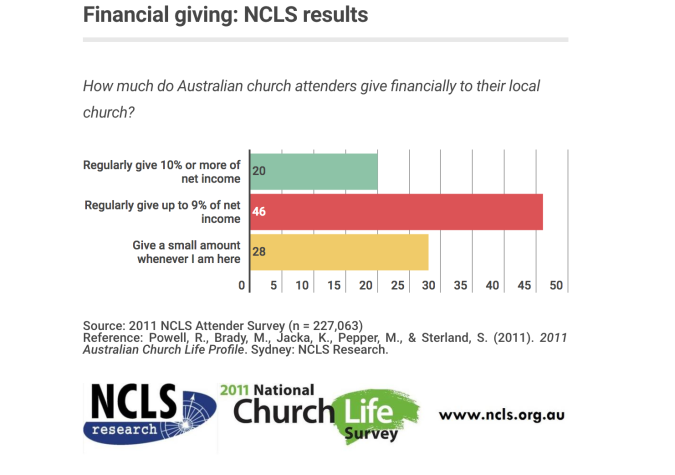
The percentage difference between the new census figures and those who regularly attend a church are vastly different, and the numbers of Australians whose membership is with an evangelical church is smaller again. Not that church attendance is the sign of being Christian, but it is a measure.

Again, it is beyond the scope of this census to determine, but decades of theologically liberal Christianity and spiritual soft drink Christianity have inevitably led to people turning away. If I held up a faded photocopy of a hand drawn chalk copy of Van Gogh’s ‘Starry Night’, drawn by me, and I tried to persuade people that this was a genuine Van Gogh, it would make sense that people were disinterested and skeptical. Who would want to believe in and follow Jesus Christ, given the fraudulent presentations so often given in Australian Churches?

One further question that was outside the parameters of the census relates to how evangelical churches are going in contrast to other Churches. While Christian denominations are overall witnessing decline, many individual churches are moving in the opposite direction. Evangelical Churches are not confined to any single denomination but are found within and across many Christian traditions. I’m using the term evangelical in the most basic way, to denote churches who uphold orthodox doctrine, and who preach and practice this faith. These Churches are Gospel-centred, Bible based, and active in evangelism. Such churches are regularly seeing growth not decline.

Australia is witnessing multiple changes in religion

There is not one religious shift taking place in Australia, but several:

1. Other religions are growing in Australia. This is primarily due to immigration, as opposed to conversion growth. There are of course a few Australian who formally convert to Islam, Buddhism, or Hinduism, but the numbers of probably very small.

2. Cultural Christianity (or nominal Christianity) continues to decline. Despite this decline, more Australians than not, still see themselves as having some affiliation with Christianity. More than that, it is highly presumptuous for social commentators to conclude that only “Christians” are interested in upholding Christian values across the cultural and political fabric of the nation. To strip away these heritages that a derivative of Christianity will eventually leave our country naked and searching for a fig leaf to hide behind.

3. Younger Australians are less likely than older Australians to align with a particular religion.

4. Humanist secularism is growing (as opposed to a properly defined secularism which gives ample public space and freedom for religious views). There are probably more atheists, as there are almost certainly more agnostics, more self-defined spiritual-not-religious people, deists, uncommitted theists, and so on.

5. Evangelical Christian Churches are growing, and there are more of these churches starting across the country.

What now?

Atheists gladly proselytise, they even organised a public campaign prior to the census, urging Australians to tick the ‘no religion’ box. Now that the figures have been released, their recruitment drive is on again. Christianity is also a missionary religion and a persuasion religion. The challenge in previous generations was to evangelise nominal Christians, today’s opportunity is to love and serve and evangelise people from other religions and those who identify with none.

Christians should not be discouraged by the census, because understanding what our fellow Australians think and believe and value, is enormously helpful.

We can expect mainline Churches to continue downward. Churches that obscure or who redefine the good news of Jesus Christ will inevitably collapse into irrelevance. While this saddens us, it is also a good thing because we don’t need more Churches painting faded fakes of Jesus Christ. More than ever Australia needs Aussie Christians to be clear on the Gospel. We Christians need to believe, trust, tell and show our fellow Australians why and how the Christian Gospel is the greatest and most vital message we can ever hear. This is imperative, not because we are trying to hijack a census or attempting to retrieve some lost national identity, but because the life of each and every Australian matters, and God matters. The ultimate numbers crunch isn’t Census 2016, or Census 2021 or 2026, but the book that will be opened on the last day. And this book will be more revealing than any census, and we long for our fellow Australians to have their names printed there.

Genderism, Atheism, and Civil Discourse falls off the precipice

Last night on live television Clementine Ford called fellow journalist, Miranda Devine, “a c**t”. The ABC has today publicly apologised to Devine, although Ford has begun moving through the expletive vocabulary as people on twitter dare suggest that a civil society requires civil discourse.

The topic for last night’s episode of Hack Live was, Is Male Privilege Bullsh!t?” With such a cleanly articulated topic for conversation, should anyone be surprised that one of the program’s guests took liberty with language?


Hack Live

Only hours earlier The Age published a piece by Andrew Street, asking the question, ‘Why do atheists have to behave like such jerks?’

Andrew Street bemoans the behaviour of some of his fellow atheists including the likes of Sam Harris and Richard Dawkins. Summarising a piece by Mark Oppenheminer, Street admits that such behaviours are a massive problem in the international atheist community. His particular and present concern is the treatment Clementine Ford has received since being invitated to speak at the Atheist Global Convention in Melbourne. Without question, the online abuse is appalling. Street quotes the moderators of the Convention’s Facebook page, ”we have been deleting specific rape and death threats as they occur… there have been substantial numbers”.  There is no justification for such demeaning and disgraceful threats and language, and I’m pleased to hear Andrew Street confronting it.

Toward his conclusion, Street makes a swipe at ACL, trying to analogise ACL with the crude atheists attacking Ford. This comparison is sadly predictable, and greatly misplaced:

He writes, “It also means such groups end up much like the Australian Christian Lobby: filled with reactionary voices that don’t remotely represent the diverse community for which they’re claiming to speak.”

The Australian Christian Lobby may not share views on sexuality and marriage that many atheists hold, but they do not resort to vulgarity, and they are known for their advocacy for women against sexual exploitation. One may not agree with ACL but one cannot associate them with the kind of vitriol that Ford has been subjected to and has also dished out.

Street’s article is revealing, for he is rightly concerned about the attitudes and behaviour of his fellow atheists, but he doesn’t recognise how their creed gives no protection from such assaults, indeed atheism gives license to demean and hate. Not for a second do I think that this is a problem exclusive for atheism, we should keep in mind that the same can also be said of many religions.

While Street’s article doesn’t dig so deep, it helpfully reminds us that worldview matters and that from the heart we speak.

“For the mouth speaks what the heart is full of” (Matthew 12:34).

Much of Australia’s intelligentsia insists that there are few if any axioms and that ethics is mostly freelance. We cannot  however do away with them and the most convinced anti-theist recognises that there are right ways and wrong ways to treat people. This deeply rooted belief doesn’t stem from atheism but from Christianity.

We often treat people in ways similar to how have been treated, and it is a vicious cycle. With a decisiveness and efficacy that makes the Hadron collider appear like recycled garbage, Jesus Christ broke the cycle. He showed us how to live and he lived that life on our behalf. He made himself a substitute, not returning hate for hate but enduring it on the cross. This grace and kindness does more than give us the example par excellence for public conversation, for he liberates the human heart from hate, as well as from pride that stems from forced adherence to cultural conventions. No doubt Christians have at times forgotten this good news, and even proven themselves unChristian by using speech that contradicts the character of Jesus Christ. This love given by Christ changes attitudes and behavior, such that we show respect toward those with whom we have significant disagreement, not because society demands civility, but because we wish to share this infectious love that God has given to us.

We still need the Reformation

Whoever follows me on twitter will win absolutely nothing, and to prove it, why not try it out today! My account is @MurrayJCampbell

In 2013, the Vatican announced that it would offer indulgences to those who followed Pope Francis on his twitter account. According to the CBS report, the Vatican Council was recognising how many young Catholics would be unable to attend the World Youth Conference in Brazil, and so Vatican kindly arranged for people to access the events on social media.

KNG-IkT9

Other indulgences have since been offered by the Vatican in an attempt to quicken the faithfuls time in purgatory and fast track the route to heaven. In 2015, Pope Francis announced that a Jubilee year of mercy would be accompanied with special plenary indulgences.

Purgatory is not a concept that is found in nor taught by the Bible, but has its origins in Medieval Catholicism. It is believed that once a person dies, instead of direct entry into heaven, they spend a period of time in an intermediate realm known as purgatory. The purpose of this place is to purify sinners and to punish all those sins that have not been forgiven in this life. Anyone caught committing a mortal sin will find themselves going directly to hell, but others have opportunity to pay for their sins by a duration in purgatory, a timeframe which depends on the number of and seriousness of those sins.

The practice of indulgences, another teaching which is not taught in the Bible, slowly came into being from the 16th Century, and became a catalyst for the Reformation. Roman Catholicism teaches that indulgences are a means by which people can receive remission for sins, and therefore reduce the time they would otherwise spend in purgatory. Indulgences take on multifarious forms, from saying a prayer, to completing a sacred pilgrimage, to helping the poor and now, by following Pope Francis on twitter. Specifically, you needed to follow the live feed of the Youth Conference via his twitter account, and doing so will alter your personal account before God and aid you to enter heaven more quickly.

Speaking to the offer of indulgences via twitter, Patrick Hornbeck (chair of the department of Theology at the University of Fordham in New York) suggested,

“This Pope has done a remarkable job of demonstrating how well aware he is of the way in which his younger audience, his younger followers, follow things and I think it totally makes sense that young Catholics would be much more likely to participate via social networking and social media rather than through traditional ways”.

While Protestants may readily repudiate these dangerous and untrue doctrines on indulgences and purgatory, we have our own ways of slipping into similar pathways. Anytime we emphasise an experience or ritual or activity as a means of convening assurance before God or of acquiring God’s favour, we have turned our backs on the only gift that justifies and reconciles.

The Bible is clear, no works, whether religious in nature or not, can aid in any way a person’s standing before God.In contrast to depending on misleading religious works to release of jail time in a place that does not exist, the good news of Jesus Christ is this,

“all have sinned and fall short of the glory of God, and all are justified freely by his grace through the redemption that came by Christ Jesus.” (Romans 3:23-24)

“For we maintain that a person is justified by faith apart from the works of the law” (Romans 3:28)

“If, in fact, Abraham was justified by works, he had something to boast about—but not before God. What does Scripture say? “Abraham believed God, and it was credited to him as righteousness. Now to the one who works, wages are not credited as a gift but as an obligation. However, to the one who does not work but trusts God who justifies the ungodly, their faith is credited as righteousness. Therefore, since we have been justified through faith, we have peace with God through our Lord Jesus Christ.” (Romans 4:2-5)

The rise of Pope Francis has been taken as a positive sign by many Catholics, Protestants, and by many irreligious Westerners; his camaraderie with the common person is appealing, and his commentary on social issues at times suggests ground is slowly shifting in  the Vatican. Even I would agree with Pope Francis on some points of theology and ethics, and yet on this most crucial matter he is in error and by reinforcing the errors of Trent, he is directing millions of twitter followers not out of purgatory but into hell.

This isn’t rocket science, does anyone truly believe that saying a prayer or throwing a few dollars to a charity or listening to a Papal sermon can really wipe away years of transgressions and persuade God to change his posture toward us? What volume of ‘good deeds’ is suffice and of what duration should they be? This is chasing after the wind. There is no assurance and it requires the adherer to trust the words of priests who have invented these supposed means of grace. Instead, we ought to accept what God has spoken and what Jesus Christ has accomplished.

At a gathering of the Victorian Chapter of the Gospel Coalition today, Peter Jensen reminded those present that “faith is the instrumental means of salvation… faith can never be boasted of because faith always points to its object…Faith is the antithesis of all good works…Don’t turn faith into a work.”

So long as ecclesial authorities play games with the grace of God in Christ Jesus (whatever their denomination affiliation), and so deny people the sweetness and joy of knowing peace with God, the principle of semper reformanda remains a pressing agenda. My encouragement to my Catholic friends is, bypass this nonsense of indulgences  and return to the source, read the Bible for yourself and see what not only the Reformers discovered in the 16th Century but what Christians have understood and believed since the very beginnings of the Church, 

“For it is by grace you have been saved, through faith—and this is not from yourselves, it is the gift of God— not by works, so that no one can boast” (Ephesians 2:8-9).


Turkey, Anzac Day, and Disappearing Religious Freedom

While Australia prepares to once again remember the Gallipoli landings, the very same day, April 25th 1915, brought Mustafa Kemal Atatürk to national prominence in Turkey. As the Australians troops waded ashore and clambered up the bluffs overlooking what would become Anzac Cove, the few Turkish defenders were gradually pushed inland, until reinforcements arrived led by Mustafa Kemal.

“I am not ordering you to attack. I am ordering you to die.”

With this extraordinary command, Kemal prevented the Australians from advancing further, and the two sides began digging into the ancient soil for what would become 9 months of death and horror.

1361173126_anzac_gallipoli

Mustafa Kemal survived the war, entered politics, and in 1923 he closed the final chapter on the 600 year old Ottoman Empire, giving birth to a new and secular democracy.  It would be a misjudgment of history to ignore the social and religious tensions that Turkey has balanced over that century, especially when it comes to minority ethnic groups in the Eastern regions of the country, and yet Turkey has avoided much of the turmoil and bloodshed that almost every other Middle Eastern nation has experienced over the same period.

As Australia commemorates Anzac Day, Turkey is on the edge of democratic suicide, as her people vote on a referendum that will introduce sweeping changes to their constitution.

Since the failed coup d’état in July last year, President Recep Tayyip Erdogan has tightened his control over the country. Many thousands of people have been imprisoned, journalists arrested, and Christian missionaries deported. Five months following the attempted coup, President Erdogan announced a referendum, proposing 18 changes to the nation’s constitution. In short, a yes vote (which appears to have won the day) will give the President new powers over judicial appointments, cabinet appointments, calling and dissolving Parliament, setting the nation’s budget, and all without need of Parliamentary approval. Opponents are concerned that genuine democratic freedoms are already slipping from the populace and should these constitutional amendments become law, Turkey will in effect become an autocratic state. Many people also fear that Turkey is transitioning from being a secular state with a Muslim majority, to an Islamic State with a non Muslim minority.

Prior to 1915, most Australians thought of Turkey as a far away land, filled with ancient history and splendour. From April 25th our history became enmeshed with theirs, and our blood mingled with their blood. Today, Turkey doesn’t feel so remote, and yet we may not automatically see the relevance of this week’s decision.

We would do well to remember that the tide of history has often set its course from this land where East and West intertwine. For six centuries prior to the Dardenelles campaign of 1915, the Ottoman Empire ruled over much of the Middle East and North Africa, serving as both a thorn and flower to Europe. For nearly a thousand years before the Ottomans, the grand Byzantine Empire flourished, a child of the Christianised Roman Empire. This clash between East and West is an ancient one, with Alexander the Great defeating Darius across Turkey, first at Grancius and then at Issus. A thousand years earlier, the shores of Turkey were the setting of Homeric poems and the tales of Troy.

As the sun sets over the Bospherus, we would be mistaken to think that Turkey’s situation is an isolated one, for all over the world we are seeing the expulsion of pluralist societies in favour of authoritarian secularism and religious monocronism. Both are absolutist and exclusivist, with the latter however showing transparency about their religious commitments and the former hiding them behind thin sheets of quasi intellectual and moral neutrality.

Jonathan Leeman is right when he asserts, “secular liberalism isn’t neutral, it steps into the public space with a ‘covert religion’, perhaps even as liberal authoritarianism. it depends on beliefs without conclusive evidence.”

At the beginning of the year I began using the phrase authoritarian secularism, as a way of making distinction between true secularism and what we now see being practiced in Australia.  When our nation adopted the language of secular, as in Section 116 of the Constitution, the intent was that the State would not create or be controlled by any given religious persuasion. Today, the language has been hijacked by popularists who allege religion has no place in the public square, whether in politics or education and even in the workplace. Such a position is not derivative of constitutional law or of reason, but the sheer and persistent belief in unbelief.

My own state of Victoria is the sharp edge of progressive politics in Australia, and it is so because authoritarian secularism has substantial sway culturally.

What is happening is this: society has begun limiting free speech in order to push out beliefs that don’t fit the current cultural milieu, and the intent is to fill that space with the agenda of the sexual revolution. What is true of Victoria is true for most other parts of Australia, and is happening across much of the Western world. The tensions are not ours alone, but with no greater zeal in Australia than what we are witnessing in Victoria.

Christians are among those feeling these cultural shifts acutely because the movement is away from cultural Christian. This is not to be confused with Gospel Christianity for the two are not synonymous. Neither, however are they impervious of the other.

It is not as though the current Victorian Government is entirely anti-religion; rather, it wants a sanitised religion and for it remain outside public discourse. In other words, progressive politics wants religion controlled. There is clear evidence of this intent, as demonstrated, for example, by the proposed amendment to the Equal Opportunity Act last year. The ‘inherent requirement test’ would have required all religious organisations, including churches, to justify before a Government organised tribunal, reasons why it is necessary for employees to subscribe to the particular religious beliefs of the organisation. In other words, a Church could be held to account for refusing employment to a Hindu, and a Mosque find itself on the wrong side should they refuse employment to a Christian. Thankfully, the Bill was unsuccessful in the Legislative Council, being defeated by a single vote!

A pluralist society, which Australia is, only continues so long as those in authority allow alternative views to be expressed publicly. The fact is that a State Government, and a number of mainstream political parties across the nation, are not only questioning freedom of religious practice, but have begun issuing policies to quell views and practices that don’t conform to the new morality.

To the surprise of many, the global movement in the early 21st Century is not away from religion to irreligion or from faith to reason, but away from philosophical pluralism to both religious and secular authoritarianism.  We are a long way from where things could lead, but we are no longer standing from the sideline and pontificating the possibilities. As Sherlock Holmes would say, ‘the game is afoot’. This should be of concern to global communities, not because pluralism is god, and not because we are moral and spiritual relativists, but because we believe that the State should not dictate religious belief.

As a Christian, I believe in persuasion not coercion. I believe in religious freedom for all, for if not for all it is not freedom at all. It is true though, Christianity can function and flourish in the midst of even ignominious regimes, because the Christian hope does not ultimately depend upon particular political structures, constitutions, and dictates. Our hope rests in the resurrection of Jesus Christ from the dead. This victory-over-death hope gives us freedom to submit to a harsh Government, and freedom to dissent when they do wrong to a neighbour.

The people of Turkey are in my prayers this week. As we take note of this history turning land, we should not be ignorant of our own proclivities. Religious freedom is being contained and controlled from Canada to Cairo, and from Russia to Riyadh, and similar intent is now being verbalised politically and socially on our own shores.  I am not arguing for freedom of religion as some ultimate axiom, but as scaffolding on which a healthy society may grow, by enabling debate and disagreement, and the contest of ideas.