This is not education

In explaining the Victorian Education Department’s own position on secular education, they state,

“The legislation clearly states that the government school system is secular, and open to the adherents of any philosophy, religion, or faith.”

This is clearly no longer the case. As a supporter of secular education I am concerned to see these principles eroded by programs designed to reconfigure how children think and behave; Safe Schools is one such program.

When Corey Bernadi first suggested a connection between Safe Schools and Marxism, I laughed and thought his comment unhelpful. However, he appears closer to the mark than many first believed.

The Australian newspaper today published a piece where Roz Ward  links Safe Schools with a political and social agenda, namely that of Marxism and same-sex marriage  (Roz Ward oversees the Safe Schools program in Victoria, and she co-authored its content).

bc746f6db7830d414dbc50bc94f0b0e4.jpeg

courtesy of The Australian

In two speeches (one in May 2013 and another in 2015), Roz Ward has explained (quoting from The Australian),

“It is a total contradiction to say we want (the) Safe Schools ­Coalition but you can’t get married to the person that you love,” Ms Ward told a rally in Melbourne. “(Teachers) have to work in this context where we have this state-sponsored homophobia in this discriminatory law and still fight against homophobia.

“The question of equal marriage is important in every single school that I go to, because I talk to teachers and they say to me: ‘How can we continue to fight against homophobia when the students will say to us that same-sex couples or transgender people cannot get married to the people they love? The law says it’s not equal and then we need to turn around as teachers and say: well it should be but it’s not’.”

Railing against a “push to fit people into gender constructs that promote heterosexuality’’ at a Marxist conference in Melbourne last year, she alluded that Safe Schools was part of a broader strategy to change society.

“Programs like the Safe Schools Coalition are making some difference but we’re still a long way from liberation,’’ she said. “Marxism offers the hope and the strategy needed to create a world where human sexuality, gender and how we relate to our bodies can blossom in extraordin­arily new and amazing ways that we can only try to imagine today.”

According to the chief author and organiser of Safe Schools in Victoria, this program has a political and social agenda. It does not exist simply to combat bullying in schools, but is designed to instruct and influence children according to a socialist ideology, which includes strengthening the case for same-sex marriage.

In his time, Karl Marx identified a societal problem with capitalism, but his solution was flawed, and those who have followed in his footsteps have too often faulted. Marxism may advertise equality, but achieving it requires others to be silenced and marginalised. Indeed, history reveals how open-minded and constructive Marxist led societies have been: amidst all the gulags, red-book education, blood-shed and oppression, all the love and acceptance simply radiates from Karl Marx’s legacy.

In the case of Safe Schools, singling out children who may not affirm the new ‘normal’ is not only a sure path to discrimination, but the material itself expressively calls these children by derogatory terms, including ‘sexist’. Labelling children who don’t subscribe to all the values of Safe Schools is somewhat ironic and hypocritical given how the course instructs children to avoid tags; even the use of ‘boy’ and ‘girl’ is discouraged.

In contrast to this latest epiphany of Uncle Karl, Michael Jensen this week suggested a view to humanity that is far deeper and attractive. He writes,

“The Christian faith has bequeathed to our culture a great gift: the teaching that we are all made in the image of God. That concept permeates even apparently secular documents like the US Declaration of Independence. It coaches us to see humanity in the face of the other. It was this conviction that held good against the social Darwinians of the late nineteenth century, who would rather have placed people of different races on the lesser rungs of the human ladder.

Add to that the experience of Jesus Christ: rejected by his own, abandoned by his friends, convicted by a corrupt and lazy government, tortured, tormented, and killed. At the heart of the Christian faith is the sign of the cross, which calls us to remember what we human beings are capable of as well as to recall what God offers us.”

In other words, as Christians we are troubled by the fact children are bullied, including homophobic behaviour in schools. All parents drop their children at school each day hoping and expecting they won’t be mistreated. We want our schools to be safe for all children.

Can we not have in our schools a program that encourages respect and kindness, without all the add-ons that are so controversial and unnecessary?

The Victorian Education Minister, James Merlino, has this week confirmed that the program will be compulsory in all Victorian Schools by the end of 2018. But why? This is not education. This is not anti-bullying. By her own admission, Roz Ward has explained how Safe Schools is part of a broader strategy to rail against heteronormacy and to slam-dunk same-sex marriage. Again, I understand that some people will have no issue with this, but many others are concerned and are asking for a more reasonable and less politically motivated alternative.
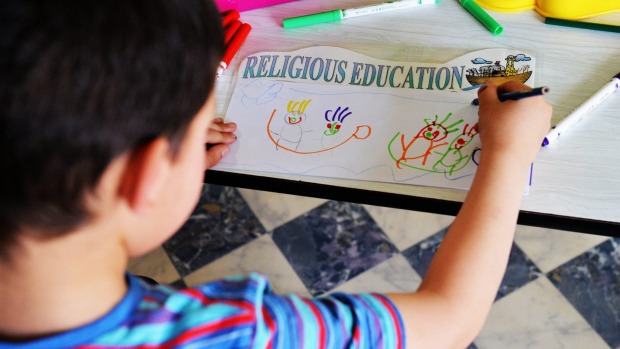
Introduction of ‘General Religious Studies’ in Victorian Schools

When I first became a parent someone gave Susan and me this wise advice, ‘whenever you offer a criticism or correction to your children, make sure you also give them 10 encouragements.’  I’m pretty sure we haven’t made it to 10 every time, but we try.

logo_vic

The logo presence does not represent a Govt endorsement of this article

When it comes to the education of children in Victoria, I could easily mention 100 things that are fantastic about our schools and teachers. As a parent with 3 children in school, I am very thankful for the education they are receiving, and for the care and expertise of their teachers.

Having said that, I do not support everything that is being implemented by the Education Department, especially  issues relating to directives from the Education Minister, Mr James Merlino.  In 2015 the current Victorian Government made several drastic and unnecessary changes to our education system in regard to SRI (and other related issues); these have been discussed at length on other occasions. In 2016 the changes will continue, and it is important for parents to be made aware.

Our State Government is introducing material on General Religious Studies (prep-year 10). This is one of two curriculums* that is replacing SRI (which can now only take place outside of normal class hours, along with an extensive list of new measures). The other program is Building Respectful Relationships.

In this post I wish to raise 4 concerns regarding the General Religious Studies.

First, the freedom to choose religious education has been taken away from students and parents. Whereas families once had choice and could opt-in for religious classes (whether it be Christian, Jewish, Muslim or Buddhist classes), they are no longer given the option.

The material has been made available for this year, but due to certain issues (relating to training, I believe) the course will become compulsory in both State and Catholic schools from January 2017.

Second, can the Education Department guarantee that the General Religious Studies material will be accurate and taught impartially?

Learning about other religions is important and useful, and at home we ensure our children can learn about what different people believe. 

About teaching religion in schools, there is a significant ideological issue at stake, is it the role of Government to teach religion? Apart from that, my concern is, will educators ensure that each religion is explained and taught with fairness and veracity?

Neutral education is a fairy tale, and this is clearly demonstrated by the Department’s own summaries of the 5 major religions. I am not an expert in Hinduism, Islam or Judaism, although I can (in my view) find fault in these representations, but as a Christian with an honours degree in theology I am in some way, able to speak to the published presentation of Christianity

According to the Education Department these are the ‘key premises’ of Christianity:

“There is one God, consisting of the Father, the Son (Jesus Christ) and the Holy Spirit. God is the creator and sustainer of the universe. God became human in the person of Jesus, the Son.

People have one life and its purpose is to live in a loving relationship with God, with others and with the world. The life and teachings of Jesus show how this is done and make possible the life-giving changes needed in individuals and society. Christians are empowered by the Holy Spirit and are called to demonstrate God’s love, compassion and justice in all their relationships and interactions. Most Christians believe in an afterlife; that after their physical death, they will live forever with God.

The Bible is the sacred text for Christians. The Bible has two parts, known as the Old and New Testaments. The Old Testament contains Jewish books and teachings, before the time of Jesus. The New Testament records the teachings of Jesus as well as the history and teaching of the early

Church which is based on the teaching and example of Jesus.”

There are certainly statements here that align with Christianity, but others are blatantly wrong, and some of the most central tenets are altogether missing.

Here is one example of a basic error, ‘Most Christians believe in an afterlife; that after their physical death, they will live forever with God”. No, all Christians believe in an afterlife, and this life beyond death will be physical.

Notice how there is no mention of sin, Jesus’ death on the cross and his resurrection, and of salvation on account of God’s grace. There is no mention of hell. Without these things there is no Christianity. It is not enough to make the excuse, we can’t say everything in a few paragraphs, the core of Christianity has been ripped out and in so doing it is presenting a Christianity that is inauthentic and inaccurate.

To quote the Bible, Christianity is about ‘Christ and him crucified’.

My point is this, if the Education Department is unable to fairly and accurately summarise the Christian faith, how can we trust what they want taught about any and all religion?

One of the stated aims is that it ‘should include…opportunities for critical thinking.’ That’s a fine intention, but if my children are to be taught any religious studies, I want them learning the facts, not an erroneous and sloppy version that looks more like a fake painted by a liberal secular humanist on a bad hair day.

Thirdly, one of the concerns aimed at SRI was that instructors were not only explaining what their religion believes but were encouraging students to practise and participate, in a variety of ways.

The Facts Sheet given to school Principals by the Victorian Education Department (November 2015) makes it clear that as part of General Religious Studies, teachers may organise for students to celebrate festivals belonging to the different religions. They cite examples including dressing up for Diwali (a Hindu festival celebrating their understanding of spiritual victory), making Christmas decorations, and sharing sweets for Eid (a Muslim festival).

In other words, not only is this new religious content compulsory and fails at a basic academic level, it is encouraging students (regardless of their own religious convictions) to participate in activities of other religions. I have no doubt that this will be deeply troubling for many thousands of Victorian parents, from different religions.

Fourthly, class room teachers will be required to teach the material, although under very strict guidelines a visitor may be invited to teach certain aspects.

I have a very high regard for the teachers at my children’s school, but I suspect that very few if any have qualifications in theology or philosophy. I imagine it is difficult enough for them to teach the many different subjects they are already putting together each year, let alone teaching theology, something which would normally require a four year university degree!

I understand that teachers will be presenting overviews, not deep theological treatises. However, even a simple grasp of the 5 major religions requires significant learning, and what of students when they ask teachers questions about these religions? Will they be equipped to answer? I certainly hope they won’t be relying on the current information that the Department are providing, given its flawed representations

I have been informed by the education department that the content must be taught (from 2017), but it will be up to each individual school as to how it will be taught.

What can parents do?

Speak to your school principal (and council) and graciously explain your concerns to them.

Write to your local member of Parliament, and kindly and succinctly express your concerns.

———————–

Technically, the General Religious Studies is not a curriculum, but content which can be fitted into various areas of learning at school, for example it may appear under ‘Civics and Citizenship’ or ‘Ethical Capability’

The non-controversial controversial program in our pre-schools

In August this year the Daniel Andrews Government banned SRI classes from Victorian Schools. Despite the fact that this has been a valued program for many decades, and that many schools are still keen to give space for this 1/2 hour weekly lesson, the Government caved into pressure from various lobby groups. Replacing this opt-in program will be a compulsory ethics/well-being/religious curriculum. Whilst announcing that this program will run from the start 2016,  the Government is yet to provide any details of its content and who will teach it. Indeed, schools remain in the dark as to what is happening.

Today, The Age has reported that ACCESS Ministries are now offering a program in Victorian pre-schools, called Explore Christianity.

FIRIS have notified their supporters on facebook, saying

“SPECIAL RELIGIOUS INSTRUCTION – COMING TO A KINDERGARTEN AND CHILDCARE CENTRE NEAR YOU!

ACCESS have now discovered a new mission field – they have transferred their proselytizing to a softer market.

They are like the Gecko, who loses its tail, only to grow another one back again. They have reinvented themselves and found another way to get to the children.

FIRIS has known about this for some time, and the VIC government was first notified about this from us back in May.

It appears that now very young children will be segregated by religion and parents who object to their children being indoctrinated while at child care will need to accept this segregation as the norm, or find another centre.

The government has been taken offguard by ACCESS’ metamorphosis and will have to either choose to deal with it – or look the other way.

The obvious concerns are:

* Proselytising

* Treats offered as an incentive to children

* Religious segregation of very young children

* The opt out nature of the program

  • Adequate informed consent being provided to parents”

I agree that any program must have transparency, and provide adequate information for parents, and it should have  either an opt-in or opt-out clause. These things are sensible and appear to be in place already.

But even if all of these  ‘concerns’ were fully met, history gives reason to suspect that FIRIS will keep pressing for this program to be shut down.

Given that, let’s look at these important facts that The Age reported today:

  1. Parents asked the Emmanuel Early Learning Centre to introduce this program and the Centre management agreed.
  2. The overwhelming majority of families are participating. After receiving consent forms, only 3 families chose to opt-out their children.
  3. The program teaches, “Christian values and beliefs, in addition to stories from the Bible.” In other words, it is teaching they very things that a program about Christianity should teach.
  4. Volunteers who run the program are accredited by ACCESS Ministries, in accord with strict requirements that have been set by the Education Department for SRI teachers in schools.

Pre-empting any call to close down the program, Minister for Families and Children Jenny Mikakos said to the The Age that, early childhood services operated independently, and any “decision on offering religious education as part of a service provider’s program is a decision for each individual provider and parents of children attending the service”.

It will be interesting to see what and if any pressure that the Government will try to apply to these early childhood centres. As it stands, they are providing a program within the law, based on parental interest and request, and with substantial by-in from both the Centre and its families.

Where is the controversy?

—————-

Photo from The Age (Nov 10): Joe Armao

New evidence suggests that the closure of SRI was a mistake

It appears as though Daniel Andrews and the Victorian Government have unnecessarily pulled the plug on Religious Instruction in schools (SRI).

In August this year Education Minister, James Merlino, announced that religious instruction classes would be removed from Victorian schools from 2016. It should be mentioned that religious groups may be permitted outside class time, however the parameters for running these lunch-time groups remains unclear and uncertain.

apple

Why am I suggesting that the Government has made a mistake? In the last 24 hours the ABC has published two articles that warrant a re-examination of SRI’s closure.

First of all, it has been demonstrated that the policy shift derives from a faulty understanding of secularism (see Michael Bird’s piece on ABC Religion and Ethics). Dr Bird refers to the ‘New Atheists’ who have redefined secularism, “no longer as the freedom of the individual in religion, but as the scrubbing of religion from all public spheres.” It is this fallacious thinking that has been pushed by groups such as FIRIS, and would seem has also been adopted by the Andrews’ Government.

One of the adverse effects of this view of secularism is that we are creating a new wave of sectarianism, where thousands of families are now faced with the dilemma of either keeping their children in a State school environment where religious toleration is dissipating, or moving their children to independent schools. Far from creating more inclusive schools, we are in danger of returning to the ugly days of sectarian divides, except this time it is not Protestant/Catholic, but religious/non-religious.

As a parent who has three children attending a State school, I value the education they receive; the teachers are excellent and the pastoral care is first rate. It is worrying though, that faulty Government policy may unnecessarily drive a wedge in many school communities, where none has existed previously.

Secondly, Michael Jensen has written a piece overviewing findings from recent academic studies, that demonstrate the positive benefits of our children learning about God and engaging with ideas found in religion.

He says,

“Here’s the bottom line. There’s been a lot of alarmist stuff written recently about the potential detrimental effects of religious teaching on young people. What the hard data says is otherwise: an active religious faith is much to be desired in young people, and the benefits of such a faith persist into old age.”

Dr John Dickson has also helpfully summarised the findings  from one set of research that has been published in The Oxford Handbook of Religion and Health (Oxford University Press, 2012):

* ‘Well-being’: 78% of over 300 studies report a significant positive relationship between religion/spirituality and well-being.

* ‘Hope’: 73% of 40 studies find that religion/spirituality is related to greater hope.

* ‘Optimism’: 81% of 32 studies indicate that optimism is more common among those who are religious/spiritual.

* ‘Meaning and purpose’: 93% of 45 studies find that religion/spirituality is related to greater purpose and meaning.

* ‘Social support’: 82% of 74 studies report significant links between religion/spirituality and a person’s social support.

* ‘Self-esteem’: 61% of 69 studies report a positive link between religion/spirituality and self-esteem.

* ‘Depression’: 61% of 413 studies found lower rates of depression or faster recovery from depression in individuals who are more religious.

* ‘Suicide’: 75% of 141 studies found that greater religiosity/spirituality is associated with less suicidal ideation, fewer suicidal attempts, or fewer completed suicides.

* ‘Social capital’ (i.e., an individual’s community participation, volunteerism, social trust, involvement in civic life): 79% of 14 studies report significantly positive associations between religious involvement and social capital.

While I would add certain caveats and qualifications about these findings, they nonetheless communicate that there are significantly positive social and mental benefits that derive from belief in God.

It is interesting to note that the Victorian Department of Education understand that ‘Health and wellbeing are essential for quality of life and are fundamental preconditions for learning and development’. One of the identified aspects of wellbeing is what they refer to as ‘spiritual wellbeing’. And yet the Government is truncating this very principle by taking away from students the freedom and opportunity to engage with these very things.

Dr Bird and Dr Jensen are not saying anything new, but they offer timely refutations to the popular memes about religion, children and education. Given the weight of their arguments, I believe it is reasonable for Mr Merlino and Mr Andrews to reconsider their decision about SRI in 2016.