Since when has Christianity been so concerned about religious freedom?

Fairfax Contributor, Matt Holden, has asked the question,

“since when has Christianity been so concerned about religious freedom?”

With a skilful display of not letting truth get in the way, he has answered,

“Not ever, really, is the short answer.”

The question is not, have forms of Christianity ever led to the diminishment of peoples’ religious freedoms, for history gives us such examples. However, history give many more examples where Christianity provides the philosophic undergirding for a genuine pluralist society. Holden cites the campaign against the Bendigo Mosque in 2016, asking, where were the Christians then? The truth is, there were Christians in Bendigo doing the very thing Holden alleges did not happen. Perhaps he should be asking, why did the media not report it? More recently, when Waverley Council in Sydney refused the building of a Synagogue in Bondi, Christian groups were vocal in calling for the Council to change their position.


OLYMPUS DIGITAL CAMERA

In a recent article for the Gospel Coalition, Dr Russell Moore (President of Ethics & Religious Liberty Commission of the Southern Baptist Convention), wrote,

“when we say—as Baptists and many other Christians always have—that freedom of religion applies to all people, Christian or not, we are not suggesting that there are many paths to God, or that truth claims are relative. We are fighting for the opposite. We are saying religion should be free from state control because we believe every person must give an account before the Judgment Seat of Christ.”

Have Christians always done this well? No, but more often they have, and the reality is, the social pluralism we enjoy in this country relies upon a Christian worldview. It is not irreligion that brought religious pluralism to our shores, but the Christian view that we ought to love our neighbours, and that authentic belief in God comes about through persuasion not coercion. This is another unfortunate mistake made by Holden. It seems as though he has swallowed the now popular myth that Christians are forcing their views onto society and that evangelism amounts to bullying. The reality is very different. By definition, Christianity is a conversion religion. No one is born Christian, but people become convinced by the claims of Jesus Christ; that he is true and good. Christianity is a persuasion religion, speaking and articulating and convincing others of what the Bible says.

Holden gives himself away when he insists, “‘the best guarantee of religious freedom is keeping religion out of politics”. In other words,  he doesn’t want religious Australians having the freedom to present their point of view. As it is, we enjoy one of the safest and most stable society’s in the world, where people of faith and none are free to express their beliefs, and to persuade others of their opinion. Holden says, those days must end.

He adds,

“This sudden defence of religious freedom by churches and religious lobby groups just doesn’t wash.”

I’m not sure how Holden would define ‘sudden’, but 116 years ago, in 1901, the framers of the Australian constitution used Judeo-Christian principles to establish a secular nation. By secular they did not mean banning religious thought from politics and public discourse. true secularism means the freedom to speak regardless of ones religious affiliation, or lack thereof. Indeed, this understanding of religious freedom can be traced back to the Bible and to the teaching of Jesus Christ.

The issue is, certain elements of the community don’t like what Christian have to say on about marriage and other social issues, but instead of engaging reasonably with argument, folk like Matt Holden are aiming to shut down those who disagree. Whether he is aware or not, Holden is not proposing secularism, but State imposed atheism; it is anti-pluralism. If the only permitted discourse must void of language deferring to God and religion, then what we have is exclusive and intolerant atheism.

We know how anti-religious world views have had a shot at taking charge of nations, and they have produced for the world Stalin, Mao Zedong, Pol Pot, and North Korea. I’m fairly sure that this is not the kind of country most Australians are wanting to become.

Last year the Victorian Government attempted to pass legislation that would have taken freedom from religious organisations in hiring staff. It was, as Dr Michael Bird explained at the time, an example of Secularized Erastianism, a philosophy which asserts that the State shapes and controls religious belief and practice. Is this the direction Australia wants to head?

Finally, despite various politicians and social commentators insisting that same-sex marriage has nothing to do with freedom of religion, they are dedicating an awful lots of words to argue how opponents of same-sex marriage are all haters and need to be silenced. Two weeks ago another Fairfax Columnist, Aubrey Perry, argued that the debate on marriage has everything to do with religion, by which she meant, let’s use marriage as a weapon to remove religion from public life altogether.

Pluralism in Australian will only continue so long as those in authority allow alternative views to be expressed publicly, without fear of litigation or threats of violence. To the surprise of many, the global movement in the early 21st Century is not away from religion to irreligion or from faith to reason, but away from philosophical pluralism to both religious and secular authoritarianism.  We are a long way from where things could lead, but we are no longer standing from the sideline and pontificating the possibilities. As Sherlock Holmes would say, ‘the game is afoot’. This should concern all Australians, not because pluralism is god, and not because we are moral and spiritual relativists, but because we believe a healthy society requires its citizens to argue and persuade, and to allow others to make up their minds.


In accordance with s 6(5) of the Marriage Law Survey (Additional Safeguards) Act 2017, this communication was authorised by Murray Campbell , of Melbourne, Victoria.

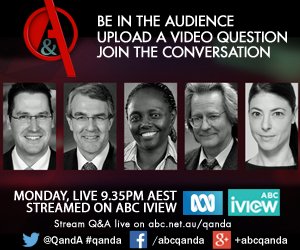
Meaningless Marriage on QandA

If you watched QandA last night, you may be left wondering why is Australia  having a discussion about marriage at all? It’s not because reason shows us that marriage should remain between a man and a woman, and it’s not because of impassioned stories from gay couples, but because we were told by two QandA panelists that we ought to get rid of marriage altogether.

DJZ6iwZVYAARmAS


English philosopher, AC Grayling, claimed that the origins of marriage were sexist, but now “there’s another sense of the word marriage which is the commitment that two or perhaps more — I don’t know — people make to one another about pooling their resources, mutually supporting one another.”

He added that he doesn’t support the institution of marriage (despite the fact that he is married), although he does support same-sex marriage.

Merav Michaeli is a former journalist and currently serves as a member of Israel’s Parliament. Like Grayling, Michaeli has a very negative view of marriage and thinks society expunge marriage altogether.

“This is not something that we should maintain in the world when we realise all of us are human beings.”

Why?

“Marriage has nothing to do with love but is a tool created to dominate women, and not somethin that should be sustained”.

“In many countries … your parents make you marry someone because of their social status, because of the family they come from, because they want to keep the property in a specific family or another family.”

Any audience member wearing their ‘love is love’ t-shirt last night, must have felt a little awkward…or enraged. Don’t worry, Michaeli was about to insult almost everyone on the planet. Not only is marriage not about love, it is an indictment on society for it is, according to Michaeli and Grayling, a system of oppression. Merav Michaeli went even further and alleged that marriage is a danger to children,

“The core family is the least safe place for children”.

“The custody, this total custody that we have in this structure of marriage which still gives men domination, complete domination over their children and too often over their women … is a part of the ongoing hurt in children.”

When host Virginia Trioli asked Ms Michaeli what is her alternative to marriage and the nuclear family, the answer was, the State should take responsibility for determining who will raise children. In other words, it should not be assumed that biological parents will raise their own children. In fact parents should not have inherent  rights to raise their children, but the State should be given authority to allocate children to what Michaeli calls, ‘share households’.

If your jaw dropped last night, I understand why. Pause for a moment and hear what Michaeli is suggesting; parents should not have the right to raise their own children. I’m guessing that Australians are sensible enough to know how absurd and immoral that idea is. It’s crazy. It’s George Orwell revisited. While we may not be in 1984, we do however need to appreciate that should marriage be redefined, the State will encourage children to be raised without one or both biological parents. Same sex marriage, even more than existing adoption laws, will institutionalise the raising of children without both biological parents. Not for a second am I suggesting that the State will be knocking on doors and taking children away without parental consent, but it does encourage a culture where children can and should be raised without mum or dad.

I have no doubt that there are Australians who have had a terrible experience in marriage. I know couples today whose marriages are not the beautiful and safe relationship that they imagined it would be. There are however many more examples where marriage does not reflect, in any way, the negative and abusive regime model that Michaeli describes. And where marriages have failed and are broken, most couples celebrate this situation, they wish that their experience was one where marriage was full of love and security and flourishing.

it is also important to note that, Michaeli and Grayling were not describing marriage as it was in the beginning, or the countless wonderful ways in which marriage has been expressed throughout history in different cultures. Instead, their arguments depend on taking poor historical examples of marriage, and fallaciously presenting them as normative.

The very first marriage is described in terms of goodness and intimacy and faithfulness,

“for Adam no suitable helper was found. 21 So the Lord God caused the man to fall into a deep sleep; and while he was sleeping, he took one of the man’s ribs  and then closed up the place with flesh. 22 Then the Lord God made a woman from the rib he had taken out of the man, and he brought her to the man.

23 The man said,

“This is now bone of my bones

    and flesh of my flesh;

she shall be called ‘woman,’

    for she was taken out of man.”

24 That is why a man leaves his father and mother and is united to his wife, and they become one flesh.

25 Adam and his wife were both naked, and they felt no shame.”

The Apostle Paul in Ephesians chapter 5 speaks of marriage with tenderness and other person centredness: a husband should lay down his life for his wife. A wife can choose to respect her husband, and help him be the kind of man he ought to be.

While both AC Grayling and Merav Michaeli said marriage was bad, both they, and Shadow Attorney General, Mark Dreyfus, presented the concept of marriage as relative and so not fixed in any ontological or purposeful way. Despite this, every historical example of marriage that was inferred in last night’s program, depended on the fact that marriage is between a man and a woman. Why is that? Could it be that no matter the extent to which a society tries to recalibrate marriage, in less than helpful ways, some things remained unchangeable?

The program also revealed that debates over marriage are much more complex than often presented. Among those who support classical marriage, are arguments grounded in biology, ontology, sociological reasons for raising children, and at times theology. Common among those advocating for marriage change is the view that marriage is a malleable and ultimately groundless institution that should reflect what people want it to mean. The logical extension of this view is exactly what we find Merav Michaeli advocating: let’s get rid of marriage altogether.

The lesson from history is not that marriage is wrong or that marriage is relative, but that we grieve when marriage goes awry.  When society adopts the less than ideal of marriage, surely the answer is not to further walk away from the ideal, but to return to it?

Listening to last night’s conversation on QandA once again reminded me that the first question Australian should be asking, what is marriage? Is marriage love is love, or something more? Is marriage a meaningless term that everyone has the right to use however they choose? Is marriage about property rights?


Yes, SSM is about more than just marriage

Australians have been told again and again that the marriage debate is only about love and equality for marriage. Fairfax columnist, Aubrey Perry, has today argued that “it’s about much more”. Perry admits that changing the Marriage Act is about removing all influence of Judeo-Christianity in Australian political and public life:

“This survey offers us a conscious opportunity to make a firm stand in support of a secular government and to reject discrimination or favouritism based on religion. It’s our opportunity to say that religion has no part in the shaping of our laws. A vote against same-sex marriage is a vote for religious bias and discrimination in our legislation, our public schools, our healthcare, and ultimately, in the foundation of our social structure.”


OLYMPUS DIGITAL CAMERA


Inadvertently, Aubrey Perry has just torn a sizeable hole in the ‘yes’ campaign for same-sex. Readers who share her fears about Christianity will no doubt be elated, but other Australians are left wondering, so this whole debate is really about religion? And it is about education, politics, and even abortion? As though mediating Roz Ward, who has insisted that she authored the Safe Schools curriculum to program children toward socialism, Perry presents marriage as the front line fight against Christianity in this country.

Unfortunately though, Perry’s presentation of Christianity often looks more like a cartoon than it does authentic Christianity, and in doing so she makes a series of factual errors.

For example, contra Perry, Christianity cannot be defined as right wing politics. There are many Christians who feel comfortable across the political spectrum. Is Perry whitewashing the Christian convictions of members of the Australian Labor Party? Christian theism is neither defined by left or right politics but by the Gospel of Jesus Christ. This good news from God cannot be squeezed into the small and narrow reaches of any political party, for it counters all such human categories and gives us a greater and more stunning alternative.

Also, in a fantastic revision of history, Perry alleges that, “Religious intolerance has kept the possibility of same-sex marriage an impossibility for decades”. Well, no. Until recent years no one, anywhere, in the world would have believed marriage was anything other than between a man and a woman. It didn’t matter whether one believed in God or not, same sex marriage was a non starter. It remains the case today, that many religious and non religious people simply don’t believe that same sex marriage is logical or good for society.

Finally, it needs pointing out that true secularism is not the absence of religious thought, but the freedom to speak regardless of ones religious affiliation, or lack thereof. Perry’s argument for a secular state is not true secularism, it’s imposed atheism. It is anti-pluralism. If the only permitted discourse is void of language deferring to God and religion, then what we will have is exclusive and intolerant atheism.

Anti-religious world views have had a shot at taking charge of nations, and they have produced for the world Stalin, Mao Zedong, Pol Pot,  and North Korea. I’m fairly sure that this is not the kind of country most Australians are wanting to become.

The reality is, it is a Judeo-Christian framework that enshrined into law how no single religion would control public policy, but instead the people should persuade and argue their case. Is this so bad? According to Aubrey Perry it is worse than bad, and we must use the marriage survey as a demonstration that we will no longer tolerate religious views in the public square.

Perry has done Australians a great service though, in being honest enough to show Australians that same sex marriage is not really about marriage, but is about removing the religious and social foundations that have given this country the freedoms, prosperity, and security that we today enjoy. I hope Australians will read her article and consider their decision in light of these confessions.

Father’s Day is telling

“For I too was a son to my father,

    still tender, and cherished by my mother.” (Proverbs 4:3)


For many families tomorrow is a special day. It’s a wonderful opportunity for family to get together, to enjoy pointless $2 gifts from school Father’s Day stalls, and to eat more cake.

I’m not a big Father’s Day enthusiast, not because there’s anything wrong with it, but it’s not me. I love my Dad, and I adore my 3 children, but I’ve never felt as though I needed a special day to remind me of Fatherhood.

During the week, Channel 9’s breakfast show, Today, ran a poll asking the question,

“Should Father’s Day be renamed “Special Person’s Day?” 

Why? Because, according to University of Sydney academic,  Miriam Giugni, such celebrations need to be more inclusive. Father’s Day excludes, well, non Dads, and in today’s society that’s unacceptable. Wait for May next year and see how that idea flies for Mother’s Day!

It is all very ridiculous, except that ridiculous has become the new standard for public morality. It’s as though we went to bed last night and have woken up on the set of Inception. We are living in one of the craziest generations: boys and girls should no longer be called boys and girls, marriage isn’t what all the world has always thought it was, the Victorian Government tried to allow its citizens to change the gender on their birth certificate (once every year), and Father’s Day should become Special Persons day.


OLYMPUS DIGITAL CAMERA

Leaving aside the question of Father’s Day, there is something natural, good, and wholesome about Fathering, as there is with the irreplaceable role of Mums. We can’t always pinpoint why, but mums and dads compliment each other, and together they form a dynamic duo for the raising of children.

Every child has a mother and a father; it is of course a biological impossibility for there to be children without them. We know that in some families children are raised without one or both parents, and others grow up in homes where a parent is abusive. I have friends who have been in these situations, and none believe that having a loving Father and Mother is undesirable and unnecessary. Not for a moment I am suggesting that other families are lesser; I know too many single parents doing a wonderful job at raising their children, and there are adults excelling in life despite growing up in an unloving and even abusive home. Very few people would however argue that those situations were ideal.

In Sara McLanahan and Isabel Sawhill’s recent essay, “Marriage and Child Wellbeing Revisited:Introducing the Issue”, they explain,

“Whereas most scholars now agree that children raised by two biological parents in a stable marriage do better than children in other family forms across a wide range of outcomes, there is less consensus about why.” [1]

New research also shows how Father loss impacts the wellbeing of children, even their physical health. [2]

Father’s Day reminds us that Dad’s play an integral role in their children’s lives. It may take a village to raise a child, but the village can’t replace mum and dad. In those situations where children can’t be raised by their mother and father, we grieve them not celebrate them.

Millie Fontana is an Melbourne woman who was raised by 2 lesbian parents. She loves her 2 mums, and even supports same-sex marriage, however she is deeply concerned by the practice of raising children without both biological parents. She said in an interview on Triple J,

“I’m an atheist. But our story needs to be told. It’s natural to want a mum and a dad. But when we speak, we are told we are homophobes and Christians’.

“It was very hard for me to establish a stable identity,” Millie said. “It was negatively impacting my development.”

‘There was always something missing.”

I realise that some people are claiming that this marriage debate has nothing to do with children. Penny Wong, on the other hand, gave an impassioned speech in Parliament recently about her children while advocating SSM. The reality is, while marriage is about more than just having children, marriage provides the natural and ideal context for raising children.

However, should the Marriage Act change by removing the language of man and woman, Australian society will require an  increasing number of children to grow up without their father, or in the case of a gay marriage, without their mother. There is a world of difference between instituting marriages where children have no chance to be raised by both biological parents, and a society that lovingly practices retrieval ethics when children sadly cannot be at home with both mum and dad.

The question is quite simple, should children ideally be raised by their mother and father? And if so, should the State sanction marriages that will prevent this from happening?

On Friday, ABC television host, Charlie Pickering sent out this tweet in response to an Sky News interview with Liberal MP, Andrew Hastie,

“What an incredible load of bullsh!t. If ideas like that make it through, you have to recalibrate your bullsh!t filter.”

What did Andrew Hastie say that was so awful?

“If we expand marriage, we also redefine it and we render it genderless.”

No matter what side of the marriage debate one takes, Andrew Hastie’s statement is true. It is the logical outcome of removing gender requirements from the Marriage Act. If marriage is no longer between a man and a woman, then it is a genderless institution. Which of course then raises the question, what then is marriage? Instead of engaging Hastie with any semblance of argument or intelligent rebuttal, Pickering chose to join those who belong to the team called slander.

I’m not suggesting that there are not individuals on the ‘no’ side, who haven’t said awful things. There have been, and we should call those offences for what they are.

To the detriment of this country, reasoned discourse is being for the most part, shouted down by a flood of vitriol and threats. If we can cool our heads for a few moments, and consider this,

We know that kids deserve a mum and dad, and we want society to continue to reflect this common good. Given that, should we redefine marriage?


===========

[1] Sara McLanahan is the editor-in-chief of the Future of Children, as well as the director of the Center for Research on Child Wellbeing and the William S. Tod Professor of Sociology and Public Affairs at Princeton University. Isabel Sawhill is a senior editor of the Future of Children, as well as a senior fellow at the Brookings Institution.

[2] “Father Loss and Child Telomere Length”, Pediatrics (Aug 2017), vol.140/2, by Colter Mitchell, Sara McLanahan, Lisa Schneper, Irv Garfinkel, Jeanne Brooks-Gunn, Daniel Notterman.

Baptists, Bible, and Marriage

In the midst of all the public conversations surrounding same sex marriage, are some issues of greater importance than how the State defines marriage; among them is the Gospel fidelity of Churches and of their ministers.

Simon Carey Holt is the Senior Minister at Collins St Baptist Church in Melbourne. He has written a piece in support of same-sex marriage. This is not anything new as Simon has made his opinions known for some time, but his latest advocacy has reached the attention of The Age newspaper.

Simon has made a series of strong assertions about why Christians should support same sex marriage, and allegations about how Christians relate to LBGTI people. Throughout the afternoon pastors, journalists, and friends have been asking me about it.  While not  intending to respond to everything he’s written, some sort of response is warranted.

1. The Bible or human experience as supreme authority

Simon admits that a key factor for shaping his view of marriage is experience; the personal stories of people whom he has encountered. In contrast to the historic understanding of marriage he says, “my experience says otherwise.”

To be fair, Simon does believe that the Bible is important for Christians, but as he admits, his experiences are what most influence his position on marriage.

Of course experience is powerful, personal, and emotive. Experience informs us of peoples fears and concerns, their values and dreams. But experience is not synonymous with what is true or best. Just because I may feel something deeply and personally does not automatically prove it to be right or good.

It is also true that everyone comes to the Bible with a mixture of personal history, experiences, ideologies, presuppositions and traditions. And those things colour our reading of the Bible, but this does not mean that experience should be read over the Bible, as Simon Carey Holt implies.

This approach to Scripture is fraught with danger. If experience is allowed to speak over Scripture then whose experiences do we listen to? Which ones are authoritative? Our different experiences need to be interpreted by Scripture, not the other way around. Not only that, the Bible’s self-testimony is that life needs to be interpreted in light of Scripture. Here are some examples:

‘Your word is a lamp to my feet and a light for my path’ (Ps 119:105). It is God’s word that directs our lives, not the other way around.

‘Preach the Word; be prepared in season and out of season; correct, rebuke and encourage—with great patience and careful instruction’ (2 Tim 4:2). The word of God preached has a threefold effect on the hearers: correction, rebuke and encouragement. God’s word stands over the Church and influences believers’ lives.

While we appreciate the logic of non Christians refusing the authority of the Bible, the consistent approach of Christians is that the word of God has authority over us. Genuine repentance and faith involves submitting to this Word and letting it interpret us and change us. To put experience over the word, or tradition over the word or human intellect over the word, is to put ourselves God and that is to make ourselves god.

At one point in his article, Simon appeals to the Bible,

“In his letter to the church in Rome, Saint Paul speaks of sexual failings as far more impacting than all others. “Don’t be immoral in matters of sex,” he writes, “that is a sin against your own body in a way that no other sin is.”

First of all, these words are not from Romans, but from the Apostle Paul’s First letter to the Corinthians (6:18).

Second, the Greek word for ‘sexual immorality’ (porneia), is used in the Bible to refer to any sexual activity outside marriage between a man and a woman.

Third, the very same chapter of the Bible earlier describes a range of porneia which all keep people outside the Kingdom of God, and homosexual practices are among them (v.9).

Fourth, if Simon does in fact wish to appeal to Romans, what he will find is another volume of Apostolic teaching that doesn’t support his ideas.

Simon is spot on about one salient point though, and that is, his views are at odds with his own denomination: “The Baptist Union of Victoria defines marriage as being the union between a man and a woman to the exclusion of all others, voluntarily entered into for life.”

ExperienceScripture.jpg

2. The Gospel of love

Simon also wants his readers to be suspicious of Christians who love LGBTI people. He suggests that such Christians are in fact disingenuous, unless they also support same sex marriage.

He states,

“In much church commentary of recent days, church leaders are at pains to underline their love and respect for LGBTI people, claiming that their aversion to same-sex marriage does not equate with their denial of the integrity of same-sex persons or the worth of their families. The availability of civil unions, they will say, is an expression of this; never have the rights of the LGBTI community been more protected, they argue, and rightly so, but marriage is surely a step too far…despite the current tenor of conversation, the underlying belief has not changed: homosexuality is a dysfunction of personhood. Indeed, the entire argument against same-sex marriage rests on it. To claim otherwise is not only misleading; it is dishonest.”

Sadly it is true that there are religious people who say and do dreadful things to LGBTI people; homophobic behaviour is unChristian. But Simon’s logic is simply untrue. He leans awkwardly toward that polarising rhetoric which so many politicians have adopted – if you don’t support same-sex marriage you are unloving, if not a bigot. Simon is too polite to use some of these words, but that is his meaning.

The reality is of course very different. It is possible to love a person even though you disagree with them. It is quite possible to not affirm a friend’s relationship and yet genuinely desire their good. Can disagreement never be a loving act? Is it never possible to so love a person that you sat to them, “no, I don’t think this is best”?

Love that only ever agrees is a shallow love indeed. A virtue of love through disagreement not only belongs close to the heart of Australian democracy, but comes to close to the centre of the Christian message:

“You see, at just the right time, when we were still powerless, Christ died for the ungodly. Very rarely will anyone die for a righteous person, though for a good person someone might possibly dare to die. But God demonstrates his own love for us in this: While we were still sinners, Christ died for us.” (Romans 5:6-8).

The Gospel isn’t God saying, ‘I agree with you’, but  it is God declaring that he disagrees with us and yet loves. The Bible speaks of a God who acted beyond helping his friends. His Son gave his life for people who are disinterested in him and who don’t approve of him. God didn’t wait to win a popularity vote before acting to redeem and reconcile, but he took the initiative and in doing so God refused the path of blind relativism. God loves too much to agree with every desire and ambition we ignite.

Equally concerning is the way Simon frames his argument around his ‘Gospel formation’. I don’t know Simon well enough to speak to this in any general sense, but on the issue of sex and marriage, the Bible’s position is clear:

The Apostle Paul again,

“We also know that the law is made not for the righteous but for lawbreakers and rebels, the ungodly and sinful, the unholy and irreligious, for those who kill their fathers or mothers, for murderers, for the sexually immoral, for those practicing homosexuality, for slave traders and liars and perjurers—and for whatever else is contrary to the sound doctrine that conforms to the gospel concerning the glory of the blessed God, which he entrusted to me.” (1 Timothy 9-11)

Over the years I have read all the spectacular hermeneutical gymnastics that tell us how this text means anything and everything other than what it actually says, as though a simple reading of the Bible is the only wrong answer. Perhaps, just perhaps, Paul intends what he says, that the activities listed in verses 9-10 are contrary to the sound doctrine which conforms to the gospel.

While Simon’s argument for marriage contradicts the Gospel, the Gospel of Jesus is for those who have supported views of sexuality and life that are at odds with God. This point is crucial to grasp, for Christians and non Christians alike, because it ought to change our posture toward our neighbours, whoever they may be.

There is scene in The West Wing where the President’s Deputy Chief of Staff, Joshua Lyman, had been receiving counselling for PTSD, following a shooting in which he was one of the victims. Joshua’s colleagues had grown increasingly concerned for his well being as they observed his even more than usual brittle nature and explosions of anger. Following this counselling, Joshua steps into the hallway of the Whitehouse and notices his boss, Presidential Chief-of-Staff,  Leo McGarry, sitting nearby.

Leo asks, ‘How’d it go?’

Josh Lyman: Did you wait around for me?

Leo proceeds to tell Josh a parable,

“This guy’s walking down the street when he falls in a hole. The walls are so steep he can’t get out.

“A doctor passes by and the guy shouts up, ‘Hey you. Can you help me out?’ The doctor writes a prescription, throws it down in the hole and moves on.

“Then a priest comes along and the guy shouts up, ‘Father, I’m down in this hole can you help me out?’ The priest writes out a prayer, throws it down in the hole and moves on

“Then a friend walks by, ‘Hey, Joe, it’s me can you help me out?’ And the friend jumps in the hole. Our guy says, ‘Are you stupid? Now we’re both down here.’ The friend says, ‘Yeah, but I’ve been down here before and I know the way out.'”

Christians must not be and cannot be those who see someone down a hole and walk on by, or who throw a stone or hurl insults. If we have been justified in the sight of God it is solely on account of God’s grace and love. Having known this wonderful justifying grace, how can we look down on people around us? We can’t walk away, instead we climb down and sit with whoever it is down there, and we point them not to ourselves, but to Jesus.

3. A greater and more fulfilling identity.

A third issue with Simon’s presentation is that he has bought into a popular view of sexuality, one that alleges, “There is nothing that goes to the heart of human identity as much as our sexuality.”

This is of course not the case. I am not diminishing the role of sexuality in a person’s life, but the Gospel pushes back on the idolising of human sexuality, which leaves many single people feeling as though they are lacking, and it leaves many same sex attracted men and women sensing that celibacy is a barrier to true self realisation.

Sam Allberry is a minister in the Church of England. Speaking as a Christian who is same sex attracted, he writes,

“We in the West find ourselves amid a culture that increasingly encourages us to seek ultimate human meaning in sexual fulfilment. Our core human identity is found in our sexuality, which in turn is defined by our desires and attractions. Yet this is an appallingly inadequate way to account for a human being.”

Responding to an author who was advocating ‘Christian’ same sex relationships, Allberry contends,

“this is not a biblical understanding of what it means to be human. My sexuality is not to be found in my feelings but in God having created me male; it is not primarily psychological but bodily. So I am not to read my core identity off my sexual desires, but to receive the sexual identity God has already granted me as a male as a good gift to be lived out and enjoyed. My sexual desires are part of what I feel, but they are not who I am.

This is incredibly significant. If my sexual feelings are who I am at my core, then they must be fulfilled in order for me to even begin to feel complete and whole as a human. My sense of fulfilment is cast upon my sexual fortunes, and everything seems to depend on it. But being a Christian gives me a different perspective. My sexual desires are not insignificant; they are deeply personal. But they are not defining or central, and so fulfilling them is not the key to fullness of life. I suspect our culture’s near-hysterical insistence that your sexuality is your identity has far more to do with the prevalence of torment, self-loathing, and destruction than we have begun to realize.”


I have no doubt that Simon will receive much public adulation today, after all a Christian minister has laid aside the Bible and accepted the cultural milieu. Everyone loves a Pastor who repeats the popular mantras of the day. Sometimes though love requires something more, a harder path. As unpopular as it is right now, perhaps following Jesus and trusting his word is the best way to love people.

Down Syndrome, and the unwanted children

Two tweets appeared on my twitter feed this morning, juxtaposed to each other. At first I couldn’t believe the ignominious paradox, for both related to children with Down Syndrome: one was about letting kids be kids, and the other tells of a nation who is systematically killing off all such children.


The first tweet refers to an article in the Sydney Morning Herald written by Peter FitzSimons, in which he responds to a call to ban a boy with Down Syndrome from playing in a local soccer team. Why? Because, while soccer allows for 11 players on the pitch, Marc Reichler-Stillhard, plays as a 12th. No one has had any problem with him playing as an extra, until now. FitzSimons has written a beautiful account of this young boy and his local soccer club, including a sensible appeal to the Football association:

“It has been wonderful for Marc and his family, great for the Yamba team who love to play with him, and make sure he gets to kick the ball, and the opposing teams in the Clarence Valley have respected the situation, and Marc, not taking advantage of his position in the team.

So it’s all fun in the sun, yes, in a manner that would bring a tear to a glass eye, as the true spirit of community sport for kids is embraced? Yes, for nearly everyone.

Somewhere out there, however, last week, a complaint was made by just one of the opposing clubs that this was – wait for it – against the rules, asking North Coast Football to stop Marc playing as a 12th man.

NCF have upheld the complaint. Though they are OK to provide an exemption to him on grounds of age, they now insist that Yamba field only 11 players.

And so allow me please, a few words, NCF, and the club making the complaint.

I respectfully submit that you are making the wrong decision and should reconsider. This is kids’ sport. This is about fun, about inclusion, about humanity. It may or may not be that Marc’s inclusion affects the outcome of the game one way or another, but, who gives a flying frock?”

The second tweet concerns a story from Iceland. This tiny Island nation is determined to ‘eradicate’ Down Syndrome…by killing all unborn children who are discovered to have the condition.

CBS reporter interviewed an Icelandic mum with a Down Syndrome child. She said of her country, that ’three babies born with Down syndrome is “quite more than usual. Normally there are two, in the last few years.”

Following this story, Actor Patricia Heaton sent out this message, ‘Iceland isn’t actually eliminating Down Syndrome. They’re just killing everybody that has it. Big difference.’

In addition, here in Australia, a 4 Corners special report revealed on Monday that 9 out of 10 babies who are diagnosed with Down Syndrome are now aborted.

It is easy to see the jarring paradox of these two morning tweets.

We are confused. Are children human beings or not? Are unborn children fully human? Are some children, born or unborn, somehow lesser than others because they carry a medical condition? Is the inherent worth of some children expunged because they are likely to carry with them a disease or disability?

Since when does the vaginal canal transpose a Being from subhuman to fully human? Since when should we fight for the freedom of children to play, learn, and be loved, and yet pressure parents to have these children removed from the womb and have their life taken?

The very nature of loving community requires the unexpected and the difficult, and rather than eliminating those surprises, we alter our life expectations in order to to see their lives flourish.

Jesus once said, ‘Greater love has no one than this: to lay down one’s life for one’s friends’. Indeed, how great a love it is to sacrifice our hopes and plans for children who enter our lives.

These words may now be 3,000 years old, but they remain true today, even for individualist and narcissist societies that may cringe at their beauty:

“For you created my inmost being;

    you knit me together in my mother’s womb.

I praise you because I am fearfully and wonderfully made;

    your works are wonderful,

    I know that full well.

My frame was not hidden from you

    when I was made in the secret place,

    when I was woven together in the depths of the earth.” (Psalm 139:13-15)

Why David Marr is wrong about Religious Freedom

Qu’ils mangent de la brioche

David Marr had his very own Marie Antoinette moment yesterday, when he exuded incredible ignorance on the issue of religious toleration in Western society. 

It is of course incumbent upon same sex marriage advocates to tell us that ‘nothing will change’. Admitting otherwise  impacts their chances of seeing the Marriage Act redefined.

David Marr asks the question, “Whatever’s happened to free speech?”

What a great question to ask in light of a string of public outings this year: Coopers Beer and the Bible Society, Rev. Markham Campbell in Tasmania, Dr Steve Chavura of Macquarie University, and others.

None of these people or organisations were acting maliciously toward LGBTI communities. In the case of the Bible Society they were simply modelling a respectful conversation about marriage. Dr Chavura hadn’t said anything publicly about same sex marriage, but being associated with an organisation was reason enough for a kangaroo court.

In addition, following the next Federal election, it will be no longer possible to win preselection in the Australian Labor Party unless you agree to same-sex marriage.

Earlier this year, Federal Shadow Attorney-General, Mark Dreyfus, indicated that Labor is considering expanding section 18C, to include banning speech that same-sex marriage advocates find offensive. According to The Australian editor, Chris Merritt,

“Under Labor’s proposal, advocates of same-sex marriage would be empowered, for example, to take legal action under 18C-style laws if they felt offended or ­insulted by those who publicly ­defended the traditional definition of marriage. Those at risk would include priests, rabbis, imams and other religious leaders who publicly oppose same-sex marriage.”

P1017769.JPG

While criticising a recent article by journalist Paul Kelly, Marr alleges that,

“He seriously oversimplifies those conflicts but this is not the place to go into detail. Most are examples of citizens, governments and institutions fed up with church gay bashing. Equal marriage was a side issue.”

Marr doesn’t try to prove these ‘oversimplifications’, but immediately turns to the trusted ad homimen, those people must have been gay haters. Really?

Should the Marriage Act change, it automatically places people who affirm classical marriage on the wrong side of the law. It is inevitable that this will lead to all manner of anti-discrimination claims and litigations, maybe not straight away but they will come. How can one publicly teach that marriage is only between a man and a woman when the law says otherwise? How can one refuse their premises for a same-sex wedding? What will happen in our academic and educational institutions for anyone arguing for heterosexual only marriage? And let’s keep in mind, there are already individuals being threatened with legal action and with loss of employment, and the law hasn’t yet changed!

While David Marr would have his readers believe that Christians are only interested in self-preservation, the contrary is in fact true. Christians are concerned about freedoms for other groups. For example, when a local council recently refused the building of a Synagogue in Bondi, Christians leapt to support the local Jewish community.

Marr adds, “Calls for religious freedom are now rolling across the landscape, but they remain strangely vague. We never see a neat list of them.”

That’s not entirely true. Dean Smith’s Bill outlined potential protections. And earlier in the year, a Parliamentary Committee sought submissions in light of the exposure draft legislation from Brandis. Many groups, including the  Aussie think tank, Freedom for Faith, made submissions and these arguments are available for anyone to read.

It is true however that the Government is yet to release details of any potential marriage legislation, and it is imperative for them to do so quickly. How can the Australian public make up their minds when they are unable to read what is being proposed?

I am not arguing for special protections, but am simply making the point that the evidence is already here, and it is already being played out in Canada, the UK, and elsewhere; changing the marriage law will change society and it will impact religious freedoms for millions of Australians.

Having said this, I don’t for a moment want anyone to get the idea that the health of Christianity depends upon the graces of Government or society. On this point I offer partial agreement with David Marr: religious organisations do enjoy certain privileges in society, and we ought not assume them. Having said that, religious organisations have done enormous good for Australian society, such that without them we would be intellectually, socially, morally, economically, and spiritually poorer. And do we want Australia to be the kind of nation that interferes with peoples religious freedoms? History is littered with Governments that have tried to control religion; do we really want to follow their examples?

It is rather ironic that David Marr can so glibly speak about ‘privilege’ while sweeping the ashes of religious freedoms under the carpet. Reshaping marriage means reshaping society and society’s laws and expectations, and reshaping the contour of religious freedom and practice. David Marr can argue otherwise, but it is the logical flow on effect, and we are already seeing this in practice around the world.

With all this talk about religious freedom one may be forgiven for thinking that this is the chief reason why Christians are arguing against changing the Marriage Act. This is not the case. Christians believe that the Genesis paradigm for marriage is a creation mandate that is a good for all humanity, not only for Christians. Until very recent, almost everyone accepted this view of marriage and believed it was good for society,  but now we are aiming to persuade our fellow Aussies that it remains a good for society today. At the same time, it is imperative that we understand the kinds of changes that will issue from this watershed redefinition of marriage.

With a final swing of sarcasm, David Marr ponders the future: “Can’t their faith, they wonder, win a free debate? How will it survive bullying demands for protection and privileges? How will it survive the hatred in the air?”

I’m sure Mr Marr reads history and will know that Christianity often flourishes when the State or society derides it. Christians have nothing to fear. While Australia remains a pluralist society, we will seek to persuade people, as Christians have done so for millennia. We do so, being assured that our ultimate confidence is in the Gospel of Jesus Christ, not in Australian law. The future of Christianity is not contingent upon any current or future legislation. No matter the socio-ethical landscape, we know God will continue his work through the Gospel and Churches will continue and people will become Christians. This of course includes implications for how Christians love and serve our gay and lesbian neighbours, whether the definition of marriage changes or not. I trust we are already making every effort to befriend and support them, and to show them the love of Christ. For we remember that we too, in all manner of ways, once defined morality and truth in ways to fit with personal inclinations, and in that moment God graciously revealed Christ to us.

Whatever position one takes on this national survey, whether to vote or not, to say yes or no, no one is served well when journalists whitewash the facts that don’t suit them. Indeed, one might ask David Marr, “Can’t your faith win a free debate?”

A Case for heterosexual only marriage

Increasingly, Australians have been led to believe that same-sex marriage is the great inevitable. The legal definition of marriage may well change in 2017, but the case for change has been less about cogent reasoning, and much to do with emotive stories and slick slogans. One should not ignore peoples personal experiences, but if we are to be fair, we will also listen to the equally powerful stories of same-sex attracted people who are asking us not to change the marriage definition. Yet, stories alone should not dictate Australian law.

Disappointingly, many people have been driven to silence, following a constant tirade of abuse from numerous politicians and media personalities. To even question the validity of same sex marriage is paramount to a new social heresy according to some. But it is possible, indeed desirable to speak for the dignity of LGBTI persons, and to seek their well being, without making the logical misstep of calling for marriage redefinition.

My local member, shadow Attorney General, Mark Dreyfus, suggested on the weekend that, “Anyone who thinks they can delay marriage equality in Australia further is standing in the way of history. Time to catch up with reality.”

While I’m impressed with Mr Dreyfus’ Delphic like insight, we also know how history shows that people often make the wrong choices. It may well be that there are good reasons for holding to the classical definition of marriage, and therefore, having sensible recourse for explaining to the Australian people that we should refrain from any change.

Screen Shot 2017-08-08 at 6.42.18 pm


You see, the question remains, what is marriage?

What is it about the nature of marriage that requires us to remove man and woman from its definition?

Is it love?

Love is of course a wonderful thing, and there are many kinds of love, but is this argument sufficient? Surely, not every loving relationship should be called marriage? The reality is, there must be more to marriage than love, otherwise even the proposed redefinition is discriminatory and inadequate.

But Australia has already changed the definition of marriage

Another argument that has been put forward is the view that marriage morphed throughout history, therefore it’s okay to once again institute change. This thesis however is nothing more than an example of historical revisionism. The 2004 amendment to the 1961 Marriage Act did not change the nature of marriage, it simply spelled out what was already established belief and practice. And when the Marriage Act was enacted in 1961, it was not reinventing the definition of marriage, but delineating what was known to be true about marriage; it was a self evident truth. Similarly, the Family Law Act 1975 which established the principle of no-fault divorce, did not alter the meaning of marriage, but wholly depended upon it.

What about the argument of equality?

The phrase ‘marriage equality’ is often cited, and it’s a clever piece of marketing, but it is also self-defeating and potentially disingenuous.  First of all, all sides in the marriage debate believe in marriage equality, but equality depends on how one defines marriage. Second, if the current debate is really about honouring equality, for whom is it attaining equality? The draft definition will continue to discriminate against polygamists and polyamorists, and it will also discriminate against those who believe marriage should have fixed term rather than ‘being for life’. If proponents of ‘marriage equality’ are in fact wanting equality for all, it makes sense to ask, why do they insist marriage should remain between 2 persons and be intended for life?

Such questions are not difficult to answer for those holding to the traditional and historical understanding of marriage, but I am yet to hear a persuasive argument from those advocating change. Indeed, I am keen to hear one.

As far as I can see, pretty much everyone in the marriage debate discerns a level of discrimination, but the question is at what point? What is it about marriage that requires 2 persons and life long commitment?

After an interesting dialogue last year, one interlocutor wrote to me saying, “marriage is about what people want it to be, whether it’s about love, convenience, social acceptance, children, getting a visa or whatever.”

I appreciated his honesty, and it demonstrated that when nudged, the reasoning for marriage change frequently ends in this same place of vagueness and imprecision. But arguing that the meaning of marriage is malleable is a fast track to making marriage meaningless. Conversations such as this one revealed the argument boils down to individualism, and to the belief that I am free to determine meaning as I like. As appealing as that may at first sound, it’s ultimately fallacious and counter-productive for a healthy society.

If I walked along the Monash freeway, I would soon find myself in trouble because the Monash freeway is not designed for pedestrians. Others may join with me and begin campaigning for pedestrian access along the Monash freeway, but it’s illogical because Freeways are not designed for any and all modes of travel.

Similarly, marriage is and has always been designed for a particular type of relationship: a loving consensual relationship between a man and a woman, intended for life, for personal relationship, for procreation, and for the building of society. There is something inherently unique about this covenantal relationship that we call marriage, and which can only be fulfilled by a man and a woman. As an example, biologically, the act of procreation requires 2 persons: a man and a woman. And such is the intimacy of this sexual union, that it requires the kind of loving commitment that marriage provides. We all know  children who grow up without a father or without a mother, but I don’t know of anyone who believes that this is a good thing. It is sometimes necessary given the awful reality of domestic violence, or the tragic death of a parent, but does anyone truly believe that the ideal context for raising children is without a mum and dad?

If Australia is to change the Marriage Act, we need better reasoning than what we have heard thus far. And 2016’s argument, ‘well, the Americans have done it’, probably doesn’t hold so much weight anymore!

I trust people won’t confuse my frankness here with glibness or insensitivity, for I do not wish to cause hurt to any for whom this is a personal issue. I genuinely desire for you to have life to the full, as Jesus spoke about (John 10:10). It is also possible that there will be a few ‘religious’ people who will read my words and use them to agitate views about homosexuality that I do not share; they will not find an ally here because the God whom I know and serve has made every human being in his image and they are deserving of love and dignity. That marriage is for a man and a woman is a good thing,  which even many gay and lesbian people recognise and affirm.

Is it wise to redefine marriage? Which ever way you respond to that question, we need to also answer these questions: what is marriage, and with what reason(s) do you define at such?


This post is a updated version of a piece published last year

Pursuing Public Conversation on Marriage

We live in strange days: When a Government breaks an election promise, the public is rightly critical and opposition Parties are justified to call them out. Even if we disagree with their political choices, there is an issue of integrity that the populace expect of our politicians.

Last night however, social commentators and some members of Parliament were outraged (again) that a Government has determined to keep its promise to electorate: to bring a plebiscite question on marriage to the Australian people. Is it not somewhat disingenuous to call Governments to account for broken promises one day, and then call them names the next day because they’re keeping their word?


Australia

I personally think there are arguments for and against a plebiscite. The pathway is a decision that needs to be made by the Government of the day.

There is precedence for a plebiscite

Since Federation in 1901, at the Federal level Australia has held 44 referendums and 3 plebiscites. The States however, have conducted many more plebiscites, covering a wide range of issues including the establishment of Wrest Point Casino (Tas, 1986), closing hours for alcohol selling establishments, extending shopping hours (WA, 2005), and daylight savings.

In other words, on no fewer than 60 occasions, Australian Governments have taken an issue to the people and asked for their opinion. That is one referendum or plebiscite every two years; meaning we’re overdue.

In 1977 a plebiscite was conducted to decide our national anthem. Now, maybe I’m not as patriotic as other Aussies, but in my view, marriage is significantly more important than choosing to sing ‘Advance Australia Fair’.

The issue warrants Australia’s input

While 94% of the Australian population don’t see this issue as very important, I am persuaded that it is of grave significance.

We are not talking about a tiny amendment to the law, but the radical and complete alteration of society’s most basic building block: from marriage comes the family unit, and from family communities are formed, and with communities a society and nation is shaped. Marriage is not everything, but it is an important thing and it is one which has held an almost universally accepted definition since history began. Until recently very few societies would even consider the question, and today the vast majority of nations remain opposed to same-sex marriage. Let us understand that no one is quibbling over a few words, at stake is rebooting the very notion of marriage. There are already community voices arguing that this rewrite is simply a steppingstone to further changes and even the eradication of marriage altogether:

In 2015, Simon Copland, a columnist with the Sydney Star Observer, argued that equal marriage might unfortunately limit expressions of sexuality, saying that ‘while monogamous marriage still works for many, our society is increasingly questioning whether it should remain as the only option’.

At the 2012 Sydney Writers’ festival, Dennis Altman, was among a number of speakers who declared their hope that the Marriage Act would be eventually repealed altogether.

The point is, it is not hyperbole to suggest that should marriage redefinition take place, it will be considered a watershed event in Australia’s history, one which will have inevitable and enormous repercussions for society.

Australians are not choosing whether to adopt a new tax or funding more schools or creating the NBN, as important as such things may be; we are deciding how Australia will view what is the most essential and basic unit of every society on earth, marriage.

While the primary issue relates to what is marriage, there are significant corollary issues that Australians need to be made aware of. There are real consequences relating to freedom of religion and freedom of speech, and there are genuine questions relating to the rights of children having a mum and dad, and to the issue of surrogacy and assisted reproduction. It is simply naive for us Australians to assume that nothing will change.

One of the largest problems facing is that, as soon as the law changes, anyone opposing the law will find themselves on the wrong side of the law, and thus exposing themselves to all manner of litigation. Law Associate Professor Neil Foster has written an important article outlining the very real threats to individual and organisation freedoms, should same-sex marriage become law in Australia.

How to conduct ourselves through this national debate

One of the 6 Liberal MPs who forwarded the proposed legislation last night, is a local member for many members of my church. I have a lot of respect for Tim Wilson, and I think it’s positive that members of the Liberal Party were able to bring forward an idea to their colleagues and to discuss its merits, even though it turned out that something like 80-90% of the caucus were not in agreement with them.

It remains to be seen whether there will be a plebiscite or not. It is doubtful that a free vote in Parliament would have the numbers for changing the Marriage Act, and it is also likely that the numbers among the Australian public are tighter than polling suggests. Whichever steps are taken in coming weeks, I am asking the Christian community to be wise and gracious in our speech. Most Christians don’t need reminding, but there are always a few who ignore the words of the Bible.

Public discussion on this issue does not justify spite or slander toward those who wish to change the Marriage Act. Throwing bile at another human being is detestable, whether it is done in person or on twitter.

Indeed, the essence of Christianity is Jesus Christ showing kindness to a world that had no room for his beliefs,

“You see, at just the right time, when we were still powerless, Christ died for the ungodly. Very rarely will anyone die for a righteous person, though for a good person someone might possibly dare to die. But God demonstrates his own love for us in this: While we were still sinners, Christ died for us.”

The Bible gives us very clear instruction on how to treat people around us, even those who disagree with us.

“14 Bless those who persecute you; bless and do not curse. 15 Rejoice with those who rejoice; mourn with those who mourn. 16 Live in harmony with one another. Do not be proud, but be willing to associate with people of low position. Do not be conceited.

17 Do not repay anyone evil for evil. Be careful to do what is right in the eyes of everyone. 18 If it is possible, as far as it depends on you, live at peace with everyone. 19 Do not take revenge, my dear friends, but leave room for God’s wrath, for it is written: “It is mine to avenge; I will repay,” says the Lord. 20 On the contrary:

“If your enemy is hungry, feed him;

    if he is thirsty, give him something to drink.

In doing this, you will heap burning coals on his head.”

21 Do not be overcome by evil, but overcome evil with good.” (Romans 12:17-21)


As important as this national conversation is, there is something of greater consequence, and that is how we conduct ourselves. Predictably although sadly, already this morning social media is alight with unhelpful and untrue rhetoric from politicians and television presenters, making assumptions about ‘equality’ and imputing all manner of malevolent motives on those who believe in classical marriage. To them, I say, please do not erroneously fuse disagreement with hate as though there is an inextricable link between the two, for this is not the case. To disagree civilly with gay marriage is not hate, and to claim such risks undermining the foundations of democracy and a free society.

Safe Schools Update

The Safe Schools Coalition released a statement on July 31st, defending the program and denying recent allegations made against their curriculum.

They state, “Recent online discussion regarding the Safe Schools Coalition Australia (SSCA) program has spread a lot of misinformation, including claims about the content of SSCA resources. These claims have no basis.”

Nowhere does the statement mention which particular allegations are being denied, and neither do they offer any evidence to counter the ‘misinformation’.

It would have been helpful had SSCA clarified what exactly they are repudiating, because as it stands, their statement raises questions rather than answering them.

I am aware of one video that has been shared on social media recently, which has now over 3 million views. The video shows a mother describing her children’s story of how Safe Schools is being taught at their school. Some of her comments relate to facts that can be easily accessed either on the Safe Schools website itself or in media reporting from the last 2 years. Other comments relate to specific activities in the classroom which I can’t personally verify and therefore I’ll suspend judgment. I have no reason to doubt her and her children’s truth telling, but one also needs to be careful about conflating accounts with facts. It is unclear however whether SSCA is referring to this video or to something else. This has an unfortunate effect, a public statement that is designed to be clarifying is in fact just creating ambiguity.

The spokesperson for SSCA ask people to read the information that is available online for teachers, students, and parents. I thought, what a great idea. I hadn’t seen the material for sometime and assume that it may have been updated. So I did check it out, and sadly all the concerns that I have previously expressed have been reinforced.

17-0039 Safe Schools_web_800x112

One statement I do agree with relating to Safe Schools, is found on the Victorian Education Department website, “All students should be safe from bullying and feel included at school. Students who don’t feel safe or included at school cannot learn effectively.”

Unfortunately though, Safe Schools is creating unsafe schools. In the year since the Federal review, concerns have not been alleviated.  It is becoming clearer that the authors of Safe Schools have taken one issue, but in the attempt to address it positively they have in fact created many more issues.

Facts:

  • What was first promoted as an anti-bullying program, was soon explained by founder Roz Ward, as a program designed to persuade children of socialist ideologies. Interestingly, the anti-bullying rhetoric is less prominent now, and the program is more clearly marketed as one of supporting LGBTI sexualities.
  • Safe Schools will be compulsory in all Victorian State secondary schools in 2018. It is also encouraged for Primary Schools.
  • Safe Schools is no longer allowed in NSW, and in South Australian it is being heavily revised.
  • Two studies have been conducted into Safe Schools by leading educational experts in Australia. The first was headed by Professor Bill Louden (of the University of Western Australia), and the other by Professor Professor Patrick Parkinson AM. Both studies demonstrate that Safe Schools is built upon misleading information and is unsuitable learning material. Prof Parkinson said that the curriculum is  ‘dubious’, ‘misleading’, and ‘containing exaggerated claims’.
  • Safe Schools relies on theories of gender and sexuality that have been deemed dangerous, and is now banned from schools in NSW.
  • Safe Schools depends on pseudo-science, relying on LGBTI statistics that have been shown to be false.
  • Safe Schools material is to be integrated throughout school subjects: “This material can be interspersed throughout school subjects, “Schools may also choose to adapt and use the videos and teaching activities in other areas of the curriculum such as English, History, Humanities, Legal Studies, Civics and Citizenship, and applied learning curriculums (e.g. VCAL, TAS) where the exploration of LGBTI people and topics allows.”
  • Despite the Federal Government calling for the removal of third party websites such as Minus 18, Victoria continues partner with Minus 18, and the material encourage teachers to refer students to the Minus 18 website.
  • The curriculum is designed to alter the way children think about sexuality and gender, and to change their behavior. Safe Schools is not mere information, but it is aiming for change how children think and relate. One of the dominant themes is that heteronormacy is wrong and immoral, and instead we need to embrace the ‘fact’ that biology doesn’t determine gender, but instead we are what we feel we are
  • Exercises and questions given to 11-13 year old children are at times staggering in their inappropriateness. For example,
      • ‘Would you invite your partner home with you to meet your family?’
      • ‘If you were in a sports team, would you confidently tell your teammates about your sexuality?’
      • “Tell students on the left-hand side of the room that their character is going out with someone of the same sex, while the character of those on the right-hand side of the room is going out with someone of the opposite sex…”


There is tremendous pressure on students to conform to the new state quo. Students are not only participating during class, but they are given homework, and are encouraged to share their answers with teachers and with the class. Can you imagine the pressure on those kids who don’t subscribe to the views being taught? Can you imagine the pressure on a child who believes sex is only for a man and a woman in marriage, and to tell the class this? What about children who are same sex attracted but don’t wish to live a gay lifestyle? There is nothing to support them. And what about children who are experiencing some form a gender dysphoria? While best medical research urges delayed action (because the majority of kids no longer suffer dysphoria by the time the reach the end of adolescence), Safe Schools encourages schools to help them transition.

The teachers at my children’s schools are fantastic, and I greatly value their input into our children’s education. Say, though that one of my children came home and told me that their science teacher didn’t believe dinosaurs ever existed; I’d be a tad concerned. If my children’s history teacher taught revisionist history, I’d be keen to chat with the school.

Why then is it ok for our children to be forced to sit in classes that teach sex material based on dubious, misleading, and dangerous ideas? We are not talking about debating palaeontology or what really happened in 1066, but the health and wellbeing of our children, which of course includes children who do not identify as heterosexual.

Building school curriculum on flawed studies ends up hurting students, including those whom its meant to help. For the sake of all our children, we must do better than this. We want to see all children doing well and flourishing, not being bullied, but loved and supported. Safe Schools is continually showing that it isn’t the answer.

I would urge all parents to read the material for themselves. Ask yourself, are you happy for your child(ren) to be taught this in the classroom?