There was evil in Melbourne today

‘My heart is in anguish within me;

    the terrors of death have fallen on me.

Fear and trembling have beset me;

    horror has overwhelmed me.

 I said, “Oh, that I had the wings of a dove!

    I would fly away and be at rest.

I would flee far away

    and stay in the desert;

 I would hurry to my place of shelter,

    far from the tempest and storm.” (Psalm 55:4-8)

Melbourne was frightened today, and tonight Melbourne mourns. This afternoon Melbourne witnessed the worse act of mass violence since the Queen St massacre of 1987, where 9 people were killed and several injured. Even as I write the toll from today’s crime has increased from 3 people dead to 4, and with a further 20 people injured. Police have told the public that the number of deaths may yet increase, and among the dead and injured are young children.

My city, our city, has been subjected to a pointless and evil act of terror. Like so many Melbournians I am trying to make sense of the incomprehensible, that a man would aim his car at innocent pedestrians in the centre of our city, along Elizabeth and Bourke Streets. 

OLYMPUS DIGITAL CAMERA

As with many others, I first realised some terrible event was unfolding as my twitter feed went into a frenzy with reports of a red car mounting the path of Bourke St, striking down several people. Within minutes a growing picture emerged of a police chase, an out of control driver doing donuts outside Flinders St Station, and hundreds of people shortly afterward running for their lives through city streets. One friend of mine reported that he heard gunshots and ran inside a nearby building, realising soon after that the assailant was being arrested, only 100m away.

During the first hour very few of us did not at least wonder whether we were seeing an act of terrorism; some foolishly sparked rumours on twitter, assuming without knowing. Police soon assured everyone that this was not terrorism and that the situation had been contained. Late afternoon police informed journalists that the alleged man was wanted for a stabbing from earlier today, and that he has a history of domestic violence and mental illness.

As with many others, I thank the police, ambulance, and hospitals who serve us so well. We should not forget them in our prayers as they work to protect, save, care, and heal.

The statement from our Premier, Daniel Andrews, echoes our own thoughts and prayers tonight,

“Our hearts are breaking this afternoon.

People have died in the heart of our city.

Others are seriously injured. Young and old. And all of them were innocent.

All of them were just going about their day, like you or I.

Some families are just starting to find out the news about their loved ones, and right now, our thoughts are with each and every one of them.

I’m so proud of all the Victorians who reached out and provided care and support to strangers today.

I’m so thankful for all our police, paramedics and emergency services workers who launched into action, and will now be working around the clock.

And I hope that everyone can be patient and cooperative, so we can let these professionals do their job.

This was a terrible crime – a senseless, evil act – and justice will be done.”

Mr Andrews is absolutely right, This was a terrible crime – a senseless, evil act”. Such appalling actions remind us how we need the moral category called, ‘evil’, and indeed that there is such a thing as evil. We are not stuck in an enclosed cosmos without Divine and ultimate reason and righteousness. Our recognition of evil forces us to discard esoteric notions of a godless universe, for we know and feel the odious presence of the nefarious, and we desperately need it gone, and perpetrators punished.

Tonight, some of our fellow Melbournians are entering the shadow of the valley of death, and many others stand nearby stunned and saddened. Psalm 23 reminds us that we do not have to walk through that valley of death alone,

‘Even though I walk

    through the darkest valley,

I will fear no evil,

    for you are with me;

your rod and your staff,

    they comfort me.’

More than that, the one called Jesus has walked this path ahead of us, and for us. He is no out-of-touch Deity, but a God acquainted with grief.

Tonight, perhaps others would also like to pray for all those tonight wrestling with what they witnessed, especially for the injured and for those facing the most inexplicable grief; praying that friends will surround them and weep with them, and asking that the God of comfort might give comfort and peace through the darkness.


phone number: 13 11 14

Lifeline Australia


Update Sunday morning (Jan 22nd): a 5th person has now died, a 3 month old baby boy. 

Terrorism, Christmas, and Boxing Day in Melbourne

Melbourne is my city. I love its people, culture, food, sport, parks, city and suburbs. It is a wonderful place to live. But over the past few days Melbourne has witnessed two significant threats to the human soul, terrorism and materialism.

OLYMPUS DIGITAL CAMERA

Last week’s threat of a terrorist attack in Melbourne City was not enough to keep people away from celebrating that most holy night. A large crowd converged on St Paul’s Cathedral, one of the alleged targets of the plot, to celebrate the birth of Jesus.

Terrorism is not an unknown experience for Churches, more often referred to as persecution. Persecution is common place for many of the hundreds of millions of people who profess Jesus Christ is Lord. It is also true that people of other faiths are also terrorised, and that there are also examples of people wielding the sword in the name of ‘Christ.’ There is no justification for any such heinous acts, but as Greg Sheridan of The Australian reported this year, Christians are ‘more persecuted than any other in the world, persecuted more frequently, more widely and with more intensity.’

Civilisations have not always survived the onslaught of horrid regimes. Carthage was put to the sword by Rome, and Rome destroyed by tribal groups from Northern and Eastern Europe, and the Mongols wiped out the Jin Dynasty, and the Conquistadors over the Aztecs. In all cases, reasons for subjugating another culture were multifarious, and it would be intellectually unsound to disconnect religious motivations from imperialism, trade, and at times racial provocations.

One idea has always outlasted persecution, and that is, Christianity. As Tertullian (2nd C) said, ‘the blood of the martyrs is the seed of the church’. This is evident in history, for example, through sporadic seasons of persecution Christianity flourished in the Roman Empire, and when China closed its doors to missionaries under Communism, 10s of millions of Chinese were converted to Christ.

Terrorism is not new, and while separating modern ‘Jihadism’ from ‘faith’ is understandable, it is ultimately irresponsible. Islamic terrorism is targeting Christianity, as well as other religious groups, and Western Civilisation. Many Muslims are appalled by news that a group of Australian muslims planned mass murder, and so it is only right that politicians are careful with their language. At the same time, as long as the social ‘left’ play games with political correctness, they will only add weight to the extreme ‘right’, as the world is seeing in the United States at the moment. In my opinion both spectrums are dangerous to a healthy pluralist society, as both insist on a flawed moral absolutism.

Undoubtedly, people congregated at St Paul’s Cathedral yesterday for different reasons: as an act of defiance, to show solidarity, as well as for marking the birth of the world’s Saviour. All these reasons have a place, but there is something true and symbolic about the message of Jesus Christ breaking through threats of violence.

The message that resonated around the Gothic walls of St Paul’s and in hundreds of churches across Melbourne this Christmas is one of the incarnation, how God broke through a world of human hostility, even amidst State attempts to kill the new born child. At Mentone Baptist with a congregation overflowing into the hall, we sang of this most extraordinary wonder,

‘True God of true God, Light from Light Eternal,

lo, he shuns not the Virgin’s womb;

Son of the Father, begotten not created’

Today in Melbourne, the same city we love and that yesterday celebrated the birth of Jesus Christ, is once again teaming with people, somewhat sluggish from overeating but eager to fill shopping bags with deals. It’s the Boxing Day sale day!  While not denigrating the pursuit of a great sales price, to fill again Santa’s sack that was emptied only one day earlier, suggests a certain proclivity toward toys and clothes and other stuff.

There is a certain irony in that the Jesus whom we sang about with such gusto on Christmas, spoke more often about the danger of materialism than he did of persecution.

‘What you have said in the dark will be heard in the daylight, and what you have whispered in the ear in the inner rooms will be proclaimed from the roofs.

“I tell you, my friends, do not be afraid of those who kill the body and after that can do no more. But I will show you whom you should fear: Fear him who, after your body has been killed, has authority to throw you into hell. Yes, I tell you, fear him.’ (Luke 12:3-5)

“When Jesus heard this, he said to him, “You still lack one thing. Sell everything you have and give to the poor, and you will have treasure in heaven. Then come, follow me.”

When he heard this, he became very sad, because he was very wealthy.  Jesus looked at him and said, “How hard it is for the rich to enter the kingdom of God!  Indeed, it is easier for a camel to go through the eye of a needle than for someone who is rich to enter the kingdom of God.” (Luke 18:22-25)

We may have resolved to resist physical violence, but eating away at the soul of Melbournians is an excessive love for things. We are the world’s most liveable city and we’re intent of maxing it out.

Christmas may be the happiest day of the year for many Australians, and it is also the loneliest for many of the poor and sick. What makes news of God incarnate, good, is not that we get to dress up in suit and tie, and visit Church for one day, feast on too much food and open presents. The incarnation says God understands human poverty and suffering, and he went further than any of us can go, he died on a cross for our sins and rose from the dead for our justification.

Terrorism can’t destroy this Christian hope, neither can materialism. But while terrorism may drive Aussies back to Church, materialism deadens the soul. I get it, such a suggestion is amount to heresy in this city that I love, but what if Jesus is right? What if these ancient words remain true for us today?

And what about the Boxing Day cricket test? Leave cricket alone!

The answer can be found inside the Victorian Parliament

“All along the answer was staring us in the face.”

BREAKING NEWS: We are thankful to God for his grace and grateful to those who voted and defeated the ‘inherent requirement’ legislation.

Should this amendment to the ‘Equal Opportunity Act’ have been adopted, all religious organisations in Victoria, including churches, would have lost their freedom to employ people based on the beliefs and practices of the organisation. A tribunal would have been appointed by the Government, establishing a theological framework for all religious groups, and this same body would determine whether potential employees would be ‘inherently required’ to follow the convictions of any particular religious organisation.

In essence, the legislation would have redefined the role of Government in religious matters, giving it pseudo-episcopalian oversight.

A liberal democracy necessarily provides and protects an environment for society whereby associations have freedom to employ persons who’s convictions and character align with that organisation. In spite of the Andrews Government’s intent to remove this freedom from churches and religious schools, the Parliament has determined otherwise, at least for this point in time.

Today, we witnessed the Victorian Parliament putting on the brakes, and in a small way, slowing down a movement that is intent on eliminating Christian beliefs from society. After a series of anti-Christian policies that have come into effect over the past 2 years, we should be thankful for today’s decision, which means that the State of Victoria has retained an important aspect of religious freedom.

As we express gratitude, I trust though that people will refrain from pontificating, and from presuming that this decision will in some way advance Christian faith in Victoria. The reason is simple, the Gospel doesn’t advance through Parliamentary processes but only through the proclamation of the Gospel of Jesus Christ. Don’t get me wrong, it is a good thing that the legislation was defeated, but we mustn’t over-state the argument.

img_9500

Rather than focusing on the ‘inherent requirement’ legislation, I wish to take the opportunity to speak of a little known fact about our Parliament building. Positioned in the middle of the Victorian Parliament building, inside the library, is a large Bible, opened and sitting on a wooden stand. It is not hidden in a corner or shelved along a row of books, but stands alone at the centre of the library, conspicuous as a light post.  Despite its prominence though, one wonders how often people stop to notice let alone read this copy of God’s word. One wonders if people consider this Holy book anything more than an item of historic curiosity.

I have walked passed this Bible on numerous occasions, and  have noted that it is always opened to the same passage, Jeremiah chapter 31. I don’t know the story behind choosing this particular portion of Scripture, and whether it was chosen carefully or just opened randomly. Either way, it is a fitting page for the seat of Victorian political power.

The book of Jeremiah was written in the 6th Century BC, at the time of the Babylonian invasion and of Jerusalem’s destruction.  The book details the ministry of Jeremiah the prophet, who expounded words from God that offered explanation of the nation’s then predicament. It was a time when society had turned its back on the God of the Bible, and instead chose to propagate and trust in ‘progressive’ political and religious thought. Not all Biblical thought was silenced, aspects were retained although heavily redacted and reinterpreted in ‘new’ ways.

The nation’s leaders, both political and religious, in ways that may remind one of Neville Chamberlain, spoke of a message of peace,

“From the least to the greatest,

all are greedy for gain;

prophets and priests alike,

    all practice deceit.

They dress the wound of my people

    as though it were not serious.

‘Peace, peace,’ they say,

    when there is no peace.

Are they ashamed of their detestable conduct?

    No, they have no shame at all;

    they do not even know how to blush.

So they will fall among the fallen;

    they will be brought down when I punish them,”

says the Lord.’

(Jeremiah 6:13-15)

The book of Jeremiah contains many bleak messages, and with good reason, but it is not without hope. Jeremiah ch.31 gives a portrait for a new beginning, a Divine promise of hope to those without hope. What is especially staggering about the message is that it is not written for ‘good’ people who are being beaten down by an oppression regime, but it is written for those who were doing the beating. To a disinterested and at times vitriolic people, God speaks a message forgiveness and newness, one that reaches to a level of humanity that no human law and politics can reach, the human heart.

He says,

31 “The days are coming,” declares the Lord,

    “when I will make a new covenant

with the people of Israel

    and with the people of Judah.

32 It will not be like the covenant

    I made with their ancestors

when I took them by the hand

    to lead them out of Egypt,

because they broke my covenant,

    though I was a husband to them,”

declares the Lord.

33 “This is the covenant I will make with the people of Israel

    after that time,” declares the Lord.

“I will put my law in their minds

    and write it on their hearts.

I will be their God,

    and they will be my people.

34 No longer will they teach their neighbor,

    or say to one another, ‘Know the Lord,’

because they will all know me,

    from the least of them to the greatest,”

declares the Lord.

“For I will forgive their wickedness

    and will remember their sins no more.”

35 This is what the Lord says,

he who appoints the sun

    to shine by day,

who decrees the moon and stars

    to shine by night,

who stirs up the sea

    so that its waves roar—

    the Lord Almighty is his name:

36 “Only if these decrees vanish from my sight,”

    declares the Lord,

“will Israel ever cease

    being a nation before me.”

37 This is what the Lord says:

“Only if the heavens above can be measured

    and the foundations of the earth below be searched out

will I reject all the descendants of Israel

    because of all they have done,”

declares the Lord.

It is quite extraordinary and wonderful that at the centre of Victoria’s State legislative power is a reminder of ultimate hope. The answer to our deepest struggles and concerns lays not with Government policy and lawmaking, not in a ground swell of public opinion, or in the strident voices of columnists, but in an ancient promise given by God, God who kept his word by sending his only Son into the world.

The reality is, in different ways our political and ideological preferences can blind us from the glory of Jeremiah ch.31, whether we define ourselves as progressive or conservative, green, red or blue. No matter where people align themselves on these spectrums Jeremiah 31 gives a Divine word that counters and surprises. God is not frustrated by or restrained by any socio-political movement, and neither is he defined by it.

I would encourage all who visit our Parliamentary library, don’t walk past the Bible. Why not pause and read, and ponder at the possibility of its promises being true?

When a theologian bemoans Christians speaking of God as Father

 ‘Our Father in Heaven…’

A colleague asked me yesterday whether I had read the outgoing reflections from Whitley College’s Principal, Frank Rees. I have now, and it offers interesting insight into the life of a Bible College Principal. I wish Frank all the best with his retirement, but I trust some of his cautions will not be adopted into the future.

I have decided to leave aside Frank’s series of uncritical criticisms levelled at ‘critics’ of Whitley College, because those words are Lilliputian compared to one statement he makes. In fact, this assertion only adds weight to the concerns for the college which many Evangelicals have expressed over the years.

god-creates-adam

He writes,

“We have gone backwards on gender inclusive language in many of our official events. These elements include a resurgence of emphasis on God as Father, without any balancing awareness of other ways of naming God.”

It is interesting to hear that Frank has identified a ‘resurgence’ of Baptists speaking of God as Father, although he makes it clear that he thinks this is not a good thing. For him, it represents a ‘growing narrowness’ among Victorian Baptists.I would be very happy for Frank to respond and clarify his views on the subject.

His comment is set within a paragraph that relates to gender equality in churches. ‘Gender inequality’ is a now popular and fairly unhelpful phrase, which is sometimes less about genuine equality between the genders and is more about gender blurring. Real gender inequality is wrong and is a denial of the imago dei and our union with Christ (Galatians 3:28). Our Churches ought to be communities where women and men may flourish in the faith and be received as crucial partners in the Gospel. Unfortunately, the language of gender equality often carries with it a false premise, where women and men are not only considered equal but the same, and thus losing God given distinctiveness of the sexes.

Much more can be said about that point, but my chief concern here is the way Frank Rees publicly laments Christians addressing God as Father. It is quite strange, theologically perilous, and somewhat reminiscent of that literary wonder, The Shack.

To be clear, Frank is not saying that we cannot speak of God as Father or that we should not, but he’s arguing that by preferencing Father we are being ‘narrow’, ‘going backwards’, and the language is responsible for breeding gender inequality. Not only this, he is implying, although he refrains from spelling it out on this occasion, we ought to use feminine names for God (i.e. God as mother).

The concept of motherhood is biblical and beautiful and to be honoured. But no where are we encouraged to call God mother or any feminine name. There are 4 similes used in the Old Testament, where God is ‘likened’ to a mother, but as J.B Torrance has argued, similes and metaphors are not to be confused, and they are certainly not to be considered analogous to biblical statements  that declare God’s personal names and being.

For example, someone says to me, ‘Murray you’re as slow as a snail.’ Such a statement is not intending to convey something ontologically true about me, as though I am a snail, but that my walking habits remind them of this slumberous creature.

We are not free to ascribe to God names or ideas that have not been given to us by God in Scripture; doing so is treading in very dangerous water, and I so trust Victorian Baptists won’t heed his caution.

In the Bible God does not reveal himself to be  like a father, but he is God the Father.  The one who reveals the Triune God is Jesus Christ, the second person of the Trinity. What did Jesus teach us? Did he speak of God in feminine ways? Did he suggest that we address God as mother? No.

‘Jesus answered: “Don’t you know me, Philip, even after I have been among you such a long time? Anyone who has seen me has seen the Father. How can you say, ‘Show us the Father’? Don’t you believe that I am in the Father, and that the Father is in me? The words I say to you I do not speak on my own authority. Rather, it is the Father, living in me, who is doing his work. Believe me when I say that I am in the Father and the Father is in me; or at least believe on the evidence of the works themselves’. (John 14:9-11)

So Jesus said, “When you have lifted up the Son of Man, then you will know that I am he and that I do nothing on my own but speak just what the Father has taught me’. (John 8:28)

‘Therefore go and make disciples of all nations, baptizing them in the name of the Father and of the Son and of the Holy Spirit’ (Matthew 28:19)

‘This, then, is how you should pray: “‘Our Father in heaven’ (Matthew 5:9)

If Frank Rees is right and there is a movement among Victorian Baptists returning to the biblical language of God as Father, we should not bemoan the fact, but thank God for his grace in causing us prodigal children to return to him.

We should not be ashamed of calling God Father, but wonder in his grace to us in Jesus that invites us to know him as Father.

The Fatherhood of God is not a doctrine to be deconstructed by the imposition of current sociological expressions of femininity, just as we must resist defining God by the masculinity of previous ages. Contrary to Frank’s comments, true knowledge of God as Father does not lead to demeaning attitudes toward women, it causes us to repent of such ideas.

For a Bible College Principal to express disappointment over Christians calling God Father is extraordinary, and has the unhelpful consequence of unhinging real conversation surrounding the topic of women in ministry. When Christians address God as Father we are doing what Jesus tells us to do;  that may be ‘narrow’ to some, but it is better for us to narrowly trust God at his word than to be broad and lost in our speculative imaginations and inclinations.

‘I will be a Father to you,

and you will be my sons and daughters,

says the Lord Almighty

(2 Corinthians 6:18)

Evangelical! Who me?

When is it time to lay a word to rest? When is it appropriate to find an alternative name?

Stephen McAlpine is among a growing number of Evangelicals who are admitting we have a word problem, an identity problem. The term evangelical has become synonymous with a branch of American politics, and more recently, with a key group of Donald Trump supporters. Yes, there are notable evangelical voices repudiating Donald Trump, and recent polls suggest the majority of evangelicals would no more vote for Trump than they would Kylo Ren, but it is difficult to fight a bushfire with a garden hose.

McAlpine writes,

“The “Evangelical” brand is well on the way to being trashed in the US.  Time to think of a new word to describe ourselves I reckon, not just in the US, but across the West.

If it’s true financially that “when America sneezes, the world catches cold.”, the same appears to be true of American evangelicalism. The US arm of the brand has caught a pox from which it may not recover, and that pox is at risk of spreading to us.

It’s actually worse than a pox.  It’s gangrene. It has the whiff of death about it. Exxon, Union Carbide, Enron, Lehman Brothers. Perhaps we can add the “Evangelical” brand to that sorry pile. Time perhaps to cut ourselves off from the descriptor before we start to smell. Time for a new word

As he laters explains, the problem didn’t start with the rise of Donald Trump, it goes back to the 1980s when Christians hitched their wagon with the Republican movement.

The issue is even broader than North America. In Europe many denominations continue to use evangelical, as a eulogy to the past, although their theology often bares little resemble to that of their forefathers.

In Australia, evangelical has had branding kudos, at least in Christian circles, so much so that even many anti-evangelicals embraced the word: ’we don’t believe in the bodily resurrection of Jesus Christ but the label works for us.’ To be fair, those who were slightly more ingenuous inserted adjectives, such as ‘broad’ or ‘progressive’, as a hint of their not so evangelical beliefs. This mass branding has not helped.

Language is situational, or least in part. When I describe my Christian faith in the community I refer to myself as a Christian, and sometimes I add that rarified name, Baptist! Rarely do I use words like evangelical or reformed, not because the words are getting a bad press, but because they hold little meaning to most Australians. Within ecclesiastical conversations I am happy to speak of my evangelical and reformed convictions, as they often help to build bridges of understanding, and at other times they clarify differences. But the reality is, when I’m chatting with my neighbours, evangelical doesn’t add anything.

If using the word inside churches is sometime confusing, McAlpine is right; outside of churches and theological institutions, identifying as an evangelical is becoming a herculean challenge, largely because our media lacks nuance. While it’s been trashed in the USA, at least American media acknowledge alternative evangelical viewpoints. Here in Australia, he only time evangelicals are mentioned is when there is a sniff of hydrogen sulphide in the air. For example, our news outlets have not been reporting Al Mohler on CNN or Russell Moore in the Washington Post, as they speak out against Donald Trump.

Has evangelical become unusable in Australia?

The Age newspaper now contains dozens of references to evangelicals, and almost without exception they associate these people with right wing American politics, or with ‘extreme’ Christian ideology in Australia.

ABC’s program, Planet America, regularly refer to the evangelical vote, and especially of their alleged support for Donald Trump.

It is clear that evangelical has become a by-word for religious right wing politics. While the media are responsible for selective reporting, they can hardly be blamed for tying at least some evangelicals with Donald Trump. After all, millions of Americans identify with evangelical and with the Republican movement.

There is an important lesson for us to learn, and that is, we must not bypass theology. We must resist making our identity a political ideology or social cause, we must begin with the Gospel and work out from there.

In 1989 David Bebbington first offered his now famous quadrilateral definition of evangelical. He understands evangelicals as holding four main qualities: biblicism, crucicentrism, conversionism, activism. There is much to like about his quadrilateral, however I also agree with Don Carson’s reservations (read “The Gagging of God”). Carson notes that even a Jesuit priest could put his hand up to this quadrilateral definition. As such, Bebbington has perhaps done evangelicals a disservice. 


To be evangelical is nothing less than being someone who holds to the Gospel of Jesus Christ. The the very word from which we get evangelical is euangelion, which means Gospel.

I agree with Carson, who in turn follows John Stott, in taking us to 1 Corinthians 15:1-8. This is far from the only Scriptural place that explicates the gospel , but it does give us one of the fullest treatments of the Gospel, and we can’t overlook Paul’s introductory remark,

Now, brothers and sisters, I want to remind you of the gospel I preached to you, which you received and on which you have taken your stand. 2 By this gospel you are saved, if you hold firmly to the word I preached to you. Otherwise, you have believed in vain.

For what I received I passed on to you as of first importance:

What is the euangelion?

that Christ died for our sins according to the Scriptures, that he was buried, that he was raised on the third day according to the Scriptures, and that he appeared to Cephas, and then to the Twelve.  After that, he appeared to more than five hundred of the brothers and sisters at the same time, most of whom are still living, though some have fallen asleep. Then he appeared to James, then to all the apostles,  and last of all he appeared to me also, as to one abnormally born.”

Both Stott and Carson summarise 1 Corinthians 15:3-7 with these 6 points: the Gospel is Christological, Biblical, Historical, theological, apostolic, and personal.

The problem is of course, people are no longer defining evangelical by the Gospel.
screen-shot-2016-10-24-at-12-56-25-pm

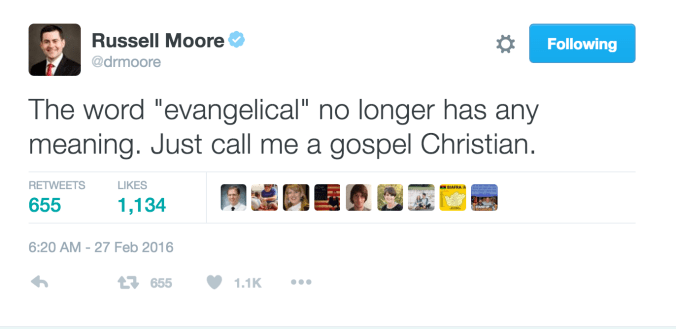
While I’m in large agreement with McAlpine, I’m not giving up on evangelical just yet, because rightly understood it is a word we should cherish and defend. But should the waves of malcontent persist, and an alternative is necessary, I think I’ll begin follow in Russell Moore’s footsteps and refer to myself a Gospel Christian.

Gospel Christian has the same meaning as evangelical Christian, but without the unhealthy socio-political connotations. Interestingly, both in the United States and here in Australia, among the larger Christian networks we don’t find the Evangelical Coalition, but rather the Gospel Coalition.

Some Christians prefer to known as orthodox or classical. I warm to both of these words, although Stephen McAlpine criticises ‘orthodox’ as a group who don’t affirm the real and physical return of Jesus Christ. Perhaps I’m ignorant, but I would have thought belief in the parousia is basic to anyone claiming orthodoxy.

The reality is, many of our Christian labels are disdained. I wish it was suffice to say, I’m a Christian. After all, that’s what I am, I am a Christian. But sadly Christian is frequently associated with all manner of social ills and evils (sometimes warranted). And when I fess up to being a Baptist, I’ve more than once had to qualify it by saying, no, we’re not like the JWs or Mormons.

McAlpine suggests we call ourselves, ‘eschatological Christians’,

“Eschatological” springs to mind. If someone asks me these days I’ve taken to saying that I am an “Eschatological Christian.” Sure it’s not catchy, but it’s not toxic either. Sure I will have to spend a bit of time explaining what it is, but hey, I’ll have to spend virtually no time explaining what it is not.

“Eschatological” is more likely to elicit an eyebrow raise than a nose wrinkle.  It is more likely to raise a question than rule a line under an answer. Most importantly it will distinguish me – and us – as those whose hopes -and energies – are not grounded in the political machinations of this age, but in the politics of the age to come lived out in the church today, and overflowing in practical, loving and humble ways into the community.

“Eschatological Christian” also distinguishes orthodox Christians who actually believe that there is a parousia coming in which King Jesus will usher in a new kingdom and judge the world in righteousness, from those who view that as an outdated notion beneath our modern sensibilities. A view that won’t get them respect in the academy.

The name has a certain Fitzroy living single-origin drinking indie-rocking listening feel to it, but I am unconvinced. First of all, few people know what eschatology means,  and second, it is  defining our identity by one area of theology, rather than the whole.

What do others think? How do you describe your Christian faith? Do you identify as an evangelical?

Misappropriation and misunderstanding shouldn’t surprise us; is it not the expectation given to us by the Lord Jesus? Does not the history of the church give us multiple examples of culture trampling on or deconstructing the church? In a world that is constantly confusing and even hijacking the Christian message, and doing so for all manner of social and political ends, we though can be responsible for how we represent the Lord Jesus Christ. Indeed, the more faithful we are to God’s word, the more useful we will be to society. So whether we call ourselves evangelical, Gospel, orthodox, or just plain and simple Christian, let’s do it with a growing sense of clarity, humility, grace, and winsomeness, in order to display the reality of Christ and of the hope held out in his Gospel.

“The Island of Despair”

1476739700903

“When a child expresses that want to kill themselves in that environment, we believe them.”  (Gabby Sutherland, Former Specialist teacher on Nauru Island)

If it came to my attention that there were children in my local community who were self-harming, being locked-up, being denied access to clean drinking water and sanitation, would I speak up? Would it not be unethical and iniquitous of me to remain silent?

I don’t know all that is happening in Nauru and Manus Island. We hear conflicting reports, but it is difficult to ignore two recent published reports, one by the United Nations and the other by Amnesty International. It is also difficult to ignore the stories that were shared last night on Four Corners by former teaching staff on Nauru, and by children themselves, whose words had to be recorded in secret.

In today’s The Age, I read,

“Anna Neistat, Amnesty’s senior director of research who travelled to Nauru, said the report provided direct evidence of Australia’s responsibility for day-to-day decision-making, and that Australia should be held accountable for breaching the Convention Against Torture – with a remote possibility that individual government officials could be prosecuted under international law.

“It’s the intentional nature of it,” she told Fairfax Media. “The Australian government is not even hiding the fact that the key purpose of this policy is deterrence. When you set up a system that inflicts deliberate harm as a deterrence, it’s really hard to find another name for it other than torture.”

Dr Neistat, a 15-year veteran of crisis work in Syria, Yemen and Chechnya, said the Nauruan regime was particularly galling because people’s suffering was “absolutely unnecessary” and shrouded in “shocking” secrecy. “I was not prepared for what I saw, and definitely not prepared for what I heard,” she said.

Torture is a loaded word and one not to be used lightly,  sadly the growing mountain of evidence suggests there is warrant for its usage in the case of our nation’s policies towards asylum seekers.

Off shore detention was introduced by the Howard Government in 2001, and has been continued by Labor and Coalition Governments since. According to the report released yesterday by Amnesty International, there are currently there are 1,159 asylum-seekers and refugees on Nauru: 410 people reside in the Refugee Processing Centre; 749 refugees live outside of the centre. Among this number are many children who have been in detention for over 3 years.

I’m not going to pretend that I have a detailed knowledge of what is transpiring in these detention centres, and I’m not going to naively suggest I have the answers. But one thing is clear to me, we have principles given by God as to how we ought to consider the refugee, and we would do well to use these as as a starting point for framing reasonable and humanitarian policies.

I realise most Australians are quick to ditch the Bible, especially the Old Testament for in it they perceive a God who is vindictive and harsh. Yes, there are hard words spoken in the Old Testament, and also in the New Testament. The fact is, some of the most difficult words ever spoken came from the lips of Jesus Christ. Instead of shunning these words, perhaps we Aussies ought to listen to them because clearly our hearts are calloused toward many of the world’s most vulnerable people.

In the Old Testament we read,

“He defends the cause of the fatherless and the widow, and loves the foreigner residing among you, giving them food and clothing”. (Deuteronomy 10:18)

In the New Testament we read,

“Religion that God our Father accepts as pure and faultless is this: to look after orphans and widows in their distress and to keep oneself from being polluted by the world.” (James 1:27)

If God is concerned for the world’s refugees and we are not, what does that say about us?

As Australia’s off-shore policies were developed, were there genuine concerns about people smugglers and the safety of refugees fleeing onboard unseaworthy boats? Yes.

Is there also an inherent selfishness among Australians, not wanting to share our plenty with those who have lost their homeland? Yes.

Is there a stain of racism that makes Australians apathetic towards refugees? Yes.

The first issue cannot be ignored and finding a fair solution is not without complication. But it seems to me as though there is an core problem with the way Australians look at the world. We live and work and care when we find net value for ourselves, but the notion of loving our neighbour as ourselves is being lost, and polluted by rampant individualism and self service. Maybe you may think I’m sounding just a little cynical, but is not the evidence before us?

Perhaps it is pride that’s preventing our Government from changing its policies toward asylum seekers. I don’t know the answer to that, although it seems plausible, and alternative explanations are far less laudable. Political pride is ugly, but we can no more blame our Parliamentary representatives than ourselves, for they are a reflection of Australia, and of the values and ambitions we cherish.

We did not create the conditions that led to so many people seeking refuge in our country, but we can be part of the answer and give these human beings hope and a safe place to live. Are we not the most prosperous and liveable nations on earth? Do we not have more to share than most other countries can even imagine? Are we not able to sacrifice a little for thousands who have lost so much?

Reports of poor conditions, deteriorating mental health among children, and abuses by detention officers are not new, but today we will be damning our consciences if we close eyes and hearts to these latest reports.

Would we ever intentionally put our own children in an unsafe environment, or permit the Government to do so? And should we be made aware that this is so, would we not get them out of there straight away? Is this not common sense, let alone the caring thing to do?

Mark Dreyfus on the Marriage Debate

My local member of the Federal Parliament, Mr Mark Dreyfus QC, gave a keynote address at today’s Freedom For Faith Conference, held in Melbourne.

Mr Dreyfus spoke on the topic of Marriage Equality & the Proposed Plebiscite. I appreciated his candour and contribution, to what has become a stimulating day thinking through issues of Religious Freedom.

download

I wish to offer 6 brief comments in response to Mr Dreyfus’ presentation.

First, Mr Dreyfus began by asserting that the main concern of persons opposing SSM is the issue of religious freedom. Indeed, there is a range of questions and issues relating to freedom of religion should the Marriage Act be changed, and no doubt these are a concern to those not supporting SSM. It is however a mistake to suggest these concerns are the main reason for opposition, which I would argue is, the reasoned belief that marriage by definition is between a man and a woman.

It is important for the public to understand that issues surrounding religious freedom are an important corollary, but the primary concern relates to the definition of marriage, and that marriage shouldn’t be redefined to allow two persons of any sexuality for the very reason that marriage refers to the life long covenantal relationship between one man and one woman.

Second, Mr Dreyfus made his argument for SSM saying, ‘it comes down to a simple truth – love is love’. Such an argument however is inadequate. There are many forms of love,  and most of them should surely not be grounds for marriage. Love is a necessary ground for marriage, but it does not stand alone. There are other necessary prerequisites, which include biology, gender, children, social order and good.

Third, Mr Dreyfus suggested that ‘it is not right to judge another person’s love’. I am happy to go a long way in agreeing with this statement, except it must be noted that marriage is not merely a private matter; by nature it is public. Marriage is the formal declaration of a new family unit, separate from other familial relationships socially, physically, personally, and legally. Thus by definition, it is only appropriate that society has a role in determining our understanding of this institution.

Fourth, Mr Dreyfus presented 3 reasons why Australia should refrain from holding a plebiscite.

  1. it will acts as an unhelpful precedent
  2. the cost
  3. the danger to LGBTI people

I have argued elsewhere that the precedent argument is somewhat fallacious, given that Australian Parliaments (both Federal and State) have undertaken 60 referendums and plebiscites since Federation.

Mr Dreyfus’ second and third objections have warrant, although there are reasonable responses to these as well (cf. https://murraycampbell.net/2016/09/08/labor-party-proposal-deserves-attention/)

Fifth, Mr Dreyfus admits that altering the Marriage Act may well lead to significant social changes to society. This is a significant admission, one that we shouldn’t overlook –  as Australia’s Shadow Attorney General, and as a supporter for marriage change, Mark Dreyfus indicated that changing our definition of marriage will foreseeably change the fabric of society.

Sixth, Mr Dreyfus challenged the room (filled with lawyers and academics!) to prove that changing the law will not lead to restrictions in religious freedom. Several lawyers and academics took up the challenge, citing examples from overseas and even from within Australia, in relation to employees being forced to choose between their conscience or compromising in order to keep their job.

As Mark Snedden noted during the question time, the cost to religious liberty is already being demonstrated including in the Australian Labor Party, where if you wish to gain preselection you must now either give up belief in heterosexual-only marriage or be denied preselection.

Once again, I found it helpful and insightful to hear my Parliamentary representative speak on this important issue. However, the concerns of many Australians will not be alleviated as a result of his address, if anything, they have gained substance. But one thing was positive, I witnessed another example of a  civil and serious engagement on the topic of marriage.

Incoherent ‘inherent requirement’ test

Two months ago I sat in a packed room where Mr Tim Wilson MP and Rev Dr Michael Bird addressed the topic, ‘Freedom of Speech in Australia today’. During the conversation Mike Bird said that the next issue facing Victorians will be in relation to religious schools and discrimination policies. This week my non-prophetic friend was proven to be right: the Victorian Government announced that it will reintroduce the ‘inherent requirement’ test, impacting whom religious organisations may and may not employ.

The test was originally introduced by the previous Labor Government in 2010, but was removed in 2011 by the Coalition Government.

IMG_9102

This explanation is offered on the Premier’s website:

“The test was scrapped by the former Coalition Government in 2011, which left many Victorians vulnerable to discrimination when seeking employment with religious bodies or schools, particularly because of their sexual orientation or gender identity.

The inherent requirements test will limit the ability of a religious body or school to rely on a religious defence to discriminate in the area of employment because of a person’s sex, sexual orientation, gender identity, marital status or differing religious beliefs.

The defence will be limited to circumstances where religious beliefs are an inherent requirement of a job, and an employee or job applicant does not meet the requirement because of a specific personal attribute.

The test will not force religious bodies or schools to employ people with attributes that conflict with its religious beliefs and principles. However, it will require them to demonstrate a necessary connection between their religious beliefs and the requirements of a specific role.”

This latest move from the Victorian Government is disturbing, although not surprising. I appreciate and at times laud the Government’s move to ensure particular social minority groups are protected, including LGBTI people. But one may be forgiven for concluding that some of the extreme measures have less to do with the principle of inclusion, and more about exclusion.

For example, removing SRI from schools had nothing to do with advocating sexual equality. Indeed, the list of anti-religious of measures is growing, and one can only wonder where and if Mr Andrews’ will draw the line. Over the last two years many Victorian families have come to feel as though they are being pushed away from public schools, and now it appears as though the same Government is set on invading the religious school space also, and that of any religious organisation. It is yet unclear whether Churches will be protected from this test or not.

The inherent requirement test is a deeply flawed concept:

First, the notion of ‘inherent requirement’ depends upon imposing a secularist view of religion. The test presumes a separation between what is considered spiritual work and what is not. It is surmising, for example, that a gardener or an office administrator is not doing specifically Christian work because they are not teaching the Bible, etc. This is a false dichotomy that does not exist in Christian faith, nor in many other religions. Every role is an expression of commitment to God and is a valuable part of the whole which serves a common purpose.

Second, this test wrongly assumes that because a particular role does not have a direct theological or spiritual teaching component, it therefore does not matter whether the employee agrees with the organisation’s ethos, beliefs, and vision. This is purely illogical. Why would any organisation or company employ a person who does not support the basic values and vision of that association?

Equal Opportunity doesn’t mean sameness. I’m not doubting the Victorian Government’s commitment to ‘equal opportunity’, but their paradigm of equal opportunity is flawed, and represents an ethic that is not ultimately about diversity, but about conformity.

During that cold July night when Michael Bird pre-empted Mr Andrews’ announcement this week, Tim Wilson offered an idea which deserves consideration as the Victorian Parliament wrestles with this legislation. Mr Wilson believes that the question of whom religious organisations employ is better dealt with through contracts rather than through law. He said,

“In terms of hiring and firing people, I don’t think it’s best dealt with through law. I fully accept that religious institutions have a right to preserve the environment and the value systems of people who embody those value systems.”

“It is the right of children and parents, to raise their children in the culture, traditions and customs to which they hold dear.”

Finally, the question needs to be asked, is it reasonable for a Government to determine what constitutes required religious adherence or not? Is it the Government’s role to dictate theology and ministry practice? Does the Government have the necessary skills and knowledge required to adequately understand theology and therefore make the right judgement regarding the question of what is inherent?

Marriage Plebiscite crumbling under light weight arguments!

In an interview on ABC’s Lateline, Friday night, Michael Kirby (former Justice of the High Court) was interviewed on the topic of the marriage plebiscite. During an engaging interview, Justice Kirby articulated his concerns over the broad debate on marriage, including his reasoning for not supporting a plebiscite.

I was immediately struck by one of his arguments, of how the plebiscite may set a “very bad precedent”. It is important to think through the ramifications for future decision making processes, and what we are communicating about our democracy by setting this path of a public vote. I was persuaded, until I discovered that plebiscites and referendums are not as rare in our history as we might think.

Since Federation in 1901, at the Federal level Australia has held 44 referendums and 3 plebiscites. The States however, have conducted many more plebiscites, covering a wide range of issues including the establishment of Wrest Point Casino (Tas, 1986), closing hours for alcohol selling establishments, extending shopping hours (WA, 2005), and daylight savings.

In other words, on no fewer than 60 occasions, Australian Governments have taken an issue to the people and asked for their opinion. That is one referendum or plebiscite every two years; meaning we’re overdue.

In 1977 a plebiscite was conducted to decide our national anthem. Now, maybe I’m not as patriotic as other Aussies, but in my view, marriage is significantly more important than choosing to sing ‘Advance Australia Fair’.

So, the bad precedent argument doesn’t work. What of Michael Kirby’s other compelling argument against the plebiscite?

“I don’t think we should draw any inferences about what would happen in a plebiscite, especially a plebiscite of compulsory voting in this country. I think we would draw better inferences from our history on constitutional referendums: and on that matter, we have a record of 44 proposals that have been put to the people at a referendum and only eight have succeeded. Australians vote “no” when they get a chance.”

Did Michael Kirby suggest that we shouldn’t hold a plebiscite on same-sex marriage because Australians will probably vote against it?

It certainly sounded so. Emma Alberici certainly thought so, because she followed up with this question, “Because you firmly believe it would be defeated? The “no” vote would win?”

Justice Kirby obviously had a change of mind, for this time he said, “No, I don’t think it would be defeated. I think it may well be passed. But this is a bad way of going about it. It’s not the Australian way.”

By the ‘Australian way’, Kirby then repeated his argument about setting a bad precedent.

Interestingly, on Insiders today, it was revealed that the Labor Party Room has been briefed by pollsters who are saying the plebiscite won’t succeed, and thus adding weight to Labor backing away from supporting a plebiscite.

Malcolm Turnbull responded,

“the worst argument, the absolutely worst argument against a plebiscite is to say that it wouldn’t be passed. So if Labor is seriously saying that, if they are saying, ‘Don’t consult the Australian people because they won’t give you the answer you want,’ it is the most anti-democratic argument.”

I don’t always agree with the Prime Minister, but I think he has a valid point.

© www.timbauerphoto.com

I am not questioning Michael Kirby’s commitment to the LGBTI community, nor his convictions about marriage. Neither am I arguing for the plebiscite here,  but I am simply making the point, if you don’t want a plebiscite, you need to make a case with more substantive reasons than these.

Even Aaron Sorkin makes mistakes with words

The follow advertisement for a screenwriting Master Class with Aaron Sorkin appeared on my Facebook page this evening. One can only assume Facebook is giving me a gentle hint about my writing talent, or lack thereof.

When it comes to contemporary screenwriters, Aaron Sorkin is among the world’s finest. The West Wing is arguably the greatest television series ever written, and Sorkin is the creative wordsmith behind movies such as A Few Good Men, Moneyball, and The Social Network.

During the 60 second promotional video, Sorkin remarked, “you should be evangelical about Aristotle’s poetics.”

Word fail!

The word he meant to use is ‘evangelistic’, not ‘evangelical’. Both words share the common Greek, εὐαγγέλιον, which means Gospel or good news. However they are nonetheless not interchangeable. Evangelism is the activity whereby one speaks the Gospel in order to persuade another. Evangelical, on the other hand, is the set of beliefs that derive from the Gospel. The latter is a noun (and sometimes an adjective), the former is a verb.

We all get Sorkin’s point, be persuasive, compelling, and passionate about Aristotle’s Poetics. Well, who isn’t!? But he has fallen for what is becoming an all to common blooper. Perhaps, one shouldn’t be too hard on Aaron Sorkin though, given so many Christians confuse the two words. And I wouldn’t have concerned myself to pick up on the mistake, after all who am I to judge a literary genius, however this presents an opportunity to ask my Christian friends, please use the right word.

Are you talking about explaining the good news of Jesus Christ? That’s evangelism.

Are you talking about the body of Christian doctrine which we believe? You mean evangelical.

Thanks Aaron