Queensland Education Department is afraid of Jesus?

In the school playground, children talk about everything and anything: what they watch on television, who is eating what for lunch, their favourite sporting players and what bands they’re listening too, and what they’re hoping to do on the weekend. But if the Queensland Education Department have their way, the one topic children will not be allowed to speak about is Jesus.

In our click bait media culture, it is sometimes hard to discern real stories from the dubious, but sure enough, this story is legitimate.

The Queensland Education Department have undertaken to inform schools that children are not to discuss Christianity outside formal Religious Instruction classes.

To quote from the Departmental report that has been given to schools,

“While not explicitly prohibited by the EGPA or EGPR, nor referenced in the RI policy statement, the Department expects schools to take appropriate action if aware that students participating in RI are evangelising to students who do not  participate in their RI class, given this could adversely affect the school’s ability to provide a safe, supportive and inclusive environment for all students.”

What is extraordinary about this memorandum is that the Department admits that this prohibition falls outside the parameters of any formal policy and guidelines, but they are nevertheless insisting schools take action.

Evangelism is defined by the Department as “preaching or advocating a cause or religion with the object of making converts to Christianity”.

The problem with their definition of evangelism is that in effectively prohibits any conversation that involves God, Jesus, and Church. Inviting a friend to a Christmas service might be interpreted as evangelism. Sharing what you learned about God could be taken as evangelism. It is only natural for children to talk about and share things that are important to them and that they enjoy; for many children this includes belief in Jesus and being part of a church.

Is the education department really wanting to squash children’s freedom to talk about issues beyond homework, sport, music, and latest i-pad apps?

Is inviting a friend to a church event really going to undermine pluralism and respect? Is a group of student engaging in the big questions of life so unacceptable?
 

QLDjpg

Associate Professor of Law, Neil Foster, has written an important response to this QLD report, pointing out that it fails several important tests. It is worth taking the time to read. In summary, he notes that,

1. This “expectation” is not supported by legislation

2. This “expectation” is probably illegal as discriminatory

3. The “expectation” is illegal as contradicting the head legislation

4. The “expectation” undermines free speech of pupils

5. The “expectation” undermines religious freedom for pupils


These points alone amount to checkmate, but there is more.

First, the prohibition fails the test of what is sensible.

Remembering what it’s like to be a child at school, and having 3 children at school, I can imagine the kinds of conversations that will happening today. During lunch there will be 10 year old students inviting their friends to the movies this weekend: Do you want to come with me and watch the new Transformers  movie or Planet of the Apes film? Watching age inappropriate movies is fine, but Church is too dangerous. Birthday cards will be handed out, but please avoid Christmas cards. Have a giggle over dirty jokes, but let’s be clear, no one can mention the Bible.

I realise Queensland is the sunny state, but one can have too much sun. This Departmental imposition really is as silly as it sounds, and it will in fact achieve the opposite of their intention, which is to ‘provide a safe, supportive and inclusive environment for all students.’ 

In recent years we have laughed at schools who have banned balls from the  playground, because they are a threat to children’s safety. Now, we have to remove Jesus talk because it will undermine social cohesion in schools?  Do we really not trust that our kids can have reasonable conversations about religion? It is all the more ironic, because the very principles that these bureaucrats  want to see in school, that of respect and inclusion, are based on Christian beliefs?

Second, the QLD Education Department wrongly assumes that non-God talk in the playground is somehow morally and spiritual neutral, as though children can chat about any topic in a theologically neutral way. This is not true secularism, it’s imposed atheism. It is anti-pluralism. If the only permitted discourse is void of language deferring to God and religion, then what we will have is exclusive and intolerant atheism. Is that the kind of school environment we want for our children?

As I was reading about this story this morning, my mind turned to the book of Acts in the Bible and to chapter 4 where the city’s leadership arrested Peter and John for talking about Jesus with people. They warned the disciples, ‘do not speak or teach in the name Jesus’. Peter and John replied, ‘we can’t help it’.  One can only assume that these education officials haven’t ready a Bible nor studied history, because demanding that people stop talking about Jesus usually has the opposite affect.

I trust that sane heads will prevail and that the Queensland Education Department will retract this injunction.


Update:

The QLD Education Minister has released a statement this afternoon denying there’s any ban on students sharing their faith with other students. Ms Jones said, ‘No one is telling a child what they can and can’t say in the playground.”

This is welcome news. However it doesn’t explain the Department’s report which she accepted, a report which urges schools not to permit God-talk by students outside of Scripture Classes. This report falls under the official policy section of the Education Department, titled, ‘Religious instruction policy statement’.

On this page there is a section marked ‘Reviews’ which is introduced with this statement,

“The purpose of the reviews is to provide guidance to state schools as to whether the program complies with departmental policies, procedures and applicable law.”

This ban is official guidance for schools.

In other words, the Minister’s statement is at odds with her own Department’s position. 

We encourage Ms Jones to follow through with today’s positive announcement and ensure that those statements about evangelism are removed altogether.

ABC, Domestic Violence, and Churches

Over the course of the week I affirmed much of the ABC’s reporting into domestic violence, and made it clear that any and all abuse is wrong and not to be tolerated. Abuses in the home contravene the teaching of the Bible, and expressly transgresses the Bible’s teaching on marriage. I have made my views public, not only this week, but 2 years ago.

Screen Shot 2017-07-22 at 10.07.11 am

Unfortunately, ABC reporters are choosing to draw links and make strong insinuations where the threads are tenuous.

For instance Julia Baird has hit back at people who questioned the ABC’s reporting of statistics, suggesting that they were “quibbling” over data. At the same time, panelist Georgina Dent, insisted that there isn’t enough data. On the one hand, viewers were told that anyone asking questions about the research were ‘quibbling” and denying some of the assertions made by Baird and others, and then viewers were being told that the research should be even more damning than it is. This is problematic and confusing for so many reasons.

I do take issue with some comments being made this week. I have not appreciated the tone of some individuals, who instead of recognising that abuse can occur in a Church context, they simply went on the defensive. This is poor form, and it only aggravates the appalling wounds of women who have had courage to speak up this week.

Having said this, it appears somewhat disingenuous when the reporters suggests there is ‘quibbling’ of data. Let’s be clear, the ABC report relies on particular research, and it has since come to light that the evidence does not support some of the connections that Baird and others are trying to establish. For example, one of the main arguments being made on the ABC is that ‘headship’ teaching plays a significant role in the abuse of women. The research however says that the men who are the least likely to abuse their wives are those who are active and regular members of conservative churches. There is though a connection between abuse and men who are sporadic attenders of conservative churches.

Those ‘quibblers’ were not doubting the veracity of the research, but the ABC’s presentation of the evidence. Viewers are left asking, should we accept the research or not?

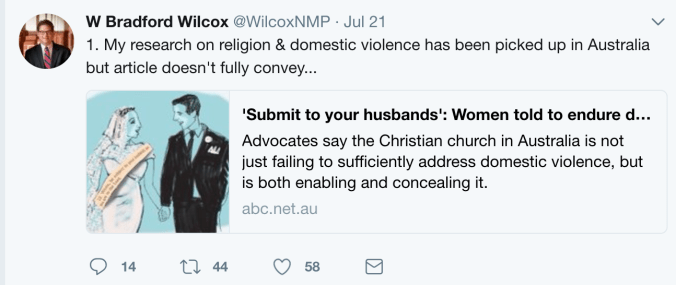
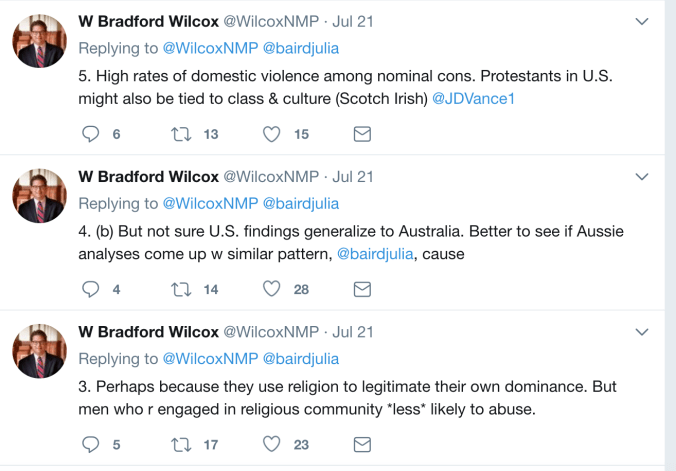
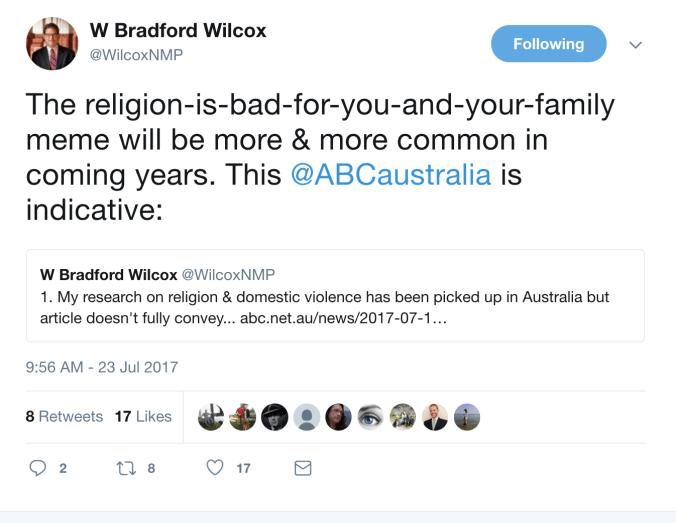
One of the key researchers that the ABC’s report relies upon is the work of Professor W Bradford Wilcox. Over the weekend he has weighed in on the conversation with a series of tweets, in which he questions the way that the ABC has represented the findings from his studies. It certainly unusual for an academic to step in and comment on a journalistic article from a different country.

Screen Shot 2017-07-23 at 8.34.40 pm


Screen Shot 2017-07-23 at 8.39.50 pmScreen Shot 2017-07-23 at 8.40.00 pmScreen Shot 2017-07-23 at 8.40.10 pm


Secondly, in a follow up piece from last night’s The Drum, the views articulated by David Ould, are not fairly represented. It’s not that you misquote him, but that you didn’t quote the rest of what David said, and that you inserted these particular comments in a context that suggests his views are out of touch with what Christians really ought to believe. The reporter didn’t even properly explain what the Bible means by headship and submission, but presents it in such a way that readers are meant to think, ‘well, we all know how silly and wrong that view is’. 

I whole-heartedly agree with this comment by Philip Freier, offered last night on The Drum,

”I know that these words are easy sometimes to say, but I think we should be truly regretful where we have failed and we haven’t listened to people, or understood the depth of their suffering, or the kind of situation that they are being urged to go back into.”

However, the Melbourne Archbishop also made this astonishing remark in which he, as a Christian leader, denounced the very own Scriptures he is ordained to uphold,

“I don’t find there is an essential reading of the Bible that teaches me that I must believe in the headship of men. I read the Bible and see that it talks more about the mutuality of people and their love towards each other.”

That’s a problem, because the Bible does teach a view of headship, and this view is one where the husband leads in love like Christ and lays down his life for his wife. Surely, the Archbishop isn’t asking husbands to ignore this biblical model? Not only that, his comment speaks against the very research that the ABC originally relied upon, that churches teaching and practicing Ephesians 5:22-31 have the male members who are LEAST likely to abuse their wives.

ABC, you have highlighted an issue that requires open and rigorous conversation. Almost every Christian leader I know is receiving this report with sober judgment and eagerness to do better when it comes to caring for abuse victims and dealing with perpetrators. I am concerned however, that this important report is mixed with at times poor journalism, and by doing so you will ultimately distract us from the actual issue that needs deliberation and action. The last thing we want is unhelpful journalism clouding the important stories being told by women about abuse, and from churches learning how to do better in the future.


________________________
P.S. This is not an anti-ABC article so please don’t circulate it as such. Thank you

Regeneration Church, a Church in and for Monash

It was a great joy to visit Regeneration Church last night for their first ever public service. It was exciting to see a packed building, and encouraging to see the Regeneration team in action for the first time.

If you live in/around Clayton, why not visit one Sunday?


16684006_381124545580542_6779362821744298752_n

I was invited to offer a word of exhortation to the new church. Below is a copy of my remarks:

“200,000 people live in the City of Monash. They are made in the image of God, important to God, and needing Jesus.

The Great Commission is Jesus sending his disciples to the nations in order to preach the Gospel and to make disciples. In line with this mission, Mentone Baptist Church has sent the Regeneration team to area of Monash, a place where the nations have come.

Understand that being part of a new church may be the hardest venture, the most joyful venture, and the more important venture, of your lives. Indeed, today marks the beginning of a new Gospel work that, we pray, will bear fruit lasting into eternity.

Most residents in this area won’t know of Regeneration Church and many won’t care, and some people will become interested and join. Understand, whatever the reception, God loves his church, Jesus will build his Church, and she is marvellous in his eyes.

While we at Mentone Baptist we will miss all of you, we are not so much saddened to see you go, as we are excited to partner with you in this new work. Indeed, Melbourne needs hundreds more Gospel-centred Churches. New Churches have begun in Box Hill, Northcote, Officer, Footscray, and elsewhere. And yet we are yet to penetrate the first layer of skin in Melbourne.

As Paul reminded the Corinthians, may I impress on you,

“I planted the seed, Apollos watered it, but God has been making it grow. So neither the one who plants nor the one who waters is anything, but only God, who makes things grow.”

Understand our role, it is to plant and water. Regeneration Church: Do the work of evangelism, preaching, teaching, loving and caring, serving. And trust God to grow his church. Trust him, depend on him, ask him.

Mentone will keep you in our prayers, and we are keen to continually support you in other ways. I’m  also looking forward to preaching here a couple of times this year.

May God richly bless this work, to grow a Church glorifying his Son.”

Genderism, Atheism, and Civil Discourse falls off the precipice

Last night on live television Clementine Ford called fellow journalist, Miranda Devine, “a c**t”. The ABC has today publicly apologised to Devine, although Ford has begun moving through the expletive vocabulary as people on twitter dare suggest that a civil society requires civil discourse.

The topic for last night’s episode of Hack Live was, Is Male Privilege Bullsh!t?” With such a cleanly articulated topic for conversation, should anyone be surprised that one of the program’s guests took liberty with language?


Hack Live

Only hours earlier The Age published a piece by Andrew Street, asking the question, ‘Why do atheists have to behave like such jerks?’

Andrew Street bemoans the behaviour of some of his fellow atheists including the likes of Sam Harris and Richard Dawkins. Summarising a piece by Mark Oppenheminer, Street admits that such behaviours are a massive problem in the international atheist community. His particular and present concern is the treatment Clementine Ford has received since being invitated to speak at the Atheist Global Convention in Melbourne. Without question, the online abuse is appalling. Street quotes the moderators of the Convention’s Facebook page, ”we have been deleting specific rape and death threats as they occur… there have been substantial numbers”.  There is no justification for such demeaning and disgraceful threats and language, and I’m pleased to hear Andrew Street confronting it.

Toward his conclusion, Street makes a swipe at ACL, trying to analogise ACL with the crude atheists attacking Ford. This comparison is sadly predictable, and greatly misplaced:

He writes, “It also means such groups end up much like the Australian Christian Lobby: filled with reactionary voices that don’t remotely represent the diverse community for which they’re claiming to speak.”

The Australian Christian Lobby may not share views on sexuality and marriage that many atheists hold, but they do not resort to vulgarity, and they are known for their advocacy for women against sexual exploitation. One may not agree with ACL but one cannot associate them with the kind of vitriol that Ford has been subjected to and has also dished out.

Street’s article is revealing, for he is rightly concerned about the attitudes and behaviour of his fellow atheists, but he doesn’t recognise how their creed gives no protection from such assaults, indeed atheism gives license to demean and hate. Not for a second do I think that this is a problem exclusive for atheism, we should keep in mind that the same can also be said of many religions.

While Street’s article doesn’t dig so deep, it helpfully reminds us that worldview matters and that from the heart we speak.

“For the mouth speaks what the heart is full of” (Matthew 12:34).

Much of Australia’s intelligentsia insists that there are few if any axioms and that ethics is mostly freelance. We cannot  however do away with them and the most convinced anti-theist recognises that there are right ways and wrong ways to treat people. This deeply rooted belief doesn’t stem from atheism but from Christianity.

We often treat people in ways similar to how have been treated, and it is a vicious cycle. With a decisiveness and efficacy that makes the Hadron collider appear like recycled garbage, Jesus Christ broke the cycle. He showed us how to live and he lived that life on our behalf. He made himself a substitute, not returning hate for hate but enduring it on the cross. This grace and kindness does more than give us the example par excellence for public conversation, for he liberates the human heart from hate, as well as from pride that stems from forced adherence to cultural conventions. No doubt Christians have at times forgotten this good news, and even proven themselves unChristian by using speech that contradicts the character of Jesus Christ. This love given by Christ changes attitudes and behavior, such that we show respect toward those with whom we have significant disagreement, not because society demands civility, but because we wish to share this infectious love that God has given to us.

Anglican Yoga?

A story about yoga and the use of Church facilities broke today in the media. It seems as though much of the public are as confused about the issue as people are about the meaning of the cobalt blue rooster! There is however good reason behind the decision among Sydney Anglicans.IMG_2455

The Bishop of South Sydney, Michael Stead, has explained that yoga is incompatible with Christian belief and practice, and therefore should classes should not be offered within Church precincts. I tend to agree with my friends from the north.

Here’s a post from a few years ago, which although not touching on yoga classes on Church property,  does highlight relevant points to the discussion:

“There are many Churches that organise yoga classes and many more Christians who use yoga at home. Even to ask this question may seem rather banal to many Christians today, but let me begin by explaining something that happened yesterday.

One of my sons came home after school and told us that they had taken a yoga class that day. Apart from the issue that parents were not made aware that this was happening (a mistake I’m sure that school won’t repeat[1]), I suspect the school was not aware of what took place during this session. The children were taught a number of different postures and to speak aloud various names. It is difficult to ascertain whether the children were simply being encouraged to learn the names of the different postures or whether they were being taught particular chants that can accompany the postures. My concerns were heightened when my 6 year old son produced a ‘magic stone’, given to him and one to every student by the instructor. Two pamphlets came home with him, one asking him to sign up to an after school yoga program, and the other explaining the value of the ‘magic stone’, to quote, “ask your magical stone to take away any of your worries, so you can sleep better at night. Or ask your magical stone to give you special powers”.

Yes, that’s right, without parental permission a stranger handed out little idols to the class (that’s what they are) and is encouraging them to pray to these stones for help and special power’!

Thankfully my son thought the whole exercise was, to use his word, ‘ridiculous’. But nonetheless he came home confused about what he had heard and been taught.

I hear some friends saying, ‘Murray that’s terrible but yoga doesn’t have to taught that way. It’s okay to do yoga’.

Can Christians practice yoga? I know some Christians who believe that yoga is demonic and should never be touched, and I know Christians who believe that yoga is fine and can be easily practiced without any pagan connotations.

I would like to offer these thoughts:

1. Yoga comes from ancient Indian religions.

Yoga’s precise origins are ambiguous. What we know is that it comes from India and has been practiced for centuries, and is intimately tied to paganism, Hinduism and Buddhism.

2. Yoga is not simply physical exercise.

The purpose of yoga is to attain union with the soul and therefore peace. It involves physical, mental and spiritual dimensions.

As Christians we do not want to delve into practices that are idolatrous and could introduce us to ideas/practices that undermine the beauty, sufficiency and truthfulness of Jesus Christ. But I know some Christians who will practice yoga and believe that they can adopt the physical exercises while keeping out the spiritual aspects that regularly accompanies yoga. I don’t use yoga, but I can appreciate how relaxation exercises can be useful, and perhaps it is possible to redeem these exercises from yoga’s pagan roots. But let’s be aware of the following:

It is often said that the yoga is practiced in ways that are divorced from Hinduism. One local yoga instructor in Mentone offers ‘Hatha yoga’. ‘Hatha yoga’ deals with, to quote, focuses mainly on the physical body as opposed to more spiritual yoga styles.’ Sounds ok. But further on the same web site says this,

‘Yoga develops all aspects of one’s being – body, mind and spirit. The body becomes stronger, more flexible, more relaxed and generally much healthier. See each class as an opportunity to nurture yourself physically, emotionally and spiritually.

And this,

‘Turn your mind inwards and focus on your own practice.’

‘Be kind and loving to yourself by accepting where you are. Remember to practise with a sense of ‘honouring and exploring’. Honour yourself and what you are capable of and explore where your body can take you. It is important to listen to your body and recognise your limits so that you do not injure yourself.’

So, spiritual free yoga is nonetheless designed to help you spiritually!

The Yoga Australia website explains.

‘Today, the most popular of these more recent approaches is generally known as a form of Hatha Yoga, and is considered to be the beginning or early stages of the process towards fullness of what Yoga offers.’

In other words, ordinary yoga is designed to be an initiation into real yoga.

3. Yoga is bad theology. Even when we leave out all religious connotations, yoga teaches us to look inside ourselves for peace, whereas the Bible clearly teaches us that we need to  look away from ourselves and to Christ. Peace doesn’t come to us from meditation and looking inward, but it comes from God and is given to us freely through the cross of Christ. Yoga simply repeats the same old problem, but with hip pseudo-spiritual language. The Gospel of Jesus Christ exposes the folly of seeking peace from within and points us to the only true God who is able and willing to forgive and restore and bring peace.

Something that yoga gets right is that we are not purely physical beings, but the physical, mental and spiritual interrelate. But it calls us to seek peace from within and it calls us to pay homage to nature and to false gods in order to empower us to achieve this self-seeking harmony.

We are physical beings, and therefore physical exercise, even relaxation exercise, can be useful. While it is theoretically possible to empty these exercises of all their religious content and replace it with godliness, the dangers are many and often subtle. When there are so many great alternatives available to us, why bother at all? Take up a sport, go swimming, go for a walk, get a massage!


NSW is removing Safe Schools. Could Victoria follow?

It was announced today that the NSW Government is scrapping the controversial school curriculum, Safe Schools. From July, not only is the Federal Government stopping its funding of Safe Schools, but the NSW Education Department will introduce an alternative program. The content of this new program is yet to be released, but early indications suggest that it will be a broader and more inclusive program, and one that does not depend on the now debunked gender theory.

Safe Schools is presented as an anti-bullying curriculum, and is designed to teach children acceptance of other children who are different to them. The emphasis however is on sexuality, and teaching a flawed view of sexuality and encouraging young children to explore these alternative sexualities for themselves.

Safe schools was originally an opt-in program, but it is now compulsory in all secondary schools across Victoria. Many primary schools have also signed up.

One of the chief authors of Safe Schools, Roz Ward, defined the curriculum’s intent as follows: 

“Programs like the Safe Schools Coalition are making some difference but we’re still a long way from liberation,’’ she said. “Marxism offers the hope and the strategy needed to create a world where human sexuality, gender and how we relate to our bodies can blossom in extraordinarily new and amazing ways that we can only try to imagine today.”

It would be wrong to suggest everyone who supports the program views Safe Schools as does Roz Ward, but it is telling that one of the chief architects has admitted that Safe Schools is less about anti-bullying, and is designed to educate and influence a new generation of children to the values of marxism and to its accompanying sexual ideology.

img_9452

One year ago, the Federal Government made numerous changes to the curriculum, following widespread concerns regarding the appropriateness of material and the promotion of third party websites whose content could not be approved.

The Victorian Education Minister responded by saying,  Canberra was caving in to the bigots, and announced Victoria would not implement any of the amendments.

At the start of this year, the NSW Government introduced even more overhauls, including that gender fluid theory could no longer be taught in schools.

Only Victoria has made Safe Schools compulsory for schools. Each school can decide how much of the curriculum they wish to use, but the material to be used must be that which is set by the education department. This makes sense, except that Safe Schools is, to quote Professor Patrick Parkinson from the University of Sydney, ‘dubious’, ‘misleading’, and ‘containing exaggerated claims’.

Concerns over Safe Schools has received some bipartisan support in NSW, with Labour MP, Greg Donnolly saying,

“Politicians in one state do not generally take kindly to colleagues in another state giving them advice. There can be exceptions but the unwritten rule is that if you stick your head out and give advice across the border, you are likely to get it knocked-off. With that said, let me now give some advice to my Labor colleagues in Victoria.

The Safe Schools program that the Victorian Government is imposing on public schools in that state is political poison. While it may be just starting to show up in focus groups and other polling activities undertaken by the Labor Party, do not underestimate its malignancy. When it fully manifests, it will be like a fully laden freight train that you will not be able to stop.

The problem for the Premier and the Minister for Education is that the Safe Schools program from the get-go was never about anti-bullying. It was about inculcating into school children hard edged sexuality and gender ideologies. The same ideologies that are examined and debated when undertaking Gender Studies units at university. The same units that such students elect to do by choice; no compulsion or requirement. Not only are these ideologies being presented to school children as a matter of fact i.e. sexuality and gender are not to be understood in any other way, but parents are being kept completely in the dark about what is being presented to their children and by who.”

As it stands, there are children in Victorian schools currently transitioning on account of what is being taught, despite best medical practice stating that most children with gender dysphoria will grow out of it by adulthood and will happily conform to their birth gender. Many Victorian families are being pressured because they cannot subscribe to the curriculum, and feeling  pushed out of the public system. Children who believe heterosexuality is normative are labelled  as sexist, and the program is built to reframe their thinking until they believe that all sexual preferences and practices are legitimate human expression, and perhaps they might wish to explore these for themselves.

Being a Victorian, I understand our reluctance to listen to our northern neighbours. After all, has anything good ever come out of Sydney? I totally get why Victorians build rhetorical walls to keep out this colony of convicts. Listening to a New South Welshman may sound like a Banshee singing Justin Bieber, but on this occasion we Victorians are fools to ignore such sage advice.

Mr Andrews and Mr Merlino, as a Victorian and parent of 3 children, I strongly urge you to re-examine your position on Safe Schools, and the unscientific and harmful gender theories now being forced upon our children. It’s ok to once in a while  redress mistakes and poor policy; humility is in fact a virtue that we value in our political leaders.  In winding back ‘Safe Schools’ and aspects of the ‘Respectful Relationships’ program, we do not have to wind back the clock on caring for children who may be working through issues of their own sexuality. We want to see them safe and flourishing, and this is achievable without having to promote ideology that is demonstrably skewed and unsuitable for the classroom.

Should Victoria introduce laws permitting doctor assisted suicide?

Who can live and not see death,  or who can escape the power of the grave? (Psalm 89)

Pastoral ministry is one of the few professions where you get to  travel with people from birth through to death. It is a privilege to minister to people who are facing their final weeks and days. Sometimes it is a brief period of illness, other times it is an elongated time of suffering. I have known people in their final days who were keen, not to die, but to see their suffering come to an end and to see their hope in Jesus Christ realised. It is an extraordinary privilege to sit beside a person who in approaching death is joyful and at peace. I have also witnessed people wrestling with their own mortality and doubts of what lies beyond death. A pastor’s care in such circumstances also extends to a spouse, to children and friends. Indeed, for many pastors, these relationships are not merely ‘professional’, for those whom we serve are much loved, and they are our friends and family.

Several members of my family work in the medical field, including my wife who worked as a nurse for 10 years, spending much of that time caring for patients with terminal and chronic illnesses. On more than a few occasions she would come home after a shift in tears, having witnessed a patient die.

I wanted to begin by mentioning the above contexts because it would be wrong to assume I am writing from a distance. Indeed, I appreciate that there are many personal stories, from people who hold to various views on euthanasia, and while these stories are all important, stories alone are not suffice for creating law.

OLYMPUS DIGITAL CAMERA

If there is common ground to be found in the debate on euthanasia, albeit a rather morbid commonality, it is agreement that death is a terrible reality in the human experience.

It is no small thing for the State to legalise killing another human being

It is of paramount importance that we recognise that the State exists not only to protect life but to enable human flourishing. Similarly, our health system exists to save human life and to bring healing of body and mind. Introducing a law that permits taking a human life is no small thing.

Physician assisted suicide not only contravenes the very purpose of our health system, it would require medical professionals to discard both the Hippocratic oath and the Declaration of Geneva.  Such a law would introduce to society the morality of taking human life, legislating that our society condones the killing of another human being. Again, this is no small and insignificant line in the sand.

Dr Michael Bird recently made the astute observation that Victoria could potentially have two hotlines: one for suicide prevention, and the other, suicide permission. The conflict is clear for everyone to see.

Palliative Care as a better option

I am not unsympathetic toward those who wish to end their lives; I hate human suffering and long for the day when it will desist forever.  I do not, however, believe that euthanasia is either morally right nor is it the only option available for terminally ill Victorians. We have been led to believe that the only choices available are either ongoing treatment or euthanasia, but there is a third option, and one that avoids unnecessarily prolonging a patient’s life and avoids actively killing them, palliative care.

Palliative care is designed to provide the greatest possible comfort for patients, without undue intervention and causing protracted suffering.

Dr Megan Best is a senior lecturer at the University of Sydney Medical Faculty and works as a palliative care physician in Sydney. In a recent article, Dr Best has argued that a better way forward is to provide adequate resources for palliative care. She says,

“While services such as palliative care and hospice can do much to relieve the distress dying people experience, many still do not have access to it. We must do better.”

It is a travesty that many Victorians cannot currently access proper care that they deserve and need at such an urgent time.

Similarly, Dr. Ian Haines is a medical oncologist, and he believes, 

“Like Andrew Denton and others who have observed unbearable suffering in loved ones and the terrible failures of modern medicine in the past, I had once believed that euthanasia was the only humane solution.

I no longer believe that.

The experiences of countless patients and families should be the inspiration for continuing to improve palliative care, for general introduction of advanced care plans and not for euthanasia with its openness to misuse.”

In other words, our Government would do better to invest properly into palliative care, providing the kind of support patients and their families need at such a time.

Unsafe safeguards

The model of euthanasia being considered in Victoria is that which is currently practiced in Oregon, USA. The process involves a Doctor prescribing a lethal capsule to a patient who has been diagnosed with a terminal illness that will lead to death within six months.

In a report recently published by the Health Department in Oregon, are a series of startling revelations regarding doctor assisted suicide in Oregon: First, 49% of patients state as a major reason for taking their own life, the belief that they are being a burden to their family. Second, once the doctor has prescribed the capsule containing secobarbital or pentobarbital, there is no guaranteed follow up in patient’s home where most are said to take their life, with no safeguards to ensure only the patient can consume the lethal dose. Third, patients with non-terminal illnesses have been given access to these lethal drugs and taken their own life.

Both Dr Megan Best and Dr Ian Haines, are among numerous medical professionals who believe the introduction of euthanasia will lead to abuses and even to amendments and extensions down the track.

Dr Best explains,

‘It upsets healthcare providers when their patients are distressed. Don’t tempt them. You can’t rely on the rules. It is not possible to write a law that can’t be abused. That’s why euthanasia bills get defeated in parliament. Because, even though we ache for those who are suffering and desire to die, we feel responsible to protect the vulnerable who would be at risk of dying under the legislation if it were to pass. Surely the worth of a society lies in how it treats those who can’t care for themselves.’

Does this not at least raise questions in our minds, if not grave concern? If medical professionals working in palliative care are already communicating that the rules will be broken, we ought to take notice.

And for to those who allege slippery slopes are mythical, have they not looked to Northern Europe, and seen how euthanasia laws are now regularly broken and expanded, to include killing children, killing people with mental illness and dementia and even gender dysphoria?

Behind the debates on many ethical issues including euthanasia, is what is known as utilitarian thinking, most notably advocated by Professor Peter Singer. Utilitarian ethics ditches belief in the inherent value of every human life, and instead determines moral good by what the greater number of persons believe will maximise their happiness. In other words, for example, killing unborn children is a moral good when the mother believes the child will not add to her own happiness. This is one of the chief reasons why the number of children with Downs Syndrome has decreased significantly in Western societies because the vast majority are now killed in the womb.

There are Parliamentary members across the spectrum who are expressing support of a Bill legalising assisted suicide, and similarly, across the parties are members who disagree and are concerned. We have all heard heartfelt stories being told from different viewpoints, but we must judge what is right. There is an overarching principle with which the State of Victoria must decide, is it the role and right of Government to introduce law that permits the killing of human life? If so, what promises will be given that no further legislative changes will be made in the future?

When society cuts our humanity away from the imago dei, we always slide down a path toward dehumanisation. Bringing the two together again requires humility and more. It requires the loving actions of God to restore and heal this broken image. Is this not the wonder of the Easter event?

If the moral compass of our State is utilitarian ethics, which certainly appears to be the case, then further expansion of euthanasia laws is almost inevitable, as is happening across many countries who’ve already taken the pledge to kill. Indeed, I have already been informed, on sound advice, that the Bill shortly to be presented to the Victorian Parliament will be in the first place be a conservative pro-euthanasia Bill, but the intent will be to extend it 3 to 5 years down the track.

When we begin defining the value of human life by the kind of utilitarianism pursued by Peter Singer and others, we should not be surprised to find ourselves in a few short years permitting and even pressuring the expungement of all manner of people whom society deems a burden. I realise all this sounds rather Stalinesque and outrageously impossible; we would never traverse such dreadful ground. But look to Belgium and the Netherlands, and consider how our own society has already deemed moral, killing unborn children, and possibly now, those who are at the end of their days.

Have you journeyed to the springs of the sea

    or walked in the recesses of the deep?

 Have the gates of death been shown to you?

    Have you seen the gates of the deepest darkness?

 Have you comprehended the vast expanses of the earth?

    Tell me, if you know all this.” (Job 38:16-18)

Are we prepared to cross the line, or instead, can we do better by providing improved and greater resources in palliative care?

The Coptic Church bombings, the Aussie Easter, and the Christian Hope

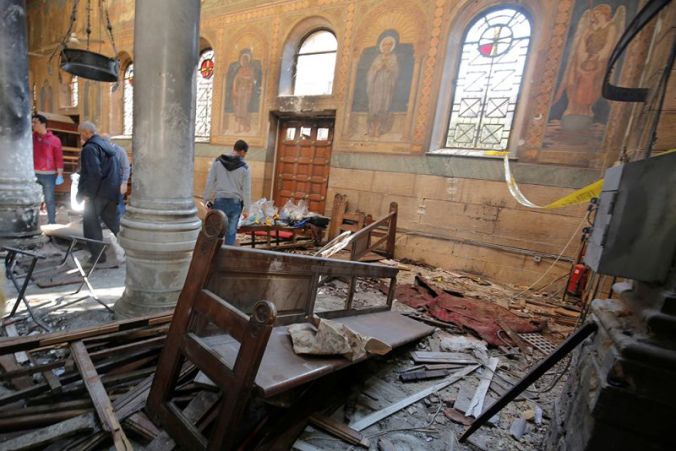
Yesterday morning we awoke to news of two Coptic Churches in Egypt that had been attacked by members of Islamic State, leaving more than 40 people including children dead, and many dozens injured.

There are groups prepared to take the lives of innocent people, self-acclaimed martyrs. They are of course nothing more than nefarious murderers following their view distorted of God. Martyrdom however is not an abhorrent idea in every circumstance. Martyrdom is the giving of one’s life to the idea that most captivates our hearts, usually with a religious connotation. There are, for examples martyrs who die for their faith in God, not through committing violence but for living in response to the love of God. In this case, the Coptic Churches in Tanta and Alexandria are now stained with the blood of 47 dead who had gathered to worship and praise the Son of God. It was Palm Sunday, the day Christians remember the Lord Jesus entering Jerusalem, his own city, where he would in a few short days be put on trial and crucified. It was the 26th attack of Coptic Christians this year.

egypt-coptic-church-bombing

Christian Post

These stories are no longer unusual occurrences, and only very few of these attacks make the news in Australia. From Turkey to Pakistan, from Egypt to North Korea, and Nigeria to Burma, literally millions of Christians face the prospect of social exclusion, imprisonment, and sometimes death.

Killing Christians is an act of evil futility because God’s love for his people cannot be broken. Death is not to be scoffed at, for it separates us from family and friends. Death is the great divider, and yet God has overcome it by the events of that first Easter.

In an extraordinary moment recorded in the Scriptures, John the disciple is given a glimpse of the reality of heaven, and there he is shown those who have suffered and died in their love for Christ:

These are they who have come out of the great tribulation; they have washed their robes and made them white in the blood of the Lamb.  Therefore,

“they are before the throne of God

    and serve him day and night in his temple;

and he who sits on the throne

    will shelter them with his presence.

‘Never again will they hunger;

    never again will they thirst.

The sun will not beat down on them,’

    nor any scorching heat.

For the Lamb at the center of the throne

    will be their shepherd;

‘he will lead them to springs of living water.’

    ‘And God will wipe away every tear from their eyes.’” (Revelation 7)

My prayer this week for my Coptic brothers and sisters is that they, in the midst of unspeakable grief, might know this promise of the certainty of God’s love in Christ.

Christ Jesus who died—more than that, who was raised to life—is at the right hand of God and is also interceding for us. Who shall separate us from the love of Christ? Shall trouble or hardship or persecution or famine or nakedness or danger or sword?  As it is written:

“For your sake we face death all day long;

    we are considered as sheep to be slaughtered.”

No, in all these things we are more than conquerors through him who loved us. For I am convinced that neither death nor life, neither angels nor demons, neither the present nor the future, nor any powers, neither height nor depth, nor anything else in all creation, will be able to separate us from the love of God that is in Christ Jesus our Lord.” (Romans 8:34-39)

The Apostle Paul who wrote these words was not immune to religious zealots chasing after him and wanting his death. Tradition has it that Paul, following an imprisonment in Rome, was one of the multitude of Christians who were put to death during Nero’s reign of terror.

While Egypt, Syria, and a hundred other places are scrubbing the blood from their floors, Aussie homes are vacuuming little scraps of metallic paper used to wrap easter eggs. To the majority of Australians Easter is now little more than a festival of chocolate and a 4 day long-weekend. It is an excuse for a camping trip, perhaps with a little religion sprinkled into the mix. Of course, both the chocolate and the weekend are pretty irrelevant (enjoyable but inconsequential), but the historic events that formed Good Friday to Easter Sunday are not.

Many Western societies are turning our backs on Christianity, to our spiritual, moral, and intellectual detriment. After centuries of economic, political, technological and military progress we have gained the world, but lost our souls.

It is true that Christians like we in Australia, are sometimes known for beating up the persecution drum. We mustn’t overstate the case of our own experiences: it’s not a broken leg, it’s a mild sprain. It’s not a heart attack, it’s indigestion. It’s not nothing, but neither is it what many Christians around the world are experiencing. The absence of physical violence doesn’t mean however that we are not witnessing significant cultural and theological shifts; it may be not Islamic terrorism, it is post-Christian authoritarian secularism, and these changes are not inconsequential for those who are and will be affected. For example,

  • we no longer have free speech, but costly speech. If you speak up in the public square it will come at a cost
  • Many Christian families are feeling pressured to take their children out of public schools.
  • In the work place employees may be forced to subscribe to particular views on marriage and sexuality.
  • workers may be forced to choose between employment or association with the Christian organisation of which they are members.
  • Businesses that support a biblical view of marriage will suffer financial loss, and be targeted for abuse.

It is not only the mass killing of Christians that has captured international attention this the past week, a few days earlier almost 100 Syrians were killed in a chemical attack, by their own Government. The New York Times reported the story of a Father who buried his wife and two young children, whose had their lives suffocated. There are no words to describe the distressing photographs which show this man embracing his dead children.

The world needs Divine retribution and Divine forgiveness. But how can we have both? Justice and mercy, judgement and grace? In all the history of the world, and among all the ideas and actions of this world, it is the event of Easter that promises the impossible.

To understand the world in which we live, we need a hermeneutic grid that is trustworthy and good; the cross of Jesus Christ is that interpretation. The cross reveals human depravation and hope more than any event in history, and the cross also reveals the character and purpose of God like no other.

Easter has become many things to many different people, but one thing it is not, and that is, trivial. While we in the West play games with fluffy bunnies, egg hunts, and another long weekend, the world is bleeding. The real Easter does not offer banal or token offerings to confirm of individualistic pursuits, but instead reveals God who ‘so loved the world that he gave his one and only son that whoever believes in him will not perish but have everlasting life’ (John 3:16).

God showed love not by changing a few coloured light bulbs on a national monument or by trending a hashtag on twitter; the depth of this love of God was the substitutionary death of his only Son. God came into his own, the incarnation. He paid the penalty for human insurrection, the cross. He triumphed over the grave, thus vindicating his claim of Divinity and the efficacy of his salvific power, the resurrection.

The extent of this love of God is for the world. John 3:16 does not suggest a universal salvation, for the text makes clear that faith in Jesus is necessary and rejecting Jesus Christ results in judgement. Nonetheless, in Christ, God has expressed extraordinary love for the world. He is not of or for the West, he is not English speaking or the God of the middle class, his concern is global. The Bible describes this God in ways unparalleled in any religion and in ways more tangible, and with a good news message that is changing hearts and lives in every nation on earth.

Time for Repentance

“For certain people have crept in unnoticed who long ago were designated for this condemnation, ungodly people, who pervert the grace of our God into sensuality and deny our only Master and Lord, Jesus Christ.” (Jude 4)

We are appalled and shocked, although sadly not completely unsurprised. The Royal Commission yesterday released statistics relating to child sexual abuse in the Roman Catholic Church of Australia, and the read is sickening.

The Royal Commission disclosed that a survey conducted by the Australian Catholic Church found 4,500 alleged cases of child abuse within their organisations. This number reflects claims made between January 1, 1980 and February 28, 2015, and it also excludes cases that were not investigated.

OLYMPUS DIGITAL CAMERA

There are few significant organisations in the country that have not discovered someone who has abused a child; my own Baptist denomination is not without known cases. Jesus warns us about the log in our own eye, and the Scriptures also call Church leaders not to treat gross sin lightly. We anticipate people will try to infiltrate all kinds of organisations in order to scope and prey on innocence; this is not to excuse due organisational diligence, but this world holds insidious individuals who will attempt to circumvent the highest standards. Having said all that, this new data communicates what we perhaps already knew, and that there is a major flaw in Roman Catholic attitudes, brought about in part by flawed theological belief and practice. While any instance of child abuse is repugnant, there is a difference between isolated cases of abuse and a culture of abuse.

7% of catholic priests serving between 1950-2009 have been identified as alleged perpetrators. The current known number is 1,880 men. Among some Catholic organisations the percentage is considerably higher: 22% of ‘Christian Brothers’, and 40.4% of those belonging to the order of ‘the Brother of St John of God’ are known to be sex offenders.

The issue extends beyond the fact that thousands of children have been abused by priests, but that Catholic Dioceses (and other denominations) have also failed to properly address allegations and the clergy in question.

This is a national catastrophe.

Abusing children is unacceptable for any person belonging to any community group or society, and sadly it is occurring even now in many family homes across our suburbs and towns; it should not be. The Royal Commission has disclosed child abuse in schools, sporting clubs, Government organisations, and across religious groups. There is however something particularly evil about the presence of such sin among communities who profess Jesus Christ.

It would be unwise for me to speak to many of the points that are being made at the Royal Commission, not because one doesn’t have strong reactions, but one needs to recognise that there are complexities being addressed, for example, issues relating to reporting processes and investigations. Without reading all the material and having due knowledge of many legal affairs, it would be imprudent to comment on many particulars. The last thing one wants to do is add confusion or cause further pain for people involved in the Royal Commission, especially to the victims.

And yet, something needs to be said. Is this not one of the cries being levelled at institutions, that for too long they have remained silent and ignored the extent of the issue?

As a parent with three children I can imagine what many Aussie parents are thinking about these revelations, and these thoughts are not cordial. There are feelings of disgust toward the perpetrators and toward ecclesial authorities who have repeatedly failed to investigate and protect. There are feelings of sorrow for those whose childhood was snatched from them.

As a Christian and as a Church minister, I am angered that men would betray children under their care and that they would so disdain the name of Jesus by their gross sin. It is beyond reprehensible.

“For certain people have crept in unnoticed who long ago were designated for this condemnation, ungodly people, who pervert the grace of our God into sensuality and deny our only Master and Lord, Jesus Christ.” (Jude 4)

As much as we may point out that these priestly behaviours are irreconcilable with authentic Christianity, for they certainly contravene the person and teaching of Jesus Christ in every way, and yet we must appreciate that this issue has understandably tainted peoples trust in Churches. I can also see how many Australians don’t differentiate between Roman Catholicism and Christian Churches, for their are correlations, but there are also stark differences, which pertain to deeply held theological views that are proving to be unbiblical and untenable, such as Rome’s view of the priesthood.

Christians mustn’t give up being like Jesus, we need to become more like him. In the same short New Testament letter of Jude, where Christians are urged to look out for potential abusers in our churches, a few verses later we are also encouraged to ‘be merciful to those who doubt’.  This is not a time for defensiveness, but repentance, public repentance. 


Kids Helpline 1800 55 1800

Lifeline 13 11 14

Post-truth hits NSW

At a time when many people are rightly questioning facts and figures, and rolling our eyes at the concept of ‘alternative facts’, surely it is incumbent upon us to tread with great care before casting allegations into the public sphere.

In the space of 4 days, the same newspaper, Newcastle Herald, has published an astonishing 5 articles by the one journalist, talking to the same topic, Scripture Classes in NSW schools. There is little development of the story across these pieces, they are mostly repeating the same negative rhetoric toward SRE.

Given the nature of the accusations being made, it is important that the public is given balanced reporting, with opportunity for alternate views to be expressed. Sadly, such balance is absent in these articles. We read of a string of protagonists who are  quoted at length, but with no SRE supporters quoted at all (with one exception being a Youthworks statement from their website). Is this story so obvious and one-sided? It is one thing to find a couple of dissenting priests, one who is known for his dislike of orthodox Christianity and therefore is hardly representative of mainstream Christians in NSW. Why not ask the many clergy who support SRE? The one-sidedness of these stories is enough to sink a battleship!

A poll was attached to one of the articles, conducted by Fairfax and asking the question, ‘Should scripture in state schools be suspended until the NSW government releases its scripture review?’ Over 73% of the 5000+ respondents answered no. The cynical side of me suspects that this poll was placed in the middle of the article in order to garner wide public support for suspending SRE, except it fell flat.

Some of the allegations are relatively minor, but others are most serious. Of gravest note is the implication that Youthworks’ Connect material has been involved in the Royal Commission into child abuse, and that the material is creating space for ‘grooming. This is fallacious and slanderous. Child abuse is a national moral issue and allegations cannot be treated lightly or flippantly. The media, and any person for that matter, should refrain from drawing ties to abuse when there is no evidence, and should there be evidence, surely the authorities including police must be informed.

One of the two articles published this morning begins by stating,

“SCRIPTURE in public schools is not an issue about religious views or what you believe about the historical accuracy of the Bible, which is where a lot of the argument seems to settle these days given the heavy involvement of evangelical Christian churches.

The scripture debate is about a more basic issue than that – child protection.

For more than three years the Royal Commission into Institutional Responses to Child Sexual Abuse has considered how institutions – churches, schools, sporting organisations, welfare providers, government departments, police, the justice system – have responded to child sexual abuse.

What can be said today, without any doubt, is that an institution with responsibility for children that fails to make child protection the top priority, is an institution where children are potentially at risk.” (Newcastle Herald, Feb 2nd)

It is astonishing to see a newspaper publishing not just sensationalism, but defamatory and slanderous claims. If I wrote an article linking an atheist group to child abuse, without clear evidence, I should expect to find myself in trouble.

Truth telling works both ways. SRE providers have a responsibility to work within the parameters set by Education Departments, and to ensure their material is age appropriate. When we make mistakes we must be eager to correct them. Evidence shows us that SRE providers continue to  work well with Education Departments in fulfilling all righteousness. The Queensland review is a clear example that the system is working well, with Youthworks taking ownership of poorly worded material and being quick to amend it.

I understand that not everyone likes the Bible and Christianity, and that some Australians have a view that such things don’t have place in a secular education. It is one thing for people to disprove of Scripture classes, but it is quite another to engineer false claims in order to have these classes suspended altogether. As it became apparent in Victoria, the agenda was not to suspend classes, but to remove Christian ideas and thinking out of schools completely, and the NSW public should not be tricked into thinking that those orchestrating the campaign are intending anything less.

We should also remember that no child is compelled to take SRE classes. Families have freedom to participate or not. That many thousands are choosing to enrol their children into the classes (I believe these numbers are growing in some schools), signals that not only SRE’s popularity but also the public wanting this curriculum for their children.

Perhaps leaders of the anti-SRE groups might consider arranging a face to face meeting with SRE providers? Would that not be more constructive rather than using newspapers to throw around out-dated and misinformation?

If we truly care for our children’s well being (and I’m sure that this is the case for people across the different perspectives on SRE), surely it is in our best interest to avoid false facts and stick close to what is true. 

This morning, as I read the Newcastle Herald, I remembered how a group of agitators conspired against Jesus. He did not retaliate or compromise integrity, he stood firm but not arrogantly, but with conviction and love, even for those who were accusing him. It is disingenuous to create an air of suspicion and fear by misrepresenting the facts and not publishing  balanced views. We should expect a higher standard of our media, but regardless of how Christians are portrayed, we must continue to graciously pursue what is good and right and noble.

“If I said something wrong,” Jesus replied, “testify as to what is wrong. But if I spoke the truth, why did you strike me?” (John 18:23)


Below is a copy of the corrections that Youthworks released yesterday:

“We also submitted a correction request to the Newcastle Herald this morning, asking them to address serious inaccuracies and misleading statements regarding Connect and SRE more broadly. We are still yet the hear back from their editors.

Here are the changes we’ve asked for:

1. The Connect material never encourages students to have secrets with their SRE teachers or other adults.

2. The use of the term “Special friends” was used in the context of describing someone who is a follower of Jesus – “Jesus was asking Matthew to be one of his special friends” and “Jesus calls us to become one of his special friends”. Education Queensland acknowledged that while they understood the context – a child-friendly translation for Jesus’ disciples – the term was unsuitable in context of child protection, and asked CEP to use an alternative (p. 11 of the Education Queensland Review). There is no suggestion in the material that students should have special friendships with adults. The term has taken on a particularly insidious connotation since the Royal Commission into Institutional Abuse and will be removed from future SRE material.

3. The Education Queensland Review never accuses or suggests that Connect encourages grooming behaviour, but provides recommendations where language and terminology has been unhelpful in this context.

4. The insinuation in the story that SRE has been a feature of the Royal Commission is untrue and intentionally misleading.

5. The articles contain a decontextualized quote asking about a man born blind: “Was it a punishment from God because his parents or someone else had done something wrong?” which is used to imply that the curriculum links disability (in this instance, a man’s blindness) with sin. The quote in its actual context is a question asked of Jesus in a Bible passage, to which he immediately responds “No”. At no point are students asked this question, nor are they asked to evaluate disability in this context. Joanne McCarthy’s use of it is intentionally misleading and sensationalist.

6. The February 1 article makes no mention of the fact that the Education Queensland review found the “vast majority of Connect materials are consistent with legislation and policy concerning religious instruction”, nor that changes have already been made to the material which were reviewed by Education Queensland.

We eagerly await their reply.”

Here is the link to a statement published by Youthworks, also dated February 2nd: https://www.youthworks.net/press_centre/response-to-connect-articles-1-2-17


Update February 4th. The Herald today published another article by the same journalist, also speaking to the topic of the Royal Commission but this time there is no mention of Scripture Classes and their providers. I am only mentioning this update because in sharp contrast to the previous days articles, this one was well written and substantive.

http://www.theherald.com.au/story/4445757/church-prospects-grim-while-abuse-culture-remains/