Does Daniel help Christians respond to the NSW Conversion Laws?

The NSW Parliament last week adopted a set of laws prohibiting the conversion of or suppression of peoples sexuality orientation and gender identity. The laws are not as extreme as those in the State of Victoria, nonetheless, there is clear government overreach. 

Yes, these new laws in places are bad.  They are bad because they introduce needless restrictions on normal Christian faith and practice. They are bad laws because they are defending against practices that are mostly mythical. The laws are bad because they take a smidgen of truth and a lot of illegitimate and aggressive sexology (to use Stephen Mcalpine’s word). The are bad laws because the give Government greater authority over religion (which is an odd position for anyone positing that we are a secular country).

Associate Professor Neil Foster has written a helpful explanation of what the laws do and do not mean and where is ambiguity. I would encourage people to read Foster’s article in light of some misinformation that is floating around and being circulated as fact.

However, Christians have begun to respond to these new laws. I’ve noticed more than a few turning to the Old Testament prophet, Daniel, and have begun quoting that famous incident that landed him in a lion’s den.  I happen to think the story of Daniel is one of many helpful Bible places we can turn to as a guide and encouragement. But if we’re going to use Daniel ch.6 for our stump speech, there are a couple of details we need to first take into account. 

Firstly, what kind of presence are we in society? 

Notice how Babylon’s officials and powerbrokers describe Daniel,

 “At this, the administrators and the satraps tried to find grounds for charges against Daniel in his conduct of government affairs, but they were unable to do so. They could find no corruption in him, because he was trustworthy and neither corrupt nor negligent. Finally these men said, “We will never find any basis for charges against this man Daniel unless it has something to do with the law of his God.” (Daniel 6:4-5)

Daniel is a wonderful example to Christians today. There is something that particularly resonates with us about the life and times of Daniel for he was an exile living away from his home, as are all Christians today.  He is living and working in a context with foreign gods and ideas dominate the horizon and we’re worshipping God is part of a small minority. Part of the wisdom that we glean from the book of Daniel, and it is a book of wisdom, is how Daniel adapted to life in Babylon and worked hard and judiciously for the common good, and yes obeyed pagan Kings, yet without compromising faithfulness to the one true God.

There have been an inflation of open letters and public declarations of late, mostly from a particular quarter of the Christian faith. These are often highlighting genuine issues, but their content and tone often fall short of usefulness.  As someone who has had moments in the past when I’ve employed too many strong adjectives, I’m more conscious these days about precision and not overblowing a situation. It is advisable to read and research before putting your name to a public statement.

As the enraged mood takes hold of so many quarters of society, a Christian voice should be different, but sometimes it is as angry and hyperbolic and therefore indistuishable from others. For example, if your public record is filled with distain for authorities and governments and making antiauthoritarian claims whenever you disagree with a policy or law, when a legitimate concern finally arises, why would those in positions of authority listen to you? It’s like the percussionist in a Symphony Orchestra who is always smashing the symbols as hard as she can strike and often out of time with the rest of the Orchestra. Soon enough the orchestra is going to send you down to the basement and lock you out!

Who wants to listen to the guy who is always shouting at everyone? Who takes seriously the voices who are decrying every issue as a threat to freedom and democracy and religion?

Defiance seems to be the default modus operandi for too many Christians today.  However, this shouldn’t be our baseline approach to life in the world and it’s certainly not the way Daniel approached life in Babylon. 

There will be some other Christians who have no issue with the new laws in NSW and who are trying to con us into thinking that anyone criticising the law is pulling a furphy. I suspect they’ll be among those who volunteer to be part of the firing squad. 

Second, notice how Daniel responded to the unreasonable law.

“Now when Daniel learned that the decree had been published, he went home to his upstairs room where the windows opened toward Jerusalem. Three times a day he got down on his knees and prayed, giving thanks to his God, just as he had done before. Then these men went as a group and found Daniel praying and asking God for help. So they went to the king…”

Daniel continues with what was his normal practice.  He didn’t make a song and dance out of it. He simply continued to faithfully pray to God three times a day.

Daniel’s praying wasn’t attention seeking, or brash, he wasn’t revving up the social temperature or resorting to hyperbolic claims or allegations. The window was always open and he carried on as he had always done, with humility and faithfulness. 

The problem is, and I understand because I know the injustice of the Victorian laws,  too many people are wanting to be David swinging a rock at Goliath’s head,  rather than a humble Daniel who went about faithfully serving the Lord and serving the common good of the city where he lived. 

In case we think, maybe Daniel is just a one off, I’m about to start a new sermon series at Mentone Baptist on 1 Peter. With little imagination required, I’ve given our series the title, ‘Living away from home’. Like Daniel, Christians are exiles and sojourners, and Peter helpfully explains how Christians ought to live as exiles. In one place he says this, 

Who is going to harm you if you are eager to do good? But even if you should suffer for what is right, you are blessed. “Do not fear their threats; do not be frightened.” But in your hearts revere Christ as Lord. Always be prepared to give an answer to everyone who asks you to give the reason for the hope that you have. But do this with gentleness and respect, keeping a clear conscience, so that those who speak maliciously against your good behavior in Christ may be ashamed of their slander.For it is better, if it is God’s will, to suffer for doing good than for doing evil. (1 Peter 3:13-17)

There is a sense in which we are to embrace suffering for the Lord’s sake. And the manner in which we do also matters according to Peter.  Gentleness and respect…not resorting to malicious speech but with good behaviour. So like Daniel and Peter, choose faithfulness, and like Daniel and Peter (and Jesus), part of faithfulness is speaking and behaving with utmost integrity and with grace and refusing to be that clanging cymbal.

A letter to the Prime Minister about child gender therapy and a view to real mercy

“The Lord our God is merciful and forgiving, even though we have rebelled against him;” (Daniel 9:9)

100 notable Australians have written a letter to Prime Minister Anthony Albanese, calling for a federal inquiry into kids gender therapy. The list of signatories includes senior medical professionals, academics, and politicians including former Prime Minister Tony Abbott and former Deputy Prime Minister, John Anderson. Lest we think this is a partisan statement, the names attached to the letter belong across the political spectrum. 

I commend the letter to the Prime Minister, and indeed, to Victoria’s Premier Jacinta Allan. 

This letter has been written off the back of growing evidence that vulnerable children are being led to permanent life-altering procedures without sufficient medical or ethical reasoning. Earlier this week, the Queensland Government was forced to act and pause transitioning procedures on minors when a hospital was allegedly caught performing dangerous procedures on children as young as 12, without the consent of parents.  Also this week in the United States, President Trump signed an executive order, stopping Federal support for the gender transitioning of young people. 

These actions are but the latest of a growing number of Governments around the world who have pulled the plug on radical gender interventions. Denmark, Finland, Norway, Sweden, France and New Zealand are among the countries who are taking action to ban, or at least pause, medical intervention on children suffering from gender dysphoria.

It took the bravery of young people in Great Britain to sound the alarm, young adults who at the time were children and subjected to the transitioning movement in the UK health system. The result was the CASS review (2024). The doors were blown open and the UK Government was forced to shut down the Tavistock Clinic and hit the emergency button to stop pumping children with hormones, chemicals and even surgical procedures. Despite the preaching by gender progressives, evidence is scant (if not fabricated) that children are better off having body parts amputated or chemicals injected into their bodies. 

The days of using children in the service of gender theories are numbered. I believe this is one of the great evils of our time, for it cuts against the very nature of being human, and being male and female.  It is to our shame that our society ever encouraged such ideas. Governments may wait until they are swamped with legal action or they can take the moral ground and take action now. 

Obviously, there are all kinds of important issues here. The note that I wish to sound in this particular article is one of mercy. Mercy is a word that has been used a lot over the past week in relation to gender and children. It is a word that can be used and misused, applied and misapplied, and so in light of the letter to Australia’s Prime Minister, I would like to add a word of mercy. 

The question of gender fluidity and children changing genders is often framed around acceptance and intolerance, affirmation or bigotry. Unfortunately, this kind of binary approach is unhelpful and is often untrue. It isn’t hatred to affirm biology and to believe that biology determines gender. Neither is it intolerance to appreciate that there are children (and some adults) who struggle to accept their physical bodies and the gender that comes with that. Words matter.

We need to differentiate between these children who deserve our love and care, and those who promote the ideology of gender fluidity and who are responsible for inflicting lifelong damage onto these children. 

For example, when Bishop Mariann Edgar Budde recently called for mercy and compassion, she wasn’t asking Americans to save children from gender therapy. She was calling on President Trump to affirm their gender confusion and enable the very social and medical processes that we know to be unethical and harmful. The Bishop may have used some of Jesus’ language but her meaning is a world apart from the kind of mercy Jesus offers and that we all need.  We may or may not approve of President Trump and much of his character and rhetoric, but his latest executive order is sensible. As the letter to the Prime Minister demonstrates, the concerns are not left or right, but moral and medical. 

I realise that there are some who have caste doubts over this interpretation of Budde’s views. But I am simply accepting her teaching. Words have meaning. The Bishop of Washington DC has expressed her views on sexuality and gender on other occasions, and lest she has experienced a Damascus road repentance in the last few weeks, her meaning in the sermon corresponds to her regular teachings. 

The notion of Divine mercy is too good and holy for us to revise or use in the service of political progressivism (and political conservatism). 

Mercy is showing kindness. Mercy is not telling children lies or encouraging them to believe in mistaken identities and shuffling them off to a hospital for puberty blockers and even castration. As the letter to the Prime Minister intimates, there are better ways. 

Mercy involves patience and love, and hope. Mercy doesn’t deny reality or brush aside physical or psychological anxieties but learns to sit and journey with someone until the light of day. 

As a Christian, mercy takes a Christ-like shape. I think of the episode when Jesus met a Samaritan woman (John ch.4). As far as society was concerned, this particular woman had 3 strikes against her name and so ostracising her was considered the right thing to do: She was a a woman, she was a Samaritan, and she had sexually broken past. Jesus didn’t follow those rules of engagement. Jesus didn’t reject her, he showed compassion. He engaged in conversation with her. He didn’t ignore or pretend that her sexual history was unimportant, but rather, Jesus went further and showed mercy. Mercy didn’t involve encouraging her to pursue sexual sin or impropriety. He revealed to her the hope of Israel and through this offered her living water that would quench her thirst forever. 

Churches who choose to mimic the message by Bishop Mariann Edgar Budde are more damnable than any other group in society, for they claim to speak in the name of God and offer faux mercy.

Churches, if your community is not already a safe place of truth and kindness, goodness and mercy, you are not ready to receive the growing number of young Australians who need to know of the hope of the gospel. If your view of mercy means accepting the culture’s latest gender theory, then your church is not ready to care for those who experience trauma and who are struggling with their body, mind and soul. 

What did the Apostle Paul say, 

“Therefore, I urge you, brothers and sisters, in view of God’s mercy, to offer your bodies as a living sacrifice, holy and pleasing to God—this is your true and proper worship.”

Prime Minister please listen to the concerns outlined in the letter. And Churches,  learn mercy from Christ and not from our culture’s talking points. 

As Jesus said, ‘go and learn what this means: ‘I desire mercy, not sacrifice.’ For I have not come to call the righteous, but sinners.’


Update: January 31st, 1:45pm, Federal Health Minister Mark Butler has ordered a “comprehensive review” into gender therapy practices for children in Australia. This is a good step. Let’s pray that it is indeed a ‘comprehensive review’. I will add, that until such review is complete, all such ‘therapies’ and practices should be paused, to avoid causing further harm to countless children

The Problem with Social Cohesion in Victoria

Victorian Premier Jacinta Allan has announced a new set of laws under the banner ‘social cohesion’.

‘Social cohesion’ when attached to government and laws has a touch of the Machiavellian about it. One doesn’t know whether to think it’s more like George Orwell or Monty Python! 

The Government’s initiative includes a new ‘social cohesion pledge’.  Any community group applying for government funding will need to make the pledge, promising to support social harmony and inclusivity. 

No doubt this is a testing time for any government. There are pressures applied from all kinds of directions, and at times this leads to inaction or delayed resolve. As we have seen over the past year, this has given more oxygen to antisocial, and in this case, antisemitic voices.

I think this specific set of government measures are sensible and necessary, but I cannot but help think that it may open the door to future measures that are unreasonable and damaging.

There is a cowardice hiding behind masked protesters.  There is an ugly hatred being propagated by some of the protests we have seen on Melbourne streets.  If you can’t protest without wearing masks, carrying threatening objects, and using disgusting slogans, maybe that should signal that you or your cause is a problem.

Victoria was never the perfect State, but we have witnessed developments over the past decade that are injurious and bring grief to many. We are less peaceful than we were. We are less inclusive and kind. There is more personal and social distress and with little sign of a turnaround. Melbourne has become Australia’s protest capital (not a title to boast about). Ever since 2020, when the government turned a blind eye to certain marches while slamming others, every Jane, Nguyen, and Bob has seen fit to grind city streets to a halt. Not a week goes by without banners and angry faces blocking traffic. 

I support these particular measures because antisemitism cannot under any circumstance be allowed to fester. If we think that our society is beyond and above 1928 Germany, we are suffering from a greater dose of egomania than I thought.

However, I am not comfortable with Jacinta Allan’s language of ‘social cohesion’. I get it; they are trying to address a specific problem without naming the elephant in the room. Why not call it ‘Rules for Safe Protests’ or something like that?

The reason why I’m uncomfortable about the Government’s language of ‘social cohesion’ is because the task of social cohesion doesn’t belong to the government, but to the people. When government sees itself as the answer to every social ill and when the people demand government to fix every crisis, we are obfuscating personal responsibility and creating systems of governance that cannot bear the weight of such responsibility. 

This is one area where the work of Dr Christopher Watkin is worthy of consideration. Monash University’s Dr Watkin articulates a positive and important work on contract theory. He says, 

“Civil society is sometimes the neglected dimension of the social contract, the “missing middle” as it has been called. We have a tendency to jump straight from government and law to the individual.

These civil society relationships across different visions of the good are a glue that holds our social contract together.”

From his book, Biblical Critical Theory

‘the vague and sporadic measures taken by contemporary governments to shore up the social contract with well-meaning but half-hearted attempts at “civic edu- cation” have little effect, when all the while billions of advertising dollars and a destructive paradigm of competition in all areas of society expertly catechize individual consumers to be little predisposed to the civic duties a strong social contract requires. No rewriting of the social contract can be complete without giving serious attention to its cultural and liturgical infrastructure.’

No Government is up for the job, and it’s not designed to be. Part of the problem embedded in any Government setting the rules for social cohesion is that this is never a natural space. This is one of the heresies attached to secularism. Secular may be preferable to Sharia Law and Christian Nationalism, but it is no more epistemologically and morally neutral. Secular is the sum of the worldviews present in and controlling the moral impulses of the day.

There are wonderful pockets of social cohesion is found in all kinds of places and communities across our State. There are sporting clubs and men’s sheds, and there are temples and synagogues. It is certainly experienced in local churches.

Churches are frequently more culturally diverse than the communities surrounding them. Where I have the privilege of serving and belonging, we have people from China and Uganda, families from Vietnam and India, Nigeria and Columbia. Young and old mix together, single and married are friends and serve one another. Of course, Churches have their failings and blindspots, (after all, the very point of Christianity is that there is only one perfect saviour and we’re not him!), and yet there is profound togetherness and other person-centredness. 

The Victorian Government is also currently working on expanding anti-vilification laws, which some are concerned will tighten the noose of faith groups from teaching and practising in accordance with their convictions. It’s amazing how often the State has assumed the bishopric role when Christian praxis hasn’t supported their social agenda. There is a mine of irony in Victoria where Government identifies a growing social disorder and yet clamps down on one of the few societal groups who are truly exhibiting positive social health and life. If we are interested in civil society, maybe we ought to return to the worldview that created the ideas and values from which this vision derives: Christianity. 

Well, it’s Christmas time, the ultimate day of truce-making, although that first holy night was filled with peril. Nonetheless, the hope born that night in Bethlehem really is the only hope we have today. Come, check out a local church and see that hope in action. 

Let me leave you with the great Messianic promise of Isaiah,

‘The people walking in darkness

    have seen a great light;

on those living in the land of deep darkness

    a light has dawned.

You have enlarged the nation

    and increased their joy;

they rejoice before you

    as people rejoice at the harvest,

as warriors rejoice

    when dividing the plunder.

For as in the day of Midian’s defeat,

    you have shattered

the yoke that burdens them,

    the bar across their shoulders,

    the rod of their oppressor.

Every warrior’s boot used in battle

    and every garment rolled in blood

will be destined for burning,

    will be fuel for the fire.

For to us a child is born,

    to us a son is given,

    and the government will be on his shoulders.

And he will be called

    Wonderful Counselor, Mighty God,

    Everlasting Father, Prince of Peace.

Of the greatness of his government and peace

    there will be no end.

He will reign on David’s throne

    and over his kingdom,

establishing and upholding it

    with justice and righteousness

    from that time on and forever.

The zeal of the Lord Almighty

    will accomplish this.’

The mistaken Baptist Guide

 The Victorian Equal Opportunity and Human Rights Commission has published, ‘A Guide for the Baptist Union of Victoria’. The ‘Guide’ relates to the Conversion and Suppression Laws adopted in Victoria 3 years ago.

The Guide was released 4 months ago and published on a Victorian Government website, and it is finding more public attention recently, including journalist John Sandeman reporting on it today.

This Government document is problematic and because of growing awareness, it is worth highlighting some of the issues.

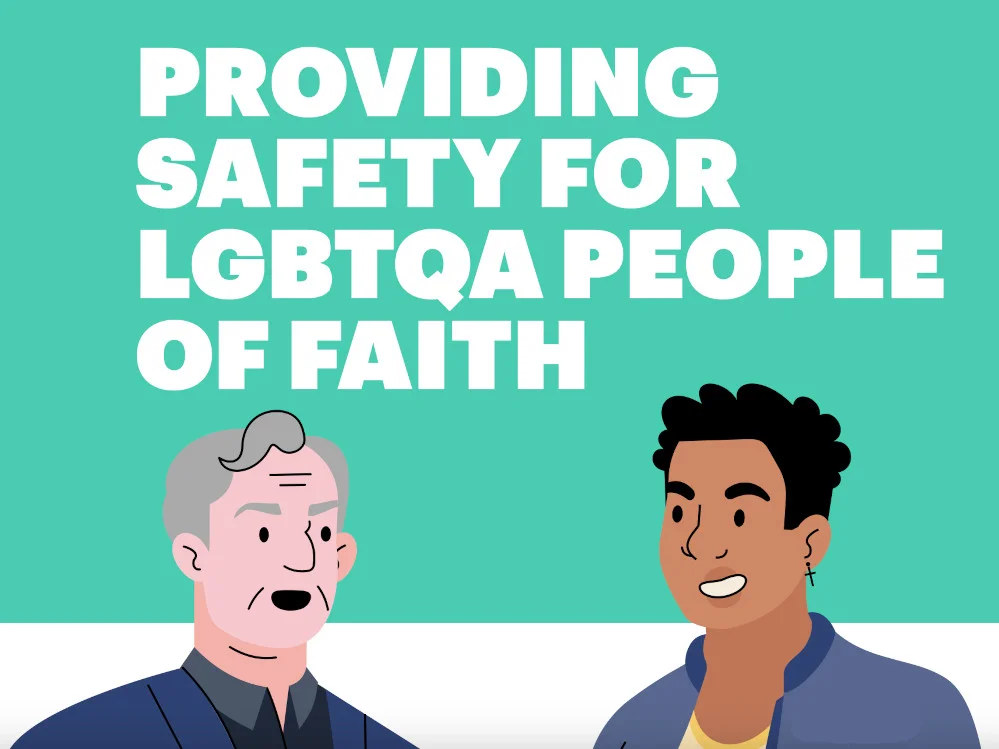
The name of the Guide is confusing and highly questionable. The Baptist Union of Victoria Assembly has not discussed or agreed to such a Guide. However, the Victorian Human Rights website, states,  ‘We have developed the Providing Safety for LGBTQA People of Faith guide with and for faith leaders in Baptist Union of Victoria churches”’. 

On the one hand, this is not a Baptist Union of Victoria document, however, the BUV name is all over it. For example, 

  • The title, “A Guide for the Baptist Union of Victoria’.
  • The Victorian Human Rights website, states, “We have developed the Providing Safety for LGBTQA People of Faith guide with and for faith leaders in Baptist Union of Victoria (BUV) churches”
  • The  ‘Guide’ states, “The Baptist Union of Victoria (BUV) recognises that Baptist communities hold a broad range of views about matters of gender and sexuality”. 
  • The BUV agreed for the HRC to write the “Guide”.
  • Multiple BUV personnel and pastors met with and provide information and ideas to the HRC.
  • The Guide acknowledges assistance from BUV and baptist members.
  • THE BUV is using and promoting the document.
  • The BUV is now running seminars run by HRC.

 My understanding is that the HRC approached the BUV and BUV personnel gave permission for this project. They then provided ideas and information to the HRC.  The HRC is now using this Guide to promote the conversion/suppression laws, and as the commissioner states, we hope other Christian denominations will follow the Baptist lead. 

Ro Allen, Victorian Equal Opportunity and Human Rights Commissioner, wrote the forward which includes this explanation, 

“The CSP Act does not stop anyone from holding beliefs about sexuality or gender, or having conversations with others about those beliefs – it prohibits causing harm to others by trying to impose beliefs to change someone’s gender or sexuality. This is a law to prevent harm. 

Change or suppression practices are actions based on the ideology that there is something wrong or broken about being lesbian, gay, bisexual, transgender, queer or asexual (LGBTQA), which this law says isn’t true….

The BUV community has been among the first to step up and work alongside the Commission to provide clear support and guidance to its faith leaders and congregations. Over time, we hope to do the same with other Victorian faith communities.” 

The Guide is confusing to the outsider and indeed to Baptists, who understandably assume that this is a Baptist document and one that Baptists affirm.

The 48 page Guide proceeds to give advice to churches and to pastors about how to respond to questions/issues surrounding a person’s sexual orientation and gender identity. At times the document acknowledges a dissonance between formal Baptist teachings/positions and the law, but then it also says things like, 

“The Baptist Union of Victoria (BUV) recognises that Baptist communities hold a broad range of views about matters of gender and sexuality.”

This dissonance within the BUV now manifests itself in a Victorian Government document, and that is a problem.

The Guide affirms all the latest iterations of sexual and gender expressions, and nowhere affirms the moral goodness of Baptist and Christian views on sexuality and gender. Of course, it can’t because the very fabric of these laws aims to disqualify Christian beliefs and practices on these issues. Instead, the Christian understanding of sexuality and gender is defined in negative terms right throughout the document.

In addition, the Guide encourages churches and pastors to seek advice from affirming churches and provides a list of LGBITQ websites for churches to use.

The dissonance is aired like a screeching car brake. As John Sandeman has highlighted,

The guide outlines restrictions on Baptists and other religious leaders on discussing sexuality and gender identity with LGBTQA persons imposed by the Change or Suppression (Conversion) Practices Prohibition Act 2021 (CSP Act). It acknowledges that the BUV takes the position that “Marriage is the union between a man and a woman to the exclusion of all others, voluntarily entered into for life.” and that “BUV shall not ordain persons who engage in homosexual practice.” The guide says that these statements of belief, and others can be made generally or in sermons and Bible studies, but not when “not targeted at an individual to change or suppress their gender identity or sexual orientation.”

There we have an example of where Baptist practice contradicts the intent behind Victorian Law. 

For Christians, sex is a beautiful gift from God and that is to be enjoyed within the constraints of marriage between a man and a woman. The Guide explains that while a church or pastor is free to explain formal doctrine in a theoretical sense, they are not permitted to address it to any individual or to insist upon it for any church member. Even praying with an individual who requests prayer, is illegal.

I don’t want to repeat everything I’ve said in the past about these laws. There are aspects that I affirm and others that I cannot, because I’m a Christian. Readers can find those comments easily enough. I will say because it is important and you may not want to read older articles (fair enough): Christians following Jesus (is there any other kind?) will love others and seek their wellbeing. The only message we have is the one we have received and that is of the righteous and loving God whose Son gave his life as ransom for many. God doesn’t pick the do-gooders, he loves those who realise they are deeply flawed. Sometimes, churches forget this. At the time when these controversial laws were being debated, I was among other Christian leaders who acknowledged there have been examples of dreadful attitudes and behaviour toward people who don’t identify as heterosexual. These may not be commonplace, but some people have been terribly mistreated. For that, churches ought to repent. Around 2019, I learned from a journalist how a few fringe religious groups practised ‘conversion techniques’, which were often adopted from mid-20th Century psychiatry, not from the Bible. The Victorian Laws go well beyond prohibiting such awful and dangerous behaviour; prayer is banned and talking with an individual about sex and gender is prohibited, unless the content of your message conforms with whatever is the latest iteration of sexual ethics from LaTrobe. That is staggering, and it’s all the more astonishing given the worldwide exposure of the abuse toward minors with gender dysphoria by State sponsored institutions.

Don’t misunderstand, there is merit in explaining the law, however, this Guide does much more. It contains ideas and advice that is contrary to Scripture and our pastoral responsibility. It is targeting Baptist Churches and for some reason, the BUV thought it wise to give them ammunition and the target. Baptists used to believe in the separation of church and state! This is a Government produced document designed to shape how our Baptist churches think about sexuality and gender issues. Arguing otherwise is simply not believing the authors’ words.

The thing about the Christian Gospel is that it is about conversion. By definition, Christianity is a conversion religion. Jesus calls people to ‘repent and believe the good news’.  Of course, it doesn’t mean someone who is same-sex attracted all of a sudden wants to marry someone of the opposite sex; that’s not the Christian goal. As many same sex attracted Christians testify, the desire and aim is to be godly, and that includes honouring God with our bodies and relationships. Sure, that may not be a common view in our culture, but in an age where we are beginning to realise that ‘you do you’ isn’t always good and it doesn’t really satisfy, there is something new and intriguing about the old time Bible vision for human flourishing.

In contrast to NSW Baptists who have taken positive action in recent years to confirm Christian belief and practice, imprecision and trying to mimic the Archbishop of Canterbury has an adverse effect on Gospel unity and mission success in Victoria. That ought to grieve our churches.

It is unfortunate, to say the least, that there is now a public document confusing people about where Baptists stand and what we believe. I have already had a member of another Christian denomination contact me because s they were perplexed and couldn’t understand why the BUV would participate in such a project. Not only is this Guide confusing people (both outside and inside baptist churches), it’s almost like handing over a noose for Baptists to hang themselves.

To be clear once again, this Guide is not our guide. It is not a Baptist Union of Victoria document. It is the unfortunate result of a few well-meaning Baptists taking the bait from the HRC.

It is my hope that we Victorian Baptists serve and love our neighbours well, always holding out the Gospel of life, and clarify and confirm that this is not our Guide. 


15 December update:

John Sandeman has spoken with the VEOHRC. This added information only adds weight to concerns that have been raised with this ‘Guide’. This issue is consequential for all Baptist Churches and Pastors in Victoria – https://theothercheek.com.au/a-disturbing-question-about-the-vic-baptists-and-the-conversion-law/

12 Dec update:

David Devine from the BUV Office has spoken with John Sandeman and offered a perspective on the Baptist Union’s role in the publication of the Human Rights Commission’s ‘Guide for the Baptist Union of Victoria’. 

David is a brother in Christ. 

His comments confirm what I have written above and underscore the important issues I have raised. 

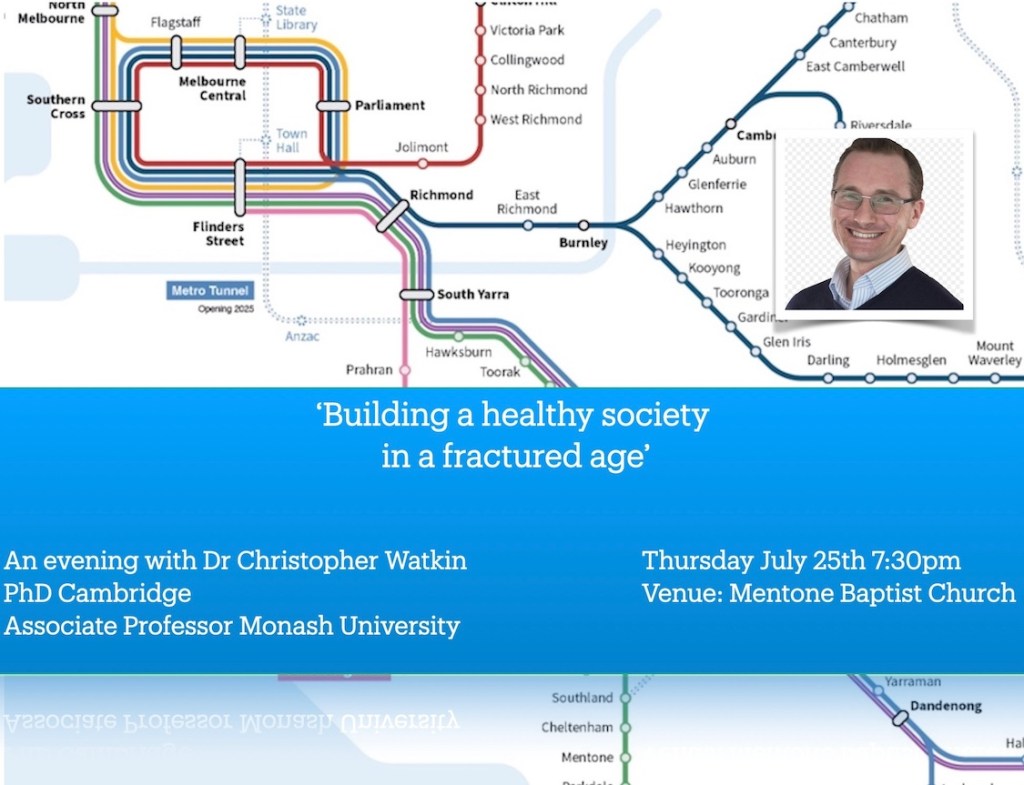
Christopher Watkin speaks on creating a healthy society

On July 25th at Mentone Baptist Church, Dr Christopher Watkin will be addressing one of the key social issues facing Australia in the 2020s:

‘How can we build a healthy society in a fractured age?’

Australia is wrestling with important issues surrounding religious and social freedoms and responsibilities. Dr Watkin will help us navigate a way forward.

In 2021, Chris addressed political and community leaders in Parliament House, Canberra, outlining a positive vision for civil society. It’s a great opportunity for Melbournians to engage with ideas that can shape tomorrow.


Dr Christopher Watkin is the ARC Future Fellow at Monash University. He is the author of the award-winning book, ‘Biblical Critical Theory’ and numerous other volumes including, ‘Difficult Atheism’.

Reserve your tickets today:

https://events.humanitix.com/building-a-healthy-society-in-s-fractured-age

Letter from 6 former Australian Prime Ministers is historic and important

We live in an odd society here in Australia. Part of us thinks that growing up means ridding ourselves of God and all those Bible verses that we find so constraining. And yet we haven’t found an alternative to provide the necessary robust foundations for moral living and a sharper and more stunning hope for ultimate peace and righteousness.

Yesterday afternoon (October 30), six former Prime Ministers of Australia released a statement. John Howard, Kevin Rudd, Julia Gillard, Tony Abbot, Malcolm Turnbull, and Scott Morrison. These former national leaders represent different sides of the political spectrum. Through the years, they have expressed strong and opposing words to undermine each other and their respective Government positions. However, today, they are standing with one voice.

I do not recall another occasion where this significant number of former national leaders of Australia signed a letter with such force, unity and concern. This is a rare and historic moment and ought to cause Australians to consider the very real and dangerous and ugly antisemitism that is spilling onto streets and social media around the world, including here in Australia. 75 years ago the world declared, ‘Never again’, and yet from university campuses to political representatives and crowds, we are hearing cries for Jewish people to be destroyed.

In the midst of an Australia that is becoming more divided and fractured, these former Prime Ministers have laid aside differences and produced a timely and vital declaration that I urge Australians to read and take with the seriousness they are conveying. They express deep concern at the antisemitism on display around the world and at home. They offer clear and unapologetic condemnation of Hamas and their evil, both upon Israel and their own people in Gaza. They also call on Israel to abide by international conventions as they exercise their right to destroy the terror network.

Returning to my opening reflection, as our former Prime Ministers seek to lead by example, they turn to the Bible for example and help. They quote Psalm 34, which forms part of the Scriptures for both Jewish people and Christians. 

“Seek peace and pursue it”

I find it odd and somewhat shallow when inner suburbanites yell at Christians and tell them to keep their Bible out of public issues. They make an exemption when Christian words seem to support their progressive (or conservative) agendas, but as soon as dissonance returns, the demands for silence come back with pugnacious certainty. Of course, sometimes Christians say unhelpful things and misuse the very Scriptures that shape us. There are times when the Christian perspective is neither left or right, progressive or conservative; indeed, this is most often the case. There are times when Christian wisdom displays a properly diagonalised view, which avoids false binaries and compromises. This is why a Christian perspective is sometimes misunderstood and or unwanted. There are also occasions when not speaking is the right thing to do. I do not, however, see how we can remain silent as the noise of antisemitism grows in Melbourne, Sydney and elsewhere (the same is true when our Muslim neighbours are targeted and abused).

It is worth noting that in October 2023, as the world witnesses horrific evil and growing unrest, six former Prime Ministers lean upon the Bible for guidance and moral impulse. I am encouraged and would encourage others to also lean in.

As we do, the Scriptures push us even deeper, not letting us settle for a consolation built on myth or vapor-like hopefulness. Words are just words if they are not conveying concrete truthfulness and goodness. Like a Shakespearean Sonnet with sonorous beauty or a Hallmark Card, they form a heart without a pulse. As the Apostle Paul dares to insist, if Christ has not been raised, we are to be pitied by all men, and our faith is an exposé of ignorance.

The phrase borrowed by our former Prime Ministers, Psalm 34, has more to say that is worthy of consideration and which provides reason and guts to the search for peace. For example, the full sentence of verse 24 says this, 

“Turn from evil and do good;

    seek peace and pursue it.”

Immediately following this statement, the Psalmist provides a framework for substantiating peace,

“The eyes of the Lord are on the righteous,
    and his ears are attentive to their cry;

but the face of the Lord is against those who do evil,
    to blot out their name from the earth.

The righteous cry out, and the Lord hears them;
    he delivers them from all their troubles.

The Lord is close to the brokenhearted
    and saves those who are crushed in spirit.”

There is evil in the world. There is also sin in each one of us. Modern Australia often tries to wipe away moral absolutes and considers categories like sin and evil as the language of oppressive Christians. Yet, time and time again we fall back into biblical language and concepts to articulate what we see and feel and know intuitively. Lean more attentively.

“Seek the LORD while he may be found; call on him while he is near” (Isaiah 55:6)

Never Again

The world said, ‘Never again’. Following the Holocaust, where 6 million Jews were slaughtered, guilt, conviction and repentance led much of the world to exclaim, ‘Never again’. Most people believed the words, and yet today, in the year 2023, that promise is losing confidence and support.

Two weeks have passed since the terror attack on Israel killed 1400 people and left thousands injured, and more than 200 as hostages. It is not the condemnation of Hamas that surprises, but the support for Hamas that is rallying voices in cities worldwide, including Australian cities.

A friend of mine, as she tries to make sense of what is happening, made this remark, 

“Over the last week or so it’s dawned on me how much I’ve domesticated Satan in my own thinking. Yes he is the subtle tempter. But he is also the blatant protagonist of violence, clamour, hatred, cruelty & death. And he’s currently having an absolute field day. God have mercy.”

Indeed, Lord have mercy. 

What we are witnessing around the globe, from Melbourne to New York, Sydney to London, are scenes that harken back to the darkest moments in 1930s Germany. Of course, the geopolitical situation is not analogous, and yet a deep and vile hatred toward the Jews is manifesting. These are not quiet murmurs but public and vocal, and at times the anti-semistim is lauded by crowds and even by political and so called ‘erudite’ groups.

We can try and explain away some anti-semitism by suggesting it’s just the fringe. When the forecourts of the Sydney Opera House witnessed a mob shouting, ‘Gas the Jews’, and when young Jewish men were threatened on the streets of Melbourne with ‘I’ll kill you’, our minds calculated that these are the words of the tiny few.

The world has seen footage of children in American schools chanting, ‘“From the River to the Sea, Palestine Will Be Free”, a saying that means eradicating Jewish people from the land of Israel. 

Bari Weiss’ office was defaced over the weekend with ‘F#ck the Jews’. 

There is story after story.

Lest we think that the awful language is limited to a few thugs, there are politicians and academic institutions supporting Hamas against Israel. Many Universities and Colleges in the United States have produced statements in support of the Gaza ‘uprising’ and condemning Israel. 

Harvard University, for instance,  is considered one of the world’s leading institutions of education. Yesterday, the halls of Harvard were filled with students supporting Palestine against Israel. This followed a letter that was signed by 30 student groups at Harvard blaming Israel for the atrocities on October 7. They didn’t even wait for the dead to be counted before asserting,

We “hold the Israeli regime entirely responsible for all unfolding violence”.

So, Hamas terrorists are not responsible for raping, kidnapping, and murdering innocent civilians but somehow they are justified or simply victims being swept up in a moral fight against their oppressors? Apparently, a few of these student groups have since rescinded their support of their letter, saying that they hadn’t read the letter carefully. 

Sydney’s Town Hall plays to all manner of social causes and lights up to display solidarity, and yet the Mayor of Sydney has blocked the attempt to show the blue and white of Israel. These are not examples of antisemitism, but this is not a time to play the argument of moral equivalence and to sidestep what took place in Israel. But to make clear, ‘never again’.

It isn’t helpful to exaggerate how wide or deep the anti-Jewish sentiment runs through our cities, for large portions of our populations see how vile such dehumanising is. It is becoming clear, however, that antisemitism exists and it is perhaps more commonplace than we realised, and it is event present in our elitist institutions with noise and clanging. We didn’t believe it. Perhaps we still refused to accept it. But for all our sophistry and hubristic self-belief, we are not immune from profound ugliness and distaste.

Contrary to the wistless historical positivism about history’s arc turning toward justice, the 20th century blew that idea out of the water.* The early decades of the 21st century have further reinforced that the saying is vapour. History is more like a Wagnerian cycle; prolonged agony with an audience gasping for resolution amidst near-eternal dissonance. Yes, we see progress and good in many spheres and yet none removes that basic instinct to sin.

My friend is right to attribute the evil of recent weeks to Satan. Satan is a cunning foe, and he is also a powerful ally in the ambition of hatred and death. It is not as though people are helpless victims in his hands, but rather he exploits our pre-existing heart condition. Lurking in all our hearts is far more sin than we are prepared to admit. It was Jesus who made the diagnosis, 

“For it is from within, out of a person’s heart, that evil thoughts come—sexual immorality, theft, murder, adultery, greed, malice, deceit, lewdness, envy, slander, arrogance and folly. All these evils come from inside and defile a person.”

That is what we are seeing spillover around the world. Deep-seated views and convictions are sensing opportunity to come out and be expressed. Anti-semitism is but one example of many blots on the human heart, but it is a fearful one.

I still cannot fathom how a Melbourne Anglican Minister went on Twitter (X) in support of Hamas’ violent and bloody attack on Israelis. It is beyond belief. 

Never again.

It is difficult to overstate the seriousness of the unfolding situation in Israel and Gaza. It is impossible to fathom the anxiety and fear overwhelming people in Israel and Gaza. National leaders and diplomats are pressing to control the situation and to find ways to release the pressure valve while at the same time acknowledging Israel’s right to destroy Hamas. For 3,000 years, Jerusalem has magnetised world history, and it remains so today. What happens in Israel doesn’t remain in Israel. We live in a global community, and when a stone is thrown in one part of the world, the ripples spread wide.

Surely we are gripped with sadness, grief and diminishing trust in man’s ability to overcome.

Never again. 

Among the stories that gripped attention for more than a week is the speed to doubt and disbelieve. As reports were given to journalists and to the public of atrocities in Israeli homes, towns, and fields, many said, no. This isn’t true. We don’t believe you. Show us the bodies. Yesterday Israeli Defence Force representatives invited journalists into a room and played video footage of the dead. Films taken by Hamas show their members torturing, killing, burning and yes even beheading Israelis. The media are now reporting what ears refused to believe but eyes have now seen and witnessed now through flood of tears. 

Andrew Neil retells, 

“Journalists in tears as IDF shows them body cam footage of massacres by Hamas terrorists on Oct 7 with civilians and soldiers being shot, stabbed, tortured and burned merely because they were Jewish.

Their corpses were bound, gagged and riddled with bullet holes and knife wounds. 

In one clip, a Hamas terrorist throws a grenade at a father and his son. The blast kills the father, while the young boy is covered in his blood. The child is dragged inside and forced to sit next to his brother, whose eye is a bloody mess after being subjected to horrific torture. One of the boys sobs: ‘Why am I alive?’

Other footage shows IDF soldiers beheaded with their headless corpses left splayed in the streets, while a contingent of female soldiers were injured by a grenade then shot at point blank range. 

A Hamas gunman brags on the the phone to his parents about ‘killing 10 Jews’. He is using phone of a Jewish woman who has just been murdered and boasts that he ‘is a hero’ after killing Israelis with his ‘own hands’.”

Never again? 

Unlike the waves of self-appointed Middle Eastern experts offering their opinions, I am not an expert. It does not, however, require a PhD in political science to understand that Hamas’ attack on Israel was evil and that Israel has the right to defend herself and her people and to agree that Hamas must never again have the ability to repeat these atrocities.

We can also and ought to affirm the protection of civilians across borders and people groups, regardless of their religion and ethnicity. How damnable are Hamas for preventing their own people from fleeing south. That Israel’s Defence Force gives prior warning and urge people to move away from targets, is demonstrably more than what a nation at war would normally do.

We pray and call for the protection of innocent Palestinians and Israelis. Speak up and stand against anti-semitism. We pray for justice. We pray for peace. Surely, we can give up our godless pretensions and take God at his word, 

The Lord is angry with all nations;

    his wrath is on all their armies.

He will totally destroy  them,

    he will give them over to slaughter.

Their slain will be thrown out,

    their dead bodies will stink;

    the mountains will be soaked with their blood.

All the stars in the sky will be dissolved

    and the heavens rolled up like a scroll;

all the starry host will fall

    like withered leaves from the vine,

    like shriveled figs from the fig tree. (Isaiah 34)

Never again.

As it happens, I don’t believe that the modern state of Israel is the fulfilment of Biblical promise. I think that view misses the point about how the person of Jesus Christ fulfils all of God’s ancient promises. And yet one cannot ignore the Apostles’ teaching in the New Testament about how God loves Israel (the people); therefore we must also.  This is a part of the Bible that Christians have sometimes ignored or abused. Sadly, the history of Christianity in Europe is marked by chapters of persecuting Jews. There are also positive moments, whether Oliver Cromwell welcoming Jews to return to England or the posture of preachers like Charles Spurgeon who insisted, ‘a Christian must be the last person who ought ever to speak disrespectfully or unkindly to the Jews’.

Never again.

Political and military courses have a place and imperative. However, the ultimate answer to justice and mercy, peace and reconciliation is the Christ whom we in the West are trying to remove from the story. Indeed, the world has tried that approach before. The world once famously rejected the Messiah. They arrested him under false pretences. They accused him of all manner of wrongdoing. The soldiers then had him tortured and forced him to carry the implement of his own execution. They crucified him, hands and feet until dead. And yet as Peter explained to the crowd in Jerusalem at Pentecost,  it is through that very cross God was winning redemption for us. To confirm this ultimate victory, God raised Jesus from the dead. 

Many of us remain sceptical today and others quietly go about thinking, maybe. In Gaza today and scattered around Israel too, are small groups of Christians, believing the world’s only hope is this Jesus.

In my previous and initial reflections on what happened on October 7th, I quoted an Old Testament Bible passage, and I do so again, because of how fitting it is. These words were written by a Jewish man who rested his hope on the promise of God. As he spoke of looming disaster and chaos and suffering, because of sin, Isaiah also gave words of comfort and hope. How the world today needs this kind of concrete hope.

“Nevertheless, there will be no more gloom for those who were in distress. In the past he humbled the land of Zebulun and the land of Naphtali, but in the future he will honor Galilee of the nations, by the Way of the Sea, beyond the Jordan—

2

The people walking in darkness
    have seen a great light;
on those living in the land of deep darkness
    a light has dawned.

You have enlarged the nation
    and increased their joy;
they rejoice before you
    as people rejoice at the harvest,
as warriors rejoice
    when dividing the plunder.

For as in the day of Midian’s defeat,
    you have shattered
the yoke that burdens them,
    the bar across their shoulders,
    the rod of their oppressor.

5

Every warrior’s boot used in battle
    and every garment rolled in blood
will be destined for burning,
    will be fuel for the fire.

For to us a child is born,
    to us a son is given,
    and the government will be on his shoulders.
And he will be called
    Wonderful Counselor, Mighty God,
    Everlasting Father, Prince of Peace.

Of the greatness of his government and peace
    there will be no end.
He will reign on David’s throne
    and over his kingdom,
establishing and upholding it
    with justice and righteousness
    from that time on and forever.
The zeal of the Lord Almighty
    will accomplish this.


A friend pointed out the origins of the ‘arc of history’ quote, which is from Martin Luther King and posits a faith in God who will make all things news. This differs from how the phrase is commonly used today, unfortunately

The Voice and what we prayed at church yesterday

The 2023 Australian Indigenous Voice referendum is less than two months away. This national conversation is producing strong emotion and opinion across political and social spheres, and not without reason. 

The Yes and No Campaigns are in full swing and trying to capture the votes of everyday Australians. It appears as though influencing the religious vote has become a crucial part of campaign strategy. Leaving aside the question as to whether the category of ‘religious vote’ exists, politicians and community leaders are trying to win over religious Australians, so much so that The Australian recently ran a piece examining, ’Faithful on both sides hear rival gospels of the voice’. 

On both religious and secular platforms, articles are being published and events organised to help religious Australians consider The Voice. For all the arguments about divorcing religion from the public square, it seems as though churches and religious societies are a useful mule to carry the message for both proponents and opponents of the Voice. 

As a Christian, I believe the Bible gives us principles that shape how we engage in society and how we think through critical moral issues. I can no more neglect seeing the world through the lens of the Bible than I chew food through my mouth or speak with an Aussie accent. 

The Bible orchestrates tremendous theological principles that inform our thinking and attitudes about social issues: love of neighbour, reconciliation, justice and mercy, and more. These are deeply Christian ideas, ones that are so embedded in Australian society that we often don’t recognise their origins.  Indeed, many of our secular assumptions today are the vapours of Christian theism, continuing to influence our desires for civil society and to do good. 

I’m not suggesting that there is always a direct and clear line between a Bible principle and a moral or societal issue. Sometimes that is the case, but often it’s not. I think this is where some Christian voices fall down as they argue for or against the Indigenous Voice to Parliament. There isn’t a single Bible verse that confirms or rejects the Government’s proposal. Rather, it is a matter of wisdom and discerning how to apply healthy and good ideas to particular situations. 

The Referendum is also a constitutional debate. The Referendum is a legal, political, and societal consideration, and so relying on gut instinct or emotive argument isn’t sufficient. At the same time, we shouldn’t ignore the heart-felt emotion that is being expressed, especially by Indigenous Australians. Listening well and understanding the other is something we can afford to do. This also means that Christians might (and should) find common agreement on guiding principles and yet may find themselves landing on different sides of this proposal on account of legal and constitutional considerations. I’m not for a moment suggesting an even split or spread among Christians; I don’t know. I am simply making the point that Christians in agreement with principles may come to different conclusions about their practice in the Governmental and constitutional spheres.

For Christians, this Referendum is unlike the marriage plebiscite of 2017 where there is a clear and direct line between the Bible and the definition of marriage. Our position on marriage was and remains in line with both the Bible and what I’d argue is the anthropological and classical understanding. At the time our church prayed that Australians would continue to affirm the classical understanding of marriage, but we also restrained from instructing people how to vote. 

Neither is this Referendum analogous to the Republican referendum of 1999; this is more consequential. And I don’t think this referendum is identical to the 1967 referendum which ensured that Aboriginal people are counted as part of Australia’s population and considered under Australian law. That referendum was a long overdue correction, and the fact that 10% of Australians didn’t support the referendum is to our shame.  Slowness in acknowledging the imago dei and therefore equality and dignity of Indigenous peoples before the law is a reminder of a sin-stained history, but also one where wrongs have been righted and progress made.

Among Christians, there are divergent views about the model presented by the Albanese Government and the chosen wording. That doesn’t mean that every viewpoint is valid or helpful or Biblically sound, but there are considered Christian voices arriving at slightly different conclusions, from Michael Jensen to John Anderson, Gray Connolly and Andrew Judd. Even among Indigenous Christians, there are varying thoughts about The Voice to Parliament (I don’t know whether, like the general Indigenous population, the majority of Aboriginal Christians support the Voice. Someone might be able to point to data on this).  My aim here isn’t to delve into these debates and to weigh various arguments, nor suggest who may or may not be correct in their judgments.

My aim here is one step further back, or perhaps it is a forward step, and that is to encourage considered and prayerful engagement on this issue, and with an awareness that Australians are looking to see how Christians speak to the Voice. I understand that by saying this, some folk will be disappointed. Others will be frustrated because I’m not urging a vote for or against. I can hear the rude jibes already. So be it. Perhaps there lays the very thing that I want to address.

I appreciate how Churches may feel pressure to campaign one way or the other, and many pastors no doubt hear impassioned pleas from congregation members to make public statements in one direction or another.  It is okay for Christian leaders to offer another way:

  • The issue deserves careful inspection and as citizens, we are responsible for informing ourselves. Encourage people to read and understand.
  • Praying is a good thing to do. It really is. This is the one task churches must surely undertake.
  • Show respect and kindness toward those who hold a different to the one you have.
  • Don’t allow this Constitutional issue to create disunity in a church.
  • Ignore and refuse to buy into the unkind or hyperbolic rhetoric being thrown around on social media and news bites.
  • Be careful to avoid binding the consciences of others where the Scriptures are not binding us. On this point, if I can clarify, Christians must oppose racism wherever we see it and are positioned to oppose and restore proper dignity and recognition. Racism is evil and is anti-Christian. Christians should also be concerned for the well-being of Indigenous Australians. I believe most Christians are, and while many believers support the Voice, others are not convinced that this is the right model. Avoid assuming people’s motives.

I mentioned prayer above. Here is what we prayed as a church yesterday at Mentone Baptist Church. Perhaps it is a prayer others might like to pray also as our nation faces a testing time over the coming months:

“Abba Father

Our nation’s past is complex, Lord, and so are our hearts. We pray for all the debate happening around the referendum about the Aboriginal Voice to Parliament at the moment. 

You are a God of justice, and we pray that the outcome would be a just one. You are a God of mercy, and we pray that the outcome would be a merciful one. 

You are a God who cares for the widows and orphans, the weakest among us, and we pray that the outcome and the way the debate is conducted would honour the weak and helpless. 

We pray for our own hearts, that your Holy Spirit would convict us of our own sinful attitudes, wherever they may lie. 

We pray for our Aboriginal brothers and sisters in Christ. We thank you for the deep godliness and sanctification of many aboriginal Christians who are living for the Lord, often in tough circumstances. We pray you would keep them faithful to your word, and fill them with your Spirit boldly to declare the praises of him who called them out of darkness into his marvelous light. We pray that you would open a door for their ministry, so that more and more aboriginal men and women can find freedom, fulfilment and life in Christ.

With issues like the Voice likely to cause divisions among Christians, we pray the words that Jesus himself prayed in John 17:

“My prayer is not for them alone. I pray also for those who will believe in me through their message, that all of them may be one, Father, just as you are in me and I am in you. May they also be in us so that the world may believe that you have sent me. I have given them the glory that you gave me, that they may be one as we are one— I in them and you in me—so that they may be brought to complete unity. Then the world will know that you sent me and have loved them even as you have loved me.”

We pray in Jesus’ name,

Amen”

The symbol of shame is removed from Calvary Hospital

On Sunday afternoon as the sun shone in Canberra, a shadow emerged as the cross was removed from Calvary Hospital. The blue cross that hung on the building front and centre, was taken down as the ACT Government prepares to take control of the Hospital Monday morning.

Calvary Hospital is (was) owned and run by the Catholic Church, along with the ACT”s only inpatient palliative care home, Clare Holland House. As of Monday, both will. be under the control of the Government, a government that is also preparing to introduce legislation allowing 14 year old children access to euthanasia. 

Whether it’s the youngest or the terminally ill, Catholic hospitals are renowned for believing in the sanctity of life. We don’t take the life of the unborn and we don’t assist the terminally ill to take their own life. As we sit fit to turn our backs on the God of the Bible, Western cultures are turning to ideas and practices that so often belittle the vulnerable, and in the name of ‘kindness’ or ‘choice’, we invite and protect their killing. 

Christian Churches have long been associated with hospitals and hospices. Indeed, Australia continues to rely upon these healthcare providers to carry the weight of caring for the sick, the injured, and the dying. Aussie society may be turning its back on Churches, but whether it’s education, social work, and medical care, we require the organisations that our churches have started and support.  Monday morning will see a hospital and hospice join the ranks of our post-Christian culture that perceives the message of the cross as objectionable and interfering with our preferred ethics of life and death, truth and lie. 

Calvary is a Bible word, describing the location outside Jerusalem where Jesus was crucified. The symbol of shame has been removed from Calvary Hospital by the Government. I’m not one for displaying religious images, icons, and crosses. We are a people of the word not iron illuminated icons. But leaving aside the question of physical representations of the faith, the sight of a government taking down the Christian cross is telling. It’s as though through the blindness or perhaps sheer arrogance of government officials, they think that removing the cross is a mark of progress. Far from it! 

The cross, now so familiar to the world, carries with it disdain and misunderstanding. For some, it is a fashion item to wear around the neck imbedded with jewels. For others, the cross represents an era of human history that we will do well to move on from. 

The cross has caused offence for millennia. The Romans understood the ignominy and shame attached to this cruel machine of torture and execution. More recently, ISIS crucified Christians in Syria and Iraq as an attempt to terrorise populations into submission. Philosophers and comedians alike continue to ridicule the cross, as though it’s worthy of a public mocking. 

The early Christians were aware of both the political and personal shame attached to the figure of the cross, as was Jesus. The Apostle Paul famously picked up on this theme of shame in his letter to the sex crazed city of Corinth. Writing to the Christians of Corinth, he said, 

“For the message of the cross is foolishness to those who are perishing, but to us who are being saved it is the power of God.  For it is written:

“I will destroy the wisdom of the wise;
    the intelligence of the intelligent I will frustrate.”

Where is the wise person? Where is the teacher of the law? Where is the philosopher of this age? Has not God made foolish the wisdom of the world?  For since in the wisdom of God the world through its wisdom did not know him, God was pleased through the foolishness of what was preached to save those who believe. Jews demand signs and Greeks look for wisdom,  but we preach Christ crucified: a stumbling block to Jews and foolishness to Gentiles,  but to those whom God has called, both Jews and Greeks, Christ the power of God and the wisdom of God.  For the foolishness of God is wiser than human wisdom, and the weakness of God is stronger than human strength.”

The cross is the ultimate emblem of suffering and shame. The cross is also the symbol of salvation and life. For in that single death, our shame was taken by the one without, and he died the death that sinners deserve. The cross also confuses and collides and will not allow us to ignore it: we either embrace its message or push against it.

Perhaps there are internal politics going on between the government and calvary care that we are not privy to. But from the information that has been published and made public, it’s difficult not to conclude that there is something hideous about a government punishing an organisation for not welcoming death for young and old alike. There is no sophistry in denigrating the cross. There is no wisdom or pride found in removing Christian freedoms and stamping the authority of the State on religious institutions. What you call the stench of death, the believer finds the aroma of life, for in the crucified and risen Christ is the greatest stimulus for love for neighbour and care for society’s most vulnerable.

To build an ethic of medicine and care while rejecting the Lord of life is doomed to failure. But the long and dark road is likely to be littered with the bodies of the unwanted and the inconvenient. My mother died recently, following a long illness, and the care she received in both hospital and hospice was excellent and ensured her pain was managed. If hospitals are in short supply of effective pain management for the terminally ill, then we would do well to better finance and equip doctors and nurses for such essential care. 

As Jesus hung on the cross, gasping for breath, muscles contorted, and with blood, running down his fastened body, he cried out these words which have echoed through the generations, 

 “Father, forgive them, for they do not know what they are doing.”


Subsequent to public statements made including by Archbishop Christopher Prowse who explained,

“The very first thing a totalitarian government does, when it seizes Christian assets, the very first thing they all do … they take down the crucifix…When the religious cage is shaken by a wolf, when the cross … is taken down, we realise how important our religion is, when it’s under attack’,

The ACT Government and Hospital Board have each produced a statement, saying that it was the Hosptial who took down the cross and not the Government (https://www.abc.net.au/news/2023-07-03/former-calvary-hospital-becomes-north-canberra-hospital/102554384). The distinction in this case is little. It’s a case of semantics as the Govt has taken control of the hospital (despite Calvary appealing to the Federal Court to stop the take over). The removal of the cross is symbolic of this forcible snatching and bringing Calvary health under the control of the ACT.

As one friend has suggested, given the Government wasn’t behind the removal, are they now prepared to reinstate it?


QandA Episode raises questions about religion in Australia

Last night’s episode of QandA on the ABC featured a discussion about God in Australian life, culture and politics. Questions and conversations were wide ranging, and like in the real world, God’s talk wasn’t far away, although I suspect Easter had something to do with it. 

The program conducted an online poll, asking, ‘Should politicians still say the Lord’s Prayer at the start of each sitting day?’

Of course, conducting a poll on ABC today is like surveying AFL supporters and asking whether they prefer to watch AFL or lawn bowls?

The surprise wasn’t the 83.5% who said no to the Lord’s Prayer but the 13.6% who said yes. By the way,   if you’re interested to read what is a typical Christian view on this topic, take a look at this article. You may find the answer surprising.

Conversations among the guests were cordial and void of the spite that is sometimes present.  It’s not as though they were unified in political or religious agreement, but the Anglican Archbishop, Muslim Labor Senator, the Indigenous Academic, the young liberal, and the British journalist, went about it with a tone of respect and humility.

The online world is of course a different place. It’s like navigating the Australian bush,  with sharp teeth and claws ready to devour any dislikable opinion. Throughout the show, tweets were displayed on our television screens, selected by the producers. These pithy opinions played out a regular pattern: religion should stay out of politics, Churches should stay silent on the Voice to Parliament, and others citing with certainty what Jesus would do today! In contrast, panellist Anne Pattel-Gray and an Indigenous woman from the audience both called on Churches to be more proactive in speaking about the proposed Constitutional changes.

I want to address one question in particular which became the focus of the final minutes of the program.

The question came from audience member, Oliver Damian. He asked,

“According to the 2021 Australian census, those declaring that they have “no religion”, the nones, increased to almost 40 per cent second only to Christianity. David Foster Wallace said “There is no such thing as not worshipping. Everybody worships. The only choice we get is what to worship.” Do you think these “nones” really ditched religion or have they just shifted to worshipping things that are much worse? And what does this mean for the soul of our nation?”

Andrew Neil answered, “Of course. Reality television, worshipping themselves, validating things they believe in…”

People took offence at Neil’s suggestion and defended their non-religiosity. 

I threw my hat in the ring and tweeted this,

“There are no religious free people. We are worshippers at our core”.

People were similarly offended. But should the nones take offence? It’s worthwhile exploring this phenomenon and further explaining the thesis that everyone worships.

First, we can’t escape religion.

Andrew O Neil observed on QandA how Christianity is declining in Western nations, including France and his own United Kingdom. Australia can be added to that list. While we can’t deny the trend, there are also counter trends. For example, the number of practising Christians living in London is increasing, and the number of evangelical Christians in France is also growing, with around 745,000 adherent today in contrast to around 50,000 in 1950. Then, of course, Christianity is growing at phenomenal rates in many other parts of the world today. What we view as dangerous, millions of people in Africa, Asia, and South America are discovering is good news. 

Australia’s nones may claim neutrality as though there exists a pure secularist mindset freed from any religious entanglements. Such a posture is framed by self-righteousness and it’s one that is already beginning to fray and lose its shape. 

We can’t escape religion. Built from a narrow bend in the Enlightenment road, we Westerners love to mock belief in God. Our hubris convinces us that the world no longer needs notions of heavenly realities and life to come. This world is all there is and there is no overarching design or purpose beyond that which we determine for ourselves.

The British historian, Tom Holland has demonstrated in his book Dominion that our culture is not the only indebted to Christianity, but Christian ideas remain t deeply embedded in our subconsciousness, such that they continue to direct and influence our moral categories and judgements today.

“If secular humanism derives not from reason or from science, but from the distinctive course of Christianity’s evolution—a course that, in the opinion of growing numbers in Europe and America, has left God dead—then how are its values anything more than the shadow of a corpse? What are the foundations of its morality, if not a myth?” 

In cities like Melbourne, we are creating drought like conditions for the garden. That is, we are trying hard to remove theological language and spiritual concepts from the public space, but killing off every blade of grass and every root is harder than we might imagine.

As the book of Ecclesiastes puts it, 

“God has also set eternity in the human heart; yet no one can fathom what God has done from beginning to end.” 

We are wired to believe in God. Searching for meaning and hope beyond blood and brain, and behind the molecular and physics is instinctive. 

While the amassing nones like to claim autonomy, and a sense of epistemic and moral maturity, in blowing off God, they are, in fact, still relying upon posits or values instilled in us via the Christian God. Hence what we have today is not less worship, but rather a distorted worship.

Indeed, to rid ourselves of Christianity is to uproot basic societal goods such as notions of equality, forgiveness, and tolerance. All these things and more find their origins in the God of the Bible.  That is not to say that the atheist doesn’t have a moral framework, of course, she does. But these ethics have a Christian vein running through them and even when they don’t,  they are ethics created in opposition to the Christian God. 

Second, everyone worships.

Everyone worships. Worship does not necessitate a higher being or god of some description. Worship isn’t limited to temples, churches, prayers and choral music. Worship is about giving oneself to a person, object or idea. Worship means giving credence to and sacrificing for the cause that your heart most desires.

The Bible itself doesn’t reduce worship to acts of prayer and song that are contained within a religious ceremony and building. While there is a particular emphasis on communal worship (whether it is at the Temple or church), the language of worship extends to all of life. For example, Romans 12:1

“Therefore, I urge you, brothers and sisters, in view of God’s mercy, to offer your bodies as a living sacrifice, holy and pleasing to God—this is your true and proper worship”.

As both the law and Jesus teach, 

‘Love the Lord your God with all your heart and with all your soul and with all your strength and with all your mind’; and, ‘Love your neighbor as yourself.’” (Luke 10:27)

Not only is worship an all-of-life attitude, but it is also often centring on areas of life that might surprise. Timothy  Keller has made this powerful and somewhat disturbing observation about American politics in recent years,

 “They have put the kind of hope in their political leaders and policies that once was reserved for God and the work of the gospel. When their political leaders are out of power, they experience a death “

As philosopher Dr Christopher Watkin notes in his best selling book, ‘Biblical Critical Theory (an idol is a Bible way of describing substitutes for God), 

“Any idol engenders this sort of dogmatic totalitarianism because it becomes, within creation, the ulti-mate measure of what is good, drawing a line down the middle of the created order and classifying some of its objects, impulses, and values as unmitigatedly good and others as unrelentingly evil. This is the lot of those who “have sup- posed that the Final Good and Evil are to be found in this life” and so “with wondrous vanity . . . have wished to be happy here and now, and to achieve bless- edness by their own efforts.”

The only way to escape this totalitarianism is to have an object of worship that is outside the created order. Any idol on the creature side of the creator- creature distinction will lead to a situation in which some thing or things in the world are pursued in an unqualified and undiscerning way, and other things (whatever gets in the way of or stands opposed to the chosen idol) will be denounced or loathed in a similarly dogmatic way” 

The convinced naturalist or materialist isn’t without gods and idols, they simply take on a different form. Dr Watkin again, 

“These idols have their own cultic rituals, argues Richard Bauckham, namely the advertising that mediates to us their values and desires. Adverts are not sell- ing objects; they are selling us ourselves, repackaged and dependent on the aura of this or that product to graft onto us a borrowed identity”.

Worship is an act and attitude of thankfulness, adoration, and love. It’s something we all do from the Internet to work, from the shopping centre and to the church. The only question is, who or what are we worshipping? Who or what are we giving our lives to?

Indeed, the ancient gods of Molech and Artemis may have changed their names, but their insatiable desires remain with us. We label them with sociological terms such as self determination and expressive individualism. 

The worship of gods can be oppressive and problematic. The worship of self is arduous, stifling, and egocentric, for it means that everyone else and everything exists to serve me. We can’t deny the fact that religion is responsible for all kinds of heinous activities throughout history, both as a distortion of religions and sometimes as a result of faithful adherence to religious beliefs.  It is also the case that our godless counterparts have been proud participants in what is called sin and evil.

Australia may be trying to move away from Christianity, but we can’t easily distance ourselves from the cross: that symbol of Divine love, justice and mercy. We do, after all, acknowledge Good Friday as a national public holiday. 

For all our advancements and developments, we haven’t found a substitute for the cross of Jesus Christ, and neither do we need one. If Jesus should die for my sins and then defeat death on the third day with his resurrection, surely that should at least cause us to consider, does my religion or lack thereof, offering this kind of freedom and new life?