Coming soon…a podcast for and about Melbourne, engaging in the big issues through the lens of the Christian faith

Coming soon…a podcast for and about Melbourne, engaging in the big issues through the lens of the Christian faith
Today millions of Australians will wake up enthused and celebrating the outcome of yesterday’s Federal election. Many others will be despondent and even angry as the candidates of their preferred party lost. To be honest, I suspect millions more Australians are waking up today with a degree of political indifference as they carry on making breakfast and figuring out how to pay their bills and care for their families and wondering how Carlton’s season ended up this way! A plethora of responses are understandable. For the Christian, who may also empathise with and see themselves at some place along this spectrum, there is one constancy. Psalm 146 famously says,
“Do not put your trust in princes,
in human beings, who cannot save.
When their spirit departs, they return to the ground;
on that very day their plans come to nothing.
Blessed are those whose help is the God of Jacob,
whose hope is in the Lord their God.”
These words remain true, before and after the votes had been cast and counted.
I understand that in quoting Psalm 146, some people might be a little annoyed and perhaps a tad angry, especially among voters disappointed by the election result. I certainly don’t mean to sound unfeeling or facile, as though the election was unimportant. I happen to believe elections do matter because government plays a significant role in the life of society; controlling much power and influence. After all, Government is a legitimate institution that falls under the banner of God’s common grace. It may not be the main game, but government nonetheless plays an important supporting role.
It is also the case that Government has less influence in setting the direction for society as it is about providing the legal, economic, and social mechanisms by which society moves in the direction that it is already preferencing. The old adage about politics being downstream of culture is complicated but still true.
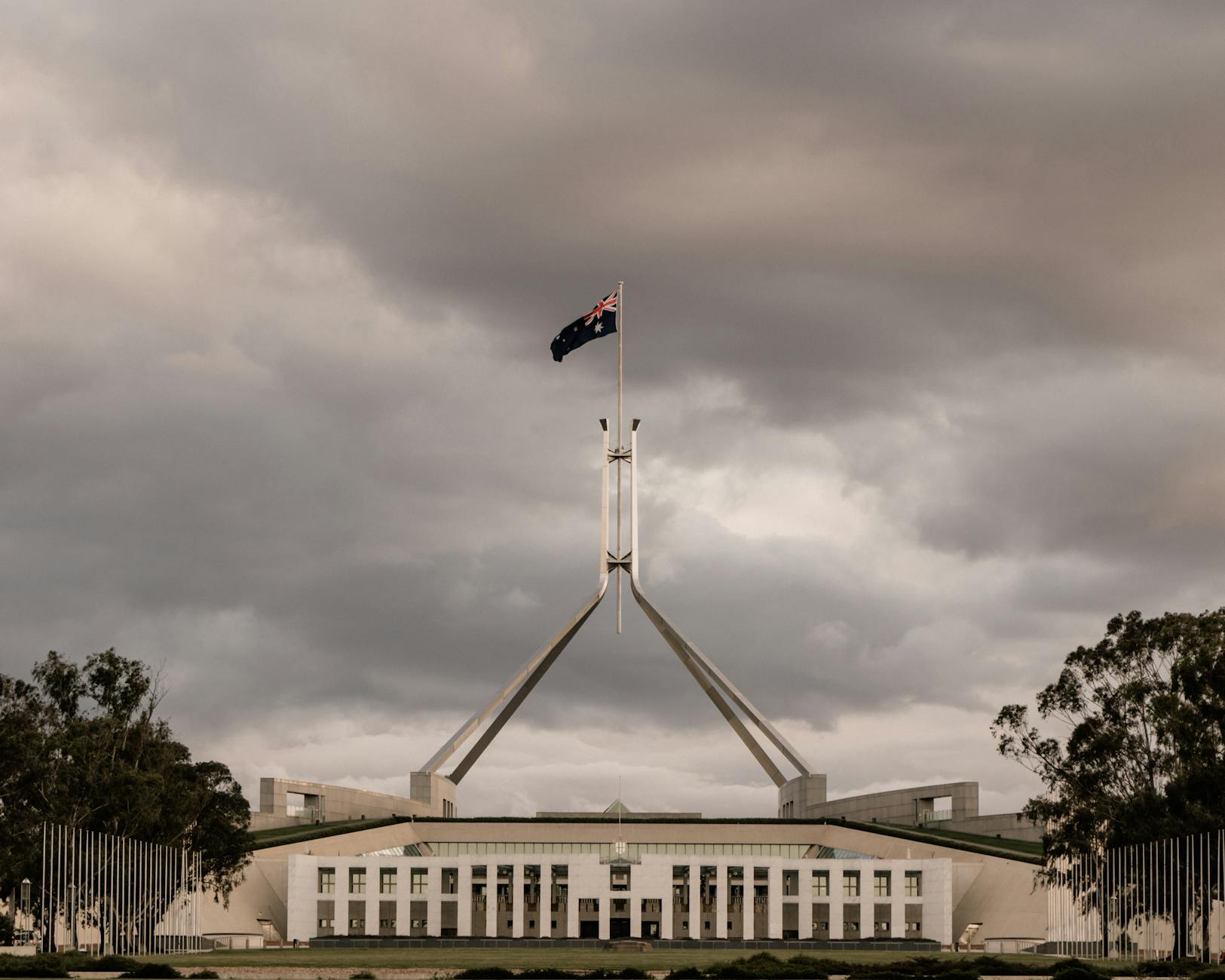
The reason behind sharing the Psalm 146 quotation is that I’m wondering if we are attaching too much responsibility on Government for fixing social ills and rectifying economic currents. This is true for both the left and the right of politics. Have we become too dependent upon Parliaments and MPs for addressing what was once the prevue of churches, synagogues, media, and an array of social organisations? If we have lost trust in those civil and religious institutions (which seems to be the case), faith in our governments is also in sharp decline. There lies perhaps some of our misplaced faith and therefore frustration and despair at the political scene. We are not meant to burden Government with all our hopes and demands and needs. A healthy society needs to spread that load. Indeed, a truly healthy society would not require government to create what we have in Australia: a society wrapped in red tape and wads of laws and rules stickier than gaffer tape.
There are better governments and worse; it’s rarely a zero-sum game. I suspect there is also a deep suspicion of and discontent toward political parties across the spectrum. Sometimes it’s a case of choosing the least bad option available, or at least that’s how many voters are feeling: I don’t like this candidate, but at least they’re not the other candidates!
How did we respond to the election at church today? This morning my church prayed for the new state government, as we do regularly for whoever is in charge at Spring Street and in Canberra. And we also prayed for our local representatives in Parliament. That’s what Christians do. It’s one of the few constancies in the unpredictable world of politics; churches pray for those in authority. To the reluctant among us, let’s consider it this way, if the Apostle Paul could pray for the Roman Emperor, then I think we can pray for our governments.
We should pray for our political representatives because they carry significant responsibility. Given the platform that we build for our leaders (or scaffold as it may be), praying is the right thing to do. Of course, government isn’t the big game in town, but its role impacts life at every level and therefore great wisdom, patience, integrity and compassion are necessary.
Without some kind of cultural reorientation, I suspect Governments will become bigger and bolder. It is interesting to see how Australians, or at least Victorians, have become more comfortable with authoritarian personality and politically styled governing. The myth of the convict, bushranger, and nonchalant Aussie digger may still exist in local sporting clubs, but as a people group, we are quite accepting of big government and monocratic-styled leadership. I’m not arguing a case either way here but simply noting the public trend.
Of course, my eyesight is myopic and so looking at the next 3 years is an imprecise art. There are, after all, no more prophets! My guess is that in the name of freedom, more laws and regulations will be introduced, and in the name of economic prosperity, more debt-inducing spending will occur, and we will remain desperately ill-prepared for the geo-political challenges that lie ahead. If we follow the now predominant current, I anticipate that we’ll see tighter controls on social behaviour, fewer parental rights and a more pronounced religion-socio education drive. In part, we’re recognising a fragmentation in society and so looking for answers is only natural and desirable (depending of course upon the solutions offered).
So I go back to the verse I began with, Christians should not look to government to be the saviour of society. Don’t put your trust in princes and prime ministers. Honour them and pray for them, but let’s not expect government to rescue society from the deepest and darkest of places.
This is one of the flaws present in much of politics today; people believe and expect Government is the answer. Big government has devotees on both the left and the right. Hence it’s no surprise to see legislative agendas enveloping society around a new moral religion. It’s interesting to see how churches have become more visible as politicians vie for attention and votes. ‘Social cohesion’ is one of the buzz words. God is optional in the new religion, and where he is worshipped, he somehow always supports the popular moral zeitgeist!
Among some Christians, there are more strident and public voices. Christians, be careful of voices that speak more about politics than they do the Great Commission and use more words of outrage than they do words of compassion and mercy. By all means, as a commitment to common grace and out of love for your neighbour, keep government accountable. Christians might join a political party and stand for Parliament, but even the most Christian of political leaders and most Christian of political agendas isn’t going to redeem society. That kind of thinking ignores the testimony of Scripture, namely that the gospel is God’s power of salvation and the church is God’s big game in town. Our churches are more likely today to sit on the sideline of culture and be ignored by many, but nonetheless, the church is the centrepiece of God’s work. Therefore, whatever you do in the name of political inspiration, aspiration or disappointment, don’t confuse it with the Gospel, don’t conflate common grace with saving grace, and don’t fuse the church with the state.
The best way we can love our fellow country people is by serving your church and being clear on the gospel. Today at church, pray for government and for those in authority, and give thanks for free and safe elections. And be clear on the gospel. If we love the Lord our God with all our heart, mind, and strength we will also love our neighbours, and that will have real and positive outcomes for our society. That kind of humble constant Christ-like hope hope-filled living may have a greater effect for the good of society than even an election.
This is the question posed by Bari Weiss. We can certainly ask the question of Australia. It’s not as though what happens in America will necessarily follow here in Australia, but their weather conditions often blow across the Pacific Ocean.
It comes to mind that there was the prophet from Crete quoted in Titus 1:12 and Epimenides gets a mention by the Apostle in his famed Areopagus speech. And let’s not to forget the Aussie band Crowded House who are getting a mention in this week’s sermon at church. There are moments when an unbeliever says something that is true either about God or about the world or Christianity, and their commentary is worth reflecting upon.
My mate Stephen McAlpine has been talking up Bari Weiss’ podcast, Honestly. Another friend drew my attention to one recent episode which I watched with interest yesterday.
For those who are unaware, Bari Weiss isn’t a Christian. She is a former New York Times journalist who famously resigned and now writes for other publications. Weiss is agnostic (former atheist?) and Jewish and a woman who’s married to another woman. There are obviously some things here out of sync with the message of Jesus Christ, especially the New York Times! (that’s a joke, sort of). Bari Weiss is among a growing throng of intellectuals who are dissatisfied with the cultural zeitgeist and who despite their unbelief, are warming to Christianity, or at least becoming positively disposed toward some of Christianity’s historical, ethical and sociological strengths. It’s as though they recognise that when a society dismantles Christianity, it’s like removing the steel frame from a building; it loses its sturdiness and begins to succumb to the environment and weather conditions surrounding it.
I have now listened to several of Weiss’ interviews, including a recent one with Jonathan Rauch. And it’s this interview that I wish to shine a light on.
Jonathan Rauch is an American journalist and Senior Fellow with the Brookings Institute. He has a pedigree from Yale University and writing for The Economist and The Atlantic. Like Weiss, Jonathan Rauch is not a Christian. He makes that clear in this podcast episode. Indeed, Weiss introduces him as an atheist Jewish gay man. As Rauch admits during the interview, he was no friend of Christianity and Christians and yet something is changing. He says,
“20 years ago I was in the camp that said America was secularising and isn’t that great. Religion is divisive and dogmatic and we’re going to have less of it and we’re going to be like Sweden or Denmark and Scandinavia, and we’ll be happier.
I was completely wrong about that. It has been the biggest mistake of my intellectual career.”
It is worth watching the full one-hour interview, both to hear Raunch’s interesting insights, and also just to hear how two thoughtful unbelievers are now engaging with Christianity.
During the conversation with Bari Weiss, Rauch wants to argue for Christianity in the sense that it provides the necessary pillars for liberal democracy. Rauch identifies 3 key pillars of Christianity and therefore of liberal democracy:
He explains how these ideas were and remain radical and derive from the Christian faith. I would quibble about what are the pillars of Christianity and we can talk about this another time. But these 3 ideas are nonetheless revolutionary and were introduced into the world by Christianity. They have been so successful that we often take them for granted today without realising that dismantling Christianity will create significant problems for social and civil flourishing.
My interest in this interview centres on Rauch’s explanation of thin Christianity and sharp Christianity. It’s how Rauch attempts to call out and even plead with Christians to be more Christian, not less.
‘Thin Christianity’, as the adjective suggests, thins out Christian distinctive such that society finds the ideas palatable. It’s classic theological liberalism. Let’s thin out all those tricky Bible ideas that progressive society finds offensive. That kind of Christianity is still around in the United States and Australia, but it’s generally easy to spot as it’s lauded by social pundits and found in emptying churches.
Rauch also observes the rise of ‘sharp Christianity’. He looks back to the 1980s and the rise of the political evangelical but notes how this has escalated in the last 8-9 years. It is his view that among American Evangelicals there is a drift from the character of Jesus. To be clear, he’s not clumping all evangelicals under this ‘sharp’ umbrella and of course, as an unbeliever, Rauch isn’t defining these issues in a gospel and theological way. Nonetheless, his point has merit.
Rauch talks about sharp Christianity being ‘political and polarised’. He goes into some detail about how President Trump played for the conservative Christian vote and offered a seat at the White House. As Rauch notes, the promise of power is an ancient one. I’ve read enough over the years to see some evangelicals sacrificing gospel humility and clarity for an invitation to a White House prayer meeting or inside conversations with policymakers.
Interestingly Rauch differentiates between the older politicised evangelical, which was a top-down movement, and the more recent interaction which is bottom-up. I have certainly heard stories where people began attending and joining churches based on the church’s political stance.
Rauch goes on to make this rather chilling comment regarding young adults in America,
“They no longer believed that the church believed what it’s meant to believe.”
Where this is true, there’s a major problem.
The rhetoric Rauch is hearing among the ‘sharp Christians’ is,
’We don’t want to hear about turning the other cheek, we want to talk about taking back our country’.
Similar rhetoric is becoming more commonplace among some Australian Christian voices. It may not be the dominant voice, but it is certainly a noisy one and one vying for influence. Just yesterday one Christian pastor suggested I was the Devil for saying Christians should be more like Jesus instead of adding to the anger and fragmentation that’s perforating all around us.
This politicisation of Christianity has the habit of confusing the gospel, conflating Church and State, and misplacing eschatological hope by trying to drag the new creation into the present. I’ve been writing about this unseemly conjugality for several years now. It is not that Christians have nothing to say or contribute to civil society. A liberal democracy enables and needs people of faith to bring their ideas and convictions to the table. And as Jonathan Rauch recognises, a healthy liberal democracy is a fruitful branch born from Christian theism. And yet, as Jesus and the Apostles made clear distinctions between common grace and particular grace, and between the two ages in which we live, so must Christians today.
1 Peter is very much on my mind as we preach through the Petrine Epistle at church. Peter is pretty clear about where Christian hope lies, what Christian identity is, and therefore how we relate to different parts of society.
He says,
“ Dear friends, I urge you, as foreigners and exiles, to abstain from sinful desires, which wage war against your soul. 12 Live such good lives among the pagans that, though they accuse you of doing wrong, they may see your good deeds and glorify God on the day he visits us.
13 Submit yourselves for the Lord’s sake to every human authority: whether to the emperor, as the supreme authority, 14 or to governors, who are sent by him to punish those who do wrong and to commend those who do right. 15 For it is God’s will that by doing good you should silence the ignorant talk of foolish people. 16 Live as free people, but do not use your freedom as a cover-up for evil; live as God’s slaves. 17 Show proper respect to everyone, love the family of believers, fear God, honor the emperor.” (1 Peter 2:11-17)
If our language and speech toward others is frequently out of sync with the apostle’s instructions, there is a problem.
Both thin and sharp Christianity share a common goal even if their modus operandi differs. They both aim to win influence and people and to take the culture or country; the former does so by diluting Christian doctrine and life, and the other by using Christian ideas as a sledgehammer. Both may win approval in various quarters and even notch a few political wins, and we likely lose people’s souls and dishonour the Christ whom we claim to worship and follow.
I hope we can say that we want to avoid both thin Christianity and sharp Christianity. Instead, we need a Christianity that is both thick and grace-filled, deep and clear. And the only way to do that is to become more Gospel-centred, not less, more Bible not less, and more Spirit-filled not less. Christians can engage in the public square but don’t take your script from the culture. Public speech is to be conducted out of love for our neighbours, not about punching your opponents to the ground. Engagement in the culture should be about promoting the Gospel of Jesus Christ, not ensuring your favoured political party wins the next election. I’m not suggesting that public issues are unimportant to the Christian; but surely we have a bigger mandate and vision in mind.
Bari Weiss and Jonathan Rauch are not confessing the Lordship of Christ or believing in the atonement. But their tune has changed. Let’s pray that their appreciation of Christ becomes a genuine trust in Him. If Nicodemus the scholar could approach Jesus at night to ask questions and realise there is something true and good about Jesus, then those asking serious questions in the light of day may also find what Jesus alone can give.
Christianity isn’t a commodity, it’s about a person. Christianity is more than a political theory or ethical system, but is knowing the God of the cosmos, and being reconciled to Him because of the brutality God’s Son embraced for us. As Peter explained to the early churches,
“For Christ also suffered once for sins, the righteous for the unrighteous, to bring you to God”.
There is my Gospel call for today. Let’s return to Christians. The temptation to be a thin or sharp Christian isn’t new. How many times have I now heard someone wanting to be John Knox!
There is warrant to Rauch’s complaint, even if he falls short of where we need to be in following Jesus. Don’t be a thin Christian or a sharp Christian. Instead, be a Jesus Christian (as if there’s another kind!). For one final time, press closely to what Peter the Apostle instructs. Take a couple of minutes to read what Peter says and reflect upon our public voice in light of these verses. Sure, it’s unlikely to win an election or change society overnight, but it is better and it is desperately what the world needs of Christians today,
“Finally, all of you, be like-minded, be sympathetic, love one another, be compassionate and humble. 9 Do not repay evil with evil or insult with insult. On the contrary, repay evil with blessing, because to this you were called so that you may inherit a blessing. 10 For,
“Whoever would love life
and see good days
must keep their tongue from evil
and their lips from deceitful speech.
They must turn from evil and do good;
they must seek peace and pursue it.
For the eyes of the Lord are on the righteous
and his ears are attentive to their prayer,
but the face of the Lord is against those who do evil.”
Who is going to harm you if you are eager to do good? But even if you should suffer for what is right, you are blessed. “Do not fear their threats; do not be frightened.” But in your hearts revere Christ as Lord. Always be prepared to give an answer to everyone who asks you to give the reason for the hope that you have. But do this with gentleness and respect, keeping a clear conscience, so that those who speak maliciously against your good behavior in Christ may be ashamed of their slander.’ (1 Peter 3:8-16)
If Peter’s exhortation grates on us, then take that as God’s alarm going off and seek his grace to work out how your heart might more align with His.
The NSW Parliament last week adopted a set of laws prohibiting the conversion of or suppression of peoples sexuality orientation and gender identity. The laws are not as extreme as those in the State of Victoria, nonetheless, there is clear government overreach.
Yes, these new laws in places are bad. They are bad because they introduce needless restrictions on normal Christian faith and practice. They are bad laws because they are defending against practices that are mostly mythical. The laws are bad because they take a smidgen of truth and a lot of illegitimate and aggressive sexology (to use Stephen Mcalpine’s word). The are bad laws because the give Government greater authority over religion (which is an odd position for anyone positing that we are a secular country).
Associate Professor Neil Foster has written a helpful explanation of what the laws do and do not mean and where is ambiguity. I would encourage people to read Foster’s article in light of some misinformation that is floating around and being circulated as fact.
However, Christians have begun to respond to these new laws. I’ve noticed more than a few turning to the Old Testament prophet, Daniel, and have begun quoting that famous incident that landed him in a lion’s den. I happen to think the story of Daniel is one of many helpful Bible places we can turn to as a guide and encouragement. But if we’re going to use Daniel ch.6 for our stump speech, there are a couple of details we need to first take into account.
Firstly, what kind of presence are we in society?
Notice how Babylon’s officials and powerbrokers describe Daniel,
“At this, the administrators and the satraps tried to find grounds for charges against Daniel in his conduct of government affairs, but they were unable to do so. They could find no corruption in him, because he was trustworthy and neither corrupt nor negligent. Finally these men said, “We will never find any basis for charges against this man Daniel unless it has something to do with the law of his God.” (Daniel 6:4-5)
Daniel is a wonderful example to Christians today. There is something that particularly resonates with us about the life and times of Daniel for he was an exile living away from his home, as are all Christians today. He is living and working in a context with foreign gods and ideas dominate the horizon and we’re worshipping God is part of a small minority. Part of the wisdom that we glean from the book of Daniel, and it is a book of wisdom, is how Daniel adapted to life in Babylon and worked hard and judiciously for the common good, and yes obeyed pagan Kings, yet without compromising faithfulness to the one true God.

There have been an inflation of open letters and public declarations of late, mostly from a particular quarter of the Christian faith. These are often highlighting genuine issues, but their content and tone often fall short of usefulness. As someone who has had moments in the past when I’ve employed too many strong adjectives, I’m more conscious these days about precision and not overblowing a situation. It is advisable to read and research before putting your name to a public statement.
As the enraged mood takes hold of so many quarters of society, a Christian voice should be different, but sometimes it is as angry and hyperbolic and therefore indistuishable from others. For example, if your public record is filled with distain for authorities and governments and making antiauthoritarian claims whenever you disagree with a policy or law, when a legitimate concern finally arises, why would those in positions of authority listen to you? It’s like the percussionist in a Symphony Orchestra who is always smashing the symbols as hard as she can strike and often out of time with the rest of the Orchestra. Soon enough the orchestra is going to send you down to the basement and lock you out!
Who wants to listen to the guy who is always shouting at everyone? Who takes seriously the voices who are decrying every issue as a threat to freedom and democracy and religion?
Defiance seems to be the default modus operandi for too many Christians today. However, this shouldn’t be our baseline approach to life in the world and it’s certainly not the way Daniel approached life in Babylon.
There will be some other Christians who have no issue with the new laws in NSW and who are trying to con us into thinking that anyone criticising the law is pulling a furphy. I suspect they’ll be among those who volunteer to be part of the firing squad.
Second, notice how Daniel responded to the unreasonable law.
“Now when Daniel learned that the decree had been published, he went home to his upstairs room where the windows opened toward Jerusalem. Three times a day he got down on his knees and prayed, giving thanks to his God, just as he had done before. Then these men went as a group and found Daniel praying and asking God for help. So they went to the king…”
Daniel continues with what was his normal practice. He didn’t make a song and dance out of it. He simply continued to faithfully pray to God three times a day.
Daniel’s praying wasn’t attention seeking, or brash, he wasn’t revving up the social temperature or resorting to hyperbolic claims or allegations. The window was always open and he carried on as he had always done, with humility and faithfulness.
The problem is, and I understand because I know the injustice of the Victorian laws, too many people are wanting to be David swinging a rock at Goliath’s head, rather than a humble Daniel who went about faithfully serving the Lord and serving the common good of the city where he lived.
In case we think, maybe Daniel is just a one off, I’m about to start a new sermon series at Mentone Baptist on 1 Peter. With little imagination required, I’ve given our series the title, ‘Living away from home’. Like Daniel, Christians are exiles and sojourners, and Peter helpfully explains how Christians ought to live as exiles. In one place he says this,
“Who is going to harm you if you are eager to do good? But even if you should suffer for what is right, you are blessed. “Do not fear their threats; do not be frightened.” But in your hearts revere Christ as Lord. Always be prepared to give an answer to everyone who asks you to give the reason for the hope that you have. But do this with gentleness and respect, keeping a clear conscience, so that those who speak maliciously against your good behavior in Christ may be ashamed of their slander.For it is better, if it is God’s will, to suffer for doing good than for doing evil. (1 Peter 3:13-17)
There is a sense in which we are to embrace suffering for the Lord’s sake. And the manner in which we do also matters according to Peter. Gentleness and respect…not resorting to malicious speech but with good behaviour. So like Daniel and Peter, choose faithfulness, and like Daniel and Peter (and Jesus), part of faithfulness is speaking and behaving with utmost integrity and with grace and refusing to be that clanging cymbal.
“The Lord our God is merciful and forgiving, even though we have rebelled against him;” (Daniel 9:9)
100 notable Australians have written a letter to Prime Minister Anthony Albanese, calling for a federal inquiry into kids gender therapy. The list of signatories includes senior medical professionals, academics, and politicians including former Prime Minister Tony Abbott and former Deputy Prime Minister, John Anderson. Lest we think this is a partisan statement, the names attached to the letter belong across the political spectrum.
I commend the letter to the Prime Minister, and indeed, to Victoria’s Premier Jacinta Allan.
This letter has been written off the back of growing evidence that vulnerable children are being led to permanent life-altering procedures without sufficient medical or ethical reasoning. Earlier this week, the Queensland Government was forced to act and pause transitioning procedures on minors when a hospital was allegedly caught performing dangerous procedures on children as young as 12, without the consent of parents. Also this week in the United States, President Trump signed an executive order, stopping Federal support for the gender transitioning of young people.
These actions are but the latest of a growing number of Governments around the world who have pulled the plug on radical gender interventions. Denmark, Finland, Norway, Sweden, France and New Zealand are among the countries who are taking action to ban, or at least pause, medical intervention on children suffering from gender dysphoria.
It took the bravery of young people in Great Britain to sound the alarm, young adults who at the time were children and subjected to the transitioning movement in the UK health system. The result was the CASS review (2024). The doors were blown open and the UK Government was forced to shut down the Tavistock Clinic and hit the emergency button to stop pumping children with hormones, chemicals and even surgical procedures. Despite the preaching by gender progressives, evidence is scant (if not fabricated) that children are better off having body parts amputated or chemicals injected into their bodies.
The days of using children in the service of gender theories are numbered. I believe this is one of the great evils of our time, for it cuts against the very nature of being human, and being male and female. It is to our shame that our society ever encouraged such ideas. Governments may wait until they are swamped with legal action or they can take the moral ground and take action now.
Obviously, there are all kinds of important issues here. The note that I wish to sound in this particular article is one of mercy. Mercy is a word that has been used a lot over the past week in relation to gender and children. It is a word that can be used and misused, applied and misapplied, and so in light of the letter to Australia’s Prime Minister, I would like to add a word of mercy.
The question of gender fluidity and children changing genders is often framed around acceptance and intolerance, affirmation or bigotry. Unfortunately, this kind of binary approach is unhelpful and is often untrue. It isn’t hatred to affirm biology and to believe that biology determines gender. Neither is it intolerance to appreciate that there are children (and some adults) who struggle to accept their physical bodies and the gender that comes with that. Words matter.
We need to differentiate between these children who deserve our love and care, and those who promote the ideology of gender fluidity and who are responsible for inflicting lifelong damage onto these children.
For example, when Bishop Mariann Edgar Budde recently called for mercy and compassion, she wasn’t asking Americans to save children from gender therapy. She was calling on President Trump to affirm their gender confusion and enable the very social and medical processes that we know to be unethical and harmful. The Bishop may have used some of Jesus’ language but her meaning is a world apart from the kind of mercy Jesus offers and that we all need. We may or may not approve of President Trump and much of his character and rhetoric, but his latest executive order is sensible. As the letter to the Prime Minister demonstrates, the concerns are not left or right, but moral and medical.
I realise that there are some who have caste doubts over this interpretation of Budde’s views. But I am simply accepting her teaching. Words have meaning. The Bishop of Washington DC has expressed her views on sexuality and gender on other occasions, and lest she has experienced a Damascus road repentance in the last few weeks, her meaning in the sermon corresponds to her regular teachings.
The notion of Divine mercy is too good and holy for us to revise or use in the service of political progressivism (and political conservatism).
Mercy is showing kindness. Mercy is not telling children lies or encouraging them to believe in mistaken identities and shuffling them off to a hospital for puberty blockers and even castration. As the letter to the Prime Minister intimates, there are better ways.
Mercy involves patience and love, and hope. Mercy doesn’t deny reality or brush aside physical or psychological anxieties but learns to sit and journey with someone until the light of day.
As a Christian, mercy takes a Christ-like shape. I think of the episode when Jesus met a Samaritan woman (John ch.4). As far as society was concerned, this particular woman had 3 strikes against her name and so ostracising her was considered the right thing to do: She was a a woman, she was a Samaritan, and she had sexually broken past. Jesus didn’t follow those rules of engagement. Jesus didn’t reject her, he showed compassion. He engaged in conversation with her. He didn’t ignore or pretend that her sexual history was unimportant, but rather, Jesus went further and showed mercy. Mercy didn’t involve encouraging her to pursue sexual sin or impropriety. He revealed to her the hope of Israel and through this offered her living water that would quench her thirst forever.
Churches who choose to mimic the message by Bishop Mariann Edgar Budde are more damnable than any other group in society, for they claim to speak in the name of God and offer faux mercy.
Churches, if your community is not already a safe place of truth and kindness, goodness and mercy, you are not ready to receive the growing number of young Australians who need to know of the hope of the gospel. If your view of mercy means accepting the culture’s latest gender theory, then your church is not ready to care for those who experience trauma and who are struggling with their body, mind and soul.
What did the Apostle Paul say,
“Therefore, I urge you, brothers and sisters, in view of God’s mercy, to offer your bodies as a living sacrifice, holy and pleasing to God—this is your true and proper worship.”
Prime Minister please listen to the concerns outlined in the letter. And Churches, learn mercy from Christ and not from our culture’s talking points.
As Jesus said, ‘go and learn what this means: ‘I desire mercy, not sacrifice.’ For I have not come to call the righteous, but sinners.’
Update: January 31st, 1:45pm, Federal Health Minister Mark Butler has ordered a “comprehensive review” into gender therapy practices for children in Australia. This is a good step. Let’s pray that it is indeed a ‘comprehensive review’. I will add, that until such review is complete, all such ‘therapies’ and practices should be paused, to avoid causing further harm to countless children
Victorian Premier Jacinta Allan has announced a new set of laws under the banner ‘social cohesion’.
‘Social cohesion’ when attached to government and laws has a touch of the Machiavellian about it. One doesn’t know whether to think it’s more like George Orwell or Monty Python!

The Government’s initiative includes a new ‘social cohesion pledge’. Any community group applying for government funding will need to make the pledge, promising to support social harmony and inclusivity.
No doubt this is a testing time for any government. There are pressures applied from all kinds of directions, and at times this leads to inaction or delayed resolve. As we have seen over the past year, this has given more oxygen to antisocial, and in this case, antisemitic voices.
I think this specific set of government measures are sensible and necessary, but I cannot but help think that it may open the door to future measures that are unreasonable and damaging.
There is a cowardice hiding behind masked protesters. There is an ugly hatred being propagated by some of the protests we have seen on Melbourne streets. If you can’t protest without wearing masks, carrying threatening objects, and using disgusting slogans, maybe that should signal that you or your cause is a problem.
Victoria was never the perfect State, but we have witnessed developments over the past decade that are injurious and bring grief to many. We are less peaceful than we were. We are less inclusive and kind. There is more personal and social distress and with little sign of a turnaround. Melbourne has become Australia’s protest capital (not a title to boast about). Ever since 2020, when the government turned a blind eye to certain marches while slamming others, every Jane, Nguyen, and Bob has seen fit to grind city streets to a halt. Not a week goes by without banners and angry faces blocking traffic.
I support these particular measures because antisemitism cannot under any circumstance be allowed to fester. If we think that our society is beyond and above 1928 Germany, we are suffering from a greater dose of egomania than I thought.
However, I am not comfortable with Jacinta Allan’s language of ‘social cohesion’. I get it; they are trying to address a specific problem without naming the elephant in the room. Why not call it ‘Rules for Safe Protests’ or something like that?
The reason why I’m uncomfortable about the Government’s language of ‘social cohesion’ is because the task of social cohesion doesn’t belong to the government, but to the people. When government sees itself as the answer to every social ill and when the people demand government to fix every crisis, we are obfuscating personal responsibility and creating systems of governance that cannot bear the weight of such responsibility.
This is one area where the work of Dr Christopher Watkin is worthy of consideration. Monash University’s Dr Watkin articulates a positive and important work on contract theory. He says,
“Civil society is sometimes the neglected dimension of the social contract, the “missing middle” as it has been called. We have a tendency to jump straight from government and law to the individual.
These civil society relationships across different visions of the good are a glue that holds our social contract together.”
From his book, Biblical Critical Theory,
‘the vague and sporadic measures taken by contemporary governments to shore up the social contract with well-meaning but half-hearted attempts at “civic edu- cation” have little effect, when all the while billions of advertising dollars and a destructive paradigm of competition in all areas of society expertly catechize individual consumers to be little predisposed to the civic duties a strong social contract requires. No rewriting of the social contract can be complete without giving serious attention to its cultural and liturgical infrastructure.’
No Government is up for the job, and it’s not designed to be. Part of the problem embedded in any Government setting the rules for social cohesion is that this is never a natural space. This is one of the heresies attached to secularism. Secular may be preferable to Sharia Law and Christian Nationalism, but it is no more epistemologically and morally neutral. Secular is the sum of the worldviews present in and controlling the moral impulses of the day.
There are wonderful pockets of social cohesion is found in all kinds of places and communities across our State. There are sporting clubs and men’s sheds, and there are temples and synagogues. It is certainly experienced in local churches.
Churches are frequently more culturally diverse than the communities surrounding them. Where I have the privilege of serving and belonging, we have people from China and Uganda, families from Vietnam and India, Nigeria and Columbia. Young and old mix together, single and married are friends and serve one another. Of course, Churches have their failings and blindspots, (after all, the very point of Christianity is that there is only one perfect saviour and we’re not him!), and yet there is profound togetherness and other person-centredness.
The Victorian Government is also currently working on expanding anti-vilification laws, which some are concerned will tighten the noose of faith groups from teaching and practising in accordance with their convictions. It’s amazing how often the State has assumed the bishopric role when Christian praxis hasn’t supported their social agenda. There is a mine of irony in Victoria where Government identifies a growing social disorder and yet clamps down on one of the few societal groups who are truly exhibiting positive social health and life. If we are interested in civil society, maybe we ought to return to the worldview that created the ideas and values from which this vision derives: Christianity.
Well, it’s Christmas time, the ultimate day of truce-making, although that first holy night was filled with peril. Nonetheless, the hope born that night in Bethlehem really is the only hope we have today. Come, check out a local church and see that hope in action.
Let me leave you with the great Messianic promise of Isaiah,
‘The people walking in darkness
have seen a great light;
on those living in the land of deep darkness
a light has dawned.
You have enlarged the nation
and increased their joy;
they rejoice before you
as people rejoice at the harvest,
as warriors rejoice
when dividing the plunder.
For as in the day of Midian’s defeat,
you have shattered
the yoke that burdens them,
the bar across their shoulders,
the rod of their oppressor.
Every warrior’s boot used in battle
and every garment rolled in blood
will be destined for burning,
will be fuel for the fire.
For to us a child is born,
to us a son is given,
and the government will be on his shoulders.
And he will be called
Wonderful Counselor, Mighty God,
Everlasting Father, Prince of Peace.
Of the greatness of his government and peace
there will be no end.
He will reign on David’s throne
and over his kingdom,
establishing and upholding it
with justice and righteousness
from that time on and forever.
The zeal of the Lord Almighty
will accomplish this.’
The Victorian Equal Opportunity and Human Rights Commission has published, ‘A Guide for the Baptist Union of Victoria’. The ‘Guide’ relates to the Conversion and Suppression Laws adopted in Victoria 3 years ago.
The Guide was released 4 months ago and published on a Victorian Government website, and it is finding more public attention recently, including journalist John Sandeman reporting on it today.
This Government document is problematic and because of growing awareness, it is worth highlighting some of the issues.
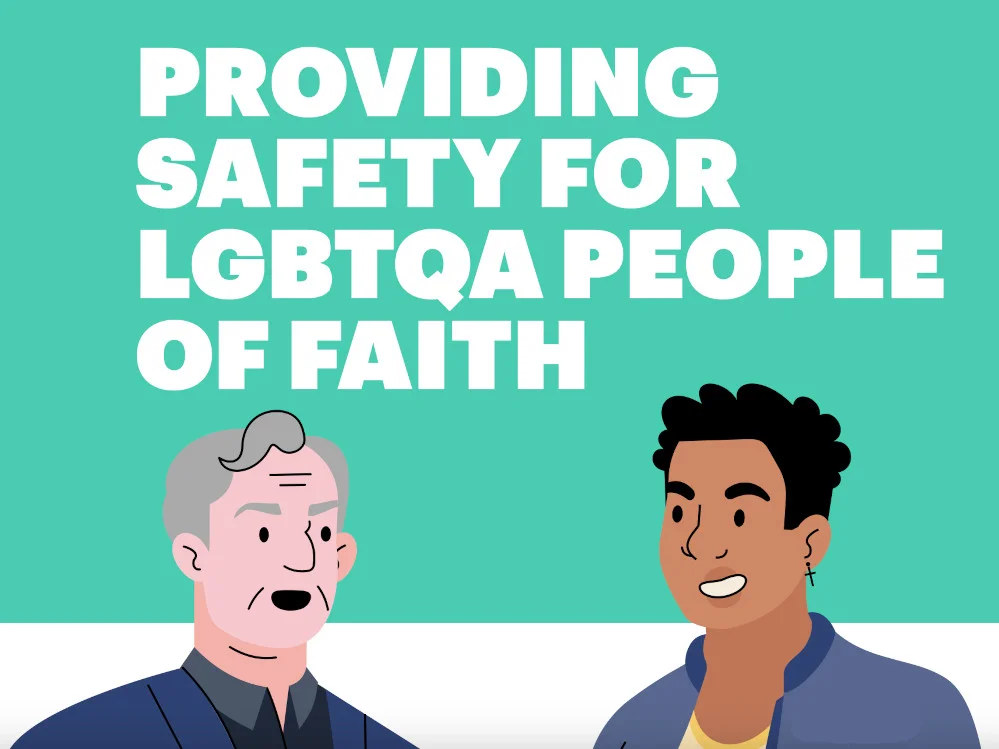
The name of the Guide is confusing and highly questionable. The Baptist Union of Victoria Assembly has not discussed or agreed to such a Guide. However, the Victorian Human Rights website, states, ‘We have developed the Providing Safety for LGBTQA People of Faith guide with and for faith leaders in Baptist Union of Victoria churches”’.
On the one hand, this is not a Baptist Union of Victoria document, however, the BUV name is all over it. For example,
My understanding is that the HRC approached the BUV and BUV personnel gave permission for this project. They then provided ideas and information to the HRC. The HRC is now using this Guide to promote the conversion/suppression laws, and as the commissioner states, we hope other Christian denominations will follow the Baptist lead.
Ro Allen, Victorian Equal Opportunity and Human Rights Commissioner, wrote the forward which includes this explanation,
“The CSP Act does not stop anyone from holding beliefs about sexuality or gender, or having conversations with others about those beliefs – it prohibits causing harm to others by trying to impose beliefs to change someone’s gender or sexuality. This is a law to prevent harm.
Change or suppression practices are actions based on the ideology that there is something wrong or broken about being lesbian, gay, bisexual, transgender, queer or asexual (LGBTQA), which this law says isn’t true….
The BUV community has been among the first to step up and work alongside the Commission to provide clear support and guidance to its faith leaders and congregations. Over time, we hope to do the same with other Victorian faith communities.”
The Guide is confusing to the outsider and indeed to Baptists, who understandably assume that this is a Baptist document and one that Baptists affirm.
The 48 page Guide proceeds to give advice to churches and to pastors about how to respond to questions/issues surrounding a person’s sexual orientation and gender identity. At times the document acknowledges a dissonance between formal Baptist teachings/positions and the law, but then it also says things like,
“The Baptist Union of Victoria (BUV) recognises that Baptist communities hold a broad range of views about matters of gender and sexuality.”
This dissonance within the BUV now manifests itself in a Victorian Government document, and that is a problem.
The Guide affirms all the latest iterations of sexual and gender expressions, and nowhere affirms the moral goodness of Baptist and Christian views on sexuality and gender. Of course, it can’t because the very fabric of these laws aims to disqualify Christian beliefs and practices on these issues. Instead, the Christian understanding of sexuality and gender is defined in negative terms right throughout the document.
In addition, the Guide encourages churches and pastors to seek advice from affirming churches and provides a list of LGBITQ websites for churches to use.
The dissonance is aired like a screeching car brake. As John Sandeman has highlighted,
The guide outlines restrictions on Baptists and other religious leaders on discussing sexuality and gender identity with LGBTQA persons imposed by the Change or Suppression (Conversion) Practices Prohibition Act 2021 (CSP Act). It acknowledges that the BUV takes the position that “Marriage is the union between a man and a woman to the exclusion of all others, voluntarily entered into for life.” and that “BUV shall not ordain persons who engage in homosexual practice.” The guide says that these statements of belief, and others can be made generally or in sermons and Bible studies, but not when “not targeted at an individual to change or suppress their gender identity or sexual orientation.”
There we have an example of where Baptist practice contradicts the intent behind Victorian Law.
For Christians, sex is a beautiful gift from God and that is to be enjoyed within the constraints of marriage between a man and a woman. The Guide explains that while a church or pastor is free to explain formal doctrine in a theoretical sense, they are not permitted to address it to any individual or to insist upon it for any church member. Even praying with an individual who requests prayer, is illegal.
I don’t want to repeat everything I’ve said in the past about these laws. There are aspects that I affirm and others that I cannot, because I’m a Christian. Readers can find those comments easily enough. I will say because it is important and you may not want to read older articles (fair enough): Christians following Jesus (is there any other kind?) will love others and seek their wellbeing. The only message we have is the one we have received and that is of the righteous and loving God whose Son gave his life as ransom for many. God doesn’t pick the do-gooders, he loves those who realise they are deeply flawed. Sometimes, churches forget this. At the time when these controversial laws were being debated, I was among other Christian leaders who acknowledged there have been examples of dreadful attitudes and behaviour toward people who don’t identify as heterosexual. These may not be commonplace, but some people have been terribly mistreated. For that, churches ought to repent. Around 2019, I learned from a journalist how a few fringe religious groups practised ‘conversion techniques’, which were often adopted from mid-20th Century psychiatry, not from the Bible. The Victorian Laws go well beyond prohibiting such awful and dangerous behaviour; prayer is banned and talking with an individual about sex and gender is prohibited, unless the content of your message conforms with whatever is the latest iteration of sexual ethics from LaTrobe. That is staggering, and it’s all the more astonishing given the worldwide exposure of the abuse toward minors with gender dysphoria by State sponsored institutions.
Don’t misunderstand, there is merit in explaining the law, however, this Guide does much more. It contains ideas and advice that is contrary to Scripture and our pastoral responsibility. It is targeting Baptist Churches and for some reason, the BUV thought it wise to give them ammunition and the target. Baptists used to believe in the separation of church and state! This is a Government produced document designed to shape how our Baptist churches think about sexuality and gender issues. Arguing otherwise is simply not believing the authors’ words.
The thing about the Christian Gospel is that it is about conversion. By definition, Christianity is a conversion religion. Jesus calls people to ‘repent and believe the good news’. Of course, it doesn’t mean someone who is same-sex attracted all of a sudden wants to marry someone of the opposite sex; that’s not the Christian goal. As many same sex attracted Christians testify, the desire and aim is to be godly, and that includes honouring God with our bodies and relationships. Sure, that may not be a common view in our culture, but in an age where we are beginning to realise that ‘you do you’ isn’t always good and it doesn’t really satisfy, there is something new and intriguing about the old time Bible vision for human flourishing.
In contrast to NSW Baptists who have taken positive action in recent years to confirm Christian belief and practice, imprecision and trying to mimic the Archbishop of Canterbury has an adverse effect on Gospel unity and mission success in Victoria. That ought to grieve our churches.
It is unfortunate, to say the least, that there is now a public document confusing people about where Baptists stand and what we believe. I have already had a member of another Christian denomination contact me because s they were perplexed and couldn’t understand why the BUV would participate in such a project. Not only is this Guide confusing people (both outside and inside baptist churches), it’s almost like handing over a noose for Baptists to hang themselves.
To be clear once again, this Guide is not our guide. It is not a Baptist Union of Victoria document. It is the unfortunate result of a few well-meaning Baptists taking the bait from the HRC.
It is my hope that we Victorian Baptists serve and love our neighbours well, always holding out the Gospel of life, and clarify and confirm that this is not our Guide.
15 December update:
John Sandeman has spoken with the VEOHRC. This added information only adds weight to concerns that have been raised with this ‘Guide’. This issue is consequential for all Baptist Churches and Pastors in Victoria – https://theothercheek.com.au/a-disturbing-question-about-the-vic-baptists-and-the-conversion-law/
12 Dec update:
David Devine from the BUV Office has spoken with John Sandeman and offered a perspective on the Baptist Union’s role in the publication of the Human Rights Commission’s ‘Guide for the Baptist Union of Victoria’.
David is a brother in Christ.
His comments confirm what I have written above and underscore the important issues I have raised.
On July 25th at Mentone Baptist Church, Dr Christopher Watkin will be addressing one of the key social issues facing Australia in the 2020s:
‘How can we build a healthy society in a fractured age?’
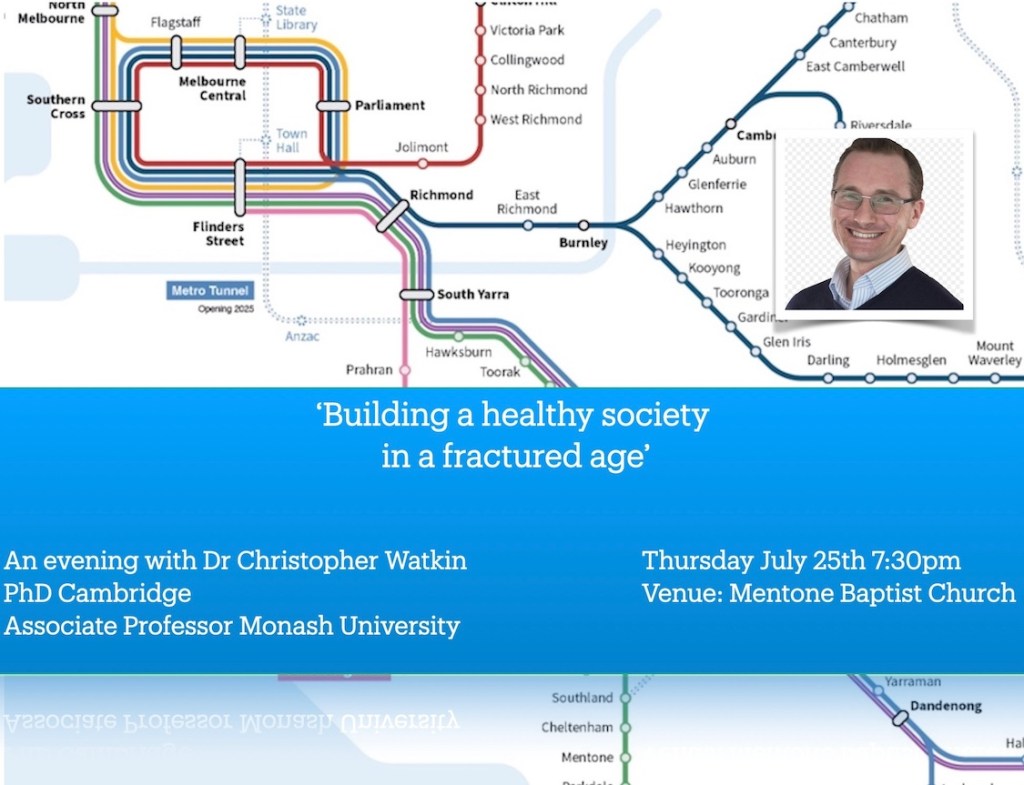
Australia is wrestling with important issues surrounding religious and social freedoms and responsibilities. Dr Watkin will help us navigate a way forward.
In 2021, Chris addressed political and community leaders in Parliament House, Canberra, outlining a positive vision for civil society. It’s a great opportunity for Melbournians to engage with ideas that can shape tomorrow.
Dr Christopher Watkin is the ARC Future Fellow at Monash University. He is the author of the award-winning book, ‘Biblical Critical Theory’ and numerous other volumes including, ‘Difficult Atheism’.
Reserve your tickets today:
https://events.humanitix.com/building-a-healthy-society-in-s-fractured-age
We live in an odd society here in Australia. Part of us thinks that growing up means ridding ourselves of God and all those Bible verses that we find so constraining. And yet we haven’t found an alternative to provide the necessary robust foundations for moral living and a sharper and more stunning hope for ultimate peace and righteousness.
Yesterday afternoon (October 30), six former Prime Ministers of Australia released a statement. John Howard, Kevin Rudd, Julia Gillard, Tony Abbot, Malcolm Turnbull, and Scott Morrison. These former national leaders represent different sides of the political spectrum. Through the years, they have expressed strong and opposing words to undermine each other and their respective Government positions. However, today, they are standing with one voice.
I do not recall another occasion where this significant number of former national leaders of Australia signed a letter with such force, unity and concern. This is a rare and historic moment and ought to cause Australians to consider the very real and dangerous and ugly antisemitism that is spilling onto streets and social media around the world, including here in Australia. 75 years ago the world declared, ‘Never again’, and yet from university campuses to political representatives and crowds, we are hearing cries for Jewish people to be destroyed.
In the midst of an Australia that is becoming more divided and fractured, these former Prime Ministers have laid aside differences and produced a timely and vital declaration that I urge Australians to read and take with the seriousness they are conveying. They express deep concern at the antisemitism on display around the world and at home. They offer clear and unapologetic condemnation of Hamas and their evil, both upon Israel and their own people in Gaza. They also call on Israel to abide by international conventions as they exercise their right to destroy the terror network.


Returning to my opening reflection, as our former Prime Ministers seek to lead by example, they turn to the Bible for example and help. They quote Psalm 34, which forms part of the Scriptures for both Jewish people and Christians.
“Seek peace and pursue it”
I find it odd and somewhat shallow when inner suburbanites yell at Christians and tell them to keep their Bible out of public issues. They make an exemption when Christian words seem to support their progressive (or conservative) agendas, but as soon as dissonance returns, the demands for silence come back with pugnacious certainty. Of course, sometimes Christians say unhelpful things and misuse the very Scriptures that shape us. There are times when the Christian perspective is neither left or right, progressive or conservative; indeed, this is most often the case. There are times when Christian wisdom displays a properly diagonalised view, which avoids false binaries and compromises. This is why a Christian perspective is sometimes misunderstood and or unwanted. There are also occasions when not speaking is the right thing to do. I do not, however, see how we can remain silent as the noise of antisemitism grows in Melbourne, Sydney and elsewhere (the same is true when our Muslim neighbours are targeted and abused).
It is worth noting that in October 2023, as the world witnesses horrific evil and growing unrest, six former Prime Ministers lean upon the Bible for guidance and moral impulse. I am encouraged and would encourage others to also lean in.
As we do, the Scriptures push us even deeper, not letting us settle for a consolation built on myth or vapor-like hopefulness. Words are just words if they are not conveying concrete truthfulness and goodness. Like a Shakespearean Sonnet with sonorous beauty or a Hallmark Card, they form a heart without a pulse. As the Apostle Paul dares to insist, if Christ has not been raised, we are to be pitied by all men, and our faith is an exposé of ignorance.
The phrase borrowed by our former Prime Ministers, Psalm 34, has more to say that is worthy of consideration and which provides reason and guts to the search for peace. For example, the full sentence of verse 24 says this,
“Turn from evil and do good;
seek peace and pursue it.”
Immediately following this statement, the Psalmist provides a framework for substantiating peace,
“The eyes of the Lord are on the righteous,
and his ears are attentive to their cry;
but the face of the Lord is against those who do evil,
to blot out their name from the earth.
The righteous cry out, and the Lord hears them;
he delivers them from all their troubles.
The Lord is close to the brokenhearted
and saves those who are crushed in spirit.”
There is evil in the world. There is also sin in each one of us. Modern Australia often tries to wipe away moral absolutes and considers categories like sin and evil as the language of oppressive Christians. Yet, time and time again we fall back into biblical language and concepts to articulate what we see and feel and know intuitively. Lean more attentively.
“Seek the LORD while he may be found; call on him while he is near” (Isaiah 55:6)
The world said, ‘Never again’. Following the Holocaust, where 6 million Jews were slaughtered, guilt, conviction and repentance led much of the world to exclaim, ‘Never again’. Most people believed the words, and yet today, in the year 2023, that promise is losing confidence and support.
Two weeks have passed since the terror attack on Israel killed 1400 people and left thousands injured, and more than 200 as hostages. It is not the condemnation of Hamas that surprises, but the support for Hamas that is rallying voices in cities worldwide, including Australian cities.
A friend of mine, as she tries to make sense of what is happening, made this remark,
“Over the last week or so it’s dawned on me how much I’ve domesticated Satan in my own thinking. Yes he is the subtle tempter. But he is also the blatant protagonist of violence, clamour, hatred, cruelty & death. And he’s currently having an absolute field day. God have mercy.”
Indeed, Lord have mercy.
What we are witnessing around the globe, from Melbourne to New York, Sydney to London, are scenes that harken back to the darkest moments in 1930s Germany. Of course, the geopolitical situation is not analogous, and yet a deep and vile hatred toward the Jews is manifesting. These are not quiet murmurs but public and vocal, and at times the anti-semistim is lauded by crowds and even by political and so called ‘erudite’ groups.
We can try and explain away some anti-semitism by suggesting it’s just the fringe. When the forecourts of the Sydney Opera House witnessed a mob shouting, ‘Gas the Jews’, and when young Jewish men were threatened on the streets of Melbourne with ‘I’ll kill you’, our minds calculated that these are the words of the tiny few.
The world has seen footage of children in American schools chanting, ‘“From the River to the Sea, Palestine Will Be Free”, a saying that means eradicating Jewish people from the land of Israel.
Bari Weiss’ office was defaced over the weekend with ‘F#ck the Jews’.
There is story after story.

Lest we think that the awful language is limited to a few thugs, there are politicians and academic institutions supporting Hamas against Israel. Many Universities and Colleges in the United States have produced statements in support of the Gaza ‘uprising’ and condemning Israel.
Harvard University, for instance, is considered one of the world’s leading institutions of education. Yesterday, the halls of Harvard were filled with students supporting Palestine against Israel. This followed a letter that was signed by 30 student groups at Harvard blaming Israel for the atrocities on October 7. They didn’t even wait for the dead to be counted before asserting,
We “hold the Israeli regime entirely responsible for all unfolding violence”.
So, Hamas terrorists are not responsible for raping, kidnapping, and murdering innocent civilians but somehow they are justified or simply victims being swept up in a moral fight against their oppressors? Apparently, a few of these student groups have since rescinded their support of their letter, saying that they hadn’t read the letter carefully.
Sydney’s Town Hall plays to all manner of social causes and lights up to display solidarity, and yet the Mayor of Sydney has blocked the attempt to show the blue and white of Israel. These are not examples of antisemitism, but this is not a time to play the argument of moral equivalence and to sidestep what took place in Israel. But to make clear, ‘never again’.
It isn’t helpful to exaggerate how wide or deep the anti-Jewish sentiment runs through our cities, for large portions of our populations see how vile such dehumanising is. It is becoming clear, however, that antisemitism exists and it is perhaps more commonplace than we realised, and it is event present in our elitist institutions with noise and clanging. We didn’t believe it. Perhaps we still refused to accept it. But for all our sophistry and hubristic self-belief, we are not immune from profound ugliness and distaste.
Contrary to the wistless historical positivism about history’s arc turning toward justice, the 20th century blew that idea out of the water.* The early decades of the 21st century have further reinforced that the saying is vapour. History is more like a Wagnerian cycle; prolonged agony with an audience gasping for resolution amidst near-eternal dissonance. Yes, we see progress and good in many spheres and yet none removes that basic instinct to sin.
My friend is right to attribute the evil of recent weeks to Satan. Satan is a cunning foe, and he is also a powerful ally in the ambition of hatred and death. It is not as though people are helpless victims in his hands, but rather he exploits our pre-existing heart condition. Lurking in all our hearts is far more sin than we are prepared to admit. It was Jesus who made the diagnosis,
“For it is from within, out of a person’s heart, that evil thoughts come—sexual immorality, theft, murder, adultery, greed, malice, deceit, lewdness, envy, slander, arrogance and folly. All these evils come from inside and defile a person.”
That is what we are seeing spillover around the world. Deep-seated views and convictions are sensing opportunity to come out and be expressed. Anti-semitism is but one example of many blots on the human heart, but it is a fearful one.
I still cannot fathom how a Melbourne Anglican Minister went on Twitter (X) in support of Hamas’ violent and bloody attack on Israelis. It is beyond belief.
Never again.
It is difficult to overstate the seriousness of the unfolding situation in Israel and Gaza. It is impossible to fathom the anxiety and fear overwhelming people in Israel and Gaza. National leaders and diplomats are pressing to control the situation and to find ways to release the pressure valve while at the same time acknowledging Israel’s right to destroy Hamas. For 3,000 years, Jerusalem has magnetised world history, and it remains so today. What happens in Israel doesn’t remain in Israel. We live in a global community, and when a stone is thrown in one part of the world, the ripples spread wide.
Surely we are gripped with sadness, grief and diminishing trust in man’s ability to overcome.
Never again.
Among the stories that gripped attention for more than a week is the speed to doubt and disbelieve. As reports were given to journalists and to the public of atrocities in Israeli homes, towns, and fields, many said, no. This isn’t true. We don’t believe you. Show us the bodies. Yesterday Israeli Defence Force representatives invited journalists into a room and played video footage of the dead. Films taken by Hamas show their members torturing, killing, burning and yes even beheading Israelis. The media are now reporting what ears refused to believe but eyes have now seen and witnessed now through flood of tears.
Andrew Neil retells,
“Journalists in tears as IDF shows them body cam footage of massacres by Hamas terrorists on Oct 7 with civilians and soldiers being shot, stabbed, tortured and burned merely because they were Jewish.
Their corpses were bound, gagged and riddled with bullet holes and knife wounds.
In one clip, a Hamas terrorist throws a grenade at a father and his son. The blast kills the father, while the young boy is covered in his blood. The child is dragged inside and forced to sit next to his brother, whose eye is a bloody mess after being subjected to horrific torture. One of the boys sobs: ‘Why am I alive?’
Other footage shows IDF soldiers beheaded with their headless corpses left splayed in the streets, while a contingent of female soldiers were injured by a grenade then shot at point blank range.
A Hamas gunman brags on the the phone to his parents about ‘killing 10 Jews’. He is using phone of a Jewish woman who has just been murdered and boasts that he ‘is a hero’ after killing Israelis with his ‘own hands’.”
Never again?
Unlike the waves of self-appointed Middle Eastern experts offering their opinions, I am not an expert. It does not, however, require a PhD in political science to understand that Hamas’ attack on Israel was evil and that Israel has the right to defend herself and her people and to agree that Hamas must never again have the ability to repeat these atrocities.
We can also and ought to affirm the protection of civilians across borders and people groups, regardless of their religion and ethnicity. How damnable are Hamas for preventing their own people from fleeing south. That Israel’s Defence Force gives prior warning and urge people to move away from targets, is demonstrably more than what a nation at war would normally do.
We pray and call for the protection of innocent Palestinians and Israelis. Speak up and stand against anti-semitism. We pray for justice. We pray for peace. Surely, we can give up our godless pretensions and take God at his word,
The Lord is angry with all nations;
his wrath is on all their armies.
He will totally destroy them,
he will give them over to slaughter.
Their slain will be thrown out,
their dead bodies will stink;
the mountains will be soaked with their blood.
All the stars in the sky will be dissolved
and the heavens rolled up like a scroll;
all the starry host will fall
like withered leaves from the vine,
like shriveled figs from the fig tree. (Isaiah 34)
Never again.
As it happens, I don’t believe that the modern state of Israel is the fulfilment of Biblical promise. I think that view misses the point about how the person of Jesus Christ fulfils all of God’s ancient promises. And yet one cannot ignore the Apostles’ teaching in the New Testament about how God loves Israel (the people); therefore we must also. This is a part of the Bible that Christians have sometimes ignored or abused. Sadly, the history of Christianity in Europe is marked by chapters of persecuting Jews. There are also positive moments, whether Oliver Cromwell welcoming Jews to return to England or the posture of preachers like Charles Spurgeon who insisted, ‘a Christian must be the last person who ought ever to speak disrespectfully or unkindly to the Jews’.
Never again.
Political and military courses have a place and imperative. However, the ultimate answer to justice and mercy, peace and reconciliation is the Christ whom we in the West are trying to remove from the story. Indeed, the world has tried that approach before. The world once famously rejected the Messiah. They arrested him under false pretences. They accused him of all manner of wrongdoing. The soldiers then had him tortured and forced him to carry the implement of his own execution. They crucified him, hands and feet until dead. And yet as Peter explained to the crowd in Jerusalem at Pentecost, it is through that very cross God was winning redemption for us. To confirm this ultimate victory, God raised Jesus from the dead.
Many of us remain sceptical today and others quietly go about thinking, maybe. In Gaza today and scattered around Israel too, are small groups of Christians, believing the world’s only hope is this Jesus.
In my previous and initial reflections on what happened on October 7th, I quoted an Old Testament Bible passage, and I do so again, because of how fitting it is. These words were written by a Jewish man who rested his hope on the promise of God. As he spoke of looming disaster and chaos and suffering, because of sin, Isaiah also gave words of comfort and hope. How the world today needs this kind of concrete hope.
“Nevertheless, there will be no more gloom for those who were in distress. In the past he humbled the land of Zebulun and the land of Naphtali, but in the future he will honor Galilee of the nations, by the Way of the Sea, beyond the Jordan—
2
The people walking in darkness
have seen a great light;
on those living in the land of deep darkness
a light has dawned.
3
You have enlarged the nation
and increased their joy;
they rejoice before you
as people rejoice at the harvest,
as warriors rejoice
when dividing the plunder.
4
For as in the day of Midian’s defeat,
you have shattered
the yoke that burdens them,
the bar across their shoulders,
the rod of their oppressor.
5
Every warrior’s boot used in battle
and every garment rolled in blood
will be destined for burning,
will be fuel for the fire.
6
For to us a child is born,
to us a son is given,
and the government will be on his shoulders.
And he will be called
Wonderful Counselor, Mighty God,
Everlasting Father, Prince of Peace.
7
Of the greatness of his government and peace
there will be no end.
He will reign on David’s throne
and over his kingdom,
establishing and upholding it
with justice and righteousness
from that time on and forever.
The zeal of the Lord Almighty
will accomplish this.
A friend pointed out the origins of the ‘arc of history’ quote, which is from Martin Luther King and posits a faith in God who will make all things news. This differs from how the phrase is commonly used today, unfortunately

