Christians supporting Roz Ward

I was thinking of writing a piece in relation to the growing saga over Roz Ward, Safe Schools, and the red flag, but David Ould has beaten me to it and written a great piece. I highly recommend – http://davidould.net/genderqueer-australian-flags-trump-pots-kettles/

“I find myself in the extraordinary position of wanting to defend Ward, and defend her vigorously.”


Julia Baird defends John Dickson…sort of

“It is easy to believe in freedom of speech for those with whom we agree.” (Leo McKern)

Like an episode of ‘Rumpole of the Bailey’, Julia Baird yesterday came to the defence of John Dickson, although in a somewhat less convincing performance.

John-Dickson.jpg,q1414797734.pagespeed.ce.xwQMht8rl1

One week ago Rev Dr John Dickson raised a question on his personal Facebook page, concerning the manner in which the same sex marriage debate is being conducted in Australia. Within hours the post was taken down by Facebook, and then reinstated one day later with a somewhat fuzzy apology attached.

In yesterday’s The Age, Julia Baird came out swinging, first of all using testimony from Prince and then proceeding to argue, ‘Dickson’s questioning should not be slammed but aired, and he is right to argue conservative viewpoints should not be so rapidly shut down or dismissed as hate. It was very odd of Facebook to delete this post.’

At the same time, Baird didn’t hold back in offering her own view on Dickson’s comments,

‘This is a massive, inadvertently inflammatory call and one I do not agree with. Surely acceptance, tolerance and absence of judgment about difference would make LGBTI youth feel better. But, isn’t it up to them, to say what makes them feel better? It is also highly provocative to accuse those who either belong to, or are allies of the LGBTI+ community of augmenting the very hatred they have spent their lives trying to fight and diminish.’

The fact that a journalist in Australia has freedom to speak her mind and to disagree with another Australian, and to do so in the most direct manner, is a sign of a healthy society. Would we want our sitz im leben to be less than this? 

In her closing statement, rather than reiterating Dickson’s right to offer an opinion, it seems as though Baird crossed the floor to the prosecutor’s table, and it is these remarks that I find most odd.

Baird finishes by quoting another Facebook post, that of Sydney Chaplain, Garry Lee Lindsay,

“I can’t see how this helps anything. Please don’t try to convince me that it is intellectual debate or you are approaching the subject with an open mind and a loving heart. You might be, but why do you have to say it? And why is it so important to make comment about other people’s lifestyle or culture on Facebook? Just go out and make friends with people because they are people, made in the image of the Creator, inseparable from God’s love.

“What about calling people to prayer for those poor people in Japan and Ecuador that lost their lives and family in the earthquakes? To start with!!! What about we stop writing posts like this one, make some soup and sandwiches, go and hand it out to the hundreds of rough sleepers on our streets every night and give them some company? Why don’t I? Because I’d rather whinge about the terrible people that aren’t like me, don’t think like me, don’t live like me. And do it from a distance, because then at least I know I’m OK. What a wretched man I am? Who will save me? Thanks be to God.”

First of all, Lee-Lindsay (and presumably Baird, given she is appealing to the quote) dismisses the importance of people offering comments about lifestyle and culture matters on Facebook. Although I wonder, does  Lee-Lindsay realise that he is guilty of the very thing he is accusing of others of doing? ‘Others mustn’t use Facebook to express opinions about sexuality issues, like I am doing right now…!’

Do Lee-Lindsay and Baird not realise that these issues of marriage and of transgenderism are very much public issues? Marriage may be a personal relationship, but it is also a societal one. If it were not, why are wedding ceremonies held in the presence of witnesses, and why does Government have a role and why do we have a national marriage registry?  Similarly, recent discussions on transgenderism demonstrates it is not merely a private issue: should boys be allowed to use girls toilets in schools? How is society to relate to people who don’t wish to identify with their biological sex? It is incongruous to suggest these issues cannot be discussed in public forums; these matters effect families, schools, communities and Governments. And if they are discussed, are only agreeable voices to be allowed?

Second, the quote implies that Christians such as John Dickson are whinging as they make public statements about SSM, when what they should be doing is ‘making friends with people’ and helping people where they are at. This is not only a very smug caricature of Christians, it is hugely presumptuous. How do they know we are not providing food for the hungry, and not praying for victims of those earthquakes?

Can we not do both? John Newton was a preacher and an anti-slavery campaigner. John Wesley preached more sermons than most and he started orphanages. Jesus preached, taught and addressed all manner of social and spiritual issues, and even daring to question the political realms, and he cared for the poor and broken. Christians I know are committed both to speaking and sharing, preaching and praying, and I have no doubt John Dickson does likewise.

Despite initially supporting John Dickson’s right to post on Facebook, Baird lands on what is becoming an all to common place; while John Dickson technically has the right to freedom of speech, he really shouldn’t say anything unless he is offering unqualified support for those who wish to pursue non-heterosexual lifestyles. In fact, Christians should stick to helping people and leave public discourse to others.

Ultimately, Julia Baird falls for the false antithesis: disagreement equals hate. Why is Baird propagating such poor logic? The latter may be an expression of the former, but not necessarily. For example, as a parent there are occasions when I disagree with my children’s choices, and yet I still love them. Indeed, love necessitates that I sometimes disagree with them. More than that, Jesus Christ lived and spoke constant love, and yet this love sometimes manifested itself by offering correction to people, even rebuke.

If Christians are to be anything like Jesus we will continue to trust and graciously speak his words, the gospel, and seek to love others as Christ has loved us. As far as John Dickson has tried to emulate his Lord and Saviour, he given us a worthwhile example to follow. It is clearly unpopular, but popularity is often a poor test for what is truly good and right.

What did John Dickson say? Facebook outrage

What was so shocking about a John Dickson post that Facebook found it necessary to delete it? What vindictive or vilifying comment did Rev Dr John Dickson make? What disgusting accusation did he write?

John-Dickson.jpg,q1414797734.pagespeed.ce.xwQMht8rl1

mug shot of the accused

Here is the full gross hate-filled speech that has caused Facebook to act with swift justice, resurrected from the hidden vaults of a computer’s history:

“I might be wrong, but I think I detect a pattern of argumentation over same-sex marriage that potentially harms LGBTI youth and, yet, is partly the fault of those advocating for gay marriage.

It is true that demeaning insults were once part of the stock language against the LGBTI community in the public square. I can only imagine the damage that did to young (and old) people wrestling with their sexuality. It is a terrible part of our recent history. God, forgive us!

But I haven’t seen many demeaning insults directed at the LGBTI community in the public square in the last few years. Whether on The Project or ABC’s Q&A, it seems that all or most of the intemperate language and spiteful tone comes from advocates of gay marriage, while defenders of classical marriage—even if they are wrong and loopy—seem to have learned to engage in this contest of ideas with respect and civility.

But here is the thing that intrigues me most. At the climax of many of these public debates, as advocates of gay marriage raise their voices and deliver their insults, they frequently declare with unnoticed irony something like, “And this is precisely why we shouldn’t have a national Plebiscite on gay marriage: the discussion is so negative and hate-filled, and it can only reinforce feelings of rejection among LGBTI youth.” They sometimes cite a recent surge in calls to LGBTI helplines to prove it.

But my fear is that by heightening the tone of the debate and reiterating the hatred which classical marriage advocates allegedly have for the LGBTI community, it is advocates of gay marriage themselves who are unwittingly entrenching in young gay and lesbian men and women the sense that there is something wrong with them, that there is a whole segment of Australian society that despises them and sees them as second-class citizens. In short, isn’t it possible that the LGBTI community’s frequent claims of being a despised minority are exacerbating feelings of being hated among LGBTI youth?

But imagine an alternative scenario. If gay marriage advocates chose tomorrow to emphasise in public debate that it’s entirely possible to disagree with same-sex marriage and be deeply respectful of LGBTI people, isn’t it possible that young gays and lesbians listening in would be spared some of the harm this debate could cause? If calm and civil discussion was the order of the day, instead of tribalism and slurs, wouldn’t LGBTI youth feel better about who they are and less ‘under attack’ from other segments of society?

I realise I see all this through the lenses of classical Christian convictions and centuries of social power. I have tried to assess my motives and look at it from the perspective of others. But I am left wondering if gay marriage advocates bear as much responsibility as traditional marriage advocates for ensuring that LGBTI youth are not harmed in the lead up to the Plebiscite.”

The offence is as easy to spot as a Facebook algorithm…well, no, it’s not.

Facebook stipulates that,

“We remove content, disable accounts and work with law enforcement when we believe that there is a genuine risk of physical harm or direct threats to public safety. Learn more about how Facebook handles abusive content.”

Fair enough, but where are any of those things in John’s post? Perhaps someone wrote a comment in the thread, so appalling that it required the entire discussion to be erased? Unfortunately the entire discussion has been deleted and so we cannot verify, although I did read many of the comments while the thread was still available and I only read civil dialogue, even when disagreement was proffered.

No one is surprised by the fact that Facebook contains millions of appalling groups, pages, comments, and images; things that are truly sickening and derogatory, toward all kinds of peoples. If Facebook was genuinely concerned with bullish, defamatory and hateful speech, perhaps they might consider visiting the pages of some football clubs, or ABC’s QandA, or The Age newspaper (I’m referring to comments posted by members of the public).

Let us be clear, John has raised a reasonable question, one based on valid observations about current conversations on LGBT issues. He was not preaching a message; he offered an opinion and then asked what other people thought. He was respectful, and called for  ‘calm and civil discussion’. He made it clear (at the end of his original post) that he would delete any harmful comments. As anyone can see for themselves, John expresses concern for LGBT people, and bemoans the fact that too often debate on SSM resorts to insults.

And yet, Facebook determined to have this respectful conversation taken down. Why? At this point in time Facebook have not responded to John’s enquiry, nor that of others who have written and asked questions.

The famous American Chef, Anthony Bourdain once said, “I don’t have to agree with you to like you or respect you.”

It appears as though Facebook is joining the league of those who haven’t read Bourdain’s recipe!

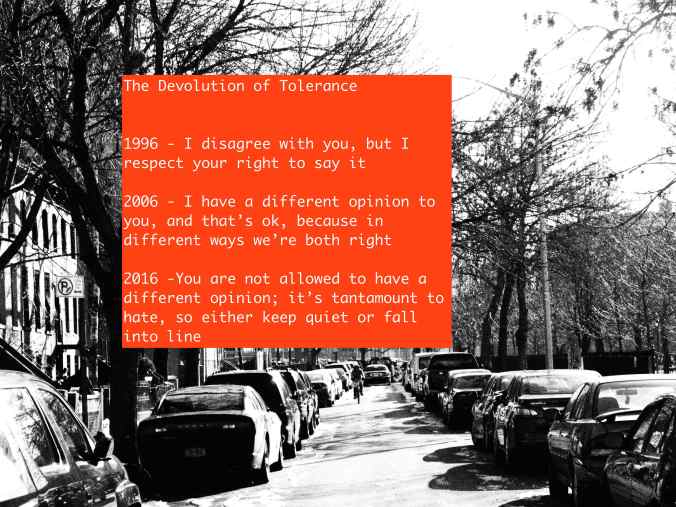
Disallowing serious and legitimate discourse is not a sign of a mature society, but of a regressive culture that has become enslaved to an absolutist and oppressive ideolog. This is increasingly the case in Western societies as we see politicians,  media personalities, and entertainers insist the population adhere to their self-defined and unprovable moral truths. The fact that their definitions frequently change doesn’t get in the way of them demanding unquestionable allegiance. Under such a system it is irrelevant whether one speaks with compassion and clarity, and with evidence and grace; it is enough that the secularist’s sexual proclivity has been questioned.

We are somewhat stunned by Facebook’s actions, but let’s remember, this is nothing new. During his life Athanasius found himself exiled 5 times for speaking his views. William Tyndale was burnt alive for giving the English people the Bible in their own language, and John Bunyan had freedom of speech snatched from him and a prison cell given instead. This is not the first time in history when sensible speech has been censored, and it won’t be the last. Yes, it is irrational and intolerant, but such was the experience of the gentlest, most loving, rational, gracious man to have ever walked the earth, Jesus Christ.  The full beauty of glory of God dwells in Him, and yet the world disdained his talk of peace and love, and people despised the fact that he showed grace toward people, even those with him he strongly disagreed.

With perspective, last night’s actions by Facebook are pretty small, but they are certainly symptomatic of a broader issue that ought to concern not only Christians but all people who believe in fair, truth-seeking, and respectful debate.

Respectful Relationships?

I agree with Daniel Andrews’ recent comments about the evils of domestic violence in our society, and I laud the Victorian Government for adopting strong measures to support victims and convict perpetrators. Domestic violence is a dreadful, dreadful thing: Sexual, physical, emotional, and material abuse is never justified.

In August 2015, Daniel Andrews announced that the program replacing SRI in schools would be Respectful Relationships, which has been introduced into secondary schools, and will be compulsory from kindergarten to year 10 in 2017.

IMG_0214

There are many things to like in the curriculum, but oddly, a significant portion of the material has little to do with domestic violence, but is teaching children how to find partners and have sex.

For example, year 8 students are asked to write an ad, describing what qualities they would like to find in a partner. Is it appropriate to ask 12 and 13 year old children what kind of sexual relationship that would like to have?  Is it healthy for children to be directed to online dating sites, and given examples, such as these found in the curriculum?:

‘hot gay gal 19 yo seeks outgoing fem 18-25 into nature, sport and nightlife for friendship and relationship’

‘lustful, sexually generous funny and (sometimes shy) Tiger1962 seeking sexy freak out with similar intentioned woman.’

Not only are young teenagers taught about what to look for in a partner, they are taught what to seek in sex, and they are taught what to believe about sexuality, even to explore and affirm alternative sexual orientations.

As one of the year 8 sessions explains, it is designed to,

“enable students to explore the concept of gender and the associated notions and expectations that have an impact on sexuality. It also provides them with the opportunity to connect issues of gender to different positions of power central to adolescent sexual behaviour. The activity also aims to extend their understanding of gender by exploring traditional notions of gender in a case study that examines the experience of a young transsexual person.”

Much of the ensuing material explores broadening the horizons of sexual relationships, with the determination of deconstructing the “narrow” view of gender.

It may surprise some people to learn that children can legally have sex in Victoria from the age of 12 (younger in some States), so long as it is consensual and the other person(s) is within the legal age bracket. This may be lawful, but I suspect many parents would be shocked to learn that schools teach our children it is okay for them to engage in sexual intercourse at such a young age.

We are fooling ourselves if we think that exposing children to these ideas will not result in influencing sexual and social behaviour. The fact that Respectful Relationships makes consent unequivocal (a vital point) does not mean the activity is therefore good and okay for the child.

Also astonishing is what is missing. In a curriculum teaching relationships and sex, marriage receives almost no mention. Why is that? Marriage is mentioned on a ‘character card’ where Stephen, a 16 year old Christian attending a Christian college, believes sex should only take place within marriage between a man and woman (got to love the pastiche Christian example!). And there is Maria, a 15 year old girl who doesn’t want to wait for marriage before experiencing sex. Otherwise, marriage is only mentioned as a power structure behind which domestic violence occurs. What a sad and miserable view of marriage. I understand there are marriages where appalling abuse happens, and in my work I have ministered to victims from such circumstances. But marriage is designed to be, and often is, a beautiful thing, and it remains the best model for loving and caring intimate relationships in society.

Is it not a wonderful thing when a couple covenant together for life, ‘for better, for worse, for richer, for poorer, in sickness and health, to love and to cherish’?

There is much sensible and good advice offered in Respectful Relationships, which could be easily taught without the intrusion of particular views on sexuality and without exposing young children to ideas that blemish their innocence. It is a travesty that the issue of domestic violence has been taken captive by sexual libertarian ideology.

Is it the role of Government to absolutise onto children a theory about gender that is disputable and widely contentious? James Merlino has made it clear that this curriculum is to be compulsory in Victorian schools; I wonder, is forcing explicit sexual language and ideas onto children, moral or even legal?

Far from solving the unspeakable horrors of domestic violence, it is ultimately presenting a different version of the me-centric vision of the world. Author, Tim Keller writes, ‘It is possible to feel you are “madly in love” with someone, when it is really just an attraction to someone who can meet your needs and address the insecurities and doubts you have about yourself. In that kind of relationship, you will demand and control rather than serve and give.’ 

Instead of leaning on a failed sexual revolution in order to find a way forward on domestic violence, would we not serve our children better  if we considered a paradigm of sacrifice and service, and where living for the good of others is esteemed more highly than our own gratification?

Topsy Turvy Sexuality?

Australians are now part of the world of topsy-turvy sexuality; gender is fluid and yet the alphabet of carefully defined sexual orientations grows longer. Our children are now taught in school that gender is not bound by biology and yet the same programs encourage boys and girls to be separated for classes dealing with sex.

IMG_5118

Rabbit or Duck Sculpture

The clarion call of 2016 is that there is no normal when it comes to gender and sexuality, indeed believing so is heresy, and yet when it comes to the teacher’s manual for Respectful Relationships, the Education Department of Victoria strongly suggest ‘single-sex groups’, and ‘male educators’.

Why? According to the Department there are inherent differences between males and females, not only biological and physical differences, but emotional and social differences, such that it ought to influence the way we talk about domestic violence in the classroom.

For example, while mixed gender groups are not dismissed,  multiple reasons are offered as to why single-sex groups may be preferred:

“Both males and females may be more comfortable and expressive in single-sex groups. In sexuality education, for example, there is evidence that young people can be uncomfortable when asked to discuss sexual matters in front of members of the other sex and reluctant to fully participate in sessions held in a mixed-sex environment.

– Mixed-sex discussions can become polarised.

– Working in single-sex groups can minimise the harmful, gendered forms of interaction that are common in mixed-sex groups.

• Girls and women with prior histories of sexual assault may experience mixed-gender workshops as revictimisation, while potential male perpetrators may misuse information on how girls and women can reduce their risk of assault.

• There is some evidence that female and male participants prefer single-sex workshops. Research on violence prevention education among men in particular tends to emphasise the need for male-only groups, for example because:

• men are more comfortable, less defensive and more honest in all male groups

• men are less likely to talk openly in the presence of women

– single-sex groups reveal a diversity of opinions among men that may not be expressed when women are present

• men may be more prepared to reveal, and thus reflect critically, on sexist and abusive histories in all-male settings

• men’s attitudes and behaviour are shaped in powerful ways by their male peers, and male–male influence can be harnessed for positive ends in all-male groups

• there may be greater opportunity to discuss and craft roles for males in ending sexism and violence.

At the same time, there are clear benefits for mixed-sex groups. In particular, they:

• create opportunities for dialogue between females and males regarding gender, sexuality, violence and relationships, fostering cross-gender understanding and alliance

• create opportunities for males to listen to females regarding these issues”

This recognition of male and female differences also affects the question of who should facilitate these Respectful Relationships classes:

“Gender of teaching staff?

Most violence prevention educators in Australia are female, reflecting women’s much higher levels of participation and employment in services, agencies and community efforts addressing men’s violence against women. However, as engaging boys in violence prevention has become more prominent and as men’s roles have received increasing emphasis, there has also been some emphasis on the need for work with boys and young men to be conducted by male facilitators in particular. Arguments for using male facilitators and peer educators when working with all-male audiences include the following:

• Given the benefits of all-male groups or classes (see the discussion under ‘Curriculum structure’ above); male educators or facilitators are a necessary complement to this.

• Male educators and participants can act as role-models for other men.

• Male educators possess an insider’s knowledge of the workings of masculinity and can use this to critical advantage with male audiences.

• Male educators tend to be perceived as more credible and more persuasive by male participants.

• The use of male educators embodies the recognition that men must take responsibility for helping to end men’s violence against women. However, female facilitators can work very effectively with boys and men, and there are benefits to women and men working together.

Such partnerships demonstrate to participants a model of egalitarian working relationships across gender; they model women’s and men’s shared interest in non-violence and gender justice; they give men opportunities to hear of women’s experiences and concerns and to further mobilise their care for the women and girls in their own lives; and they enhance accountability to women and women’s services.

The argument that work with girls and young women should be conducted by female facilitators in particular has been made less often, perhaps as this is the norm anyway, given women’s overrepresentation in the violence prevention field. Nevertheless, it is supported by similar arguments to those above and by earlier arguments for single-sex groups per se.

Simplistic assumptions about ‘matching’ educators and participants, for example by sex, may not address the complex interactions and negotiations that take place regarding a range of forms of social difference, from age and ethnicity to class and sexuality. Indeed, sharing a biological sex is no guarantee of individuals’ compatibility, given males’ and females’ diverse gender identities and relations. In any case, there may be practical constraints on ‘matching’ educators, particularly when it comes to working with boys and young men.

Therefore, while there are valuable arguments for matching the sex of the educator(s) and their students in violence prevention and respectful relationships classes, this report suggests that programs have clear rationales for, or at least a critical understanding of, their use of female or male staff.”

The document is revealing because it presents a teaching methodology that contradicts the teaching material. The authors acknowledge there are real differences between males and females which extend beyond biology and which are not necessarily social constructs.  Indeed, one could say, it is normal. In fact, the authors are left, almost having to justify exceptions to this pattern, saying, ‘here’s what works, but we understand you may want to try things differently’.

No matter how hard sexual deconstructionists try to bend or even remove the parameters of the two genders, we inevitably return to them like fish to water.  I am not saying that there aren’t people who have genuine struggles and even dysphoria, but if gender is as fluid as some are arguing, why did these education experts think it pertinent to provide such specific guidelines, taking into account marked differences between boys and girls? Are they simply reinforcing archaic stereotypes? Or is it the case, that despite pressures to conform to the current mood on sexual thinking, it is impossible to altogether abandon what we know to be true, that boys are boys, and girls are girls:  both are equal and yet different.

Answers to Difficult Questions

This Sunday at Mentone Baptist Church we are beginning a 3 week apologetic series, examining 3 hot topics:

1. Should Christians object to same-sex marriage? (April 3rd)

2. What is a Christian response to refugees? (April 10th)

3. Is the a reason for suffering (April 17)

Everyone is welcome to join us. Following each service there will be a QandA session to explore in further detail questions relating to these topics

ApologeticsforWeb


The good & not so good from the Safe Schools Review

First of all, I want to thank Prime Minister Malcolm Turnbull for calling the review of Safe Schools, and Education Minister, Simon Birmingham for his role in overseeing the process.

I know many people are grateful to these and other members of Parliament who have listened to the concerns expressed by the public.

The proposed changes are indeed positive and welcomed, however there remain a number of serious concerns, especially for Victorians.

The positives:

I have copied the Minister’s report below, but to summarise the more significant amendments.

  1. Parents will now have more access to the program, be included in the process if and when a school considers using Safe Schools, and be given the right to have their children opt-out of the program.
  2. Third-party websites will removed except for “organisations funded by state, territory or Commonwealth governments for the provision of mental health or counselling services.”
  3. The content from some lessons will be either removed or reconfigured to be less affronting and to be more age appropriate.
  4. There will be tighter controls on what materials can be used and distributed in classes and in schools.

The negatives:

1. The Network Provider in Victoria is La Trobe University, the very group who authored the program. According to the findings of the review, the La Trobe university team have been found to have written material unsuitable for young teens, and using the program to promote political ideologies.

It is therefore surely untenable to have La Trobe university acting as Network Provider for the State of Victoria. Their reputation has been diminished, and trust significantly eroded, if not altogether.

What guarantees do we have that Roz Ward and her colleagues will desist from using school children as a means to further their ideological agenda? If this were any other education program, they would surely be removed from such an influential position of power over schools and children.

2. What guarantee is there for Victorian families that children will be given permission to opt-out of the program?

While the Federal Government are making this guarantee, the Victorian Government have repeated their policy that the program will be mandatory.

What are Victorian families to expect when our Education Minister, James Merlino, refers to the Federal Government as “caving into bigots”?  Where does that leave 100,000s of Victorians who are against bullying but do not support Safe Schools? The possibility of any genuine dialogue with the Andrews’ Government is doubtful, and no wonder there are people using social media to lash out at concerned persons, when we are hearing Government ministers resorting to such malicious rhetoric.

3. The fact remains that Safe Schools teaches gender fluidity (as though it is the new norm), and it encourages children to question their own sexual orientation and practices. It is ironic that this imbedded doctrine of gender fluidity remains so  intolerant towards anyone who doesn’t fit within its parameters. Teaching children to doubt or ignore biology, and to create their sense of sexuality will inevitably lead to confusion, experimentation and harm.

At this stage, children who believe in heteronormacy will still be labelled as ‘sexists’, and children with unwanted same-sex attraction are given little choice other than to believe that it is inevitable, permanent, and to be embraced.

P1013305.JPG

Like with Autumn the leaves fall from their branches so Safe Schools has been pruned, but its roots remain unchanged. The revisions are a good start, but they do not go far enough. Safe Schools remains a social engineering program that is wired to change the way children view themselves and each other. With the revisions announced today it is certainly a more sensible program, but the wisest course would have been to put Safe Schools to rest and introduce a new and better program which teaches respect, kindness and resilience.

Guercino_-_Jesus_and_the_Samaritan_Woman_at_the_Well_-_WGA10946

There is a story in John’s Gospel where Jesus broke the cultural expectations of his day by speaking to a Samaritan woman. At that time Samaritans were considered social outcasts, and often discriminated against. Jesus’ conversation is all the more outrageous because the person before him was a woman and she was then living with a man to whom she was not married.  To our culture of anything goes this may not sound particularly shocking, but at that time this woman was guilty of  triple-headed social evil. However, it didn’t stop Jesus.

The text tells us how Jesus understood her heart and her past, and yet he struck up a conversation with her, showed her kindness, and even offered this astonishing word, “whoever drinks the water I give them will never thirst. Indeed, the water I give them will become in them a spring of water welling up to eternal life.” In other words, Jesus did not agree with her lifestyle and yet he loved her and broke down cultural barriers to express kindness to her.

In contrast, many advocates for Safe Schools are repeatedly slandering, and throwing around derogatory names toward anyone getting in the way of this program.

Which of the two examples demonstrates greater tolerance? Which of these two illustrations is more attractive?

Augustine once wrote,

“I have read in Plato and Cicero sayings that are wise and very beautiful; but I have never read in either of them: Come to me all who are weary and burdened and I will give you rest.”

Safe Schools may get a few things rights, but its blind commitment to a particular gender theory is setting the stage for a generation of confused children and a society that will grow less tolerant by the day. We need better. We must do better. We can do better.

——————————————————————

Here are the stated changed announced by Simon Birmingham:

1. Fix the content of the programme resources by:

a. Having the lesson plans for Lessons 2, 6 and 7 of the All of Us resource amended to remove those activities identified by the review as potentially unsuitable for some students.

b. Having the content of Lesson 5 of the All of Us resource redesigned to ensure that the content aligns with the curriculum content for biology appropriate for the target age group.

c. Requiring that the amended resources and any further resources be peer reviewed and approved by a panel of qualified educators appointed by the Department of Education and Training.

2. Address concerns about third party links, advocacy and materials in resources by:

a. Having all third party organisation branding removed from all official resources.

b. Having reference to any third parties limited to organisations funded by state, territory or Commonwealth governments for the provision of mental health or counselling services.

c. Requiring that national and local programme managers not bring the programme into disrepute, or engage in political advocacy in a way that represents their views as being endorsed by the programme.

d. Requiring that the resources for the programme not be used for political advocacy.

3. Limit the distribution of certain materials by:

a. Requiring local programme managers to ensure the distribution and promotion of Safe Schools Coalition Australia programme materials is restricted to secondary school settings only.

b. Restricting the use and distribution of the OMG I’m Queer, OMG My Friend’s Queer and Stand Out resources, which were not developed as classroom resources, to one-on-one discussions between students and key qualified staff.

4. Align the location of resources with other inclusion, support, tolerance and anti-bullying measures by housing official resources only on the official Australian Government Safe Schools Hub website, which contains other inclusion and anti-bullying resources for schools, teachers, parents and students in areas such as racism, domestic violence and disabilities. The Safe Schools Coalition Australia website will not have any resources, advice or links and will limit operations to programme coordination and direct users to the Safe Schools Hub for access to official programme resources only.

5. Ensure parents are appropriately empowered and engaged by:

a. Requiring agreement of relevant parent bodies for schools to participate in the Safe Schools Coalition Australia programme, including the extent of participation and any associated changes to school policies.

b. Requiring parental consent for student participation in programme lessons or activities, while maintaining the rights of all students to seek counselling services.

c. Having an official fact sheet for the Safe Schools Coalition Australia programme for parents about the programme developed so they have access to full and consistent information of its content and the resources that may be used in schools.

d. Having an official resource for parents of students dealing with questions of sexual identity developed, and distributed only by key qualified staff.
A Letter to Education Minister, Simon Birmingham

mast-headshot

Dear Minister,

I am foremost writing to you as a father of 3 children who all attend school, and only secondarily as a local community leader.

I am supportive of schools educating children about bullying and making a stand against all manner of bullying, including because of sexuality, but I am convinced that the Safe Schools program is not the answer.

Roz Ward, one of the chief authors and overseers of the program has herself explained that Safe Schools is designed not merely to be an anti-bullying program but it is a tool to promote same-sex marriage and to work against heterosexuality. This reasoning ought to be given due consideration by the Government as they review the material.

I have published many of my questions and concerns on a blog and in The Age, but to summarise some of the more pertinent points for you:

  • What materials and support is offered to students who experience same-sex attraction and do not wish to encourage or live out these desires? I am yet to find anything in all their website that will help these children.
  • For a course designed to remove ‘stereotypes’, Safe Schools successfully stereotypes many people including some LBGTI people, by not giving legitimacy to individuals who for personal and sometimes religious reasons, do not believe in living out same-sex thoughts and feelings.
  • Safe Schools teaches the false dichotomous view about peoples attitudes to gender differences: either you support and encourage all sexual variants, or you are a bigot and homophobe. This is simply not true, and to insist of such simplistic and erroneous positioning is intellectually and morally dishonest.
  • The teaching material expressively dismisses heteronormativity and alternative sexual expressions are encouraged. A child who believes  heterosexuality is normal or desirable is given label ‘heterosexism.’ Far from educating against bullying, this is bringing bullying into the classroom and giving it legitimacy.
  • As a parent I am all to aware how my children are influenced by what they read and watch, and are taught in the classroom. It is simply  naive to pretend that Safe Schools will not impact the behaviour and thinking of children in regard to sexual thinking and behaviour. After all, Roz Ward has indicated that this is one of her goals in writing the curriculum.
  • As other people have rightly asked, why is an anti-bullying program providing links to websites where students can buy ‘sex equipment’, attend masochist training, and watch pornography? I understand that some of these links have been taken down, but why were they ever there in the first place, and who is to guarantee that they won’t reappear at a future date? These things may not be part of the formal curriculum, but they have nonetheless been added for students who wish to investigate further.
  • Finally, the Victorian Government are making Safe Schools compulsory by the end of 2018.  What steps will the Federal Government be taking to ensure students will have freedom to opt-out of these classes, should parents believe the program unsafe and unsuitable?

Surely there is a better way forward where we can encourage children to show respect and kindness, and to support children wrestling with identity issues, without pushing a course with questionable science, material, and that has already begun estranging children in our schools.

I am happy to speak further with you should you wish.

Yours Sincerely

Murray Campbell

What price should we attach to marriage?

The media has been abuzz with the announcement made by accounting firm Price Waterhouse Coopers (PwC), that the proposed marriage plebiscite will cost Australians $525 million.

P1017924.JPG

The cost attached to the plebiscite itself is $158 million. Another $30 million has been estimated to deal with mental health issues that may arise for LGBTI people from potential hate-speech and acts, $66 million set aside for the yes/no campaigns, and it is estimated that while we duck off to the polling venue on a Saturday afternoon to vote, there will be productivity loss around the nation to the sum of $280 million.

It needs to be said that despite how some media outlets are reporting the PwC modelling, this figure is not factual, but is an educated opinion, and one which is already being disputed. It is also important to note PwC is not acting as an impartial third party, but they are a strong supporter of same-sex marriage and of the group Australian Marriage Equality.

Despite these qualifications, let’s assume the sum is accurate. Given all those factors I would call myself a reluctant supporter of the plebiscite.

Bill Shorten has said of the plebiscite, “what a waste”. I sympathise with this view, for I can see how the money could be used to assist any number of important social concerns: mental health, housing for indigenous Australians, addressing domestic violence, and refugee assistance are just a few of a hundred issues requiring attention and support. Having said that, the notion of changing the definition of marriage is no small thing, and it is naive for anyone to suggest so.

The proposal is not a tiny amendment to the law, but the radical and complete alteration of society’s most basic building block: from marriage comes the family unit, and from family communities are formed, and with communities a society and nation is shaped. Marriage is not everything, but it is an important thing and it is one which has held an almost universally accepted definition since history began. Until recently very few societies would even consider the question, and today the vast majority of nations remain opposed to same-sex marriage. Let us understand that no one is quibbling over a few words, at stake is rebooting the very notion of marriage. There are already community voices arguing that this rewrite is simply a steppingstone to further changes and even the eradication of marriage altogether:

Last year, Simon Copland, a columnist with the Sydney Star Observer, argued that equal marriage might unfortunately limit expressions of sexuality, saying that ‘while monogamous marriage still works for many, our society is increasingly questioning whether it should remain as the only option’.

At the 2012 Sydney Writers’ festival, Dennis Altman, was among a number of speakers who declared their hope that the Marriage Act would be eventually repealed altogether.

The point is, it is not hyperbole to suggest that should marriage redefinition take place, it will be considered a watershed event in Australia’s history, one which will have inevitable and enormous repercussions for society.

Australians are not choosing whether to adopt a new tax or funding more schools or creating the NBN, as important as such things may be; we are deciding how Australia will view what is the most essential and basic unit of every society on earth, marriage.

Yes, $525 million is a lot of money, but when one breaks down the cost per capita, it comes to $21.88 for each Australian. For the cost of little more than a movie ticket, I can have a say in deciding the direction Australia will take on the most fundamental social unit

A separate concern surrounding the plebiscite has been raised by various advocates for marriage change, including Rodney Croome who said,

“The damage an ugly and divisive campaign will do to vulnerable members of the LGBTI community, their families, and youth will have far-reaching consequences that cannot be quantified,”

As someone who has a voice in the community, albeit a small one, should the plebiscite be presented to the nation, I want to state publicly that hateful speech and actions against LGBTI people are unacceptable. A marriage plebiscite does not justify spite or slander toward those who wish to change the Marriage Act. Throwing bile at another human being is detestable, whether it is done in person or on twitter.

“A marriage plebiscite does not justify spite or slander toward those who wish to change the Marriage Act”

As important as this plebiscite is, there is something of greater consequence, and that is the good of others. I have no desire to sacrifice people for the sake of a vote. I do not wish harm on any homosexual and lesbian Aussies, and will gladly speak against such behaviour. But please do not erroneously fuse disagreement with hate as though there is an inextricable link between the two, for this is not the case. To disagree civilly is not to hate, and to think that it is risks undermining the foundation of democracy.

The logical terminus of Croome’s argument is a prohibition on disagreement; that is not healthy for democracy and would set a bind on the conscience of those who disagree with the change to the marriage law. A society that forbids the public articulation of civilly expressed views that come out of a long, thoughtful and widespread tradition is on the road to becoming the very thing it claims to stand against.

It is possible, indeed desirable, to show kindness in disagreement. I realise that kindness like marriage is a disappearing norm in Australia today, but showing gentleness and respect toward those with whom there is a different view ought to be basic to our humanity. Is this not one of the reasons why Donald Trump leaves us shuddering?

Indeed, the essence of Christianity is Jesus Christ showing kindness to a world that had no room for his beliefs,

“You see, at just the right time, when we were still powerless, Christ died for the ungodly. Very rarely will anyone die for a righteous person, though for a good person someone might possibly dare to die. But God demonstrates his own love for us in this: While we were still sinners, Christ died for us.”

While bullish and malicious behaviour toward same-sex marriage advocates is rightly called out, I wonder whether those leading the charge for marriage change insist that their supporters don’t resort to hate speech toward those who believe marriage can only be between a man and a woman?

Will they pledge to publicly denounce individuals who disparage the millions of Australians who do not support same sex marriage?

Will they call out public figures who time and time again call people homophobes and bigots for believing only in heterosexual marriage?

Australians are increasingly recognising that this decision is of major consequence, not only for the way we build society, but this may have enormous implications for ‘freedom of speech’ and ‘freedom of religion’. We only have to look at Canada, the United States, and the United Kingdom to see how same-sex marriage introduces a wave of intellectual and moral oppression on those who cannot for reason of conscience affirm it.

The Labor Party have made it abundantly clear that they will not allow their members to vote against same-sex marriage. This is hardly the stuff of a dynamic democracy. Only two weeks ago, Labor Senator Joe Bullock was forced to retire because of his Party’s unwillingness to allow a conscience vote on this issue. Such political censorship has given cause for the public to doubt that a fair vote can take place in Parliament.

I share concerns over the cost of a plebiscite, but given what is at stake the Australian public ought to have their voice. If John Howard believed in taking the GST to an election, how much more should the question of marriage, which is insurmountably more important, be given a say by the people.