A return to common sense pluralism in Victoria?

Matthew Guy, leader of the Victorian State Opposition, has announced that “a government I lead will bring back religious instruction in schools because it’s very important.”

This is encouraging news, not only for Christian families but also for Victorians in general. Let me explain.

But first of all, it is important to premise my commentary with this statement: when I talk about various policies or pieces of legislation, one shouldn’t read into this an advocation for any one political party.  I don’t believe it is the role of a pastor to dictate or to suggest to their congregation (or to others) how to vote. I also recognise that there are many important issues which influence the way we vote and on these Christians may differ. One, however, may comment on specific policies, for such things are designed to influence and to shape aspects of society, and therefore they can very real consequences for constituents. It is a misstep however for the reader to conclude that either giving praise or criticism is a signal to vote in any one direction.

img_9452

Having said that, let’s address the issue at hand.

In 2015, the Victorian State Government announced that Special Religious Instruction (SRI) classes would cease in our schools, during class hours, as of January 2016. This was not a policy that State Labor took to the election.

At the time, Education Minister, James Merlino, offered this reason for SRI’s removal, ‘We can’t have kids missing out on essential teaching time.’ However, he then announced that a new program will be introduced to schools, replacing SRI, which includes instruction on faith and ethics. The reasoning behind the axing morphs again when the Australian Education Union supported the decision, stating that SRI is at ‘odds with Victoria’s secular education system’.

To be fair, Mr Merlino also made it clear that SRI could continue “outside the curriculum.” I am sure that Mr Merlino was and is aware of what every parent knows, and that is our children already have multiple programs running during lunchtimes and after school. During those breaks when they are not having sport or music practice, they need that downtime to relax and to play with friends.  Yes, schools are permitted to run SRI, but the goal posts were moved so frequently that almost no one knew what was permissible, and the red tape has been wound so tight that most schools were unable to give students an option. Despite the rhetoric about schools being allowed to run religious classes, by design, there is a massive disconnect between optics and what is actually possible on the ground.

One of the results of this move is that many Victorian families no longer feel welcomed in State Schools, and instead have been pressured into moving their children into religious schools, often at significant and unplanned cost to these families. This movement may have benefited independent schools, but our State Schools are the poorer for it. Matthew Guy’s announcement is welcoming and sends the message that all children are welcome.

It is also important to note that under the current Government (and the previous Government), important lessons were learned in relation to the training of religious instructors and to preferring an opt-in approach. Mistakes were made by SRI providers, but the sensible answer, however, was never to rid schools of these classes.

Once again, I understand that Matthew’ Guy’s announcement is enmeshed in politics and an upcoming election; so let me repeat, that’s not my interest here. What can be said is that (whatever the motivation) the Liberal’s position on this issue better reflects the Australian ethos than does the current position on religion in schools. The announcement permits and encourages healthy pluralism, as opposed to the narrow ideology that is currently being forced upon an entire generation of children.

A return to opt-in SRI also better reflects the Universal Declaration of Human Rights (UDHR) which was adopted by the United Nations in 1948:

‘Every child shall enjoy the right to have access to education in the matter of religion or belief in accordance with the wishes of his parents or, as the case may be, legal guardians, and shall not be compelled to receive teaching on religion or belief against the wishes of his parents or legal guardians, the best interests of the child being the guiding principle.’

Art5(2) Declaration on the Elimination of All Forms of Intolerance and of Discrimination Based on Religion or Belief (1981)

Replacing Safe Schools with a curriculum safe for our children

Matthew Guy has also announced that a Coalition Government would remove the  Safe Schools curriculum from Victorian schools. This is a safe option for our children.

While some of the intent of Safe Schools needs affirming, it was unnecessarily but inextricably enmeshed in unscientific and dangerous theories that have potential to cause immense damage upon our children. To teach our children to respect others, regardless of their sexuality, is right and important, but to teach that gender is fluid, to encourage exploration in sex, and to encourage children to transition to another gender despite research indicating that most children will recover from dysphoria with maturity, it is morally and intellectually reprehensible to have such things taught in our schools. To label children who believe in heteronormacy as ‘sexist’ is itself sexist, and demonstrates the hypocrisy that’s woven into the program. The whole saga has been troubling; Safe Schools isn’t about anti-bullying, it’s about forcing on our children a particular and narrow view of sexuality. When the very authors of the curriculum pointed out this fact, the Government were quickly dismissive.

Since the introduction of Safe Schools, two separate and academic reviews have been conducted (the first by Professor Louden and one by Professor Parkinson), both demonstrating significant flaws and problems with material, including dependence on fake statistics, unscientific theories, and in places presenting as fact ideas that remain highly contested within the medical fraternity. Following Professor Louden’s Review, the Federal Government announced significant changes to the curriculum, but Victoria has insisted on ignoring the findings and implementing the program without change.

What has happened in Victoria over the past 3 years is that a ½ hour opt-in religious program was removed and then replaced with compulsory curriculum (not only Safe Schools but also Respectful Relationships). In addition, the Government began designing a ‘general religious’ curriculum course for schools, which is to be compulsory across our schools (I am not aware if this course has been implemented as yet).

Don’t fall for revisionist views of secularism

According to The Age, “Australian Education Union Victorian branch president Meredith Peace said special religious instruction had no place in the curriculum of secular public schools.

She said there was already room to learn about religion and its role in society and history in state schools.”

“But it shouldn’t be taught by unqualified people who come into the schools with a very different purpose.”

These remarks prove the point. Contrary to Meredith Peace, secular does not mean non-religious or keeping religion out of public education and other public domains. The definition of secularism is not private religion, as Peace implies. True secularism allows for and encourages the plurality of ideas.

Also contrary to Meredith Peace, it is sensible that those who teach the Bible, should be qualified people (whether teachers or volunteers) who understand and believe the Bible’s message, rather than skeptics who explain away and misrepresent the Bible’s message.

Neutral education is a fairy tale, and it’s simply disingenuous for anyone to suggest such. This bias is clearly demonstrated by the Department’s own statements in the draft general religious studies program. As someone who holds an honours degree in theology I am in some way able to speak to the following statements.

According to the Education Department, these are the key premises of Christianity:

“There is one God, consisting of the Father, the Son (Jesus Christ) and the Holy Spirit. God is the creator and sustainer of the universe. God became human in the person of Jesus, the Son.

People have one life and its purpose is to live in a loving relationship with God, with others and with the world. The life and teachings of Jesus show how this is done and make possible the life-giving changes needed in individuals and society. Christians are empowered by the Holy Spirit and are called to demonstrate God’s love, compassion and justice in all their relationships and interactions. Most Christians believe in an afterlife; that after their physical death, they will live forever with God.

The Bible is the sacred text for Christians. The Bible has two parts, known as the Old and New Testaments. The Old Testament contains Jewish books and teachings, before the time of Jesus. The New Testament records the teachings of Jesus as well as the history and teaching of the early Church which is based on the teaching and example of Jesus.”

Some of the above statements align with Christianity, while others are blatantly wrong, and some of the most central tenets are altogether missing.

Here is one example of a basic error, ‘Most Christians believe in an afterlife; that after their physical death, they will live forever with God”. No, all Christians believe in an afterlife, and this life beyond death will be physical.

Notice how there is no mention of sin, Jesus’ death on the cross and his resurrection, and of salvation on account of God’s grace. There is no mention of hell. Without these things, there is no Christianity. It is not enough to make the excuse, we can’t say everything in a few paragraphs, the core of Christianity has been ripped out and in so doing it is presenting a Christianity that is inauthentic and inaccurate.

To quote the Bible, Christianity is about “Christ and him crucified”.

My point is this, if the Education Department is unable to fairly and accurately summarise the Christian faith, how can we trust what they want to be taught about any and all religion?

Would we want our children being taught maths by a teacher who doesn’t understand algebra? Would we be happy to learn that the school biology teacher doesn’t believe in male and female anatomy? Is it acceptable for sports teachers to deny the value of physical exercise? Why is it, therefore, acceptable when it comes to Christianity specifically, and religion more generally.

This is not about imposition, this is about recognition.

Why shouldn’t we give our children an opportunity to explore the greatest book that has ever been written? A book to which we owe more than any other? A book that has given shape to millennia of civilisation (not only in the West but also in the East), and has given our society its ethical and political moorings?

An intolerant secularism that is claiming the public space.

The version of secularism that now dominates much public and political conversation in Victoria feints intellectualism and freedom, but it is simply the guise for a new wave of intellectual totalitarianism, where dissent is squashed by a tirade of shout downs.

Barney Zwartz made this astute comment in the The Age,

“This attitude masks a more serious problem in the widespread contemporary misunderstanding of what “secular” means, one that I suspect is shared by Fairness in Religions in School. It has never meant, as many imagine, the absence of religion from the public arena but simply that no religion should be privileged (as, for example, the Church of England is in Britain).

Properly understood, that works to protect people of all religions and none, and to foster an open, vibrant, tolerant public culture.”

Are we so frightened of the Bible that we must prevent our children from spending 1/2hr of the week from exploring it in a safe and fun environment? It is sad to see children having taken from them the freedom and opportunity to explore what is the greatest book to have influenced Australian life and culture.

I said it in 2015, and it remains the case today; 20 years from now, a generation of Victorians will look back upon the decisions that have been made, and we will recognise the diminished experience that we have given our children, having kept from them the very ideas that gave birth to Augustine and J.S Bach, C.S Lewis and Martin Luther King, and many of the greatest thinkers, scientists, artists, writers, and humanists of history.

I would encourage the Government to reconsider their own policies on these issues, and to realign them true secularism and with best scientific and medical research. Surely for the good our children and the future of the State, it is worth it.

Religious Freedom and Civil Speech: the insane, the fair, and the good

Narrative is important. In 2018, the winning argument doesn’t rely on facts and accurate information but depends upon telling a story which will garner the outrage of one’s constituents. Anger is power. Anger is persuasion. Truth-telling has become optional; useful when it supports one’s thesis, and redundant when it does not.

In this current age of rage and rhetorical bashing (which both progressives and conservatives are utilising), alternative narratives are often not presented with accuracy and fairness. It is proving increasingly difficult, and at times, near impossible to engage in civil discourse, because the climate is reaching temperature levels that resist reasoned and gentle speech.

The test case was the now infamous 2017 conversation promoted by the Bible Society and featuring Tim Wilson and Andrew Hastie. The point of the exercise was to demonstrate that it is possible to conduct a civil conversation over a beer while disagreeing on same-sex marriage.  Apparently, the very notion that Australians could enjoy polite disagreement on SSM was too much, as beer drinkers all over the nation raged and smashed bottles of Coopers’ Beer in protest. Coopers’ was threatened with boycotts to the point that they were forced to recant and join those waving rainbow flags (despite the fact that they were never sponsoring the video in the first place). Sadly, this response is now normal in Australia today.

One month ago, most journalists in the country were saying very little about the Ruddock inquiry into religious freedom…until a Christian became Prime Minister. Since then there has been an almost absurd flurry of attention given to this review in which the Government is still yet to release its decisions. Don’t get me wrong, there is a legitimate story here as to why the Government has been so slow in releasing its findings from the Ruddock review, but instead of waiting to find out what the Government’s position will be, media outlets began hypothesising and arguing points based on speculation, and when a summary of the Ruddock report was leaked to the media, everyone went nuts.

In the first few days, Fairfax published no fewer than 19 articles, in which they argued that the Government was taking steps to give religious schools freedom to expel gay students.

It soon became apparent that this was not a measure that the Government was considering, in fact, this provision already existed and it was introduced by the Labour Government in 2013. More importantly,  Christian schools across the country came out, saying that they were not aware of this policy and they certainly did not support or practice it. Eternity newspaper made inquiries around the nation and found the whopping sum total of schools who were expelling gay students to be zero. The other day I asked a teacher who works at a Christian school in Melbourne and they were stunned that the media would argue that this was a practice inside Christian schools.

In other words, the whole story was a beat up. But it hasn’t stopped anti-Christian hysteria, with numerous social commentators and now members of Parliament attacking this dangerous practice that doesn’t exist.

ABCs Media Watch presented an excellent summary of this sloppy journalism.

To be fair, since publishing the first 19 articles, Fairfax has now allowed two pieces which finally offer an alternate perspective. Both articles are indeed excellent and worth reading.

Come this morning, I wake up and the top of my Twitter feed is sprucing another article, with this title, “Sydney Anglicans set to ban gay weddings and pro-LGBTI advocacy on church property

9033538-3x2-340x227

The problem with this piece is that it is neither new news nor is it news at all. The Sydney Anglican Diocese, like other Anglican Dioceses around Australia, already have a position on marriage and their clergy and property is already constrained to practice weddings that conform to their definition of marriage. I realise that journalists are under growing pressure to write articles that are provocative and opinionated because such writing can increase audience reach and circulation, but this does not cultivate better public conversation. 

Deep into the article, after readers have already been won over to once again tut tut these  incredulous Christians, Michael Koziol, adds this important detail, one which in fact completely debunks that click-bait headline,

“Bishop of South Sydney Michael Stead, the senior clergyman who authored the proposal, told Fairfax Media that the use of church property had “always been governed by various regulations” and the new policy merely sought to consolidate those into a single document.

“The new policy doesn’t represent a change in our position and I wouldn’t expect it to have an effect on any activities currently occurring on church trust property,” he said.

“Because the federal government has changed its definition of marriage, the policy makes clear the church’s doctrine of marriage has not changed and that property use scenarios relate only to man/woman marriage.”

Is it so shocking that a Christian denomination should reaffirm their already stated beliefs? Is it so outrageous that Christians should practice what they preach? How dare Christians believe what Christians have always believed and practiced!

There is literally no point in publishing this article on the Anglican Synod, other than trying to add weight to the narrative that’s being spun, namely that conservative Christians in general, and especially Sydney Anglicans, are awful people who are intolerant, and who are fighting a rearguard action against the inevitable tide of sexual and moral progressiveness. Just so readers come away believing that Sydney Anglicans are really out of step, Koziol finds a few quotes to suggest that most Christians (certainly Anglicans) don’t support this out of touch view of marriage. Readers are told that Sydney Anglicans are just playing power games of ‘privilege’.

There you have it; it doesn’t matter what’s true or not, just insert one of those key intersectionality words, like ‘privilege’, and the story is complete; Sydney Anglicans are bad!

I’m reminded of a conversation that I had with a Fairfax journalist not so long ago. They shared with me how most journalists have little understanding of religion, in general, let alone comprehending Christianity. Of course, sometimes Christians add to the confusion by doing and saying things that are not true of Christianity. This kind if misinformation happened in the time of the New Testament Church. Take, for example, Alexander the metalworker whom Paul mentions as having “done him a great deal of harm”.

There are many fine journalists around Australia, some are Christians, many are not. I wonder though, how can we reach out to journalists and help educate them as to what it is Christians do and don’t believe?

Regardless of what one’s personal suppositions and moral inclinations are, Australian society needs to find ways to reduce the dangerous and at times disingenuous reporting and commentary that is taking over the public square. It would be great if our politicians would show the way, and societal conversations would certainly be strengthened if media outlets stepped away from speculative and sensationalised reporting.

Regardless of how others decide to debate ethical and political issues, Christians must follow the guidelines that are set out by the very Scriptures which our society deems as foolish and immoral.

Early this week I was reminded of this timely words written to Timothy by his friend and mentor, Paul,

 Don’t have anything to do with foolish and stupid arguments, because you know they produce quarrels.  And the Lord’s servant must not be quarrelsome but must be kind to everyone, able to teach, not resentful.  Opponents must be gently instructed, in the hope that God will grant them repentance leading them to a knowledge of the truth,  and that they will come to their senses and escape from the trap of the devil, who has taken them captive to do his will.” (2 Timothy 2:22-26)

That’s not a bad place for us to begin.

AFL Passion

Only once have I missed the AFL Grand Final, and that was in 1999.  We were living in London at the time, but even then, I woke up at 4 in the morning to read the then minute by minute updates that were being published on the internet (yes, this was before the days of live-streaming).

It doesn’t matter whether my team is playing on Grand Final day or not, it’s un-Melbourne not watch and enjoy the game.

UNADJUSTEDNONRAW_thumb_d81e.jpg

mysterious photo of the MCG,  taken the night before football

There will be 100,000 people filling the MCG this afternoon and living out their love for football, with millions more watching on television at home or at the pub.

Where ever one walks in the city, there are kids and adults dressed up in their football colours. Houses are fitted out in black and white, and the very rare and very brave, yellow and blue.  Everywhere you look, men, women and children are wearing footy jumpers and scarves. The only news today is about this single game of football. Football fans are not hard to spot: they are committed to supporting their team, they’re enthusiastic, they attend matches and if they can’t they will watch it on tv, they talk about footy at work, there are footballs lying around the house to hold and caress. 

Think about how much interest we take in the footy, how many conversions begin or end with footy, how passionate we get during the game (even if our team isn’t playing), and how the entire day revolves around the AFL.

Our own household has descended into the deep navy blues, pondering the good old days of 1995 and 1987, remembering that we are still the most successful club in AFL history, and will again rise…maybe.

Grand Final day is so important to Melbourne that we now celebrate a public holiday on the day before Grand Final!

For the 3.5 Melbournians who don’t love footy, there will be something else that you’re passionate about – art, music, gardening, cooking, technology,  spending time with friends, travel.

To prove that I’m not just another nodular barely-civilised football fan (can’t think why Collingwood comes to mind!), remember that famous balcony scene in Romeo and Juliet where Juliet is standing outside in the night sky and Romeo sees her, and is smitten and starts talking to himself, 

‘See how she leans her cheek upon her hand. O that I were a glove upon that hand, That I might touch that cheek.’

Romeo would be satisfied to be a glove on her hand so that he could touch her cheek. It’s all very romantic, but that’s what happens with passions and desires. Whatever the heart most desires, we think and talk and dream about it.

Football, music, and poetry are among the many good things we enjoy under a good God, and every year Grand Final week makes me wonder why Christians don’t exhibit similar enthusiasm for the good news of Jesus Christ?

Listen to what the Apostle Paul wrote,

“I speak the truth in Christ—I am not lying, my conscience confirms it through the Holy Spirit—  I have great sorrow and unceasing anguish in my heart.  For I could wish that I myself were cursed and cut off from Christ for the sake of my people, those of my own race.”

I think of Jesus who as he approached Jerusalem, wept, and said,

‘“If you, even you, had only known on this day what would bring you peace’

Where is this Gospel driven passion today? Where is the deep-heart-convinced desire to tell Melbournians the Gospel? We are passionate about many things and yet the purposes of God in Christ is rarely one of them.

Imagine if Christians preferenced time with Church over lazy weekends and sporting events?

Imagine if Christians gave just a portion of their football fanaticism to the Great Commission instead?

Charles Spurgeon once remarked, ‘‘Have you no wish for others to be saved? Then you’re not saved yourself, be sure of that!”

The thing is, while we may give intellectual assent to Surgeon’s question, what we truly desire is evident by what we give our energies too and the decisions we make in life.

Imagine, if Christians put first in their lives, God’s mission into the world?

Like everyone, I have limited time and energy, and so I need to be wise and ensure that how I live is being driven by the reality that I am persuaded is of greatest value. Friends, make it the Gospel.

FYI Collingwood by 11 points!

(This is a revised version of the article that was first published for the GF in 2015)

Pray for China

The Chinese Government has recently reasserted Sinicization, the project aimed at conforming Christianity into the likeness of Communist China.

Over the past 70 years, China has born witness to one of the greatest movements the world has ever seen. At the close of the Second World War and with the rise of Communism, Western missionaries were removed from China and many left wondering what would happen to the fledgling Churches left behind in that extraordinary land.

Communism has little time for religion, as has been demonstrated in 100 years of socialist run States. Belief in God is deemed to be a threat to social harmony and to those who have power over the people.

As the bamboo curtain descended in the 1950s, God did not turn away from the Chinese people, but behind the scenes, he began an amazing work which has led to so many people becoming Christian, no one can count the number. Estimates range between 40 and 80 million followers of Jesus Christ in China today—possibly more Christians than in any other nation on earth.

It is somewhat ironic that the most ‘Christian’ nation is one with a communist Government with a capitalist facade!


robert-nyman-442988-unsplash.jpg

unsplash.com

Over the past 20 years, China has gradually opened its doors to the world outside, and in some Provinces, religious toleration is greater than in others. As the bamboo curtain rose a little, Anglo-European Christians discovered that God does not need Western Christianity in order to grow the Gospel elsewhere. The Holy Spirit does not travel through western missionaries into indigenous groups but rather, the Spirit is God’s gift given directly to all who come to faith in the risen Christ. This is not to denigrate centuries of European witness to the Gospel, for we should be thankful for the fact that men and women traveled to China, and many died in order to give the Gospel to that great land. Today there are still many non-Chinese men and women who are serving in a variety of ways inside China, to love the people and show people the reality and good news of Jesus.

Once again, Chinese Christians are facing persecution. The Government is clamping down on Christianity with new intent and severity. According to a report in the ABC, the crackdown includes:

  • removing Bibles from online stores
  • removing Christian objects from buildings
  • closing hundreds of churches
  • and forcing Christian icons to include or be accompanied by images of Mao Zedong.

The last of these measures reminds me of Daniel ch.3 where King Nebuchadnezzar exercised religious toleration by requiring all of his subjects to submit to a statue in his image. Who doesn’t like to think of the cross with an image of Mao Zedong standing over it!

One Pastor explained what has happened to his church,

“And then they [the authorities] came into the church saying that things inside should be removed.

“For example, the banner saying: ‘For God, so love the world’ and the scriptures were torn down, and all things related to the Bible and faith had to be cleared out.”

Papal Collusion

All this would be bad enough, but news this week is highlighting collusion with the Chinese Government by the Vatican.

While President Xi Jinping is beginning to sound like King Nebuchadnezzar, Pope Francis is appearing as one of his astrologers who betrays Shadrach, Meshach and Abednego.

Writing for the New York Times, Ian Johnson has suggested that recent negotiations between the Chinese Government and the Vatican are designed to further stamp out underground Churches. In other words, to reduce even further any little autonomy and freedom Christian Churches might have had in China.

“Beijing’s goal in the agreement, however, appears to be the same as with the church demolitions: greater control over the rapid spread of Christianity, which gained a permanent presence in China in the 16th century.”

The deal will allow the Vatican to have greater say in appointing future Bishops in China (but not full control), and this was contingent upon Pope Francis formally recognising seven Catholics Bishops who have already been appointed by the Chinese Government.

According to Johnson,

“The ruling Communist Party sees the compromise with the Vatican as a step toward eliminating the underground churches where Chinese Catholics who refuse to recognize the party’s authority have worshiped for generations. With the pope now recognizing all bishops and clergy members in the official Catholic churches approved and controlled by the party, the underground church may have no reason to exist.

The move is part of a broader push by the government to clamp down on all aspects of society since Xi Jinping took power as the party’s leader in 2012.”

The founder of ChinAid, a Christian human rights organisation, Bob Fu, has responded to the deal,

“While we understand the eagerness of Vatican for seeking more legitimacy in the eye of the Chinese Communist Party, this reported deal is nothing but a betrayal of both the millions of suffering persecuted Christians in China and the global Catholic Church.” 

In other words, Pope Francis has struck a deal with the devil, one which will essentially hand over millions of Chinese Christians (especially Protestant Churches) into the unforgiving hands of the Government. According to all accounts, the Chinese Government is using the Vatican as a tool to increase pressure on underground Churches, either to close or to formally register and come under their authority and control.

Authoritarian Secularism

It is fair to say that many Christians in Australia are concerned with where things are heading in our own country. There are signs suggesting that new forms of authoritarian secularism are gaining momentum. The project to limit religious freedom and to control public Christianity has certainly gained ground in recent times. These moves need to be called out and pushed back for the sake of all Australians who believe in social pluralism and freedom of conscience, speech, and association. Do we really want to live in a country where the government or where self-appointed militia get to choose how Christian Christians can be or to police how Jewish Jews can be or how Hindu Hindus can be? 

Perhaps we should have one eye looking toward China, and ask ourselves, is that the kind of religious freedom we want to have here? We are a long way from the politico-religious scene of our northern neighbour, and yet it is not irrational to suggest that should some Australian political parties and notable social commentators have their way, we would be aiming toward an Australian Sinicization, conforming Christianity into the likeness of Australian humanistic secularism.

With a wonderful sense of divine irony, the future of Christianity in Australia, at least in part, lays with Chinese believers. As many Aussies of European descent turn their backs on God, preferring to worship plastic images of the self, large numbers of Chinese men and women, and of many from other ethnic descent, are becoming followers of Jesus Christ in Australia. It is exciting and encouraging. It’s as though the stupid identity politics and intersectionality ethics created by white middle-class university students, is being blown up before their very eyes.

The reason for writing this post is to raise further awareness of what is unfolding in China and to encourage Christians to pray.

When Paul shared his troubles with the Church in Corinth,  he mentioned the efficacy of the prayers offered for him by the Corinthians,

“We do not want you to be uninformed, brothers and sisters, about the troubles we experienced in the province of Asia. We were under great pressure, far beyond our ability to endure, so that we despaired of life itself. Indeed, we felt we had received the sentence of death. But this happened that we might not rely on ourselves but on God, who raises the dead. 10 He has delivered us from such a deadly peril, and he will deliver us again. On him we have set our hope that he will continue to deliver us, 11 as you help us by your prayers. Then many will give thanks on our behalf for the gracious favor granted us in answer to the prayers of many.” (1 Corinthians 1:8-11)

When we see terrible things in other parts of the world we respond with sadness,  concern,  and we may also carry a sense of helplessness, not knowing what to do.  As Christians, there is always one thing we can do, no matter where we are are in the world,  and that is, pray.

Prayer is not wasted breath to a nonexistent God, as our atheist friends might suggest. We pray to God our Father, who remains Sovereign over all nations even today, and who loves his people dearly, and who is committed to seeing his Gospel grow both here in Australia and in China.

A season for pruning churches in Australia

Does God sometimes allow unbelievers to do the work Churches should be doing themselves?

God used Nebuchadnezzar and the Babylonians as a weapon of judgement against Judah, and God used Cyrus as an instrument to bring God’s people back to the land and to see the Temple rebuilt.

While we cannot say with certainty that any specific person or organisation has been handed the pruning shears by God (for the simple reason, God hasn’t told us), we do know from the Scriptures that God is concerned with cutting off dead branches, pruning lives branches, and bearing fruit in the lives of his disciples.

In John ch.15 Jesus uses one of his many analogies to describe his relationship with his people, namely that of the vine and branches.

Jesus says,

 “I am the true vine, and my Father is the gardener. He cuts off every branch in me that bears no fruit, while every branch that does bear fruit he prunes so that it will be even more fruitful. You are already clean because of the word I have spoken to you. Remain in me, as I also remain in you. No branch can bear fruit by itself; it must remain in the vine. Neither can you bear fruit unless you remain in me.

“I am the vine; you are the branches. If you remain in me and I in you, you will bear much fruit; apart from me you can do nothing. If you do not remain in me, you are like a branch that is thrown away and withers; such branches are picked up, thrown into the fire and burned. If you remain in me and my words remain in you, ask whatever you wish, and it will be done for you. This is to my Father’s glory, that you bear much fruit, showing yourselves to be my disciples.”

img_7985


There is no doubt that churches have been entangled in many scandals over recent years. Clergy have been guilty of committing terrible abuses on children, while other ecclesial authorities have at times covered over these crimes. Popular preachers have been called out for marital unfaithfulness, embezzling money, acting like mini-dictators, and saying some really dumb and unwise things relating to an array of social and political issues.

Australia has a band of public figures and journalists who are always quick to castigate, shame, and then to investigate, all manner of evils perpetrated by Christians (and by people of various kinds of religious perspectives). This is no bad thing, for why should Christians be given a jail free pass, simply because they allege a diplomatic Jesus card?

At the same time, Churches and Christians are being increasingly condemned for believing and practising things that are in line with their Scriptures. Whereas abusing children is abhorrent and aberrant to the Christian faith, believing in heterosexual only marriage is consistent with biblical and historical Christianity, and yet many do not care for such moral distinctions.

Broader Australian culture has lost its cognitive awareness, rarely knowing what is and isn’t Christianity (and this blurring will only increase as Governments further squeeze out Christian education and religious freedoms); let’s return to the good old days of Pliny the Younger, who assumed the Lord’s Supper consisted of Christians eating the flesh and drinking the blood of fellow human beings! Weeds, plants, trees, and grass, all look the same, and the temptation to mow it all down is too great for some. This unfortunate and unsurprising trend toward religious ignorance is one reason why our society struggles to differentiate between the real sins in Churches and Churches who are properly exercising their faith.

Another problem is that in the world of today’s social media madness, the noise is at a crescendo, with people shouting and screaming at everything they don’t like, forgetting that not everything that they disagree with is necessarily wrong or harmful or evil. Religious and irreligious people are both guilty of the unsociable new norm, and it’s a worrying trend because when the volume reaches triple forte, it becomes near impossible to any worthwhile and important discourse.

Juxtaposed to these Metallica like screams is a deafly quiet that we find in some religious quarters. Rare moments of stillness can be of some value, but we should not confuse the appearance of saint-like silent meditation with spiritual authenticity; sometimes it’s nothing more than a magician’s trick to hide cowardice or complicity.

You see, at one level we can’t blame the culture, because it defines good and bad by its own standards, even if those moral lines keep moving around like a cat chasing a laser light. We are not expecting secular Australia to define moral goodness according to the Christian faith, because we understand, even as Jesus taught, that the two are not synonymous.

It’s not as though God’s righteousness is only true for the Church and is irrelevant to the outside world, for there is nothing in creation that escapes God’s good design and intent. The entire cosmos, including Governments, is subject to the rule of God, and yet they are in a state of rebellion, whereas the Church is meant to be a redeemed people, a city on the hill revealing the glory of Christ.

The greater responsibility lays with Churches and religious organisations, who have too often neglected the faith once for all delivered, and have instead adopted the moral and epistemological posture of the prevailing culture.

One of the persistent problems we have in Australia is with many Christian leaders failing in their responsibility. They have failed to stand for orthodox teaching. Instead of refuting bad and dangerous doctrines, these ideas are promoted and taught, or they give a silent endorsement. After all, can anyone really say that they know what the Bible says? Surely, only a puffed-up bigoted Pharisee would ever suggest that Biblical truth is clear and mandated? While far too many theologians and pastors have hired smoke machines to create ambiguity over pretty much every Christian doctrine, others have failed to act against bullies and abusers, perhaps through incompetence, more often, through neglect or not being willing to pay the cost.

The question is if Churches are unclear about discipleship and if Church leaders are failing to fulfill their ordained responsibilities, perhaps God will employ another to do that all-important work of pruning?

I understand why some Aussies look at our backyard, and conclude, religious and especially Christianity is waning. The culture has shifted, and every leaf and twig not conforming to the new pattern will be picked off for mulch. But that is to misunderstand what is happening. When a tree is pruned, it looks so bare and feeble that some might mistake it for being dead. That was certainly the reported diagnosis in the wake of last year’s national census, and with regular reminders about church closures and dipping church attendances. Is the Church dying? Is Christianity on the way out? Or is God in the process of cutting off dead branches and pruning those that bear fruit?

While many Australian Christians are concerned with happenings both inside Churches and in our surrounding communities, it would be wrong to respond with despair or hopelessness. It is a work of grace that God so loves his church that he attends to it: watering, feeding, and yes even pruning her. The vine is Jesus, and the branches are those who have been united with him. Remaining in Jesus is the only way to be fruitful, and remaining in Him is to remain in his word, namely to keep trusting and obeying his words. 

Surely we can be thankful as dead Christendom is removed from the scene, and while the culture isn’t savvy enough to discern between real and fake Christianity, the season can also be used of God to refine and prepare. In other words, pruning may hurt, but it’s good, and it’s the necessary prelude to a bumper crop. 


Don’t “mess” with laws on freedom of religion, fix them!

At the start of the week, a news reporter stood outside on a North Carolinian street during Hurricane Florence, facing the heavy rain and struggling against winds. It looked as though he might be blown over at any moment. As he clenched his muscles and defied the hurricane’s power, two men passed by behind him, walking casually and without any trouble or concern caused by the winds.

Not all news is fake, but sometimes journalists exaggerate their case or they forget to mention other pertinent information. Maybe it’s due to ignorance, while at other times there is an agenda which they reckon can’t afford nuance or balanced reporting. I cannot say which is the case for Wednesday’s Editorial in The Age, “No need to mess with laws on freedom of religion”. Let’s assume the best and that the writer, Alex Lavelle, is simply not on top of the issues he is addressing.

Lavelle has stated a simple case, arguing Australia does not need further religious protections. Responding to the Prime Minister’s suggestion that religious freedoms require legislative protections,  Lavelle contends,

“There is a real risk such undue interference by government, which could undermine separation between church and state in a secular democracy, might unleash further discrimination, including the refusal to employ or provide goods and services to people of other religions or from the queer community. In short, Mr Morrison risks needlessly reducing the rights of many.”

Two important corrections need to be made.

First, existing laws do not adequately protect people of faith.

Alex Lavelle cites Section 116 of the constitution, which reads,

‘‘The Commonwealth shall not make any law for establishing any religion, or for imposing any religious observance, or for prohibiting the free exercise of any religion, and no religious test shall be required as a qualification for any office or public trust under the Commonwealth.’’

His point is that Section 116 provides adequate protections for religious people in Australia. What Lavelle ignores or is perhaps unaware of, is that  Section 116 has been interpreted so narrowly by the High Court that no successful litigation has ever been brought under it. Also, this section of the Constitution only binds the Commonwealth, not the States and Territories, and most of the growing problems in relation to religious freedom have arisen at a state level where S116 cannot help. 

When it comes to state laws, protections for religious freedom are inconsistent and often weak. In Tasmania, you can find yourself in serious trouble for doing nothing more than teaching the basics tenets of one’s religion. And in NSW, religion is not even a protected attribute for anti-discrimination law.

Second,  examples of religious restrictions are real and growing

The second major problem with this editorial is Lavelle’s reason as to why Australia is considering religious protections. He suggests,

“The issue exists only because former prime minister Malcolm Turnbull commissioned a review by former Liberal Party minister Philip Ruddock to assuage minority concerns about same-sex marriage.”

This is simply not the case, or at the very least, it is not the full story. The Ruddock Inquiry was initiated because there already is an issue relating to religious freedoms in Australia, and there are concrete reasons for thinking such freedoms will be further weakened and even denied.

Recent examples abound:

  • Archbishop Julian Porteous wrote to Catholics, explaining Catholic teaching on marriage, and he soon found himself facing the anti-discrimination laws of Tasmania
  • A Presbyterian preacher in Hobart wrote a blog article in which he addressed same-sex marriage from a Bible and pastoral perspective. The Anti-discrimination commissioner accepted a complaint against him.
  • A Queensland doctor is currently in trouble with the Medical Board for committing the horrendous crime of retweeting a selfie of Lyle Shelton and author Ryan Anderson (and expert in transgenderism), with Lyle encouraging people to read Anderson’s book.
  • In 2016, the Sydney University student body attempted to deregister the Evangelical Union, because it required students to affirm, “Jesus is Lord”.
  • Last September at the University of Sydney, a mob of 200 students violently attacked a small group of Catholic students who were peacefully handing out literature on marriage and encouraging a ‘no vote’ during the marriage plebiscite.
  • Churches were vandalised in the lead up to the marriage plebiscite.
  • A young university student asked another student if she would like prayer. He was told by university authorities that he had challenged a student’s beliefs, and was subsequently suspended. The university informed him that he was to attend fortnightly counselling and that he would be forcibly removed should he step foot on the university campus.
  • The Victorian State Government is seeking to ban ideology that does not fully embrace transgenderism and homosexuality. It may become unlawful to even question a person’s sexual self-identity or to present the Biblical view of abstinence outside of heterosexual marriage. Federal Labor is also putting forward for their national platform, policies that will include as child abuse, any persons (including parents) who do not support young children in transitioning from one gender to another.
  • The chief executive of a Queensland Baptist agency sent an email to staff, calling for people to respect differing views on marriage while also presenting his case against same-sex marriage. One employee complained and a case was taken to Queensland Industrial Relations Commission.

We praise Qantas when they wrap themselves in rainbow colours and when their chief executive officer publicly advocates gay marriage, but it’s deeply offensive and outrageous for a religious person to express an alternate view in their organisation (and a religious organisation at that!)? Had the Baptist chief executive sent an email to staff in favour of same-sex marriage, the outcome would be vastly different. To begin with, the Queensland Industrial Relations Commission would almost certainly be disinterested. On the off chance that he sent an email in which he advocated for a ‘yes’ vote in last year’s plebiscite, and one of his staff complained to the Baptist Union of Queensland, and he was reprimanded as a result, can you imagine the public outcry? How dare Baptists stifle this man’s freedom to voice an opinion and to share his views amongst his staff!

The Federal member of Goldstein, Tim Wilson, was asked about the particular case on Sky News only two weeks ago. Mr Wilson said,

“it’s not a good trend. It’s not a good principal, and it’s certainly inconsistent with the very basis of free speech”

He also pointed out how in the workplace free speech needs to be used “reasonably and respectfully”, and from what he had seen, this Queensland Baptist case hadn’t crossed that line.

Maybe Alex Lavelle is unaware of these and many other examples that have been disclosed in recent times. Perhaps he is unaware that his own newspaper has reported on some these cases. Perhaps he is also unaware of Fairfax journalists who have written articles arguing for the restriction of religious freedoms. To cite two examples,

Auberry Perry

“This survey offers us a conscious opportunity to make a firm stand in support of a secular government and to reject discrimination or favouritism based on religion. It’s our opportunity to say that religion has no part in the shaping of our laws. A vote against same-sex marriage is a vote for religious bias and discrimination in our legislation, our public schools, our healthcare, and ultimately, in the foundation of our social structure.”

Matt Holden,

“‘the best guarantee of religious freedom is keeping religion out of politics”.

DMJzz1jVwAAKJDy

I  imagine that a decade ago most Australians would probably have agreed, there is little need to offer legal reform in relation to religious freedoms, for most Australians accepted that we should have freedom of association, and be free to speak and to have a conscience that accords with our religious convictions. Australia has changed and is changing. The move away from cultural and philosophical pluralism and toward domesticating and conditioning religion according to the zealotist rules of humanistic secularists is no mere trickle.

We can choose to ignore the evidence and to proffer that there is no issue, but we can only pretend for so long before that leaky tap spills over the sink and floods the entire house. The agenda to squeeze out religious beliefs from politics and schools and businesses and universities is all too real, and the fact that many cases are already reaching anti-discrimination tribunals demonstrates that there is a problem. Even if some of these cases are being thrown out or overturned, the tide is persistent, and without proper and positive protections in place, we will see an increasing number of religious Australians losing their freedom to believe and practice their faith.

Banning ‘Conversion’ Therapy, what does it mean?

Media outlets have renewed a campaign to outlaw gay conversion therapy (GCT). The Age published an article on the weekend with the title, Churches, LGBTI Christians urge crackdown on ‘conversion’ therapy.

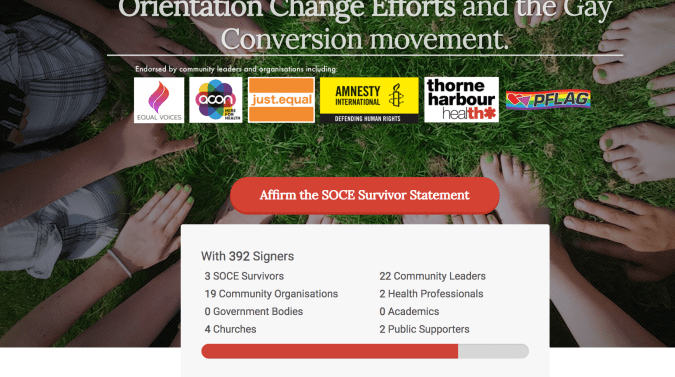
The headline is somewhat misleading, for according to the SOCE website (the group who are asking the Federal Government to ban GCT), only four churches have signed their statement along with 3-4 church ministers. No doubt there other supportive Churches, but nothing like the groundswell of ecclesial enthusiasm that the newspaper implies.

If The Age had asked Christian leaders and Churches from across the country, I suspect that they would find partial agreement with the folk at SOCE Survivors, and also significant disagreement.

Screen Shot 2018-09-05 at 9.54.24 am.png

To begin with, testimonies of gay conversion therapies are disturbing. Far from being ‘normal,’ these practices belong to fringe religious groups, finding little or no support amongst mainstream Christian Churches and theology. As a Christian, I do not support or agree with gay conversion therapy, as defined in terms of using pseudo-scientific and unbiblical spiritual methods to change a person’s sexuality. I feel for those who have undergone these traumatic experiences, wishing that they had not, and praying that they will find true and lasting recovery and peace.

The conversation is important because the health and life of LGBTIQ Australians matters enormously. They are not pawns to be played in political games, but human beings made in the image of God, and who ought to be treated with dignity. This, however, does not mean that every sexual preference and activity is morally good and beneficial, and neither does it mean that people who choose celibacy are somehow less complete or fulfilled as human beings.

It is interesting to learn that the SOCE Survivors statement makes the repeated observation that most organisations who once practiced GCT have now folded or no longer use such programs. If this is the case, then why are LGBTIQ groups and two political parties campaigning to have gay conversion therapy banned by Governments? If the aim is to inform the public of these formerly used and egregious methods, that’s fine, and yet their stated goals extend far beyond this. Why is there a concerted campaign to make illegal, practices that are no longer employed? As one reads further into the document, a picture emerges that their primary focus is no longer with GCT  but with any ideology that does not fully support LGBTIQ identity and lifestyles.

The statement argues that “many expressions of SOCE exist at the micro level, making them difficult to recognise, quantify, and regulate. The underlying ideology is firmly embedded in the everyday life of many faith communities as a collection of messages, beliefs and practices.”

According to their document, the key to this ideology is the erroneous and harmful belief (in their opinion) that “heterosexuality is the intended order”. Among these unacceptable practices are sermons that “talk about and reinforce traditional gender roles and ‘living as men and women of God”.

How broad is the net of unacceptable teaching and practice in faith communities? It certainly feels sufficiently broad to include the majority of Churches and Christian organisations. That’s part of the problem with the SOCE website, and also with the reporting in the newspaper, their descriptions of gay conversion therapy are vague, so much so that depending on how one reads in between the blurry lines, preaching a sermon on Genesis chs.1-3 or Romans 1:18-32 could fall foul of the authorities.

Definitions matter. The meaning of words and phrases is essential, lest we import a wrong sense or create confusion by speaking across each other. At the same time though, ambiguity and breadth are also proven rhetorical devices that gently and unassumingly push the envelope open even further.

In the Bible, God calls Christians to sexual purity. This does not necessarily mean there will be a change in sexual orientation. Some men and woman find their sexual desires and identity change with time, and to argue otherwise is to ignore the weight of personal testimonies. Indeed, researchers have demonstrated that the majority of children who experience gender dysphoria will grow out of it by adulthood and will happily identifying with their biological sex. However, the fact is, when becoming a Christian, many gay and lesbian people will not become heterosexual.

The Bible may not state that a person’s sexual orientation will change, but it does teach conversion. Christianity by definition is a conversion religion, where human beings made in the image of God, shift from looking for freedom in the myth of post-enlightenment moral relativism, and instead discovering the greatest freedom in the person of Jesus Christ. Let me repeat, I am not suggesting that people cease to struggle with aspects of their past, including sexual orientation, but it does mean that they now want to be godly in their sexuality. According to the Bible, this sanctification includes affirming that sex belongs to the loving, exclusive, mutually consenting, covenant of marriage between a man and a woman.

Does believing and teaching the above, and encouraging Christians to practice the above, push me outside the moral parameters of SOCE? Keeping in mind that none of the above views are new or novel, for they sit perfectly within orthodox Christian teaching and practice. Nonetheless, should this standard Christian view be considered wrong and harmful, and to be scrutinised by the authorities?

Anything other than the full affirmation of lgbtiq individuals as fully equal (including in the church, with a move toward correcting the poorly translated words currently classed as “homosexual” in the bible) is really unacceptable.”

While the SOCE Survivors document is vague at points, a spokesperson from SOCE has this week responded to a friend of mine who was also seeking clarification from them. The spokesperson said,

“The conversion therapy movement is very broad. Eg. theologically driven celibacy of lgbtiq people, prayer ministry, sermons that veer into exgay ideology leading to harm. They all need firm interventions. The survivors who wrote the statement are very keen to keep the definition broad. Anything other than the full affirmation of lgbtiq individuals as fully equal (including in the church, with a move toward correcting the poorly translated words currently classed as “homosexual” in the bible) is really unacceptable.”

The SOCE representative also asked,

“Would people who attend this group be encouraged to avoid being in a long-term committed same-sex relationship on theological or psychological grounds?”

When my friend suggested, ‘yes’, he was then informed that,

“I would say this group falls under the umbrella of the ex-gay movement. As you can see from the statement, the ex-gay movement has been viewed through many lenses over the years – from conversion therapy, to ex-gay programs that are less about therapy and more about solidarity. Regardless, such a group goes against the latest biblical scholarship, as well as a significant body of research detailing the harm caused by attempts to suppress or change a person’s orientation or gender affirmation on religious grounds. Thanks.”

There you have it. The agenda is wider than banning rare and harmful practices, but includes ministry and preaching that encourages the classical Biblical understanding of sexual holiness and human identity.

One might choose to ignore this most recent reporting of the issue, believing it’s another example of Christian philistinism. However, SOCE’s agenda is being adopted by two of the nation’s major political parties (ALP and the Greens), and the current Victorian State Government is also considering legislating on the issue. In other words, there is a strong possibility that these views will be shaped into legislation in the not too distant future, and could be used to against Christian Churches across Australia (and especially in Victoria). In case we assume there will be no severe implications from such legislation, as one example, the ALP platform speaks of removing children from parents who fail to affirm children in their self-assigned gender and sexuality, referring to this as child abuse.

Rather than chasing the culture down the rabbit hole of fluffy and imprecise language, Churches need theological and pastoral precision. This is a time for Christians to repudiate unsound, unbiblical, and harmful practices that have been used in the past, albeit by marginal and whacky groups. This is a time to repent of resentment toward LGBTIQ Australians and to ask for forgiveness where we have wronged them. This is also a time to embrace God’s good ways that are revealed in the Scriptures.

The future of Christianity does not depend on Governmental or societal approval, but it does hinge on whether Churches will “contend for the faith that was once for all entrusted to God’s holy people.” Christianity didn’t survive and flourish in the Roman Empire because they allowed the sexual norms of the day to define the Church, or because they played dodge-the-bullet with broad and vague language, but because they believed and lived the freedom that was brought about by Jesus Christ. Clarity in an age of confusion; that is what is required of Christians today: humble clarity and gracious conviction that God’s purposes are good and true.

Gehenna’s Dead

abortion2-flickr


Piled in unmarked graves,

Ashes to ashes, dust to dust.

Filling Gehenna with what remains,

Of flesh and blood and marrow.


Who are these nameless ones,

Whose time on earth so short?

What mountain of horror to see,

the scandalous unwanted dead.


No coffin or ceremony,

No words of solace spoken.

Though lingering in the deep,

Are perhaps doubts and disquiet,

Wonderings and hopes.


What cause,

What appeal,

What affliction has created this disturbance?

What necessity or hate has so consumed,

That life is deemed discretional?


Who would give their children to Molek,

Or present offerings to Eros and Aphrodite?

What god so insatiable must we appease,

To pull from womb ones so dear?


A public commotion shudders the earth,

Let us dance and celebrate;

Cheers reverberate through the streets;

We are free to kill.

We choose to kill.

Little ones, do not deny our liberty.


Jezebel, she is a jealous prophet;

Let us prove our dignity and worth.

For freedom sake,

Give us our rights.

We choose ourselves,

And we vote to forfeit others.


The altar of self is a bloody place.

The smell of burning corpses stiffens the air.

Winning is losing and the losers die.

Is this progress’ price,

Suffer the little children, and let them not come?


“Death has climbed in through our windows and has entered our fortresses;

it has removed the children.”

With approval we look on;

Humanity scorched, and losing soul.


Who will love these little ones, imago dei?

Who will remember them, their smiles and motions,

their cries and laughter,

that first word and step?

Who will celebrate their first birthday,

Hug them and say, ‘I love you’?


Who would give life to these unwanted,

to those disdained and sacrificed for Molek?

What name is given to these young lives,

Who are found amidst rubbish and refuse alike?


Greater Josiah has come.

He will love them.

He will welcome them home.

This greater Josiah;

A King upon a cross,

purify Gehenna,

redeem the dead,

forgive the transgressor.

Come Lord Jesus, come.

Is this Rome’s time for Reformation?

An open letter written by Archbishop Carlo Maria Viganò, has connected the coverup of child sexual abuse with the highest offices in the Roman Catholic Church,

“A former Vatican ambassador to the United States alleges in a 7,000 word letter that top Catholic Church officials, including Pope Benedict XVI and Pope Francis, were long aware of sexual misconduct allegations against former D.C. archbishop Cardinal Theodore McCarrick.” (NPR)

For years it has been apparent that there is a culture of abuse among many Roman Catholic priests, and that church hierarchy has been quietly suppressing the stories for many decades. But this week’s allegations demand, even more, the need for Rome to reform. At this point, Pope Francis’ only response has been to say, “I will not say one word on this. I think the statement speaks for itself and you have sufficient journalistic capacity to reach your own conclusions.”


photo-1522460676881-83490b51a873.jpeg

unsplash.com

When Martin Luther nailed his 95 theses to the Wittenburg Cathedral door in 1517, he was not calling for schism within the Roman Catholic Church, but for her reform. Luther rightly observed that reform begins with repentance.

The first of the 95 theses reads,

 “When our Lord and Master Jesus Christ said, ‘Repent,’ he willed the entire life of believers to be one of repentance.”

Martin Luther’s rediscovery of the Gospel call had an almost immediate effect. As the Reformation swept across Europe in the 16th Century, Rome sent out counter punches in the hope of quelling the tide. In the centuries since, there have indeed been moments of change made inside the Vatican, but these revisions have been primarily cosmetic and cultural, rather than ripping out the rotted foundations and replacing them with τ γιαινούσ διδασκαλί.

It is interesting to note that the events which led to Martin Luther’s clarion call concerned an issue of abuse; Rome’s teaching of and reliance upon indulgences.

The practice of indulgences is nowhere taught or encouraged in the Christian Bible. Indulgences contradict the most basic of Christian teachings, that justification before God is by God’s grace alone, received by faith alone, because of Jesus Christ’s atoning death alone,

“For it is by grace you have been saved, through faith—and this is not from yourselves, it is the gift of God— not by works, so that no one can boast” (Ephesians 2:8-9).

Roman Catholicism has taught indulgences since Medieval times, believing that they are a means by which people can receive remission for sins, and therefore reduce the time they would otherwise spend in purgatory. Leaving aside the fact that purgatory is another Roman concept which finds no warrant in the Bible,  indulgences take on multifarious forms, from saying a prayer, to completing a sacred pilgrimage, to helping the poor. Indulgences regularly contained a monetary aspect, paying a financial sum to the church to gain an indulgence, and thus time exemption from purgatory. The stunning St Peter’s Basilica in Rome that tourists and pilgrims enjoy today, was built in the 16th Century by stripping Europe’s poor via these indulgences.

In case we make the mistake of thinking that indulgences were left behind 500 years ago, they remain in vogue, with the current Pope publicly encouraging the practice of indulgences on at least two occasions since taking the seat in the Vatican in 2013. More odd, the ABC reported this week that the Anglican Church in Yea, Victoria, has recently taken up the practice in order to raise money to repair their dilapidated building.

Revelations made in recent years have once again made it clear that the problems inside Roman Catholicism are deeply rooted. When Martin Luther exposed the abuses made in the 16th Century, he rightly called for repentance and sought reform in the Church. Once again, Rome has been caught abusing the vulnerable, this time, sexually abusing young children and then consistently covering up the crimes. There are voices from within and many from outside, calling for Rome to reform her ways, but it appears that so far there is little sign of change. The allegations made this week by Archbishop Carlo Maria Viganò suggest that change needs to extend to the very top. Indeed, should the Archbishop’s letter be proven accurate, this would confirm the abuse scandals to be the most profound  faced by the Roman Church in centuries.

In criticising Rome, please don’t misunderstand, I am not suggesting that Protestant Churches automatically make the cut. Children have been abused inside Anglican, Baptist, and Pentecostal Churches, and even one example is one more than should ever be. There is, however, a vast difference between cases of abuse, and a culture of abuse. In addition, Churches that have once embraced the principles of the Reformation, need to reaffirm them with every new generation, lest we too lose our way. Europe, the United Kingdom, and Australia are littered with churches that once joyful upheld the 5 Solas, but today are little more than crumbling buildings sitting on prime real estate supporting the retirement funds of heterodox clergy.

The Apostle Paul insisted that we hold onto both doctrine and life, “Watch your life and doctrine closely. Persevere in them, because if you do, you will save both yourself and your hearers” (1 Timothy 4:16). The former shapes the latter, and the latter can easily distort the former when we preference personal morality above the ethics given by a good and holy God.

Is this Rome’s time for Reformation? Will Rome finally wake up and realise that they need to do more than move around the furniture or cover up the walls with a new coat of paint? 500 years ago, abusive practices were called out and thousands of clergy and churches across Europe heeded God’s gracious call to repent, but Rome ignored the opportunity. How will Rome respond this time?

At the heart of the 16th Century, abuses derived from a distorted view of God and his Gospel. With the rediscovery of God’s good news and with the people gaining access to the Scriptures in their own languages, unhelpful and gross evil practices were exposed and removed.

Reformation needs to come from within, and reformation requires the dismantling of any and all teachings, practices, and traditions that confuse, cloud or contradict the Gospel of Jesus Christ. This kind of foundational change will be confronting and difficult. Christians can pray that a movement of repentance will take over Rome. We can pray that both among Rome’s clergy and congregations there will be a rediscovery of the Gospel, the good news that the Apostle Paul first shared with the Romans almost 2000 years ago,

“All have sinned and fall short of the glory of God, and all are justified freely by his grace through the redemption that came by Christ Jesus.” (Romans 3:23-24)

“For we maintain that a person is justified by faith apart from the works of the law” (Romans 3:28)

Bad Leaders and Good Leaders

The very notion of leadership has become a public parody, a cartoon, a crazy dream that is strangely Orwellian and Black Adder together.

It seems as though among leadership of every kind and level, there is crisis, mismanagement, incompetence, and division. Whether we are talking about Australian politics or international politics, managing boards of major corporations, sporting clubs and yes even Churches, not even twitter can hashtag all the latest fiascos and failings. 

Of course, there are always criticisms, whingers, and dissenters, no matter who is leading. Even when leaders are performing their duties with excellence, grumblers are never far away.

At yet, corruption, bias, and abuses of power are very real and when it happens people are understandably upset, and they lose confidence in their leaders.

At the moment I’m preparing for Sunday’s sermon. We are currently preaching through the book of Jeremiah, and this week our reading is chapter 23, and it’s all about leadership: good leaders and bad leaders.

Jeremiah2.jpg

I should note, this blog post is not about the current state of affairs in Australian politics.  It is about a form of leadership that is more significant, namely that of Christian or Church leadership. The original context of Jeremiah chapter 23 is of God addressing the leadership of Judah (which included the King, the priests, and the prophets); the equivalent for us today is the church.

Characteristics of a good leader

“Therefore this is what the Lord, the God of Israel, says to the shepherds who tend my people: “Because you have scattered my flock and driven them away and have not bestowed care on them, I will bestow punishment on you for the evil you have done,” declares the Lord. “I myself will gather the remnant of my flock out of all the countries where I have driven them and will bring them back to their pasture, where they will be fruitful and increase in number. I will place shepherds over them who will tend them, and they will no longer be afraid or terrified, nor will any be missing,” declares the Lord.

“The days are coming,” declares the Lord,
“when I will raise up for David a righteous Branch,
a King who will reign wisely
and do what is just and right in the land.

In his days Judah will be saved
and Israel will live in safety.
This is the name by which he will be called:
The Lord Our Righteous Savior.

“So then, the days are coming,” declares the Lord, “when people will no longer say, ‘As surely as the Lord lives, who brought the Israelites up out of Egypt,’ but they will say, ‘As surely as the Lord lives, who brought the descendants of Israel up out of the land of the north and out of all the countries where he had banished them.’ Then they will live in their own land.” (Jeremiah 23:1-9)

Two metaphors are used, the Shepherd and the King.

Like a Shepherd:

  • a good leader tends (feeding and protecting those under his care)
  • he gathers (brings them together)
  • he calms fears and terror

Like a righteous King:

  • he will act wisely
  • he will act with justice
  • he will act with righteousness

It is important to note that God identifies himself as the Shepherd, and the King (the righteous branch) is the promised Messiah. The point is, the Lord will accomplish what his leaders have failed to achieve. He will redeem his people from the mess created by failed leaders.

Seven Centuries following this Divine pronouncement,  a preacher from Galilee arose, and announced, “I am the good shepherd”. But the phrase, “I am”, he was adopting the holy name of the Lord for himself. By exclaiming “I am the good shepherd”, Jesus was identifying himself as the God of Jeremiah 23:3, in contrast to the generations of bad shepherds who had gone before him and who were prevalent during his own public ministry.

What is most remarkable, is the extent to which the Good Shepherd would go in order to save and bring lost sheep: he would lay down his life for his sheep. This Shepherd leader loves his sheep so much, that he would give his life to save them. Jesus is providing us with much more than a model of leadership, for his sacrificial death is unique is salvific power and design, and yet he also signals a pattern that is to be followed by those who would serve as leaders under his rule.

In Jeremiah 23:4, God also speaks of other shepherds who will work under him. “I will place shepherds over them who will tend them, and they will no longer be afraid or terrified, nor will any be missing,” declares the Lord.” While the salvific focus is on God himself and his leadership role, he intimates that he will raise up shepherds to work under him” (v.4).

1 Peter 5 interprets Jeremiah 23 (and similar Old Testament passages) by speaking of the Chief Shepherd (the Lord Jesus) and Elders of a local Church,

“To the elders among you, I appeal as a fellow elder and a witness of Christ’s sufferings who also will share in the glory to be revealed: Be shepherds of God’s flock that is under your care, watching over them—not because you must, but because you are willing, as God wants you to be; not pursuing dishonest gain, but eager to serve; not lording it over those entrusted to you, but being examples to the flock. And when the Chief Shepherd appears, you will receive the crown of glory that will never fade away”. (1 Peter 5:1-4)

Characteristics of a bad leader:

The leaders in question are Judah’s king, the priests, and the prophets. Rather than faithfully administering their responsibilities under God, according to his covenantal word:

i. They create their own ‘truth’

“I did not send these prophets,
yet they have run with their message;
I did not speak to them,
yet they have prophesied.” (verse 21)

“This is what the Lord Almighty says:

“Do not listen to what the prophets are prophesying to you;
they fill you with false hopes.
They speak visions from their own minds,
not from the mouth of the Lord.

They keep saying to those who despise me,
‘The Lord says: You will have peace.’
And to all who follow the stubbornness of their hearts
they say, ‘No harm will come to you.’ (vv.16-17)

 Like Dustin Hoffman and Robert De Niro in the film Wag the Dog, the prophets have raised a green screen and laid over an unreal picture of reality. The prophets have fabricated an alternate reality: times of peace and prosperity, with images of green fields and cool streams, sandy beaches, city cafes, captivating moods and suggestions of a beautiful life to come.

ii. They make promises that they can never keep

“They keep saying to those who despise me,

    ‘The Lord says: You will have peace.’

And to all who follow the stubbornness of their hearts

    they say, ‘No harm will come to you.’” (v.17)

iii. They falsely attribute their words to God

“I have heard what the prophets say who prophesy lies in my name. They say, ‘I had a dream! I had a dream!’ How long will this continue in the hearts of these lying prophets, who prophesy the delusions of their own minds?” (vv.25-26)

“I am against the prophets who steal from one another words supposedly from me. Yes,” declares the Lord, “I am against the prophets who wag their own tongues and yet declare, ‘The Lord declares.’ (vv.30-31)

iv. They are motivated by evil

“And among the prophets of Jerusalem
I have seen something horrible:
They commit adultery and live a lie.
They strengthen the hands of evildoers,
so that not one of them turns from their wickedness.
They are all like Sodom to me;
the people of Jerusalem are like Gomorrah.” (v.14)

This religious industry of ‘new’ Divine words was tied to a moral agenda that was being promoted by Judah’s leaders. God connects their words with the concept of adultery and he likens them to the days of Sodom and Gomorrah. In other words, they form their religious ideas and Divine words based on their moral vision. The reference to Sodom and Gomorrah is telling. Sodom and Gomorrah were the famous twin towns destroyed by God in Genesis chapter 19, as a result of the townsmen wanting to have sex with the men whom Lot was protecting. It is therefore likely that the prophets’ message was an 8th Century version of the sexual revolution.

According to God, the prophets were speaking new words because God’s words restrain sin and they want to live out sin. If the Bible doesn’t give me adequate justification to pursue immorality, let’s make up new words and say that they are from God.

v. They are responsible for division and destruction

The outcome is scattering, misery, and social and spiritual carnage.  As God exclaims, “They do not benefit these people in the least” (v.32).

Right expectations

Should we expect more of our political leaders? Politics in the age of social media has yet to deliver on the kind of stability, integrity, and unifying vision that some predicted would occur. There may be some principles worth reflecting upon for leaders in general, but like I said at the outset, Jeremiah ch.23 is not speaking to the question of modern civic and political leadership, but to those who assume or are recognised as leaders of Churches. The kind of leader God affirms, is one who chooses God’s ways over popular cultural movements, who is okay with being unoriginal and uninventive in his words, and who brings unity not division among God’s people.

What do we expect of our Church leaders? They will certainly fall short because they are as human as the rest of us. They carry weaknesses and they struggle with temptation like all of us, and yet the expectations set for those who oversee churches are appropriately high.

Jeremiah ch.23 reminds us of how perilous it is to entertain new and interesting ideas about God and to use God as justification for our moral proclivities. Whether it is the Roman Catholic crisis coming out of Pennsylvania or with the schism within the Uniting Church of Australia, or royal preachers, prosperity preachers, or theological scholars from the school of Lord Voldemort, it is not difficult to see the harm and division that is created by many modern-day priests and prophets. If our favourite preachers and authors smell like the culture and look like the culture, and are praised by the culture, perhaps it’s time for us to find new preachers and teachers.  Above all, I’m reminded of how much we need the promised Shepherd and King of Jeremiah ch.23.

“I am the good shepherd; I know my sheep and my sheep know me— just as the Father knows me and I know the Father—and I lay down my life for the sheep.”