How are Australian evangelicals reading the American election, Donald Trump, and the way American evangelicals are engaging in politics?
Check out my interview on Carmen Fowler La Berge’s radio show, The Reconnect

How are Australian evangelicals reading the American election, Donald Trump, and the way American evangelicals are engaging in politics?
Check out my interview on Carmen Fowler La Berge’s radio show, The Reconnect
History cannot be changed.
This axiom used to be true, until now with the Victorian Government introducing a Bill, giving people freedom to alter their birth certificates, as much as once a year, should they feel the need.
Would you like to change your birth certificate? Perhaps the year in which you were born? What about the place of your birth? We are not yet able to make these changes, but you will be able to change the identity of your gender, should you decide that your preference no longer matches your birth gender.
Birth certificates were once sacrosanct, treated as definitive legal documents. What was once subject to facts surrounding the birth of a child, can now be repeatedly changed according to how individuals wish to reconstruct their sexual identity.
I want a pause for a moment and recognise that gender dysphoria is real, although rare. I am not without personal knowledge of Victorians who are genuinely struggling and suffering due to gender confusion, and they seek resolution and acceptance (which does not always mean being identified in ways contrary to their biological sex). I want to affirm their dignity and humanity, and would pray that they would come to know the God who loves and gives us the greatest and most fulfilling identity, of being in Christ and knowing him.
My intent is not to cause people greater consternation, but to explain that this Bill does not provide answers.
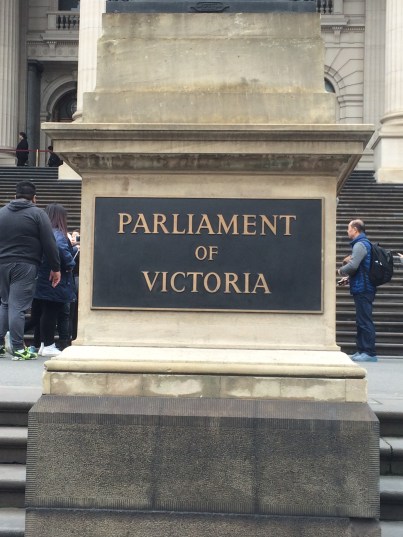
The Bill’s scope includes transgender, gender diverse, and intersex persons. Transgender for example, is not identical with gender dysphoria, although it’s inclusive of; trans covers a broad range of sexual expressions. The category of gender diverse technically means, well, almost anything. The point is, the Bill’s parameters are so broad as to include persons who are not suffering medically diagnosed sexual dysphoria, but include people who for many reasons wish to change their legal status.
The Government website summarises the Bill as follows:
The Victorian Government will remove barriers for trans, gender diverse and intersex Victorians seeking new birth certificates.
Delivering on another equality agenda election commitment, the Births, Deaths and Marriages Registration Amendment Bill 2016 to be introduced in Parliament today removes the need for applicants to have undergone sex affirmation surgery before being able to apply for a new birth certificate.
Importantly, the Bill also ensures couples will no longer be forced to divorce if one partner wishes to apply to change the sex recorded on their birth registration.
Adults will be able to apply to alter the sex recorded on their Victorian birth registration and birth certificate.
Under the changes, an applicant will be able to nominate the sex descriptor in their birth registration as male, female or specify a gender diverse or non-binary descriptor.
The Registrar of Births, Deaths and Marriages will be able to refuse to register an amendment descriptor that is obscene or offensive, or if it is not reasonably established as a sex descriptor.
The Bill will also introduce a new process enabling parents or a guardian to apply to alter the sex recorded on their child’s birth registration.
The process will require the child’s consent. The application must be accompanied by a supporting statement from a doctor or registered psychologist confirming the child has capacity to consent, and that the change is in the best interests of the child. Children over the age of 16 will be assumed to have capacity to consent.
The social, familial, educational, and legal implications are enormous. For example,
1. Persons will be permitted to change their birth certificate every 12 months (according to the amended Section 30A). This is not an abstract over-the-top never-going-to-happen eventuality, for why would the Government provide this known loop hole if it is not designed to be used? And why, given the significance of this point, has it not been delineated by the Government in their press releases?
2. Apart from the legal and social confusion arising from persons changing their identified gender, perhaps annually, the Government has created a back door for same sex marriage:
A married man can choose to now identify as a women on his birth certificate, without having to divorce his wife. Or a unmarried woman may change her birth certificate to male and therefore be legally free to marry a woman, and should they choose 12 months later, change back to female without needing to divorce.
3. Gender confusion exists among a small but significant number of children. Research has demonstrated that as children mature their psychology will conform to their biology, and thus grow out of their confusion. For a tiny percentage, dysphoria continues into adulthood, but this is not the norm.
It is therefore not difficult to see the problems arising when young children and parents, due to misinformation being now taught in our schools about sexuality, are told that their little boy is in fact a girl and should identify as such (there are numerous examples of this happening in Victorian primary schools at the moment). What will happen is that children will have their birth certificates altered, and be treated as a different gender, only to realise in adolescence that they are in fact what their biology says. This will result in all manner of social, legal, and personal disorientation for these children and their families.
We need to appreciate how incredibly dangerous this Bill is to the health and well being of young Victorians.
4. Biologically, even with sex-change surgery, one cannot change their gender. Changing one’s birth certificate does not alter one’s identity, and thus it will create a dissonance between one’s legal status and one’s nature.
The births, Deaths and Marriages Registration Amendment Bill 2016 is the latest step in a social engineering agenda that has been moving in the background for many years and is now being championed by Daniel Andrews.
There are many difficult and pastoral issues surrounding these issues, but the fact is, the now many legal and social changes that have been forced upon Victorians by the current Government will not relieve and lay aside issues surrounding sexuality, but will only heighten sexual confusion in our society.
Teaching boys and girls that are not boys and girls, and that they can choose and change their sexual identities, depending on how they are feeling for the day, is frightening and irresponsible; this is not education, and it is not responsible lawmaking.
The Bill was due for final consideration and vote in the Legislative Council earlier this month, but the Government has delayed the vote due to a lack of support by members.
Perhaps it would be helpful if the Government paused and considered the due concerns of their Parliamentary colleagues and of the broader public whom they are here to represent and serve.
When is it time to lay a word to rest? When is it appropriate to find an alternative name?
Stephen McAlpine is among a growing number of Evangelicals who are admitting we have a word problem, an identity problem. The term evangelical has become synonymous with a branch of American politics, and more recently, with a key group of Donald Trump supporters. Yes, there are notable evangelical voices repudiating Donald Trump, and recent polls suggest the majority of evangelicals would no more vote for Trump than they would Kylo Ren, but it is difficult to fight a bushfire with a garden hose.
McAlpine writes,
“The “Evangelical” brand is well on the way to being trashed in the US. Time to think of a new word to describe ourselves I reckon, not just in the US, but across the West.
If it’s true financially that “when America sneezes, the world catches cold.”, the same appears to be true of American evangelicalism. The US arm of the brand has caught a pox from which it may not recover, and that pox is at risk of spreading to us.
It’s actually worse than a pox. It’s gangrene. It has the whiff of death about it. Exxon, Union Carbide, Enron, Lehman Brothers. Perhaps we can add the “Evangelical” brand to that sorry pile. Time perhaps to cut ourselves off from the descriptor before we start to smell. Time for a new word
As he laters explains, the problem didn’t start with the rise of Donald Trump, it goes back to the 1980s when Christians hitched their wagon with the Republican movement.
The issue is even broader than North America. In Europe many denominations continue to use evangelical, as a eulogy to the past, although their theology often bares little resemble to that of their forefathers.
In Australia, evangelical has had branding kudos, at least in Christian circles, so much so that even many anti-evangelicals embraced the word: ’we don’t believe in the bodily resurrection of Jesus Christ but the label works for us.’ To be fair, those who were slightly more ingenuous inserted adjectives, such as ‘broad’ or ‘progressive’, as a hint of their not so evangelical beliefs. This mass branding has not helped.
Language is situational, or least in part. When I describe my Christian faith in the community I refer to myself as a Christian, and sometimes I add that rarified name, Baptist! Rarely do I use words like evangelical or reformed, not because the words are getting a bad press, but because they hold little meaning to most Australians. Within ecclesiastical conversations I am happy to speak of my evangelical and reformed convictions, as they often help to build bridges of understanding, and at other times they clarify differences. But the reality is, when I’m chatting with my neighbours, evangelical doesn’t add anything.
If using the word inside churches is sometime confusing, McAlpine is right; outside of churches and theological institutions, identifying as an evangelical is becoming a herculean challenge, largely because our media lacks nuance. While it’s been trashed in the USA, at least American media acknowledge alternative evangelical viewpoints. Here in Australia, he only time evangelicals are mentioned is when there is a sniff of hydrogen sulphide in the air. For example, our news outlets have not been reporting Al Mohler on CNN or Russell Moore in the Washington Post, as they speak out against Donald Trump.
Has evangelical become unusable in Australia?
The Age newspaper now contains dozens of references to evangelicals, and almost without exception they associate these people with right wing American politics, or with ‘extreme’ Christian ideology in Australia.
ABC’s program, Planet America, regularly refer to the evangelical vote, and especially of their alleged support for Donald Trump.
It is clear that evangelical has become a by-word for religious right wing politics. While the media are responsible for selective reporting, they can hardly be blamed for tying at least some evangelicals with Donald Trump. After all, millions of Americans identify with evangelical and with the Republican movement.
There is an important lesson for us to learn, and that is, we must not bypass theology. We must resist making our identity a political ideology or social cause, we must begin with the Gospel and work out from there.
In 1989 David Bebbington first offered his now famous quadrilateral definition of evangelical. He understands evangelicals as holding four main qualities: biblicism, crucicentrism, conversionism, activism. There is much to like about his quadrilateral, however I also agree with Don Carson’s reservations (read “The Gagging of God”). Carson notes that even a Jesuit priest could put his hand up to this quadrilateral definition. As such, Bebbington has perhaps done evangelicals a disservice.
To be evangelical is nothing less than being someone who holds to the Gospel of Jesus Christ. The the very word from which we get evangelical is euangelion, which means Gospel.
I agree with Carson, who in turn follows John Stott, in taking us to 1 Corinthians 15:1-8. This is far from the only Scriptural place that explicates the gospel , but it does give us one of the fullest treatments of the Gospel, and we can’t overlook Paul’s introductory remark,
“Now, brothers and sisters, I want to remind you of the gospel I preached to you, which you received and on which you have taken your stand. 2 By this gospel you are saved, if you hold firmly to the word I preached to you. Otherwise, you have believed in vain.
For what I received I passed on to you as of first importance:”
What is the euangelion?
“that Christ died for our sins according to the Scriptures, that he was buried, that he was raised on the third day according to the Scriptures, and that he appeared to Cephas, and then to the Twelve. After that, he appeared to more than five hundred of the brothers and sisters at the same time, most of whom are still living, though some have fallen asleep. Then he appeared to James, then to all the apostles, and last of all he appeared to me also, as to one abnormally born.”
Both Stott and Carson summarise 1 Corinthians 15:3-7 with these 6 points: the Gospel is Christological, Biblical, Historical, theological, apostolic, and personal.
The problem is of course, people are no longer defining evangelical by the Gospel.
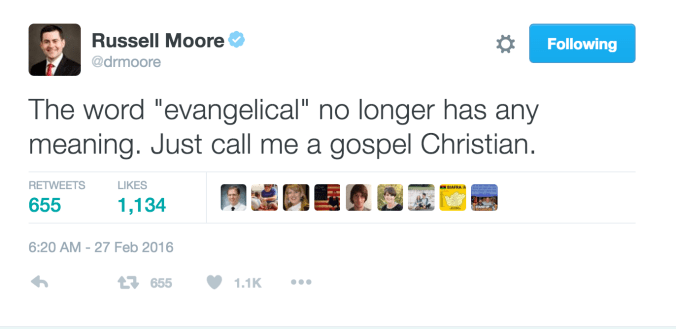
While I’m in large agreement with McAlpine, I’m not giving up on evangelical just yet, because rightly understood it is a word we should cherish and defend. But should the waves of malcontent persist, and an alternative is necessary, I think I’ll begin follow in Russell Moore’s footsteps and refer to myself a Gospel Christian.
Gospel Christian has the same meaning as evangelical Christian, but without the unhealthy socio-political connotations. Interestingly, both in the United States and here in Australia, among the larger Christian networks we don’t find the Evangelical Coalition, but rather the Gospel Coalition.
Some Christians prefer to known as orthodox or classical. I warm to both of these words, although Stephen McAlpine criticises ‘orthodox’ as a group who don’t affirm the real and physical return of Jesus Christ. Perhaps I’m ignorant, but I would have thought belief in the parousia is basic to anyone claiming orthodoxy.
The reality is, many of our Christian labels are disdained. I wish it was suffice to say, I’m a Christian. After all, that’s what I am, I am a Christian. But sadly Christian is frequently associated with all manner of social ills and evils (sometimes warranted). And when I fess up to being a Baptist, I’ve more than once had to qualify it by saying, no, we’re not like the JWs or Mormons.
McAlpine suggests we call ourselves, ‘eschatological Christians’,
“Eschatological” springs to mind. If someone asks me these days I’ve taken to saying that I am an “Eschatological Christian.” Sure it’s not catchy, but it’s not toxic either. Sure I will have to spend a bit of time explaining what it is, but hey, I’ll have to spend virtually no time explaining what it is not.
“Eschatological” is more likely to elicit an eyebrow raise than a nose wrinkle. It is more likely to raise a question than rule a line under an answer. Most importantly it will distinguish me – and us – as those whose hopes -and energies – are not grounded in the political machinations of this age, but in the politics of the age to come lived out in the church today, and overflowing in practical, loving and humble ways into the community.
“Eschatological Christian” also distinguishes orthodox Christians who actually believe that there is a parousia coming in which King Jesus will usher in a new kingdom and judge the world in righteousness, from those who view that as an outdated notion beneath our modern sensibilities. A view that won’t get them respect in the academy.
The name has a certain Fitzroy living single-origin drinking indie-rocking listening feel to it, but I am unconvinced. First of all, few people know what eschatology means, and second, it is defining our identity by one area of theology, rather than the whole.
What do others think? How do you describe your Christian faith? Do you identify as an evangelical?
Misappropriation and misunderstanding shouldn’t surprise us; is it not the expectation given to us by the Lord Jesus? Does not the history of the church give us multiple examples of culture trampling on or deconstructing the church? In a world that is constantly confusing and even hijacking the Christian message, and doing so for all manner of social and political ends, we though can be responsible for how we represent the Lord Jesus Christ. Indeed, the more faithful we are to God’s word, the more useful we will be to society. So whether we call ourselves evangelical, Gospel, orthodox, or just plain and simple Christian, let’s do it with a growing sense of clarity, humility, grace, and winsomeness, in order to display the reality of Christ and of the hope held out in his Gospel.

“The people advocating for marriage equality in Australia are not attempting to impose their beliefs on to any church, they are simply objecting to churches imposing their definition of marriage onto the rest of us.”¹ (Jane Gilmore, Freelance writer, 18/10/16)
“What happened in Ireland, and Great Britain, most of continental Europe, most of the Americas, New Zealand, Canada and all the rest?
Again.
Nothing.”² (Lisa Wilkinson, 14/10/16)
“I challenge people here to demonstrate that changing the Marriage Act will lead to negative changes in religious freedom.”³ (paraphrase of a statement spoken by Mark Dreyfus at the recent Freedom For Faith Conference, 23/09/16)
It is unsurprising to hear a growing cacophony of voices dampening suggestions that changing marriage in Australia will lead to any negative consequences for society and religious freedom. To acknowledge such impact would probably weaken their position. But it is important for Australians to recognise that the argument of ‘no change’ is simply untrue.
Scott Sanders from The Geneva Push recently sat down with Mikey Ovey (Principal of Oak Hill College, London) to talk about what has been happening in the UK since same-sex marriage was legalised in 2014. It is worth taking time to listen to these 4 short videos. Keep in mind, Mike is speaking directly to the situation in the United Kingdom. There are also examples coming out of Canada and the USA which demonstrate how same sex marriage undermines not only freedom of religion, but also freedom of conscience. Al Mohler’s program, The Briefing, is a helpful resource for gauging the shifting climate in North America.
Even here in Australia, and this being prior to the legalisation of same-sex marriage, there are clear examples of how this issue is rearranging and limiting religious freedoms. For example, it is no longer possible to win preselection in the Australian Labor Party unless you agree to same-sex marriage. In recent weeks, in light of the now unlikely plebiscite, politicians across Parliament have been discussing which people and organisations will receive legal protections, should same-sex marriage be introduced. If there are no negative outcomes, why is the Government drafting legislation to protect certain groups?
Reshaping marriage means reshaping society and society’s laws and expectations, and reshaping the contour of religious freedom and practice. Lisa Wilkinson and Jane Gilmore can argue otherwise, but it is the logical flow on effect, and we are seeing this in practice around the world.
With all this talk about religious freedom one may be forgiven for thinking that this is the chief reason why Christians are arguing against changing the Marriage Act. This is not the case. Christians believe that the Genesis paradigm for marriage is a creation mandate that is a good for all humanity, not only for Christians. Until a few years ago this view of marriage was an assumed good, but now we are aiming to persuade our fellow Aussies that it remains a good for society today. At the same time, it is imperative that we understand the kinds of changes that will issue from this watershed redefinition of marriage.
To Christians reading this, be assured, our ultimate confidence is in the Gospel of Jesus Christ, not in Australian law. The future of Christianity is not contingent upon any current or future legislation. No matter the socio-ethical landscape, we know God will continue his work through the Gospel and Churches will continue and people will become Christians. If God can redeem 50 million Chinese in communist China, and millions under persecuting Roman Emperors, cannot God still work in Australia? This of course includes implications for how Christians love and serve our gay and lesbian neighbours, whether the definition of marriage changes or not. I trust we are already making every effort to befriend and support them, and to show them the love of Christ. For we remember that we too, in all manner of ways, once defined morality and truth in ways to fit with personal inclinations, and in that moment God graciously revealed Christ to us.
2. http://www.huffingtonpost.com.au/lisa-wilkinson/what-will-happen-if-we-legalise-same-sex-marriage/
Descending onto Melbourne yesterday wasn’t the gale force winds sweeping across from South Australia, but another tirade against Sydney Anglicans. I’m not sure why The Age even bothered to reproduce the article, given it has little relevance to Melbourne, but why should Sydney keep all the sensationalism to themselves?

It is always disappointing to read of anyone being misrepresented in the media. We all know it happens, and we know it ought not, but it does. It doesn’t matter who is being misrepresented, slander is slander regardless of who is in the firing line. In this case, it is the Anglican Diocese of Sydney.
Author and Columnist, Elizabeth Farrelly, is careful to paint a vivid portrait of Sydney Anglicans. The language is suitably chosen to support her thesis:
“skullduggery in the church”
“What if the Pharisees are back in charge?”
“It’s not just the ongoing nightmare of institutionalised child-sex abuse and the decades-long connivance that implies. Nor even the antediluvian opposition to women preachers and same-sex marriage. Exacerbating all that is an increasingly aggressive stamping out of dissent.”
“These are voices the church now works to destroy.”
“Sydney Anglicanism’s now “cultish” atmosphere”
And on it goes.
Everyone warms to Friar Tuck and the Vicar of Dibley, and we all like to boo Camerlengo Patrick McKenna, the Bishop of Hereford, and John Ballard. Elizabeth Farrelly wants to leave readers in no doubt as to which group of clergy the Diocese of Sydney belongs.
Farrelly’s language is selected carefully in order build a case of Pharisaism against Sydney Anglicans, and to portray Keith Mascord and others as victims who lay in their wake. It is of little consequence that the allegations are as thin as the slimmest slice of swiss cheese; cheese smells.
Especially worrying is the way Farrelly so easily draws in the issue of child abuse. With such an incredibly sensitive and serious matter, it is disingenuous and even dangerous to clump it with the topic she is primarily addressing. For example, to introduce the situation with child sexual abuses in the Newcastle Diocese as evidence of hypocrisy among Sydney Anglican is misleading and paramount to libel. Farrelly’s gotcha moment is a quote from Sydney pastor, Rev David Ould…except that his actual quote says the opposite of what she claims. He has subsequently written this response to the misquote.
It is also important to note this crucial factual error, which Farrelly’s case depend on: depends on for her chief criticism of the Diocese: contrary to what Farrelly writes, Keith Mascord was not delicensed as a priest last week. He has not been licensed since 2013. Not only that, he was recently offered a licence to minister in his local parish, but Keith declined as he was unwilling to follow his ordination vows.
When evidence is not to be found, Farrelly resorts to conjecture in order to further her case:
She says, “You might think an institution of diminishing influence would engage its internal questioners in eager debate. You might expect the church, having been built around a rocker-of-boats and tipper-of-apple carts, to know that comfortable words pattered out over tea are not the only ones to hear.”
Anyone who has studied at Moore College or attended Diocesan Synods will know that Sydney Anglicans are more willing to debate issues and have those difficult conversations than any other Christian denomination I know of in Australia. The issue is not whether the Diocese is open to serious debate, but that they have not landed in a place that Farrelly would approve of.
Also this,
“The tellers of uncomfortable truths are those we most need. People whose truths come at significant cost to themselves, whose truths are wrenched from them; they’re the heroes, the soothsayers, the prophets. But these are voices the church now works to destroy.”
Farrelly doesn’t define what she means by truth; all we know is that the Sydney Diocese don’t have it, and the dissenting voices whom she supports do have it.
In the case of Keith Mascord, we are not seeing any example of Pharisaism, but of common sense. If a builder confessed that he no longer accepted the building code, and that he would proceed to break it at several points, it would be reasonable for his licence not be renewed. Similarly, when a Christian minister explains that he can no longer abide by the beliefs of the Denomination he is licensed to, it is appropriate that he not continue.
Are Sydney Anglicans perfect? Of course not, and I suspect nearly all Sydney Anglicans would gladly put up their hand in agreement. That’s what Christians do, we confess our sins.
I’m not a Sydney-sider nor am I an Anglican, but the impression I am left with is that Elizabeth Farrelly is no supporter of the Sydney Anglicans! I don’t think anyone is insisting that Elizabeth Farrelly like or approve of their teaching, but when it comes to reporting a story, readers deserve to be presented with the facts.
A Statement from the Sydney Diocese regarding Keith Mascord’s license can be read here
Behind this post are two conversations that I’m having with myself today: One, Mike Frost wrote a piece titled, It’s Not a Liberal Agenda, it’s the Gospel!. Second, this Sunday I’m preaching on Matthew 7:15-23, and so I’m spending time grappling with these words from the Lord Jesus.
As you read these ponderings you shouldn’t read them as a critique of Mike Frost, unless I refer to him explicitly. Mike’s meanderings serve as a jumping point for some ideas rather than the framing of what I want to say.
Also, as you read this article I understand that some people may burst a boil as you spot caveats, ‘what ifs’, and buts. In light of these medical emergencies may I offer this prefatory remark: this is a blog post not a 15,000 word essay, and so don’t be disappointed if I don’t fill in every gap or close every alleged theological aperture.

The Bible is certainly not short of individuals who lived a ‘form of godliness’, but ‘denied its power’, meaning they were bereft of Christ’s Gospel.
In my experience, both cultural conservatives and progressives have a propensity to fail in this way.
First of all, they are almost always selective in the kind of issues they promote. When was the last time you heard social and theological progressives defending the rights of unborn children and fighting to retain a classical view of marriage? Of course, the question could be asked of many issues across the socio-political spectrum.
It shouldn’t need to be said, but we know it needs to be said, Jesus never voted Green, Labor, or Liberal. Trying to squeeze Jesus under under any socio-political umbrella is wrong; maybe he would prefer to stand out in the rain!
There are historical reasons why evangelicals have dropped the ball on many social concerns. These include the World Council of Churches’, Missio Dei, Second Vatican, and Lausanne 1974, each which have negatively impacted confidence in and need for verbal proclamation of the Gospel. Before this century long trajectory, Evangelicals immersed themselves in caring for the poor and suffering in society; some of the greatest evangelists were also intimately involved in creating orphanages and charities for the poor (John Wesley and Charles Spurgeon, for example).
Perhaps Mike’s critics smell some WCC residue in his social concerns; I don’t know.
But I love the fact that Mike Frost (and others) is seizing these issues from those who think they belong to a ‘leftist agenda.’ Concerns for Refugees and Indigenous people doesn’t belong to theological liberals, any more than other issues belong to the ‘right’. Rather, he’s rightly placing all things in the scope of God’s cosmic rule in Christ. While none of us can be active across all that troubles this fallen world, there is no opting out of loving our neighbour, including further examples that Frost cites, people caught up in gambling and in the sex industry.
“Our job, as his followers, is to both announce and demonstrate what the rule of King Jesus is like and invite others to join us, to recognize that Jesus’ sacrificial death atoned for the sins of all, and that his resurrection establishes him as the Son whom God has appointed judge of the world and Lord of the coming kingdom.” (Mike Frost)
It’s a great statement, but the question is, in practice what is this looking like? Four questions/concerns come to mind. I don’t know Mike well enough to know what he’d think of these points, but they are certainly true of some of my friends who readily identify with some social justice issues. With the view of loving the poor:
1. Verbal proclamation of the Gospel is often relegated, if not dispensed with altogether.
I remember sitting in a seminar a few years back, addressing the topic of local mission. The presenter spoke of ‘doing mission’ by creating programs to help the poor and marginalised. I asked a question about evangelism, to which he answered, one might explain the Gospel but it is not necessary.
I did find this comment of Mike’s about evangelism a little boorish,
‘Is the gospel really just a set of magic words, like an incantation, I have to blurt out to appear to be true to Jesus?’
I certainly don’t know anyone who thinks this way, and it’s a bit mischievous to portray folk this way. We would do well to remind ourselves of Jesus’ earthly ministry where he prioritised the public preaching of God’s Word, a model adopted by the Apostles and passed on to future generations of pastors. At the same time, they didn’t ignore the very real social needs around them, and Jesus gives us the example par excellence of loving society’s most disadvantaged.
2. Aspects of the atonement such as Christus exemplar and Christus victor take centre stage while penal substitution is squeezed out, often becoming little more than an awkward ‘theory’.
3. The Gospel of ‘forgiveness of sins’ drops from the centre of the Christian message, and we fall danger of converting people into a Gospel of works.
4. I want to be careful about confusing Gospel fruit with the Gospel, although we want to say the Gospel will inevitably and necessarily produce fruit (cf. Matt 7:15-23).
If any of these points are representative of the bald man of Manly, then there may be warrant for criticism, but fighting for refugees is no indicator of belittling evangelism or compromising the Gospel. And of the social concerns he has written, how can we not want to speak up and to defend and love?
None of the above points are inevitable. Serving the hurting, lonely, and unwanted, are beautiful and necessary examples of loving our neighbours. These actions are fruit of the Gospel.
Does not the good news of Jesus Christ change everything? When we have experienced God’s forgiveness, and by grace been brought into his family, this love changes the way we view other people. Therefore, we mustn’t leave these issues to the left or right, for the love of Christ compels us.
In light of the Scripture I think it is fair to say that a Church who promotes social justice but doesn’t practice evangelism has failed to understand the Gospel and is disobeying God. And Christians who believe in evangelism and who think it unChristian to fight for the most oppressed, they too are yet to grasp the Gospel. As Jesus says, a good tree will produce good fruit. And in the Sermon on the Mount, fruit is almost a synonym for righteousness, and righteousness here includes purity, humility, sacrifice, and generosity. Is it not applicable to live out these things for the good of society’s most vulnerable people?
From what I can see, Evangelicals are returning to social justice ministries, and many respected evangelical leaders are increasingly speaking to these issues, including Tim Keller, Russell Moore, Al Mohler, and the Anglican Archbishop of Sydney, Glenn Davies. Why? The Gospel changes everything.
We don’t have to choose between helping the poor and doing evangelism. We ought to do both for both express love for others, and we commit to both without de-centralising the place of Gospel telling.
Yesterday’s The Drum invited two Anglican ministers and an atheist to discuss the question of marriage and homosexuality.

Panellist Jane Gilmore came out and suggested, ‘Logically, I can’t see how Christian stance on homosexuality and ‘marriage equality’ makes sense’.
Her reasoning for this Christian’ illogic’ is that Christianity is about accepting ‘Jesus as the Son of God and the Gospels as the word of God’ but that Jesus said nothing about homosexuality and so Christians should support both homosexuality and Same-sex marriage.
It is true, accepting Jesus as God’s Son and believing the Bible to be the word of God are both essential (and might I add, sublime) parts of the Christian faith, but is her rationale about marriage accurate?
I understand most Australians no longer read the Bible, and rarely listen to sermons expounding the Bible, but when one goes on national television and erroneously suggests the support of Jesus Christ, I can hear someone shouting fact check!
When we open and read the Bible we soon discover that Jesus often spoke about marriage, and when he did he repeatedly affirmed these two points: First, he affirmed the Old Testament view of marriage, that it is between a man and a woman intended for life. Second, Jesus called all other sexual behaviour porneia, meaning sexual immorality. It is important to note that Jesus was not towing the normal cultural line of his culture; often he spoke about marriage in front of people who contravening Old Testament teachings by divorcing their wives for all kinds of crazy and wrong reasons. He challenged the marital norms of his day by reaffirming one woman and one man for life.
“But at the beginning of creation God ‘made them male and female.’ ‘For this reason a man will leave his father and mother and be united to his wife, and the two will become one flesh.’ So they are no longer two, but one flesh,” the words of Jesus in Mark 10:6-8.
According to Jane Gilmore, not only did Jesus have nothing relevant to say about current questions over marriage, homosexuality is only mentioned in the Old Testament. Unfortunately, Gilmore also gets this wrong. The New Testament speaks of homosexuality on three occasions. We shouldn’t make more of it than there is, but we cannot ignore the fact that on every occasion the New Testament speaks of homosexual behaviour, it does so negatively.
It should be said, none of these passages are pitching their argument against people who experience same-sex attraction or sexual confusion, but of practice. Indeed, there are many Christians who live with same-sex attraction, and have chosen to live a life of abstinence.
Abstinence is of course portrayed as one of today’s deadly sins; a vice not a virtue. But perhaps this says more about our society than it does about the good of self-control.
Gilmore is guilty of one further error, although it’s understandable for those who haven’t read the Bible: It is a mistake to pit Jesus’ words against the rest of the Bible, for it is believed he is the ultimate author of all Scripture, and as Jesus himself said, all the Scriptures point to him. Again, the 3 New Testament mentions of homosexuality are found in the midst of discussions exploring the Gospel of Jesus Christ and what is considered ‘sound doctrine’.
The two Anglican ministers on the panel unfortunately did not correct Jane Gilmore, and I suspect the reason is, revising her lack of Bible knowledge would expose the hypocrisy of their own views. Let’s be clear, these two men were on the program specifically because they support same-sex marriage, a position which Julia Baird pointed out is not supported by most Anglicans. The truth is, all major Christian denominations in Australia share what we might call, the classic view of marriage.
Rod Bower, of Gosford Anglican, tried to give some credence to Gilmore’s miss-exegesis when he claimed the Bible authors only knew of heterosexuality and nothing of homosexuality. To back up this allegation, he suggested that the Bible’s only issue with homosex is when heterosexuals are doing it. This is a very poor reading of Romans ch.1, and only few scholars would even entertain this as a possible interpretation. The phrase ‘abandoned natural relations’ (Romans 1:27) does not mean heterosexuals acting contrary to their nature. The noun phusikos is used in both Scripture and Hellenistic Jewish traditions to speak of created order. Neither Paul, nor any Bible writer, differentiates between“homosexuals” committing acts of homosex and “heterosexuals” committing homosex. Homosexual behaviour, regardless of how one might define one’s sexuality, is contrary to God’s created order, contrary to phusikos.
Our atheist professing panellist did get something right, Jesus did speak about love. It’s true, Jesus said a lot about love, and he wasn’t just a preacher, he practiced love, and he loved those whom others were unwilling to love. But this love Jesus taught and modelled was not expressed in a moral vacuum, such that we can fill it up any way we like, and his definition of love was not derivative of popular morality or from religious shibboleths. Rather, his love is an expression to human beings of Divine love, a Trinitarian love, a holy love.
Jesus had plenty to say about sex and marriage, but arguing that Jesus would support same sex marriage is as incongruous as predicting Sydney Swan supporters will be barracking for the Doggies at Saturday’s AFL Grand Final. In Jesus we will not find an ally for progressive sexuality, we do however discover a God who demonstrated profound love and concern for those who found themselves in alternate situations, some by choice, others forced upon them. He gave up his life to promise a new kind of life that is more ultimate and satisfying, no matter where we have found ourselves.
The Sri Lankan evangelist, Ajith Fernando tells the story, ‘A convert to Christianity, when asked what attracted him to Christ, said “what other God would die for people like me?’
People may choose to disagree with Jesus but let’s not debase these important conversations by misrepresenting him, or anyone for that matter. At a time when our national discourse is often overrun with stereotypes and misinformation about opposing views, is it asking too much that we get the facts right?
For my review of last week’s Freedom for Faith Conference in Melbourne, go to The Gospel Coalition Australia site – https://australia.thegospelcoalition.org/article/freedom-for-faith-melbourne-conference

Two thoughtful articles were published today by two Australian Christian leaders, critiquing the pros and cons of the marriage plebiscite.
While they are addressing different points, they could be read as complementary pieces.

Mike Frost asks the question, ‘is Australia really mature enough for a plebiscite on this matter?’ His answer? No. His reason? ‘Are Australians capable of debating this matter without descending into a cruel and divisive fight about intensely personal matters like people’s religious views and their sexuality? I very much doubt it.’ Sadly, it is not difficult to find examples, many from people supporting SSM, but deplorable comments have also been made toward LGBTI Australians.
Ray Galea is also concerned with the rhetoric plebiscite; he is concerned for the well being of gay and lesbian Australians, and he is also conscious of how Christianity may be presented to the public during this debate.
This Pastor from Western Sydney offers sage advice for Christians, that we must not let this issue confuse, lessen, or hide the good news of Jesus Christ. He is also right to point out that personal testimony is a powerful tool to persuade people of Christian theology and ethics:
“Our ongoing focus should be on where the battle is really fought. Its in our homes. It’s when we get to present to our family and friends spouses who are loved and respected.”
Whatever the outcome on the plebiscite the real battle for marriage is first and last on the ground, as the world sees husbands and wives under the Lordship of Christ living out order and equality, love and respect (Eph 5:33).
The better our marriages the more powerful is our argument that God’s way is indeed the best way.”
Without taking away anything they have said, the fact remains, someone needs to decide whether the Marriage Act will change to include same-sex marriage or not. If not the people, then the Parliament, but of course many of the malicious and slanderous comments have come from the lips of our political representatives. If we can’t trust the Australian people with a plebiscite, we certainly can’t trust the Parliament.
The question then is, where can serious discussion take place on this issue?
There are of course many positive examples, although few come to public attention because calm, intelligent, and respectful conversation doesn’t send the news cameras racing to the scene.
I don’t think we should give up on highlighting attractive examples of public debate on marriage, and to encourage Australians emulate these. Sadly, there will always be some who insist on fighting dirty, and we trust that these dreadful tactics will be exposed and seen for what they are. Perhaps some of the vitriol stems from fear, certainly much of it is hate, but most disgraceful of all are those who are using hate and insult as a weapon to silence other points of view. Such methods are unChristian. Indeed, we must go further and not only set an example of gracious dissent, we must be prepared to call out that mud when ‘Christians’ are throwing it, and we should be ready to take those hits for our gay and lesbian neighbours.
Always remember the Lord Jesus. Jesus Christ remains the most true and compelling example of how to engage in conversation where there is significant disagreement. He would never compromise the righteousness of God; the New Testament records many events where Jesus disagrees with the views of 1st Century Jewish society. But Jesus didn’t stop with disagreement; he went much further: he volunteered to lay down his life for the very people with whom he disagreed. His death and resurrection provides us not only with the example par excellence, but it works, it brings about forgiveness of sins and reconciliation with God.
It is encouraging to see more Christian leaders expressing views on this issue of marriage. I share the concerns that my brothers Mike and Ray have raised, but I do not think any of the alternatives will prove to be more reasonable and civil. However, whether there is a plebiscite, a Parliamentary vote, or no vote at all, the Gospel doesn’t change, the way we view our fellow Australians shouldn’t change, and the partnership of love and truth must remain in our mouths, hearts and lives.
Like many Australians I appreciated Philip Freier’s letter, and there is much to like about his message and the tone in which it was written. There is little with which I disagree.
In relation to the potential fallout from altering the Marriage Act , I suspect Freier’s optimism is misplaced; not that I want to dampen his hope, but there is substantial evidence pointing to the likelihood of decreased religious freedoms in event of the law changing. One only has to look at Canada and the UK to see the growing mountain of legal, political, and social disarray created by legalising same-sex marriage. Indeed, look at the State of Victoria, my own home state, to see a Government using sexuality issues to restrict public conscience and religious freedom.

My attention here, however, is to point out the way this letter is being interpreted by some folk. For example, the headline for the Sydney Morning Herald and The Age reads, “Religious shift on same-sex marriage.” The underpinning logic is, Archbishop says follow your conscience, rather than the Bible.
The Archbishop is following a long tradition in esteeming the human conscience. *Evangelical Christians have long held that the conscience is an important part of the human psyche, and it should not be easily ignored and contravened.
Perhaps the most famous example from history is that of Martin Luther. As he stood before the council at the Diet of Worms in 1521, Luther is reputed to have said,
“Unless I am convinced by the testimony of the Scriptures or by clear reason (for I do not trust either in the pope or in councils alone, since it is well known that they have often erred and contradicted themselves), I am bound by the Scriptures I have quoted and my conscience is captive to the Word of God. I cannot and will not recant anything, since it is neither safe nor right to go against conscience. May God help me. Amen”
This conviction about the importance of the conscience goes back to the Scriptures itself:
Speaking of people who had not been raised with the Mosaic Law, the Apostle Paul writes,
‘They show that the requirements of the law are written on their hearts, their consciences also bearing witness, and their thoughts sometimes accusing them and at other times even defending them.’ (Romans 2:5)
Elsewhere Paul says, ‘My conscience is clear, but that does not make me innocent. It is the Lord who judges me.’ (1 Corinthians 4:4)
‘One of the requirements for Church leaders is that they, ‘must keep hold of the deep truths of the faith with a clear conscience.’ (Titus 3:9)
It can be sinful and dishonest to act against the conscience, but this doesn’t mean that the conscience is morally neutral or always right. The conscience is corruptible as is every part of the human being:
“let us draw near to God with a sincere heart and with the full assurance that faith brings, having our hearts sprinkled to cleanse us from a guilty conscience” (Hebrews 10:22)
In the volume, Conscience in the New Testament, C.A Pierce notes that the conscience does not provide a set of moral norms for the person, as much as it functions as an alarm, alerting a person to their moral oversteps.
All this together means that the conscience is a subjective guide but not the ultimate guide for determining moral and spiritual truth. Of course I don’t expect my non Christian friends to agree with this point, but rather I am explaining a Christian perspective of the conscience. This is important, because while Christians affirm the the role of the conscience, we do not place it above or on par with the Scriptures.
To place the conscience on par with Scripture is to subvert the authority of the Bible and inevitably place the human mind over the Bible. Throughout life there are decisions to make where one must decide, do I accept what the Bible says or what my conscience is saying? Neither is it the case of having two equal but different axiomatic authorities, but when the conscience contradicts Scripture, it ought to be corrected and reshaped according to those words of God.
Philip Freier is right to encourage people not to act against their conscience, but it would be misleading to therefore conclude there are multiple valid Christian positions on the issue of same-sex marriage. The Archbishop’s words are being celebrated today as a shift in Christian thinking about homosexuality. That is not the case, even as Philip Freier indicated, the Anglican Church is holding to its understanding of marriage; this is true of all major Christian denominations in Australia.
In other words, no Australian should ignore their conscience when deciding their view on marriage, but as far as Christians are concerned, it is the Bible not our subjective consciences, that defines the Christian view of marriage.
Finally, I agree with the Archbishop in that Australian Christians ought to respect the decision made by the Australian public. It may well be that the majority decide to retain the current definition of marriage, but in the event of change, we should respect the democratic process. One question remains, however, will dissenters be permitted freedom of conscience to continue teaching, officiating, and practicing the Christian view of marriage, without fear of litigation?
————————————
* Evangelicalism has nothing to do with right wing American politics. That is a recent sociological phemenemon, which has stripped the word of its theological and historical roots. The word means, euangelion, the Gospel. Evangelicals are Christians who believe & live out the Gospel of Jesus Christ (which of course, by definition is foundational for all genuine Christianity)
 MurrayCampbell.net