Baptists believe in Freedom of Association

Until Friday, I had never heard of Logan Robertson or Pillar Baptist Church in Queensland. Today, all Australia knows his name.

Logan Robertson and two other men have been charged with public nuisance offences following events that took place during the week at two Brisbane mosques. The incidents were ugly, offensive, and without warrant.

Mr Robertson is a New Zealand national who has already gained notoriety in his homeland for extreme religious views, including being subject to a police investigation regarding his public conduct. Prior to entering Australia a year ago, Robertson was cautioned about his behavior. Tonight he is in custody and will be shortly deported back to New Zealand.

Screen Shot 2018-07-07 at 9.46.15 pm

To begin with, along with Christians across the country, I wish to apologise to our Muslim Australians who were subjected to Robertson’s unruly conduct. People of any religion should be permitted to worship in freedom and without threat. We have seen other nasty incidents in recent months, usually with Christian churches and groups being targeted. On this occasion though,  the perpetrators were a group who purport to be Christian. We do not want Westboro or Münster type religious fanatics interfering with peoples religious freedoms, regardless of what their religion may be.

It is understandable that this story has made headline news across the country; this is a time when religious freedom is a topic of national conversation and we await the Government’s report on the Ruddock review. In the middle of these discussions, here is a ‘Christian’ minister intruding on a Muslim time of prayer and intimidating worshippers, including teenage boys.

Why does this matter? There are two issues here. First, there is the criminal charges and social ills that Robertson and others have allegedly engaged in. We should not intimidate other Australians by entering their worship spaces and interrupting religious services. Second, it is important to address this story, because just like the fake gynaecologist who was caught out and imprisoned in Melbourne this past week, a fake Baptist should also be called out because of the dangers in misrepresenting what Baptists, and Christians in general, believe.

While Logan Robertson self-identifies as a Baptist, as the media have rightly stated, he and his church have no affiliation with the Queensland Baptist Union and the Baptist Union of Australia. Indeed, there is little about Pillar Baptist Church that can be called Baptist.

As with all Christians, Baptist beliefs and practices are shaped by the Bible. What Christian Churches share in common is far greater than any differences. For example, while Baptists don’t baptise infants as do Anglicans and Presbyterians, and our church governance differs, otherwise,  we share the same beliefs that have been taught and lived out for 2000 years.

I have read the Doctrinal Statement of Pillar Baptist Church, and it does not resemble any Baptist confession that I have ever read before, and it includes some very strange ideas indeed.

Most Baptist Churches in Australia belong to the Baptist Union of Australia, and so they are in formal association with one another. There are also independent Baptist churches, and these vary in their beliefs and practices. Independence does not alone denote what a church is like, but as with every church (including those belonging to a traditional denomination), we ought to examine their doctrine and life closely. At the very least, when a Church states that it “reject[s] the teaching of the universal church” and does not associate with other Christian groups, that ought to raise serious questions.

Not only does Robertson’s Church have a doctrinal statement that doesn’t fit with historic Baptist faith, and not only are they unrelated to any formal Baptist association, it is clear that Logan Robertson has abrogated two important Baptist principles, namely that of freedom of conscience and freedom of association. While these principles are not owned by Baptists, they are closely aligned with Baptist thinking through the Centuries. Freedom of thought and freedom of association found clear expression among Baptists in the 17th Century, at a time when religious freedom didn’t exist but was often controlled by the crown, by Parliament, and by establishment churches. Baptists were often oppressed and even imprisoned for holding these beliefs. The author of Pilgrim’s Progress, John Bunyan, was twice imprisoned because he believed in and practiced freedom of religious association.

These two principles are not saying that Baptists agree with other religions or that we think that these religions are intellectually coherent, spiritually healthy, and morally good. Baptists are not theological and moral relativists. It does, however, mean that we believe Christianity is accepted through persuasion not by coercion, by gracious explanation and not by galling intimidation. Freedom of belief is not about privileging  one religious group over another, but positively guaranteeing that all Australians can speak and live their beliefs without harassment. Neither the State nor individuals in the community should resort to browbeating in order to change another person’s mind on an issue. We cannot create a healthy society by thuggery, whether it is noisy secularists forcing out Christians from the public square or religious fanatics spitting out their dogma in our faces.

Australia needs honest conversations about the big questions of life. We need these discussions happening in public spaces and in private meetings, and yet sadly, people like Logan Robertson caste a shadow on our optimism, and authoritarian secularists are throwing even darker clouds over the social and religious freedoms that we have long enjoyed in this country.

It is easy to say that Logan Robertson’s behaviour is unAustralian, but I’m not sure if I want to indict my New Zealand friends on this occasion! Robertson’s ideas and behaviour are certainly anti-Baptist, and therefore they have caused confusion over the beauty and goodness of the Gospel of Jesus Christ. When Jesus met people with whom he held profound disagreement, he loved them and he went to a cross to die that they might come to know and enjoy God forever. That is how Australians can tell a Christian, not that we agree with your beliefs, but that we love you and above everything we desire for you to know the Lord Jesus Christ, not to force him upon you, but with grace and fervour, with openness and humility, to explain the reason for the hope with have in Him.

12 Lessons from Jeremiah

I am currently preparing for a sermon series at Mentone on the book of Jeremiah. It is a daunting task, not least because of the size of this volume; Jeremiah is the longest book in the entire Bible. More than that, the message that God speaks through his prophet is often distressing and frightening. God’s indictment of Judah and on the nations is terrifying in what it reveals about the human heart. The sheer number of words given over to spell out the charges and judgment can be overwhelming to read.

Jeremiah2.jpg


Here are 12 things that have struck me as I’ve been meditating on the book Jeremiah:

1. Disobeying or making light of God’s word is dangerous and reckless.

“‘How can you say, “We are wise,

    for we have the law of the Lord,”

when actually the lying pen of the scribes

    has handled it falsely?

 The wise will be put to shame;

    they will be dismayed and trapped.

Since they have rejected the word of the Lord,

    what kind of wisdom do they have?”  (Jer 8:8-9)

Refusing to accept, believe and obey God’s word led to an entire nation being destroyed, its cities made rubble and survivors sent into exile.

2. God not only uses history to achieve his purposes, but he shapes history according to his purposes.

For example, God’s orchestrates Babylon’s rise to regional power and they will become an instrument to punish Judah, and yet Babylon is not exempt from being accountable for their own actions.


3. God’s warnings about judgement are also an expression of grace.

Within lengthy passages where God expounds his pronouncements on Judah, we also find words of grace and mercy.

“Return, faithless people,” declares the Lord, “for I am your husband. I will choose you—one from a town and two from a clan—and bring you to Zion. Then I will give you shepherds after my own heart, who will lead you with knowledge and understanding.” (Jer 3:14-15)

God loves to show mercy. God longs for his people to repent and to return to him.


4. Social sins (i.e caring for the poor) are integrally connected to spiritual sin (what we think of God and his law).

“But these people have stubborn and rebellious hearts;
they have turned aside and gone away.

They do not say to themselves,
‘Let us fear the Lord our God,
who gives autumn and spring rains in season,
who assures us of the regular weeks of harvest.’

Your wrongdoings have kept these away;
your sins have deprived you of good.

“Among my people are the wicked
who lie in wait like men who snare birds
and like those who set traps to catch people.

Like cages full of birds,
their houses are full of deceit;
they have become rich and powerful

    and have grown fat and sleek.
Their evil deeds have no limit;
they do not seek justice.
They do not promote the case of the fatherless;
they do not defend the just cause of the poor.” (5:23-28)

5. Fake repentance is a thing

“In spite of all this, her unfaithful sister Judah did not return to me with all her heart, but only in pretense,” declares the Lord.” (3:10)

6. God’s promise of judgement is not merely rhetorical:

God promises:

“I have determined to do this city harm and not good, declares the Lord. It will be given into the hands of the king of Babylon, and he will destroy it with fire.” (21:10)

God acts:

“In the ninth year of Zedekiah king of Judah, in the tenth month, Nebuchadnezzar king of Babylon marched against Jerusalem with his whole army and laid siege to it.” (39:1)

“Then he put out Zedekiah’s eyes and bound him with bronze shackles to take him to Babylon.The Babylonians set fire to the royal palace and the houses of the people and broke down the walls of Jerusalem.” (39:7-8)


7. God is serious about his 10 commandments

22 For when I brought your ancestors out of Egypt and spoke to them, I did not just give them commands about burnt offerings and sacrifices, 23 but I gave them this command: Obey me, and I will be your God and you will be my people. Walk in obedience to all I command you, that it may go well with you. 24 But they did not listen or pay attention; instead, they followed the stubborn inclinations of their evil hearts. They went backward and not forward”. (Jer 7:22-24)


8. Wrath is often a slow drip rather than a sudden flood

Jeremiah’s public ministry extended for almost 40 years, and there were prophets before him and afterward, who warned God’s people about their sin and who called them to repentance.

During the latter years of Jeremiah’s ministry, 13 years separated Nebuchadnezzar’s first invasion of Judah, and of his final defeat and destruction of Jerusalem.

This gradual unfolding of wrath and periods of ‘relief’ was sometimes interpreted as evidence that Jeremiah was wrong. It was not God who was lying, but Judah’s leaders and prophets,

“The prophets prophesy lies, the priests rule by their own authority, and my people love it this way. But what will you do in the end?” (5:2)


9. Not every story ends with grace, judgment can be final.

“There at Riblah the king of Babylon killed the sons of Zedekiah before his eyes; he also killed all the officials of Judah.” (Jeremiah 52:10)


10. Leaders of God’s people must not twist or ignore God’s word.

The strongest warnings and judgments are directed toward Judah’s teachers and priests, those who claim to speak for God and yet deny him with their words and actions. Churches leaders cannot afford to trivialise, ignore, and remove words of Scripture, simply because they are unpopular or difficult.

“They dress the wound of my people

    as though it were not serious.

“Peace, peace,” they say,

    when there is no peace.

Are they ashamed of their detestable conduct?

    No, they have no shame at all;

    they do not even know how to blush.

So they will fall among the fallen;

    they will be brought down when they are punished,

says the Lord.” (8:11-13)


11. Divine grace and forgiveness is more astonishing and wonderful than we can ever imagine

“At that time,” declares the Lord, “I will be the God of all the families of Israel, and they will be my people.”

This is what the Lord says:

“The people who survive the sword
will find favor in the wilderness;
I will come to give rest to Israel.”

The Lord appeared to us in the past,[a] saying:

“I have loved you with an everlasting love;
I have drawn you with unfailing kindness.

I will build you up again,
and you, Virgin Israel, will be rebuilt.
Again you will take up your timbrels
and go out to dance with the joyful.

Again you will plant vineyards
on the hills of Samaria;
the farmers will plant them
and enjoy their fruit.

There will be a day when watchmen cry out
on the hills of Ephraim,
‘Come, let us go up to Zion,
to the Lord our God.’”

This is what the Lord says:

“Sing with joy for Jacob;
shout for the foremost of the nations.
Make your praises heard, and say,
‘Lord, save your people,
the remnant of Israel.’

See, I will bring them from the land of the north
and gather them from the ends of the earth.
Among them will be the blind and the lame,
expectant mothers and women in labor;
a great throng will return.

They will come with weeping;
they will pray as I bring them back.
I will lead them beside streams of water
on a level path where they will not stumble,
because I am Israel’s father,
and Ephraim is my firstborn son.

10 “Hear the word of the Lord, you nations;
proclaim it in distant coastlands:
‘He who scattered Israel will gather them
and will watch over his flock like a shepherd.’

11 For the Lord will deliver Jacob
and redeem them from the hand of those stronger than they.” 
(Jer 31:1-11)


12. Jesus is the promised redeemer in Jeremiah

“the ministry Jesus has received is as superior to theirs as the covenant of which he is mediator is superior to the old one, since the new covenant is established on better promises.

For if there had been nothing wrong with that first covenant, no place would have been sought for another. But God found fault with the people and said:

“The days are coming, declares the Lord,
when I will make a new covenant
with the people of Israel
and with the people of Judah.

It will not be like the covenant
I made with their ancestors
when I took them by the hand
to lead them out of Egypt,
because they did not remain faithful to my covenant,
and I turned away from them,
declares the Lord.

10 This is the covenant I will establish with the people of Israel
after that time, declares the Lord.
I will put my laws in their minds
and write them on their hearts.
I will be their God,
and they will be my people.

11 No longer will they teach their neighbor,
or say to one another, ‘Know the Lord,’
because they will all know me,
from the least of them to the greatest.

12 For I will forgive their wickedness
and will remember their sins no more.”

13 By calling this covenant “new,” he has made the first one obsolete; and what is obsolete and outdated will soon disappear.” (Hebrews 8:6-13)

Tasmanian Art Needs Saving

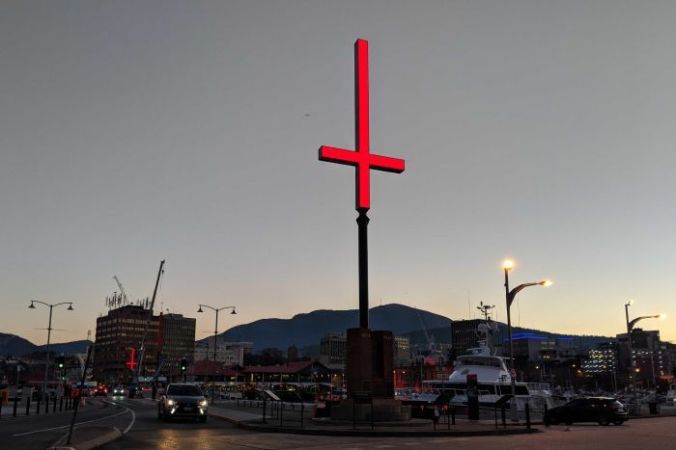
Last month a friend was about to visit Hobart and asked me whether it was worth visiting the Mona (Museum of Modern Art in Hobart). At first I thought he said MOMA, and so I proceeded to give a rapturous endorsement of this famous art gallery in New York City. He then clarified that he had said Mona and not Moma, at which point I was no longer able to help him. Perhaps there is a vibrant contemporary art scene in Tasmania, perhaps not. But then today, as I peered outside my Melbourne window and across Bass Strait, the distant feint red glow of upside down crosses didn’t succeed in turning around  my opinion about Tasmanian art.

9845166-3x2-700x467 (1).jpg

ABC

This is art? I realise that in Tasmania, the ministry of the Arts is combined with Justice, Correction, and the Environment. Was someone in the ministry confused when they opened the public purse? Or is Tasmania introducing a new form of justice and correction?

These so called ‘Crosses of Saint Peter’ look more like half assembled mood lights from Bunnings, rather than works of art. Then again, perhaps I’m being unfair to Bunnings!

Dark Mofo is a winter solstice festival, which aims to shock and to subvert. Last year, the Festival caused controversy in its ‘artistic’ use of slaughtered bulls, with blood and guts smeared all over people. This year, there is an anti-Christian theme, which would be innovative and interesting, except that it’s not. It’s kind of old and tried, about 2000 years so,  and sticking a few coloured LEDs onto  crosses is somewhat pedestrian.

Speaking of which, also appearing during the Dark Mofo Festival, is another artist, Mike Parr, who is going to bury himself under a road for three days. It’s unlikely though that his performance will have the same energy and excitement as the real resurrection, given that he’s not actually dead, and presumably he’ll need to eat and drink and poo and sleep. The more pressing question is this,  how is Mr Parr going to assess the critics reviews? Is trampling and driving over his ‘grave’ a sign of critical acclaim or of people expressing disinterest in the stupidity of the stunt?

Going back to these disco coloured inverted crosses, not only are they advertising an absence of artistic creativity, surely this project is a theological and social misfire.

The sight of these crosses is upsetting some Christians around Hobart, and I understand their reasons. Indeed, for millions of women and men around the world, they are being imprisoned and even killed because they love and believe the message of the cross, but why we would allow such facts to interrupt the creative processes. More so, I also think that once we’ve taken a step back, we can evaluate these cultural illuminatatis in a different way.

In his interview on the ABC, Mikey Lynch said it well,

“My immediate reaction was a bit of an eye roll — here we go, a shock jock statement that gets Christians grumpy.

“It’s a religious symbol and so for some people it is precious, so of course people are going to find that hurtful.

“For Christians, the cross is a symbol of shame and it’s about God taking on shame for the salvation of the world, so there’s a weird irony in getting offended by a symbol which in itself is offensive.”

These artists are taking what is the most offensive object of history, the cross, and are attempting to make some subversive statement about Christianity and to offend Christians in the process. Really? Let’s shame the symbol of shame? Perhaps the point has escaped the genius of these Dark Mofo artists, because surely their own subversive and unoriginal interpretations of the cross in fact reinforces the original point that was proven on the cross.

The Apostle Paul put it most aptly when he wrote,

“18 For the message of the cross is foolishness to those who are perishing, but to us who are being saved it is the power of God. 19 For it is written:

“I will destroy the wisdom of the wise;
    the intelligence of the intelligent I will frustrate.”

20 Where is the wise person? Where is the teacher of the law? Where is the philosopher of this age? Has not God made foolish the wisdom of the world?21 For since in the wisdom of God the world through its wisdom did not know him, God was pleased through the foolishness of what was preached to save those who believe. 22 Jews demand signs and Greeks look for wisdom, 23 but we preach Christ crucified: a stumbling block to Jews and foolishness to Gentiles, 24 but to those whom God has called, both Jews and Greeks, Christ the power of God and the wisdom of God. 25 For the foolishness of God is wiser than human wisdom, and the weakness of God is stronger than human strength.” (1 Corinthians 1)

Tasmania may be disconnected from the mainland by 500km of water, but apparently there also exists an ocean separating the Dark Mofo team from the world of art. Artists of Tasmania, please paint and sculpt, and resurrect what remains of your reputation.

They have may failed to set the art world alight, but these winter solstice revellers have given Tasmanians a new reason to ask questions about the cross. What a great conversation starter for Christians in Hobart this week.

Melbourne Baptist Church Hosts Same Sex Wedding

A story broke on DavidOuld.net this morning, naming a Baptist Church in Victoria which has recently opened its building to host a same sex wedding.

The focus on DavidOuld.net is of several ordained Anglican ministers from the Diocese of Melbourne who were present at the ceremony, and who appear to have formally participated during the service. It is not currently known who the official celebrant was, but presiding over a same sex marriage is a violation of the government marriage licence for both Anglican and Baptist clergy. Anglican and Baptist marriage celebrants can only conduct weddings according to the marriage rites of their said denomination.

According to the Baptist Marriage Rites, marriage is “the union between a man and a woman to the exclusion of all others, voluntarily entered into for life.”

My concern is the news that a Baptist Church in Melbourne has hosted this wedding, and it appears as though at least one ordained Baptist minister was involved. This doesn’t project a view of Victorian baptists that will adorn the Gospel of Jesus Christ.

Screen Shot 2018-05-28 at 11.14.14 am.png


Community Church of St Mark belongs to the association of Churches that is the Baptist Union of Victoria. I cannot imagine that they would have received permission from the BUV to conduct a same sex wedding on their premises. Such permission is not however required as local churches have significant autonomy.

There is a question as to whether the Community Church of St Mark rented out their building to a third party or were  formally hosting and supporting the event? In one sense, that distinction is a matter of semantics, for either option is a clear promotion of same sex marriage. Footage of the wedding procession clearly shows the banner of St Mark’s being paraded, thus indicating at least some involvement by the Church. In addition, an ordained baptist minister was also present and part of the procession, and it appears that she was involved in a formal capacity.

Why does this matter?

It is important for baptists for at least these two reasons:

First, Community Church of St Mark have misrepresented what Baptists believe about marriage. They have welcomed teaching and have blessed a view of marriage that contravenes the clear doctrinal position of the Baptist Union of Victoria. In so doing, they are sending confusing messages to local communities as to what Baptist believe about marriage, and in so doing they are leading people astray from God’s good purposes. 

Second, Churches who are affiliated with the BUV are in relationship with each other. There is rightly a significant degree of autonomy given to each church, however an association is not arbitrary or meaningless. Without clear theological common ground that is affirmed and practiced, churches can’t work together. To what point can we share an identity together when that name is being misrepresented in such grievous ways?  The question is, should our Baptist Churches allege unity with another Church who has decided to act against Baptist doctrine? Is it appropriate to call Community Church of St Mark to repentance?

The issue of marriage is not unimportant or secondary in the Bible. Indeed, during last year’s plebiscite debate advocates made it clear that they believe it’s about human rights and amending one of the great social evils in our country. For Christians, our Scriptures define sexual relations outside of heterosexual marriage as porneia, it being alongside many other activities which prevent people from entering the Kingdom of God. The Apostle Paul includes homosexual activity as being “contrary to the sound doctrine  that conforms to the gospel concerning the glory of the blessed God, which he entrusted to me.” If the Bible defines this as a Gospel issue, then it is incumbent upon us to do so as well.

This morning’s news is incredibly sad but unsurprising. For some time there have been baptist clergy and churches agitating to redefine marriage and to be given permission to formally conduct same sex weddings. These numbers are small, only representing tiny fraction of the BUV, but they are persistent. We are being naive if we believe that this matter will eventually blow over and that these advocates will simply give up.

A precedent can easily become a pattern if we don’t speak up.

As it currently stands, Baptist marriage celebrants cannot conduct same sex weddings. The position for churches is however somewhat murky. The spirit of the law suggests that a Baptist Church should not facilitate a same sex marriage, either by renting out their building or by inviting a secular celebrant to preside. However, the strict letter of the law does not (to my knowledge), prohibit this practice. This ambiguity needs to be attended to and fixed in the near future.


Update (Monday 7pm): I can now confirm that the officiating celebrant was Rev James (Jim) Barr. Rev Barr was formerly the Senior Pastor at Collins St Baptist and at Canberra Baptist. He is now a Welsh Methodist credentialed minister, and thus no longer holds a baptist licence. It is however unclear how how substantive his role was in this service, given that Baptist and Anglican clergy were also participating. In other words, one question is answered, but the original concerns remain, and they are substantive concerns for Baptists and Anglicans alike.

Should we speak of “Bible Believing Christians”?

“Jesus answered, “It is written: ‘Man shall not live on bread alone, but on every word that comes from the mouth of God.’” (Matthew 4:4)


Yesterday I was accused of making a “serious” category mistake in theology, namely to speak of “Bible believing Churches”. Geoff Thompson, who teaches Systematic Theology at the Uniting Church’s college here in Melbourne, wrote a respectful critique of my recent article on Bishop Michael Curry and his royal sermon.

The focus of Thompson’s piece was on a phrase I used, “Bible believing Church”. I was encouraging people who were struck by the wedding sermon to seek out a Bible believing and Jesus loving Church, as opposed to one that is not. Geoff Thompson has taken issue with my encouragement, saying,

“Christians are not called to ‘believe’ the Bible; they are called to acknowledge its authority, and to listen to it through the filter of the gospel proclaimed by Jesus. It is a serious category mistake to talk about ‘believing’ the Bible.”

I certainly agree with his statement about acknowledging the Bible’s authority and interpreting Scripture through the Gospel of Jesus Christ, but those things do not denude the phrase, ‘Bible believing’, in fact, they accurately reflect part of what it means to be a Bible believing Christian.

Does Geoff Thompson have a case? To answer, I thought, well, what does the Bible say? Let’s take some examples,

“And we also thank God continually because, when you received the word of God, which you heard from us, you accepted it not as a human word, but as it actually is, the word of God, which is indeed at work in you who believe.” (1 Thessalonians 2:13)

“By this gospel you are saved, if you hold firmly to the word I preached to you. Otherwise, you have believed in vain”. (1 Corinthians 15:2)

“After he was raised from the dead, his disciples recalled what he had said. Then they believed the scripture and the words that Jesus had spoken”. (John 2:22)

“I look on the faithless with loathing, for they do not obey your word”. (Psalm 119:158)

“And now you will be silent and not able to speak until the day this happens, because you did not believe my words, which will come true at their appointed time.” (Luke 1:20)

“And because of his words many more became believers”. (John 4:41)

“Very truly I tell you, whoever hears my word and believes him who sent me has eternal life and will not be judged but has crossed over from death to life.” (John 5:24)

“Don’t you believe that I am in the Father, and that the Father is in me? The words I say to you I do not speak on my own authority. Rather, it is the Father, living in me, who is doing his work.” (John 14:10)

“The apostles and the believers throughout Judea heard that the Gentiles also had received the word of God”. (Acts 11:1)

It is clear from these verses (and many others could have been used) that God wants us to believe his word. Accepting and trusting the Bible (which is God’s word) not only pleases God, it is one of the ways God differentiates between his people and those who are not. Indeed, when his people reject his word, he calls them to repent and to return to the word. Receiving, believing, and obeying the word is one of the Bible’s ways of describing who is Christian.

IMG_0302.JPG


This word is from God and is about God, and especially his son Jesus Christ.  God’s call to believe his words, both Old and New Testaments, is never merely about intellectual assent, but is about understanding, trusting, desiring, and obeying. In fact, prior to our response the word, the word must firstly begin a work in us, as the book of Hebrews declares,

“For the word of God is alive and active. Sharper than any double-edged sword, it penetrates even to dividing soul and spirit, joints and marrow; it judges the thoughts and attitudes of the heart.” (Hebrews 4:12)

The word is not only God working in the human heart but it is God saving, creating, and ruling. More than that, as many of above Bible references explain, when Jesus, the Apostles, and the Prophets talk about believing the word, they don’t divide belief in the word and belief in God; to trust in the Scriptures is to believe God.

In short, the Bible does talk about believing the Bible and it does so in a very positive and necessary way. To speak of Bible believing Christians and Churches is one way of talking about men and women who accept the Bible as God’s authoritative, true and good word, and who now commune with God by his Spirit through his word about his Son. 

Wouldn’t it be odd for someone to respond, “Oh that’s not Murray, that’s just his words…I believe in Murray, but not his words.”

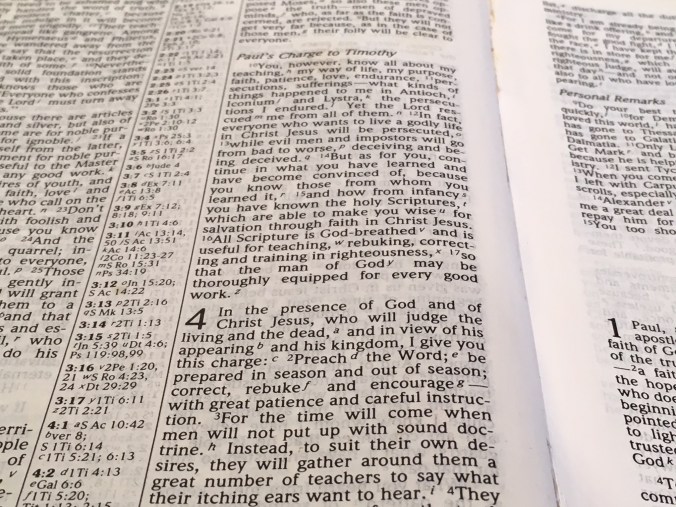
Yes, there is a question of ontology, but nonetheless, we don’t divorce a person from their words. What does the Apostle Paul say to Timothy?

“14 But as for you, continue in what you have learned and have become convinced of, because you know those from whom you learned it, 15 and how from infancy you have known the Holy Scriptures, which are able to make you wise for salvation through faith in Christ Jesus. 16 All Scripture is God-breathed and is useful for teaching, rebuking, correcting and training in righteousness, 17 so that the servant of God may be thoroughly equipped for every good work.”

Far from being a category error, “Bible believing Church” is a phrase which accurately reflects the Bible’s own presentation of the relationship between God, His word, and his Church. It doesn’t say everything, and neither is it intended to. Like any Christian idiom, it can be misappropriated, but that doesn’t mean it’s theologically wrong or misleading. Yes, it is possible for someone to believe the Bible is true or useful without having personal faith in Jesus Christ; our society is filled with such people. But is this what we mean when referring to Bible believing Christians and Churches? The only people I know who might talk about being Bible believing are those who have a living faith in Jesus Christ. If anything, it could be used, not adjectively, but as another way of describing a Christian.

The real question is, why do some Christian scholars want to discourage this identity marker?  Why is it the case that when God can define his people as those who believe his word, there are Christians telling us that it’s wrong to describe ourselves as Bible believing? Geoff Thompson explains, it’s because he doesn’t agree with my interpretation of the Bible. No doubt, the task of interpreting the Bible is incredibly important but that doesn’t mean it’s “seriously” wrong to talk about “Bible believing Churches”.

He argued, “When a church presents itself as ‘Bible-believing’, it is often a fairly blunt proxy for legitimating its interpretations of the Bible without acknowledging that they are interpretations.”

While that can be the case, it doesn’t have to be, and normally it is not. Thompson’s argument is more red herring rather than substantive.

On the other hand, when it comes to hermeneutics, the opposite can be true, “when a church wants to teach and practice revisionist morality, they often present the Bible as having many and varied meanings and we should accept validity in all interpretations.” Indeed, some are honest enough to admit that they no longer believe in certain parts of the Bible. 

I don’t know Geoff Thompson or the hermeneutical grid he uses to interpret the Bible, and how broad his theological canvas is in accepting divergent interpretations, so I won’t offer speculation. My purpose here is not to delve into those questions (as important as they are), but it is to correct the alleged correction, that it is wrong to speak of “Bible believing Churches”. Do we not want our Churches believing the Scriptures? I certainly pray so.

Bishop Curry and his Royal Sermon

“Jesus replied, “Anyone who loves me will obey my teaching. My Father will love them, and we will come to them and make our home with them. Anyone who does not love me will not obey my teaching. These words you hear are not my own; they belong to the Father who sent me.” (John 14:23-24)


Michael Curry’s royal wedding sermon has been the hot topic of conversation over the last 2 days. Newspapers, television shows, and social media are alight with opinions over the bishop and his sermon.

I have heard people speak favourably of the preacher because of his energy and enthusiasm.

Some people are admiring Michael Curry because in their opinion, he has broken with royal convention and stuck it up at English tradition.

There were voices praising how this is a sign of dismantling white privilege and power.

Others were warmed by Curry’s message of love

Other again, were annoyed because he spoke too long.

Some people, including Christians, thought he preached an amazing Gospel sermon, while others have criticised Curry’s message for being Gospel absent, perhaps even implying an alternate gospel.

In other words, there are many very different reasons why people responded positively and negatively to this wedding sermon.

abc royal wedding.png

My reaction? I was partly pleasantly surprised, and also profoundly concerned.

Did Michael Curry say some things that were true and helpful? Yes. Did he speak too long? For a wedding, probably yes, but every preacher know that temptation. Was it positive to see an African American preaching at a royal wedding? Absolutely. Maybe in the future we’ll see a Chinese or Persian Pastors preaching the Gospel at such an auspicious occasion. Did the bishop say anything unhelpful or untrue? The answer is, yes.

One Anglican Minister made this astute observation,

“Here’s the biggest problem I have with it: The Archbishop has made our love of others the driving force of the renewal of the world.

“Dr. King was right: “We must discover the power of love, the redemptive power of love.

And when we discover that, we will be able to make of this old world a new world. Love is the only way.”

According to Archbp Curry, Jesus dies to save us, but it’s *our love* of the other, including in marriage, that ultimately renews creation.”

If this is the case, then there is a significant theological problem with the message.

The one comment that I did share on social media Saturday night, wasn’t about the sermon or about Michael Curry’s ethnicity or personality, but one glaring point that was being overlooked. As someone who has the joy of marrying couples, I found it ironic, and sad, that the invited preacher doesn’t believe in the definition of marriage that was articulated in the wedding ceremony. I can’t imagine a church inviting someone to preach at a wedding service who doesn’t accept the understanding of marriage being declared, and who is also known publicly for their errant views.

The view of marriage that was read out loud at the start of service comes from the Anglican book of common prayer, and it is a beautiful expression, theologically rich and Biblically sound. The wording is so clear and helpful, that many other Christian denominations use the language themselves. As another friend noted, ‘it almost makes one want to be Anglican!’

Yes, it is great to see people talking about love and especially God’s love. We should pray that it will cause people to seek out a Bible believing and Jesus loving Church, and even to open a Bible for themselves to discover this extraordinary God who loves so much that he sent his only son into the world to atone for our sin. We cannot however ignore the fact, that despite his proclamations of love,  Michael Curry is partly responsible for leading an entire Christian denomination away from the Bible, and in so doing, is fracturing the Anglican Communion worldwide.

Michael Curry has not shied away from his belief in same sex marriage. He has publicly acknowledged that his views are out of sync with conservative Anglicans, and he has insisted that his American churches would not be returning to an orthodox view of marriage.

Many leaders in the Anglican Communion, including from Australia and especially from Africa and Asia, have explained their considerable concerns over Bishop Curry’s teaching and how it is causing harm both within the American Episcopal Denomination and Anglicans globally. The problem is most poignant for thousands of Anglicans in America who love God and his word, but who now face losing their church property and financial security, should they not conform to the newly fashioned views on marriage. Indeed, this is already happening.

My understanding is that in 2017, the Archbishop of Canterbury, Justin Welby, agreed to the wishes of the International Primates, and so sanctions were imposed on the American Episcopal Church, whose presiding bishop is Michael Curry.

The decision made by the American Episcopal Church is not insignificant; our view on marriage has important corollaries including how we understand the cross, sin, the Bible, ethics, and many other matters. This is unsurprising given the connection the Apostle Paul made between sex, sound doctrine, and the Gospel (1 Timothy 1:9-11). Relevant to the running theme of love, it is worth grappling with Paul’s logic in 1 Timothy ch.1 and how love is integrally tied to what is taught.  Love is not without definition and intent, but promotes truth.

As I urged you when I went into Macedonia, stay there in Ephesus so that you may command certain people not to teach false doctrines any longer or to devote themselves to myths and endless genealogies. Such things promote controversial speculations rather than advancing God’s work—which is by faith.The goal of this command is love, which comes from a pure heart and a good conscience and a sincere faith. Some have departed from these and have turned to meaningless talk. They want to be teachers of the law, but they do not know what they are talking about or what they so confidently affirm.

We know that the law is good if one uses it properly. We also know that the law is made not for the righteous but for lawbreakers and rebels, the ungodly and sinful, the unholy and irreligious, for those who kill their fathers or mothers, for murderers, 10 for the sexually immoral, for those practicing homosexuality, for slave traders and liars and perjurers—and for whatever else is contrary to the sound doctrine 11 that conforms to the gospel concerning the glory of the blessed God, which he entrusted to me.”

This matters because both love and truth matter, and to deny one is to reject the other. Without God’s truth, what remains is a sentimental religiosity, powerless to change and save. 

When it comes to weddings, couples are of course free to ask for someone outside the local church to marry them or to preach at their wedding. The presiding clergy however have the right and the responsibility to say yes or no to that request. Given the present suspension over the American Churches, which the Archbishop of Canterbury had agreed to follow, it is difficult to fathom how this decision came about. No doubt, there were many closed door conversations and internal pressures, but at the end of the day, was the decision so impossible to make?

The sheer volume of excitement over Michael Curry should at least make us ask the question, why is the media and the public so enamoured by his message? Is it because the message of love is universal and it hit the right spot? Is it because his message of love was broad that most people found nothing offensive about it? Maybe, a bit of both.  Perhaps I’m a little skeptical, but I think Jesus was also skeptical about the world loving him and his Gospel.

Will the decision to invite Michael Curry help heal deeps wounds within the Anglican Communion, or further alienate evangelical congregations  and confirm to them that her leaders lack the courage to stand on their own doctrinal positions?

These are very difficult times for Anglicans worldwide, especially for our brothers and sisters who live and serve in Dioceses that are moving away from the Gospel. Is it helpful for the rest of us to be praising a preacher who is leading his denomination away from Scripture, and in so doing, straining and even dividing the Communion?

We can be grateful for things said that were true, but let’s be slow to join the Michael Curry facebook fan club. The issues at stake here are far greater than a wedding sermon. The excitement and enthusiasm will soon disappear from news headlines, but the word of God remains, and I reckon it’s better for us to keeping believing God and not getting swept away by a few moments in Windsor.


For a slightly different but helpful take on the sermon, read Michael Jensen’s piece in the SMH

Victorian Government aims to outlaw Gay Conversion Therapy

Last year a journalist from the ABC phoned me, to ask about gay conversion therapy. I must have been a poor interviewee because they didn’t run a story at that time.

The questions were easy to answer, I asked him explain what he meant by gay conversion therapy. He wasn’t very sure, but he did share a few anecdotes, to which I responded,

“that sounds awful…I don’t know anyone who practices this and so I couldn’t even tell you who to speak to about it…I wouldn’t want anyone subject to this kind of counselling and I don’t know anyone who has been.”

I don’t know how widespread this practice is, but it was easy to agree that the stories shared with me were disappointing and an awful experience for those who went through those programs. There is however, a  now very real possibility that Victoria will erroneously conflate those extreme views with normal and historic Christian beliefs about sexuality. 

There is a massive difference between offering someone shock therapy or performing a supposed exorcism, and reading the Bible with someone and them concluding that they no longer wish to identify as same sex attracted or transgender. But will the Victorian Government make this vital distinction. There are certainly prominent social voices who would not care whether there is a difference or not, anything other than complete allegiance to the current sexual narrative must be followed.

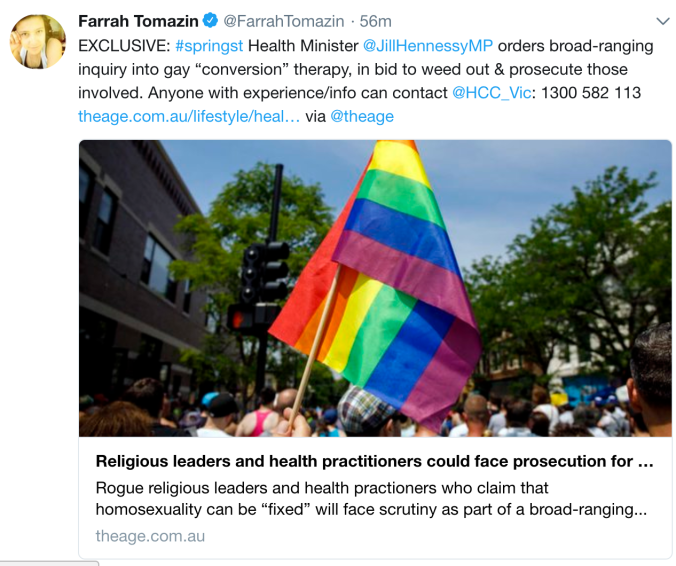
The Age has published a series of articles this year on this issue and the result is that the Victorian Government is planning to take action. In today’s edition, reporter Farrah Tomazin writes, 

Rogue religious leaders and health practitioners who claim that homosexuality can be “fixed” could end up being prosecuted as the Andrews government orders an unprecedented inquiry into gay conversion therapy.

Health Minister Jill Hennessy has asked Victoria’s Health Complaints Commissioner to conduct a broad-ranging investigation, and has not ruled out tougher laws to crack down on those attempting to change or suppress a person’s sexuality or gender identity.

The inquiry will capture registered or unregistered counsellors, clinicians who treat homosexuality as a disorder, and anyone purporting to convert LGBTI people through therapeutic means.

But significantly, it will also seek information on a more insidious trend: faith-based ministries and church figures who disguise their work as “spiritual guidance”.

“We have zero tolerance for anyone purporting to ‘convert’ gay people through any medical or therapeutic means,” Ms Hennessy told The Age.”


Screen Shot 2018-05-17 at 8.32.29 am.png

I want to respond to Farrah Tomazin’s piece and to the comments being made by our Health Minister, Jill Hennessy.

First, because I am a Christian, I do not support gay conversion therapy, as defined in terms of using pseudo-scientific and unbiblical spiritual methods to change a person’s sexuality.

Second, in the Bible God calls Christians to sexual purity; this does not necessarily mean there will be a change in sexual orientation. The fact is, in becoming Christian many gay and lesbian people will not become heterosexual. When people become Christians, there is however always a change in life. What point is there in becoming a follower of Jesus Christ if nothing changes? In beginning the Christian life, there are newly found desires for sanctification. Let me repeat, this does not imply that people cease to struggle with aspects of their past, including sexual orientation, but it does mean that they now want to be godly in their sexuality. According to the Bible, sanctification includes affirming that sexual practices remain within the loving, exclusive, mutual consenting, covenant of marriage between a man and a woman.

You see, the Bible may not state that a person’s sexual orientation will change, but it does teach conversion. Christianity by definition is a conversion religion, where human beings made in the image of God, shift from looking for freedom in the myth of post-enlightenment moral relativism, and instead discovering the greatest freedom in the person of Jesus Christ.

Third, I know people who are committed and godly Christians, and who continue to experience same-sex attraction. They are convinced that their greater and more satisfying identity is in Jesus Christ, and that living a celibate lifestyle is positive and good.

Fourth, it is an indisputable fact that some people do change sexual orientation. I appreciate that this evidence doesn’t fit with the current sexual narrative and it’s become socially and politically taboo to even mention it, but I don’t believe in ignoring research and personal stories, even if they contradict popular attitudes. For example, the majority of children who experience gender dysphoria will grow out of it by adulthood and will happily identifying with their biological sex. There are also many gay and lesbian people who have found their affections changing and have become heterosexual.  Let me reiterate, this does not mean that there is some proven or absolute way to reconfigure a person’s sexuality, but it is empirically false and socially irresponsible to deny that some people do experience a change of affections and self identification.

Fifth, I am concerned about how our culture is increasingly marginalising people who are conscious of their sexual orientation but do not wish to express or live it out. This is one of the key flaws with the Safe Schools curriculum; there is no freedom offered to children to say no to their feelings. The emphasis is on instruction children to be who they currently think they are, and to celebrate and express it. I have found no pastoral empathy in the material that encourages children to think in alternate ways

It is hypocritical for us to defend the rights of LGBT people who want to express their lifestyle and to condemn those who do not wish to follow their orientation. You can’t claim to believe in gender fluidity and then disallow entire part of the population, simply because the don’t fit inside the current subscribed spectrum; it is intellectually dishonest and morally absurd.

Sixthly, there should be concerns as to how far the Victorian Government will proceed in drafting legislation to outlaw conversion therapies. If the reporting in The Age is correct, it may become illegal for churches to teach (whether from the pulpit or in private counselling) what the Bible says about sexuality.

Without due consideration and careful definition (ie what is conversion?), it is not beyond the realm of plausibility that legislation will ban Christians from teaching the Bible’s ethics on sexuality. Sadly this is not new, for back in 2016 the current Government sought to hamstring religious toleration in Victoria with a proposed amendment to the Equal Opportunity Act.

It seems to me that there are voices on both spectrums who are ignoring science and the Bible. We might assume that both of these groups have good intentions, but whether it is political progressive with their latest interpretation of the sexual revolution, or a few crazy Pentecostals pursuing unhelpful ideas, both are making mistakes that will cause undue harm to real people.

If the Government intends to ban gay conversion therapy, consistency would have them also prohibit therapies that are aimed at changing the gender of children. In light of the research which indicates most children with gender dysphoria naturally reorienting over time, it is appalling to know of schools who are denying young children’s biological sex, and are putting them in counselling to begin transitioning them to the opposite sex. This not only includes outside dress and appearance, but hormonal therapy and eventually there is the possibility of surgery. What is even more staggering is that schools can commence some of these steps without the permission of and even knowledge parents.

To outlaw gay conversion therapies and not ban gender reassignment treatment and therapy among our youth would be sheer hypocrisy. Equally so, it is egregious to conflate fringe excessive programs with mainstream and historic Christian beliefs about sexuality, and to prohibit the freedom to articulate and persuade others with these beliefs.

I share concerns over some of the alleged practices that are contained in these so-called conversion therapies. The well-being of gay and lesbian Victorians is important, but recent political history and the current reporting in the media does not give us much hope that any drafted legislation will be fair and reasonable. There is reason to believe that these laws could negatively impact many Victorians who are wrestling with their sexuality (as is already happening through Safe Schools), and that legislation will effectively diminish religious freedoms in this wonderful State of Victoria. Indeed when the Government interferes with the teachings of Churches, all Victorians, from across religions and of none, should be troubled and asking our political representatives serious questions.

Indonesian Church attacks: some reflections

Surabaya

At approximately 10:30am, during the Sunday service at Mentone Baptist Church, three churches in Indonesia were attacked. While our children were heading out for Sunday School and the adults opening their Bibles for a second Scripture reading, suicide bombers entered 3 churches in the city of Surabaya. 11 people have died, with another 40 people injured.

As shocking as this news is, it is sadly not an unusual story for Christians in Indonesia. The persecution of Christians has been commonplace for many years in certain Indonesians provinces: in East Kalimantan, Aceh, and the city of Medan, just to name a few.

Not only in Indonesia, but similar horrific events are happening around the world on an almost weekly basis. Churches are attacked in Egypt, Nigeria, China, Pakistan, and many other parts of the world. The reality is, for millions of Christians in the world today, belonging to a Church and even attending a Church service, comes with an awareness that the cost may be great.

9756532-3x2-700x467.jpg

Source: ABC news

Abusing our religious freedom

As I’ve reflected upon the juxtaposition between Mentone and what happened inside those Indonesian Churches, I remembered one of the verses that I preached on today,

“Then the church throughout Judea, Galilee and Samaria enjoyed a time of peace and was strengthened. Living in the fear of the Lord and encouraged by the Holy Spirit, it increased in numbers.” (Acts 9:31)

This verse follows the conversion of the Apostle Paul. Previous to becoming a Christian, Paul was a renowned persecutor of Churches, killing Christians and imprisoning others. After a period of persecution, came a time of peace for these new church being planted across Judea and Samaria.

In the New Testament we learn that there can be seasons when there is relative societal peace and tolerance of Christianity, and there are also times of acute and dreadful opposition. In the book of Acts, we discover that Churches can grow and flourish in both situations.

Joining a Church in some parts of the world is potentially life threatening. On the other hand, attending Church in Australia is easy. We wake up on Sunday mornings, perhaps following a sleep in. We eat breakfast, get dressed, and drive down the road to a local church. There’s a good chance that we’re running late, and have already missed the first 10 minutes, but the temptation to spend those extra minutes at home is hard to fight against.

Making it to Sunday Church is easy in Australia, and yet how many of us find it hard, if not a burden? No one is going to enter our buildings and blow themselves up. The Government isn’t going to arrest congregation. And yet, so many of us Aussie Christians struggle to attend Church weekly. The situation has become so dire that once a month is now considered regular attendance! Imagine only eating one meal a month with your family and arguing that it is ‘regular family time’! Picture an employee informing their colleagues that turning up for 1 in 4 meetings was suffice and a demonstration of real commitment!

Of course belonging to a local church can’t be reduced to Sunday attendance, but it is the primary and central gathering of God’s people to whom you have covenanted. We meet to encourage others, just as they are meeting in order to love and grow us in Christ.

Making it to Church regularly should be easy. Unlike millions of Christians in other parts of globe, we have the freedom to meet, and we have the means: we can walk, we can drive, we can take public transport. And yet, we find it so hard. We don’t need the threat of bombs to keep us away from Church, the allure of the beach or of a coffee shop is more than equal to the task.

I once tried to calculate how many “ordinary” Sundays were in the calendar year. To begin with, there are summer holidays which take out about 6 Sundays, and then another 3 Sundays for each of the Autumn, Winter, and Spring school breaks. On top of that, in between there’s a highway of long weekends with public holidays attached to them, and we mustn’t forget Mothers Day and Fathers Day. I also assume, that like myself, other people catch winter colds and flues, and so that might mean we miss another 1-2 Sundays. If we have children, we can strike out a few more weeks with sore throats, head colds, and bouts of diarrhoea.

It is so easy to attend Church in Australia, and yet we find it so difficult. Australian society offers so much, promising our children every dream, offering us every heart desire. How hard it is to saying to our kids, we can’t play footy on Sundays because we have Church. We work so hard to climb ladders and create success and to pay extravagant mortgages, that we find ourselves with little energy for much else. We need the fishing trip and the late Sunday brunch, because we’ve exhausted ourselves in trying to drag heaven onto earth. I wonder, are we not worshiping God with his people on Sundays because we are no longer worshiping Him with our lives from Monday to Saturday?

Instead of using freedom of religion to minimise effort and commitment, should we not maximise the time we have? Are we so arrogant as to presume that freedom of religion will continue forever in Australia?

There are of course legitimate reasons for missing Church on a Sunday morning. Churches (and Pastors) should be understanding of members who are simple unable to attend every week, because of poor physical or mental health, because kids are sick or that long awaited annual vacation has come around. There are professions where workers are rostered for Sundays; after all, we can’t run hospitals or police or trains without people.

Make Church a habit

I was speaking with one of my church’s members recently. He and family are going through a difficult time, and so when they arrived late one Sunday, I said to him that I would understand if they couldn’t make it to Church on occasion. He responded with this gracious and rather memorable rebuke,

“Murray, of course we come to Church every week; it’s what we do.”

By this, he didn’t mean that Church attendance was a ritual or tired tradition. Rather, it was a helpful habit. Going to bed on Saturdays, they already knew what they were doing the next morning, because as a couple they had already settled in their hearts and decided made with their minds, Church matters. It wasn’t always easy, but they didn’t have to make the choice each Sunday because the decision was settled and the habit formed.

Consider Church a Joy

Tonight, as I pray for Indonesia and for Mentone, I want to cherish the local church and to make the most of the freedoms we have to meet each week, and even more.

May be I should be thinking, what temporary offerings can even begin to compare to the wonder of knowing God and to be part of the Church that Jesus has promised to build? Would I settle for playing football on the X-box if an AFL team called me to join their side? And yet we easily sacrifice Church, for small moments that will soon be forgotten.

According to Hebrews, a sign that our hope is directed in the right place, is that we are fight against the temptation to diminish Church. Those who draw near to God, are those who not give up on one another.

22 let us draw near to God with a sincere heart and with the full assurance that faith brings, having our hearts sprinkled to cleanse us from a guilty conscience and having our bodies washed with pure water. 23 Let us hold unswervingly to the hope we profess, for he who promised is faithful. 24 And let us consider how we may spur one another on toward love and good deeds, 25 not giving up meeting together, as some are in the habit of doing, but encouraging one another—and all the more as you see the Day approaching.” (Hebrews 10)

Richard Condie’s Positive Steps to help victims of child abuse

I want to commend the steps taken by Tasmania’s Anglican Bishop, Richard Condie, to redress the issue of child sexual abuse.

According to this evening’s ABC report,

“Tasmania’s Anglican Diocese is proposing to sell more than 120 properties, including churches, halls, houses and vacant land, to fund redress for survivors of child sexual abuse.

The church said it would need to sell just under half of its Tasmanian properties to cover an estimated $8 million of liability in additional payments to survivors.

It has been lobbying for the State Government to sign up to the National Redress Scheme for survivors, due to start on July 1 as a result of the Royal Commission into Institutional Responses to Child Sexual Abuse.

The Tasmanian Diocese also agreed to increase the payment cap for its own Pastoral Support and Assistance Scheme from $75,000 to $150,000 per claim.

Previous claimants will be entitled to have their claims reassessed, which may result in extra payments.

The figure of $8 million is based on advice that 150 survivors may be eligible to receive the average payment of $78,000 under the national scheme, or a similar figure from the church’s own scheme.”

“Survivors will not be able to claim from both schemes but, unlike the national scheme, the Tasmanian Anglican scheme is open to non-Australian citizens, those with a criminal conviction or people who were abused as adults.”

bishop-richard-condie-tasmania-2


Christian denominations and organisations have been rightly rebuked for the evil acts of child abuse that have been carried out by clergy and employees over many decades.  The abomination is not only the fact that the lives of young children have been devoured by demonic men, but that some groups covered up the crimes, or through inadequate training others did not respond to the cries of victims as they needed.

In part due to the Royal Commission into Institutional Responses to Child Sexual Abuse, Australians are more aware of the depth and breadth of the issue, and positive moves are now being taken to ensure children are safe and that Churches and other groups are better informed as to how to deal with reports of abuse. It still saddens me that the Royal Commission was ever required, but we should thankful for the tireless work of those who organised and participated. It is also encouraging to see many organisations being quick to follow the report’s recommendations, and it is disturbing to hear of others who are slow to practice repentance.

The damage created by decades of abuse will remain with us for decades to come. Thousands of Australians have been personally scarred, and their families too. Confidence in many institutions, including Churches, has been understandably broken. Churches have given Australians reason to doubt the authenticity of the Gospel, and to disbelieve the witness of Churches. This should never have been the case, for the name of Jesus Christ is good and holy, and without a single spot of unrighteousness, and followers of Jesus are called to be like their Lord and show others how good He is. Yet men from hell came and covered themselves in white robes and stole innocence. God is just and their evil behaviour will be recompensed in full, but  we are being naive if we believe that Aussies will quickly forgive or forget. We should not forget, we must repent.

I am reminded of the Law in the Old Testament. The Pentateuch may have fallen out of favour in our culture, like an out of date carton of milk, but perhaps we shouldn’t be so quick to pass judgment. Yes, the Mosaic law sours when it’s misapplied, but the law is more useful and essential than we might be willing to admit. In reading the law we learn two profound truths: Justice is paramount, and mercy is desperately needed.

“Do not deny justice to your poor people in their lawsuits.” (Exodus 23:6)

“Do not pervert justice or show partiality.” (Deuteronomy 6:19)

I thank God for Richard Condie’s leadership in practicing public and genuine repentance. He has not minimised the sins of past generations, and he is willing to go beyond recommendations in order to offer compensation to victims.

“When justice is done, it brings joy to the righteous but terror to evildoers” (Proverbs 21:15).

Let justice be done. My prayer is that others will follow the example of the Tasmanian Anglican Diocese (and that of the Sydney Anglican Diocese who have also made welcoming steps forward).

Are we prepared to walk away, for sake of Christ?

Israel Folau has come out and explained his recent remark on Instagram that has led to huge public controversy, and has involved Rugby Australia and their chief sponsors. It seems as though everyone has an opinion, and so it has been helpful to hear Israel speak for himself.

I appreciate his honesty and his humility. It made me think of the Apostle Paul’s words,

The grace of our Lord was poured out on me abundantly, along with the faith and love that are in Christ Jesus.

Here is a trustworthy saying that deserves full acceptance: Christ Jesus came into the world to save sinners—of whom I am the worst. But for that very reason I was shown mercy so that in me, the worst of sinners, Christ Jesus might display his immense patience as an example for those who would believe in him and receive eternal life”. (1 Timothy 1:14-16)

I appreciate Folau’s clarification about what believes. I appreciate his unswerving faith in Jesus Christ and his trust that the Bible is true and good,

“I believe when Jesus died on the cross for us, it gave us all the opportunity to accept and believe in Him if we wanted to. To enter the kingdom of Heaven, though, we must try our best to follow His teachings and, when we fall short, to seek His forgiveness.”

FOLAU_PV3_1280x560-1.jpg

He has indicated that should Rugby Australia find his views to be untenable he would resign,

“After we’d all talked, I told Raelene if she felt the situation had become untenable – that I was hurting Rugby Australia, its sponsors and the Australian rugby community to such a degree that things couldn’t be worked through – I would walk away from my contract, immediately.”

At this point in time, no decision has been made by either Folau or Rugby Australia. Last week, Rugby Australia chief executive Raelene Castle, admitted the difficulty she is facing,

“This is a difficult issue when you think you are trying to combine religious beliefs, freedom of speech and inclusion, respect and the use of social media,” 

“We’re proud of the fact that he’s a strong believer and he’s prepared to stand up for what he believes in.

“We want athletes in our code who are prepared to do that and that’s really important.

“But at the same time, Rugby Australia’s got a policy and position of inclusion and using social media with respect.

“So that’s where we shared stories, shared ideas and shared positions and both of us recognise that what we want is a situation where we use our social media platforms in a respectful and positive way.”

I think Castle helpfully summarises some of the tensions that now exist in the broader community. As a nation we are struggling to cope with societal pluralism. Sexuality has now been defined in such strong terms, that alternative views, as reasonable and loving as they may be expressed, are now perceived as evil and unacceptable. It’s reached the point that sporting codes are now making theological commentary, and assuming a position on hell. Unfolding before us is another test for Australian society. Are we serious about religious freedoms and freedom of speech, or does the rhetoric only apply when beliefs fall into line with the new sexual morality? Do we accept that millions of Australians don’t subscribe to the now popular view on marriage and sexuality, and that these Australians have a right to express their opinions? While politicians and company CEOS and sporting organisations wrangle over a position on religious freedom, it is even more important for Australian Christians to be thinking through these issues. What do we really believe? How can we best communicated what we believe? What are prepared to lose for the sake of knowing Christ Jesus as Lord?

Even though Folau’s sporting future remains uncertain, his testimony presents a healthy challenge to the rest of us Aussies who profess faith in Jesus Christ. Would we be prepared to walk away from job security? Would we be willing to give up a lucrative income? Are we ready to embrace public abuse?

I hope no one is thinking, Israel Folau can afford to make a decision to leave because he’s already earned millions of dollars and he has options in front of him to return to Rugby League. First of all, those who have more often find it exponentially harder to give it up. It is relatively easy to keep our beliefs quiet and to ourselves, and the pressure to compromise can be immense. Second, in standing by his Christian convictions, Folau is likely to face further public backlash. Third, NRL chief executive Todd Greenberg, has made it clear that Folau’s belief in hell would be unacceptable in their code, meaning that there is far from any guarantee that he could return to Rugby League.

When Jesus spoke about taking up a cross and giving up the world’s offerings, he wasn’t speaking rhetorically. Perhaps it is time for us to ponder his words and examine our own hearts and ambitions,

Then he called the crowd to him along with his disciples and said: “Whoever wants to be my disciple must deny themselves and take up their cross and follow me.  For whoever wants to save their life will lose it, but whoever loses their life for me and for the gospel will save it.  What good is it for someone to gain the whole world, yet forfeit their soul?  Or what can anyone give in exchange for their soul? If anyone is ashamed of me and my words in this adulterous and sinful generation, the Son of Man will be ashamed of them when he comes in his Father’s glory with the holy angels.” (Mark 8)