Israel Folau decision may set a course for the future

Christians across Australia have been given a message, “don’t commit social blasphemy” and “be careful if you choose to use the Bible”.

After three days of deliberations, a three person panel has found Israel Folau guilty of a “high level breach” of Rugby Australia’s player code of conduct.  Not that the outcome was much in doubt, given that Rugby Australia and the Waratah’s had bypassed due process and instead announced to the nation that Folau’s contract was terminated and that he would never be selected again to play for his country or club. Last night’s verdict was little more than a formality.


FOLAU_PV3_1280x560-1

Whatever Izzy’s motives may have been for posting on social media, he has forced onto the national stage an issue that has been pulled and tugged and tested in quieter situations from the East Coast to the West; can a pure form of Christian beliefs be permitted in the public space?

What was his offence? It is believed that Israel Folau declined to sign a document in addition to the standard players’ contract, which would have placed greater restrictions on his use of social media. He did, however, sign his contract, which presumably includes a clause about adhering to the players Code of Conduct. He has been found guilty of a “high level breach” of the Rugby Code of Conduct. This breach hangs on a subjective interpretation of Part 2 Article 1.3, “Treat everyone equally, fairly and with dignity regardless of gender or gender identity, sexual orientation, ethnicity, cultural or religious background, age or disability. Any form of bullying, harassment or discrimination has no place in Rugby.”  Interpretation of this clause depends on one’s a priori beliefs and moral framework, and in this case the panel have deemed that summarising 1 Corinthians 6:9-11 is a “high” form or harassment, even though the point of that passage is quite the opposite, and so too the meaning of Folau’s post.

Legal experts are expressing concerns over the handling of the issue. Professor Nicholas Aroney has interpreted the allegations against Folau with reference to International law. He explains that

“ [What] Folau has said is not an example of hate speech, and he should not lose his rugby career as a result.” Indeed, he reminds us of the broader framework in which Folau has posted comments, “In addition to repeatedly expressing his love and acceptance of all people, Folau has confessed to having committed many of the sins about which he now warns his readers. This makes it difficult to attribute any intention on his part to advocate hatred against these classes of people, for he numbers himself amongst them”

Setting aside legal questions (which I will certainly leave to those who legal expertise) what is clear is that Rugby Australia and the social commentators who’ve joined the scrum have defined ‘orthodox’ religion. Whether Rugby Australia realise it or not, they have taken a theological stand on Israel Folau and have determined to define what is and isn’t acceptable religious belief and speech. Remember, Folau was quoting the Bible and summarising basic Christian teaching.

Yes, as I and others have said a thousand times, Folau’s comments were not seasoned with grace and kindness. They appeared blunt and insensitive, much like a Rugby footballer. Was his manner lacking? Probably, yes. Were his words untrue to 2000 years of Christian belief? No.

Footballers have been forgiven for all manner of social and even criminal offences over the last few years; have we forgotten what some NRL and AFL players have been embroiled in the last few years. But Israel Folau isn’t to be forgiven.

And what of the teammates who have spoken out in support of Folau and have even agreed with his post? Surely Rugby Australia can’t afford to lose any more players before the World Cup? Is Folau to be a sacrificial lamb, served up to warn others of what might happen should they transgress again?

Let’s not be fools, Christians and non-Christians alike are praised for quoting the Bible when they squeeze it to fit with progressive social agendas. Kristina Keneally wasn’t removed from the Labor Party after quoting the Bible against Prime Minister Scott Morrison, and Peter FitzSimons hasn’t been sacked by Fairfax for repeatedly speaking of Jesus Christ? Why not? Because their speech falls into the rut of the cultural narrative, no matter how poor their handling of Christian texts may be.

Lest we conclude that this story will soon be forgotten as a blip on the cultural radar, Rugby Australia’s stance may well soon find legislative legs. The Australian Labor Party (as the Greens have already done) have announced that they are considering expanding “anti-discrimination legislation to shield gay and transgender ­people from harmful speech if elected, in a move that has alarmed lawyers and free-speech advocates.”

“When prejudice against LGBTIQ people contributes to harassment by the written or ­spoken word, such harassment causes actual harm, not simply mere offence, to people who have suffered discrimination and prejudice, and causes particular harm to young same-sex-attracted, gender-questioning or intersex people.

“Labor considers such harmful harassment is an unacceptable abuse of the responsibilities that come with freedom of speech and must be subject to effective sanctions. Labor will ensure that anti-discrimination law provides such effective sanction.”

Depending on how the language of ‘harm’ is understood, all manner of reasonable speech may be found on the wrong side of the law. For example, former rugby league player, Ian Roberts, last week alleged that comments like those of Israel Folau play a role in teenage kids committing suicide as they come to terms with their sexuality

“There are literally kids in the suburbs killing themselves — and I say that with the greatest sense of respect — I’m not implying that Israel’s responsible solely for that, please don’t take it that way.

“But it’s these types of comments and these off the cuff remarks, when you have young people and vulnerable people, kids in the suburbs who are dealing with their sexuality, confused, not knowing how to deal with it, these types of remarks can and do push people over the edge.”

If explaining the Christian view of sexuality is deemed to be a trigger for teenage suicide, we can anticipate further public outrage and potential legislation that will restrict and prohibit words that conform to and explain the Christian message. One might respond by pointing out that thousands of Christians are killed every year simply because they are Christian, therefore we must not limit or silence Christians freedom to speak their beliefs. If we are to be morally and logically consistent, Robert’s argument works in different directions. Leaving that aside, Roberts’ comments could be taken offensively by some Christians because we too are concerned for the wellbeing of teenagers. It is good to be reminded that these conversations are not merely academic or theoretical but they relate to real people who matte. We can thank Ian Roberts for this reminder.  No one wants teenagers despairing of their worth and believing they are unloved. I am reminded of Jesus’ encounter with the Samaritan woman, a woman who’s sexual past was complicated, to say the least. Jesus didn’t affirm or applaud her but he did love her and speak a powerful word of compassion and hope to her.

“Everyone who drinks this water will be thirsty again, but whoever drinks the water I give them will never thirst. Indeed, the water I give them will become in them a spring of water welling up to eternal life….The woman said, “I know that Messiah” (called Christ) “is coming. When he comes, he will explain everything to us.”… Then Jesus declared, “I, the one speaking to you—I am he.” (John 4:13-14, 25-26)

In the midst of all the myriad of questions and issues relating to the Folau case, it is important to repeat an observation that was made last month: while Folau’s offending posts are in line with orthodox Christian teaching, he has on other occasions suggested a troubling view of the Trinity. He appears to advocate Oneness theology, which contradicts the Creeds and the very Scriptures themselves. This matters because it would be unwise to use Folau as a poster for Australian Christianity should he not subscribe to one of the most basic of Christian doctrines. It would be unwise and unChristian for Christians to pedestal Israel Folau while knowing he may well reject an even more foundational belief. As I suggested at the time, it may well be the case that Folau is like many Christians who are confused about and fuzzy on the Trinity. At the very least, this is a reminder as to why it is incumbent upon Pastors to teach the Bible clearly and faithfully in order to aid their congregations to understand such crucial doctrines.

The controversy over Israel Folau was not the first case and it is far from being the last. School children in Victoria are force-fed gender theories which are often unsupported by science and best medical practice, and many families have already felt pressured to leaving the public system and forced to pay the expense of independent schooling because of this Governmental pressure in Victoria. We can expect more corporations and organisations falling for the kinds of pressures that have been exposed by the Folau situation. Australia is moving toward introducing limitations on religious freedom that we see in parts of Europe and in Canada. We are heading closer toward the situation found in China, whereby Christians cannot join a political party and they cannot speak openly about Christianity and churches must be approved of by the State. This isn’t hyperbole, this is the natural progression of authoritarian secularism who will use the sexual revolution and identity politics to push all but their sanitised version of religion out of the public square.

A culturally palatable Christianity will entail deleting most Bible verses, any references to hell and to judgment, removing the core of the faith which is the atonement, and of course, we must let go of any teaching about marriage and sex and the roles of women and men. We will be left with a very tiny Bible and one that makes little sense, and one that has no power to give life and hope to this world.

“I am the way and the truth and the life. No one comes to the Father except through me.” That saying of Jesus will need to go. So too will Jesus’ introductory summary of his ministry, ““The time has come,” he said. “The kingdom of God has come near. Repent and believe the good news!” Anything that challenges personal autonomy and freedom to define self realisation cannot be tolerated.

I have said it before, Christians need to start taking Jesus’ words seriously, “Whoever wants to be my disciple must deny themselves and take up their cross daily and follow me.” We cannot afford to give up gentleness and compassion, grace and kindness, for these are indispensable attributes of the Gospel we claim to believe. We cannot respond to cultural shifts with hate but with enduring love because God has loved us. However, we have to accept the fact that loving others will not always be read as love because today’s secularist police will not permit views that transgress their narrow understanding of righteousness. Don’t give up on love, and don’t sacrifice truth and goodness for doing so means that we have also evacuated love from the picture.

If Christianity’s demise in Australia has been party due to Christianity’s seducement by the culture, then perhaps the clarifying disjunction between Church and culture will aid believers to regain Gospel convictions, compassion, and expectations. After all, it was communist China that created a moral and epistemic environment which catalyzed the explosion of Christianity and the conversion of 10s of millions of Chinese.  We may be disappointed by indicative direction Australian public life may be taking and the ramification this may have for our job security, education, and financial stability, but we are hopeful and joyful because Jesus Christ remains true and good today as ever. And by the grace of God, over time some our Aussie neighbours may come to realise that we are not against them but for them and have a message of hope that we alter their lives in the most satisfying and liberating fashion.

Do Christians still believe in hell today? A response to Robyn Whitaker

“If you don’t believe in hell, you’ll never heard the love of God.” (Tim Keller)


As part of commemorating Easter, the Conversation published two articles by Uniting Church minister and theological college lecturer, Robyn Whitaker. 

Whitaker is (as I suspect many pastors have done in the past few weeks)  offering a contribution to the public debate on hell, which has followed Israel Folau’s recent Instagram comments.

Whitaker provides an interesting and at times informative account of the biblical notions of heaven and hell, but readers are left wondering whether we are meant to believe that these destinations are believable today.

It is difficult to know what Whitaker personally believes about heaven and hell. Her excurses take us through some biblical material and references to ANE religions, but there appears to be a reluctance to share what she herself believes. More problematic is the direction she is leaving for her readers.  It feels like an ethereal rendition of John Lennon’s,

‘Imagine there’s no heaven

It’s easy if you try

No hell below us

Above us only sky’


istockphoto-851824664-612x612.jpg

istock photo

First of all, where does heaven and hell come from?

Readers are given the impression that heaven and hell don’t originate with God of the Bible, but rather they are evolving compilation of many different faith traditions. Whitaker notes the possible influence of cultures surrounding ancient Israel and Judea. While the Bible at times utilises words and images from surrounding cultures, that does not mean that the biblical concepts depend on or are derived from these religious settings.

The Bible describes heaven and hell as places created by and belonging to God, as much as this universe is made by the same God. Biblical authors may at times borrow language from other places to help readers understand what heaven and hell are about (of much greater influence on the New Testament is a heavy dependence on the Old Testament), but to imply that the Biblical teaching should be traced to another religious milieu is both unnecessary and counters the Scriptures themselves (i.e. Acts 17:16-31).

Whitaker not only suggests the Bible’s teaching about heaven and hell are sourced from other ancient religions, rather than originating with God himself, dotted throughout her presentation are misleading phrases like, “mythic stories”,  which reinforce the view that the Bible is either unreliable or is little more than a superb piece of fiction. The quote by Paula Gooder is telling in this regard,

“it is impossible to state categorically what the Bible as a whole says about heaven… Biblical beliefs about heaven are varied, complex and fluid.”

Two millennia of  Creeds, Catechesis, and doctrinal statements have achieved the very thing that Gooder says is impossible! That does not mean that every aspect of the Bible’s teaching on heaven and hell are captured in any of these statements, but the essence of and a faithful representation of these teachings can be accomplished.

Second, is hell a real place?

Whitaker’s argument leaves readers believing that the answer is a likely, no. While Whitaker is more than willing to accept heaven as an ultimate place (by which she understands heaven to be the healing and transformation of this world), her confidence in a literal hell is lacking, to say the least.

For example, Whitaker makes a big deal of the Bible’s use of metaphors and imagery and does so in a way that explains away any imperative to believe these things are representative of real and concrete places.

Jesus frequently used allegories and analogies in his teaching to convey concrete realities. For example, the mustard seed describing the kingdom of heaven, or the farmer’s seed which represents the word of God. The illustrations are vivid descriptions describing very real things. Similarly, fire and smoke and gnashing of teeth may be rhetorical and symbolic but they are not describing a fiction destination but an eternal place.

Speaking of the book of Revelation Whitaker says,

“It should be noted that these are poetic and highly symbolic apocalyptic texts whose purpose is primarily to persuade people to stay faithful to their God, not to set out a precise agenda for the afterlife.”

Why create the dichotomy? Can’t such texts achieve both? The opening verses of Revelation certainly suggest that the book is presenting an agenda for life both this side of death and on the other side.

“The revelation from Jesus Christ, which God gave him to show his servants what must soon take place. He made it known by sending his angel to his servant John, who testifies to everything he saw—that is, the word of God and the testimony of Jesus Christ. Blessed is the one who reads aloud the words of this prophecy, and blessed are those who hear it and take to heart what is written in it, because the time is near.” (Revelation 1:1-4)

In addition, there are plenty of non-poetic and non-apocalyptic texts within Scripture that explain future resurrection to either eternal life or to judgment.

“Just as people are destined to die once, and after that to face judgment” (Hebrews 9:27)

“ If we deliberately keep on sinning after we have received the knowledge of the truth, no sacrifice for sins is left, but only a fearful expectation of judgment and of raging fire that will consume the enemies of God.” (Hebrews 10:26-27)

Whitaker then suggests that the Bible itself implies that hell may not be a literal place. She contends,

“One challenge to the idea of hell as a literal place comes from the Bible itself. Parts of the New Testament record that when Jesus died on the cross he descended into the realm of the dead.”

“These fleeting references were preserved in ancient Christian creeds. Medieval Christians called Jesus’ descent to the dead the “harrowing of hell”. The theology behind it is that even the realm of the dead (hell) and death itself have been transformed by God.”

If I have accurately joined her dots together, Whitaker appears to be making the same error that some Reformed and Medieval theologians made, and that is to conflate the realm of the dead with hell. Death and hell are not the same. As Michael Bird explains in Evangelical Theology: A Biblical and Systematic Introduction,

“The New Testament distinguishes hadēs (waiting place of the dead) from geenna (judgment place for the dead).”

Part of the confusion with Jesus’ descending to the dead (or to hell) lays with a mistranslation of the creed. As Bird explains,

“the Latin creed does not say that Christ descended into hell. This wrong “tradition” is based on a mistranslation of the Latin. The Latin ad inferos found in the creed means “to the grave, the place of the dead” (i.e., hadēs). It does not say ad infernum, meaning “to hell,” the place of punishment after death…A better English translation of the creed, which is used in the Church of England, is this: “He descended to the dead.” In other words, the wrong “tradition” about a descent into hell is really a wrong translation of the Latin perpetuated by the Reformers, who did not differentiate “hell” from “Hades.”

Jesus’ death, burial, and resurrection did not close the door on hell or bring about its demolition, rather his atoning sacrifice saved from entering hell those who repent of their sin and put their faith in Him.

And what about this unnecessary yet loaded phrase, “fleeting references”? Again, Whitaker is carefully laying down rhetorical mines to undermine confidence in the Bible. It’s as though she is saying, because the number of references are few, the teaching can’t be all that important or all that reliable.  How many Bible verses are required before we ditch ‘fleeting’ and treat the subject with due seriousness? As it happens, the topic of hell and of a final judgment is pretty commonplace in the New Testament, with it being spoken of in passing commentary and in extended didactic argument and portrayed in lengthy apocalyptic teaching. Lest we forget, Jesus taught about hell more often than any other person in the New Testament.

“If Jesus, the Lord of Love and Author of Grace spoke about hell more often, and in a more vivid, blood-curdling manner than anyone else, it must be a crucial truth.” (Tim Keller)

Third, motivation for talking about hell.

Robyn Whitaker (perhaps as a swipe at Israel Folau), mocks Christians who talk about hell.

“Similarly, some Christians invoke hell to persuade individuals to repent of their sins. Such rhetoric is from a different time and place, when scaring people into faith seemed like a good idea.”

There is some wisdom here, at least in terms of emphases. Becoming a Christian is not primarily about avoiding hell. Preachers who fixate on hell and not on Jesus Christ are in danger of skewing the good news message of Christianity. The Gospel is wonderful and amazing news of reconciliation with the living God through Christ, but it not less than salvation from hell, but more. Keep in mind, it is Jesus who invoked hell as a means of warning people from ungodly living,

“If your right eye causes you to stumble, gouge it out and throw it away. It is better for you to lose one part of your body than for your whole body to be thrown into hell.”(Matthew 5:29)

“Do not be afraid of those who kill the body but cannot kill the soul. Rather, be afraid of the One who can destroy both soul and body in hell”. (Matthew 10:28)

Fourth. What God do we believe in?

In her conclusion, Robyn Whitaker reveals what the conversation is really about. Our views about heaven and hell reveal underlying suppositions about what we believe God is like.

“It begs the question – does hell continue to exist? Many Christians today would say no. Others claim an ongoing belief in a literal place of eternal punishment, which raises a different theological question: what kind of God do you believe in to think God consigns people to eternal torment?”

What we say about heaven and hell reflects what we believe about the Bible and ultimately about God.

What God do we believe in? Do we believe in a God who is telling us the truth in his word or in a God who fibbing or who has changed his mind or is unable to keep his word?

The Bible speaks of God who is love and who is holy. It is because of this love and holiness that hell exists. It is because of this love and holiness, God sent his only Son as a propitiation for our sins, and thus offering forgiveness and eternal wonder instead of his just judgment.

Part of the biblical teaching on hell is to remind and even encourage people that God is just and will bring about righteous judgment. If there is no final judgment, then what are we to suppose to conclude about justice and about God’s character and about hope for those who have suffered injustice?

Is the Bible warning humanity about a judgment that will not come? Is God’s promise of eternal life not eternal? When Jesus promised to return at the eschaton was he telling a whopper? And where is Jesus right now, following his resurrection and ascension? Major aspects of the atonement lose their power and significance, and so does Christ’s resurrection. If we follow Whitaker’s line of thinking we are left with a very different Christianity and a very different God.

What impression do her two articles leave with the reader? We conclude that hell is a minor theme mentioned by a few bible writers who were depending on other ancient religions for the concept, but isn’t something Christians really believe today, except for those few left behind angry medieval preaching type Christians. We are left sensing that both hell and heaven are difficult to pin down, and among Christians, there are diverging views and it is not necessary to that there is such a place known as hell. Is this a helpful conclusion to leave both Christians and unbelievers alike? Is this a recognisable Christian message?

If our speech about heaven and hell leaves people in doubt as to their existence, we have failed to be clear and faithful. If the Lord Jesus taught these topics with clarity and concern, should we not also?

If our speech muddies the Divine promise of a new heavens and new earth and of eternal judgment for the unrepentant, we are misrepresenting God and we are stripping people of hope. 

If our speech denies either the existence of heaven or of hell, then we have failed to be Christian. Christians may wrestle with the biblical material and be confused at times, but to explain away either heaven or hell is to ultimately set ourselves against the teaching of Jesus Christ and against God-given reasons for which he died on the cross and was raised to life.

“Then I saw a great white throne and him who was seated on it. The earth and the heavens fled from his presence, and there was no place for them. 12 And I saw the dead, great and small, standing before the throne, and books were opened. Another book was opened, which is the book of life. The dead were judged according to what they had done as recorded in the books. 13 The sea gave up the dead that were in it, and death and Hades gave up the dead that were in them, and each person was judged according to what they had done. 14 Then death and Hades were thrown into the lake of fire. The lake of fire is the second death.15 Anyone whose name was not found written in the book of life was thrown into the lake of fire.” (Revelation 20:11-15)

Then I saw “a new heaven and a new earth,” for the first heaven and the first earth had passed away, and there was no longer any sea. I saw the Holy City, the new Jerusalem, coming down out of heaven from God, prepared as a bride beautifully dressed for her husband. And I heard a loud voice from the throne saying, “Look! God’s dwelling place is now among the people, and he will dwell with them. They will be his people, and God himself will be with them and be their God. ‘He will wipe every tear from their eyes. There will be no more death’ or mourning or crying or pain, for the old order of things has passed away.”

 He who was seated on the throne said, “I am making everything new!” Then he said, “Write this down, for these words are trustworthy and true.” (Revelation 21:1-5)


April 30th – A friend of mine who is familiar with Paula Goode’s writings has sent me a helpful email where she points out that Robyn Whitaker seems to have quoted Goode out of context. Far from undermining the ontological reality of heaven, Goode is simply noting the difficulty facing biblical writers in finding vocabulary and imagery to fully explain the wonder that is heaven.

God is not embarrassed by Christians

It shouldn’t be difficult to say the word, after all, people can’t wait to use it when there’s an opportunity to deride those who adhere to this worldview. And when representatives of their ranks are caught in a scandal or in an evil and immoral act, the social outrage queue is long and eager.  Sometimes though, in fact, more often than not, the unnameable populace doesn’t fit with the subscribed narrative that Western playwrights are busily writing on their twitter feeds, political speeches, and op-ed pieces. On these occasions, which again is the normal state of affairs, our progressive friends are left rhetorically naked and yet bound by their own scripts.


bfcbbe8a-d72e-4dda-a6b3-eba667e7209f-AP_Sri_Lanka_Church_Blasts.6.jpg

CNN photo

Among the cast of notables who struggled to articulate what happened in Sri Lanka on Easter Sunday were Hilary Clinton and Barack Obama.

President Obama tweeted,

“The attacks on tourists and Easter worshippers in Sri Lanka are an attack on humanity. On a day devoted to love, redemption, and renewal, we pray for the victims and stand with the people of Sri Lanka.”

Clinton released this statement,

“On this holy weekend for many faiths, we must stand united against hatred and violence. I’m praying for everyone affected by today’s horrific attacks on Easter worshippers and travelers in Sri Lanka.”


The death toll currently sits at 359 people, with 500 injured. This is one of worse human-made atrocities committed anywhere in the world in the past decade, and possibly the largest terrorist attack since 9/11, and yet world leaders are stumbling over their words in order to avoid noting important facts

Who or what is an “Easter worshipper”? And since when have many faiths celebrated Easter? Our Jewish friends celebrate Passover during the same period, but who other than Christians worship Jesus Christ as God and accept his death and resurrection as the payment for sins and hope for eternal life?

I realise that the West is super keen to attach ‘Christian’ with everything that is wrong with the identity of the 21st Century world. Australians have been watching our own latest melodrama with Rugby and AFL players losing the socially mandated script and instead of inserting a few Bible verses here and there. We have since been reminded that such things are outdated and unacceptable, so much so that Israel Folau may lose his contract to play Rugby for Australia.

The media don’t seem to have an issue in ascribing ‘Christian’ to moral apostates (whether real or perceived) and they are quick to Christianise heretics like Father Rod Bower. Why? Because his own version of Christianity is a perfect fit with the sexualised authoritarian secularism that is published from our universities to our schools, from our television shows to our halls of Parliament. And most genuine Christians don’t shirk at the fact that sometimes other Christians behave in ways that are wicked or unwise or insensitive; we call it out. But when Christians are believing and behaving like Christians, as in, trusting Jesus Christ and growing in obedience to God of the Bible, watch the public edifice of our culture either move toward caricature, slander, or silence.

We could respond by being a little angry or disappointed, disillusioned even; I think it’s sad.

It is ok to use the word ‘Christian’. It is not a sin to mention by name the religion of the victims in Sri Lanka, nor is it immoral to mention the religious motivations of those who perpetrated this great evil.

Christians ought to grieve with those who grieve, whether they are Christian or atheist or Muslim or Hindu. Every human being is an image bearer of God and their life is precious and their dignity, great. The world is lessened when a life is taken, and we weep. Christchurch remains fresh on our minds. Christians mourned for Christchurch, and we prayed for the many Muslims people who were injured and for the families affected by that evil attack on their Mosques. 

We may long for justice in this world, and we are not amiss for expecting such, and yet we also understand that the world is fighting against the very notions of righteousness and goodness, because of a persistent antipathy toward God.

It is sad to hear that as hundreds of funerals take place throughout Sri Lanka today and this week, national leaders and notable commentators are unable to utter basic truths about what took place. This is not uncommon either, but a surge of whitewashing facts that don’t fit with preset views about the world.

We will not serve the honour of those who died by denying who they are, and neither can society confront and address the issues facing us while our leaders play the dangerous game of avoidance. Regardless of how Governments and societies respond to those who are the most persecuted group in the world today, namely Christians, we have a higher and truer authority who is perfect in love and justice, in mercy and righteousness, and it is to him whom we ultimately place our hope and find our comfort,

Then one of the elders asked me, “These in white robes—who are they, and where did they come from?” I answered, “Sir, you know.”

And he said, “These are they who have come out of the great tribulation; they have washed their robes and made them white in the blood of the Lamb.  Therefore,

“they are before the throne of God
    and serve him day and night in his temple;
and he who sits on the throne
    will shelter them with his presence.

‘Never again will they hunger;
    never again will they thirst.
The sun will not beat down on them,’
    nor any scorching heat.

For the Lamb at the center of the throne
    will be their shepherd;
‘he will lead them to springs of living water.’
    ‘And God will wipe away every tear from their eyes

(Revelation 7:13-17)

When talking about hell…

When I went to sleep last Thursday I didn’t expect to wake and find that the topic of hell had become a national conversation piece. While we cannot control the public conversation with all its warts, snidery, and well-meaning contributions, we can take responsibility for how we speak about what is a grave issue; the eternal state of people.

With a sense of humour reminiscent of Nero plucking his harp while Rome burned, columnist for The Sydney Morning Herald, Greg Growden, wrote,

“Folau’s version of hell, surrounded by drunks, homosexuals, adulterers, liars, fornicators, thieves, atheists and idolaters, actually sounds like good fun – especially if it excludes narrow-minded sporting identities.”

I don’t know anyone who enjoys talking about hell. It is a truly horrific subject. This doesn’t mean that we avoid or downplay what the Bible teaches, it does, however, necessitate that approach the topic of hell with great care and earnestness.

Unbelievers are poking fun at Israel Folau’s comments on hell with hackneyed jokes and Memes. There are Christians squirming uncomfortably as though a cactus needle were stuck erect in their chair. Hell makes people angry and dismissive, generating a range of negative reactions. So, how should Christians approach the subject of hell?


Screen Shot 2019-04-11 at 9.30.10 am

Here are 4 words of advice for talking about hell

1. Be biblical

Hell is a Christian doctrine. Hell (or Gehenna) is taught and affirmed in the Bible as a real place of eternal judgment. This notion of a final judgment is included in the historical Christian Creeds and Catechisms, as well as in doctrinal statements for Christian churches throughout the ages. Such as …

He will come to judge the living and the dead. (Apostles Creed)

What is the misery of that estate whereinto man fell? A. All mankind by their fall lost communion with God are under his wrath and curse, and so made liable to all the miseries of this life, to death itself, and to the pains of hell forever (Westminster Shorter Catechism, Question 19)

The resurrection of the dead, and the final judgment of all people by the Lord Jesus Christ. (article 8, Baptist Union of Victoria Doctrinal Basis)

Jesus taught about hell frequently, and as others have observed, the topic was on Jesus’ lips more than anyone else in the Bible. In his own words …

“Do not be afraid of those who kill the body but cannot kill the soul. Rather, be afraid of the One who can destroy both soul and body in hell.” (Matt 10:38)

“But the subjects of the kingdom will be thrown outside, into the darkness, where there will be weeping and gnashing of teeth.” (Matt 8:12)

 “‘Depart from me, you who are cursed, into the eternal fire prepared for the devil and his angels…  “Then they will go away to eternal punishment, but the righteous to eternal life.” (Matthew 25:41,46)

While Bible writers, Jesus in particular, use various metaphors and analogies to convey the awfulness of hell, they do so, not to obscure its reality, but to communicate the finality and dreadful realism of what hell signifies. There is no benefit in Christians downplaying the Bible’s teaching on hell or concentrating on speculations and theories of what hell may or may not be: the Christian’s responsibility is to be biblical. By that I mean, read, understand, and communicate what the Bible teaches about hell. In talking about hell, use the range of words and reasoning that is offered to us in the Scriptures—not ignoring the contexts and arguments in which the concept appears. Such diligence will aid us in speaking of hell accurately and helpfully.

Indeed, it is difficult to explain the Christian Gospel without reference to judgment, given that the Gospel is about redemption from Divine judgment. Whereas we tend to view the Gospel through the lens on anthropological needs and problems, the Bible also views salvation in light of Divine categories (justice and the right satisfaction of God’s righteousness). We obscure God’s glory and we diminish the human condition when we ignore or downplay this doctrine, like a Doctor talking of a patient’s terminal cancer as though it was a bruised knee.

2. Be loving and earnest

Speak about hell with soberness and with tears. Talking about hell isn’t judgmental; it is an act of love. Of course, people can speak about hell in a judgmental and unhelpful way, but people can also explain the Bible’s teaching on hell with sincerity and clarity because they love their friends and neighbours.


3. Appeal to notions of ultimate justice

The Bible doesn’t present hell as a Russian gulag; unjust, mean, cruel, and unnecessary. It is, rather, a just outcome and the place where people prefer to be. The natural consequence of life lived for self. While Greg Growden and others might joke about Folau’s list of transgressions and how many they have broken, the reality of such things is far from funny. Marital unfaithfulness destroys lives and families. Lying breaks the bond of friendship. Theft is a betrayal of trust and leaves victims frightened, and at times, financially destitute.

Our nation, for all its blessings, is filled with extraordinary pain and sorrow caused by the greed and hate of its citizens. We are governed by thousands of laws because we don’t trust one another and because we feel the necessity to guard ourselves against each other. Our judicial system, for which we should be thankful, is not beyond making mistakes and many who perpetrate crimes escape justice, and many of the deepest wounds are not the result of criminal activity but moral and personal assault. Where is the justice for such?

Our nation, for all its blessings, is filled with extraordinary pain and sorrow caused by the greed and hate of its citizens. We are governed by thousands of laws because we don’t trust one another and because we feel the necessity to guard ourselves against each other

Do we not long for a justice that is altogether right and comprehensive? Do Australians not hope that no evil will escape the attention of justice? I suspect that there are very few Australians (no matter what their religious beliefs) who do not (at least on some scale) believe or wish they could believe that hell exists for some people. One of the things the Bible does is to show us that the problem is not only external and persistent in society, but it derives from hearts that seek to define life without God: the problem lies within each of us. In other words, we may desire justice when others are guilty, but we long for mercy we realise our own guilt.

The point is, God offers justice, the kind of justice the world is ultimately looking for, and yet paradoxically does not wish to be true.

4. Don’t forget the gospel

Our message isn’t merely hell, our message is the good news of Jesus Christ, which includes salvation from hell, and the forgiveness of sins and the gift of justification, regeneration, adoption, and eternal life. The Gospel is good news because what is deserved is taken from us and what is undeserved is given to us by God as his gracious and loving gift

We will never turn to God and seek his mercy unless we first appreciate our personal culpability and accountability before a holy God. There is no genuine turning to Christ without a manifest awareness of guilt. The gospel tells us both the bad news of our sin and judgment; and the glorious antidote to that judgment in Christ. As the writer of Hebrews summarises things:

Just as people are destined to die once, and after that to face judgment, so Christ was sacrificed once to take away the sins of many; and he will appear a second time, not to bear sin, but to bring salvation to those who are waiting for him. (Hebrews 9:27-28)

Or, as Luther puts it in his earthy and practical way:

When the devil throws your sins in your face and declares that you deserve death and hell, tell him this: “I admit that I deserve death and hell, what of it? For I know One who suffered and made satisfaction on my behalf. His name is Jesus Christ, Son of God, and where He is there I shall be also!” (Martin Luther)

Was Israel Folau guilt of hate speech, as many are arguing? He may be guilty of breaking his word by continuing to post such comments. But are his comments bigoted? If connecting a list of sins with hell is akin to hate speech, it doesn’t take much imagination to work out how our society would view Jesus Christ. Connecting sex outside of heterosexual marriage with the language of sin and hell is not inherently anti-social and anti-people; it comes from the conviction that not every action and not every attitude is good or right. Australia’s problem is that we’re suffering from Judges syndrome, everyone wants to “do what’s right in their own eyes.” Such attitudes have become mainstream platitudes. And now we want to send Izzy into the eternal Rugby exclusion zone for daring to suggest that it might lead to disaster.

The danger for most Christians today isn’t that we make too much of hell, but that we think too little of the Bible’s teaching on hell. We may not have a conversation about hell every week, but if we never talk about it, our friends would be right to wonder, do these Christians even believe what Jesus says?

Israel Folau Charged with Social Blasphemy

Israel Folau is in trouble once again for espousing views that are in line with 2,000 years of orthodox Christianity. This is not the first time that he garnered the fury of the cultural watchdogs and has found himself reported to the governing authorities of Rugby Australia.

Yesterday, Folau posted 2 comments on Instagram which garnered immediate anger and disappointment, such that it is the subject of newspaper articles and television reporting today.


Israel Folau is one of the great rugby players that Australia has produced in the past 20 years. His reputation on the field has excited spectators, and off the field, he has defied cultural messaging and created national consternation: what to do with a national sporting star when he won’t conform to the moral narrative of today’s Australia?

Here are 5 thoughts:

1. Social media is a problematic medium.

I am increasingly convinced that social media is not a particularly constructive medium for conveying important messages. Pithy statements are too often misunderstood and taken out of context. On this occasion, the issue isn’t that people are misreading Folau, but that he hasn’t said enough. A photo on Instagram or a 240 character tweet often doesn’t suffice. I don’t offer an answer for resolving this perpetual problem with social media, but I am observing that it does exist, and it is a problem not only for people we agree with but also among those with whom we disagree.

Perhaps one forward step would be to ask for clarification; what do you mean by that tweet? Can you elaborate and tell me more so that I can understand where you are coming from?

2. Both content and manner matter

“Let your conversation be always full of grace, seasoned with salt, so that you may know how to answer everyone”. (Colossians 4:6)

“in your hearts revere Christ as Lord. Always be prepared to give an answer to everyone who asks you to give the reason for the hope that you have. But do this with gentleness and respect…” (1 Peter 3:15)

I am not about to lambast Israel Folau for not being as irenic as perhaps we might prefer. He certainly has more courage to speak Bible truths than do many of our Bishops and Christian leaders across the country.

What we say matters enormously. The content of our speech either reflects our deeply held beliefs or it betrays them. How we speak also communicates volumes to those who are listening. I don’t know Israel Folau nor his heart and motivation. I appreciate why some people might read his comments as coming from a frustrated or even angry man. Of course, he may well be expressing heartfelt concern and earnestness for his fellow Australians. If Israel reads this blog post, I would gently suggest that his comments could be improved if they reminded his followers of his own need and thankfulness for God’s mercy to him; Christians don’t want to give the impression that we are somehow morally or intellectually superior to anyone else. While quoting Galatians 5:19-21 Folau could also have mentioned some of the wonders and goodness that comes from knowing the transformative power of the Gospel of Jesus Christ, as Paul describes in Galatians 5. For example,

13 You, my brothers and sisters, were called to be free. But do not use your freedom to indulge the flesh; rather, serve one another humbly in love. 14 For the entire law is fulfilled in keeping this one command: “Love your neighbor as yourself.”

The good news of Jesus Christ is salvation from hell and it is salvation to a new and better life. The Gospel is the greatest story ever told and it is one that can become my own as I accept God’s assessment of me and trust God’s answer for me.

FOLAU_PV3_1280x560-1

3. Don’t expect the culture to endorse the Gospel of Jesus Christ.

This shouldn’t surprise because it is, after all, the Bible’s own presentation of humanity. People don’t accept God on God’s terms. Instead, humanity has a very long history of showing intent to redefine and deconstruct God’s righteousness in order to justify their own moral proclivities. The Apostle Paul’s words remain true today,

“To the one we are an aroma that brings death; to the other, an aroma that brings life. And who is equal to such a task?” (2 Corinthians 2:16)

The Christian message is both compelling and repellent, attractive and offensive. We should present the good news of Jesus Christ with clarity and kindness and with unction, and still, there will be people who object and are even angered. Remember the greatest Christian preacher and apologist of all time, Jesus Christ. No one spoke a more compelling story than Jesus and yet the social elite could not tolerate him, not least because he would not abide by the sexual ethics of the day.

The media are particularly upset by Folau including homosexuality in his list of sins. Had he limited his list to adultery, lying, and stealing, people might have laughed but we wouldn’t see the kind of reaction that we’re observing today. Folau’s heresy is that he doesn’t fully and without qualification, affirm LGBTIQ lifestyles. He contravened the moral law of the land and no one, not even a sporting great, is allowed to get away with such blasphemy.

The response in the media and by Rugby Australia’s need to have the matter investigated once again highlights our society’s view of Christianity. Effectively what Israel Folau has done is quote the Bible and summarise part of the Gospel message. Are we really at the stage in Australian society where Australians are to be publicly castigated for quoting the Bible? Are we prepared to enter that ominous space where nations like North Korea, Saudi Arabia, and China, already belong, namely to prohibit Bible verses and Christian messaging? Are beliefs consistent with 2000 years of Christian faith now to be defined as hate speech?

The reality is, the only version of Christianity our society is willing to accept is a Christianity that has all its edges cut and its heart and skeleton removed. The only acceptable Christianity is a dead Christianity, where Jesus is no longer Lord and where he doesn’t need to save because we are without sin. Jesus is nothing more than the candyman, handing out spiritual tips to people who haven’t yet grown up and realised that the world is without ultimate meaning and design.


4. Society wants to control religious speech

The word on the street today is less about Israel Folau holding his beliefs or not everyone is saying that he shouldn’t have freedom to speak his views. The message being proclaimed by commentators including Peter FitzSimons is  that Folau’s contract must be terminated,

“His contract will be suspended or terminated on the grounds of having breached either rugby’s social media policy or his contract.

Rugby Australia simply has no choice.”

In other words, you have the freedom to speak but should your words fail the test of modern secularist orthodoxy, your words will cost you.

The headline in today’s Fairfax newspapers is telling,

“Until Folau repents, Australia has no choice but to let him go”.

This is only the latest of a growing number of examples of Aussie Christians facing job loss and financial cost for choosing Jesus. There is no tolerance, no accepting of religious opinion that deviates from the proscribed agenda. There is only space for the dogmatic preaching of conformity to the storyline of authoritarian secularists.


5. Jesus was serious when he spoke about taking up a cross and following him

Notice the deathly silence from Christian leaders once again, as we squirm with the uncomfortable knowledge that we agree with Izzy even if we would say things a little differently. This is another awkward day for Aussie Christians because one of our own has let the cat out of the bag, and if we’re being honest, we’d prefer if he hadn’t. I wonder, what does this say about us?

At the time when Israel Folau was the subject of similar controversy last year, I wrote

“As a nation we are struggling to cope with societal pluralism. Sexuality has now been defined in such strong terms, that alternative views, as reasonable and loving as they may be expressed, are now perceived as evil and unacceptable. It’s reached the point that sporting codes are now making theological commentary, and assuming a position on hell. Unfolding before us is another test for Australian society. Are we serious about religious freedoms and freedom of speech, or does the rhetoric only apply when beliefs fall into line with the new sexual morality? Do we accept that millions of Australians don’t subscribe to the now popular view on marriage and sexuality, and that these Australians have a right to express their opinions? While politicians and company CEOS and sporting organisations wrangle over a position on religious freedom, it is even more important for Australian Christians to be thinking through these issues. What do we really believe? How can we best communicated what we believe? What are prepared to lose for the sake of knowing Christ Jesus as Lord?”

Even though Folau’s sporting future remains uncertain, his testimony presents a challenge to the rest of us Aussies who profess faith in Jesus Christ. Would we be prepared to walk away from job security? Would we be willing to give up a lucrative income? Are we ready to embrace public abuse?

Our Bible text for this Sunday at Mentone Baptist Church is Matthew 16:13-28. Following Peter’s confession that Jesus is the Christ, Jesus began to explain that he must suffer and die. When Peter rebuffed Jesus for suggesting such a crazy idea, Jesus then explained,

“Whoever wants to be my disciple must deny themselves and take up their cross and follow me. 25 For whoever wants to save their life will lose it, but whoever loses their life for me will find it. 26 What good will it be for someone to gain the whole world, yet forfeit their soul? Or what can anyone give in exchange for their soul? 27 For the Son of Man is going to come in his Father’s glory with his angels, and then he will reward each person according to what they have done.”

Do we love our sport more than we love Jesus? Is our pursuit for social acceptance more important to us than loving our neighbours as Christ has loved us? 

When Jesus spoke about taking up a cross and giving up the world’s offerings, he wasn’t speaking rhetorically. Perhaps it is time for Christians in Australia to begin pondering his words and examine our own hearts and ambitions.


Update: Rugby Australia have announced that they are terminating their contract with Israel Folau (April 11th, 6:30pm)


Update April 14th

It’s important to relay important information when it comes to light so that I’m not misrepresenting the facts

  • Rugby Australia remain intent to sack Folau, however, the argument is being made by legal experts that this may not be possible as RA haven’t followed their own code of conduct when it comes to disciplining players
  • More important, someone has brought to my attention that Folau seems, at the very least, to be confused by the Christian teaching of the Trinity. His comments on the Trinity that have been shared with me are troubling, to say the least. This doesn’t negate the 5 points made in this post, but it may cause us to reevaluate Folau’s understanding of Christianity.  I suspect that many Christians, in explaining God, fall into one Trinitarian heresy or another, simply because they haven’t been taught the Scriptures well. Perhaps he needs a Christian brother to get alongside him and disciple him with a Bible in hand (don’t we all?). The doctrine of the Trinity, however, is too important, too central to the Christian faith, for us to ignore.
  • A few voices are now suggesting that Folau made a verbal agreement with Rugby Australia not to post such comments again on social media (I don’t know whether this is accurate or not). If that is true, then he has acted dishonestly and it is appropriate for Rugby Australia to sanction him. It also remains the case that it is inappropriate for RA to make such religious demands of its players, especially given there are examples where other players have publicly commented on similar issues, albeit for a different point of view to Izzy. 

A Mural and a Sign: Two Messages for Melbourne

A mural has appeared in Melbourne’s famous Hosier Lane. I’m not sure whether it’s commemorating or celebrating the egging of Senator Fraser Anning, but it’s there and no doubt it’ll gain national if not international attention by tomorrow morning.

It was only last night that I realised that this incident took place just up the road from where I live and from where my church is located. Frankly, I felt sickened that in my neighbourhood an event took place which is being described as an extreme right-wing political meeting.


Egg boy mural.jpg

Photograph V.T Rudd

The egging was a 17-year-old boy’s response to Senator Anning’s comments about Friday’s terrorist attack in Christchurch, where 50 Muslims were murdered as they prayed in two separate Mosques. Senator Anning suggested,

“The real cause of bloodshed on New Zealand streets today is the immigration program which allowed Muslim fanatics to migrate to New Zealand… The entire religion of Islam is simply the violent ideology of a sixth century despot masquerading as a religious leader.”

He then had the audacity to misread and misapply the Bible as a proof text. Dr Andrew Moody has written a helpful article which explains what Jesus is saying, as opposed to the message Anning is communicating.

I find Senator Anning’s comments morally repugnant. As an Australian, I wish we would be more welcoming of refugees. I spoke to someone over the weekend who works among some of the poorest and more oppressed peoples in the Middle East. They reminded me of the continued needs that thousands of Christians, Muslims, and Yazidis have, who are looking for a new home, a place that is safe and where they can raise their families without bloodshed.  Also, as a Christian who is serving in a church literally down the road from Moorabbin, I find Anning’s use of Jesus’ words repellent.

Like many Australians, I understand why a 17 year old boy might be tempted to ‘egg’ the Senator when the opportunity arose. If I was 17 years old and the supermarket was close by, I might also be tempted to do likewise, but surely we don’t correct one wrong by making another, even if it a relatively harmless egg.

What has been equally sad in the midst of a grief that so many New Zealanders are experiencing this week, is to see politicians, journalists and social commentators throwing their own rhetorical eggs at each other, lobbing insults from left to right and from right to left. If tragedies like Christchurch are unable to bring communities closer together, we have drifted into an unseemly place in our society. It has reached levels where I prefer not to check my twitter feed, and where reading the opinion pages leaves one feeling more disillusioned and disappointed. I don’t think it’s because we have forgotten how to speak civilly and how to show respect by carefully listening to each other, it’s that we don’t want to, and when people do try they are often shouted down with a torrent of verbal insults. The aim of the day is to win the argument by shouting louder and making oneself appear more morally outraged than others.

A few minutes drive south from Moorabbin along Nepean Hwy and with a left hand turn into Mentone, there is a sign which has been displaying its message for 50 years. Thousands of cars drive past this sign every day, although I suspect most people take little notice; it certainly won’t gain the attention that the mural will receive. I understand why. However, the message does grab the attention of some people. At Church yesterday, a man shared his testimony before the congregation and explained how he was driving past Mentone Baptist Church a few years ago and the message on this sign stood out to him and left him wondering about his own life. He eventually started to attend the Church and he became a Christian, his life turned dramatically, and yesterday he and another young guy at Mentone were baptised down at Parkdale Beach.

The message he saw reads, “Jesus Saves”. It is simple and beautiful, its meaning is ancient and yet also current, it both repels and compels, it creates questions and gives an answer. The message is very different from the mural on Hosier Lane that is imprinting the Moorabbin incident onto the city landscape. In a couple of years time only a few people will remember the egging and by then the mural will have been painted over many times. But the good news message of Jesus Christ will still be here, not because there’s anything special about the sign at Mentone Baptist, but because He is that good. It is a message that not only stands against racism but all manner of thinking and living that deposes goodness and truth and life. It is a message that not only signals fault but speaks of an extraordinary and undeserving redemption.

“For God so loved the world that he gave his one and only Son, that whoever believes in him shall not perish but have eternal life.” (John 3:16)


IMG_6840.jpg

Can I be a Christian and a Marxist? A Qanda

I haven’t watched Q&A for some time. The predicable lineup of guests, questions, and interventions by Tony Jones has made the program rather dull. But given the interest that the ABC was generating with Jordan Peterson’s invitation onto the panel, I thought perhaps it was time for a revisit. Not that I’m a Peterson devotee, but at least he speaks his mind and is not afraid to challenge newly adopted cultural norms.

Did the show live up to the hype? Probably not. I suspect the tone of conversation was more civilised than producers were hoping for—even to a fanciful extent, when Terri Butler MP, insisted that no one in Australia is shut down or squeezed-out for speaking their mind. Had she forgotten what happened when Tim Wilson and Andrew Hastie sat down with a Coopers beer and started a friendly conversation about gay marriage? Has no one shared with Ms. Butler how difficult it is for cultural conservatives (especially Christians) to retain faculty teaching positions in Australian universities today? Could someone at least share with her the stories of families who are being forced out of the public school system because of the social engineering programs that are being forced fed on our children?

QandA.png

Leaving that aside, I was interested in what each of the panelists said when answering one of the final questions for the evening: “do you believe in God?”

What a great question. I listened to each of the responses. With responses ranging from agnosticism to deism, it was a reminder that hardline atheism is not as prevalent as some would make it out to be. Even politicians, psychologists, and transgender women, wrestle the notion of God. This is a question that won’t go away.

I was particularly struck by Catherine McGregor’s comment about being without a spiritual home. Catherine acknowledged the reason for this. Catherine, if you’re reading this, I would love to meet up with you over a coffee next time you’re in Melbourne. In fact, I would be keen to sit down with any of the panelists to listen to their questions and thoughts about God and to open the Bible with them and explore the Gospel together. There is no greater inquiry than this, who is God and can he be known?

Now I’m zooming in on the particular issue that I wish to comment on in this post. Tony Jones brought Van Badham into the conversation by revealing what he must have thought was a revolutionary marriage: Marxism and Christianity.

Van Badham nodded and explained that she is a Christian and a Marxist, “both at the same time … I absolutely believe in God”.

Alex Hawke, retorted, “I’m not sure you can be a Christian and a Marxist … they are mutually exclusive”.

Marxist Christianity?

Who is right? Can we hold Christianity together with Marxism? Hawke would go on to repeat the unhelpful and untrue idea that religion is a private affair, so I’m not suggesting that he is espousing a better view of God.

The question this raises is not as silly as we might think.  For example, socialism is once again finding appeal among young Australians. So when Roz Ward wrote the curriculum for Safe Schools, she announced that its purpose was to expose children to Marxist ideology.

Is Van Badham right to say that we can hold Marxism and Christianity together? I think we are right to be a little suspicious of anyone who juxtaposes Christianity with a set political ideology. It doesn’t matter whether the political views are representative of left or right, progressive or conservative, it is entirely appropriate to tread with caution.

It was Jesus who said, 

“Give back to Caesar what is Caesar’s and to God what is God’s.” (Mark 12:17)

“My kingdom is not of this world.” (John 18:36)

Jesus was not arguing for a complete separation of religion and state and of the temporal and eternal. Jesus elsewhere taught that, “The time has come … The kingdom of God has come near. Repent and believe the good news!” Also, the Great Commission doesn’t ignore nationhood and systems of Governance, but rather insists that Christ, as Lord, has the right to issue a gospel summons to the nations:

“All authority in heaven and on earth has been given to me. 19 Therefore go and make disciples of all nations, baptizing them in the name of the Father and of the Son and of the Holy Spirit, 20 and teaching them to obey everything I have commanded you. And surely I am with you always, to the very end of the age.” (Matthew 28:20)

It is important to see that, while different groups tried to box in Jesus politically and socially, he would not allow it. His political ideology is the Gospel and the Kingdom of God, not liberalism or socialism. It is prudent for Christians to step with care, for if Jesus wouldn’t permit his character and work to be defined in socio-political categories, should we? It may be argued, that aspects of Christ’s teaching can be adopted by political minds. We might find tiny pieces of Jesus’ethics at work across the political spectrum in all kinds of legislative agendas. However, we ought to express great reticence at matchmaking the message of Christianity with any political structure and ambition.

Having said that, what about the example offered by Van Badham? I suspect Karl Marx would disagree with her synthesis.

Karl Marx argued:

“The foundation of irreligious criticism is: Man makes religion, religion does not make man. Religion is, indeed, the self-consciousness and self-esteem of man who has either not yet won through to himself, or has already lost himself again. But man is no abstract being squatting outside the world. Man is the world of man – state, society. This state and this society produce religion, which is an inverted consciousness of the world, because they are an inverted world. Religion is the general theory of this world, its encyclopaedic compendium, its logic in popular form, its spiritual point d’honneur, its enthusiasm, its moral sanction, its solemn complement, and its universal basis of consolation and justification. It is the fantastic realization of the human essence since the human essence has not acquired any true reality. The struggle against religion is, therefore, indirectly the struggle against that world whose spiritual aroma is religion.

Religious suffering is, at one and the same time, the expression of real suffering and a protest against real suffering. Religion is the sigh of the oppressed creature, the heart of a heartless world, and the soul of soulless conditions. It is the opium of the people.

The abolition of religion as the illusory happiness of the people is the demand for their real happiness. To call on them to give up their illusions about their condition is to call on them to give up a condition that requires illusions. The criticism of religion is, therefore, in embryo, the criticism of that vale of tears of which religion is the halo.”

Take for example the following comparisons:

Karl Marx

Christianity

Was an atheist

Jesus believes in God and he claims to be God

Taught that belief in God is the invention of people

God is eternal and we exist because of him and for him

Claimed religion is a drug given to dull peoples senses as well as comfort them in their poverty

The Gospel is real good news of salvation that brings forgiveness and freedom and reconciliation to the living God

Christianity is dangerous

Christianity is good

The religion of revolution, with the masses toppling those in authority.

Christianity grows through preaching and prayer, loving our neighbours as ourselves

The State controls total life: commerce, education, art, sport, religion

Governments have a role to play but they are not God.

Has led to totalitarian regimes who have oppressed and murdered 10s million of people

Christianity is largely responsible for the political and religious freedoms exercised in the Western Hemisphere today. The principle of persuasion not coercion is antithetical to Marxism and foundational to the Christian Gospel.

The goal is a classless society, achieved by the masses.

The goal is the exaltation of Jesus Christ, the redemption of sinful men and women, right judgment on the world, and the bringing in of the new creation, accomplished by God alone through Christ.

Christ and the Collective Saviour

These differences are hard to reconcile. The subject has added complexity if, as some philosophers suggest, Marxism is its own religion. Raymond Aron is among many who note that communism, (the natural outworking of Marxist thought), is a “secular religion” whereby “Marxist eschatology attributes to the proletariat the role of a collective saviour”. There is no synthesis to be had between Marxism and Christianity.

Marxism, like other ’isms, asks important questions and highlights real issues that face real people. However, whether it we define it according to Marx’s own teaching, or by the embodiment of those original ideas in  130 years of history, it is pretty hard to marry Marxism with Christianity. Marxism is driven by an a-theology, soteriology, and eschatology that rejects almost every single Christian premise. There has not been a single country that has fully embraced Marxism and has also encouraged religious freedom and freedom of thought. The sum total Marxist States that support Christianity is zero. It is true that Christianity often expanded in these contexts, but this was despite Governmental oppression, not because of it.

It was a great question for Q&A, and some interesting answers were offered. I hope it might encourage other Australians to ask and seek and find God. He is better than we imagine. He may counter our expectations and agendas and supplant them with a greater love and meaning and challenge than we can imagine.

“Seek the Lord while he may be found; call on him while he is near.” (Isaiah 55:6)


I’ve posted a follow-up article in light of comments offered by a few readers – Further Thoughts on Marxism and Christianity. Can I be both?

Pope Francis calls critics of Rome “friends of the Devil”

Pope Francis has accused thousands of victims and their families who have been abused by Roman Catholic priests of being related to the Devil.

Yesterday during an address given to pilgrims in southern Italy, Pope Francis said,

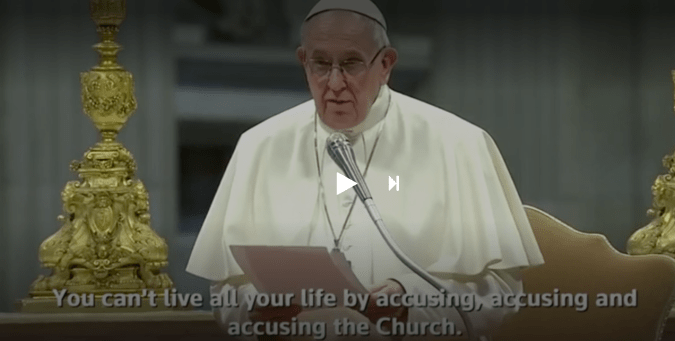
“You can’t live all your life by accusing, accusing,  and accusing the church. Who is the accuser? Who in the Bible is called the Great Accuser? Who is it? …The Devil.

Those who spend their lives accusing, accusing, accusing, are not the devil’s children because the devil has none. Friends, cousins and relatives of the devil and this is wrong. Mistakes should be reported to be corrected. When mistakes are reported, when flaws are denounced, the church is loved”.

Screen Shot 2019-02-22 at 10.58.49 am.png

Despite Pope Francis opening a summit for Rome’s Bishops to address these issue of abuse,  where he has acknowledged that they must fight the “enemy within” almost every element in this statement by the Pope is appalling. Mistakes? Which mistakes is he talking about? Is Pope Francis referring to thousands of priests slipping their hands into little boys genitals and asking children into having sex with them? Is he talking about the shoddy processes responsible for mishandling sex abuse allegations, or of the deliberate protection offered to perpetrators of these crimes? Even the word, ‘accusing’, which the Pope has chosen to emphasise, is a poor choice of language, for it suggests that there may be reason to doubt the claims being made and even that the person making the allegations is a troublemaker.

This is not the first time that Pope Francis has insulted the victims of abuse. In September 2018 he suggested,

“With people who do not have good will, with people who seek only scandal, who seek only division, who seek only destruction, even within families,” the answer is “silence. And prayer.”

“May the Lord give us the grace to discern when we must speak and when we must be silent. And [to do] in all of life: in work, at home, in society…” to become more closely imitators of Jesus Christ

As it says in the day’s Gospel, the people “rose up, drove [Jesus] out of the town, and led him to the brow of the hill… to hurl him down headlong. But he passed through the midst of them and went away.”

Those who drove Jesus out of the city were not people, but “a pack of wild dogs,” …They shouted instead of using reason, and in the face of this, Jesus’ response was to remain silent.”

I responded at the time by asking,

“I certainly hope Pope Francis wasn’t inferring that he is behaving like Jesus and that those asking for clarification of the allegations are not like ‘a pack of wild dogs.’”

Days later Pope Francis added,

“In these times, it seems like the ‘Great Accuser’ has been unchained and is attacking bishops. True, we are all sinners, we bishops. He tries to uncover the sins, so they are visible in order to scandalize the people. The ‘Great Accuser’, as he himself says to God in the first chapter of the Book of Job, ‘roams the earth looking for someone to accuse’. A bishop’s strength against the ‘Great Accuser’ is prayer, that of Jesus and his own, and the humility of being chosen and remaining close to the people of God, without seeking an aristocratic life that removes this unction. Let us pray, today, for our bishops: for me, for those who are here, and for all the bishops throughout the world.”

The Pope’s remarks about the Devil and abuse victims is disgusting. I cannot work out why he would continue to articulate such insensitive and even untrue statements. By them, he is accentuating the pain that is already carried by so many thousands of Catholics, and his comments make a mockery of the message that is the good news of Jesus Christ, which marks out what a Church is about.

I feel compelled to speak up because the Pope’s commentary is wrong and Christian leaders need to respond and correct his galling words. Calling for justice and for repentance is not the work of the Devil. The Devil’s work lays with those evil priests who have abused innocence, and with the bishops and cardinals who have covered over the bloody stains of these heinous acts of betrayal. Surely, demands for the Vatican to change her ways is more in line with the Lord of the Church, Jesus Christ.

What does Jesus say? “You belong to your father, the devil, and you want to carry out your father’s desires. He was a murderer from the beginning, not holding to the truth, for there is no truth in him. When he lies, he speaks his native language, for he is a liar and the father of lies.” (John 8:44)

Christ’s message to any church who uncovers sinful activity in her midst is repentance and discipline. Churches that either enable sexual abuse or protect guilty persons are not representing Jesus Christ but are defaming his name.

Have we forgotten what happened to the Church in Pergamum? Of this church Jesus said,

12 “To the angel of the church in Pergamum write:

These are the words of him who has the sharp, double-edged sword. 13 I know where you live—where Satan has his throne. Yet you remain true to my name. You did not renounce your faith in me, not even in the days of Antipas, my faithful witness, who was put to death in your city—where Satan lives.

14 Nevertheless, I have a few things against you: There are some among you who hold to the teaching of Balaam, who taught Balak to entice the Israelites to sin so that they ate food sacrificed to idols and committed sexual immorality.15 Likewise, you also have those who hold to the teaching of the Nicolaitans.16 Repent therefore! Otherwise, I will soon come to you and will fight against them with the sword of my mouth. (Revelation 2:12-16)

500 years ago there was a God-given opportunity for Rome to repent and to reform. Many Christians throughout Europe listened to God’s gracious call and they found new life and forgiveness and Churches began to flourish and through them, entire cities and regions were transformed. All the while Rome instead chose to dig in her heels. Today, once again the cries are great, and the frustration is telling.

While the Vatican persists with upholding doctrine that contradicts the beauty and truth of the Gospel, it is should not surprise us to see her continue to obfuscate issues of holiness and morality. The problems are deep, not only legal and material but also spiritual and theological. In once sense Pope Francis has rightly identified an underlying cause in Rome’s current crisis: the Devil is playing his game. But sadly and dreadfully, he is laying fault at the feet of the wrong group of people.

Bishop Curry: Preacher of love and Persecutor of the Church?

“give your servant a discerning heart to govern your people and to distinguish between right and wrong.” (1 Kings 3:9)

Who is wise? Let them realize these things. Who is discerning? Let them understand. The ways of the Lord are right; the righteous walk in them, but the rebellious stumble in them. (Hosea 14:9)


The world fell in love with Bishop Michael Curry last year as he delivered the sermon at the royal wedding. Even Christians were smiling and laughing at his wit and mesmerised at his storytelling, and nodding in agreement each time he spoke of love. He left convention behind, ignoring the stale, stuffy, and short sermonette that everyone has become accustomed to for a royal event, and he instead preached a long humorous monologue about love.

abc royal wedding


Prior to this sermon which stole the news headlines around the world for days to come, few people had ever heard of Bishop Michael Curry outside The Episcopal Church (TEC), of which he is the Presiding Bishop. Within moments of beginning his homily, social media lit up with Christians and atheists alike, gleaming and expressing likes all-round.

Some voices dared challenge the message and the preacher; I was one of them. I understood why Curry’s sermon might appeal to non-Christians; his words sounded awfully like their own secular worldview, except that he added the idea of God to the conversation. But many Christians were disappointed and even angry by the fact that some Christian leaders questioned the royal sermon. Even when concerns were more fully expressed, some swiped them away as though we were throwing mud at a great man of God.

His sermon was stamped ex cathedra, out of bounds to any criticism. He mentioned love and God, and Jesus was thrown in somewhere, so what’s the problem? Jump off the critic’s chair and join the crowds in celebrating Bishop Curry and his message of love!

Earlier this week, a story reported that this preacher of love is perhaps less loving that he has been made out to be. Indeed, he is less like Apostle Paul who wrote 1 Corinthians 13 and more like Saul, the persecutor of the church.

Christian Today has reported that,

“The head of the US Episcopal Church has taken disciplinary action against the Bishop of Albany for opposing same-sex marriage ceremonies. 

Presiding Bishop, the Most Rev Michael Curry, moved to restrict part of Bishop William Love’s ministry after he introduced a policy in the diocese last year preventing churches from performing gay weddings.” 

The Bishop famed for his sermon on love has moved to discipline a local bishop who believes in upholding the biblical understanding of marriage.

In 2015, Episcopal Church’s General Convention protected dioceses who banned the practice of same-sex weddings, but those protections were removed last year. Bishop Love has instead chosen to follow what he believes is congruent with God’s word and to guard his congregations against damaging teaching and ceremonies. Bishop Love has responded to Curry’s disciplinary action, saying that his policy reflected the official teaching of the Church that marriage is between one man and one woman, and that no resolutions from the General Convention had overridden this. 

Before anyone assumes that this is the first of such instances, Michael Curry has a history of persecuting clergy and churches who don’t support his progressive views of sexuality and marriage.

This was one of the important facts that was whitewashed amidst all the public adulations being heaped on Michael Curry in the wake of the wedding; not only does he deny the biblical definition of marriage, he presides as Bishop over a denomination which has taken its own churches to court in order to remove them from buildings and property, on account that these churches won’t cave into theological liberalism. Michel Curry has been and continues to be one of the chief protagonists responsible for fracturing the Anglican communion not only in America but worldwide.

Curry’s latest actions against a local bishop are just another example of this man who preaches love and practices persecution.

It grieves me to know that while brothers and sisters in Christ in the United States are counting the cost for faithfulness to the Gospel, many other Christians remember that royal wedding sermon with fondness. It perhaps shouldn’t surprise us, but it ought to trouble us, that with a few slick words spoken at a wedding, Christians have sided with the world and decided that Curry’s heterodox beliefs and practices shouldn’t discount the warmth people enjoyed by his presence as he stood and spoke behind that pulpit in St Georges Chapel. It’s almost as though, for the sake of lapping up a captivating presentation, we are prepared to ignore reality and to toss out God’s loving truth, even when these things are made transparent to us.

Let us pray for and learn discernment. Let us side with those who are persecuted, and not with the persecutors. Pray for the churches and clergy who remain in The Episcopal Church and remain in Christ. And ask God that he might lovingly bring Michael Curry to repentance, just as God so graciously did for Paul on that road to Damascus.

Our Summer Vacation wasn’t a time for missing out on Church

“the gospel is bearing fruit and growing throughout the whole world—just as it has been doing among you since the day you heard it and truly understood God’s grace” (Colossians 1:6)

This year we decided to escape one month of the Australian summer by heading for the northern hemisphere. Susan and I had the opportunity to take an overseas holiday with our children, and so we packed our winter coats and gloves, grabbed the passports, made a dash across the equator and didn’t stop for 18000km.

We marched up The Mall to Buckingham Palace. We joined the Tottenham hoards at Wembley Stadium for an EPL game. We toured Lord’s Cricket Ground, wandered the galleries at Tate Modern, drove through Flanders and the First World War battlefields, spent days walking through the beautiful city of Paris, eating a ridiculous amount of tasty French breads and cakes, and finally, a mountain of bbq pork and daily yum cha in the enticing city of Hong Kong. Yes, it was amazing and alluring and many other adjectives beginning with the letter ‘a’.

IMG_1150.JPG

Amidst visiting and enjoying many wonderful sights, foods, and experiences, there was something else even greater and most astonishing, something we didn’t want to miss out on. To non-Christians, this may sound daft, and sadly, even among many Christians. What could possibly outdo the many places and tastes that garnished our holiday? What beats lunch in Paris and shopping at Selfridges? Answer? It was spending time with God’s people each Sunday. That’s right, the highlight of our trip was Church.

I admit it,  I don’t leap out of bed every week for church, let alone when I’m on holidays. It’s not that I don’t want to be with church, but rather, I’m exhausted, in every sense of the word. Nevertheless, I take Hebrews 10:23-24 seriously, and I have a beautiful wife who spurs me on even when I’m lacking motivation. And after all, when Christians in China are facing arrest and imprisonment for gathering together as Church, how can I justify nonattendance because I’m on holiday?

I remind my own congregation that regularly meeting with God’s people is both a command and a comfort, an exhortation and encouragement. Just as eating food is necessary and delicious, so church for the Christian is both vital and pleasing, nourishing the soul and feeding the body. That means, we need time with God, in his word, and with his people, even when I’m on vacation.

We visited several churches during our time away: 3 in London, 1 in Lille (France), and 1 in Hong Kong. We met people for the first time, who were already brothers and sisters on account of Christ. We sat among a French-speaking Church and heard the name of Jesus sung and preached with joyful earnestness. We watched another Church not only accommodate but love special needs children in the most natural and beautiful way; their spasmodic noises and motions were not an interruption to the service but were warmly embraced as part of their worship to God.

On our final Sunday before heading home to Melbourne, we listened to a sermon which captured wonderfully a truth that we experienced throughout our time away.

An old friend, John Percival, serves as the Senior Pastor of Ambassador International Church in Hong Kong. John opened the Scriptures to Colossians 1:1-8.

I was immediately struck by verses 3- 6, which reads,

“We always thank God, the Father of our Lord Jesus Christ, when we pray for you, because we have heard of your faith in Christ Jesus and of the love you have for all God’s people—  the faith and love that spring from the hope stored up for you in heaven and about which you have already heard in the true message of the gospel 6 that has come to you. In the same way, the gospel is bearing fruit and growing throughout the whole world—just as it has been doing among you since the day you heard it and truly understood God’s grace.”

What I noticed is how the churches we visited are an embodiment of Colossians 1:3-6 (at the very least, this was our experience of them, as it is has been our joy and privilege in serving at Mentone Baptist for the past 14 years).

Each of the Churches we visited prayed for the nations and for the Gospel to advance throughout the world. They gave thanks for God’s grace at work in bringing people to Christ. The preachers pointed people to the Lord Jesus and called them to believe in him and put their hope in Christ and not the things of this world. It is always exciting to see these words spoken to a small town church 2000 years ago are still working today in the lives of congregations in different parts of the world, and knowing that it is the same Gospel at work in our own lives. And so, just as Paul thanked God for the Gospel at work among the Colossians, I am thankful to God for evidence of his grace among these churches

Our time away was beneficial for many reasons, and among them was seeing again how the Apostolic word is continuing to bear fruit all over the world, just as God said would happen. The same good news that we believe at Mentone Baptist is held by women and men 17000km away. The same message that is preached at Mentone is being proclaimed to people across continents in other languages. The same message that Paul speaks to the Colossians is, 21 Centuries later, still bearing fruit all over the world.

As in the years that have already past by, 2019 will no doubt provide us will another onslaught of church naysayers and Gospel skeptics. We’ll hear unbelievers knock the message of the cross and laugh at the notion of resurrection, and we’ll read about clergy doing the very same thing. New leadership gurus and theological “pioneers” will give advice about how we need to be more ‘radical’ and more ‘revolutionary’ in our approaches to ministry (as though innovation is the Gospel).

Instead, I have been refreshed by words that speak of a faith, love and hope that is growing among churches, born from hearing and understanding God’s grace, “true message of the gospel”. 

You see, if we had chosen the ‘easier’ path and not bothered to find a Bible-believing local church, if we had instead skipped church so that I could catch up on lost sleep or see more sights and try new things, we would have missed out on this great encouragement from God. I would have given up Divine food for stuffing myself with a few stale chips, such are medieval buildings, fashion houses, and restaurants, in comparison with what God is growing throughout the whole world.

So as I return to Melbourne and to a new year of pastoral ministry at Mentone, having enjoyed a time away and seeing God’s world and taking pleasure in many wonders of human intellectual and creative exercise. More importantly, I am reminded of the one Gospel which in 2019 will give birth to faith, love, and hope, and being reminded how these things grow together in and through the life of the local church.