President Trump is wrong about Evangelicals but he is not to blame

“Therefore, you kings, be wise; be warned, you rulers of the earth.” (Psalm 2:7)


The necessary divorce

Is this the necessary divorce? The match wasn’t made in heaven. It was a coupling that shouldn’t have been, and yet some leading Christian voices in the United States laid down their theology and ascended the White House. In the last 48 hours, this special relationships has unravelled. Government and Church can be good friends but they make a lousy married couple.

Following an article written by Christianity Today’s Editor in Chief, Mark Galli, President Trump has attacked the magazine and ‘defended’ evangelicals. With what appears to be a sense of betrayal, the President has resorted to his usual public naming and shaming on twitter.

“….have a Radical Left nonbeliever, who wants to take your religion & your guns, than Donald Trump as your President. No President has done more for the Evangelical community, and it’s not even close. You’ll not get anything from those Dems on stage. I won’t be reading ET again!

“A far left magazine, or very “progressive,” as some would call it, which has been doing poorly and hasn’t been involved with the Billy Graham family for many years, Christianity Today, knows nothing about reading a perfect transcript of a routine phone call and would rather…..”

“guess the magazine, “Christianity Today,” is looking for Elizabeth Warren, Bernie Sanders, or those of the socialist/communist bent, to guard their religion. How about Sleepy Joe? The fact is, no President has ever done what I have done for Evangelicals, or religion itself!”

I’m not writing to comment on the impeachment or to even comment on President Trump’s policies. I’m not here to defend Christianity Today either. My issue relates to the necessary separation of Evangelicalism from the White House (and any single political party for that matter).

EMLq7IvUUAAGPk9.jpeg

In response to President Trump’s assertion about looking after evangelical interests, it is not the role of Government to guard the evangelical faith. That is beyond the purview of a President’s responsibilities. The Church is not the State and the State does not control the Church.

Government and Church have different spheres of responsibility. The keys of the Kingdom belong to the Church while the Government holds the sword of justice. The different roles don’t mean there is no conversation between the two and that one cannot be of service to the other, but they are not institutions designed for a wedding. This important separation of Church and State is not an argument for the removal of religion from the public square, for all politics is religious. Some pundits argue for the removal of any semblance of religion in proximity to government, but this is neither biblical nor is it ideologically possible. Whether in the foreground and background everyone brings their convictions with them into the public square. We are all shaped by views about God and the world and these beliefs impact political priorities and policies.

It shouldn’t need saying, but just in case, the Government is not tasked with the responsibility of guarding one subsection of society, but caring for all its citizens by upholding the constitution, the law, and working for the good. Christians are part of the constituency, not the whole.

Also, President Trump understands Evangelical Christianity through a political lens that sees everything through a false binary: You’re either Conservative or socialist, you either vote Republican or Democrat. This is to misunderstand the nature of Christianity and the message of the Christian Gospel.

The Christianity Today article has spoken boldly about the importance of character,

“It’s time to say what we said 20 years ago when a president’s character was revealed for what it was.”

Indeed,  too many Christians threw this qualification into the recycling bin for a season. I also remember at the time of the 2016 election, leading evangelical voices were cautioning Christians and reminding them that character matters. Ed Stetzer, Russell Moore, and Al Mohler were among them. The reality is that some evangelicals wedded Trump while others stood at a distance. By in large, the Australian media ignored all this and instead ran with the preferred narrative of evangelicals supporting Trump. The reality is far more complex than has been reported. This doesn’t take away from the fact that many Christians in the United States, especially with notable names like Franklin Graham and Jerry Falwell Jnr, anointed Trump with a sacred calling that he and no President can hold.

Lest we conclude the problem is all Trump, we would do well to recall remember some of the things that have been said recently by Democratic presidential nominees in the name of Christianity. Pete Buttigieg, for example, takes the identity of Christian while supporting many ethical positions which are irreconcilable with the Christian faith, both politically and personally.

Should we blame the President? He is certainly responsible for what he believes and says. But is he to blame for the marriage with Evangelicals? No.

The greater responsibility lies with the fact that many Evangelicals in the United States fused their hopes and aspirations onto the Presidential bandwagon. They sacrificed integrity for expediency. I am not saying that voting Democrat is the alternative. How can one support a party that advocates the killing of unborn children and the destruction of sexual norms?

Sometimes there is no viable option. Surely this has been the predicament for Christians in many cultures during many seasons in history. The Bible never gives Christians a voting card. We are meant to honour, obey and pray for the Governing authorities, and to keep doing good to all. Some Governments are better than others, and we should wisely decide whom to support.

In none of this am I making a statement about who to vote for; not at all. The issue at hand is far more important and pressing; do not fuse the Christian faith with a political party or leader. Do not give to the State that which belongs to the Church. Do not sacrifice the Great Commission in order to maintain a place in the halls of Washington DC.

This isn’t an evangelical problem alone. Conservatives and Progressives alike make this blunder with a place too much emphasis on common grace and not enough episodes on the churches mission which centres in particular grace

It has been sad to watch a word which has holds such rich theological and historical significance, being undone in such a short time. Evangelical has been regularly misappropriated not only by political pundits but also by Americans themselves. True evangelicalism has little to do with the political aspirations of right-wing America, and everything to do with the Gospel of the Lord Jesus Christ. Authentic evangelicalism is defined by this Gospel as presented in the Bible, not by the political right or left, not with Democrats or Republicans, and for the Australian context, neither Liberal nor Labor.

Terribly, “evangelical” America supported Donald Trump and have been tarnished for doing so. I cannot see how this association will advance the cause of Jesus Christ. If anything, the word may become irretrievably immeshed in a cause that is not the Gospel.

It is one thing to be part of a Presidential term, but it is quite another to one day stand before the Judge of the earth and give an account for how our lives have adorned or maligned the Gospel of Christ.

This final point is not only true for American Christians but also Australian Christians. When will Christians learn not to place undue hope in Government? The election has exposed a messed up eschatology and misplaced soteriology, which will not only disappoint, but will prevent people from seeing Christ. However Donald Trump decides to build his wall along the Mexican border, it is nothing compared to the wall evangelicals have built-in this election which will block out the wonder of the Gospel. How will true evangelicals work to dismantle this false gospel? What will we do publicly and in our Churches to redress the damage caused by this political misalignment?

Bethel causing greater grief

In 2018, Bethel Church (Redding California), sponsored and organised a revival rally in Melbourne. At the time, Stephen Tan of Regeneration Church, myself, and others expressed concerns about the event because of Bethel’s reputation for teaching and practicing ideas that are at odds with orthodox Christian faith. The backlash to these criticisms was sizeable, and yet since then many of the original concerns have remained and been reaffirmed.

One year later, there is a new and disturbing story coming out of Bethel. The two year old daughter of one of Bethel’s music leaders, Kalley Heiligenthal, died over the weekend.

The grief of losing a child is a grief no parent ever wishes to know. I am truly sorry that this family are experiencing such a trauma. We can pray that Kalley, her husband, and family are surrounded by friends at this dreadful time.

A photo of their daughter is being shared on social media through Bethel, but I will not show it on this post as I believe it is inappropriate. The reason for writing now is because Bethel is making an assertion that is incredibly harmful,  and because of their widespread influence around the world including Australia, it is appropriate to respond.


UNADJUSTEDNONRAW_thumb_dd36

Grief is hard enough in the best of circumstances. Grief is compounded by bad theology and misplaced hope. Bethel Church have posted a request on their facebook page, including a statement from Heiligenthal, asking for prayer that God would raise their daughter from the dead.

“Our God is the God of miracles, and nothing is impossible for Him! We are asking you, our global church family, to join with us in prayer and in declaring life and resurrection over @kalleyheili and @apheiligenthal’s daughter, Olive Alayne! Kalley, Andrew, and Elise, we stand with you in faith and in agreement for Olive’s life!

Read Kalley’s Post:
We’re asking for prayer. We believe in a Jesus who died and conclusively defeated every grave, holding the keys to resurrection power. We need it for our little Olive Alayne, who stopped breathing yesterday and has been pronounced dead by doctors. We are asking for bold, unified prayers from the global church to stand with us in belief that He will raise this little girl back to life. Her time here is not done, and it is our time to believe boldly, and with confidence wield what King Jesus paid for. It’s time for her to come to life.”

If it wasn’t already established back in 2018, the signs are clear that Bethel is producing strange and errant teachings, ones that create false hopes for grieving families.

To quote the Apostles Creed,

“I believe in the resurrection of the dead.”

I believe along with all Christians that Jesus Christ was raised from the dead on the third day. It was a bodily resurrection, not a spiritual awakening or temporary resuscitation. Indeed, the credibility and efficacy of the Christian Gospel depends upon this resurrection of Jesus Christ from the grave.

“if Christ has not been raised, our preaching is useless and so is your faith… 17 And if Christ has not been raised, your faith is futile; you are still in your sins. 18 Then those also who have fallen asleep in Christ are lost. 19 If only for this life we have hope in Christ, we are of all people most to be pitied.” (1 Corinthians 15)

The Bible explains that the resurrection of the dead is tied to the return of Christ and the unveiling of the new creation. In the mean time, the Bible speaks of suffering and patience, death and hope. For example in Romans chapter 8,

I consider that our present sufferings are not worth comparing with the glory that will be revealed in us. 19 For the creation waits in eager expectation for the children of God to be revealed. 20 For the creation was subjected to frustration, not by its own choice, but by the will of the one who subjected it, in hope 21 that[h] the creation itself will be liberated from its bondage to decay and brought into the freedom and glory of the children of God.

22 We know that the whole creation has been groaning as in the pains of childbirth right up to the present time. 23 Not only so, but we ourselves, who have the firstfruits of the Spirit, groan inwardly as we wait eagerly for our adoption to sonship, the redemption of our bodies. 24 For in this hope we were saved. But hope that is seen is no hope at all. Who hopes for what they already have? 25 But if we hope for what we do not yet have, we wait for it patiently.”

Since posting the prayer request two days ago, thousands of people have shared it on social media and thousands have posted prayers in which they ‘claim’ the power of God to bring this little girl back to life. There’s the problem. That’s the reason for saying something today. Errant theology produces false hopes and misleads people into believing and expecting wrong things from God. It also gives unbelievers reason to dismiss Christianity as a load of nonsense. If you are not yet convinced of the ongoing and dangerous influence of the ‘Signs of Wonders’ movement, surely this persuade you? 

The Scriptures themselves warn us about teachers who allege an early resurrection.

“Their teaching will spread like gangrene. Among them are Hymenaeus and Philetus, who have departed from the truth. They say that the resurrection has already taken place, and they destroy the faith of some.” (2 Timothy 2)

Losing a child is horrible beyond imagination. A Church has responsibility to love and comfort people in their grief, not to entertain, encourage, or promote unbiblical and false hopes. It is one thing for parents to wish for an alternate outcome, but for a Church to affirm this request is pastorally irresponsible and biblically aberrant.


Postscript

I believe that the parents have now asked for the prayers to cease.

Again, this is an awful situation that no parents wish ever to experience. I feel for them. May they turn to the God of grace in this time and know the comfort of family around them

(December 22 2019)


Hope for a generation without hope

During the course of 2019, I have observed a growing sense of hopelessness being felt and expressed by people across the globe, especially among teenagers. Climate change, political agendas and social uncertainties are compounding and amplifying a disillusionment about the future.

There is an audible disquiet and growing despair spilling over from social media and into our schools and onto our streets. My children’s school was so concerned about this that they wrote a letter to parents, urging us to address these matters in a calm and constructive manner.

This year we have heard young people declaring that they will never have because of threats facing the globe. Members of the British Royal family have also joined the chorus, announcing that they will have fewer children because of the perils posed by climate change. 

8d97297ef589b7c30bb2a5b925559345832bea9e.jpg

AAP

It is not only Climate Change that is of concern. Western societies are experiencing a rise in anti-Semitism, stories of sexual abuse rarely leave the headlines, and the question of religious freedom is no longer limited to the theoretical. The oft forgotten issues of alcohol, drugs, and gambling continue to destroy homes and lives across our suburbs and towns. There is also the situation facing Hong Kong, the forced internment of over one million Uyghurs in China, and a 1000 who have been killed in Iran recently protesting in support of freedoms in that land.

There is much to see in our world today that can overwhelm young and vibrant hearts. Indeed, has there been another year in living memory that has exuded so much negativity and sense of despair?

Our city streets are regularly clogged with protests. Once upon a time, we might see 3 or 4 such marches during the course of a year, but now it is almost every week. And the people protesting have also changed. There are fewer industry unions standing for the rights of the working class. The demonstrations are about sexual rights and the environment: save the planet, save animals, and kill the unborn. If that final inclusion sounds a little distasteful, that’s because it is. Children are now joining in these rallies in their thousands, skipping school to express dread and discouragement as they consider their future.

These conditions are a dangerous recipe. Passionate citizens and concerned people can be exploited by vociferous ideologues. History is littered with such examples and even some current movements have also been used and turned by less than helpful campaigners. How quickly we forget. For example, when Safe Schools was launched, its chief architect, Roz Ward, explained that the curriculum was designed to introduce Marxist thinking into our schools. Far from assisting youth who are wrestling with their sexual identity, they became pawns in a political subversion game being played among academics and social activists.

There is something particularly disconsolating in watching a generation lose hope. Sure, some of it is virtual signalling. Of course, adults need to take responsibility for the over the top rhetoric they sometimes apply to public issues. And yet, we should recognise that many young Australians are feeling the weight of a less than certain future.

When we looked back we remember that ours isn’t the first generation of young people to experience despondency. The generation of 1914-18 was marked by the trauma of world war. The following generation grew up during the Great Depression and was soon struck down by a global war more terrifying and bloody than the one their parents survived. Children of the 1950s learned to duck and cover, in the event of a nuclear attack that many believed was inevitable.

We could dig further back into history and look to the time of the Exodus or to the age of exile in Babylon. What were those people living through?  How did they feel? And where did they place their hope?

Of the Israelites enslaved in Egypt for 400 years, 

“During that long period, the king of Egypt died. The Israelites groaned in their slavery and cried out, and their cry for help because of their slavery went up to God.  God heard their groaning and he remembered his covenant with Abraham, with Isaac and with Jacob. So God looked on the Israelites and was concerned about them.”

Of the people living in exile for 70 years, 

“They say, ‘Our bones are dried up and our hope is gone; we are cut off.’” (Ezekiel 37:11)

Millennials are not the first generation to face enormous life changing obstacles and they won’t be last. This is not to dismiss Climate Change. My purpose here is not to contest the science for I am no expert in this area. I have no reason to doubt the research being conducted by so many and where there is broad consensus. Indeed the issue fits neatly with a biblical understanding of the world and of the human capacity to care for and to abuse the creation in which we live. 

Are we reaping the fruit of generations of greed and selfishness? Probably. We are also reaping the benefits of generations of ingenuity and progress. I can almost hear Charles Dickens penning those famous words, 

“It was the best of times, it was the worst of times, it was the age of wisdom, it was the age of foolishness, it was the epoch of belief, it was the epoch of incredulity.”

In some respects, we are living in the best of days. Our standard of living has never been higher. Our children have more opportunities and experiences open to them than could have been imagined 20 years ago. In many areas, life has never been better, but the rhetoric of doom is drowning out much else.

Call me a heretic but Climate change isn’t the existential threat facing the planet and humanity. It is a symptom of an ancient problem that we have afforded to ignore for far too long. If there is no God, why should we ultimately concern ourselves with altruism? Why bother with protecting the environment for future generations if purpose is found in the individual and defined by personal satisfaction? The fact that we understand that there are moral boundaries and that the future does matter, is not an argument against Divine purpose but the only rational explanation for having such concerns. How we behave toward one another and how we use the planet is important because this isn’t a meaningless existence. 

“He has made everything beautiful in its time. He has also set eternity in the human heart; yet no one can fathom what God has done from beginning to end.” (Ecclesiastes 3:11)

 There has been a cosmological battle taking place for millennia, and it is ultimately against the Creator, not the creation. The ancient mandate to care for the world remains, but the growing call to save and redeem the world is not one within our purview. Those who believe we can save the planet have far too high regard for human capability and moral will. I’m not saying, don’t bother reducing carbon omissions and forget about investing in renewable energy; far from it. The house I live in won’t stand forever but it doesn’t mean I neglect the building. I neither wreck the house nor place all my energy and hopes in the house. I’m just pointing out the fact that people putting their ultimate hope in other people will always disappoint in the end. The role of global saviour is too big a job. You see, I don’t believe things are as bad as we suggest they are; despite even the good around us the reality is far more perilous. 

At least in the West, millennials are following their parents lead and ditching Christianity in favour of either vague and undefinable spirituality or choosing a-theism and an irrational universe. I reckon this pursuit is partly responsible for hopelessness that is weaving itself through our communities. It is time to revisit the person of Jesus Christ. Indeed, for most Australians, it is to visit Him for the very first time. The Gospel of Matthew declares, 

“In his name the nations will put their hope.” (Matt 12:21)

And this, 

 “And again, Isaiah says,

“The Root of Jesse will spring up,
one who will arise to rule over the nations;
in him the Gentiles will hope.”

” May the God of hope fill you with all joy and peace as you trust in him, so that you may overflow with hope by the power of the Holy Spirit.” (Romans 15:12-13)

Here are words of profound hope. Here is a person in whom we can rest our hope. Jesus wasn’t a virtual signaller. He came into a hostile world and to a people without hope. He demonstrated his Divinity in the most powerful and loving ways. He chose to take a road to crucifixion. He was raised to life on the third day. He has ascended to heaven. He will hold the nations to account. He will hold all of us to account. He brings hope and healing, peace and reconciliation. Some Churches have done a great job at confusing and even betraying these things, but the message stands the test of time. Indeed there are millions of millennials turning to the Gospel all over the world today and discover the kind of hope they need and cannot find in anything else.

We can’t survive without hope. Hope in the world or hope in humanity is an age-long route to despair. Human responsibility is noble and right, but the hope of the world cannot rest on the shoulders of our children. You may doubt what I suggest, but at the very least, why not open a Bible to the Gospel of Luke or the Gospel of John, read and consider this hope before you discount him?

“And hope does not disappoint us, because God has poured out His love into our hearts through the Holy Spirit, whom He has given us” (Romans 5:5)

Finding a cricket role model for my children

It’s not always easy to find positive role models in the sporting world. Sure, if all we’re looking for is success or strength, there are plenty of examples in Australia. But what about sportsmen and sportswomen who also have integrity, and who speak and act in ways that you can say to your own children, there’s someone to look up to? There’s been more than a few times when I’ve had to say to my kids, sure this person excels in their sport but… It is refreshing when one can complete the sentence without needing to introduce the ‘but’!

All my three children play cricket. My boys have been playing for years and my daughter is playing her first season. I love watching my kids train and play. I love the fact that I can no longer face my boys in the nets, too many bruising deliveries now. I love watching a beautiful cover drive and hearing the sound of the ball reverberating off the willow. I love how my daughter and her friends enjoy every moment of a game and encourage each other, and even make a rep team after only 3 months of playing!

Cricket is a beautiful sport to watch and play.  And yes, cricket is also frustrating. Seriously, in few sports does a single ball or shot have such repercussions for an entire game. Sometimes, as I tell my kids,  you have to accept the fact that Umpire made a mistake (or just possibly maybe, my own kids played the wrong shot).  Whether they played well or not so well, I can say to them now, remember the perspective Marnus Labuschagne has spoken about.

Screen Shot 2019-12-13 at 9.31.52 am.png

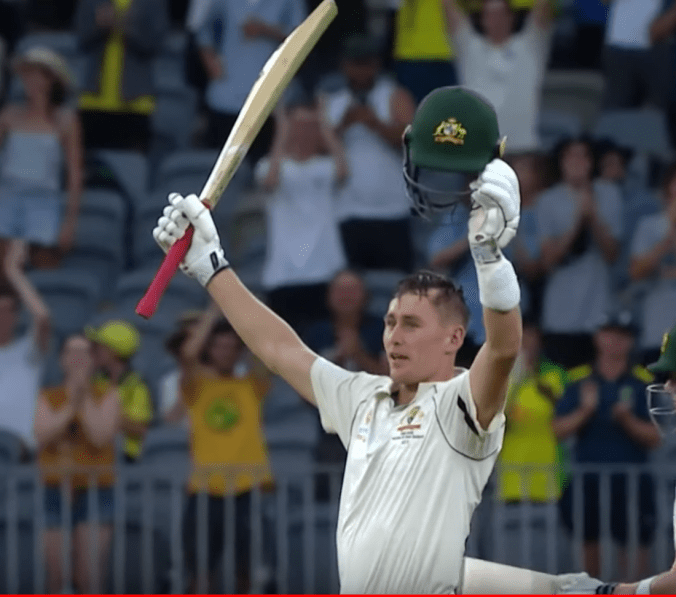
Those living in a cricket playing nation will almost certainly have heard the name Marnus Labuschagne. Marnus Labuschagne is emerging as a truly great cricketer for Australia. While debuting for Queensland in the Sheffield Shield during 2014-15 and receiving his baggy green in 2018, it was during the recent Ashes tour of England that Labuschagne’s reputation shot into the sky. Filling in for an injured Steve Smith, he batted beautifully for Australia and retained the spot for the rest of the series.

Yesterday during the First Test against New Zealand, Marnus Labuschagne scored his third consecutive century during the Australian Summer. He is an impressive young Aussie cricketer and has easily cemented his place in the nation’s first 11.

There is another quality about Marnus Labuschagne that I can point out to my children. For Labuschagne there is more to life than cricket and sporting success. Obviously, to play at such a standard he is clearly gifted at the game and no doubt he trains tirelessly, and yet, he is open to sharing what life is about for him.

He says, 

“Sport is a fickle game and injuries play a big part. In the big scheme of things, what you’re worth, what you put your value in, isn’t out there on the pitch; it’s internal and in Christ… cricket is always going to be up and down and if you have [Jesus Christ as] a constant in your life, it makes life a lot easier.”

His mum would write Bible verses in his shoes, to remind him of greater things, and on his bat there is a picture of an eagle, to remind himself of the Bible verse, Isaiah 40:31. “For those who hope in the Lord, He shall renew their strength. They shall soar on wings like eagles; they shall run and not grow weary, they shall walk and not be faint.”

This is such a healthy perspective to have on sports and life. You can enjoy the sport and keep God central. It is possible to be a leading international cricketer and practice Christianity. It is possible to love the game but have your identity found in Christ.

I haven’t met Marnus Labuschagne, but I’m encouraged by what I’ve heard him say.  I’m wrapped to find another Aussie sportsperson whom I can say to my kids, listen to what he just said, what he’s saying is true and worth thinking about. You can try to play cricket like Marnus Labuschagne and place “your worth…in Christ”.

Going Bananas over Art

I may be in the minority here, but I think there is something going on in Maurizio Cattelan’s work titled ‘Comedian’.

The Italian satirical artist has ‘created’ a work of art by using two common objects: an overripe banana stuck to a wall with a strip of duct tape. The work which is being exhibited at the famous Miami Gallery, Art Basel, has just sold for $120,000US.


banana.jpeg


Before the mockers mock and critics criticise, it is worth observing how successful this Cattelan original has become. Some might say that the work itself should be subject to ridicule. Add a $120,000 price tag, and the jeering and sneering is more than audible. But the story of this captivating banana isn’t yet finished. A performance artist by the name of David Datuna visited the Art Basel and while admiring ‘Comedian’ up close, he committed the great heresy of reaching out and touching the banana. He didn’t stop there. He ripped the banana and its duct tape from the wall and then proceeded to peel the banana and eat its flesh. Onlookers gasped while others laughed. A security guard appeared, horrified. Datuna exclaimed that his was a work of art and he gave it the name, ‘Hungry Artist’.

He was quickly taken away but later emerged as a free man, free to perform and eat again.

Posting on Instagram he said,

“Art performance by me. I love Maurizio Cattelan artwork and I really love this installation. It’s very delicious,”

The director of the gallery, Lucien Terras,  told the Miami Herald,

“[Datuna] did not destroy the art work. The banana is the idea”.

The $120,000 banana has since been replaced with a fresh banana.

As this work of art captivates people all over the world, I’m thinking, who is acting the fool here? Friends are rolling their eyes all over social media and decrying the waste of money.  People are quick to point out the foolishness.

Who is the fool? Maurizio Cattelan? After all, all he did was take a banana and stick it on a wall. Far from acting the fool, Cattelan is looking at us and laughing with a $120,000 wry grin, shaped like a banana. More significantly, Cattelan’s genius is him successfully drawing us into conversation and debate about a slightly smelly piece of fruit. We are the suckers, falling into Maurizio Cattelan’s world of satire. The banana isn’t the subject, we are the subject. Even eating the art piece forms part of the ever evolving expression that has been set in motion by the artist.

So are we the fool? Well, we are certainly silly monkeys for eating into his artistic expression, and then, of course, there’s the fool who paid $120,000 for old fruit and a strip of duct tape!

In the world of commonsense, we would be regarded as fools,  as we offer up our half-digested opinions about a piece of fruit stuck to a wall. However, the world today isn’t ruled by reason. Rather, we have become eager participants in Cattelan’s pantomime. In this upside-down world where right is now wrong, and wrong is lauded, and where such divisions are even removed altogether, the only fool here is the security guard who dared assume that eating the banana was an act of vandalism. And yet, as Lucien Terras has declared, even the guard has become an aspect of the artist’s expression.

Art has merged into life. Or should that be, life has merged in art? Everything becomes art. We are the artist’s subject as much as that banana, and all the subsequent bananas that will replace the mould and smell.

As far as originality is concerned, Cattelan’s object is little more than a spin-off from Andy Warhol’s portrait of a banana. He is simply replacing a painting with the object itself. And yet, here we are, talking about a banana.

Now that we’ve established that all of us are fools and yet none of us is the fool, is there a right way to be looking at ‘Comedian’? Is there any single interpretation of ‘Comedian’ that is the right one? Indeed, should we even be talking in such categories?

The sculpture isn’t designed to elucidate a set response, but to create an entire spectrum of reactions. It is a portrait of the absurd and the absurd is us. There is no fixed meaning, just meanings. There is no primal purpose, just a bunch of ripening and then slowly rotting contributions.

I’m not quite sure whether ‘Comedian’ is mocking today’s avant garde or is an example of its stupidity. Either way, it is certainly revealing something rather sad and disillusioning about our society. What if the real world is also without overarching meaning and design? What if all we have is 7 billion opinions and convocations and divisions? It would be a truly satirical place to live. In such a world, why shouldn’t we eat and destroy an expensive work of art? Why shouldn’t we deride or laugh or even destroy? Why not spend $120,000 on a banana instead of giving the money to charity?

A universe without God is such a world. In such a closed material construct the only fool is the one who stands up and says “no, you mustn’t do that”. Instead, let people be, to steal, to take, to laugh, to admire, and however else we choose to express ourselves.

If Cattelan’s ultimate objective was to communicate the irreverence and heresy of particular meaning, the joke rests finally on him, for it was after all necessary for Cattelan to image the idea in his mind and then to make it with his hands. There is no art without the artist. Even the aleatoric movement of John Cage and company, the author could not fully remove himself.

The universe God created and in which we live is not such a place. It is filled with careful design and purpose. Not all opinions and reviews are equal. Not every action is good. Not every investment is wise or useful. The scary thing is that this world’s creator takes an active interest in things and he is concerned for how we treat his creation including one another. As Psalm 2 indicates, he is a God who laughs and scoffs at us for deluding ourselves into pretending that our speculations and philosophising can subvert and replace his revelation.

“The One enthroned in heaven laughs;

    the Lord scoffs at them.

He rebukes them in his anger

    and terrifies them in his wrath, saying,

“I have installed my king

    on Zion, my holy mountain.” (Psalm 2)

How much better is the portrait God has given us of his creation. How much more stunning and meaningful and satisfying is the Creator’s plan for the canvas on which you and I exist and have our being. Indeed, it involved the artist entering his own creation for the sake of redeeming us and reconciling us to His Divine purpose.

“In the beginning was the Word, and the Word was with God, and the Word was God. He was with God in the beginning. Through him all things were made; without him nothing was made that has been made. In him was life, and that life was the light of all mankind. The light shines in the darkness, and the darkness has not overcome it.

There was a man sent from God whose name was John. He came as a witness to testify concerning that light, so that through him all might believe. He himself was not the light; he came only as a witness to the light.

The true light that gives light to everyone was coming into the world. 10 He was in the world, and though the world was made through him, the world did not recognize him. 11 He came to that which was his own, but his own did not receive him. 12 Yet to all who did receive him, to those who believed in his name, he gave the right to become children of God— 13 children born not of natural descent, nor of human decision or a husband’s will, but born of God.

14 The Word became flesh and made his dwelling among us. We have seen his glory, the glory of the one and only Son, who came from the Father, full of grace and truth.”

This isn’t the final word

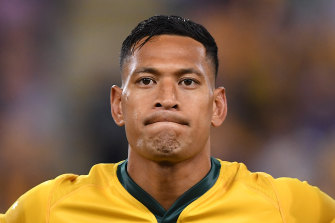
Rugby Australia and Israel Folau have come to an agreement. The terms of the settlement remain confidential but both parties have released a joint statement in which Folau affirms he never intended to offend anyone and where Rugby Australia apologise to Folau.

Israel Folau will be remembered as a greatly gifted player, who was nevertheless a disaster for rugby.

AAP

Not everyone is satisfied. Lawyers are expressing their preference to see the case played out in court, not necessarily because of prejudice against either party but for the sake of clarifying where Australian Law sits in regard to religious freedom. Other Aussies are disappointed because the case has ended in ex-communication for Folau rather than social execution. For 18 months, Peter FitzSimons has used his privileged place in the Australian media to call for and support the sacking of Israel Folau. He is far from the only voice, but Fitz has perhaps been the loudest and most consistent.  Writing in the Sydney Morning Herald yesterday, FitzSimons has expressed his disappointment over the final outcome and has tried to type out the final word on the Israel Folau saga.

“From the point of view of resolving the many issues raised, however – and more particularly holding Folau to account for his damaging actions – it is singularly dissatisfying.”

“As one who has followed the issues closely since Folau first disgraced himself by putting up a post endorsing the view that gays are destined for hell, and who has written and ranted about it extensively, I am more aware than most of the damage he has done, the hurt he has caused. In the 21st century, his homophobic gibberish – you heard me – simply has no place. And it is no excuse that the gibberish in question is sourced from the Bible. I was hoping the court would confirm that, hence the dissatisfaction.

It was for that reason my first reaction on hearing the news – and I write in the first few minutes thereafter – was the settlement was, firstly, a great pity. Secondly, my stronger reaction was I hoped RA kept the presumed payment to him to an absolute minimum.”

FitzSimons has been quick to call out rumours on social media that suggest the size of the settlement, and yet here he is, acting as a judicial speculator,

“have no inside knowledge of the terms, not even a hint, but my bet is it will be about $200,000 to $300,000…. Any sum more than that and I hope RA would have said, “bring it on, we’ll see you in court”.

Finally, he writes,

“Goodbye, Israel. You will be remembered as a greatly gifted player, who was nevertheless a disaster for rugby. The day you severed the final strands of your relationship with Rugby Australia was a good day for the game.

Good day to you, I said good day.”

FitzSimons may be posturing to give the final word, but this is far from over. The ‘Rugby Australia and Israel Folau’ chapter may have been signed off, but the issue of religious freedom in Australia is only just beginning.

Peter FitzSimons may not speak for all Australians, and probably not for mainstream Australia either, but he does represent a group of self-appointed moral arbiters who have significant public and influential voice. He has made it clear that believing and publicly affirming the Bible’s teaching on sexuality amounts to phobia and gibberish and it has no place in Australia today.

“In the 21st century, his homophobic gibberish – you heard me – simply has no place. And it is no excuse that the gibberish in question is sourced from the Bible.”

Back in July, Rugby Australia’s CEO, Raelene Castle, admitted that had Israel Folau only quoted Bible verses, that would be sufficient grounds to have him sacked. The Folau case was never really about contract law. This was always a case of cultural signalling, with Rugby Australia proving its wokeness to the world. Regardless of what one thinks about Folau’s post, he dared break the new moral code that is being pressed upon Australians, and that is, do not question the new sexual narrative. We are to fully subscribe to the new sexuality paradigm, and failure to do so requires a public cancelling and shaming. This forced social subscription may have found a high profile case in Australia but there are countless examples appearing all over the country, including Margaret Court, Coopers Beer, legislative moves by the Victorian Government, and more. Indeed, as Victoria pushes to ban conversion practices they have set the parameters so broadly that it may impact normal teaching and praying that occurs within church ministries.

Peter FitzSimons is an example of broad cultural ignorance toward the Christian Gospel. The entire premise of the Christian Gospel is that God disagrees with us, and yet he loves us. God’s disapproval of human attitudes and actions isn’t an example of phobia, and neither is Christian disagreement with the current sexual narrative. Peter FitzSimons is perpetuating the myth that the only good Christian is the Christian who embraces the atheistic ethic. Yes, it’s illogical and he is not entirely to blame.  It seems as though FitzSimons takes his theological education from the progressive Christian voices whom our culture hasn’t yet cancelled out. Of course, there is no need to silence the priest of Gosford and others. These are nice Christians who have signed up to the neo-Proletariat. They have given up the Gospel for a seat among our society’s culture club. Christians need to work harder at countering these fake Gospels and to do so in a manner that confirms the Gospel and not with the kind of behaviour that contradicts the message we claim to believe.

Like I said, the final word on religious freedom in Australia hasn’t been spoken.

The Federal Government’s religious discrimination Bill has recently returned to the drawing board, following criticisms from both religious and non-religious groups. As it stands, when it comes to religious freedom, Australian law remains unwritten.

Part of the reason behind this legal mess is because Australian law was not framed to deal with a culture that turns against the very belief system which provided its societal and legal foundations. Like a game of Jenga, you can only remove so many blocks before the entire structure comes crashing down. Of course, that hasn’t happened as yet, but that’s part of complexity facing many Western cultures today. How do we remove Christianity without destroying the very fabric upon which our culture depends?

Christians would be fools to bag their hopes in any future law. The law ought to function for the common good of all society (not only for Christians). The law should exist as a friend to its citizens by protecting freedoms. The difficulty of today’s Australia is that we have become the dog chasing its own tail. We allege freedom and toleration but by eating away at freedom and toleration.

More important than the law, will Australians learn to rediscover the art of civil disagreement? We are fast losing both the cognitive and moral ability to engage with opposing worldviews and to live together despite these differences. Social pluralism is being fast replaced by an ugly and authoritarian secularism that reigns with tackless hubris. Christians need to grow thicker skin and realise that the culture has set course. We need to stop that pointless dreaming about a ‘Christian Australia’ which by the way never existed, and we need to stop falling into modern trap of dumping our hope into the societal structures and systems. We must not give up on kindness, patience, or truth telling, on gentleness, love, or faithfulness. There is no need to play by the rules that Rugby Australia, Peter FitzSimons, and others insist upon. Hell is too awful and heaven too wonderful, and we want to serve our fellow Aussies well by offering a better story.

God is not unjust; he will not forget your work and the love you have shown him as you have helped his people and continue to help them. We want each of you to show this same diligence to the very end, so that what you hope for may be fully realized. We do not want you to become lazy, but to imitate those who through faith and patience inherit what has been promised.” (Hebrews 6:10-12)

It’s beginning to look like Christmas

It’s beginning to look like Christmas…

If you’re living in and around Mentone why not join us this Christmas?

Our Christmas Carol Service is on December 15th and begins at 6pm. There’s a scrumptious Christmas supper following the service.

Our Christmas Morning Service starts 9:30am.

Everyone is Welcome


christmas ad.jpg

Victoria to Outlaw Conversion Therapy (part 2)

In this second post, I am turning to the question of definition. How is conversion practice being defined and what should we think about it?

The definition which the Victorian Government is suggesting is the same as that offered by the HCC report. However, before offering a comment on the definition it is worthwhile highlighting this salient point which comes from the Government’s own website for the rather Orwellian sounding, “Department of Justice and Community Safety”.

img_9452

The Government justifies limiting religious freedom

The Government has admitted that it is prepared to further limit religious freedom.

“Both the HCC and HRLC Reports highlight that many modern LGBT conversion practices are religious rather than medical in nature in that they involve, or consist entirely of, pastoral and prayer activities. Manifestation of religious belief through religious practice is protected by the right to freedom of religion. This right to manifest is not absolute and a number of commentators argue that it is not clear that it extends to practices that seriously harm others. The impact of a ban of conversion practices on the right to freedom of religion may be justified given the nature and extent of the harm described in the HCC and HRLC Reports. Legislation to implement the government announced ban on conversion practices needs to demonstrate that it is necessary, effective, and proportionate to protect LGBT individuals from harm.”

To be clear, the Victorian Government is targeting religion, and specifically, the primary focus is on Christian churches, organisations, and denominations, as the material in the 2 reports exemplifies.

The intention is also clear: without any philosophical working, the Government has assumed that sexual rights are more important than religious rights. It is, of course, a false binary, for a person’s understanding of sexual morality is always attached to religious presuppositions. Sexual expression is an expression of one’s deepest convictions about God, the world, and the individual. Having said that, we mustn’t ignore the suggestion of harm, for the wellbeing of these Victorians is important. 


Classical Christian teaching defined as harmful

The Government is using the argument of harm in order to limit the freedom of religious groups. Certainly, we do not want any Victorians, including LGBTI Victorians, being harmed. It is important to hear that I am not disputing that some Victorians have been subjected to practices that have caused them all manner of distress and damage. It seems as though these have come about through good intentions, but funnelled through misleading understandings of Christian faith and psychology. The definition of harm, however (as expounded in the HCC and HRLC Reports) extends beyond certain practices which are found on the margins among some religious organisations. For example,

The HCC report includes under its understanding of harm,

“Conversion therapy/practices reinforced homosexuality as a form of ‘brokenness’”

And

“Church teachings that homosexuality is sinful;”

Notice the attention given to Church teachings (as opposed to other religions who also identify homosexual practices as sinful). In other words, classical Christian teaching about sexuality is deemed to be harmful. According to the HCC, an exposition of Romans ch.1 or 1 Corinthians ch.6 would fall under the umbrella of harm. If a Church organises a marriage enrichment day where the Bible’s presentation of marriage is affirmed, this event could fall foul of harm. From weddings to Sunday sermons, from Bible study groups to counselling sessions, in contexts where sex outside of heterosexual marriage is spoken of as sinful or broken, the Health Complaints Commissioner identifies all of the above as harmful and therefore the State can justify limiting religious freedom.

I don’t know of anyone who would argue against protecting people from genuine harm. But dragging traditional Christian teaching and ethics into the ‘harm’ category diminishes the real harm that has been done to some Victorians. Is the Health Complaints Commissioner really proposing that the Government step in to control and redefine Christian belief and practice?

The Proposed Definition of Conversion Practice

Here is the suggested definition of conversion practice:

“(i) any practice or treatment that seeks to change, suppress or eliminate an individual’s sexual orientation or gender identity,

(ii) including efforts to eliminate sexual and/or romantic attractions or feelings toward individuals of the same gender, or efforts to change gender expressions.”

The Government acknowledges that there are narrow and broad definitions available and that they have chosen to accept the broader definition that has been supplied by the HCC. It is important for the Government to explain why they are preferencing a broad definition rather than a narrow one. Also, why are they seeking to expand the definition even beyond the few international jurisdictions that have proceeded to ban conversion therapy?

Let’s be clear, the proposed definition of Conversion Practice is so broad that it includes more than a psychologist’s clinic or a counselling room.

The HRLC report wants included under the umbrella of conversion practice,

“pastoral care which includes (or claims to include) ‘counselling’, ‘healing’, claims about ‘curing’, ‘changing’ or ‘repairing’ a person’s sexual orientation or gender identity, or claims about improving a person’s mental or physical health, would likely still be classified as a health service, and the above regulations would apply.”

Indeed, the definition is so expansive that it may include sermons, Bible Studies, marriage courses, counselling, and prayer. Before a Government spokesman denies this is the case, let’s turn to the reports themselves.

Under the heading of, “RELIGIOUS CONVERSION THERAPY IN AUSTRALIA TODAY”,  the HRLC report refers to new forms of conversion practice, which include promoting self-control and abstinence.

“Instead, they are beginning to promote activities designed to help same-sex attracted people live chaste and celibate lives, in accordance with the sexual ethics of their religious traditions.”

As one academic in the field of gender studies has said to me in private, according to the above assertion, “self control is conversion therapy”. In one foul stroke, significant portions of the Bible would have to be removed.

The examples don’t end there. According to the same report, affirming the historical and biblical definition of marriage is also considered a form of conversion therapy,

“This ‘welcoming but not affirming’ posture equates to a more sophisticated version of the old evangelical adage, ‘love the sinner, hate the sin’. LGBT conversion therapy is not prominently promoted. However, LGBT people worshipping in communities that present cisgendered heterosexual marriage as the only valid form of gender and sexual expression are positioned to repress and reject their LGBT characteristics and to seek reorientation.”

Without significant revision and clarification, the Government’s plan to outlaw Conversion Practices will be used by some to impede what are normal and deeply held convictions among our religious communities.

It should also be said that religious institutions have a responsibility to prevent practices/therapies that are genuinely harmful and wrong. While I cannot speak for other religions, I know that the aim of Christianity is not to change a person’s sexual orientation or gender. I’m reminded of the testimony given by Sam Allberry,

“I am same-sex attracted and have been my entire life. By that, I mean that I have sexual, romantic and deep emotional attractions to people of the same sex. I choose to describe myself this way because sexuality is not a matter of identity for me, and that has become good news,”

“My primary sense of worth and fulfillment as a human being is not contingent on being romantically or sexually fulfilled, and this is liberating,”

“The most fully human and compete person was Jesus Christ. He never married, was never in a romantic relationship, and never had sex. If we say these things are intrinsic to human fulfilment, we are calling our saviour subhuman. “

“I have met literally hundreds of Christians in my situation, and know of thousands more, who are same-sex attracted, and who joyfully affirm the traditional understanding of marriage being between a man and a woman, and the only Godly context for sex. If you do not hear from more of us, it is because it is really hard to stand up and describe ourselves in this way…”

The Bible calls Christians to sexual purity; this does not necessarily mean there will be a change in sexual orientation. The fact is, in becoming Christian many gay and lesbian people will not become heterosexual. When people become Christians, there is however always a change in life. What point is there in becoming a follower of Jesus Christ if nothing changes? In beginning the Christian life, there are newly found desires for sanctification. Let me repeat, this does not imply that people cease to struggle with aspects of their past, including sexual orientation, but it does mean that they now want to be godly in their sexuality. According to the Bible, sanctification includes affirming that sexual practices should remain within the loving, exclusive, mutually consenting, covenant of marriage between a man and a woman. I say all this while I can without fear of being pulled up before a tribunal or court for espousing ‘conversion therapy’!

The fact is, some people over time do change. It is not a Christian teaching that homosexuals ought to become heterosexuals or that transgender people will conform to their biological sex, but it does sometimes happen, and for these reports to ignore this fact is curious, to say the least.

Conversion by coercion or conversion by choice?

As it stands, the Government’s proposal is nothing short of forced conversion. Without significant revisions, this looks like an attempt to control and redefine what religious organisations believe and teach about human sexuality and flourishing.

It is difficult not to see the Government’s grandstanding as somewhat duplicitous, given their proclivity to legislate in favour of gender and sex changes. On the one hand, the Government’s position here is that a person’s sexual orientation and gender cannot change, and supporting someone who wants to change is immoral and should be banned. On the other hand, only a few months ago the Victorian Parliament passed a Bill from the Government that gives Victorians permission to change the sex on their birth certificate, once every 12 months. And of growing concern to many people are Government policies which encourage children to transition their gender, something that State permits without parental permission and knowledge. There is growing consensus and concern amongst medical experts that these kinds of practices are indeed harmful and detrimental to the long-term physical and mental health of Victorian children.

Victoria is witnessing a fundamental clash of worldviews, one supports a healthy pluralism in our society and the other believes in conforming to a narrow and uncompromising agenda.

The Government’s current position on conversion practice is about pressuring religious groups to change their views on sexuality. If the definitions were limited to those rare, extreme, and dangerous practices that some peoples have been subjected to, there is warrant for discussion. What we are seeing thus far from the Government is unnecessary and contravenes those basic distinctions between Church and State.

Christians don’t believe in forced conversions. We believe in persuading others of a message that is good and attractive. Christianity is by definition a conversion religion. No one is born a Christian. People become Christians as they are convinced by the truthfulness and goodness of Christianity’s message, the Gospel of Jesus of Christ.

As Jesus once said to a notable leader,

“Very truly I tell you, no one can enter the kingdom of God unless they are born of water and the Spirit.  Flesh gives birth to flesh, but the Spirit gives birth to spirit. You should not be surprised at my saying, ‘You must be born again.’  The wind blows wherever it pleases. You hear its sound, but you cannot tell where it comes from or where it is going. So it is with everyone born of the Spirit.”

Christianity posits conversion as a result of personal conviction and choice, whereas the Government’s position seems to be, convert by coercion. Indeed, placing this conversation on conversion under the “Department of Justice and Community Safety” is probably not meant to be prophetic, but the irony is certainly not be missed.

All Victorians should be concerned by the Government’s plan to ban conversion practices. Let me reiterate, the Government is indicating more than simply banning practices that have proven harmful to some individuals, they are proposing to force-convert religious organisations and churches to the theological convictions of the new secular sexual milieu.

In the future, will Churches and religious organisations in Victoria have freedom to preach, teach, and counsel and pray in line with their religious convictions? Without significant revisions to the proposed definition, the answer is probably no.

Marat’s Assassination on QandA

I’m not an anti-ABC Aussie, but sometimes I suspect they are trying to convert me.

One program I gave up on long ago is Monday night’s QandA. I wouldn’t have known about last night’s program except The Age’s Neil McMahon was praising it, and there was this one segment from the program that kept appearing and reappearing on my twitter feed all day, like a fly buzzing around the dining table in summer.

Screen Shot 2019-11-05 at 8.10.03 pm.png

An audience member by the name of Murray (not this Murray!) asked the question,

“When trying to bring about significant change, when is aggression and violence a better option than assertiveness, strong arguments and modelling the behaviour you expect of others?”

Among the 5 female panellists, there was no-one suggesting that we turn the other cheek or love our enemies. There wasn’t any air of justice either, just simple revenge-seeking, fear-mongering and hate.

Mona Eltahawy said,

“I have an answer for this that a lot of people do not like. I want patriarchy to fear feminism. And there is a chapter in my book on violence. There is a chapter in my book about white women who voted for Trump and white women who accept crumbs from patriarchy because they allow their whiteness to trump their gender. I’m fully aware of this. But at the end of the day, even those white women have to recognise that nothing protects them from patriarchy.

Nothing. For me, as a feminist the most important thing is to destroy patriarchy. And all of this talk about how, if you talk about violence, you’re just becoming like the men. So, your question is a really important one but I’m going to answer it with another question. How long must we wait for men and boys to stop murdering us, to stop beating us and to stop raping us? How many rapists must we kill? Not the state, because I disagree with the death penalty and I want to get rid of incarceration and I’m with you on the police. So I want women themselves… As a woman I’m asking, how many rapists must we kill until men stop raping us?”

Fran Kelly then asked Murray what he thought of the answer. Murray (who sounds way too sensible for this program) suggested,

“if you think about bullying, bullying begets bullies, so, violence begets violence is what I’m seeing.”

Jess Hill then joined the growing chorus,

“Well, you know, it’s interesting. I think if anyone is shocked by what Mona is suggesting, you just have to look back to history and a certain faction of the suffragettes in the earlier 20th century. They used violence. They thought what they were fighting was a civil war between the sexes. They smashed windows. One suffragette actually went up to a young Winston Churchill in 1909 and whipped him with a horse whip at a railway station”. 

Reminiscent of the knitting ladies watching the guillotine in Paris during the French Revolution,  not one of the 5 women on the panel came out in opposition, instead, there was broad support for the use of mob like violence. Apparently, it is okay to assault people if you don’t like their moral or political views. In fact, it is even okay to murder them. Yep, their words are astonishing and incredibly reckless, but that’s the game of social politics today.

For a few moments, I did wonder, perhaps one or more of the panellists have experienced personal violence against them or against their family at some point. If that is the case, one can understand and even sympathise with some of the anger. I even understand the notion of self defence. But these were not just angry words, this speech was advocating violence.

In all the spittle that was landing on the studio floor last night, none of it bared any semblance of originality of thought or constructive commentary. It just sounded like the kind of neo-Trotskyism that has captivated so many parts of the Western world at this time. It has very little to do with justice and righteousness, and a lot to do self-aggrandisement.  It is a brand of social speech that’s turned into a competition to out shock your opponents. Over the last 2 years ‘cancel culture’ has become a thing: if you disagree with someone you destroy their reputation. These women have decided that cancel culture doesn’t go far enough. In the fine tradition of both the extreme left and right groups, to achieve goals we need to commit acts of violence. It’s pretty daft and it’s also dangerous.

Imagine if a male panellist advocated for violence on the program last night? It doesn’t require much imagination to know what the reaction would be if a conservative had even vaguely implied the possibility of non-State-sanctioned violence. After all, QandA’s history is littered with reasonable men and women supported ideas that even 10 years ago were considered commonsense, but today it’s considered heresy, and so they have been on the receiving end of grotesques verbal reprisals.

To justify the use of violence and murder, Mona Eltahawy claimed that,

“It’s throughout history, no-one has ever gotten their right or their freedom by appealing to the moral sense of their oppressor.”

No one? It didn’t take me long to think of someone. As I cringed through the 5 minutes clip from QandA, I remembered another video I watched, only a couple of weeks ago. It featured a young man speaking in a courtroom and addressing the woman who had murdered his older brother. Brandt Jean looked at Amber Guyger and told her that he loved her. He spoke of a God who forgives. He then asked the Judge if he could approach Guyger and give her a hug.

Which message is better? Which message is more likely to bring about a beneficial and positive outcome? What message gives hope to both the oppressed and the oppressor? The answer is pretty obvious.

The one to whom Brandt Jean pointed Amber Guyger, was the man called Christ. The records show that he was brutalised and murdered by the cancel culture crowd of first-century Judea. The astonishing thing is,  he had the position and power to avoid that outcome but he chose to undergo this ignominious suffering for the sake of those who hated him. It is, what the Bible calls, propitiation (Romans 3:25). For God so loved those who did not love him nor treat him as we ought. Perhaps next time on QandA we can have panellists sharing and advocating that kind of good news message.