Is my local Church my joy and crown?

This morning in my Bible reading I was stopped by this verse from Paul’s letter to the Philippian Church,

‘Therefore, my brothers and sisters, you whom I love and long for, my joy and crown, stand firm in the Lord in this way, dear friends!’ (4:1)

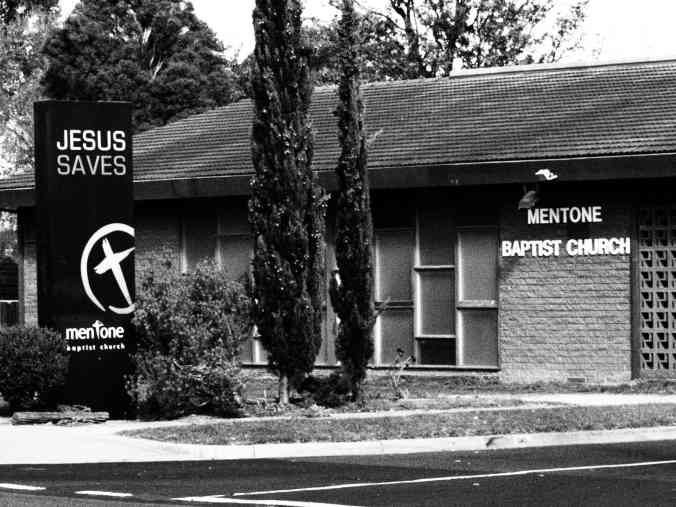
I was struck by Paul’s affection for the local church in Philippi. He not only loves the people and wants to be with them, he speaks of them as being his joy and crown. This made me pause and ask myself, what words do I use to describe Mentone Baptist Church? How do I view this family to whom I belong in Christ?

Joy is one of the main themes that threads through the entire letter; it speaks of a deep wonderment and excitement of knowing these people are God’s and were partnering alongside Paul in the Gospel of Jesus Christ.

Crown refers to the wreath awarded to an athlete who had trained hard and seen success. As Paul surveys his life and ministry, his prized achievement and great happiness is a local church, and this accomplishment is all God’s doing. From what we know of the Philippian Church there was nothing remarkable about them, but in their ordinariness they lived the Gospel of Christ. Paul’s joy was not rooted in the Church’s power ministries, or in some captured à la mode vibe, but in the genuineness of their Gospel partnership.

We will better understand Paul’s affection for the Church by  reading what he says prior to and following 4:1:

In the latter part of chapter 3 Paul has exposed a group of people, who though probably connected to the Church, were not genuine believers. He refers to their appetite for ‘earthly things’. These people lived for now and the pleasures that can be had in the present, whilst ignoring greater and more important realities. In contrast, Paul reminds us of  an identity and home that is in heaven, and we set our minds on this hope.

‘Join together in following my example, brothers and sisters, and just as you have us as a model, keep your eyes on those who live as we do. 18 For, as I have often told you before and now tell you again even with tears, many live as enemies of the cross of Christ. 19 Their destiny is destruction, their god is their stomach, and their glory is in their shame. Their mind is set on earthly things. 20 But our citizenship is in heaven. And we eagerly await a Savior from there, the Lord Jesus Christ, 21 who, by the power that enables him to bring everything under his control, will transform our lowly bodies so that they will be like his glorious body.

Immediately following 4:1, Paul mentions an argument that is occurring within the church between two godly and Gospel-centred women, Euodia and Syntche.

‘I plead with Euodia and I plead with Syntyche to be of the same mind in the Lord.  Yes, and I ask you, my true companion, help these women since they have contended at my side in the cause of the gospel, along with Clement and the rest of my co-workers, whose names are in the book of life.’

Paul can both speak wonderfully of this Church and also recognise there are issues needing to be addressed.

The two women whom Paul is talking about are not enemies of the Gospel, they are mature and faithful workers who have found themselves clashing. We don’t know the nature of their disagreement, but it is clear the issue needs resolving. In verses 2-3 we see that Paul is not harsh with them, he does not tell them to leave or remove them from ministry, but rather he organises counselling for them in order to restore the relationship.
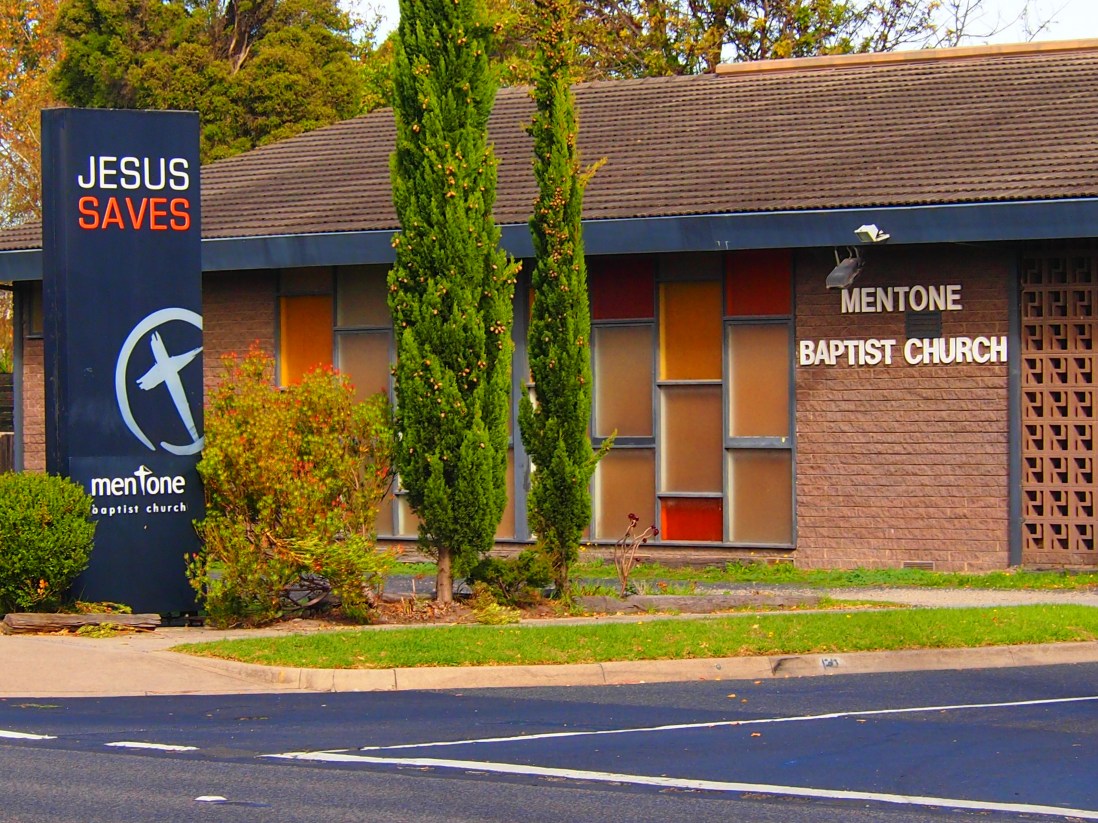
P1018405.JPG

As I meditated on God’s words today, these 3 points came to mind:

Firstly, Philippians 4:1-3 encourages me because even healthy churches have disagreements. It is inevitable but it need not diminish our affection for one another; indeed we can and ought to work through these quarrels and arguments because of our Gospel partnership.

Secondly, an appetite for ‘earthly things’ is a constant danger and is a destroyer of genuine Christian fellowship and joy. If our affection for the local church diminishes, it is worth asking ourselves the question, what are we hungry for? What are we filling up on in order to feel satisfied?

Third and foremost, when we sense our passion and love for our local church dissipating, return to the Scriptures and listen afresh to how God describes these communities of brothers and sisters in Christ.  The Bible is a great antidote to our modern individualism and sense of autonomous living, which sadly impacts the growth of so many of our Churches.

I confess, there are moments when my own Church doesn’t feel like it’s my joy and crown, and I suspect the sentiment is at times reciprocated! That is a great reason for reading Philippians 4:1 and many other passages like it. We often forget how extraordinary the local church is in the sight of God, and how wonderful it is to be called by God to belong to a local gathering of his people.

Is our local Church a people whom we love and long to spend time with? Do we see the local church to whom we belong as our joy and crown?
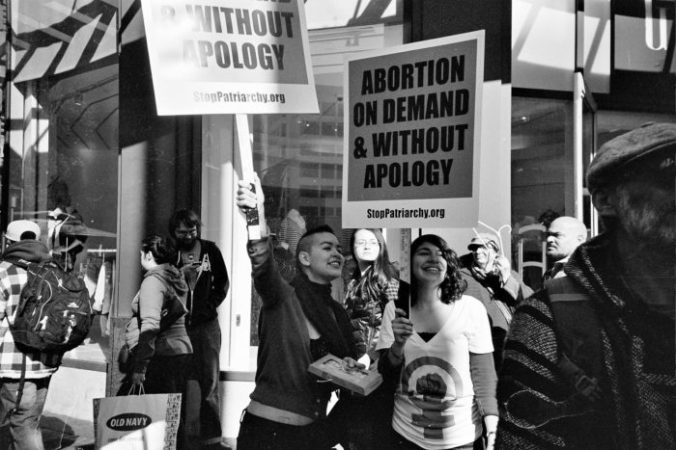
Let’s speak about, not shout about abortion

“Heaven is filled with boys and girls, who though unwanted by their earthly parents, have been welcomed by a Father who is committed to their eternal good and joy.”

Every year in Australia 10,000s of children are aborted, a practice that is not only supported by the law in some states, but it is something celebrated by many Australians.

Over the weekend Jane Caro has come out to defend and publicise abortion. Caro begins by sharing her own story of having an abortion, and then calls on other women to shun the guilt associated with abortion.

She writes,

“Abortion and the fear of unwanted pregnancy, frankly, is a normal — if not very pleasant — part of many women’s lives.”

“Shout out about your abortion any way you see fit — if the subject comes up in conversation, perhaps, or there is a story about it in the news.”

“If you have had an abortion, do not be ashamed of it. You are in good company. Shout it out and help lift the shame for all the other women who have also decided that every child should be a wanted child.”

I may need to clear the air in relation to one obvious point, which in the eyes of some readers will automatically preclude me from having anything to say on the issue. Yes, I am a male, and because of this anatomical and psychological fact, I understand some women will straightaway invalidate any comment I wish to make. We are all familiar with the mantras, ‘it’s the woman’s right to choose’, and, ‘women have the right to control their body’.

I suspect though, many on the pro-abortion side would be quite happy to have men speaking in support of abortion. Indeed, only a few short months ago Queensland MP, Rob Pyne, introduced legislation to relax abortion laws in that State; we didn’t hear many women protesting his public voice.

Not only that, it is a simple point of biology that men are involved in the process of women becoming pregnant. Should a father be involved only in the act of procreation, and be excluded from happens next? This is not about being controlling or patriarchal, it is about being a responsible parent and participating in an relationship. Sadly though, many men are irresponsible and uncaring, a problem which continues to cause frightful harm in so many of our homes.

abortion2-flickr

Morten Liebach, Steenaire (inset); flickr

While abortion has remained a hot political issue in the United States, in Australia it had largely shifted out of public discourse, becoming a forgotten shadow twisting through our cities, towns, and homes. But now, all of a sudden, partly due to the recent American Presidential election and also because of a Queensland Parliamentary vote, abortion is being talked about once more.

Jane Caro is writing though in response to last week’s announcement by Pope Francis, who has given priests ‘permission’ to forgive Roman Catholic women for having an abortion,

“I henceforth grant to all priests, in virtue of their ministry, the faculty to absolve those who have committed the sin of procured abortion.”

Caro responds,

“Given the Catholic Church’s attitude to contraception and its behaviour towards vulnerable children the world over, I simply cannot take anything this institution has to say about sex and reproduction seriously.”

Her criticism has some warrant, and I certainly understand her blanket mistrust of Roman Catholicism in light of its dreadful  history of sexual abuse. I am also critical of the Pope, for it is not the Pope’s place, nor the role of any priest to forgive anyone their sins. Priests may find permission in a papal edict and in their Church dogmatics, but such authority is not found in the the Bible, and as Christians that’s what counts. Priests are imperfect men who need their own sins forgiven by God, and as the Bible affirms, 

“there is one God and one mediator between God and mankind, the man Christ Jesus,” (1 Tim 2:5)

One of the reasons for writing today is because of a sadness that overcame me when I read Caro’s call to view abortion as ‘normal’. It is not normal. Abortion is never something to be celebrated or normalised. On rare occasions, when a mother’s life is genuinely at risk, I understand it is permissible, but to consider killing unborn children as okay is not okay.

A society that sanctions, and even celebrates the killing of unborn children is one denying its own humanity.

If one surveys global societies that have embraced a culture of abortion, one notes China with its population suppression policy. There are also numerous religious cultures who denigrate women and frequently force abortions when the baby is female.  And there is our western secularism with its excessive commitment to individualism. When we value the self above the good of others, we create an atmosphere of self-indulgence and not sacrifice, of self-worship rather than selflessness.

The very nature of loving community is that it requires the unexpected and difficult, and rather than eliminating those surprises, we alter our life expectations in order to to see their lives flourish.

Jesus once said, ‘Greater love has no one than this: to lay down one’s life for one’s friends’. Indeed, how great a love it is to sacrifice our hopes and plans for children who enter our lives unplanned.

In my role as a Christian Minister, over the years women have shared with me their stories of having an abortion, and without exception there is a shame attached. Reasons are multifarious: when a woman is raped,the fear of giving birth to children with a disability, when the mother’s life is at risk, and when the child is unwanted due to the mum not feeling ready or not wanting the responsibility or wanting children to impact their lifestyle or career. The reality is, only a tiny portion of abortions occur on medical grounds that the mother’s life is in danger. Many more abortions occur because of the child’s gender, or because the child may carry a disability, and many other children are killed because of lifestyle choices. For many many women this decision has left a wound that has not healed.

As much as Jane Caro wishes women to wash away their shame for having abortions, many women cannot, and no Pope or priest can achieve that either. But in the person of Jesus Christ we find a God who is willing and able, and who is more merciful and wonderful than any of us can ever imagine.

As distressing a topic as abortion is, it is good to hear people talking once again. I don’t want to silence women who have had an abortion. Claire Smith has last week written an article encouraging people to speak more about abortion, and I wish to echo her words. And to a certain extent I also repeat Jane Caro’s words, that of urging women not to keep silent. But the speech we need is different, words that don’t speak affirming  destroying young life, but words that enable conversation, and ears that will listen to these stories.

Saying No to a Registry for Muslims

According to media reports, political advisors close to Donald Trump are exploring the establishment of a registry for Muslim immigrants to the United States. The policy may extend as far as requiring all Muslim Americans to be signed up to a Government register.

No doubt such a decision will find many supporters, even among some Australians. It is likely that Trump policies may give greater voice to certain groups in Australia, and so as a way of pre-empting such conversations here, let me give 4 reasons why a Muslim registry is a really bad idea.

1. Lessons from history

When a Government decides to impose itself on a religious minority, hatred and intolerance is incited and people suffer. Is this not one of the plagues of the Islamic State? Indeed, in many Islamic nations non-muslim citizens are marked out and carry the burden of having to pay the Jizya.

Some commentators have already raised the example of Nazi Germany. On the one hand, I find it somewhat duplicitous  that ‘left’ leaning journalists are outraged when conservative commentators cite the example of Nazism, and yet they seem to have little qualm in using the analogy when it suits them. In this instance though, while being careful not to overdo the comparison, the question is not completely absurd.

2. Most Muslims are not terrorists

It would be foolish to deny a connection between Islamic beliefs and current terrorist activity across the globe. Whether it is IS, Al Qaeda, Boko Haram, and many others, one of the common threads is Islamic religion.

It is also the case that many nation states adhere to strict forms of Islam, and while we exchange trade and business with these countries, internally they impose a religion on their citizens that is often harsh, and where women are mistreated and non believers denied rights.

Without ignoring real ideological issues that are often found in cultures where Islam is dominant, this does not mean that the populations living in those countries are content with the status quo, or that they are potential insurgents laying in waiting. The reality is, millions of people are fleeing these countries in order to find a new life, a  better life.

Muslim people have been living in Australia since the 19th Century, and for the most part they are hard working contributors to our country. They are friendly, kind, and are important members of our diverse and pluralist society.

Should the many suffer indignity because of a few? Indeed, those few persons who are of concern to the Government, are they not already highlighted? If so, what is the point of another register which will require all Muslim people to be participants?

3. The hypocrisy

There is a hidden hypocrisy at work here, both in the political and religious arenas.

Over the last decade across Western Governments we have witnessed increased intolerance towards people whose religious convictions don’t conform to the secular humanist worldview, especially when it comes to the issues of sexuality and marriage. This has been evident both in the USA and Canada, and my own State of Victoria is among the leading examples of this Erastian movement. Those who have been working to remove Christian ethics in the public square may well cry foul over this proposed registry, but they do so from a position of illegitimacy.

This works both ways. So when Christians speak up and seek to defend their freedom of religious thought, speech and life, do we deny it for others?

It will be of no surprise to readers that I disagree with Islam, mormonism, atheism, and many other belief systems. These theologies hold a view of God that contradicts the person and teaching of Jesus Christ, and yet nation states are not Churches, they are (in our modern history) secular and pluralist institutions. As such, a functioning and maturity society will find ways for this diversity to cohere, and encourage public spaces for people to disagree and to debate with fervour and respect.

4. Threats of a registry creates fear and makes people vulnerable.

Would I like my own family to live in fear and with uncertainty, not knowing how the Government may act toward us, given our race or religion?

I know for a fact, many Victorian Christians have felt apprehension as our Government continues to pressure our children out of public schools, and we are experiencing uncertainty as legislation is introduced to control Christian Churches and organisations. Would we wish that on another minority group?

One American Muslim has written this,

“This is what it feels like to me now that the republican nominee is now the president elect.

He is the abuser. We are trapped. We are circling the wagons, trying to mitigate the damage by finding allies and waiting for the abusive behavior that we know is coming. We are sharing strategies on how to parent our children now that our president elect has taught them that being a racist, sexist, fear mongering, money hungry bully will get you the highest office in the nation.

We are trying to find the way to rebuild the inroads amongst ourselves while finding the strength and power to strategize how we can get free.

This is a far different place than I thought our nation would be today. I saw hope, I saw people of color being treated fairly. I saw refugees and immigrants being embraced for their unique potential; I envisioned a path towards unity. I live and breathe the mantra, Stronger Together every day.

Now I look out my door and wonder, which one of my neighbors thought it was a good idea to elect a president who wants to implement a Muslim registry. A database of anyone who practices Islam, so they can be watched and rounded up whenever he believes we need to be put in check.”

OLYMPUS DIGITAL CAMERA

Christians must speak up for our Muslim neighbours, not because we agree with their religion, but because they should not be discriminated against for their religious beliefs. They are citizens of our countries, and they are human beings who ought to be treated with dignity and kindness.

There is no doubt, Donald Trump’s ascent to the Presidency has sent many social progressives into cardiac arrest. What many thought was an inevitable social engineering quest from the left has become not so assured. Perhaps the rise of Trump will only prove to be a temporary swing of the pendulum, but for now, the shift is real and no one yet knows how far it will move.

Many Christians will be thankful that they may find some reprieve after years of pushing and shoving from social progressives, but I don’t believe we should be rejoicing at the prospect of a Trump Presidency.

As calls are made for a Muslim registry, Christians would do well to remember people like Naaman, the Samaritan woman, and the jailor in Philippi. Ask ourselves, how do we love our neighbours? Should we cause them to fear, or should we protect them? I reckon we would do well to reread Jesus’ parable of the Good Samaritan,

“A man was going down from Jerusalem to Jericho, when he was attacked by robbers. They stripped him of his clothes, beat him and went away, leaving him half dead. A priest happened to be going down the same road, and when he saw the man, he passed by on the other side. So too, a Levite, when he came to the place and saw him, passed by on the other side. But a Samaritan, as he traveled, came where the man was; and when he saw him, he took pity on him. He went to him and bandaged his wounds, pouring on oil and wine. Then he put the man on his own donkey, brought him to an inn and took care of him. The next day he took out two denarii and gave them to the innkeeper. ‘Look after him,’ he said, ‘and when I return, I will reimburse you for any extra expense you may have.’

“Which of these three do you think was a neighbor to the man who fell into the hands of robbers?”

The expert in the law replied, “The one who had mercy on him.”

Jesus told him, “Go and do likewise.”

(Luke 10:25-37)

American Evangelicals have harmed Evangelicalism

“Therefore, you kings, be wise; be warned, you rulers of the earth.” (Psalm 2:7)

160128212624-fox-january-gop-debate-trump-rally-780x439

Eleven months ago a good friend sat on the lounge in my home and told me that the Presidential race would be between Hillary Clinton and Donald Trump…and that Trump would win!

I looked at him as though he had had a lobotomy. But over the course of the year my friend’s projection has been rattling in the deep recesses of my mind where I try to leave all the crazy thoughts.

Like the majority of Australians I feel as though I’m floating in a hypnagogic state. How many of us really thought that Trump would trump America?!

According to the latest figures, it appears the main reason for Hillary Clinton’s loss is because Democrats stayed home: 5 million fewer democrats voted yesterday than in 2012; that’s a lot of people. The Republican turn out was also slightly down, which is unsurprising given the candidate.

I have no doubt that there are numerous reasons behind Trump’s win, and I am no expert to decode all these, and neither is it my purpose to explore them here.

After surveying this morning’s twitter sphere, it revealed though how mainstream media, Hollywood, and the self acclaimed intelligentsia still don’t get it; the progressive moral and social agenda is repugnant to many Americans, and also to many Australians.

More concerning, American “evangelicals” don’t get it. I am hearing reports suggesting that as many as 85% of “evangelicals” voted for Donald Trump. Whatever the actual number, it will be a substantial percentage. I appreciate why Christians could not vote for Hillary Clinton; for example, her position toward unborn children is paramount to evil, but so is Trump’s posture toward women and refugees.

I want to reiterate a concern that I have raised in recent weeks, and that is how the evangelical cause will be weakened as a result of a Trump Presidency. The reason is obvious, “evangelicals” have so closely aligned themselves with Donald Trump that in the public eye the two have been aligned.

While there were multiple groups investing in the campaign, “evangelicals” are at least partly responsible for Donald Trump’s ascendancy to the American Presidency. That’s right, without their endorsements, the Republican nominee may well have been a Jed Bush or Marco Rubio.

You will notice my proclivity to use the inverted comma when referring to evangelicals, and that’s because the word has been regularly misappropriated by not only political pundits but also by Americans themselves. True evangelicalism has little to do with the political aspirations of right wing America, and everything to do with the Gospel of the Lord Jesus Christ. Authentic evangelicalism is defined by this Gospel as presented in the Bible, not by the political right or left, not with Democrats or Republicans, and for the Australian context, neither Liberal nor Labor.

While never wishing for a Clinton victory, I do think that scenario would have at least given “evangelicals” an opportunity to break with Donald Trump and start afresh, to repent of foolish associations and  to rethink how Christians should engage in the political space. Unfortunately, “evangelical” America supported the winner, and have been tarnished for doing so. I cannot see how this association will advance the cause of Jesus Christ. If anything, the word may become irretrievably immeshed in a cause that is not the Gospel.

I am thankful for the many evangelicals who have stood up to Donald Trump and have copped flack for doing so: Ed Stetzer, Russell Moore, and Al Mohler among them. In Australia, the general public will not be informed of these voices, and instead Australians will time and time again hear how “evangelicals” assisted Donald Trump to the White House. At least in the Australian public square, the 2016 Presidential election will tarnish Christian witness and further perpetrate myths about Christianity. It is for this reason I am calling on my American friends to return to their evangelical roots and think carefully about political associations.

It is one thing to be part of a Presidential win, but it is quite another to one day stand before the Judge of the earth and give an account for how our lives have adorned or maligned the Gospel of Christ.

This final point is not only true for American Christians but also Australian Christians. When will Christians learn not to place undue hope in Government? The election has exposed a messed up eschatology and misplaced soteriology, which will not only disappoint, but will prevent people from seeing Christ. However Donald Trump decides to build his wall along the Mexican border, it is nothing compared to the wall evangelicals have built in this election which will block out the wonder of the Gospel. How will true evangelicals work to dismantle this false gospel? What will we do publicly and in our Churches to redress the damage caused by this political misalignment?

We need much prayer. We need much repentance.

As the political shape of America turns, may Christians return to our true hope:

“For to us a child is born,

    to us a son is given,

    and the government will be on his shoulders.

And he will be called

    Wonderful Counselor, Mighty God,

    Everlasting Father, Prince of Peace.

 Of the greatness of his government and peace

    there will be no end.

He will reign on David’s throne

    and over his kingdom,

establishing and upholding it

    with justice and righteousness

    from that time on and forever.

The zeal of the Lord Almighty

    will accomplish this.”

(Isaiah 9:5-7)

Evangelical! Who me?

When is it time to lay a word to rest? When is it appropriate to find an alternative name?

Stephen McAlpine is among a growing number of Evangelicals who are admitting we have a word problem, an identity problem. The term evangelical has become synonymous with a branch of American politics, and more recently, with a key group of Donald Trump supporters. Yes, there are notable evangelical voices repudiating Donald Trump, and recent polls suggest the majority of evangelicals would no more vote for Trump than they would Kylo Ren, but it is difficult to fight a bushfire with a garden hose.

McAlpine writes,

“The “Evangelical” brand is well on the way to being trashed in the US.  Time to think of a new word to describe ourselves I reckon, not just in the US, but across the West.

If it’s true financially that “when America sneezes, the world catches cold.”, the same appears to be true of American evangelicalism. The US arm of the brand has caught a pox from which it may not recover, and that pox is at risk of spreading to us.

It’s actually worse than a pox.  It’s gangrene. It has the whiff of death about it. Exxon, Union Carbide, Enron, Lehman Brothers. Perhaps we can add the “Evangelical” brand to that sorry pile. Time perhaps to cut ourselves off from the descriptor before we start to smell. Time for a new word

As he laters explains, the problem didn’t start with the rise of Donald Trump, it goes back to the 1980s when Christians hitched their wagon with the Republican movement.

The issue is even broader than North America. In Europe many denominations continue to use evangelical, as a eulogy to the past, although their theology often bares little resemble to that of their forefathers.

In Australia, evangelical has had branding kudos, at least in Christian circles, so much so that even many anti-evangelicals embraced the word: ’we don’t believe in the bodily resurrection of Jesus Christ but the label works for us.’ To be fair, those who were slightly more ingenuous inserted adjectives, such as ‘broad’ or ‘progressive’, as a hint of their not so evangelical beliefs. This mass branding has not helped.

Language is situational, or least in part. When I describe my Christian faith in the community I refer to myself as a Christian, and sometimes I add that rarified name, Baptist! Rarely do I use words like evangelical or reformed, not because the words are getting a bad press, but because they hold little meaning to most Australians. Within ecclesiastical conversations I am happy to speak of my evangelical and reformed convictions, as they often help to build bridges of understanding, and at other times they clarify differences. But the reality is, when I’m chatting with my neighbours, evangelical doesn’t add anything.

If using the word inside churches is sometime confusing, McAlpine is right; outside of churches and theological institutions, identifying as an evangelical is becoming a herculean challenge, largely because our media lacks nuance. While it’s been trashed in the USA, at least American media acknowledge alternative evangelical viewpoints. Here in Australia, he only time evangelicals are mentioned is when there is a sniff of hydrogen sulphide in the air. For example, our news outlets have not been reporting Al Mohler on CNN or Russell Moore in the Washington Post, as they speak out against Donald Trump.

Has evangelical become unusable in Australia?

The Age newspaper now contains dozens of references to evangelicals, and almost without exception they associate these people with right wing American politics, or with ‘extreme’ Christian ideology in Australia.

ABC’s program, Planet America, regularly refer to the evangelical vote, and especially of their alleged support for Donald Trump.

It is clear that evangelical has become a by-word for religious right wing politics. While the media are responsible for selective reporting, they can hardly be blamed for tying at least some evangelicals with Donald Trump. After all, millions of Americans identify with evangelical and with the Republican movement.

There is an important lesson for us to learn, and that is, we must not bypass theology. We must resist making our identity a political ideology or social cause, we must begin with the Gospel and work out from there.

In 1989 David Bebbington first offered his now famous quadrilateral definition of evangelical. He understands evangelicals as holding four main qualities: biblicism, crucicentrism, conversionism, activism. There is much to like about his quadrilateral, however I also agree with Don Carson’s reservations (read “The Gagging of God”). Carson notes that even a Jesuit priest could put his hand up to this quadrilateral definition. As such, Bebbington has perhaps done evangelicals a disservice. 


To be evangelical is nothing less than being someone who holds to the Gospel of Jesus Christ. The the very word from which we get evangelical is euangelion, which means Gospel.

I agree with Carson, who in turn follows John Stott, in taking us to 1 Corinthians 15:1-8. This is far from the only Scriptural place that explicates the gospel , but it does give us one of the fullest treatments of the Gospel, and we can’t overlook Paul’s introductory remark,

Now, brothers and sisters, I want to remind you of the gospel I preached to you, which you received and on which you have taken your stand. 2 By this gospel you are saved, if you hold firmly to the word I preached to you. Otherwise, you have believed in vain.

For what I received I passed on to you as of first importance:

What is the euangelion?

that Christ died for our sins according to the Scriptures, that he was buried, that he was raised on the third day according to the Scriptures, and that he appeared to Cephas, and then to the Twelve.  After that, he appeared to more than five hundred of the brothers and sisters at the same time, most of whom are still living, though some have fallen asleep. Then he appeared to James, then to all the apostles,  and last of all he appeared to me also, as to one abnormally born.”

Both Stott and Carson summarise 1 Corinthians 15:3-7 with these 6 points: the Gospel is Christological, Biblical, Historical, theological, apostolic, and personal.

The problem is of course, people are no longer defining evangelical by the Gospel.

screen-shot-2016-10-24-at-12-56-25-pm

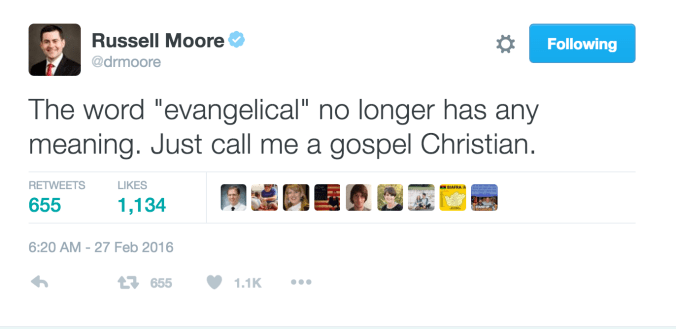
While I’m in large agreement with McAlpine, I’m not giving up on evangelical just yet, because rightly understood it is a word we should cherish and defend. But should the waves of malcontent persist, and an alternative is necessary, I think I’ll begin follow in Russell Moore’s footsteps and refer to myself a Gospel Christian.

Gospel Christian has the same meaning as evangelical Christian, but without the unhealthy socio-political connotations. Interestingly, both in the United States and here in Australia, among the larger Christian networks we don’t find the Evangelical Coalition, but rather the Gospel Coalition.

Some Christians prefer to known as orthodox or classical. I warm to both of these words, although Stephen McAlpine criticises ‘orthodox’ as a group who don’t affirm the real and physical return of Jesus Christ. Perhaps I’m ignorant, but I would have thought belief in the parousia is basic to anyone claiming orthodoxy.

The reality is, many of our Christian labels are disdained. I wish it was suffice to say, I’m a Christian. After all, that’s what I am, I am a Christian. But sadly Christian is frequently associated with all manner of social ills and evils (sometimes warranted). And when I fess up to being a Baptist, I’ve more than once had to qualify it by saying, no, we’re not like the JWs or Mormons.

McAlpine suggests we call ourselves, ‘eschatological Christians’,

“Eschatological” springs to mind. If someone asks me these days I’ve taken to saying that I am an “Eschatological Christian.” Sure it’s not catchy, but it’s not toxic either. Sure I will have to spend a bit of time explaining what it is, but hey, I’ll have to spend virtually no time explaining what it is not.

“Eschatological” is more likely to elicit an eyebrow raise than a nose wrinkle.  It is more likely to raise a question than rule a line under an answer. Most importantly it will distinguish me – and us – as those whose hopes -and energies – are not grounded in the political machinations of this age, but in the politics of the age to come lived out in the church today, and overflowing in practical, loving and humble ways into the community.

“Eschatological Christian” also distinguishes orthodox Christians who actually believe that there is a parousia coming in which King Jesus will usher in a new kingdom and judge the world in righteousness, from those who view that as an outdated notion beneath our modern sensibilities. A view that won’t get them respect in the academy.

The name has a certain Fitzroy living single-origin drinking indie-rocking listening feel to it, but I am unconvinced. First of all, few people know what eschatology means,  and second, it is  defining our identity by one area of theology, rather than the whole.

What do others think? How do you describe your Christian faith? Do you identify as an evangelical?

Misappropriation and misunderstanding shouldn’t surprise us; is it not the expectation given to us by the Lord Jesus? Does not the history of the church give us multiple examples of culture trampling on or deconstructing the church? In a world that is constantly confusing and even hijacking the Christian message, and doing so for all manner of social and political ends, we though can be responsible for how we represent the Lord Jesus Christ. Indeed, the more faithful we are to God’s word, the more useful we will be to society. So whether we call ourselves evangelical, Gospel, orthodox, or just plain and simple Christian, let’s do it with a growing sense of clarity, humility, grace, and winsomeness, in order to display the reality of Christ and of the hope held out in his Gospel.

Redeeming social justice from liberals (and conservatives)

Behind this post are two conversations that I’m having with myself today: One, Mike Frost wrote a piece titled, It’s Not a Liberal Agenda, it’s the Gospel!. Second, this Sunday I’m preaching on Matthew 7:15-23, and so I’m spending time grappling with these words from the Lord Jesus.

As you read these ponderings you shouldn’t read them as a critique of Mike Frost, unless I refer to him explicitly. Mike’s meanderings serve as a jumping point for some ideas rather than the framing of what I want to say.

Also, as you read this article I understand that some people may burst a boil as you spot caveats, ‘what ifs’, and buts. In light of these medical emergencies may I offer this prefatory remark: this is a blog post not a 15,000 word essay, and so don’t be disappointed if I don’t fill in every gap or close every alleged theological aperture.

IMG_7985.jpg

i. Social selectivism

The Bible is certainly not short of individuals who lived a ‘form of godliness’, but ‘denied its power’, meaning they were bereft of Christ’s Gospel.

In my experience, both cultural conservatives and progressives have a propensity to fail in this way.

First of all, they are almost always selective in the kind of issues they promote. When was the last time you heard social and theological progressives defending the rights of unborn children and fighting to retain a classical view of marriage? Of course, the question could be asked of many issues across the socio-political spectrum.

It shouldn’t need to be said, but we know it needs to be said, Jesus never voted Green, Labor, or Liberal. Trying to squeeze Jesus under under any socio-political umbrella is wrong;  maybe he would prefer to stand out in the rain!

There are historical reasons why evangelicals have dropped the ball on many social concerns. These include the World Council of Churches’, Missio Dei, Second Vatican, and Lausanne 1974, each which have negatively impacted confidence in and need for verbal proclamation of the Gospel. Before this century long trajectory, Evangelicals immersed themselves in caring for the poor and suffering in society; some of the greatest evangelists were also intimately involved in creating orphanages and charities for the poor (John Wesley and Charles Spurgeon, for example).

Perhaps Mike’s critics smell some WCC residue in his social concerns; I don’t know.

But I love the fact that Mike Frost (and others) is seizing these issues from those who think they belong to a ‘leftist agenda.’ Concerns for Refugees and Indigenous people doesn’t belong to theological liberals, any more than other issues belong to the ‘right’. Rather, he’s rightly placing all things in the scope of God’s cosmic rule in Christ. While none of us can be active across all that troubles this fallen world, there is no opting out of loving our neighbour, including further examples that Frost cites,  people caught up in gambling and in the sex industry.

ii. Missing the Evangelical heart.

“Our job, as his followers, is to both announce and demonstrate what the rule of King Jesus is like and invite others to join us, to recognize that Jesus’ sacrificial death atoned for the sins of all, and that his resurrection establishes him as the Son whom God has appointed judge of the world and Lord of the coming kingdom.” (Mike Frost)

It’s a great statement, but the question is, in practice what is this looking like? Four questions/concerns come to mind. I don’t know Mike well enough to know what he’d think of these points, but they are certainly true of some of my friends who readily identify with some social justice issues. With the view of loving the poor:

1. Verbal proclamation of the Gospel is often relegated, if not dispensed with altogether.

I remember sitting in a seminar a few years back, addressing the topic of local mission. The presenter spoke of ‘doing mission’ by creating programs to help the poor and marginalised. I asked a question about evangelism, to which he answered, one might explain the Gospel but it is not necessary.

I did find this comment of Mike’s about evangelism a little boorish,

‘Is the gospel really just a set of magic words, like an incantation, I have to blurt out to appear to be true to Jesus?’

I certainly don’t know anyone who thinks this way, and it’s a bit mischievous to portray folk this way. We would do well to remind ourselves of Jesus’ earthly ministry where he prioritised the public preaching of God’s Word, a model adopted by the Apostles and passed on to future generations of pastors. At the same time, they didn’t ignore the very real social needs around them, and Jesus gives us the example par excellence of loving society’s most disadvantaged.

2. Aspects of the atonement such as Christus exemplar and Christus victor take centre stage while penal substitution is squeezed out, often becoming little more than an awkward ‘theory’.

3. The Gospel of ‘forgiveness of sins’ drops from the centre of  the Christian message, and we fall danger of converting people into a Gospel of works.

4. I want to be careful about confusing Gospel fruit with the Gospel, although we want to say the Gospel will inevitably and necessarily produce fruit (cf. Matt 7:15-23).

If any of these points are representative of the bald man of Manly, then there may be warrant for criticism, but fighting for refugees is no indicator of belittling evangelism or compromising the Gospel. And of the social concerns he has written, how can we not want to speak up and to defend and love?

iii. Redeeming social justice.

None of the above points are inevitable. Serving the hurting, lonely, and unwanted, are beautiful and necessary examples of loving our neighbours. These actions are fruit of the Gospel.

Does not the good news of Jesus Christ change everything? When we have experienced God’s forgiveness, and by grace been brought into his family, this love changes the way we view other people. Therefore, we mustn’t leave these issues to the left or right, for the love of Christ compels us.

In light of the Scripture I think it is fair to say that a Church who promotes social justice but doesn’t practice evangelism has failed to understand the Gospel and is disobeying God. And Christians who believe in evangelism and who think it unChristian to fight for the most oppressed, they too are yet to grasp the Gospel. As Jesus says, a good tree will produce good fruit. And in the Sermon on the Mount, fruit is almost a synonym for righteousness, and righteousness here includes purity, humility, sacrifice, and generosity. Is it not applicable to live out these things for the good of society’s most vulnerable people?

From what I can see, Evangelicals are returning to social justice ministries, and many respected evangelical leaders are increasingly speaking to these issues, including Tim Keller, Russell Moore, Al Mohler, and the Anglican Archbishop of Sydney, Glenn Davies. Why? The Gospel changes everything.

We don’t have to choose between helping the poor and doing evangelism. We ought to do both for both express love for others, and we commit to both without de-centralising the place of Gospel telling.

Letters for Members of the Victorian Parliament: RE ‘inherent requirement’ test

If you are interested in writing to your local State MP to express concerns about the amendment to the Equal Opportunity Act, here are some salient points that you might include when drafting a letter of your own


OLYMPUS DIGITAL CAMERA


Dear Sir/Madam,

I am writing to express concerns over the proposed ‘inherent requirement’ test, that is being re-introduced by the Andrews Government.

Diversity, freedom of association, and freedom of religion, are key characteristics of our liberal democracy that are esteemed by Australians. Throughout our history Governments have valued the contributions of religious organisations, indeed society would be the lesser without them, and yet Governments have also understood a demarcation between the State and religious institutions.

The proposed Equal Opportunity Amendment (Religious Exceptions) Bill 2016 will cross that line, with the Victorian Government taking a role in supervising whom religious organisations may employ.

First of all, why is this legislation targeting religious groups?

The amendment to the Equal Opportunity Act will not impact any social or political groups, only religious ones.

As it stands, political parties, sporting clubs, and other interest groups have freedom to appoint persons who subscribe to the views and goals of those organisations. This is only common sense. For example, it would be unfair to force the Greens to employ a climate-change skeptic, or to expect the local Football Club to appoint a groundsman who was intent on converting the oval into a swimming pool.

It is therefore reasonable to ask, what is the motivation behind the Government focusing on religious organisations, and not others?

Indeed, this amendment to the Equal Opportunity Act is but the latest of a growing list of anti-religious measures that have been introduced by the Government over the last 2 years. I appreciate that some policy changes are being presented as fighting equality for LBGTI people, and some of this is laudable. However other policies are completely unrelated to sexuality issues, and are simply attacks on religious freedoms: removing SRI lessons from schools is one such example. And the legislation itself says its scope is not limited to discrimination on the basis of sexual orientation, but extends to ‘differing religious beliefs’. In other words, it is no longer permissible for a church or school to reject an applicant on the basis of them adhering to a different religion. Such an idea would be laughable, except it may soon become law.

Secondly, the inherent requirement test assumes that the Government has the right to intrude on religious organisations, and influence whom they employ.

This test is a clear abrogation of one of Australia’s most basic ideals, that the State will not interfere with the beliefs and practices of religious organisations.

Mr Andrews has stated, “Religious bodies or schools will be required to demonstrate a necessary connection between their religious beliefs and the requirements of a specific role.”

This move counters the very notion of a pluralist society, and is setting up the situation whereby  a Government impose impose its narrow secularist agenda onto groups who do not share their ethical and religious viewpoint.

Thirdly, the test assumes that the Government, and any tribunal set up by the Government, has the expertise and knowledge to interpret the theological framework underpinning these organisations.

Again, Mr Andrews has said,

“The defence will be limited to circumstances where religious beliefs are an inherent requirement of a job, and an employee or job applicant does not meet the requirement because of a specific personal attribute.”

But who is to say when and where religious beliefs are an inherent requirement of a job?

The legislation assumes that some jobs in a church,  or mosque, or religious school can be considered ‘religious’ and others not. This may be the case in some instances, but is the Government really in a position to decide what is inherent and what is not?

It is important to understand that this assumption is not ethically or  theologically neutral; it requires a body, set up by the Government, to interpret and impose their understanding of Islam, Judaism, or Christianity onto these various organisations. For example, in Christian thinking, the roles of gardener, administrator, and teacher are not separated into religious and non-religious work, for all are expressions of service to God. 

As it happens, many of these organisations do employ persons who don’t subscribe to the particular religious principles of the institution; that is their freedom to do so. Surely though, school boards, charities, and churches are in the best position to understand the values and needs of their organisation?

In the end, it comes down to these questions:

Is it the role of Government to interfere with the beliefs and practices of religious organisations?

Is it wise or fair to force religious organisations to employ persons who do not share their values and beliefs?

I believe this legislation is unnecessary, and will set a dangerous precedent for our future as Victorians.

I am asking that you consider voting against this legislation. I am very happy to answer any questions you may have.

Thank you for taking the time to hear my concerns

Yours Kindly,

Murray Campbell

Mother Teresa, Sainthood, and the Saints

Mother Teresa was today declared a saint by Pope Francis. Her many decades of work among India’s poorest in Calcutta, left an indelible mark on the 20th Century. In front of  10,000s of people at a special Vatican ceremony, Pope Francis has canonised Mother Teresa, and there are special masses being conducted in India also.

_91020410_035091930-1

Pope Francis proclaimed,  “After due deliberation and frequent prayer for divine assistance, and having sought the counsel of many of our brother bishops, we declare and define Blessed Teresa of Calcutta to be a saint and we enrol her among the saints, decreeing that she is to be venerated as such by the whole Church.”

One nun, working in the same mission where Mother Teresa once served, said, “We are blessed with this canonization because we know mother is in heaven and she will pray for us and she will bless us”

Sainthood is a prestigious club in the Roman Church, although no one knows exactly how many members there are, with some estimating there being as many as 10,000 Saints. This number may seem rather large, but when one takes into account that there are over 1 billion Catholics in the world today, we begin to sense exceptional character of sainthood club.

Sainthood is rare in the Roman Church, partly because the process is arduous and only a few hold the right kind of resume to even proceed.

Canonisation (the final process of becoming a saint) begins with death. Sainthood is only given to men or women posthumously, and generally with at least 5 years separating their death from the commencement of the process.

The process begins usually with the Diocesan Bishop opening an investigation into the life of the departed person, whereby they try to ascertain if they have lived a life that is adequately holy and deserving of sainthood. In other words, if we think you’ve been good enough, as testified to by various witnesses and documents. If this all goes well, a higher authority, the Congregation for the Causes of Saints, examines the holiness, deeds, and miracles of the deceased. Following this is beatification, where evidence of a miracle must be verified, of someone who has experience miraculous healing by praying to the deceased person. If all goes well, the Pope will finally canonise or declare the dead person to be a saint.

For Catholics, Saints play an active role in peoples’ lives, this side of heaven. Millions of Catholics venerate (honour and even worship) saint, praying to saints, and allegedly experience healing, guidance, and help from these saints.

In contrast, when we read the Bible we don’t find different classes of Christian, depending on levels of holiness or miraculous deeds. Rather, every Christian is known as a saint. The word itself comes from the Greek verb, meaning, to set apart or to be holy. It is a designation that is true for every Christian, indeed the Christian life is contingent upon this work of the Holy Spirit.

“To all in Rome who are loved by God and called to be his holy people” (Romans 1:7)

“To the church of God that is in Corinth, to those sanctified in Christ Jesus, called to be saints together with all those who in every place call upon the name of our Lord Jesus Christ, both their Lord and ours” (1 Corinthians 1:2)

“And he gave the apostles, the prophets, the evangelists, the shepherds and teachers, to equip the saints for the work of ministry, for building up the body of Christ, until we all attain to the unity of the faith and of the knowledge of the Son of God, to mature manhood, to the measure of the stature of the fullness of Christ…” (Ephesians 4:11-13). Note that the Saints are not leading churches, but a normal congregation members.

Does it really matter? Yes, it matters because it is fudging the teaching of the Bible, and it matters because it creates  false classes of Christians, and it matters because it empties the Gospel of its power by leading many people to believe in merited salvation. In the Scriptures from which Christianity forms its beliefs,  we find that saints are not spectacular Christians who should be awarded special honours; saints are the only Christians to be found in heaven or on earth.

There is no gold or platinum level club in heaven, and there ought to be no elitism in our churches. The Christian message is about God’s undeserved grace and kindness to us, and everyone has equal standing before God in Christ.

We can thank God for the multitude of ways various Christian brethren have served Christ, the Church, and the world. We would be foolish and ungrateful if we didn’t remember and give thanks for lives devoted to the service of the poor, lives spent in the service of the gospel, lives laid down in martyrdom for the name of Jesus. We may (and we must) celebrate good deeds done in love, and remember the stories of lives worthy of imitation. But “sainthood” is not the category for these stories, apart from how the Bible defines sainthood – those who know God through faith in Jesus Christ.

And should anyone be wondering, should I or can I pray to someone who is not God? Is it ok to pray to a saint? If I may respond by asking another question,  why would we want to pray to a saint? Even if we leave aside the fact that the Roman category of sainthood is erroneous, the extraordinary good news of Christianity is that Jesus Christ has opened the way to God the Father. If this is true, that we have freedom to enter the presence of God through trusting Jesus; we have no need of knocking on empty doors.

As the Bible tell us,

“Since then we have a great high priest who has passed through the heavens, Jesus, the Son of God, let us hold fast our confession. For we do not have a high priest who is unable to sympathize with our weaknesses, but one who in every respect has been tempted as we are, yet without sin. Let us then with confidence draw near to the throne of grace, that we may receive mercy and find grace to help in time of need.” (Hebrews 4:14-16)

Baptist Courage of the 17th Century


17th Century England was not a promising environment for serious discourse on theological matters. Indeed, discussing theology in public could lead to loss of employment, imprisonment, exile, and on rare occasions, death.

Pressure to conform to the prevailing winds was enormous, with both governmental and ecclesial bodies (the two often working in tandem) interpreting difference as hostility and something to be silenced.

And yet this period of English history also witnessed tremendous Gospel growth, and playing a significant role in the missio Angliae were the early Baptists.

john-bunyan

Perhaps no group in England made more use of public disputations than did Baptists. Between 1641 and 1700 at least 109 such public debars involving Baptists were held in England, with 79 of these between 1641 and 1660. These debates pitted one or more Baptist champions against opponents from Anglican, Quaker, Independent, or sometimes, Roman Catholic groups. Baptists welcomed these occasions, for they gave opportunity for declaring the gospel to large crowds, helped defend Baptists against unjust slanders, and often led to numerous conversions and the planting of new Baptist Churches. Many leading Baptists of that time were converted at public disputations.” (Leon McBeth, ‘The Baptist Heritage’, p64)

The Scriptures encourage Christians to live quiet, peaceful and productive lives. We are to pray for all, including those who Govern over us, and to submit to their authority with humility and obedience. At the same time, we are to live courageous lives, choosing godliness and faithfulness over compromise and indifference.

Of course, we do not need to choose between 1 Timothy 4:1-2 and 2 Timothy 4:2-5, or between Ephesians 4:1-6 and Galatians 1:6-9. All are applicable to our circumstances and they are driven by the desire to see God saving people and bringing them to a knowledge of the truth.

Challenging the norms of society is no easy task; it requires grace and wisdom the size of the outback.

A century of ecumenical murkiness makes the Rio Olympic pool smell and look like pure H2O. Indeed, one might forgiven for thinking the only heterodoxy left is the view that still believes that there is a line separating orthodoxy and other.

As we look at the enormous social and spiritual challenges before us, both in terms of engaging in the public square and in the ecclesial circle, there is encouragement to be found from among our Baptist grandparents. They didn’t permit a culture of fear to win the day. Instead, taking their confidence in the power, truth, and beauty of the Gospel, they sought to persuade all. Not all were convinced, but many were and thus begun one of the great church planting movements in Western history. 

I wonder what might happen if we in Melbourne (and Australia) adopted this kind of Gospel determination?

Looking to the Russian Winter

News of the Russian Olympic drug scandal has reached the ears of the media and is being rightly exposed, but flying under the radar is another Russian story, one of tragic Dostoevskian proportions.

Two weeks ago President Vladimir Putin signed into law measures outlawing evangelistic activities of religious groups in Russia. Under the guise of ‘anti-terrorism’, the Russian Government has banned churches from communicating their beliefs outside of sites officially designated by the state.

Charges can now be made against individuals for inviting people to church, for distributing literature in the community, and for presenting in peaceful ways, a persuasive case for one’s religious convictions.

Chair of the United States Commission on International Religious Freedom, Thomas J. Reese, has said,

“These deeply flawed anti-terrorism measures will buttress the Russian government’s war against human rights and religious freedom…They will make it easier for Russian authorities to repress religious communities, stifle peaceful dissent, and detain and imprison people. Neither these measures nor the currently existing anti-extremism law meet international human rights and religious freedom standards.”

Thousands of Churches across Russia are holding prayer vigils, but with little hope of seeing the Government return to any sense of reasonableness.

IMG_8049

Most Australians will recognise these measures as alarming, draconian, and unbefitting of any nation claiming to be a pluralist society and a liberal democracy. Whether Russia would consider itself to be these things is disputable, but surely we would never witness such restrictions here in Australia?

Before we ask Dale to tell the world of the hole we haven’t dug, we must recognise that Putin-like voices can also be found in Australia, on both poles of politics. The ideology is different, but the desire to control and limit religion is similar.  In the media, politics, and education there is a growing murmuring, arguing that religion is tolerable in private, but has no place in public discourse, and certainly not in politics and in our schools. For example, both the Greens and the Sex Party are famed for policies that will reduce religious freedoms, and the current Victorian Government has done more to legislate against Christian freedoms than any other Australian Government in living memory.

Then there is the now infamous example of Section 17 of the Tasmanian Anti-Discrimination Act, and how it was used to attack the Catholic Archbishop, Julian Porteous. What was so intolerable that the weight of law was required to come down on him? Well, Porteous published a pamphlet for Catholics, explaining a view of marriage that is congruent not only with Catholic beliefs, but which also reflects the legal definition of marriage in Australia.

It is possible to prohibit religious speech through law, and it possible to achieve the same goal by bullying and slandering those who hold religious convictions. In the lead up to the Federal election there were notable voices telling the Australian people that public dialogue about the Marriage Act was impossible. Ironically, the very same people proved their point as they employed insults and derogatory words against those who dared suggest a plebiscite might be a good idea.

Secularists wants us to believe that the public space is a purist place free from ideologue, which of course they define as atheistic humanism.This could not be further from the truth, for there is no public vacuum free from assumptions and beliefs informed by world views.  The Australian public space is pluralist, and invites people to contribute, not by leaving their convictions and consciences at home, but by bringing them to the conversation. The epistemic and moral superiority of secular humanism is as mythical as the pokemon, and yet we are chasing after it.

There is a distinction established in Australia’s Constitution between the secular state and religious institutions, but it does not denude the role of religion in public, but simply protects the State from either being controlled by or instituting any single Christian denomination.

“The Commonwealth shall not make any law for establishing any religion, or for imposing any religious observance, or for prohibiting the free exercise of any religion, and no religious test shall be required as a qualification for any office or public trust under the Commonwealth.” (Ch5. Section 116)

This Australian dichotomy between government and religion is easily sustained for Christians, given that the distinction exists because of the Christian world view. For the Christian, Jesus is Lord over all of life but the church is not the state and the state is not the church. There is an entity called the  ‘Church of England’, which is the unfortunate outcome of various historical quirks, rather than theological necessity, but it is not the situation we have here in Australia. To what extent other religions can manage this distinction, is a topic worth exploring.

During the recent Symposium on ‘Freedom of Speech’, hosted by Mentone Baptist Church, the new member of Goldstein, Tim Wilson, remarked,

“we need a lived culture of open discussion”.

It was as though someone had finally solved the congestion issues on Melbourne’s roads, such was the freshness.  Mr Wilson gave example to this value by addressing the marriage debate, saying, “I don’t think we can have a constructive conversation around the marriage of same-sex couples until both sides can say what they truly think.”

I couldn’t agree with him more.

A darkness is descending on Russia. For so much of her history the Russian people have been oppressed by one totalitarian rule or another. The light of democracy that dawned late last century is now disappearing over this vast steppe. Australians can assume the naive posture of ‘never us’, but the seeds of religious intolerance are already planted, and without due care it will grow and choke free speech. 

Not imposition but persuasion; that is the mark of a true liberal democracy. Progress cannot be achieved when the State bullies its own citizens and stifles disagreement; it only further polarises people. We would do well to heed Tim Wilson’s exhortation. More than that, perhaps we should return to the words of the Christian Scriptures’ that many Australians now deem as irrelevant, ‘speak truth in love’. Imagine, grounding a society upon that ethic?