Hope for a generation without hope

During the course of 2019, I have observed a growing sense of hopelessness being felt and expressed by people across the globe, especially among teenagers. Climate change, political agendas and social uncertainties are compounding and amplifying a disillusionment about the future.

There is an audible disquiet and growing despair spilling over from social media and into our schools and onto our streets. My children’s school was so concerned about this that they wrote a letter to parents, urging us to address these matters in a calm and constructive manner.

This year we have heard young people declaring that they will never have because of threats facing the globe. Members of the British Royal family have also joined the chorus, announcing that they will have fewer children because of the perils posed by climate change. 

8d97297ef589b7c30bb2a5b925559345832bea9e.jpg

AAP

It is not only Climate Change that is of concern. Western societies are experiencing a rise in anti-Semitism, stories of sexual abuse rarely leave the headlines, and the question of religious freedom is no longer limited to the theoretical. The oft forgotten issues of alcohol, drugs, and gambling continue to destroy homes and lives across our suburbs and towns. There is also the situation facing Hong Kong, the forced internment of over one million Uyghurs in China, and a 1000 who have been killed in Iran recently protesting in support of freedoms in that land.

There is much to see in our world today that can overwhelm young and vibrant hearts. Indeed, has there been another year in living memory that has exuded so much negativity and sense of despair?

Our city streets are regularly clogged with protests. Once upon a time, we might see 3 or 4 such marches during the course of a year, but now it is almost every week. And the people protesting have also changed. There are fewer industry unions standing for the rights of the working class. The demonstrations are about sexual rights and the environment: save the planet, save animals, and kill the unborn. If that final inclusion sounds a little distasteful, that’s because it is. Children are now joining in these rallies in their thousands, skipping school to express dread and discouragement as they consider their future.

These conditions are a dangerous recipe. Passionate citizens and concerned people can be exploited by vociferous ideologues. History is littered with such examples and even some current movements have also been used and turned by less than helpful campaigners. How quickly we forget. For example, when Safe Schools was launched, its chief architect, Roz Ward, explained that the curriculum was designed to introduce Marxist thinking into our schools. Far from assisting youth who are wrestling with their sexual identity, they became pawns in a political subversion game being played among academics and social activists.

There is something particularly disconsolating in watching a generation lose hope. Sure, some of it is virtual signalling. Of course, adults need to take responsibility for the over the top rhetoric they sometimes apply to public issues. And yet, we should recognise that many young Australians are feeling the weight of a less than certain future.

When we looked back we remember that ours isn’t the first generation of young people to experience despondency. The generation of 1914-18 was marked by the trauma of world war. The following generation grew up during the Great Depression and was soon struck down by a global war more terrifying and bloody than the one their parents survived. Children of the 1950s learned to duck and cover, in the event of a nuclear attack that many believed was inevitable.

We could dig further back into history and look to the time of the Exodus or to the age of exile in Babylon. What were those people living through?  How did they feel? And where did they place their hope?

Of the Israelites enslaved in Egypt for 400 years, 

“During that long period, the king of Egypt died. The Israelites groaned in their slavery and cried out, and their cry for help because of their slavery went up to God.  God heard their groaning and he remembered his covenant with Abraham, with Isaac and with Jacob. So God looked on the Israelites and was concerned about them.”

Of the people living in exile for 70 years, 

“They say, ‘Our bones are dried up and our hope is gone; we are cut off.’” (Ezekiel 37:11)

Millennials are not the first generation to face enormous life changing obstacles and they won’t be last. This is not to dismiss Climate Change. My purpose here is not to contest the science for I am no expert in this area. I have no reason to doubt the research being conducted by so many and where there is broad consensus. Indeed the issue fits neatly with a biblical understanding of the world and of the human capacity to care for and to abuse the creation in which we live. 

Are we reaping the fruit of generations of greed and selfishness? Probably. We are also reaping the benefits of generations of ingenuity and progress. I can almost hear Charles Dickens penning those famous words, 

“It was the best of times, it was the worst of times, it was the age of wisdom, it was the age of foolishness, it was the epoch of belief, it was the epoch of incredulity.”

In some respects, we are living in the best of days. Our standard of living has never been higher. Our children have more opportunities and experiences open to them than could have been imagined 20 years ago. In many areas, life has never been better, but the rhetoric of doom is drowning out much else.

Call me a heretic but Climate change isn’t the existential threat facing the planet and humanity. It is a symptom of an ancient problem that we have afforded to ignore for far too long. If there is no God, why should we ultimately concern ourselves with altruism? Why bother with protecting the environment for future generations if purpose is found in the individual and defined by personal satisfaction? The fact that we understand that there are moral boundaries and that the future does matter, is not an argument against Divine purpose but the only rational explanation for having such concerns. How we behave toward one another and how we use the planet is important because this isn’t a meaningless existence. 

“He has made everything beautiful in its time. He has also set eternity in the human heart; yet no one can fathom what God has done from beginning to end.” (Ecclesiastes 3:11)

 There has been a cosmological battle taking place for millennia, and it is ultimately against the Creator, not the creation. The ancient mandate to care for the world remains, but the growing call to save and redeem the world is not one within our purview. Those who believe we can save the planet have far too high regard for human capability and moral will. I’m not saying, don’t bother reducing carbon omissions and forget about investing in renewable energy; far from it. The house I live in won’t stand forever but it doesn’t mean I neglect the building. I neither wreck the house nor place all my energy and hopes in the house. I’m just pointing out the fact that people putting their ultimate hope in other people will always disappoint in the end. The role of global saviour is too big a job. You see, I don’t believe things are as bad as we suggest they are; despite even the good around us the reality is far more perilous. 

At least in the West, millennials are following their parents lead and ditching Christianity in favour of either vague and undefinable spirituality or choosing a-theism and an irrational universe. I reckon this pursuit is partly responsible for hopelessness that is weaving itself through our communities. It is time to revisit the person of Jesus Christ. Indeed, for most Australians, it is to visit Him for the very first time. The Gospel of Matthew declares, 

“In his name the nations will put their hope.” (Matt 12:21)

And this, 

 “And again, Isaiah says,

“The Root of Jesse will spring up,
one who will arise to rule over the nations;
in him the Gentiles will hope.”

” May the God of hope fill you with all joy and peace as you trust in him, so that you may overflow with hope by the power of the Holy Spirit.” (Romans 15:12-13)

Here are words of profound hope. Here is a person in whom we can rest our hope. Jesus wasn’t a virtual signaller. He came into a hostile world and to a people without hope. He demonstrated his Divinity in the most powerful and loving ways. He chose to take a road to crucifixion. He was raised to life on the third day. He has ascended to heaven. He will hold the nations to account. He will hold all of us to account. He brings hope and healing, peace and reconciliation. Some Churches have done a great job at confusing and even betraying these things, but the message stands the test of time. Indeed there are millions of millennials turning to the Gospel all over the world today and discover the kind of hope they need and cannot find in anything else.

We can’t survive without hope. Hope in the world or hope in humanity is an age-long route to despair. Human responsibility is noble and right, but the hope of the world cannot rest on the shoulders of our children. You may doubt what I suggest, but at the very least, why not open a Bible to the Gospel of Luke or the Gospel of John, read and consider this hope before you discount him?

“And hope does not disappoint us, because God has poured out His love into our hearts through the Holy Spirit, whom He has given us” (Romans 5:5)
Finding a cricket role model for my children

It’s not always easy to find positive role models in the sporting world. Sure, if all we’re looking for is success or strength, there are plenty of examples in Australia. But what about sportsmen and sportswomen who also have integrity, and who speak and act in ways that you can say to your own children, there’s someone to look up to? There’s been more than a few times when I’ve had to say to my kids, sure this person excels in their sport but… It is refreshing when one can complete the sentence without needing to introduce the ‘but’!

All my three children play cricket. My boys have been playing for years and my daughter is playing her first season. I love watching my kids train and play. I love the fact that I can no longer face my boys in the nets, too many bruising deliveries now. I love watching a beautiful cover drive and hearing the sound of the ball reverberating off the willow. I love how my daughter and her friends enjoy every moment of a game and encourage each other, and even make a rep team after only 3 months of playing!

Cricket is a beautiful sport to watch and play.  And yes, cricket is also frustrating. Seriously, in few sports does a single ball or shot have such repercussions for an entire game. Sometimes, as I tell my kids,  you have to accept the fact that Umpire made a mistake (or just possibly maybe, my own kids played the wrong shot).  Whether they played well or not so well, I can say to them now, remember the perspective Marnus Labuschagne has spoken about.

Screen Shot 2019-12-13 at 9.31.52 am.png

Those living in a cricket playing nation will almost certainly have heard the name Marnus Labuschagne. Marnus Labuschagne is emerging as a truly great cricketer for Australia. While debuting for Queensland in the Sheffield Shield during 2014-15 and receiving his baggy green in 2018, it was during the recent Ashes tour of England that Labuschagne’s reputation shot into the sky. Filling in for an injured Steve Smith, he batted beautifully for Australia and retained the spot for the rest of the series.

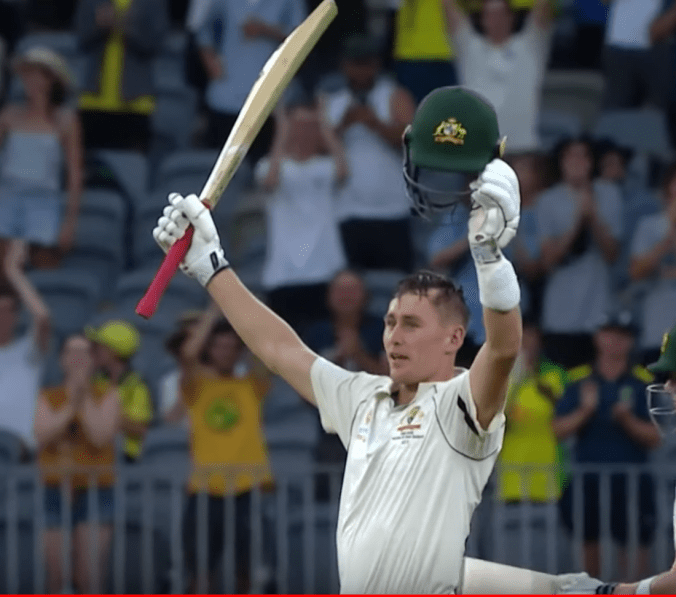
Yesterday during the First Test against New Zealand, Marnus Labuschagne scored his third consecutive century during the Australian Summer. He is an impressive young Aussie cricketer and has easily cemented his place in the nation’s first 11.

There is another quality about Marnus Labuschagne that I can point out to my children. For Labuschagne there is more to life than cricket and sporting success. Obviously, to play at such a standard he is clearly gifted at the game and no doubt he trains tirelessly, and yet, he is open to sharing what life is about for him.

He says, 

“Sport is a fickle game and injuries play a big part. In the big scheme of things, what you’re worth, what you put your value in, isn’t out there on the pitch; it’s internal and in Christ… cricket is always going to be up and down and if you have [Jesus Christ as] a constant in your life, it makes life a lot easier.”

His mum would write Bible verses in his shoes, to remind him of greater things, and on his bat there is a picture of an eagle, to remind himself of the Bible verse, Isaiah 40:31. “For those who hope in the Lord, He shall renew their strength. They shall soar on wings like eagles; they shall run and not grow weary, they shall walk and not be faint.”

This is such a healthy perspective to have on sports and life. You can enjoy the sport and keep God central. It is possible to be a leading international cricketer and practice Christianity. It is possible to love the game but have your identity found in Christ.

I haven’t met Marnus Labuschagne, but I’m encouraged by what I’ve heard him say.  I’m wrapped to find another Aussie sportsperson whom I can say to my kids, listen to what he just said, what he’s saying is true and worth thinking about. You can try to play cricket like Marnus Labuschagne and place “your worth…in Christ”.

You are more than an ATAR

60,000 teenagers from around Victoria are today finding out the results from their VCE. Many students will be pleased, many others disappointed. Some will be relieved while others will be anxious.

First of all, congratulations on completing the VCE. It is no small feat. Even though I finished the VCE last century, I remember it well, both the highs and lows, and mostly the lows. I stuffed up big time! My original plans went cascading down the mountain with such momentum that I was never going to stop that fall. However, I am so grateful for the way God used my mistakes and shortcomings to redirect life down the path where I find myself today, now 25 years after finishing school. It didn’t take me 25 years to grasp this; within a year of finishing VCE I became captivated by the way God began to orient my life along a new and more exciting road. I was still somewhat embarrassed by the way my school and friends were aghast at my performance but I was thankful for the new turn toward the future.

Screen Shot 2019-12-12 at 8.32.46 am.png

An ATAR is something but it is far from everything. Your ATAR isn’t the end of the story. To be blunt, a place in the top 1% doesn’t secure anything in life, except the first day of a university course of your choosing. 

To those students who are happy and content, well done. You are being rewarded for two years of hard work.

To those students who are dissatisfied, or even despondent now, life is so much more than study and school and university and even work. Yes, it opens doors that can lead to amazing experiences, but the likelihood is that the dreams and pursuits you now hold onto will change significantly from those you will have when you are 25.  Indeed, many of the happiest and most content people I know didn’t knock their VCE out of the park. Some were clean bowled and others didn’t get onto the pitch at all.

A word to parents, chill. Don’t measure your children by this result for they are worth more than a thousand top ranking ATAR scores and scholarships to university. Remind them,  they are worth more than their 99.95 or 75 or 35 or whatever score they achieve.

For both parents and kids the Lord Jesus has spoken a word that befits a day like this, whether we are feeling pumped or deflated.

Jesus gently warns us, 

19 “Do not store up for yourselves treasures on earth, where moths and vermin destroy, and where thieves break in and steal. 20 But store up for yourselves treasures in heaven, where moths and vermin do not destroy, and where thieves do not break in and steal. 21 For where your treasure is, there your heart will be also.”

Following, Jesus encourages us, 

 “Therefore I tell you, do not worry about your life, what you will eat or drink; or about your body, what you will wear. Is not life more than food, and the body more than clothes? 26 Look at the birds of the air; they do not sow or reap or store away in barns, and yet your heavenly Father feeds them. Are you not much more valuable than they? 27 Can any one of you by worrying add a single hour to your life?

28 “And why do you worry about clothes? See how the flowers of the field grow. They do not labor or spin. 29 Yet I tell you that not even Solomon in all his splendor was dressed like one of these. 30 If that is how God clothes the grass of the field, which is here today and tomorrow is thrown into the fire, will he not much more clothe you—you of little faith? 31 So do not worry, saying, ‘What shall we eat?’ or ‘What shall we drink?’ or ‘What shall we wear?’ 32 For the pagans run after all these things, and your heavenly Father knows that you need them. 33 But seek first his kingdom and his righteousness, and all these things will be given to you as well. 34 Therefore do not worry about tomorrow, for tomorrow will worry about itself. Each day has enough trouble of its own.”

This isn’t the final word

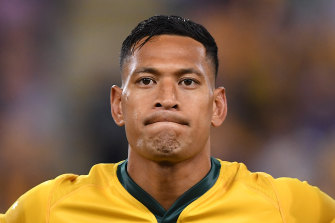
Rugby Australia and Israel Folau have come to an agreement. The terms of the settlement remain confidential but both parties have released a joint statement in which Folau affirms he never intended to offend anyone and where Rugby Australia apologise to Folau.

Israel Folau will be remembered as a greatly gifted player, who was nevertheless a disaster for rugby.

AAP

Not everyone is satisfied. Lawyers are expressing their preference to see the case played out in court, not necessarily because of prejudice against either party but for the sake of clarifying where Australian Law sits in regard to religious freedom. Other Aussies are disappointed because the case has ended in ex-communication for Folau rather than social execution. For 18 months, Peter FitzSimons has used his privileged place in the Australian media to call for and support the sacking of Israel Folau. He is far from the only voice, but Fitz has perhaps been the loudest and most consistent.  Writing in the Sydney Morning Herald yesterday, FitzSimons has expressed his disappointment over the final outcome and has tried to type out the final word on the Israel Folau saga.

“From the point of view of resolving the many issues raised, however – and more particularly holding Folau to account for his damaging actions – it is singularly dissatisfying.”

“As one who has followed the issues closely since Folau first disgraced himself by putting up a post endorsing the view that gays are destined for hell, and who has written and ranted about it extensively, I am more aware than most of the damage he has done, the hurt he has caused. In the 21st century, his homophobic gibberish – you heard me – simply has no place. And it is no excuse that the gibberish in question is sourced from the Bible. I was hoping the court would confirm that, hence the dissatisfaction.

It was for that reason my first reaction on hearing the news – and I write in the first few minutes thereafter – was the settlement was, firstly, a great pity. Secondly, my stronger reaction was I hoped RA kept the presumed payment to him to an absolute minimum.”

FitzSimons has been quick to call out rumours on social media that suggest the size of the settlement, and yet here he is, acting as a judicial speculator,

“have no inside knowledge of the terms, not even a hint, but my bet is it will be about $200,000 to $300,000…. Any sum more than that and I hope RA would have said, “bring it on, we’ll see you in court”.

Finally, he writes,

“Goodbye, Israel. You will be remembered as a greatly gifted player, who was nevertheless a disaster for rugby. The day you severed the final strands of your relationship with Rugby Australia was a good day for the game.

Good day to you, I said good day.”

FitzSimons may be posturing to give the final word, but this is far from over. The ‘Rugby Australia and Israel Folau’ chapter may have been signed off, but the issue of religious freedom in Australia is only just beginning.

Peter FitzSimons may not speak for all Australians, and probably not for mainstream Australia either, but he does represent a group of self-appointed moral arbiters who have significant public and influential voice. He has made it clear that believing and publicly affirming the Bible’s teaching on sexuality amounts to phobia and gibberish and it has no place in Australia today.

“In the 21st century, his homophobic gibberish – you heard me – simply has no place. And it is no excuse that the gibberish in question is sourced from the Bible.”

Back in July, Rugby Australia’s CEO, Raelene Castle, admitted that had Israel Folau only quoted Bible verses, that would be sufficient grounds to have him sacked. The Folau case was never really about contract law. This was always a case of cultural signalling, with Rugby Australia proving its wokeness to the world. Regardless of what one thinks about Folau’s post, he dared break the new moral code that is being pressed upon Australians, and that is, do not question the new sexual narrative. We are to fully subscribe to the new sexuality paradigm, and failure to do so requires a public cancelling and shaming. This forced social subscription may have found a high profile case in Australia but there are countless examples appearing all over the country, including Margaret Court, Coopers Beer, legislative moves by the Victorian Government, and more. Indeed, as Victoria pushes to ban conversion practices they have set the parameters so broadly that it may impact normal teaching and praying that occurs within church ministries.

Peter FitzSimons is an example of broad cultural ignorance toward the Christian Gospel. The entire premise of the Christian Gospel is that God disagrees with us, and yet he loves us. God’s disapproval of human attitudes and actions isn’t an example of phobia, and neither is Christian disagreement with the current sexual narrative. Peter FitzSimons is perpetuating the myth that the only good Christian is the Christian who embraces the atheistic ethic. Yes, it’s illogical and he is not entirely to blame.  It seems as though FitzSimons takes his theological education from the progressive Christian voices whom our culture hasn’t yet cancelled out. Of course, there is no need to silence the priest of Gosford and others. These are nice Christians who have signed up to the neo-Proletariat. They have given up the Gospel for a seat among our society’s culture club. Christians need to work harder at countering these fake Gospels and to do so in a manner that confirms the Gospel and not with the kind of behaviour that contradicts the message we claim to believe.

Like I said, the final word on religious freedom in Australia hasn’t been spoken.

The Federal Government’s religious discrimination Bill has recently returned to the drawing board, following criticisms from both religious and non-religious groups. As it stands, when it comes to religious freedom, Australian law remains unwritten.

Part of the reason behind this legal mess is because Australian law was not framed to deal with a culture that turns against the very belief system which provided its societal and legal foundations. Like a game of Jenga, you can only remove so many blocks before the entire structure comes crashing down. Of course, that hasn’t happened as yet, but that’s part of complexity facing many Western cultures today. How do we remove Christianity without destroying the very fabric upon which our culture depends?

Christians would be fools to bag their hopes in any future law. The law ought to function for the common good of all society (not only for Christians). The law should exist as a friend to its citizens by protecting freedoms. The difficulty of today’s Australia is that we have become the dog chasing its own tail. We allege freedom and toleration but by eating away at freedom and toleration.

More important than the law, will Australians learn to rediscover the art of civil disagreement? We are fast losing both the cognitive and moral ability to engage with opposing worldviews and to live together despite these differences. Social pluralism is being fast replaced by an ugly and authoritarian secularism that reigns with tackless hubris. Christians need to grow thicker skin and realise that the culture has set course. We need to stop that pointless dreaming about a ‘Christian Australia’ which by the way never existed, and we need to stop falling into modern trap of dumping our hope into the societal structures and systems. We must not give up on kindness, patience, or truth telling, on gentleness, love, or faithfulness. There is no need to play by the rules that Rugby Australia, Peter FitzSimons, and others insist upon. Hell is too awful and heaven too wonderful, and we want to serve our fellow Aussies well by offering a better story.

God is not unjust; he will not forget your work and the love you have shown him as you have helped his people and continue to help them. We want each of you to show this same diligence to the very end, so that what you hope for may be fully realized. We do not want you to become lazy, but to imitate those who through faith and patience inherit what has been promised.” (Hebrews 6:10-12)

Marat’s Assassination on QandA

I’m not an anti-ABC Aussie, but sometimes I suspect they are trying to convert me.

One program I gave up on long ago is Monday night’s QandA. I wouldn’t have known about last night’s program except The Age’s Neil McMahon was praising it, and there was this one segment from the program that kept appearing and reappearing on my twitter feed all day, like a fly buzzing around the dining table in summer.

Screen Shot 2019-11-05 at 8.10.03 pm.png

An audience member by the name of Murray (not this Murray!) asked the question,

“When trying to bring about significant change, when is aggression and violence a better option than assertiveness, strong arguments and modelling the behaviour you expect of others?”

Among the 5 female panellists, there was no-one suggesting that we turn the other cheek or love our enemies. There wasn’t any air of justice either, just simple revenge-seeking, fear-mongering and hate.

Mona Eltahawy said,

“I have an answer for this that a lot of people do not like. I want patriarchy to fear feminism. And there is a chapter in my book on violence. There is a chapter in my book about white women who voted for Trump and white women who accept crumbs from patriarchy because they allow their whiteness to trump their gender. I’m fully aware of this. But at the end of the day, even those white women have to recognise that nothing protects them from patriarchy.

Nothing. For me, as a feminist the most important thing is to destroy patriarchy. And all of this talk about how, if you talk about violence, you’re just becoming like the men. So, your question is a really important one but I’m going to answer it with another question. How long must we wait for men and boys to stop murdering us, to stop beating us and to stop raping us? How many rapists must we kill? Not the state, because I disagree with the death penalty and I want to get rid of incarceration and I’m with you on the police. So I want women themselves… As a woman I’m asking, how many rapists must we kill until men stop raping us?”

Fran Kelly then asked Murray what he thought of the answer. Murray (who sounds way too sensible for this program) suggested,

“if you think about bullying, bullying begets bullies, so, violence begets violence is what I’m seeing.”

Jess Hill then joined the growing chorus,

“Well, you know, it’s interesting. I think if anyone is shocked by what Mona is suggesting, you just have to look back to history and a certain faction of the suffragettes in the earlier 20th century. They used violence. They thought what they were fighting was a civil war between the sexes. They smashed windows. One suffragette actually went up to a young Winston Churchill in 1909 and whipped him with a horse whip at a railway station”. 

Reminiscent of the knitting ladies watching the guillotine in Paris during the French Revolution,  not one of the 5 women on the panel came out in opposition, instead, there was broad support for the use of mob like violence. Apparently, it is okay to assault people if you don’t like their moral or political views. In fact, it is even okay to murder them. Yep, their words are astonishing and incredibly reckless, but that’s the game of social politics today.

For a few moments, I did wonder, perhaps one or more of the panellists have experienced personal violence against them or against their family at some point. If that is the case, one can understand and even sympathise with some of the anger. I even understand the notion of self defence. But these were not just angry words, this speech was advocating violence.

In all the spittle that was landing on the studio floor last night, none of it bared any semblance of originality of thought or constructive commentary. It just sounded like the kind of neo-Trotskyism that has captivated so many parts of the Western world at this time. It has very little to do with justice and righteousness, and a lot to do self-aggrandisement.  It is a brand of social speech that’s turned into a competition to out shock your opponents. Over the last 2 years ‘cancel culture’ has become a thing: if you disagree with someone you destroy their reputation. These women have decided that cancel culture doesn’t go far enough. In the fine tradition of both the extreme left and right groups, to achieve goals we need to commit acts of violence. It’s pretty daft and it’s also dangerous.

Imagine if a male panellist advocated for violence on the program last night? It doesn’t require much imagination to know what the reaction would be if a conservative had even vaguely implied the possibility of non-State-sanctioned violence. After all, QandA’s history is littered with reasonable men and women supported ideas that even 10 years ago were considered commonsense, but today it’s considered heresy, and so they have been on the receiving end of grotesques verbal reprisals.

To justify the use of violence and murder, Mona Eltahawy claimed that,

“It’s throughout history, no-one has ever gotten their right or their freedom by appealing to the moral sense of their oppressor.”

No one? It didn’t take me long to think of someone. As I cringed through the 5 minutes clip from QandA, I remembered another video I watched, only a couple of weeks ago. It featured a young man speaking in a courtroom and addressing the woman who had murdered his older brother. Brandt Jean looked at Amber Guyger and told her that he loved her. He spoke of a God who forgives. He then asked the Judge if he could approach Guyger and give her a hug.

Which message is better? Which message is more likely to bring about a beneficial and positive outcome? What message gives hope to both the oppressed and the oppressor? The answer is pretty obvious.

The one to whom Brandt Jean pointed Amber Guyger, was the man called Christ. The records show that he was brutalised and murdered by the cancel culture crowd of first-century Judea. The astonishing thing is,  he had the position and power to avoid that outcome but he chose to undergo this ignominious suffering for the sake of those who hated him. It is, what the Bible calls, propitiation (Romans 3:25). For God so loved those who did not love him nor treat him as we ought. Perhaps next time on QandA we can have panellists sharing and advocating that kind of good news message.

Victoria to outlaw Conversion Therapy (part 1)

This is the first of a series of articles that I’m aiming to write on the topic of Gay Conversion Therapy. The Victorian Government has announced that it will introduce legislation in 2020 to ban Conversion Practice (Therapy) in Victoria. While the original issue was gay conversion therapy, the scope has been broadened to include any and all sexualities, including transgenderism.

img_9452

I wrote on this topic twice last year, and on both occasions, I expressed concerns with conversation therapies. It is important for readers to hear that I am not supportive of certain practices. I have explained

“To begin with, testimonies of gay conversion therapies are disturbing. Far from being ‘normal,’ these practices belong to fringe religious groups, finding little or no support amongst mainstream Christian Churches and theology. As a Christian, I do not support or agree with gay conversion therapy, as defined in terms of using pseudo-scientific and unbiblical spiritual methods to change a person’s sexuality. I feel for those who have undergone these traumatic experiences, wishing that they had not, and praying that they will find true and lasting recovery and peace.

The conversation is important because the health and life of LGBTIQ Australians matters enormously. They are not pawns to be played in political games, but human beings made in the image of God, and who ought to be treated with dignity.”

Having said this, and without taking anything away from Victorians who have been subject to dangerous and unethical practices, there are serious questions here and concerns that must be adequately addressed by the Government before considering any legislation.

The Government has invited Victorians to give feedback on the issue, although the process appears to be a furphy. In the same opening remarks that invite Victorians to offer their views, the Government also makes it clear that they intend to ban conversion practices.

“In February 2019 the Victorian Government committed to prohibiting harmful LGBT conversion practices.

Conversion practices are any practices or treatments that attempt to change or suppress a person’s sexual orientation or gender identity.

We’re asking Victorians to have their say. We want to know how you think the law can prevent the harm caused by LGBT conversion practices and protect and support LGBT Victorians.

The feedback you give us will inform the way the government approaches the ban and help shape the law.

The commitment to the ban follows the Health Complaints Commissioner Inquiry into Conversion Therapy report (HCC Report) which recommended the introduction of legislation to ban the practices in Victoria.”

Despite this Government exercise sounding awfully like a case of confirmation bias, I intend to proceed, for like I said above, “the health and life of LGBTIQ Australians matters enormously. They are not pawns to be played in political games, but human beings made in the image of God, and who ought to be treated with dignity.” In addition, there are also very real and relevant issues here relating to religious freedom. I will address these in a later post.

In this post, I want to draw your attention to the Report, Preventing Harm, Promoting Justicewhich forms a basis for the forthcoming legislation. The Report was a joint exercise between 3 organisations, the Human Rights Law Centre, La Trobe University,  and the Gay and Lesbian Health Victoria.

One might expect that an academic report of this importance would be thorough and broad, encompassing different perspectives and listening to a breadth of experiences, from those who have undergone conversion practices to those who have been practitioners and with others who have advocated against them.

Surely the researchers interviewed hundreds, if not thousands of people. Surely dozens of organisations were included in the process for comment, both religious and secular groups. Did they interview anyone who practices conversion therapy? The answer seems to be, no. The report upon which the Victorian Government is building its case to ban conversion practice depends largely on the stories of 15 individuals who each allege a negative experience of gay conversion practices.

The report,

“reveals the voices and lived experiences of 15 LGBT people who have struggled to reconcile their sexuality and transgender identities with the beliefs and practices of their religious community.”

“Nine participants identified as male and gay, two as female and lesbian, two as transgender, one as female and bisexual and one as non-binary. Thirteen participants were from Christian backgrounds, one from a Jewish background and one from a Buddhist background.”

Surely 15 individuals is an inadequate pool size from which to draw substantive conclusions. More importantly, the research appears to be guilty of sampling bias. The recruitment process was limited to a narrow range of networks, which inevitably biased the sampling group that would be chosen.

“Participants were recruited through social media, LGBTI media reportage of the project, and through various LGBTI, queer and ex-gay survivor networks. Participants were selected, using theoretical sampling, to be broadly representative of religious and LGBT demographics in Australia, and were screened for their psychological capacity to undertake an in-depth life interview about potentially traumatic personal histories.”

Significantly, no persons from Muslim, Hindu, or irreligious backgrounds were interviewed, and only persons who were negatively impacted are included in the report. While the 15 participants are Australians, it is not known how many were recipients of conversion practices in Victoria, which I would have thought is important for the given context.

It is also important to note that the report was co-written by an LGBTI advocacy group and by La Trobe University (which is famously responsible for orchestrating the Safe Schools curriculum). The credibility of the research is further weakened by the fact that the project steering committee consisted of representatives from LGBT lobby groups and progressive religious groups. To my knowledge, not one of the advisors represents a faith group that holds to the traditional understanding of sexuality and marriage. Why is that so? 

In other words, from beginning to end, this report is skewed. Even before one word was written, the trajectory was obvious. In my opinion, the report is biased, narrow in its engagement with relevant parties, and relies on a selected group of advisors who are predisposed to criticise beliefs and practices that don’t fully support LGBTIQ ideologies and lifestyles.

Once again, I am not arguing against the experiences of the 15 people and neither am I advocating for the kinds of therapies mentioned in the report. Pseudo-psychological and or spiritual practices aimed at altering a person’s sexuality can be harmful.  However, the Government’s adoption of the HRLC report is no way to put together public policy, let alone for establishing Government legislation. The HRLC  report may be used as a position paper but little more.

Victorians have been given the impression that Conversion Practices are widespread across the country and endemic within religious organisations, especially among Christians. The report states that, “Nonetheless, the ideology of the conversion therapy movement has become mainstreamed in many conservative Christian communities.” The reality is very different, and despite comments like in the previous sentence, the report evidences that the practice is marginal at most.

When a journalist from the ABC contacted me back in 2017, to ask what I thought about gay conversion therapy, I answered, 

“that sounds awful…I don’t know anyone who practices this and so I couldn’t even tell you who to speak to about it…I wouldn’t want  anyone subject to this kind of counselling and I don’t know anyone  who has been.”

If these conversion therapies are not a widespread and common practice throughout Victoria, one begins to ask, why is the Government making this into such a significant public issue, even warranting laws to prohibit practices that are voluntarily undertaken by people? I suspect part of the answer lays in the proposed definition of conversion practice, which will be the subject of my next post.


There was a typo earlier, which read HCC report, not HRLC. I have since fixed this

Churches need to be more like the world?

I’ve just read Nikki Gemmell’s latest contribution to The Weekend Australian, “Why the Anglican church must evolve or die”. At first, I assumed this must be satire, for the essence of her argument is that for Churches to succeed they need to become more like majority culture!

“the majority of Australians do support same-sex marriage. It feels like the archbishop is damaging his church and Jesus’s teachings of tolerance, gentleness and inclusivity. “

“The church has been on the wrong side of public opinion recently on abortion as well as same-sex marriage. It’s slowly killing itself by refusing to open its heart to others.”

gndwebprofile_thumb


Without question, Gemmell’s call to the Anglican Church sounds almost identical to what Jesus says, in a dysutopian Hitchhiker’s Guide to the Galaxy kind of way.

“If the world hates you, keep in mind that it hated me first” (John 15:18)

“If you belonged to the world, it would love you as its own. As it is, you do not belong to the world, but I have chosen you out of the world. That is why the world hates you.” (John 15:19)

“When he comes, he will prove the world to be in the wrong about sin and righteousness and judgment” (John 16:8)

“What good is it for someone to gain the whole world, yet forfeit their soul?” (Mark 8:36)

It’s almost as though Jesus is saying the precise opposite of Nikki Gemmell. Jesus doesn’t think the world is always the best measure for what is good and true. Indeed, it’s pretty obvious that Jesus is telling us that the world’s understanding of life is frequently at odds with God.

The wonderful paradox that is Christianity is that while the world’s beliefs oppose those of God in his word, and while God stands in judgment over a world that subverts his creational purposes, God still loves. “For God so loved the world”. This love is not a sign of moral alignment with our culture, far from it.

“For God so loved the world that he gave his one and only Son, that whoever believes in him shall not perish but have eternal life. 17 For God did not send his Son into the world to condemn the world, but to save the world through him. 18 Whoever believes in him is not condemned, but whoever does not believe stands condemned already because they have not believed in the name of God’s one and only Son. 19 This is the verdict: Light has come into the world, but people loved darkness instead of light because their deeds were evil”. (John 3:16-19)

To be like Jesus isn’t to support same-sex marriage, abortion,  and a myriad of other popular moral messaging, but it does involve loving those who are different and to desire their good despite vehement disagreement.

Gemmell’s offering is such a silly argument. Only the majority are ever naive enough to believe that majority equals right. Majority opinion or minority opinion doesn’t establish a position as right or wrong, just popular or unpopular. In addition, being in opposition to majority opinion doesn’t make one’s own position any more correct. It could be the case that both groups are advocating stupid ideas. What makes Christian belief, well, Christian, is that it conforms to the Christian Bible, as rightly understood through the lens of Jesus Christ. In the case of Glenn Davies’ recent comments to Anglican Bishops, they may be uncomfortable and even sound intolerant, but Jesus and the Apostles also used pretty strong language toward leaders who attempted to subvert his Church with erring ideas. That’s the point, the Sydney Anglican Archbishop was calling out fellow bishops who have abandoned Christian doctrine in favour of popular culture.

Not only does Gemmell equate Church success with supporting what the majority of Australians believe, but she also makes another blunder by lumping everything she doesn’t like about Churches under the same umbrella of ‘bigotry’.  This is poor theology and it is misleading sociology. For example, the Sydney Anglican Diocese believes strongly in mandatory reporting, whereas the Catholic Church does not support it.  However, the former is an expression of Christian concern that arises from biblical principles, the latter is the result of longstanding tradition but not Biblical principles. Apples and Pineapples may share the same name but they are hardly the same fruit. As an Anglican, Gemmell should know better.

To be sure, Christians sometimes espouse Christianity with a distasteful tone. That is disappointing and dishonours the good news that is our message.

Nikki, Gemmell is correct about one point, and that is when she notes how Australians are confused about Churches and Christianity.

“The public image: a riven and confused church that doesn’t quite know what it stands for but is pushing people away in the process. Not only members of the congregation but non-churchgoing parents with children in Anglican schools.”

Yes, there is confusion. The average Aussie is confused because there are Churches leaders taking her advice and diluting the Christian message with the dominant moral posturing of Aussies. They are confused because there are ‘Christians’ redefining Jesus into their own image in order to support all manner of popular sexual revisionism. The answer, however, isn’t for Churches to give up Biblical Christianity and to adopt more of society’s moral inclinations. We need our Churches to be more biblical, not less. We need our Churches to be more like the Lord Jesus, not less.  For what have we offer Australian society if all we are doing is preaching the society’s values back to itself? Could it not be the case, that Christian Churches are convinced that God’s design for human life is better and more satisfying than some of the alternatives that have currently captured the imagination of pop culture?

To quote one famous Anglican Bishop, who facing the unpopularity of 16th Century England, stood firm and found himself in a public firestorm, “Be of good comfort, and play the man, Master Ridley; we shall this day light such a candle, by God’s grace, in England, as I trust shall never be put out.” 

The major problem with Gemmell’s presentation is that she equates Christian gentleness and tolerance with agreement of current cultural norms. For Gemmell, to be the Church of Jesus Christ is to say yes to what the majority of Australian want in regard to sexuality and abortion. What a puerile thing to say.

Does she not realise from history that Churches who align with the values of majority culture are those most likely to witness decline? While Churches who believe, teach, and practice good old fashioned Christianity are more likely to experience growth. It is a demonstrable fact of history that people have been persuaded by the truth and goodness of Jesus Christ because Churches have stood out as distinct from the surrounding culture.

I’m still not convinced that Nikki Gemmell’s piece isn’t satire. If it is,  I’m just slow to see the humour, then I apologise for my sluggishness; it is Saturday morning after all.

Ridley College explains its position on marriage

A good news story has come out of Melbourne evangelicalism this week. In what may be a first, an Australian theological College has produced a formal statement about their position on marriage.


download.png

Ridley College in Melbourne has released a letter in which they affirm the biblical (or ‘traditional’) understanding of marriage. They explain the reason behind the decision to articulate the College’s position,

“Our purpose in writing this brief letter is to support our fellow Anglicans in wrestling with this issue by offering a summary of the scholarly discussion over what the Bible teaches on homosexuality, and an explanation for why we believe the traditional path on marriage and sexuality is the one that Christ is calling us to take.”

Ridley’s influence extends beyond the Anglican communion, touching denominations across Melbourne and indeed around Australia. Accordingly, this letter is an encouragement not only to Anglicans, but also to Baptists, Charismatics, Presbyterians, and others.

The document goes onto outline 3 primary views on marriage that are held by various people under the Christian umbrella. They explain why Ridley College rejects both the revisionist and the progressive view on marriage, and instead why they affirm the belief that “Bible teaches that sex is designed for marriage between a man and a woman, and that we should do what the Bible says”.

You can read the full letter here:

Two weeks ago I wrote about the mounting pressure on Christian organisations to either capitulate or accommodate to the current sexual morality. Many other denominations and leaders have chosen to defer or kick the can down the street, so to speak, as though avoiding the issue is dealing with the issue. Ridley College has chosen the third and only proper Christian option, faithfulness.

As the letter makes clear, Gospel fidelity doesn’t stand in opposition to love and grace, rather it is a rightly ordered expression of these virtues. Adhering to the classical understanding of marriage doesn’t diminish the beauty of the Gospel, but is a God-given reflection of the good news of Jesus Christ.

“We are convinced that the biblical vision for human sexuality is clear. We also believe that it is beautiful, and that God’s commands are for our good as well as for his glory.”

The letter opens by acknowledging that this no mere academic exercise for these scholars,

“We acknowledge that homosexuality is a difficult topic to discuss. This is not because the Bible’s teaching on marriage and sexuality is especially unclear, but because its implications are so deeply personal. We are Bible scholars, but we are also people. All of us have wrestled with God’s teaching on marriage on a personal level as it relates to those we love –  our children, our friends, those we pastor  –  and indeed to our own lives.”

The letter also rightly points out the wonderful example in our churches of same sex attracted believers, who have chosen fidelity and godliness over and above the narrative that is being fed to us in almost every part of the culture, and which is sadly becoming normalised within some of our churches and institutions. 

As I read this sentence, “The traditional path may be a hard one to travel, but it is the one we are called to take”, I was reminded of the College’s namesake, Bishop Nicholas Ridley. Almost 500 years ago, Nicholas Ridley taught against erring doctrine and practised what he believed was in line with Biblical Christianity. He did so in the face of severe opposition, which ultimately cost him his life. His famous example reminds the Churches that holding onto biblical truths rarely garners popular adulation, but it does prepare the soil for a Gospel harvest.

God honours faithfulness. I suspect that there will be some backlash as a result of this letter but isn’t that what the Lord Jesus taught us to expect as we follow him in this world? Faithfulness is almost always hard, and it may create some difficulties for us in the days ahead, but faithfulness never fails in the end.

 It gave me great joy when some believers came and testified about your faithfulness to the truth, telling how you continue to walk in it. I have no greater joy than to hear that my children are walking in the truth.” (3 John 3-4)

I am thankful to God for Ridley College’s public testimony in this letter. We can pray that other Christian colleges and institutions have the courage to follow suit.

A Corinthian Tale

Because I do not love you? God knows I do!” 

(2 Corinthians 11:11)


There are growing signs that the ecclesial weather is changing and our churches are not prepared.

As the broader culture becomes more insistent about its moral narrative, Churches have become less certain. Universities, media personalities, and political representatives vocalise a secular righteousness with increasing confidence, while ecclesial leaders pray that kicking the can down the street will do the trick.


P1017923.JPG

Last Sunday I preached on 2 Corinthians ch.10 at Mentone. The Church in Corinth was known as an ‘inclusive’ community: they had welcomed ‘false apostles’ into their midst and they had accepted members who followed the sexual ethics of the city. The Apostle Paul responded by pointing out that their accommodation didn’t strengthen Christian unity and witness, but rather they had caused significant harm to both these things. As he later exclaims, “you put up with it easily enough” (11:5).

The Apostle takes a very different posture to the one we are seeing many clergy adopt in the current climate. Instead of moral silence, Paul speaks up. Instead of accommodating heterodox ideas, Paul tackles them. He also explains his motivation for speaking up and calling out bad ideas; he wants to see the church built up (v.8) and the Gospel grow out (vv.15-16). He isn’t driven by bigotry and narrow mindedness,  it is love that galvanises him into action. Paul loves the Corinthians too much to simply hand her over to divisive and destructive ideas. For the Apostle, such de facto fellowship contradicts the identity of the local church,

“Do not be yoked together with unbelievers. For what do righteousness and wickedness have in common? Or what fellowship can light have with darkness?  What harmony is there between Christ and Belial? Or what does a believer have in common with an unbeliever? What agreement is there between the temple of God and idols? For we are the temple of the living God. As God has said:

“I will live with them
and walk among them,
and I will be their God,
and they will be my people” (2 Corinthians 6:14-17)


Over the past month, there have been developments regarding how Christian Churches in Australia are handling the issue of same-sex marriages. While the outcomes are yet to be determined, the signs are ominous and Christian denominations across the nation must discuss and decide how they are going to respond.

Wangaratta Anglicans 

The initial incident relates to the Anglican Diocese of Wangaratta. The Anglican Communion in Australia formally holds to the classical understanding of marriage. There are, however, some who wish to navigate around this by instituting ‘blessing ceremonies’ for same sex couples. In August, the Wangaratta synod voted to permit same sex blessing ceremonies for couples who have been married (67 in favour, 18 against, and one abstention). Retiring Bishop John Parkes led the way in calling for his Diocese to support the practice.

The Primate, Archbishop Philip Frier, responded to concerns raised among numerous Anglicans across Australia by referring the matter to the Appellate Tribunal. It is believed that this process may take many months, and the outcome is less than certain. Archbishop Frier asked that Wangaratta refrain from using their newly adopted service until after the Tribunal has looked into the case. Bishop Parkes subsequently agreed to delay, although I believe some kind of ceremony still proceeded over the weekend, following the very public wedding of two male Anglican priests.

Dean of St Andrew’s Cathedral and member of GAFCON Council, Australia, Rev Kanishka Raffel, referred to the move in Wangaratta as apostasy, the formal walking away from the faith. He asked, how can one bless (in God’s name) something God does not bless? Indeed, how can one invoke the name of Jesus for a union that Christ opposes?

The Archbishop of Sydney, Glenn Davies, noted parallels with the situation in Canada which gave rise to the breaking of the global Anglican Communion,

“The circumstances of this event are reminiscent of the actions of the Diocese of New Westminster in Canada in 2003. It is now universally acknowledged that those events were the beginning of the ‘tear in the fabric of the Anglican Communion’. Moreover, to claim the authority of our Church to carry out a service of blessing contrary to the biblical view of marriage and the doctrine of our Church will certainly fracture the Anglican Church of Australia.”

What will Churches decide?

We need to appreciate that this is not a merely theoretical or hypothetical question. No Christian denomination or Church in Australia can afford to play dodge ball with the marriage issue. As far as I can see, there are only three options available for churches and denominations: choose capitulation, accommodation, or faithfulness.

Most Christian associations will reject the first option. The second, however, is finding traction among some associations. For example, this was the approach adopted by the Uniting Church. But of course, accommodation is in reality just a politically correct and ultimately dishonest way of capitulating to the new sexual narrative. It demonstrates that either we don’t know what the biblical understanding of marriage is or that we don’t believe it’s so important that agreement is necessary for Christian fellowship and unity. It is this disingenuous compromise position that some Anglicans are also advocating.

Doing nothing is not a solution. To ultimately decide on inaction is a form of accommodation. In Victoria, at least one same sex wedding has already been conducted in a Baptist Union Church. There are at least a few Baptist Churches that have either already sanctioned same sex blessing services or are considering them. Further, recent events have once again demonstrated that there are clergy and churches who have no intention of giving up their cause. Davidould.net last week revealed the public stance of yet another Church, St John’s Toorak, 

“We deeply regret that at the present time, it is not legally possible for Anglican clergy to conduct marriage services for couples of the same sex. We look forward to the day when we will be able to do so. Until this legal problem is addressed, however, the clergy of St. John’s would be pleased to welcome any couple, including couples of the same sex, to have a service for the blessing of their marriage, including a renewal of vows, following a legal marriage conducted by a celebrant licensed to do so.”

Over the weekend the Anglican Bishop of Newcastle Dr Peter Stuart publicised intent to begin practising same-sex blessings, following approval by the Synod. In his letter he explained,

“Conversations about human sexuality

There is no doubt that these ‘Private Members’ Bills will cause anguish to some in the Diocesan community as well as being a cause of celebration for others. In a real way the debate that has being underway in the Anglican Communion for over 20 years, and is a very current debate in the Anglican Church of Australia, will be a live debate in the formal processes of our Diocese. Our engagement with and response to LGBTIQ+ Anglicans has been actively discussed for some time.

The Doctrine Commission of the General Synod has published a series of essays as part of this conversation (https://anglican.org.au/wp-content/uploads/2019/07/Marriage-Doctrine-Essays-Final.pdf)

I shared with the clergy recently a summary of the main standpoints of Anglicans that has been workshopped by Bishops Stephen Pickard and Michael Stead –

1. The church should exclude those with LGB identity because it is a sin

2.The church should encourage a person to repent of LGB identity and seek to live as a heterosexual

3.The church should fully and unreservedly welcome people who are LGB, but expect them to live in singleness and abstinence

4. The church should fully and unreservedly welcome LGB couples who live a celibate life

5.The church should fully and unreservedly welcome LGB couples who live in a legally

recognised civil relationship/same-sex marriage

6. The church should endorse a liturgy to bless the marriage/relationship of LGB couples

7. The church should solemnise LBG marriages as a religious marriage

All of these views are expressed within our Diocesan family and will be present within the Synod.I have written previously to the Synod about my experience of the National Meeting of Bishops. I am looking forward to Bishop Pickard assisting the Synod frame this significant conversation.

The Primate has already referred a similar regulation to

Blessing of Persons Married According to the Marriage Act Regulation 2019 from the Diocese of Wangaratta to the Appellate Tribunal. Should our Synod pass this regulation and/or the Clergy Discipline Ordinance of 1966 Amending

Ordinance 2019 it is likely, and to be welcomed, that the Primate would refer them also to the Appellate Tribunal. The combined processes of Diocesan Synods, the General Synod and the Appellate Tribunal over the next two years will fashion what is lawful in the Anglican Church of Australia and what approaches Diocese’s will take.”

It is clear how Peter Stuart wishes to proceed. The argument is simple, effective, and completely misses the point of Christian praxis. To summarise,  the suggestion is,  given the diverse opinions within a denomination it is only appropriate that freedom is given to clergy and churches to practice whichever position they see fit. It’s as though Peter Stuart read Judges 17:6 and mistook it to be an endorsement!

“Everyone did what was right in his own eyes.”

The longer Christian associations kick the can down the road, the harder it will be to pick it up. The Church should never be treated in such a reckless way. She is precious and holy to God. Delaying or wishing away difficult decisions will only result in further confusion and harm. Not only this, these matters relate to real people who are made in God’s image; to offer them misleading hope and blessing amounts to a grave betrayal of trust and truth. By following the Gospel, our churches ought to be safe and welcoming communities for people who don’t identify as heterosexual. As people who have ourselves experienced sexual brokenness and sin, and have come to know God’s love and mercy in Christ Jesus, how can we not embrace others? But blessing that which God does not bless is not loving our neighbour but is performing the worse kind of misrepresentation.

Of what use is a doctrinal statement if churches can freely ignore or reject articles without consequence? Of what benefit is a definition of marriage if churches and pastors can circumvent the rules and pursue alternate avenues without disciplinary procedures both defined and enacted? These clergy and churches have either broken fellowship or they have not.

If a pastor or Church no longer subscribes to the theological convictions of the Church/denomination surely it is a matter of integrity that they resign and leave the Church and/or denomination. If they refuse, surely it is the responsibility of the broader fellowship to call them to repentance, and should they persist in their views, they ought to be disaffiliated. 

To borrow Paul’s analogy in Ephesians ch.4, our associations are becoming like ships without a rudder, being blown and tossed about by whatever cultural wave is currently landings on the shore. The difficulty is, in the face of intense cultural conditions and fears of losing people and especially money, many leaders don’t want to touch the rudder. In the meantime, the ship is getting beaten up and the Sirens of Sirenum scopuli are luring churches closer to the rocky shoreline.

Will not God honour the faithfulness of his Church? Will God be displeased if we choose his good design? Choosing faithfulness is unlikely to win over many fans among the cultural elites but why should we allow their agenda to determine our actions? It may be counter-intuitive in today’s climate, but remember, Christian sexual ethics was also foreign to First Century Corinth. Paul makes the very point to the Church in Corinth that trusting and living out Christian sexual ethics will not detract from Christian unity and Gospel growth; the opposite is the case. The Church will be built up and the Gospel will grow out (2 Cor 10:8; 15-16).

Will our churches choose faithfulness over accommodation. Do we desire Gospel unity over religious diversity? We can’t predict how everyone will respond, whether those inside our churches or in the community at large, but we can be assured that God will honour the faithfulness of his people.