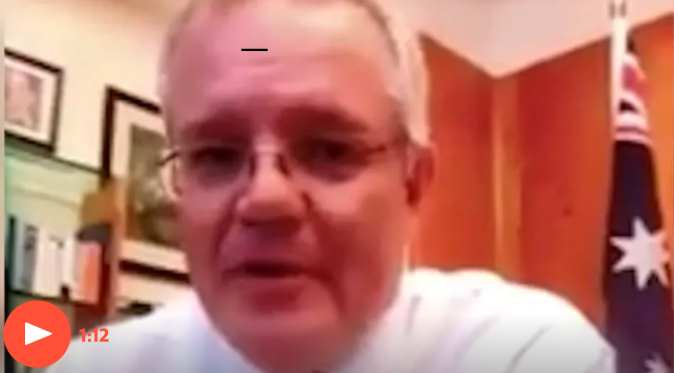
Here’s a video message that I gave to my church last night outlining what we are doing and why
We have communicated with the Mentone family our policy for COVID-19. Of course, with changing circumstances, the policy may well change over coming days. I’ve posted a copy here for readers as an example of what one church is communicating.

Dear Church,
Over the last two Sundays at Church we have explored Jesus’ apocalyptic teaching in Matthew’s Gospel. Our preaching schedule is usually organised months in advance and in God’s providence he has been provided us with a timely word. In light of living in this age, the Lord Jesus cautions us against both alarmism and complacency. We don’t need to resort to panic or irrational behaviour because God is Sovereign and the Lord Jesus remains on the throne. Neither should we be careless or thoughtless.
The certainty of our hope in Jesus Christ gives us great freedom and impulse to love our neighbours. A significant way we can serve one another during this current health crisis is to adopt sensible measures as a church.
Mentone Baptist Church will follow government and health department advice and wish to put forward the following as our policy from today:
1. If you have been in countries now on the travel ban list or have high cases of infection (China, South Korea, Iran, Italy), you are required to quarantine yourself for two weeks before gathering with your brothers and sisters from Mentone Baptist Church.
We expect this list will expand in the near future. In light of this, we are requesting that anyone who has recently travelled internationally to not attend Sunday services for 2 weeks (upon the date of your return to Australia).
2. If you suspect you have been in contact with any of the community COVIC-19 infections that are being reported in the news, please consult a GP and also self-quarantine.
3. There are also regular colds beginning to circulate among us that aren’t and won’t be COVID-19. We ask that you use commonsense. If it is not COVID-19 there is no need to quarantine yourself. However please be mindful of others in the church community and minimise the chances of infection by taking care in your personal contact and when we gather.
4. As a policy, we will now be urging our church members not to shake hands or hug (or high-five) with one another. Given the nature of Christian community, this is not easy among brothers and sisters in Christ, but we do so in order to love our neighbour and honour those who are in authority over us.
5. In addition, cover your mouth and nose when coughing and sneezing with a tissue, or cough into your elbow.Dispose of the tissue into a bin and then wash your hands afterwards.
6. Wash your hands regularly, using soap and water, including after using the toilet, and before eating. Alcohol-based sanitiser (greater than 60 per cent alcohol) is a good back-up if soap and water is not readily accessible.
7. If you are planning not to attend a service, we encourage you to contact us (Mike or myself) and let us know how you are going and if there is anything we can be doing to help.
We are monitoring advice that is being issued from the BUV (Baptist Union of Victoria) and from Government agencies. We will keep you informed if the situation arises where we need cancel public gatherings for a period of time (inc. Sunday services). In the event of cancelling public gatherings, we will inform you of alternative arrangements (ie livestreaming).
We encourage you to look after each other by following these steps. Also, given there is a shortage of some supplies in supermarkets, if you are needing something please ask people in our church family. The church’s private facebook group is an easy way to do this. Let us show generosity toward one another. Let us check on the elderly in our church and ensure that are ok. Let us pray for each other, and pray for our local community.
Above all, know that the Lord Jesus is sovereign over his people and he tends his flock like a shepherd (Isa. 40). We have his love and peace and security over our lives because nothing can separate us from his love (Rom. 8). So go in peace to love and serve him even in the midst of this crisis. Speak liberally and graciously about the peace Jesus offers to those who are most anxious and worried at this time.
In what may be a betrayal of much contemporary philosophising about boys and girls, I’ve just a read an article in The Age arguing the case for single sex schools, “particularly for girls”.
Loren Bridge (Executive Officer of the Alliance of Girls’ Schools Australasia), contends that while,
“Positives can be found in every type of education, but there are just so many more positives for girls in a single-sex school.”
This educator suggests that both research and experience demonstrate that girls perform better academically and adapt better socially in a single sex environment,
“There is simply no doubt that single-sex education benefits girls. Research shows unequivocally that girls thrive in an all-girls environment – they do better academically, socially and emotionally. Not just a single study but a plethora of data from across the world supports these findings.
Research aside, you only need to visit a girls’ school to see the difference. Girls in co-ed schools tend to be more self-conscious and less confident. They are less likely to speak up in class, ask questions or take on a leadership role. They are also more likely to have a negative body image and to experience sexual harassment or bullying. In contrast, those in girls-only environments feel empowered to be themselves. They participate more freely in discussions, are more competitive and take more healthy risks with their learning – skills that are advantageous for life success.”
But hang on, I thought there were no differences between boys and girls? Until recently it was permissible to acknowledge biological differences between girls and boys, but no longer. Talk about biological distinctions is now considered social blasphemy and a quick route to public cancelling (see here for an example). Why? The woke brigade preach’s that biology has no bearing on what defines a boy and girl, because boys can fall pregnant and girls can have a penis.
![]()
What is interesting about the article is that Loren Bridge isn’t discussing physical differences; she goes much further. She suggests that there are psychological and social differences between the sexes, such that it warrants single sex classes in schools. Whether conscious or not of the fact, she has crossed the line and entered that chilling space known as woke heterodoxy.
I happen to agree with her. As a Dad with two boys and a girl, it’s one of those self evident truths; boys and girls are not the same. Gender makes a difference not only with appearance and physical attributes, but it also impacts how we think, react, and relate. This is not something to be ashamed of or to be denied or ignored, but is part of who we are. In making male and female, God didn’t make a mistake.
To be sure, cultural conditioning influences the way boys and girls view themselves. But this cannot fully explain the why’s and how’s and what of boys and girls. As Bridge has noted, it is the case that some approaches to education work better simply because boys and girls are not the same.
As a parent with a daughter I found Bridge’s article interesting and persuasive, but I’m also conscious that her opinion contradicts the Victorian Education Department’s own understanding of sex and gender (as evidenced by the Safe Schools and Respectful Relationships Curriculums). At the end of the day, reality either catches up or catches us out. No matter how much we suppress and explain away the realities of boys and girls, what is true eventually insists upon being recognised, and it’s encouraging to find educators acknowledging this.
If you’re looking for a pick me up message for today, I don’t recommend this contribution on the ABC website, The human race is not special. So why do we think we’re immune to mass extinction?
Geoff Dawson, whose bio says he is a psychologist and Zen Buddhist teacher, explains that human beings are no more important than any other species on the planet and that we should not over concern ourselves with our potential demise.
He asks the question, “Could we face a mass extinction of human beings in our lifetime?”
Dawson acknowledges that,
“To contemplate mass extinction is indeed a dark place to go to and a difficult conversation to have — even more difficult than global warming itself — because it is to think the unthinkable.”
However, don’t be fooled into thinking that this dark place holds any real meaning. Dawson explains that this conversation isn’t difficult because there is some overarching meaning to life or because human life is intrinsically more important than other life forms. Far from it, he would say. The extinction of people only warrants a problem for those who are facing termination.
“If one’s view of the world is based on science, we are not special, we were not placed here by a God to be the custodians of the Earth (and if we were, we have let the Almighty down big time!) and like all other species, we will have our place in the sun.
We will die out, and other, more adaptable, life forms will take our place.
The myth that we are somehow special and will continue to live forever as a dominant species is based on a deluded human-centric form of existential narcissism.
We may wring our hands and our hearts may ache at the rapid destruction of wildlife that is happening right now before our eyes, but we never seem to seriously consider that we may go the same way.”
What fantastic news! Don’t worry about the future because you are not special. Our significance is no greater than that of any other species on the planet. Your impending death may not be a particularly pleasant experience for you or for the people who have affections for you, but in real terms, you’re just preparing the ground for future species. In the grand scheme of meaningless time, we are no more special than the dinosaur, the Dodo, or the Sabre-toothed Tiger.
Feeling better now? Probably not, but our Zen Buddhist friend insists that this is science. Although, why Dawson is bothered with science remains a mystery to me, because one of the basic assumptions of Zen Buddhism is that intellect and language of ethereal and true meaning can only be found by disengaging from both.
Contradictions aside, what Dawson describes is not science, but naturalism, which is a way of interpreting scientific evidence based on the prior assumption that there is no God. In this way, both Zen Buddhism and naturalism share some common threads. The world has no overreaching design or telos, and one creature is not inherently more valuable than another. What makes human beings important is the evolutionary roll of the dice, that has resulted in cognitive, physical, and social strengths that enable us to control and use other species. Naturalism believes that people only sit at the top of the world because of power. All these conscious thoughts and beliefs about inherent dignity and greater worth than a tree or a frog are simply evolutionary mechanisms put in place to maintain the survival of our species. In fact, the very notion of human rights presupposes superiority over other things; perhaps this should be revisited!
By now, I’m sure you’re feeling the love. If you weren’t already questioning your self-worth, you probably are by now. But of course, this is the natural course when believing there is no God. Should we ignore this logic and feign belief in intrinsic human worth or do accept the world of Geoff Dawson? If the latter, why bother addressing issues of Global warming or caring for endangered species? After all, it’s all a game of power and serving self-interest.
![]()
I suspect most of us are uncomfortable with Dawson’s evaluation. We do not believe that goats and rats or even our pet dog are as important as other human beings. This raises an important question, why? Why do most of us find Dawson’s comments not only unsatisfying but even grotesque?
Why should your thoughts or feelings or relationships matter any more than those of non-Homo Sapiens? Why should my desires and plans bear any more weight than that of non-sentient objects such as the rainforest or mountain or bushland?
Surely, it is because we know that while birds and fish and kangaroos are wonderful creatures and who add beauty and wonder to this world, we are not those things. Human beings are unique. We are physical beings, but also sentient and moral beings. We have a mind, soul, and spirit. There are vast cognitive differences between a human being and every other species on the planet, and to argue otherwise is stupid and anti-science. None other, despite their astonishing habits and works, come remotely close to the glory of man and woman. But in our world of today, the obvious cannot be spoken, and the evidential is denied. People know that they are superior to animals and yet it is almost blasphemous to say so.
The answer humanity’s greater worth is not limited to this existential knowing, it is also grounded in a knowing that is more ancient than the universe itself. One might even say, that it is a Divine word that has created this knowledge of ourselves and of the world.
Rather than denigrating human beings, belief in God elevates our stature in a way that is both congruent to experience and that fills us with meaning and purpose. You were not just a clump of moving cells in flesh; you are made in the image of God. You are no mere animal with no more rights than an orangutan or cow or goldfish. At the same time, neither are we God. While I cannot speak for other religions, the Christian view pushes against both insignificance and self-absorption. Christianity repudiates the ultimate meaningless of naturalism and its companion, ultimate hopelessness, and Christianity also rebukes greed, consumerism, and abuse.
The answer to human misuse of the environment is not to relegate human beings to the place of monkeys, snakes, or the koala. Rather, it is to renew a proper understanding of what the Bible refers to as stewardship. And it is to recognise the reality of the incarnation, where at a direct point in history, God the Son took on flesh. John announced in his famous prologue,
“In the beginning was the Word, and the Word was with God, and the Word was God. 2 He was with God in the beginning. 3 Through him all things were made; without him nothing was made that has been made. 4 In him was life, and that life was the light of all mankind. 5 The light shines in the darkness, and the darkness has not overcome it.” (John 1:1-5)
The fact that God became man, more than anything in history, says that every single person matters. They are not neglected by God or of no consequence to him. Indeed, God entered this space, becoming fully human without stripping his Divinity. The Gospel describes how this Jesus suffered the full gamut of human trials, and went through death that we might not be extinguished. Indeed, according to the Christian Bible extinction isn’t the end, but there is genuine hope of redemption and resurrection.
I appreciate that among my readers, you may or may not accept the Christian worldview. But my question, for now, is this – Which is better, the world of Geoff Dawson or the world explained by Jesus Christ? Should we suck it up and conclude that you and I are not special, and so treat each other accordingly? Or perhaps this Jesus has more to show us about both human worth and failing, and global trauma and reconciliation, than we perhaps realise.
Is the human race special? Are you special? Let me conclude by turning to these words of the Psalmist,
“You have searched me, Lord,
and you know me.
2 You know when I sit and when I rise;
you perceive my thoughts from afar.
3 You discern my going out and my lying down;
you are familiar with all my ways.
4 Before a word is on my tongue
you, Lord, know it completely.
5 You hem me in behind and before,
and you lay your hand upon me.
6 Such knowledge is too wonderful for me,
too lofty for me to attain….
…For you created my inmost being;
you knit me together in my mother’s womb.
14 I praise you because I am fearfully and wonderfully made;
your works are wonderful,
I know that full well.
15 My frame was not hidden from you
when I was made in the secret place,
when I was woven together in the depths of the earth.
16 Your eyes saw my unformed body;
all the days ordained for me were written in your book
before one of them came to be.
17 How precious to me are your thoughts, God!
How vast is the sum of them!
18 Were I to count them,
they would outnumber the grains of sand—
when I awake, I am still with you. (Psalm 139)
The straw man mock-up of the Religious Discrimination Bill is getting stuffier with every passing day.
It wasn’t enough for Judith Ireland and Luke Beck to write a couple of fictional pieces last week for Fairfax. Their collation of hypotheticals have been mistaken by some readers as fact, but in the end, their scaremongering ended up belittling religious and irreligious Australians alike!

Apparently, the straw man has yet more room to fill. A string of articles this week (once again thanks to our friends at Fairfax) have continued to make hay out of the Religious Discrimination Bill. This overstuffed straw man is about ready to burst, even before they even finishing preparing to light the bonfire.
Take, for example, The Royal Women’s Hospital. According to reporting in yesterday’s The Age, they are arguing that the Religious Discrimination Bill will lead to Doctors refusing to perform abortions and even to abortion freedoms being stifled.
First, Doctors are already protected by law to refuse to perform an abortion. Second, and contrary to the straw man, this Bill is primarily aimed at protecting already existing freedoms of religious Australians, not introducing new rights. Third, if abortions laws are tightened in the future, it won’t be the consequence of this Bill but because Australians once again acknowledge that unborn children are human beings and therefore must be treated with due dignity and worth.
Former High Court Justice Michael Kirby has joined the fray with a piece in The Age, arguing that the Bill will divide Australians and not unite them.
What is Michael Kirby’s evidence that this will be the case? For the most part, he entertains a similar line of hypotheticals that have already been paraded in the street. There is however one concrete example. He mentions the case in Victoria where a Doctor allegedly refused to prescribe contraception or advice to a patient about IVF. It is important to note however that this alleged incident has nothing to do with the drafted Religious Discrimination Bill. This case has arisen under existing laws in Victoria and not because of a Bill that has yet to be even debated before the Parliament.
It is worth noting the kind of language Justice Kirby employs to describe the kind of person who is advocating for the Bill:
“it actively facilitates intolerance and will work to divide rather than unite Australians”
“support those who use religious belief as a weapon against non-believers.”
Is this really the state of mind and heart of religious Australians? We are wanting legal protection for the purpose of using our beliefs as a weapon? There is more…
“This is something obsessive religious proponents demand”.
Of course, any person who supports this Bill is obviously ‘obsessive’ and unreasonable and a fool! For a decisive knock out punch, Justice Kirby concludes by bringing out one of the big words,
“We should be vigilant to preserve it, not erode its legacy by enacting laws to appease an extreme minority.”
Are our mainstream Christian denominations now to be described as ‘extreme’? Are Anglicans, Presbyterians and Baptists, ‘extreme’. Extreme in what and how? For affirming what Christians have believed and practised for 2,000 years? For cherishing ideas that have created the freedoms and societal goods that we enjoy today in this country? We all know how appalling extremists are, but labelling people in this false way is incredibly slanderous. I understand, resorting to this kind of rhetorical game can be effective and persuasive, but it does nothing to aid truth-telling and it only further exemplifies the fracturing of civil society. Of course, there are some religious tools in our community; I don’t see anyone denying that. But this narrative being spun by Kirby and others is simply disingenuous.
As I wrote earlier in the week, I’m not saying that the Bill cannot be improved. My preference would be that we live in a society where such legislation isn’t required. It is important to remember why this Bill is even being considered: it is because of the unreasonable and hardline secularists who will not tolerate Australians who do not fully endorse their narrow way of looking at the world. The same people who cry out for love speech are calling fellow Australians bigots for not supporting their causes, and are going to great lengths to silence these Australian and even remove them from their places of employment.
Wouldn’t it be advantageous and refreshing to see disagreeing Australians discuss these matters with civility and sitting down together without spitting coffee at each other? I remember one such example. Back in 2017, Andrew Hastie and Tim Wilson sat down with a Coopers beer in hand and chatted about their differing position on gay marriage. It was polite, honest, and respectful. Yet within hours, social media was alight with hate, and with photos of people destroying bottles of Coopers and with pubs declaring that they would no longer serve the Aussie beer. That’s the problem, we no longer wish to talk across the table or to show kindness to those who disagree with us. There is only one flavour in town and that is ‘outrage’.
Whether it is Michael Kirby or Luke Beck, the media, and the rest of us (including those who support some kind of religious discrimination bill), we really need to put the straw man out to pasture and rediscover those out-of-fashion virtues, kindness and authentic tolerance. The Religious Discrimination Bill is aimed at going some way to hold together this fraying society, but I do hope that wherever it finally lands, Christians will keep speaking truth in love and to love our neighbours whoever they may be. Yes, sometimes we will fail to do so, and so we should ask for forgiveness. We should hold to the faith once for all delivered to the saints. If our society so determines that this is extremism, then so be it. Let us be extreme in loving God and in wanting good for others
The fight against the Religious Discrimination Bill is heating up with a submission from some of the nation’s powerful Unions and with a bank telling everyone to love their way or go away.
The Sydney Morning Herald is reporting that the Australian Council of Trade Unions and the Australian Industry Group have written a letter to Attorney General, Christian Porter, warning the Government about perceived flaws in the Bill.
I am not saying that the Bill is perfect and that improvements cannot be made. I personally wish there was no need for a Religious Discrimination Bill in Australia, but hardline secularists continue to threaten religious freedoms and raise the temperature against religious Australians such that a Bill has become important, if not necessary.
So what are the Unions’ concerns? According to Dana McCauley, the primary issue relates to “a risk of harm to the staff and customers of Australian businesses”.
“Employers are concerned the provision will conflict with their obligation under workplace laws to provide safe environments free of bullying and harassment, risk damage to their reputations, harm productivity and make it harder to recruit and retain staff.”
The argument goes like this: this Bill will give religious people license to be mean and say horrible things to other workers and customers and employers won’t have the power to stop it. But is this the case?
Associate Professor, Neil Foster, has detailed that “The Bill does not authorise all religiously motived” acts, and second, the Bill does not create rights to new forms of horrible speech, but it does protect freedom of speech that operates against the background of already existing rights.
“The “right” to make offensive remarks, is a right which already exists as part of our long tradition of protecting free speech, even speech which we don’t like and which upsets people. That is why we need a right to free speech- none of us are tempted to censor speech we agree with!”
There has been a tidal wave of pressure to succumb to the new sexual code of conduct, and I can’t but help conclude that the ACTU and AI are just the latest to succumb. To be fair (relying on the SMH’s reporting), they are not against the Bill altogether, but those parts that they believe will undermine the employer. Part of the issue with this tidal narrative is that religion is seen as a threat to business and as a threat to social cohesion. In reality, it can serve as a constructive partner. It is a little odd that Australian businesses are wanting to squeeze out religion when globally the world is becoming more religious. As Dr Brian J. Grim (President of the Religious Freedom & Business Foundation) has observed through his research, “religious freedom is good for the economy, good for society, and good for business”.
Underneath this wave is a strong current to strip religious Australians of their freedom to hold and speak of their beliefs. This is no mere hypothetical; the proof is in the Israel Folau case, and in many other cases that have not gained attention by the media. Remember, it was not the tone of Folau’s Instagram posts that led to his dismissal (even I took issue with his tone), for as Rugby Australia’s CEO, Raelene Castle, admitted, even quoting the Bible would have been cause for Folau’s sacking.
There are many workers who speak with me in private, employed across professions and industries, and who have been frightened into silence by their workplace, afraid they will lose their job if they dare mention their faith in Jesus Christ. To be more accurate, the fictitious Jesus who embraces the new sexual morality is permissible, just not the Jesus who subscribes to the Bible.
Both the ACTU and AI have an invested interest in this discussion and ought to be heard. I get it, anyone believing the straw man arguments may well express concerns over religious workers causing “workplace bullying, aggression, harassment including sexual harassment, discrimination, or other unreasonable behaviour”. In reality, such cases are unusual. Is there no room for discussion and disagreement over life’s biggest questions, either in the workplace or on people’s private social media accounts? This rhetoric about harm and bullying too easily becomes political speak, cloaking what is really going on under the guise of justice and human rights.
In some quarters, bullying is now code for, this Christian doesn’t support gay marriage. Or, that employee doesn’t join in workplace rituals for LGBT celebration days. And, I don’t like the article my colleague shared on his Facebook page and so I’m reporting him to the HR department.

Let’s look at the ANZ’s new messaging. ANZ has released a document entitled, “Your Guide To Love Speech“.
“During the 2020 Sydney Gay and Lesbian Mardi Gras Festival, ANZ is taking a stand against hurtful language and has launched #LoveSpeech – a national campaign to educate Australians on the impact that hurtful language has on the LGBTIQ+ community.”
“By changing hateful messages to give them new meaning, we hope to create awareness, understanding, and unity. That’s what Love Speech is all about.”
I assume the document (with its accompanying posters) are mandatory in ANZ workplaces. I also assume that ANZ board are comfortable for staff to share this messaging outside of work. Indeed, ANZ specifies that this is a “national campaign to educate Australians”.
I am all for ‘love speech’, but what ANZ mean by love is, the unqualified affirmation of the new sexual ethic. And what they consider hate speech includes what are reasoned and deeply held beliefs for millions of Australians. It is quite extraordinary but ANZ feel so confident about their posturing that they can explicitly state that mere expression of a belief in heterosexual only marriage is a form of hate speech.
My question to ANZ is, what will happen to employees who cannot get behind this campaign and who hold a different opinion? What is to become of employees who are discovered expressing a different opinion? What will happen to the employee who either at work or in public voices disagreement with this campaign?
Are we to conclude that affirming gay marriage and transgenderism is an inherent requirement for employment at a bank?
It’s not as though ANZ, Rugby Australia, and some Unions hate religion, they just can’t accept religion that doesn’t fully embrace their virtue signalling. This is about controlling religion (specifically Christianity). This wave of authoritarian secularism pervades our education systems, now employment, the public square, and may soon pour inside religious institutions and churches. We are fools to think otherwise. The gods of secularism will not tolerate an alternative, even if means dismantling the faith upon which the structures and fibres of our great society were built. Religion is to be controlled, much like during the good old days of Ancient Rome or in today’s Communist China, where Christianity is permitted so long as all the non-communist bits are deleted. This would all sound crazy and like the ravings of religious nut stuck on hyperbolic drive, except that Australia has already begun witnessing this cultural control.
And that is why the Religious Discrimination Bill matters. The Bill aims to preserve the kinds of freedom Australians have enjoyed for decades. This is about maintaining a healthy pluralism and retaining an essential ingredient of a civilised society. It is difficult to assess the Union’s letter through the lens of a newspaper article, for the spin may not accurately represent the written concerns; I don’t know. Is there warrant for further consideration of the “Folau clause”? Perhaps so. Of course, we should want the Bill to be as fair and useful as possible.
The broader issue is of course, that the culture has shifted. Increasingly, religious people are being informed that their opinions are not welcome in the public square. It is not acceptable to believe in heterosexual-only marriage. It is only okay to share views that fully conform to the narrow and intolerant sexual agenda that is being preached in most almost every sphere of life in contemporary Australia. The Federal Government is acting to introduce the religious discrimination Bill for the very reason that religious Aussies are losing their jobs and being squeezed out of schools, because of their religious convictions.
Whatever the outcome of this religious discrimination bill, I hope and pray Christians will continue to follow the ethic give to us by the Lord Jesus Christ: to honour him and to respect those among whom we work, to be gentle and kind and to give reason for the hope we have and to not shy away from the good news we have come to know and cherish above everything.
Last night Peter FtizSimons tweeted an article that was published in the Fairfax newspapers, written by Monash University’s, Associate Professor Luke Beck. With the headline, “Religious discrimination bill backfires on Christians”, Beck mounted a shallow and rather silly case in which he not only threw paper-thin arguments at Christians but also managed to insult everyone else.
I wrote a letter to the Editor, which was published in The Age yesterday (see below), and I tweeted my response to Fitz last night. He asked a couple of polite questions which I responded to with the brevity that Twitter only permits. But then, with a mountain of surprise as thick as thin a slice of toast, the retorts came thick and fast from twitter’s moral mob.
Following this brief exchange with the Fitz, I have been reminded of the following:
1. Ignorance of Christianity is sky high in Australia.
2. Churches failing to deal with sin in their midst have done enormous damage to the Gospel
3. Churches who protect bad theology and promote false versions of Christianity have caused huge social confusion and damage.
4. The sins of the past are not forgotten
5. Lots of people must be learning their history from the back of cereal boxes or from National Geographic rather than from, you know, actual history. (I speak as someone who studied history at university)
6. People are prepared to whitewash the historical record in order to sustain their point of view.
7. People are getting their information about the religious discrimination bill from the media outlets who propagate their already formed views. Responding to or challenging misconceptions is like trying to roll a boulder up a mountainside.
![]()
1. Own our sins, confess them and repent of them
2. Stop protecting and promoting garbage theology that comes from Marx’s cell in hell
3. Don’t whitewash history. Some people have done horrendous things in the name of Christ
4. Remember the Gospel is good news. It really is true and good and beautiful and life changing.
5. Become more like the Lord Jesus: Love God and love our neighbours
6. Do good to those who don’t like you
7. Twitter is a poor platform for exchanging ideas and having meaningful conversations
Finally, I’m reminded of these words spoken by the Lord Jesus,
“By their fruit you will recognize them. Do people pick grapes from thornbushes, or figs from thistles? 17 Likewise, every good tree bears good fruit, but a bad tree bears bad fruit. 18 A good tree cannot bear bad fruit, and a bad tree cannot bear good fruit. 19 Every tree that does not bear good fruit is cut down and thrown into the fire. 20 Thus, by their fruit you will recognize them.” (Matthew 7)
My letter in The Age (Feb 21):
Luke Beck’s attempt to scare Christians away from the religious discrimination bill amounts to shooting blanks; noisy but harmless. Firstly, Christians are quite used to people insulting their faith. It’s been happening for 2,000 years and there’s little reason to think that will change.
Second, I suspect many unbelieving Australians will be surprised by Beck’s small opinion of them, suggesting that they would stoop so low that “Employers will be able to ridicule Christians in the workplace” and “Doctors will be able to humiliate Christian patients.”
If you’re mean to us, we’ll be mean to you! While Beck seems content to attribute that modus operandi to our society, I much prefer Jesus’ ethic, “But to you who are listening I say: Love your enemies, do good to those who hate you”.
The Age published a response to my letter today (Feb 23):
“Pastor Murray Campbell knows his theology but perhaps not his history. Christians, over many centuries, have not merely insulted, but tried to obliterate the faiths of others. The Crusades, the Inquisition, the burning of witches, missionaries as agents of the colonial power in Africa, Asia, the Americas and Australia…the list goes on.
It’s difficult to reconcile the pastor’s words of love and tolerance with the history of the institutions he represents
All over the world, Christians have attempted to wipe out cultural and spiritual practices and even committed genocide in the name of their God. Take a look at the record. Christians are not the victims here
Susan Green, Castlemaine”
3 brief responses to Susan:
Hi Susan
Melbourne may think of herself as a secular city but she remains very religious.
This Saturday the National Gallery of Victoria (NGV) is being turned into a spiritual centre, with hundreds of people paying to gather around a KAWS sculpture for meditation.
The NGV’s newest major exhibition consists of works by the Brooklyn based pop-artist, Brian Donnelly. The exhibition includes a series of really tall cartoon-like sculptures made of bronze. I can’t make up my mind if they’re re-imaging Elmo, Mickey Mouse, Krusty the Clown, or a synthesis of several different stuffed puppets. They are a fascinating combination of cute and sad, of adorable and melancholy. These sculptures are impressive and thoughtful.

photo from NGV
Sitting around the largest of the sculptures, titled, Gone, will be 350 paying guests who are hoping to lose their minds and find themselves. The two forlorn figures represent the emotions that accompany loss. I am not quite sure what role Gone will perform during the meditation. Perhaps it is a symbol for the exercise, to lose ourselves or to excise the losses we experience in life.
The event is a collaboration with Manoj Dias of A-Space, a yoga and meditation teacher based here in Melbourne.
In an interview for Broadsheet, Dias shares his journey into meditation:
“Manoj Dias had a career in the advertising industry. He worked 70 hours a week. He drank four cups a day. And then Manoj Dias had a panic attack.
His doctor prescribed anxiety medication, but that didn’t sit right with him. So a friend recommended a yoga class with a Buddhist monk. Though Dias grew up in a Buddhist household in Sri Lanka, he’d lost touch with the traditions when his family immigrated to Australia. Despite his distance from meditation practice, he struck up an immediate connection with his new teacher. “I practised with him every day for five years and he’s still my guru today,” says Dias.
Dias and Lynch created A-Space with two intentions in mind: help people connect with their own thoughts, and therefore connect with others. It’s a space to slow down, be introspective and “genuinely feel connected to the person next to you”, says Dias.
“Meditation has given me a moment to genuinely feel something – that what I’m doing right now is really meaningful.”
![]()
The NGV is advertising the event with this befitting tagline by Friedrich Nietzsche,
‘Invisible threads are the strongest ties.’
It is apt because, like Nietzsche who was a nihilist, meditation is often an expression of nihilism. The aim is to disconnect yourself from the material and from life’s desires. You overcome by avoidance. You find yourself by disengaging. Peace is experienced by removing all the distractions and troubles and responsibilities that usually absorb our attention.
Buddhism and Nihilism share a common thread, and that is life is ultimately a sardonic joke, an illusion to either escape or will eventually consume us. This NGV event will no doubt be popular because it pulls on peoples’ desires for inner peace. True peace isn’t found by disengaging with the world or by introspection but looking to the one who was crucified and who raised to life. If Gone is the end of the story we are indeed lost and a few moments of quiet introspection won’t offer lasting consolation.
Ironically, according to the NGV’s description of Gone, the work is reminiscent of Michelangelo’s, Pietà. This sculpture by Michelangelo depicts the lifeless body of Jesus Christ, cradled by Mary.
If only we would grab hold of that reference point and meditate beyond ourselves and look to that crucified one, not via a sculptured image but in the words that reveal God to us. My contention is that the crucified Christ offers a more substantive and satisfying answer for those who are searching for peace and hope.
Glen Scrivener puts it this way,
“The answer to suffering is not detachment but attachment”
Instead of disconnecting from the pressures, sufferings of this life, Jesus came to us and experienced them for us. The God who exists didn’t ignore or wish away the depths of human despair and depravity, but he bore the sins of the world on that cross.
When the Apostle Paul entered the great city of Athens, he noted the culture’s obsession with spirituality. In order to cover all the bases, the Athenians had built a statue to ‘the unknown god’. Paul announced and reasoned with the city’s population, evidencing that God has made himself known and that He is greater and better than our imaginings.
“The God who made the world and everything in it is the Lord of heaven and earth and does not live in temples built by human hands. 25 And he is not served by human hands, as if he needed anything. Rather, he himself gives everyone life and breath and everything else. 26 From one man he made all the nations, that they should inhabit the whole earth; and he marked out their appointed times in history and the boundaries of their lands. 27 God did this so that they would seek him and perhaps reach out for him and find him, though he is not far from any one of us. 28 ‘For in him we live and move and have our being.’ As some of your own poets have said, ‘We are his offspring.’
29 “Therefore since we are God’s offspring, we should not think that the divine being is like gold or silver or stone—an image made by human design and skill. 30 In the past God overlooked such ignorance, but now he commands all people everywhere to repent. 31 For he has set a day when he will judge the world with justice by the man he has appointed. He has given proof of this to everyone by raising him from the dead.” (Acts 17:24-31)
This news may have fallen out of favour in parts of Melbourne today, but surely it is worth revisiting. Melbournians are searching.
Christianity doesn’t dismiss the idea of meditation altogether. The Bible speaks of a form of meditation that has value. This meditation does not look inward, but outward. It doesn’t involve emptying the mind but filling the mind with God who has made himself known. Christian meditation involves communing with God by remembering, reading and understanding his words, promises, and works, and through this, we truly find ourselves and the peace and hope that each of us longs for.
“I gave an account of my ways and you answered me;
teach me your decrees.
Cause me to understand the way of your precepts,
that I may meditate on your wonderful deeds.
My soul is weary with sorrow;
strengthen me according to your word.” (Psalm 119:26-28)
“Keep this Book of the Law always on your lips; meditate on it day and night, so that you may be careful to do everything written in it. Then you will be prosperous and successful.” (Joshua 1:8)
The KAWS exhibition in Melbourne is a timely reminder of humanity’s sense of lostness and of that craving to find peace, love, and hope. The answer is not in ourselves and to accept the black hole that is nihilism but to discover the God who made us with design and good purpose, and who entered this world and embraced suffering and death that we might come to know him.
The ABC has been caught out in the rain and subjected to a torrent of tweets demanding a retraction. They ran a story about the rain that is falling in NSW with the blasphemous headline, “Prayers answered as NSW rainfall extinguishes 74-day Currowan bushfire”.
Thousands of comments have poured down over Twitter and Facebook, expressing anger at the ABC for daring to use the word, prayer.
“Prayers have no place in journalism. #ThisisNotJournalism”
ABC news… prayers had nothing to do with it. Please delete this offensive tweet. #FreedomFromReligion
“Prayers answered” ???
Seriously @abcnews get this religious propaganda out of your lexicon. The rain came because science. Nothing more nothing less. Sure as shootin’ not because someone asked nicely for it.”
I suspect the choice of wording had nothing to do with actual belief in God, as though the editor was personally thanking God or encouraging readers to do so. Like millions of Australians every day, we borrow words and ideas from Christianity to express our own thoughts. In this case, someone at the ABC probably thought they were being cute. It’s a rather innocuous and generic way of noting thankfulness that the bushfires have been extinguished.
But in Australia today, this cannot be tolerated. References to God cannot be permitted unless it is in the pursuit of mocking religion. Religion (and specifically, Christianity) is to be ridiculed by the media in the most celebratory and obnoxious ways, but no one is to dilute the purity of worship to secularism. Introducing the word prayer is sacrilege. It might encourage someone to, you know, actually pray to God. Worse still, maybe there’s a religious person working for the ABC and they’re trying to brainwash the country with subtle suggestions of Divine power.
Our friendly neighbourhood secularists have reminded us, even an irreligious use of a religious word must be opposed. I couldn’t help but turn a little smile as I noted that some of the people yelling at the ABC today were, only weeks earlier, defending the ABC for its evenhandedness and balanced reporting. But now, they are demanding to know the name of the editor who approved the headline; no doubt to shame them and call for their immediate dismissal.

Wait till the outrage mob realise that there are Christians working at the Bureau of Meteorology and that some of our country’s Climate Change scientists are also Christian! Yes, that’s right, scientists who also pray. Scientists who believe in God and in the Bible!
The ABC has now repented of their grievous sin. The headline has been replaced, but our moral judges are not yet satisfied. What guarantees will be put in place so that this never happens again?
In contrast to this irrational and over the top reaction to the ABC, I think prayer is great. We should thank God for the rain, for the rain has put out dreadful fires. We should also ask God for safety for those who may experience flooding, just as we have done so with the recent fires.
A friend of mine who lives in the Blue Mountains faced the threat of bushfire only a month ago. This weekend he called the SES for sandbags to help protect his home from floodwaters. Fire and flood remind us that the world, as wonderful as it is, is not the safe and secure environment that we long for. As we have been reminded in recent weeks, humanity has done much to harm the world; it is, to use a biblical word, cursed. It is both a place of extraordinary beauty and terror. In the current cultural climate, we mostly focus on the things we don’t like. Australian society is filled with perennial complaining and whinging, and in that, we often forget the tremendous blessings that we enjoy and the good that we can see and hold.
Many Australian have been praying for rain, both to put out a terrible season of bushfire and also to break the drought has gripped so much of the country. Has God answered those prayers?
Sometimes our words carry more truth in them than we realise. The angry mob who have bullied the ABC this afternoon will probably not thank God for the rain. They may well be grateful, but to whom? Thankful for the meaningless weather patterns that have combined to create the splashes of water on our gardens and in our rivers? Without God, surely the weather is just nature’s mechanics at work without reason and meaning? The clouds did not form for our benefit, to help us in any way. There is no ethic or design; it’s just water. That’s all it is. The very notion of thankfulness for rain is an illusion, an evolutionary mistake in the human consciousness that causes us to pray and thank a God who does not exist.
Or maybe, as the Apostle Paul once told a crowd in the city of Iconium,
“In the past, God let all nations go their own way. Yet he has not left himself without testimony: He has shown kindness by giving you rain from heaven and crops in their seasons; he provides you with plenty of food and fills your hearts with joy.” (Acts 14:16-17).
We have moved beyond peering through the looking glass. We’ve entered a crazy new world where left is right and wrong is good and the impossible is normal. Sky is grass and the ocean is space. Nothing is what it seems to be, and questioning the new morality is the only heresy.
The only problem with this new world of topsy-turvey is that it’s given a good shake every 6 months or so, and then once again all the epistemological furniture and our moral certainties are thrown into the air. And it’s not the sanest or smartest who catch the debris and reorder the room but the loudest and most militant.
Case in point, the recent Australian Tennis Open. First of all, what an amazing tournament. Second, in yesterday’s SMH Peter FitzSimons threw a volley at Novak Djokovic for touching the umpire’s foot during the final. If Fitz’s issue was simply that Djokovic committed a foot violation and should be fined for it, that’s fine. But you see, Fitz’s fury doesn’t depend on right and wrong, and rules of any kind, but on whether he supports the activity of the person. Remember, it was only a few days earlier when John McEnroe and Martina Navratilova unfurled a political banner on one of the courts in Melbourne Park. It was a protest against Margaret Court, with Navratilova also attempting to grab the umpire’s microphone in order to speak to the crowd and media. In that case, Peter FitzSimons quickly came out in support of the two former tennis players, who not only broke tournament protocols but brought the game into disrepute.
He tweeted,
“If your last name is McEnroe or Navratilova and you are on a tennis court, you have no need to “hijack” a tournament. You have earned your spot as your sport’s most respected voices.”

In contrast, days earlier Margaret Court was invited to a special evening during the tournament where she was recognised by Tennis Australia for her famous Grand Slam of 1970. On Court, Margaret Court did not use the event to promote her personal beliefs. She said nothing about her views on sexuality which have been denounced in some parts of the community.
The upside roundabout of modern Western thinking isn’t done yet. While Martina Navratilova got away with her anti-Court banner and her online letter was republished or quoted by major media outlets all around Australia and the world, it was only last year that she was sacked by an LGBT group. While serving as an ambassador for Athlete Ally, Navratilova criticised transgender athletes and claimed that men competing as women are cheats and being unfair. Hmmm…so Margaret Court name must be removed because of her views on sexuality, and yet Navratilova, according to the latest definitions of phobia is also a phobe and a bigot. Indeed, how on earth did Tennis Australia miss that one when they ranted about their inclusivity policy? How can we support and praise the on-court protest by a former player who publicly speaks against transgender women playing tennis at the highest level?
Thankfully, amidst all these double faults being served by our social and sporting commentators,, there was some great tennis played both on and off the court. As journalists tried to grab quotes from players about all kinds of social and moral issues, some players like Novak Djokovic and our very own Ash Barty, saw the spin coming and avoided it with skill and grace; well done.
All this demonstrates these three simple points: One, intersectional politics and cancel culture are intent on smashing their way into every pocket of life. Second, it is an ultimately hypocritical and destructive ethic. Three, our society needs a better way of evaluating moral confusion and for relating to the other.
I remember the words of Jesus,
“Then you will know the truth, and the truth will set you free” (John 8:32).
That sounds pretty enticing. Just maybe, there is more wisdom and compassion, more goodness and truth in Jesus Christ than we realise. Of course, Jesus remains no.1 target of the cancel culture, but just perhaps, we could look at the world the right way up and see that he is not an opponent to be beaten but the one who gave his life to be our advocate. Recognising such liberating news requires a doss of humility and sadly, few in this age of rage feel able to accept what Jesus says. My suggestion is this, while the intersectional mob throw balls at each other, step aside and take a few moments to consider the One who offers, ‘truth that sets you free’.