A suburb called Mentone

The Age has tonight published a little write-up about my suburb, Mentone. 

I don’t know the author, Sofia Dedes, but let me say,  ‘hi neighbour’!

Sofia notes the eclectic nature of Mentone. There is little to resemble its namesake found along the French Riviera, other than a splash of seawater along the edge. 

Melbourne is famed for sport, food, coffee and street art. Mentone’s reputation doesn’t quite include any of these. Mentone doesn’t represent cool or vintage, ostentatious wealth or extreme poverty. Mentone isn’t the most multiethnic part of Melbourne, although this is slowly changing. The streets don’t boast stunning architecture or botanical gardens. And yet to thousands of people, this is home, and a great home it is.

I have lived and worked in the area for 19 years now, and my wife and I have raised our 3 children here, and life here counts as a blessing. From kindergarten in Acacia Avenue to Mentone Primary School, from Little Athletics at Dolamore Oval, to playing cricket at almost every ground in the area, we sometimes feel as much part of the local environment.


Sofia correctly alludes to the huge gaping divide that appears like a seismic crack – the Nepean Hwy. I’m accustomed to traversing the barrier almost every day, along with a tangle of busy roads that crisscross Mentone, including Warrigal Rd and Lower Dandenong Rd. Together they chop the suburb into quarters, like a charcoal chicken readied for lunch.  

Yes, there is the beach (which we seldom visit) and a forgettable train station. Sofia  Dedes is right, Mentone is a suburb with potential, but with few to cast a vision for what can be. 

Our streets witness happiness and sadness, success and tragedy. It is a place of fond memories and nightmares.

Some things have changed. Mentone is no longer an affordable suburb, although where in Melbourne is today? The price reached the ‘magical’ median price of $1 million some years ago and has steadily moved northward since. Moving into the area requires money, and this sadly squeezes out many. And yet like our multi-sided suburban sprawl, local schools are growing if not booming, as is the traffic!

Mentone’s future includes a younger population with money to invest, an unused cavity in the middle of the shopping strip, and a beach where pollution sometimes conquers the waters. 

Is there more? Sofia Dedes have offered the rest of Melbourne an impression of Mentone, but something was missing in her picture.

If anyone is interested to gaze into the future and see what Mentone could become, there is a little ‘secret’ in our community. Okay, it’s not exactly a secret but it is often overlooked as people walk by and cars drive along Warrigal Rd each day. The building, like the area, is eclectic. There is a red brick hall attached to what can only be described as a retro-styled ‘I want to be funky and never will be’ auditorium. The yellow and orange stained glass windows are the same vintage as John Lennon’s coloured sunglasses, but without the cool factor. 

Inside these forgettable buildings is something quite special. So ordinary, but also quite remarkable. Meeting regularly is a growing community of men, women, and children, from all kinds of backgrounds. There are doctors and lawyers, factory workers and students, teachers and architects. More exciting than this, the people come from all quarters of the earth, from China and Colombia, Uganda and Ukraine, India, England and more. 

It’s not little old Mrs Smith with her pet cat playing the organ to empty pews, but a place that regularly creates more noise than the Mentone Tigers winning a home game.

This community is Mentone Baptist Church: plain, ordinary and spectacular. The message that forms and brings together such diversity is an ancient one, and one that continues to give hope and meaning to people across the suburbs and streets of Melbourne. We can’t agree on which footy team to support, but we agree on life’s biggest questions.

At Mentone Baptist Church the people may have little in common, and yet in Jesus, we have everything together. That’s one of the exciting fruits of Christianity. Church is a visual display of what can be, where encountering the living God changes lives with the kind of generosity and gentleness, love and selflessness, that every community desperately needs. As our Church sign famously ascribes, ‘Jesus Saves’ and ‘Christ our Hope’.

When all is said and done, we are made for more than material security. Mentone offers schools, beautiful homes, sporting clubs,  and a 2-minute drive to one of Melbourne’s best coffee roasters (albeit in Cheltenham), but these good things don’t satisfy the soul. They don’t last forever and they can’t take away the burdens and guilts that we all carry.

Many residents of Mentone have tried religion. Many others are convinced there’s no point looking. Others again are enjoying the demands and opportunities afforded us to live in our ordinary yet affable suburb. And yet, the nagging sensation, is there God and what he is like?’ remains. 

Something is going on in that awkward-looking church building along Warrigal Rd: a belief that a dead man is now alive and he is God and has the power and love to forgive and reconcile. I get it, it sounds kinda weird if not old school; it’s certainly different to the slogans splashed on the billboards along Nepean Hwy. After 2000 years of history there remains nothing like this ancient message of Jesus. In our suburb divided by roads, the good news of Jesus is bringing together people from all manner of life, and I think that says something pretty special.

As Jesus once said to a friend who was grieving

 “I am the resurrection and the life. The one who believes in me will live, even though they die; and whoever lives by believing in me will never die. Do you believe this?”

Next time you’re driving past the ‘church with the sign’, pull over and visit us one Sunday. We’d love to see you. 
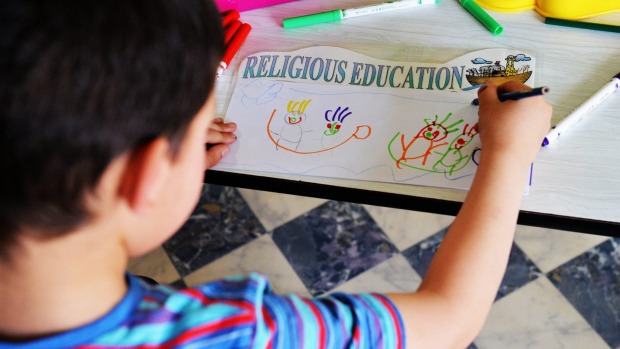
The non-controversial controversial program in our pre-schools

In August this year the Daniel Andrews Government banned SRI classes from Victorian Schools. Despite the fact that this has been a valued program for many decades, and that many schools are still keen to give space for this 1/2 hour weekly lesson, the Government caved into pressure from various lobby groups. Replacing this opt-in program will be a compulsory ethics/well-being/religious curriculum. Whilst announcing that this program will run from the start 2016,  the Government is yet to provide any details of its content and who will teach it. Indeed, schools remain in the dark as to what is happening.

Today, The Age has reported that ACCESS Ministries are now offering a program in Victorian pre-schools, called Explore Christianity.

FIRIS have notified their supporters on facebook, saying

“SPECIAL RELIGIOUS INSTRUCTION – COMING TO A KINDERGARTEN AND CHILDCARE CENTRE NEAR YOU!

ACCESS have now discovered a new mission field – they have transferred their proselytizing to a softer market.

They are like the Gecko, who loses its tail, only to grow another one back again. They have reinvented themselves and found another way to get to the children.

FIRIS has known about this for some time, and the VIC government was first notified about this from us back in May.

It appears that now very young children will be segregated by religion and parents who object to their children being indoctrinated while at child care will need to accept this segregation as the norm, or find another centre.

The government has been taken offguard by ACCESS’ metamorphosis and will have to either choose to deal with it – or look the other way.

The obvious concerns are:

* Proselytising

* Treats offered as an incentive to children

* Religious segregation of very young children

* The opt out nature of the program

  • Adequate informed consent being provided to parents”

I agree that any program must have transparency, and provide adequate information for parents, and it should have  either an opt-in or opt-out clause. These things are sensible and appear to be in place already.

But even if all of these  ‘concerns’ were fully met, history gives reason to suspect that FIRIS will keep pressing for this program to be shut down.

Given that, let’s look at these important facts that The Age reported today:

  1. Parents asked the Emmanuel Early Learning Centre to introduce this program and the Centre management agreed.
  2. The overwhelming majority of families are participating. After receiving consent forms, only 3 families chose to opt-out their children.
  3. The program teaches, “Christian values and beliefs, in addition to stories from the Bible.” In other words, it is teaching they very things that a program about Christianity should teach.
  4. Volunteers who run the program are accredited by ACCESS Ministries, in accord with strict requirements that have been set by the Education Department for SRI teachers in schools.

Pre-empting any call to close down the program, Minister for Families and Children Jenny Mikakos said to the The Age that, early childhood services operated independently, and any “decision on offering religious education as part of a service provider’s program is a decision for each individual provider and parents of children attending the service”.

It will be interesting to see what and if any pressure that the Government will try to apply to these early childhood centres. As it stands, they are providing a program within the law, based on parental interest and request, and with substantial by-in from both the Centre and its families.

Where is the controversy?

—————-

Photo from The Age (Nov 10): Joe Armao

One Christian’s Response to Paul Sheehan’s Call for Increasing Australia’s Refugee Intake

Fairfax Media has published an astonishing piece by Paul Sheehan, Operation rescue: the Christians of the Middle East face extinction. It is remarkable because it pushes against the assumed political correctness that often strangles public conversation in Australia today, and it contrasts the mood of our secularist dominated media which is obsessed with denigrating all things Christian.1441571094171

Sheehan presents two reasons why Australia should increase its refugee intake, and to allow these numbers to consist of displaced Christians from the Middle East:

Firstly, he is right to point out that, ‘For the past 20 years Christians have been ethnically cleansed across much of the Middle East as part of the rise of Muslim militancy’. This is true, although the persecution has existed far longer than 20 years. Christians remain among the most vulnerable and persecuted peoples in the world, and what we are witnessing in the Middle East is but one example.

Christians are not the aggressors in these Middle Eastern conflicts; they are among the most targeted victims. Christians are literally being exterminated. The New York Times published a piece in July revealing the extent of the  persecution.

I have already read several responses to Paul Sheehan, where people are blaming the ‘Christian’ West for the situation in Iraq and Syria. But to fuse Christianity with the West is a sloppy an analysis as calling all Arabs, Muslim or all Syrians, Muslim. The fact is, the conflict between Sunni and Shia, and their common dislike for Christians and other minority groups, pre-dates era 9/11, President Bush Senior, and prior to the Sykes–Picot Agreement of 1919. That is not to say that Western intervention hasn’t made issues more complex; it has been one hundred years of immoral intrusion, but it is grounded in selfish capitalism, not sacrificial Christianity. Syrian Christians and Iraqi Christians cannot be blamed for the West, and Western transgressions aside, the fact remains that Christians are being targeted, thousands have been slaughtered, and survivors forced out of their homes to flee for their lives.

The international community increasingly recognised that Christians in the Middle East have become a displaced people group, and therefore a humanitarian response is to welcome them into Australia.

Second, Sheehan argues that Christians will better assimilate into Australian society.

He believes that Christians are less of a threat to social cohesion in Australia than some other groups. I am not an expert on Sunni/ Shiate tensions, and so I can’t evaluate his point. Perhaps the concern has warrant and therefore it’s not without consequence, and I am sure that there are experts out there who can make comment. Having said that, there can be no doubt that there are also significant numbers of Sunnis and Shias who are victims of atrocities; where they are fleeing from their homelands we ought to consider welcoming them.

I do not believe that we should exclude refugees on account of their race, culture, or religion. If a neighbour’s house is on fire, you don’t first ask them for their passport, resume, or survey their theology; you help them on account of their humanity.

In other words, I am persuaded by Paul’s Sheehan’s first point, but not his second.

I also support Sheehan’s idea of Churches working in conjunction with the Federal Government. I am certain that Australian Churches will gladly work together with the Government to assist these refugees, whether they are Christian or not. To this end, I am encouraging Mr Abbott, Mr Dutton, Ms Bishop to speak with Christian leaders across the country.

Finally, there is a certain irony in all of this, these Christians are fleeing lands that don’t want them, perhaps only to arrive in a new land that is increasingly expressing malice towards Christians. The methods are different, but the motive is similar. For instance, I read this caustic response to Paul Sheehan, ‘Don’t let Christians in. Let people of reason in. Giving people an advantage because they follow a palatable brand of delusion doesn’t seem fair.’ Sadly, this sentiment is all too common in Australia today. One can only hope that the irrationality of such foolish people is muted by the voice of generosity and welcome.