A response to Waleed Aly’s piece in today’s The Age and some further reflections…
Follow the link for my substack
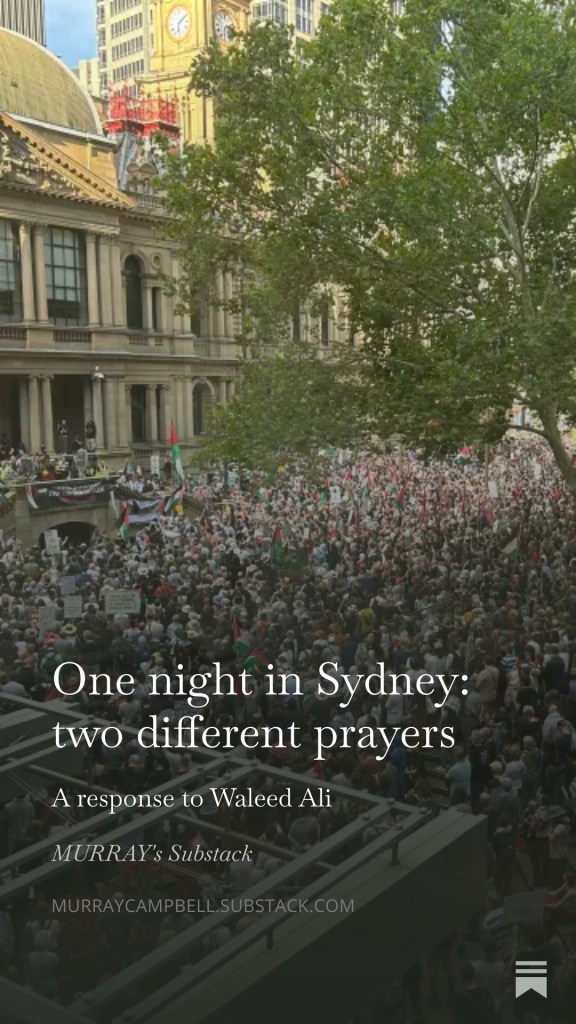
A response to Waleed Aly’s piece in today’s The Age and some further reflections…
Follow the link for my substack
“For those who’ve come across the seas
We’ve boundless plains to share”
Australia has a rich and wonderful history of immigration. It is not overstating the case to say that our great nation is largely built on the blood, sweat and tears of migrants. Australia also has a mixed and difficult history with immigration; from the treatment of Chinese settlers in the 19th Century, to the Irish and sectarianism, the arrival of Italians, the white Australia policy, to welcoming Cambodian and Vietnamese refugees and more.
Like in the United Kingdom and the United States, there are growing noises here demanding that Australia shut down mass immigration.
A march is being organised across Australian cities for next Sunday. I would never have known about it except for a couple of individuals plugging it on social media. The website claims,
“Australia is changing in ways most of us never agreed to. People are waking up to a country they barely recognise. Endless migration, weak leadership, and political cowardice have brought us here, and it’s time to put a stop to it.
Immigration poses exciting possibilities. Also, immigration always presents significant challenges. There are genuine questions to be asked of Islam, as there are of Christian Nationalism and other isms. Nations rightly have borders, laws, and citizenship that govern and give shape to a country. To be pro-immigration doesn’t mean zero borders and no caps on immigration. There are real and complex questions relating to social cohesion in Australia. Deciding on intake numbers and who comes into the country and under what conditions isn’t an easy task. If you have ever spoken with an immigration officer, you’ll understand that they take their work with utmost seriousness.
People are afraid, fearful of losing the known, fearful of losing identity, and fearful of the other. But is the answer to fear, demanding the end to large immigration? Is the answer to wrap ourselves around the Australian flag, close the borders and keep out those who look different from us?

There is a major problem with this ‘March for Australia’.
The problem lies both in its starting point and in its trajectory. In short, ‘March for Australia’ is grounded in fear, ethnocentrism, and at times racism. I’m sure many people who’ll be swept up in the march are not racists, they are Aussies concerned about their country, and they’re unduly jumping onto a movement who while willing to give them a voice, is promoting xenophobic and racist ideas.
When your slogan is, ‘Stop Mass Immigration’, you are in fact acting in an anti-Australian way, because Australia is a nation made up from the nations, and we have always been. Who among us isn’t a descendant of migrants? Who among us hasn’t brought our culture into our cities, both good and bad? Have we forgotten sectarianism? It’s more than that, it is this Christian notion of the dignity of every human being, loving your neighbour and welcoming the poor and oppressed, that gave moral impetus to welcoming people to our shores. We do not welcome them because they are like us, but because we are ‘the lucky country’, and, to quote our National Anthem, “For those who’ve come across the seas, We’ve boundless plains to share”.
If your starting place is ‘immigration is bad and we must stop it’, then what follows will almost certainly be unhelpful. If, however, we begin by affirming the goodness of immigration, then we can have a conversation.
The trajectory is already being shown. When I hear a promoter say that ‘Australia has too many Chinese and too many Indians’, that is racism. And that way of thinking is gross and an affront to huge numbers of Aussies of Chinese and Indian descent, and I take it personally on behalf of my family and friends.
As one friend pointed out, this march is essentially calling for a return to the White Australia policy.
Another person alleged that anti-semitism is the reason why we must clamp down on immigration. I have said more about anti-semitism than most Christian leaders over the last couple of years, and while there is an evil anti-semitic undertone among some Muslim people, most of the anti-semitism I see is from university students and old socialists of white European heritage.
To allege immigration must stop is to say something about our character and how we view the other. It is building a society based on fear, not grace, on protectionism, not generosity, on self-actualisation, not sacrifice. In that sense, it’s all law and zero gospel. Now, that may not bother the average unbelieving Aussie, but it should surely concern the Christian. What casts out fear? Not hate, it’s love.
The wonder of the Christian message is that God includes the outsider. God’s only Son gave his life to welcome into God’s Kingdom the very people who do not belong and do not deserve citizenship. God’s Gospel is about grace, kindness, love of neighbour and for the nations.
While the Gospel and the Parable of the Good Samaritan do not outline an immigration policy, they are doing something deeper and broader. If Jesus died to save people from Morocco and Mexico, and from China and Chad, surely this changes the way we will view these image bearers of God.
Yesterday I posted a comment about immigration as a blessing, not a curse. One of the problems with my interlocutors yesterday is that as soon as I said, ‘immigration is a blessing’, they read it as saying I’m advocating for open immigration, even though my very next sentence stated that immigration brings challenges. They can’t seem to distinguish between no borders and generous immigration. But this march isn’t calling for generous immigration, according to many comments I’ve read; they want Muslims, Chinese, and Indians kept out of our country.
We are a nation of plenty. We are a nation of extraordinary wealth and prosperity. We are also a society wrapped up in red tape and layers of bureaucracy that make even simple decisions near impossible (ie solving housing). I find it interesting how Jesus didn’t say, ‘Let me come and help out so long as it doesn’t cost me anything’.
What especially stood out to me was the fact that a couple of Christians think that this march is a good idea. First of all, this protest would require you to skip church. Sure, it begins at midday, but for most people, that means missing church. If a movement or march requires you to miss church, do you think its origins are of God? Second, do they really believe that changing government policy will save our nation? That’s not a Christian answer.
Several years ago, Russell Moore was asked a question about Muslims moving into the community and wanting to build a mosque. Moore not only espoused a Baptist view of religious freedom and toleration, he also said this,
“That doesn’t turn people into Christians, that turns people into pretend Christians and sends them straight to hell. The answer to Islam isn’t Government it is the Gospel of Jesus Christ and the new birth that comes from that”.
Russell Moore is right.
Ephesians ch. 2 makes it clear that God’s reconciliation plan isn’t accomplished through Government or political means, but through the Gospel of Jesus Christ. This kind of Jesus reconciling brings disparate people together; it unites the great divide between Jew and Gentile.
“remember that at that time you were separate from Christ, excluded from citizenship in Israel and foreigners to the covenants of the promise, without hope and without God in the world. But now in Christ Jesus you who once were far away have been brought near by the blood of Christ.
For he himself is our peace, who has made the two groups one and has destroyed the barrier, the dividing wall of hostility, by setting aside in his flesh the law with its commands and regulations. His purpose was to create in himself one new humanity out of the two, thus making peace, and in one body to reconcile both of them to God through the cross, by which he put to death their hostility. He came and preached peace to you who were far away and peace to those who were near. For through him we both have access to the Father by one Spirit.
Consequently, you are no longer foreigners and strangers, but fellow citizens with God’s people and also members of his household”
If you think Australia will be saved through less immigration, you have missed the gospel, you probably won’t enjoy heaven, and you’re behaving more like the Levite than the Samaritan.
Jesus didn’t side with the Sadducees (who might be described as Roman conformists) nor with the Zealots. Modern-day Australian religious zealots may be feeling and seeing social discord, but rather than bringing reconciliation, they add to the discord.
Next week’s march is no more Christian than many of the protests that belong to the left-edge side of culture. Those already caffeinated on rage and scribbling out their placards for the march, will probably not like what I have written. If anything, the rage temperature will increase; perhaps it is a self-fulfilling prophecy!
However, if you’re one of those followers of Jesus who are troubled by social divisions and the fracturing we are witnessing in our streets and suburbs, press closer to the gospel of Jesus and believe God’s purposes through his son.
If you have issues with Islam, as I certainly do, love your Muslim neighbours, don’t hate on them; invite them over to your home for a meal with the family, don’t ostracise them. Invite them to Church and make them feel welcome, because they are.
Our Church is hoping to begin a ministry next year to migrant families in our community. Why? Because we want to serve them and we want them to know the good news of Jesus, just as someone once shared with us.
I love how yesterday in Western Sydney, a Sydney Anglican Church hosted a conference. It was given the name, ONE FOR ALL, and Archbishop Kanishka Raffel preached on the gospel that crosses cultures. Australia needs more of that.
If you hear people saying that there are too many Chinese or Indians or whoever in our country, call them out.
On Sunday, 31 August, go to Church as you ought, worship God with his people from among the nations, love each other, and hear again how the gospel of grace is our answer.
Update: the Melbourne march was attended by people from many different persuasions. However, the march was led by a group of self-identifying neo-Nazis, and a prominent neo-Nazi spoke from the platform to address the crowd.
Victorian Premier Jacinta Allan has announced a new set of laws under the banner ‘social cohesion’.
‘Social cohesion’ when attached to government and laws has a touch of the Machiavellian about it. One doesn’t know whether to think it’s more like George Orwell or Monty Python!

The Government’s initiative includes a new ‘social cohesion pledge’. Any community group applying for government funding will need to make the pledge, promising to support social harmony and inclusivity.
No doubt this is a testing time for any government. There are pressures applied from all kinds of directions, and at times this leads to inaction or delayed resolve. As we have seen over the past year, this has given more oxygen to antisocial, and in this case, antisemitic voices.
I think this specific set of government measures are sensible and necessary, but I cannot but help think that it may open the door to future measures that are unreasonable and damaging.
There is a cowardice hiding behind masked protesters. There is an ugly hatred being propagated by some of the protests we have seen on Melbourne streets. If you can’t protest without wearing masks, carrying threatening objects, and using disgusting slogans, maybe that should signal that you or your cause is a problem.
Victoria was never the perfect State, but we have witnessed developments over the past decade that are injurious and bring grief to many. We are less peaceful than we were. We are less inclusive and kind. There is more personal and social distress and with little sign of a turnaround. Melbourne has become Australia’s protest capital (not a title to boast about). Ever since 2020, when the government turned a blind eye to certain marches while slamming others, every Jane, Nguyen, and Bob has seen fit to grind city streets to a halt. Not a week goes by without banners and angry faces blocking traffic.
I support these particular measures because antisemitism cannot under any circumstance be allowed to fester. If we think that our society is beyond and above 1928 Germany, we are suffering from a greater dose of egomania than I thought.
However, I am not comfortable with Jacinta Allan’s language of ‘social cohesion’. I get it; they are trying to address a specific problem without naming the elephant in the room. Why not call it ‘Rules for Safe Protests’ or something like that?
The reason why I’m uncomfortable about the Government’s language of ‘social cohesion’ is because the task of social cohesion doesn’t belong to the government, but to the people. When government sees itself as the answer to every social ill and when the people demand government to fix every crisis, we are obfuscating personal responsibility and creating systems of governance that cannot bear the weight of such responsibility.
This is one area where the work of Dr Christopher Watkin is worthy of consideration. Monash University’s Dr Watkin articulates a positive and important work on contract theory. He says,
“Civil society is sometimes the neglected dimension of the social contract, the “missing middle” as it has been called. We have a tendency to jump straight from government and law to the individual.
These civil society relationships across different visions of the good are a glue that holds our social contract together.”
From his book, Biblical Critical Theory,
‘the vague and sporadic measures taken by contemporary governments to shore up the social contract with well-meaning but half-hearted attempts at “civic edu- cation” have little effect, when all the while billions of advertising dollars and a destructive paradigm of competition in all areas of society expertly catechize individual consumers to be little predisposed to the civic duties a strong social contract requires. No rewriting of the social contract can be complete without giving serious attention to its cultural and liturgical infrastructure.’
No Government is up for the job, and it’s not designed to be. Part of the problem embedded in any Government setting the rules for social cohesion is that this is never a natural space. This is one of the heresies attached to secularism. Secular may be preferable to Sharia Law and Christian Nationalism, but it is no more epistemologically and morally neutral. Secular is the sum of the worldviews present in and controlling the moral impulses of the day.
There are wonderful pockets of social cohesion is found in all kinds of places and communities across our State. There are sporting clubs and men’s sheds, and there are temples and synagogues. It is certainly experienced in local churches.
Churches are frequently more culturally diverse than the communities surrounding them. Where I have the privilege of serving and belonging, we have people from China and Uganda, families from Vietnam and India, Nigeria and Columbia. Young and old mix together, single and married are friends and serve one another. Of course, Churches have their failings and blindspots, (after all, the very point of Christianity is that there is only one perfect saviour and we’re not him!), and yet there is profound togetherness and other person-centredness.
The Victorian Government is also currently working on expanding anti-vilification laws, which some are concerned will tighten the noose of faith groups from teaching and practising in accordance with their convictions. It’s amazing how often the State has assumed the bishopric role when Christian praxis hasn’t supported their social agenda. There is a mine of irony in Victoria where Government identifies a growing social disorder and yet clamps down on one of the few societal groups who are truly exhibiting positive social health and life. If we are interested in civil society, maybe we ought to return to the worldview that created the ideas and values from which this vision derives: Christianity.
Well, it’s Christmas time, the ultimate day of truce-making, although that first holy night was filled with peril. Nonetheless, the hope born that night in Bethlehem really is the only hope we have today. Come, check out a local church and see that hope in action.
Let me leave you with the great Messianic promise of Isaiah,
‘The people walking in darkness
have seen a great light;
on those living in the land of deep darkness
a light has dawned.
You have enlarged the nation
and increased their joy;
they rejoice before you
as people rejoice at the harvest,
as warriors rejoice
when dividing the plunder.
For as in the day of Midian’s defeat,
you have shattered
the yoke that burdens them,
the bar across their shoulders,
the rod of their oppressor.
Every warrior’s boot used in battle
and every garment rolled in blood
will be destined for burning,
will be fuel for the fire.
For to us a child is born,
to us a son is given,
and the government will be on his shoulders.
And he will be called
Wonderful Counselor, Mighty God,
Everlasting Father, Prince of Peace.
Of the greatness of his government and peace
there will be no end.
He will reign on David’s throne
and over his kingdom,
establishing and upholding it
with justice and righteousness
from that time on and forever.
The zeal of the Lord Almighty
will accomplish this.’
 MurrayCampbell.net