Olympic ‘Last Supper’ depiction with a French Twist

I do enjoy French quirkiness and the absurd. It is often playful and sometimes provocative. And sometimes it is attention-seeking and puerile.

I loved much of the innovation and freshness that the French gave the opening ceremony of the Olympic Games. The interplay between art and athletes, and the sitz im leben of the city instead of stadium was pretty cool.

During the Opening Ceremony, there were many highlights, and of course, there was controversy. There was the mass reenactment of Marie Antoinette’s beheading with geysers of blood reaching the skies. If blood lust didn’t do it for you, another scene was depicted, and unsurprisingly it was most controversial, consciously so. although as myopic and unoriginal as a school kid’s impression of Monet’s water lilies. 

I’m still unsure how Leonardo Da Vinci’s The Last Supper relates to the Olympics. Let’s leave aside that the painting is Italian, not French. The French do however enjoy the question and leave us without the answer.   In this Olympic staged drama, the French have, as artists previously mimed, revised this Biblical scene where Jesus teaches his disciples over the Passover meal, on the night before his crucifixion. The French Jesus isn’t a male. Of course, let’s turn Jesus into an obese woman with a halo hovering over her head. The disciples can’t be men either. No, let’s have men in drag and a child and a splash of androgyny. 

More than a few people are angered by or upset by this depiction of Jesus and his disciples. I don’t like it either. Mocking Jesus is kinda stupid and unoriginal. It’s a pale copy of the original setting where the crowds, Pharisees, and soldiers mocked Jesus every step to and on the cross.

Bear with me, but this reminded of the sermon that I’ve prepped for church tomorrow. W e are looking at that most famous and intriguing saying of Jesus,

“the truth will set us free” 

Without giving too much away ,there is a line in my notes where I explore contemporary understandings of freedom and at one point, already with the French in mind, I say this,

‘When it comes to art, in painting, music and film, it does is pushes into the absurd or obscene, because freedom requires difference, new and fresh.”

The French have just provided a classic example! In this sense, the artistic directors for the Opening Ceremony are doing little more than conforming to the overdone narrative that is now basic to university education, social commentary and Parliamentary halls. 

France is famous for revolutionary undertones; it’s part of the kindergarten curriculum: how to protest and exhibit violence 101.  For example, French Protestant Christians were nearly wiped out in the 16th and 17th centuries, and Christianity has been a tiny minority ever since. In a way, Christianity is an easy target for the French (and yes, for Aussies too). Although, if the organisers had thought for more than a French moment, they’d have realised that more many African and Asian and South American Olympians, Jesus isn’t a parody or obtuse figure of derision; he is worthy of more honour and glory than all Olympic gold combined. Maybe they aren’t so concerned about social and international tolerance!

If the French were really daring, they would imagine an Islamic scene and the prophet Mohammed But of course, we know how that would quickly turn into real bloodshed  (by the way, I think that would be a really dumb idea for all kinds of reasons: not least, because it’s not a way to love our Muslim friends).

So why depict Jesus and his disciples in feminine and trans robes? Is it a call to equality or sexual expression? Is the city of love trying to deconstruct the patriarchy? Like many things French, who knows! One thing on display however is this return to paganism that is popping up in Western cultures. The Olympic Games have their origins in paganism and as recent Olympic Games have intimated, we are returning to these superstitious waters.

This dramatic display turns the Last Supper into a hyper-sexualised trans orgy with Greek mythological overtones (hence Bacchus the smurf turning up).

I suspect this is not the intention, but there is in this boorish parody of The Last Supper, something that at least opens a question to what Jesus was showing that night.

The revolution planned by God before all eternity and carried out by his Son involved the shedding of blood, as the Passover meal vividly showed.  The bloodshed didn’t involve chopping off the heads of his enemies, but dying in their place for their salvation.

If we are looking for the absurd and obscene, the beautiful and original, the cross of Jesus Christ to which the Last Supper prepares, is as French as it gets. It is the efficacious symbol for the peoples of the world.  Not for the glory of sport, but where God’s good news draws people from everywhere corner in freedom and truth and love and grace. And yes, this will include people whom we find unlikable and uncomfortable or just different from us.  That’s true originality: the cross speaks volumes about the foolishness of freedom searching without God and of staggering Divine love for these very people. As those who don’t fit gaze upon the crucified and risen Christ, there is not an emptiness or sterile religion, but a holy and loving God who forgives and frees. Stick that in your baguette and enjoy it!


Update Jul 29.

Olympic organisers have apologised. They confirm that the scene was depicting the Last Supper, infused with Greek paganism (Bacchus the blue smurf). It was a conscience artistic and moral judgment to sexualise and trans the Last Supper and with pagan elements added into the mix.

The apology sounds like the unrepentant juvenile caught stealing on CC TV, but I can afford to accept the apology.

One wonders what the closing ceremony will include!

https://www.theguardian.com/sport/article/2024/jul/28/paris-olympics-organisers-apologise-to-christians-for-last-supper-parody

https://www.yahoo.com/news/paris-olympics-producers-confirm-last-173957068.html?
What should we think of overturning Roe v Wade?

On June 24th 2022 the Supreme Court of the United States overruled Roe V Wade, and thus returning the question of abortion to the States. The below piece was written almost two months prior to the decision in light of the leaking of the draft majority opinion. The observations made and the points argued remain unchanged in light of the decision.

———————————————-

There are quite literally millions of strong opinions and emotions being expressed right now about the future of Roe v Wade. By no means am I attempting to say everything or even to offer the final word, but as an outsider, there is a message that I wish to convey to my American friends and even to Aussies, for the issue of abortion is also present here in Australia. But before I comment on the leak coming from the Supreme Court, I want to draw attention to an ancient, yet famous and important story.

Last Sunday our church started a new sermon series on the book of Exodus. I gave the series the title ‘Journeying Home’, as I think it captures the meaning of Exodus and the language used in Hebrews ch.11 that summarises the story’s theme and trajectory. 

Exodus begins with a violent and discordant juxtaposition: on the one hand, the LORD blesses his people and they multiply. From the 70 men and women who entered Egypt at the time of Joseph, generations later they now number more than a million, even more. At the same time, Pharaoh is threatened by the Israelites. He deems them a threat to social cohesion and cultural prosperity, and so he enslaves them. This strategy, while brutal, proves inadequate for God continues to bless the Israelites and their numbers increase. Pharaoh then sanctions the deaths of all newborn male infants. 

Two Hebrew women, Shiphrah and Puah, become heroes as they ignore Pharaoh’s decree and refuse to end the lives of these children. Frustrated that his ‘health plan’ was failing, he pushes further.  The river Nile may be the source of life for Egypt but Pharaoh turned it into a graveyard as thousands of babies were disposed of in the waters. 

I begin with the Exodus story, partly because it’s fresh in my mind and because we are rightly appalled by what we read. To hear of the mass destruction of the young should create outrage and tremendous grief. How can a civil authority feel so threatened by a people group that he gives licence for infant boys to be disposed of?  At the same time, Pharaoh was trying to protect a way of life; his autonomy, position and future. 

Of course, there are significant differences between Exodus and the United States and how the removal of the unborn or newborn is considered. However there is also an uncomfortable parallel, and that is, that the life of the young is conditional and the State can justify taking life when these little ones are deemed unwanted or a threat to personal progress and way of life. The evil perpetrated by Pharaoh does not stop at the fact that he sought to control an ethnic group, but that as an ethnic group these baby boys are human beings and therefore should never be treated as a commodity or considered as having less value or with fewer rights to live. 

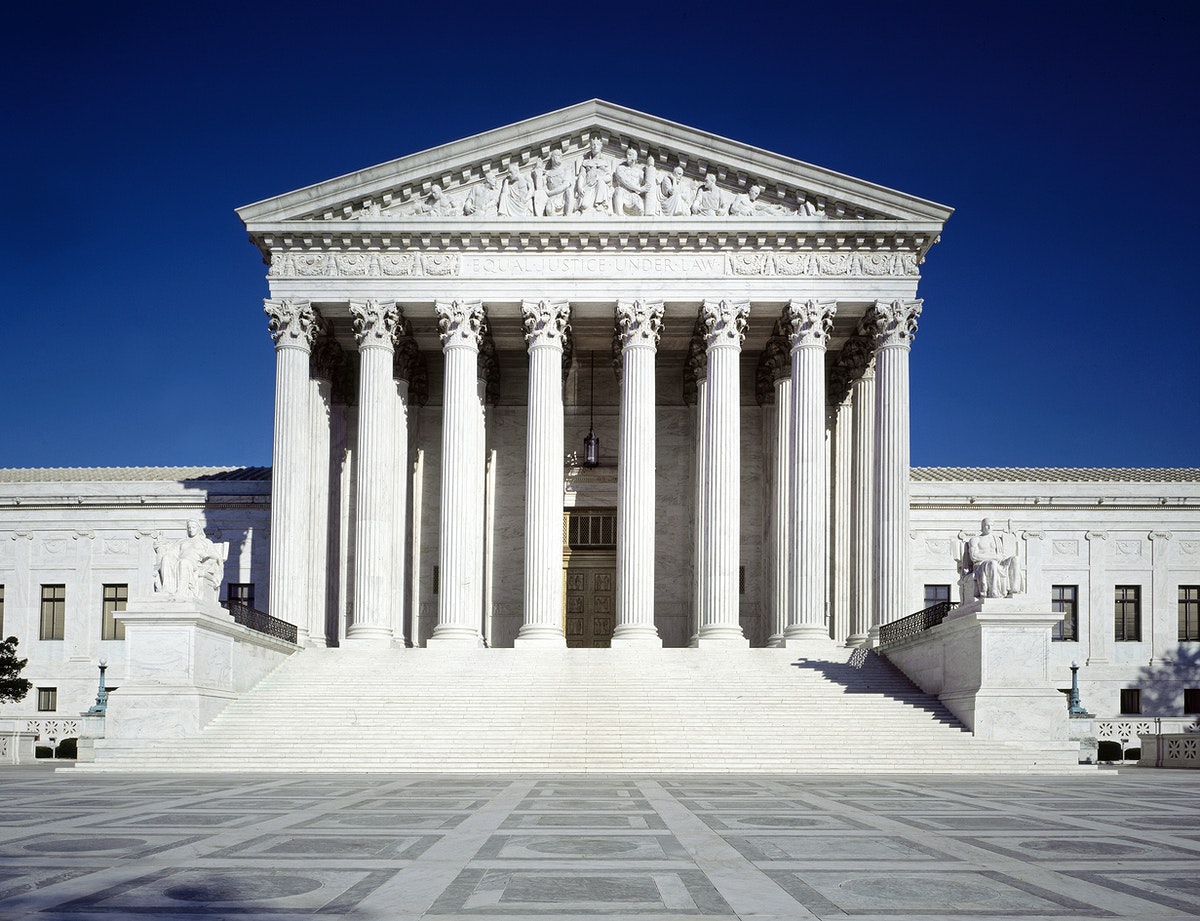
United States Supreme Court Building. Original image from Carol M. Highsmith’s America, Library of Congress collection. Digitally enhanced by rawpixel. by Carol M Highsmith is licensed under CC-CC0 1.0

Today, the news story dominating the United States is the future of abortion. Yesterday a draft majority opinion was leaked to Politico. Written by Justice Samuel Alito, the paper outlines the argument to overturn Roe v Wade. This is the first time in American history that a document of this nature has been leaked. Many people are interpreting this leak as a last-ditch attempt to pressure the Supreme Court Justices to change their minds and uphold Roe v Wade.

Overturning Roe v Wade does not mean abortion will become illegal throughout all of the USA. It does, however (and in my mind correctly) determine that the United States Constitution nowhere presents or protects abortion as a right. If it turns out that the draft opinion accurately reflects the final decision of the court, it means that the issue of abortion will return to the states and therefore will become the responsibility of the people to decide what laws will govern the unborn. In practice this will probably mean some states will restrict abortion (limiting it to pregnancies under 24 weeks or 15 weeks), others may prohibit abortion altogether,  while other states will continue to commit abortions even up to the point of birth.

Any decision made by the Supreme Court of the United States has no legal bearing on my part of the world, but the cultural influence of America eventually washes across the Pacific Ocean. My own home here in the State of Victoria is more akin to New York State where abortion is lauded, even for infants who reach 40 weeks. While I am thankful for any public and legal decision that weakens the abortion position, I am reminded of how far my own context has regressed from upholding the sanctity of human life.

In the 50 years since Roe v Wade, 60 million children in the United States have been taken from the womb. In Australia, 10,000s children are aborted every year, many because they are diagnosed as carrying a disability or disease, and many because the child is felt to be an impediment to the dreams and life preferences of the mother (and sometimes the father).  Over the weekend, a famous (now retired) Australian swimmer revealed how her coach once pressured her into having an abortion. These stories are far more common than we dare acknowledge. 

As news broke about Justice Samuel Alito’s draft statement, one could hear the palpable joy and thanksgiving among many Americans. One could also hear the anger of others. From President Biden to Alexandria Ocasio-Cortez and Elizabeth Warren, and even to politicians and commentators across the globe, including the Mayor of London, there is an anxious and loud demand to keep what they crudely describe as a ‘woman’s health care’. 

Should Roe v Wade be overturned, and I pray that it is, I also pray that pro-life Americans will not gloat or pride themselves and disdain others. Instead, give humble thanks and continue to give due love and care to women who are grappling with unwanted or difficult pregnancies. Justified anger at the destruction of life can be coupled with compassion and commitment to helping those who struggle.

When the Supreme Court decision is finally announced and comes into effect, may the final word not be one of triumphalism or anger. The story of Exodus doesn’t end in chapter 1 and with a river of death. There is much grace and mercy to be found in the story of Exodus. There is atonement for sin and freedom found for those who cry out to God.  

The blood of 60 million babies cries out for justice; God hears.  There are also countless women who to this day grieve over their dead children and the decision they once made.  The wonderful news to which Exodus points and which is found in Jesus Christ, is a word of forgiveness and hope and restoration. The final word isn’t judgement. Forever guilt isn’t the only option. The God of the Passover, the God who rescued Israel from Egypt, is the same God whose only Son gave his life to remove every stain.

As Jesus himself said, during that most famous of Passover meals, on the night he was betrayed, 

“This is my blood of the covenant, which is poured out for many for the forgiveness of sins.”

Christians, encourage and support the removal of Roe v Wade, and let us not lose sight of the Gospel of grace and forgiveness, which is our ultimate and only hope.