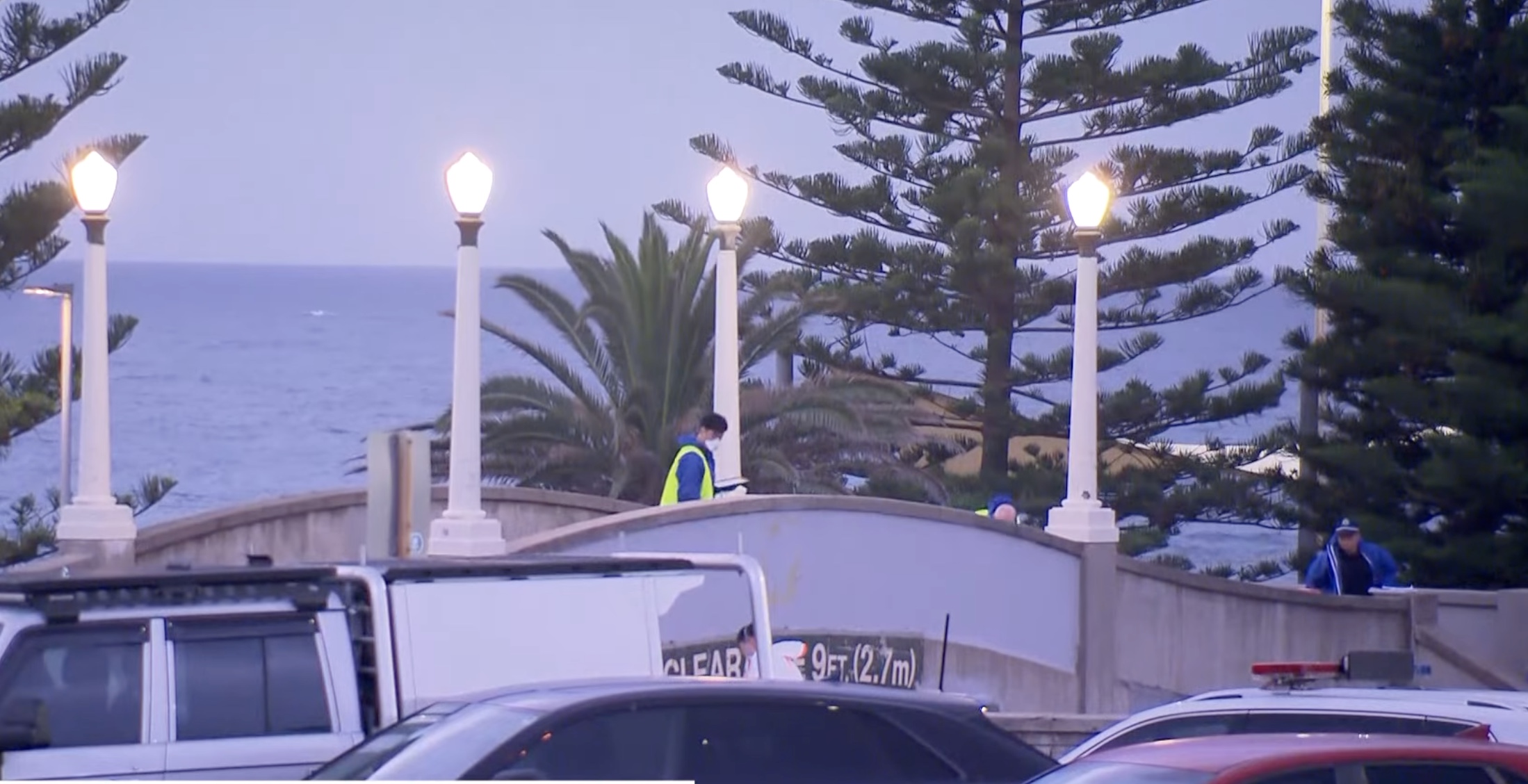
Last night our church building was packed with people, gathered to celebrate the birth of Jesus. While our evening was filled with laughter and joy and praise, what we didn’t know at the time was that a massacre was unfolding at Bondi Beach in Sydney.
Thousands of Jewish Sydneysiders gathered at Bondi Beach to celebrate the first night of Hanukkah. As they welcomed the festival of light, darkness descended as two men dressed in black opened fire.
15 people are now dead, with dozens injured, including 2 police. One of the gunmen is also dead, and his accomplice is critically injured. Police and the NSW Government were quick to announce this as an attack on Jewish people and an act of terrorism.
I am shaken. I am profoundly saddened. What has become of this nation?
I am angry, really angry. Damn those men to hell. Damn those who cultivate and stir hatred toward Jewish people, and those who excuse growing anti-Semitism in Australia.
Can we say that Australia is safe for Jewish people? If the answer wasn’t already tenuous, after last night’s terror, it is difficult to say yes.
Melbourne this year has borne witness to Neo-Nazis leading marches through our city streets. A prominent Neo-Nazi has addressed crowds in public. Arson at Melbourne’s Addas Israel Synagogue saw the building severely damaged 12 months ago. Jewish Aussies are regularly subjected to anti-semitic graffiti and verbal attacks on the streets.
To suggest Australia is safe for Jews rings hollow. It is too our shame.
Stories of heroics are slowly emerging. It needs to be said, given the likely identity of the gunmen, that one hero who emerged last night was a Muslim man who ran and tackled one of the gunmen, almost certainly preventing further loss of life. He in turn was shot twice and is now in hospital.
As hundreds of people came together at Mentone Baptist Church last night, we focused on the God who came. I talked about how hurt and harm naturally produce friction and distance. God knows how deeply divided our cities and suburbs have become. Something counterintuitive happened with Jesus; God determined to come closer. When God saw all the evil in this world and all odious motives and words and deeds, instead of walking away as he had every right to do, he came to us. He came in the most miraculous and vulnerable of ways. The Son of God didn’t come to take away life, but to lay down his own life so that we might gain eternal life.
The birth of Jesus was accompanied by such bright light, and the scene was also interrupted by a wave of evil and darkness. The Gospel of Matthew records the massacre of the innocents, when Herod chose violence and murdered the young of Bethlehem in his hunt to rid the world of the prophesied one.
Matthew turned to these Scriptures to echo the horror,
“A voice is heard in Ramah,
weeping and great mourning,
Rachel weeping for her children
and refusing to be comforted,
because they are no more.”
Today, there is weeping and great mourning in Sydney. This should not be. Why are we not surprised? We are shocked, and yet who is surprised by the blood soaking into the sands of Bondi Beach? Perhaps the location took us by surprise, but our fractured society is losing coherence as we struggle to find something that keeps us together.
Politicians, stop pandering to groups who advocate this bile.
Religious groups, expose and expel religious preachers who teach this evil.
How long must we watch city streets clogged with protesters shouting obscenities and anti-semitic slurs, all in the name of ‘freedom’.
This isn’t a left or right issue, for the hatred has its horns on both ends. It is a religious issue. It is an ideological issue. It is a heart issue, and evidence suggests we are not equipped to respond. Violence isn’t the solution. Vile social media posts won’t bring about peace and healing.
The Gospel of John records Jesus attending Hanukkah. While not one of the Festivals instituted in the Bible, this commemoration of the Second Temple’s restoration in the 2nd Century BC, had quickly found a home in the Jewish calendar. It is unsurprising that Jesus, a Jewish man, participated in this Festival of Light (John 10:22).
A light was snuffed out last night at Bondi Beach, and the light has grown dim around Australia.
Where will we find light to overcome the darkness? Political muscle and social goodwill have some but limited influence. Who can gaze into the soul? Who can outdo evil?
“I am the light of the world. Whoever follows me will never walk in darkness, but will have the light of life.”
Pray for the injured. Pray for the hundreds of victims who were present and witnessed last night’s evil. Pray for our emergency services who today continue to work and protect our streets, investigating last night, and attending to the wounded, both the physically and mentally hurt. Pray for our Jewish friends and neighbours. Check in on them. Assure them of our friendship. Pray for them.
As Hanukkah continues and Christmas approaches, my hope rests in the One about whom it is written,
“The light shines in the darkness, and the darkness has not overcome it.”
‘after all, is Apollos? And what is Paul? Only servants, through whom you came to believe—as the Lord has assigned to each his task. I planted the seed, Apollos watered it, but God has been making it grow.’
20 years ago today I was inducted as Pastor of Mentone Baptist Church. I won’t lie, it feels like 20 years! Our 3 children have literally grown up in the church. Prior to 2005, Susan and I had spent several years preparing for this scenario. I had always loved serving in my local church, although I had zero desire to move into pastoral ministry. It turned out that God had other plans. My pastor at Camberwell Baps was gracious enough to give me opportunities to teach the Bible; that idea of speaking and sharing God’s words with people got my heart pumping. But an immature 19 year old, is just that, an immature 19 year old! After finishing uni and getting married, Susan and I moved to London and then to Sydney, for training and gaining experience in churches, so that we could return to Melbourne and serve Christ here.
We returned to Melbourne from our place of exile and started at Mentone Baptist Church on February 6 2005.
I’ve wrestled with this for the past week, should I say something about the 20 years or not. I guess it is an anniversary of sorts. As some readers will be aware, I’m someone who writes more than a few words. Through this blog and writing for both Christian and secular publications, I enjoy talking about the gospel and trying to help others think through issues from the lens of scripture. I also love talking about music and cricket, and sharing with friends what my kids are up to and all their latest adventures. Talking about myself, isn’t something I generally do (leaving aside the compulsory self-effacing sermon jokes). I am conscious about not making Murray Campbell the topic of somethingness. It’s hard enough to see Jesus clearly, without my oddities standing in the way!
It was only this morning, as I read my Bible and read those verses in 1 Corinthians 3, that I decided, maybe I’ll put a few thoughts together. Maybe there is something I have learned from serving one church for 20 years that might be helpful to pastors elsewhere. Although, the last impression I want to suggest is that pastoral ministry is about the pastor. I’m not looking for praise (or the inverse!). And serving in the same church for 20 years doesn’t make the work any more or less important than pastors who only serve a few years. I’m also aware of how every church differs in some ways, and that means my particular experiences aren’t identical to a pastor who is serving in Mildura or Maroochydore. Then again, every minister of the Gospel shares the same Bible, the same mission and message, so perhaps similarities and parallels are not so few and far apart.
Here are 20 lessons that I have learned over 20 years of serving at Mentone Baptist Church. It’s not as though I didn’t believe or was unaware of many of these lessons prior to coming to Mentone. And it’s not as though I’ve reached the apex for these 20 themes. Most things in the Christian life are repetitive and a day by day process of sanctification. I’m not planning to provide detailed explanations and examples for these 20 lessons, but rather to note them in passing.
1. I still have much to learn.
I am often amazed at how little I know and how little I understand of the Scriptures and I’m excited at the prospect of continuing to dig deeper and discover more wonders of God in his word.
I’m still learning how to Shepherd a local church. Our Elders are currently reading Andrew Heard’s provocative book, Growth and Change, and am enjoying discussing penetrating questions about ministry and mission. It’s great. I love how the elders (and church) want to keep moving forward in the Gospel and to be more effective in seeing God’s Kingdom growing.
2. God answers prayer.
He really does. When the church has prayed, we have seen God work. Which begs the question, why do we pray so little?
3. God’s Gospel is powerful.
Just last year, our church heard testimonies and witnessed baptisms where the reality of Jesus Christ compelled and changed people’s lives. We have more planned in the early part of 2025. It is so strange to me to hear of churches smudging or avoiding clear and faithful presentation of the Gospel, as though that’s the best strategy for faithfulness and growth. So weird.
4. I’m still learning patience.
I like to run fast but there’s little point sprinting if the church isn’t ready. Sometimes though, I could probably encourage our leaders and members to walk a little faster!
5. God’s word really is beautiful and true and complete.
At Mentone, we use the Bible lots and we want to present God’s words in a way that reflects the treasure that it is. How amazing it is that God has given us a living word that speaks truth and grace today. That’s why we have 2 bible readings every Sunday morning and why we make sure our ministries, from Sunday school to youth group and 1-1 discipleship involve opening, reading and living out his word
6. People will hurt you (and at times you’re no saint either)
Learning to process hurt isn’t quick or easy. Having trusted and godly leaders is really important for working through these times.
7. I’m more convinced about the value of having a plurality of leaders.
The eldership hear me talking about this all the time. We want to grow the number of elders. A church needs a plurality of leaders: from pastors and elders, to deacons, and all kinds of lay ministry leaders. Paul didn’t lay out a paradigm in Ephesians 4 for us to ignore!
8. Make sure the eldership consists of godly men who share a broad breadth of personality, experience and skills.
A church requires greater wisdom than that of one pastor. However, we insist that there is profound and convinced agreement and unity on the church’s doctrine and direction.
9. Trying to set an example for others is hard.
The Bible says that pastors ought to set an example of life and godliness for the believers. It’s a balancing act, trying to share and show how I live outside the pulpit and yet doing so without handing out an autobiography each week.
10. Don’t do everything.
Set early and clear expectations and boundaries and be okay with saying ‘no’. Teach your congregation to be okay in hearing, ‘no’.
11. Membership really is important.
I believed this 20 years ago, and as the years have progressed I’ve become more convinced. Expressive individuals is a scourge on churches and hamstrings Gospel witness and effectiveness. Jesus meant every word when he said, “Love one another. As I have loved you, so you must love one another. By this everyone will know that you are my disciples, if you love one another.” Want to impact the world for Jesus? Then join a church and love the saints.
12. I will make mistakes and that’s ok.
13. The fear of losing people is common, but not dealing with problems generally makes the situation worse.
14. Technology is a curse.
Ok, not entirely. Tech is both good and bad, a useful servant and a terrible master. As technology changes, churches will often adopt and adapt and yet we also need to be wise in its use. Too often churches begin paying a cost without first thinking through behavioural changes that come about through smart phones or AI. Hey, even schools are now recognising these dangers!
I remember Carl Trueman suggesting once that the invention of the car changed people’s behaviours in ways that negatively impacted the local church. Cars are great, what a blessing it is to be able to move about easily and speedily. Cars give people more freedom and as Trueman explains, people started taking long weekends and pursuing more activities, and this turn impacted church attendance and participation. In other words, the car impacted the ministry and mission of the local church and does so even today.
15. We still need to cultivate a better culture of disciple making.
We talk about it and preach on it and we practice it in all kinds of ways, but I think we are yet to be convinced of how important discipleship is to the health and maturity of church.
16. Repetition is key to cultural change (thinking of point 14).
I’m learning that I need to say the same thing over and over again, and when I’ve done that, I need to repeat it again. I’m also trying to encourage our leaders to press repeat so that messages sink in and therefore lead to changed expectations or behaviours or whatever it is we’re trying to move forward.
Part of the issue isn’t reluctance from people, but leaders remembering that people live busy lives and their heads aren’t in the church 24//7 as mine is.
17. Church history is amazing and it matters.
I don’t need to be sold on history. I’ve always enjoyed reading history books and watching documentaries, even as a 3-year-old kid. I studied history at Melbourne University.
Many years later, I am more persuaded that churches should appreciate and understand that who we are today is the result of the sacrifices, thinking, preaching and lives of the saints from old. Churches make mistakes, take wrong turns, and lean into theological mess because we haven’t learned the lessons of church history.
We ran a course last year on Reformation history and this year we are talking about the Council of Nicaea.
18. Protecting my day off was a great idea.
Pastoral ministry isn’t just a job, it is a way of life. Family is family and church is also family. This makes setting boundaries often murky and imprecise. Susan and I have always wanted our children to view church as a family, and yet we never wanted to sacrifice them at the altar of ministry. I’m thankful for the clear and flexible boundaries that Susan and I set together and which the church embraced.
19. Theological liberalism is an easy gospel enemy to spot, but there is an emerging conservatism that we need to be aware of and keep away from the church.
Christian Nationalism which conflates common grace with the Gospel, and Church with State, is a growing concern not only in the United States but also in segments of Australian Churches.
This isn’t a biggy at Mentone Baps, but knowing this flavoured heresy is gaining popularity in some circles, I have already begun talking about these issues in sermons and discipleship (and of course on this blog). The Gospel is neither left nor right. Our mission isn’t defined by a side of politics, but by the Lordship of Christ and his Gospel that brings the forgiveness of sins.
20. There is so much work do to.
When all is said and done, the most pressing issue today remains the eternal state of people in light of the coming judgement of God. How many millions of people in Melbourne may know their left hand and right but are oblivious to Christ the judge and Christ the redeemer?
Pastoral ministry is the worst job in the world. Pastoral ministry is the best job in the world. I get to see and be part of people’s highest and lowest moments of life, to share their joys and sorrows. Pastors have the terrifying responsibility to preach the full counsel of God and dare suggest, see my life and follow my pattern of living. And we do, knowing that God will hold us to account for how we have shepherded his people. It really is a work that people should avoid and embrace.
I don’t spend a lot of time looking back over the years. To be honest, if you asked me for particular highlights in any given previous year, I may not be able to tell you with any precision. When I do reflect on the 20 years, I do so with some embarrassment and also much thankfulness: for Susan and my children, for a church that was patient and kind and who looks after the staff so well, and for God who never lets us down.
Mentone’s current associate pastor, Mike Veith has now been with us for 14 years in this role (and as a student pastor for 2 years before then), so that’s a milestone for which I am thankful.
I realise that 20 years in one church sounds a little bit unusual, but I know pastors who have served their churches for a great deal many more years. I think of Philip Calman from whom I learned so much during my 4 years at Chatswood Baptist as a student. He has been serving as their senior pastor for 28 years and counting. Praise God!
These are 20 of the lessons I’m learning from my 20 years at Mentone Baptist Church. There are many others, but perhaps among this this 20 there is something that might strike a note or encourage another pastor in their work for the Lord.
Last week’s ministry conference in Melbourne was an encouraging and stimulating day. Many thanks to David Starling and Dani Treweek for serving us well. Each of the talks and the QandA session are now available for listening to on youtube.
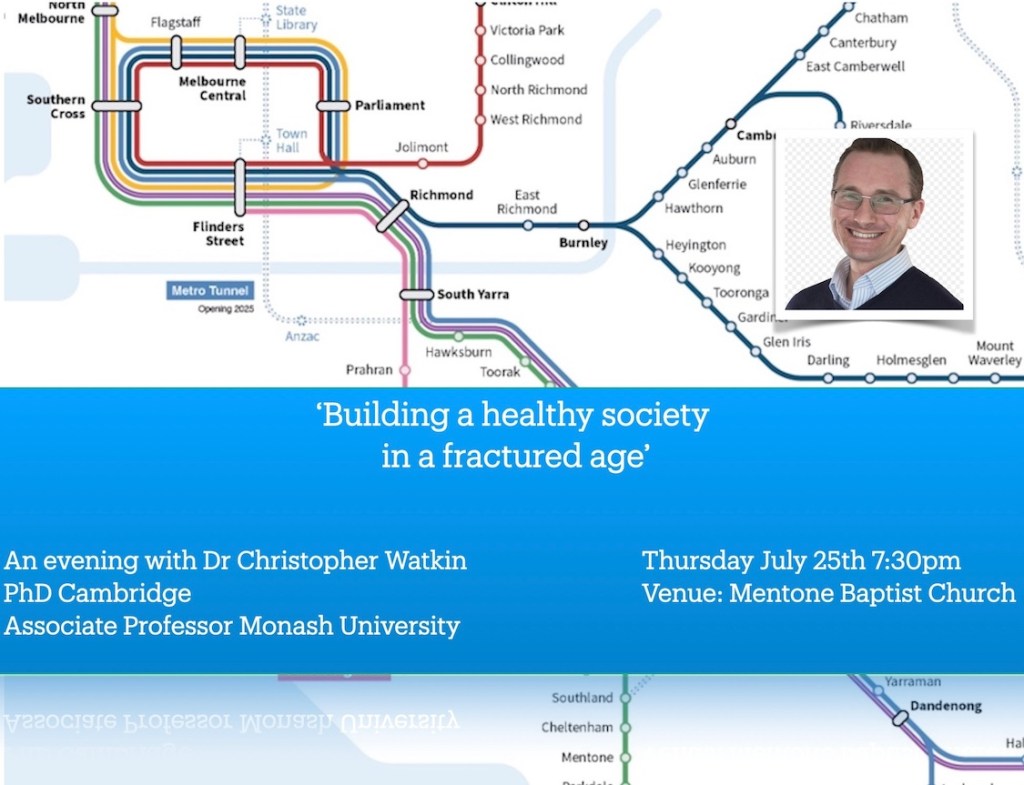
On July 25th at Mentone Baptist Church, Dr Christopher Watkin will be addressing one of the key social issues facing Australia in the 2020s:
‘How can we build a healthy society in a fractured age?’
Australia is wrestling with important issues surrounding religious and social freedoms and responsibilities. Dr Watkin will help us navigate a way forward.
In 2021, Chris addressed political and community leaders in Parliament House, Canberra, outlining a positive vision for civil society. It’s a great opportunity for Melbournians to engage with ideas that can shape tomorrow.
Dr Christopher Watkin is the ARC Future Fellow at Monash University. He is the author of the award-winning book, ‘Biblical Critical Theory’ and numerous other volumes including, ‘Difficult Atheism’.
The Age has tonight published a little write-up about my suburb, Mentone.
I don’t know the author, Sofia Dedes, but let me say, ‘hi neighbour’!
Sofia notes the eclectic nature of Mentone. There is little to resemble its namesake found along the French Riviera, other than a splash of seawater along the edge.
Melbourne is famed for sport, food, coffee and street art. Mentone’s reputation doesn’t quite include any of these. Mentone doesn’t represent cool or vintage, ostentatious wealth or extreme poverty. Mentone isn’t the most multiethnic part of Melbourne, although this is slowly changing. The streets don’t boast stunning architecture or botanical gardens. And yet to thousands of people, this is home, and a great home it is.
I have lived and worked in the area for 19 years now, and my wife and I have raised our 3 children here, and life here counts as a blessing. From kindergarten in Acacia Avenue to Mentone Primary School, from Little Athletics at Dolamore Oval, to playing cricket at almost every ground in the area, we sometimes feel as much part of the local environment.
Sofia correctly alludes to the huge gaping divide that appears like a seismic crack – the Nepean Hwy. I’m accustomed to traversing the barrier almost every day, along with a tangle of busy roads that crisscross Mentone, including Warrigal Rd and Lower Dandenong Rd. Together they chop the suburb into quarters, like a charcoal chicken readied for lunch.
Yes, there is the beach (which we seldom visit) and a forgettable train station. Sofia Dedes is right, Mentone is a suburb with potential, but with few to cast a vision for what can be.
Our streets witness happiness and sadness, success and tragedy. It is a place of fond memories and nightmares.
Some things have changed. Mentone is no longer an affordable suburb, although where in Melbourne is today? The price reached the ‘magical’ median price of $1 million some years ago and has steadily moved northward since. Moving into the area requires money, and this sadly squeezes out many. And yet like our multi-sided suburban sprawl, local schools are growing if not booming, as is the traffic!
Mentone’s future includes a younger population with money to invest, an unused cavity in the middle of the shopping strip, and a beach where pollution sometimes conquers the waters.
Is there more? Sofia Dedes have offered the rest of Melbourne an impression of Mentone, but something was missing in her picture.
If anyone is interested to gaze into the future and see what Mentone could become, there is a little ‘secret’ in our community. Okay, it’s not exactly a secret but it is often overlooked as people walk by and cars drive along Warrigal Rd each day. The building, like the area, is eclectic. There is a red brick hall attached to what can only be described as a retro-styled ‘I want to be funky and never will be’ auditorium. The yellow and orange stained glass windows are the same vintage as John Lennon’s coloured sunglasses, but without the cool factor.
Inside these forgettable buildings is something quite special. So ordinary, but also quite remarkable. Meeting regularly is a growing community of men, women, and children, from all kinds of backgrounds. There are doctors and lawyers, factory workers and students, teachers and architects. More exciting than this, the people come from all quarters of the earth, from China and Colombia, Uganda and Ukraine, India, England and more.
It’s not little old Mrs Smith with her pet cat playing the organ to empty pews, but a place that regularly creates more noise than the Mentone Tigers winning a home game.
This community is Mentone Baptist Church: plain, ordinary and spectacular. The message that forms and brings together such diversity is an ancient one, and one that continues to give hope and meaning to people across the suburbs and streets of Melbourne. We can’t agree on which footy team to support, but we agree on life’s biggest questions.
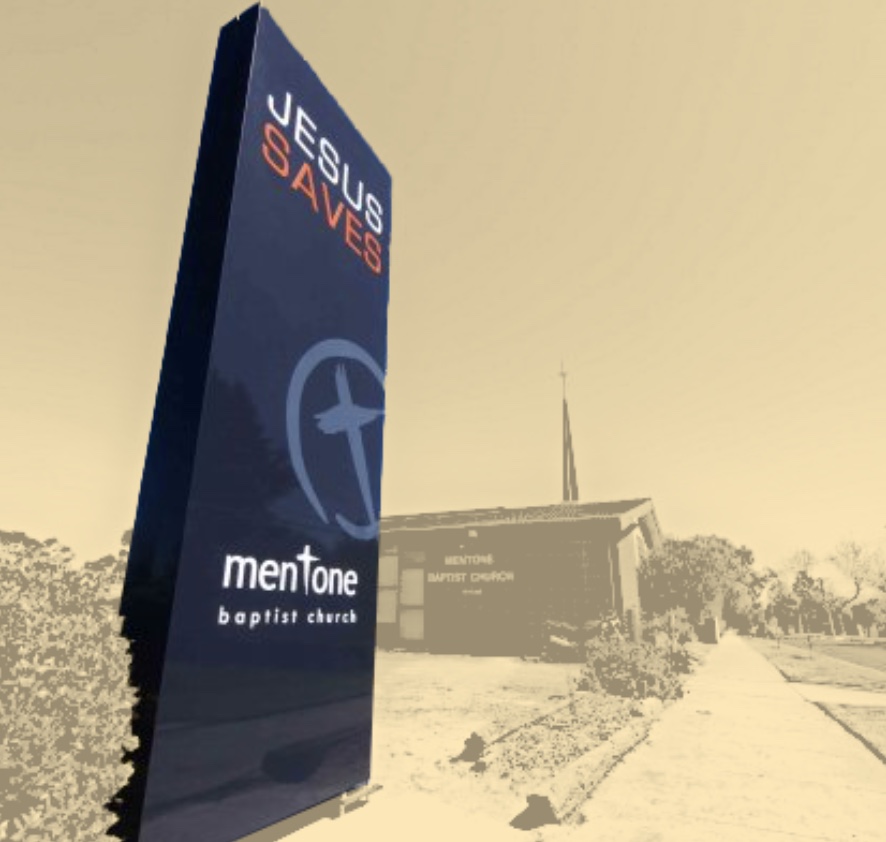
At Mentone Baptist Church the people may have little in common, and yet in Jesus, we have everything together. That’s one of the exciting fruits of Christianity. Church is a visual display of what can be, where encountering the living God changes lives with the kind of generosity and gentleness, love and selflessness, that every community desperately needs. As our Church sign famously ascribes, ‘Jesus Saves’ and ‘Christ our Hope’.
When all is said and done, we are made for more than material security. Mentone offers schools, beautiful homes, sporting clubs, and a 2-minute drive to one of Melbourne’s best coffee roasters (albeit in Cheltenham), but these good things don’t satisfy the soul. They don’t last forever and they can’t take away the burdens and guilts that we all carry.
Many residents of Mentone have tried religion. Many others are convinced there’s no point looking. Others again are enjoying the demands and opportunities afforded us to live in our ordinary yet affable suburb. And yet, the nagging sensation, is there God and what he is like?’ remains.
Something is going on in that awkward-looking church building along Warrigal Rd: a belief that a dead man is now alive and he is God and has the power and love to forgive and reconcile. I get it, it sounds kinda weird if not old school; it’s certainly different to the slogans splashed on the billboards along Nepean Hwy. After 2000 years of history there remains nothing like this ancient message of Jesus. In our suburb divided by roads, the good news of Jesus is bringing together people from all manner of life, and I think that says something pretty special.
As Jesus once said to a friend who was grieving
“I am the resurrection and the life. The one who believes in me will live, even though they die; and whoever lives by believing in me will never die. Do you believe this?”
Next time you’re driving past the ‘church with the sign’, pull over and visit us one Sunday. We’d love to see you.
Yesterday at church we enjoyed our biggest Good Friday service yet. That’s not a message for boasting, but rather one of thankfulness. Other churches are reporting similarly.
Over this Easter weekend, our friends at The Age newspaper decided on taking a different angle. They want readers to feel a disenchantment over Christianity and the merit of alternative faiths.
One of Australia’s worst-kept secrets is how nominal Christianity is declining. Naturally. Even the Bible speaks of the inevitable slow death of empty religion. The story is not new so why is it a feature story over the Easter weekend?
Society is at pains to honour and respect the sacred days of various world religions. Football Clubs produce special messages. Politicians offer the now obligatory salutations, often accompanied by a visit to the local Temple or Mosque, with a news camera or six! I’m knocking not them, but simply observing. We ought to respect our neighbours (even when we disagree with them) and be thankful for the religious toleration that still exists in our country.
The Agehas chosen to commemorate Christianity’s most ‘holy’ days with 2 articles speaking of the rise of world religions in Australia and of Christianity ‘plummeting’.
“Meanwhile, Christianity has plummeted by more than 26 per cent during the same period, and once grand houses of worship are battling a mass exodus and shrinking congregations.”
Whether this is designed to be a kick in the gut or they naively thought that this is a suitable way for the newspaper to celebrate Easter, I can’t help but see a parallel with the first Easter. Of course, the two are dissimilar in very big ways, but nonetheless, the jab in the side is noticeable.
Don’t get me wrong, sociological studies exploring the beliefs of Australians is an interesting and important task, and worthy of media reporting. I am simply noting that the data is not new, the research isn’t recent. I have engaged in conferences and conversations about the waves and currents of religion in Australia for many years. The timing for The Age’s expose is ironic to say the least. Like a Pharisaical jibe at Jesus as he hung on the cross, it’s open season for slamming Christianity.
In our reading at church yesterday,
“they began to call out to him, “Hail, king of the Jews!” Again and again they struck him on the head with a staff and spit on him. Falling on their knees, they paid homage to him. And when they had mocked him, they took off the purple robe and put his own clothes on him. Then they led him out to crucify him.”
And this,
“Those who passed by hurled insults at him, shaking their heads and saying, “So! You who are going to destroy the temple and build it in three days, come down from the cross and save yourself!” In the same way the chief priests and the teachers of the law mocked him among themselves. “He saved others,” they said, “but he can’t save himself! Let this Messiah, this king of Israel, come down now from the cross, that we may see and believe.” Those crucified with him also heaped insults on him.
Like a gambling addict, these sceptics were far too quick to claim Jesus had failed. Two days later, the earth erupted when Jesus physically rose from the dead. The world has never been the same. And even if Western nations like Australia convince ourselves that Christianity is on the way out, Christianity worldwide has never been bigger. Praise God! It is we who are missing out.
Unlike Jesus, Christians sometimes react to social movements with the angry rant of an American President or the rage of the latest mob blocking traffic in the city. Christians respond to negativity with hateful words need to be called out.
Like Jesus, Christians can respond to critics with kindness and grace. He didn’t retaliate. He didn’t hate on them. He absorbed the wrath of God in their place.
The Age expose includes this observation about the chessboard of Australian religious affiliation,
“Andrew Singleton, associate professor of sociology and social research at Deakin University, says the growth of religious minorities is tied to migration trends in Australia.”
I am a big supporter of migration. Our nation is largely built on the blood and sweat of millions of migrants. Come along to Mentone Baptist one day and you see the nations represented in just one small Church; it’s fantastic.
This is one major difference between Christianity and world religions. Christianity grows by conversion. Yes, I know ‘conversion’ is an ugly word in Victoria, even an illegal one, but if Jesus and the Apostles preached for conversion, so do we.
Conversion isn’t our society’s great sin; it is the great moment of liberation: God in Christ brings forgiveness. He justifies and reconciles. The Good news of Easter isn’t religions offer of enlightenment to those who work hard enough and who acquire sufficient levels of holiness, far from it. The good news of Easter is a gift; God’s loving gift of redemption. Jesus isn’t about merit, he is mercy.
We are seeing a plethora of reports tabled by Government and legislations produced, designed to further limit religious freedom. Hardline secularism opposes healthy pluralism, which values freedom to preach and persuade and engage. Christianity grows via conversion and conversion is about reasoning and persuading and people coming to believe the gospel for themselves. How different is the approach of authoritarian secularists who create laws to force-convert what Christians may and may not teach and practice. It is as though they googled Emperor Domitian or Communist China’s Sinicization program and concluded, that’s what we need here.
Of course, such opposition to the Christian faith is doing little more than reinforcing the Bible’s anthropology and the significance of the cross. Those who mock the cross are not undoing Christianity but simply exposing the human condition and thus our desperate need for divine mercy.
Unfortunately, I don’t think Australia has yet reached peak secularism; the reigns of power are rarely loosened without struggle. We are however beginning to see cracks appear and falling through these holes are real people whose lives have been promised much by life without God, and the results are often catastrophic: Not peace, but narcissism. Not freedom but bondage to self-realisation.
The one fact that The Age hasn’t explored is why and how classical evangelical churches are growing. I’m not referring to the super cool tribe who have the resources to stage a concert every Sunday, but churches who believe, open and teach the Bible, who preach about Christ crucified, who love to sing and praise God, and who are actively loving and serving the other.
It is important to differentiate between churches that hold to orthodox Christian beliefs, and those who don’t. I suspect the major fault line between churches that decline and those that grow is this one. Yes, there are other factors, changing demographics and sociological phenomena, and individual preferences that play into service styles. But there are too many ordinary churches where music is possible and the preaching okay, but who experience a work of God and more people becoming Christians.
Whereas, the churches that face most decline are those that move away from classical Christianity. Churches that embrace each latest iteration of sexology, who erase the Bible’s tricky bits, who explain away the resurrection, who argue against the penal aspect of the atonement, these are churches who race their congregations off a precipice and into a spiritual grave.
As Tom Holland famously quipped,
“I see no point in bishops or preachers or Christian evangelists just recycling the kind of stuff you can get from any kind of soft left liberal because everyone is giving that…if they’ve got views on original sin I would be very interested to hear that”.”
So thank you to The Age for interesting and poorly timed articles. And next time, dig a little deeper and you’ll notice the stronger currents that are at work in Christianity around Australia today.
Mentone Baptist Church celebrated our 70th anniversary yesterday (November 19).
It was a great morning. Our auditorium is often fairly full, but yesterday it was very full and dozens of people spilling over into the foyer and hall to be part of this thanksgiving service. It was encouraging to have former pastors and former members visiting and local MPs giving their time to celebrate with us. Many thanks.
The theme for our celebration was giving thanks for the past and looking to the future. Our Bible text was Philippians 1:3-11 (there is a link to the sermon below).
As we live in the present to worship God, to proclaim Jesus Christ and to show our community the reality of Christ, we give thanks to God for the last 70 years and we are looking to the future.
In recent years aspects of Melbourne’s culture have made much hay out of churches and negative press toward Christianity. Let’s be honest, sometimes Christians deserve the bad press given the awful things committed by some religious figures. At the same time, we might be forgiven for believing that Christianity in Melbourne is on the way out. To be sure, ‘progressive’ forms of Christianity are declining, but the real picture on the ground and in many local churches suggests new growth and new hope.
I want to share a brief history of Mentone Baptist Church that was presented at the anniversary service (it’s impossible to capture every story from 70 years!). There is also the link to our anniversary sermon. I hope you’re encouraged.
Mentone Baptist Church: church for the future
Beginnings
Mentone Baptist Church is known as the church with the sign: ‘Jesus Saves’ and ‘Christ our Hope’.
The original sign was replaced in 2009, and the buildings, people, and times have changed, but our message remains the same.
Mentone Baptist Church was formally constituted as a Church on November 19th 1953, but the origins came earlier. As far back as 1945, there was a desire to start a Baptist church in the area. At that time there was no Baptist church in Melbourne south of Oakleigh.
It wasn’t until 1950 that a group of 10 people living in Mentone and Cheltenham began discussing the possibility of a church. They first met on 9 Nov 1950, in a home on Nepean Hwy. Rev. Hawley led the group which included Reg and Ruby Ward, Jim and Grace Sutherland.
9 months later this group of 10 men and women began praying and searching for a property. A site on the corner of Warrigal Rd and Harpley St was purchased in February 1952 by the Baptist Home Mission Society, although some of the land, including what is today the cark park, was purchased years later.
Horace Jeffs commenced as the first pastor in April 1953, on a part-time basis with a stipend of 1 pound and 12 shillings per week. While waiting for the build, which is what today is known as the church hall. Mentone made news in The Age newspaper, for the novel story about a church meeting in a house and with their own organ! Sunday attendance reached 30-40 people.
On 1 November 1953, the church building opened. But of course, church isn’t the building, it is the people, and so on November 19 with a membership of 23 people, Mentone Baptist Church was formally constituted and the first members meeting conducted. Baptist Churches highly value the priesthood of all believers and so congregational involvement and ownership matters to us. Hence, our (in)famous members meetings!
A manse was purchased in 1955. Today this house is known as the church office, where it is used as office space, meeting rooms and children’s ministry.
Over Mentone’s first 10 years, the church grew to 60 members and always with a strong emphasis on the ministries of prayer and word.
A season for growing
Mentone’s evangelical roots and desire to start new churches continued with a team planting Beaumaris in 1959. This has continued over our history and most recently, Mentone sent out a team under Stephen Tan to plant Regeneration Church, next to Monash University. Over the years we experienced a trickle of university students travelling to us from Monash, with many being baptised at Mentone. We however saw the need and benefit from us moving closer to the university. 6 years later, there are more than 170 students and young adults calling Regeneration Church home (and growing every year).
A key turning point for Mentone took place in 1961 when Alcc White accepted the invitation to become pastor. Alec White was an effective preacher and communicator. He was rightly convinced the Bible is God’s word good and sufficient word, and that Jesus Christ is the way to know God. Under his leadership, and with many folks including the Foxes, the Lees, Betty Boase, the Platts, and the LePage family, the church grew in number and maturity. The Church invested in connecting with the local community, including ministering to the sick at the Kingston Centre and providing RE classes in local schools. Boys and Girls Brigades provided opportunity for local children to enjoy mid-week activities, gain life skills and learn about God. Dorcas commenced, a women’s group providing practical help to disadvantaged people around the world.
For 50 years Rex and Shirley Wills have been faithful members, serving in almost every part of church life. Betty Boase is our only member today who has been part of the church for 60 years.
A right emphasis on the good news of Jesus Christ raised up a generation of men and women who were trained and sent out to serve overseas on mission: Jim and Pam Sterrey, Daphne Smith, Fred Stoll, Chris and Carole Hebert, David and Sim Senator, Roger and Ruth Alder, and more. In the late 1960s, Marsali Ashley joined Mentone while studying at the Melbourne Bible Institute. Following a term in Papua New Guinea, she returned and married John Campbell at Mentone in 1972 (Murray’s parents).
Our current auditorium was built in 1968, with member Don Platt drawing the plans and his company constructing it. Originally, the seats faced north, with a stage in front of the northern window. The space was renovated in 2013 to accommodate more seating. Internal walls were knocked down and the old parent’s room was removed, thus increasing the space from 150 to 230 seats.
In 1981 Ross Prout was inducted as the new pastor and served here for 10 years. Under Ross’ leadership, the church experienced significant growth, especially among young adults. He continued the church’s emphasis on Bible teaching and a heart to see people coming to know Christ.
With Ross and Bronwen moving to Mitcham Baptist in 1991 after 9 years of fruitful ministry, Leigh Diprose commenced his ministry here, with Helen his wife and their 4 children joining. The Church continued to support ministry in the local community and worked alongside Youth Dimension to reach teenagers. Leigh concluded in 2000 and has since served at Altona Baptist and helping rural churches with preaching. Today Leigh serving at City on a Hill at their Melbourne West Campus.
Every church experiences difficult seasons and challenges, and Mentone is no exception. At the start of the new century, a significant number of the Church moved away as housing prices squeezed out young families and the Church lost a sense of direction and what it was about.
The congregation had shrunk to a Sunday attendance of 30 people by the end of 2004.
A new chapter
In 2005 Murray and Susan joined, following 4 years studying at Moore Theological College and gaining pastoral experience at Chatswood Baptist in Sydney. After several years away from Melbourne, the Campbells were excited to return and to make Mentone Baptist Church home for their young family.
The Church started to grow and saw growth of 10-20% each year for several years to come. In 2010, Murray suggested to the church that to help facilitate further growth, it would be advantageous to employ an associate pastor. To see whether the church could finance this, he asked if members would commit to increasing their giving. The Church was able to employ an associate pastor full-time from the first day! The Church called Phil Ninness and he commenced in 2011. Phil is an excellent preacher, and we also began an evening congregation, which attracted university students, and saw many becoming Christians and baptised and joining the church.
Phil and his wife Heather finished after 2 years to take on the Senior Pastoral role at a Baptist church in Tasmania. Mike Veith, who was serving as a student pastor while studying at Ridley College, became the new associate pastor. Mike has served in this role for 10 years, with his wife Camille and daughters part of the church family.
Over the past 18 years, the church has developed strong links with the Christian Union at Monash University. Stuart White and Dan King are both members at Mentone and they work on campus with AFES. We might assume that in our secular society, intelligent university students are disinterested in God; the campus ministry is experiencing quite the opposite.
The church continues to have a heart for mission both locally and overseas. In the past 6 years, several members have been sent out for church planting, pastoral ministry, and mission. We pray that God will add to those numbers in years to come.
The vision that began all those years ago in a Cheltenham house hasn’t been forgotten or lost but continues in 2023: ‘Christ our Hope’ and ‘Jesus Saves’.
70 years ago a tiny church moved from meeting in a house to this property on Warrigal Road. The year 2023 may look and sound very different from 1953. The streets and suburbs look very different today. 70 years ago this area was dominated by small farms and market gardens. There were a few schools and a train line. Southland didn’t exist. There was no McDonalds or KFC! The cars and cricket bats, the coffee and fashion and phones have changed, but the underlying issues and questions and longings of the human heart remain the same.
Our vision and prayer is to see the good news of Jesus Christ growing more and more and lives being transformed by God’s grace, love and truth. We thank God for the past and we look forward to the future and seeing how God continues his good work.
The 2023 Australian Indigenous Voice referendum is less than two months away. This national conversation is producing strong emotion and opinion across political and social spheres, and not without reason.
The Yes and No Campaigns are in full swing and trying to capture the votes of everyday Australians. It appears as though influencing the religious vote has become a crucial part of campaign strategy. Leaving aside the question as to whether the category of ‘religious vote’ exists, politicians and community leaders are trying to win over religious Australians, so much so that The Australian recently ran a piece examining, ’Faithful on both sides hear rival gospels of the voice’.
On both religious and secular platforms, articles are being published and events organised to help religious Australians consider The Voice. For all the arguments about divorcing religion from the public square, it seems as though churches and religious societies are a useful mule to carry the message for both proponents and opponents of the Voice.
As a Christian, I believe the Bible gives us principles that shape how we engage in society and how we think through critical moral issues. I can no more neglect seeing the world through the lens of the Bible than I chew food through my mouth or speak with an Aussie accent.
The Bible orchestrates tremendous theological principles that inform our thinking and attitudes about social issues: love of neighbour, reconciliation, justice and mercy, and more. These are deeply Christian ideas, ones that are so embedded in Australian society that we often don’t recognise their origins. Indeed, many of our secular assumptions today are the vapours of Christian theism, continuing to influence our desires for civil society and to do good.
I’m not suggesting that there is always a direct and clear line between a Bible principle and a moral or societal issue. Sometimes that is the case, but often it’s not. I think this is where some Christian voices fall down as they argue for or against the Indigenous Voice to Parliament. There isn’t a single Bible verse that confirms or rejects the Government’s proposal. Rather, it is a matter of wisdom and discerning how to apply healthy and good ideas to particular situations.
The Referendum is also a constitutional debate. The Referendum is a legal, political, and societal consideration, and so relying on gut instinct or emotive argument isn’t sufficient. At the same time, we shouldn’t ignore the heart-felt emotion that is being expressed, especially by Indigenous Australians. Listening well and understanding the other is something we can afford to do. This also means that Christians might (and should) find common agreement on guiding principles and yet may find themselves landing on different sides of this proposal on account of legal and constitutional considerations. I’m not for a moment suggesting an even split or spread among Christians; I don’t know. I am simply making the point that Christians in agreement with principles may come to different conclusions about their practice in the Governmental and constitutional spheres.
For Christians, this Referendum is unlike the marriage plebiscite of 2017 where there is a clear and direct line between the Bible and the definition of marriage. Our position on marriage was and remains in line with both the Bible and what I’d argue is the anthropological and classical understanding. At the time our church prayed that Australians would continue to affirm the classical understanding of marriage, but we also restrained from instructing people how to vote.
Neither is this Referendum analogous to the Republican referendum of 1999; this is more consequential. And I don’t think this referendum is identical to the 1967 referendum which ensured that Aboriginal people are counted as part of Australia’s population and considered under Australian law. That referendum was a long overdue correction, and the fact that 10% of Australians didn’t support the referendum is to our shame. Slowness in acknowledging the imago dei and therefore equality and dignity of Indigenous peoples before the law is a reminder of a sin-stained history, but also one where wrongs have been righted and progress made.
Among Christians, there are divergent views about the model presented by the Albanese Government and the chosen wording. That doesn’t mean that every viewpoint is valid or helpful or Biblically sound, but there are considered Christian voices arriving at slightly different conclusions, from Michael Jensen to John Anderson, Gray Connolly and Andrew Judd. Even among Indigenous Christians, there are varying thoughts about The Voice to Parliament (I don’t know whether, like the general Indigenous population, the majority of Aboriginal Christians support the Voice. Someone might be able to point to data on this). My aim here isn’t to delve into these debates and to weigh various arguments, nor suggest who may or may not be correct in their judgments.
My aim here is one step further back, or perhaps it is a forward step, and that is to encourage considered and prayerful engagement on this issue, and with an awareness that Australians are looking to see how Christians speak to the Voice. I understand that by saying this, some folk will be disappointed. Others will be frustrated because I’m not urging a vote for or against. I can hear the rude jibes already. So be it. Perhaps there lays the very thing that I want to address.
I appreciate how Churches may feel pressure to campaign one way or the other, and many pastors no doubt hear impassioned pleas from congregation members to make public statements in one direction or another. It is okay for Christian leaders to offer another way:
The issue deserves careful inspection and as citizens, we are responsible for informing ourselves. Encourage people to read and understand.
Praying is a good thing to do. It really is. This is the one task churches must surely undertake.
Show respect and kindness toward those who hold a different to the one you have.
Don’t allow this Constitutional issue to create disunity in a church.
Ignore and refuse to buy into the unkind or hyperbolic rhetoric being thrown around on social media and news bites.
Be careful to avoid binding the consciences of others where the Scriptures are not binding us. On this point, if I can clarify, Christians must oppose racism wherever we see it and are positioned to oppose and restore proper dignity and recognition. Racism is evil and is anti-Christian. Christians should also be concerned for the well-being of Indigenous Australians. I believe most Christians are, and while many believers support the Voice, others are not convinced that this is the right model. Avoid assuming people’s motives.
I mentioned prayer above. Here is what we prayed as a church yesterday at Mentone Baptist Church. Perhaps it is a prayer others might like to pray also as our nation faces a testing time over the coming months:
“Abba Father
Our nation’s past is complex, Lord, and so are our hearts. We pray for all the debate happening around the referendum about the Aboriginal Voice to Parliament at the moment.
You are a God of justice, and we pray that the outcome would be a just one. You are a God of mercy, and we pray that the outcome would be a merciful one.
You are a God who cares for the widows and orphans, the weakest among us, and we pray that the outcome and the way the debate is conducted would honour the weak and helpless.
We pray for our own hearts, that your Holy Spirit would convict us of our own sinful attitudes, wherever they may lie.
We pray for our Aboriginal brothers and sisters in Christ. We thank you for the deep godliness and sanctification of many aboriginal Christians who are living for the Lord, often in tough circumstances. We pray you would keep them faithful to your word, and fill them with your Spirit boldly to declare the praises of him who called them out of darkness into his marvelous light. We pray that you would open a door for their ministry, so that more and more aboriginal men and women can find freedom, fulfilment and life in Christ.
With issues like the Voice likely to cause divisions among Christians, we pray the words that Jesus himself prayed in John 17:
“My prayer is not for them alone. I pray also for those who will believe in me through their message, that all of them may be one, Father, just as you are in me and I am in you. May they also be in us so that the world may believe that you have sent me. I have given them the glory that you gave me, that they may be one as we are one— I in them and you in me—so that they may be brought to complete unity. Then the world will know that you sent me and have loved them even as you have loved me.”
Sadness, shock, anger, disappointment, frustration, and despair. Such feelings are not uncommon in our streets and suburbs. Of course, there is much for us to enjoy, and opportunities abound for most people across Melbourne, and yet more and more data suggest that a cavity exists in many lives and it is only growing with time.
In the extraordinary musical, Les Miserables, Fantine sings a song that haunts. The words tell her story. It is a story of lingering hope. It is a story of desperate hope that fades. It is a story that too many of our neighbours and friends resonate with, and perhaps even yourself.
I dreamed a dream in time gone by
When hope was high and life worth living
I dreamed that love would never die
I prayed that God would be forgiving
Then I was young and unafraid
And dreams were made and used and wasted
There was no ransom to be paid
No song unsung, no wine untasted
But the tigers come at night
With their voices soft as thunder
As they tear your hopes apart
And they turn your dreams to shame
And still I dream he’d come to me
That we would live the years together
But there are dreams that cannot be
And there are storms we cannot weather
I had a dream my life would be
So different from this hell I’m living
So different now from what it seemed
Now life has killed the dream, I dreamed
In our search for hope, we are often urged to look inside ourselves or to carry on and push through barriers. On other occasions, we are encouraged to hold onto relationships or careers as though these can secure contentment and peace. What happens when these things fall apart or fail? What happens when we reach all our goals, only to discover that they cannot fulfil the burden we placed upon them?
Easter really does give us the answer. Maybe that sounds a little too Christian for you; an unimaginative and prosaic offering. I don’t mean the long weekend or colourfully wrapped chocolate bunnies and eggs. I’m referring to the historic events that took place just outside Jerusalem about 2000 years ago. Even today, with all our latest gadgets and knowledge, the world hasn’t overcome the irresistible story of God who gave his life for hopeless and helpless people.
Over Easter, my church is exploring (as will churches across Melbourne) the good news story that never dies or fades or disappoints. On that cross, the darkest dark fell upon the Son of God in the place of a sinful world. On the Sunday morning, a light more brilliant than the dawning of the sun pierced history and continues to shed light on millions of lives across the world.
Our Bible text for Easter Sunday this year includes these breathtaking words from John’s Gospel,
“For God so loved the world that he gave his one and only Son, that whoever believes in him shall not perish but have eternal life. For God did not send his Son into the world to condemn the world, but to save the world through him. Whoever believes in him is not condemned, but whoever does not believe stands condemned already because they have not believed in the name of God’s one and only Son. This is the verdict: Light has come into the world, but people loved darkness instead of light because their deeds were evil. Everyone who does evil hates the light, and will not come into the light for fear that their deeds will be exposed. But whoever lives by the truth comes into the light, so that it may be seen plainly that what they have done has been done in the sight of God.” (John 3:16-21)
Notice, how God is described as recognising there is something not right in the world. Also, note how these verses assume God doesn’t agree with every want and desire and activity we pour our lives into; it’s as though we’re not the standard for righteousness. At the same time, there is a profound love spoken and expressed.
A lot of Aussies have given up on Church. Millions have discounted Christianity. When we’re being honest we can understand why this is sometimes the case, given the horrors uncovered in some church buildings and lives of clergy. At the same time, most churches aren’t playing games of pretension and hypocrisy, but they are filled with ordinary people who are convinced by the power and goodness of the God who has loved the world.
Many of our dreams cannot be and some ought not to be. But life cannot kill the greatest dream: God is forgiving. Jesus has paid the ransom.
Why not visit a church this Easter? Perhaps open a Bible and read the Easter story for yourself (Mark chs. 14-16; John chs. 18-21)*
————————————
* You can read the Bible online for free. https://www.biblegateway.com/ is one of many great websites that allow us to search and read any part of the Bible)
Check out this short video that explains how we’re returning to church at Mentone Baptist. It may be a little while before we are gathering as one congregation and doing everything that is so important to us, but this is a start.
Whether you’re a Christian or not, you’re very welcome to join us. If you don’t live near Mentone/Cheltenham and would like to find a church to visit, let me know and we’ll try to suggest one for you.



 MurrayCampbell.net