It’s Biblical

‘It’s biblical’. The disaster is of ‘biblical proportions.’

The Age newspaper ran this headline to describe the terrifying fires in Los Angeles: ‘It was biblical.’

It’s fascinating to see how quick we are to turn to and lean upon biblical language and imagery when trying to make sense of events in front of us. This isn’t specifically a Christian trait, it is a cultural one. In fact, it is a near-universal tone for people grasping for description and explanation of what has befallen them.

The fires in and around Los Angeles are truly epic and terrible. As a Melbournian, I am familiar with fire. Every summer breeds conditions that can be whipped into a firestorm across our hills and outer suburbs within a very short period of time. Though we live across the Pacific Ocean, we are watching with understanding and trepidation for our American cousins.
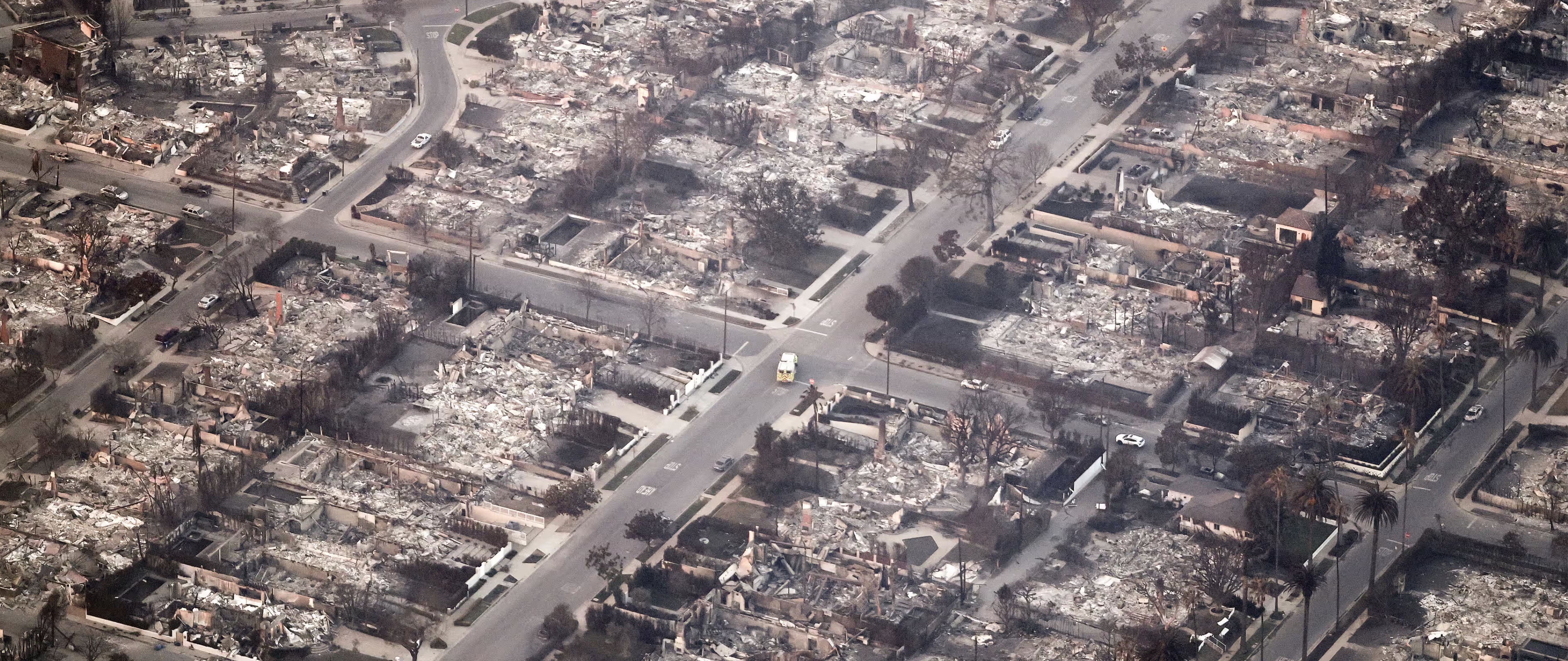
The observation that I wish to explore for a few moments here is the regularity in which the idiom, ‘biblical’  is used to describe events of monumental significance, and most commonly, those that are tragic in nature. It’s not only the use of ‘biblical’ in the vernacular but our almost subconscious reliance upon the Bible in order to make sense of life’s events. The Bible has so influenced our epistemology and morality and spirituality, that we defer to its words and ideas, often without realising or without belief. 

What does it mean to be ‘biblical’?

On one level, it makes sense that we use the word, ‘biblical’ to describe overwhelming tragic events. After all, the Bible contains a large volume of events with awesome power and of cosmic consequence. Whether it is the Noahic Flood, the Plagues on Egypt, or the destruction of nations and humbling of kingdoms, the Bible depicts massive occasions and crises.

However, one of the mistakes we can fall into is assuming the Bible’s presentation of disaster as simplistic. This is far from the case. Comprehending the whys and what’s of grim events isn’t as easy as dividing the world into good and bad people, or equating blessing with moral people and suffering with sinful people. This is one reason for engaging seriously with the Bible text rather than relying on easy sloganeering. Learn our theology less from Dante and more from the Bible, and when we do we discover that the Holy Scriptures presentation is far more fearful and freeing, awesome, overwhelming and also consoling. 

Let me show you. Take, for example, these five elements that are traced throughout the Bible’s storyline and which intersect and develop as we move from Genesis to Malachi and from Matthew to Revelation. Rather than picking and choosing or making a bland pot of tea, there is more to this ‘biblical’ than we may first realise.

First, disasters, whether ‘natural’ or manmade, signal to us that the world is not okay. The world in which we live, work, and play is amazing and replete with good things, and yet hardship and suffering meet us at every intersection. This is not a utopian world. The greatest minds and technologies still cannot control the forces of nature. We cannot ever curb human instincts toward evil, let alone human error. Indeed, we often use our imaginations and advancements to continue ill, rather than to cure. In this, the Bible is an honest story. The Bible is real to life. The Scriptures don’t ignore the heights of human joy and love and life, nor the greatest ignominy and ignorance. 

The Bible isn’t a fictitious fable where everything ends well and the Princess rides off with the pony. The Bible exposes the cruelty of loss, the horror of death, and the thousand ways life is upended.

Second, today’s disasters are prelude to a day of Divine judgment. The presence of floods, fires, and disease are not moot experiences, simply to be endured.

As C.S Lewis famously wrote, “God whispers to us in our pleasures, speaks in our conscience, but shouts in our pains: it is his megaphone to rouse a deaf world”

In his famous ‘apocalyptic’ sermon, Jesus likens both natural and human-made disasters to a pregnant woman entering labour,

“Such things must happen, but the end is still to come.  Nation will rise against nation, and kingdom against kingdom. There will be famines and earthquakes in various places.  All these are the beginning of birth pains.” (Matthew 24:5-8)

In other words, not only is tragedy and pain signalling a world that is in turmoil, but these preempt, like a siren or rolling thunder, that a cataclysmic event is approaching. Jesus is saying, that as awful as these things are, they are reminders that we will all one day meet the God who is a consuming fire, holy and awesome.

Third, tragedy strikes everyone. We ought to step with extreme caution as we try to understand events in our lives and in those of other people. It is too easy, and erroneous, to suppose the tragedy only strikes the ‘sinner’ and blessing for the ‘righteous. Don’t be like Job’s friends!

In Los Angeles this week, the poor and wealthy alike, Hollywood stars and house cleaners, have shared the same loss. I know of Christians who have lost homes and Church buildings that become ruin and ash.

There are occasions in the Bible narrative where disaster falls on particular people as Divine judgment for specific sins. Many of the most serious words and actions are directed by God on his own people because of their continued evil and unrepentance. Moreover, the biblical testimony describes the world in which we live as fallen and corrupted, and all experience the moment. On one occasion Jesus gave an explanation of tragedy which should caution all before attributing specific Divine judgment for particular events in our time. 

On one occasion when Jesus pushed back on the view that tragedy is necessarily linked to some specific horrible deed lurking in your past. Jesus mentions to local events, one was a massacre and the other a building collapse, and he used both incidents to rebuff the idea that suffering equals guilt, 

Jesus answered, “Do you think that these Galileans were worse sinners than all the other Galileans because they suffered this way?  I tell you, no! But unless you repent, you too will all perish.  Or those eighteen who died when the tower in Siloam fell on them—do you think they were more guilty than all the others living in Jerusalem? 5 I tell you, no! But unless you repent, you too will all perish.” (Luke 13:2-5)

Fourth, we long for Divine intervention and grace. Why do we pray? When we lose control and when hope dissipates why is prayer the near universal default? 

Jesus won’t have us believe that this is some evolutionary residue or chromosomal leftover from less developed times.  Jesus (and therefore the Bible), won’t let us think that God is in any way less Sovereign today than in any moment of history. Rather, it is because God is God, and because he is a good God, that we can cry out to him, ‘Abba Father’.

Fifth, and perhaps most important of all, ‘biblical’ does not only denote terrible events, but also the wonderful and life giving.

Not all the ‘biblical’ is bad and disastrous – the truly biblical includes exquisite and extraordinary, grace and goodness. The pages of the Bible are filled with stories of immense love and of extravagant mercy and forgiveness. Even judgment is often met with redemption, and grief finds consolation.   Above all, the most horrifying event of all history, the cross of Jesus Christ, also turns out to be the defining event that produces forgiveness, peace and new life. 

The incarnation is big time ‘biblical’. That God the Son should come into our space and share our humanity and experience every gamut of human suffering. Jesus went further and grabbed hold of human sin and guilt and bore Divine punishment for us by his death on the cross. 

This event of ‘biblical’ proportion is matched by his resurrection. The God Man who died and was laid in the tomb, was raised to real life on the third day: breathing, walking, physical and cognitive functioning life. 

Within hours of the fires erupting in Los Angeles, people were looking for explanations and for people to blame. Indeed, investigations and enquiries will no doubt take place. Such things are important. Lessons need learning. 

My point here is a simple one, equating events to ‘biblical’ isn’t a bad starting place. Most of us will do this, and do so without knowing what is ‘biblical’. In 2025, believers, sceptics and investigators will each turn to the Bible to image, explain and interrupt the events in our world, both great and small. As we do, let’s not mythologise the Bible or reduce the Scriptures to monolithic meaning, but embrace the whole.  

We won’t grasp the ‘why’ of every tragedy in this life and world; such wisdom is beyond our pay grade. What is remarkably Biblical is to realise that God entered human suffering in the most personal of ways. Jesus’ life was marked by suffering. He walked alongside the sick and the destitute. He loved the poor and the outcast. His crucifixion entailed every manner of pain and violence, such that he satisfied the right wrath of God.  He has even extinguished the power of death so that we might share ultimately in his life forever.


What Melbourne’s Earthquake reveals about ourselves

On the day Melbourne equalled the world record for the longest lockdown of the COVID-19 pandemic and during another day of violent protests in our city, we were struck by a surprising visitor.

About 9:15 in the morning, our house began to shake violently. For the first 3-4 seconds I assumed a large truck was speeding down the road past our home. I soon realised then that this was more than a vehicle travelling too quickly. The floor and the walls continued to sway for over 20 seconds. 

The earthquake hit 6.0 on the Richter scale, just north of Melbourne. Thankfully no one was injured and the damage was limited to 40 buildings.  

Melbourne isn’t exactly the epicentre of earthquakes. Australia sits comfortably in the middle of a tectonic place, and yet even this seat proved unstable.

At the time my 12 year old daughter  described the event as “surfing on concrete”.  Over the course of the morning Melbournians came together in a way we rarely see, and on Twitter of all places! Comedic memes and funny one liners appeared. One of the best ones was a take on our Premier, then Dan Andreas Fault! Even better was the meme featuring Melbourne’s Federation Square with the tag line suggesting that the earthquake has improved this iconic building.

As the day progressed, people tried to explain the earthquake. Scientists suggested New Zealand was responsible, an explanation that makes sense to most Aussies. Apparently it’s something to do with moving plates and the Kiwis jumping and breaking them in order to keep our nuclear subs away.

Other people pointed to the protests erupting in Melbourne or the Government for its continued lockdown rules.  Others again, suggested the event was some kind of Divine sign, even if most said it in jest. 

It’s this last thought connection which is most interesting. There remains in Melbourne’s subconsciousness, a reference to God and the supposition that behind cataclysmic events is God. Sadly though we less often associate all the good things and beautiful things with God, even though God, 

“satisfies your desires with good things

so that your youth is renewed like the eagle’s” (Psalm 103:5)

This thought process isn’t a drop of evolutionary dross that remains to be drained from our minds, it is evidence of the God whom we are trying to shut out.

Should we connect the earthquake with God generally or with God’s anger more specifically? The Bible has much to tell us about this question. For example, God is Sovereign and the earth is His. He made all that is and he remains in control.

“Nothing in all creation is hidden from God’s sight. Everything is uncovered and laid bare before the eyes of him to whom we must give account.” (Hebrews 4:13)

Earthquakes are mentioned in the Bible, usually as historical events and other times as analogies illustrating God’s activities and character. And of course, as Jesus hung on the cross and died, there was a violent earthquake in Jerusalem. 

Perhaps the most poignant Biblical reference to earthquakes is found on the lips of Jesus, 

“You will hear of wars and rumors of wars, but see to it that you are not alarmed. Such things must happen, but the end is still to come. Nation will rise against nation, and kingdom against kingdom. There will be famines and earthquakes in various places. All these are the beginning of birth pains.” (Matthew 24:6-8).

Jesus is describing the world as it is and the world that will continue to be until the Son of Man returns to judge. Jesus’ explanation doesn’t ignore a scientific one, he is answering the why question rather than the how. To be clear, Jesus’ summary of world history is not connecting specific ‘natural’ events with particular human transgressions, as Melbournians suggested with humour yesterday. For example, in Luke’s Gospel the story is retold of a tower collapsing in Jerusalem and 18 people died. Jesus says of this tragedy, “do you think they were more guilty than all the others living in Jerusalem?” The answer was, no. 

You see, the jokes about judgement, while missing the mark in one sense, are in another way closer to the truth than may realise. Earthquakes, bush fires, pandemics, and wars each defy and destroy the hopes we have. They are violent reminders telling us that life isn’t right and that the world isn’t what we long for it to be. This is why, even in our subconsciousness we desire for things likes  restoration and reconciliation. Even in our secular age where unbelief is the passport to intellectual and popular success, we cannot escape the inbuilt desire to explain our world in design with God, and with a God who both judges and saves.

Today Melbourne has taken the world record for having the longest lockdown, and we know that are many more weeks to go. Dreams have been shredded. Securities have come up empty. Suffering is real. For many, hope has fallen through the cracks.

Jesus understands. He has interpreted the world for us and his words are written down to prepare us. Jesus doesn’t leave us with a world of hopeless despair. He entered it with us and for us, even death on a cross. Through resurrection from the grave, he offers something we need, not just for heaven, but to make sense of today and to give the peace and joy today.

In the same message where he talks about earthquakes, Jesus also says this, 

“Now learn this lesson from the fig tree: As soon as its twigs get tender and its leaves come out, you know that summer is near. 33 Even so, when you see all these things, you know that it[e] is near, right at the door. 34 Truly I tell you, this generation will certainly not pass away until all these things have happened. 35 Heaven and earth will pass away, but my words will never pass away.

“Therefore keep watch, because you do not know on what day your Lord will come. 43 But understand this: If the owner of the house had known at what time of night the thief was coming, he would have kept watch and would not have let his house be broken into. 44 So you also must be ready, because the Son of Man will come at an hour when you do not expect him.

The Apocalypse is coming

The Apocalypse is coming and we are not ready.

I woke up last night (Susan says I have old man sleeping syndrome); I noticed Stephen McAlpine was writing about the great toilet paper crisis, a tornado was hitting Nashville, and then without warning our street suddenly had a blackout.

Morning finally came, and while our power had returned, the toilet paper crisis had worsened, and a real tragedy had unfolded in Nashville.

UNADJUSTEDNONRAW_thumb_127b

Firstly, I just want to say to all the panic buyers around Australia, thanks for nothing. Quite literally, nothing! I had tried to convince Susan that while there was no problem with the supply of toilet paper, people don’t always react with good measure. Thank you media for ramping up the scare levels. I heard this morning that one of the country’s major supermarket chains has begun rationing its toilet paper supplies thanks to those Aussies who couldn’t hold on for a little. While I sit around and hold on for the foreseeable future, let me share some thoughts about the Apocalypse which I was preaching last Sunday at church.

Talk about the end of the world was once associated with religious mania, but today throngs of irreligious people have amped up the chorus, ‘the end is nigh’, while others are following on social media, quietly pondering the possibility.

I’ve already responded to a piece by Geoff Dawson on the ABC, where he argues that perhaps humankind will become extinct and it doesn’t really matter because people are not special.  Dawson may be following the logic of his own Zen Buddhism, which sounds almost identical to atheistic naturalism, but most of us don’t buy it. People do matter. We are not the same as animals. Prospects of mass eradication of human beings trouble us because surely we have inherent and great worth.

Then we have our Climate Change alarmists who are going around and warning us that the world only has 10, 12 or 20 years remaining on the clock.  Before we roll our eyes at this new era of apocalyptic mania, I  can understand people being swept up rhetoric and tales of disaster. Indeed, for those who have survived personal trauma, such concerns are not merely hypothetical.

Global warming isn’t a phantom, Australia has just experienced a frightful bushfire season, and there are geopolitical uncertainties, and now, of course, there is the potential global pandemic with the Corona Virus.

Instead of thinking that maybe Hollywood was right, with its constant stream of disaster movies, there is another word that’s worth consideration.

Matthew ch.24 records the famous ‘Apocalyptic’ sermon of Jesus. You can listen to my exposition of Matthew ch.24 on the Mentone Baptist website. For now, I want to make note of four salient points from Jesus’ discourse on the end of the world.

Firstly, Jesus is describing how life in the world will be.

Jesus isn’t giving us a linear description of history, but a Divine interpretation of history and what we ought to expect in the world before the real and physical return of the creator King. There are 3 characteristics that mark this age.

One, there are global catastrophes and uncertainties,

 You will hear of wars and rumors of wars, but see to it that you are not alarmed. Such things must happen, but the end is still to come. 7 Nation will rise against nation, and kingdom against kingdom. There will be famines and earthquakes in various places. 8 All these are the beginning of birth pains. (vv.6-7)

When we see a disaster, it makes us pause and ponder. When the sky darkens and the thunder rolls, we often ask, what of the end? These things are not the end but serve as reminders that the world has not yet finished.

Second, there are attacks on the Church, from outside and from within. Jesus speaks of persecution, false prophets, and apostasy.

 “Then you will be handed over to be persecuted and put to death, and you will be hated by all nations because of me. 10 At that time many will turn away from the faith and will betray and hate each other, 11 and many false prophets will appear and deceive many people. 12 Because of the increase of wickedness, the love of most will grow cold, 13 but the one who stands firm to the end will be saved. 

Again, we are not required to read these verses as though Jesus is describing a not yet time in the future or as though there will necessarily be an escalation of these things prior to the coming of Christ. Rather, throughout this age Churches will experience this trifecta.

Thirdly, world evangelisation will take place. The good news of Jesus will be preached and reach every nation, and people from every tongue and tribe will respond and believe Jesus is Lord.

 “And this gospel of the kingdom will be preached in the whole world as a testimony to all nations, and then the end will come.” (v.14)


Second, we are not the first generation to face significant crises.

Last month I wrote an article criticising legislation that the Victorian Government is planning to introduce this year.  Thousands of people were reading, with hundreds and hundreds of comments made on social media. One of the more popular responses came from Christians who said things like, “this proves Jesus is coming soon….this is a sign of the end times….the anti-Christ has appeared in Melbourne…”

This reminded me that not only do we let our imaginations disconnect from the Bible, but also from history. I wanted to post an emoji with a screaming face, saying, “no, you have misunderstood me”! 

The problem with our apocalyptic manic Christians is that they always believe that ‘now’ are the last times, whereas yesterday wasn’t. If only we listened to our history classes at school. Ours is not the first generation to experience massive issues and seen terrible evil. The world has faced staggering mountains of trouble and uncertainty before. What of Jews living in Poland in 1939 as the Nazis destroyed everything in their wake? What of a Jewish family in hiding, as the SS hunted down neighbours and friends, either shooting them dead on the spot or throwing them onto a train bound for a death camp? Could things be any worse? Or what of those living 14th Century Europe as the Black Plague killed 1/3 of the continent’s population in Europe? What about the people fleeing from Genghis Khan who killed population after population across Asia and Europe? Could things be worse than that?

Most Aussies live in a luxurious bubble that few people in the world today enjoy, and even fewer in history.  There are however issues of major consequence facing us. At the very least, reading Jesus’ words should cause us to rethink our assumptions about our own security and dependencies in life.

Third, Jesus gives only one sign for his impending return

The word apocalyptic simply means, unveiling. It is to make known something that was previously unknown. The great unveiling concerns the time and manner in which the world will wrap up and the new creation revealed. As Jesus speaks to this question of the apocalypse, he explains that there is one sign, and that sign is his return.

“Then will appear the sign of the Son of Man in heaven. And then all the peoples of the earth will mourn when they see the Son of Man coming on the clouds of heaven, with power and great glory. 31 And he will send his angels with a loud trumpet call, and they will gather his elect from the four winds, from one end of the heavens to the other. (vv.30-31)

This one sign will be visible, unavoidable and unmistakable. As Jesus adds, people will mourn. Why? Because we have spent our days denying and explaining away the reality of Christ. To those whom he describes as the elect, he says, stand firm (v.13) keep watch (v.4; v.42), don’t grow cold (v.12), don’t get sucked in by false teachers (vv.23-24).

Fourth, God is Sovereign

When will the final hour strike? No one knows the time or hour when Christ will return. Jesus tells us that only God the Father knows, and yet people press for more information and our imaginations get drawn into all manner of crazy theories and speculations.

42 “Therefore keep watch, because you do not know on what day your Lord will come. 

And Jesus also says,

“see to it that you are not alarmed.”

We should not be alarmed or surprised by events that take hold of people, nations, and the natural world. We can be appalled and grieve these sharp reminders of a world that is cursed and cannot redeem itself. Alarmism, however, isn’t befitting for the one who trusts in a God who is Sovereign.

Jesus’ apocalyptic sermon reinforces one of the Bible’s great themes, that events in our time are not beyond God’s knowledge or control. He isn’t reacting to events in the world as though he’s playing catch up. He knows what will happen tomorrow. He knows the outcome before the event. He is omniscient and omnipotent. Surely, this can be of great comfort? We may not know what lies tomorrow, whether it’s a virus or the weather, our work or exams. God has it all under his control and it is all pointing to the return of our Lord and Saviour.

The Apocalypse is coming and we are not ready.

And yet, here we are, religious and non-religious Australian alike are beginning to talk and to contemplate the potential. As talk about the apocalypse intensifies here are two simple things Christians can do: 1. Don’t contribute to the mania, 2. Take on board the encouragements and admonishments Jesus gives to the apocalyptic generation.


Epilogue:

Susan has just returned from the supermarket….there was no toilet paper!