The new Archbishop of Canterbury, Sarah Mullally, gave her first sermon in the new role.
How was it? Were there glarring omissions?
Click on the link…
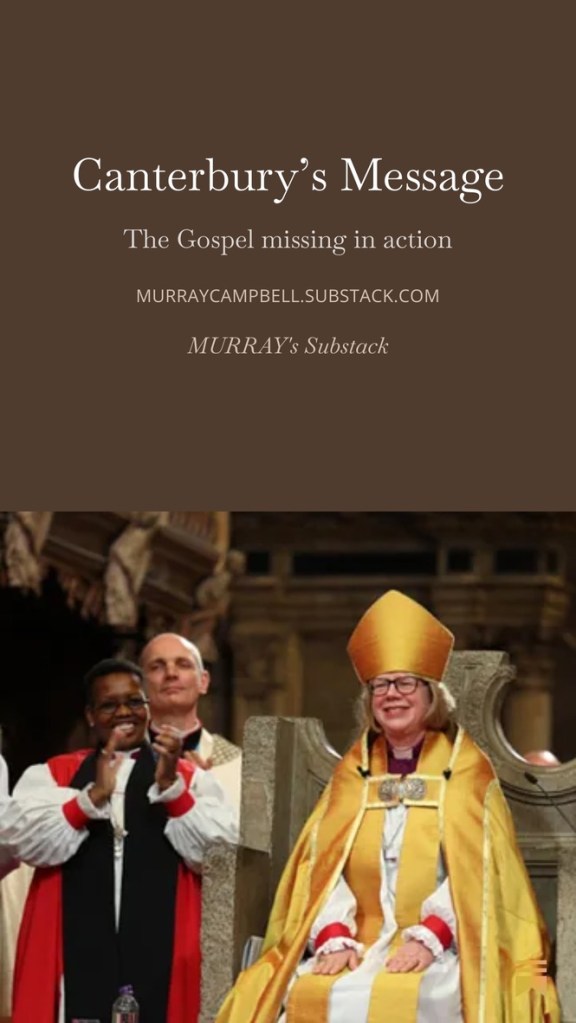
The new Archbishop of Canterbury, Sarah Mullally, gave her first sermon in the new role.
How was it? Were there glarring omissions?
Click on the link…
Congratulations to Dr Dani Treweek on winning Australia’s Christian Book of the Year, for her outstanding work in, The Meaning of Singleness: Retrieving on eschatological vision for the contemporary church.
Dr Dani Treweek and Dr David Starling will be speaking at this special ministry leaders’ day at Mentone Baptist Church on September 6th.

In an age that is increasingly confused about sex and gender, what are we meant to think? What is a Gospel way to think through these important issues?
Click on the link or QR Code for further information and to book tickets for what will be an encouraging and equipping day.
https://events.humanitix.com/sex-gender-and-the-good-news-of-the-gospel-sbjsm9s9

It’s the season for reflecting on the year that has been. People are compiling lists of the biggest or most momentous events of 2023. While these lists can be interesting, I want to do something a little different here. Rather than taking the usual perspective, I want to remind us that the Scriptures give us another view of reality and it’s one that we can easily miss or forget in the midst of everyday life.
Enjoy and be encouraged and a little bit challenged as well.

Two angels are in heaven. They are enjoying sipping ‘heaven’s nectar’ (single origin bean 2023; naturally) when they strike up a conversation. These 2 angels, let’s call them George and Sally, have seen much in 2023. The date (on earth) is December 14.
The universe may be cut off from heaven, but heaven knows what happens on earth. George and Sally read the New Jerusalem Gazette and learn of decisions and events as they go about serving God.
Amidst the clamour being made by 8 billion people in every corner of the world, the annual sound of Christmas Carols crescendos. Although most carolling fails to hit the heights of heaven, such is the powerless nature of lips singing truth from hearts that don’t believe.
George takes another sip and thinks to himself, ‘if only Melbourne knew what the greatest coffee tastes like!’
As the sweet aroma fills their angelic nostrils and swims around the palate, Sally says to George, what do think are the 7 biggest stories of 2023?
Where do the angels begin? The year has brought about eternal cheer and also much grief. On earth conversations and debates rage over a million stories and events that have influenced and shaped, bringing happiness and sadness. Which of these do angels choose?
Sally began compiling an initial list in her mind. She thought, “The Ashes were certainly memorable…maybe we won’t mention the Commonwealth Games or Rail link…And of course, there have been more than a few political elections this year but none of them make the cut…”
George observes that the 7 biggest stories in 2023 are in fact the same headlines from 2022, and pretty much every year. It’s not that each incident and event is glossed over and ignored. The angels have been around long enough to realise that the human condition remains unchanged and God’s eternal decree continues to work over and through every page of history. Sally agrees, which isn’t surprising given there is no unction for disagreement around God’s eternal home.
So here are the 7 biggest events from 2023 according to George and Sally:
The angels agree that number 7 isn’t on the list because of any virtue or value, but because of Divine outrage that continues against God’s world. Sally and George understand how God grieves every sin and transgression. They appreciate how much more than they, God grasps the gravity of these events that harm and offend and destroy.
Whether the acts are carried out by terrorists in the ancient land or Governments promoting injustice, greedy corporations or the hidden sins of a billion people, God grieves. God angers. His anger thunders with a ferocity that shakes the very foundations of the cosmos. The angels witness that while the most judicious of man-made courts cannot capture every offence, in the heavenly court every perpetrator of evil will face God’s wrath and eternal judgment.
Sally points out to George, how blinded by hubris, human beings readily believe they can circumvent Divine justice. At our worst, we even redefine righteousness and call evil good, but God isn’t fooled by our calculations. Whether it is the slaughter of civilians in Israel, the abusive parent in a suburban street in Melbourne, the academic legitimising the dehumanisation project, or the employer cheating his staff out of fair pay; God sees and condemns and guarantees justice.
Some events make the news in Sydney, New York and Colombo, while a billion go unnoticed or are wilfully ignored by friend and neighbour. There is no such overlooking by the King of Kings.
As the angels consider all the headline news, they ponder that God persists with the world; what a staggering thought. Sally then reminds, George, remember what God has said,
“But do not forget this one thing, dear friends: With the Lord a day is like a thousand years, and a thousand years are like a day. 9 The Lord is not slow in keeping his promise, as some understand slowness. Instead he is patient with you, not wanting anyone to perish, but everyone to come to repentance.
10 But the day of the Lord will come like a thief. The heavens will disappear with a roar; the elements will be destroyed by fire, and the earth and everything done in it will be laid bare” (2 Peter 3:9-10)
George remarks, “God has given the most precious gift of all and to people who did not want or ask, his Son. And yet look at all these Christians filling up life with lesser things.
George scratches his head, “God gave himself in Christ but these Christians still aren’t satisfied. They are working harder and earning more and playing more, and yet sacrificing the very thing that can gives them life. And see how they’re teaching their children to chase after the wind. Why are they feeding them junk food when God offers living water? Sure, who doesn’t enjoy a party and decent education or long weekends at the beach. But do they have no sense of discipline and seeking first God’s Kingdom? No wonder millennials don’t take God seriously, when their elders are teaching like this.”
It is another year of sadness as more churches give up Jesus for a seat at the table of respectability, success and ease.
Sally notes a conversation she had with Thomas Cranmer and Hugh Latimer on November 16. She saw them weeping over the Church of England. To give up Divine love for the sake of a moment’s likability staggers the mind. Cranmer reflected on his own moment of weakness and then the grace that caused his repentance. Latimer remarked, that if the bishops of England snuff out the candle, then God will light it again among others.
Spurgeon still can’t get over the joy that his old days of melancholy are over forever. He remains overjoyed knowing that all the superlatives he used in his sermons to convey the wonders of Christ, were barely a tiny impression of the true glory that is being with Christ and seeing him face to face.
As he overhears Latimer talking with Sally, he interjects with Shakespearean flourish, to describe the ongoing downgrade among Baptists as being like the melting polar ice caps. Spiritual climate change is eroding church faithfulness and vitality. Instead of displaying the glory of God in the face of Christ, churches convince themselves that they need to become more like the world to reach the world. The Gospel is melted down and replaced with mirrors to reflect the culture, thus confirming unbelievers’ assumptions about the irrelevance and idiocy of the Christian faith in 2023.
George observed the unusual number of Bibles that are never opened or read.
“It’s like churches don’t ever open the Bible and read what God has to say to them. Don’t churches believe the Lord of the Church? Why do they pretend that the lamb’s 7 letters to the churches are always about someone else and not for them?
Mary and Martha walk past and add, “Churches who choose between love and truth end up losing both.”
Both angels are pleased to announce that the top stories of 2023 include more encouragement and thankfulness than sadness and grief. At number 4 is…
Sally is convinced that one of the highlights for 2023 is seeing so many people becoming more like Jesus. George gives an emphatic nod of agreement.
It’s amazing to observe the breadth of places and conditions in which people are living and the countless challenges many are facing. Instead of becoming bitter or turning to jealousy or despair, Christ’s light is shining. LED lighting might be seen from space, but the Spirit’s light in people’s lives reaches heaven.
The encouragement and comfort of God’s words produce the perseverance of the saints,
“Let us not become weary in doing good, for at the proper time we will reap a harvest if we do not give up.” (Gal 6:9)
“Since everything will be destroyed in this way, what kind of people ought you to be? You ought to live holy and godly lives 12 as you look forward to the day of God and speed its coming…14 So then, dear friends, since you are looking forward to this, make every effort to be found spotless, blameless and at peace with him.” (2 Peter 3:11-12; 14)
“For this very reason, make every effort to add to your faith goodness; and to goodness, knowledge; 6 and to knowledge, self-control; and to self-control, perseverance; and to perseverance, godliness; 7 and to godliness, mutual affection; and to mutual affection, love. 8 For if you possess these qualities in increasing measure, they will keep you from being ineffective and unproductive in your knowledge of our Lord Jesus Christ.” (1 Peter 1:5-8)
Sally and George praise God for his faithfulness in 2023. God’s big project in the world is reconciliation and the church is the people of reconciliation. After all, Jesus shed his blood for the church and gave his word, ‘I will build my church’. The Lordship of Christ and the promises of God in the Gospel are intimately tied to God saving a people,
“And God placed all things under his feet and appointed him to be head over everything for the church, 23 which is his body, the fullness of him who fills everything in every way.” (Ephesians 1:22-23)
you are no longer foreigners and strangers, but fellow citizens with God’s people and also members of his household, 20 built on the foundation of the apostles and prophets, with Christ Jesus himself as the chief cornerstone. 21 In him the whole building is joined together and rises to become a holy temple in the Lord. 22 And in him you too are being built together to become a dwelling in which God lives by his Spirit.” (Ephesians 2:19-21)
God is pleased and heaven is enthralled to see churches of all shapes and sizes given birth in Kenya and Cameroon, in Iran and India, in China and Argentina, and even in the great lost nations of England and Australia. People may turn their backs on God, but His Gospel is compelling and he will finish what he has started building.
George and Sally agree that integrally tied to story no.3 is story no.2. Indeed, stories 2 and 3 are easily interchangeable, and really the same story, just from being reported from different angles.
The Church is God’s masterpiece and churches are made up of countless names and faces of the imago dei, sinful, forgiven and redeemed. Conversion may be considered a dirty and immoral word in parts of the world, but heaven rejoices.
2023 is another year of explosive Gospel growth around the world. A few of these names are recognised by society and media and their conversion stories go viral. In heaven the new birth and adoption of every person goes viral among heaven’s choir.
What a massive year for heaven’s choirs! It’s been non-stop singing with all the millions and millions of people from every language, ethnicity and city turning to Christ and coming to know new life in his name. George exclaims, “Every time I finish the chorus we sing it again. In heaven, Taylor Swift never gets a nod, not even Bach is back. It’s constant no.1”
“Salvation belongs to our God,
who sits on the throne,
and to the Lamb.”
Heaven loves a home coming.
George confessed to Sally that while they enjoy a vantage point that those on earth don’t possess, God authored a word for people. It wasn’t to the angels that Scripture was given, but to people.
Sally recalls the words of Jesus,
“My sheep listen to my voice; I know them, and they follow me. 28 I give them eternal life, and they shall never perish; no one will snatch them out of my hand. 29 My Father, who has given them to me, is greater than all; no one can snatch them out of my Father’s hand
George adds the Apostolic voice,
“We know that the whole creation has been groaning as in the pains of childbirth right up to the present time. 23 Not only so, but we ourselves, who have the firstfruits of the Spirit, groan inwardly as we wait eagerly for our adoption to sonship, the redemption of our bodies”
Heaven longs that people daily correct our myopic gaze. It’s not that we have lenses to see through all time and space; naturally, we are not omniscient as is God (and neither are George and Sally). We do have, because of the God of wisdom and grace, His word which reveals more to us than we deserve and can imagine. The Scriptures provide more than a detailed account of human affairs and moral statutes. God opens his Divine foreknowledge to us so that we can see beyond the immanent frame and know a tiny snapshot of what was and what will be. These words from God give great assurance and encouragement to keep going.
A great crowd this year have finished the race and received those words from God, ‘Well done good and faithful servant”.
Sally is fascinated by the commitment people make to winning gold medals, trophies and awards. “See how they pour their lives into attaining a piece of tin or gold or something with a $ sign attached. The number 1 story of 2023 isn’t a World Cup or Grand Slam, but the crown of righteousness given to all who finish the race. In 2023 millions of people have made it home.
Thanks be to God.
“I have fought the good fight, I have finished the race, I have kept the faith. 8 Now there is in store for me the crown of righteousness, which the Lord, the righteous Judge, will award to me on that day—and not only to me, but also to all who have longed for his appearing.” (2 Timothy 4:7-8)
A game of AFL is taking place on a local oval when a small group jump the fence and start kicking a round ball along the ground. The game stops. Players approach the group and ask them to desist.
They retort, ‘we’re also playing football.
The players answer, ‘no, you’re playing a different game. Different ball, different shaped ground, different goals….if you’re interested, you can join us but first of all, get rid of the soccer ball’.
The group insist, ‘no, we are playing football. We can all play together at the same time.”
In trying to point out the obvious, someone again speaks up, ‘hang on, look…the balls are a different shape. The goals are different. You’re wanting a completely different sport.’
Ignoring the self-evident, the group gaslight the footy plays and again insist,
“We’re going to use this ground. Let’s talk about it. Let’s arrange a series of meetings to sort it out. After all, what we share in common is far greater than our differences.”
In the meantime, the match has been severely disrupted, the umpires feel bullied, and with each new sentence uttered by the small group of soccer players, they encroach further onto the oval and begin handing out Man U jumpers to everyone.
A significant announcement was made this week, one which may change the Church landscape in Australia. The decision is not so much about changing the game but is confirming that we will not change the game. GAFCON is responding to what is a tireless intrusion onto Christian Churches by certain bishops and leaders who are trying to change the Gospel beyond recognition. They are not playing the same game as Christians Churches, but something quite different.

Bishop Richard Condie, has explained the situation well,
“You know as well as I do that there is an emergency…When some of our bishops have failed to affirm basic biblical teachings [on marriage and sexual ethics] at the recent General Synod – when 12 of our bishops failed to uphold what Christians have taught for millennia – you know there is an emergency.”
“The issue for us is the authority of the Bible.”
He’s right. And let’s not fall for the red herring, “GAFCON are obsessed with sex and sexuality”, as one person put it yesterday. Not at all. It is the errant bishops who keep pushing and insisting churches allow and change their doctrines and practices on sex and marriage. GAFCON is rightly observing how these aberrant views impact and are ultimately shaped by a distorted theology of the Bible and the Gospel.
Marriage may be the presenting issue, but it is about so much more. There is an irreconcilable view of the Bible, of the cross, of the nature of sin and salvation, and the list continues. It shouldn’t surprise us to learn that ecclesial leaders who reject the Bible’s teaching on sexuality often don’t believe in other crucial doctrines including the atonement and the resurrection.
As we turn to Jesus, we find the superlative includer. Jesus shows kindness and mercy toward those who for 100 reasons sit outside the Kingdom of God. The very definition of a Christian is someone who did not belong and now by grace alone is welcomed by God. The same Jesus insisted on the biblical teaching on marriage and human sexuality. Jesus describes any sexual activity outside marriage between a man and a woman as ‘immoral. Today’s faithless bishops are pretty much saying, Jesus is wrong.
The Bible is clear, our moral practitioning is connected to other essential Christian beliefs about God and about sin and salvation and more.
“Or do you not know that wrongdoers will not inherit the kingdom of God? Do not be deceived: Neither the sexually immoral nor idolaters nor adulterers nor men who have sex with men 10 nor thieves nor the greedy nor drunkards nor slanderers nor swindlers will inherit the kingdom of God. 11 And that is what some of you were. But you were washed, you were sanctified, you were justified in the name of the Lord Jesus Christ and by the Spirit of our God.” (1 Corinthians 6:9-11)
“ We also know that the law is made not for the righteous but for lawbreakers and rebels, the ungodly and sinful, the unholy and irreligious, for those who kill their fathers or mothers, for murderers, 10 for the sexually immoral, for those practicing homosexuality, for slave traders and liars and perjurers—and for whatever else is contrary to the sound doctrine 11 that conforms to the gospel concerning the glory of the blessed God, which he entrusted to me.” (1 Timothy 1:9-11)
Churches that adopt the anthropological positions of popular culture are not serving their community well or God. They are giving people a message without hope and without grace. They are like an old English General sipping his brandy from a grand chateau while sending a carrier pigeon to the front line and telling the soldiers in the trenches, ‘there is peace. You are safe. All is well’.
Even as hundreds of Australian Anglicans meet in Canberra this week, I’ve heard some Anglican voices crying out, ‘peace, peace…what we need to do is keep dialoguing and living together’.
This reminds me of Bishop Curry and his famed sermon of ‘love’ at Meghan and Prince Harry’s wedding in 2018. Behind the scenes, this preacher of love was seizing church properties and dragging leaders before disciplinary hearings. For what crime of the church? These pastors and churches continued to teach the orthodox position on marriage rather than capitulating to the culture.
Conversations and meetings and forums and synods have met for years, and sadly little progress made. What are Christian Churches meant to do when bishops and coaches insist on changing the very game?
GAFCON is choosing faithfulness to God over allegiance to broken institutions.
The Sydney Morning Herald has published a fair report on the story, although there was this one unfortunate line,
“The Diocese of the Southern Cross was formally launched in Canberra on Sunday. The first service was led by a rebel minister who resigned from the liberal Brisbane Archdiocese because he “cannot go along with same-sex blessings”.
Rebel isn’t the right word to describe Rev Peter Palmer. He has given up a steady stipend and is now driving a bus to put bread on the table. His congregation has lost their church’s property. Far from being a ‘rebel minister’, Palmer is a Christian minister who has chosen to remain faithful to Jesus while his Diocesan bishops have chosen faithlessness to both the Gospel and the churches under their care.
As news of this week’s GAFCON announcement circulates, I am not hearing cheers and laughter over the decision to introduce a new Anglican Diocese in Australia, but tears and lament at seeing ecclesial leaders persisting with errant teachings and destroying churches under their care. And there is love for God and the deep desire for the Gospel to go out to Australians.
Christ’s Church is holy to God. The Gospel is too vital for Christians to play ball with those who are maligning it. People (both inside and outside churches) are too important and misleading them with errant teachings doesn’t help anyone.
This issue isn’t limited to the Anglican Communion. There are other Christian denominations in Australia facing similar trouble. Eventually, we must decide, who will we follow. Will we obey the Lord of the Church, Jesus Christ, or will we play the role of the chameleon and keep changing the gospel according to the whims of the culture?
16,000kms may separate Australia from New York but no distance could keep us apart from our American friends on that day, September 11th 2001.
I don’t remember the exact moment I turned on the television. I think it was about 11 pm. Susan and I were getting ready for bed but I thought to quickly look at the late night news before going to sleep.
On the screen, I saw a plane crashing into what appeared to be a skyscraper in New York City. For a few moments, I asked myself, what movie is this? It took me several seconds to release that this was no Hollywood production. I was seeing a real passenger airplane explode into a ball of fire as it struck the World Trade Centre. I called out to Susan and for the next 3 hours we sat in horror at the unfolding scenes taking place in New York City, Washington DC and a Pennsylvanian field. In real-time we saw real people jumping out of buildings and those buildings crash to the earth. In real time we saw the Pentagon billowing with fire and smoke.
Our generation had never witnessed an event on this scale: Three thousand people murdered by a group of Islamic terrorists who hijacked four civilian aircraft, filled with innocent passengers.
Susan and I were living in Sydney at the time, and I was studying first year of a Divinity degree at Moore College. As we woke up in the morning in the safety of our home and street, I turned on the news again. As the Manhattan skyline was filled with choking smoke, our suburb of Erskineville and Newton was in stunned silence. I don’t recall everything that happened that day at College but I do remember the community gathering to pray. My first-year chaplaincy group later met across the road at a cafe called the Green Iguana, where we sat, shared, and prayed.
Twelve years later, in 2013, Susan and I took our 3 children for a holiday in the United States. For 5 weeks we lived in New York. The city of Seinfeld, Home Alone, and the Muppets had enthralled my imagination since childhood and the opportunity to visit with our children was too good to decline.

Our Greenwich Street apartment was situated only 50m away from where the Twin Towers once stood. Outside our window, we would see the queue forming each day as people waited to visit the 9/11 Memorial. Every morning we walked past the NYC Fire Fighters memorial wall as we went about enjoying the incredible city that is New York. For that short time, we were New Yorkers, observing the tourists.
One afternoon I visited the 9/11 Memorial with a friend. His father had worked on the construction of the Towers in the late 1960s.
There is an entire generation of Australians and Americans growing up with no recollection of 9/11 and with little appreciation for what took place. I’m so glad my children have seen the area in lower manhattan and know what happened on September 11th 2001. Although, even now it is impossible to grasp how Greenwich Street was once filled with thousands of fleeing office workers, a ferocious dust storm, twisted metal, and millions of paper sheets drifting through the air. The streets are still noisy with people and the occasional blaring of a siren from police or fire trucks. But it in the late Autumn of 2013 the city of New York was healing, Christmas celebrations were gearing up, and the new skyscraper that is One World Centre was well on its way toward completion.
Today marks the 20th Anniversary of 9/11. In the 20 years that have past it is not only the New York skyline that has changed. While American resilience and muscle proved to be strong in the months following the attack, and the world largely stood alongside our American friends, today the world is very different. It is the same world with the same fundamental flaws and sins, but the pieces are shifting on the global stage.
America was proven to be vulnerable that day. Not only the United States but the West itself. Years followed with terrorist attacks all over the world and armed conflict in the Middle East. At the same time, these 20 years that have gone by have also produced years of economic growth, technological advancement. Yet the cracks are more pronounced. The West no longer needs enemies abroad. Al Qaeda may have injured the West, the West is killing itself. Block by block we are removing the very foundations that created the modern secular and pluralist society we enjoy. Tolerance is giving way to strident opinion. Basic facts about the human condition can no longer be spoken without fear of losing one’s job and place in society. The ability to listen and engage the other is now a luxury few can afford. Words are now rarely used to unite and bring peace, they are weapons of power used to breed fear, and to humiliate and silence those who think differently.
Several years ago I met an American man by the name of Mack Stiles. His story is well known. He and his wife have a heart for the Middle East and to share Christ with Muslim people. Their decision to leave the United States and move to UAE was interrupted by 9/11, or least one would have thought so. Instead, the Stiles resolved that the Gospel is good news even for the millions living in the Middle East. On September 13th 2001 the Stiles sold their home. They then flew to Dubai. For the last 20 years they have been serving Christ, planting Churches and loving Muslim people in the UAE and in Iraq.
Without ever diminishing the evil done that day 20 years ago, and without us pretending that the sins committed against us are ever okay, there is an alternative to hatred and the persistent rage, selfishness, and hostility that is now controlling public discourse in many Western societies, including Australia and America. Now, I am not a pacifist. I accept Romans 13 which speaks of Government having authority in taking up the sword. Sadly, Governments often wield the sword unjustly, even if it there was justification in unsheathing it to begin with. What I am saying is that the answer our societies so desperately need is the good news we are turning our back on. We are not rejecting it through sword, but with words and heart. With a hubris that it’s only matched by the indignation shown toward the very worst of public sins, our cultural leaders deem Biblical Christianity to be a threat to society. In some Australian States, our Governments are even beginning to legislate in order to protect society from Christian teaching. This is a mistake.
“For God so loved the world that he gave his one and only Son, that whoever believes in him shall not perish but have eternal life.” (John 3:16)
“For if, while we were God’s enemies, we were reconciled to him through the death of his Son, how much more, having been reconciled, shall we be saved through his life!” (Romans 5:10)
What if we grasped that God has loved those who do not love him? What if we understood that the God of complete holiness is also the God of mercy? What if we had ears to hear the announcement that God who just in punishing evil has also spoken a word of forgiveness and reconciliation? This isn’t something we should be deleting from the social consciousness but resurrecting in order to save us from community self-harm and cultural destruction.
In the day following 9/11 Mack Stiles was persuaded by the Christian message such that he left his home to love and serve a people who were despised in the West. If this Gospel of Jesus Christ has the power to do that, think of the good this same message can accomplish in Australia today, and in America, Afghanistan and across the world. If it is wrong to bite the hand that feeds us, let us not despise the Son of God who died to save us.
I will never forget 9/11, but even more I pray that we will never forget the One who laid down his life for his enemies.
On Saturday, Greg Clarke (former CEO of the Bible Society, Australia) sent out the following tweet,
“I remember as a young Christian at University in the 80s when we felt we would have to work really hard in Australia to ‘keep the rumour of God alive’. At the moment, it’s wall to wall God stuff.”
Greg Clarke is right. I’m not aged well enough to remember university in the 1980s but we don’t have to peer so far. Even looking back a few short years, I remember Christians being frustrated and saddened by the fact that God was absent from most conversations and seemed to be rarely on people’s agendas. It was as though the culture was erasing God for the public conscience, and it was only a small number of persistent believers who could jump-start God into the conversation.
Australia is experiencing are the most unusual season at the moment. For three months social media has been filled with conversations about religion and God and Christianity, and every day there is more reporting and more opinion pieces published about Christianity. Who would have guessed that the topic of hell would become an election issue? For a nation that is supposedly post-Christian and secular, we are engaging in a significant national conversation where God features.
To be sure, some of the conversations are less than edifying. Not all, but some reporting is little more than crude and unoriginal Christian bashing. Some of the commentary that is passing for Christianity is nothing of the sort. There are also atheists defending Christians. Even Professor Peter Singer, who preaches some of the most repugnant ideas that can be heard anywhere in the world today, last week wrote a constructive and reasoned article in support of Israel Folau. Other remarks come from well-meaning Christians, who are nonetheless being unhelpful and take conversations down misguided paths. There is also much anger being vented from various quarters and doubling down on caricatures of different people and ideas.
To argue that there is no issue of religious freedom in Australia is to close your eyes and ears to the growing number of cases that are being disclosed in many areas of Australian life, from sport to business and to education. Sure, as human beings we are sometimes guilty of exaggerating the socio-political climate; we are not living in the Soviet Union and this isn’t 1984. But neither is the culture static and neutral. I find it ironic that the voices most ardently insisting that there is no agenda to limit religious freedoms, are those lauding Rugby Australia for sacking Israel Folau and those urging for Christians Schools to lose their funding if they don’t subscribe to the sexual revolution, and on and on the list continues. Religious freedom is one of the pivotal tests of this generation. Without it we lose the capacity to be a truly pluralistic society. This topic should matter to all Australians, whether we are Christian or Jewish or Hindu or atheist. Do we really want to live in a State where corporate business dictates religious doctrine and where Government defines theological values? I have detailed this case on other occasions, my aim here is to underline another matter that is even more close to my heart.
As I read and agreed with Greg’s tweet, I thought a little more and my attention turned to 2 Corinthians chapters 5 and 6 (which I am currently preaching through at Mentone). For example, in 6:2 God defines the age in which we are living. He does not say that this is a post-Christian or post-modern or post or pre anything age. Rather, the announcement is,
“I tell you, now is the time of God’s favor, now is the day of salvation.”
Not was, not might be, and not maybe one future day, but today. The epoch of history in which we live is the day of salvation. That’s exciting!
Is the current Australian discourse on religion a final gasp before we venture into a new and intolerant and irrational era of religious restrictions, or will common sense prevail? We don’t know yet. What interests me is the fact that talk about God and Christ and the Bible is filling newspapers paragraphs and trending on social media every day at the moment. Have not Christians been praying for opportunities to give the reason for the hope we have? Do we not ask God for conversations where introducing Jesus is a natural progression?
That day is today.
Brothers and sisters in Christ, we can let this season slip past our attention, or we can engage in loving and useful ways.

Here are 3 suggestions.
First, we can pray. Let us pray often, repeatedly, fervently for God to make known his Gospel love, just as he has shown us great mercy and kindness. Pray for our fellow Australians, regardless of their worldview and moral inclinations. If we are praying for them, we will have no time or desire to be spiteful or demeaning toward them.
We have the opportunity to break the cultural narrative and show Christ-like love to those who are vulnerable. At Church this morning we prayed,
“Father in Heaven, help us to uphold your holiness and goodness. In an age of sexual confusion teach us clarity and to trust that your ways are good. May we present your Gospel with love and gentleness, patience and care. May Mentone Baptist Church be a safe place for people to investigate Christianity, to be welcomed and encouraged.”
Second, let us love
Be the best of friend, the most loyal work colleague, the gentle and helpful student, and be a kind voice on social media. Offer hospitality and ask permission to share the message that has changed our own lives.
Third, let us speak
In 2 Corinthian 5:11-18, the Apostle Paul employs 3 verbs to describe his intent in evangelising: persuasion, compulsion, and regard.
“Since, then, we know what it is to fear the Lord, we try to persuade others. What we are is plain to God, and I hope it is also plain to your conscience. 12 We are not trying to commend ourselves to you again, but are giving you an opportunity to take pride in us, so that you can answer those who take pride in what is seen rather than in what is in the heart. 13 If we are “out of our mind,” as some say, it is for God; if we are in our right mind, it is for you. 14 For Christ’s love compels us, because we are convinced that one died for all, and therefore all died. 15 And he died for all, that those who live should no longer live for themselves but for him who died for them and was raised again.
16 So from now on we regard no one from a worldly point of view. Though we once regarded Christ in this way, we do so no longer. 17 Therefore, if anyone is in Christ, the new creation has come: The old has gone, the new is here! 18 All this is from God, who reconciled us to himself through Christ and gave us the ministry of reconciliation: 19 that God was reconciling the world to himself in Christ, not counting people’s sins against them. And he has committed to us the message of reconciliation.”
First, Christian evangelism is not compulsion, it is clear and passionate persuasion, presenting the facts of Jesus Christ and leaving it for people to make their decision. Second, it is not bigotry or ignorance motivating Christian evangelism but love; we don’t want anyone missing out on the astonishing benefits that come from knowing Jesus Christ. As one reads through the above portion of the Bible we don’t see any picture of oppression or forced faith, but freedom that surpasses any temporary offerings. Third, we ought to regard people not through the grid of any current cultural paradigm but through the sense of God’s good news about Jesus. This means we may not affirm every belief, idea, and action but we fight for the dignity of every person.
When it comes to the art of persuasion most often this is best done away from sharing thoughts and articles of social media, but instead taking an interest in the lives of people around us, listening to the dreams and fears of work colleagues and friends, and sharing how we believe Jesus is the ultimate answer.
In my opinion, the most unhelpful and loudest critics that I’ve heard during the Folau controversy are not from gay and lesbian Australians, but from comfortable and secure North Shore Sydneysiders who take virtue signaling to a new level. I have also heard about other social media interactions that hurt and insult people, and where gay and lesbians feel denigrated. Christians need to stand alongside gay and lesbian Aussies against such vitriol. A case in point is Israel Folau today speaking against those who have abused Magda Szubanski online for her sharing an opinion about the Rugby player.
This is no time to be sticking our heads in Bondi’s sand or holidaying in New Zealand. The whole nation is talking about Christianity. If God is right, and “now is the time of salvation”, let us be praying and loving and speaking.

When is it time to lay a word to rest? When is it appropriate to find an alternative name?
Stephen McAlpine is among a growing number of Evangelicals who are admitting we have a word problem, an identity problem. The term evangelical has become synonymous with a branch of American politics, and more recently, with a key group of Donald Trump supporters. Yes, there are notable evangelical voices repudiating Donald Trump, and recent polls suggest the majority of evangelicals would no more vote for Trump than they would Kylo Ren, but it is difficult to fight a bushfire with a garden hose.
McAlpine writes,
“The “Evangelical” brand is well on the way to being trashed in the US. Time to think of a new word to describe ourselves I reckon, not just in the US, but across the West.
If it’s true financially that “when America sneezes, the world catches cold.”, the same appears to be true of American evangelicalism. The US arm of the brand has caught a pox from which it may not recover, and that pox is at risk of spreading to us.
It’s actually worse than a pox. It’s gangrene. It has the whiff of death about it. Exxon, Union Carbide, Enron, Lehman Brothers. Perhaps we can add the “Evangelical” brand to that sorry pile. Time perhaps to cut ourselves off from the descriptor before we start to smell. Time for a new word
As he laters explains, the problem didn’t start with the rise of Donald Trump, it goes back to the 1980s when Christians hitched their wagon with the Republican movement.
The issue is even broader than North America. In Europe many denominations continue to use evangelical, as a eulogy to the past, although their theology often bares little resemble to that of their forefathers.
In Australia, evangelical has had branding kudos, at least in Christian circles, so much so that even many anti-evangelicals embraced the word: ’we don’t believe in the bodily resurrection of Jesus Christ but the label works for us.’ To be fair, those who were slightly more ingenuous inserted adjectives, such as ‘broad’ or ‘progressive’, as a hint of their not so evangelical beliefs. This mass branding has not helped.
Language is situational, or least in part. When I describe my Christian faith in the community I refer to myself as a Christian, and sometimes I add that rarified name, Baptist! Rarely do I use words like evangelical or reformed, not because the words are getting a bad press, but because they hold little meaning to most Australians. Within ecclesiastical conversations I am happy to speak of my evangelical and reformed convictions, as they often help to build bridges of understanding, and at other times they clarify differences. But the reality is, when I’m chatting with my neighbours, evangelical doesn’t add anything.
If using the word inside churches is sometime confusing, McAlpine is right; outside of churches and theological institutions, identifying as an evangelical is becoming a herculean challenge, largely because our media lacks nuance. While it’s been trashed in the USA, at least American media acknowledge alternative evangelical viewpoints. Here in Australia, he only time evangelicals are mentioned is when there is a sniff of hydrogen sulphide in the air. For example, our news outlets have not been reporting Al Mohler on CNN or Russell Moore in the Washington Post, as they speak out against Donald Trump.
Has evangelical become unusable in Australia?
The Age newspaper now contains dozens of references to evangelicals, and almost without exception they associate these people with right wing American politics, or with ‘extreme’ Christian ideology in Australia.
ABC’s program, Planet America, regularly refer to the evangelical vote, and especially of their alleged support for Donald Trump.
It is clear that evangelical has become a by-word for religious right wing politics. While the media are responsible for selective reporting, they can hardly be blamed for tying at least some evangelicals with Donald Trump. After all, millions of Americans identify with evangelical and with the Republican movement.
There is an important lesson for us to learn, and that is, we must not bypass theology. We must resist making our identity a political ideology or social cause, we must begin with the Gospel and work out from there.
In 1989 David Bebbington first offered his now famous quadrilateral definition of evangelical. He understands evangelicals as holding four main qualities: biblicism, crucicentrism, conversionism, activism. There is much to like about his quadrilateral, however I also agree with Don Carson’s reservations (read “The Gagging of God”). Carson notes that even a Jesuit priest could put his hand up to this quadrilateral definition. As such, Bebbington has perhaps done evangelicals a disservice.
To be evangelical is nothing less than being someone who holds to the Gospel of Jesus Christ. The the very word from which we get evangelical is euangelion, which means Gospel.
I agree with Carson, who in turn follows John Stott, in taking us to 1 Corinthians 15:1-8. This is far from the only Scriptural place that explicates the gospel , but it does give us one of the fullest treatments of the Gospel, and we can’t overlook Paul’s introductory remark,
“Now, brothers and sisters, I want to remind you of the gospel I preached to you, which you received and on which you have taken your stand. 2 By this gospel you are saved, if you hold firmly to the word I preached to you. Otherwise, you have believed in vain.
For what I received I passed on to you as of first importance:”
What is the euangelion?
“that Christ died for our sins according to the Scriptures, that he was buried, that he was raised on the third day according to the Scriptures, and that he appeared to Cephas, and then to the Twelve. After that, he appeared to more than five hundred of the brothers and sisters at the same time, most of whom are still living, though some have fallen asleep. Then he appeared to James, then to all the apostles, and last of all he appeared to me also, as to one abnormally born.”
Both Stott and Carson summarise 1 Corinthians 15:3-7 with these 6 points: the Gospel is Christological, Biblical, Historical, theological, apostolic, and personal.
The problem is of course, people are no longer defining evangelical by the Gospel.
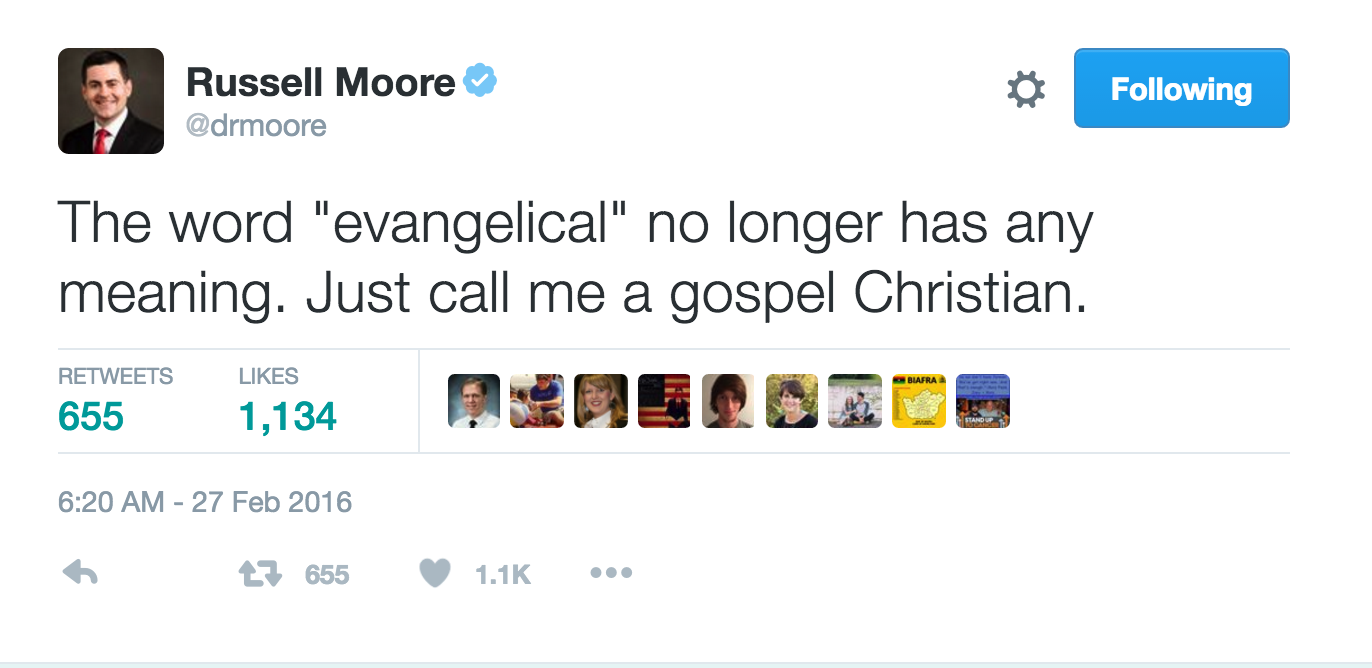
While I’m in large agreement with McAlpine, I’m not giving up on evangelical just yet, because rightly understood it is a word we should cherish and defend. But should the waves of malcontent persist, and an alternative is necessary, I think I’ll begin follow in Russell Moore’s footsteps and refer to myself a Gospel Christian.
Gospel Christian has the same meaning as evangelical Christian, but without the unhealthy socio-political connotations. Interestingly, both in the United States and here in Australia, among the larger Christian networks we don’t find the Evangelical Coalition, but rather the Gospel Coalition.
Some Christians prefer to known as orthodox or classical. I warm to both of these words, although Stephen McAlpine criticises ‘orthodox’ as a group who don’t affirm the real and physical return of Jesus Christ. Perhaps I’m ignorant, but I would have thought belief in the parousia is basic to anyone claiming orthodoxy.
The reality is, many of our Christian labels are disdained. I wish it was suffice to say, I’m a Christian. After all, that’s what I am, I am a Christian. But sadly Christian is frequently associated with all manner of social ills and evils (sometimes warranted). And when I fess up to being a Baptist, I’ve more than once had to qualify it by saying, no, we’re not like the JWs or Mormons.
McAlpine suggests we call ourselves, ‘eschatological Christians’,
“Eschatological” springs to mind. If someone asks me these days I’ve taken to saying that I am an “Eschatological Christian.” Sure it’s not catchy, but it’s not toxic either. Sure I will have to spend a bit of time explaining what it is, but hey, I’ll have to spend virtually no time explaining what it is not.
“Eschatological” is more likely to elicit an eyebrow raise than a nose wrinkle. It is more likely to raise a question than rule a line under an answer. Most importantly it will distinguish me – and us – as those whose hopes -and energies – are not grounded in the political machinations of this age, but in the politics of the age to come lived out in the church today, and overflowing in practical, loving and humble ways into the community.
“Eschatological Christian” also distinguishes orthodox Christians who actually believe that there is a parousia coming in which King Jesus will usher in a new kingdom and judge the world in righteousness, from those who view that as an outdated notion beneath our modern sensibilities. A view that won’t get them respect in the academy.
The name has a certain Fitzroy living single-origin drinking indie-rocking listening feel to it, but I am unconvinced. First of all, few people know what eschatology means, and second, it is defining our identity by one area of theology, rather than the whole.
What do others think? How do you describe your Christian faith? Do you identify as an evangelical?
Misappropriation and misunderstanding shouldn’t surprise us; is it not the expectation given to us by the Lord Jesus? Does not the history of the church give us multiple examples of culture trampling on or deconstructing the church? In a world that is constantly confusing and even hijacking the Christian message, and doing so for all manner of social and political ends, we though can be responsible for how we represent the Lord Jesus Christ. Indeed, the more faithful we are to God’s word, the more useful we will be to society. So whether we call ourselves evangelical, Gospel, orthodox, or just plain and simple Christian, let’s do it with a growing sense of clarity, humility, grace, and winsomeness, in order to display the reality of Christ and of the hope held out in his Gospel.
“Whether ’tis nobler in the mind to suffer
The slings and arrows of outrageous fortune,
Or to take arms against a sea of troubles,
And, by opposing, end them?”

From the Delphic hamlet that is The Australian, Greg Sheridan has given Australian Churches an oracle.
According to Sheridan,
Australia’s Christian churches are in crisis, on the brink of complete strategic irrelevance. It’s not clear they recognise the mortal depth of their problems.
The churches need a new approach to their interaction with politics and the public debate, and to keeping themselves relevant in a post-Christian Australian society.
The churches cannot recognise and come to grips with their strategic circumstances. They behave as though they still represent a living social consensus.
The Christian churches now need to reconceive of themselves as representing a distinct and not all that big minority (of practising Christians). They should conduct themselves as a self-confident minority, seeking to win conversion through example and persuasion and not to defend endlessly legal protections and enforcements that are increasingly untenable or meaningless.
In my opinion Greg Sheridan offers a lucid critique of many Churches who are failing to grapple with the rise of secularism, although I wonder if he adequately understands the nature of the Church’s mission and therefore how success and relevance are defined.
Sheridan is right to point out the gross sins of abuse within the Catholic Church (and other denominations as well), and the way this has greatly damaged community perceptions of Churches.
There is urgent need for Churches to practice repentance. Dressed in clerical collars and reciting liturgy, great evil has been perpetrated, especially in the area of sexual abuse. Joe Smith and Lisa Jones can see it, but there remain clergy in some institutions that still don’t get it. The fact that their deeds expose them to be frauds of faith does not diminish the impact on the community. Real, transparent, and deep repentance is required.
Sheridan is also spot on in observing the naivety of some Christians who believe they still belong to the centre of Australian life. We defer to census figures that prove the majority of Aussies believe in God and who identify as Christian, but surely we know better. The reality is, Churches have never belonged comfortably at the centre of Australian society; they have played a significant role in shaping culture, alongside many other voices, but it is more a case of Churches being tolerated rather than celebrated and embraced.
This tolerance is eroding, rapidly so. This year alone we have seen various groups slamming the foot on the accelerator, such that we are fast approaching an intersection called ‘free speech’, and the direction Australians will take remains unclear.
Several political groups have declared their hand:
The Greens have decided their way forward by calling for religious organisations to lose their exemptions for discrimination laws.
Federal Labor have made clear: “Labor believes that no faith, no religion, no set of beliefs should ever be used as an instrument of division or exclusion, and condemning anyone, discriminating against anyone, vilifying anyone is a violation of the values we all share, a violation which can never be justified by anyone’s faith or belief. Accordingly, Labor will review national anti-discrimination laws to ensure that exemptions do not place Australians in a position where they cannot access essential social services.”
Bill Shorten has since stepped back from this position, but there are no guarantees he won’t step forward again.
And the Victorian Government, singing from their autocratic hymnal, has determined to insult and silence anyone who challenges their hermeneutic of life.
Should churches fight to keep a voice in the public arena?
We must concede that Churches no longer occupy a position in the middle, but we don’t want to evacuate the public space altogether. I want to argue that it is worth fighting for a voice in public discourse, but we do so with the belief that the Gospel does not depend upon it. So why should we defend notions of ‘freedom of speech’.
First of all, we have something to say. We have good news to speak and show our neighbours, and so why would we walk away from secular principles that give us freedom for speaking and contributing?
Secondly, we should defend the right to speak for the sake of those who speak against us. Is this not a way in which we love our neighbour? Is it also not a sign of a mature society, one that is big enough to allow a plurality of voices, and to say ‘I disagree with you, but let’s hear you out and then talk it through’.
A great example of this happened last week when Christians came to the support of Roz Ward, a professing Marxist and co-founder of the controversial curriculum, Safe Schools. Ward was forced to resign from a Government role and was suspended from La Trobe University after a comment she made in regard to the Australian flag. While her views may be disagreeable to many, she has the right to express them, and to find herself being ousted from an academic institution on account them was extreme. Subsequently, a number of Christian leaders noted this hypocrisy and sided with those who called for her reinstatement.
Thirdly, we are members of a democratic society, which in principle gives permission for Christians and atheists alike to speak and offer their opinion.
As a liberal democracy, Australia is governed by these 4 principles:
“A belief in the individual: since the individual is believed to be both moral and rational;
A belief in reason and progress: based on the belief that growth and development is the natural condition of mankind and politics the art of compromise;
A belief in a society that is consensual: based on a desire for order and co-operation not disorder and conflict;
A belief in shared power: based on a suspicion of concentrated power (whether by individuals, groups or governments).”
If we accept these principles, surely Christians have freedom to articulate their views in public discourse? This doesn’t mean people have to like or affirm these beliefs (nor those of any worldview), but it does mean there is freedom to speak. Unfortunately though, it seems as though these values are becoming museum pieces, relics from a golden age of democracy when the Cleisthenes’ of Australia stood tall. After all, no fair democracy has ever endured the ages. And yet, while Australia formally holds to these democratic convictions, there is a place for Christians to speak without fear of law or litigation.
Our democratic liberties give Christians a platform and context for doing public ministry, and we are thankful for this, but the Gospel is not curtailed by the limitations or freedoms of liberal democracy. Indeed, history demonstrates that Churches have often flourished where they have been most resented. More importantly, Jesus Christ taught a theology of the world which lives in opposition to God and which hates those who follow Jesus. Why should we assume Australia is any different?
How should Churches view ‘success’?
Are, as Greg Sheridan suggests, ‘churches in crisis now on all fronts’? It depends on how one defines the mission and role of the church.
Our aim is to love others, whether our convictions are affirmed by others or not.
Our goal is not relevance, for the Gospel we believe is not defined by a popularist epistemological current, but by the word of the cross, which is foolishness to the wise and powerful of this world. Instead, our purpose is to preach this foolishness for through it God works to redeem and heal.
Our mission is not to set up power structures at the centre of society, but to speak the Gospel and to love others no matter where we find ourselves situated in relation to broader society.
Freedom of speech has become the gordian knot of our day. Politicians, lawyers, and academics will ponder and debate and try to find a way to navigate through the many layers of twisted and knotted rope, and while their answers will have implications for Christian speech and life in public, our hope does not lay with them, but in the Gospel, a word that is sharper than a two edged sword. Our hope rests in the Christ who has promised that he will build his church and not even Hades can stand against it.
Sadly many Christians have sold their soul in order to buy a place at the centre of public life, and they are now being marshalled into following the lead of the social progressives, and others are instead holding tight to their conservative neuroses. There are however exceptions; across the land there are churches growing and people are becoming Christians, and there are Bible colleges in Australian cites who are training more men and women than in the previous generation. There are Christians serving in Parliament, teaching in universities, and working in a thousand different jobs. And to these men and women, keep preaching and living the Gospel, loudly from the centre or whispering it from the edge, and through it God will keep working his grace and growing his Kingdom.
 MurrayCampbell.net