Australia needs to look deeper to find ‘social cohesion’

Can’t we just get along?

In the 1970 film ‘Waterloo’, a British soldier’s cries are heard over the din of battle, ‘how can we kill one another…how can we? Why do we? Why? Why?…”

Why can’t Australians all get along?

Hatred and discord are woven into the human condition. The original imago dei didn’t contain such stains, but ever since the Great Fall,  humanity has carried and desired personal gain through demeaning the other and yes, even through bloodletting. The history of the world is less peace interrupted by violent moments, as it is, continued iniquity that finds momentary rest by the grace of God.

Almost everyone is talking about the State of Australia. The massacre of Jews at Bondi Beach on December 14th has forced us to ask questions that most Aussies are ill equipped to even frame, let alone answer with resolve. There is widespread shock, there is tremendous grief, along with anger, fear and yes, and still with much gaslighting. 

Can’t we as a society just get along? 

Clearly the answer is no. It should be yes, and I imagine the average Aussie longs for the answer to be yes, but we are falling far short of this thing called, ‘social cohesion.’

There are three simple observations that I wish to make here. They are not new or novel. Others are far better qualified than myself to speak to this topic. And even here, many of my words are ones that I’ve previously offered up in public discourse.

The 3 points that I wish weave together are these:

  1. Government can’t bear the weight of creating social cohesion. 
  2. Take note of the scholarly work of Christopher Watkin. He has much wisdom to offer on the subject.
  3. Come home to Christianity. 

One year ago and a week before Christmas, the Victorian State Government proposed ‘social cohesion’ laws. A watered down version of the Bill was adopted by Parliament in April 2025. At the time I suggested that ‘social cohesion’ when it’s attached to government and to laws has a touch of the Machiavellian about it. One doesn’t know whether to think it’s more like George Orwell or Monty Python! 

No doubt this is a testing time for any government. There are pressures applied from all kinds of directions, and at times this leads to inaction or delayed resolve. As we have seen for more than 2 years now, this has given more oxygen to antisocial, and especially, antisemitic voices and violence. Antisemitism is an indignant on the moral and spiritual state of Australia.

Australia has never been heaven. We have never been ther perfect country, but we have witnessed developments over the past decade that are injurious and bring grief to many. We are less peaceful than we were. We are less inclusive and kind. There is more personal and social distress and with little sign of a turnaround. This is evident across the country, but Melbourne is Australia’s protest capital (not a title to boast about). Ever since 2020, when the government turned a blind eye to certain marches while slamming others, every Jane, Nguyen, and Bob has seen fit to grind city streets to a halt. Not a week goes by without banners and angry faces blocking traffic. 

According to the Bible, from which we owe the fundamental notions of civil society, governments have a responsibility to protect its citizens and to punish evil doers (Romans 13:1-6). This requires the careful and just creation of laws and their reasonable enforcement. It’s not a coincidence that the Apostolic framing of Government responsibilities is accompanied with an injunction for citizens to pay taxes. The purpose of taxation is largely tied to enabling government to do this  double edged sword duty of protecting and punishing effectively.

Government inaction is no longer an option. Thankfully NSW’s Premier, Chris Minns, seems to realise this and is moving beyond empty rhetoric and thin pieces of legislation. Even a Muslim Mayor in Western Sydney has taken decisive action to close a hate factory where one of the gunmen was fed his lies about Jewish people.

We have too long sacrificed cohesion at the altar of diversity. Diversity, properly defined is a beautiful thing which adorns a healthy society. I thank God for the tapestry of multi-ethnicism that has given strength and flavour and wonder to Australia. But as we have deconstructed big T Truth and other axioms, we have lost the ability to acknowledge that some ideas are counter productive and even dangerous.  We can practice pluralism while recognising not every worldview is equally valid or good.

If we think that our society is beyond and above 1928 Germany, we are suffering from a greater dose of egomania than I thought.

How can the Federal Government not call for a Royal Commission to investigate the terrorist attack at Bondi Beach on December 14? This wasn’t an isolated event, but the culmination of more than two years of government sitting on their hands while Jewish Australians were attacked in their synagogues and cafes and homes. And while genuine hatred was proclaimed and promoted on our city streets every week. As Stephen Mcalpine has noted, there is a directed line from the Sydney Opera House to Bondi Beach. 

Even the slaughter of 15 Jews at Bondi Beach hasn’t been enough to completely silence the keffiyeh wearing mafia. So much whataboutism and justifying and excusing continues even before the bodies of the slain were laid to rest. Of course,  their right handed sibling, neo nazism with men in black, is equally a scourge on our society.

While Governments must taken action against anti-semitism, Government action is not suffice. I’m not suggesting some kind of community vigilanteism; please no. But everyday Aussies are responsibile for their own words and actions and setting an example to others and demonstrating the power of kindness and grace and generosity over hatred and intolerance and selfishness. Of course we must be intolerant towards views that breed hatred toward Jewish people and views that dehumanise the other. That we need laws to demand ‘decent behaviour’ communicates how far our society has strayed. Churches need to take a lead in this, by teaching and practicing what is in accord with the Christian faith. I still cannot fathom how one Melbourne Anglican Minister in 2023 excused Hamas’ slaughter in Israel. Such disgusting commentary should be held to account.

As the Victorian Government proposed their ‘social cohesion’ laws last Christmas, I expressed discomfort at the language of ‘social cohesion’, and I remain uncomfortable. I get it; they are ‘trying’ to address a specific problem without naming the elephant in the room. Why not call it ‘Rules for Safe Protests’ or something like that?

The reason why I’m uncomfortable about the Government’s language of ‘social cohesion’ is because the task of social cohesion doesn’t belong to the government, but to the people. When government sees itself as the answer to every social ill and when the people demand government to fix every crisis, we are obfuscating personal responsibility and creating systems of governance that cannot bear the weight of such responsibility. 

This is one area where the work of Dr Christopher Watkin is worthy of consideration. Monash University’s Dr Watkin articulates a positive and important work on contract theory. He says, 

“Civil society is sometimes the neglected dimension of the social contract, the “missing middle” as it has been called. We have a tendency to jump straight from government and law to the individual.

These civil society relationships across different visions of the good are a glue that holds our social contract together.”

From his book, Biblical Critical Theory

‘the vague and sporadic measures taken by contemporary governments to shore up the social contract with well-meaning but half-hearted attempts at “civic edu- cation” have little effect, when all the while billions of advertising dollars and a destructive paradigm of competition in all areas of society expertly catechize individual consumers to be little predisposed to the civic duties a strong social contract requires. No rewriting of the social contract can be complete without giving serious attention to its cultural and liturgical infrastructure.’

We will do well to engage with Dr Watkin’s material closely and carefully. There is much goodness and valuable ideas to be found. Here is one lecture he gave recently on the subject.

No Government is up for the job, and it’s not designed to be. Part of the problem embedded in any Government setting the rules for social cohesion is that this is never a natural space. This is one of the heresies attached to secularism. Secular is certainly preferable to Sharia Law and to Christian Nationalism, but it is no more epistemologically and morally neutral. Secular is the sum of the worldviews present in and controlling the moral impulses of the day.

There are wonderful pockets of social cohesion is found in all kinds of places and communities across our State. There are sporting clubs and men’s sheds, and there are temples and synagogues. It is certainly experienced in local churches.

Churches are frequently more culturally diverse than the communities surrounding them. Where I have the privilege of serving and belonging, we have people from China and Uganda, families from Vietnam and India, Nigeria and Columbia. Young and old mix together, single and married are friends and serve one another. Of course, Churches have their failings and blindspots, (after all, the very point of Christianity is that there is only one perfect saviour and we’re not him!), and yet there is profound togetherness and other person-centredness. 

The Victorian Government accompanied its Social Cohesion directives with expanding anti-vilification laws. Religious groups were understandably concerned such new laws will tighten the noose of faith groups from teaching and practising in accordance with their convictions; history is a strong indicator. It’s amazing how often over the last 10 years Victoria has assumed the bishopric role when Christian praxis hasn’t supported their social agendas. There is a mine of irony in Victoria where Government identifies a growing social disorder and yet clamps down on one of the few societal groups who are truly exhibiting positive social health and life. If we are interested in civil society, maybe we ought to return to the worldview that created the ideas and values from which this vision derives: Christianity. 

Not every religion is equal. Not every idea is equally valid,  and assuming so will only give licence to the kind of behaviour that is all to common now in our city streets. And yet we must delver deeper than legislative reforms. No, I don’t support the idea of a State religion. Religious freedoms and pluralism is a Christian idea for Christianity isn’t something to be gained via Government guidelines and laws. Christianity is grounded grace not law. Without irony however, it is the Christian message that cdreates the space and gives air to the art of persuasion and serving others through disagreement. It is, for example, because Christians believe Jesus is the only way to God that we don’t want Governments legislating religious doctrines. There are however religious and irreligious teachings which contradict basic ideas of social freedom and respect of life and dignity of fellow Australians.

This is one reason why we are losing something precious by running away from the Bible and the God the of the Bible. It’s not something for Government to oversee, this is something the people have largely lost and would do well to come home to. The Scriptures that Jews and Christians alike believe, teach that we must love God with all our being and love our neighbour. Jesus insisted, 

“Hear, O Israel: The Lord our God, the Lord is one.Love the Lord your God with all your heart and with all your soul and with all your mind and with all your strength.’The second is this: ‘Love your neighbor as yourself.’There is no commandment greater than these.” (Mark 12:29-31)

We must love our neighbours. We ought respect and reach out to our Jewish neighbours. We should show kindness to our Muslim neighbours. Law and legislation is a necessary weapon, but the bigger antidote to seeing real and heart transformation requires something more.

Two days ago we celebrated Christmas, the ultimate day of truce-making, although that first holy night was filled with peril. Nonetheless, the hope born that night in Bethlehem really is the only hope we have today. Come, check out a local church and see that hope in action. Let me leave you with the great Messianic promise of Isaiah for he is breathtaking,

‘The people walking in darkness

    have seen a great light;

on those living in the land of deep darkness

    a light has dawned.

You have enlarged the nation

    and increased their joy;

they rejoice before you

    as people rejoice at the harvest,

as warriors rejoice

    when dividing the plunder.

For as in the day of Midian’s defeat,

    you have shattered

the yoke that burdens them,

    the bar across their shoulders,

    the rod of their oppressor.

Every warrior’s boot used in battle

    and every garment rolled in blood

will be destined for burning,

    will be fuel for the fire.

For to us a child is born,

    to us a son is given,

    and the government will be on his shoulders.

And he will be called

    Wonderful Counselor, Mighty God,

    Everlasting Father, Prince of Peace.

Of the greatness of his government and peace

    there will be no end.

He will reign on David’s throne

    and over his kingdom,

establishing and upholding it

    with justice and righteousness

    from that time on and forever.

The zeal of the Lord Almighty

    will accomplish this.’

The ‘Prophetic Voice’

I’m someone who is wary of the ‘prophetic voice’. I’m a huge believer in believing the word of the prophets, but not so much of those who attribute ‘prophetic’ to their own messaging. 

A social media post this morning used the phrase as they promoted a social agenda. Yesterday, a Facebook friend did something similar. The phrase ‘prophetic voice’ has joined the pantheon of overused and misused religious phrases.

It’s troubled me for years how the language of ‘prophetic’ is used by Christians. 

Maybe it’s the theological window from which I see the world, but for most of the time, the ‘prophetic voice was a phrase connected with progressive theology, as various thinkers and writers advocated for their views. The term ‘prophetic’ became a way of trying to authenticate a point of view, saying that God is behind this teaching. 

ABC’s religious program, God Forbid, ran a segment in 2017 that captures the classic liberal understanding of the ‘prophetic voice’. The synopsis reads,

‘Religion and politics are supposed to be separate, but some strange magnetic force keeps pulling them back together. The “prophetic voice” in Christian tradition is supposed to speak out against the abuses of the powerful, even when they’re political leaders. But does this mean the pulpit should be a platform for political views?’

I’m accustomed to this usage of ‘prophetic language.’ For example, in 201,6 I responded to a Melbourne Baptist who claimed this role for the local Baptist college, 

Theological educators must be prepared to stand on the sidelines of the church and call it to account. Like those pesky prophets of old, courageous theologians call the church to be different than what it is, a challenge to a radical transformation and a critique of the status quo.

Once one understood this pastor’s own convictions, for him, the prophetic voice stands against the mainstream evangelical faith and is either subverting or trying to win over Christians to a new way of thinking (usually a heterodox one). 

Which is why I replied at the time,

 ‘I guess Hananiah was a prophet of sorts! Should not prophets contend for the faith, rather than contravene the faith? In fact, professionalising prophecy was the error of the kings of Israel and Judah. While God may use a voice from the college in a ‘prophetic’ way, assuming the mantle of prophet is dangerous’.

However, over more recent years, the phrase ‘prophetic voice’ (again from my window view), has been increasingly co-opted by conservative Christians to advocate a particular posture, as well as message. It’s become one of these phrases that are thrown into the mix every second day. For example, a Facebook friend yesterday suggested Canon Press speaks with a prophetic voice on today’s issues in contrast (he believes) with TGC, that doesn’t.

There are a number of problems here (not least Canon Press).

Prophetic voice has fast become a rhetorical device, employed to legitimise or bolster the view they’re trying to prove. After all, if it’s prophetic, how can we dare oppose?

Whereas theological liberals often postulated ‘prophetic’ with their progressive message, conservatives often use ‘prophetic’ in line with a certain style of voice. It’s equating the ‘prophetic’ with a particular public posturing.

It’s also reducing the role of prophet. Prophets may challenge. Prophets might also condemn. And prophets could also give a word to console and comfort. At the very least, the ‘prophetic voice’ crowd are rather narrow in what they consider prophetic. 

In short, the ‘prophetic voice’, turns out to be a power play, as though the battering ram approach to public conversation is more godly and faithful than the one who knocks on the gate and asks to come inside and share? Or it’s like, if you don’t play the game my way, then you’re obviously not playing the game at all (which any sports coach and player will know is nonsense).

It’s confusing style, strategy and substance. 

Tim Keller famously and so helpfully explores the space known as ‘theological vision’. Between our theological foundations and our ministry practice is this in-between hermeneutical and wisdom space where we develop strategy and approach. 

In his super helpful book on Eldership, Murray Capill explains this way, 

“As Keller notes, people with the same theology can have very different ministry practice. Not all churches with reformed theology, for example, worship in the same way or do youth ministry in the same way. They can have enormously differing practice, not because of a different theology but a different vision for ministry”

This is also true when it comes to Churches and Christians doing evangelism and thinking through how to communicate Christian ethics. Some Christians are quick to judge our brothers and sisters for not adopting ‘our’ particular approach to social issues. If you’re not signing petitions and making public statements, you’re viewed with suspicion. Or perhaps public silence isn’t complicity or cowardice; it may be that a local church is doing effective gospel ministry to people in their community without making a noise about it.

For example, on the topic of abortion, the Bible is clear that killing the unborn is sin, and so the moral injunction is always clear. Christians arguing otherwise are representing God as much as Hananiah. However, is there only one way to speak about affirming life and value of unborn children? Is the only approach loud condemnatory retorts? Are churches complicit in evil if they are not actively making statements in the public square? What if a group of Christians are going about loving their neighbours and supporting pregnant mums in ways that encourage them to keep their child? That’s going well beyond virtue signalling and actually doing something. 

There is another question: what does ‘prophetic voice’ actually mean? How does one define a legitimate ‘prophetic voice’ and do we find biblical warrant for such a category today? What do the Scriptures teach? Does the office of Prophet even exist today? Is it big P Prophet or can there be little p prophets? That’s a whole other conversation. 

I think it’s problematic when people employ the phrase to add authority to their methodology for doing public theology.  We may well agree with the desired outcome and with the message, but disagree with how best to approach societal sins and problems. What ends up happening when we attach loaded language like ‘prophetic’ is that we aggravate division among gospel centred people who are otherwise dealing with and living godly lives in their particular place.

If one’s ‘prophetic’ speech creates ungospel-like division and plants seeds of suspicion in fellow Christians, it is near certain that you need to stop playing prophet.

At the very least, I’m nervous when people start attributing ‘prophetic’ to public speech because it suggests Divine authority and weight.  Yes, 1 John tells us to test the spirits. And yes, as I read the Scriptures, there are clear warnings attached to those who profess to be prophets or speaking ‘prophetically’. 

Returning to Canon Press as I wrap up, Jeremy Sexton wrote an excellent piece last week, ‘Doug Wilson is not a prophet’. It’s worth a read as a corollary to what I’ve just shared.

Charlie Kirk’s Memorial Service: an event with 2 narratives

One of the largest memorial services in American history has just concluded. 

Whether we approve or not, whether we are invested in the story or not, the assassination of Charlie Kirk has dominated the news cycle and continues to do so today, with his memorial service taking place in Glendale, Arizona. 

The papers and social media are speaking about very little else. It’s not that this is the only thing that matters today, but there are moments in history that capture the public imagination in ways that coinciding events do not. 

It’s clear that there were two narratives running through the memorial service, and we mustn’t confuse them as being the same or necessarily belonging together. I want to pull apart the politics that were present and the gospel that was also present.

Several members of the Trump administration spoke, including the President. Donald Trump gave a speech in which this line has already gone viral, 

“He  [Charlie Kirk] didn’t hate his opponents. He wanted the best for them – that’s where I disagreed with Charlie. I HATE my opponent and I DON’T want the best for them.

I suspect the President said these words with a certain tongue in cheek. He was bringing a moment’s levity to what was a very sombre occasion. At the same time, that does seem to be his modus operandi. But of course, Trump’s words are not his alone; this is the norm and assumed posture across religions and ideologies and politics. Whether it is fascist or anti-fascists or left or right, and most of the middle, we think ill of those who disagree with us. That the President is saying so with knowledge of the truth isn’t laughable, it’s woeful. Doubling down on hate doesn’t resolve the growing friction and factions that are disintegrating our societies. That leaves us with a game of power where the loudest, fastest and strongest aim to take charge and impose their will on the rest of us.

Trump, the ever populist and pragmatist, may well use whatever movement that helps maintain momentum. That’s a problem, as it was when previous American presidents co-opted Christian language and concepts to promote their own ethics and agendas. 

On Saturday, I gave a lecture at the Reformed Theological College, where I outlined 3 principles for doing public theology:

  • Don’t conflate Church and state.
  • Don’t confuse common grace with particular grace.
  • Understand both the common good and the eternal good.

Christian pundits, commentators and pastors would do well and serve our congregations and the unbelieving public  by recognising and practising those distinctions. Of course, the differences are not always perfectly clear and it is true that the gospel of Jesus changes every part of us, but nonetheless, we will do well to avoid those trappings. Why? In part, because the gospel is too important to be confused or co-opted by red or blue or green. 

Merging the Christian faith with politics is fraught with dangers, and that’s true across the political spectrum. If you think that your particular position is exempt from that rule, that only exemplifies the very problem. It doesn’t mean every political ideology is equally true or good or respectable. Of course not. How we value the unborn really does matter. How we view migrants and the poor matters. And many other topics.

As I said earlier,  two narratives were present in the memorial service, and it is the second one that I hope shines the most. 

Charlie Kirk’s pastor, Rob McCoy, gave a clear presentation of the good news of Jesus. He said.

“Charlie knew … at an early age … he entrusted his life to the Savior of the World.  . Jesus came to this earth, was tempted in all ways, yet was without sin, was crucified upon the cross…”

“His blood was poured out because blood must be shed for the remission of sins…And His death upon that cross was sufficient for all the world’s sins, but only efficient for those who, like Charlie, would receive Him as their Savior.”

Can we say an Amen to those words?

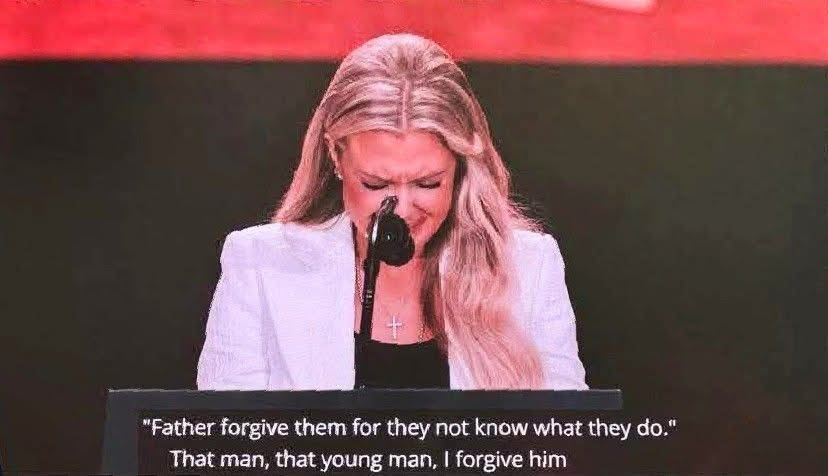
Erika Kirk  then addressed the crowds and uttered the impossible word,

“I forgive him…I forgive him because it was what Christ did, and it is what Charlie would do.”

“The answer to hate is not hate,” she said. “The answer we know from the gospel is love and always love – love for our enemies and love for those who persecute us.”

This is the message our polarised world needs to hear. I thank God that God has not judged me according to every word I have said and every thought I have entertained. I am eternally thankful to God that he forgives sinners such as me. And grasping this gospel does something to us, where Trump’s words disappear and where love and forgiveness take shape.

What is so sad and troubling is that I know our culture well enough to see how this is going to play out in the media and social media: most people will simply double down on their prior commitments and attitudes. People are so entrenched in their ideological preferences that we will read the room as our glasses are glued onto our faces, and we are unable to see any other perspective. MAGA supporting Aussie conservatives will criticise me for my posture here and progressive Aussies will criticise me for not damning Charlie Kirk to hell alongside the President. 

Reality is almost always more complicated and nuanced. One does not need to elevate Charlie Kirk to the status of Stephen (Acts 6) or label him ‘ult right’. The Christian truth is that sinners are saved by grace alone on account of the perfect sacrifice of Jesus alone. Anything else is hubris.

Here is a thought: regardless of our political leanings, if God uses the gospel preached at Charlie Kirk’s funeral to convince some people of God’s saving news through Jesus, will we rejoice or will we resent & grumble like Jonah in Ninevah?

Would you sell out Jesus for $4.37 billion?

‘What good is it for someone to gain the whole world, yet forfeit their soul? ‘

“No one can serve two masters. Either you will hate the one and love the other, or you will be devoted to the one and despise the other. You cannot serve both God and money.”

Nah, ‘surely not’, says the entrepreneur hungry for another dollar. As long as there is commerce, trade, and ingenuity, people have contended Jesus is wrong. You can have riches and God. You can have wealth and religion.

Why choose between the two? Can’t we have both, Jesus and a growing portfolio? Perhaps not $4 billion; let’s drop it down to a more reasonable $4 million, enough to live comfortably but not so much that my face and portfolio are splashed in The Australian.

It’s an Aussie dream story: success, celebrity status, and a partnership with Ferrari.  Wouldn’t we follow these steps given the chance? 

The Gospel of Luke tells the occasion when a young influencer makes a pitstop in front of Jesus while on the way to the Grand Prix (yes, there’s a touch of creative licence in this storytelling, but the point remains the same). Careful not to step his $1200 sneakers in a puddle beside the road, he approached Jesus. He was impressed by the man of Nazareth. This Jesus had a way with words and what he touched turned into something amazing. Jesus is useful. 

This young dude introduced himself and spoke respectfully to Jesus. He may be young, but he was already enjoying his prosperity. He was going places, but there was this nagging question lurking at the back of his head: did he have it all?

So he asked Jesus, ‘“Good teacher, what must I do to inherit eternal life?”

Jesus then went through a list, spelling out the requirements of God’s law: Don’t murder, don’t commit adultery, and so on.

This pleased the man because he felt pretty solid on those grounds. But then Jesus went where the man did not want to go: his heart. 

“You still lack one thing. Sell everything you have and give to the poor, and you will have treasure in heaven. Then come, follow me.”

When he heard this, he became very sad, because he was very wealthy. Jesus looked at him and said, “How hard it is for the rich to enter the kingdom of God! Indeed, it is easier for a camel to go through the eye of a needle than for someone who is rich to enter the kingdom of God.”

Wealth remains one of the world’s great con jobs. It promises happiness and success and adventure and respect, and yet it is among the worst of addictions. Wealth can be obtained through family and through hard work. Many creative geniuses have made discoveries or invented new technologies that benefit society and have made a fortune through the process. Others have made millions through theft or deceit. And then there is gambling. 

Laurence Escalante is Australia’s 32nd wealthiest person, with a personal fortune of $4.37 Billion.  There is a feature story in today’s The Australian, with Laurence Escalante sharing his rags-to-riches journey, and from religion to Los Vegas. 

Laurence Escalante grew up in a religious family, first attending a Catholic Church and then joining a large Pentecostal Church in Perth. Speaking to John Stensholt, he said,

“At the time I was very much into faith and religion. I was an acolyte”.

Apparently, Escalante has previously served as a church treasurer and started a Christian gaming company. In the vein of typically cringey Christian products, Escalante made video games based on Timothy and Titus, where players venture not to shoot all the bad guys, but to share the good news. 

He left this debt-inducing business and subsequently started a new and massively successful business: casino games.

I’m interested in the way John Stensholt writes. Even he, a journalist, can sense the clash of worlds between Escalante’s Christianity and his worldly lifestyle. The article begins, 

“If things had gone according to plan, Laurence Escalante would have had a career developing Christian computer games based on the Apostle Paul’s disciples, Timothy and Titus.

It may have been a decent earner, but it’s unlikely to have brought the level of success the 43-year-old has quickly attained in a decidedly less pious way and allowed him to live what is – judging from his social media accounts – quite the hedonistic lifestyle.”

And notice the headline, Saint to sinner? Or just a migrant kid who can now afford a jet. Even the editors can spot the scam.

Instead of bringing the good news of Jesus to the cyber world, Escalante is now making billions from the credit of the greedy and the foolish and the vulnerable. Stensholt can spot the contradiction, as can many a reader, but what about Escalante? 

It would be interesting to hear how Laurence Escalante squares this with Jesus.

The podcast episode accompanying the article is tagged, ‘Guided by God to an online gambling fortune’. I’m not sure whether this is Escalante’s personal view or it’s an editorial interpretation. Either way, it’s not true.  Can you imagine, ‘Guided by God to commit adultery’ or Guided by God to steal from my neighbour’? Neither can I.   But how often do we reconfigure God in order to justify the life decisions we are making, regardless of what God has actually said (take a look at the Bible).

He wants to assure readers,

“While admitting he isn’t as religious as he once was, Escalante insists he is no sinner. He reckons he doesn’t worry about his reputation, and says he is simply revelling in success earned from hard work and learning from previous business failures.

“I’m having fun, enjoying life,” he says in a rare interview. “Being in the moment. I’ve always been that sort of person, [wanting] to enjoy life.

“I was always into cars; I just didn’t have the means to enjoy them. Now I can afford a jet … You have to enjoy life. You never know when it could disappear.”

Nowhere does Jesus say we can’t have fun in life and enjoy ourselves. But chasing the good life without God is like investing in counterfeit money and pouring your life savings into a scam. Are you running on a high? Sure, until reality hits home. 

‘Those who trust in their riches will fall, but the righteous will thrive like a green leaf.’ (Proverbs 11:28)

‘Cast but a glance at riches, and they are gone, for they will surely sprout wings and fly off to the sky like an eagle.’ (Proverbs 23:5)

It is one thing to have wealth and it is another thing to consider how to be good stewards of our wealth. And it is an altogether different moral category when exploring by what means we accumulate our wealth. 

But why choose between the two? Can’t we have both, Jesus and a growing portfolio? It’s an Aussie dream story: success, celebrity status, and a partnership with Ferrari.  Wouldn’t we follow in his steps given half the chance? Before we throw the first cricket ball at Escalante, we might do well to consider our own hearts.

That’s the thing, Laurence Escalante is a God to riches story, and the appeal is strong. It’s easy to throw stones at this billionaire but what if we share his spiritual DNA? He’s simply succeeded where many more Aussies dream. Human nature hasn’t changed over thousands of years, and Jesus’ words are as sharp and confronting today as they were 2 millennia ago. We all too easily sell the soul for a few years of splashed excess.

Gambling is one of Australia’s favourite evils. We gamble in greater numbers than nearly every other nation on earth. We know it’s harmful. We know it destroys lives and families, and yet from Government to Sport, we’ve created this entanglement where we require gambling to sustain community projects and our appetite for a high standard of living.

To be clear, Escalante’s online casino games are illegal in Australia (from what I gather); he makes his money mostly from customers in the United States and in smaller countries like Malta. 

Gambling is about playing on your hope through chance. It’s playing the odds as a means to change your life circumstances. Like every good addiction, gambling promises much and lies like porn. It exploits vulnerable people and strips them of further dignity, security and relationships. 

If Escalante believes Jesus is okay with his billions, I urge him to think again. 

How different is Jesus’ approach? Jesus isn’t utilitarian. He counted the cost. He chose sacrifice, even atonement for the sins of many. Jesus didn’t exploit the poor, he gave his life as a ransom for many. Instead of mingling with Melbourne’s celebrity culture over caviar and champagne at the Grand Prix, Jesus picked up the pieces left behind and gave life. He welcomed the humble and repentant, whether rich or poor. 

That’s part of the problem, isn’t it? We want everything. How often are we told that we deserve everything? We create a list of desires and expect God to contribute, as though he owes us. It may not be a $ amount or material possessions, but likability or recognition or career success. What kind of screwed-up view of God that is. The very premise is mistaken. We neither deserve everything nor can we. If we treat Jesus like the non-essential extra to life, then not only do we miss out on Jesus, but in the end we’ll lose the lot. 

What does Jesus tell us, 

‘For whoever wants to save their life will lose it, but whoever loses their life for me and for the gospel will save it.  What good is it for someone to gain the whole world, yet forfeit their soul?  Or what can anyone give in exchange for their soul?  If anyone is ashamed of me and my words in this adulterous and sinful generation, the Son of Man will be ashamed of them when he comes in his Father’s glory with the holy angels.” (Mark 8:35-38)

But what would Jesus know?

I don’t know what Christmas is but Christmas time is here

“I don’t know what Christmas is but Christmas time is here.”

Did you know Guardians of the Galaxy is more than a sci-fi Marvel franchise: they have a Christmas Special!

Peter Quill is missing Christmas on earth. His friends have noticed his despondent face and decide to cheer him up by kidnapping Quill’s hero, Kevin Bacon, and wrapping him up like a slice of prosciutto for Christmas.

And because rock music apparently exists on other planets, an alien band is playing a tribute song to Christmas: ‘Bzermikitokolok and the Knowheremen’. 

The lead singer is chatting to Peter Quill about, “one of your earth traditions…”

This alien rock star (despite an uncanny similarity, not to be confused with your typically aged rock star), explains to Peter Quill that he’s done his homework, 

“Everything I know about Christmas I learned from rocket who learned it from Cosmo who learned it from Kraglin, who learned from you… so I thought I would take it back to the source and make sure I understand this all correctly. This is after all a historical document.”

So far, so good.

The band then starts playing their intergalactic carol, 

Out on the third planet closest to the sun

There’s a special celebration

And it sounds quite fun

A jolly old fellow brings toys to everyone

On a holiday they call Christmas

Now I’m not gonna lie

It makes no sense to me

But here’s what Earthlings told me

About this Christmas mystery

Santa is a furry freak

With epic super powers

He flies to every human home

In under fourteen hours

He’s a master burglar

A pro at picking locks

If you don’t leave milk and cookies out

He will put dung in your socks

Ho, ho, ho, ho, ho

Earthlings are so weird

I don’t know what Christmas is

But Christmastime is here

Or maybe it’s there

Or it’s somewhere

I don’t know, I don’t know


It’s funny. The words are obviously confusing and conflating different ideas surrounding Christmas. It’s as though in outer space, 2 turtle doves and 5 gold rings equals larceny and arson!

Why quote this space Christmas pop song? Because the joke is closer to reality than we might think. Allow me to explain.

With Christmas, we throw all kinds of things into the mix. We have this conception of Christmas that is like a gigantic tinselled blender where we get to toss in a hundred ideas and traditions and somehow together it all tastes amazing.

Let’s leave Turkey and Christmas trees aside, and should we eat Christmas pudding (the answer to that one is obviously, ‘eek’). We can even leave aside December 25 because we don’t know the exact date when Jesus was born and there is no Bible rule about having to celebrate December 25.

Many of our Christmas traditions are like garnishes; nice, but not the essence.

“I don’t know what Christmas is but Christmas time is here.”

I suspect this sentiment is more earthbound than the interplanetary travellers realise.

‘Bzermikitokolok and the Knowheremen’ get one thing right; go back to the source. It makes sense, doesn’t it? Why float around with third-hand notions and rumours when we can open up the original and best source for what Christmas is about? 

The Bible gives us the original and superlative story. It is the one indispensable message. For example, in Luke’s account of the birth of Jesus, we read, 

“The angel said to the Shepherds, “Do not be afraid. I bring you good news that will cause great joy for all the people. Today in the town of David a Savior has been born to you; he is the Messiah, the Lord. This will be a sign to you: You will find a baby wrapped in cloths and lying in a manger.”

With a few words, the world changed forever:

God isn’t silent: here is a message is from God

God is no grinch-like character: his message is good news that brings great joy.

The message is about a Saviour. The Saviour’s name is Jesus, and he is ascribed the titles ‘Messiah’ and ‘Lord’. Far from vague and ambiguous meanings, God’s good news message points to a humble birth with huge God given credentials. As we read from other parts of the Bible, these credentials are tied up with ancient God given promises to bring salvation to a world that is broken and filled with wickedness.

As much as I enjoy roast Turkey and the smell of pine trees, these don’t come close to the magnitude of this Divine word for the world.

A new French restaurant opened in Melbourne recently, Maison Bâtard. The menu is mouth-watering. A host of celebrities were invited to a special gala opening event and were the first to taste the menu. If you’re a famous Melbournian, wealthy or have the right connections, you may have made the cut. Perhaps you were invited!

That’s not how God chooses. When we visit the sources and uncover the message that gave birth to Christmas, we discover something wonderfully subversive and counter-cultural. God’s message is of incalculable importance and God chose to announce his good news, not to the famous and important, but to a group of underpaid, uneducated and probably unlikeable Shepherds. This speaks volumes about theGod who exists.

God doesn’t work according to who’s popular, who’s powerful, or who’s likeable. God acts according to his own character. That God announced his good news to the Shepherds signals grace and mercy. That means, God’s message can be for me.

On that holy night, there was no confusion, no myths, or hearsay. This is a clear announcement from God about his Son Jesus who came to save. 

We know from the sources that as Jesus grew and later began his public ministry, a lot of people pushed against on his message. Some people thought he was a joke. Some people thought Jesus was evil. Others again, dismissed Jesus as though he’s not for me.

These are traditions we continue to this very day. 

This raises a pertinent question, if not Jesus, where do we turn for good news? Where are turning for news that brings about forgiveness, hope, and peace? Where will we uncover substantive and reliable good news that will overcome the sorrow, fear and wickedness we see around in society and also see in ourselves?

There is a serious message revealed that night in Bethlehem. Whether we are living in Eastern Europe or in the Middle East or Eastern Australia, we need good news that will overcome the darkest night and deepest fears.

As we explore the original sources, we learn that God doesn’t just make bold promises, he keeps them. This same Jesus born in the manger, lived out the promise of salvation, even though it meant death on a cross, and from the grave to resurrection life.

“I don’t know what Christmas is but Christmas time is here.”

Except we can know. People celebrate Christmas for all kinds of reasons, and that’s ok. It is possible to distinguish between the add-ons and garnishes and uncover the truth and power in the historical document. The Shepherds responded to the good news announcement by visiting Bethlehem and investigating for themselves. Perhaps now is the season for us to do the same. 

Myer’s Perfect Christmas Message

“Gifts for the naughty and the nice. Share the Joy”

Has Myer rediscovered the evangelistic drive of its founder, Sidney Myer? 

Most Australians may be unaware, but 104 years ago, Sidney Myer became a Christian. Myer was an upcoming Melbourne entrepreneur and businessman. Despite growing success, he had made some rather poor choices in life, one of which resulted in his first marriage ending.

One day, another Melbourne businessman named Lee Neil, had his company bought out by Sidney Myer. Neil then went to work for Myer. Neil was a Christian and over time he shared with Myer his most precious possession, God’s good news of Jesus. 

Sidney Myer could not buy or afford this news of Divine forgiveness. As the Apostle Paul once explained, 

‘it is by grace you have been saved, through faith—and this is not from yourselves, it is the gift of God’

Once Myer realised this message, this gift of God transformed the way he did business. Generosity was part of the parcel of his success. Myer included his employees in the benefits of a growing company and he shared his profits among those who had little. He even celebrated Christmas by organising lunches for 100s of people. Today, Sidney Myer remains one of Australia’s great success stories, but few are aware of the Divine gift that prompted his philanthropy. Indeed, he rarely made mention of it during his lifetime, apart from a few occasions when he was encouraging others to join a charitable cause. 

Has Myer recaptured Sidney Myer’s greatest vision? 

Perhaps? I suspect not.  The furry creature who features on the billboard is named, ‘humbug’, and apparently you can buy your very own soft and cuddly humbug in Myer. From doing a little research today, I’ve learned that humbug represents the annoyance and grrr most of us feel at some point around Christmas (sound familiar?). Whatever the marketing intention, the statement is true: “Gifts for the naughty and the nice. Share the Joy”.

In fact, I reckon Myer’s marketing department has underestimated how true their slogan is. Consider these amazing words from the Bible, 

“She will give birth to a son, and you are to give him the name Jesus, because he will save his people from their sins.”” (Matt 1:21)

“Here is a trustworthy saying that deserves full acceptance: Christ Jesus came into the world to save sinners—of whom I am the worst” (1 Timothy 2:15)

If anything, humbug underestimates the seismic problem of the human condition that Christmas exposes, just as the red-suited man from the North Pole gets it wrong. We are more than a little grumpy, and unlike jolly Mr Claus who keeps his studious eyes on 2 very different lists, the God of Christmas delivers a very different message. It’s not the righteous who find blessing and the sinners get lumps of coal; everyone sits on the same page.

Here lays the cutting edge of Christianity, which makes the Gospel unlike every other story, philosophy and religion. God doesn’t choose between the naughty and nice. He says, ‘Christ died for the ungodly…God demonstrates his own love for us in this: While we were still sinners, Christ died for us… the gift is not like the trespass. For if the many died by the trespass of the one man, how much more did God’s grace and the gift that came by the grace of the one man, Jesus Christ, overflow to the many! (Romans 5)

The message of the Christ is one of overflowing love and mercy toward those who are undeserving and unable. Imagine a God who gives gifts unmerited! Imagine God whose only Son sacrificed himself to deliver us from every iniquity, even death?  Imagine if the real message of Christmas isn’t ‘be nice not naughty’ but, you are forgiven; come home to God. Of course, we don’t have to imagine. Look at that night in Bethlehem. Check out the infant Jesus and his life, words and deeds. Above all, come to terms with why the only good man chose to die on a Roman cross.

Thank you Myer for your Christmas message this year. I for one, will ‘share the joy’. Jesus really is good news, God’s “Gift for the naughty and the nice.” 

Be refreshed by God

Another way I am to encourage readers during this time is with this new podcast. My aim is to publish a couple of short messages each week that you can listen to on your phone. They are only a few minutes in length.
In today’s episode, I present a meditation on Psalm 23, as an encouragement for us to spend time with God and to be refreshed by him in his word.
If you want to listen and to subscribe, click on the graphic and follow the link
MurrayCampbell

When a theologian bemoans Christians speaking of God as Father

 ‘Our Father in Heaven…’

A colleague asked me yesterday whether I had read the outgoing reflections from Whitley College’s Principal, Frank Rees. I have now, and it offers interesting insight into the life of a Bible College Principal. I wish Frank all the best with his retirement, but I trust some of his cautions will not be adopted into the future.

I have decided to leave aside Frank’s series of uncritical criticisms levelled at ‘critics’ of Whitley College, because those words are Lilliputian compared to one statement he makes. In fact, this assertion only adds weight to the concerns for the college which many Evangelicals have expressed over the years.

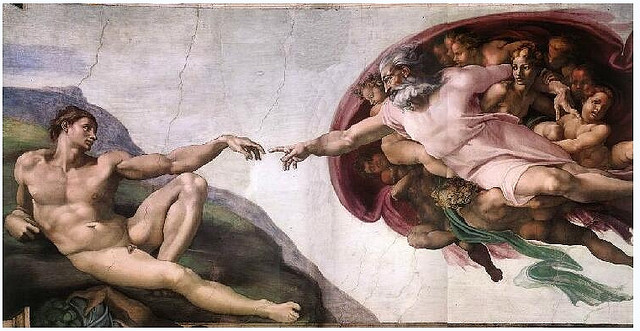
god-creates-adam

He writes,

“We have gone backwards on gender inclusive language in many of our official events. These elements include a resurgence of emphasis on God as Father, without any balancing awareness of other ways of naming God.”

It is interesting to hear that Frank has identified a ‘resurgence’ of Baptists speaking of God as Father, although he makes it clear that he thinks this is not a good thing. For him, it represents a ‘growing narrowness’ among Victorian Baptists.I would be very happy for Frank to respond and clarify his views on the subject.

His comment is set within a paragraph that relates to gender equality in churches. ‘Gender inequality’ is a now popular and fairly unhelpful phrase, which is sometimes less about genuine equality between the genders and is more about gender blurring. Real gender inequality is wrong and is a denial of the imago dei and our union with Christ (Galatians 3:28). Our Churches ought to be communities where women and men may flourish in the faith and be received as crucial partners in the Gospel. Unfortunately, the language of gender equality often carries with it a false premise, where women and men are not only considered equal but the same, and thus losing God given distinctiveness of the sexes.

Much more can be said about that point, but my chief concern here is the way Frank Rees publicly laments Christians addressing God as Father. It is quite strange, theologically perilous, and somewhat reminiscent of that literary wonder, The Shack.

To be clear, Frank is not saying that we cannot speak of God as Father or that we should not, but he’s arguing that by preferencing Father we are being ‘narrow’, ‘going backwards’, and the language is responsible for breeding gender inequality. Not only this, he is implying, although he refrains from spelling it out on this occasion, we ought to use feminine names for God (i.e. God as mother).

The concept of motherhood is biblical and beautiful and to be honoured. But no where are we encouraged to call God mother or any feminine name. There are 4 similes used in the Old Testament, where God is ‘likened’ to a mother, but as J.B Torrance has argued, similes and metaphors are not to be confused, and they are certainly not to be considered analogous to biblical statements  that declare God’s personal names and being.

For example, someone says to me, ‘Murray you’re as slow as a snail.’ Such a statement is not intending to convey something ontologically true about me, as though I am a snail, but that my walking habits remind them of this slumberous creature.

We are not free to ascribe to God names or ideas that have not been given to us by God in Scripture; doing so is treading in very dangerous water, and I so trust Victorian Baptists won’t heed his caution.

In the Bible God does not reveal himself to be  like a father, but he is God the Father.  The one who reveals the Triune God is Jesus Christ, the second person of the Trinity. What did Jesus teach us? Did he speak of God in feminine ways? Did he suggest that we address God as mother? No.

‘Jesus answered: “Don’t you know me, Philip, even after I have been among you such a long time? Anyone who has seen me has seen the Father. How can you say, ‘Show us the Father’? Don’t you believe that I am in the Father, and that the Father is in me? The words I say to you I do not speak on my own authority. Rather, it is the Father, living in me, who is doing his work. Believe me when I say that I am in the Father and the Father is in me; or at least believe on the evidence of the works themselves’. (John 14:9-11)

So Jesus said, “When you have lifted up the Son of Man, then you will know that I am he and that I do nothing on my own but speak just what the Father has taught me’. (John 8:28)

‘Therefore go and make disciples of all nations, baptizing them in the name of the Father and of the Son and of the Holy Spirit’ (Matthew 28:19)

‘This, then, is how you should pray: “‘Our Father in heaven’ (Matthew 5:9)

If Frank Rees is right and there is a movement among Victorian Baptists returning to the biblical language of God as Father, we should not bemoan the fact, but thank God for his grace in causing us prodigal children to return to him.

We should not be ashamed of calling God Father, but wonder in his grace to us in Jesus that invites us to know him as Father.

The Fatherhood of God is not a doctrine to be deconstructed by the imposition of current sociological expressions of femininity, just as we must resist defining God by the masculinity of previous ages. Contrary to Frank’s comments, true knowledge of God as Father does not lead to demeaning attitudes toward women, it causes us to repent of such ideas.

For a Bible College Principal to express disappointment over Christians calling God Father is extraordinary, and has the unhelpful consequence of unhinging real conversation surrounding the topic of women in ministry. When Christians address God as Father we are doing what Jesus tells us to do;  that may be ‘narrow’ to some, but it is better for us to narrowly trust God at his word than to be broad and lost in our speculative imaginations and inclinations.

‘I will be a Father to you,

and you will be my sons and daughters,

says the Lord Almighty

(2 Corinthians 6:18)

The Creeds, Wheaton College, and the same God theory

Last week a Professor at Wheaton College tweeted, “I stand in religious solidarity with Muslims because they, like me, a Christian, are people of the book”, and “And as Pope Francis stated last week, we worship the same God.”

The College has since suspended Dr. Larycia Hawkins. News of the suspension has caused a bush fire of controversy among American Christians, and the debate has also spilled over into Australia.

IMG_3322

Islam and Christianity share with Judaism a heritage from Abraham, and all three are monotheistic religions, but the similarities don’t extend much beyond.

Dr Hawkins is rightly seeking to express Christian love toward Muslim people. At this troubled time in world history, it is vital and godly for Christians to show love, grace, and hospitality to our Muslim neighbours and friends, including welcoming Muslim Refugees from Syria. But stretching commonalities in theology doesn’t help anyone, let alone glorifying God.

Miroslav Volf is a notable Christian scholar whom I’ve benefited from in my own thinking on other issues. He has weighed in on this debate in a significant way, arguing while Muslims and Christians hold different views of God,  ultimately the same God is worshiped. That doesn’t mean there is not crucial disagreement about God, however. It is worth reading Volf with his own words.

As I read an update of this story this morning, I was reminded of the Creeds. The historic creeds give articulation to the Christian understanding of God, as is found in the Bible. Do they help us in grappling with this question as to whether Muslims and Christians believe in the same God? How would a Muslim respond, for example, to the Nicene Creed?

“We believe in one God, the Father, the Almighty, maker of heaven and earth, of all that is, seen and unseen.

We believe in one Lord, Jesus Christ, the only Son of God, eternally begotten of the Father, God from God, Light from Light, true God from true God, begotten, not made, of one Being with the Father. Through him all things were made. For us men and for our salvation he came down from heaven: by the power of the Holy Spirit he was incarnate of the Virgin Mary, and became man. For our sake he was crucified under Pontius Pilate; he suffered death and was buried. On the third day he rose again in accordance with the Scriptures; he ascended into heaven and is seated at the right hand of the Father. He will come again in glory to judge the living and the dead, and his kingdom will have no end.

We believe in the Holy Spirit, the Lord, the giver of life, who proceeds from the Father and the Son. With the Father and the Son he is worshipped and glorified. He has spoken through the Prophets. We believe in one holy catholic and apostolic Church. We acknowledge one baptism for the forgiveness of Sins. We look for the resurrection of the dead, and the life of the world to come. Amen.”

My point is simple, we mustn’t neglect the Creeds as we consider God.

It’s an opportune time of the year to consider who is God, for at Christmas the invisible God took on flesh, in order to take and die for our sins.

This Christmas we will sing, among other carols, ‘O Come all ye Faithful’ which has these words remarkable words about the incarnation of the eternal God, God the Son,

“True God of true God, Light from Light Eternal,
lo, he shuns not the Virgin’s womb;
Son of the Father, begotten not created;”

——-

Ed Stetzer has also weighed in on the controversy. As usual he makes a lot of sense.                                       http://www.christianitytoday.com/edstetzer/2015/december/my-daughter-wheaton-college-protests-and-why-we-are-more-in.html

Al Mohler has written this importance response to the issue – http://www.albertmohler.com/2015/12/18/do-christians-and-muslims-worship-the-same-god/

Kevin De Young has written a useful piece on The Gospel Coalition website