The new Archbishop of Canterbury, Sarah Mullally, gave her first sermon in the new role.
How was it? Were there glarring omissions?
Click on the link…
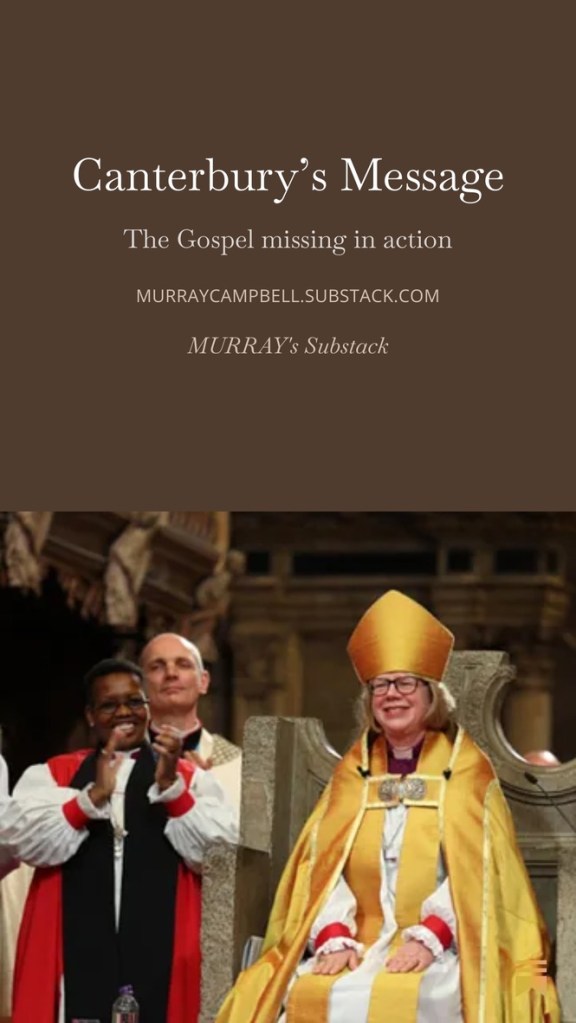
The new Archbishop of Canterbury, Sarah Mullally, gave her first sermon in the new role.
How was it? Were there glarring omissions?
Click on the link…
A pilgrimage to Canterbury or the ‘Pilgrim’s Progress’.
Click below for my latest substack

Westminster Abbey is England’s storyteller, and indeed, perhaps that of 1000 years of Western Civilisation. The stone floors and walls, her columns and stained glass windows are filled with the memory of the world’s timeline since that of Edward the Confessor. Every corner of the naive from floor to wall, is covered in the markers, statues and tombs of Britain’s greatest. There are Kings and Queens, soldiers and poets, scientists and Prime Ministers honoured and remembered.
The Abbey is an extraordinary place to visit, especially when the crowds are absent. I recall one evening I was there to attend a concert. Afterwards, people left hurriedly while I gave myself a few moments to look up and gaze upon this giant memorial to the past. I found myself able to then walk down the Abbey without people brushing passed and interrupting the silence with nagging little chatter. There is something weird and wonderful about walking on stone and marble where Edwards and Elizabeths, Richards and Henrys once trode.

The coronation of a British monarch isn’t an everyday event. It has been 70 years since the last British monarch received the sceptre and crown at Westminster Abbey. The coronation of a King may no longer carry the political and cultural weight of centuries past, but the event remains to impress, inspire and unify.
There is a tinge of sadness tied to today’s coronation, for the new King reminds us of the death of the great woman, Queen Elizabeth II. Her death may well turn out to mark the end of an era; not only the divorce with the 20th Century and the end of the Empire (with all the ills and goods associated), but also the age of Western Christianity.
There is something awe-inspiring about pomp and circumstance. No doubt, there are republicans and complainers across Australia, and even inside the United Kingdom criticising the pageantry and tradition that will fill the coronation service of King Charles III.
While changes have been made to reflect multi-faith realities of 21st-century Britain, the service remains deeply Christian. For example, the coronation service takes place in a Christian Abbey, the very same place where English Kings and Queens have been crowned for nearly 1000 years. The Scripture readings and the prayers and the oaths are Christian in words and meaning. While there are some theological question marks over connections made between an English monarch and that of Kings David and Solomon, there is a right link established between God, the Lord Jesus Christ, and the rule of the new monarch. The King serves under God and serves the people under his watch.
There is something weirdly wonderful about this ceremony: from the music and liturgy to the symbols of State and the oaths, and the seriousness and awe that will envelop each moment. This service pushes our hearts and spirit beyond the ceiling and sky and makes us ponder heavenly realities.
In a rush to eradicate the centuries of police and traditions, we can lose something that is important for the present and our future selves. The paucity of the materialist frame is exposed and filled with the light of prayers and defining words of God and accountability to the One who rules from heaven.
“Therefore, you kings, be wise;
be warned, you rulers of the earth.
11
Serve the Lord with fear
and celebrate his rule with trembling.
12
Kiss his son, or he will be angry
and your way will lead to your destruction,
for his wrath can flare up in a moment.
Blessed are all who take refuge in him.” (Psalm 2:10-12)
I remember Stephen Mcalpine writing a piece some years ago, explaining why millennials are turning to more traditional forms of Christian worship. In the race to be contemporary and relevant, we too readily disconnect ourselves from the past and become the boat that’s lost its mooring. We need to place our souls and something in a schema that is bigger than just me.
Nick Cave is one of a few select Australians invited to attend the coronation. When news broke that Cave had accepted the invitation, some of his fans were bewildered and annoyed. They couldn’t understand why this super cool non-conforming rock star would attend what is about as traditional and conservative an event that will probably take place this year.
Nick Cave responded in an open letter,
This “will more than likely be the most important historical event in the UK of our age. Not just the most important, but the strangest, the weirdest”
I hold an inexplicable emotional attachment to the Royals – the strangeness of them, the deeply eccentric nature of the whole affair that so perfectly reflects the unique weirdness of Britain itself. I’m just drawn to that kind of thing – the bizarre, the uncanny, the stupefyingly spectacular, the awe-inspiring.
And as for what the young Nick Cave would have thought – well, the young Nick Cave was, in all due respect to the young Nick Cave, young, and like many young people, mostly demented, so I’m a little cautious around using him as a benchmark for what I should or should not do. He was cute though, I’ll give him that. Deranged, but cute.
So, with all that in mind, I am looking forward to going the Coronation. I think I’ll wear a suit.
Love, Nick
The true weirdness isn’t in the crowning of a man named Charles, but in the words of the Bible about The representative man to whom all Kings and Queens and people owe their allegiance. Strangeness meets realness in the man who was crucified and raised from the dead.
The true significance of King Charles’ coronation may well be found elsewhere, in Africa. In what is even more strange (in an amazing way) are the events that took place in Kigali Rwanda, only 3 weeks ago. The meeting place may have lacked the splendour of Westminster Abbey, and there were few monarchs, presidents and celebrities in attendance. However, that meeting will do more to reach the heavens and the earth, than the enthronement of King Charles III. While world media ignored this meeting of global Anglicans, with time I suspect it will have greater influence in the shaping of things to come. 1400 Anglican leaders, representing around 85% of worldwide Anglicans, declared that the Archbishop of Canterbury had lost his spiritual authority over the church. Indeed, all 4 instruments of communion were declared broken.
It is difficult to think of another event in the past 500 years that carries such importance in the Anglican Communion as the recent GAFCON meeting.
William Taylor of St Helen’s Bishopsgate (London) said,
“Canterbury has walked away”
Rico Tice from All Souls Langham Place stated,
“We really are serious…we are serious because this is a first-order salvation issue”.
During the ceremony, the King will be asked this question by the Archbishop of Canterbury,
“the Church established by law, whose settlement you will swear to
maintain, is committed to the true profession of the Gospel, and, in so
doing, will seek to foster an environment in which people of all faiths and
beliefs may live freely. The Coronation Oath has stood for centuries and is
enshrined in law.
Are you willing to take the Oath?”
The King:
“I am willing.”
His Majesty will take an oath to a church, that while is established in law, has divorced herself from the true profession of the Gospel on account of her bishops and their wayward teaching. Sadly, the Church of England has abandoned the faith once for all delivered, and the vast majority of global Anglicans no longer see themselves in communion with Canterbury.
But why mention such a contentious issue on a day like this? First of all, this is truly historic. Second, we are witnessing a shift of in the world but we mustn’t conflate the failure of Westminster with the demise of Christianity. I suggested last year that with the death of Queen Elizabeth, we are perhaps marking the end of an era in the beginning of something new. With her passing, we are probably witnessing the closure of the 20th century and British imperialism (with all the bad and good that came). More so, Her Majesty’s death may serve as a bookmark, signalling the shift from West to the 2/3s World, and with this, a work of the Holy Spirit that sees Christ’s Church ground firmly in the soils of Africa and grassland and jungles of East Asia.
The coronation of King Charles III will pound with echoes of eternal truths, but living faith in the living Christ is more likely found in unlikely places: in Kigali and Lagos, in house churches across China and Iran, and in the favelas of Brazil. And yes, even in the ordinary suburbs of Melbourne, Australia. To break the materialist glass ceiling and grasp. To find mystery and awe that meets real life, visit a local church and hear the greatest story.
I’ve just read what is a pretty ordinary piece of opinion writing The Age. The approach isn’t uncommon, but it’s not particularly helpful. It is another attempt to deride Anglicans who wish to hold onto Anglican beliefs. Let’s remember, the beliefs in question (human sexuality), aren’t particular to Anglicans but are shared by Christians Churches globally and ever since Jesus inaugurated the church.
Dr Kate Milner writes about some of her experiences growing up in churches, including an inner city Anglican Church in Melbourne. As the headline states, As a woman, I am glad to be free of the Anglican Church, Dr Milner is ‘relieved’ to be no longer part of the Anglican Church. Why?
She explains,
“When I read about schisms within the Anglican church and anger about the breakaway Diocese of the Southern Cross, which does not support same-sex marriage, I feel both sadness and relief. I feel sad that it has taken so long for the fundamentalist, ultra-orthodoxy of this emergent network and their extreme values to be called-out. While I lived it every day for decades, in the midst of it I was never able to find words for the bigotry of what has been described as a “network of ultra-conservative, fundamentalist, patriarchal, schismatic Anglicans who, predictably, claim to be the only truly orthodox Anglican Church.”“
Dr Milner doesn’t engage with the theological convictions that have given rise to the Southern Cross Diocese. She doesn’t offer any alternative other than a passing reference to a few Bible words, although with no consideration for their Bible meaning. Instead, she mounts a verbal attack on her previous church and any like it (which apparently includes the newly formed Southern Cross Diocese). Dr Milner’s approach is simple and effective in a superficial sense. She unloads a barrage of insults. It doesn’t matter whether the words are true of these churches or not. It doesn’t matter whether she has even understood the meaning of her chosen words. Just throwing them at churches is sufficient. Obviously, someone thinks her tactic succeed, after all, it made the opinion page of a national newspaper!

I get how today’s rhetorical bamboozling works. Words are power and power brings influence and change. And so if I look inside the garbage bin of words and find the right ones to bring emotional charge to an issue, then that’s what I’ll use. The thing is, when one takes a look at Milner’s chosen language, one quickly realises that she’s firing blanks: loud but empty.
Fundamentalist? No
Patriarchal? No.
Ultra Conservative? No.
Bigotry? No.
Kate Milner may not like the fact (and it is a fact), but churches associated with GAFCON (and now with Southern Cross) hold to mainstream normal orthodox Christianity. There is nothing outrageous or ‘ultra’ anything about what these churches believe and practice. Indeed, the belief that men and women are men and women, and that marriage is reserved for one man and one woman, is as normal as it comes. These Anglican Churches affirm the same Christianity that is growing around the world today and which conforms to the faith once for all delivered to the saints. It’s the same Christianity preached by the Apostles and which comes from the lips and life of Jesus.
By the sounds of it, Dr Milner prefers to align with a religion that is not those things, but (mis)using words because they come from the bag marked ‘terrible religious words’ and because it garners the ‘right’ kind of angry allies, is far from cultivating reasonable and important conversation. Therein lies a problem. If critics (and yes, there are also a few Anglican bishops who belong to this cheer squad) rely on spurious insults and slander to push for the downfall of orthodox Christianity, then their cause is already faulty.
I’m not privy to Dr Milner’s story beyond what she has written but I hope and pray that with time she changes her mind, because Christianity is good news. It’s the greatest message we can ever embrace. Sure, Christianity doesn’t swing along with the ever changing sexual revolution and all its latest iterations; Jesus offers a better story, a more secure hope.
I’ve read a lot of nonsense recently with people attacking Churches for doing the very thing churches are meant to do: believe and live out the Bible. But there is also danger here for Christians. Yes, we grieve when people defame the name of Jesus and insult our churches, but we must also guard our own hearts and tongues. We mustn’t copy those who oppose us and resort to their patterns of speech. When we fail, we ought to repent and ask for forgiveness. It’s easy to respond when you’re angry or hurt with the same low level verbal artillery, but we mustn’t.
Sometimes the wise decision is to say nothing in response; you cop the flack and ask God to sort it out. I’ve had to repeatedly learn that important lesson over the years. At other times it is prudent to speak and correct the allegations. It’s the Proverbs 26 dilemma:
“Do not answer a fool according to his folly,
or you yourself will be just like him.
Answer a fool according to his folly,
or he will be wise in his own eyes.”
There is also a time and place for strong words. After all, Jesus cursed the Pharisees and the Apostle Paul could say of the false teaches infiltrating the Galatian churches,
“If anybody is preaching to you a gospel other than what you accepted, let them be under God’s curse”
Such language however should never be used lightly or inappropriately. Too often even Christians begin at 9 and dial up the rhetoric from there. The problem is, public discourse doesn’t encourage meekness and reasonableness and patience. We desperately need such approaches, but today’s world of white noise gives little attention to careful, fair, and important argument. Outrage and derogatory superlatives is the staple diet. If you want to be heard, use bigger meaner words. As it happens, words like ‘fundamentalist’ and ‘bigot’ have become the religious version of Godwin’s law. They’re lazy and often untrue insults, but use them and the Colosseum crowd will lap it up.
My advice is this, avoid the mud and don’t forget the long game. If responding to every misrepresentation endangers us of jumping into the Colosseum and swinging our sharpest rhetorical swords, it is probably better to practice patience and joyfully take the hit. Other times, for example, when my neighbour is being slandered, speaking on their behalf may be a loving action. When ecclesial leaders promote a gospel that is no gospel at all, and there is an opportunity for us to speak with the manner of Jesus, then faithful church leaders ought to speak up so that God’s good news isn’t muddied. If we are looking for examples to follow at this present time, of how to speak truth with grace and clarity, look no further than to how evangelical bishops have conducted themselves in the public space over the past month, including Kanishka Raffal and Richard Condie.
“When they hurled their insults at him, he did not retaliate; when he suffered, he made no threats. Instead, he entrusted himself to him who judges justly.” (1 Peter 2:23)
“Do not repay evil with evil or insult with insult. On the contrary, repay evil with blessing, because to this you were called so that you may inherit a blessing.” (1 Peter 2:29)
“If you are insulted because of the name of Christ, you are blessed, for the Spirit of glory and of God rests on you.” (1 Peter 4:14).
Let’s keep learning to respond and engage in a Christ like way.
A game of AFL is taking place on a local oval when a small group jump the fence and start kicking a round ball along the ground. The game stops. Players approach the group and ask them to desist.
They retort, ‘we’re also playing football.
The players answer, ‘no, you’re playing a different game. Different ball, different shaped ground, different goals….if you’re interested, you can join us but first of all, get rid of the soccer ball’.
The group insist, ‘no, we are playing football. We can all play together at the same time.”
In trying to point out the obvious, someone again speaks up, ‘hang on, look…the balls are a different shape. The goals are different. You’re wanting a completely different sport.’
Ignoring the self-evident, the group gaslight the footy plays and again insist,
“We’re going to use this ground. Let’s talk about it. Let’s arrange a series of meetings to sort it out. After all, what we share in common is far greater than our differences.”
In the meantime, the match has been severely disrupted, the umpires feel bullied, and with each new sentence uttered by the small group of soccer players, they encroach further onto the oval and begin handing out Man U jumpers to everyone.
A significant announcement was made this week, one which may change the Church landscape in Australia. The decision is not so much about changing the game but is confirming that we will not change the game. GAFCON is responding to what is a tireless intrusion onto Christian Churches by certain bishops and leaders who are trying to change the Gospel beyond recognition. They are not playing the same game as Christians Churches, but something quite different.
Bishop Richard Condie, has explained the situation well,
“You know as well as I do that there is an emergency…When some of our bishops have failed to affirm basic biblical teachings [on marriage and sexual ethics] at the recent General Synod – when 12 of our bishops failed to uphold what Christians have taught for millennia – you know there is an emergency.”
“The issue for us is the authority of the Bible.”
He’s right. And let’s not fall for the red herring, “GAFCON are obsessed with sex and sexuality”, as one person put it yesterday. Not at all. It is the errant bishops who keep pushing and insisting churches allow and change their doctrines and practices on sex and marriage. GAFCON is rightly observing how these aberrant views impact and are ultimately shaped by a distorted theology of the Bible and the Gospel.
Marriage may be the presenting issue, but it is about so much more. There is an irreconcilable view of the Bible, of the cross, of the nature of sin and salvation, and the list continues. It shouldn’t surprise us to learn that ecclesial leaders who reject the Bible’s teaching on sexuality often don’t believe in other crucial doctrines including the atonement and the resurrection.
As we turn to Jesus, we find the superlative includer. Jesus shows kindness and mercy toward those who for 100 reasons sit outside the Kingdom of God. The very definition of a Christian is someone who did not belong and now by grace alone is welcomed by God. The same Jesus insisted on the biblical teaching on marriage and human sexuality. Jesus describes any sexual activity outside marriage between a man and a woman as ‘immoral. Today’s faithless bishops are pretty much saying, Jesus is wrong.
The Bible is clear, our moral practitioning is connected to other essential Christian beliefs about God and about sin and salvation and more.
“Or do you not know that wrongdoers will not inherit the kingdom of God? Do not be deceived: Neither the sexually immoral nor idolaters nor adulterers nor men who have sex with men 10 nor thieves nor the greedy nor drunkards nor slanderers nor swindlers will inherit the kingdom of God. 11 And that is what some of you were. But you were washed, you were sanctified, you were justified in the name of the Lord Jesus Christ and by the Spirit of our God.” (1 Corinthians 6:9-11)
“ We also know that the law is made not for the righteous but for lawbreakers and rebels, the ungodly and sinful, the unholy and irreligious, for those who kill their fathers or mothers, for murderers, 10 for the sexually immoral, for those practicing homosexuality, for slave traders and liars and perjurers—and for whatever else is contrary to the sound doctrine 11 that conforms to the gospel concerning the glory of the blessed God, which he entrusted to me.” (1 Timothy 1:9-11)
Churches that adopt the anthropological positions of popular culture are not serving their community well or God. They are giving people a message without hope and without grace. They are like an old English General sipping his brandy from a grand chateau while sending a carrier pigeon to the front line and telling the soldiers in the trenches, ‘there is peace. You are safe. All is well’.
Even as hundreds of Australian Anglicans meet in Canberra this week, I’ve heard some Anglican voices crying out, ‘peace, peace…what we need to do is keep dialoguing and living together’.
This reminds me of Bishop Curry and his famed sermon of ‘love’ at Meghan and Prince Harry’s wedding in 2018. Behind the scenes, this preacher of love was seizing church properties and dragging leaders before disciplinary hearings. For what crime of the church? These pastors and churches continued to teach the orthodox position on marriage rather than capitulating to the culture.
Conversations and meetings and forums and synods have met for years, and sadly little progress made. What are Christian Churches meant to do when bishops and coaches insist on changing the very game?
GAFCON is choosing faithfulness to God over allegiance to broken institutions.
The Sydney Morning Herald has published a fair report on the story, although there was this one unfortunate line,
“The Diocese of the Southern Cross was formally launched in Canberra on Sunday. The first service was led by a rebel minister who resigned from the liberal Brisbane Archdiocese because he “cannot go along with same-sex blessings”.
Rebel isn’t the right word to describe Rev Peter Palmer. He has given up a steady stipend and is now driving a bus to put bread on the table. His congregation has lost their church’s property. Far from being a ‘rebel minister’, Palmer is a Christian minister who has chosen to remain faithful to Jesus while his Diocesan bishops have chosen faithlessness to both the Gospel and the churches under their care.
As news of this week’s GAFCON announcement circulates, I am not hearing cheers and laughter over the decision to introduce a new Anglican Diocese in Australia, but tears and lament at seeing ecclesial leaders persisting with errant teachings and destroying churches under their care. And there is love for God and the deep desire for the Gospel to go out to Australians.
Christ’s Church is holy to God. The Gospel is too vital for Christians to play ball with those who are maligning it. People (both inside and outside churches) are too important and misleading them with errant teachings doesn’t help anyone.
This issue isn’t limited to the Anglican Communion. There are other Christian denominations in Australia facing similar trouble. Eventually, we must decide, who will we follow. Will we obey the Lord of the Church, Jesus Christ, or will we play the role of the chameleon and keep changing the gospel according to the whims of the culture?
 MurrayCampbell.net