I am Pakistan?


7278816-3x2-940x627

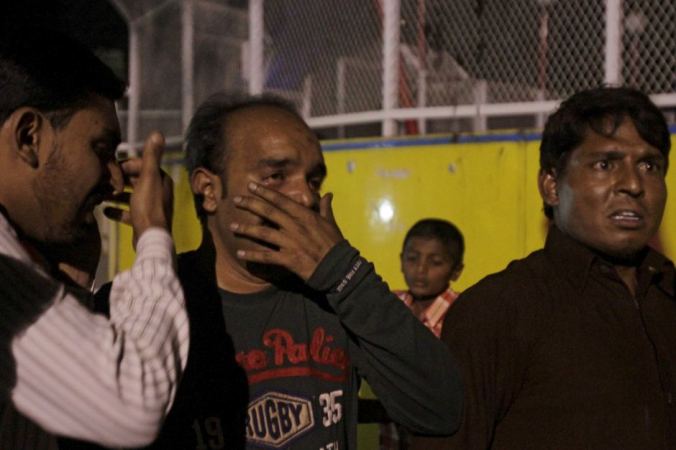
Today, 70 people in Lahore Pakistan were murdered as they celebrated Easter. The majority of the dead are children and women. Hundreds more people have been injured by the suicide bombing, which has been claimed by the Taliban.

The Taliban chose their time and place carefully, deliberately targeting Christians. This is a far too common story in the Middle East and subsaharan Africa. Persecution against Christians and other minority groups has persisted in many of these countries for decades, and sporadically over centuries. But they are not the only victims; as we have seen in Syria, Iraq and Turkey, Muslim people are readily targeted, and in Brussels and Paris the attacks were levelled at secular societies.

Yesterday in Baghdad while people gathered to enjoy a soccer match, a man blew himself up killing 41 people, mostly children.

Last week, 31 people were blown up in Brussels, with Islamic State taking responsibility.

The week before, at least 37 people were killed in one of Ankara’s busiest streets, when a car packed with explosives was detonated;  a Kurdish group has claimed to be behind the bombing.

As with Paris last year, following the dreadful carnage in Belgium social media was taken captive to hashtag Belgium, and people overlaid their Facebook profiles with the colours of the Belgian flag. National leaders took to their pulpits to cry solidarity with our friends and allies. Perhaps somewhat symbolic of Western ignorance, the One World Trade Centre lit up the Manhattan skyline in the Belgian colours: red, white and blue? But where was the public support for the Turkish people last week? Where was the twitter outrage and the clarion calls from our politicians when a Baghdadi soccer field turned red with the blood of children? In light of the Lahore massacre will we tomorrow light  the spiral of the Victorian Arts Centre in Pakistan’s green and white?

Our humanity has constraints; limitation is after all a characteristic common to all people. We do not therefore have the emotional capacity to mourn all who die in this world and to scream at all the wickedness that weaves so deeply through every culture. But while  our tears are reserved for Western nations, the rest of the world is right to be suspicious of us

There is an episode of The West Wing where President Bartlett is troubled by a genocide unfolding in a African nation. During a conversation with a staffer he asks, “Why is a Kuhndunese life worth less to me than an American life?” To which the advisor answered, ‘I don’t know, Sir, but it is.’

Why is it, we feel the grief and anger from Paris and Brussels, and not of Africa, Pakistan, and Turkey?

Until we can say ‘I am Turkey’ and ‘I am Pakistan’, we again prove the prejudice of our humanity. And  yet can we even dare to speak such seemingly supercilious words to those who have suffered so much?

Last year I made the observation that where the cultural and historical links are closer, there is often a greater outpouring of responses. Perhaps we should not be surprised therefore that more attention is given to our European friends than to others. Then again, perhaps our compassion stems from a vulnerability which emerges from seeing in those Western cities a mirror into our own way of life.

In other words, we empathise with those who are most like us. In contrast, consider the way Easter defines God’s condescension toward humanity. The explosion that has killed so many people in Lahore will one day be silenced by the Easter message which those people had gathered to celebrate. Easter reminds us of God who ‘so loved the world that he gave his one and only son that whoever believes in him will not perish but have everlasting life’ (John 3:16)

God showed love not by changing a few coloured light bulbs or by trending a hashtag on twitter; the depth of this love of God was the substitutionary death of his only Son. God came into his own, the incarnation. He paid the penalty for human insurrection, the cross. He triumphed over the grave, thus vindicating his claim of Divinity and the efficacy of his salvific power, the resurrection.

The extent of this love of God is for the world. John 3:16 does not suggest a universal salvation, for the text makes clear that faith in Jesus is necessary and rejecting Jesus Christ results in judgement. Nonetheless, in Christ, God has expressed extraordinary love for the world. He is not of or for the West, he is not English speaking or the God of the middle class, his concern is global. The Bible describes this God in ways unparalleled in any religion and in ways more tangible, and with a good news message that is changing hearts and lives in every nation on earth:

In that day you will say: “Give praise to the Lord, proclaim his name; make known among the nations what he has done, and proclaim that his name is exalted. (Isaiah 12:4)

“He will judge between the nations and will settle disputes for many peoples. They will beat their swords into plowshares and their spears into pruning hooks. Nation will not take up sword against nation, nor will they train for war anymore.” (Isaiah 2:4)

Many Western societies, including our own, are turning our backs on Christianity; to our spiritual, moral, and intellectual detriment. After centuries of economic, political, technological and military progress we have gained the world, but lost our souls. But in many of these very nations who are witnessing such horrific slaughter, Christianity is growing. In these lands the reality of Easter resonates louder and more true than the wimpish silence of the West who either do not share the desire or have the capacity to be one with them and for them.

’16 For God so loved the world that he gave his one and only Son, that whoever believes in him shall not perish but have eternal life. 17 For God did not send his Son into the world to condemn the world, but to save the world through him. 18 Whoever believes in him is not condemned, but whoever does not believe stands condemned already because they have not believed in the name of God’s one and only Son. 19 This is the verdict: Light has come into the world, but people loved darkness instead of light because their deeds were evil. 20 Everyone who does evil hates the light, and will not come into the light for fear that their deeds will be exposed. 21 But whoever lives by the truth comes into the light, so that it may be seen plainly that what they have done has been done in the sight of God.’ (John 3:16-21)

Earth Hour and Resurrection Sunday

This year, Earth Hour shares the same day as Easter Sunday. Coincidence? Yes. Timely? Perhaps so.

Earth Hour began in 2007 in one of Australia’s colloquial towns, Sydney. A year later Melbourne joined with hundreds of global cities to participate in Earth Hour. According to the Earth Hour website, there are now over 7000 cities and towns participating worldwide.

It is hard for my wife and I to forget Earth Hour, given it coincides with our wedding anniversary. Nothing makes for a romantic dinner than having the power turned off for an hour!

OLYMPUS DIGITAL CAMERA

Earth hour is a one hour ‘lights off’ event. Between 7:30-8:30pm homes, businesses, and public places are encouraged to switch off their lights as a way of communicating the threat of global warming and showing consensus that we need to do more to limit its consequences.

To quote, we “show their support a low pollution, clean energy future, one in which we can continue to enjoy the best of nature and our great Aussie outdoor lifestyle.”

Earth hour is symbolic, a gesture indicating a concern and call for responsible living in this world.

This year, Earth Hour synchronises with Easter Sunday, or Resurrection Sunday as it is also known. This is a day when Christians celebrate the resurrection of Jesus Christ from the dead.

Far from being symbolic, Jesus’ death and resurrection is historic, literal, and real. We may turn the lights off for an hour, Jesus experienced the darkness of death.

His work changed the world. While the resurrection of Jesus certainly has a future looking fulfilment, it is has the power to change the human heart even in the present. And far from ditching this current world, the physical nature of Jesus’ resurrection affirms the value of creation. We are not left disregarding the world and neither are we left pinning the hopes of the world on ourselves.

Earth Hour reminds us of the fallenness of this world, and indeed how complicit we are in this; the resurrection of Jesus proclaims the redemption. We need a God-sized solution to our world’s problems, whether it is global warming or a thousand of other insurmountable issues that weigh down humanity and stifle life, truth and love.

As the Apostle Paul wrote,

’We know that the whole creation has been groaning as in the pains of childbirth right up to the present time. Not only so, but we ourselves, who have the firstfruits of the Spirit, groan inwardly as we wait eagerly for our adoption to sonship, the redemption of our bodies. For in this hope we were saved. But hope that is seen is no hope at all. Who hopes for what they already have?  But if we hope for what we do not yet have, we wait for it patiently. (Romans 8:22-25)

The ultimate answer to Earth hour is Resurrection Sunday.

As we turn off our lights for one hour and commiserate the global sized problems before us, why not also reflect on the tangible hope offered us in the person and work of Jesus Christ?

The Autumn of Tolerance

The weeks leading up to Easter have witnessed some of the worst mud slinging Australians have thrown at each other for quite some time. Just a few short years ago tolerance was lauded as a national virtue. Showing respect to another person with whom there was disagreement was part of the course of conversation. There was space not only to express an opinion, but freedom to persuade others of that view. After all, is this not a basic tenet of a democratic society?

Recently however, it appears as though tolerance has been given the flick, and a neo-Orwellian temperament has come to the fore, especially in Victoria.

Education Minister, James Merlino, is among a number of politicians labelling people ‘bigots’, simply for raising concerns about Safe Schools. And despite proven flaws with the Safe Schools material and agenda, the Victorian Government insist that it will be mandatory for schools. There has even been backlash at the Federal Government’s decision to give parents information about the program, and the right to opt-out their children should they choose. When the State wishes to take from parents their responsibility to make decisions for the good of their children there is a fundamental problem in Spring Street.

The message being communicated by the Government is that Victorians must adhere to the current social milieu or be branded as haters; agree with us or shut up.

This however is counter productive. Changing a culture of fear cannot be achieved by the State bullying its own citizens and stifling disagreement, indeed it only further polarise people. No one wants children self-harming. No one wants children bullied. And many believe with fair reason that Safe Schools is not the answer. It is one thing for a Government to disagree with these concerns, it is quite another for them to call the same public bigoted and insist their children attend these classes against parental permission. Have they not become guilty of the very hostility they are alleging needs stamping out?

Perhaps all of us need to look afresh at Easter,  and be reminded of that most radical idea which continues to turn inside out haters from all sides.

There is a story in John’s Gospel where Jesus broke with the cultural expectations of his day to speak with a Samaritan woman. At that time Samaritans were considered social outcasts, and they were often discriminated against. Jesus’ conversation was all the more outrageous because the person before him was a woman, and a woman was then living with a man to whom she was not married.  In our minds this may not sound particularly shocking, but at that time this woman was guilty of triple-headed social evil. However, it didn’t stop Jesus.

John tells the reader how Jesus understood her heart and her past, and yet he struck up a conversation with her. He showed her kindness, and even offered this astonishing word, “whoever drinks the water I give them will never thirst. Indeed, the water I give them will become in them a spring of water welling up to eternal life.”

In other words, Jesus did not agree with her lifestyle and yet he loved her and he dismantled cultural barriers to express kindness to her.

This account is one of many that preempt the supreme act of love that Jesus would express, that which we remember at Easter; the cross and resurrection.

Both the religious and political establishment were convinced that Jesus’ views could not be tolerated, and therefore must be silenced. And yet without his volition they could not have enacted their plan. It is one of the extraordinary juxtapositions we see in the cross: people conspired Jesus’ death and he himself chose that path. He responded to hate not with hate but laying down his life for the good of those who ridiculed and mocked him.

We are losing the art of disagreement and because of this, true respect and reconciliation becomes evasive. Indeed it appears as though we are entering the Autumn of tolerance, and winter is on the horizon. It is only fair to ask, is this a sign of how dissent will be treated in the future?

EasterforWeb

The message of Easter is one all of us need to hear afresh. At its heart, Easter is God reconciling to himself those who disagree with him and he with them. The cross demonstrates disagreement and love, grace and truth. Jesus did not choose the path of the self-acclaimed intelligentsia, or the self-righteous. He sided with the oppressed and unpopular, not because he agreed with their values but because he loved them

Miroslav Volf put it like this, “I don’t think we need to agree with anyone in order to love the person. The command for Christians to love the other person, to be benevolent and beneficent toward them, is independent of what the other believes.”