Blessed are the peacemakers

‘Blessed are the peacemakers’

It was an incredible day when, on Thursday, 9th October, it was announced that peace negotiations had been agreed between Israel and Gaza (Hamas). A 20-point peace plan proposed by President Donald Trump has started to come into effect, including the return of all hostages, both alive and dead, the withdrawal of Israeli troops to an agreed position, and the cessation of armed conflict.

‘Blessed are the peacemakers’.

These famous words started to trend on social media last Thursday. The trending media has continued into the new week as the final 20 surviving Israeli hostages were released back home yesterday.

Scenes across Israel’s streets and cities are being shown around the world, and the joy filling the Knesset from across political divides is palpable to see.

They must also be ongoing grief and trauma for many people. One can imagine this day has brought also tremendous relief, rejoicing, and hopefulness.

Even celebratory speeches by Benjamin Netanyahu and Donald Trump contained notes of caution and qualification. The past 80 years have spoken: peace in the Middle East is hard fought and regularly disrupted by violence. Indeed, the pattern of peace and war is an ancient theme in the Promised Land.

‘Blessed are the peacemakers’.

As news broke of Hamas and Israel agreeing to peace, pockets of people in cities around the world stuck their fists in the air defiantly to protest the peace plan. It is telling when Hamas comes to the table and signs, and yet voices in Melbourne and London protest against peace. The rage and antisemitism now stifles the city streets of Melbourne to our shame. Over the weekend, a sitting Federal Senator stood in the middle of our CBD and threatened to burn down Parliament House in support of Palestine. 

‘Massacre of the Innocents’ by Ruben

Drowning out that rhetoric were cries and prayers of gladness and thankfulness in many homes, synagogues,  churches, and Parliamentary buildings.

I don’t wish to predict or guess what I think may or may not transpire in weeks and years to come in that ancient land. Such things are beyond my pay grade, and yours. The thought that I wish to convey here is observational and catechismal.

As people speak and share these words, ‘blessed are the peacemakers’, I wonder how many realise where these words originate? I wonder if we are conscious of the man who first uttered this beautiful and weighty phrase?

It is Jesus.

In what remains one of the most astonishing addresses ever given, the ‘Sermon of the Mount’, Jesus opened with the 8 Beatitudes, of which peacemakers is the 6th.

All eight beatitudes belong together and work together like an eight-note tonic scale. Each sounds a different pitch and yet every note relates to and belongs with the others.

“Blessed are the poor in spirit,
    for theirs is the kingdom of heaven.

Blessed are those who mourn,
    for they will be comforted.

Blessed are the meek,
    for they will inherit the earth.

Blessed are those who hunger and thirst for righteousness,
    for they will be filled.

Blessed are the merciful,
    for they will be shown mercy.

Blessed are the pure in heart,
    for they will see God.

Blessed are the peacemakers,
    for they will be called children of God.

Blessed are those who are persecuted because of righteousness,
    for theirs is the kingdom of heaven.

“Blessed are you when people insult you, persecute you and falsely say all kinds of evil against you because of me.  Rejoice and be glad, because great is your reward in heaven, for in the same way they persecuted the prophets who were before you’

In trying to capture the near miraculous breakthrough in Israel and Gaza, people have turned to the words of Jesus, ‘Blessed are the peacemakers’. 

Here is a thought experiment: If this wondrous phrase has captivated people’s hearts and imaginations, imagine knowing the man who first spoke these words? What was it in Jesus’ mind and heart that caused him to say, ‘Blessed are the peacemakers’?

What must this Jesus be like who can compose such heart-rendering and hope-bringing words?

As we read about Jesus’ life, he did more than preach fine words; he modelled them throughout his life,  and went far further.

One of the names given to Jesus is the ‘Prince of peace’. The name mirrors his life mission to bring peace, to re-establish relations between God and sinful human beings. Perhaps what is most astonishing is the means by which Jesus established peace, through sacrificing his own life. 

Peace is rarely free of charge. Peace is costly. Then grasp the biblical revelation that God himself was prepared to pay the cost for human iniquity and transgression.

The same Jesus, on another occasion, while preaching a sermon in Jerusalem, warned the world, 

“You will hear of wars and rumors of wars, but see to it that you are not alarmed. Such things must happen, but the end is still to come. Nation will rise against nation, and kingdom against kingdom. There will be famines and earthquakes in various places.”

The problem of evil in this world goes far deeper than social circumstances and economic opportunity; there is something that is most disturbing in the human soul. This Jesus, God the Son, went as deep as can be to reconcile and bring about peace through his atoning sacrifice. 

As tenuous as the situation remains in Israel and Gaza, there is much to be thankful for today. And pray for peace for the people of Gaza and peace for the people of Israel.

My suggestion today, or challenge as it may be construed, is, if you like the phrase, blessed are the peacemakers, and you long for that to be a reality, even in your own heart, take a look at the one who’s next created the phrase. Take a look at the peace plan he has instituted.
Charlie Kirk’s Memorial Service: an event with 2 narratives

One of the largest memorial services in American history has just concluded. 

Whether we approve or not, whether we are invested in the story or not, the assassination of Charlie Kirk has dominated the news cycle and continues to do so today, with his memorial service taking place in Glendale, Arizona. 

The papers and social media are speaking about very little else. It’s not that this is the only thing that matters today, but there are moments in history that capture the public imagination in ways that coinciding events do not. 

It’s clear that there were two narratives running through the memorial service, and we mustn’t confuse them as being the same or necessarily belonging together. I want to pull apart the politics that were present and the gospel that was also present.

Several members of the Trump administration spoke, including the President. Donald Trump gave a speech in which this line has already gone viral, 

“He  [Charlie Kirk] didn’t hate his opponents. He wanted the best for them – that’s where I disagreed with Charlie. I HATE my opponent and I DON’T want the best for them.

I suspect the President said these words with a certain tongue in cheek. He was bringing a moment’s levity to what was a very sombre occasion. At the same time, that does seem to be his modus operandi. But of course, Trump’s words are not his alone; this is the norm and assumed posture across religions and ideologies and politics. Whether it is fascist or anti-fascists or left or right, and most of the middle, we think ill of those who disagree with us. That the President is saying so with knowledge of the truth isn’t laughable, it’s woeful. Doubling down on hate doesn’t resolve the growing friction and factions that are disintegrating our societies. That leaves us with a game of power where the loudest, fastest and strongest aim to take charge and impose their will on the rest of us.

Trump, the ever populist and pragmatist, may well use whatever movement that helps maintain momentum. That’s a problem, as it was when previous American presidents co-opted Christian language and concepts to promote their own ethics and agendas. 

On Saturday, I gave a lecture at the Reformed Theological College, where I outlined 3 principles for doing public theology:

  • Don’t conflate Church and state.
  • Don’t confuse common grace with particular grace.
  • Understand both the common good and the eternal good.

Christian pundits, commentators and pastors would do well and serve our congregations and the unbelieving public  by recognising and practising those distinctions. Of course, the differences are not always perfectly clear and it is true that the gospel of Jesus changes every part of us, but nonetheless, we will do well to avoid those trappings. Why? In part, because the gospel is too important to be confused or co-opted by red or blue or green. 

Merging the Christian faith with politics is fraught with dangers, and that’s true across the political spectrum. If you think that your particular position is exempt from that rule, that only exemplifies the very problem. It doesn’t mean every political ideology is equally true or good or respectable. Of course not. How we value the unborn really does matter. How we view migrants and the poor matters. And many other topics.

As I said earlier,  two narratives were present in the memorial service, and it is the second one that I hope shines the most. 

Charlie Kirk’s pastor, Rob McCoy, gave a clear presentation of the good news of Jesus. He said.

“Charlie knew … at an early age … he entrusted his life to the Savior of the World.  . Jesus came to this earth, was tempted in all ways, yet was without sin, was crucified upon the cross…”

“His blood was poured out because blood must be shed for the remission of sins…And His death upon that cross was sufficient for all the world’s sins, but only efficient for those who, like Charlie, would receive Him as their Savior.”

Can we say an Amen to those words?

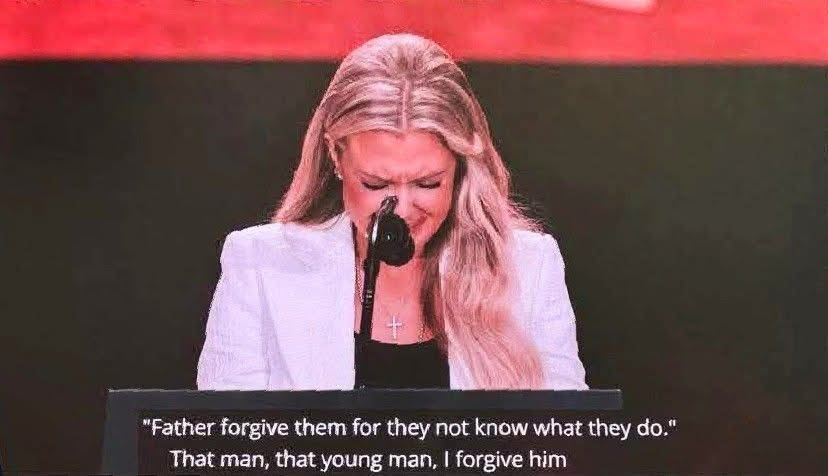
Erika Kirk  then addressed the crowds and uttered the impossible word,

“I forgive him…I forgive him because it was what Christ did, and it is what Charlie would do.”

“The answer to hate is not hate,” she said. “The answer we know from the gospel is love and always love – love for our enemies and love for those who persecute us.”

This is the message our polarised world needs to hear. I thank God that God has not judged me according to every word I have said and every thought I have entertained. I am eternally thankful to God that he forgives sinners such as me. And grasping this gospel does something to us, where Trump’s words disappear and where love and forgiveness take shape.

What is so sad and troubling is that I know our culture well enough to see how this is going to play out in the media and social media: most people will simply double down on their prior commitments and attitudes. People are so entrenched in their ideological preferences that we will read the room as our glasses are glued onto our faces, and we are unable to see any other perspective. MAGA supporting Aussie conservatives will criticise me for my posture here and progressive Aussies will criticise me for not damning Charlie Kirk to hell alongside the President. 

Reality is almost always more complicated and nuanced. One does not need to elevate Charlie Kirk to the status of Stephen (Acts 6) or label him ‘ult right’. The Christian truth is that sinners are saved by grace alone on account of the perfect sacrifice of Jesus alone. Anything else is hubris.

Here is a thought: regardless of our political leanings, if God uses the gospel preached at Charlie Kirk’s funeral to convince some people of God’s saving news through Jesus, will we rejoice or will we resent & grumble like Jonah in Ninevah?

Will Donald Trump be welcomed into heaven?

Will Donald Trump be welcomed into heaven?

 I didn’t expect that question to be going viral this week! But then again, we are all living Alice’s Wonderland of the late Roman Empire. 

This week, during an interview on Fox & Friends, President Trump was speaking of the negotiations between Ukraine and Russia. As he spoke of the hopes for the war coming to an end and for some kind of peace to be established, he mentioned his hope for heaven.

“I wanna end it. You know, we’re not losing American lives … we’re losing Russian and Ukrainian mostly soldiers…I wanna try and get to heaven if possible. I’m hearing I’m not doing well. I am really at the bottom of the totem pole. But if I can get to heaven, this will be one of the reasons.” 

Whatever one might think of the sitting American president, he has a sense of humour, and even these remarks contain a touch of jocularity.  Part of the problem when writing about President Trump is that people are so entrenched in their opinions, any thought bubble not fitting prior judgments of the man simply blows away. No doubt, Trumpites are trumpeting his sainthood and have already assumed he is the 13th Apostle. Others are equally convinced Donald Trump is the Devil incarnate and worse than Hitler!

Later on, White House Press Secretary Karoline Leavitt was asked if the President was “partially seeking peace in order to get to heaven. Was he joking or is there spiritual motivation?”

She answered, 

“I think the President was serious. I think the President wants to get to heaven as I hope we all do in this room”.

I’m not God (obvious), and so I don’t have access to the President’s heart. He certainly has a public record that spells out danger. If, however, there is something to the rumours circulating since the first attempt on his life one year ago, President Trump has, at the very least,  been forced to examine the question of mortality.

The question of heaven is one that almost every single person on the planet will ask. Even the most ‘true blue’ naturalist and atheist is likely to ponder whether the God who doesn’t exist will let them into the heaven they believe is fiction. When confronted with death, the word from Ecclesiastes proves true, ‘He has also set eternity in the human heart’ (3:11).  We ask. We even long for an answer in the affirmative. 

What must I do to gain entry into heaven? Who must I be or become to find welcome into God’s home?

Before we get to the answer given by Jesus, let’s consider the President’s plan.

Whether his comment was said in jest or with a doss of honesty, Donald Trump signals that he’s near the bottom of the pile.  His working assumption is that getting to heaven is about moral conduct and or spiritual aptitude. It’s a totem pole or ladder we climb. If the President can bring to a close what is the worst war in Europe since 1945, surely that counts as a big leg up in God’s eyes. 

In effect, the President is relying on the same view of God and heaven that is shared among most of the world’s religions (including distorted views of Christianity): Heaven is reward for the holy, and we achieve this status through self-improvement and helping others, whether it is a volume of good works or spiritual exercises.

The problem with this assumption is that it doesn’t work. It places too much confidence in our ability to create personal righteousness, it belittles our record of personal transgressions, and it thinks too lowly of God’s holiness and too little of God’s grace. Let me explain.

The Gospel of Luke famously retells two encounters where an individual asks the question of Jesus,

“what must I do to inherit eternal life?’”

It’s essentially the same question Donald Trump is asking. 

The first man to approach Jesus was a religious academic. The second man is described as a ruler. He was a local official of some description who also had significant wealth.  One can read about the religious leader in Luke 10:25-37, but let’s focus on the second inquisitor.

A local ruler asks Jesus, ‘What must I do to inherit eternal life?’ Jesus turns and asks a question about the requirements in God’s law: Don’t murder, don’t commit adultery, and so on.

 The ruler recites the laws, and, whether he’s being honest or dishonest or delusional, he informs Jesus that he has judiciously followed God’s precepts since boyhood. Sounds good so far. But then Jesus went where the man did not want to go: his heart. 

“You still lack one thing. Sell everything you have and give to the poor, and you will have treasure in heaven. Then come, follow me.”

When he heard this, he became very sad, because he was very wealthy. Jesus looked at him and said, “How hard it is for the rich to enter the kingdom of God! Indeed, it is easier for a camel to go through the eye of a needle than for someone who is rich to enter the kingdom of God.”

The point is not that one can enter God’s Kingdom if our godliness measures up; the point is, no one does. 

If Jesus’ assessment isn’t explosive enough, when the disciples follow up with this question, ‘who then can be saved?’, Jesus states the obvious: 

 “What is impossible with man is possible with God.” 

We can’t con God. The bloke who is paying for his kids’ school fees while having an affair is still behaving reprehensibly, no matter how much the school fees are costing him. The President who secures a peace deal (as good as that is, and we pray that he will succeed), does not remove or justify or excuse a lifetime of dishonouring the God who exists and mistreating others. 

In what can only be described as a devastating analysis of human hubris and religious zeal, the Apostle Paul exposes the notion that human beings can ascend to where God is,

“You, therefore, have no excuse, you who pass judgment on someone else, for at whatever point you judge another, you are condemning yourself, because you who pass judgment do the same things. Now we know that God’s judgment against those who do such things is based on truth. So when you, a mere human being, pass judgment on them and yet do the same things, do you think you will escape God’s judgment? Or do you show contempt for the riches of his kindness, forbearance and patience, not realizing that God’s kindness is intended to lead you to repentance?

But because of your stubbornness and your unrepentant heart, you are storing up wrath against yourself for the day of God’s wrath, when his righteous judgment will be revealed.” (Romans 2:1-5)

These words jar and clash with our sensibilities, but thank God someone is honest with us. Paul continues, 

“There is no one righteous, not even one;

 there is no one who understands;

    there is no one who seeks God.

All have turned away,”

We might even mutter an ‘Amen’ to these words as we consider the American President, but the thing is Paul is also speaking of us. 

This is one of the key ideas of Christianity that unsettled the world in those early centuries AD, and again in the 16th Century and still today in many parts of the world. Christianity is not a religion of merit, but of grace.  It’s not about reward, but repentance. It’s not forging a golden staircase to heaven but receiving forgiveness brought about by a bloody cross.

Another American President once preached, ‘ask not what your country can do for you — ask what you can do for your country.’

Jesus preached a very different message. He came down from heaven and announced, ‘what’s impossible for you is possible for God’: salvation is not what we do for God, it is what God has accomplished for us. He then laid down his life to pay for the sins of many. 

Heaven isn’t a reward for the best of humanity; it is the gift of God to the worst.

Once we realise God’s peace plan, it changes us inside out. It requires humility and confession. This grace changes your outlook and ambition; it reorients how we view the people around us.

So, will Donald Trump make it to heaven? According to Jesus, the answer is no, not if he believes in himself and thinks that his ‘good’ conduct is going to impress the God of the universe. If, like anyone who is convinced by Jesus, and so repents and believes God’s gracious gift, then the answer is yes,   Donald Trump will be welcomed by God.  

That answer will probably grate on the many who see the American President as an existential threat to whatever it is you value, and it might bring a smile to those who adore Donald Trump. But both those responses fail to appreciate the nature of grace. Presidents and Prime Ministers, billionaires and the poor, company executives and employees, everyone without exception will meet God and be held to account. That prospect ought to terrify even the most self-confident.

Should God…can God… open his heart and home to the moral incalcitrant and spiritually vacuous? For us, it’s impossible, but with the God of grace through Jesus, it is certain. 

A letter to the Prime Minister about child gender therapy and a view to real mercy

“The Lord our God is merciful and forgiving, even though we have rebelled against him;” (Daniel 9:9)

100 notable Australians have written a letter to Prime Minister Anthony Albanese, calling for a federal inquiry into kids gender therapy. The list of signatories includes senior medical professionals, academics, and politicians including former Prime Minister Tony Abbott and former Deputy Prime Minister, John Anderson. Lest we think this is a partisan statement, the names attached to the letter belong across the political spectrum. 

I commend the letter to the Prime Minister, and indeed, to Victoria’s Premier Jacinta Allan. 

This letter has been written off the back of growing evidence that vulnerable children are being led to permanent life-altering procedures without sufficient medical or ethical reasoning. Earlier this week, the Queensland Government was forced to act and pause transitioning procedures on minors when a hospital was allegedly caught performing dangerous procedures on children as young as 12, without the consent of parents.  Also this week in the United States, President Trump signed an executive order, stopping Federal support for the gender transitioning of young people. 

These actions are but the latest of a growing number of Governments around the world who have pulled the plug on radical gender interventions. Denmark, Finland, Norway, Sweden, France and New Zealand are among the countries who are taking action to ban, or at least pause, medical intervention on children suffering from gender dysphoria.

It took the bravery of young people in Great Britain to sound the alarm, young adults who at the time were children and subjected to the transitioning movement in the UK health system. The result was the CASS review (2024). The doors were blown open and the UK Government was forced to shut down the Tavistock Clinic and hit the emergency button to stop pumping children with hormones, chemicals and even surgical procedures. Despite the preaching by gender progressives, evidence is scant (if not fabricated) that children are better off having body parts amputated or chemicals injected into their bodies. 

The days of using children in the service of gender theories are numbered. I believe this is one of the great evils of our time, for it cuts against the very nature of being human, and being male and female.  It is to our shame that our society ever encouraged such ideas. Governments may wait until they are swamped with legal action or they can take the moral ground and take action now. 

Obviously, there are all kinds of important issues here. The note that I wish to sound in this particular article is one of mercy. Mercy is a word that has been used a lot over the past week in relation to gender and children. It is a word that can be used and misused, applied and misapplied, and so in light of the letter to Australia’s Prime Minister, I would like to add a word of mercy. 

The question of gender fluidity and children changing genders is often framed around acceptance and intolerance, affirmation or bigotry. Unfortunately, this kind of binary approach is unhelpful and is often untrue. It isn’t hatred to affirm biology and to believe that biology determines gender. Neither is it intolerance to appreciate that there are children (and some adults) who struggle to accept their physical bodies and the gender that comes with that. Words matter.

We need to differentiate between these children who deserve our love and care, and those who promote the ideology of gender fluidity and who are responsible for inflicting lifelong damage onto these children. 

For example, when Bishop Mariann Edgar Budde recently called for mercy and compassion, she wasn’t asking Americans to save children from gender therapy. She was calling on President Trump to affirm their gender confusion and enable the very social and medical processes that we know to be unethical and harmful. The Bishop may have used some of Jesus’ language but her meaning is a world apart from the kind of mercy Jesus offers and that we all need.  We may or may not approve of President Trump and much of his character and rhetoric, but his latest executive order is sensible. As the letter to the Prime Minister demonstrates, the concerns are not left or right, but moral and medical. 

I realise that there are some who have caste doubts over this interpretation of Budde’s views. But I am simply accepting her teaching. Words have meaning. The Bishop of Washington DC has expressed her views on sexuality and gender on other occasions, and lest she has experienced a Damascus road repentance in the last few weeks, her meaning in the sermon corresponds to her regular teachings. 

The notion of Divine mercy is too good and holy for us to revise or use in the service of political progressivism (and political conservatism). 

Mercy is showing kindness. Mercy is not telling children lies or encouraging them to believe in mistaken identities and shuffling them off to a hospital for puberty blockers and even castration. As the letter to the Prime Minister intimates, there are better ways. 

Mercy involves patience and love, and hope. Mercy doesn’t deny reality or brush aside physical or psychological anxieties but learns to sit and journey with someone until the light of day. 

As a Christian, mercy takes a Christ-like shape. I think of the episode when Jesus met a Samaritan woman (John ch.4). As far as society was concerned, this particular woman had 3 strikes against her name and so ostracising her was considered the right thing to do: She was a a woman, she was a Samaritan, and she had sexually broken past. Jesus didn’t follow those rules of engagement. Jesus didn’t reject her, he showed compassion. He engaged in conversation with her. He didn’t ignore or pretend that her sexual history was unimportant, but rather, Jesus went further and showed mercy. Mercy didn’t involve encouraging her to pursue sexual sin or impropriety. He revealed to her the hope of Israel and through this offered her living water that would quench her thirst forever. 

Churches who choose to mimic the message by Bishop Mariann Edgar Budde are more damnable than any other group in society, for they claim to speak in the name of God and offer faux mercy.

Churches, if your community is not already a safe place of truth and kindness, goodness and mercy, you are not ready to receive the growing number of young Australians who need to know of the hope of the gospel. If your view of mercy means accepting the culture’s latest gender theory, then your church is not ready to care for those who experience trauma and who are struggling with their body, mind and soul. 

What did the Apostle Paul say, 

“Therefore, I urge you, brothers and sisters, in view of God’s mercy, to offer your bodies as a living sacrifice, holy and pleasing to God—this is your true and proper worship.”

Prime Minister please listen to the concerns outlined in the letter. And Churches,  learn mercy from Christ and not from our culture’s talking points. 

As Jesus said, ‘go and learn what this means: ‘I desire mercy, not sacrifice.’ For I have not come to call the righteous, but sinners.’


Update: January 31st, 1:45pm, Federal Health Minister Mark Butler has ordered a “comprehensive review” into gender therapy practices for children in Australia. This is a good step. Let’s pray that it is indeed a ‘comprehensive review’. I will add, that until such review is complete, all such ‘therapies’ and practices should be paused, to avoid causing further harm to countless children

Please don’t sing ‘Imagine’ at Funerals

Imagine there is no ultimate meaning, purpose or goal toward which our lives are headed.

Imagine there is no overarching design and no inherent significance. 

Imagine if our lives were reduced to the pot luck outcome of billions of years of impersonal atoms and molecules running around hitting and missing, making and destroying.

Imagine a world where the reality of conscience and moral choice has no grounding in a purpose beyond that of group survival in the evolutionary race to the top.

Imagine human affections are ultimately an illusion, a cruel joke orchestrated by the impersonal rules pf physics.

Imagine all the people living for today, for tomorrow is the end.

Welcome to the world offered by John Lennon’s song, Imagine.

Jimmy Carter was buried yesterday, following a State memorial service in Washington DC. Attention on the former American President and Statesman was somewhat overshadowed by the media’s obsession with Donald Trump. Cameras fixated on Trump’s every facial expression and movement of his lips. To the frustration of some, Former Presidents Trump and Obama were caught not only speaking to each other, but laughing and sharing whim as the service began.

The truly strange moment occured when Trisha Yearwood Garth Brooks performed John Lennon’s ‘Imagine’. I don’t know whether ‘Imagine’ was selected by Carter himself, or by his family or by the ecclesial folk at Washington’s national Cathedral. Whatever the case, ‘Imagine’ is a strange and indeed hopeless song for any funeral, let alone one that is meant to be Christian in nature.

I’ve noted over the past decade thanks to several Olympic Games Ceremonies and a COVID celebrity rendition, John Lennon’s ‘apotheosis’ has become an international anthem. To rouse people and provide solace, ‘Imagine’ has become to go to song. And yet, ‘Imagine’ is void of meaning and hope. Lennon’s words strips away ultimate meaning and concrete hope, and instead offers a materialistic world where everything is up for grabs and where death is the ultimate winner. In doing so, ‘Imagine’ provides the very philosophical groundwork for authoritarian and thuggish autocratism. Imagine excuses political aspiration and ideological illiberalism, for who is to judge and hold us to account? What Divine Being establishes truth and justice?

OLYMPUS DIGITAL CAMERA

In contrast to Lennon’s nihilist proclamation, people want to know that there is hope beyond a crisis and that there is hope when faced with mortality.

Imagine gives little consolation to a gravely ill person that not only is death imminent, but that it is ultimately meaningless. This atheistic ethic doesn’t do much to help grieving families who have just witnessed a loved one being ripped from their lives.

We want there to be a heaven; a better world with a better life. We want the cessation of sorrow and suffering, but Imagine cannot offer any such promise. 

At the same time, hell is also a necessity, for we do not want to live in a world where evil wins or where injustice prevails. While we should be thankful for our judicial system, it is not full proof and many terrible deeds are never prosecuted. People need to know that in death the wicked do not escape justice. Imagining there is no hell would be a form of hell its self.

John Lennon’s song collapses in on its own irrationality. He imagines ‘living life in peace’, and there being no “greed or hunger”, but such talk demands a form and purpose, but atheism and naturalism cannot provide such a definition. 

Every funeral is a voracious reminder of the fragility of life and the uncertainty of building society on credit. Hedonism is vanity. Pushing against greed and social disharmony suggests meaning, but meaning is disqualified in a God-absent universe. As Solomon the wise wrote in the book of Ecclesiastes, 

“Meaningless! Meaningless!”

    says the Teacher.

“Utterly meaningless!

    Everything is meaningless.”

Nietzsche was right, at least as far his logic is concerned, that “the masses blink and say ‘We are all equal – Man is but man, before God – we are equal.’ Before God! But now this God has died.” A contemporary of Nietsche, Anatole France retorted without regret,

“It is almost impossible systematically to constitute a natural moral law. Nature has no principles. She furnishes us with no reason to believe that human life is to be respected. Nature, in her indifference, makes no distinction between good and evil.”

What if there is heaven and hell? What if God exists? Everything must change. What we think and say has greater import. How we live and how we treat others has far more consequence. 

What if the God who exists is the God of the Bible: who is Sovereign, and altogether righteous and loving, just and kind? What if Jesus Christ is the perfect image of God, the One who as John testifies, 

“In the beginning was the Word, and the Word was with God, and the Word was God.  He was with God in the beginning.  Through him all things were made; without him nothing was made that has been made.  In him was life, and that life was the light of all mankind.  The light shines in the darkness, and the darkness has not overcome it…The Word became flesh and made his dwelling among us. We have seen his glory, the glory of the one and only Son, who came from the Father, full of grace and truth.”

These words are far more sustainable and substantial than the sentiment of living in a world without Divine structure. A Biblical view of the world both assesses its beauty and its horror, the worth and the uncertainty. This is not only the Baptist view of reality, but the Christian one, and one that is closer to message (that I believe) that guided Jimmy Carter’s life.

These Scriptures bring us to the most astonishing words, ones that counter John Lennon’s pipe dream with concrete hope, 

 “For God so loved the world that he gave his one and only Son, that whoever believes in him shall not perish but have eternal life.” (John 3:16)

Donald Trump isn’t the Messiah

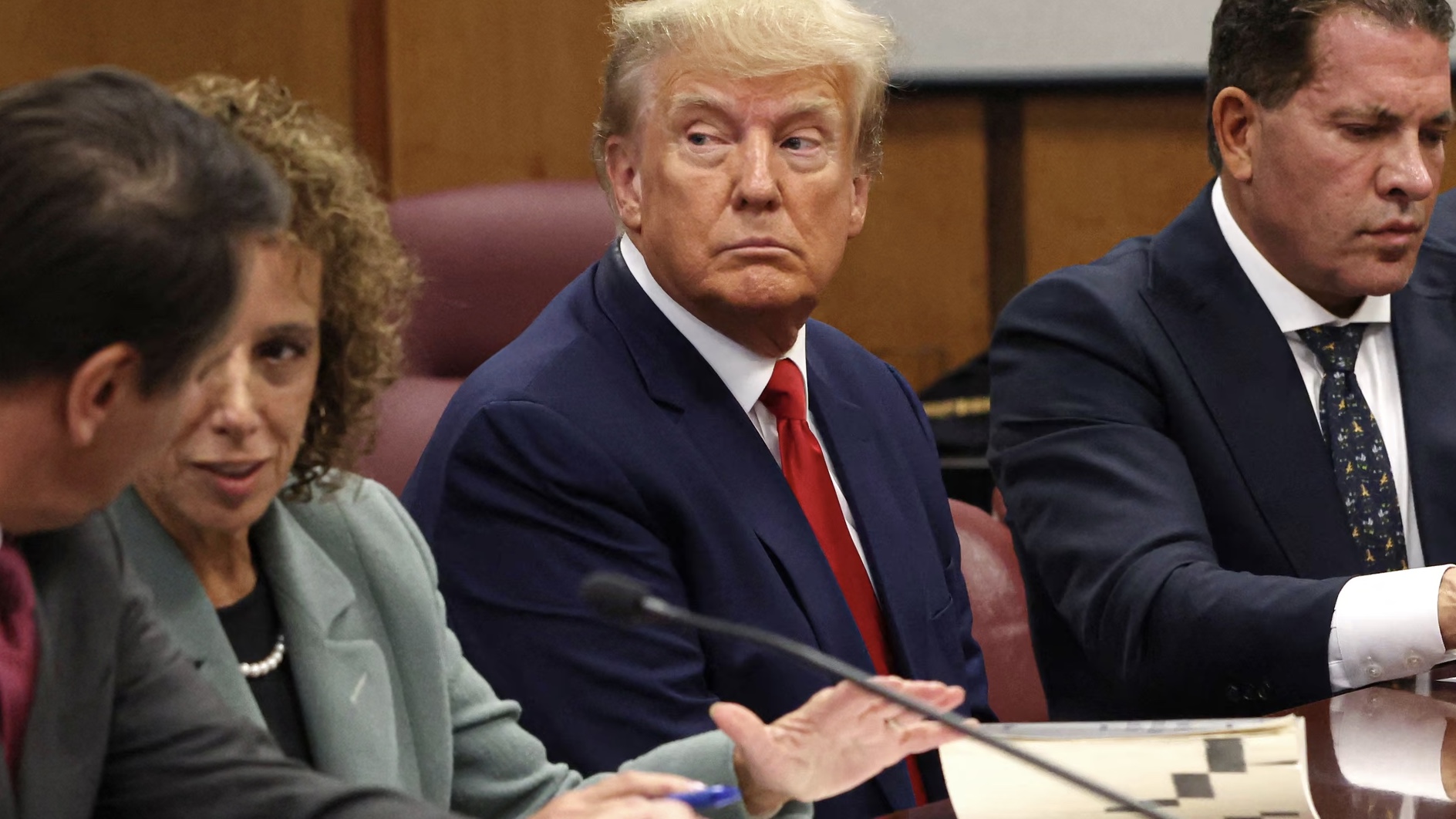
Donald Trump is being compared to Jesus Christ this week. Suffering and crucifixion analogies have been thrown around during Passion Week as President Donald Trump prepared to learn of the charges against him and then presented himself to the authorities in New York State.

Representative Marjorie Taylor Greene, protested in Manhattan,

“Jesus was arrested and murdered by the Roman government,” she said. “There have been many people throughout history that have been arrested and persecuted by radical corrupt governments, and it’s beginning today in New York City.”

As the President left the Course house and boarded his plane to Florida,  he joined in a ‘prayer call’, comprising an eclectic group of religious Trump followers.

I have seen footage of and tweets all week that make comparisons between Donald Trump’s trial and that of Jesus.  None of this is new. Adopting and hijacking the person and work of Jesus for political and social agendas is more common than we might realise. People have been doing so since Jesus’ actual trial and crucifixion. Constantine tried it at Milivian Bridge, David’s ‘The Death of Marat’ and 1000 other paintings that superimpose Christ’s sufferings,  the Confederacy and the KKK, the Taiping Rebellion, Horst Wessel,  some anti-vax campaigners, and more. 

Political agendas from both right and left have a long history of misappropriating the person and mission of Jesus Christ. I recall an incident only two years ago; a representative of the Victorian government informed a group of Melbourne church leaders what Jesus’ views on gender would be today, and then told us that contravening this thinking may lead to criminal charges. In case you’re wondering, this person was not even close to reflecting Jesus’ teaching. 

Sadly, there are times when members of Christian communities and leaders of Churches get swept up by these false narratives. That doesn’t mean that there is never any validity to the concerns they raise, but that it is bad theology and even blasphemous to equate their situation with that of Jesus’ suffering. 

Notice the religious language that President Trump chose for his speech following his court appearance?

 “America is going to hell”

Well, yes, that is a theological truism. It also accurately describes people in every nation, but it has nothing to do with allegiance to Donald Trump or some other political leader, but whether we can find atonement before God for our own sinfulness.

It is of course possible to think that the charges against President Trump are politically motivated and also believe that Trump has little moral compass. After all, behind the 34 felony charges of falsifying financial records are allegations of adultery and sexual immorality. There is no semblance of Jesus in this story. That is not to suggest for a moment that the political alternatives are morally or spiritually better. As a Christian leader, my responsibility isn’t to navigate political left or right but to follow Jesus and faithfully point people to him, a course that is altogether different.

Let it be said again, lest anyone is unclear, there is no comparison between President Donald Trump and Jesus Christ. One is a deeply sinful human being, the other the innocent Son of God. The former President carries with him a lifetime of transgressions, Jesus went to the cross taking our sins onto himself.

It is intriguing to see how again our society never moves far from the cross of Jesus Christ. All of history pivots on those three days: from the cross to the grave and to resurrection. And despite our best attempts to rid the culture of Christianity’s DNA, people from all walks of life and with all kinds of agendas, still think it is advantageous to attach themselves to the image of the suffering and dying Christ. 

What if, instead of identifying with the crucified One, we understand what the Easter story really does tell us, and that is, we all stand against Him. Rather than seeing ourselves close to Jesus, we are more like Peter who disowns, Judas who betrays, the Pharisees who denounce, and the crowds who mock.

Donald Trump is no Messiah figure. He is not an innocent lamb laying down his life to save a nation. He may or may not be innocent of these particular charges. But neither Trump nor President Biden and any political leader comes remotely close to the one who had written above his head on the cross, ‘the king’.

Regardless of where we find ourselves on the political spectrum, it’s nonetheless intuitive for us to find a hero in the story. We walk through life searching for someone who triumphs over adversity and overcomes iniquity and who can bring about the new Jerusalem.

Sometimes we put ourselves in that position as the hero, but when the hubris dissipates we are left with despair.  Sometimes we elevate our favourite celebrity or politician, but none of them qualifies to carry the burden. There is only one hero and Easter reveals him, and what a hero Jesus is,

“Father, forgive them, for they do not know what they are doing.”

The President went to Church and the Pastor prayed for him

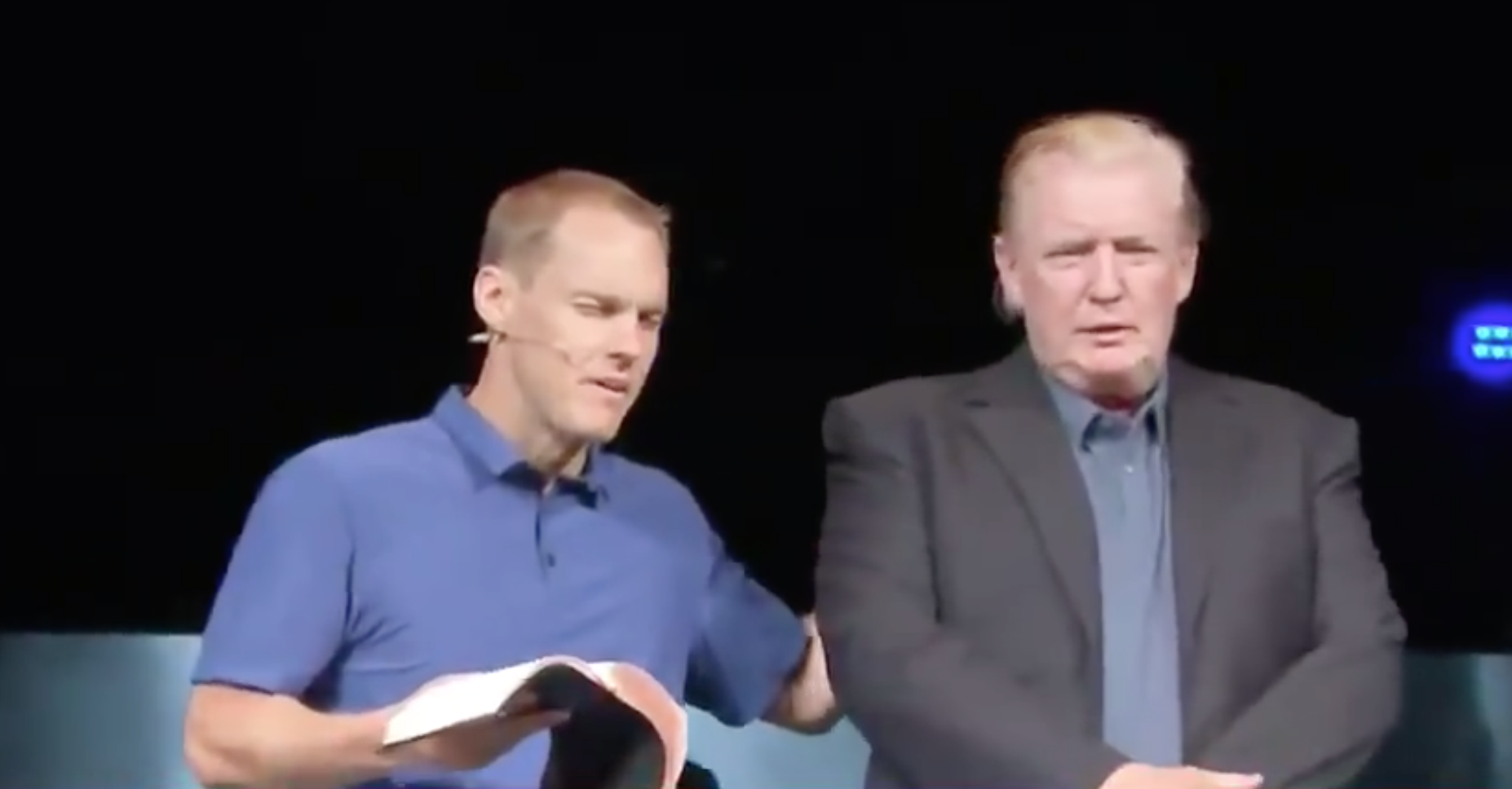
President Donald Trump went to Church today. After playing a round of golf on Sunday morning, he visited McLean Bible Church in Vienna, Virginia. A spokesman from the White House said that President Trump was there to “visit with the pastor and pray for the victims and community of Virginia Beach.”

David Platt is a Pastor at McLean Bible Church. Platt was formerly the President of the Southern Baptist Convention’s International Mission Board and is a Council member of the Gospel Coalition. McLean Bible Church is a nondenominational church located just outside of Washington DC. The Church describes their aim as, “We glorify God by making disciples and multiplying churches among all nations beginning in greater Washington, DC.”

Screen Shot 2019-06-03 at 10.47.13 am.png

What does a Pastor say when the President of the United States arrives for Church? One could conflate Christian faith with conservative politics and therefore deflate the Gospel and create needless divisions in your church. One could condemn the man and his politics and so initiate another unnecessary division in your church and once again confuse the Gospel. One could use the opportunity to campaign either for or against President Trump.

The Scriptures provide us with examples of how to navigate such scenarios, although I don’t recall a specific example of a national leader visiting a church service. There is Daniel before Nebuchadnezzar, and Paul before Agrippa, Festus, and Felix.  As David Platt made mention in his prayer, 1 Timothy 2 gives us instructions as to how to pray for Governing authorities,

“I urge, then, first of all, that petitions, prayers, intercession and thanksgiving be made for all people— for kings and all those in authority, that we may live peaceful and quiet lives in all godliness and holiness. This is good, and pleases God our Savior, who wants all people to be saved and to come to a knowledge of the truth.”

It is clear from Platt’s prayer that he shares this Pauline view of the world.

I’m not privy to the arrangements made prior to the President’s visit (reporting suggests that it was quite an impromptu visit), but it is worth noting that Mr Trump did not speak or share while on the platform; Church is not a political rally. Mr Trump did not pray or read the Bible, as Church’s sometimes feel obliged when dignitaries visit. Pastor Platt and the Elders of McLean Bible Church respectfully guarded their pulpit and they rightfully acknowledged their nation’s leader with them and prayed for him and for the country.

We need more examples like David Platt.

How would we greet our political representatives, should they turn up to our churches next Sunday?  What would our reaction be should our Prime Minister, Scott Morrison or our Opposition Leader, Anthony Albanese decide to drop by for church? Or if you live in Victoria, what if our Premier Daniel Andrews wished to attend? Placards or prayer? Posturing or Gospel presentation?

In an era where social outrage and political partisanship are on the rise, and where the culture drives people to the poles of icy extremes, David Platt offers us an example worth heeding.

Take 3 minutes to watch the video and listen to the pastor’s prayer for the President.


Since writing earlier today I have received some pushback. For the most part, Christians have expressed gratefulness for the way in which David Platt prayed, but some are suggesting that it’s all about optics rather than the content of the prayer. I don’t know what motivated the President to turn up that morning (I’m not naive enough to think politics wasn’t at play), but I also believe that the God to whom we pray is more wise and powerful and can outwit even the optics created by the President of the United States. The will of God to whom we pray will outdo the intent of any who wish to spin it for their own short-term political ends.


David Platt has since written this letter to his church. I appreciate his love for the Gospel and for his Church https://www.mcleanbible.org/prayer-president?fbclid=IwAR1nxkslWRJlU7kxOquyYYmyQxsjilfOHIp5nCtKKbG5GZwuAjn2vMfvRlI 


The Glass Ceiling Women are not allowed to break

Recent conversations about abortion in Australia and in the United States have made it clear that it is not enough for a woman to be a woman, nor is being a feminist suffice; one must also publicly support abortion. A woman may reach the zenith of public office but it is apparently redundant if they are not promoting a particular type of womanhood. It is not enough for a woman to be woman (which I assume is insulting to many women), but you have to be a woman who talks to and represents a particular agenda.

443_1_promo

Last week the world witnessed over 3 million Americans marching through their cities, protesting the Presidency of Donald Trump. These protests are understandable given the unacceptable views on women that the new President has expressed. I want to emphasize how appalled I am by his comments about women. However, not everyone who wanted to march in support of women was welcomed, those who describe themselves as ‘pro-life’ were excluded.

The new Minister for Women in NSW is Tanya Davies, and within moments of giving her first press conference as minister,  numerous journalists and social commentators began calling for her removal. The reason? What atrocious deed is lurking in her wardrobe? The problem is, Tanya Davies is pro-life.

She said,

“Personally I am pro-life … but in my role I am there to support all women and I will support all women, and I will listen to all women and I will take on board all the stakeholders’ comments and feedback … and ensure the best outcome for all women is secured,”

In today’s The Age, Jenny Noyes made it clear as translucent silica that one cannot be Minister of Women if one does not support a woman’s right to abort her children,

“the appointment of Tanya Davies as the new Minister for Women was immediately soured when she admitted during the press conference to being “personally pro-life.”

“This simply is not good enough…NSW needs a Minister for Women who will actually fight for women’s rights, who is willing to put reproductive rights on the table – not to wind them back…”

The comment that I found most troubling was this one,

“The so-called “pro-life” movement says a life that hasn’t even begun is more important than the self-determination of a living, breathing woman.”

First of all, let’s not fudge the facts: life has already begun. Treating unborn children as pre-life and pre-human counters what we know to be true scientifically and ethically. To grade human beings according to levels of humanness is gross and immoral, and reminds us past generational ideologies which rightly cause us to shudder. Life does not begin at birth; our children are living sentient beings inside the womb. They are feeling and thinking and feeding and growing, responding to music and to touch.

Noyes’ also misrepresents the “pro-life” paradigm, painting  an either/or fallacy. It is possible to be both for unborn children and for women. But in the highly charged individualism which so much feminism has now adopted, room isn’t permitted for women (or men) to both support a woman’s health and life, and the health and life of the child in her womb. 

In Ancient Rome, baby girls were often abandoned and left to die in the open. Today, it is not sexism and misogyny that is responsible for most abortions in Western countries (although evidence suggests that the majority of world-wide aborted babies are girls), and neither is it the endangered-life of the mother, but the endangered life-style of women who are encultured to smash more glass ceilings. 

The irony is, Tanya Davies is cracking another panel, but it is not one that some women want broken.

As a Christian I can’t help talking about Jesus, for I reckon he is more relevant to these discussions than we often think. We know Jesus’ views of women countered the norms of his day, which angered many men who sought to subjugate women. Jesus also taught us to welcome and care for little children. A healthy and mature society will do both.

I wonder, instead of women and men jumping to break more ceilings, what if we learned from Jesus, and stopped climbing on our step-ladders and shattering glass all over those underneath us? How often in advancing our own dreams we sacrifice others whom we leave below? Jesus accomplished the greatest act in the history of human rights, not by asserting his position but in laying down his life out of love for others. He flipped on its head the alleged axiom of ‘power verses abuse’, when he chose to serve those with whom he held strong disagreement. And instead of discarding those whom we perceive as holding us back, Jesus gave them dignity and called them to walk with him through life. At least to me, this sounds like a better way forward.

Post-Truth is not so new

Post-truth has been declared word of the year, by the Oxford Dictionary.

I have to confess, I can’t recall ever hearing of the word prior to the announcement, but rarely have I been confused with owning hip, cool, and trendy oratory. I have no doubt though, our cultural frontline linguists know what they are talking about!

The Dons of the Oxford Dictionary define post-truth as, ‘an adjective defined as ‘relating to or denoting circumstances in which objective facts are less influential in shaping public opinion than appeals to emotion and personal belief’.’

8032076-3x4-700x933

Oxford Dictionary website

There is a drop of irony here, post-truth’s rise to the top coincided with Donald Trump’s victory in the Presidential election. Apparently, the  Presidential campaigns were responsible for a spike in world-wide usage of post-truth, as was the Brexit campaign earlier in the year.

According to the official website, post-truth first appeared in 1992, in an essay written by the late Serbian-American playwright Steve Tesich. In 2016 there has been an observed 2000% increase in its usage, thus warranting the title of Oxford Dictionaries’ word of the year.

The word may be new, but the concept has had a long run through history.

In the 4th Century BC Aristotle pre-empted post-truth when he spoke of the tripartite art of persuasion: ethos, logos, and pathos.

Jesus Christ spoke of post-truth. In the parable Lazarus and the Rich Man, Jesus makes the point, that should a man rise from dead, people will not believe the evidence if they are not also prepared to believe God at his word. In other words, empirical demonstration is important but it is not suffice to persuade a person of what is true and good.

Accordingly, the Bible adds a fourth category to Aristotle’s tripartite art of persuasion: pnevmatikós (or spiritual). Ardent rationalists may scoff at this notion, but perhaps it is the case that their post-truth commitment to naturalism denies them the reasonable conclusion of accepting the reality of Christ, including the overwhelming evidence of his resurrection from the dead.

Post-truth is a word that carries with it an air of elitism and superiority. It is used to denigrate those whom we deem are less rational and intelligent.

In a documentary series marking a trip across the United States, Stephen Fry visited Los Alamos, the place where the first hydrogen bomb was developed. While exploring this once secret location, Fry made this remark,

“some people would think this is a grizzly place, a place of death, but to me I see nothing but optimism, and that’s because I believe in science. Many people today don’t.”

Stephen Fry is an example of a generation who credit science and rationalism as being security for human progress. Indeed, in the recent election a wave political experts and pollsters proclaimed the moral high ground on the basis of their education and they decried the uneducated who followed Donald Trump.

Whether we believe ourselves intelligent or not, and whether we have letters running after our name or not, we have always been post-truth, at least part-time.

The reality is we all need facts and truth to live well, and we adhere to these when these thing conform to our likes and wants. But rarely, are our ethical positions and personal decisions determined solely or even primarily because of what is true.

Today I was reminded of a classic post-truth moment in Victoria this year. Roz Ward has found herself in the media’s eye once again, with a photograph capturing the Safe Schools architect bullying a bystander during an anti-Trump demonstration in Melbourne yesterday. As I saw the photograph I was reminded of Roz Ward’s now infamous declaration, that the Safe Schools program is not primarily about creating Safe Schools but is designed to teach children Marxist values. Despite the repeated admission by this key designer of the curriculum, many politicians and social commentators have glued blue tac to their ears, and pretended the truth had never been leaked. Why? Political and social ideology trumps a confession.

Post-truth is not a 2016 problem, it is a human problem. Our word of the year communicates something about the proclivity of the human heart. Searching for truth is a noble task; as Jesus himself said, ‘the truth will set you free’. But knowing what is true and listening to it requires more than simple assent to objective facts. It requires a posture of humility, whereby we allow truth, especially God’s truth, to penetrate and challenge and restore.

Saying No to a Registry for Muslims

According to media reports, political advisors close to Donald Trump are exploring the establishment of a registry for Muslim immigrants to the United States. The policy may extend as far as requiring all Muslim Americans to be signed up to a Government register.

No doubt such a decision will find many supporters, even among some Australians. It is likely that Trump policies may give greater voice to certain groups in Australia, and so as a way of pre-empting such conversations here, let me give 4 reasons why a Muslim registry is a really bad idea.

1. Lessons from history

When a Government decides to impose itself on a religious minority, hatred and intolerance is incited and people suffer. Is this not one of the plagues of the Islamic State? Indeed, in many Islamic nations non-muslim citizens are marked out and carry the burden of having to pay the Jizya.

Some commentators have already raised the example of Nazi Germany. On the one hand, I find it somewhat duplicitous  that ‘left’ leaning journalists are outraged when conservative commentators cite the example of Nazism, and yet they seem to have little qualm in using the analogy when it suits them. In this instance though, while being careful not to overdo the comparison, the question is not completely absurd.

2. Most Muslims are not terrorists

It would be foolish to deny a connection between Islamic beliefs and current terrorist activity across the globe. Whether it is IS, Al Qaeda, Boko Haram, and many others, one of the common threads is Islamic religion.

It is also the case that many nation states adhere to strict forms of Islam, and while we exchange trade and business with these countries, internally they impose a religion on their citizens that is often harsh, and where women are mistreated and non believers denied rights.

Without ignoring real ideological issues that are often found in cultures where Islam is dominant, this does not mean that the populations living in those countries are content with the status quo, or that they are potential insurgents laying in waiting. The reality is, millions of people are fleeing these countries in order to find a new life, a  better life.

Muslim people have been living in Australia since the 19th Century, and for the most part they are hard working contributors to our country. They are friendly, kind, and are important members of our diverse and pluralist society.

Should the many suffer indignity because of a few? Indeed, those few persons who are of concern to the Government, are they not already highlighted? If so, what is the point of another register which will require all Muslim people to be participants?

3. The hypocrisy

There is a hidden hypocrisy at work here, both in the political and religious arenas.

Over the last decade across Western Governments we have witnessed increased intolerance towards people whose religious convictions don’t conform to the secular humanist worldview, especially when it comes to the issues of sexuality and marriage. This has been evident both in the USA and Canada, and my own State of Victoria is among the leading examples of this Erastian movement. Those who have been working to remove Christian ethics in the public square may well cry foul over this proposed registry, but they do so from a position of illegitimacy.

This works both ways. So when Christians speak up and seek to defend their freedom of religious thought, speech and life, do we deny it for others?

It will be of no surprise to readers that I disagree with Islam, mormonism, atheism, and many other belief systems. These theologies hold a view of God that contradicts the person and teaching of Jesus Christ, and yet nation states are not Churches, they are (in our modern history) secular and pluralist institutions. As such, a functioning and maturity society will find ways for this diversity to cohere, and encourage public spaces for people to disagree and to debate with fervour and respect.

4. Threats of a registry creates fear and makes people vulnerable.

Would I like my own family to live in fear and with uncertainty, not knowing how the Government may act toward us, given our race or religion?

I know for a fact, many Victorian Christians have felt apprehension as our Government continues to pressure our children out of public schools, and we are experiencing uncertainty as legislation is introduced to control Christian Churches and organisations. Would we wish that on another minority group?

One American Muslim has written this,

“This is what it feels like to me now that the republican nominee is now the president elect.

He is the abuser. We are trapped. We are circling the wagons, trying to mitigate the damage by finding allies and waiting for the abusive behavior that we know is coming. We are sharing strategies on how to parent our children now that our president elect has taught them that being a racist, sexist, fear mongering, money hungry bully will get you the highest office in the nation.

We are trying to find the way to rebuild the inroads amongst ourselves while finding the strength and power to strategize how we can get free.

This is a far different place than I thought our nation would be today. I saw hope, I saw people of color being treated fairly. I saw refugees and immigrants being embraced for their unique potential; I envisioned a path towards unity. I live and breathe the mantra, Stronger Together every day.

Now I look out my door and wonder, which one of my neighbors thought it was a good idea to elect a president who wants to implement a Muslim registry. A database of anyone who practices Islam, so they can be watched and rounded up whenever he believes we need to be put in check.”

OLYMPUS DIGITAL CAMERA

Christians must speak up for our Muslim neighbours, not because we agree with their religion, but because they should not be discriminated against for their religious beliefs. They are citizens of our countries, and they are human beings who ought to be treated with dignity and kindness.

There is no doubt, Donald Trump’s ascent to the Presidency has sent many social progressives into cardiac arrest. What many thought was an inevitable social engineering quest from the left has become not so assured. Perhaps the rise of Trump will only prove to be a temporary swing of the pendulum, but for now, the shift is real and no one yet knows how far it will move.

Many Christians will be thankful that they may find some reprieve after years of pushing and shoving from social progressives, but I don’t believe we should be rejoicing at the prospect of a Trump Presidency.

As calls are made for a Muslim registry, Christians would do well to remember people like Naaman, the Samaritan woman, and the jailor in Philippi. Ask ourselves, how do we love our neighbours? Should we cause them to fear, or should we protect them? I reckon we would do well to reread Jesus’ parable of the Good Samaritan,

“A man was going down from Jerusalem to Jericho, when he was attacked by robbers. They stripped him of his clothes, beat him and went away, leaving him half dead. A priest happened to be going down the same road, and when he saw the man, he passed by on the other side. So too, a Levite, when he came to the place and saw him, passed by on the other side. But a Samaritan, as he traveled, came where the man was; and when he saw him, he took pity on him. He went to him and bandaged his wounds, pouring on oil and wine. Then he put the man on his own donkey, brought him to an inn and took care of him. The next day he took out two denarii and gave them to the innkeeper. ‘Look after him,’ he said, ‘and when I return, I will reimburse you for any extra expense you may have.’

“Which of these three do you think was a neighbor to the man who fell into the hands of robbers?”

The expert in the law replied, “The one who had mercy on him.”

Jesus told him, “Go and do likewise.”

(Luke 10:25-37)