Two young women from the local community died tragically this week in a foreign land while enjoying a vacation together.
The names and faces of Holly Bowles and Bianca Jones have become global news, and shocking a nation as their lives were needlessly taken from them, following someone mixing methanol in their drinks in Laos. 6 people have now died as a result of the poisoning.
Both girls are from Beaumaris, across the road from Mentone and from where I live and where I serve as Pastor of Mentone Baptist Church. They went to school in the area and played footy for Beau.
I didn’t have the privilege of knowing Holly and Bianca, but when a community grieves, we all grieve. Connections are not far apart.
I want to express my own sadness to the families of these two young women and their friends. I don’t want to pretend to understand how you are feeling and the thoughts you are processing, but as a father of 3, including a 19 year old, I can only imagine, and even then I don’t wish to.
One thing I have noticed over these last few days is how people across the political and social divide has become united, to express anguish and reach out to the neighbourhood as people come to terms with the unspeakable.
Talking and sharing is important. It doesn’t remove pain or resolve questions, but these points of connection help in tiny ways. More so, I’m reminded of the Psalmist who cries out to God when words cannot fathom what wrenches the heart,
“Be merciful to me, Lord, for I am in distress; my eyes grow weak with sorrow, my soul and body with grief.” (Psalm 31:9)
The Scriptures don’t pretend by giving simplistic answers to the question of why, but these Divine words encourage us to shout and whisper and implore God who listens.
The Psalmist looks to God for mercy, for where else can we go? The inexplicable is not beyond His attention and care, although we may be overwhelmed by every doubt and anger, and grief and sorrow. We need a God who understands while we cannot. We need a God to whom we can turn and plea. We need a God who understands and empathises with every grief.
One day, Jesus’ friend, Lazarus died and we are told, ‘he wept’. Three short words in the original language: ‘wept, the Jesus’. We are also told that as Jesus reached the grieving community, ‘he was deeply moved in spirit and troubled’.
This is a portrait of God’s attitude toward death. The story goes on, and demonstrates that Jesus will do more than sit with those in sorrow. His opposition to death is great and absolute. He spoke words to Martha, a sister of Lazarus, words that have resonated ever since,
“I am the resurrection and the life. The one who believes in me will live, even though they die; and whoever lives by believing in me will never die. Do you believe this?”
The thing about death is that it’s worse the worse. Let’s not pretend otherwise. The story of the Bible however doesn’t leave us there. Jesus’ pronouncement at Lazarus’ grave was more than empathy, they are efficacious.
The God of the Bible speaks of his only child, his Son, who came upon death. He is the Father who understands the grave. But the very same event provides the greatest offer of hope the world can ever know and which remains the hope for those living in Beaumaris and Mentone.
The consolation of the ages is often read aloud in times of grief. I pray that as people gather together in their profound sorrow and others as ponder with speechless words the brevity of life and of the beauty and wonder of every young life, may the light of resurrection hope, pierce the dark,
‘Listen, I tell you a mystery: We will not all sleep, but we will all be changed— in a flash, in the twinkling of an eye, at the last trumpet. For the trumpet will sound, the dead will be raised imperishable, and we will be changed. For the perishable must clothe itself with the imperishable, and the mortal with immortality. When the perishable has been clothed with the imperishable, and the mortal with immortality, then the saying that is written will come true: “Death has been swallowed up in victory.
“Where, O death, is your victory? Where, O death, is your sting?”
The sting of death is sin, and the power of sin is the law. But thanks be to God! He gives us the victory through our Lord Jesus Christ.’
I appreciate that the title may sound a little presumptuous, but hear me out.
Cate Blanchett is one of the world’s finest actors…and she hails from Melbourne!
The first movie I recall watching that starred Cate Blanchett was Elizabeth. My wife and I were living in London at the time, the very city where Queen Elizabeth 1 had lived, reigned and died. I already loved historical movies, but watching the film while immersed in Elizabeth’s city brought about a visceral connection. It’s a great movie.
As we enjoyed Elizabeth, Susan commented, ‘Murray, I went to school with Cate.’
I looked at Susan, and with my eyes pressed for more information.
Susan, typically downplaying such things, added only a few words,
“We weren’t friends. Cate was a few years ahead of me.”
That was it. That’s all Susan said. I suspect there was a little more to it, after all, Susan had clear memories of Cate being at the same school with her. But today I learnt something new about Cate Blanchett, albeit from the newspaper and it’s about those school years.
At the age of 10, Cate’s father suffered a heart attack and died. To lose a parent at any age is difficult, but at such a young age, one can only imagine the pain, grief, and disorientation created by such a sudden loss.
Speaking with a journalist while filming a new movie near her old suburban home and school, Cate reflected on how her Dad’s death caused her to turn away from both Church and God.
“As a child I wanted a religion. I wanted the strong hand of God to put a hand on my childish shoulders to say, ‘Your father is with me. He’s having fun. You’ll see him in 60 years.
“But that didn’t happen. And so as a ten-year-old I fled from the church and moved down to the river and spent my childhood propelled into nature”.
“If I’d stayed inside the Methodist church I’d have a lot of bad guitar playing, but instead I rode my bike, thinking I was Nancy Drew, down by the Yarra River. I remember that as profoundly as I remember the hymns”.
She was asked whether she left religion because it didn’t give her what she wanted,
“It was not so much about what I wanted…more what I was hoping for. Also, I was ten.
“But religion contains a sense of hope and also a sense of community. And, in a way, that desire for something greater than myself never left me”.
First of all, I agree with Blanchett’s fears of bad guitar playing. As a former classical musician, many a time have I cringed and groaned at the sounds wafting over a congregation. But fear not, it is also possible to find excellent guitar playing in churches today.
Music aside, I am reminded of something Timothy Keller wrote years ago as he borrowed from C.S Lewis,
“Horrendous, inexplicable suffering, though it cannot disprove God, is nonetheless a problem for the believer in the Bible. However, it is perhaps an even greater problem for nonbelievers. C. S. Lewis described how he had originally rejected the idea of God because of the cruelty of life. Then he came to realize that evil was even more problematic for his new atheism. In the end, he realized that suffering provided a better argument for God’s existence than one against it…
My argument against God was that the universe seemed so cruel and unjust. But how had I got this idea of “just” and “unjust”?… What was I comparing this universe with when I called it unjust?… Of course I could have given up my idea of justice by saying it was nothing but a private idea of my own. But if I did that, then my argument against God collapsed too— for the argument depended on saying that the world was really unjust, not simply that it did not happen to please my private fancies…. Consequently atheism turns out to be too simple.”
Let’s take as an example, John Lennon’s ‘Imagine’. Imagine doesn’t articulate the highest intellectual efforts to sustain unbelief in God but it does represent popular sentiment. Indeed, Imagine has become something of an international anthem in recent years. For a moment, let’s play out the song’s logic of imagining a world without God, without religion, and without heaven and hell:
Imagine there is no ultimate meaning or goal toward which our lives are headed.
Imagine there is no overarching design and no inherent significance.
Imagine if our lives were reduced to the potluck outcome of billions of years of impersonal atoms and molecules running around hitting and missing, making and destroying.
Imagine a world where the reality of conscience and moral choice has no grounding in a purpose beyond that of group survival in the evolutionary race to the top.
Imagine human affections are ultimately an illusion, a cruel joke orchestrated by the impersonal rules of physics.
Imagine all the people living for today, for tomorrow is the end.
This view offers no consolation to a gravely ill person. Nothing to help grieving families who have just witnessed a loved one being ripped from their lives.
It offers no hope to someone who is a victim of injustice, for there is no judgment and vindication to come.
In fact, the song collapses in on its own irrationality, like a sandcastle overrun by the incoming tide. Lennon imagines ‘living life in peace’, and there being no “greed or hunger”. We affirm this sentiment but peace requires a common purpose between people and demands reason and design in the world beyond us. A universe without God does not allow for the idea of universal peace.
As Cate Blanchett shares her personal testimony from God to nonGod, she admits,
“desire for something greater than myself never left me”.
It is as though a Divinely given conscience keeps poking and prodding at us despite our cognitive and emotional rescripting of life.
None of us comprehend all of the events we experience or see in this life. To have that kind of knowledge is to be omniscient, and not the brightest or most prophetic have the kind of understanding. But Easter reminds us that there is One who has gone before us and for us. Hope is not defined by my ability to create or sustain it, but by trusting the one who can gift it. Even faith, fragile and compounded by tragic loss, is given assurance through the Easter event.
As a father, I appreciate the limited capacity of my children to grasp concepts both significant and small. It’s not that a child is necessarily wrong, but like adults, our beliefs and commitments are trialled and formed by many kinds of circumstances, inquiries and tests. This is one reason why the message of Easter is so compelling and continues to offer consolation. The death and resurrection of Jesus Christ took place inside history and is thus subject to our scrutiny, but it also punches through time and into eternity and therefore offer timeless hope and assurance.
Last Sunday I preached on Hebrews 5:1-10. The text provides one of the wonderful explanations of why and how Jesus today serves as our faithful representative before God in heaven. There is a tangible and sustainable connection point between our world and heaven, between humanity and God; the God Man Jesus Christ.
The text explains,
“During the days of Jesus’ life on earth, he offered up prayers and petitions with fervent cries and tears to the one who could save him from death, and he was heard because of his reverent submission. Son though he was, he learned obedience from what he suffered and, once made perfect, he became the source of eternal salvation for all who obey him”.
Never think the cross was easy for Jesus. We should never conclude that suffering didn’t impact Jesus. He is utter love and light and goodness. He did not deserve to suffer even a scratch. And yet he committed himself to his father’s will to endure the greatest evil ever perpetrated.
No story ends before it begins. No movie is shown at the cinema before it is first written, shot, and produced. In the moment by moment, God is valuing the world and each person who lives. More than that, God didn’t press fast forward to the end of the story, but his Son pressed in every moment and every day, for it is through his suffering and atoning death that God brings about forgiveness and life. Not only does Easter declare an ultimate hope over tragedy but Easter proves that we have an empathetic High Priest in Jesus.
Cate Blanchett’s impulse as a 10-year-old is relatable for many, and so is her constant companion who reminds her that there must be something more, something better. Several members of my church have suffered loss in recent months, the death of a parent or child. Death is horrible. Death is, to quote the Bible, the last enemy.
Easter is for the unbeliever, it is for the doubter and for the lifelong transgressor. Easter is for those who know death and suffering. This confidence lies outside ourselves in the only one who can claim to outdo death. As these beautiful words from Hebrews 4 tell us,
“Therefore, since we have a great high priest who has ascended into heaven, Jesus the Son of God, let us hold firmly to the faith we profess. 15 For we do not have a high priest who is unable to empathize with our weaknesses, but we have one who has been tempted in every way, just as we are—yet he did not sin. 16 Let us then approach God’s throne of grace with confidence, so that we may receive mercy and find grace to help us in our time of need.”
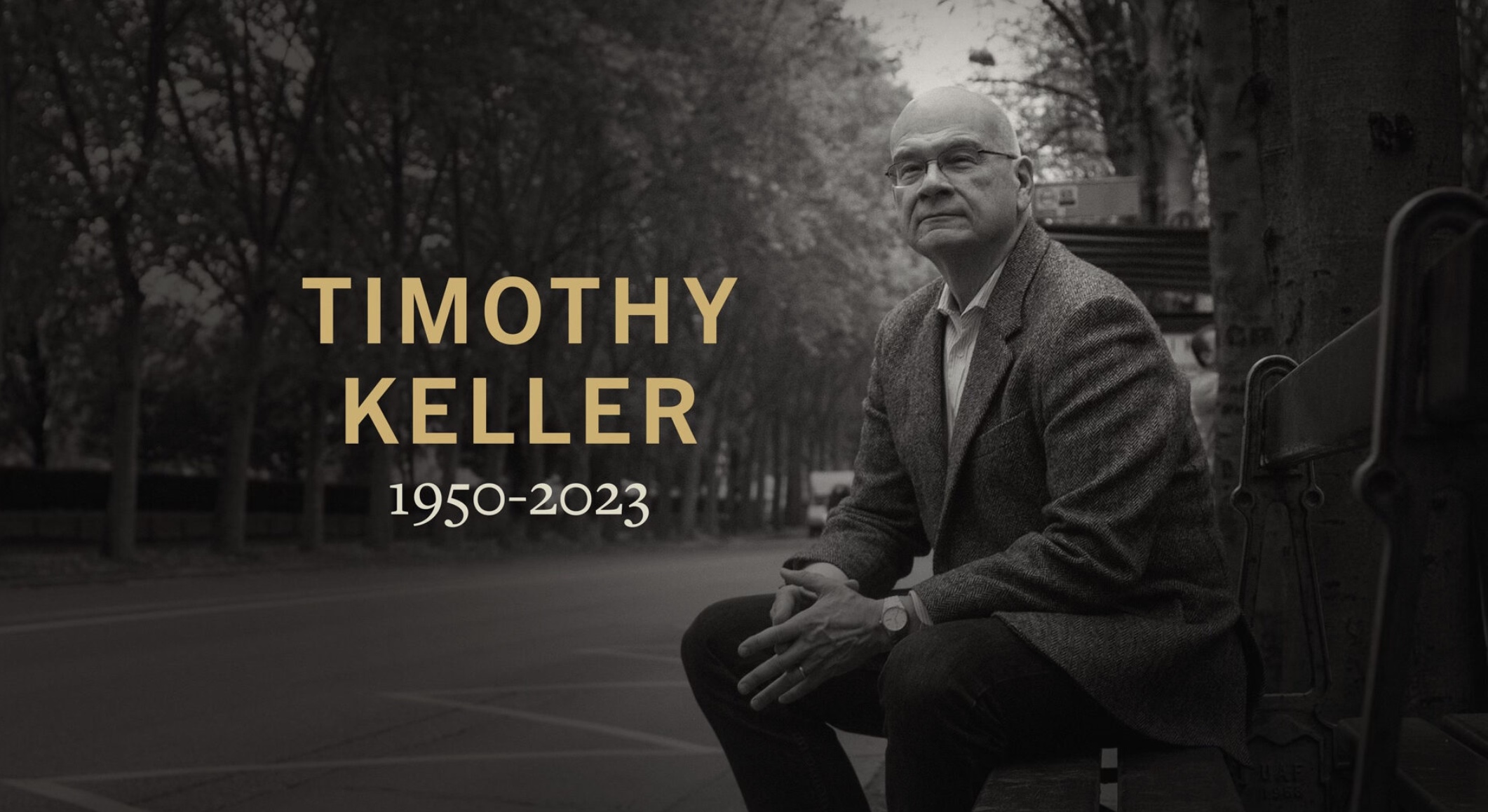
I have decided to write a few words about the death of Timothy Keller, realising that many words will be composed over the coming days about Manhattan’s Pastor.
Few evangelical Christians have not been influenced by Tim Keller in some way over the past 30 years. While he preached for New Yorkers and planted churches for New York, his Gospel-centred teaching has impacted Christians all around the world, including Australia.
I first heard the name Tim Keller in June 2000 at the annual Evangelical Ministry Assembly in London. The topic of the conference was church planting, and the speakers included Dick Lucas, D.A Carson, John Chapman, Phillip Jensen, and Tim Keller. Yes, the theological spiritual meal those days surpassed the menu at Eleven Madison Park. Keller’s preaching didn’t contain the charisma and firepower that was present among some figures on the platform, but over the years I began to increasingly appreciate and understand the hows and whys of his teaching ministry, and to learn from him.
I’ve only met Tim Keller once, and it was a conversation on a sidewalk in midtown Manhattan; it was brief and unassuming. Over the years I have read some although not all of his books. Making Sense of God may well pass the test of generations like CS Lewis’ Mere Christianity. Another book, The Prodigal God has remained with me, helping shape my own heart before God and the manner in which I am seeking to learn to write and teach. I am forever grateful for the ways Keller has helped me think and write, not through the prism of left or right, progressive or conservative, the legalist or the antinomian, but in that better space filled with God’s truth and grace, his righteousness and his love. Indeed, I haven’t needed to read every Keller book and listen to every Keller sermon to understand his theological heartbeat because he was all about Jesus and helping people to see and grasp and believe the greatest story the world can know: the Gospel of Jesus Christ. By digging deeper into the treasure of God’s good news helps us see the key to Keller’s mission and ministry.
Many will be mourning his death today, and understandably so. The world will see few Tim Keller’s in a generation. But then again, and going back to his heartbeat, what motivated Keller and what his ministry oozed with, was the same beautiful and powerful Gospel that is at work in the lives of all who trust in Christ. His unique and influential ministry is extraordinarily ordinary in that once, and that is what made it worthwhile.
I am also grateful for the way Tim Keller helped uncover and encouraged a new generation writer by the name of Christopher Watkin. While I’ve had the joy of knowing Chris for 9 years and been deeply impacted by his thinking, few knew the name until Tim Keller read Chris’ book, Thinking Through Creation. Last year, Chris Watkin’s, Biblical Critical theory was published. Tim wrote the Forward and in it he explained how he had waited for years for someone to come along and write this book. Time will tell, but Biblical Critical Theory is already considered to be one of the most important books written this century. Thank you Tim Keller for encouraging Chris and in Christian service helping the world find more Christian truth to be read and grow and benefit.
The reason for writing this short reflection about Tim Keller is less about talking about Tim Keller but to offer a corollary point. Because you see, my mum is currently in palliative care and we don’t expect her to live out the day. She has been unwell for a very long time and the last 4 months have been particularly difficult for her and my dad. We have been called into the hospital numerous times over the last few weeks, as staff expected her to pass any moment. As I write, my mum is still alive although her final hours are coming to an end. But you see, my mum trusts and believes the same Jesus as Tim Keller. Her hope isn’t in her own righteousness but knowing that Jesus died and was raised from the dead. And that makes all the difference. It really does.
My mum never wrote any books and will certainly not receive an obituary in the New York Times, but like Keller and a billion people around the globe today, she is known by God. That fact is both the great leveller and elevator.
The Apostle Paul famously wrote,
“For to me, to live is Christ and to die is gain. If I am to go on living in the body, this will mean fruitful labor for me. Yet what shall I choose? I do not know!”
The Christian cannot lose.
Our age of self-realisation isn’t producing great volumes of satisfaction, hope and life. We are more frail and fearful than ever. Among both the great and the small, the known and the little known, there really is concrete hope that frees us to live well today and be certain about eternity
Tim Keller’s son, Michael, shared on social media yesterday that his dad say, “I’m ready to see Jesus. I can’t wait to see Jesus. Send me home.”
I know my mum is thinking those very words as well, and I pray that others too might not just find some vague solace in the comforting words, but the living hope that is for all who come to the Lord Jesus.
The funeral for Her late Majesty Queen Elizabeth was filled with ceremony and pageantry on the grandest scale. The sights and sounds were more than impressive. Thousands of soldiers marched and guarded the route of the funeral procession. Military bands played a funeral dirge to the impeccable timing of the bass drum. Inside Westminster Abbey the choral singing was sublime. Even from viewing the funeral at home in my living room one could not help but be swept up.
Every detail communicated dignity, grandeur and majesty.
We have never before witnessed a funeral on such a scale and may never again. Hundreds of Princes, Prime Ministers, and Presidents representing nearly every nation on earth joined together at Westminster Abbey. Alongside religious leaders, dignitaries, and ordinary members of the public, all sat together as we said farewell to Queen Elizabeth. Millions of people lined the street of London and Windsor to catch one final glimpse of a much-loved monarch. It is estimated that as many as 4 billion people across the globe watched the funeral.
For a few days culminating in yesterday’s funeral, the world slowed down a little. News outlets gave attention to a single story. For a period of 10 days news readers and reporters dressed in black as a sign of respect and mourning. Television stations paused normal programming, and even limiting comedy and satire out of respect for the Queen’s death. Sporting events were postponed or observed a minute’s silence.
As I watched the funeral last night, intently and moved by what I was hearing and seeing, I was struck by the contrast between Queen Elizabeth’s funeral and that of Her Saviour and Lord.
Instead of honour and respect from world leaders and from local populations, Jesus’ journey to the grave was marked with disdain and abandonment. Kings and Governors didn’t honour him with kind words; they condemned him to death. Crowds didn’t line the streets to pay their respects; they jeered as he dragged a cross through the streets. Religious leaders didn’t pray for him, they mocked him. Soldiers didn’t protect him, they drove nails through his hands and feet, spat on him and gambled away his clothes. His friends, filled with terror, either ran away or stood at a distance in shock and silence. As a final attempt to mock Jesus, a sign was placed over his head that read, “Here is the king of the Jews”.
How and why would the Prince of glory subject himself to such ignominy? And how is it that a Queen should look to Him for mercy and grace? And how is it that this Jesus, despite the very best attempts was not erased from history but instead has become the focal point and end of history?
One of the most famous accounts of Jesus’ death was in fact written prior to that day, and yet, the prophet Isaiah foretold with precision the undertaking God’s Servant would follow. As Her Majesty had years earlier determined the details of her own funeral, so in advance, God announced the path his only Son would take,
“He was despised and rejected by mankind, a man of suffering, and familiar with pain. Like one from whom people hide their faces he was despised, and we held him in low esteem.
Surely he took up our pain and bore our suffering, yet we considered him punished by God, stricken by him, and afflicted.
But he was pierced for our transgressions, he was crushed for our iniquities; the punishment that brought us peace was on him, and by his wounds we are healed.
We all, like sheep, have gone astray, each of us has turned to our own way; and the Lord has laid on him the iniquity of us all.
He was oppressed and afflicted, yet he did not open his mouth; he was led like a lamb to the slaughter, and as a sheep before its shearers is silent, so he did not open his mouth.
By oppression and judgment he was taken away. Yet who of his generation protested? For he was cut off from the land of the living; for the transgression of my people he was punished.
He was assigned a grave with the wicked, and with the rich in his death, though he had done no violence, nor was any deceit in his mouth.”
Every detail in the Queen’s funeral suggests importance and splendour deserving of a monarch. And yet the true wonder and glory of what we saw and heard was not about Her Majesty, but about the One to whom she placed her trust. Her faith and her hope rests in the King who laid aside eternal glory and entered this broken and sinful world to die a sinner’s death as our substitute. The grandeur and awesome sights of the Queen’s funeral are but a tiny and pale reflection of the hope of resurrection she has in the One who gave his life as a ransom for many.
It was no coincidence that these words of Jesus were read out loud during the service,
“I am the way and the truth and the life. No one comes to the Father except through me. If you really know me, you will know my Father as well. From now on, you do know him and have seen him.”
In the part of the world where I live, we often reduce life to a bucket of cotton candy. We distract ourselves with sugary treats that promise bursts of happiness and pleasure and personal advantage. We’ve bought the marketers presentation. Life is driven by gaining sensory experiences which give us regular dumps of dopamine. The secularist’s dream and immanent frame has tried to block out transcendence with guarantees of sexual freedom and fulfilment, and offerings of entertainment, leisure, comfort and success. Eventually, the sugar rush wears off, and the realities of age, uncertainty, failure, pain and even death knock on our door. Her Majesty’s final gift was not to elevate herself and encourage the world to look at her, but rather to consider the One whom even monarchs must bow the knee.
The hope in which Queen Elizabeth looked and trusted is for great and small alike, for royal and commoner together. Her hope rested in a King who has walked the path of suffering and death for us and who in love shares his glory with all who lay their lives at his feet.
Take a moment to dwell on these words, which were the final words sung at Westminster Abbey and which formed part of the Scripture readings. Consider, where else can such amazing and certain hope be found?
“Finish, then, thy new creation;
true and spotless let us be.
Let us see thy great salvation
perfectly restored in thee.
Changed from glory into glory,
till in heav’n we take our place,
till we cast our crowns before thee,
lost in wonder, love and praise.”
“Where, O death, is your victory?
Where, O death, is your sting?”
The sting of death is sin, and the power of sin is the law. But thanks be to God! He gives us the victory through our Lord Jesus Christ.” (1 Corinthians 15:55-57)
I think it is fair to say that the whole nation is in mourning. The cricket world is in shock. At the age of 52, Shane Warne is dead. This legitimate Aussie larrikin and cricket legend (and legend is no exaggerated term) died suddenly on Friday night, apparently from a heart attack. To his family and friends, we cannot understand your loss and grief, and yet we want to mourn with you. Australia has lost one of our greatest ever sportsmen, and yet you have lost a Dad, a mentor, a friend.
It seems as though everyone has a Warnie connection. Conversations are taking place across our streets as neighbours and mates talk about some special moment with Shane Warne or memories of a special ball they witnessed him bowl at the G one day. I never met him, even though we share the same backyard. His local cricket club is one my boys play matches against regularly. Warnie’s former school is literally a one minute drive down the road from my church. Like millions of Aussies, I spent many a day admiring his cricketing genius as we watched him on the television or at the MCG.
Josh Gordon writes, “Shane Warne’s death from a suspected heart attack at the age of 52 has come as a wake-up call for middle aged-men across the country, many of whom took to WhatsApp groups Saturday morning to question their sense of mortality.”
Yes! Aussie men aren’t generally the most congenial visitors to the local GP, let alone verbalising their fears about mortality. Visiting your local doctor for a check-up sounds like a pretty smart move. Now, I’m several years younger than Warnie and I’ve never smoked and never drunk the volume of alcohol that our famed Aussie cricketers are renowned for doing, but then again, avoiding such things is no guarantee of making a century. I mean, isn’t this the issue? None of us knows how long the innings will last. If Shane Warne’s passing has made you gasp in horror, talk to your GP. But let’s not stop with a stethoscope, blood pressure machine and cholesterol test. The question of our mortality goes well beyond what any doctor can observe and diagnose.
The issue of human mortality is often laid hidden behind sterile rooms and hushed tones. When it comes to death, Aussies are not an upfront people. It’s not a subject for polite conversation. However, talk about death has become more urgent and real and public over the last two years. The COVID pandemic, especially in its earliest days, rushed forward the issue of mortality, entering people’s minds and even spoken on our lips. War in Ukraine is reminding us of the violent presence of death as does Afghanistan. And punctuating the thinly veiled pride and sense of masculine endurance is the sudden death of an Australian icon.
What are we to do with our mortality? How can we resolve this ignominious question?
Death is the inevitable door that we long to avoid. For all our momentum in running away from the grave, we are all in fact heading along the same road: the great and the small, the iconic and the average.
As a minister of a church, I have often spoken with people who are approaching death. There is always sadness for death is a great enemy, destroying life and ripping apart relationships. Rarely does anyone want the innings to end, perhaps ‘retire not out’ but no one wants to be bowled. Yet, we do not choose the day or manner of our dying, whether we are given time to assess our end or it comes suddenly and without warning. Ignoring the question will not fix it and save us.
If it is time for middle-aged men to ‘wake up’ and get a check up, it is also wise and imperative that we find the ultimate answer to death.
My Twitter feed has been filled with ‘RIP Shane Warne’ and ‘RIP Rodney Marsh’. When a person dies we often resort to this simple and hopeful phrase. I was reminded today of how the saying has been shortened. The phrase was originally and purposefully longer: “Rest in peace and rise in glory”. This is a Christian idiom that harkens back to the early centuries AD and whose meaning is found in the Bible and rests in the person and work of Jesus. As the Scripture says,
“Just as people are destined to die once, and after that to face judgment, so Christ was sacrificed once to take away the sins of many; and he will appear a second time, not to bear sin, but to bring salvation to those who are waiting for him.” (Hebrews 10:27-28)
If this is indeed the time to evaluate our mortality, then may I suggest we need to go no further than the One who died and went to the grave, only to defeat death with resurrection life. You see, the answer is staring at us and has been for millennia. We have heard the words spoken at funerals, in school chapels and at church. These living and hope bringing words are found in every Gideon’s Bible and available to us on our smartphones.
Young and old, men and women, cricket devotees and those who should be, if we are serious about answering the question of our own mortality, then believe the One who has gone ahead of us and conquered death for us, that it may not have the final word:
“When the perishable has been clothed with the imperishable and the mortal with immortality, then the saying that is written will come true: “Death has been swallowed up in victory.”
“Where, O death, is your victory? Where, O death, is your sting?”
The sting of death is sin, and the power of sin is the law. But thanks be to God! He gives us the victory through our Lord Jesus Christ.” (1 Corinthians 15:54-57)
When beggars die, there are no comets seen; The heavens themselves blaze forth the death of princes. (Shakespeare, Julius Caesar, Act 2, Scene 2)
In any given population there will be a few individuals whose death will be reported by media and mourned by grieving masses. Some people make the news, not because of their life but because of the tragic circumstances in which they died. Many more will people die without even a footnote in the local obituary, and yet their death is as a real and the grief from loved ones as profound.
More celebrities will depart this world in 2017, and countless thousands of anonymous people will join them in the grave. This isn’t being facetious or morbid, but stating what is inevitable
As we have been assailed with stories of people dying we respond to death with revulsion, and rightly so, for it is a destroyer of life and friendship; death is our enemy. When we have witnessed someone suffer for an extended season, there can be relief in their passing, but it is not their life that wish to see ending but their suffering.
Their mortality reminds us of our own, and it is wise for us to give due consideration to our beliefs and hopes over the grave.
It is not uncommon for people to sentimentalise and even trivialise death. Perhaps we do so in the hope of defying this great adversary.
Death is nothing at all.
It does not count.
I have only slipped away into the next room.
Nothing has happened.
(Henry Scott-Holland)
Another approach, and one that is probably more common, is that of rage and anger, as Dylan Thomas famously cried,
Do not go gentle into that good night,
Old age should burn and rave at close of day;
Rage, rage against the dying of the light.
Though wise men at their end know dark is right,
Because their words had forked no lightning they
Do not go gentle into that good night.
Good men, the last wave by, crying how bright
Their frail deeds might have danced in a green bay,
Rage, rage against the dying of the light.
Wild men who caught and sang the sun in flight,
And learn, too late, they grieved it on its way,
Do not go gentle into that good night.
Grave men, near death, who see with blinding sight
Blind eyes could blaze like meteors and be gay,
Rage, rage against the dying of the light.
And you, my father, there on the sad height,
Curse, bless, me now with your fierce tears, I pray.
Do not go gentle into that good night.
Rage, rage against the dying of the light.
There is however an alternative to uncertain optimism and despair, and it is spelled out in the good news of Jesus Christ,
“Listen, I tell you a mystery: We will not all sleep, but we will all be changed— in a flash, in the twinkling of an eye, at the last trumpet. For the trumpet will sound, the dead will be raised imperishable, and we will be changed. For the perishable must clothe itself with the imperishable, and the mortal with immortality. When the perishable has been clothed with the imperishable, and the mortal with immortality, then the saying that is written will come true: “Death has been swallowed up in victory.
“Where, O death, is your victory?
Where, O death, is your sting?” The sting of death is sin, and the power of sin is the law. But thanks be to God! He gives us the victory through our Lord Jesus Christ.”
(1 Corinthians 15:51-57)
Throughout the life and ministry of Jesus Christ we see God who empathises with those who grieve. John ch.11 records the story of one of Jesus’ close friend, Lazarus, falling ill and dying. When Jesus reached the town where Lazarus lived and died, he mourned with the family and outside the tomb “he wept”.
Jesus not only sat alongside those in the midst of grief, but he has walked the path of death. He endured its full horrors, not because of sickness or tragic circumstances, but he chose to enter into death out of love for humanity and to face hell for us. Indeed, in the hours before his crucifixion he told his disciples, “My soul is overwhelmed with sorrow to the point of death.” (Matt 26:38)
We are all approaching death, faster than we imagine; it is the great wall that cannot be avoided. But it does not have to be journeyed alone, and it does not have to endured without certain hope of resurrection. Imprinted into the fabric of the deathly world is the resurrection of Jesus Christ from the dead; real, historic, physical, and forever resurrection.
We can choose to pin our hopes on imagined sleep-like permanence, or fight off all thoughts of death until the moment arrives and we explode with fearful rage, or we can place our confidence in the one who has defeated death and who promises eternal resurrection to all who accept him, to the celebrity and the unknown, the beggar and the prince.




 MurrayCampbell.net