Gearing up for the Marriage Survey Outcome

Tomorrow morning, the results of the national marriage survey will be announced. While I suspect many Australians are moderately interested, many others are waiting with much anticipation and anxiety.

I was thinking through the book of Daniel this morning and realised again how instructive it is for us. So, ahead of tomorrow’s results I wish to suggest, for Christians, some lessons worth learning from this Old Testament book.

1. Choice when there is no choice.

Daniel did not choose the time in which he lived, nor did he decide to leave his homeland for Babylon, where he was forced into the service of King Nebuchadnezzar. He did however have choices as to how he would live in this place of exile.

2. Ask permission

Soon after his move to Babylon, Daniel made the decision to refuse food that would defile him (i.e. cause him to disobey God’s food laws). While he was firm in his conviction, Daniel nonetheless asked permission from his supervisor to eat an alternative. He even proposed a trial period, to see whether it was beneficial for the broader group.

Daniel was strong in his views but he did not push this on everyone else. Rather, he did encouraged a better way via presenting clear requests to those in charge.

3. Seek the wellbeing of society

Daniel find himself living in a very different culture to where he had been raised and understood. He was now living in a city that had destroyed his own city, and had removed all that was common to and valued by God’s people. He was living in a place which showed little regard for the God of Israel and his purposes. Despite all this, throughout the entire book, Daniel uses his wisdom for the good of Babylon, even the Kings of Babylon: he gave regular counsel, and his 3 friends became administrators over Babylonian Provinces.

4. Work for mercy

One one occasion when Nebuchadnezzar became fed up with his advisors and threatened to have them executed, Daniel mediated on their behalf. Despite the irreconcilable worldview being propagated by these figures and the damage inflicted by their whacky views, Daniel called for mercy. 

This is one of the greatest gifts we have to offer Australian society. In our culture that is becoming sharply polarised, and where disagreeable ideas are quickly associated with ‘extreme’ and hateful ideologies, Christians can resist this behavior. “Blessed are the merciful”, says Jesus. Seek the good of those who do not tolerate Christianity, be generous in our attitudes toward fellow Australians who have no time for Christian speech and ideas in the public square.

5. Faithfulness is always better than freedom

Daniel and his friends repeatedly risked their security and position, choosing to honour God over obeying wrongful laws. From this we shouldn’t surmise that Daniel was not a loud voice or angry voice or hateful voice. He was courageous, not stupid.

When a law was introduced, forbidding prayers to anyone except the King, Daniel continued in praying only to God. He didn’t make a song and dance out of it, but quietly maintained his practice.

Daniel didn’t abandon or avoid what he believed was right and good, and when asked to give an account, he spoke truthfully, with clarity and courage. Of what value is societal freedom if we have to sell the soul and give up God?  

For Daniel, faithfulness to God would at times result in threats, and other times, especially when God’s word was demonstrably proven true, Daniel was vindicated. Vindication normally follows faithfulness, not the other way round, and the only vindication promised to Christians in Scripture, will come about when the Lord Jesus appears on the last day.

6. Whose word is our hope?

Unlike Melbourne’s much loved Elm trees that are sadly facing extinction, no matter tomorrow’s marriage survey outcome, the good news of Jesus Christ will remain true and good.

“the grass withers and the flowers fall,  but the word of the Lord endures forever.” (1 Peter 1:24b-25a)

Daniel didn’t view exile as the end of his story, nor that of the people of God. Through the word of God, Daniel was often reminded about the faithfulness of God’s promises and appeals to Him.

15 “Now, Lord our God, who brought your people out of Egypt with a mighty hand and who made for yourself a name that endures to this day, we have sinned, we have done wrong. 16 Lord, in keeping with all your righteous acts, turn away your anger and your wrath from Jerusalem, your city, your holy hill. Our sins and the iniquities of our ancestors have made Jerusalem and your people an object of scorn to all those around us.

17 “Now, our God, hear the prayers and petitions of your servant. For your sake, Lord, look with favor on your desolate sanctuary. 18 Give ear, our God, and hear; open your eyes and see the desolation of the city that bears your Name. We do not make requests of you because we are righteous, but because of your great mercy. 19 Lord, listen! Lord, forgive! Lord, hear and act! For your sake, my God, do not delay, because your city and your people bear your Name.” (Daniel 9:15-19)

7. Conscious about confessing sin

Daniel was not ignorant of Israel’s history of covenantal unfaithfulness, and nor did he try to cover it up. Chapter 9 records a prayer of confession, and a request for Divine mercy in light of the multitude of sin,

“Lord, the great and awesome God, who keeps his covenant of love with those who love him and keep his commandments, we have sinned and done wrong.We have been wicked and have rebelled; we have turned away from your commands and laws. We have not listened to your servants the prophets, who spoke in your name to our kings, our princes and our ancestors, and to all the people of the land.

“Lord, you are righteous, but this day we are covered with shame—the people of Judah and the inhabitants of Jerusalem and all Israel, both near and far, in all the countries where you have scattered us because of our unfaithfulness to you.We and our kings, our princes and our ancestors are covered with shame, Lord, because we have sinned against you. The Lord our God is merciful and forgiving, even though we have rebelled against him; 10 we have not obeyed the Lord our God or kept the laws he gave us through his servants the prophets.11 All Israel has transgressed your law and turned away, refusing to obey you.”

babylon


I’ll have more to say tomorrow, once the results have been published, but dear Christian, as we wait let us guard our hearts and check our motives and think carefully about our words.

We pray as did Daniel, “We do not make requests of you because we are righteous, but because of your great mercy.”

Baptists, Bible, and Marriage

In the midst of all the public conversations surrounding same sex marriage, are some issues of greater importance than how the State defines marriage; among them is the Gospel fidelity of Churches and of their ministers.

Simon Carey Holt is the Senior Minister at Collins St Baptist Church in Melbourne. He has written a piece in support of same-sex marriage. This is not anything new as Simon has made his opinions known for some time, but his latest advocacy has reached the attention of The Age newspaper.

Simon has made a series of strong assertions about why Christians should support same sex marriage, and allegations about how Christians relate to LBGTI people. Throughout the afternoon pastors, journalists, and friends have been asking me about it.  While not  intending to respond to everything he’s written, some sort of response is warranted.

1. The Bible or human experience as supreme authority

Simon admits that a key factor for shaping his view of marriage is experience; the personal stories of people whom he has encountered. In contrast to the historic understanding of marriage he says, “my experience says otherwise.”

To be fair, Simon does believe that the Bible is important for Christians, but as he admits, his experiences are what most influence his position on marriage.

Of course experience is powerful, personal, and emotive. Experience informs us of peoples fears and concerns, their values and dreams. But experience is not synonymous with what is true or best. Just because I may feel something deeply and personally does not automatically prove it to be right or good.

It is also true that everyone comes to the Bible with a mixture of personal history, experiences, ideologies, presuppositions and traditions. And those things colour our reading of the Bible, but this does not mean that experience should be read over the Bible, as Simon Carey Holt implies.

This approach to Scripture is fraught with danger. If experience is allowed to speak over Scripture then whose experiences do we listen to? Which ones are authoritative? Our different experiences need to be interpreted by Scripture, not the other way around. Not only that, the Bible’s self-testimony is that life needs to be interpreted in light of Scripture. Here are some examples:

‘Your word is a lamp to my feet and a light for my path’ (Ps 119:105). It is God’s word that directs our lives, not the other way around.

‘Preach the Word; be prepared in season and out of season; correct, rebuke and encourage—with great patience and careful instruction’ (2 Tim 4:2). The word of God preached has a threefold effect on the hearers: correction, rebuke and encouragement. God’s word stands over the Church and influences believers’ lives.

While we appreciate the logic of non Christians refusing the authority of the Bible, the consistent approach of Christians is that the word of God has authority over us. Genuine repentance and faith involves submitting to this Word and letting it interpret us and change us. To put experience over the word, or tradition over the word or human intellect over the word, is to put ourselves God and that is to make ourselves god.

At one point in his article, Simon appeals to the Bible,

“In his letter to the church in Rome, Saint Paul speaks of sexual failings as far more impacting than all others. “Don’t be immoral in matters of sex,” he writes, “that is a sin against your own body in a way that no other sin is.”

First of all, these words are not from Romans, but from the Apostle Paul’s First letter to the Corinthians (6:18).

Second, the Greek word for ‘sexual immorality’ (porneia), is used in the Bible to refer to any sexual activity outside marriage between a man and a woman.

Third, the very same chapter of the Bible earlier describes a range of porneia which all keep people outside the Kingdom of God, and homosexual practices are among them (v.9).

Fourth, if Simon does in fact wish to appeal to Romans, what he will find is another volume of Apostolic teaching that doesn’t support his ideas.

Simon is spot on about one salient point though, and that is, his views are at odds with his own denomination: “The Baptist Union of Victoria defines marriage as being the union between a man and a woman to the exclusion of all others, voluntarily entered into for life.”

ExperienceScripture.jpg

2. The Gospel of love

Simon also wants his readers to be suspicious of Christians who love LGBTI people. He suggests that such Christians are in fact disingenuous, unless they also support same sex marriage.

He states,

“In much church commentary of recent days, church leaders are at pains to underline their love and respect for LGBTI people, claiming that their aversion to same-sex marriage does not equate with their denial of the integrity of same-sex persons or the worth of their families. The availability of civil unions, they will say, is an expression of this; never have the rights of the LGBTI community been more protected, they argue, and rightly so, but marriage is surely a step too far…despite the current tenor of conversation, the underlying belief has not changed: homosexuality is a dysfunction of personhood. Indeed, the entire argument against same-sex marriage rests on it. To claim otherwise is not only misleading; it is dishonest.”

Sadly it is true that there are religious people who say and do dreadful things to LGBTI people; homophobic behaviour is unChristian. But Simon’s logic is simply untrue. He leans awkwardly toward that polarising rhetoric which so many politicians have adopted – if you don’t support same-sex marriage you are unloving, if not a bigot. Simon is too polite to use some of these words, but that is his meaning.

The reality is of course very different. It is possible to love a person even though you disagree with them. It is quite possible to not affirm a friend’s relationship and yet genuinely desire their good. Can disagreement never be a loving act? Is it never possible to so love a person that you sat to them, “no, I don’t think this is best”?

Love that only ever agrees is a shallow love indeed. A virtue of love through disagreement not only belongs close to the heart of Australian democracy, but comes to close to the centre of the Christian message:

“You see, at just the right time, when we were still powerless, Christ died for the ungodly. Very rarely will anyone die for a righteous person, though for a good person someone might possibly dare to die. But God demonstrates his own love for us in this: While we were still sinners, Christ died for us.” (Romans 5:6-8).

The Gospel isn’t God saying, ‘I agree with you’, but  it is God declaring that he disagrees with us and yet loves. The Bible speaks of a God who acted beyond helping his friends. His Son gave his life for people who are disinterested in him and who don’t approve of him. God didn’t wait to win a popularity vote before acting to redeem and reconcile, but he took the initiative and in doing so God refused the path of blind relativism. God loves too much to agree with every desire and ambition we ignite.

Equally concerning is the way Simon frames his argument around his ‘Gospel formation’. I don’t know Simon well enough to speak to this in any general sense, but on the issue of sex and marriage, the Bible’s position is clear:

The Apostle Paul again,

“We also know that the law is made not for the righteous but for lawbreakers and rebels, the ungodly and sinful, the unholy and irreligious, for those who kill their fathers or mothers, for murderers, for the sexually immoral, for those practicing homosexuality, for slave traders and liars and perjurers—and for whatever else is contrary to the sound doctrine that conforms to the gospel concerning the glory of the blessed God, which he entrusted to me.” (1 Timothy 9-11)

Over the years I have read all the spectacular hermeneutical gymnastics that tell us how this text means anything and everything other than what it actually says, as though a simple reading of the Bible is the only wrong answer. Perhaps, just perhaps, Paul intends what he says, that the activities listed in verses 9-10 are contrary to the sound doctrine which conforms to the gospel.

While Simon’s argument for marriage contradicts the Gospel, the Gospel of Jesus is for those who have supported views of sexuality and life that are at odds with God. This point is crucial to grasp, for Christians and non Christians alike, because it ought to change our posture toward our neighbours, whoever they may be.

There is scene in The West Wing where the President’s Deputy Chief of Staff, Joshua Lyman, had been receiving counselling for PTSD, following a shooting in which he was one of the victims. Joshua’s colleagues had grown increasingly concerned for his well being as they observed his even more than usual brittle nature and explosions of anger. Following this counselling, Joshua steps into the hallway of the Whitehouse and notices his boss, Presidential Chief-of-Staff,  Leo McGarry, sitting nearby.

Leo asks, ‘How’d it go?’

Josh Lyman: Did you wait around for me?

Leo proceeds to tell Josh a parable,

“This guy’s walking down the street when he falls in a hole. The walls are so steep he can’t get out.

“A doctor passes by and the guy shouts up, ‘Hey you. Can you help me out?’ The doctor writes a prescription, throws it down in the hole and moves on.

“Then a priest comes along and the guy shouts up, ‘Father, I’m down in this hole can you help me out?’ The priest writes out a prayer, throws it down in the hole and moves on

“Then a friend walks by, ‘Hey, Joe, it’s me can you help me out?’ And the friend jumps in the hole. Our guy says, ‘Are you stupid? Now we’re both down here.’ The friend says, ‘Yeah, but I’ve been down here before and I know the way out.'”

Christians must not be and cannot be those who see someone down a hole and walk on by, or who throw a stone or hurl insults. If we have been justified in the sight of God it is solely on account of God’s grace and love. Having known this wonderful justifying grace, how can we look down on people around us? We can’t walk away, instead we climb down and sit with whoever it is down there, and we point them not to ourselves, but to Jesus.

3. A greater and more fulfilling identity.

A third issue with Simon’s presentation is that he has bought into a popular view of sexuality, one that alleges, “There is nothing that goes to the heart of human identity as much as our sexuality.”

This is of course not the case. I am not diminishing the role of sexuality in a person’s life, but the Gospel pushes back on the idolising of human sexuality, which leaves many single people feeling as though they are lacking, and it leaves many same sex attracted men and women sensing that celibacy is a barrier to true self realisation.

Sam Allberry is a minister in the Church of England. Speaking as a Christian who is same sex attracted, he writes,

“We in the West find ourselves amid a culture that increasingly encourages us to seek ultimate human meaning in sexual fulfilment. Our core human identity is found in our sexuality, which in turn is defined by our desires and attractions. Yet this is an appallingly inadequate way to account for a human being.”

Responding to an author who was advocating ‘Christian’ same sex relationships, Allberry contends,

“this is not a biblical understanding of what it means to be human. My sexuality is not to be found in my feelings but in God having created me male; it is not primarily psychological but bodily. So I am not to read my core identity off my sexual desires, but to receive the sexual identity God has already granted me as a male as a good gift to be lived out and enjoyed. My sexual desires are part of what I feel, but they are not who I am.

This is incredibly significant. If my sexual feelings are who I am at my core, then they must be fulfilled in order for me to even begin to feel complete and whole as a human. My sense of fulfilment is cast upon my sexual fortunes, and everything seems to depend on it. But being a Christian gives me a different perspective. My sexual desires are not insignificant; they are deeply personal. But they are not defining or central, and so fulfilling them is not the key to fullness of life. I suspect our culture’s near-hysterical insistence that your sexuality is your identity has far more to do with the prevalence of torment, self-loathing, and destruction than we have begun to realize.”


I have no doubt that Simon will receive much public adulation today, after all a Christian minister has laid aside the Bible and accepted the cultural milieu. Everyone loves a Pastor who repeats the popular mantras of the day. Sometimes though love requires something more, a harder path. As unpopular as it is right now, perhaps following Jesus and trusting his word is the best way to love people.

What the Census reveals and doesn’t reveal about Aussie religion

If Tuesday’s headlines in the Melbourne’s media were anything to go by, the most important news coming out of the national census is that Melbourne is better than Sydney and we are about to become bigger. After all, you can’t dispute numbers! A closer inspection of the data however points out that Melbournians will have to wait a little longer for this prestigious non-title title, about 33 years!

Australia


A more important conversation has exploded across the country, that of the religious contour of Australia, or should that be, its lack thereof?

Lobbyists have begun spinning census numbers their way, for greater numbers supposedly means more social power and influence. However, statistics can be less useful than we are being led to believe, this is certainly true regarding the question of religious affiliation. The census is useful as a sociological exercise, for it is asking Australians to self-identify. Census data is the national collation of Australian opinion and self-allocated identity, but the numbers however may not always reflect what some are alleging.

Let us take the following two groups as an example, ‘no religion’ and ‘Christian:

No religion

Tosca Lloyd wrote a piece in The Age, with this headline, “End Australia’s Christian bias”. His was one of several examples of census overreach. It is truly an odd piece, take this comment for example,

“Does secularism commit the same offence, imposing the views of the nonreligious onto the religious? No. The advantage of a secular society is its tolerance of, and neutrality between, different groups and individuals in society providing they obey the law and do no harm.”

Lloyd equates the ‘no religion’ numbers with atheism, he wrongly defines secularism as non religion and therefore with atheism, he ignores the fact the the majority of Australians still identify as Christian (22% higher than ‘no religion’), and he doesn’t appreciate how many non Christians value much of the Christian heritage Australia has and would like this to continue, and he ignores the fact that atheistic secularism is not neutral but is frequently intolerant of other world views. Indeed, his own article reeks of intolerance toward Christianity.

I understand people feeling tempted to inflate numbers, but it is not a particularly rational response to the data. One senses from social media that some of our atheist friends have been looking for the knock out punch against Christianity, and they believe the census is just that. It seems that they don’t always know what they are swinging at.

The Australian suburb with the largest percentage of people ticking ‘no religion’ is North Fitzroy in Melbourne, with 47%. In an interview for SBS,

“Local councillor Misha Coleman said the high number of “no religion” responses may just have been a reluctance of responders in the area to identify with one particular faith.

“It’s more than privacy, it’s maybe a reticence to say they’re one thing or the other,” she said.

“Maybe people in the area don’t want to be defined, or categorised, or labelled as a particular religion.”

In other words, don’t conclude that ‘no religion’ always means no belief in God.

In the words of the Australian Bureau of Statistics (ABS),

“Australia remains a religious country, with 60% of our population reporting a religious affiliation. However, the proportion of people reporting no religion, including people with secular and other spiritual beliefs, increased to 30% in 2016 – up from 22% five years ago.

The current state of the nation’s faith breaks along age lines. Older people keep their faith. Younger people tend to report ‘no religion’. This response was most common among younger people, with 39% of those aged 18 to 34 reporting no religious affiliation.

Part of the decline in religious affiliation is a general move away from the traditional Christian denominations. Nevertheless, 52% reported an affiliation with a Christian religion – predominantly Catholic (23%) and Anglican (13%). New South Wales and Queensland remain the most Christian states, but there is an overall decline in the percentage of Australians reporting their faith as Christian.

About 8.2% of us reported a religion other than Christianity, with Islam (2.6%) and Buddhism (2.4%) the most common.”

Christian

The census no more reveals the number of convinced atheists in the nation than it does the number of actual Christians in the nation.

The census assumes Christianity is defined in ways other than by the Gospel of Jesus Christ. The only category offered is, do you self-identify as Christian, and with which Christian denomination? This is not a fault of the census as such, for ABS is simply asking questions through a different grid to that which Christians would use for working out such things.

Who is a Christian in Australia today? The census gives great laxity here. A individual may define their religion according to their cultural or family heritage. It may be that they were baptised as infants, or that  their grandparents attend a church.The connection may be as tight or as loose as each person determines.

The percentage difference between the new census figures and those who regularly attend a church are vastly different, and the numbers of Australians whose membership is with an evangelical church is smaller again. Not that church attendance is the sign of being Christian, but it is a measure.

Again, it is beyond the scope of this census to determine, but decades of theologically liberal Christianity and spiritual soft drink Christianity have inevitably led to people turning away. If I held up a faded photocopy of a hand drawn chalk copy of Van Gogh’s ‘Starry Night’, drawn by me, and I tried to persuade people that this was a genuine Van Gogh, it would make sense that people were disinterested and skeptical. Who would want to believe in and follow Jesus Christ, given the fraudulent presentations so often given in Australian Churches?

One further question that was outside the parameters of the census relates to how evangelical churches are going in contrast to other Churches. While Christian denominations are overall witnessing decline, many individual churches are moving in the opposite direction. Evangelical Churches are not confined to any single denomination but are found within and across many Christian traditions. I’m using the term evangelical in the most basic way, to denote churches who uphold orthodox doctrine, and who preach and practice this faith. These Churches are Gospel-centred, Bible based, and active in evangelism. Such churches are regularly seeing growth not decline.

Australia is witnessing multiple changes in religion

There is not one religious shift taking place in Australia, but several:

1. Other religions are growing in Australia. This is primarily due to immigration, as opposed to conversion growth. There are of course a few Australian who formally convert to Islam, Buddhism, or Hinduism, but the numbers of probably very small.

2. Cultural Christianity (or nominal Christianity) continues to decline. Despite this decline, more Australians than not, still see themselves as having some affiliation with Christianity. More than that, it is highly presumptuous for social commentators to conclude that only “Christians” are interested in upholding Christian values across the cultural and political fabric of the nation. To strip away these heritages that a derivative of Christianity will eventually leave our country naked and searching for a fig leaf to hide behind.

3. Younger Australians are less likely than older Australians to align with a particular religion.

4. Humanist secularism is growing (as opposed to a properly defined secularism which gives ample public space and freedom for religious views). There are probably more atheists, as there are almost certainly more agnostics, more self-defined spiritual-not-religious people, deists, uncommitted theists, and so on.

5. Evangelical Christian Churches are growing, and there are more of these churches starting across the country.

What now?

Atheists gladly proselytise, they even organised a public campaign prior to the census, urging Australians to tick the ‘no religion’ box. Now that the figures have been released, their recruitment drive is on again. Christianity is also a missionary religion and a persuasion religion. The challenge in previous generations was to evangelise nominal Christians, today’s opportunity is to love and serve and evangelise people from other religions and those who identify with none.

Christians should not be discouraged by the census, because understanding what our fellow Australians think and believe and value, is enormously helpful.

We can expect mainline Churches to continue downward. Churches that obscure or who redefine the good news of Jesus Christ will inevitably collapse into irrelevance. While this saddens us, it is also a good thing because we don’t need more Churches painting faded fakes of Jesus Christ. More than ever Australia needs Aussie Christians to be clear on the Gospel. We Christians need to believe, trust, tell and show our fellow Australians why and how the Christian Gospel is the greatest and most vital message we can ever hear. This is imperative, not because we are trying to hijack a census or attempting to retrieve some lost national identity, but because the life of each and every Australian matters, and God matters. The ultimate numbers crunch isn’t Census 2016, or Census 2021 or 2026, but the book that will be opened on the last day. And this book will be more revealing than any census, and we long for our fellow Australians to have their names printed there.

The Phoney War is Over

The days of free speech in Australia have come to an end. From today, public speech comes with a cost.

For several decades Australia has experienced a pseudo-peace. Since the 1960s the sexual revolution has been gaining momentum and slowly dynamiting deeply held views about God, humanity, sex, and family. We have noted these changes, and sometimes with protest, but mostly we just get on with life and pretend that things are not so bad. The last 3 years has seen an acceleration in social and moral change, and just maybe we are rubbing the sleep from our eyes and beginning to wonder, what’s going on? Gender is fluid, and it’s compulsory for my kids to be taught this in school? Marriage can be for 2 people of the same gender?

For several years I have tried to speak to all kind of issues in the public square, with a measure of success and also with some mistakes. Today, I’m calling it, the days of free speech have come to an end. The end though won’t be the end because the appetite of the sexual revolution is insatiable, and we are fools if we think that the conquest will end should Australia adopt same-sex marriage. Changing the law will simply escalate the efforts of those who would love to see Christianity pushed into Southern Ocean.

The catalyst for this cultural epitaph was a video produced by the Bible Society. Understand what people are so angrily protesting about:

The video does not present a hate filled preacher spitting out vitriol.

The video does not present a Christian leader carefully and winsomely articulating the Bible’s view on marriage.

The video shows a gay man who supports same-sex marriage and a heterosexual man who does not, and they are engaging in a respectful conversation about marriage while enjoying a beer.

What is so reprehensible about this video? Nothing, of course, but in the eyes of the self-determined moral judges of our age, this video debunks the myth they have spun, that civil speech and questioning same sex marriage cannot go together. From Canberra to Spring St, from SBS to The Age, we have been told that unless we support same sex marriage without qualification, we are bigots and homophobes. The problem is, this video dismantles that myth. But instead of engaging with it, there has been outrage because there is no forgiveness for those who dare denude the same-sex marriage narrative. 

The Hastie/Wilson conversation (and there are many other examples that could be mentioned) reminds us that there are still people of good will, Australians of different persuasions who believe in giving everyone a say on these important topics. What we are seeing however, are vocal and powerful people overreaching and drowning out these discussions.

To be fair, some people have also argued that the same-sex marriage is a human right, and to even question marriage change is therefore undermining their rights. I can see the point of view, but this is also a myth and needs challenging: marriage is not a human right…for anyone. It is a gift and a privilege but not a right. More than that, the onus lays with marriage change advocates to demonstrate the logic of their definition for marriage. How can any reasonable society redefine its societal foundation without first having reasoned, rigorous, and respectful discourse?

Let the reader understand, anyone, any organisation or person who allies themselves with civil discourse will not be immune for public shaming. Add God or the Bible to the mix, and the response will be even stronger.

OLYMPUS DIGITAL CAMERA

It’s also important for us to realise from today that opponents to free speech are not prepared to end with name calling. Despite not being a sponsor of the video, Cooper’s Brewery has been branded homophobic and could well suffer financial loss as a result. The lesson is, if you associate too closely with Christians and they happen to say anything about marriage, be prepared to take a financial hit.

It is somewhat ironic, and indeed Biblical, that this watershed day centres on an organisation that exists to bring the word of God to Australians. It’s not totally unlike when Hamlet mistakingly kills Polonius with his sword.

Waving his sword around, Hamlet shouts, ‘How now, a rat? Dead for a ducat, dead!’ He then plunges his sword into a wall carpet and kills Polonius who is hiding behind.His mother cries, ‘what hast thou done?’ , to which Hamlet responds, ‘dunno’.

I wonder, have we understood our actions and the consequences that will flow from them?

I’ve had Christian friends suggest to me today, if only the Bible Society had stayed away from same-sex marriage, as though that would keep everybody happy. Respectfully, do we not realise that that is in itself a concession, and is simply buying into the rhetoric of those who wish to outlaw dissenting speech and belief from society?

In some formal sense, free speech will exist tomorrow morning, but  in practice, a cacophonous minority have succeeded in shouting down reasoned and respectful speech. I remember one year ago referring to freedom of speech as the gordian knot of our time; well, today the sword has been taken out of its sheath and cut right through the ropes.

Free speech is gone and what we have left is costly speech. To speak truth will cost. To suggest an alternative narrative, will have you branded as bigot, and more.

Again understand, this is not about what is right and fair, or about what is reasonable and respectful, it is about conforming to the program of what Stephen McAlpine has termed, the sexual fundamentalists.

What now?

For many Australians life will go on as usual, until the shrapnel finally crashes through their own lounge-room window.

The self-determined moral elite will celebrate with a pint  of anything-but-Coopers-Beer. 

Today may well mark the end of cost-free speech in this country, but it doesn’t mark the end of the Gospel and the relevance of the Church. The reality is, we could lose all our political and civic freedoms, and yet we will not cease to love Christ and to love and serve our neighbours.

What I am praying is that sleepy Christians will wake up, alert Christians will be humble, and compromising Christians will repent.

“Wake up! Strengthen what remains and is about to die, for I have found your deeds unfinished in the sight of my God. Remember, therefore, what you have received and heard; hold it fast, and repent. But if you do not wake up, I will come like a thief, and you will not know at what time I will come to you.” (Revelation 3:2-3)

Christians in this country have to often and wrongly believed that we can have our Christianity and  it won’t cost us anything. Sure, we recite those verses that talk about talking up our cross, and we nod in agreement, but our lives betray this flimsy assent to Jesus. We have believed the prophets of our time who calmly reassure us that there is peace, when in fact there is no peace. We work and play and make love, and believe the world is ok. We have turned to our false prophets who keep scratching where we itch and assuring us that all is well. But the phoney war has ended, and too many of us have been caught unprepared. We love our hedonistic lifestyle, and I fear many will be unable to let it go in order to follow Christ into this new Australia.

We need to wake up.

This is no time to leave behind Biblical convictions and godly character. We must resist any temptation to run away or to change teams. The one thing we can no longer afford to do is keep pretending everything is ok: I’ve got my family, and my job, and Church is there when I need it. She’ll be right, ain’t right!

If we (I’m speaking to Christians here) are serious about staying true to that which we have become persuaded of, namely the Gospel of Jesus Christ, then we can no longer afford to live in isolation from other Christians. Christians without a Church don’t survive. We need one another for encouragement, support, care, correction, and courage. Roll out of bed and commit to a local church. Forget about the materialist and ultimately self-centred Aussie dream, drop the beach days every other weekend, and instead commit  to learning from and supporting your brothers and sisters in Christ.

We also need to listen to the Bible more closely than we have ever done before. Take for example, the Beatitudes. The Beatitudes have been misrepresented a fair bit lately. They are not cushy and likeable sentiments, they are vital words teaching us how to live in a fallen world.

Indeed the Beatitudes give us perhaps the greatest template for speaking and living in an environment that is eager for us to disappear. It is worth every moment to read and consider the Beatitudes. Be encouraged, be challenged, be rebuked, be changed:

“Blessed are the poor in spirit,

    for theirs is the kingdom of heaven.

4 Blessed are those who mourn,

    for they will be comforted.

5 Blessed are the meek,

    for they will inherit the earth.

6 Blessed are those who hunger and thirst for righteousness,

    for they will be filled.

7 Blessed are the merciful,

    for they will be shown mercy.

8 Blessed are the pure in heart,

    for they will see God.

9 Blessed are the peacemakers,

    for they will be called children of God.

10 Blessed are those who are persecuted because of righteousness,

    for theirs is the kingdom of heaven.

11 “Blessed are you when people insult you, persecute you and falsely say all kinds of evil against you because of me. 12 Rejoice and be glad, because great is your reward in heaven, for in the same way they persecuted the prophets who were before you.


If you have read this article, I’d also encourage you to read this follow up piece (published March 15th) – https://murraycampbell.net/2017/03/15/in-the-coopers-wash-up-lets-revisit-the-beatitudes/

Australia’s Oldest Organisation Turning 200 years old

This weekend, Australia’s longest continuing organisation is celebrating it’s 200th anniversary. Few institutions survive 200 years, let alone continue to flourish after such time. The organisation which is reaching this rare milestone is not a bank or a theatre company, nor a business or school; it is the Bible Society of Australia.

logo

I suspect that if this were any other type of organisation, the coverage would be wide across our news and television. Let’s admit it, a 200 year anniversary doesn’t happen very often in Australian history.

The Bible Society had started in England some years earlier, with the purpose of distributing copies of the Bible to military servicemen, and later to Welsh speaking Britains who could not read an English translation of the Scriptures.

It was Governor Macquarie who in March 1817 encouraged the birth of the Bible Society of Australia.

The aims of the Bible Society have changed little in its 200 years. They exist to bring the Bible to Australians, whether in English or  by translating the Scriptures into many other languages so that people can read the word of God for themselves. They also support many translations projects across the world.

According to McCrindle research, approximately 45% of Australians now own a Bible (and that percentage shrinks to 32% for Gen Y), although Bible websites are visited by Australians in huge numbers, one site alone has over 50 million visits a year by Aussies. 

The Bible remains the most read book throughout the world, and has been translated into more languages than any other book. Despite a smaller number of Australians owning and reading the Bible, it remains enormously influential across our culture, including in politics, law, and the arts. And while some Australians have put is aside, many thousands of new Australians are keen to read this most astonishing book. Like the foundations of a building, or the innumerable kms of pipes that traverse underneath our streets, both are unseen and yet we depend on them every day, so to  the Bible has provided a bedrock with out which our society would be considerably weaker and less certain.

Think about it…the Bible is, to use its own description, the words of God, the very breathed out words of the living God for us. The Bible is the words of God, about God, and for us so that we might know him, and understand the world and even ourselves.

“The law of the Lord is perfect,

    refreshing the soul.

The statutes of the Lord are trustworthy,

    making wise the simple.

The precepts of the Lord are right,

    giving joy to the heart.

The commands of the Lord are radiant,

    giving light to the eyes.

The fear of the Lord is pure,

    enduring forever.

The decrees of the Lord are firm,

    and all of them are righteous.

They are more precious than gold,

    than much pure gold;

they are sweeter than honey,

    than honey from the honeycomb.

By them your servant is warned;

    in keeping them there is great reward.” (Psalm 19:7-11)

The Bible is without parallel in human thinking in regards to its view of God and design for humanity. It portraits God in ways that make the Sistine Chapel appear like a cistern, it penetrates the human psyche more deeply than a hydraulic drill piercing deep into ancient bedrock. It is more glorious than the music of J.S Bach and more comforting than the closest friend. It is more honest, more confounding, more rational, more mysterious than any other text we will read in our short lives. And yes, it chiefly tells us the story of redemption, of the God-man Jesus Christ, who has accomplished the impossible for us.

In a season when many Aussies are less inclined to consider God, I love the Bible Society’s anniversary slogan, Here for Good. Perhaps it sounds a little presumptuous, but 200 years isn’t a bad beginning, and for a book that has been changing the world for centuries longer, might I suggest that the presumption lies with those skeptics who would wish us to close the Bible once and for all, or to lock it up in a Museum’s glass case with the nation’s relics. The problem is, the Bible is a living book and it will continue to transform future generations of Australians, long after every other book has been forgotten.

This weekend there are formal celebrations taking place around the nation, but people are welcome to drop in to a church near them. If you live around Mentone/ Cheltenham, we’d love you to join us this Sunday at 10am, as we open the Bible together and hear of wonderful thing from God.

Also, the Bible Society is giving away free Bibles to anyone interested. If you’re visiting Mentone we are also very happy to give you a free Bible.

Evangelical! Who me?

When is it time to lay a word to rest? When is it appropriate to find an alternative name?

Stephen McAlpine is among a growing number of Evangelicals who are admitting we have a word problem, an identity problem. The term evangelical has become synonymous with a branch of American politics, and more recently, with a key group of Donald Trump supporters. Yes, there are notable evangelical voices repudiating Donald Trump, and recent polls suggest the majority of evangelicals would no more vote for Trump than they would Kylo Ren, but it is difficult to fight a bushfire with a garden hose.

McAlpine writes,

“The “Evangelical” brand is well on the way to being trashed in the US.  Time to think of a new word to describe ourselves I reckon, not just in the US, but across the West.

If it’s true financially that “when America sneezes, the world catches cold.”, the same appears to be true of American evangelicalism. The US arm of the brand has caught a pox from which it may not recover, and that pox is at risk of spreading to us.

It’s actually worse than a pox.  It’s gangrene. It has the whiff of death about it. Exxon, Union Carbide, Enron, Lehman Brothers. Perhaps we can add the “Evangelical” brand to that sorry pile. Time perhaps to cut ourselves off from the descriptor before we start to smell. Time for a new word

As he laters explains, the problem didn’t start with the rise of Donald Trump, it goes back to the 1980s when Christians hitched their wagon with the Republican movement.

The issue is even broader than North America. In Europe many denominations continue to use evangelical, as a eulogy to the past, although their theology often bares little resemble to that of their forefathers.

In Australia, evangelical has had branding kudos, at least in Christian circles, so much so that even many anti-evangelicals embraced the word: ’we don’t believe in the bodily resurrection of Jesus Christ but the label works for us.’ To be fair, those who were slightly more ingenuous inserted adjectives, such as ‘broad’ or ‘progressive’, as a hint of their not so evangelical beliefs. This mass branding has not helped.

Language is situational, or least in part. When I describe my Christian faith in the community I refer to myself as a Christian, and sometimes I add that rarified name, Baptist! Rarely do I use words like evangelical or reformed, not because the words are getting a bad press, but because they hold little meaning to most Australians. Within ecclesiastical conversations I am happy to speak of my evangelical and reformed convictions, as they often help to build bridges of understanding, and at other times they clarify differences. But the reality is, when I’m chatting with my neighbours, evangelical doesn’t add anything.

If using the word inside churches is sometime confusing, McAlpine is right; outside of churches and theological institutions, identifying as an evangelical is becoming a herculean challenge, largely because our media lacks nuance. While it’s been trashed in the USA, at least American media acknowledge alternative evangelical viewpoints. Here in Australia, he only time evangelicals are mentioned is when there is a sniff of hydrogen sulphide in the air. For example, our news outlets have not been reporting Al Mohler on CNN or Russell Moore in the Washington Post, as they speak out against Donald Trump.

Has evangelical become unusable in Australia?

The Age newspaper now contains dozens of references to evangelicals, and almost without exception they associate these people with right wing American politics, or with ‘extreme’ Christian ideology in Australia.

ABC’s program, Planet America, regularly refer to the evangelical vote, and especially of their alleged support for Donald Trump.

It is clear that evangelical has become a by-word for religious right wing politics. While the media are responsible for selective reporting, they can hardly be blamed for tying at least some evangelicals with Donald Trump. After all, millions of Americans identify with evangelical and with the Republican movement.

There is an important lesson for us to learn, and that is, we must not bypass theology. We must resist making our identity a political ideology or social cause, we must begin with the Gospel and work out from there.

In 1989 David Bebbington first offered his now famous quadrilateral definition of evangelical. He understands evangelicals as holding four main qualities: biblicism, crucicentrism, conversionism, activism. There is much to like about his quadrilateral, however I also agree with Don Carson’s reservations (read “The Gagging of God”). Carson notes that even a Jesuit priest could put his hand up to this quadrilateral definition. As such, Bebbington has perhaps done evangelicals a disservice. 


To be evangelical is nothing less than being someone who holds to the Gospel of Jesus Christ. The the very word from which we get evangelical is euangelion, which means Gospel.

I agree with Carson, who in turn follows John Stott, in taking us to 1 Corinthians 15:1-8. This is far from the only Scriptural place that explicates the gospel , but it does give us one of the fullest treatments of the Gospel, and we can’t overlook Paul’s introductory remark,

Now, brothers and sisters, I want to remind you of the gospel I preached to you, which you received and on which you have taken your stand. 2 By this gospel you are saved, if you hold firmly to the word I preached to you. Otherwise, you have believed in vain.

For what I received I passed on to you as of first importance:

What is the euangelion?

that Christ died for our sins according to the Scriptures, that he was buried, that he was raised on the third day according to the Scriptures, and that he appeared to Cephas, and then to the Twelve.  After that, he appeared to more than five hundred of the brothers and sisters at the same time, most of whom are still living, though some have fallen asleep. Then he appeared to James, then to all the apostles,  and last of all he appeared to me also, as to one abnormally born.”

Both Stott and Carson summarise 1 Corinthians 15:3-7 with these 6 points: the Gospel is Christological, Biblical, Historical, theological, apostolic, and personal.

The problem is of course, people are no longer defining evangelical by the Gospel.

screen-shot-2016-10-24-at-12-56-25-pm

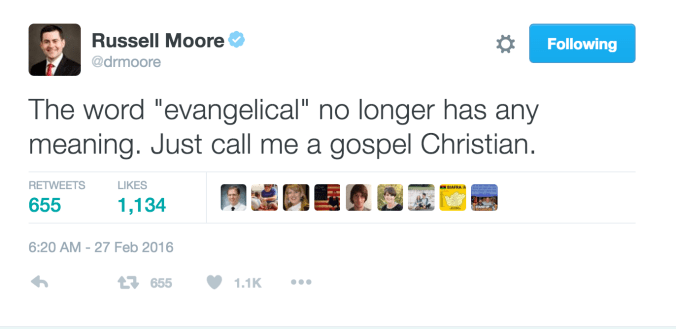
While I’m in large agreement with McAlpine, I’m not giving up on evangelical just yet, because rightly understood it is a word we should cherish and defend. But should the waves of malcontent persist, and an alternative is necessary, I think I’ll begin follow in Russell Moore’s footsteps and refer to myself a Gospel Christian.

Gospel Christian has the same meaning as evangelical Christian, but without the unhealthy socio-political connotations. Interestingly, both in the United States and here in Australia, among the larger Christian networks we don’t find the Evangelical Coalition, but rather the Gospel Coalition.

Some Christians prefer to known as orthodox or classical. I warm to both of these words, although Stephen McAlpine criticises ‘orthodox’ as a group who don’t affirm the real and physical return of Jesus Christ. Perhaps I’m ignorant, but I would have thought belief in the parousia is basic to anyone claiming orthodoxy.

The reality is, many of our Christian labels are disdained. I wish it was suffice to say, I’m a Christian. After all, that’s what I am, I am a Christian. But sadly Christian is frequently associated with all manner of social ills and evils (sometimes warranted). And when I fess up to being a Baptist, I’ve more than once had to qualify it by saying, no, we’re not like the JWs or Mormons.

McAlpine suggests we call ourselves, ‘eschatological Christians’,

“Eschatological” springs to mind. If someone asks me these days I’ve taken to saying that I am an “Eschatological Christian.” Sure it’s not catchy, but it’s not toxic either. Sure I will have to spend a bit of time explaining what it is, but hey, I’ll have to spend virtually no time explaining what it is not.

“Eschatological” is more likely to elicit an eyebrow raise than a nose wrinkle.  It is more likely to raise a question than rule a line under an answer. Most importantly it will distinguish me – and us – as those whose hopes -and energies – are not grounded in the political machinations of this age, but in the politics of the age to come lived out in the church today, and overflowing in practical, loving and humble ways into the community.

“Eschatological Christian” also distinguishes orthodox Christians who actually believe that there is a parousia coming in which King Jesus will usher in a new kingdom and judge the world in righteousness, from those who view that as an outdated notion beneath our modern sensibilities. A view that won’t get them respect in the academy.

The name has a certain Fitzroy living single-origin drinking indie-rocking listening feel to it, but I am unconvinced. First of all, few people know what eschatology means,  and second, it is  defining our identity by one area of theology, rather than the whole.

What do others think? How do you describe your Christian faith? Do you identify as an evangelical?

Misappropriation and misunderstanding shouldn’t surprise us; is it not the expectation given to us by the Lord Jesus? Does not the history of the church give us multiple examples of culture trampling on or deconstructing the church? In a world that is constantly confusing and even hijacking the Christian message, and doing so for all manner of social and political ends, we though can be responsible for how we represent the Lord Jesus Christ. Indeed, the more faithful we are to God’s word, the more useful we will be to society. So whether we call ourselves evangelical, Gospel, orthodox, or just plain and simple Christian, let’s do it with a growing sense of clarity, humility, grace, and winsomeness, in order to display the reality of Christ and of the hope held out in his Gospel.

Looking to the Russian Winter

News of the Russian Olympic drug scandal has reached the ears of the media and is being rightly exposed, but flying under the radar is another Russian story, one of tragic Dostoevskian proportions.

Two weeks ago President Vladimir Putin signed into law measures outlawing evangelistic activities of religious groups in Russia. Under the guise of ‘anti-terrorism’, the Russian Government has banned churches from communicating their beliefs outside of sites officially designated by the state.

Charges can now be made against individuals for inviting people to church, for distributing literature in the community, and for presenting in peaceful ways, a persuasive case for one’s religious convictions.

Chair of the United States Commission on International Religious Freedom, Thomas J. Reese, has said,

“These deeply flawed anti-terrorism measures will buttress the Russian government’s war against human rights and religious freedom…They will make it easier for Russian authorities to repress religious communities, stifle peaceful dissent, and detain and imprison people. Neither these measures nor the currently existing anti-extremism law meet international human rights and religious freedom standards.”

Thousands of Churches across Russia are holding prayer vigils, but with little hope of seeing the Government return to any sense of reasonableness.

IMG_8049

Most Australians will recognise these measures as alarming, draconian, and unbefitting of any nation claiming to be a pluralist society and a liberal democracy. Whether Russia would consider itself to be these things is disputable, but surely we would never witness such restrictions here in Australia?

Before we ask Dale to tell the world of the hole we haven’t dug, we must recognise that Putin-like voices can also be found in Australia, on both poles of politics. The ideology is different, but the desire to control and limit religion is similar.  In the media, politics, and education there is a growing murmuring, arguing that religion is tolerable in private, but has no place in public discourse, and certainly not in politics and in our schools. For example, both the Greens and the Sex Party are famed for policies that will reduce religious freedoms, and the current Victorian Government has done more to legislate against Christian freedoms than any other Australian Government in living memory.

Then there is the now infamous example of Section 17 of the Tasmanian Anti-Discrimination Act, and how it was used to attack the Catholic Archbishop, Julian Porteous. What was so intolerable that the weight of law was required to come down on him? Well, Porteous published a pamphlet for Catholics, explaining a view of marriage that is congruent not only with Catholic beliefs, but which also reflects the legal definition of marriage in Australia.

It is possible to prohibit religious speech through law, and it possible to achieve the same goal by bullying and slandering those who hold religious convictions. In the lead up to the Federal election there were notable voices telling the Australian people that public dialogue about the Marriage Act was impossible. Ironically, the very same people proved their point as they employed insults and derogatory words against those who dared suggest a plebiscite might be a good idea.

Secularists wants us to believe that the public space is a purist place free from ideologue, which of course they define as atheistic humanism.This could not be further from the truth, for there is no public vacuum free from assumptions and beliefs informed by world views.  The Australian public space is pluralist, and invites people to contribute, not by leaving their convictions and consciences at home, but by bringing them to the conversation. The epistemic and moral superiority of secular humanism is as mythical as the pokemon, and yet we are chasing after it.

There is a distinction established in Australia’s Constitution between the secular state and religious institutions, but it does not denude the role of religion in public, but simply protects the State from either being controlled by or instituting any single Christian denomination.

“The Commonwealth shall not make any law for establishing any religion, or for imposing any religious observance, or for prohibiting the free exercise of any religion, and no religious test shall be required as a qualification for any office or public trust under the Commonwealth.” (Ch5. Section 116)

This Australian dichotomy between government and religion is easily sustained for Christians, given that the distinction exists because of the Christian world view. For the Christian, Jesus is Lord over all of life but the church is not the state and the state is not the church. There is an entity called the  ‘Church of England’, which is the unfortunate outcome of various historical quirks, rather than theological necessity, but it is not the situation we have here in Australia. To what extent other religions can manage this distinction, is a topic worth exploring.

During the recent Symposium on ‘Freedom of Speech’, hosted by Mentone Baptist Church, the new member of Goldstein, Tim Wilson, remarked,

“we need a lived culture of open discussion”.

It was as though someone had finally solved the congestion issues on Melbourne’s roads, such was the freshness.  Mr Wilson gave example to this value by addressing the marriage debate, saying, “I don’t think we can have a constructive conversation around the marriage of same-sex couples until both sides can say what they truly think.”

I couldn’t agree with him more.

A darkness is descending on Russia. For so much of her history the Russian people have been oppressed by one totalitarian rule or another. The light of democracy that dawned late last century is now disappearing over this vast steppe. Australians can assume the naive posture of ‘never us’, but the seeds of religious intolerance are already planted, and without due care it will grow and choke free speech. 

Not imposition but persuasion; that is the mark of a true liberal democracy. Progress cannot be achieved when the State bullies its own citizens and stifles disagreement; it only further polarises people. We would do well to heed Tim Wilson’s exhortation. More than that, perhaps we should return to the words of the Christian Scriptures’ that many Australians now deem as irrelevant, ‘speak truth in love’. Imagine, grounding a society upon that ethic?

A Christian QandA: But where was the Gospel?

Tonight’s ABC’s QandA program was purposed to examine the role of Christianity in Australian society today.

Interestingly, two hours prior to the show, I tweeted a question to which many of my Christian friends responded, ‘no, they would not be watching the program’. It seems as though lots of people are dubious about QandA’s capacity to present a fair and reasonable picture of Christianity, which is perhaps has some warrant based on previous programs.  I guess I include myself among the sceptics, but overall such doubts were given the boot. The show was presented well, and the rudeness scale from some previous episodes dropped off significantly.

Cg2v2IVUYAAHq7C

The program though didn’t quite start of the right footing, with Julia Baird exclaiming, “Everyone on the panel is a Christian.” Hmmm, really? There were some pretty dubious theologies up there tonight. But then I remembered how Julia recently referred to the Jehovah’s Witnesses, a cult who reject Christianity, as ‘conservative Christian’. That aside, Julia Baird did a fine job at facilitating the proceedings.

The Panel

On the panel was John Haldane (a Scottish Catholic who is a Papal advisor to the Vatican), Julie McCrossin (radio & tv personality, and gay rights activist), Ray Minniecon (Pastor & Chairperson of the Sydney Anglican Indigenous People’s Committee), Tiffany Sparks (Anglican minister in Brisbane), and Lyle Shelton (Director of ACL).

Given the program’s topic, one would have thought the ABC would invite Australia’s most notable Christian voices: where was Peter Adam, Peter Jensen, Brian Rosner, John Dickson, Michael Jensen, Justine Toh, and many others? I understand why Lyle Shelton was chosen, and Ray Minniecon, but the other panelists? McCrossin and Sparks represent what is at best a fringe and frayed interpretation of Christianity. John Haldane is from out of town and struggled to comment on Australian cultural particulars, although he did add a sense of intellectual gravitas that was otherwise missing at times.

Having said that, QandA is not (nor is it meant to be) an orthodox Christian program, and the producers no doubt have pressures on them to diversify the panel and encourage as many sparks as possible.

The Questions:

The most interesting part of the show was seeing what questions people were asking:

  • When a 16yo is arrested for terrorism is it time for us to consider if we have failed to nurture our sons?
  • Do the churches share responsibility for failing to articulate the Christian principles of a ‘just war’?
  • There was a question about Eric Metaxas and his alleged comparison between Nazi Germany and debates over sexuality.
  • Why are churches in Australia so silent when it comes to climate change?
  • What role should our churches be playing for true reconciliation in our nation today?Do Church leaders recognise the role that patriarchal hierarchies & theologies play in DV?
  • Is what the Bible describes a more realistic view of our world or have the secularists got it right?

Apart from the final question, no one asked about the veracity of Christian beliefs (is it true or not), rather, people wanted to know whether Christianity is good (good being defined in a variety of ways). That is worth reflecting on from an apologetic and evangelistic perspective. But also, for many of the questions, including the climate change and indigenous recognition, Christians have been actively speaking on these issues, and yet it seems as though the public hasn’t listened (ABC viewers at least!). This raises an important question for Christians as we seek to speak into society: why are we not being heard? How can we work better at clearly presenting our views?

The Conversation:

It is best to watch the program for answers to the specific questions, for here I only wish to offer one comment, which to me sums up the program:

Where was the Baptist tonight? Yes, that’s tongue in cheek…sort of. Baptists are in fact one of the few Christian denominations growing across Australia, and yet there was no room for one? Leaving the facetious aside,

Why was an entire episode of a ‘Christian’ Qanda without any mention of the crux of the Christian faith, the Gospel of Jesus Christ?

I remember an episode with Peter Jensen and one with John Dickson, where both sought to explain the Gospel and give a reason for the hope they have. Tonight, the entire program was addressing matters from a Christian perspective and yet where was a faithful and clear articulation of the Gospel, even in a single sentence? The closest we came was when Lyle Shelton made passing reference to Christ laying down his life, and when Ray Minniecon called Australians to ‘repentance’. 

Of course, television programs (and the media in general), have little interest in the actual message of Christianity;  it is easier and more contentious to focus on moral questions. These questions are important, and as a Christian I believe the Bible gives us answers, but Christianity is not moralism. This is one of the potential dangers for groups like the Australian Christian Lobby. While I agree with many of their statements, they can be guilty of presenting a Christianity that is defined by a set of moral values, but that is a faulty view of Christianity. This is not questioning their orthodoxy, but the only message we have is  is the good news message of Jesus Christ, the Son of God, who died on a cross and rose from the dead for the salvation of everyone who believes in Him.

‘God made him who had no sin to be sin for us, so that in him we might become the righteousness of God.’ (2 Corinthians 5:21)

‘I consider everything a loss because of the surpassing worth of knowing Christ Jesus my Lord’ (Philippians 3:8)

As Julia Baird summed up the final question, she gave the panel every opportunity. She asked, ‘is it down to God’s grace or human endeavour?’ There I sat, pleading, would some one please explain the good news of Jesus Christ? Would someone at least say, ‘yes, it’s God’s grace’. What an opportunity to articulate the truth and beauty and power of God’s grace, but no. I was saddened to hear no minister of the Gospel say yes to God’s grace.

I was saddened. I was not surprised to hear Julie McCrossin and Tiffany Sparks contradicting Biblical truths; that’s what ‘progressives’ do; they throw away those things in the Bible that contravene their liberal views. But still, as Australians listened tonight to Christian leaders expound their beliefs, they will go to sleep none the wiser, yes, hearing some Christian ideas and thoughts, but almost nothing about the message which is Christianity. 

What I heard tonight was, Christians have opinions about lots of issues, just like everyone else. I heard, Christians disagree a lot. I heard, people have the capacity to change.

This ‘Christian’ QandA ended up sounding more like a Jane Austen novel set in Victorian England, acknowledging some things Christian, but with very little appeal to the Christ of Christianity and to the grace of God which Christians do trust, rejoice in, and want other Australians to know.