Earth Hour and Resurrection Sunday

This year, Earth Hour shares the same day as Easter Sunday. Coincidence? Yes. Timely? Perhaps so.

Earth Hour began in 2007 in one of Australia’s colloquial towns, Sydney. A year later Melbourne joined with hundreds of global cities to participate in Earth Hour. According to the Earth Hour website, there are now over 7000 cities and towns participating worldwide.

It is hard for my wife and I to forget Earth Hour, given it coincides with our wedding anniversary. Nothing makes for a romantic dinner than having the power turned off for an hour!

OLYMPUS DIGITAL CAMERA

Earth hour is a one hour ‘lights off’ event. Between 7:30-8:30pm homes, businesses, and public places are encouraged to switch off their lights as a way of communicating the threat of global warming and showing consensus that we need to do more to limit its consequences.

To quote, we “show their support a low pollution, clean energy future, one in which we can continue to enjoy the best of nature and our great Aussie outdoor lifestyle.”

Earth hour is symbolic, a gesture indicating a concern and call for responsible living in this world.

This year, Earth Hour synchronises with Easter Sunday, or Resurrection Sunday as it is also known. This is a day when Christians celebrate the resurrection of Jesus Christ from the dead.

Far from being symbolic, Jesus’ death and resurrection is historic, literal, and real. We may turn the lights off for an hour, Jesus experienced the darkness of death.

His work changed the world. While the resurrection of Jesus certainly has a future looking fulfilment, it is has the power to change the human heart even in the present. And far from ditching this current world, the physical nature of Jesus’ resurrection affirms the value of creation. We are not left disregarding the world and neither are we left pinning the hopes of the world on ourselves.

Earth Hour reminds us of the fallenness of this world, and indeed how complicit we are in this; the resurrection of Jesus proclaims the redemption. We need a God-sized solution to our world’s problems, whether it is global warming or a thousand of other insurmountable issues that weigh down humanity and stifle life, truth and love.

As the Apostle Paul wrote,

’We know that the whole creation has been groaning as in the pains of childbirth right up to the present time. Not only so, but we ourselves, who have the firstfruits of the Spirit, groan inwardly as we wait eagerly for our adoption to sonship, the redemption of our bodies. For in this hope we were saved. But hope that is seen is no hope at all. Who hopes for what they already have?  But if we hope for what we do not yet have, we wait for it patiently. (Romans 8:22-25)

The ultimate answer to Earth hour is Resurrection Sunday.

As we turn off our lights for one hour and commiserate the global sized problems before us, why not also reflect on the tangible hope offered us in the person and work of Jesus Christ?

The Gospel Coalition Australia: Victoria

Around 50 church leaders from across Melbourne met yesterday (Feb 17) to pray for our city.

The Gospel Coalition Australia (TGCA) launched in Brisbane last year, and a Victorian Chapter of TGCA is starting this year.

12715405_1117430541613973_7239837344654408155_n

Photo courtesy of Shebu John

I appreciated the thoughtful approach taken in organising this first public gathering:  there was no mass advertising beforehand, no elaborate staging with a ‘worship’ band belting out Christian anthems and celebrity preachers taking the stage. I’m not criticising doing any of those things, but to begin by saying, ‘hey, come and join us so that we can listen to God’s word and pray for Melbourne together’, communicated something beautiful about the tone and purpose of the event.

A few years ago a small group of pastors began meeting to pray for Melbourne and to discuss how evangelicals can more effectively work together in order to see the Gospel grow; not that God is constrained by our prayers and unity, but Scripture teaches us that these things are desirable and useful. Yesterday, was the first of gatherings, purposed to encourage Victorian Christians with the Gospel, and to find ways for working together for the sake of the Gospel.

The morning began with a exposition from Romans 1:1-17, ‘what is the Gospel?’ Andrew Reid (of Holy Trinity, Doncaster) exhorted us to be clear about the Gospel, and to remember that God’s power to save is in this Gospel of Jesus Christ, and not in our methods and personalities. Such a message may be Christianity 101, but it is always good to hear it again, and was particularly relevant given the nature of yesterday’s gathering. If the Apostle Paul felt the need to remind his readers of the Gospel multiple times in every letter, I think we would do well to remind each other when we meet.

Peter Adam then gave a brief and insightful history of Christianity in Melbourne. It was encouraging to be reminded of how God has graciously worked throughout our history, and to consider, if God has worked through his Gospel in the past, can he not also do so today?

For much of the morning we prayed together, for Melbourne itself, for God to grow his Gospel throughout Melbourne, and for each other’s local ministries. It was a rare although enthralling yet ordinary scene, seeing 45-50 Melbourne leaders from many denominations, churches, and organisations, expressing our unity in Christ, and a common desire to see men and women coming to faith in Jesus.

TGCA Victoria will meet again in June/July for another morning of prayer, and there is a more formal event being organised for November with William Taylor (of St Helen’s Bishopsgate).

For details email admin@tgcavic.org

Christians, Muslims and God: Does it matter?

The Wheaton College controversy regarding Dr. Larycia Hawkins and her comments about Islam is gaining momentum not only in the United States, but also here in Australia, with the ABC publishing two articles on the issue this week.

The controversy relates to this statement made by Dr Hawkins on twitter in December last year,  “I stand in religious solidarity with Muslims because they, like me, a Christian, are people of the book”, and “And as Pope Francis stated last week, we worship the same God.”

16xp-wheaton-facebookJumbo

Dr Hawkins has been suspended by the Council of Wheaton College, and discussions are being held regarding potential dismissal from her teaching position.

There are many issues surrounding this saga, for here, I wish to offer comment on two of the questions: One, does it matter? Does it matter whether Muslims and Christians worship the same God or not?  Second, is Prof. Miroslav Volf right to use a Jewish view of God as a defence for the proposition that Muslims and Christians worship the same God?

First of all, does it matter?

Writing on The Drum, Ruby Hamad has bemoaned Wheaton’s position, referring to the ‘wildly disproportionate reaction from the college’ and  “it’s surprising that such a statement is even considered enough to raise an eyebrow.”

Hamad believes that Muslim and Christians do worship the same God:   

“That the world’s three great monotheistic faiths worship the same god is, or at least has hitherto been, a mainstream position to take. Muslims accept it as a given, the Catholic Church has taught it since the Second Vatican Council, and Pope Francis – who Hawkins referred to her in her statement – reiterated this last November, when he said that “Christians and Muslims are brothers and sisters”.”

As someone raised in the Muslim faith, I find it bewildering that anyone denies that the God of Judaism, Christianity, and Islam are indeed the same deity. Muslims are taught from a very young age that Mohammed is the last in a long line of prophets tracing back to Adam, and that includes Abraham, Moses, and Jesus.”

Leaving aside some fallacious rewriting of history whereby she claims that “three great monotheistic faiths worship the same god is…a mainstream position to take”, and her strange recounting of Islamic teaching whereby young children are taught that the Christian God is identical with the Muslim God, I want to make mention of the Trinity and its place in this debate.

Hamad makes a passing reference to the Trinity and to Christology, but apparently these basic tenants of the Christian faith are no obstacles to someone wanting to insist that Muslims and Christians believe in the same God.

Really?

Now, there are theological arguments at stake that require careful exegesis, and many a tome has been written attempting to consider God. Although there are ideas here that have stretched the greatest minds in history, the essence is simple. One person may be an expert in trigonometry, and another not, but a triangle is a triangle and both can identify it as such. My point is, there are basic theological convictions held by Christians that are irrefutably denied by Islam, and there is no meeting place in the middle.

For example,

Christians hold that that God is triune, one God in three persons. Muslims, on the other hand, insist on God being a monad.

Christians believe that Jesus is fully God and fully human. He is the eternal God, God the Son, the second member of the Trinity. Muslims believe Jesus was a prophet from God, but he is not God (and neither did he die on the cross).

It does not require a scholar to appreciate that Christians and Muslims have a vastly different view of God. Christians love, worship and serve God who is Father, Son, and Holy Spirit. The Quran explicitly rejects this God, and instead speaks of another who is monad. We can caste doubts on this clarity by writing lengthy and complicated essays, using lots of big words that no one understands, or, as Ruby Hamad has done, we can ridicule Wheaton College and suggest they are extreme, bigoted, and naive for holding to their beliefs. After all, none of us want to side with the stupid or the hate-filled! Sometimes, though, differences are self-evident and irreconcilable.

But does it matter? Is it a big deal? It is certainly a significant issue if truth matters. It is a big deal for the many thousands of Christians in the Middle East who are being persecuted and threatened with death if they don’t deny Jesus Christ is God. And it does matter if a person’s identity and being is to be honoured.

Allow me to illustrate by speaking about my wife, Susan. Susan is a particular human being, with a particular personality, history, attributes, likes and dislikes, appearance, and so forth. If I call her Lisa or Stuart, she is unlikely to respond, given that her name is Susan. If someone asks me to describe Susan and I begin talking about a 24 year old 5ft 10” red head who enjoys motocross, eating mexican food, and works in real estate, you may want to question whether I know Susan at all, let alone being married to her.

Manufacturing false allegations about a person in public may make me open to a defamation case. Misrepresenting a person is demeaning and exemplifies either ignorance or incredible rudeness. 

The caricature of Susan that I offer above is so far removed from the real Susan who lives and breathes and whom I love as my wife, it is nothing short of a fabrication; an unreal Susan. If it is respectful and right to represent a human being accurately, how much more if that person is God.

If God is real, it is only proper to describe him truthfully. If this God is holy and light and love and truth and Sovereign and personal (as the Bible teaches), then how much more care must we take before dishing out more relativist offal about religious sameness.

I now wish to turn to a second question, which relates to an analogy used by Miroslav Volf in his defence of Dr Hawkins view, an analogy that has since been repeated by others, including Ruby Hamad:

“This argument, however, is easily dispelled given that Judaism also rejects the trinity and doesn’t even acknowledge, let alone worship, Jesus as God. And yet, no one is proclaiming that Jews and Christians have entirely different gods”.

Is this analogy of Judaism valid? While this argument sounds lucid, it is in fact a logical fallacy, for the relationship between Judaism and Christianity is significantly different to that between Christianity and Islam.

There are not two different Gods in the Bible, one in the Old Testament and a different one revealed in the New Testament. That view is known as Marcionism, and it has always been rightly referred to as a heresy.

The God of the Old Testament is self-identified as the Triune God. The God worshiped by Israel was the Triune God, although it must be said that much more is made of God’s unity in the Old Testament than of his diversity.

Old Testament Judaism did not reject the Trinity, it alludes to it and prepared the people for the full self-disclosure of God who is one God in three persons: Father, Son, and Holy Spirit.

Islam falls outside the parameters of Biblical testimony, and beyond fullness and finality of God’s self-revelation that is in and about Jesus Christ. If Judaism is an artist’s sketch, Christianity is the sketch being painted,  coloured and completed. In other words, Judaism leads to Christianity, whereas Islam rejects Christianity. That Mohammed borrowed some names and ideas from the Bible when writing the Qu’ran does not mean synergy of faith, indeed links are no stronger than those which Mormons have with Christianity.

Dr Al Mohler has offered this critique of Volf’s analogy:

“But this line of argument evades the entire structure of promise and fulfillment that links the Old Testament and the New Testament. Abraham and Moses could not have defined the doctrine of the Trinity while they were on earth, but they believed that God would be faithful to all of his promises, and those promises were fulfilled only and fulfilled perfectly in Christ. And, going back to John 8:56-58, Jesus said: “Your father Abraham rejoiced that he would see my day. He saw it and was glad … Truly, truly, I say to you, before Abraham was, I am.”

Evangelical Christians understand that, theologically, there is a genetic link between Judaism and Christianity. That is why Christians must always be humbled by the fact that we have been grafted onto the promises first made to Israel. In terms of both history and theology, there is no genetic link between Christianity and Islam. The Qur’an claims that to confess Jesus Christ as the divine Son and the second person of the Trinity is to commit blasphemy against Allah.”

It is possible to believe in the true God and yet worship him wrongly, whether by attributing false characteristics and ideas about him, or by creating erroneous criteria for knowing him. But the view of God, as articulated in the Qu’ran and the Hadiths, does not fit into this category.

Volf and Hamad both argue that the real issue at Wheaton is not concern for God’s Being, but has to do with bigotry and anti-Islamic sentiments. I cannot speak for the Council of Wheaton College as I don’t know them personally and I certainly don’t have access into their hearts, but from what I have read, I have not picked up such a distasteful tone.

Given the allegations, it is still wrong to denude the major theological differences that exist. The truth of God matters. The glory of God matters. However, irreconcilable difference does not mean Christians and Muslims cannot be friends, and cannot work together in many areas of society. This does not mean that we cannot support the many Muslims who are suffering terribly in Syria. This does not mean that we cannot welcome Muslim refugees to Australia, and to provide them with a safe and caring community. This does not mean that we outlaw their beliefs, simply because we disagree with them. If Christians believe in freedom of speech, then we hold that conviction for Christian, Muslim, and atheist alike.

A true knowing of God will produce not only clear and robust convictions about God, but growing humility and thankfulness. For we do not own God. God is not our possession or our knowledge that is attained by some pseudo-superiority complexion. The God of the Bible is known only by grace, because of his incredible love toward defiant creatures. Grace produces humble convictions and loving concern for our neighbours, even our Muslim neighbours who matter to God and ought to matter to us.

The Creeds, Wheaton College, and the same God theory

Last week a Professor at Wheaton College tweeted, “I stand in religious solidarity with Muslims because they, like me, a Christian, are people of the book”, and “And as Pope Francis stated last week, we worship the same God.”

The College has since suspended Dr. Larycia Hawkins. News of the suspension has caused a bush fire of controversy among American Christians, and the debate has also spilled over into Australia.

IMG_3322

Islam and Christianity share with Judaism a heritage from Abraham, and all three are monotheistic religions, but the similarities don’t extend much beyond.

Dr Hawkins is rightly seeking to express Christian love toward Muslim people. At this troubled time in world history, it is vital and godly for Christians to show love, grace, and hospitality to our Muslim neighbours and friends, including welcoming Muslim Refugees from Syria. But stretching commonalities in theology doesn’t help anyone, let alone glorifying God.

Miroslav Volf is a notable Christian scholar whom I’ve benefited from in my own thinking on other issues. He has weighed in on this debate in a significant way, arguing while Muslims and Christians hold different views of God,  ultimately the same God is worshiped. That doesn’t mean there is not crucial disagreement about God, however. It is worth reading Volf with his own words.

As I read an update of this story this morning, I was reminded of the Creeds. The historic creeds give articulation to the Christian understanding of God, as is found in the Bible. Do they help us in grappling with this question as to whether Muslims and Christians believe in the same God? How would a Muslim respond, for example, to the Nicene Creed?

“We believe in one God, the Father, the Almighty, maker of heaven and earth, of all that is, seen and unseen.

We believe in one Lord, Jesus Christ, the only Son of God, eternally begotten of the Father, God from God, Light from Light, true God from true God, begotten, not made, of one Being with the Father. Through him all things were made. For us men and for our salvation he came down from heaven: by the power of the Holy Spirit he was incarnate of the Virgin Mary, and became man. For our sake he was crucified under Pontius Pilate; he suffered death and was buried. On the third day he rose again in accordance with the Scriptures; he ascended into heaven and is seated at the right hand of the Father. He will come again in glory to judge the living and the dead, and his kingdom will have no end.

We believe in the Holy Spirit, the Lord, the giver of life, who proceeds from the Father and the Son. With the Father and the Son he is worshipped and glorified. He has spoken through the Prophets. We believe in one holy catholic and apostolic Church. We acknowledge one baptism for the forgiveness of Sins. We look for the resurrection of the dead, and the life of the world to come. Amen.”

My point is simple, we mustn’t neglect the Creeds as we consider God.

It’s an opportune time of the year to consider who is God, for at Christmas the invisible God took on flesh, in order to take and die for our sins.

This Christmas we will sing, among other carols, ‘O Come all ye Faithful’ which has these words remarkable words about the incarnation of the eternal God, God the Son,

“True God of true God, Light from Light Eternal,
lo, he shuns not the Virgin’s womb;
Son of the Father, begotten not created;”

——-

Ed Stetzer has also weighed in on the controversy. As usual he makes a lot of sense.                                       http://www.christianitytoday.com/edstetzer/2015/december/my-daughter-wheaton-college-protests-and-why-we-are-more-in.html

Al Mohler has written this importance response to the issue – http://www.albertmohler.com/2015/12/18/do-christians-and-muslims-worship-the-same-god/

Kevin De Young has written a useful piece on The Gospel Coalition website

Jesus, the Son of God?

In the lead up to Christmas and Easter, Jesus deniers and antagonists reappear on the media circuit espousing their speculations. They are entitled to express their opinions but it would be nice if they occasionally observed the evidence, rather than hanging their theories on innuendo and cockeyed imaginations.

On Late Night Live with Phillip Adams (November 25), author and Academy award winning screenwriter, Frederic Raphael, was being interviewed on the topics of anti-semitism and screen-writing. What was an otherwise intriguing conversation about cinema and anti-semitism, was interrupted by  some odd ahistorical claims, including that Jesus never said he was the Son of God, “…the Jews who would not accept that Jesus was the Son of God, nor of course did Jesus…but what does he know about it”.

Raphael’s argument isn’t that Jesus and his followers were wrong in believing that he was the Son of God, but that Jesus himself did not believe that he was Son of God.

Presumably, however, the same sources that Raphael depends on for  historical figure of Jesus Christ, are also the very same the sources that insist upon the idea of Jesus’ Divinity. It is one thing to reject that Jesus is the Son of God, but it simply impossible to escape the fact that Jesus identified himself as God the Son. The only way one can arrive at his conclusion is if we were to erase the historical record.

r975057_10612042

Here are some examples (and please note that these are only samples) from the historical record indicating Jesus’ self-belief in his Divine nature. The documents I am quoting are also considered by academics as the most reliable and earliest sources for the words and life of Jesus.  It is therefore incongruous to consider Jesus without them.

Jesus’ words

“If you are the Son of God,” he said, “throw yourself down. For it is written: “‘He will command his angels concerning you, and they will lift you up in their hands, so that you will not strike your foot against a stone.” Jesus answered him, “It is also written: ‘Do not put the Lord your God to the test.’” (Matthew 4:6-7)

‘I am the God of Abraham, the God of Isaac, and the God of Jacob’? He is not the God of the dead but of the living.” (Matthew 22:32)

“It is written in the Prophets: ‘They will all be taught by God.’ Everyone who has heard the Father and learned from him comes to me. 46 No one has seen the Father except the one who is from God; only he has seen the Father.  Very truly I tell you, the one who believes has eternal life”.  (John 6:45-47)

“Very truly I tell you, a time is coming and has now come when the dead will hear the voice of the Son of God and those who hear will live”. (John 5:25)

“Very truly I tell you,” Jesus answered, “before Abraham was born, I am!” (John 8:58)¹

Jesus replied, “If I glorify myself, my glory means nothing. My Father, whom you claim as your God, is the one who glorifies me. (John 8:54)

“I and the Father are one” (John 10:30)

“Why then do you accuse me of blasphemy because I said, ‘I am God’s Son’? Do not believe me unless I do the works of my Father.  But if I do them, even though you do not believe me, believe the works, that you may know and understand that the Father is in me, and I in the Father.” (John 10:36-38)

“When he heard this, Jesus said, “This sickness will not end in death. No, it is for God’s glory so that God’s Son may be glorified through it.” (John 11:4)

“How can you say, ‘Show us the Father’? Don’t you believe that I am in the Father, and that the Father is in me? The words I say to you I do not speak on my own authority. Rather, it is the Father, living in me, who is doing his work” (John 14:9b-10)

“For God so loved the world that he gave his one and only Son, that whoever believes in him shall not perish but have eternal life.  For God did not send his Son into the world to condemn the world, but to save the world through him.  Whoever believes in him is not condemned, but whoever does not believe stands condemned already because they have not believed in the name of God’s one and only Son.”(John 3:16-18)²

The many ‘I AM’ sayings of Jesus in John’s Gospel are less about English grammar and is the holy name of Israel’s God, revealed to Moses at the burning bush. The religious intelligentsia rightly understood Jesus’ use of the phrase as calling himself the God of Abraham, Isaac and Jacob. 

In addition, Jesus’ most frequently used title was ‘Son of Man. While it’s meaning was somewhat enigmatic, Jesus spoke and acted in ways that accorded with the Old Testament and therefore it is difficult to conclude that Jesus viewed the title, ‘Son of Man’, in a way that differed from its use in Daniel chapter 7, where the ‘Son of Man’ is described as one who is given the authority and power of God, and is worshiped accordingly.

Words from others that Jesus did not repudiate

“The tempter came to him and said, “If you are the Son of God, tell these stones to become bread.” ((Matthew 4:3)

“What do you want with us, Son of God?” they shouted. “Have you come here to torture us before the appointed time?” (Matthew 8:29)

“Then those who were in the boat worshiped him, saying, “Truly you are the Son of God.” (Matthew 14:33)

“Simon Peter answered, “You are the Messiah, the Son of the living God.” (Matthew 16:16)

“Some of the Pharisees said, “This man is not from God, for he does not keep the Sabbath.” But others asked, “How can a sinner perform such signs?” So they were divided. Then they turned again to the blind man, “What have you to say about him? It was your eyes he opened.” (John 9:16-17)³

“When Jesus saw their faith, he said, “Friend, your sins are forgiven.” The Pharisees and the teachers of the law began thinking to themselves, “Who is this fellow who speaks blasphemy? Who can forgive sins but God alone?” (Luke 5:20-21)

“Again his Jewish opponents picked up stones to stone him, but Jesus said to them, “I have shown you many good works from the Father. For which of these do you stone me?” “We are not stoning you for any good work,” they replied, “but for blasphemy, because you, a mere man, claim to be God.” (John 10:31-33)

“Yes, Lord,” she replied, “I believe that you are the Messiah, the Son of God, who is to come into the world.” (John 11:27)

“Thomas said to him, “My Lord and my God!” (John 20:28)

The reason for Jesus’ crucifixion

“For this reason they tried all the more to kill him; not only was he breaking the Sabbath, but he was even calling God his own Father, making himself equal with God”. (John 5:18)

“The Jewish leaders insisted, “We have a law, and according to that law he must die, because he claimed to be the Son of God.” (John 19:7)

Conclusion

The conclusion is simply inescapable, Jesus believed he was the Son of God. The volume of statements spoken by Jesus about his Divinity is significant, and is perhaps greater than the number of recorded words spoken by President Obama whereby he addresses himself as the President of the United States! In addition to the words of Jesus, when considering whether Jesus is the Son of God, one must also attest to his character and works, all which draw us to the same conclusion. We may question the conclusion, but it is poor form to excise parts of the historical record simply because it doesn’t fit your agenda.

To summarise the evidence:

  • On numerous occasions Jesus indicated that he is God’s Son.
  • Jesus’ opponents believed that Jesus was claiming to be God, and for the said reason they had him killed.
  • Many people believed that Jesus was God and Jesus did not correct them
  • Jesus’ life, character, works, miracles, death and resurrection are unique in the entire history of the world, and each adds weight to his claim of Divinity, not detracts.
  • The first Christians, many of whom were eye-witnesses to the life of Jesus and others were at one time opponents, were prepared to suffer imprisonment and even death for the confession, Jesus is Lord.

“These are written that you may believe that Jesus is the Messiah, the Son of God, and that by believing you may have life in his name” (John 20:31)

————-

  1. Jesus is suggesting more than that he was living prior to Abraham’s birth (at least 1600 years earlier!)
  2. There is debate over whether these words were spoken by Jesus or are a commentary on Jesus’ words to Nicodemus by John. Either way, the understanding is clear.

  3. This debate between Pharisees implies that some people indeed believed Jesus was God

It’s all Dutch to me

You may have read these startling words a few days ago:

“profit from making misery out of the lives of others”

“Australians are harming themselves and others”

These statements were among others released last week, raising suspicions as to what pernicious if not terrorist plans are being mounted in Australia.

Why are they calling for people to take advantage of those in desperate circumstances? How are Australians harming others, and who are these others? Syrians? Iraqis?

Far from belonging to a foiled terror plot, all three sentences were in fact spoken by Prime Minister Malcolm Turnbull, as part of a speech he gave last week at St Vincent’s hospital, Sydney. He was announcing the release of a report looking into the terrible trauma that the drug ice is inflicting on our society.

Without context, each of these lines could be interpreted in a range of ways, including a worst case scenario.

bibles

You may be one of the million or more people who have now watched on youtube, ‘The Holy Quran Experiment’. Last week, two Dutch filmmakers, Sacha Harland and Alexander Spoor, had the bright idea of taking a Bible and disguising its cover to  look like a copy of the Koran. They then walked the streets asking people for their reactions to certain ‘shocking’ verses that were read to them from the “Koran”. The Koran  of course was never cited, only Bible passages were read, such as from Leviticus ch.20 and ch.26 and from 1 Timothy ch.2.

People were genuinely convinced that the Bible verses being read to them where sayings from the Koran, and they offered comments such as,

“To me this sounds like they want to oppress you and force you to believe what they believe.”

“If you’ve been raised with this book and these kinds of thoughts, it’s going to influence the way you think.”

At the start of the video, Harland and Spoor offer this explanation for the experiment, “Muslims have been accused of following a faith that has no place in our Western culture. What about Christianity? A religion that has influenced our culture greatly”.

This “comic” Bible-Koran experiment might possibly reveal something about Dutch attitudes toward Islam, but what it really proves is sadly how illiterate people are when it comes to knowing the Bible (and also the Koran).

If the intent was, as the video suggests, to demonstrate how Christianity contains awful ideas and practices, they haven’t done a particularly stellar job. Ripping Bible verses out of their context says no more about Christianity than what you learnt about Malcolm Turnbull when I cut and pasted from his speech on fighting drugs. Phrases and sentences have historic and literary contexts, without which, they lose the meaning given to them, and thus we end up reaching all kinds of strange conclusions that were never intended. That is not to say that the Bible doesn’t describe some pretty shocking events or contain ideas that challenge our modern sensibilities, but reciting words without their context helps no one to understand either the Bible or Islam. If anything, these Dutch comedians haven’t mocked the Bible, they’ve  made a bad joke about their own methodology.

I wonder if Australians are as biblically illiterate as the Dutch? I hope not, but I suspect so. Perhaps there is a lesson here though, read the Bible more not less!

Return of the Christmas Grinch

The Grinch has jumped off the pages of Dr Seuss and has landed in town.  In Victoria, the current Government have informed state schools that Christmas celebrations can continue, but  references to Jesus Christ are discouraged and may even be outlawed.

The-Grinch-how-the-grinch-stole-christmas-31423260-1920-1080


Like blowing out candles and eating a birthday without celebrating an actual birthday, it’s ok to celebrate Christmas, so long as we avoid talking about its actual significance.

The Bible is now banned from being mentioned during school time and no more prayers. Even hymns are prohibited, although carols are ok.  Can anyone tell me how a school is meant to differentiate between a hymn and a carol? Does that mean Jingle Bells still rocks, but Away in a Manger has been thrown out?  Are songs about an obese man obsessed with dressing in strange costumes in, but songs about the birth of Jesus  are out? We can mention the reindeer but not the donkey, the elves but not the shepherds?

Perhaps this has less to do with religion and more about discriminating against classical music in favour of crappy pop songs. After all, has there been a genuine classic Christmas song composed in the last 50 years? Any school performing Handel’s Messiah had better watch out.

To be fair, Education Minister, James Merlino, has said, “As with other curriculum decisions, schools will make the decision as to which Christmas carols feature as part of classroom activities.” So maybe, just maybe,  there is still so room in our schools to sing  ‘Joy to the world’.

I like the Grinch; when he’s mean he is funny, and in the end the Grinch realises the folly of his ways, but real life isn’t always so comical.  We can easily close our children’s books but we should not be so quick to overlook our history books.

There is a lesson from history that the Daniel Andrews’ Government are ignoring, and it is a lesson that was taught at the very first Christmas.  At the time when Jesus was about to be born, Joseph and Mary were knocked back by the BMA (Bethlehem Motel Association); no one wanted them, and so Jesus was born in a cave where animals sheltered at night. When news of Jesus’ birth reached the Government, they didn’t take it too well. In fact , the man in charge, Herod, sent his cronies across to Bethlehem to stamp out any mention of Jesus.

Well, we know how history ended up, Jesus won, and Herod and the citizens of Bethlehem with their closed door policy have been booed into incongruity ever since.

These new  Herodian-like policies in our schools ought to be respected; they are stupid but we must obey them, for the Scriptures tell us to do so (Romans 13). However, I think it is wise for us to revisit history, because by giving it the cold-shoulder we are bound to repeat the same errors that others before us have made.

While Herod hounded and Bethlehem was brusque, at the same time some of the smartest people and the lowest people of that time,  did go to Bethlehem seeking Jesus and in finding him  worshipped him as king and God. History remembers well the Magi and the Shepherds .

If you’re not a fan of Herod, and you do love Christmas, why not visit one of the many churches that will be celebrating the birth of Jesus and singing all the carols we love? And maybe do it soon, just in case someone has the cracker idea that talking about Jesus in Church is no longer a tolerable thing to do.

There is an invitation to Mentone Baptist’s Christmas services here. Indeed, I would like to extend an invitation to Mr Andrews and Mr Merlino to attend our Carols Service on December 20th, 6pm. You and your families are very welcome to join us.

ChristmasWeb

A Christian response to Paris & the problem of religion

Australians (and the West at large)  don’t know what to do with religion. We don’t want to say that one religion is better or worse than another, but how do we deal with aspects of religion that are unacceptable? While ISIL are not supported by most Muslims, adherents are nonetheless practicing a devotion to Islam that finds support in the Koran. However because their ideology does not conform to the accepted pluralist world-view that all religions are valid, we hear political and religious leaders being forced to explain them away.

I don’t claim to speak for everyone and I don’t want to suggest that what I’ve written isn’t without bias. What I have written is a list of criteria that I try to practice when I’m talking with people about my Christian beliefs.

CT1mToqUkAAuT2u

1. Show grace. Pride is not a Christian virtue. The very nature of Christian faith is that knowing God is a gift from God through Jesus Christ. Therefore, as we engage in conversation with people from different religions we avoid arrogance and pride, both in what we say and in the manner we speak.

2. Be gentle and respectful. When we talk to men and women we are speaking with people who are God’s image-bearers. That imago Dei, like in ourselves, is broken, but we maintain that they have value and ought to be treated with dignity. Therefore we don’t support graffiti on Mosques or other buildings, and we don’t support verbal or physical abuse toward people of other religions

3. Be honest about differences, and recognise that some contrarieties really do matter. One of the great weaknesses in current religious discourse is the unwillingness to call a spade a spade. Where there is commonality and agreement it should be recognised, but the pretend game of sameness is intellectually dishonest and shows disrespect to the many who hold to those points of difference.

There is no value in diminishing, ignoring or lying about differences in theology, ethics, or politics. For example, Christians and Muslims must not pretend that they share the same view of Jesus: Muslims do not believe that Jesus is fully and eternally God, Christians do. Muslims do not believe that Jesus was crucified and died on the cross, Christians do. Muslims do not accept that the Bible is God’s authoritative, sufficient and final word, Christians do. In the same way Christians don’t accept the Koran as a holy book, whereas Muslims do.

There exists an epistemological crisis in the world right now. The current crisis is not merely  a moral one, but it is about how we understand truth. September 11 2001 shocked the world, not only because of the scale of evil perpetrated, but because it exposed the foolishness of our deference to the philosophical liberalism in the West; we were reminded that not every world-view is equally good or valid. Despite the warning, 14 years have now past and most of us in the West continue to walk the line of relativism. Will the recent and appalling rise of ISIL rouse us from the age of the post-critical conscience or will we keep popping our everyone-is-right pills?

4. Don’t excuse or protect the sins of your family. Sin is sin, whether it is perpetrated by someone else or by me. Christians can be guilty of wrongdoing: sometimes they break the law, other times they act lawfully but in ways that are unloving and therefore spurious. In the name of Christ, men and women have committed acts of cruelty and hate, not because of the Christian Bible but because they have abused the Bible in the pursuit of personal agendas. Where and when we are wrong we need to confess and repent, and repentance includes accepting the cost of restitution.

5. Aim to persuade. Coercion, threats, insults, violence – such things don’t help anyone. Beating someone down with a string of rapid rhetorical assaults does little more than create more distance between people, making genuine communication even more difficult. Persuasion, however, is healthy because it gives due weight to the subject at hand and it shows respect for the person with whom you are dialoguing. Persuasion says that people matter and the topic of dispute is too important for flippant dismissal or violent suppression. Persuasion includes using considered argument, showing coherence in your reasoning and providing evidence, using story and testimony, appealing to peoples hopes and desires, pointing out the weaknesses and untruths in alternative beliefs, and speaking with clarity and conviction.

6. Don’t caricature people or their beliefs. Not all atheists are like Richard Dawkins. Not all Muslims support ISIL. Not all Arabs are Muslim. Not all politicians are self-seeking egomaniacs. Not all Baptists are tee-totalling anti-fun facebook club members!

7. Seek to understand. Too often we assume what other people  think and believe. Let’s not ignore the power of attentive listening, and of asking questions and taking time to research what other religions believe, teach and practice.

8. Live what you believe. Christianity doesn’t begin or end on the blog or at the public meeting, it continues through every encounter in all of life. If what Christians believe is true and good then it will influence every aspect of our interactions, both private and public.

When was the last time we smiled at and said hello to someone who was Muslim or Hindu? When was the last time we invited into our home for a meal someone who practices another religion? When was the last time we shared the good news of Jesus with someone from another religion? Why not put these things on our agenda?

9. The State and not the Church has the role to exercise civil and military authority. Unlike Muslim Scriptures, the Christian Bible recognises a distinction between the Church and the State. Throughout history not everyone has properly practiced this, but that has been due to a rejection of the Bible’s teaching, not adherence. However, in Islam there is no such distinction between religious and civil law and Government, hence Saudi Arabia and some of nations, as well as the theology underpinning ISIL. Having said that, other Muslim majority nations such as Turkey, have managed to move away from this orthodox Islamic worldview. (This article in The Atlantic about “What ISIL Really Wants” is worth reading)

“For the one in authority is God’s servant for your good. But if you do wrong, be afraid, for rulers do not bear the sword for no reason. They are God’s servants, agents of wrath to bring punishment on the wrongdoer. 5 Therefore, it is necessary to submit to the authorities, not only because of possible punishment but also as a matter of conscience.” (Romans 13:3-5)

My point here, is that  Governments have responsibility to protect its citizens and to punish those who harm its people. It is not wrong for the French people to desire justice, and we must recognise that issues surrounding a response are complex. Doing nothing is hardly going to stop ISIL and engaging militarily seems to play into their agenda. Recognising them as a legitimate state is out of the question, given their propensity to abuse and kill thousands under their the control, and they are clearly not content to limit their borders at their current places. What we can do is pray for our Governments.

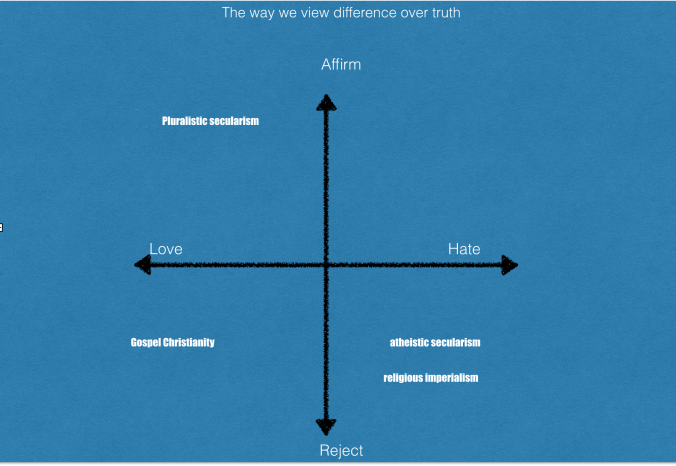
Below is a diagram that represents various approaches to viewing difference:

 the way we view difference
——-
This article has been adapted from a piece I published last year at Engaging with Religions

Paris, Terror, and Hope

Here is the sermon I preached today at Mentone Baptist Church in light of the dreadful attacks on Paris. The sermon is an exposition of the book of Habakkuk.

“O Lord, I have heard the report of you,
    and your work, O Lord, do I fear.
In the midst of the years revive it;
    in the midst of the years make it known;
    in wrath remember mercy.” (Hab 3:2-3)

The non-controversial controversial program in our pre-schools

In August this year the Daniel Andrews Government banned SRI classes from Victorian Schools. Despite the fact that this has been a valued program for many decades, and that many schools are still keen to give space for this 1/2 hour weekly lesson, the Government caved into pressure from various lobby groups. Replacing this opt-in program will be a compulsory ethics/well-being/religious curriculum. Whilst announcing that this program will run from the start 2016,  the Government is yet to provide any details of its content and who will teach it. Indeed, schools remain in the dark as to what is happening.

Today, The Age has reported that ACCESS Ministries are now offering a program in Victorian pre-schools, called Explore Christianity.

FIRIS have notified their supporters on facebook, saying

“SPECIAL RELIGIOUS INSTRUCTION – COMING TO A KINDERGARTEN AND CHILDCARE CENTRE NEAR YOU!

ACCESS have now discovered a new mission field – they have transferred their proselytizing to a softer market.

They are like the Gecko, who loses its tail, only to grow another one back again. They have reinvented themselves and found another way to get to the children.

FIRIS has known about this for some time, and the VIC government was first notified about this from us back in May.

It appears that now very young children will be segregated by religion and parents who object to their children being indoctrinated while at child care will need to accept this segregation as the norm, or find another centre.

The government has been taken offguard by ACCESS’ metamorphosis and will have to either choose to deal with it – or look the other way.

The obvious concerns are:

* Proselytising

* Treats offered as an incentive to children

* Religious segregation of very young children

* The opt out nature of the program

  • Adequate informed consent being provided to parents”

I agree that any program must have transparency, and provide adequate information for parents, and it should have  either an opt-in or opt-out clause. These things are sensible and appear to be in place already.

But even if all of these  ‘concerns’ were fully met, history gives reason to suspect that FIRIS will keep pressing for this program to be shut down.

Given that, let’s look at these important facts that The Age reported today:

  1. Parents asked the Emmanuel Early Learning Centre to introduce this program and the Centre management agreed.
  2. The overwhelming majority of families are participating. After receiving consent forms, only 3 families chose to opt-out their children.
  3. The program teaches, “Christian values and beliefs, in addition to stories from the Bible.” In other words, it is teaching they very things that a program about Christianity should teach.
  4. Volunteers who run the program are accredited by ACCESS Ministries, in accord with strict requirements that have been set by the Education Department for SRI teachers in schools.

Pre-empting any call to close down the program, Minister for Families and Children Jenny Mikakos said to the The Age that, early childhood services operated independently, and any “decision on offering religious education as part of a service provider’s program is a decision for each individual provider and parents of children attending the service”.

It will be interesting to see what and if any pressure that the Government will try to apply to these early childhood centres. As it stands, they are providing a program within the law, based on parental interest and request, and with substantial by-in from both the Centre and its families.

Where is the controversy?

—————-

Photo from The Age (Nov 10): Joe Armao