Rachael Denhollander and her extraordinary speech

“blessed are the merciful for they will be shown mercy” (Jesus Christ)


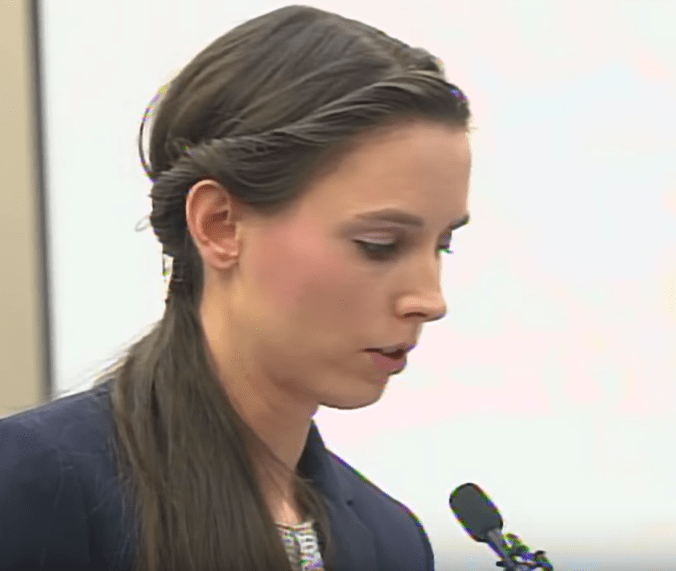
Today I had the privilege, along with millions around the world, to watch one of the most extraordinary speeches I have ever heard.

Child sexual abuse is one of the great sins of this age. It is an ancient evil, as well as modern one, but until recent times so much was covered up and victims were so often not believed. Today, the former USA Gymnastics team doctor, Larry Nassar, was jailed for 175 years, having sexually abused countless number of girls under his care.
 

Screen Shot 2018-01-25 at 3.14.48 pm.png

These stories are far too common, as we also know here in Australia, and we should not be surprised to hear of many more similar cases coming to the fore in days and years to come. The crime is now sadly a familiar one, but in the midst of harrowing testimonies there came a message of purity, goodness, and astonishment.

Rachael Denhollander was the first victim to publicly come forward with allegations against Nassar, and she was final of 156 survivors to speak in court. 24 hours ago I had never heard of Rachael Denhollander, but today I encourage people to listen to her voice and to hear her message.

We live in a world filled with the stench of evil, and that evil resides in the hearts of humankind. It was not so long ago that we all had friends who doubted the existence of evil, certainly in an intellectual or objective sense. At yet, as doors open and as people find courage to speak, we discover that evil abounds and it is more prevalent and real and darker than we believed.

In her address, Rachael Denhollander speaks candidly of the pernicious and devastating behaviour of Larry Nassar upon so many girls, including herself.

“Larry is a hardened and determined sexual predator. I know this first-hand. At age 15, when I suffered from chronic back pain, Larry sexually assaulted me repeatedly under the guise of medical treatment for nearly a year. He did this with my own mother in the room, carefully and perfectly obstructing her view so she would not know what he was doing. His ability to gain my trust and the trust of my parents, his grooming and carefully calculated brazen sexual assault was the result of deliberate, premeditated, intentional and methodological patterns of abuse — patterns that were rehearsed long before I walked through Larry’s exam room door and which continue to be perpetrated I believe on a daily basis for 16 more years, until I filed the police report.”

She spoke of why justice must be meted out.

“Who is going to tell these little girls that what was done to them matters? That they are seen and valued, that they are not alone and they are not unprotected? And I could not do that ,but we are here now and today that message can be sent with the sentence you hand down you can communicate to all these little girls and to every predator to every little girl or young woman who is watching how much a little girl is worth.

I am asking that we leave this courtroom we leave knowing that when Larry was sexually aroused and gratified by our violation, when he enjoyed our suffering and took pleasure in our abuse, that it was evil and wrong.

I ask that you hand down a sentence that tells us that what was done to us matters, that we are known, we are worth everything, worth the greatest protection the law can offer, the greatest measure of justice available.”

She also spoke of an idea, a message and desire that is shared less often in Western societies today, less believed and more rarely practiced. Rachael Denhollander spoke of Divine judgment and mercy. She affirmed her belief in the God of the Bible as one who rightly punishes evil, and yet who lovingly offers mercy.

While addressing Larry Nassar, Rachael Denhollander said,

“In our early hearings. you brought your Bible into the courtroom and you have spoken of praying for forgiveness. And so it is on that basis that I appeal to you. If you have read the Bible you carry, you know the definition of sacrificial love portrayed is of God himself loving so sacrificially that he gave up everything to pay a penalty for the sin he did not commit. By his grace, I, too, choose to love this way.

You spoke of praying for forgiveness. But Larry, if you have read the Bible you carry, you know forgiveness does not come from doing good things, as if good deeds can erase what you have done. It comes from repentance which requires facing and acknowledging the truth about what you have done in all of its utter depravity and horror without mitigation, without excuse, without acting as if good deeds can erase what you have seen this courtroom today.

If the Bible you carry says it is better for a stone to be thrown around your neck and you throw into a lake than for you to make even one child stumble. And you have damaged hundreds.

The Bible you speak carries a final judgment where all of God’s wrath and eternal terror is poured out on men like you. Should you ever reach the point of truly facing what you have done, the guilt will be crushing. And that is what makes the gospel of Christ so sweet. Because it extends grace and hope and mercy where none should be found. And it will be there for you.

I pray you experience the soul crushing weight of guilt so you may someday experience true repentance and true forgiveness from God, which you need far more than forgiveness from me — though I extend that to you as well.”

Rachel Denholander’s words are the Christian message. The God whom she spoke about is not ignorant of, or complicit with, or powerless to judge sin; he hates it more than us. She is right, no supply of good works can erase the evil Nassar perpetrated and which arose from a heart that is more putrid than his actions. But Rachel Denhollander did not end with a message of condemnation, but she pointed her abuser to God’s mercy and forgiveness.

Should you ever reach the point of truly facing what you have done, the guilt will be crushing. And that is what makes the gospel of Christ so sweet. Because it extends grace and hope and mercy where none should be found. And it will be there for you.

I pray you experience the soul crushing weight of guilt so you may someday experience true repentance and true forgiveness from God, which you need far more than forgiveness from me — though I extend that to you as well.”

The cross of Jesus Christ highlights our sins more vividly than we wish, and it reveals the justice of God more holy and fierce than we imagine, and the cross is God pouring out his love and grace more wonderfully and abundantly than any could ever conceive.

 We should not be so quick to dismiss the efficacy and goodness of the Gospel of Jesus Christ today. In a court of law, and in circumstances addressing the ugliest of human affairs, a woman spoke with quiet dignity, sharing her pain, calling for justice on behalf of countless girls, and speaking grace to a man who deserves none. Rare? possibly. Contrary to human wisdom? Yes. Attractive and causes us to ponder? Absolutely.

Regeneration Church, a Church in and for Monash

It was a great joy to visit Regeneration Church last night for their first ever public service. It was exciting to see a packed building, and encouraging to see the Regeneration team in action for the first time.

If you live in/around Clayton, why not visit one Sunday?


16684006_381124545580542_6779362821744298752_n

I was invited to offer a word of exhortation to the new church. Below is a copy of my remarks:

“200,000 people live in the City of Monash. They are made in the image of God, important to God, and needing Jesus.

The Great Commission is Jesus sending his disciples to the nations in order to preach the Gospel and to make disciples. In line with this mission, Mentone Baptist Church has sent the Regeneration team to area of Monash, a place where the nations have come.

Understand that being part of a new church may be the hardest venture, the most joyful venture, and the more important venture, of your lives. Indeed, today marks the beginning of a new Gospel work that, we pray, will bear fruit lasting into eternity.

Most residents in this area won’t know of Regeneration Church and many won’t care, and some people will become interested and join. Understand, whatever the reception, God loves his church, Jesus will build his Church, and she is marvellous in his eyes.

While we at Mentone Baptist we will miss all of you, we are not so much saddened to see you go, as we are excited to partner with you in this new work. Indeed, Melbourne needs hundreds more Gospel-centred Churches. New Churches have begun in Box Hill, Northcote, Officer, Footscray, and elsewhere. And yet we are yet to penetrate the first layer of skin in Melbourne.

As Paul reminded the Corinthians, may I impress on you,

“I planted the seed, Apollos watered it, but God has been making it grow. So neither the one who plants nor the one who waters is anything, but only God, who makes things grow.”

Understand our role, it is to plant and water. Regeneration Church: Do the work of evangelism, preaching, teaching, loving and caring, serving. And trust God to grow his church. Trust him, depend on him, ask him.

Mentone will keep you in our prayers, and we are keen to continually support you in other ways. I’m  also looking forward to preaching here a couple of times this year.

May God richly bless this work, to grow a Church glorifying his Son.”

Genderism, Atheism, and Civil Discourse falls off the precipice

Last night on live television Clementine Ford called fellow journalist, Miranda Devine, “a c**t”. The ABC has today publicly apologised to Devine, although Ford has begun moving through the expletive vocabulary as people on twitter dare suggest that a civil society requires civil discourse.

The topic for last night’s episode of Hack Live was, Is Male Privilege Bullsh!t?” With such a cleanly articulated topic for conversation, should anyone be surprised that one of the program’s guests took liberty with language?


Hack Live

Only hours earlier The Age published a piece by Andrew Street, asking the question, ‘Why do atheists have to behave like such jerks?’

Andrew Street bemoans the behaviour of some of his fellow atheists including the likes of Sam Harris and Richard Dawkins. Summarising a piece by Mark Oppenheminer, Street admits that such behaviours are a massive problem in the international atheist community. His particular and present concern is the treatment Clementine Ford has received since being invitated to speak at the Atheist Global Convention in Melbourne. Without question, the online abuse is appalling. Street quotes the moderators of the Convention’s Facebook page, ”we have been deleting specific rape and death threats as they occur… there have been substantial numbers”.  There is no justification for such demeaning and disgraceful threats and language, and I’m pleased to hear Andrew Street confronting it.

Toward his conclusion, Street makes a swipe at ACL, trying to analogise ACL with the crude atheists attacking Ford. This comparison is sadly predictable, and greatly misplaced:

He writes, “It also means such groups end up much like the Australian Christian Lobby: filled with reactionary voices that don’t remotely represent the diverse community for which they’re claiming to speak.”

The Australian Christian Lobby may not share views on sexuality and marriage that many atheists hold, but they do not resort to vulgarity, and they are known for their advocacy for women against sexual exploitation. One may not agree with ACL but one cannot associate them with the kind of vitriol that Ford has been subjected to and has also dished out.

Street’s article is revealing, for he is rightly concerned about the attitudes and behaviour of his fellow atheists, but he doesn’t recognise how their creed gives no protection from such assaults, indeed atheism gives license to demean and hate. Not for a second do I think that this is a problem exclusive for atheism, we should keep in mind that the same can also be said of many religions.

While Street’s article doesn’t dig so deep, it helpfully reminds us that worldview matters and that from the heart we speak.

“For the mouth speaks what the heart is full of” (Matthew 12:34).

Much of Australia’s intelligentsia insists that there are few if any axioms and that ethics is mostly freelance. We cannot  however do away with them and the most convinced anti-theist recognises that there are right ways and wrong ways to treat people. This deeply rooted belief doesn’t stem from atheism but from Christianity.

We often treat people in ways similar to how have been treated, and it is a vicious cycle. With a decisiveness and efficacy that makes the Hadron collider appear like recycled garbage, Jesus Christ broke the cycle. He showed us how to live and he lived that life on our behalf. He made himself a substitute, not returning hate for hate but enduring it on the cross. This grace and kindness does more than give us the example par excellence for public conversation, for he liberates the human heart from hate, as well as from pride that stems from forced adherence to cultural conventions. No doubt Christians have at times forgotten this good news, and even proven themselves unChristian by using speech that contradicts the character of Jesus Christ. This love given by Christ changes attitudes and behavior, such that we show respect toward those with whom we have significant disagreement, not because society demands civility, but because we wish to share this infectious love that God has given to us.

The ethics of Peter Singer: he believes what?

Does a pig have greater value than a child with Down Syndrome? Is a dog worth more than a severely disabled child?

According Peter Singer the answer is, yes.

Peter Singer is the Ira W. DeCamp Professor of Bioethics at Princeton University. Australian born, he is one of our country’s best known academic figures, and tonight he was invited to return to be part of the panel on ABC’s QandA. 

c5oga3zuwae1loo

In 2007 Singer wrote a piece in the New York Times, where he discussed ethical questions surrounding  a severely disabled 9 year old girl by the name of Ashley. He wrote,

“Here’s where things get philosophically interesting. We are always ready to find dignity in human beings, including those whose mental age will never exceed that of an infant, but we don’t attribute dignity to dogs or cats, though they clearly operate at a more advanced mental level than human infants. Just making that comparison provokes outrage in some quarters. But why should dignity always go together with species membership, no matter what the characteristics of the individual may be?

What matters in Ashley’s life is that she should not suffer, and that she should be able to enjoy whatever she is capable of enjoying. Beyond that, she is precious not so much for what she is, but because her parents and siblings love her and care about her. Lofty talk about human dignity should not stand in the way of children like her getting the treatment that is best both for them and their families.”

Notice the comparison he makes? He suggests that the life of a dog or cat has more value and ‘dignity’ than a human being with limited cognitive faculties. Not only that, in true utilitarian style he denies Ashley’s intrinsic worth as a human being, suggesting that she has worth only insofar as she is loved by her family.

In a recent article in the Journal of Practical Ethics, Peter Singer tried to justify killing children with Down Syndrome.

“For me, the knowledge that my [hypothetical Down] child would not be likely to develop into a person whom I could treat as an equal, in every sense of the word, who would never be able to have children of his or her own, who I could not expect to grow up to be a fully independent adult, and with whom I could expect to have conversations about only a limited range of topics would greatly reduce my joy in raising my child and watching him or her develop.

“Disability” is a very broad term, and I would not say that, in general, “a life with disability” is of less value than one without disability. Much will depend on the nature of the disability.

But let’s turn the question around, and ask why someone would deny that the life of a profoundly intellectually disabled human being is of less value than the life of a normal human being. Most people think that the life of a dog or a pig is of less value than the life of a normal human being. On what basis, then, could they hold that the life of a profoundly intellectually disabled human being with intellectual capacities inferior to those of a dog or a pig is of equal value to the life of a normal human being? This sounds like speciesism to me, and as I said earlier, I have yet to see a plausible defence of speciesism. After looking for more than forty years, I doubt that there is one.”

That’s right, according to Peter Singer, a pig has more right to live than some human beings, should the person have intellectual and mental disability.

In 1999, Michael Specter of the New Yorker, wrote that, “Singer believes, for example, that a humans life is not necessarily more sacred than a dogs and that it might be more compassionate to carry out medical experiments on hopelessly disabled unconscious orphans than on perfectly healthy rats.”

The worldview driving Peter Singer’s beliefs is atheism, and his ethic of choice is utilitarianism, which holds that the most horrid actions can be justified should the outcome bring benefit to another person or group of people. It is therefore unsurprising that he openly advocates bestiality, infanticide, euthanasia, abortion, and that he dehumanises those whom he declares less fit for life in this world.

We need to appreciate that these ideas are not being whispered on the dark web or behind closed doors, but openly in one of America’s Ivy League Universities, and in some of the United States’ and Australia’s most respected news and journalistic outlets. Indeed, he retains a teaching position at the University of Melbourne, where I am a graduate.

I have no doubt that it’s not only Christians who will be appalled by Peter Singer’s ideas; many atheists will also be disgusted.  And yet, Peter Singer is in some sense a victim of his own atheistic ideology, for he is chasing his worldview through to its logical conclusion. If this world is it, and there is no God who made and oversee all things, why should we pretend that people have inherent worth and equal dignity? Why should we attribute greater moral value to a sick person than a healthy animal? Why shouldn’t we kill the weak in order to help the strong?

We can be prone to hyperbole for all kinds of things, but it would not be an exaggeration to suggest that some of Peter Singer’s ideas are akin to ideologies pronounced by some of the most dangerous regimes the world has ever known. Before we yell out condemnation from across a chasm, we should  recognise that our own society has already adopted aspects of this ethical framework: in the way we understand some of society’s most vulnerable people, including the unborn because they may carry an ‘abnormality’. The fact that most of us resist and want to push back on many of Singer’s ideas, tells us something about how unsatisfactory and unnatural atheism truly is.

So where should we turn our attention? How different is the answer that we find with the God of the Bible. The Bible insists that every human being, from the moment of conception, is precious and made in the image of God. Gender, age, health, mental faculties, physical appearance, do not detract from a person’s inestimable worth.

Throughout his three years of ministry Jesus was known for befriending and caring for those whom society thought little, and had often neglected. No one was too insignificant for him to take interest in and show love.

On one occasion we are told,

“A man with leprosy came and knelt before him and said, “Lord, if you are willing, you can make me clean.”

Jesus reached out his hand and touched the man. “I am willing,” he said. “Be clean!” Immediately he was cleansed of his leprosy.” (Matthew 8:2-3)

Jesus didn’t stop there, the extent of love that God demonstrated was found on a roman cross, where the Son of God sacrificed his life for the salvation of others.

“Surely he took up our pain

    and bore our suffering,

yet we considered him punished by God,

    stricken by him, and afflicted.

But he was pierced for our transgressions,

    he was crushed for our iniquities;

the punishment that brought us peace was on him,

    and by his wounds we are healed.” (Isaiah 53:4-5)

Post-Truth is not so new

Post-truth has been declared word of the year, by the Oxford Dictionary.

I have to confess, I can’t recall ever hearing of the word prior to the announcement, but rarely have I been confused with owning hip, cool, and trendy oratory. I have no doubt though, our cultural frontline linguists know what they are talking about!

The Dons of the Oxford Dictionary define post-truth as, ‘an adjective defined as ‘relating to or denoting circumstances in which objective facts are less influential in shaping public opinion than appeals to emotion and personal belief’.’

8032076-3x4-700x933

Oxford Dictionary website

There is a drop of irony here, post-truth’s rise to the top coincided with Donald Trump’s victory in the Presidential election. Apparently, the  Presidential campaigns were responsible for a spike in world-wide usage of post-truth, as was the Brexit campaign earlier in the year.

According to the official website, post-truth first appeared in 1992, in an essay written by the late Serbian-American playwright Steve Tesich. In 2016 there has been an observed 2000% increase in its usage, thus warranting the title of Oxford Dictionaries’ word of the year.

The word may be new, but the concept has had a long run through history.

In the 4th Century BC Aristotle pre-empted post-truth when he spoke of the tripartite art of persuasion: ethos, logos, and pathos.

Jesus Christ spoke of post-truth. In the parable Lazarus and the Rich Man, Jesus makes the point, that should a man rise from dead, people will not believe the evidence if they are not also prepared to believe God at his word. In other words, empirical demonstration is important but it is not suffice to persuade a person of what is true and good.

Accordingly, the Bible adds a fourth category to Aristotle’s tripartite art of persuasion: pnevmatikós (or spiritual). Ardent rationalists may scoff at this notion, but perhaps it is the case that their post-truth commitment to naturalism denies them the reasonable conclusion of accepting the reality of Christ, including the overwhelming evidence of his resurrection from the dead.

Post-truth is a word that carries with it an air of elitism and superiority. It is used to denigrate those whom we deem are less rational and intelligent.

In a documentary series marking a trip across the United States, Stephen Fry visited Los Alamos, the place where the first hydrogen bomb was developed. While exploring this once secret location, Fry made this remark,

“some people would think this is a grizzly place, a place of death, but to me I see nothing but optimism, and that’s because I believe in science. Many people today don’t.”

Stephen Fry is an example of a generation who credit science and rationalism as being security for human progress. Indeed, in the recent election a wave political experts and pollsters proclaimed the moral high ground on the basis of their education and they decried the uneducated who followed Donald Trump.

Whether we believe ourselves intelligent or not, and whether we have letters running after our name or not, we have always been post-truth, at least part-time.

The reality is we all need facts and truth to live well, and we adhere to these when these thing conform to our likes and wants. But rarely, are our ethical positions and personal decisions determined solely or even primarily because of what is true.

Today I was reminded of a classic post-truth moment in Victoria this year. Roz Ward has found herself in the media’s eye once again, with a photograph capturing the Safe Schools architect bullying a bystander during an anti-Trump demonstration in Melbourne yesterday. As I saw the photograph I was reminded of Roz Ward’s now infamous declaration, that the Safe Schools program is not primarily about creating Safe Schools but is designed to teach children Marxist values. Despite the repeated admission by this key designer of the curriculum, many politicians and social commentators have glued blue tac to their ears, and pretended the truth had never been leaked. Why? Political and social ideology trumps a confession.

Post-truth is not a 2016 problem, it is a human problem. Our word of the year communicates something about the proclivity of the human heart. Searching for truth is a noble task; as Jesus himself said, ‘the truth will set you free’. But knowing what is true and listening to it requires more than simple assent to objective facts. It requires a posture of humility, whereby we allow truth, especially God’s truth, to penetrate and challenge and restore.

Saying No to a Registry for Muslims

According to media reports, political advisors close to Donald Trump are exploring the establishment of a registry for Muslim immigrants to the United States. The policy may extend as far as requiring all Muslim Americans to be signed up to a Government register.

No doubt such a decision will find many supporters, even among some Australians. It is likely that Trump policies may give greater voice to certain groups in Australia, and so as a way of pre-empting such conversations here, let me give 4 reasons why a Muslim registry is a really bad idea.

1. Lessons from history

When a Government decides to impose itself on a religious minority, hatred and intolerance is incited and people suffer. Is this not one of the plagues of the Islamic State? Indeed, in many Islamic nations non-muslim citizens are marked out and carry the burden of having to pay the Jizya.

Some commentators have already raised the example of Nazi Germany. On the one hand, I find it somewhat duplicitous  that ‘left’ leaning journalists are outraged when conservative commentators cite the example of Nazism, and yet they seem to have little qualm in using the analogy when it suits them. In this instance though, while being careful not to overdo the comparison, the question is not completely absurd.

2. Most Muslims are not terrorists

It would be foolish to deny a connection between Islamic beliefs and current terrorist activity across the globe. Whether it is IS, Al Qaeda, Boko Haram, and many others, one of the common threads is Islamic religion.

It is also the case that many nation states adhere to strict forms of Islam, and while we exchange trade and business with these countries, internally they impose a religion on their citizens that is often harsh, and where women are mistreated and non believers denied rights.

Without ignoring real ideological issues that are often found in cultures where Islam is dominant, this does not mean that the populations living in those countries are content with the status quo, or that they are potential insurgents laying in waiting. The reality is, millions of people are fleeing these countries in order to find a new life, a  better life.

Muslim people have been living in Australia since the 19th Century, and for the most part they are hard working contributors to our country. They are friendly, kind, and are important members of our diverse and pluralist society.

Should the many suffer indignity because of a few? Indeed, those few persons who are of concern to the Government, are they not already highlighted? If so, what is the point of another register which will require all Muslim people to be participants?

3. The hypocrisy

There is a hidden hypocrisy at work here, both in the political and religious arenas.

Over the last decade across Western Governments we have witnessed increased intolerance towards people whose religious convictions don’t conform to the secular humanist worldview, especially when it comes to the issues of sexuality and marriage. This has been evident both in the USA and Canada, and my own State of Victoria is among the leading examples of this Erastian movement. Those who have been working to remove Christian ethics in the public square may well cry foul over this proposed registry, but they do so from a position of illegitimacy.

This works both ways. So when Christians speak up and seek to defend their freedom of religious thought, speech and life, do we deny it for others?

It will be of no surprise to readers that I disagree with Islam, mormonism, atheism, and many other belief systems. These theologies hold a view of God that contradicts the person and teaching of Jesus Christ, and yet nation states are not Churches, they are (in our modern history) secular and pluralist institutions. As such, a functioning and maturity society will find ways for this diversity to cohere, and encourage public spaces for people to disagree and to debate with fervour and respect.

4. Threats of a registry creates fear and makes people vulnerable.

Would I like my own family to live in fear and with uncertainty, not knowing how the Government may act toward us, given our race or religion?

I know for a fact, many Victorian Christians have felt apprehension as our Government continues to pressure our children out of public schools, and we are experiencing uncertainty as legislation is introduced to control Christian Churches and organisations. Would we wish that on another minority group?

One American Muslim has written this,

“This is what it feels like to me now that the republican nominee is now the president elect.

He is the abuser. We are trapped. We are circling the wagons, trying to mitigate the damage by finding allies and waiting for the abusive behavior that we know is coming. We are sharing strategies on how to parent our children now that our president elect has taught them that being a racist, sexist, fear mongering, money hungry bully will get you the highest office in the nation.

We are trying to find the way to rebuild the inroads amongst ourselves while finding the strength and power to strategize how we can get free.

This is a far different place than I thought our nation would be today. I saw hope, I saw people of color being treated fairly. I saw refugees and immigrants being embraced for their unique potential; I envisioned a path towards unity. I live and breathe the mantra, Stronger Together every day.

Now I look out my door and wonder, which one of my neighbors thought it was a good idea to elect a president who wants to implement a Muslim registry. A database of anyone who practices Islam, so they can be watched and rounded up whenever he believes we need to be put in check.”

OLYMPUS DIGITAL CAMERA

Christians must speak up for our Muslim neighbours, not because we agree with their religion, but because they should not be discriminated against for their religious beliefs. They are citizens of our countries, and they are human beings who ought to be treated with dignity and kindness.

There is no doubt, Donald Trump’s ascent to the Presidency has sent many social progressives into cardiac arrest. What many thought was an inevitable social engineering quest from the left has become not so assured. Perhaps the rise of Trump will only prove to be a temporary swing of the pendulum, but for now, the shift is real and no one yet knows how far it will move.

Many Christians will be thankful that they may find some reprieve after years of pushing and shoving from social progressives, but I don’t believe we should be rejoicing at the prospect of a Trump Presidency.

As calls are made for a Muslim registry, Christians would do well to remember people like Naaman, the Samaritan woman, and the jailor in Philippi. Ask ourselves, how do we love our neighbours? Should we cause them to fear, or should we protect them? I reckon we would do well to reread Jesus’ parable of the Good Samaritan,

“A man was going down from Jerusalem to Jericho, when he was attacked by robbers. They stripped him of his clothes, beat him and went away, leaving him half dead. A priest happened to be going down the same road, and when he saw the man, he passed by on the other side. So too, a Levite, when he came to the place and saw him, passed by on the other side. But a Samaritan, as he traveled, came where the man was; and when he saw him, he took pity on him. He went to him and bandaged his wounds, pouring on oil and wine. Then he put the man on his own donkey, brought him to an inn and took care of him. The next day he took out two denarii and gave them to the innkeeper. ‘Look after him,’ he said, ‘and when I return, I will reimburse you for any extra expense you may have.’

“Which of these three do you think was a neighbor to the man who fell into the hands of robbers?”

The expert in the law replied, “The one who had mercy on him.”

Jesus told him, “Go and do likewise.”

(Luke 10:25-37)

American Evangelicals have harmed Evangelicalism

“Therefore, you kings, be wise; be warned, you rulers of the earth.” (Psalm 2:7)

160128212624-fox-january-gop-debate-trump-rally-780x439

Eleven months ago a good friend sat on the lounge in my home and told me that the Presidential race would be between Hillary Clinton and Donald Trump…and that Trump would win!

I looked at him as though he had had a lobotomy. But over the course of the year my friend’s projection has been rattling in the deep recesses of my mind where I try to leave all the crazy thoughts.

Like the majority of Australians I feel as though I’m floating in a hypnagogic state. How many of us really thought that Trump would trump America?!

According to the latest figures, it appears the main reason for Hillary Clinton’s loss is because Democrats stayed home: 5 million fewer democrats voted yesterday than in 2012; that’s a lot of people. The Republican turn out was also slightly down, which is unsurprising given the candidate.

I have no doubt that there are numerous reasons behind Trump’s win, and I am no expert to decode all these, and neither is it my purpose to explore them here.

After surveying this morning’s twitter sphere, it revealed though how mainstream media, Hollywood, and the self acclaimed intelligentsia still don’t get it; the progressive moral and social agenda is repugnant to many Americans, and also to many Australians.

More concerning, American “evangelicals” don’t get it. I am hearing reports suggesting that as many as 85% of “evangelicals” voted for Donald Trump. Whatever the actual number, it will be a substantial percentage. I appreciate why Christians could not vote for Hillary Clinton; for example, her position toward unborn children is paramount to evil, but so is Trump’s posture toward women and refugees.

I want to reiterate a concern that I have raised in recent weeks, and that is how the evangelical cause will be weakened as a result of a Trump Presidency. The reason is obvious, “evangelicals” have so closely aligned themselves with Donald Trump that in the public eye the two have been aligned.

While there were multiple groups investing in the campaign, “evangelicals” are at least partly responsible for Donald Trump’s ascendancy to the American Presidency. That’s right, without their endorsements, the Republican nominee may well have been a Jed Bush or Marco Rubio.

You will notice my proclivity to use the inverted comma when referring to evangelicals, and that’s because the word has been regularly misappropriated by not only political pundits but also by Americans themselves. True evangelicalism has little to do with the political aspirations of right wing America, and everything to do with the Gospel of the Lord Jesus Christ. Authentic evangelicalism is defined by this Gospel as presented in the Bible, not by the political right or left, not with Democrats or Republicans, and for the Australian context, neither Liberal nor Labor.

While never wishing for a Clinton victory, I do think that scenario would have at least given “evangelicals” an opportunity to break with Donald Trump and start afresh, to repent of foolish associations and  to rethink how Christians should engage in the political space. Unfortunately, “evangelical” America supported the winner, and have been tarnished for doing so. I cannot see how this association will advance the cause of Jesus Christ. If anything, the word may become irretrievably immeshed in a cause that is not the Gospel.

I am thankful for the many evangelicals who have stood up to Donald Trump and have copped flack for doing so: Ed Stetzer, Russell Moore, and Al Mohler among them. In Australia, the general public will not be informed of these voices, and instead Australians will time and time again hear how “evangelicals” assisted Donald Trump to the White House. At least in the Australian public square, the 2016 Presidential election will tarnish Christian witness and further perpetrate myths about Christianity. It is for this reason I am calling on my American friends to return to their evangelical roots and think carefully about political associations.

It is one thing to be part of a Presidential win, but it is quite another to one day stand before the Judge of the earth and give an account for how our lives have adorned or maligned the Gospel of Christ.

This final point is not only true for American Christians but also Australian Christians. When will Christians learn not to place undue hope in Government? The election has exposed a messed up eschatology and misplaced soteriology, which will not only disappoint, but will prevent people from seeing Christ. However Donald Trump decides to build his wall along the Mexican border, it is nothing compared to the wall evangelicals have built in this election which will block out the wonder of the Gospel. How will true evangelicals work to dismantle this false gospel? What will we do publicly and in our Churches to redress the damage caused by this political misalignment?

We need much prayer. We need much repentance.

As the political shape of America turns, may Christians return to our true hope:

“For to us a child is born,

    to us a son is given,

    and the government will be on his shoulders.

And he will be called

    Wonderful Counselor, Mighty God,

    Everlasting Father, Prince of Peace.

 Of the greatness of his government and peace

    there will be no end.

He will reign on David’s throne

    and over his kingdom,

establishing and upholding it

    with justice and righteousness

    from that time on and forever.

The zeal of the Lord Almighty

    will accomplish this.”

(Isaiah 9:5-7)

Redeeming social justice from liberals (and conservatives)

Behind this post are two conversations that I’m having with myself today: One, Mike Frost wrote a piece titled, It’s Not a Liberal Agenda, it’s the Gospel!. Second, this Sunday I’m preaching on Matthew 7:15-23, and so I’m spending time grappling with these words from the Lord Jesus.

As you read these ponderings you shouldn’t read them as a critique of Mike Frost, unless I refer to him explicitly. Mike’s meanderings serve as a jumping point for some ideas rather than the framing of what I want to say.

Also, as you read this article I understand that some people may burst a boil as you spot caveats, ‘what ifs’, and buts. In light of these medical emergencies may I offer this prefatory remark: this is a blog post not a 15,000 word essay, and so don’t be disappointed if I don’t fill in every gap or close every alleged theological aperture.

IMG_7985.jpg

i. Social selectivism

The Bible is certainly not short of individuals who lived a ‘form of godliness’, but ‘denied its power’, meaning they were bereft of Christ’s Gospel.

In my experience, both cultural conservatives and progressives have a propensity to fail in this way.

First of all, they are almost always selective in the kind of issues they promote. When was the last time you heard social and theological progressives defending the rights of unborn children and fighting to retain a classical view of marriage? Of course, the question could be asked of many issues across the socio-political spectrum.

It shouldn’t need to be said, but we know it needs to be said, Jesus never voted Green, Labor, or Liberal. Trying to squeeze Jesus under under any socio-political umbrella is wrong;  maybe he would prefer to stand out in the rain!

There are historical reasons why evangelicals have dropped the ball on many social concerns. These include the World Council of Churches’, Missio Dei, Second Vatican, and Lausanne 1974, each which have negatively impacted confidence in and need for verbal proclamation of the Gospel. Before this century long trajectory, Evangelicals immersed themselves in caring for the poor and suffering in society; some of the greatest evangelists were also intimately involved in creating orphanages and charities for the poor (John Wesley and Charles Spurgeon, for example).

Perhaps Mike’s critics smell some WCC residue in his social concerns; I don’t know.

But I love the fact that Mike Frost (and others) is seizing these issues from those who think they belong to a ‘leftist agenda.’ Concerns for Refugees and Indigenous people doesn’t belong to theological liberals, any more than other issues belong to the ‘right’. Rather, he’s rightly placing all things in the scope of God’s cosmic rule in Christ. While none of us can be active across all that troubles this fallen world, there is no opting out of loving our neighbour, including further examples that Frost cites,  people caught up in gambling and in the sex industry.

ii. Missing the Evangelical heart.

“Our job, as his followers, is to both announce and demonstrate what the rule of King Jesus is like and invite others to join us, to recognize that Jesus’ sacrificial death atoned for the sins of all, and that his resurrection establishes him as the Son whom God has appointed judge of the world and Lord of the coming kingdom.” (Mike Frost)

It’s a great statement, but the question is, in practice what is this looking like? Four questions/concerns come to mind. I don’t know Mike well enough to know what he’d think of these points, but they are certainly true of some of my friends who readily identify with some social justice issues. With the view of loving the poor:

1. Verbal proclamation of the Gospel is often relegated, if not dispensed with altogether.

I remember sitting in a seminar a few years back, addressing the topic of local mission. The presenter spoke of ‘doing mission’ by creating programs to help the poor and marginalised. I asked a question about evangelism, to which he answered, one might explain the Gospel but it is not necessary.

I did find this comment of Mike’s about evangelism a little boorish,

‘Is the gospel really just a set of magic words, like an incantation, I have to blurt out to appear to be true to Jesus?’

I certainly don’t know anyone who thinks this way, and it’s a bit mischievous to portray folk this way. We would do well to remind ourselves of Jesus’ earthly ministry where he prioritised the public preaching of God’s Word, a model adopted by the Apostles and passed on to future generations of pastors. At the same time, they didn’t ignore the very real social needs around them, and Jesus gives us the example par excellence of loving society’s most disadvantaged.

2. Aspects of the atonement such as Christus exemplar and Christus victor take centre stage while penal substitution is squeezed out, often becoming little more than an awkward ‘theory’.

3. The Gospel of ‘forgiveness of sins’ drops from the centre of  the Christian message, and we fall danger of converting people into a Gospel of works.

4. I want to be careful about confusing Gospel fruit with the Gospel, although we want to say the Gospel will inevitably and necessarily produce fruit (cf. Matt 7:15-23).

If any of these points are representative of the bald man of Manly, then there may be warrant for criticism, but fighting for refugees is no indicator of belittling evangelism or compromising the Gospel. And of the social concerns he has written, how can we not want to speak up and to defend and love?

iii. Redeeming social justice.

None of the above points are inevitable. Serving the hurting, lonely, and unwanted, are beautiful and necessary examples of loving our neighbours. These actions are fruit of the Gospel.

Does not the good news of Jesus Christ change everything? When we have experienced God’s forgiveness, and by grace been brought into his family, this love changes the way we view other people. Therefore, we mustn’t leave these issues to the left or right, for the love of Christ compels us.

In light of the Scripture I think it is fair to say that a Church who promotes social justice but doesn’t practice evangelism has failed to understand the Gospel and is disobeying God. And Christians who believe in evangelism and who think it unChristian to fight for the most oppressed, they too are yet to grasp the Gospel. As Jesus says, a good tree will produce good fruit. And in the Sermon on the Mount, fruit is almost a synonym for righteousness, and righteousness here includes purity, humility, sacrifice, and generosity. Is it not applicable to live out these things for the good of society’s most vulnerable people?

From what I can see, Evangelicals are returning to social justice ministries, and many respected evangelical leaders are increasingly speaking to these issues, including Tim Keller, Russell Moore, Al Mohler, and the Anglican Archbishop of Sydney, Glenn Davies. Why? The Gospel changes everything.

We don’t have to choose between helping the poor and doing evangelism. We ought to do both for both express love for others, and we commit to both without de-centralising the place of Gospel telling.

Baptist Courage of the 17th Century


17th Century England was not a promising environment for serious discourse on theological matters. Indeed, discussing theology in public could lead to loss of employment, imprisonment, exile, and on rare occasions, death.

Pressure to conform to the prevailing winds was enormous, with both governmental and ecclesial bodies (the two often working in tandem) interpreting difference as hostility and something to be silenced.

And yet this period of English history also witnessed tremendous Gospel growth, and playing a significant role in the missio Angliae were the early Baptists.

john-bunyan

“Perhaps no group in England made more use of public disputations than did Baptists. Between 1641 and 1700 at least 109 such public debars involving Baptists were held in England, with 79 of these between 1641 and 1660. These debates pitted one or more Baptist champions against opponents from Anglican, Quaker, Independent, or sometimes, Roman Catholic groups. Baptists welcomed these occasions, for they gave opportunity for declaring the gospel to large crowds, helped defend Baptists against unjust slanders, and often led to numerous conversions and the planting of new Baptist Churches. Many leading Baptists of that time were converted at public disputations.” (Leon McBeth, ‘The Baptist Heritage’, p64)

The Scriptures encourage Christians to live quiet, peaceful and productive lives. We are to pray for all, including those who Govern over us, and to submit to their authority with humility and obedience. At the same time, we are to live courageous lives, choosing godliness and faithfulness over compromise and indifference.

Of course, we do not need to choose between 1 Timothy 4:1-2 and 2 Timothy 4:2-5, or between Ephesians 4:1-6 and Galatians 1:6-9. All are applicable to our circumstances and they are driven by the desire to see God saving people and bringing them to a knowledge of the truth.

Challenging the norms of society is no easy task; it requires grace and wisdom the size of the outback.

A century of ecumenical murkiness makes the Rio Olympic pool smell and look like pure H2O. Indeed, one might forgiven for thinking the only heterodoxy left is the view that still believes that there is a line separating orthodoxy and other.

As we look at the enormous social and spiritual challenges before us, both in terms of engaging in the public square and in the ecclesial circle, there is encouragement to be found from among our Baptist grandparents. They didn’t permit a culture of fear to win the day. Instead, taking their confidence in the power, truth, and beauty of the Gospel, they sought to persuade all. Not all were convinced, but many were and thus begun one of the great church planting movements in Western history. 

I wonder what might happen if we in Melbourne (and Australia) adopted this kind of Gospel determination?