The ‘Prophetic Voice’

I’m someone who is wary of the ‘prophetic voice’. I’m a huge believer in believing the word of the prophets, but not so much of those who attribute ‘prophetic’ to their own messaging. 

A social media post this morning used the phrase as they promoted a social agenda. Yesterday, a Facebook friend did something similar. The phrase ‘prophetic voice’ has joined the pantheon of overused and misused religious phrases.

It’s troubled me for years how the language of ‘prophetic’ is used by Christians. 

Maybe it’s the theological window from which I see the world, but for most of the time, the ‘prophetic voice was a phrase connected with progressive theology, as various thinkers and writers advocated for their views. The term ‘prophetic’ became a way of trying to authenticate a point of view, saying that God is behind this teaching. 

ABC’s religious program, God Forbid, ran a segment in 2017 that captures the classic liberal understanding of the ‘prophetic voice’. The synopsis reads,

‘Religion and politics are supposed to be separate, but some strange magnetic force keeps pulling them back together. The “prophetic voice” in Christian tradition is supposed to speak out against the abuses of the powerful, even when they’re political leaders. But does this mean the pulpit should be a platform for political views?’

I’m accustomed to this usage of ‘prophetic language.’ For example, in 201,6 I responded to a Melbourne Baptist who claimed this role for the local Baptist college, 

Theological educators must be prepared to stand on the sidelines of the church and call it to account. Like those pesky prophets of old, courageous theologians call the church to be different than what it is, a challenge to a radical transformation and a critique of the status quo.

Once one understood this pastor’s own convictions, for him, the prophetic voice stands against the mainstream evangelical faith and is either subverting or trying to win over Christians to a new way of thinking (usually a heterodox one). 

Which is why I replied at the time,

 ‘I guess Hananiah was a prophet of sorts! Should not prophets contend for the faith, rather than contravene the faith? In fact, professionalising prophecy was the error of the kings of Israel and Judah. While God may use a voice from the college in a ‘prophetic’ way, assuming the mantle of prophet is dangerous’.

However, over more recent years, the phrase ‘prophetic voice’ (again from my window view), has been increasingly co-opted by conservative Christians to advocate a particular posture, as well as message. It’s become one of these phrases that are thrown into the mix every second day. For example, a Facebook friend yesterday suggested Canon Press speaks with a prophetic voice on today’s issues in contrast (he believes) with TGC, that doesn’t.

There are a number of problems here (not least Canon Press).

Prophetic voice has fast become a rhetorical device, employed to legitimise or bolster the view they’re trying to prove. After all, if it’s prophetic, how can we dare oppose?

Whereas theological liberals often postulated ‘prophetic’ with their progressive message, conservatives often use ‘prophetic’ in line with a certain style of voice. It’s equating the ‘prophetic’ with a particular public posturing.

It’s also reducing the role of prophet. Prophets may challenge. Prophets might also condemn. And prophets could also give a word to console and comfort. At the very least, the ‘prophetic voice’ crowd are rather narrow in what they consider prophetic. 

In short, the ‘prophetic voice’, turns out to be a power play, as though the battering ram approach to public conversation is more godly and faithful than the one who knocks on the gate and asks to come inside and share? Or it’s like, if you don’t play the game my way, then you’re obviously not playing the game at all (which any sports coach and player will know is nonsense).

It’s confusing style, strategy and substance. 

Tim Keller famously and so helpfully explores the space known as ‘theological vision’. Between our theological foundations and our ministry practice is this in-between hermeneutical and wisdom space where we develop strategy and approach. 

In his super helpful book on Eldership, Murray Capill explains this way, 

“As Keller notes, people with the same theology can have very different ministry practice. Not all churches with reformed theology, for example, worship in the same way or do youth ministry in the same way. They can have enormously differing practice, not because of a different theology but a different vision for ministry”

This is also true when it comes to Churches and Christians doing evangelism and thinking through how to communicate Christian ethics. Some Christians are quick to judge our brothers and sisters for not adopting ‘our’ particular approach to social issues. If you’re not signing petitions and making public statements, you’re viewed with suspicion. Or perhaps public silence isn’t complicity or cowardice; it may be that a local church is doing effective gospel ministry to people in their community without making a noise about it.

For example, on the topic of abortion, the Bible is clear that killing the unborn is sin, and so the moral injunction is always clear. Christians arguing otherwise are representing God as much as Hananiah. However, is there only one way to speak about affirming life and value of unborn children? Is the only approach loud condemnatory retorts? Are churches complicit in evil if they are not actively making statements in the public square? What if a group of Christians are going about loving their neighbours and supporting pregnant mums in ways that encourage them to keep their child? That’s going well beyond virtue signalling and actually doing something. 

There is another question: what does ‘prophetic voice’ actually mean? How does one define a legitimate ‘prophetic voice’ and do we find biblical warrant for such a category today? What do the Scriptures teach? Does the office of Prophet even exist today? Is it big P Prophet or can there be little p prophets? That’s a whole other conversation. 

I think it’s problematic when people employ the phrase to add authority to their methodology for doing public theology.  We may well agree with the desired outcome and with the message, but disagree with how best to approach societal sins and problems. What ends up happening when we attach loaded language like ‘prophetic’ is that we aggravate division among gospel centred people who are otherwise dealing with and living godly lives in their particular place.

If one’s ‘prophetic’ speech creates ungospel-like division and plants seeds of suspicion in fellow Christians, it is near certain that you need to stop playing prophet.

At the very least, I’m nervous when people start attributing ‘prophetic’ to public speech because it suggests Divine authority and weight.  Yes, 1 John tells us to test the spirits. And yes, as I read the Scriptures, there are clear warnings attached to those who profess to be prophets or speaking ‘prophetically’. 

Returning to Canon Press as I wrap up, Jeremy Sexton wrote an excellent piece last week, ‘Doug Wilson is not a prophet’. It’s worth a read as a corollary to what I’ve just shared.

Charlie Kirk’s Memorial Service: an event with 2 narratives

One of the largest memorial services in American history has just concluded. 

Whether we approve or not, whether we are invested in the story or not, the assassination of Charlie Kirk has dominated the news cycle and continues to do so today, with his memorial service taking place in Glendale, Arizona. 

The papers and social media are speaking about very little else. It’s not that this is the only thing that matters today, but there are moments in history that capture the public imagination in ways that coinciding events do not. 

It’s clear that there were two narratives running through the memorial service, and we mustn’t confuse them as being the same or necessarily belonging together. I want to pull apart the politics that were present and the gospel that was also present.

Several members of the Trump administration spoke, including the President. Donald Trump gave a speech in which this line has already gone viral, 

“He  [Charlie Kirk] didn’t hate his opponents. He wanted the best for them – that’s where I disagreed with Charlie. I HATE my opponent and I DON’T want the best for them.

I suspect the President said these words with a certain tongue in cheek. He was bringing a moment’s levity to what was a very sombre occasion. At the same time, that does seem to be his modus operandi. But of course, Trump’s words are not his alone; this is the norm and assumed posture across religions and ideologies and politics. Whether it is fascist or anti-fascists or left or right, and most of the middle, we think ill of those who disagree with us. That the President is saying so with knowledge of the truth isn’t laughable, it’s woeful. Doubling down on hate doesn’t resolve the growing friction and factions that are disintegrating our societies. That leaves us with a game of power where the loudest, fastest and strongest aim to take charge and impose their will on the rest of us.

Trump, the ever populist and pragmatist, may well use whatever movement that helps maintain momentum. That’s a problem, as it was when previous American presidents co-opted Christian language and concepts to promote their own ethics and agendas. 

On Saturday, I gave a lecture at the Reformed Theological College, where I outlined 3 principles for doing public theology:

  • Don’t conflate Church and state.
  • Don’t confuse common grace with particular grace.
  • Understand both the common good and the eternal good.

Christian pundits, commentators and pastors would do well and serve our congregations and the unbelieving public  by recognising and practising those distinctions. Of course, the differences are not always perfectly clear and it is true that the gospel of Jesus changes every part of us, but nonetheless, we will do well to avoid those trappings. Why? In part, because the gospel is too important to be confused or co-opted by red or blue or green. 

Merging the Christian faith with politics is fraught with dangers, and that’s true across the political spectrum. If you think that your particular position is exempt from that rule, that only exemplifies the very problem. It doesn’t mean every political ideology is equally true or good or respectable. Of course not. How we value the unborn really does matter. How we view migrants and the poor matters. And many other topics.

As I said earlier,  two narratives were present in the memorial service, and it is the second one that I hope shines the most. 

Charlie Kirk’s pastor, Rob McCoy, gave a clear presentation of the good news of Jesus. He said.

“Charlie knew … at an early age … he entrusted his life to the Savior of the World.  . Jesus came to this earth, was tempted in all ways, yet was without sin, was crucified upon the cross…”

“His blood was poured out because blood must be shed for the remission of sins…And His death upon that cross was sufficient for all the world’s sins, but only efficient for those who, like Charlie, would receive Him as their Savior.”

Can we say an Amen to those words?

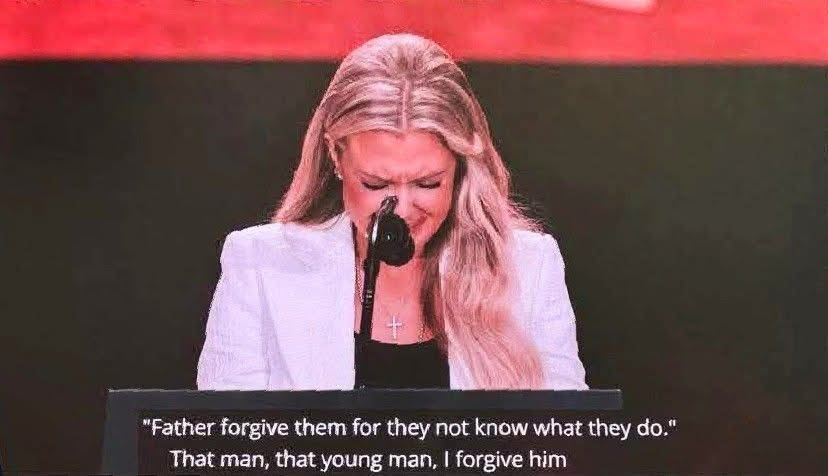
Erika Kirk  then addressed the crowds and uttered the impossible word,

“I forgive him…I forgive him because it was what Christ did, and it is what Charlie would do.”

“The answer to hate is not hate,” she said. “The answer we know from the gospel is love and always love – love for our enemies and love for those who persecute us.”

This is the message our polarised world needs to hear. I thank God that God has not judged me according to every word I have said and every thought I have entertained. I am eternally thankful to God that he forgives sinners such as me. And grasping this gospel does something to us, where Trump’s words disappear and where love and forgiveness take shape.

What is so sad and troubling is that I know our culture well enough to see how this is going to play out in the media and social media: most people will simply double down on their prior commitments and attitudes. People are so entrenched in their ideological preferences that we will read the room as our glasses are glued onto our faces, and we are unable to see any other perspective. MAGA supporting Aussie conservatives will criticise me for my posture here and progressive Aussies will criticise me for not damning Charlie Kirk to hell alongside the President. 

Reality is almost always more complicated and nuanced. One does not need to elevate Charlie Kirk to the status of Stephen (Acts 6) or label him ‘ult right’. The Christian truth is that sinners are saved by grace alone on account of the perfect sacrifice of Jesus alone. Anything else is hubris.

Here is a thought: regardless of our political leanings, if God uses the gospel preached at Charlie Kirk’s funeral to convince some people of God’s saving news through Jesus, will we rejoice or will we resent & grumble like Jonah in Ninevah?

Would you sell out Jesus for $4.37 billion?

‘What good is it for someone to gain the whole world, yet forfeit their soul? ‘

“No one can serve two masters. Either you will hate the one and love the other, or you will be devoted to the one and despise the other. You cannot serve both God and money.”

Nah, ‘surely not’, says the entrepreneur hungry for another dollar. As long as there is commerce, trade, and ingenuity, people have contended Jesus is wrong. You can have riches and God. You can have wealth and religion.

Why choose between the two? Can’t we have both, Jesus and a growing portfolio? Perhaps not $4 billion; let’s drop it down to a more reasonable $4 million, enough to live comfortably but not so much that my face and portfolio are splashed in The Australian.

It’s an Aussie dream story: success, celebrity status, and a partnership with Ferrari.  Wouldn’t we follow these steps given the chance? 

The Gospel of Luke tells the occasion when a young influencer makes a pitstop in front of Jesus while on the way to the Grand Prix (yes, there’s a touch of creative licence in this storytelling, but the point remains the same). Careful not to step his $1200 sneakers in a puddle beside the road, he approached Jesus. He was impressed by the man of Nazareth. This Jesus had a way with words and what he touched turned into something amazing. Jesus is useful. 

This young dude introduced himself and spoke respectfully to Jesus. He may be young, but he was already enjoying his prosperity. He was going places, but there was this nagging question lurking at the back of his head: did he have it all?

So he asked Jesus, ‘“Good teacher, what must I do to inherit eternal life?”

Jesus then went through a list, spelling out the requirements of God’s law: Don’t murder, don’t commit adultery, and so on.

This pleased the man because he felt pretty solid on those grounds. But then Jesus went where the man did not want to go: his heart. 

“You still lack one thing. Sell everything you have and give to the poor, and you will have treasure in heaven. Then come, follow me.”

When he heard this, he became very sad, because he was very wealthy. Jesus looked at him and said, “How hard it is for the rich to enter the kingdom of God! Indeed, it is easier for a camel to go through the eye of a needle than for someone who is rich to enter the kingdom of God.”

Wealth remains one of the world’s great con jobs. It promises happiness and success and adventure and respect, and yet it is among the worst of addictions. Wealth can be obtained through family and through hard work. Many creative geniuses have made discoveries or invented new technologies that benefit society and have made a fortune through the process. Others have made millions through theft or deceit. And then there is gambling. 

Laurence Escalante is Australia’s 32nd wealthiest person, with a personal fortune of $4.37 Billion.  There is a feature story in today’s The Australian, with Laurence Escalante sharing his rags-to-riches journey, and from religion to Los Vegas. 

Laurence Escalante grew up in a religious family, first attending a Catholic Church and then joining a large Pentecostal Church in Perth. Speaking to John Stensholt, he said,

“At the time I was very much into faith and religion. I was an acolyte”.

Apparently, Escalante has previously served as a church treasurer and started a Christian gaming company. In the vein of typically cringey Christian products, Escalante made video games based on Timothy and Titus, where players venture not to shoot all the bad guys, but to share the good news. 

He left this debt-inducing business and subsequently started a new and massively successful business: casino games.

I’m interested in the way John Stensholt writes. Even he, a journalist, can sense the clash of worlds between Escalante’s Christianity and his worldly lifestyle. The article begins, 

“If things had gone according to plan, Laurence Escalante would have had a career developing Christian computer games based on the Apostle Paul’s disciples, Timothy and Titus.

It may have been a decent earner, but it’s unlikely to have brought the level of success the 43-year-old has quickly attained in a decidedly less pious way and allowed him to live what is – judging from his social media accounts – quite the hedonistic lifestyle.”

And notice the headline, Saint to sinner? Or just a migrant kid who can now afford a jet. Even the editors can spot the scam.

Instead of bringing the good news of Jesus to the cyber world, Escalante is now making billions from the credit of the greedy and the foolish and the vulnerable. Stensholt can spot the contradiction, as can many a reader, but what about Escalante? 

It would be interesting to hear how Laurence Escalante squares this with Jesus.

The podcast episode accompanying the article is tagged, ‘Guided by God to an online gambling fortune’. I’m not sure whether this is Escalante’s personal view or it’s an editorial interpretation. Either way, it’s not true.  Can you imagine, ‘Guided by God to commit adultery’ or Guided by God to steal from my neighbour’? Neither can I.   But how often do we reconfigure God in order to justify the life decisions we are making, regardless of what God has actually said (take a look at the Bible).

He wants to assure readers,

“While admitting he isn’t as religious as he once was, Escalante insists he is no sinner. He reckons he doesn’t worry about his reputation, and says he is simply revelling in success earned from hard work and learning from previous business failures.

“I’m having fun, enjoying life,” he says in a rare interview. “Being in the moment. I’ve always been that sort of person, [wanting] to enjoy life.

“I was always into cars; I just didn’t have the means to enjoy them. Now I can afford a jet … You have to enjoy life. You never know when it could disappear.”

Nowhere does Jesus say we can’t have fun in life and enjoy ourselves. But chasing the good life without God is like investing in counterfeit money and pouring your life savings into a scam. Are you running on a high? Sure, until reality hits home. 

‘Those who trust in their riches will fall, but the righteous will thrive like a green leaf.’ (Proverbs 11:28)

‘Cast but a glance at riches, and they are gone, for they will surely sprout wings and fly off to the sky like an eagle.’ (Proverbs 23:5)

It is one thing to have wealth and it is another thing to consider how to be good stewards of our wealth. And it is an altogether different moral category when exploring by what means we accumulate our wealth. 

But why choose between the two? Can’t we have both, Jesus and a growing portfolio? It’s an Aussie dream story: success, celebrity status, and a partnership with Ferrari.  Wouldn’t we follow in his steps given half the chance? Before we throw the first cricket ball at Escalante, we might do well to consider our own hearts.

That’s the thing, Laurence Escalante is a God to riches story, and the appeal is strong. It’s easy to throw stones at this billionaire but what if we share his spiritual DNA? He’s simply succeeded where many more Aussies dream. Human nature hasn’t changed over thousands of years, and Jesus’ words are as sharp and confronting today as they were 2 millennia ago. We all too easily sell the soul for a few years of splashed excess.

Gambling is one of Australia’s favourite evils. We gamble in greater numbers than nearly every other nation on earth. We know it’s harmful. We know it destroys lives and families, and yet from Government to Sport, we’ve created this entanglement where we require gambling to sustain community projects and our appetite for a high standard of living.

To be clear, Escalante’s online casino games are illegal in Australia (from what I gather); he makes his money mostly from customers in the United States and in smaller countries like Malta. 

Gambling is about playing on your hope through chance. It’s playing the odds as a means to change your life circumstances. Like every good addiction, gambling promises much and lies like porn. It exploits vulnerable people and strips them of further dignity, security and relationships. 

If Escalante believes Jesus is okay with his billions, I urge him to think again. 

How different is Jesus’ approach? Jesus isn’t utilitarian. He counted the cost. He chose sacrifice, even atonement for the sins of many. Jesus didn’t exploit the poor, he gave his life as a ransom for many. Instead of mingling with Melbourne’s celebrity culture over caviar and champagne at the Grand Prix, Jesus picked up the pieces left behind and gave life. He welcomed the humble and repentant, whether rich or poor. 

That’s part of the problem, isn’t it? We want everything. How often are we told that we deserve everything? We create a list of desires and expect God to contribute, as though he owes us. It may not be a $ amount or material possessions, but likability or recognition or career success. What kind of screwed-up view of God that is. The very premise is mistaken. We neither deserve everything nor can we. If we treat Jesus like the non-essential extra to life, then not only do we miss out on Jesus, but in the end we’ll lose the lot. 

What does Jesus tell us, 

‘For whoever wants to save their life will lose it, but whoever loses their life for me and for the gospel will save it.  What good is it for someone to gain the whole world, yet forfeit their soul?  Or what can anyone give in exchange for their soul?  If anyone is ashamed of me and my words in this adulterous and sinful generation, the Son of Man will be ashamed of them when he comes in his Father’s glory with the holy angels.” (Mark 8:35-38)

But what would Jesus know?

The search for irrelevance: The British public is asked to suggest who should be the next Archbishop of Canterbury

My teenage daughter has an eye for noting desperation. She perceptively sees through attempts by adults to make Christianity cool, relevant and whatever adjectives are now used among Gen Z. Whether it is the band playing like U2 or the preacher dressing like he’s vying for Vogue, my daughter is able to spot a try-hard attempt from a mile away.

It turns out that the Church of England is turning to the British public for assistance in choosing the next Archbishop of Canterbury. The BBC reports,

“The public is being invited to suggest candidates for the next Archbishop of Canterbury following Justin Welby’s resignation…The Church said the consultation, which runs until 28 March, was “an opportunity to gather the views of a wide range of people from across England and the Anglican Communion on the gifts, qualities and skills needed” for the role.”

How does it look when the British public is asked who’d they like as the next Archbishop of Canterbury? I wouldn’t be surprised if they nominated a man named Rowan (no, not the former Arch Druid, I’m referring to Atkinson). After all Rowan Atkinson has played the role of the archbishop before on stage.

To preempt what some readers are thinking, yes, there are already issues with the traditional process where the Government and King are involved. But this latest attempt takes ‘try hard’ to a new level.

Is the Archbishop of Canterbury a popularity contest? Is this one of those pop idol shows where you send in a text and vote for your favourite? 

Does the public even know what the biblical requirements are for Church leadership? Is the public familiar with Christian doctrine? Does the average Brit prefer to have church leaders who believe and can teach such doctrine? Can you imagine the everyday Britt wanting to uphold Christian ethics and where there’s an Archbishop who believes in marriage and godliness in sexuality? Yeah, neither can I.

Either the establishment cannot find a suitable candidate (which wouldn’t surprise anyone given the current college of bishops) or some marketing guru thought, ‘I know what will make the Anglican Church great again, let’s run a popularity contest’. Populism might work in the political world but it’s a certain path to irrelevance for a church. Character really does matter. Believing the Bible and holding to classical Christian teaching really does matter.

Of course, if choosing church leaders is akin to who has the biggest Instagram following, then Jesus would have zero chance. Remember, what happened when God the Son came to earth? People conspired against him and had been crucified. 

Even a quick read through the Bible will tell us that it is the responsibility of the church to appoint from their own, a man who is qualified. The Church, not subbing out to politicians and everyone stuck in the London tube during peakhour.

The Apostle Paul on one occasion gave Titus instructions to appoint elders (same as bishop or pastor) in local churches. Here’s what he had to say, 

 An elder must be blameless, faithful to his wife, a man whose children believe and are not open to the charge of being wild and disobedient.  Since an overseer manages God’s household, he must be blameless—not overbearing, not quick-tempered, not given to drunkenness, not violent, not pursuing dishonest gain.  Rather, he must be hospitable, one who loves what is good, who is self-controlled, upright, holy and disciplined.  He must hold firmly to the trustworthy message as it has been taught so that he can encourage others by sound doctrine and refute those who oppose it.”

Can such a man be found in all of England? Yes, there are many, and likely members of non-establishment churches. There are also, like in the days of Elijah, within local Church of England parishes, men and women of character and who will defend the truths of the faith. I know of many, although they’ll never get a look in. Why?  The Bishops have set their course and an unbelieving public will have little interest in nominating anyone other than a prophet who preaches their own preferences. And that, of course, only reinforces why the public is disinterested and the pews are emptying. Why bother with church when I can hear the same hopeless message at uni or at this week’s Grammys? 

May God have mercy on the Church of England. May he bring repentance and raise up a leader whom they do not deserve and yet desperately need. At stake is a lampstand, let the reader understand. 

——————-

4th October Postscript:  Dame Sarah Mullally has been appointed as the 106th Archbishop of Canterbury. Her service in the public health sector is widely recognised. Her spiritual and theological commitments follow the current trajectory of the Church of England. Rather than being an appointment that can bring healing and restoration of the Gospel and faithfulness to the word of God, Mullaly’s views on Scripture, Church and human sexuality will only exacerbate the divide. May the Lord have mercy.

20 Lessons from 20 years of Pastoral Ministry

‘after all, is Apollos? And what is Paul? Only servants, through whom you came to believe—as the Lord has assigned to each his task. I planted the seed, Apollos watered it, but God has been making it grow.’

20 years ago today I was inducted as Pastor of Mentone Baptist Church. I won’t lie, it feels like 20 years! Our 3 children have literally grown up in the church. Prior to 2005, Susan and I had spent several years preparing for this scenario.  I had always loved serving in my local church, although I had zero desire to move into pastoral ministry. It turned out that God had other plans. My pastor at Camberwell Baps was gracious enough to give me opportunities to teach the Bible; that idea of speaking and sharing God’s words with people got my heart pumping. But an immature 19 year old, is just that, an immature 19 year old! After finishing uni and getting married, Susan and I moved to London and then to Sydney, for training and gaining experience in churches, so that we could return to Melbourne and serve Christ here.

We returned to Melbourne from our place of exile and started at Mentone Baptist Church on February 6 2005.

I’ve wrestled with this for the past week, should I say something about the 20 years or not. I guess it is an anniversary of sorts. As some readers will be aware, I’m someone who writes more than a few words.  Through this blog and writing for both Christian and secular publications, I enjoy talking about the gospel and trying to help others think through issues from the lens of scripture. I also love talking about music and cricket, and sharing with friends what my kids are up to and all their latest adventures.  Talking about myself, isn’t something I generally do (leaving aside the compulsory self-effacing sermon jokes). I am conscious about not making Murray Campbell the topic of somethingness.  It’s hard enough to see Jesus clearly, without my oddities standing in the way!

It was only this morning, as I read my Bible and read those verses in 1 Corinthians 3, that I decided, maybe I’ll put a few thoughts together. Maybe there is something I have learned from serving one church for 20 years that might be helpful to pastors elsewhere. Although, the last impression I want to suggest is that pastoral ministry is about the pastor. I’m not looking for praise (or the inverse!).  And serving in the same church for 20 years doesn’t make the work any more or less important than pastors who only serve a few years.  I’m also aware of how every church differs in some ways, and that means my particular experiences aren’t identical to a pastor who is serving in Mildura or Maroochydore. Then again,  every minister of the Gospel shares the same Bible,  the same mission and message, so perhaps similarities and parallels are not so few and far apart.

Here are 20 lessons that I have learned over 20 years of serving at Mentone Baptist Church. It’s not as though I didn’t believe or was unaware of many of these lessons prior to coming to Mentone. And it’s not as though I’ve reached the apex for these 20 themes.  Most things in the Christian life are repetitive and a day by day process of sanctification. I’m not planning to provide detailed explanations and examples for these 20 lessons, but rather to note them in passing. 

1. I still have much to learn.

I am often amazed at how little I know and how little I understand of the Scriptures and I’m excited at the prospect of continuing to dig deeper and discover more wonders of God in his word.

I’m still learning how to Shepherd a local church. Our Elders are currently reading Andrew Heard’s provocative book, Growth and Change, and am enjoying discussing penetrating questions about ministry and mission. It’s great. I love how the elders (and church) want to keep moving forward in the Gospel and to be more effective in seeing God’s Kingdom growing.

2. God answers prayer. 

He really does. When the church has prayed, we have seen God work. Which begs the question, why do we pray so little?

3. God’s Gospel is powerful. 

Just last year, our church heard testimonies and witnessed baptisms where the reality of Jesus Christ compelled and changed people’s lives. We have more planned in the early part of 2025. It is so strange to me to hear of churches smudging or avoiding clear and faithful presentation of the Gospel, as though that’s the best strategy for faithfulness and growth.  So weird. 

4. I’m still learning patience. 

I like to run fast but there’s little point sprinting if the church isn’t ready. Sometimes though, I could probably encourage our leaders and members to walk a little faster!

5. God’s word really is beautiful and true and complete. 

At Mentone, we use the Bible lots and we want to present God’s words in a way that reflects the treasure that it is. How amazing it is that God has given us a living word that speaks truth and grace today. That’s why we have 2 bible readings every Sunday morning and why we make sure our ministries, from Sunday school to youth group and 1-1 discipleship involve opening, reading and living out his word

6. People will hurt you (and at times you’re no saint either)

Learning to process hurt isn’t quick or easy. Having trusted and godly leaders is really important for working through these times.

7. I’m more convinced about the value of having a plurality of leaders.

The eldership hear me talking about this all the time. We want to grow the number of elders.  A church needs a plurality of leaders: from pastors and elders, to deacons, and all kinds of lay ministry leaders. Paul didn’t lay out a paradigm in Ephesians 4 for us to ignore!

8. Make sure the eldership consists of godly men who share a broad breadth of personality, experience and skills.

A church requires greater wisdom than that of one pastor. However, we insist that there is profound and convinced agreement and unity on the church’s doctrine and direction.

9. Trying to set an example for others is hard. 

 The Bible says that pastors ought to set an example of life and godliness for the believers. It’s a balancing act, trying to share and show how I live outside the pulpit and yet doing so without handing out an autobiography each week. 

10. Don’t do everything. 

Set early and clear expectations and boundaries and be okay with saying ‘no’. Teach your congregation to be okay in hearing, ‘no’. 

11. Membership really is important.

I believed this 20 years ago, and as the years have progressed I’ve become more convinced.  Expressive individuals is a scourge on churches and hamstrings Gospel witness and effectiveness. Jesus meant every word when he said,  “Love one another. As I have loved you, so you must love one another. By this everyone will know that you are my disciples, if you love one another.” Want to impact the world for Jesus? Then join a church and love the saints. 

12. I will make mistakes and that’s ok.

13. The fear of losing people is common, but not dealing with problems generally makes the situation worse.

14. Technology is a curse. 

Ok, not entirely. Tech is both good and bad, a useful servant and a terrible master. As technology changes, churches will often adopt and adapt and yet we also need to be wise in its use. Too often churches begin paying a cost without first thinking through behavioural changes that come about through smart phones or AI. Hey, even schools are now recognising these dangers!

I remember Carl Trueman suggesting once that the invention of the car changed people’s behaviours in ways that negatively impacted the local church.  Cars are great, what a blessing it is to be able to move about easily and speedily. Cars give people more freedom and as Trueman explains, people started taking long weekends and pursuing more activities, and this turn impacted church attendance and participation. In other words, the car impacted the ministry and mission of the local church and does so even today.

15. We still need to cultivate a better culture of disciple making. 

We talk about it and preach on it and we practice it in all kinds of ways, but I think we are yet to be  convinced of how important discipleship is to the health and maturity of church. 

16. Repetition is key to cultural change (thinking of point 14).

I’m learning that I need to say the same thing over and over again, and when I’ve done that, I need to repeat it again.  I’m also trying to encourage our leaders to press repeat so that messages sink in and therefore lead to changed expectations or behaviours or whatever it is we’re trying to move forward. 

Part of the issue isn’t reluctance from people, but leaders remembering that people live busy lives and their heads aren’t in the church 24//7 as mine is. 

17. Church history is amazing and it matters. 

I don’t need to be sold on history. I’ve always enjoyed reading history books and watching documentaries, even as a 3-year-old kid. I studied history at Melbourne University. 

Many years later, I am more persuaded that churches should appreciate and understand that who we are today is the result of the sacrifices, thinking, preaching and lives of the saints from old. Churches make mistakes,  take wrong turns, and lean into theological mess because we haven’t learned the lessons of church history.  

We ran a course last year on Reformation history and this year we are talking about the Council of Nicaea. 

18. Protecting my day off was a great idea.

 Pastoral ministry isn’t just a job, it is a way of life. Family is family and church is also family. This makes setting boundaries often murky and imprecise. Susan and I have always wanted our children to view church as a family, and yet we never wanted to sacrifice them at the altar of ministry. I’m thankful for the clear and flexible boundaries that Susan and I set together and which the church embraced.

19. Theological liberalism is an easy gospel enemy to spot, but there is an emerging conservatism that we need to be aware of and keep away from the church.

Christian Nationalism which conflates common grace with the Gospel, and Church with State, is a growing concern not only in the United States but also in segments of Australian Churches.

This isn’t a biggy at Mentone Baps, but knowing this flavoured heresy is gaining popularity in some circles, I have already begun talking about these issues in sermons and discipleship (and of course on this blog). The Gospel is neither left nor right. Our mission isn’t defined by a side of politics, but by the Lordship of Christ and his Gospel that brings the forgiveness of sins. 

20. There is so much work do to.

When all is said and done, the most pressing issue today remains the eternal state of people in light of the coming judgement of God. How many millions of people in Melbourne may know their left hand and right but are oblivious to Christ the judge and Christ the redeemer?

Pastoral ministry is the worst job in the world. Pastoral ministry is the best job in the world. I get to see and be part of people’s highest and lowest moments of life, to share their joys and sorrows. Pastors have the terrifying responsibility to preach the full counsel of God and dare suggest, see my life and follow my pattern of living. And we do, knowing that God will hold us to account for how we have shepherded his people. It really is a work that people should avoid and embrace.

I don’t spend a lot of time looking back over the years. To be honest, if you asked me for particular highlights in any given previous year, I may not be able to tell you with any precision. When I do reflect on the 20 years, I do so with some embarrassment and also much thankfulness: for Susan and my children, for a church that was patient and kind and who looks after the staff so well, and for God who never lets us down.

Mentone’s current associate pastor, Mike Veith has now been with us for 14 years in this role (and as a student pastor for 2 years before then), so that’s a milestone for which I am thankful.

I realise that 20 years in one church sounds a little bit unusual, but I know pastors who have served their churches for a great deal many more years.  I think of Philip Calman from whom I learned so much during my 4 years at Chatswood Baptist as a student. He has been serving as their senior pastor for 28 years and counting. Praise God!

These are 20 of the lessons I’m learning from my 20 years at Mentone Baptist Church. There are many others, but perhaps among this this 20 there is something that might strike a note or encourage another pastor in their work for the Lord.

Sola Deo Gloria

What I think about Bishop Mariann Edgar Budde’s sermon to President Trump

President Trump and Bishop Mariann Edgar Budde have run into each other for a second time. The first occasion was outside St John’s church in Washington DC, this time it is inside the National Cathedral.

In 2020, Donald Trump stood outside St John’s building following an arson attack the previous night. He held a Bible aloft. The bishop criticised Trump for standing on church property and organising a photo op. 

I suggested at the time…

“A friend of mine noted the irony of this chosen site for politico-religious vanity. Outside St John’s, the cameras took photos of a President who does not believe the Scriptures nor does he practice what they teach. Inside St John’s Church, there are clergy who also do not believe or practice the Scriptures. St John’s Church and the presiding bishop of Washington are known for their errant views about Christianity. Both inside and out, they treat the Bible with disdain.”

Yesterday, at the Inauguration Prayer Service in Washington DC, the Episcopalian Bishop of Washington delivered a 15 minute sermon in front of and toward President Donald Trump.

Bishop Mariann Edgar Budde spoke of national unity, prayer and action.

The sermon has gone viral and become headline news around the world, as the Bishop no doubt knew would be the case when speaking truth to power. Had the Bishop spoken of support for the President, few would have been interested, but standing up to Donald Trump is global news!

The lines that grabbed attention were the bishop’s call for mercy and compassion toward illegal immigrants and  LGBT children.

Unsurprisingly the reception of her sermon is divided largely between the political divide (which is probably a clue that there is something amiss in the sermon). There are also many Christians lauding her address. Might I suggest that we stop and pause and consider a few things first. 

I don’t have a problem with preachers calling for compassion and mercy. How can we not when we have understood God’s exquisite compassion and mercy toward us in Christ. The problem I have with the sermon is that while Bishop Mariann Edgar Budde uses some Bible language and invokes God’s name, what she means by these words is often quite different from what the Bible is saying. If a pastor’s sermon fits neatly into a political convention (regardless of political side), I want to suggest that there is possibly something skewed.

I have listened to her sermon in its entirety. The bishop communicates well and clearly (and quite differently from the viral videos of her deriding the President on other occasions). Yes, she uses Christian language and some Bible categories. But even within this sermon, there are giveaway signs of the troubling theology that underpins her views. For example, she makes the claim that all religions believe in the inherent dignity and worth of all people (which is not the case) and then suggests these many religions somehow represent and find origin in ‘our one God’.  Really?  And then, where was the Gospel? A bishop chooses to speak ‘truth’ to power and leaves out the Gospel?

As listeners we’ve all done it; we hear a Christian word spoken and our brains translate it in the way we understand the language and therefore we assume they are saying what we believe. That’s not always the case. Let’s not be ignorant and assume that this particular cleric means by these words what the Bible explains. That is not the case. This is made obvious by one example that she gives in her sermon in regard to LGBT people.

Christians ought (indeed, necessarily) to show kindness and love to people regardless of their sexuality and gender. I’m not mocking the idea of mercy, we need more mercy. Railing against contemporary sexual ethics, Christians can sometimes neglect to speak and exhibit Christ-like kindness. But is it compassionate to affirm or call good what God calls sinful? Is it compassionate to reject a creational paradigm and pretend that gender is fluid and that men can be women and vice versa?

A slightly different question, although relevant to the situation at hand, can we separate Donald Trump from the idea that there are only two genders? Yes, we can. His Presidency does not own the definition of gender however it is repudiating an immoral and harmful notion that’s become normalised in the academy and in pop culture, and that is, gender is fluid and cascading with options and possibilities.. Both Bible and biology communicate that we are made male or female. This is a wonderful blessing and common good, and distorting this is producing all kinds of problems, and incredible harm, especially among children. 

It is possible and indeed biblical to both affirm 2 genders and show compassion. Affirming the two genders should not diminish the fact that there are also boys and girls, men and women who find themselves in a distressing place where they are not comfortable within their biological body; they do require compassion.  Is this what the Bishop means? Previous teachings and statements by the bishop points in a different direction, and that what she means is the full affirmation of current sexual ethics, as though current gender theories are moral goods and even Christian-like. That’s a problem.

The heart of the Gospel of compassion and mercy is Christ’s substitutionary death on the cross. The Bishop could have taken the President there, but I note, this is something Bishop Mariann Edgar Budde repudiates. She says of penal substitutionary atonement, that it is “justifiably offensive”. That’s a big problem because God’s rich mercy toward us centres on Christ who bore the punishment for our sins in our place. That’s the good news of the Gospel: God forgives and reconciles and treats us not as our sins deserve because of the atonement. 

Not only this, but God’s mercy toward us in Christ does not leave us in our sins but transforms us in the power of the Holy Spirit.

This story of the Bishop Curry so-called ‘love’ sermon at Prince Harry’s and Meghan Markle’s wedding several years ago. Christians were enthralled by the smiling Bishop who spoke of love. But his message had very little to do with God’s love but preaching a Hollywood version of love and grinning while persecuting churches in his diocese for holding onto the Bible.  It’s probably of no coincidence that Bishop Curry wrote the forward for Bishop Mariann Edgar Budde’s recent book, ‘Receiving Jesus: The Way of Love’!

Christian, please don’t praise this Episcopalian Bishop as though her speech represents the Christian message. She may use Bible language at times but what she means is often quite different to what the Bible means. That doesn’t mean we are siding with Donald Trump or affirming Republican or Democrat. That’s part of the problem that we’re buying into in this fractious age.

The thing is, we don’t have to choose between President Donald Trump or Bishop Mariann Edgar Budde. I sense that sometimes we are choosing sides based more on our political preferences or social leanings rather than being guided by Scripture and the Gospel. This is happening among both left and right leaning Christians, and it’s a problem. We need to recognise that as sojourners and aliens, the Christian will often not sit comfortably at the table of power or public discourse. Sometimes we are going to be left on the bench, not choosing either side but instead taking a less popular and more lonely position. Why? Because both doctrine and life require us to take that harder route.

There is often little gospel advancement when Christians jump into bed with any political party. We may find favour with one group and then leave everyone else the impression that to be Christian is to be left or to be right,  Republican or Democrat, Liberal or Labour. That’s not to suggest that all politicians are equal or that every policy is good for society or that we Christians don’t speak truth to power.

Christians will and can disagree over many Government policies. Read Prof Sarah Irving StoneBraker’s excellent new volume, Priests of History. Even when it comes to immigration (an ideal that I value and thank God for), public safety and social cohesion do matter as do compassion and mercy. It’s one reason why we need to pray for our political leaders, for their task isn’t easy.

My point here though is not to dissect American policies but caution Christians against buying into this political and cultural partisanship that has become normalised in places like America and Australia. President Trump is not the Messiah and the Bishop is not representing God; both such notions are folly. Whether you are an evangelical praising Trump’s ascendancy or an Episcopalian disguising progressive politics behind Christian language, are we presenting the beauty and goodness and power of the gospel or simply adding to the confusion? At stake is not an election cycle or the West Wing, but the judgment seat of God and eternity. 


Additional Note (January 24):

A few people have asked, how do we know that the bishop was using Bible words in non Bible ways. In the article I’ve already cited some examples, but here are more,

The Cathedral service included prayers offered by other religions, including a Muslim call to prayer. Such things are anathema to a Christian Church. 

Lest we think this is a one-off, in 2021 the National Cathedral invited Max Lucado to preach. Washington Episcopalians went into meltdown. Read what the Dean of the Cathedral, Randolph Marshall Hollerith, said, 

“When we only engage with those with whom we agree on every issue, we find ourselves in a dangerous (and lonely) place…That means this cathedral, and this pulpit, are big enough and strong enough to welcome pastors, rabbis, imams, clergy of every faith.”

Hollerith then apologised to angry Anglicans, ‘In my straight privilege I failed to see and fully understand the pain he has caused. I failed to appreciate the depth of injury his words have had on many in the LGBTQ community. I failed to see the pain I was continuing. I was wrong.”

Bishop Mariann Budde also apologised, saying, ‘”I made you feel at risk and unwelcome in your spiritual home.’

There it is, Budde believes that a Bible believing preacher is a danger to her Diocese, while a Muslim Iman in the pulpit is not.

I realise some Christians maintain that Mariann Budde is offering a prophetic voice, but seriously? She is no more prophetic than the prophets of Jeremiah ch6 who were effectively conning God’s people with their ‘Bible’ words, 

“They dress the wound of my people

    as though it were not serious.

‘Peace, peace,’ they say,

    when there is no peace.”

What Michael Leunig’s Art Said to Me

I was saddened to learn last night that Michael Leunig has died at the age of 79. It’s as though a little part of Australia has died with him.

Leunig’s family announced his death with these befitting words, 

“The pen has run dry, its ink no longer flowing – yet Mr Curly and his ducks will remain etched in our hearts, cherished and eternal.” 

25 years ago, Susan and I were enjoying dinner at a friend’s home when I saw it hanging on the wall above the dining table.  It was a drawing of a man sitting at a grand piano. The man had a particularly large rounded nose, which I had seen before.  There was little colour on the canvas. Like Matisse, the artist conveyed all he needed with two or was it perhaps three tones. 

The etching was simple and clean, almost like a cartoon.  It conveyed something of the simple pleasures accompanying the piano. As someone who had until that time spent virtually his entire entirety life learning to play this magisterial instrument, I was immediately drawn to his work by Michael Leunig; it made sense to me.

Leunig’s cartoons, drawings and paintings communicate life and provoke us to question and consider the Divine design behind the canvas.

Life is beautiful. Whether it’s the inquisitive duck or his vibrant trees or musicians,  Leunig painted a beautiful life. Life is precious and is a wondrous gift.  Acknowledging God who gives life, is both an obligation and a joy. 

Imagine their existing a masterful painting on the wall at home and never stopping to gaze upon it, to understand and enjoy it. How often do we walk about and consume and enjoy the world without stopping to give thanks to the one who designed and enables us to live and participate?

Leunig was renowned for his use of subtle humour to elucidate critical thinking and moral evaluation. It reminds me a little of Jesus who added humorous, almost silly liners while teaching things of great import, 

“You blind guides! You strain out a gnat but swallow a camel”

“It is easier for a camel to go through the eye of a needle than for someone who is rich to enter the kingdom of God.”

One of Leunig’s better-known drawings is this betrayal of Jesus’s crucifixion. In a mood faithful to the original crowd who mocked Jesus on the cross, Leunig paints a soldier calling out,

“Look at that? Brilliant! You kill the leader and you nip the whole movement in the bud”.

The joke is on us. The cross makes us fools. The cross turns our power into ineptitude. Indeed, the joke is on us, filled with intellectual hubris and moral certainty, as we turn down the only redemption available.

Leunig’s work pushes us to say ‘no’ to ambivalence. It is a gentle and humorous rebuke toward an Australian culture that even today wishes to paint over the most pivotal moment in history.

I know next to nothing about Leunig’s personal life. Whether in concert or in contradiction, his work conveyed a bright message that is being overshadowed by a compounding grey.

Today Michael Leunig no longer needs his paintbrush, for he gets to see his Creator, the One who crafted with his word every colour and shape and mountain range, every ocean and even the stars. And the pinnacle of his creativity, making us, his image bearers.

Again life is beautiful. And life is too easily cut short even at 79 years of age. Life ebbs away, and the blotch of tragedy, sadness, and yes also, evil marks every home. How much do we need a story where such things are overcome.

Talks from ‘Sex, Gender and the Good News of the Gospel’ now available

Last week’s ministry conference in Melbourne was an encouraging and stimulating day. Many thanks to David Starling and Dani Treweek for serving us well. Each of the talks and the QandA session are now available for listening to on youtube.

Horoscopes are on the news!

Since when does superstition qualify as news?

Look no further, astrology is coming to a news channel near you. Channel 7 has announced that their nightly news will have a new and regular segment on the stars to inform viewers on what Sagittarius and Capricorn are up to today. 

Laugh not; the producers are quite serious. 

It’s been reported

“Channel 7 has defended a new daily astrology segment to be introduced as part of its evening news bulletin.

The network has confirmed it will be bringing in the new segment featuring an astrology report from Natasha Weber, also known as ‘Astro Tash’.

Ms Weber’s new segment will be about 20 seconds and will be aired after the weather forecast.  

New Director of News and Current Affairs Anthony De Ceglie said it was part of “exploring new ideas and concepts”

Photo by Mikhail Nilov on Pexels.com

Channel 7s entertainment reporter, Peter Ford, explains that the decision is motivated by shrinking audiences on commercial television,

“the EPs of the news services in Melbourne and Sydney are under a lot more pressure than in Perth, because the competition is much, much tighter. So this is a response to that.”

He also admits that Natasha Weber is a real believer in horoscopes, 

“She’s deadset serious about it all.”

What a juxtaposition, following the daily meteorological report will be a report on the stars. It’s science versus superstition. Horoscopes now equals journalism!

This shift is less surprising than we might think. Sure, it feels like desperation, but I reckon the Seven News boss Anthony De Ceglie knows something, and that is, belief in alternate spiritualities is on the rise in Australia. 

In one sense, this isn’t new, but it has been suppressed by the weight of hubristic rationalism and the ride taken by the new atheists.

When we remove God from the picture,  we must find an alternative to create meaning and fill life. The new atheists put up an effort for 20 years, but their ‘godless’ alternative leans either toward a moral and spiritual vacuum or a gladiatorial arena where power wins and the weak are trodden. A world without God is brittle; no wonder issues of identity and self worth are paralysing a young generation.

The Gospel Coalition have reported how in the United States, astrology and horoscopes are finding popularity primarily among millennials. It’s not sceptical Generation X or the latter-day baby boomers, but teenagers and young 20-somethings who are grasping for meaning and hope.

Why is this the case? Hard-core materialism doesn’t work. Millennials are smart enough to see through that crusty materials don’t satisfy and they have been sufficiently indoctrinated to assume organised religions, especially Christianity, can’t be trusted. So where we do go? Like swings and roundabouts, let’s revisit pagan Europe and source wisdom from the gods of Greece and Babylon. Let’s turn our gaze again to the stars as though they offer droplets of guidance and words of hope.

For all the talk about science, human beings are a suspicious lot. For all our reasoning and cognitive faculties, our society is replacing empiricism with emotion,  and truth with neo-paganism. Part of the reason is the emptiness offered by secular humanism and the new atheism. Another reason is a biblical one: God has wired us for eternity.

‘He has also set eternity in the human heart’ (Ecclesiastes 3:11) 

We are made to worship. At our core, human beings are worshippers, seeking Divine purpose and design. 

Don’t misunderstand, the Bible isn’t anti-science. Far from it; it is the biblical worldview that can gave rise to much modern science and intellectual growth. I’m simply affirming the BIble’s thesis, that the default setting in our heads and hearts knows there is a God and spiritual realities that govern and interact, subject and even save. 

For example, the former juggernaut of the new atheists, Ayaan Hirsi Ali,  is now a professing Christian and follower of Jesus! She speaks of her mental agony and former belief that ‘she can do all things by self’ but with ‘humility’, she has experienced a ‘spiritual awakening…my life has changed, it’s been transformed’.

Ali has found that the alternative to crippling unbelief isn’t to believe in anything and everything but to grasp a concrete hope in a real God.

It seems that Channel 7 news will be following the weather by reporting a very human imprint on celestial gaze. But it’s not news and it’s certainly not journalism. It’s old fashion suspicion and gaslighting. 

Will I fall in love?

Should I buy that house?

How can I find meaning?

 Does life have real purpose?

Don’t worship the stars. Worship the God who made the stars.

Psalm 8 puts it like this, 

“Lord, our Lord,
    how majestic is your name in all the earth!

You have set your glory
    in the heavens.

Through the praise of children and infants
    you have established a stronghold against your enemies,
    to silence the foe and the avenger.

When I consider your heavens,
    the work of your fingers,
the moon and the stars,
    which you have set in place,

what is mankind that you are mindful of them,
    human beings that you care for them?”

Last year at church, a woman was baptised after becoming a Christian. For many years she immersed herself in alternate spiritualities, what we often call ‘new age’. While her attention didn’t lay with horoscopes, she tapped into almost everything else. This is some of what she had to say, 

“My New Age practices were strengthening as I became focused on positivity and not allowing negative energy to flow into my life. I’m not going to lie, it was exhausting. Having routines and rituals, having crystals, stones, special essential oils, cleansing spaces, clearing your mind and meditating. The New Age practises which are supposed to be to clear your mind so you can just ‘be’ involved doing the exact opposite. They involve work, concentration, work and more work on your part and if you get it wrong, you’re the one to blame.”

Then she read the Bible and in those words, she met Jesus and like an exploding star, she found peace, for God had found her. She continued,

“After becoming a Christian it’s been amazing to see how God has opened my eyes to so many things. From that moment onwards my life was different. God had given me new eyes. Everything I once saw in the New Age and believed to be good I realised had come from darkness. I also had a sudden awareness of my sin, things I had done and how I had fallen from God. 

Since becoming a Christian I wake every day with a sense of peace. Peace about why we are here on earth, our purpose, which of course is to glorify God. There isn’t a day that goes by where I don’t thank God for sending Jesus to die for my sins. For those of you who see me here, I often hide in the back, primarily because even now, 3 years on I still get so emotional and teary singing in church about God’s grace and the grace he has shown in saving me. I often think people must look and think ‘who is that crazy girl crying at the back’. 

Since becoming a Christian, going to church and attending growth groups here at Mentone I have been blown away by the impact God has had in my life. The first and biggest change is the sense of peace I have in my heart. Whilst there are the obvious happy and sad events that take place in life… put those aside and I now live in a place of contentment. There is absolutely nothing anyone could give me or take away from me to take that. No money, no person, no material object can bring me and more joy or peace. I already have all the peace I need inside me from Jesus. He is my peace.”

Don’t listen to the horoscope, listen to Jesus. 

Richard Dawkins asks an important question and here is my answer

I can imagine Richard Dawkins sitting in the back row at the Areopagus, stern-faced and shaking head, and leading a small chorus of sceptics.

Richard Dawkins is continuing his mission to evangelise people out of Christianity (and religion altogether) and to secure his message of a world without hope. 

Today in a video message, he asks, ‘Do you want to be comforted by a falsehood?’

It’s a good question and an important one. Does anyone want to find consolation in a fabrication? Does anyone want to pour all their hopes into a dead end? For Professor Dawkins death is of course the dead end, with nothing beyond and no light to give hope to either the dead or those who are left behind. 

“When your brain decays there is absolutely no reason to suppose your consciousness will continue, so the grounds of plausibility, the balance of plausibility is heavily in favour or there been no survival after death and that is something and that is something we need to live with. It’s not all that horrifying a prospect when you think about it because we think as Mark Twain said, ‘I’ve been dead for billions of years before I was born and never suffered the smallest inconvenience.” 

I suspect that Dawkins’ answer will arouse applause and retweets from fans and devotees, and with a satisfied Amen. Leaving aside for a moment the question of whether he’s right or not, his answer isn’t particularly consoling. Dawkins says that he finds solace in the finality of being no more, but I suspect most people including a lot of atheists are not so convinced. Our intellectual commitments (whether theistic or atheistic) come under a sudden assault when death approaches and when a loved one is lowered into the grave. There is a longing for death not to win. There is palpable hope that life may continue and love to beat any final breath. 

Why divorce cognitive processes from heart filled yearnings? Of course, the two can be in conflict and they can also partner together as a harmonious duet, as we find in Christian theism.

Dawkins (and fellow atheists) believes that once our final breath expires and we are buried, the totality of what we were begins to rot and we cease to be. All that is left is the box in the ground holding our biological material and the memories that people have of you. Again, some readers may find that a satisfying end of the story, but most of us don’t. Whether we find it satisfying or not isn’t evidence of what is ultimately true.

The thing about the Christian view of resurrection is not one of lacking commitment to the intellectual process but appreciating that there is more going on. It is not wrong to appeal to deep heart filled longings, for those emotional impulses are part of who we are as human beings. We are more than those heart desires, not less.

I believe, along with Oxford and Cambridge Dons, scientists, poets, plumbers and children, that the Christian explanation of resurrection is both intellectually satisfying and emotionally, psychologically, spiritually liberating and consoling.

Something happened that day just outside Jerusalem that changed the world. Women and men saw something that didn’t compute. The evidence defied their prior assumptions and challenged their emotional state. They saw and heard and touched Jesus raised from the dead. 

Before we line up the Biblical accounts with ancient mythology, we mustn’t assume that resurrection was a commonly held view in the ancient world, for that is not the case. Many ancient religions believed in some kind of life after death, although not all (including many Athenians in the First Century AD).  The Christian notion of resurrection is altogether different 

As Dr Chrisopher Watkin summarises in his new volume, Biblical Critical Theory

“The nature of the resurrection is very different to the ancient notion of rising gods known as apotheosis. The bodily nature of resurrection sets the Christian claim apart from other superficially similar narrative patterns in the ancient world. The Romans, for example, were familiar with the idea that a mortal person could undergo an apotheosis to become a god, but apotheoses were spiritual, not bodily, and the deified mortal would not be expected to tread the streets of Jerusalem for forty days before ascending to heaven. Apotheosis was also a privilege reserved for the rich and mighty, not for the common artisan and certainly not for the crucified criminal. Christ’s resurrection was also different from the myths of dying and rising agricultural gods in other pagan religions. N. T. Wright, author of the 740-page The Resurrection of the Son of God insists that “even supposing Jesus’s very Jewish followers knew any traditions like those pagan ones—nobody in those religions ever supposed it actually happened to individual humans.”

Richard Dawkins talks about plausibility, as does the Apostle Paul at the Areopagus. He insists, let’s examine the evidence. At that centre of Athenian learning and thought, Paul argues for the resurrection of Jesus Christ from the dead. He began, 

“He  [God] has given proof of this to everyone by raising him from the dead.”

Proof? I can hear Dawkins of Athens reproving! What proof? Dead people stay dead. Their brains, blood, muscles and organs decay and become a manure in a box. 

Of course, Paul, like Jesus and like Christians everywhere, knew that dead people don’t rise. That’s the point and the resurrection testifies to our wrong assumptions about God and life and death. 

What I found interesting in Dawkins’s tweet is how he relies heavily on Bible reasoning in order to muster an argument against God and the notion of life beyond death.  Take, for example, this paragraph from Paul’s First Letter to the Corinthians, 

But if it is preached that Christ has been raised from the dead, how can some of you say that there is no resurrection of the dead? 13 If there is no resurrection of the dead, then not even Christ has been raised. 14 And if Christ has not been raised, our preaching is useless and so is your faith. 15 More than that, we are then found to be false witnesses about God, for we have testified about God that he raised Christ from the dead. But he did not raise him if in fact the dead are not raised. 16 For if the dead are not raised, then Christ has not been raised either. 17 And if Christ has not been raised, your faith is futile; you are still in your sins. 18 Then those also who have fallen asleep in Christ are lost. 19 If only for this life we have hope in Christ, we are of all people most to be pitied.

20 But Christ has indeed been raised from the dead, the firstfruits of those who have fallen asleep. ” (1 Corinthians 15:12-18)

The Apostle, and subsequently Christian theologians, scientists, and believers in general, all understand the implausibility of resurrection and understand that single event of history that dumbfounds the Sadducees and Epicureans of every age. 

It is worth noting that Paul’s words were written within 20 years of the events that surrounded Jesus’ death in Jerusalem. He even says to his readers, that many eyewitnesses are still alive so go and talk to them. His are not the words of someone covering up evidence and trying to commit fraud on the public. The resurrection is a public event that is open to investigation. 

For Dawkins, as brilliant a scientist as he is, he believes in a closed universe and so it’s unlikely that he’ll accept any compelling evidence that punctures his system. Even Jesus was aware of how our a priori commitments block us. He famously said, “‘If they do not listen to Moses and the Prophets, they will not be convinced even if someone rises from the dead.’”

Why? Because there is more going on in our minds and hearts than just intellectual questions and the pursuit of what happened.

Richard Dawkins may have made up his mind, but death will continue to haunt us. The grave is the one appointment we hope to avoid and yet will come. To take consolation in Christ is not fake or feeble, but reason finding hope. 

If you are interested, below is a short summary of the evidence outlined in the New Testament as well as a summary of some of the more popular objections to the resurrection.

The facts:

1. Weeks out from his death on the cross Jesus predicted with startling accuracy what would happen.

 “Jesus began to explain to his disciples that he must go to Jerusalem and suffer many things at the hands of the elders, the chief priests and the teachers of the law, and that he must be killed and on the third day be raised to life”. (Matt 16:21)

2. Jesus genuinely died and his death was verified by the executing authorities (Matt 27:50-54)

3. After Jesus’ death had been verified, Pilate released the body to Joseph of Arimathea who buried it in his own new tomb, carved out of rock in a garden near the place of the crucifixion (Matt 27:57-60).

4. The tomb was sealed and was guarded by Roman soldiers (Matt 27:62-66).

5. A number of women witnessed the burial and presumably the posting of the guard (Matt 27:61)

6. On the Sunday following the crucifixion the body was no longer in the tomb (Matt 28:1-7).

7. That same day, and over the next 40 days, Jesus met with his original disciples and others (later Saul). During this period the commission to be his witnesses, first to the Jews and then to the nations, was given by Jesus himself (Matt 28:1-20)

8. After 40 days Jesus was taken up into heaven, a cloud hiding him from sight (Acts 1:9-11)

Some arguments against the resurrection:

TheoryChief exponentsSome suggested responses
Intentional fraud by the disciplesJewish High Priests; H.S Reimarus (1787)How could it be done despite the guard and the suspicion of the authorities? How could the lie be sustained for the rest of their lives and in the face of fierce persecution?
Swoon TheoryPaulus (1833) Huxley (1896) Thiering (1992)His death was verified by experts when Pilate raised questions. If he did revive in the cool of the tomb, how did he roll away the stone, get past the guard, and walk all the way to Emmaus with those wounds?
The women went to the wrong tombLake (1907)The women were nearby as Jesus was buried. Joseph of Arimathea would certainly know which tomb was his. The guards and the seal would have made the tomb rather conspicuous. The authorities could have just gone to the right tomb and produced the body.
Jesus was never actually crucified (someone was)The KoranIt is inconceivable that the Jewish authorities would have stood by whilst the Romans crucified the wrong man. Surely this argument would have been used by the Jews to combat the apostle’s preaching if it was true (and even if it wasn’t but was credible)
The resurrection is an allegory not a factWoolston (1728)There is no evidence in the Gospels that this part of the narrative is allegorical as opposed to the rest.
HallucinationStrauss (1835) Spong (1993)The number and variety of people, times, and types of appearances tell against this theory. This attitude of the disciples was either fearful or aggressively opposed (Saul) at the time of the appearances. Fear and aggression are not the usual preconditions for a hallucination of an unprecedented event.
Spiritual resurrection and/ or divine vision evoking faith in the disciplesKeim (1883) Lampe (1966) Carnley (1987)Jesus himself goes to great lengths to demonstrate he is not a ghost or a vision. The empty tomb is unnecessary and the arguments of Paul do not make sense if the resurrection does not involve the crucified body of Jesus. What happened to the body?