Coldplay’s prayer in Melbourne

Coldplay is in town. It seems like every second friend has bought tickets and is  joining in the chorus of ‘Yellow’ and singing, ‘I used to rule the world’

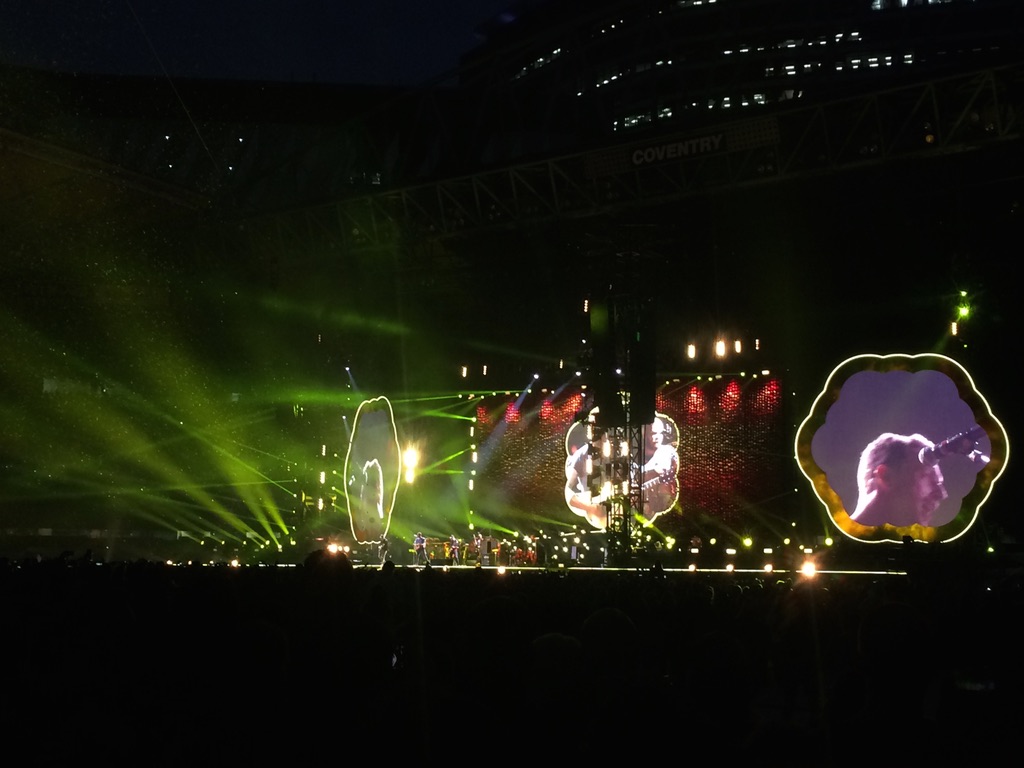
The last time Coldplay performed in Melbourne was in 2016,  and I took my 2 boys to the concert.  The eldest, who was 11 at the time, had aspirations to be a drummer like Will Champion. The night was a kaleidoscope of colour and light and memorable tunes.

Coldplay is back in Melbourne and singing a prayer. 

By prayer, I’m not referring to fans hoping to see Guy Berryman after illness forced him to miss out on performing with the quartet for the first time in their 27 year history (I believe he returned last night for their second Melbourne concert). Coldplay’s latest hit song is called, ‘We pray’.

‘We pray’ was written by lead singer, Chris Martin, in conjunction with a group of musicians from around the world, and it explores his personal journey in spirituality and understanding the human condition. 

The song itself is a congregational invocation to prayer. The lyrics are deliberately vague for no particular god is addressed and his character and personality are unknown. The song is about the human longing for help, hope and forgiveness.
‘We pray’ is clever because people can fill in the gaps however the wish, but is that point of prayer? The word grabs onto some vague and universalist notion of the Divine: unnamed and unknown. 

It’s hoping without knowing, it’s needing and not possessing.

Take a look at some of the lyrics, 

Pray that I don’t give up
Pray that I do my best
Pray that I can lift up
Pray my brother is blessed
Praying for enough
Pray Virgilio wins
Pray I – I – I
Judge nobody and forgive me my sins
I pray we make it
Pray my friend will pull through
Pray as I take it
Unto others I do
Praying on your love
We pray with every breath
Though I – I – I’m in the valley of the shadow of death

Pray that we make it to the end of the day
And so We Pray
I know somewhere that heaven is waiting
And so We Pray
I know somewhere there’s something amazing
And so We Pray
I know somewhere we’ll feel no pain
Until we make it to the end of the day

Coldplay is, of course, singing a similar tune to one that is all over our streets and suburbs today.

Human beings are deeply spiritual. The sum of who we are cannot be reduced to skin, bones, blood, and organs. This is one reason why the new atheism was always doomed to be little more than a cultural fad. The materialist world cannot sustain or explain the needs and hopes found in the human soul. But neither are we left in the realm of guessing and taking a stab in the dark.

New Atheism is dead. In places like Australia and the UK, neo-paganism is gaining traction, Eastern religions are growing (largely through migration), and people are dabbling in alternative spiritualities in volumes I’ve not seen before. Why? The soul needs peace. We need hope.

‘We pray’ is a descriptor of the human condition but it doesn’t give any substantive answer.

Prayer isn’t a magical amulet that I rub and repeat. Prayer without relationship with the actual living, listening and loving God is little more than a placebo. What if real prayer was possible?

Coldplay’s idea of prayer isn’t original. The city of Athens was renowned in ancient times for its religious pluralism. In fact on the day the Apostle Paul walked through that great city, he noticed a statue to the Unknown God. The citizens of Athens erected a monument to a God with no name, just in case the pantheon of gods had missed one and so people could pray and pay homage to this unknown divinity, hoping to find blessing and help.

Paul, this early Christian leader, made a commentary about this Athenian spirituality, when the leading intellectuals invited the him to address the famous Areopagus, “May we know what this new teaching is that you are presenting? You are bringing some strange ideas to our ears, and we would like to know what they mean.” 

What follows is one of the great speeches of history. The words of this address, both astonished and intrigued people in what was the equivalent of Oxford in the day, and I suspect there is good reason for the people of Melbourne to be similarly astonished and intrigued today.

“People of Athens! I see that in every way you are very religious. 23 For as I walked around and looked carefully at your objects of worship, I even found an altar with this inscription: to an unknown god. So you are ignorant of the very thing you worship—and this is what I am going to proclaim to you.

“The God who made the world and everything in it is the Lord of heaven and earth and does not live in temples built by human hands. 25 And he is not served by human hands, as if he needed anything. Rather, he himself gives everyone life and breath and everything else. 26 From one man he made all the nations, that they should inhabit the whole earth; and he marked out their appointed times in history and the boundaries of their lands. 27 God did this so that they would seek him and perhaps reach out for him and find him, though he is not far from any one of us. 28 ‘For in him we live and move and have our being.’ As some of your own poets have said, ‘We are his offspring.’

29 “Therefore since we are God’s offspring, we should not think that the divine being is like gold or silver or stone—an image made by human design and skill. 30 In the past God overlooked such ignorance, but now he commands all people everywhere to repent. 31 For he has set a day when he will judge the world with justice by the man he has appointed. He has given proof of this to everyone by raising him from the dead.” (Acts 17)

In summary, he explains:

  • There is a God and he is the powerful and purposeful creator of the universe.
  • This God doesn’t need us but provides us with life and breath. 
  • God has made himself known
  • We don’t fashion God’s existence.
  • The world will be held to account by God (how we need a God is right and just and will do justice)
  • The definitive proof of God is the resurrection of Jesus Christ from the dead.

Understand, these points are but the introduction to all that Paul had to say, but straight away he eliminates vagueness and universality. There is God and he is this God. It’s not guesswork and speculation, but the resurrection of Jesus is proof. 

Does it matter to whom we pray? Is the efficacious nature of prayer found in the activity itself or in the one to whom we address? 

Why does it matter which God we pray to, if the spiritual and psychological benefit lies in the activity?

By way of illustration, would it matter if  I spoke to any individual and in any way, assuming or hoping that they were my spouse? Would it be appropriate to pour out my heart in a married kind of way with any random person who happened to hear me talking out loud on the street?

Apart from the fact that they have no duty to listen or respond to my words, how belittling and insulting it is to the person who actually is my spouse!

To whom we pray does matter. 

On one occasion Jesus speaks about lostness.  This being lost is a way of describing our natural state; being disconnected from God and the forgiveness and life that can be found in him. We wander about and test and experiment, looking for a way to leave behind this state of hopelessness and uncertainty. Jesus says, he is the way. He is the One who came to seek and save the lost.

Don’t believe me? You don’t have to take my word, check out the resurrection of Jesus. 

I love this prayer that Jesus taught. It is to God who is named, known, who is just, who forgives, and in whom we can depend,

Our Father in heaven,

hallowed be your name,

your kingdom come,

your will be done,

    on earth as it is in heaven.

Give us today our daily bread.

And forgive us our debts,

    as we also have forgiven our debtors.

And lead us not into temptation,

    but deliver us from the evil one

Government Commissioner Confirms Church Leaders Concerns

A spokesperson for the Victorian Government has made a series of admissions that confirm the concerns religious leaders are expressing over the Change or Suppression (Conversion) Practices Prohibition Bill 2020.

Eternity newspaper sent questions to the office of the Commissioner for LGBTIQ+ Communities, within Victoria’s Department of Premier and Cabinet. Commissioner, Ro Allen, has responded.

The article was published on the Eternity website two days ago (Dec 17th). Within the hour the Government contacted Eternity and asked for the article to be taken down. This request is quite astonishing and one can imagine media outlets expressing concern over a Government asking media to delete an already published article, especially where the Government representative freely gave written comments on the record. There are a couple of significant changes between the two versions of the interview.

Before I offer comment on Ro Allen’s answers, it is worthwhile reiterating how wide societal concerns over over the Bill.

There is broad and growing concern over the Bill

The LGB alliance have expressed grave concerns with the Bill.

Feminists are speaking against the Bill. University of Melbourne’s Feminist Philosopher, Holly Lawford-Smith, has said,

”The Keira Bell verdict [UK High Court landmark case- see below] establishes that children are unlikely to be competent to consent to puberty blockers, which establishes that an ‘affirmation-only’ approach is the wrong approach where it is likely to involve medicalisation. Yet Victoria is heading in the opposite direction, with a new bill about to criminalise any individual who fails to ‘affirm’ or support a child’s claim about her gender identity.”

Men and women who have detransitioned are voicing grave concerns about how this bill will harm not help Victorians who are wrestling with their gender identity.

Legal experts believe the Bill poses needless and extraordinary infringements on religious freedoms. As one example (among many that can be mentioned),

“In the most aggressive action ever taken by an Australian government to attack freedom of religion, the Labor Government in Victoria proposes to make it a criminal offence, punishable by several years’ imprisonment, for a person to pray with another person about issues they are having concerning their sexual orientation or gender identity. It will not be a defence that the person actually wanted prayer.”

Barney Zwartz wrote earlier in the week that ,

“Most Victorian churches are concerned about the conversion bill”.

The Bill itself clearly denotes that the prohibitions are not limited to the few and awful practices that were once engaged in by a small number of religious groups. The Bill includes a ban on ‘prayer’. The Explanatory memorandum states that conversation with a faith leader can be considered conversion practice and therefore subject to prosecution. 

The Premier and the now Former Attorney General have each made their case. They oppose not only those rare and dreadful conversion practices, but they are pitching to remove the beliefs from Victoria.

“Cruel and bigoted practices that seek to change or suppress a person’s sexual orientation or gender identity will soon be stamped out across Victoria, thanks to new laws introduced to Parliament today.       

The Bill denounces such practices as deceptive and harmful, reinforces that the ideology behind these practices is flawed and wrong.”

Attorney-General Jill Hennssey said,

“We’re sending a clear message: no one is ‘broken’ because of their sexuality or gender identity,” 

“These views won’t be tolerated in Victoria and neither will these abhorrent practices.”

 La Trobe University’s Dr Timothy W. Jones wrote a report for the Government on the topic. Despite claiming churches have nothing to fear about the Bill he then proceeded to tell churches  change their beliefs and instead do what LGBT activists tell them to do. In his report he refers to “insidious development”. By this he is speaking of Christians who hold to the Bible’s teaching on marriage and sexuality (the very teaching that forms the foundations for our society). 

All those comments should be suffice to convince people that the Government is not limiting its intent to outlawing extreme practices. They are consciously legislating against religious Victorians who hold legitimate practices, even those doctrines that are as ancient and good for society as the Christian Bible. 

Photo by Ric Rodrigues on Pexels.com

Now to offer comment in response to the interview with the Victorian Commissioner.

The question of sermons

Are there any limits on what can be prosecuted? Yes, but these lines are often blurry and as both Jill Hennessy and Ro Allen admit, these boundaries may well expand over time to include even more religious practices.

For example, the one activity the Government is clear on is the sermon. Under the current provisions contained in this Bill preaching a sermon will not be prohibited. However, Jill Hennessy told the Parliament that the Government may later reconsider this activity, “such conduct may be considered as part of the Legislative Assembly’s ongoing inquiry into anti-vilification protections.”

The issue of sermons doesn’t go away.

Eternity asked,

“Will the educational role of the Commission act to discourage the general teaching that the Bible says homosexual sex is wrong?

This statement was made in the original interview

“The proposed law is quite clear in countering any teaching that says that homosexual sex is wrong, so this may well be part of their education”

In other words, a sermon may not lead to charges and 10 years imprisonment, but a sermon may be reported and the preacher compelled to attend a reeducation camp. Victorians should appreciate the authoritarian and Caesar like approach this Government has told religious freedom. If a Christians upholds the Christian view of sexuality and persuades others of this view, you may be forced to attend the Andrews school of ethics and be told that Christianity is bigotry and that queer theory is right. What makes Allen’s admission even more startling are the changes made in the new Government approved version of the interview.

The response becomes,

“If general prayer in c) is reported to the Commission, the Commission would not be required or empowered to do anything as this is not a change or suppression practice. The Commission would decline to consider the report.

There will be a 12-month period before the law starts, in order to allow important implementation work to be completed. The Victorian Equal Opportunity and Human Rights Commission will lead this and consult widely with Victorians.”

Which version of the answer expresses the Government’s position? The former is a clear threat to Churches, while the latter communicates, ‘we’re not going to tell you what will happen should you preach, teach, or counsel in line with your church’s doctrine. Wait and see!’

There is a further significant revision made in Allen’s answer. Eternity referred to stories of individuals who allege harm at the hands of churches who prayed for them and whose churches disproved of non heterosexual marriage. “These activities may or may not have been targeted at the individual person in each case.” The question was then asked,

“Will there be experiences regarded as harmful by LGBTQ persons not covered by the bill?”

In the original interview Allen answered by saying,

“Under the current law, such practices are not covered. This law will be reviewed in two years. If the advice coming to the government is that these practices do indeed cause harm in the same way, then the government may have to revisit the law.”

In the new version of the interview, Allen takes a step back, offering a response that is more vague.

“This is unclear and may be determined when such a case is raised. If, for example, a religious leader was providing lessons to LGBTIQ people to “pray the gay away”,  it could possibly be captured under this law as inducing a person to try and change their sexual identity or gender identity.”

While the revised answer sounds less threatening, the point remain: this unnecessary law is likely to grow fatter with time. This is a further indication that the current Government has not finished its strategy to, “stamp out across Victoria” any view of sexuality and gender that does not fully embrace (and without questioning it), the current expression of queer theory. 

Allen also reinforces the Bill’s own statement about how the list of prohibited activities are only ‘examples’. It is not an exhaustive list at all.

“These religious practices given as examples are among those known to cause the most harm to people. Other religious practices that will be covered by the law will be any religious practice that is directed at an individual person to try to change or suppress their sexual orientation or gender identity.

As the Explanatory Memorandum goes on to say, the bill “is intended to capture a broad range of conduct, including informal practices, such as conversations with a community leader that encourage change or suppression of sexual orientation or gender identity, and more formal practices, such as behaviour change programs and residential camps.’”


Targeting ministry to individuals rather than groups

The Government’s Commissioner notes the Government’s aim is to distinguish between what takes place in a general setting and what occurs with individuals. Sermons are ok (for now) because they are teachings addressed to a group of people. He explains, 

“Some sermons may express beliefs that seem contrary to the aim of this bill, which affirms that people of faith have the right to express their views, but not to force them upon other people. The law becomes triggered when it is aimed at changing or suppressing an individual.”

It is reasonable to ask in response to this comment, for how long will a Government permit ‘sermons’ given that they supposedly “express beliefs that seem contrary to the aim of this bill”?

For now, the issue for churches relates to ministry that focuses on individuals. This includes praying with people, and exhorting people to live in accord with Biblical ethics.

Rev Dr John Dickson said on Eternity’s Facebook page, 

“advising an LGBT person to be celibate for life (because traditional marriage isn’t an option) seems to be described here as an outlawed practice.”

He is correct.

Personal prayer and conversation forms a regular part of clergy ministry. It is also not uncommon for a lay believer to meet with another person for prayer and bible study. These are normal activities. However, should the topic of sex and gender arise, the government may charge individuals with encouraging abstinence and moral godliness. Refraining from sex outside of heterosexual marriage has been normative for the entire history of the church.

The Government is forcing religious Victorians into an impossible position: do we remain faithful to our convictions and continue to love people by sharing our faith, or do we submit to these scandalous demands of a Government? 

Here is a further important scenario that may fall foul of this law. Christians churches require potential members to affirm the doctrinal convictions of the church. For example, Churches regularly require members to refrain from sexual activity outside marriage between a man and a woman. Members who sin in this way (to use the Bible’s own language) are usually asked to repent and discipline can take place (which may include being asked to refrain from taking Communion or even being removed from membership).  Given that these normal practices relate to individual persons, will the church’s actions be prohibited under this Bill?

The Government has chosen to attack churches rather than work with them

Premier Daniel Andrews last week directed an attack against church in leaders during a speech in the Parliament. 

“Some faith leaders have been critical of these provisions, critical of a law to ban the worst form of bigoted quackery imaginable.

“This is not kindness and love, or the protection of the vulnerable and persecuted. This is not something to be proud of. This is not what I pray for.”

His words are unfortunate. The Premier has dismissed the legitimate concerns that are being expressed and which Allen has now validated. Instead, Mr Andrews implied that teaching and praying for the Christian view of human sexuality is the “worst form of bigoted quakery imaginable?” But surely the Premier was only referring to those awful practices such as aversion therapy? But no faith leader is supporting such a thing. They are they are calling on the Government to amend a Bill so we may continue to practice of faith without the undue intrusion of the State. Allen’s words have given further substance to these concerns.

There are members of the Government who are privately expressing concerns about the Bill’s overreach. I trust they will find their voice and speak with the new Attorney General.

I also understand how some members of the community are praising the Government’s Bill, and that some are already demanding that it be extended to include a greater range of religious activities.  Are not the beliefs that have carried and formed and blessed our societies for 2000 years no longer welcome?

It remains a disappointment that the Government didn’t follow the example of Queensland and write a Bill that focuses on the few, rare, and genuine harmful practices that once existed. Religious leaders could have partnered with the Government to make this Bill work. Instead, the Premier labels us bigots and quacks.

I appreciate how fellow Christians have approached this Bill with grace and gentleness, assuming the Government’s good intentions. Grace and gentleness should exude from us, but there is nothing virtuous about gullibility. Playing nice sometimes slides into naïveté. The Government’s spokesperson has reaffirmed concerns that many have raised over the past month.

Since the times of the Caesars Christians have prayed for Governments, honoured them, and submitted to their authority.  We will continue to do so. There is however a line that Christians will not cross, and this State Government is drawing that line thick in the black ink of law. It is bullying people of faith into either submission or having a criminal record with a stint at a reeducation camp. Does this sound like healthy pluralism? Does this bode well for a free and democratic society? Does this continue centuries of strong partnership between Church and State?

Presbyterians, Roman Catholics, Orthodox are among the many groups who are voicing legitimate concerns over this Bill. It is time for others to join. At the end of the day these voices may not persuade the Parliament to fix this Bill, but at least we can say that in this day of trouble we stood with Christ, with our churches and for our people.  One day we can look back and know that didn’t throw our congregations to the lions, we instead chose to remain with them. 


A correction. The original Eternity article spelled the Commissioner’s surname as Allan. They have informed me that they were incorrect and it is Allen. I have subsequently changed the spelling.