One of the largest memorial services in American history has just concluded.
Whether we approve or not, whether we are invested in the story or not, the assassination of Charlie Kirk has dominated the news cycle and continues to do so today, with his memorial service taking place in Glendale, Arizona.
The papers and social media are speaking about very little else. It’s not that this is the only thing that matters today, but there are moments in history that capture the public imagination in ways that coinciding events do not.
It’s clear that there were two narratives running through the memorial service, and we mustn’t confuse them as being the same or necessarily belonging together. I want to pull apart the politics that were present and the gospel that was also present.
Several members of the Trump administration spoke, including the President. Donald Trump gave a speech in which this line has already gone viral,
“He [Charlie Kirk] didn’t hate his opponents. He wanted the best for them – that’s where I disagreed with Charlie. I HATE my opponent and I DON’T want the best for them.
I suspect the President said these words with a certain tongue in cheek. He was bringing a moment’s levity to what was a very sombre occasion. At the same time, that does seem to be his modus operandi. But of course, Trump’s words are not his alone; this is the norm and assumed posture across religions and ideologies and politics. Whether it is fascist or anti-fascists or left or right, and most of the middle, we think ill of those who disagree with us. That the President is saying so with knowledge of the truth isn’t laughable, it’s woeful. Doubling down on hate doesn’t resolve the growing friction and factions that are disintegrating our societies. That leaves us with a game of power where the loudest, fastest and strongest aim to take charge and impose their will on the rest of us.
Trump, the ever populist and pragmatist, may well use whatever movement that helps maintain momentum. That’s a problem, as it was when previous American presidents co-opted Christian language and concepts to promote their own ethics and agendas.
On Saturday, I gave a lecture at the Reformed Theological College, where I outlined 3 principles for doing public theology:
- Don’t conflate Church and state.
- Don’t confuse common grace with particular grace.
- Understand both the common good and the eternal good.
Christian pundits, commentators and pastors would do well and serve our congregations and the unbelieving public by recognising and practising those distinctions. Of course, the differences are not always perfectly clear and it is true that the gospel of Jesus changes every part of us, but nonetheless, we will do well to avoid those trappings. Why? In part, because the gospel is too important to be confused or co-opted by red or blue or green.
Merging the Christian faith with politics is fraught with dangers, and that’s true across the political spectrum. If you think that your particular position is exempt from that rule, that only exemplifies the very problem. It doesn’t mean every political ideology is equally true or good or respectable. Of course not. How we value the unborn really does matter. How we view migrants and the poor matters. And many other topics.
As I said earlier, two narratives were present in the memorial service, and it is the second one that I hope shines the most.
Charlie Kirk’s pastor, Rob McCoy, gave a clear presentation of the good news of Jesus. He said.
“Charlie knew … at an early age … he entrusted his life to the Savior of the World. . Jesus came to this earth, was tempted in all ways, yet was without sin, was crucified upon the cross…”
“His blood was poured out because blood must be shed for the remission of sins…And His death upon that cross was sufficient for all the world’s sins, but only efficient for those who, like Charlie, would receive Him as their Savior.”
Can we say an Amen to those words?
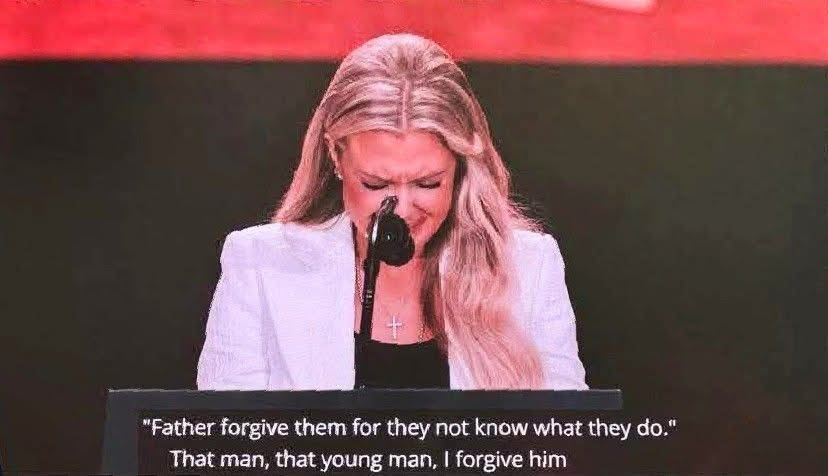
Erika Kirk then addressed the crowds and uttered the impossible word,
“I forgive him…I forgive him because it was what Christ did, and it is what Charlie would do.”
“The answer to hate is not hate,” she said. “The answer we know from the gospel is love and always love – love for our enemies and love for those who persecute us.”
This is the message our polarised world needs to hear. I thank God that God has not judged me according to every word I have said and every thought I have entertained. I am eternally thankful to God that he forgives sinners such as me. And grasping this gospel does something to us, where Trump’s words disappear and where love and forgiveness take shape.
What is so sad and troubling is that I know our culture well enough to see how this is going to play out in the media and social media: most people will simply double down on their prior commitments and attitudes. People are so entrenched in their ideological preferences that we will read the room as our glasses are glued onto our faces, and we are unable to see any other perspective. MAGA supporting Aussie conservatives will criticise me for my posture here and progressive Aussies will criticise me for not damning Charlie Kirk to hell alongside the President.
Reality is almost always more complicated and nuanced. One does not need to elevate Charlie Kirk to the status of Stephen (Acts 6) or label him ‘ult right’. The Christian truth is that sinners are saved by grace alone on account of the perfect sacrifice of Jesus alone. Anything else is hubris.
Here is a thought: regardless of our political leanings, if God uses the gospel preached at Charlie Kirk’s funeral to convince some people of God’s saving news through Jesus, will we rejoice or will we resent & grumble like Jonah in Ninevah?


 MurrayCampbell.net