I have read some of the stories being recounted in the media of teenagers being bullied and abused because of their sexuality. I would not wish such experiences upon anyone. It is because bullying is so detrimental to children (and adults too) that it is vital for schools to have in place effective and fair programs. In my view, Safe Schools is neither.
Despite what Bill Shorten and some others are claiming, it is possible to be concerned for these children and believe that Safe Schools is not the answer. It is possible to want these children supported and to see them flourishing, and have reason for believing that Safe Schools may cause more harm than good.
1. Bullying is real. Children are bullied in schools for all kinds of reasons, including race, religion, weight, social status, mental ability, and sexuality. Safe Schools doesn’t address any of these other forms of bullying and focuses solely on sexuality. This is not to ignore bullying on the basis of gender, but would it not be sensible to provide an overarching program that teaches children to respect and care for other people in all these areas? Indeed, many of our schools already run such programs, and to great success.
2. Session 2 of the program for year 7 and 8 students asks the question, ‘Imagine you are attracted to someone of the same sex…’ and students are then encouraged to pursue this path of possibility. Is this suitable for 11-13 year old children?
3. Why is an anti-bullying program providing links to websites where students can buy ‘sex equipment’, attend masochist training, and watch pornography? I understand that some of these links have been taken down, but why were they ever there in the first place, and who is to guarantee that they won’t reappear at a future date? These things may not be part of the formal curriculum, but they have nonetheless been added for students who wish to investigate further.
4. What materials and support is offered to students who experience same-sex attraction and do not wish to encourage or live out these desires? I am yet to find anything in all their website that will help these children.
5.Safe Schools teaches the false dichotomous view about peoples attitudes to gender differences: either you support and encourage all sexual variants, or you are a bigot and homophobe. This is simply not true, and to insist of such simplistic and erroneous positioning is intellectually and morally dishonest.
6. Heteronormativity is dismissed and alternative sexual expressions are encouraged. A child who believesheterosexuality is normal or desirable is labelled with heterosexism.
7. The material makes use of the Blooms Taxonomy, which is designed to make learning more than merely impartation of information and ideas, but to change behaviour and attitudes. In other words, Safe Schools is no mere anti-bullying program, it is carefully constructed to re-engineer how children think about gender and sex.
8. Why does the Safe Schools Coalition website cite statistics that lack scientific credibility?
These statistics are offered as assumed facts, however according to recent studies, the numbers are significantly lower than those suggested on the website.
I understand that gauging accurate numbers for sexuality and gender is near impossible given difficulties over definitions and categories, as well as social and cultural stigmas, and other reasons that may prevent some people from aligning with LGBTIQ. On top of that, other people find that with age and experience their self-understanding and lifestyle may change. Keeping all those variables in mind, the statistics presented by Safe Schools differs significantly to the major studies conducted around the world.
Safe Schools want us to believe that 10% of the population have same-sex attraction, whereas most scientific studies put the figure under 4% (and that includes bisexual people), and other research suggests even lower.
While the Safe Schools material states with confidence that 1.7% of people are intersex.
The American Psychological Association suggests the figure to be about 1 in 1,500, not the 1 in 60 which Safe Schools would have us accept as scientific fact.
And this research directly contests the 1.7% figure:
“Anne Fausto‐Sterling’s suggestion that the prevalence of intersex might be as high as 1.7% has attracted wide attention in both the scholarly press and the popular media…If the term intersex is to retain any meaning, the term should be restricted to those conditions in which chromosomal sex is inconsistent with phenotypic sex, or in which the phenotype is not classifiable as either male or female. Applying this more precise definition, the true prevalence of intersex is seen to be about 0.018%, almost 100 times lower than Fausto‐Sterling’s estimate of 1.7%.”
This kind of misrepresentation of facts and science straight away raises questions about the legitimacy of this program. It is analogous to a political party taking 10 polls, publishing the one that is favourable and deleting the 9 which are less supportive. Or it’s like coming home after a cricket match and telling everyone I scored 185 runs, when in fact it was 42.
Smaller numbers does not of course reduce the value of people who find themselves in these categories, nor does it excuse us from providing care and support for children struggling with identity questions.
9. Is it the role of the Government and schools to teach sexual ethics to children? It’s a question worth asking.
For a course designed to remove ‘stereotypes’, Safe Schools successfully stereotypes many people including some LBGTI people, by not giving legitimacy to people who for personal and sometimes religious reasons, do not believe in living out same-sex thoughts and feelings.
Surely there is a better way forward where we can encourage children to show respect and kindness, and to support children wrestling with identity issues, without pushing a course with questionable science, material, andthat has already begun estranging children in our schools.
When children speak in favour of atheism or secularism or GLBTI issues, they are praised and receive vocal public support.
sydneyanglicans.net
Last week, several anonymous female school students received wide public backing when they expressed to the ABC, “shock and frustration” by the “outdated” ideas Archbishop Davies promoted.Archbishop Glenn Davies had spoken at the annual service for Anglican School Leaders, and as part of his address he made comments about gender equality; nothing radical, he affirmed the historic Christian understanding.
But when a teenage girl spoke out on Friday in favour of the Bible and the Bible’s teaching about marriage, the story was sadly very different. Paige Katay wrote a piece for The Drum, and was also interviewed by Julia Baird for The Drum’s evening television program.
To be fair, and probably in view that a 17 year old school girl was speaking, many people dampened their rhetoric from some of the usual delights. It should also be noted thata significant number of people encouraged Paige for her courage, clarity and conviction. However, underlying many the comments was a streak of condescension, with frequent references to ‘brain-washing’and ‘indoctrination’.
Here are some examples from the comments section on ABC’s The Drum:
“Good that this poor child is having her washed brain questioned by @cassandragoldie who knows what happens when men rule”
“Spirited defence, but I suppose a girls Anglican school has to rationalise like this in order to stop the girls smelling a rat when the law of the land says they are equal to their brother….”
“Your “belief” that males and females have different gender based roles in society and relationships is incredibly sexist. This type of “belief” ALWAYS results in *MEN* occupying the primary positions of societal authority and power, whereas you interpret it as “a beautiful kind of harmony”. Yep, you’ve been very effectively and thoroughly brainwashed by your religion.
Yes, the Archbishop has you thoroughly controlled and brainwashed. After all, nearly 2,000 years of brutal Christianity has shown it’s all about domination and control of others. Luckily, old style violent Christianity has been slowly defeated over the past several hundred years by secularism ….. by secular morals, secular freedom, secular democracy and secular decency. Hopefully Christianity will never return to it’s bad old days.”
And among the responses on twitter (some tweets are sadly unrepeatable):
“Poor brainwashed indoctrinated Child.”
“Paige Katay believes in invisible men in the sky & has been indoctrinated from age zero. Her opinions are worthless.”
“I had been mightily impressed with how today’s young people seem so progressive and socially aware. Then along came Paige Katay.”
As I observe Australians debating important issues, I can see three main approaches:
The first approach (and most common) is where there is no engagement with an opposing view with reasoned argument or questions, just ridicule and bullish tactics.
This has become all to common when discussions use the word ‘gender’ or ‘marriage’.
I had believed that bullying was a reprehensible act, and the public outraged at any whiff of children being intimidated, but apparently it is okay if the person in question is a Christian teenage girl affirming her beliefs.
The second approach is somewhat better, although far from ideal. Here, there is no engagement with the views actually presented, but loaded with assumptions about what we ‘think’ the person has said or should be saying, a critique is offered. But arguing against a caricatured position is hardly fair and it does little to progress debate.
This was evident on Friday’s episode of The Drum, when Tom Allard was asked a question about Paige Katay’s views. He began by rebutting an idea that Paige never articulated, and when Julia Baird corrected him, he then spoke against a view of the Bible that no Christian that I know of, believes or teaches.
The third approach is where each party listens carefully to the others, and can repeat accurately the views you disagree with, and then offer a respectful critique, and finally outline your own position. It requires humility, honesty, and kindness, even when you feel strongly about the issue.
As Australians talk to polemical social and moral issues, I am not surprised that many are choosing to interact in the first two ways,although I am nonetheless disappointed and saddened, especially when politicians and ‘leaders’ resort to these machiavellian tactics. Here, I want to encourage people, especially Christians to work hard at exemplifying the third way. Paige Katay has given us a wonderful example, as have many other Christians in the public space. Indeed, non-Christians such as the now former Human Rights Commissioner, Tim Wilson, also give us an example.
I remember watching a short video conversation on the Gospel Coalition website between Tim Keller, Matt Chandler and Michael Horton, where they agree that we want to be in the place where we can express the views of our opponents better than they, such that they can see that we understand them.
Meekness may not be easy, but Jesus certainly thinks it is the way to go. Let’s resist hateful speech, false representations, and parodies, and insist upon words and a way of communicating that reflect the Lord Jesus.
Over the past week I have been listening to people comment on the speech given by journalist, Stan Grant, on the issue of Indigenous reconciliation and racism.
I watched it today and found Mr Grant’s words compelling, sad, difficult and necessary. I would urge all Australians to take the 8 minutes it requires to listen to the speech in full.
In Mr Grant’s voice there was heart-felt honesty but no self-pity, anger but not rage, truth-telling but not condescension.
As a preacher I am aware of the tenure of peoples’s reactions to words; forgetfulness often quickly follows acknowledgement. A problem with speeches like Mr Grant’s is that we are moved by them, and for a few days we agree with them and believe that action needs to follow, but soon enough we have forgotten those beliefs and emotions, and words, and nothing changes.
For example, in 2009 Rev Dr Peter Adam gave the John Saunders Lecture. He spoke on the issue of indigenous peoples in Australia, and in particular he addressed the issue of land ownership and recompense:
“No recompense could ever be satisfactory because what was done was so vile, so immense, so universal, so pervasive, so destructive, so devastating and so irreparable.’’
‘We European Australians often claim that one of the strengths of the Australian character is ‘caring for the underdog’. That claim is hypocrisy – we do not act with justice, let alone care.”
At the time, Adam’s lecture gained attention in the media, with it being reported in The Age and Sydney Morning Herald. I remember it well because it was the first time I was convicted to think seriously about reconciliation issues with Indigenous Australians.
Will this be another speech remembered for its oratory or for the change it brought to this country?
The God whom I know and worship is the God who made the heavens and earth, and who made all humanity in his image.
It was out of this theological conviction that Martin Luther King cried,
‘I have a dream that my four little children will one day live in a nation where they will not be judged by the color of their skin but by the content of their character.’
This God sent his only Son, Jesus Christ, into the world because humanity was bent on throwing away the dignity of the imago dei. Humanity’s actions have resulted in the belittling of human life in a thousand different ways, including the abhorrent belief of racial inferiority
We cannot live in the past, but living in the present can remain most hard when our history remains unresolved. To this, I am looking forward to the Day when God will put away forever all that is wrong and evil, but in the present we remain responsible for our words and actions, and to ignore the call for reconciliation when it is given us, is simply iniquitous.
At this time, let us re-issue calls to include in our national constitution a statement recognising the first Australians. Of course, the wording of such an inclusion is incredibly important, and so instead of deferring it because the task is complex, let’s move forward.
Also, January 26th is our national holiday, and on this day I will give thanks for the many blessings we enjoy in our country. It does seem as though the date has evolved beyond the tall ships in Botany Bay, as it is now cherished by many thousands of immigrants who have no connection to 1788, but who have made their home here from all corners on the globe and who celebrate becoming citizens on this date. But I am stillconscious of the fact that for many Indigenous people, ‘Australia Day’ is not so celebratory.
Are we so tied to this date that we cannot move to another?
I have heard it suggested that we should make Federation Day our national day. It’s not a bad idea, except that it’s January 1st!
These two changes may be symbolic, but they are also tangible expressions to our fellow Australians that we recognise their pain, we acknowledge past sins, and we are eager to pursue reconciliation.
UPDATE (Dec 23, 2pm): Peter Dutton has announced that Hassan Asif’s family will now be granted visa to Australia to visit their son/brother.
Good news
A good decision
—————————-
You may have heard the heart wrenching story of Hassan Asif today. A 24 year old student from Pakistan who has terminal cancer. His mother and brother have been refused visas to enter Australia, so that they can be with their son and brother, as he dies.
This is dreadfully sad, and of course I am not privy to all the story. From the report, it sounds as though the family were denied because it was believed that they might out stay their visa time frame.
Tonight, I wrote this brief letter to our Prime Minister, Malcolm Turnbull, asking him to reconsider the decision. Perhaps you might like to consider contacting Mr Turnbull or Mr Dutton also.
Dear Prime Minister,
I have heard of the extremely sad situation facing Mr Hassan Asif, and I am asking that we show compassion and grace to him and to his family, by allowing Mr Asif’s family to travel to Australia. No one should have to face death without being surrounded by loved ones. Sometimes this happens, but when the power is in our hands to avoid it, we have the moral imperative to act.
Perhaps there is reason behind declining visas to the family, but I am wondering whether we can show kindness to them, given the circumstances.
I am sure that there will be many Australians who will be willing to assist in bringing the family to Australia, and to caring for them while they are here.
Australians (and the West at large)don’t know what to do with religion. We don’t want to say that one religion is better or worse than another, but how do we deal with aspects of religion that are unacceptable? While ISIL are not supported by most Muslims, adherents are nonetheless practicing a devotion to Islam that finds support in the Koran. However because their ideology does not conform to the accepted pluralist world-view that all religions are valid, we hear political and religious leaders being forced to explain them away.
I don’t claim to speak for everyone and I don’t want to suggest that what I’ve written isn’t without bias. What I have written is a list of criteria that I try to practice when I’m talking with people about my Christian beliefs.
1. Show grace. Pride is not a Christian virtue. The very nature of Christian faith is that knowing God is a gift from God through Jesus Christ. Therefore, as we engage in conversation with people from different religions we avoid arrogance and pride, both in what we say and in the manner we speak.
2. Be gentle and respectful. When we talk to men and women we are speaking with people who are God’s image-bearers. That imago Dei, like in ourselves, is broken, but we maintain that they have value and ought to be treated with dignity. Therefore we don’t support graffiti on Mosques or other buildings, and we don’t support verbal or physical abuse toward people of other religions
3. Be honest about differences, and recognise that some contrarieties really do matter. One of the great weaknesses in current religious discourse is the unwillingness to call a spade a spade. Where there is commonality and agreement it should be recognised, but the pretend game of sameness is intellectually dishonest and shows disrespect to the many who hold to those points of difference.
There is no value in diminishing, ignoring or lying about differences in theology, ethics, or politics. For example, Christians and Muslims must not pretend that they share the same view of Jesus: Muslims do not believe that Jesus is fully and eternally God, Christians do. Muslims do not believe that Jesus was crucified and died on the cross, Christians do. Muslims do not accept that the Bible is God’s authoritative, sufficient and final word, Christians do. In the same way Christians don’t accept the Koran as a holy book, whereas Muslims do.
There exists an epistemological crisis in the world right now. The current crisis is not merelya moral one, but it is about how we understand truth. September 11 2001 shocked the world, not only because of the scale of evil perpetrated, but because it exposed the foolishness of our deference to the philosophical liberalism in the West; we were reminded that not every world-view is equally good or valid. Despite the warning, 14 years have now past and most of us in the West continue to walk the line of relativism. Will the recent and appalling rise of ISIL rouse us from the age of the post-critical conscience or will we keep popping our everyone-is-right pills?
4. Don’t excuse or protect the sins of your family. Sin is sin, whether it is perpetrated by someone else or by me. Christians can be guilty of wrongdoing: sometimes they break the law, other times they act lawfully but in ways that are unloving and therefore spurious. In the name of Christ, men and women have committed acts of cruelty and hate, not because of the Christian Bible but because they have abused the Bible in the pursuit of personal agendas. Where and when we are wrong we need to confess and repent, and repentance includes accepting the cost of restitution.
5. Aim to persuade. Coercion, threats, insults, violence – such things don’t help anyone. Beating someone down with a string of rapid rhetorical assaults does little more than create more distance between people, making genuine communication even more difficult. Persuasion, however, is healthy because it gives due weight to the subject at hand and it shows respect for the person with whom you are dialoguing. Persuasion says that people matter and the topic of dispute is too important for flippant dismissal or violent suppression. Persuasion includes using considered argument, showing coherence in your reasoning and providing evidence, using story and testimony, appealing to peoples hopes and desires, pointing out the weaknesses and untruths in alternative beliefs, and speaking with clarity and conviction.
6. Don’t caricature people or their beliefs. Not all atheists are like Richard Dawkins. Not all Muslims support ISIL. Not all Arabs are Muslim. Not all politicians are self-seeking egomaniacs. Not all Baptists are tee-totalling anti-fun facebook club members!
7. Seek to understand. Too often we assume what other peoplethink and believe. Let’s not ignore the power of attentive listening, and of asking questions and taking time to research what other religions believe, teach and practice.
8. Live what you believe. Christianity doesn’t begin or end on the blog or at the public meeting, it continues through every encounter in all of life. If what Christians believe is true and good then it will influence every aspect of our interactions, both private and public.
When was the last time we smiled at and said hello to someone who was Muslim or Hindu? When was the last time we invited into our home for a meal someone who practices another religion? When was the last time we shared the good news of Jesus with someone from another religion? Why not put these things on our agenda?
9. The State and not the Church has the role to exercise civil and military authority. Unlike Muslim Scriptures, the Christian Bible recognises a distinction between the Church and the State. Throughout history not everyone has properly practiced this, but that has been due to a rejection of the Bible’s teaching, not adherence. However, in Islam there is no such distinction between religious and civil law and Government, hence Saudi Arabia and some of nations, as well as the theology underpinning ISIL. Having said that, other Muslim majority nations such as Turkey, have managed to move away from this orthodox Islamic worldview. (This article in The Atlantic about “What ISIL Really Wants” is worth reading)
“For the one in authority is God’s servant for your good. But if you do wrong, be afraid, for rulers do not bear the sword for no reason. They are God’s servants, agents of wrath to bring punishment on the wrongdoer. 5 Therefore, it is necessary to submit to the authorities, not only because of possible punishment but also as a matter of conscience.” (Romans 13:3-5)
My point here, is thatGovernments have responsibility to protect its citizens and to punish those who harm its people. It is not wrong for the French people to desire justice, and we must recognise that issues surrounding a response are complex. Doing nothing is hardly going to stop ISIL and engaging militarily seems to play into their agenda. Recognising them as a legitimate state is out of the question, given their propensity to abuse and kill thousands under their the control, and they are clearly not content to limit their borders at their current places. What we can do is pray for our Governments.
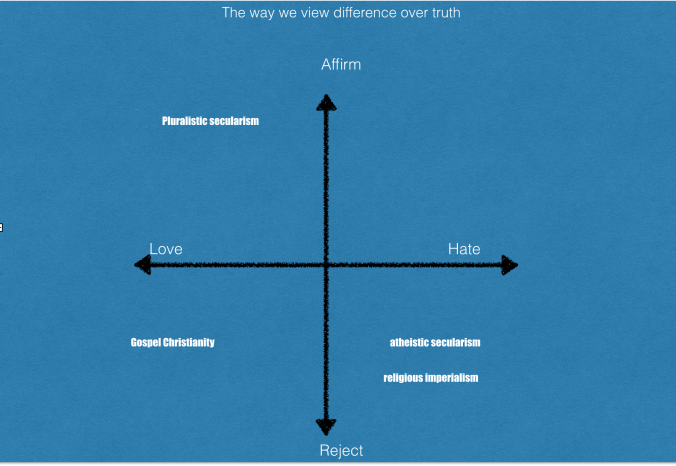
Below is a diagram that represents various approaches to viewing difference:
“You think freedom means doing what you like. Well, you’re wrong. That isn’t true freedom. True freedom means doing what I tell you.” (Shift, in The Last Battle)
I can’t remember many times when I have found myself agreeing with Germaine Greer, but on this occasion I am at least sympathetic with her situation. A petition with over 800 signatories is pushing to ban Germaine Greer from giving a lecture at Cardiff University, on account of her views about sexuality. That’s right, one the world’s most outspoken voices on women’s rights and sexual liberties is apparently too orthodox for these students.
The author of the petition commented, ”Greer has demonstrated time and time again her misogynistic views towards trans women, including continually misgendering trans women and denying the existence of transphobia altogether.”
“While debate in a university should be encouraged, hosting a speaker with such problematic and hateful views towards marginalised and vulnerable groups is dangerous. Allowing Greer a platform endorses her views, and by extension, the transmisogyny which she continues to perpetuate.” (quoted in The Age October 25, Petition calls for university to ban Germaine Greer from event over ‘hateful’ transgender views)
Based on this explanation it sounds as though Germaine Greer must hold some very distasteful views about transgender people. However, when I listened to Greer’s views, it appears that the accusations are false. The point that so riled these Welsh students is that Greer believes that surgical and hormonal treatment does not make a man into a woman. In fact, Greer does little more than state a biological fact. Listen to this interview by the BBC (language warning):
The allegations are so ridiculous; I feel like I need to rub my eyes to make sure that I’m not living in some fantasy land. But no, this isn’t Narnia or Animal Farm.
The allegation of transmisogyny maybe unfounded, but that doesn’t matter because the accusation itself is an effective way to silence opposing views.It may not have worked in the case of Germain Greer, not but not everyone is boisterous and thick skinned.
These students from Cardiff University have used a tool of debate that is becoming all to common:
Silence your opponents by accusing them of hate.
Silence your opponents by insisting that their views will lead to abuses.
No one is doubting that homosexual and transgender people have suffered abuses, and speaking out about such treatment is only right. The issue here, however, is not about protecting transgender people from hate and abuse, it is about denying people the freedom to discuss and disagree with the current sexual milieu. What makes this whole approach particularly ugly is that it is using people’s vulnerabilities and fears as a smoke screen for social engineering.
Germaine Greer is not the first victim of these Calormene-like speech police, this is the growing experience for many groups in the UK, Canada, Germany and the USA; especially Christian groups.
Sadly, this change of climate is also moving over Australian society, and a cold winter is gradually freezing out free speech. Take for example, Bill Shorten’s op-ed piece for Fairfax on the issue of the plebiscite for same-sex marriage:
“But I don’t think enough attention has been paid to the biggest risk a plebiscite brings – the danger and the damage of unleashing a divisive, drawn-out debate.
A plebiscite could act as a lightning rod for the very worst of the prejudice so many LGBTI Australians endure. A platform for people to attack, abuse and demean Australians on the basis of who they love.”
In other words, we should by-pass public opinion because public views may not necessarily conform to the progressive agenda.
“You thought! As if anyone could call what goes on in your head thinking.” Just as Shift challenged the Bear who dared question him, we seem to bemoving toward a democratic totalitarianism, where society permits us to support same-sex marriage and sexual fluidity, but we are no longer free to offer a dissenting voice. Nowhere is this more evident than perhaps in Victoria where the Daniel Andrews’ Government is introducing policies that deliberately target the removal of Christian ideas and values from the public arena.
Deitrich Bonheoffer observed how the Reichstag Fire Decree of 1933 changed the public space in Germany. He wrote,
“Restrictions on personal liberty, on the right of free expression of opinion, including freedom of the press, on the rights of the assembly and association, and violations of the privacy of postal, telegraphic and telephonic communications, and warrants for house searches, orders for confiscations as well as restrictions on property, are also permissible beyond the legal limits otherwise prescribed.”
We have begun down this insane path, and if the media and certain political parties are anything to go by, the journey is just beginning.
In light of this, I offer these 3 suggestions:
1. Don’t accept the premise behind the case for marriage change. Disagreement and disapproval does not equal hate. The Bill Shorten’s and Cardiff students of this world would have us believe that there are only two roads to travel, either total acceptance or hate and fear. Both options are untenable. Christians know that the Gospel of Jesus Christ offers us a third way, that of loving and reasonable disagreement.
2. Don’t yield to the pressure and remain silent. It is important for the plurality of Australian voices to be heard in the public space.
3. Speaking up is no longer free; it will come at a cost. Our situation is unusual in light of world history; we have enjoyed social freedoms that people in many other parts of the world have never experienced. It has been possible to speak openly without any genuine sacrifice, perhaps a few crude comments thrown our way but nothing more. We need to wake up to the fact that Australia has changed, and for Christians, Jesus’ words about taking up our cross may become more than just words.
A donkey dressed up as a lion is still a donkey, no matter how much a monkey tells you otherwise. That old Narnian like Bear, Germaine Greer, has spotted a fraud in public discourse and we Aussies’ would be wise to also question the course that national conversation is now taking.
Fairfax Media has published an astonishing piece by Paul Sheehan, Operation rescue: the Christians of the Middle East face extinction. It is remarkable because it pushes against the assumed political correctness that often strangles public conversation in Australia today, and it contrasts the mood of our secularist dominated media which is obsessed with denigrating all things Christian.
Sheehan presents two reasons why Australia should increase its refugee intake, and to allow these numbers to consist of displaced Christians from the Middle East:
Firstly, he is right to point out that, ‘For the past 20 years Christians have been ethnically cleansed across much of the Middle East as part of the rise of Muslim militancy’. This is true, although the persecution has existed far longer than 20 years. Christians remain among the most vulnerable and persecuted peoples in the world, and what we are witnessing in the Middle East is but one example.
Christians are not the aggressors in these Middle Eastern conflicts; they are among the most targeted victims. Christians are literally being exterminated. The New York Times published a piece in July revealing the extent of thepersecution.
I have already read several responses to Paul Sheehan, where people are blaming the ‘Christian’ West for the situation in Iraq and Syria. But to fuse Christianity with the West is a sloppy an analysis as calling all Arabs, Muslim or all Syrians, Muslim. The fact is, the conflict between Sunni and Shia, and their common dislike for Christians and other minority groups, pre-dates era 9/11, President Bush Senior, and prior to the Sykes–Picot Agreement of 1919. That is not to say that Western intervention hasn’t made issues more complex; it has been one hundred years of immoral intrusion, but it is grounded in selfish capitalism, not sacrificial Christianity. Syrian Christians and Iraqi Christians cannot be blamed for the West, and Western transgressions aside, the fact remains that Christians are being targeted, thousands have been slaughtered, and survivors forced out of their homes to flee for their lives.
The international community increasingly recognised that Christians in the Middle East have become a displaced people group, and therefore a humanitarian response is to welcome them into Australia.
Second, Sheehan argues that Christians will better assimilate into Australian society.
He believes that Christians are less of a threat to social cohesion in Australia than some other groups. I am not an expert on Sunni/ Shiate tensions, and so I can’t evaluate his point. Perhaps the concern has warrant and therefore it’s not without consequence, and I am sure that there are experts out there who can make comment. Having said that, there can be no doubt that there are also significant numbers of Sunnis and Shias who are victims of atrocities; where they are fleeing from their homelands we ought to consider welcoming them.
I do not believe that we should exclude refugees on account of their race, culture, or religion. If a neighbour’s house is on fire, you don’t first ask them for their passport, resume, or survey their theology; you help them on account of their humanity.
In other words, I am persuaded by Paul’s Sheehan’s first point, but not his second.
I also support Sheehan’s idea of Churches working in conjunction with the Federal Government. I am certain that Australian Churches will gladly work together with the Government to assist these refugees, whether they are Christian or not. To this end, I am encouraging Mr Abbott, Mr Dutton, Ms Bishop to speak with Christian leaders across the country.
Finally, there is a certain irony in all of this, these Christians are fleeing lands that don’t want them, perhaps only to arrive in a new land that is increasingly expressing malice towards Christians. The methods are different, but the motive is similar. For instance, I read this caustic response to Paul Sheehan, ‘Don’t let Christians in. Let people of reason in. Giving people an advantage because they follow a palatable brand of delusion doesn’t seem fair.’ Sadly, this sentiment is all too common in Australia today. One can only hope that the irrationality of such foolish people is muted by the voice of generosity and welcome.





 MurrayCampbell.net