Coldplay is in town. It seems like every second friend has bought tickets and is joining in the chorus of ‘Yellow’ and singing, ‘I used to rule the world’
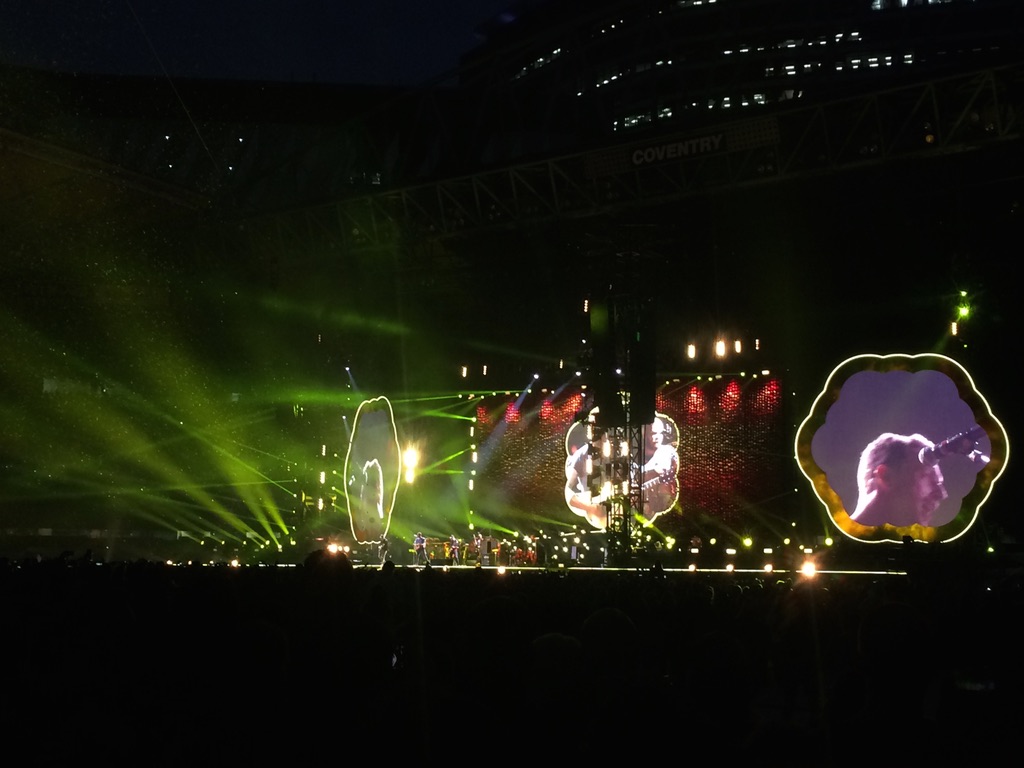
The last time Coldplay performed in Melbourne was in 2016, and I took my 2 boys to the concert. The eldest, who was 11 at the time, had aspirations to be a drummer like Will Champion. The night was a kaleidoscope of colour and light and memorable tunes.
Coldplay is back in Melbourne and singing a prayer.
By prayer, I’m not referring to fans hoping to see Guy Berryman after illness forced him to miss out on performing with the quartet for the first time in their 27 year history (I believe he returned last night for their second Melbourne concert). Coldplay’s latest hit song is called, ‘We pray’.
‘We pray’ was written by lead singer, Chris Martin, in conjunction with a group of musicians from around the world, and it explores his personal journey in spirituality and understanding the human condition.
The song itself is a congregational invocation to prayer. The lyrics are deliberately vague for no particular god is addressed and his character and personality are unknown. The song is about the human longing for help, hope and forgiveness.
‘We pray’ is clever because people can fill in the gaps however the wish, but is that point of prayer? The word grabs onto some vague and universalist notion of the Divine: unnamed and unknown.
It’s hoping without knowing, it’s needing and not possessing.
Take a look at some of the lyrics,
Pray that I don’t give up
Pray that I do my best
Pray that I can lift up
Pray my brother is blessed
Praying for enough
Pray Virgilio wins
Pray I – I – I
Judge nobody and forgive me my sins
I pray we make it
Pray my friend will pull through
Pray as I take it
Unto others I do
Praying on your love
We pray with every breath
Though I – I – I’m in the valley of the shadow of death
Pray that we make it to the end of the day
And so We Pray
I know somewhere that heaven is waiting
And so We Pray
I know somewhere there’s something amazing
And so We Pray
I know somewhere we’ll feel no pain
Until we make it to the end of the day
Coldplay is, of course, singing a similar tune to one that is all over our streets and suburbs today.
Human beings are deeply spiritual. The sum of who we are cannot be reduced to skin, bones, blood, and organs. This is one reason why the new atheism was always doomed to be little more than a cultural fad. The materialist world cannot sustain or explain the needs and hopes found in the human soul. But neither are we left in the realm of guessing and taking a stab in the dark.
New Atheism is dead. In places like Australia and the UK, neo-paganism is gaining traction, Eastern religions are growing (largely through migration), and people are dabbling in alternative spiritualities in volumes I’ve not seen before. Why? The soul needs peace. We need hope.
‘We pray’ is a descriptor of the human condition but it doesn’t give any substantive answer.
Prayer isn’t a magical amulet that I rub and repeat. Prayer without relationship with the actual living, listening and loving God is little more than a placebo. What if real prayer was possible?
Coldplay’s idea of prayer isn’t original. The city of Athens was renowned in ancient times for its religious pluralism. In fact on the day the Apostle Paul walked through that great city, he noticed a statue to the Unknown God. The citizens of Athens erected a monument to a God with no name, just in case the pantheon of gods had missed one and so people could pray and pay homage to this unknown divinity, hoping to find blessing and help.
Paul, this early Christian leader, made a commentary about this Athenian spirituality, when the leading intellectuals invited the him to address the famous Areopagus, “May we know what this new teaching is that you are presenting? You are bringing some strange ideas to our ears, and we would like to know what they mean.”
What follows is one of the great speeches of history. The words of this address, both astonished and intrigued people in what was the equivalent of Oxford in the day, and I suspect there is good reason for the people of Melbourne to be similarly astonished and intrigued today.
“People of Athens! I see that in every way you are very religious. 23 For as I walked around and looked carefully at your objects of worship, I even found an altar with this inscription: to an unknown god. So you are ignorant of the very thing you worship—and this is what I am going to proclaim to you.
“The God who made the world and everything in it is the Lord of heaven and earth and does not live in temples built by human hands. 25 And he is not served by human hands, as if he needed anything. Rather, he himself gives everyone life and breath and everything else. 26 From one man he made all the nations, that they should inhabit the whole earth; and he marked out their appointed times in history and the boundaries of their lands. 27 God did this so that they would seek him and perhaps reach out for him and find him, though he is not far from any one of us. 28 ‘For in him we live and move and have our being.’ As some of your own poets have said, ‘We are his offspring.’
29 “Therefore since we are God’s offspring, we should not think that the divine being is like gold or silver or stone—an image made by human design and skill. 30 In the past God overlooked such ignorance, but now he commands all people everywhere to repent. 31 For he has set a day when he will judge the world with justice by the man he has appointed. He has given proof of this to everyone by raising him from the dead.” (Acts 17)
In summary, he explains:
- There is a God and he is the powerful and purposeful creator of the universe.
- This God doesn’t need us but provides us with life and breath.
- God has made himself known
- We don’t fashion God’s existence.
- The world will be held to account by God (how we need a God is right and just and will do justice)
- The definitive proof of God is the resurrection of Jesus Christ from the dead.
Understand, these points are but the introduction to all that Paul had to say, but straight away he eliminates vagueness and universality. There is God and he is this God. It’s not guesswork and speculation, but the resurrection of Jesus is proof.
Does it matter to whom we pray? Is the efficacious nature of prayer found in the activity itself or in the one to whom we address?
Why does it matter which God we pray to, if the spiritual and psychological benefit lies in the activity?
By way of illustration, would it matter if I spoke to any individual and in any way, assuming or hoping that they were my spouse? Would it be appropriate to pour out my heart in a married kind of way with any random person who happened to hear me talking out loud on the street?
Apart from the fact that they have no duty to listen or respond to my words, how belittling and insulting it is to the person who actually is my spouse!
To whom we pray does matter.
On one occasion Jesus speaks about lostness. This being lost is a way of describing our natural state; being disconnected from God and the forgiveness and life that can be found in him. We wander about and test and experiment, looking for a way to leave behind this state of hopelessness and uncertainty. Jesus says, he is the way. He is the One who came to seek and save the lost.
Don’t believe me? You don’t have to take my word, check out the resurrection of Jesus.
I love this prayer that Jesus taught. It is to God who is named, known, who is just, who forgives, and in whom we can depend,
Our Father in heaven,
hallowed be your name,
your kingdom come,
your will be done,
on earth as it is in heaven.
Give us today our daily bread.
And forgive us our debts,
as we also have forgiven our debtors.
And lead us not into temptation,
but deliver us from the evil one
 MurrayCampbell.net