Richard Dawkins asks an important question and here is my answer

I can imagine Richard Dawkins sitting in the back row at the Areopagus, stern-faced and shaking head, and leading a small chorus of sceptics.

Richard Dawkins is continuing his mission to evangelise people out of Christianity (and religion altogether) and to secure his message of a world without hope. 

Today in a video message, he asks, ‘Do you want to be comforted by a falsehood?’

It’s a good question and an important one. Does anyone want to find consolation in a fabrication? Does anyone want to pour all their hopes into a dead end? For Professor Dawkins death is of course the dead end, with nothing beyond and no light to give hope to either the dead or those who are left behind. 
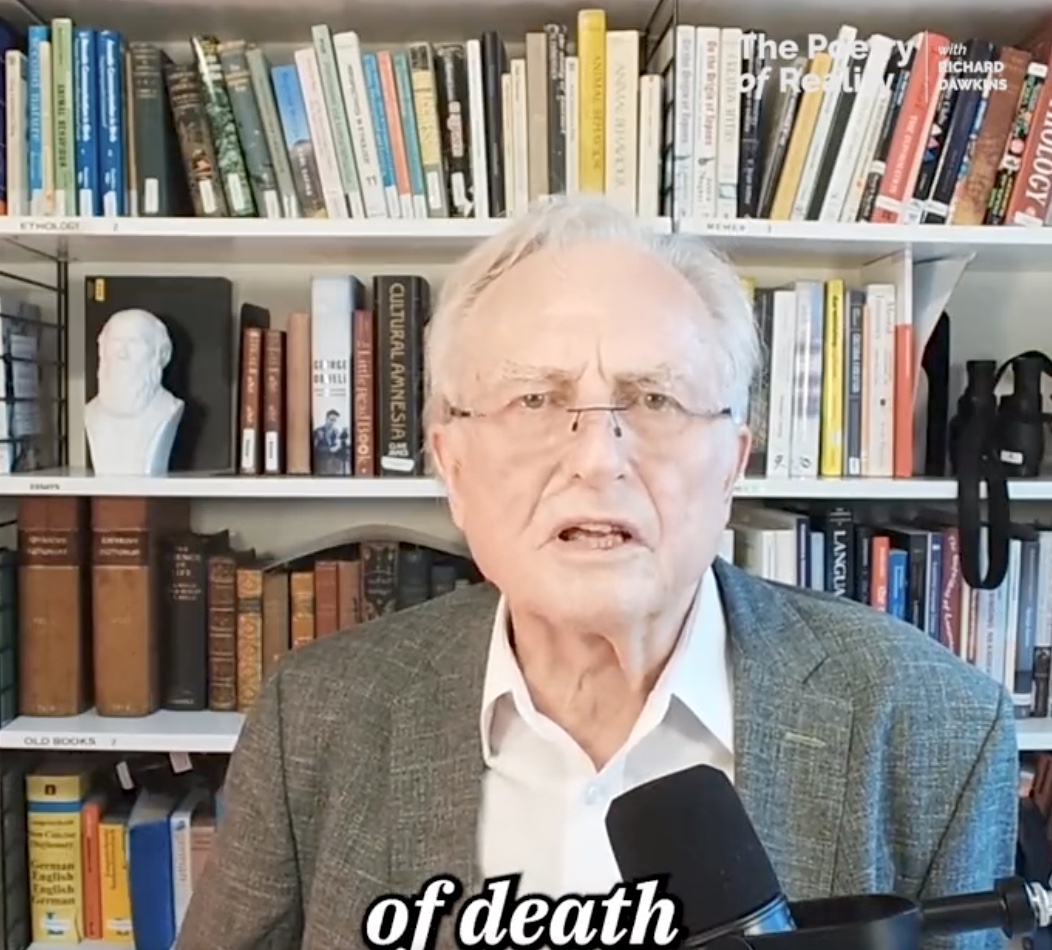
“When your brain decays there is absolutely no reason to suppose your consciousness will continue, so the grounds of plausibility, the balance of plausibility is heavily in favour or there been no survival after death and that is something and that is something we need to live with. It’s not all that horrifying a prospect when you think about it because we think as Mark Twain said, ‘I’ve been dead for billions of years before I was born and never suffered the smallest inconvenience.” 

I suspect that Dawkins’ answer will arouse applause and retweets from fans and devotees, and with a satisfied Amen. Leaving aside for a moment the question of whether he’s right or not, his answer isn’t particularly consoling. Dawkins says that he finds solace in the finality of being no more, but I suspect most people including a lot of atheists are not so convinced. Our intellectual commitments (whether theistic or atheistic) come under a sudden assault when death approaches and when a loved one is lowered into the grave. There is a longing for death not to win. There is palpable hope that life may continue and love to beat any final breath. 

Why divorce cognitive processes from heart filled yearnings? Of course, the two can be in conflict and they can also partner together as a harmonious duet, as we find in Christian theism.

Dawkins (and fellow atheists) believes that once our final breath expires and we are buried, the totality of what we were begins to rot and we cease to be. All that is left is the box in the ground holding our biological material and the memories that people have of you. Again, some readers may find that a satisfying end of the story, but most of us don’t. Whether we find it satisfying or not isn’t evidence of what is ultimately true.

The thing about the Christian view of resurrection is not one of lacking commitment to the intellectual process but appreciating that there is more going on. It is not wrong to appeal to deep heart filled longings, for those emotional impulses are part of who we are as human beings. We are more than those heart desires, not less.

I believe, along with Oxford and Cambridge Dons, scientists, poets, plumbers and children, that the Christian explanation of resurrection is both intellectually satisfying and emotionally, psychologically, spiritually liberating and consoling.

Something happened that day just outside Jerusalem that changed the world. Women and men saw something that didn’t compute. The evidence defied their prior assumptions and challenged their emotional state. They saw and heard and touched Jesus raised from the dead. 

Before we line up the Biblical accounts with ancient mythology, we mustn’t assume that resurrection was a commonly held view in the ancient world, for that is not the case. Many ancient religions believed in some kind of life after death, although not all (including many Athenians in the First Century AD).  The Christian notion of resurrection is altogether different 

As Dr Chrisopher Watkin summarises in his new volume, Biblical Critical Theory

“The nature of the resurrection is very different to the ancient notion of rising gods known as apotheosis. The bodily nature of resurrection sets the Christian claim apart from other superficially similar narrative patterns in the ancient world. The Romans, for example, were familiar with the idea that a mortal person could undergo an apotheosis to become a god, but apotheoses were spiritual, not bodily, and the deified mortal would not be expected to tread the streets of Jerusalem for forty days before ascending to heaven. Apotheosis was also a privilege reserved for the rich and mighty, not for the common artisan and certainly not for the crucified criminal. Christ’s resurrection was also different from the myths of dying and rising agricultural gods in other pagan religions. N. T. Wright, author of the 740-page The Resurrection of the Son of God insists that “even supposing Jesus’s very Jewish followers knew any traditions like those pagan ones—nobody in those religions ever supposed it actually happened to individual humans.”

Richard Dawkins talks about plausibility, as does the Apostle Paul at the Areopagus. He insists, let’s examine the evidence. At that centre of Athenian learning and thought, Paul argues for the resurrection of Jesus Christ from the dead. He began, 

“He  [God] has given proof of this to everyone by raising him from the dead.”

Proof? I can hear Dawkins of Athens reproving! What proof? Dead people stay dead. Their brains, blood, muscles and organs decay and become a manure in a box. 

Of course, Paul, like Jesus and like Christians everywhere, knew that dead people don’t rise. That’s the point and the resurrection testifies to our wrong assumptions about God and life and death. 

What I found interesting in Dawkins’s tweet is how he relies heavily on Bible reasoning in order to muster an argument against God and the notion of life beyond death.  Take, for example, this paragraph from Paul’s First Letter to the Corinthians, 

But if it is preached that Christ has been raised from the dead, how can some of you say that there is no resurrection of the dead? 13 If there is no resurrection of the dead, then not even Christ has been raised. 14 And if Christ has not been raised, our preaching is useless and so is your faith. 15 More than that, we are then found to be false witnesses about God, for we have testified about God that he raised Christ from the dead. But he did not raise him if in fact the dead are not raised. 16 For if the dead are not raised, then Christ has not been raised either. 17 And if Christ has not been raised, your faith is futile; you are still in your sins. 18 Then those also who have fallen asleep in Christ are lost. 19 If only for this life we have hope in Christ, we are of all people most to be pitied.

20 But Christ has indeed been raised from the dead, the firstfruits of those who have fallen asleep. ” (1 Corinthians 15:12-18)

The Apostle, and subsequently Christian theologians, scientists, and believers in general, all understand the implausibility of resurrection and understand that single event of history that dumbfounds the Sadducees and Epicureans of every age. 

It is worth noting that Paul’s words were written within 20 years of the events that surrounded Jesus’ death in Jerusalem. He even says to his readers, that many eyewitnesses are still alive so go and talk to them. His are not the words of someone covering up evidence and trying to commit fraud on the public. The resurrection is a public event that is open to investigation. 

For Dawkins, as brilliant a scientist as he is, he believes in a closed universe and so it’s unlikely that he’ll accept any compelling evidence that punctures his system. Even Jesus was aware of how our a priori commitments block us. He famously said, “‘If they do not listen to Moses and the Prophets, they will not be convinced even if someone rises from the dead.’”

Why? Because there is more going on in our minds and hearts than just intellectual questions and the pursuit of what happened.

Richard Dawkins may have made up his mind, but death will continue to haunt us. The grave is the one appointment we hope to avoid and yet will come. To take consolation in Christ is not fake or feeble, but reason finding hope. 

If you are interested, below is a short summary of the evidence outlined in the New Testament as well as a summary of some of the more popular objections to the resurrection.

The facts:

1. Weeks out from his death on the cross Jesus predicted with startling accuracy what would happen.

 “Jesus began to explain to his disciples that he must go to Jerusalem and suffer many things at the hands of the elders, the chief priests and the teachers of the law, and that he must be killed and on the third day be raised to life”. (Matt 16:21)

2. Jesus genuinely died and his death was verified by the executing authorities (Matt 27:50-54)

3. After Jesus’ death had been verified, Pilate released the body to Joseph of Arimathea who buried it in his own new tomb, carved out of rock in a garden near the place of the crucifixion (Matt 27:57-60).

4. The tomb was sealed and was guarded by Roman soldiers (Matt 27:62-66).

5. A number of women witnessed the burial and presumably the posting of the guard (Matt 27:61)

6. On the Sunday following the crucifixion the body was no longer in the tomb (Matt 28:1-7).

7. That same day, and over the next 40 days, Jesus met with his original disciples and others (later Saul). During this period the commission to be his witnesses, first to the Jews and then to the nations, was given by Jesus himself (Matt 28:1-20)

8. After 40 days Jesus was taken up into heaven, a cloud hiding him from sight (Acts 1:9-11)

Some arguments against the resurrection:

TheoryChief exponentsSome suggested responses
Intentional fraud by the disciplesJewish High Priests; H.S Reimarus (1787)How could it be done despite the guard and the suspicion of the authorities? How could the lie be sustained for the rest of their lives and in the face of fierce persecution?
Swoon TheoryPaulus (1833) Huxley (1896) Thiering (1992)His death was verified by experts when Pilate raised questions. If he did revive in the cool of the tomb, how did he roll away the stone, get past the guard, and walk all the way to Emmaus with those wounds?
The women went to the wrong tombLake (1907)The women were nearby as Jesus was buried. Joseph of Arimathea would certainly know which tomb was his. The guards and the seal would have made the tomb rather conspicuous. The authorities could have just gone to the right tomb and produced the body.
Jesus was never actually crucified (someone was)The KoranIt is inconceivable that the Jewish authorities would have stood by whilst the Romans crucified the wrong man. Surely this argument would have been used by the Jews to combat the apostle’s preaching if it was true (and even if it wasn’t but was credible)
The resurrection is an allegory not a factWoolston (1728)There is no evidence in the Gospels that this part of the narrative is allegorical as opposed to the rest.
HallucinationStrauss (1835) Spong (1993)The number and variety of people, times, and types of appearances tell against this theory. This attitude of the disciples was either fearful or aggressively opposed (Saul) at the time of the appearances. Fear and aggression are not the usual preconditions for a hallucination of an unprecedented event.
Spiritual resurrection and/ or divine vision evoking faith in the disciplesKeim (1883) Lampe (1966) Carnley (1987)Jesus himself goes to great lengths to demonstrate he is not a ghost or a vision. The empty tomb is unnecessary and the arguments of Paul do not make sense if the resurrection does not involve the crucified body of Jesus. What happened to the body?

Genderism, Atheism, and Civil Discourse falls off the precipice

Last night on live television Clementine Ford called fellow journalist, Miranda Devine, “a c**t”. The ABC has today publicly apologised to Devine, although Ford has begun moving through the expletive vocabulary as people on twitter dare suggest that a civil society requires civil discourse.

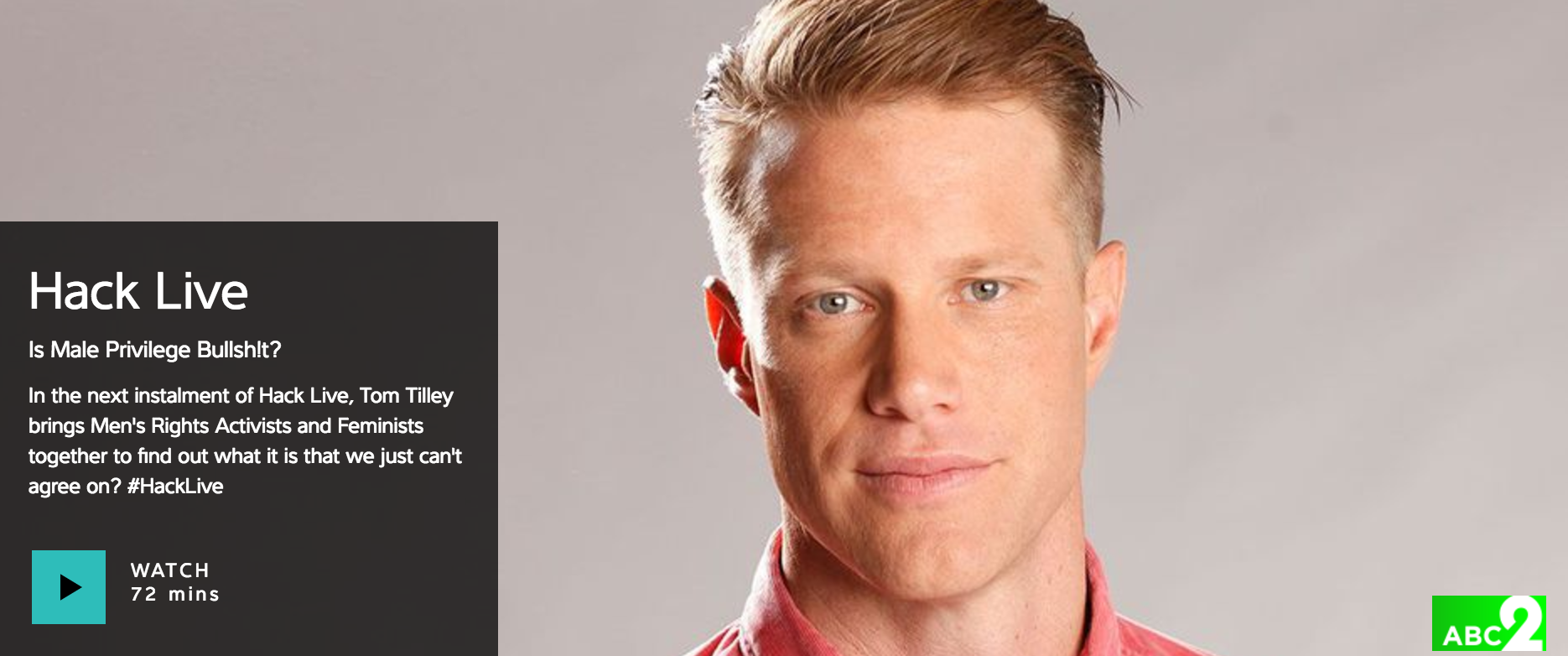
The topic for last night’s episode of Hack Live was, Is Male Privilege Bullsh!t?” With such a cleanly articulated topic for conversation, should anyone be surprised that one of the program’s guests took liberty with language?


Hack Live

Only hours earlier The Age published a piece by Andrew Street, asking the question, ‘Why do atheists have to behave like such jerks?’

Andrew Street bemoans the behaviour of some of his fellow atheists including the likes of Sam Harris and Richard Dawkins. Summarising a piece by Mark Oppenheminer, Street admits that such behaviours are a massive problem in the international atheist community. His particular and present concern is the treatment Clementine Ford has received since being invitated to speak at the Atheist Global Convention in Melbourne. Without question, the online abuse is appalling. Street quotes the moderators of the Convention’s Facebook page, ”we have been deleting specific rape and death threats as they occur… there have been substantial numbers”.  There is no justification for such demeaning and disgraceful threats and language, and I’m pleased to hear Andrew Street confronting it.

Toward his conclusion, Street makes a swipe at ACL, trying to analogise ACL with the crude atheists attacking Ford. This comparison is sadly predictable, and greatly misplaced:

He writes, “It also means such groups end up much like the Australian Christian Lobby: filled with reactionary voices that don’t remotely represent the diverse community for which they’re claiming to speak.”

The Australian Christian Lobby may not share views on sexuality and marriage that many atheists hold, but they do not resort to vulgarity, and they are known for their advocacy for women against sexual exploitation. One may not agree with ACL but one cannot associate them with the kind of vitriol that Ford has been subjected to and has also dished out.

Street’s article is revealing, for he is rightly concerned about the attitudes and behaviour of his fellow atheists, but he doesn’t recognise how their creed gives no protection from such assaults, indeed atheism gives license to demean and hate. Not for a second do I think that this is a problem exclusive for atheism, we should keep in mind that the same can also be said of many religions.

While Street’s article doesn’t dig so deep, it helpfully reminds us that worldview matters and that from the heart we speak.

“For the mouth speaks what the heart is full of” (Matthew 12:34).

Much of Australia’s intelligentsia insists that there are few if any axioms and that ethics is mostly freelance. We cannot  however do away with them and the most convinced anti-theist recognises that there are right ways and wrong ways to treat people. This deeply rooted belief doesn’t stem from atheism but from Christianity.

We often treat people in ways similar to how have been treated, and it is a vicious cycle. With a decisiveness and efficacy that makes the Hadron collider appear like recycled garbage, Jesus Christ broke the cycle. He showed us how to live and he lived that life on our behalf. He made himself a substitute, not returning hate for hate but enduring it on the cross. This grace and kindness does more than give us the example par excellence for public conversation, for he liberates the human heart from hate, as well as from pride that stems from forced adherence to cultural conventions. No doubt Christians have at times forgotten this good news, and even proven themselves unChristian by using speech that contradicts the character of Jesus Christ. This love given by Christ changes attitudes and behavior, such that we show respect toward those with whom we have significant disagreement, not because society demands civility, but because we wish to share this infectious love that God has given to us.

The ethics of Peter Singer: he believes what?

Does a pig have greater value than a child with Down Syndrome? Is a dog worth more than a severely disabled child?

According Peter Singer the answer is, yes.

Peter Singer is the Ira W. DeCamp Professor of Bioethics at Princeton University. Australian born, he is one of our country’s best known academic figures, and tonight he was invited to return to be part of the panel on ABC’s QandA. 

c5oga3zuwae1loo

In 2007 Singer wrote a piece in the New York Times, where he discussed ethical questions surrounding  a severely disabled 9 year old girl by the name of Ashley. He wrote,

“Here’s where things get philosophically interesting. We are always ready to find dignity in human beings, including those whose mental age will never exceed that of an infant, but we don’t attribute dignity to dogs or cats, though they clearly operate at a more advanced mental level than human infants. Just making that comparison provokes outrage in some quarters. But why should dignity always go together with species membership, no matter what the characteristics of the individual may be?

What matters in Ashley’s life is that she should not suffer, and that she should be able to enjoy whatever she is capable of enjoying. Beyond that, she is precious not so much for what she is, but because her parents and siblings love her and care about her. Lofty talk about human dignity should not stand in the way of children like her getting the treatment that is best both for them and their families.”

Notice the comparison he makes? He suggests that the life of a dog or cat has more value and ‘dignity’ than a human being with limited cognitive faculties. Not only that, in true utilitarian style he denies Ashley’s intrinsic worth as a human being, suggesting that she has worth only insofar as she is loved by her family.

In a recent article in the Journal of Practical Ethics, Peter Singer tried to justify killing children with Down Syndrome.

“For me, the knowledge that my [hypothetical Down] child would not be likely to develop into a person whom I could treat as an equal, in every sense of the word, who would never be able to have children of his or her own, who I could not expect to grow up to be a fully independent adult, and with whom I could expect to have conversations about only a limited range of topics would greatly reduce my joy in raising my child and watching him or her develop.

“Disability” is a very broad term, and I would not say that, in general, “a life with disability” is of less value than one without disability. Much will depend on the nature of the disability.

But let’s turn the question around, and ask why someone would deny that the life of a profoundly intellectually disabled human being is of less value than the life of a normal human being. Most people think that the life of a dog or a pig is of less value than the life of a normal human being. On what basis, then, could they hold that the life of a profoundly intellectually disabled human being with intellectual capacities inferior to those of a dog or a pig is of equal value to the life of a normal human being? This sounds like speciesism to me, and as I said earlier, I have yet to see a plausible defence of speciesism. After looking for more than forty years, I doubt that there is one.”

That’s right, according to Peter Singer, a pig has more right to live than some human beings, should the person have intellectual and mental disability.

In 1999, Michael Specter of the New Yorker, wrote that, “Singer believes, for example, that a humans life is not necessarily more sacred than a dogs and that it might be more compassionate to carry out medical experiments on hopelessly disabled unconscious orphans than on perfectly healthy rats.”

The worldview driving Peter Singer’s beliefs is atheism, and his ethic of choice is utilitarianism, which holds that the most horrid actions can be justified should the outcome bring benefit to another person or group of people. It is therefore unsurprising that he openly advocates bestiality, infanticide, euthanasia, abortion, and that he dehumanises those whom he declares less fit for life in this world.

We need to appreciate that these ideas are not being whispered on the dark web or behind closed doors, but openly in one of America’s Ivy League Universities, and in some of the United States’ and Australia’s most respected news and journalistic outlets. Indeed, he retains a teaching position at the University of Melbourne, where I am a graduate.

I have no doubt that it’s not only Christians who will be appalled by Peter Singer’s ideas; many atheists will also be disgusted.  And yet, Peter Singer is in some sense a victim of his own atheistic ideology, for he is chasing his worldview through to its logical conclusion. If this world is it, and there is no God who made and oversee all things, why should we pretend that people have inherent worth and equal dignity? Why should we attribute greater moral value to a sick person than a healthy animal? Why shouldn’t we kill the weak in order to help the strong?

We can be prone to hyperbole for all kinds of things, but it would not be an exaggeration to suggest that some of Peter Singer’s ideas are akin to ideologies pronounced by some of the most dangerous regimes the world has ever known. Before we yell out condemnation from across a chasm, we should  recognise that our own society has already adopted aspects of this ethical framework: in the way we understand some of society’s most vulnerable people, including the unborn because they may carry an ‘abnormality’. The fact that most of us resist and want to push back on many of Singer’s ideas, tells us something about how unsatisfactory and unnatural atheism truly is.

So where should we turn our attention? How different is the answer that we find with the God of the Bible. The Bible insists that every human being, from the moment of conception, is precious and made in the image of God. Gender, age, health, mental faculties, physical appearance, do not detract from a person’s inestimable worth.

Throughout his three years of ministry Jesus was known for befriending and caring for those whom society thought little, and had often neglected. No one was too insignificant for him to take interest in and show love.

On one occasion we are told,

“A man with leprosy came and knelt before him and said, “Lord, if you are willing, you can make me clean.”

Jesus reached out his hand and touched the man. “I am willing,” he said. “Be clean!” Immediately he was cleansed of his leprosy.” (Matthew 8:2-3)

Jesus didn’t stop there, the extent of love that God demonstrated was found on a roman cross, where the Son of God sacrificed his life for the salvation of others.

“Surely he took up our pain

    and bore our suffering,

yet we considered him punished by God,

    stricken by him, and afflicted.

But he was pierced for our transgressions,

    he was crushed for our iniquities;

the punishment that brought us peace was on him,

    and by his wounds we are healed.” (Isaiah 53:4-5)

Religion Makes us Meaner

I agree.

Like sharks smelling a drop of blood, the media is swarming around the latest ‘religion is bad’ news story. This time, it comes in the form of a report that has been published in the journal Current ­Biology, by a group of researchers at Chicago University.

OLYMPUS DIGITAL CAMERA

Research leader, Dr Jean Decety, has said, “Together, these results reveal the similarity across countries in how religion negatively influences children’s altruism. They challenge the view that religiosity facilitates prosocial behavior, and call into question whether religion is vital for moral development—suggesting the secularization of moral discourse does not reduce human kindness. In fact, it does just the opposite,”¹

That is one gargantuan call to make, and with significant implications should the assertion be true.

The Australian newspaper offered this helpful summary of the study (Nov 6):

“In the study, more than 1100 kids aged between five and 12 were asked to share stickers with anonymous schoolmates. The subjects lived in North America, the Middle East, South Africa and China, and included Christians, Muslims, Jews, Buddhists and Hindus.

Those from agnostic and atheist households consistently proved less likely to keep the best stickers to themselves. “The more religious the parents, the less altruistic the children, irrespective of the religion,” Dr Decety told The Australian.

He attributed the findings to a phenomenon dubbed “moral licensing”, where people’s perceptions that they were doing good — in this case, practising religion — exempted them from the obligation to perform other worthy deeds. “Apparently, doing something that helps strengthen our positive self-image also makes us less worried about the consequences of immoral behaviour,” he said.

The study also found that when the children were shown videos of “mundane” affronts, such as people bumping and pushing each other, religious kids were more inclined to decide harsh punishment was warranted. Dr Decety said this supported previous findings that organised religion promoted intolerance and punitiveness.”

I agree…in part.

I affirm the idea that religion can make people meaner and more selfish. This idea is hardly new, Christians have understood this since its earliest days, and it conforms to what the Bible has been saying since it was first written, millennia ago.

As Tim Keller put it in The Reason for God, “Those who believe they have pleased God by the quality of their devotion and moral goodness naturally feel that they and their group deserve deference and power over others. The God of Jesus and the prophets, however, saves completely by grace. He cannot be manipulated by religious and moral performance–he can only be reached through repentance, through the giving up of power. If we are saved by sheer grace we can only become grateful, willing servants of God and of everyone around us.”

According to Roman ch.1 religion stems from suppressing what is true, and creating and then depending upon things that are not true for meaning and salvation.

Subsequently, it is unsurprising to learn that religion is largely about self-justification; it is the human attempt to persuade God and others of one’s worthiness and goodness. Religion is about doing things and saying things in order to win God’s favour. Even acts of kindness can be a cover for gaining approval and for feeling better or happier about oneself. In other words, we shouldn’t be surprised to find that religion can make people, even children, mean.

The study doesn’t only suggest that religion makes children mean, it would have us believe that atheism makes children kind. Does unbelief enhance out potential for true altruism? A survey of non Government welfare agencies and charities will be hard pressed to find more than a handful that don’t have their foundations and funding in organised religion, especially Christianity. How many atheistic organisations can you think of that are working in our local communities and across the world to care for the poor and needy?

The average Australian gives away less than $200 each year, whereas Christians give on average, 5-9% of their annual income, and many give considerably more².

While I know some very friendly atheists, atheists are also among the most intolerant people in our society; listen to how many journalists, politicians, and social commentators now address Christians. For not subscribing to the secular agenda, Christians are labelled stupid and bigots, and Christian programs are being shutdown across the country.

History and contemporary society demonstrate that both religion and atheism are a problem. Should we debate who is worse, ISIS or Stalin? Surely evil is evil, whether it is perpetrated by the religious or irreligious.

How then, do we explain the findings of this outcome?

While I’m not dismissing the research, there are problems. For example,

1. In my opinion the study does not adequately differentiate between nominal religious believers and those who actually practice their religion. In particular, I am thinking of the distinction between Gospel (or Evangelical) Christianity and cultural Christianity. The use of the Duke Religiosity Questionaire may be useful as a sociology calculator but it is a poor theological and spiritual one.

2. The findings don’t properly differentiate between various religions. Islam and Christianity are at times lumped together, while other religions didn’t receive a large enough sample size to warrant analysis.

3. The research is making strong claims based upon limited research. Children completed a game and parents filled out a questionnaire, and from this we can now confirm that non religious families exude greater kindness than religious families? I think we call that, overreach.   

4. “Children from religious households favored stronger punishments for anti-social behavior and judged such behavior more harshly than non-religious children”. Why is this deemed a negative? It is quite possible that children from religious families have a stronger moral compass and therefore a greater sense of justice.

5. The study involved children from 6 countries: Canada, China, Jordan, South Africa, Turkey and the United States. To what extent have the researchers accounted for cultural differences, and how these affect the way children behave? The way that culture and religion relate in Jordan is different from China and indeed the USA.

In my view, there are simply too many questions for people to be jumping on the bandwagon. Remember, this is one study, and it is worth noting that its findings conflict with other research that has been conducted in recent times, which have found that belief in God makes people happier and more community oriented (https://murraycampbell.net/2015/09/24/new-evidence-suggests-that-the-closure-of-sri-was-a-mistake/).

Dr Decety and the team from Chicago University have driven us to an all to familiar dead end street: we want to maintain that religion and irreligion are our only options, but there is a third way. That is why the message of Christianity is so subversive and why it does not fit with the dimensions of human expectations.

Christianity teaches that everyone is sinful, yes, even children. Isn’t it ironic that when Christians make this suggestion it is called ‘child abuse’, and when secular academics make the same observation it is called science! We shouldn’t be surprised to learn that young children exhibit selfish and judgemental traits; it is human nature. Sometimes we clothe it in God-speech and promises of eternal reward, and other times we simply call upon humanitarianism.

Altruism is unattainable because we simply cannot do it. Both religious and non religious people are capable of love and acts of kindness, but inconsistently, partially, and often for self-seeking reasons. The history of the world is our autobiography, and we are seriously kidding ourselves if we think that we have climbed up the evolutionary tree: domestic violence in 1 in 3 Australian homes, over 80,000 unborn children killed each year, the revelations on Ashley Madison, cruel Asylum Seeker policies, ka-ching and the masterminds behind the pokies industry, and on and on.

But in Jesus Christ we see perfect love, selfless service and sacrifice for the good of others; he is uncompromising in holiness and generous in mercy:

“This is love: not that we loved God, but that he loved us and sent his Son as an atoning sacrifice for our sins”. (1 John 4:10)

This is the essence of Christianity:

“The gospel is this: We are more sinful and flawed in ourselves than we ever dared believe, yet at the very same time we are more loved and accepted in Jesus Christ than we ever dared hope.” (Tim Keller)

When a person comes to know this declaration of God’s love, they are changed, forgiven and liberated to truly love God with our whole being and to love our neighbour. It changes us to give without expectation of return, and to sacrifice for the good of those who despite us. Religion and irreligion are proven dead ends, but the Gospel of Jesus Christ promises a light that changes how we see everything.

——————

  1. http://news.uchicago.edu/article/2015/11/05/religious-upbringing-associated-less-altruism-study-finds
  2. See NCLS research for information regarding giving habits of Australian Christians. A summary of broader Australian giving can be found here – http://www.businessinsider.com.au/here-are-the-top-20-most-generous-suburbs-in-australia-2014-5