We need more empathy not less

‘Before you criticize a man, walk a mile in his shoes. That way, when you do criticize him, you’ll be a mile away and have his shoes.’ (Steve Martin)

An easterly wind is blowing across the Pacific and blowing dust into some Aussie churches. From Moscow to Queensland, there is a mood swirling about that believes what we need today is a strong Christianity that will defeat the hoards of hell. Weakness is to be blamed for the status quo and to save the day we need a particular masculine-styled Christianity. Out with gentle Jesus, bring in Excalibur Jesus!

Of course, we don’t want to be reductionist and suggest that the Christ who is gentle and kind is not also awesome in power and the judge of the world. He is both the God of mercy and the God of justice. 

There is an emerging vigilante approach to Gospel ministry and mission which is, I contend, as big a problem as the spiritual and moral hopelessness it claims to be redeeming. 

And before the bros throw around their customary innuendos, I learnt to shoot when I was 10, I know from experience how to chase down a thief and stand up to a violent man, I have a son who made grown men cower when he bowled,  and I am proud of my eldest who is serving in the military; so you can stick your manly verbiage in your salad!

Some of the masculine talking and taunting that’s coming out of the United States and sprouting in certain ecclesial Aussie backyards, isn’t  complementarianism and therefore not biblical. It’s two versions of a gender culture war playing ping pong against each other, and unfortunately using the church as the table.

If you don’t believe me, Neil Shenvi yesterday sent a test balloon on X, 

 “If a man were described as kind, gentle, patient, loving, peaceful, joyful, good, and faithful, large segments of Twitter would call him effeminate.”

With the surprise of learning that sea water contains salt, Shenvi is right.

This supposed muscular Christianity found recent expression on the Al Mohler show when Al Mohler interviewed Joe Rigney for his book, ‘the Sin of Empathy’.

Over the years, I have appreciated some of what Al Mohler has said and stood for. This, not so much.

No, I haven’t read Rigney’s book, and I have little desire to do so. Rigney has however, expressed his ideas in this interview, and so presumably he agrees with his own words to Al Mohler. In short, Rigney’s thesis is that empathy is sinful and responsible for churches losing their way today.
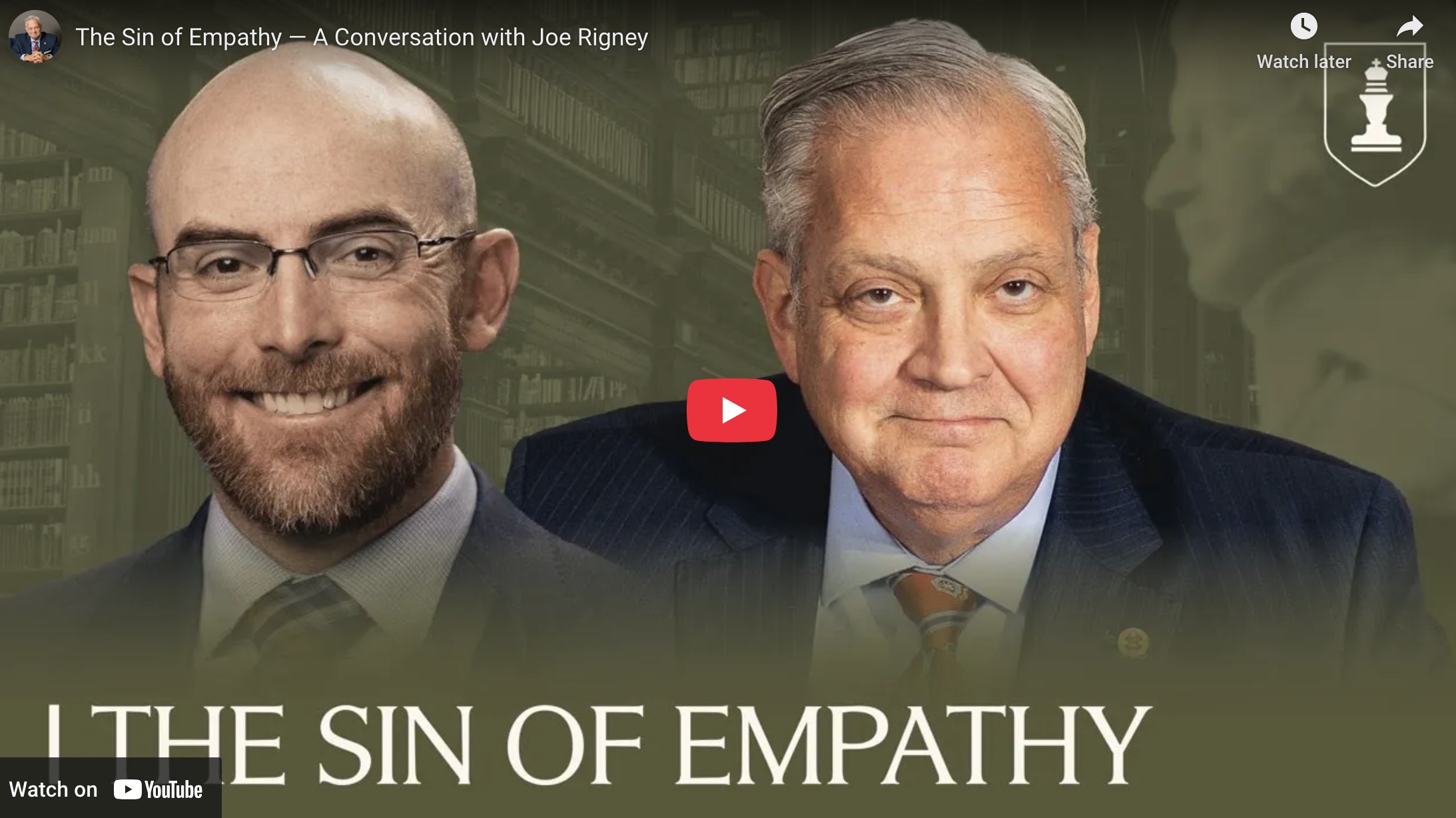
Rigney’s complaint is that churches are guilty of the sin of empathy,

“There is a reason that the empathetic sex that women are barred from the pastoral office, they were barred from the priestly office in the Old Testament for the same reason. Because priests and pastors, priests in the Old Testament, pastors and ministers and elders in the New Testament, are charged fundamentally with guarding the doctrine and worship of the church, of setting the perimeter for what is in and out. That’s the calling. And therefore the sex that is bent and wired towards care, nurture, compassion and empathy is ill-suited to that role. So it’s no surprise that in a culture that has become dominated by feminism, it’s deep in the American system at this point, that in that same timeframe, you would have an outbreak of empathy that would become the steering wheel by which every institution is hijacked.”

In other words,  empathy is a problem because it’s a trait found in women, and permitting that leads to the slippery slope of feminism and last stop, hell. 

No doubt, many readers will find this as problematic as do I, not least because it smacks of misogyny.

Rigney is convinced that the slippery slope of liberalism clambers back to a weak Christianity that is too sympathetic (by which he means, to feminine)

“Every church faces some version of this kind of pressure to have women in the room where it happens to let them make, let’s have them in the room, let’s have them making decisions. We won’t call them pastors, at least initially, but once you started down that road, you’ve effectively seeded the ground that men and women are interchangeable. We don’t know why the Bible says that only men can be pastors. And until we can twist that verse, we’ll hold the line on that one little thing, but it’s a complimentarian thread that’s trying to hold up an egalitarian boulder, and it will not hold in the long run.”

Mohler has also bought into this line of thinking, 

“No, and the argument about hermeneutics is I think amply, tragically demonstrable. I don’t know of a single body that has genuinely affirmed women in the pulpit that has not eventually affirmed the LGBTQ revolution. Because if you can take the plain teachings of Scripture, and by the way, reflected all the way through creation order, and you can deny that when it comes to a woman as a pastor of a church, and it’s not that women don’t have many of the gifts, it’s that women, it’s ontologically forbidden by scripture.”

The problem with those statements is that it’s not necessarily true. The slippery slope argument is sometimes real and other times not. Now, before you suggest that I’m some wet slippery progressive who’s drinking the cool-aid, I’m writing as a convinced complementarian and someone who has expressed concerns about current gender ideologies, such that it’s made front page news on major newspapers. The reality is, there are different hermeneutical grids among egalitarians. Not all egalitarians are identical. There are some who hold to a theological framework that does slide into gender fluidity and adopting the latest cultural norms of sex and gender, and there are others whose theological convictions do not permit the slide. 

Take Mike Bird for example. Rigney said of Bird this week,

“This comment is particularly funny coming out of a decade or more in which feminism, wokeness, and soft-pedaling sodomy infiltrated the SBC, the PCA, and other conservative evangelical contexts. That’s who I wrote it for.”

yeah, nah. Mike Bird is egalitarian. He’s wrong on this one (and I still love him) but I also know he has a robust anthropology that will not let him fall down into gender relativity or matters like same sex marriage. 

The thing is, we don’t advocate for what is and has been the norm among Christian churches throughout its history by adorning men with a 6 pack and rifle slung over the shoulder and making them sound more gruff. Be more Christlike. Be more Biblical, not less.

How does this sin of empathy square with Christ who is our empathetic High Priest? At the very least, Rigney’s interview causes us to cast doubts over or to explain away Bible statements like Hebrews 4:15,

 “For we do not have a high priest who is unable to empathize with our weaknesses, but we have one who has been tempted in every way, just as we are—yet he did not sin.” (Hebrews 4:15)

In his commentary on Hebrews, Paul Ellingworth paraphrases, “Our high priest can feel with us in our weaknesses, because he has been tempted in all respects as we are…”

The verb συμπαθῆσαι and its cognates, as Ellingworth notes, “are used most often of family affection”.  Peter O’Brien explains, “the verb rendered empathize was used of a bond similar to a mother’s feeling for her children or one brother’s feeling for another.”

Peter O’ Brien notes, “Believers have in heaven a high priest with an unequalled capacity for empathising with them in all their weaknesses, especially the weakness that result in sin”. 

If that’s too much empathy for you, let’s bring in a Puritan, Thomas Goodwin,

“The word is a deep one. He suffers with you, he is as tender in his bowels to you as ever he was; that he might be moved to pity you. 

He is willing to suffer, as it were, that one place to be left naked, and to be flesh still, on which he may be wounded with your miseries, that so he might be your merciful high priest.”

Al Mohler suggested in the interview that empathy is a 20th Century concept. Goodwin and Hebrews suggests that’s not the case. What’s more likely is that the division between sympathy and empathy is a 20th Century construct.

Can empathy be problematic? Sure, of course it can. When we sever any human emotion or disposition from the work of the Spirit, we are in danger of misuse and misapplication. That doesn’t mean empathy is the sin of our age; the church doesn’t need less empathy, but more.

Some Christian men have the impression that being ferocious like is Jesus is good, whereas showing the gentleness of Jesus somehow inhibits our masculinity and church steadfastness. Everyone wants to be Jesus overthrowing tables and using a whip in the Temple. They love to argue online and are quick to jump on others. Strength and power and angry tone is just as dangerous a foe to Christian vitality as those more gentle of virtues when separated from the Spirit.. Besides, real masculinity does not deny strength or power, but uses it in the service of others. It is therefore humble, sacrificial, gentle and kind. It doesn’t demean women, it honours them. If your version of strong Christianity produces mysogony, think again.

Let’s remember the Apostle Paul who rebuked the Corinthians for their liking of strength and power,

‘Jews demand signs and Greeks look for wisdom, but we preach Christ crucified: a stumbling block to Jews and foolishness to Gentiles,  but to those whom God has called, both Jews and Greeks, Christ the power of God and the wisdom of God. For the foolishness of God is wiser than human wisdom, and the weakness of God is stronger than human strength.’

This is part of the problem with this neo-masculine movement. It doesn’t want weakness and it derides anything that appears ‘effeminate’. If you think empathy is a sign of weakness, I suggest you take that up with our High Priest. 


April 10 Update: Read Dani Treweek’s excellent and detailed review of Joe Rigney’s ‘Sin of empathy’ over at Mereorthodoxy https://mereorthodoxy.com/sin-of-empathy-joe-rigney-book-review

Do we need another Creed?

A new declaration,  ‘The Australian Creed for Sexual Integrity,’ was launched late last year. I hadn’t heard of this Sex Creed until a friend on Facebook made a comment before Christmas, and another friend messaged me about it. Since then, I’ve read the website and asked for friends’ opinions. One question that immediately came to mind is, do we need another Creed?

I love and appreciate a good Creed. Indeed, to this day, the universal church subscribes to four formal Creeds: The Apostles, The Nicene, The Athanasian, and Chalcedon.

Despite the rumours, Baptists affirm the ancient Creeds. To be sure, some baptists insist upon the mantra, ‘no creed but the bible’, but they do so ignoring much of Baptist history and overlooking the Creedal material found in the Bible itself. Leaving aside that in-house debate, what do I think of the ‘The Australian Creed for Sexual Integrity’?

First, I want to commend the idea of addressing biblical anthropology.  There is merit (if not necessity) for churches, denominations, and paragroups to clarify and confess a Christian understanding of sex, gender, and the Gospel. What it means to be human is one of the biggest issues of our time. It is one reason why theologians like Brian Rosner and Carl Trueman are writing important volumes on the subject. Scholars like Dani Treweek and Christian apologists including Rebecca McLaughlin are speaking to vital questions surrounding human sexuality and being.  It isn’t hyperbole to say that our society is confused about what it means to be a man and a woman. Even more basic,  we live in an age that is increasingly unclear about what it means to be human. This haze easily hovers over and influences Christians in the pew. It is not easy to be a Christian in the workplace or at school and believe what the Bible affirms about marriage and sex.

It is the role of pastors to preach the full council of God, and with grace and gentleness teach the Bible’s vision for human sexuality and gender. It is incumbent upon denominational heads and Christian organisations to ensure we are guarding the faith and protecting the people under our care by providing sufficient affirmation of and clarity on these topics. 

Churches need greater clarity and conviction on the Bible’s teaching on humanity, not less. We need better discipling in our churches to help people think in a Bible and Gospel way about what it means to be human. Accompanying truth, we need oceans of grace, kindness and patience. How we draw lines in the sand matters.

So what about the, ‘The Australian Creed for Sexual Integrity’? 

There are a number of church and parachurch leaders who have signed the document, although that number remains tiny in comparison to the actual number of denominational and church leaders across the country. Several notable evangelical leaders have signed, as well as a number of friends of mine, men for whom I have great respect and personal friendship. 

(As a quick aside, I was amazed as I read the list to note how many Christian organisations exist in Australia. I had never heard of some of the organisations.  It feels as though every Bob, Jane, and pet dog has its own registered ministry organisation, which all sounds very significant and important!  The list also includes Roman Catholics, secular professionals, and a few from overseas.)

At this stage, I have 4 questions/observations, which I have asked of others and haven’t yet found adequate answers.

First, who wrote the Creed? The authors’ names are not published anywhere. From what I have gleaned after asking a friend who signed the Creed, a group called the Canberra Declaration is behind it. Apparently, there are so many people involved, that they didn’t wish to identify specific authors. That doesn’t quite wash given that if 100 people were involved, there would yet only be a small handful of people editing and finalising the end product. Knowing who is behind the document is important.

Second, while there is good theology contained in the statements (for which I’m thankful), where is the Gospel? The final article mentions forgiveness, but for a document that is supposed to summarise the Christian view on sexuality and gender, there is little weight given to the Gospel of grace and no attention offered to the eschatological vision for human sexuality and gender. In these two ways, the statement is lacking. 

Third, I find the language of ‘Creed’ problematic. A Creed by definition is authoritative and formal and is universally recognised. This is one reason why in the history of the Church, the number of recognised Creeds is incredibly small: fourto be exact. Throughout history, other types of important documents have been written. For example, there are Confessions of Faith, which are more numerous than Creeds, and which hold weight for Christians within particular denominations or movements. Creeds, however, are considered more weighty. Even during the Reformation, which produced countless Confessions and Statements, the Reformers didn’t propose further Creeds. In the waves of 20th Century liberalism, where almost every Christian doctrine has been attacked or undermined by progressivism, Churches have not written a new Creed.

According to their website, the category of Creed is deliberate. On more than one occasion they refer to the Nicene Creed and assume a similar position for ‘The Australian Creed for Sexual Integrity.

“Every era has its particular heresies. In the 21st century, heresies abound in the area of human sexuality. The church has not been immune to these errors. We believe the time has come for a new creed that affirms the timeless teachings of the church regarding sexual integrity, and that articulates God’s glorious design for sex and marriage as revealed in Holy Scripture.

Our hope and prayer is that the Australian Creed for Sexual Integrity will gain global approval from biblically orthodox leaders in the Catholic Church, the Anglican/Episcopalian Church, the Lutheran Church, the Presbyterian Church, the Orthodox Church, Evangelical and Pentecostal churches, and many more besides. We also welcome the support of Christian schools, charities, para-church ministries and missionary organisations.”

Lest anyone think that this Murray Campbell is hiding behind his laptop and unable to affirm a biblical anthropology, the record shows that I have been more vocal on these issues than many.  In 2021 I featured on the front page of The Age newspaper for standing up to the Victorian Government which introduced dreadful laws that stifle Christian speech and practice about sexuality. Several years earlier, I received numerous lovely fan letters for advocating the classical view of marriage on the ABC. So, no, I’m not one of these compromising or complicit chaps. I do, however, disagree with using the category of ‘Creed’ for such a statement. 

I note this 2024 conversation between Al Mohler and Carl Trueman. Trueman is no slouch when it comes to upholding Christian orthodoxy and he’s no poor student of history. He made these comments about the ascendancy of anthropology as a mark of Christian faithfulness, 

“I still believe that the best way for churches to preserve the faith and to make sure it’s communicated in a stable way, both to the people in the pew today and for future generations, is to have creeds and confessions, or the equivalent thereof, in our churches functioning as a way of capturing the essence, the deposit of the faith. I think what has changed in the last couple of, well really in the last decade, the whole question of identity has become much more pressing, and that’s raised a whole host of issues that I didn’t anticipate at the time I wrote the first book, but which I think confessionalism also addresses. In addition to the stuff that I did cover, I would use an example, for example, gay marriage that popped up really. It was brewing, but it became a big thing sort of 2013 to 2015 in the United States, and I remember a lot of friends saying, “Do we need to add, say a chapter to the Westminster Confession, or the second London Baptist confession to address the issue of gay marriage?” And my answer was always, I don’t think so.

I think what we need to do is first of all use our confessions and apply them to the issues that arise today. But I also became aware in answering that question that way, that one of the things that confessions did that I think has become very, very important is precisely because they give a summary of the faith. They also show how different elements of the faith interlock and interconnect with each other, and they show the broad framework of Christian doctrine that then allows us to address, for example, questions of sexuality or identity by realizing that, well actually, we’re not looking for a Bible verse on this. We have to think in terms of holistic structure of Christian doctrine, and creeds and confessions really do help us, I think, see that sort of architectonic structure that is very, very helpful in facing the crazy stuff that we’re addressing at the moment.”

Unfortunately, by claiming ‘Creed’, the document comes across as a little pretentious, like some other recent declarations that claim to offer a prophetic voice to the Australian Church and society. I’m generally wary of such posturing. 

If the aim is to be a truly national Creed, why not take proper time to work through formal processes? This comes to my fourth point, 

Fourth, this document hasn’t gone through the necessary rigour and ecclesial channels to hold the weight of ‘Creed’.

Historically, Creeds were the outworking of ecumenical Councils where Church leaders attended and worked through presenting theological issues. Unless I’m mistaken or missed the invite in my inbox(!) this Creed has not undergone any such Synod or Conference.

My biggest issue with ‘The Australian Creed for Sexual Integrity’ is that it purports to be something that it is not. It’s like claiming a PhD without going to university or driving on the road without a licence simply because you know how to drive. This Creed claims too much, and it lacks a transparent and considered pathway for instituting such weighty words. Perhaps these are among the reasons why the majority of Reformed evangelical leaders have not signed it.

Others have noted certain ‘nationalistic’ overtones on the Creed’s website and explanatory notes.  The website authors themselves highlight a conscious decision to incorporate the Australian flag colours in the logo and to launch the Creed on the same day as the Australian Lighthouse Charge at Beersheba. Why draw such parallels? When one realises some of the groups who are putting their names to the Creed, their reputation of signalling Christian nationalism and anti-everything is telling, and unfortunate. 

I understand the pull to sign a document. Christians are looking for clarity. Christians are looking for leadership. As we feel the assault of culture that is taking one blind turn after another, and causing grief and harm to people we care about, we want to see people healed and protected and coming to know the Lord Jesus.  Had we not been in the situation where many Christian leaders have been reluctant to stand on Holy Scripture*, we may not find ourselves in a place where a group of unordained individuals have grabbed the bullhorn and produced a less than satisfactory piece of writing. 

I appreciate that not everyone will agree, but there are better ways forward. I’m happy to be persuaded otherwise, but at this point in time, my view is that we don’t need another Creed. Statements, yes. Updated polices, Yes. We need ongoing clarity and commitment to biblical anthropology by faithfully teaching and living out God’s words and ways, and by Christian denominations finding constructive ways to affirm what God has ordained in his word. 

—————————-

*this statement needs some qualifying for there are Christians leaders who have stood firm with pastoral conviction and love)

American Evangelicals have harmed Evangelicalism

“Therefore, you kings, be wise; be warned, you rulers of the earth.” (Psalm 2:7)

160128212624-fox-january-gop-debate-trump-rally-780x439

Eleven months ago a good friend sat on the lounge in my home and told me that the Presidential race would be between Hillary Clinton and Donald Trump…and that Trump would win!

I looked at him as though he had had a lobotomy. But over the course of the year my friend’s projection has been rattling in the deep recesses of my mind where I try to leave all the crazy thoughts.

Like the majority of Australians I feel as though I’m floating in a hypnagogic state. How many of us really thought that Trump would trump America?!

According to the latest figures, it appears the main reason for Hillary Clinton’s loss is because Democrats stayed home: 5 million fewer democrats voted yesterday than in 2012; that’s a lot of people. The Republican turn out was also slightly down, which is unsurprising given the candidate.

I have no doubt that there are numerous reasons behind Trump’s win, and I am no expert to decode all these, and neither is it my purpose to explore them here.

After surveying this morning’s twitter sphere, it revealed though how mainstream media, Hollywood, and the self acclaimed intelligentsia still don’t get it; the progressive moral and social agenda is repugnant to many Americans, and also to many Australians.

More concerning, American “evangelicals” don’t get it. I am hearing reports suggesting that as many as 85% of “evangelicals” voted for Donald Trump. Whatever the actual number, it will be a substantial percentage. I appreciate why Christians could not vote for Hillary Clinton; for example, her position toward unborn children is paramount to evil, but so is Trump’s posture toward women and refugees.

I want to reiterate a concern that I have raised in recent weeks, and that is how the evangelical cause will be weakened as a result of a Trump Presidency. The reason is obvious, “evangelicals” have so closely aligned themselves with Donald Trump that in the public eye the two have been aligned.

While there were multiple groups investing in the campaign, “evangelicals” are at least partly responsible for Donald Trump’s ascendancy to the American Presidency. That’s right, without their endorsements, the Republican nominee may well have been a Jed Bush or Marco Rubio.

You will notice my proclivity to use the inverted comma when referring to evangelicals, and that’s because the word has been regularly misappropriated by not only political pundits but also by Americans themselves. True evangelicalism has little to do with the political aspirations of right wing America, and everything to do with the Gospel of the Lord Jesus Christ. Authentic evangelicalism is defined by this Gospel as presented in the Bible, not by the political right or left, not with Democrats or Republicans, and for the Australian context, neither Liberal nor Labor.

While never wishing for a Clinton victory, I do think that scenario would have at least given “evangelicals” an opportunity to break with Donald Trump and start afresh, to repent of foolish associations and  to rethink how Christians should engage in the political space. Unfortunately, “evangelical” America supported the winner, and have been tarnished for doing so. I cannot see how this association will advance the cause of Jesus Christ. If anything, the word may become irretrievably immeshed in a cause that is not the Gospel.

I am thankful for the many evangelicals who have stood up to Donald Trump and have copped flack for doing so: Ed Stetzer, Russell Moore, and Al Mohler among them. In Australia, the general public will not be informed of these voices, and instead Australians will time and time again hear how “evangelicals” assisted Donald Trump to the White House. At least in the Australian public square, the 2016 Presidential election will tarnish Christian witness and further perpetrate myths about Christianity. It is for this reason I am calling on my American friends to return to their evangelical roots and think carefully about political associations.

It is one thing to be part of a Presidential win, but it is quite another to one day stand before the Judge of the earth and give an account for how our lives have adorned or maligned the Gospel of Christ.

This final point is not only true for American Christians but also Australian Christians. When will Christians learn not to place undue hope in Government? The election has exposed a messed up eschatology and misplaced soteriology, which will not only disappoint, but will prevent people from seeing Christ. However Donald Trump decides to build his wall along the Mexican border, it is nothing compared to the wall evangelicals have built in this election which will block out the wonder of the Gospel. How will true evangelicals work to dismantle this false gospel? What will we do publicly and in our Churches to redress the damage caused by this political misalignment?

We need much prayer. We need much repentance.

As the political shape of America turns, may Christians return to our true hope:

“For to us a child is born,

    to us a son is given,

    and the government will be on his shoulders.

And he will be called

    Wonderful Counselor, Mighty God,

    Everlasting Father, Prince of Peace.

 Of the greatness of his government and peace

    there will be no end.

He will reign on David’s throne

    and over his kingdom,

establishing and upholding it

    with justice and righteousness

    from that time on and forever.

The zeal of the Lord Almighty

    will accomplish this.”

(Isaiah 9:5-7)

Evangelical! Who me?

When is it time to lay a word to rest? When is it appropriate to find an alternative name?

Stephen McAlpine is among a growing number of Evangelicals who are admitting we have a word problem, an identity problem. The term evangelical has become synonymous with a branch of American politics, and more recently, with a key group of Donald Trump supporters. Yes, there are notable evangelical voices repudiating Donald Trump, and recent polls suggest the majority of evangelicals would no more vote for Trump than they would Kylo Ren, but it is difficult to fight a bushfire with a garden hose.

McAlpine writes,

“The “Evangelical” brand is well on the way to being trashed in the US.  Time to think of a new word to describe ourselves I reckon, not just in the US, but across the West.

If it’s true financially that “when America sneezes, the world catches cold.”, the same appears to be true of American evangelicalism. The US arm of the brand has caught a pox from which it may not recover, and that pox is at risk of spreading to us.

It’s actually worse than a pox.  It’s gangrene. It has the whiff of death about it. Exxon, Union Carbide, Enron, Lehman Brothers. Perhaps we can add the “Evangelical” brand to that sorry pile. Time perhaps to cut ourselves off from the descriptor before we start to smell. Time for a new word

As he laters explains, the problem didn’t start with the rise of Donald Trump, it goes back to the 1980s when Christians hitched their wagon with the Republican movement.

The issue is even broader than North America. In Europe many denominations continue to use evangelical, as a eulogy to the past, although their theology often bares little resemble to that of their forefathers.

In Australia, evangelical has had branding kudos, at least in Christian circles, so much so that even many anti-evangelicals embraced the word: ’we don’t believe in the bodily resurrection of Jesus Christ but the label works for us.’ To be fair, those who were slightly more ingenuous inserted adjectives, such as ‘broad’ or ‘progressive’, as a hint of their not so evangelical beliefs. This mass branding has not helped.

Language is situational, or least in part. When I describe my Christian faith in the community I refer to myself as a Christian, and sometimes I add that rarified name, Baptist! Rarely do I use words like evangelical or reformed, not because the words are getting a bad press, but because they hold little meaning to most Australians. Within ecclesiastical conversations I am happy to speak of my evangelical and reformed convictions, as they often help to build bridges of understanding, and at other times they clarify differences. But the reality is, when I’m chatting with my neighbours, evangelical doesn’t add anything.

If using the word inside churches is sometime confusing, McAlpine is right; outside of churches and theological institutions, identifying as an evangelical is becoming a herculean challenge, largely because our media lacks nuance. While it’s been trashed in the USA, at least American media acknowledge alternative evangelical viewpoints. Here in Australia, he only time evangelicals are mentioned is when there is a sniff of hydrogen sulphide in the air. For example, our news outlets have not been reporting Al Mohler on CNN or Russell Moore in the Washington Post, as they speak out against Donald Trump.

Has evangelical become unusable in Australia?

The Age newspaper now contains dozens of references to evangelicals, and almost without exception they associate these people with right wing American politics, or with ‘extreme’ Christian ideology in Australia.

ABC’s program, Planet America, regularly refer to the evangelical vote, and especially of their alleged support for Donald Trump.

It is clear that evangelical has become a by-word for religious right wing politics. While the media are responsible for selective reporting, they can hardly be blamed for tying at least some evangelicals with Donald Trump. After all, millions of Americans identify with evangelical and with the Republican movement.

There is an important lesson for us to learn, and that is, we must not bypass theology. We must resist making our identity a political ideology or social cause, we must begin with the Gospel and work out from there.

In 1989 David Bebbington first offered his now famous quadrilateral definition of evangelical. He understands evangelicals as holding four main qualities: biblicism, crucicentrism, conversionism, activism. There is much to like about his quadrilateral, however I also agree with Don Carson’s reservations (read “The Gagging of God”). Carson notes that even a Jesuit priest could put his hand up to this quadrilateral definition. As such, Bebbington has perhaps done evangelicals a disservice. 


To be evangelical is nothing less than being someone who holds to the Gospel of Jesus Christ. The the very word from which we get evangelical is euangelion, which means Gospel.

I agree with Carson, who in turn follows John Stott, in taking us to 1 Corinthians 15:1-8. This is far from the only Scriptural place that explicates the gospel , but it does give us one of the fullest treatments of the Gospel, and we can’t overlook Paul’s introductory remark,

Now, brothers and sisters, I want to remind you of the gospel I preached to you, which you received and on which you have taken your stand. 2 By this gospel you are saved, if you hold firmly to the word I preached to you. Otherwise, you have believed in vain.

For what I received I passed on to you as of first importance:

What is the euangelion?

that Christ died for our sins according to the Scriptures, that he was buried, that he was raised on the third day according to the Scriptures, and that he appeared to Cephas, and then to the Twelve.  After that, he appeared to more than five hundred of the brothers and sisters at the same time, most of whom are still living, though some have fallen asleep. Then he appeared to James, then to all the apostles,  and last of all he appeared to me also, as to one abnormally born.”

Both Stott and Carson summarise 1 Corinthians 15:3-7 with these 6 points: the Gospel is Christological, Biblical, Historical, theological, apostolic, and personal.

The problem is of course, people are no longer defining evangelical by the Gospel.

screen-shot-2016-10-24-at-12-56-25-pm

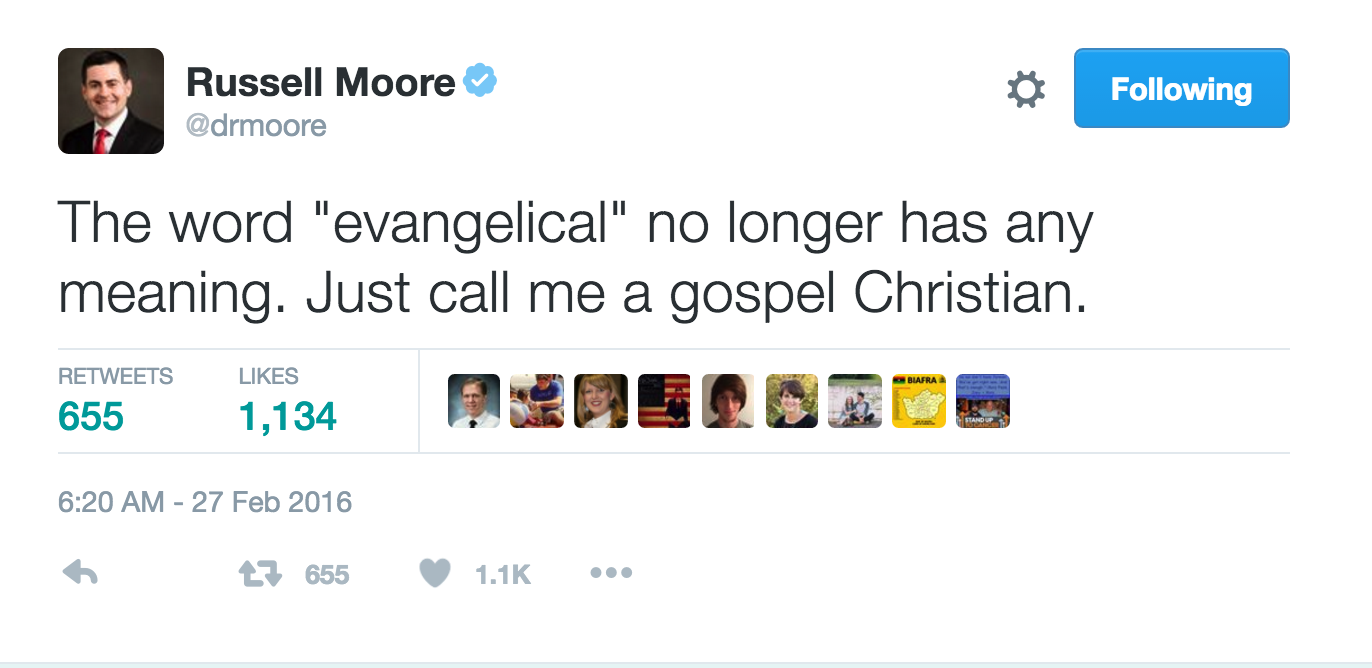
While I’m in large agreement with McAlpine, I’m not giving up on evangelical just yet, because rightly understood it is a word we should cherish and defend. But should the waves of malcontent persist, and an alternative is necessary, I think I’ll begin follow in Russell Moore’s footsteps and refer to myself a Gospel Christian.

Gospel Christian has the same meaning as evangelical Christian, but without the unhealthy socio-political connotations. Interestingly, both in the United States and here in Australia, among the larger Christian networks we don’t find the Evangelical Coalition, but rather the Gospel Coalition.

Some Christians prefer to known as orthodox or classical. I warm to both of these words, although Stephen McAlpine criticises ‘orthodox’ as a group who don’t affirm the real and physical return of Jesus Christ. Perhaps I’m ignorant, but I would have thought belief in the parousia is basic to anyone claiming orthodoxy.

The reality is, many of our Christian labels are disdained. I wish it was suffice to say, I’m a Christian. After all, that’s what I am, I am a Christian. But sadly Christian is frequently associated with all manner of social ills and evils (sometimes warranted). And when I fess up to being a Baptist, I’ve more than once had to qualify it by saying, no, we’re not like the JWs or Mormons.

McAlpine suggests we call ourselves, ‘eschatological Christians’,

“Eschatological” springs to mind. If someone asks me these days I’ve taken to saying that I am an “Eschatological Christian.” Sure it’s not catchy, but it’s not toxic either. Sure I will have to spend a bit of time explaining what it is, but hey, I’ll have to spend virtually no time explaining what it is not.

“Eschatological” is more likely to elicit an eyebrow raise than a nose wrinkle.  It is more likely to raise a question than rule a line under an answer. Most importantly it will distinguish me – and us – as those whose hopes -and energies – are not grounded in the political machinations of this age, but in the politics of the age to come lived out in the church today, and overflowing in practical, loving and humble ways into the community.

“Eschatological Christian” also distinguishes orthodox Christians who actually believe that there is a parousia coming in which King Jesus will usher in a new kingdom and judge the world in righteousness, from those who view that as an outdated notion beneath our modern sensibilities. A view that won’t get them respect in the academy.

The name has a certain Fitzroy living single-origin drinking indie-rocking listening feel to it, but I am unconvinced. First of all, few people know what eschatology means,  and second, it is  defining our identity by one area of theology, rather than the whole.

What do others think? How do you describe your Christian faith? Do you identify as an evangelical?

Misappropriation and misunderstanding shouldn’t surprise us; is it not the expectation given to us by the Lord Jesus? Does not the history of the church give us multiple examples of culture trampling on or deconstructing the church? In a world that is constantly confusing and even hijacking the Christian message, and doing so for all manner of social and political ends, we though can be responsible for how we represent the Lord Jesus Christ. Indeed, the more faithful we are to God’s word, the more useful we will be to society. So whether we call ourselves evangelical, Gospel, orthodox, or just plain and simple Christian, let’s do it with a growing sense of clarity, humility, grace, and winsomeness, in order to display the reality of Christ and of the hope held out in his Gospel.

Christians, Muslims and God: Does it matter?

The Wheaton College controversy regarding Dr. Larycia Hawkins and her comments about Islam is gaining momentum not only in the United States, but also here in Australia, with the ABC publishing two articles on the issue this week.

The controversy relates to this statement made by Dr Hawkins on twitter in December last year,  “I stand in religious solidarity with Muslims because they, like me, a Christian, are people of the book”, and “And as Pope Francis stated last week, we worship the same God.”

16xp-wheaton-facebookJumbo

Dr Hawkins has been suspended by the Council of Wheaton College, and discussions are being held regarding potential dismissal from her teaching position.

There are many issues surrounding this saga, for here, I wish to offer comment on two of the questions: One, does it matter? Does it matter whether Muslims and Christians worship the same God or not?  Second, is Prof. Miroslav Volf right to use a Jewish view of God as a defence for the proposition that Muslims and Christians worship the same God?

First of all, does it matter?

Writing on The Drum, Ruby Hamad has bemoaned Wheaton’s position, referring to the ‘wildly disproportionate reaction from the college’ and  “it’s surprising that such a statement is even considered enough to raise an eyebrow.”

Hamad believes that Muslim and Christians do worship the same God:   

“That the world’s three great monotheistic faiths worship the same god is, or at least has hitherto been, a mainstream position to take. Muslims accept it as a given, the Catholic Church has taught it since the Second Vatican Council, and Pope Francis – who Hawkins referred to her in her statement – reiterated this last November, when he said that “Christians and Muslims are brothers and sisters”.”

As someone raised in the Muslim faith, I find it bewildering that anyone denies that the God of Judaism, Christianity, and Islam are indeed the same deity. Muslims are taught from a very young age that Mohammed is the last in a long line of prophets tracing back to Adam, and that includes Abraham, Moses, and Jesus.”

Leaving aside some fallacious rewriting of history whereby she claims that “three great monotheistic faiths worship the same god is…a mainstream position to take”, and her strange recounting of Islamic teaching whereby young children are taught that the Christian God is identical with the Muslim God, I want to make mention of the Trinity and its place in this debate.

Hamad makes a passing reference to the Trinity and to Christology, but apparently these basic tenants of the Christian faith are no obstacles to someone wanting to insist that Muslims and Christians believe in the same God.

Really?

Now, there are theological arguments at stake that require careful exegesis, and many a tome has been written attempting to consider God. Although there are ideas here that have stretched the greatest minds in history, the essence is simple. One person may be an expert in trigonometry, and another not, but a triangle is a triangle and both can identify it as such. My point is, there are basic theological convictions held by Christians that are irrefutably denied by Islam, and there is no meeting place in the middle.

For example,

Christians hold that that God is triune, one God in three persons. Muslims, on the other hand, insist on God being a monad.

Christians believe that Jesus is fully God and fully human. He is the eternal God, God the Son, the second member of the Trinity. Muslims believe Jesus was a prophet from God, but he is not God (and neither did he die on the cross).

It does not require a scholar to appreciate that Christians and Muslims have a vastly different view of God. Christians love, worship and serve God who is Father, Son, and Holy Spirit. The Quran explicitly rejects this God, and instead speaks of another who is monad. We can caste doubts on this clarity by writing lengthy and complicated essays, using lots of big words that no one understands, or, as Ruby Hamad has done, we can ridicule Wheaton College and suggest they are extreme, bigoted, and naive for holding to their beliefs. After all, none of us want to side with the stupid or the hate-filled! Sometimes, though, differences are self-evident and irreconcilable.

But does it matter? Is it a big deal? It is certainly a significant issue if truth matters. It is a big deal for the many thousands of Christians in the Middle East who are being persecuted and threatened with death if they don’t deny Jesus Christ is God. And it does matter if a person’s identity and being is to be honoured.

Allow me to illustrate by speaking about my wife, Susan. Susan is a particular human being, with a particular personality, history, attributes, likes and dislikes, appearance, and so forth. If I call her Lisa or Stuart, she is unlikely to respond, given that her name is Susan. If someone asks me to describe Susan and I begin talking about a 24 year old 5ft 10” red head who enjoys motocross, eating mexican food, and works in real estate, you may want to question whether I know Susan at all, let alone being married to her.

Manufacturing false allegations about a person in public may make me open to a defamation case. Misrepresenting a person is demeaning and exemplifies either ignorance or incredible rudeness. 

The caricature of Susan that I offer above is so far removed from the real Susan who lives and breathes and whom I love as my wife, it is nothing short of a fabrication; an unreal Susan. If it is respectful and right to represent a human being accurately, how much more if that person is God.

If God is real, it is only proper to describe him truthfully. If this God is holy and light and love and truth and Sovereign and personal (as the Bible teaches), then how much more care must we take before dishing out more relativist offal about religious sameness.

I now wish to turn to a second question, which relates to an analogy used by Miroslav Volf in his defence of Dr Hawkins view, an analogy that has since been repeated by others, including Ruby Hamad:

“This argument, however, is easily dispelled given that Judaism also rejects the trinity and doesn’t even acknowledge, let alone worship, Jesus as God. And yet, no one is proclaiming that Jews and Christians have entirely different gods”.

Is this analogy of Judaism valid? While this argument sounds lucid, it is in fact a logical fallacy, for the relationship between Judaism and Christianity is significantly different to that between Christianity and Islam.

There are not two different Gods in the Bible, one in the Old Testament and a different one revealed in the New Testament. That view is known as Marcionism, and it has always been rightly referred to as a heresy.

The God of the Old Testament is self-identified as the Triune God. The God worshiped by Israel was the Triune God, although it must be said that much more is made of God’s unity in the Old Testament than of his diversity.

Old Testament Judaism did not reject the Trinity, it alludes to it and prepared the people for the full self-disclosure of God who is one God in three persons: Father, Son, and Holy Spirit.

Islam falls outside the parameters of Biblical testimony, and beyond fullness and finality of God’s self-revelation that is in and about Jesus Christ. If Judaism is an artist’s sketch, Christianity is the sketch being painted,  coloured and completed. In other words, Judaism leads to Christianity, whereas Islam rejects Christianity. That Mohammed borrowed some names and ideas from the Bible when writing the Qu’ran does not mean synergy of faith, indeed links are no stronger than those which Mormons have with Christianity.

Dr Al Mohler has offered this critique of Volf’s analogy:

“But this line of argument evades the entire structure of promise and fulfillment that links the Old Testament and the New Testament. Abraham and Moses could not have defined the doctrine of the Trinity while they were on earth, but they believed that God would be faithful to all of his promises, and those promises were fulfilled only and fulfilled perfectly in Christ. And, going back to John 8:56-58, Jesus said: “Your father Abraham rejoiced that he would see my day. He saw it and was glad … Truly, truly, I say to you, before Abraham was, I am.”

Evangelical Christians understand that, theologically, there is a genetic link between Judaism and Christianity. That is why Christians must always be humbled by the fact that we have been grafted onto the promises first made to Israel. In terms of both history and theology, there is no genetic link between Christianity and Islam. The Qur’an claims that to confess Jesus Christ as the divine Son and the second person of the Trinity is to commit blasphemy against Allah.”

It is possible to believe in the true God and yet worship him wrongly, whether by attributing false characteristics and ideas about him, or by creating erroneous criteria for knowing him. But the view of God, as articulated in the Qu’ran and the Hadiths, does not fit into this category.

Volf and Hamad both argue that the real issue at Wheaton is not concern for God’s Being, but has to do with bigotry and anti-Islamic sentiments. I cannot speak for the Council of Wheaton College as I don’t know them personally and I certainly don’t have access into their hearts, but from what I have read, I have not picked up such a distasteful tone.

Given the allegations, it is still wrong to denude the major theological differences that exist. The truth of God matters. The glory of God matters. However, irreconcilable difference does not mean Christians and Muslims cannot be friends, and cannot work together in many areas of society. This does not mean that we cannot support the many Muslims who are suffering terribly in Syria. This does not mean that we cannot welcome Muslim refugees to Australia, and to provide them with a safe and caring community. This does not mean that we outlaw their beliefs, simply because we disagree with them. If Christians believe in freedom of speech, then we hold that conviction for Christian, Muslim, and atheist alike.

A true knowing of God will produce not only clear and robust convictions about God, but growing humility and thankfulness. For we do not own God. God is not our possession or our knowledge that is attained by some pseudo-superiority complexion. The God of the Bible is known only by grace, because of his incredible love toward defiant creatures. Grace produces humble convictions and loving concern for our neighbours, even our Muslim neighbours who matter to God and ought to matter to us.

The Creeds, Wheaton College, and the same God theory

Last week a Professor at Wheaton College tweeted, “I stand in religious solidarity with Muslims because they, like me, a Christian, are people of the book”, and “And as Pope Francis stated last week, we worship the same God.”

The College has since suspended Dr. Larycia Hawkins. News of the suspension has caused a bush fire of controversy among American Christians, and the debate has also spilled over into Australia.

IMG_3322

Islam and Christianity share with Judaism a heritage from Abraham, and all three are monotheistic religions, but the similarities don’t extend much beyond.

Dr Hawkins is rightly seeking to express Christian love toward Muslim people. At this troubled time in world history, it is vital and godly for Christians to show love, grace, and hospitality to our Muslim neighbours and friends, including welcoming Muslim Refugees from Syria. But stretching commonalities in theology doesn’t help anyone, let alone glorifying God.

Miroslav Volf is a notable Christian scholar whom I’ve benefited from in my own thinking on other issues. He has weighed in on this debate in a significant way, arguing while Muslims and Christians hold different views of God,  ultimately the same God is worshiped. That doesn’t mean there is not crucial disagreement about God, however. It is worth reading Volf with his own words.

As I read an update of this story this morning, I was reminded of the Creeds. The historic creeds give articulation to the Christian understanding of God, as is found in the Bible. Do they help us in grappling with this question as to whether Muslims and Christians believe in the same God? How would a Muslim respond, for example, to the Nicene Creed?

“We believe in one God, the Father, the Almighty, maker of heaven and earth, of all that is, seen and unseen.

We believe in one Lord, Jesus Christ, the only Son of God, eternally begotten of the Father, God from God, Light from Light, true God from true God, begotten, not made, of one Being with the Father. Through him all things were made. For us men and for our salvation he came down from heaven: by the power of the Holy Spirit he was incarnate of the Virgin Mary, and became man. For our sake he was crucified under Pontius Pilate; he suffered death and was buried. On the third day he rose again in accordance with the Scriptures; he ascended into heaven and is seated at the right hand of the Father. He will come again in glory to judge the living and the dead, and his kingdom will have no end.

We believe in the Holy Spirit, the Lord, the giver of life, who proceeds from the Father and the Son. With the Father and the Son he is worshipped and glorified. He has spoken through the Prophets. We believe in one holy catholic and apostolic Church. We acknowledge one baptism for the forgiveness of Sins. We look for the resurrection of the dead, and the life of the world to come. Amen.”

My point is simple, we mustn’t neglect the Creeds as we consider God.

It’s an opportune time of the year to consider who is God, for at Christmas the invisible God took on flesh, in order to take and die for our sins.

This Christmas we will sing, among other carols, ‘O Come all ye Faithful’ which has these words remarkable words about the incarnation of the eternal God, God the Son,

“True God of true God, Light from Light Eternal,
lo, he shuns not the Virgin’s womb;
Son of the Father, begotten not created;”

——-

Ed Stetzer has also weighed in on the controversy. As usual he makes a lot of sense.                                       http://www.christianitytoday.com/edstetzer/2015/december/my-daughter-wheaton-college-protests-and-why-we-are-more-in.html

Al Mohler has written this importance response to the issue – http://www.albertmohler.com/2015/12/18/do-christians-and-muslims-worship-the-same-god/

Kevin De Young has written a useful piece on The Gospel Coalition website